
Season 4 · Episode 26
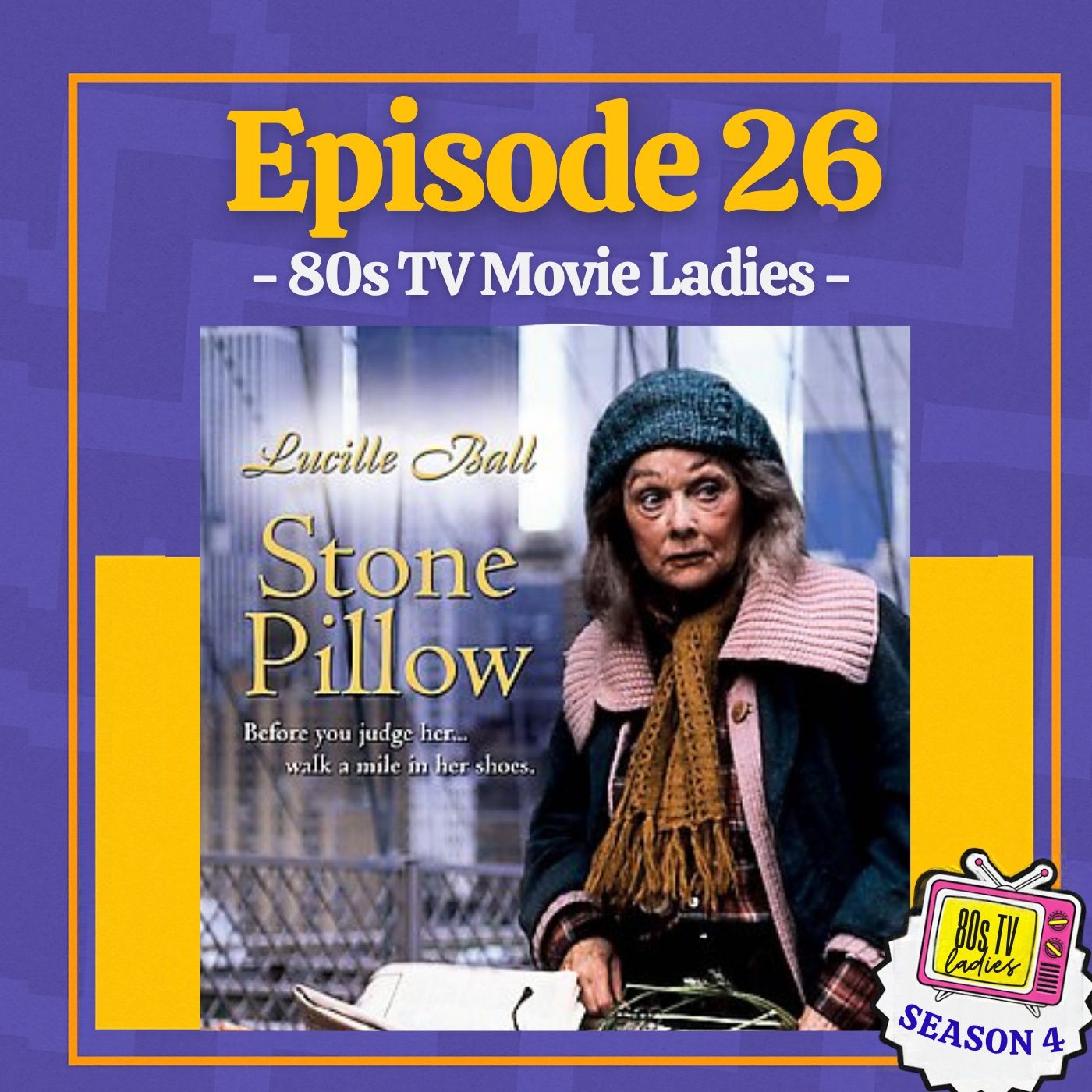
80s TV Movie Ladies | 1985: Lucille Ball, Daphne Zuniga in Stone Pillow
About this episode
“I was so impressed with her performance. She’s almost unrecognizable.” – Susan Lambert Hatem, on Lucille Ball
The 80s TV Ladies launch a brand-new series looking back at 1980s television movies with Stone Pillow(1985), the CBS drama in which 74-year-old Lucille Ball plays a woman living on the streets of New York City, opposite a young Daphne Zuniga. Spoilers ahead!
Welcome to 80s TV Ladies, where we look back in order to leap forward, and where we work together to make a better tomorrow! Today, hosts Sharon Johnson and Susan Lambert Hatem (with producer Melissa Roth) kick off a new series on 80s TV movies with one of the most surprising projects of an 80s TV lady’s career. On November 5, 1985, the one and only Lucille Ball starred in Stone Pillow as Florabelle, an older woman living on the streets of Manhattan with a shopping cart that holds everything she owns. Daphne Zuniga plays Carrie Lang, an idealistic young social worker who goes out to learn what life is really like for people without homes.
The ladies cover the movie, the stars, the people behind the camera, how it was received, and what happened to Lucy right after it aired. Plus, Susan climbs up on her soapbox about why getting an ID is so hard, and why it matters.
THE CONVERSATION
- Lucy Like You’ve Never Seen Her: Lucille Ball was born in 1911, co-invented the modern sitcom with Desi Arnaz, and became the first woman to head a Hollywood studio. Her company Desilu even gave us Star Trekand Mission Impossible. After no series since Here’s Lucy ended in 1974, she pitched this movie to CBS after seeing a shopping bag lady in New York, and named the character after her grandmother.
- Daphne Zuniga’s Big Year: In 1985 she starred in Stone Pillow, Vision Quest with Matthew Modine, and The Sure Thing with John Cusack, before Spaceballs, Melrose Place, and One Tree Hill. The ladies agree Lucy gets the heft of the story, while Carrie’s character is a little underwritten.
- The People Behind the Camera: Director George Schaefer, the Tony winner and Hallmark Hall of Famelegend with five Emmys and a record number of Directors Guild nominations. Writer Rose Leiman Goldemberg, a former TV Guide staffer who became a “queen of TV movies,” wrote The Burning Bed the year before and died in 2025 at age 97. And Oscar-winning cinematographer Walter Lassally, who shot Zorba the Greek and Tom Jones.
- How It Was Received: A ratings hit that landed in the week’s top 10 with a 33 share, even though critics were mixed. The New York Times called it a carefully contrived tearjerker but praised Lucy for being in total control of the role. Fans love it today, with an 88% audience score on Rotten Tomatoes. Lucy followed it with the short-lived sitcom Life with Lucy in 1986.
- Homelessness, Shelters & the System: In the 80s, awareness was growing as the social safety net frayed. The ladies discuss the shelter scenes, Flora’s trip to a brutal Brooklyn shelter, a social worker sent out on her own, and why losing an address can mean losing access to services, to travel, and even to the vote.
- A New Series & Your Suggestions: Female-driven stories were a big part of 80s TV movies, and the ladies are excited to look at more of them, including The Burning Bed. Plus, help us pick a fun title for the series, and tell us which TV movies we should cover!
- NEXT EPISODE TEASERDon’t miss our next episode, when the ladies are back with another fabulous look at the shows and stars that made 80s TV great! Subscribe now so you don’t miss it.
- Stone Pillow (1985): Watch on YouTube (there are a few different versions), or find the 2005 Koch Vision DVD on eBay. See the Apple TV listing and the Wikipedia page.
- The New York Times Review: Read John J. O’Connor’s “Lucille Ball Plays A Bag Lady On CBS” (November 5, 1985).
- Rose Leiman Goldemberg: Learn more about the writer on her website https://www.roseleimangoldemberg.com/ and read her obituary in The Boston Globe.
- The Burning Bed (1984): Rose’s groundbreaking movie with Farrah Fawcett isn’t streaming right now, but there are clips on YouTube.
- Help Americans get life-saving and life changing IDs through ProjectID.org and SpreadTheVote.org
- Vote.org: Voting really does matter! Make sure you check your voter registration regularly and your state’s ID rules. Find out more at Vote.org.
- DemocracyDocket.com: Learn more about protecting our right to vote at DemocracyDocket.com.
🌟 COMMUNITY CONNECT
Share your memories of Lucille Ball’s dramatic turn! Did you watch Stone Pillow back in the day, or see it for the first time? Would you have recognized Lucy if you hadn’t known it was her? And which 70s and 80s TV movies should we cover next? Email us at 80sTVLadies@gmail.com.
Support us and get ad-free episodes on Patreon. Watch-throughs with our patrons are coming soon! Thank you to our Patreon supporters, who make this podcast possible every single week.
Discover more great shows on Weirding Way Media!
🌟🛍️ SPECIAL 8TL PROMOTIONS!
- COZY EARTH: Get 21% OFF awesome bamboo sheets and pajamas at CozyEarth.com using promo code: 80STVLADIES.
- TORRAIN BAGS: Get 15% OFF recycled bags perfect for travel and work at Torrain.org with promo code: 80sTVLadies.
- All Promo Deals: See all special offers at MyDeals.Page/19wy.
- 🎁 Promo Code: 80STVLADIES
Visit 80sTVLadies.com for more info.
Listen to 80s TV Ladies at YouTube. Subscribe and help us grow.
Don’t miss out. Sign up for the 80s TV Ladies mailing list!
Help us make more episodes and get ad-free episodes, video interviews, and exclusive content on PATREON.
Transcript
Automatically generated, so expect the odd misheard name.
Welcome to 80s TV Ladies, where we look back in order to leap forward. And where we work together to make a better tomorrow. Here are your hosts, Sharon Johnson and Susan Lambert-Haddam. Hello, I'm Susan. And I'm Sharon.
Today, we're starting a new series on 80s TV movies, and we have a really interesting one to kick us off. We are talking about one of the most surprising projects of an 80s TV lady's career. In November 1985, at the age of 74, the one and only Lucille Ball starred in a CBS television movie called Stone Pillow. It was about a homeless woman. So, Lucy as a bag lady in a serious drama.
Yep, that's right. And Bag Lady was the well-used moniker for a woman experiencing homelessness in the 1980s. I was surprised when I looked for interviews, everyone described it that way. And both Rich and I were like, ooh, Bag Lady, ooh. I totally didn't know this existed.
And it was so interesting to find that I was so excited for us to cover it as our first. Series of 80s TV ladies TV movies. I did remember it, that it existed, I should say. But I don't think I saw it. When I watched it, I didn't get any, you know, feeling like I'd seen this before.
So I agree. I think this is a great one to start us off with. Stone Pillow also starred a young Daphne Zuniga, who was directed by the legendary George Schaefer and written by Rose Lehman Goldenberg, who also wrote the groundbreaking television movie The Burning Bed. Today, we'll talk about the movie, the stars, the people behind the camera, and how it was received. And we'll tell you what happened to Lucy right after it aired.
It's a little twist. Quick warning, we'll be talking about the whole story. So if you want to watch Stone Pillow without spoilers, go watch it first and then come back and give us a listen. In a nutshell, Stone Pillow premiered on CBS Tuesday, November 5th, 1985. It's about one hour, 40 minutes, plus commercials.
And it was shot in New York City. The plot is this. Carrie Lang... played by Daphne Zuniga, is a young idealistic social worker who's just starting out working in a homeless shelter. She wants to make a difference, but she doesn't really know what life is like for the homeless in New York City. Her boss and other people tell her to go learn more about people on the street.
So she does. And then she meets. Flora Bell, played by Lucille Ball. Flora is an older woman living on the streets of Manhattan with a shopping cart that holds all her possessions. She doesn't want the company or the help or to be separated from her cart.
But Carrie wins Flora's trust after saving her cart and Carrie's purse is stolen, and Flora assumes Carrie is a runaway. See how he looked at you? All men think women on the streets is tramps. You gotta know how to protect yourself. First of all, you gotta make them think you're crazy.
Bam! And you gotta kick them anywhere, everywhere. And you gotta bite them, scratch their eyes out. Remember, you're fighting for your life. Let them all think you're crazy.
Then everybody will leave you alone. Right? You see, kid, you're in a jungle. It's like a bad dream, but you don't wake up. Do they think you're crazy, Flora?
What? Do they think you're crazy? I hope so. But I'm not crazy. I'm smart.
I'm still here, and I know how to protect myself. So she begins to show her the best places to find food, the warmest places to sleep, and she starts to share some of her personal story and some of her painful memories. They spend the night at Grand Central Terminal. Carrie becomes sick from eating out of the trash, and Flora goes to get her medicine. While she's gone, the police come to clear everyone out of the basement hiding space, and they are separated.
Flora goes looking for Carrie at the shelter and is stunned to find her. But she's an employee, not a resident. So Flora feels betrayed and refuses to talk to her. Carrie gets in trouble and goes to talk with her boss. And while that's happening, Flora is accidentally shuttled off with other women experiencing homelessness to a very brutal and very mean women's shelter in Brooklyn. where she is treated poorly and ultimately kicked out.
She has to find her way back to Manhattan, and she's without money, none of her belongings, and Brooklyn in particular looks scarier than Manhattan. Carrie first gets in trouble for having gone out to do what she was tasked to do, and then when she finds out that Flora was sort of shuttled away without her cart, and she's trying to help her, Nobody seems to want to help her do that, and the systems are not interested in helping one particular person, but she still wants to find Flora and really help her. At the end, Flora accepts Carrie's helping hand, and she finally gets a little place to call home. Yeah. We're going to talk a little bit more about the story in a minute, but I thought it was super interesting that the first real line was Lucille Ball's.
It's when Flora, who's been sleeping on a heating grate on the street, covered in garbage bags and she kind of pokes out of her bag and gets up and she's like, well, I'm still here. I thought that was very interesting. In some ways, kind of very Lucille Ball. Very Lucille Ball, but an unrecognizable Lucille Ball. Exactly.
Lucille Ball was born August 6th, 1911 in Celeron, New York. She starred in I Love Lucy, of course, which ran on CBS from 1951 to 1957. She was a movie star before she became a TV star. She is also credited with developing the idea of filming a television series with three cameras on a set in front of a live audience. She and Desi Arnaz invented the sitcom.
And she was an Emmy Award-winning pioneer in front of and behind the scenes. After her divorce from Desi Arnaz, she bought his half of Desilu Studios and became the first woman to head a Hollywood studio. And of course, her production company, in addition to Lucille Ball shows, brought us Star Trek, and Mission Impossible shows. That's so incredible that there would be no Star Trek without Lucille Ball. It's my favorite thing to think about.
Mine too. So why Stone Pillow? By 1985, she had not had a series on TV since her sitcom Here's Lucy ended in 1974, and her last appearance on TV, according to IMDb, was 1979. So apparently Lucy said she wanted to go back to work because she likes to work. I'm curious about what happened in the sort of five years between that.
But she told one interviewer that she had no idea what she wanted to do until she saw a shopping bag lady in New York. And so she suggested a film to CBS about one of those women. She also told a reporter that CBS said George Schaefer wanted to work with her. And that, plus the subject, is what got her to do it. In order to research the role, she read books and she named the character Flora Bell after her grandmother.
The movie was a hit. ABC gave her another shot at a sitcom, ultimately that was called Life with Lucy, in 1986 with Gail Gordon, about three generations under one roof. Jenny Lewis, who later became an indie rock star, played the granddaughter. The critics hated Life with Lucy. They also didn't really love the TV movie.
It lost out to Facts of Life. and was canceled in its first season. But Stone Pillow was a success, and it was just very interesting because it was a straight drama. Lucy died in April 1989 at the age of 77. The woman playing Carrie Lang was Daphne Zuniga. She was born October 28, 1962, in Berkeley, California.
She moved to Vermont when she was a teenager and then returned to California to study theater at UCLA. She made her film debut in 19 in the horror film The Dorm That Dripped Blood. Then came The Initiation in 1984. And then she had a very big year. In 1985, she starred in Stone Pillow and then Vision Quest opposite Matthew Modine and The Sure Thing directed by Rob Reiner opposite John Cusack.
And that's the film that I remember making her a star. Like that's the film where it was like, oh my gosh, this woman. She went on to Modern Girls in 1986, then Spaceballs in 1987 as Princess Vespa. And of course, she was Jo Reynolds in Melrose Place from 1992 to 1996. She was also on One Tree Hill and has been an active environmentalist for many years.
And it was really interesting to see her in this role. The supporting cast included William Converse Roberts as Max. Stephen Lang as Tim. Susan Batson as Ruby. Anna Marie Horsford as Collins, Stefan Schnabel as Mr.
Berman, and Rebecca Schull as Mrs. Nelson. So Sharon, what'd you think? As I said, I had heard about the TV movie around the time that it aired, but didn't have an opportunity to watch it. I don't remember reading anything specific about it, but the sense I got was that it was well-received by critics.
So I was a little surprised in looking at some reviews and preparing for this to see that it wasn't as positively received, perhaps, as I had remembered it to be. But overall, I thought it did some things really well, if for no other reason than to humanize people in general who are living on the streets. I think it mostly did a good job of that. Yeah, it's so interesting. You know, we have an ongoing problem with homelessness in our country. that has exacerbated since the 80s.
But I think in the 80s, people were starting to become aware of it because I think it was increasing because our social net was beginning to fray or be frayed. But you hear Lucille Ball playing a homeless woman in a 1985 drama, and you're kind of thinking, how can that work a little bit based on what we know of Lucille Ball? And I was so impressed with her performance. She's almost unrecognizable. If you didn't know it was her, You might recognize her from her voice, but she's really giving a really incredible performance in this movie and really carries the piece.
It's also beautifully shot. Now, I watched it on YouTube, and I'm sure it was not the best version and a little bit darker than it needed to be, but it was also that time when we had light and dark scenes. in movies and even on television movies. And you wouldn't light everything. It was just, I thought it really captured a very interesting time in television movies and in New York. And I thought that her performance is the reason to watch it.
It's kind of heartbreaking and sad, but also very interesting because she's clearly taking care of herself. Daphne Zuniga's performance is lovely, but a little less interesting. And I found her character and her character motivations to be questionable. Like they were, you know, it wasn't the best written part of the TV movie. That's exactly what I was going to say.
Her part was really kind of underwritten. I think that as well they should, they gave most of the heft to Lucy's character. To Flora. You know, the opening sequence where, as you said, she gets up in the morning and she starts her day and you get to see what she does to survive living out on the street. She has to be very resourceful.
I don't want to say charming, but engaging to a certain extent with the people that she meets and the people that are around her. While at the same time, she manages to maintain her strength and her, dare I call it, crankiness as she's dealing with some of these folks. But still, you really get a sense of who Flora is in this moment in a way that you really don't get as well with Daphne. But it's Flora's story. It's really not necessarily about Daphne.
Oh, Carrie. Carrie, yes. Sorry. But again, there isn't much character there. It's 1985, so it's not necessarily exactly the era that I know of, but Coming out of film school, one of the jobs I had while I was trying to write was I worked at a youth shelter for runaway youth called Children of the Night, which specializes in victims that had been sexually abused or were sex workers.
And so I got trained to do hotline and I got trained to find shelters for people. We had a hotline that was a national hotline that helped anybody to find shelter, find food. And then also help people get out of dangerous situations and into shelters and out of sex trafficking if that was happening. So we had a lot of training to do that. And I was a little bit annoyed with the shelters and how they were portrayed in this 1985 movie.
This would have been a little bit later, but not that much later that I was, I mean, well, I think I was doing that in the mid-90s. But there were problems with shelters initially. But the way they portrayed the shelters and the shelter workers were unlike what I had experienced in working with Children of the Night. So I was a little bit frustrated by that story part of it. Though, again, I don't know New York and I didn't know New York in 1985.
But it was also that Carrie did not have much of a character, except I'm being told to go into the streets and learn about homeless people so that I can know how to service them. and go by myself, which is probably the worst. Like that's literally the advice she's getting. That's how they're like, you should go out there and talk to people, which you should, but you should go with an experienced person. Yeah. I just, maybe it's just that they were, were making it a, a part of her, her character in that.
I mean, the line from her boss who said that seemed to be really more of a throwaway line, not a walk out the door line, and go and find some unhoused people. And latch onto them and become unhoused with them for a night. Yeah, but that's okay. They needed somebody who was going to be the eyes and ears of the audience who has no idea about what this is and how to survive in this kind of circumstance. But yeah, they could have done.
A little bit better. It was sort of the least elegant part of the movie. I think that As we start to look at 80s TV movies, we'll see a lot of that, that certain aspects are going to be really well portrayed. And then kind of everything else around the one aspect they're really looking at may be a little questionable in terms of both story, but in terms of, I feel... Characterization.
Characterization, yes. And I found their performance together really lovely. Yes. That was a highlight. I felt like it really, it was a very scary New York and also interesting New York.
And they made Brooklyn look like a bomb zone. I'm like, was it really that bad? Or what are we saying about Brooklyn exactly? Okay, Melissa's nodding. So that was very interesting.
But the performance of Lucille Ball was spectacular and well worth watching. I was really impressed by her. And by the time they took with the character, and how they sort of laid out her story. It's a little bit questionable how she got from, I mean, I guess she took the subway back to her place, her grate. It's a happy ending, even though they gloss over the fact that there's another woman who has died on the grate at the end of the movie.
Spoiler alert, which I guess I'm supposed to say beforehand, but we already said it at the end of the show. But it was interesting to look at. It was interesting that this was a very female-centered, which was a lot of the 80s television movies. Female-centered and female-issue oriented. And really seem to kind of deal with the issues that the women have who are living on the streets like this, very specifically about the issues that women have.
Obviously, there are families and men that each have some of their own specific kinds of issues they're dealing with, but this one really did center on the women. Yes. We want to make sure when we're recommending products that it's something we like. And that's exactly what Cozy Earth is all about. They've been on Oprah's favorite things list for years.
80s TV ladies can offer you the best discount of 21% off the ultimate in luxury sleep. We're talking buttery soft bamboo sheets plus amazing pajamas. Go to 80s TV ladies. My deals link in show notes to see all of our fabulous deals. Use promo code 80s TV ladies.
That's eight zero S TV L A D I E S. So I was curious about George Schaefer, the director-producer. He's from Connecticut and studied directing at Yale School of Drama, which is a way a lot of television directors came up, and some of the ones we've talked to. It was interesting that he was in the Army in World War II, which I think a lot of, obviously a lot of men of that generation were, and did some theater work while he was in the Army, and then obviously made his way to Hollywood. First to Broadway.
He won a Tony Award in 1953 for The Tea House of the August Moon, but television is where he kind of landed. And it's where he's best known because during the golden age of television, he directed live adaptations of Broadway plays for Hallmark, Hall of Fame, plus his TV work earned five Emmy wins out of 21 nominations and four Directors Guild Awards out of 17 nominations. That's really, that's, that's really pretty amazing. And he holds a record for the most DGA award nominations. That's pretty impressive.
I was very, again, I thought this was a very well-directed piece and well shot. He directed TV movies until his death on September 10th, 1997 at the age of 76. And as was mentioned earlier, the writer of this screenplay, Rose Lehman Goldenberg, she was born Rose Marion Lehman May 17th. 1928 on Staten Island, New York. She started writing stories about the age of five and entered Brooklyn College at the age of 16, which is kind of remarkable for that time and that time and place, I would imagine.
And she just died. in 2025. Because I was like, can we get her on the show? That's always our first question, you know, when we find out about these ladies, because we want to talk to them. And we know that you, our listeners, are also interested in hearing their stories. So, She started her career at TV Guide, which I thought was really interesting since we had a whole TV Guide episode.
And she was a playwright. But TV movies is where she really became. She became kind of a queen of TV movies from what I can tell. Mother and Daughter, The Loving War, Born Beautiful in 1982, Florence Nightingale, 1985, starring Jacqueline Smith. A lot of really women-driven television movies.
But she is best known for writing The Burning Bed. that aired on NBC in October of 1984. It starred Farrah Fawcett as an abused wife who killed her husband, and she wrote the script. By she, of course, I'm talking about Rose, not Farrah. Not that Farrah's not talented, but Rose is the one that wrote the script. It brought a taboo subject about domestic violence into the national conversation.
It won the Writers Guild Award for Best Dramatic Adaptation and earned Emmy nominations. And a year later, she wrote Stone Pillow. And Stone Pillow, she received a Humanitas Prize nomination. You know, what's interesting is Burning Bed was one of the first ones I thought we'd look at, like when we decided, hey, maybe we should do TV movies. And so Burning Bed was obviously like one of the first ones that comes to mind.
But it's a little intense. Yes, it is. And I didn't really want to start with it. I kind of feel like maybe that'll be one we cover after, you know, tiptoeing in first. Burning Bed was based on a true story.
It'll be really interesting to look at that movie. And clearly, she was a pretty amazing writer. She died in her home in Cape May, New Jersey in 2025 at the age of 97. Speaking of Burning Bed, though, just really quickly, it's not available, unfortunately, for streaming right now, but there are some excerpts, some clips that I found on YouTube. And Boy, oh boy, it's pretty harrowing.
Looking forward isn't quite the right word, but I didn't see it when it aired, so I am anxious to see it and interested in seeing it. And we will hopefully have a chance to talk to everybody about it at a later date. And that's another reason we didn't start with it is because it was not available for streaming. And I want to ease us into the most harrowing of the 80s television movies because it was, again, an interesting part of 80s television. That we sort of haven't really talked a lot about was the 70s and 80s television movie.
We've talked a little bit about the miniseries, and that might be something we cover at some point, some of the miniseries. But the interesting thing about the television movie was it really did become a vehicle for female-driven stories. That's one of the reasons I think it'll be really interesting to cover that. I do want to talk about the cinematographer, Walter Lassaly. Is that how we pronounce it?
Lassaly. Lassaly. He's an Academy Award winning cinematographer for Zorba the Greek and shot so many incredible movies. The Loneliness of the Long Distance Runner, Tom Jones. So many movies.
Taste of Honey. And very interesting. You know, by the time he's doing these movies, he's very older. He's very older. Oh, oh, that was the one.
He did The Ballad of the Sad Cafe. I've not heard of that. It's an indie movie from the early 90s. But all of these movies have a very interesting look. Tom Jones looks very, very different from the loneliness of the long-distance runner.
So he's pretty interesting. He's German, but lived in Greece. There is an interview with him that I found where he's... Sounds kind of annoyed with Lucifer. Maybe just the one clip, but I found it very interesting that how kind of sparsely it was shot.
And I thought it was very effective. Again, I'd be very curious to see a really true version of it. I'm going to see if there's a DVD somewhere because I would be very curious to see a really good version of it. Melissa, I think you'd be intrigued, too. Indeed.
Always good to see what it really looked like. Let's not forget with Lucy that they not only invented the three camera sitcom, but they did it on film. And that's why we get to see it still today so well. Yes, because the old style video did not survive as well as the negative. So that's why we get to watch all of them.
That is a good point. That is an excellent point. Yeah. Even though critically it isn't super well-received. Stone Pillow, it was a hit.
It was a hit and got a 33 share and was in the top 10 of programs for the week. And I think it did very well. But as you said, the reviews were a little bit mixed. Nevertheless, John O'Connor, who was a TV critic at the New York Times, called it a carefully contrived tearjerker that was earnest and sometimes too cute. but said it works reasonably well on that level. He also praised Lucy for being in total control of the role, starting with that very first scene.
I probably liked it more than he did, but that's okay, because I do agree with some of his praise for it and agree to a certain extent with some of his criticism as well. But I still think it's quite remarkable. I think it is well worth looking at, mostly for her performance, also for the way it was shot, also for the fact that it was an early film examination of a subject that was going to become increasingly important and still is today is an issue we have not solved because apparently we want to protect rich people more than poor people. And we don't want anyone to have a place to sleep at night. I found the scenes of them sending her off to the other shelter where she did not want to go and getting sort of caught in the Very excruciating.
And you're like, Carrie, get over there now. Hop on that subway. Go find that shelter. Go get Lucy. I think it did give a face to a very challenging subject, even in the 80s.
And it would take someone with Lucy's reputation and notoriety and talent. To get people to watch it. Yeah, I think to get it made. you know, her going, this is what I want to do, made that movie happen. And fans love it today. It has an 88% audience score on Rotten Tomatoes.
And I think a lot of people that watch it now think it's an underrated piece just for itself, but also for Lucille Ball's performance. You know, it's pretty startling that we're still dealing with the same issues. Mm-hmm. Well, because we, you know, most problems are solvable. This one is complicated don't get me wrong but that doesn't mean it's not solvable but we as a country have chosen not to try to solve it it's just really that simple about this and and many other subjects we just have not if we chose to that to to say we're going to solve this i think we could again not saying it'll be easy but it is doable it is.
Absolutely doable you know and it really did highlight the fact that you know she had a family and you know literally lost her family I wasn't always this. What were you, Flora? Tell me. I, uh. I had a husband once, and....
Sonny. Couldn't have no more kids, but that didn't matter. He was so cute. Used to call me Mommy. He loved to watch me plant things in the garden.
Oh. dirt smelled so sweet and Sonny smelled so sweet. What happened? Well, Sonny, Sonny got awful sick and I was worried. Then I got sick and they, they, they took me off to a hospital and all of them Expenses, you know, the doctors and hospitals. My husband couldn't take it, I guess.
When I finally came home, they was gone. They just left? Never came back. I worked for a while. I looked and I looked for them.
I worked in a war plant and I cleaned houses. I kept looking, but I I never found them. Like she got sick and went to the hospital and came back and they were gone. And then once you lose a place to live and an address, you lose a lot of social services and a lot of access to being a person in the United States of America. And that still goes on today.
Getting an ID is very hard. It's not easy. It's expensive. Getting one now, oh my lord, have you gotten your real ID in California? I do.
I got mine during the first wave of them saying, you need to get this. And I took it seriously, I guess, and made sure I got it because I could. I could get it done. But that doesn't mean that everybody has the same ability to do it. Everybody's got things going on.
Everybody's got, you know, everybody's got something that they're trying to handle. And the real idea, especially if it's not something that's up here, it's maybe way down here in terms of priorities, you know. And here's the joke. So Dash, our son, our youngest, you know, recently, you know, not that long ago, started driving, got his driver's license. I, you know, went with him through the process, which is not an incredibly easy process.
Going to the DVD, DVD, going to the DVD several times. Going to the DMV several times and it's crowded and you have to make an appointment and then you still have to stand in line for a long time. Then you have to bring paperwork. And then they want a 16-year-old to have two pieces of mail with their address on it. What?
Just to get an ID. Two pieces of U.S. mail with their address on it to a 16-year-old. That's insane. Yeah. I had to open a bank account so that I could get the bank to send him two pieces of mail.
Because most 16-year-olds don't have any mail coming to them. Especially not these days. Not these days. That was insane to me. That was just a couple of years ago.
We went through the process. I knew real ID was a thing. So we signed up to get his ID as a real ID. and paid extra for it. It costs more to get a real ID, which is required for you to have. And it costs more money than the non-real ID.
Why they're even offering a non-real ID in a time when they're like requiring real ID is insane. It's another level of like, why would you even offer me the ID that isn't going to work anymore? If I go to get a new ID, Why not just make it the only ID I can get? Because here's what happened. We paid extra for real ID.
We went through the whole process. We got his driver's license and the thing. And, you know, he's been driving for, and now I'm like, oh, you need to go do this thing and do whatever. And he goes down and they're like, oh, I have to get a real ID. I said, well, you have a real ID.
And it turns out he does not. Paid for a real ID. We did the whole thing. He got an ID and it's a regular ID. And now I have to go back through the process with him or he has to go back through the process.
I will be helping him despite the fact that he is now technically an adult because it's so hard and complicated. We've just moved. So now we have to go also change it anyway. But it's infuriating. I feel like I'm a fairly competent human being.
I walked my son through this and somewhere in the process, they sent him A non-real ID, even though I paid for it, it was three years ago because we didn't notice right away because he didn't know what a real ID looked like or not look like. Well, and why should you be looking at it to make sure it's right? You expect them to do what they said they were going to do, heaven help us all. Oh my gosh. And we feel fairly functional and fairly privileged and we have enough to fight the fight of getting a real ID.
But many, many, many, many people don't. And that is insane. He also has a passport that we made sure he had so he can still fly on an airplane. But it is something. And so, you know what?
I'm going to add to the audiography today. It's an organization, a nonprofit, that helps get people IDs. And that enables them to live their life, get social services done. You know, be in the world when they go, give us your real ID, travel, but also vote. Because many places, even though they shouldn't have to, require sometimes ID to vote.
Right. So I'll add a link to our audiography to Project ID and Spread the Vote. Great organizations to support for this very thing. Anyway, about that soapbox, I'll get off it now. But thank God.
That Flora Bell didn't have to come up with a real ID to get any services. She was a person. That should be identification enough. Exactly. That's the beginning and the end.
You're a person, so sure, we'll help you. All right. Anyway, getting back to the movie. Back to the movie. Happy to say, as you said, fans love it.
So during that time in the 1980s, they were also doing a lot of TV movies and some miniseries about... social issues like this. I mean, as you mentioned, The Burning Bed, that was another one. And there were a lot of them. So hopefully we'll get a chance to see more of them and discuss them here on the podcast for our listeners. All right.
So listeners, let us know what television movies from the 70s and 80s we should be talking about and covering on 80s TV Ladies, because we will start that series up and it's going to be really fun. We'll just sort of pop them in when we have a break in between seasons. or a break-in between covering a particular show, and we're going to have to come up with a cool, fun title for it. It's going to be super awesome. And I'm excited to watch some of these television movies from the 80s, because I really enjoyed Stone Pillow and Lucille Ball's performance. I thought it was a real gift.
Absolutely. Absolutely. Between horseback riding and grinding it out Monday through. Friday, I really need some good gloves. If you are tired of stiff, uncomfortable gloves, you need Bare Knuckles.
That's B-E-A-R, Knuckles. Their patented leather gloves are pre-curved for ultimate comfort. They fit your hand perfectly, reducing fatigue. They have super awesome strong and flexible gloves for all heavy-duty occasions, gardening, outdoor work, and even welding. My kids love their welding gloves.
Stop wearing out your hands. Use our exclusive code 80sTVLADIES. Get 15% off any product at buybareknuckles.com. The link is in our description. For our audiography today, you can find Stone Pillow on DVD from Koch Vision and on eBay.
It was released in 2005. It is currently streaming on YouTube. There's actually a couple different versions. And several sources, links will be in our description. And if you want to learn more about Rose Lehman-Goldenberg, check out The Burning Bed with Farrah Fawcett.
And she has a website, roselehmangoldenberg.com. It's still up. And so you can go read about her on her own website. I'm really excited about that. We would love to hear your memories of watching Lucille Ball's dramatic turn on Stone Pillow.
If you remember the TV movie from back in the day, if you rewatched it, let us know what you think. And also, let us know if you think you would have recognized Lucille Ball in that role if you didn't know it was Lucille Ball. Find Project ID at projectid.org and its sister organization, Spread the Vote, at spreadthevote.org. They do life-changing and life-saving work. Listeners, your support means the world to us.
Advertising pays very little, so to help us pay for this show and make more episodes, please consider supporting us at patreon.com slash 80sTVLadies. You can also support the show by following us and rating us on Apple Podcasts and Spotify and where you find your podcasts, or just talking us up to your 80s-loving friends. Send us a message at 80sTVLadies. com or you can email us at 80sTVLadies at gmail.com. And send those TV movies that we need to listen to. I mean, listen to.
That we need to watch. We'll just play them. And for Patreon, we want to start doing some watch-throughs with our patrons. So, we will be announcing that coming soon. It'll be a lot of fun.
As always, we hope 80s TV Ladies brings you joy and laughter and lots of fabulous new and old shows to watch, all of which will lead us forward toward being amazing ladies of the 21st century. Thank you, Lucy. Ladies, ladies, ladies.


Similar episodes across the network
Matched by shared keywords.
-
Special Report: Shari & Lamb Chop (2025)
1 shared keyword: women in tv
-
Columbo Explains the Seventies
1 shared keyword: classic tv
-
Episode 55: Old Love + Altercation + Bones
1 shared keyword: classic tv