
Season 3 · Episode 11
Carol Burnett, Vicki Lawrence and all about ‘The Family’
About this episode
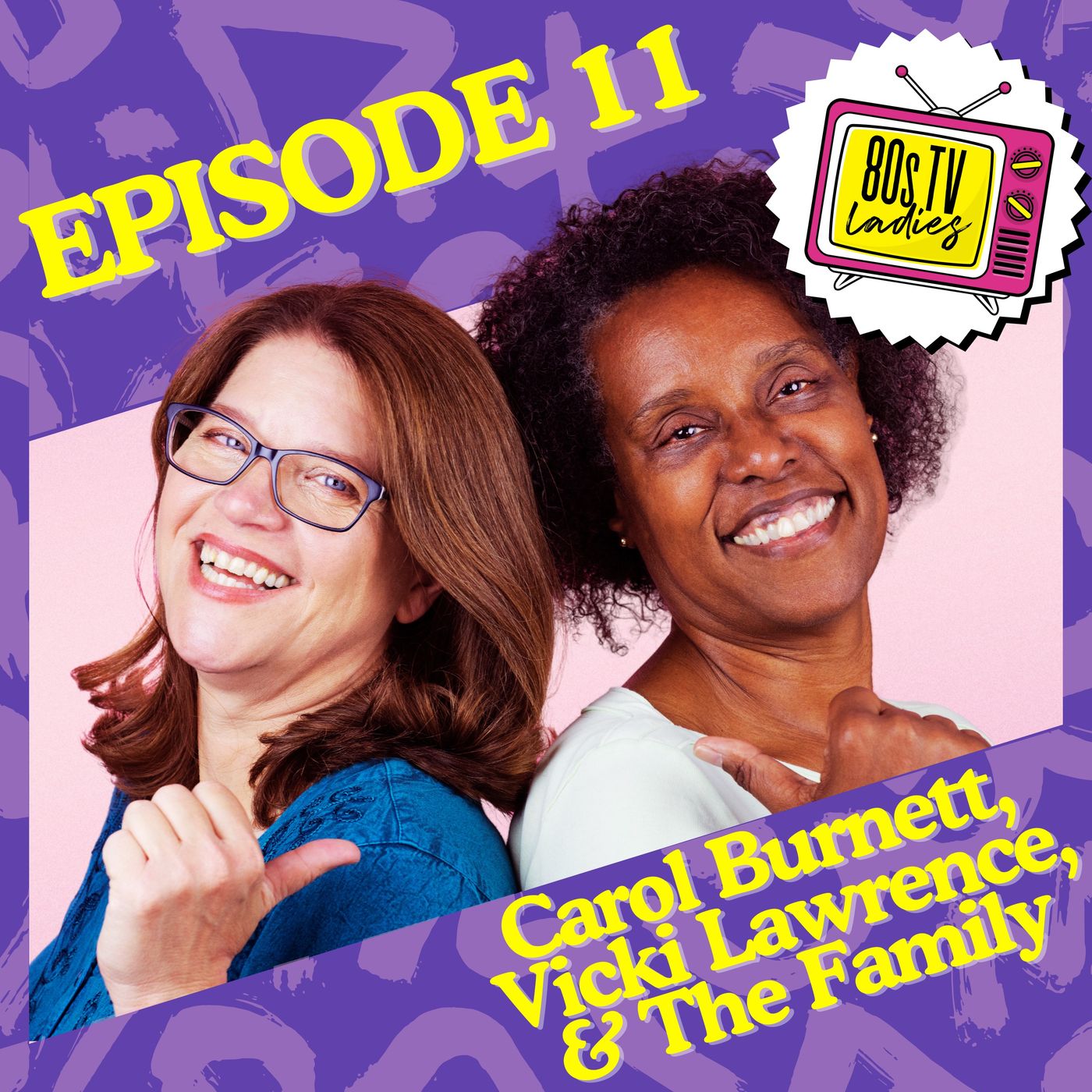
In “The Family”, Carol Burnett played the melodramatic, ambitious, brow-beaten daughter of ‘Mama’. Mama, played by Vicki Lawrence, is an exaggeratedly mean-spirited and insult-spitting widow and mother of five children: three sons played by guest stars Roddy McDowell, Alan Alda and Tom Smothers -- and two daughters: Eunice & Ellen (played by Betty White). Eunice’s husband Ed Higgins was played by Harvey Korman.
How did one simple sketch take on such a huge life of its own, creating a sprawling TV empire that some are calling “The Mama-Verse”? Susan and Sharon put on their housecoats and curly gray wigs to find out!
THE CONVERSATION
- Carol Burnett’s career started with a Broadway role starring as the lead in Once Upon a Mattress and then as a rising star on The Garry Moore Show.
- The Carol Burnett Show was hugely successful, running eleven seasons, garnering 70 Emmy nominations and winning 25.
- Carol Burnett was encouraged to “speak up for herself” by another TV comedy legend -- Lucille Ball.
- A fan letter from then 18 year-old Vicki Lawrence to Carol Burnett led to her actually being cast as a regular on the show!
- “HARVARD SCHOOL OF COMEDY”: Lawrence cites Harvey Korman and Carol Burnett as her show business mentors during the 11 years she spent on the show.
- ONE-HIT WONDER: Five years into her run on The Carol Burnett Show, Lawrence had a hit song, recording “The Night the Lights Went Out in Georgia”!
- In the TV movie Eunice, Mama suddenly only has three children instead of five -- what happened to the others? And why is one of them suddenly Ken Berry?
- Vicki Lawrence was nominated for an Emmy for her portrayal of ‘Mama’ in Eunice.
- The TV series Mama’s Family was aired first as a prime-time network comedy and later as a nationally syndicated series. It originally ran for two years on CBS, was cancelled in 1984 -- and then revived TWO YEARS LATER in 1986 by Lorimar Syndication to run for additional 100 episodes!
- NAME SWITCH: The character Ken Berry played started out as “Phillip” in the TV-movie but then became “Vinton” in the TV series.
- The TV show introduced “Fran” played by future Golden Girl, Rue McClanahan -- playing Betty White’s aunt!
- The TV show also introduced Vinton’s children Buzz and Sonya played by “80’s TV Ladies” alum, Eric Brown and actress Karin Argoud.
- Mama’s neighbor, Naomi Oates, was played by “Another World” “The Nanny” and now “80s TV Ladies” alum, Dorothy Lyman!
AUDIO-OGRAPHY
Watch The Carol Burnett Show and Mama’s Family across many platforms. Not all of them feature all seasons.
The Carol Burnett Show can be seen for free on Pluto TV.
Mama’s Family can be seen for free on Pluto TV.
The Carol Burnett Show “The Family” select episodes:
S7, EP23 - Aired 3/16/1974 - Jackson Five and Roddy McDowall.
The first of “The Family” sketches. “The Reunion - Eunice's brother Phil (Roddy McDowall), a Nobel and Pulitzer prize winning author, returns home for a visit. On YouTube.
S8, EP13 - Aired 12/21/1974 - Alan Alda“Home for the Holidays”
Christmas sketch with Alan Alda on YouTube.
VITAL READING
Get Handbook for A Post-Roe America by Robin Marty at Bookshop.org.
Check out Men In Dark Times by Hannah Ahrendt at Bookshop.org.
Read Democracy Awakening by Heather Cox Richardson at Bookshop.org.
You can also follow Heather’s substack.
SHOP
LAST WEEK FOR THE “80’s TV LADIES” HOLIDAY SALE!
15% off on all merch at the 8TL Shop.
Make sure to use promo code “Festive80s”!
CONNECT
Visit 80sTVLadies.com for transcripts and more.
Sign up for the 80s TV Ladies mailing list.
Support us and get ad-free episodes on PATREON.
In Honor of President Carter and to learn more about his presidency: Get Susan’s new play about him and his Crisis of Confidence speech: Confidence (and the Speech) at Broadway Licensing.
Visit 80sTVLadies.com for more info.
Listen to 80s TV Ladies at YouTube. Subscribe and help us grow.
Don’t miss out. Sign up for the 80s TV Ladies mailing list!
Help us make more episodes and get ad-free episodes, video interviews, and exclusive content on PATREON.
Transcript
Automatically generated, so expect the odd misheard name.
Weirdy Weird Media. Eightyn So Pretty through the City, Getting the money Man World eight. Welcome to eighties TV Ladies in the Year of Our Lady twenty twenty five. We are wishing you all a very happy new year. And here are your hosts, Sharon Johnson and Susan Lambert had them.
Hello. I'm Susan and I'm Sharon. How are your holidays, Sharon? Are we still standing? I don't know about that last one.
We'll see. But my holidays were great. It's always wonderfully had a chance to spend some time with my family. I'm happy to say that I happen to think that I have the three best siblings in the world, and I love spending time with them. And no matter how much time we do or don't get to spend with each other where we're tight and I'd like to think will always be that way.
So my holidays were great. That's so great. That's my favorite thing too. I mean, I am so grateful I get to see my family and we get to spend time with Richard's family. We see my family on Thanksgiving and we go back and on Christmas we see Richard's family.
But I'm really really. Grateful for that and all the friends that come to the Christmas Eve party and we have a wonderful time. Always, thank you, Melissa. It's been fun, always fun, always fun, good food, good friends. Yeah, good stuff, Kevin, good holidays, he said.
So one of our mottos on this show is to look back in order to leap forward and to hope we become amazingly the twenty first century. At the beginning of this new year, I think that's a good time to sort of do that, But it's hard still to know where we stand. Well. I can always wonder about the value of if you will, of this podcast. I think we're pretty clear about what we're trying to say with it.
It's and maybe it has evolved a little bit, but it's always been about celebrating the women in the eighties on television who made for some great TV that we still look back. On and admire. And I think that's what's kept us going over three seasons and over seventy episodes, and there's still so much for us to learn. There's still so many women for us to be able to shine a spotlight on that have not had, in my opinion, enough time in the sun. And had the opportunity to be celebrated in the way that they deserve.
So what little we can do to continue to do that, I think is for me anyway, what makes what we do important? And frankly, a lot of fun, super a lot of fun. And I'm constantly going back to the importance and power of women telling their stories and the importance of telling women's stories, and that it's not a voice that still is equal in our society, and i think part of the problems we have maybe because of that, because we're not hearing the stories of everybody. It's stunning when looking at some of these forty year old episodes or now forty five year old episodes, and we're still talking about the same issues today, from Designing Women to Remington Steel to even Mama's Family. It's been a treasure trove of very entertaining reminders that as much as things have changed, the pushback against change has not.
It's very true and sadly has been the pattern over the course of human existence, because for every advancement of human rights, there has been this push to keep it from going forward and even to push it back even further from where it was before. And when it comes to tor equality, equity representation, and the equal sharing of resources, justice and democracy across sex, orientation, religious beliefs, race. We have not achieved that we're further down the road than we have been before, but we. Still have far far to go. But it's a fight worth fighting, and a fight that we obviously have not gone as far down the road as perhaps a lot of us thought we had, so there's still work to do.
There's still work to do. My husband Rich and I have been revisiting Lou Grant, a spin off of the seventies ladies show The Mary Tyler Moore Show. Lou Grant ran from seventy seven to eighty two, and the last two episodes we just watched were from season three episode fourteen, Brushfire and the season three episode eighteen censored. Brushfire is literally the paper covers a massive fire outbreak in Malibu complicated by the Santa Ana Wins, And we literally watched it the night that Franklin fire tore through Malibu. Wow, and I was like, what is happening.
That's forty five years ago. These episodes ran January and February nineteen eighty, forty five years ago. Because censored was about the Tribune investigates a small town censoring books and attacking teachers and librarians for the stuff they're talking and teaching about and checking out to students and young people and their burning books. And it also happens to be at the time that the Tribune is refusing to run a controversial comics which accuses local politicians of being in bed with foreign interest. It just felt like, what is going on?
Wouldn't it be nice to have new problems instead of doing the old ones over and over again. Ripped from the headlines Lou Grant from nineteen eighty. It does feel very weird that sometimes we're still facing the same issues, but I'm glad we're still talking about them. So enough about Lou Grant. Let's get on to this show today.
We're going to talk about the Carol Burnett Show and how she helped create and then left Mama's Family, because without Carol Burnett there would be no Mama's Family. And we also want to talk about the very odd Mama's Family metaverse. You know, this came up, I think with the Eric Brown episode because I suddenly we were talking about how just very odd the Mama's Family conceit is that is Vicky Lawrence started in her twenties playing a fifty sixty year old Mama grandmother and it just gets weird from there. But also the weirdest parts of Mama Vision for me is how many iterations of Mama's family there actually are. This is a show that took characters and transported them into similar and yet different TV worlds, not unlike Luke Grant.
First there were the sketches known as the Family on the Carol Burnett on the Carol Burnett Show. Yes, so the Family sketches, you know again, we were seven seasons into the Carol Burnett Show. They did sketch after sketch and this was sort of a new what became a recurring sketch. The central character in these sketches were Eunice, played by Carol Burnett, the melodramatic, ambitious, browbeaten daughter of Mama played by Vicki Lawrence. Mama is an exaggeratedly mean spirited and insult spitting widow and mother of five children, three sons played by guest stars Roddy McDowell, Alan Alda and Tom Smothers, and two daughters.
Eunice, of course, and Ellen played by Betty White, and Eunice's husband, Ed Higgins was played by Harvey Korman. Very funny. The last sketch of the family appeared in a four episode summer mini series variety show Carol Burnett and Friends. This was a super popular sketch. Overall, there were thirty one sketches that appeared featuring the family.
Kind of every season of the last five seasons had at least one, usually more than one. In nineteen eighty two, based on the characters from the sketches, starring Carol Burnett, came the TV movie special Unice. In this Mama verse, Mama only has three Childrennice, Ellen, and Philip played by Ken Barry looks at four times in Eunice's life over her relationship with her husband and Mama was super highly rated, as probably most things Carol Burnett did were, and Vicky Lawrence was nominated for an Emmy for her portrayal of Mama. Then came The Mama's Family Series, So this was the series that we've been talking about. It ran from January second, nineteen eighty three to April seventh, nineteen eighty four.
It's set in the fictional and yet named after a town, Ray Town, that was where the writers were from and the creators were from, and widowed Mama is the main character. This is where it sort of shifts to be about Mama, and Eunice is a side character, and Mama in this version has three children, but a new son, Vinon played by Ken Barry Ellen played by Betty White, and of course Nice played by Carol Burnett. And then Mama's sister Fran played by Rue McClanahan lives with her, and then Vinton has moved in and with his two children, Buzz and Sonia, played respectively by Eric Brown and Karen Argood. And then we get to also meet in that first season Naomi Oates who is played by Dorothy Lyman, who we spoke to, And so they do two seasons with this iteration, and then it is canceled in nineteen eighty four.
And then Laura Mar Syndication decides to revive the show, still called Mama's Family, and it runs from September twenty seventh, nineteen eighty six, until February twenty fourth, nineteen ninety. The original Mama's Family does well in reruns, which is why Laura Mar decided to revive it and order an additional one hundred episodes. As we learned in Eric Brown's episode, Vinton's kids are not invited back. It appears they went to live with their mother in Vegas. Bobba Higgins, the not very bright son of Eunice and Ed, now lives with Mama, but Eunis and Ed are gone.
Carol Burnett and Harvey Korman never come back on the show. Beverly Archer plays a neighborhood friend, Iola Bolin on the show. She's a new character added to the show. It's just so interesting that that there was these that was That's sort of fascinates me when when a show sort of shifts had changed. It happens a lot in soaps we bring new characters and whole worlds shift over, but in prime time it didn't happen that often at this point in television.
But as we've seen from other shows, the television audience was very open to whatever kind of shifts that were made. As we saw on our very first and one of our first shows in Cagney and Lacy, where we had three Cagneys. Three Cagney's, Yes, changing out an actress. I think, yeah, but this is This is literally sort of reconfiguring the family right and the focus of the family as it were, into Mama's family, you know. So, I don't know, I just I find that very interesting, particularly as a sort of a creator and a writer.
It's like, Okay, we're gonna shift stories this way, and now we're gonna have these characters. It shifted away from Eunice and the greater Carol Burnette ensemble to Mama and whoever whoever in her house at the time, so and wherever it was that they lived and evolved in over over time. I also found it really interesting that we had both Betty White and Rue McClanahan in this show for relatively short periods of time, but still that uh and they were one of them, and Rue was playing Betty White's aunt for goodness. It just gets so crazy, but it really does. It still feels like a sketch.
Yes, definitely that first season, and yet it's also starting to coalesce around this and around in some ways Vicky Lawrence. That this apparently was created so that Vicky Lawrence could shine, yes, and that the Carol Burnette team could keep making stuff after the show was sort of over. And I think it was really interesting, and Vicky Lawrence has an interesting story and she was invited on to the Karra Burnette Show in the craziest way unheard of. I don't think it's ever happened before or since. Yeah, it's pretty crazy.
Yeah. The short story is, she wrote a fan letter to Carol Burnett, sent a picture, invited Carol to come and watch her perform at some show she was doing as part of she. Was running for a Miss Firecracker or something like. She was running for Miss Fireball of Inglewood. Yes, and a rather heavily pregnant Carol Burnett and her husband decide to go to the show just because, much to the surprise and shock of Vicky Lawrence's family.
Because she was eighteen, so she's a senior in high school when this happens. And and part of the article that says, oh, there's going to be this miss uh this Miss Fireball contest says that she looks like a young Carol burnand. Yeah, and so they show up. Vicky Lawrence wins the contest and they realize Carol Burnett's there, so they bring her and to crown her and coincidentally for the show, apparently they were looking for someone to play Carol Burnett's sister for a sketch. So they hire her, Like she does some auditions, she has to be approved by everybody, but they basically hire her.
Now it sounds like, okay, this is just out of blue. You know, Vicky Lawrence was performing at a high level at that point. She was on and the Young Americans, which was a group that performed at the Oscars, and so she wasn't like just a gal sitting around. She won the Miss Fireball contest, right. And based on Carol Burnett's history, it's not really that odd that she would do something like that because someone gave her a helping hand at some point in her early in her career and to help her get to where she wanted to be.
And one of the caveats was you'll pay me back within five years if you're successful, and you will do things for other people as well. So I think that that's kind of I mean, not that she wouldn't have anyway, perhaps, but I think it was really top of mind for her that she's like, Oh, I see this young girl, this is what we're looking for. Let's give her a try. She asked, yeah, and then Vicky Lawrence basically starts appearing on The Caroberurnet Show and season one and is on that show for eleven seasons, right, and becomes a huge star and is basically sort of taught comedy and tell by Cara Burnett and Rve Gorman. What a place to learn, for goodness sake, on one of the best variety shows that has ever existed on network television, you know, from some of the best to ever do it.
It's just so crazy. And I've always liked Vicky Lawrence because of a little song she sang her first husband in nineteen seventy two. Songwriter Bobby Russell writes this song and. Sends it out and no one else really wants to sing it, but Vicky Lawrence is like, no, this is a good song. I'll sing it.
And so the Night the Lights Went Out in Georgia is sung by none other than Vicky Lawrence becomes a huge hit, not because she's Vicky Lawrence on The Carobernet Show, just because it's a great song and she sings a great song and it becomes a huge hit. So I thought that was just like this weird offshoot of the Vicky Lawrence career. Which is again kind of wild. Yeah. Absolutely, Yeah.
So she and her first hasan break up, she goes on to marry her makeup man, who was also like a pretty big known makeup guy, the head of makeup for Carol Burnett Show. And then ultimately around this the time she's breaking up with her husband, he's promoted to the head of West Coast makeup at CBS, Al Schultz, and then they fall in love and get married. And so it's Carol Burnette and Joe Hamilton, her husband producer, and Vicki Lawrence and her husband makeup guy manager Al Schultz. I just imagine like their dinner parties, big fun and funny, big fun and funny, and yeah, so that's really fun. But I think I just want to make sure that everybody, our listeners truly understand the power and comedy and talent of Carol Burnett in the TV universe nineteen sixty to nineteen eighties through the nineteen eighties.
Yeah. Absolutely, And if you weren't there to see it, it's really hard to explain just how popular and powerful in the zeitgeist the Carol Burnett Show was. Yeah, for basically the entirety of its run. It just it was on Saturday night at ten o'clock. And granted this was in the days before time shifting, but people would stay home to watch her show.
It was that good and that popular. Yeah, and like I love Lucy. It was a woman who both you know, sort of created and produced the show and was the star of the show and was this incredible comedian and was able to build a universe around for her and for her to showcase her immense talents. It's pretty unprecedented. She's like the television Beyonce or something like.
You know, there's something that is so incredible that she built this sort of world for herself that just really played to every single one of her talents. And one of that was just bringing people on, you know, and having incredible guests on and getting them to break on camera. Well. And a lot of it obviously was right place, right time. She came along at a time when television was ready for a performer like her, a multi talented performer like her, to come along.
I'm not sure today there's I mean, you mentioned Beyonce, but it's not quite the same still. I mean Beyonce, not that Beyonce isn't very talented and can do multiple things, but it's still not why it's. Not quite the same. Yeah, I'm not sure who like or even Taylor Swift. Because Taylor Swift, I mean, people have more lanes that they have to stay in these days, mainly because the whole idea of a variety show, a variety performer, there isn't room for that.
Really, there isn't a place for it. So it's all on TikTok now. Yeah, yeah, perhaps that's where it is. I'm not on tic tac TikTok, so I don't have a clue. But but that was a time when variety performers were very important to the entertainment business.
There were tons of variety shows over the years, people of multi you know, of differing kinds of talents, but there was nobody that matched Carol Burnett in terms of the breadth of her talent and what she was able to do, whether it be as a singer, as a comedian, physical comedy, you know, you name it, she could do it and do it really really well. Yeah, she's she's kind of a unicorn. And like many of our favorite eighties TV ladies, she started in theater in nineteen sixty. Carol Burnette became a star on Broadway with a show called Once Upon a Mattress, which is currently playing somewhere here, right, he's playing here. Bob with the Sutton Foster.
Yes in the Dyes, that's right. Many a brilliant comedic actress has done Once Upon a Mattress. She earned a Tony nomination for it. And at the same time that she was sort of taking on the Great White Way, she was also in New York a supporting player in a local television comedy variety show that I think went nationwide ultimately The Gary Moore Show, and she won her first Emmy in nineteen sixty two on that show, and so CBS gave her sort of a deal, said, oh, okay, you can develop your own variety shows, because she was sort of this rising star are and so her first in nineteen sixty two, she went to a buddy she had just met that was like their people introduced them and they were like, oh, I'll go take this meeting, but I don't want to, and they ended up hitting it off and becoming great friends.
Her new Broadway friend, Julie Andrews, and her decided to do a variety special The Julie and Carol at Carnegie Hall, and that is something I would love to take a look at at some point, even though it's not eighties, it's well. It's historic television, historic television. Yeah, two ladies headlining a television show in that at that time, I didn't want to do it. As was like, yeah, and they're like, nobody knows who Julie Andrews is, even though she's a big Broadway star from My Fair Lady and she had just done the Rodgers and Hammerstein television musicals Cinderella, the first of the television musical Cinderella's I think Julie and Carol made for a huge CBS special. She ends up with a ten year contract to continue to do sort of television specials with CBS, and there was this little clause that they decided to trigger with CBS where they're like, oh, it turns out we can sort of just burn through this contract if I do thirty one hour variety shows.
And I think CBS was like, well, we didn't mean that. Well, the guy who was in charge at that time is not the one that dropped the car. No idea, no clue, And they basically are like we'll give you a sitcom. But you know men do variety shows, little lady. So the Calibernet show was born.
They're like, we have a contract. It's highly successful. It runs for eleven seasons. It's nominated for seventy Emmys, wins twenty five of them. It's a juggernaut of talent Showcase and it's it is appointment TV.
You had to watch it, yep, and we got to stay up to watch it. Yeah. Yeah, truly an amazing story. I mean I do want to give some credit to her husband, Joe Hamilton, Yes, because I listened to the Television Academy interview Yeah, in which she talks about how he was instrumental in helping her deal with the productions to shot side of things. I mean obviously the things that she had to learn over time, but if not for him helping to help her steer through this.
And she also mentioned Lucille Ball was really helpful too to her, oh, in that she had a conversation at one point with Lucille Ball. This was after Lucy and Desi had broken up, and basically Lucille was the one that said, yeah, let your husband do like DESI didn't deal with all that stuff, and Lucille Ball was also the one that told her that it was okay for her to speak up for herself. I mean, I'm paraphrasing, but it was okay for her to say, y, yeah, no, that's. Not going to work or that's not good enough. For No, I'd rather do what I want to do.
Yeah, because I think that's I mean, even women today is something we all have to learn. But certainly back then, yeah, for someone I mean, she didn't grow up with a father. Her grandmother is really the one that raised her, and I would imagine it was definitely a world where as you said, you know, women got pated on the head and you know, just you know, just do what we we'll take care we'll take care of it, we'll tell you what to do. But she learned lessons over time, and she was really the driver of her own destiny, I think in her own career. Ultimately.
I know that ultimately she and Joe Hamilton divorced in nineteen eighty four, but they clearly built a pretty incredible power couple career. For the creation of The Carobernet Show and all of all of that, I think that it's an example of men supporting women in a very powerful way and using their man power to let women go forward, right, Yeah, and that is pretty unusual for the time and to many now now, like you just don't you don't see men who are that powerful. And I'm thinking of Vicky Lawrence's husband too. It's like, we're going to use the power that we have as men to make sure that these women get to fly, like, get to push forward and be as powerful as they can be. And I'm going to be their support system, you know.
And again I'm I'm sure that there's lots of politics and things and personalities and stuff like that, but that's what it looks like from the outside, is that these men made it possible for the women to be as powerful as they could be, just as so often women just do right right, you know. It's like the woman behind the man is sort of considered and of course even now in our society. But when men take a back seat and let women go forward and they make sure that those women get to succeed, that seems still so incredibly unusual, and that they're the star and they're the ones that get to be out front. Yeah, and especially in a business like this where somebody like Joe Hamilton to be comfortable behind the scenes and okay with his wife being the one in front, that's great.
You know, I don't know anything about their marriage, but obviously they made it work together for a number of years and there are some examples. But still today, when something like that happens, where it's the woman that's out front and the husband that's more the support seemingly, or is the one that's not doesn't have the spotlight on him, there is a degree of backlash or a degree of diminution of him, like there must be something wrong with him, or he's not as whatever because there is this strong woman who is the one maybe leading, seeming to lead, and somehow there's something wrong with that. Yeah, and I feel like we we just went through, you know, oh. Yes, what possible situation could I might be thinking of?
Could that be. Former Vice president Kamala Harris and oh yes, former vice president? Yeah? Douglas m Off Maha, how do you pronounce his last off? M Hoff?
Yes, m Hoff, Douglas m Hoff. Yeah. I mean, everybody's marriage is different and who they hell knows what goes on behind closed doors, But I and I know there are pressures on relationships and all kinds of situations. But that's got to be especially then and not to diminish whatever talents Carol Burnett has and exhibited, Vicky Lawrence has and exhibited. But they, the men in their lives were obviously there to support them, to help them shine as brightly as possible, and not necessarily do anything to impede that.
Yeah, and I'm thinking of Harry Thomasin to Linda Bilbert. Thomasin's exactly, and you see that in all relationships, but you want to see more of that. It's like, hey, here's where I can shine, and here's where I can shine, and we make sure that we are letting the best of you go forth. And everybody wants that in their relationship, and everybody wants that in their partnerships. It's true across you know, bosses I had who were you knew a difference between a boss that wanted you to succeed and a boss that only cared about them succeeding.
And that made that boss less successful in my mind because they weren't doing their job, which was to make sure that everybody in their department shines. I don't know if any of you any of you guys are watching Mattlock on CBS, The New Mattlock, The New matt Lock, No very good, okay. And I bring it up because there have been a couple of moments in the show where the Madeline Mattlock character has conversations with her husband where they're talking about where the subject of their their relationship when it comes to their work lives come up. And there was something really interesting that happened this last week where, without going into the detail, they're talking about when their daughter was growing up.
He says something about how well you know, or she brings up how on Mondays and Wednesdays or something he had something to do and so she you know, and he's like, well, it was never a problem, and she says, it was never a problem because I took care of it. I adjusted my life, my work life to make sure that you could go do that. But that meant but you didn't do the same for me, which meant I had to give up some things because there was nobody to do. That for me. Yeah, and it was a revelation for him.
They'd never had that conversation before, you know, so it kind of brought that back to me. I definitely recommend it because because there have been a several instances of things like that where because she's her character is basically at the age of of Kathy Bates, and so she talks about her. A couple of times, she's talked about what it was like for her. It's fascinating, it's been really interesting. So anyway, well, I and that.
That sort of you know, negotiation for roles, you know, like who's gonna take care of what is a constant in our society, a constant for partners romantic and otherwise. But there's something really unique about clearly that sort of Joe Hamilton Carol Burnett partnership and I think the Vicky Lawrence and Al Schultz partnership in that they really were men making sure that the women were in front. And that's pretty unusual and feels like that gave them a lot of power, and you often see the reverse. There's there's no it's not like. You know that it's so stunning, you know how often and we just don't even pay attention right to how you like when you you know, you go back and look at you know, Hillary Clinton and Bill Clinton, and from the get go, she's as accomplished and as powerful and as amazing, sometimes more so than him, and she clearly steps back because only only one person can run for press time.
But it's so interesting the interesting dynamics that have clearly go on in their relationship where it's like, Okay, I am going to step back and hurt my career, which she did in order for you to succeed in this area. And then he had to shift. And those are very, i think, very interesting relationships to look at and what we will see as we go forward, hopefully more of of course, there's always a dynamic to a relationship, but you want everyone to be able to have their time in the sun, you know. And that's not to say that every relationship is the same. What every woman, every man wants is the same.
Yes, there are a. Lot of women a lot of men who are like, please you go and stand in the spotlight. I'm real happy over here doing something else. Yeah. I mean we're talking about big show biz people and big political people, but like this happens in every day marriage.
Dad Rich and I are in constant discussion of like, Okay, we had a point where I was traveling and he was traveling for work and we're like, how are we going to do this? Because we have kids, and so it was real. You know, it's like, okay, I'm going to compromise this year, and you know, and we're it's a constant negotiation of who's taking what you know, element. And it's okay, whatever works for your relationship is what works for is what you should do. Everybody is different.
And if there's a woman who's like, yeah, don't I don't need to you know, I'm good staying at home taking care of the kids. That's what I want to do, or some variation of that, and her husband goes off and you know, is the big shiny person in the relationship or vice versa or something in between. It's whatever works for you. But it shouldn't have to be just one way. Well, and that's what it feels so weird when there's such a response to binary like this is you know, this is how it should be, and this you know, and that return to tradition or whatever, like you know, it feels ridiculous.
You're like, there is no one type of family right there. We live in a very complex world, we have very complex relationships, and so we should be modeling all sorts of healthy relationships that look like a lot of different things, and people should be able to find, you know, It's what we go back to of what defines an eighties ladies show, right, it's the lady driving the story. It's like, people should be able to drive their own story and make choices that are best for themselves, right, and you do that in partnership with your community and sometimes with partners, but you want to be able to everyone should be able to fulfill their story exactly, exactly, so clearly Carol Burnette and Vicki Lawrence did, they did.
And continue to do so. So I think I wanted to just take some time to sort of honor the Carol Burnette of it all. The weird trajectory of Almana's family became a show that's beloved. I mean, I forget how much these shows were powerful to people in the eighties, in the seventies and eighties because that they were our Internet. They were our engagement with outside world views, but also just comedy and variety, and I mean the Variety show was important.
It's like, oh yeah, the first time I heard opera was on the Carol Burnett Show. Because my people weren't opera people, and so you know, and so I knew technically, I guess opera existed. Well, the first time I would have seen opera singers would have been on the Carol Burnette Show. And that introduction to a world bigger than you. And that's so much of what seventies and eighties television was for us.
It's like, oh, here's a story about something a little different than what I know, and here's a way to be in the world. As like it's like I was trying to figure out what did I want to do and what did I want to be? And you know, did I want to be Laura Halt from Remington Steel? Did I want to be you know, uh, missus King. Cagney, I want to be lazy exactly?
Did I want to be Policewoman? You know? It's like that's why we have sort of stars, and we have stories, and we have all of these things that we keep going back to stories is because we're looking for how to navigate our world and how to feel I think fully engaged and engage with sort of our true nature. And that's why the Carol Burnette Show Mama's Family is important. And just to reiterate, I don't think there's any show that I can recall that went through the the number of permutations that Mama's Family went through.
I mean significant permutations in terms of tone, in terms of characters, in terms of I mean, it was just kind of was all over the place because of the way that it that its existence changed to the Carol Burnett shows, then the situation. I mean, it's just it's just all over the place, and yet it remained successful throughout. Well and such an engagement, like I forgot until we started revisiting these, I forgot how much the live audience was a big part of this. That Carol Burnett would start every show just talking to the audience, bringing people up. They would bring her gifts, she would you know, sometimes let them sing a song.
Like it was this crazy, like live show, variety show experience that was sort of brought to everybody and then really created this perfect sort of character for Carol Burnett to portray that was sort of loving and open and funny. I mean, she just got to be funny, and that is so difficult for women to be and to be accepted for, to be, you know, talented and all that stuff, but to be allowed to be funny and then ultimately, you know, down the line movies, she played really dramatic stuff, too beautiful actress, she sings, she's dances yaks, but the big thing is she's dropped dead funny. H Yeah, people get really weird when women start to be funny sometimes, And somehow she navigated her way so. Perfectly through that.
Yeah, she broke so much ground for sketch comedians, for women like Tina Fey who would be both creator and showrunner for their comedy, you know, like lucial Ball. She impacted television just to even in format like the doing sketches before a live audience, basically the precursor for Sharon Live. Like, Oh, we're gonna have We're gonna do sketches in front of a live audience, We're gonna have a musical guest where they have a guest star, They're going to join the sketch. I mean that was all Carol Burnette, yeah show. You know, she basically invented Sara Night Live.
I think Lauren michaels owes her something a small percent of the royalties would do. Yeah, help her sass. And what I love is even though I think the humor of the family, particularly starting with the sketch, and even the early Mama's Family television show had a lot of meanness to it. Yeah, it really did. It had, like you know, and Cara Burnette was the child of alcoholics.
I imagine that some of that was not far from. Something. But at the same time, the show itself had so much warmth. It had more warmth I think than than I Love Lucy and the Lucia Ball shows, because she was so welcoming to the audience, to the television audience. In between the sketches, She's so so enthusiastically presented these other musicians and artists and talent and let them shine like Vicky Lawrence.
That it was so gracious, It was so generous. There's a generosity to the Karrol Burnette comedy that I think is kind of unique. And despite the fact that you know, Mama's Family in particular is a comedy and the Carol Burnett Show in general is a comedy, it was in a lot of those episodes about the family where you really began to see just how good a dramatic actress she is. Yes, because she brought all kinds of subtext and pain and anger and frustration and you know, wanting and yearning. There are so many layers to unit.
Yes, there really are. She is both trying to break away and so deeply miserable she could cut everyone down like she like it is really amazing, like to watch her and Harvey Gorman and Vicki Lawrence go at it. Yeah, it's really something. It's really something, and that like you know, and I think that you know, Mama character took on some of that in the later seasons of giving her some both pathos but also the like I have my crustiest exterior that I can give you, but at the end of the day, I can't chop the goose's head off, the goose that I've been feeding. And taking care of.
I'm just not going to job its head off. It's just, I don't know, so interesting to look back on the Carol Burnette look back at the Mama's family and see all these women, and it's also like women being here's the fine The family is so clearly I realized just as I was watching it this time. It's the female all of the family. I totally believe that that was part of why it's called the family. Mama is the Archie Bunker.
Do you think it's or Unics is the Archie Bunty. Well, certainly, initially Unis. I could see that because obviously in the Carol Burnett show, Unice was it was the lead character because it was all about her. I think there's something there. But but yeah, hold on, but wait, was it before all in the family?
It was after, wasn't it? Because all the family started in what's seventy two? Seventy Oh for sure, yeah, seventy But the sketches the Mama's family, the family started in seventies, right right around that time. I'm telling you, seventy one all the family, seventy one the family, all the family, I have put it together. Yeah that makes sense.
See, you know, there's just so much there. I mean, just governed. I was like, why is it called the fan? Oh? The family?
They should have started with a little piano playing. All right. Well, you know what, our guests have been delightful, But Sharon, it's always delightful to just talk. With you same here because that's one of the reasons we started this, so we could sit here and talk about about TV. Oh my god, it's true.
I'm always like, God, we haven't We're gonna you know, we have so many guests on what are we Sharon and not going to talk about just us. Clearly that's not a problem. Sorry, Kevin. Good stuff, Oh good times. All right.
So to wrap up in today's audiography, The Carol Burnette Show is available across a lot of channels like Pluto and two B, in the Roku channel, Peacock, Paramount Plus, and YouTube, but not every episode is available everywhere, as we found when looking for the Alan Alda Carol Burnett Show episode. And Mama's Family can be found also on Pluto and Roku. It is available for purchase on Amazon and Apple and all the purchase places. You can also find clips on YouTube as well. We really are an unprecedented times see changes all around us.
What we build for ourselves and our communities matter. It is not our job to finish the work of humanity and save the world, as often as I think it must be my job, but I believe it is our job to start where we are and do what we can. Here are some more recommended books for reading this year. Handbook for a Post Row America by Robin marty. Men In Dark Times by Hannah Arrant and Democracy Awakening by Heather Cox Richardson.
I highly recommend her daily newsletter and her podcast as well. Oh cool, Yeah, she's great. She's great, great writer. Hey, be sure to visit Eighties TV Ladies for merch. We're sort of dropping new stuff all the time.
You can get your Amazing Ladies of the twenty first Century t shirt wear that and swag wear that about loud and proud, and you can also on our eightiestv Ladies dot com find all the episodes, links to all our socials, transcripts, and more. Be sure to tune in next time where we show the nineties TV Babies some Mama's Family episodes. I cannot wait, It's gonna be wild. We'll also in our description have the episodes we're showing them. So as always as we end, we hope Eighties TV Ladies brings you joy and laughter and lots of fabulous new and old shows to watch, all of which will lead us forward toward being amazing Ladies of the twenty first century.
Babies, Dad, I'm like han' so pretty. He's dead out into the city's stabling, nothing dreamed, gutting for God for the money, the man world, any dat



Similar episodes across the network
Matched by shared keywords.
-
Columbo Explains the Seventies
1 shared keyword: pop culture
-
Special Report: I Am McLovin
1 shared keyword: pop culture
-
Special Report: A JAWS Companion
1 shared keyword: pop culture