
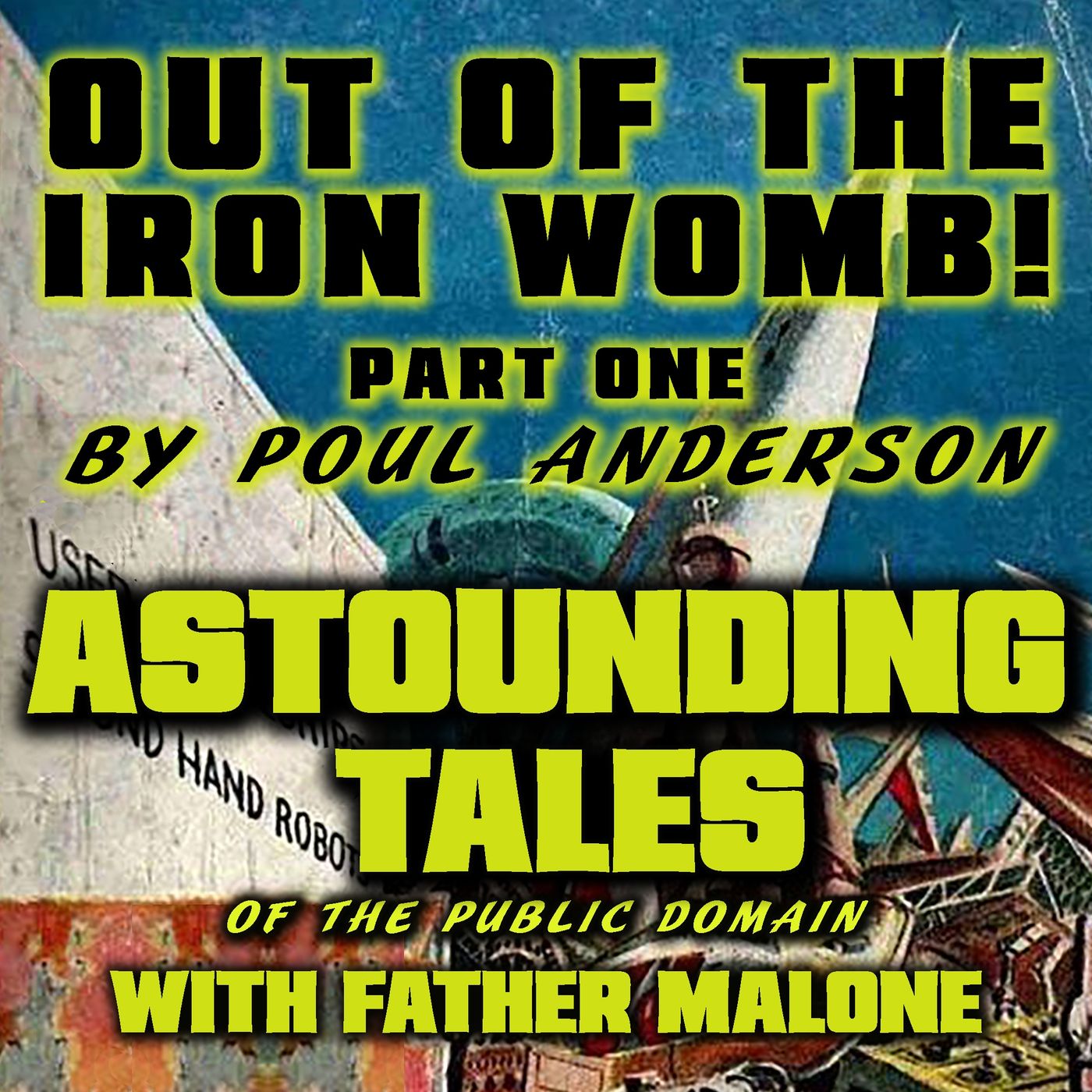
About this episode
A Joke? Illusion? Possibly, unless, of course—
Transcript
Automatically generated, so expect the odd misheard name.
Weird immedia, weird way, immediate disease, A stouting tau of the public Golo you don't walk alone by Frank M. Robinson. It wasn't my idea. I wasn't the first one to think of it. It started with John Kelly, who passed the idea on to me.
And I'm going to do something about it. Think John wanted to, but he never got the chance. Began about two months ago when I was sitting at the lunch counter in Chicago's LaSalle station drinking coffee. I was on my second cup when John walked in. He saw me about the same time I saw him and came over to the counter and we gave each other the I haven't seen you for years, what are you doing now?
Routine, which was a laugh in a way, because while he wouldn't know what I had been doing, I couldn't help but know what he had been doing. And so with you. If I told you his right name, you wouldn't have recognized him. Of course. He was the inconspicuous type, the sort of man who blended in so well with his background you would have had to hunt to find him, even if he was standing right in front of you.
He was thin, not particularly tall, with limp straw colored hair that clung close to his scalp, and a complexion that had never been exposed to the sun. He was dressed in an old blue suit, a shapeless hat that might have been new five years ago, and a lightweight gray topcoat that hadn't been cleaned and pressed since he bought it. See, you wouldn't have noticed him at all. It's a somewhat deceptive description. Of course, John could have afforded a Brook's mother's suit and at least one Cadillac, but the fact was that he preferred being inconspicuous, and in his job it was a definite advantage.
Both John and I were reporters, but the difference was, as Oscar Levant would say, the difference between talent and genius. He ordered coffee, then gave me a once over with a pair of tired blue eyes that took in everything from my brown shoes that needed a shine to the newest thing in string bow ties. How's it going, Charlie. I blew the loose sugar off a donut and dangle it just over the edge of the cup. It goes all right.
It could be better, but I suppose it could be worse too. What brings you to Chicago. I'm on a story. Sorry, I said, I didn't mean to pry. He got a refill on his coffee and stirred in a half a pound of sugar.
You're not prying, as a matter of fact. Maybe you can help me. What's up. I'm doing a story about an invasion. It's one that started a few years ago, one that I'm afraid was highly successful, and one that I think is still going on.
I looked at him blankly. Invasion one invasion, one from out in space, he said, casually, you know, one from another planet or another star, that type of invasion. I sat there, letting my coffee grow cold, because all the time I was thinking that the one thing in the world John Kelly didn't possess was a sense of humor. As long as I had known him, he had never told a joke, and came damn close to never laughing at any Don't recall any reports of anybody running around with six arms, or green skin or tentacles instead of limbs, I protested mildly. He shook his head deadly serious.
You're not looking at it logically, Charlie The only beings who would be interested in the planet in the first place are beings who could live here. And if they could live here, then it's possible they could have the same sort of physical makeup, he paused, maybe the exact same sort of physical makeup, even to the extent of the average man's desire. Or to avoid trouble, Kelly had something there. Every time you think of an invasion from outer space, you think of a hundred huge rocket ships settling down, with ray guns going full blast and king sized atomic bombs breaking up the landscape. Actually, of course, it doesn't have to be like that at all.
Granted a physical resemblance in the first place, maybe it wouldn't be an invasion. It might be more of an infiltration. I jerked my thumb towards the people who crowded around the train gates and sprawled out on the benches. You mean that some of those people aren't genuine that's right, John said slowly. Some of them aren't the real McCoy.
I watched the people for a moment, more, staring hard at the old man buying a newspaper at the news stand and the old woman who's selling it to him. How can you tell which or which? I can't so far as I know, there isn't any way. He had forgotten his coffee. Now it's that at his elbow, an unappetizing mixture of lukewarm grounds, cigarette ash and disintegrated downut.
And he leads, You've been reading them every day, Charlie. A dozen times a year. Somebody sees flashes in the sky. A dozen times lights settled down in relatively uninhabited sections of the country. Sure people see them and report them, and what happens.
The papers treat them as part of the silly season. Readers only glance at the reports. You know as well as I that nobody packs up a camera and goes out to investigate. He shrugged. I took another look around the station, the board, people sitting on benches and reading their papers, the mother with her baby sleeping now but one you knew would be squalling in a few minutes.
The porter sweeping up just in front of the washroom. The man in the information booth rifling through a stack of timetables, all very prosaic, all very everydayish. I turned back to Kelly, my face showing disbelief. You don't believe me, do you. I turned up my hands.
It's a pretty big order, John, that's the one big drawback convincing people. He sat there for a moment, fingering the check the waitress that had given him, then made up his mind. Meet me to night by the library, Randolph Street side nine o'clock. I'll have some photographs along, I reached from my hat. Exhibit A better be pretty convincing, John, And oddly enough I didn't have any doubts, but what they would be.
His reputation was that good. It was a nice, warm summer night. When I got to the library a couple of minutes after nine, Downtown was already filling up with teenagers and pickups who flutter around the bright lights like moths around a candle. I stood on the library steps and waited, watching people crowd out of the ic entrance. I had smoked my way through half a pack of cigarettes before it occurred to me that maybe John wasn't going to show.
My first thought was that he had pulled the gag on me. My next was that something had delayed him. I started to walk over to his hotel between Michigan and Wabash, right next door to the library. There's a small street that's more of an alley than a street. Street Cars used to turn down it before the Chicago Transit Authority got into office.
It's not too well lighted, and the only people who use it at night to cut through from Washington to Randolph are people in a hare. You're way ahead of me, I know, and you're right, but you're wrong if you think I found him after five minutes to play in Sherlock. The police found him at three in the morning, after they had combed the loop half the night. John Kelly was in one of the storefronts, his head bashed in. John Kelly was the first martyr to the cause.
In a lot of ways, he didn't make a very good one. The papers put it down to gangland enemies, the usual explanation for murders in Chicago, and for a while I thought I had convinced myself that they were right. Then I caught myself glancing behind me when I walked up dark streets at night, and staring hard at the mirror in the local bar, watching the people on the stools, and wondering which were real and which were fake. Kelly's story had started to haunt me. I couldn't shake it.
I thought maybe a vacation would help, so I pulled strings at the office and got the last two weeks in July. I usually take my two weeks up in northern Wisconsin around hayward Er in the Chippawaff Floage. It's one of the best fishing spots in the nation, everything from muskies to bullheads, bass to trout. You can take along a small fortune and fly rod for game fish, or you can have a lot of fun with a plaine bamboo pole and a bomber for panfish. Fred Gray, he was in the advertising department, went along with me.
After all, fishing is a gregarious sport, and besides, whoever heard of going alone? And Fred was the kind of man who was good company, the big bluff variety with a string of stories as long as your arm. We packed up Friday night and left early Saturday, with both of us trading off on driving. It was still a fourteen hour trip. If we pushed it, we could get to the flowage early Saturday evening.
Fred took his turn at the wheel first and I sat in the backseat and snoozed. When I woke up, it was early afternoon in the towns and the farmlands. It started to fall away, and there were longer and longer stretches of second growth timber, and wild looking country that was largely devoted to Indian reservations. And even then the shacks were getting fewer and fewer, an occasional wisp of smoke every few miles marking a cabin back in the brush. I took the wheel, and when we had about two hours to go, I stopped at a crossroad store to pick up some groceries.
While I was picking over the bacon and the pancake flower in the corn meal, Fred was glancing through the assortment of plugs in the beat up showcase near the door. I took what we needed up to the counter and slid them across to the character who ran the place. He was an old man, the veins standing up big and blue in his arms, and his face showing the effects of a lot more than just age. Hanny's pancake flower is real good flower, he said, glancing at the box I had picked out. What's wrong with this?
Nothing? Just make a couple more sense on Hanny's I started for a moment, then decided to be obliging and went back and got a package of Hanny's. Do you have any white flower? Yep, we got flower comes in bulk. Got asked for it.
He fixed me up with a paper bag containing a couple of pounds, then started to figure out how much I owed him, using a pencil and a hunk of wrapping paper. Pretty dead around here, isn't it? Sometimes it is? Sometimes it isn't. Fred came over with a brilliant red and blue striped plug.
How much The old man lanced at the plug and then at Fred to fifty maybe. Fred dug for the money, and I said, when isn't it dead around here? Last night? For one? He pocketed the two fifty bots of lights off in the woods a spell.
I figured it was some city people. Local folks go to bed at a decent time of night. I stood there looking at him, and John Kelly's nightmare crawled out of the dim recesses of my mind where I thought I had buried it and squatted right between my eyes, like a big, friendly Collie dog making itself at home, lights late at night, lights lights like in a hundred news reports I had filed and forgotten. I opened my mouth to say something, and then let it go. An old school bus had ground to a stomp out in front.
The driver came in and I didn't more than glance at him, young fellow, tanned wearing marine fatigue pants and a white tshirt. Event I thought, you see a hundred like him every day. He jerked a thumb towards the gas pump in front. Need some gasp pop about ten? Should do it.
The old man gave up figuring what I owed him, and went out to fill the tank. I tried to strike up a conversation. Beautiful country around here, sure is, I think get best in the summertime. Too much vision, so I'm generally pretty busy. I looked out through the window at the bus, where the old man was cranking the gas pump, counting the profits on ten gallons of gas.
The bus itself was battered and scarred, the red and yellow paint flaking off the sides. It was filled with adults, most of them young, and a sprinkling of kids. Some kind of outing, he laughed, Ah, that's right. The Young People's League from the Methodist Church in winook hard group to keep entertained. Huh, he made a face and said, you know how it goes.
The old man came back from the pump. That's true. Seventy sixth son took a little over ten. The driver paid and started for the door. See you around, I said, yeah, sure, think.
I turned back to the old man and asked what do I owe you for the groceries? Call it three and a quarter, he said, slowly, not taking his eyes off the window where the bus still sat. The driver worked the gas pedal. The aimless wearing finally caught and the bus lumbered off. Something funny there, real funny.
What do you mean? He came out of it, took my money and leaned closer. So even Fred, who was still fingering plugs at the far counter, couldn't hear. You know that young fellow came by last night and that bust at his was empty. There's a fork in the road up ahead, and he went to the right.
Nothing up that way at all, road just deadheads into the brush for about three miles and that's it. And I would have sworn that's where he came from. Just now. Didn't hear him go back last night? And I ain't seen him all morning.
Where all those people come from? He said? They were from some young people's group in Winnook. The old man looked surprised, or nook, no town around here by that name that I heard of. I've been here a mighty long time.
I picked up my load of groceries and started at the door. Maybe I misunderstood him. I mumbled, you must have been some other town out in the car. I left the motor idle for a minute up the road for about three miles. The old man had said, my stomach felt funny, in the palms of my hands were oozing dampness.
But I had to take a look. I had to go. What's the matter? Fred asked nothing, I said, I put the car in gear and went straight ahead. I took the right fork.
Where are you going? Step the road a bit. I want to check on something. He looks sour. It's after six now.
We don't have much time. It'll only take a couple of minutes. He turned indifferent. So yourself, I was thinking we might get some fish in it. You let it hang there, and I almost changed my mind.
You know how it is with fishing, if there's any daylight at all, you want to at least trail a hook in the water before hitting the sack. The asphalt changed to loose gravel, and I ground my teeth every time I thought of what the gravel and the dusk were doing to the finish of the car. It took ten minutes to make those three miles. Then the gravel thinned out and we came to the end of the road and a small clearing rimmed with pine trees and other scrub timber. Fred was surly, here we are, Now, what the hell it was it you wanted to see?
I got out and stretched and put my hands on my hips and looked around the clearing. It almost looked like Fred was right. It wasn't a damn thing to be seen. Brush and trees and knee high grass and the two inch mosquitoes that only seemed to come out at dusk. Then I saw it looked like a piece of paper by one of the trees.
I ran over and picked it up. It was paper, and yet not paper. It looked more like a fusion of paper and plastic, with an odd kind of printing on it. I couldn't shake the idea that it was a scramp of some foreign paper. Then I looked around and saw where the grass was trampled and where a rough path led back through the woods.
I yelled, I'll only be gone a minute, and started out. It was longer than a minute. It was the longest half hour in my life. The path wound between trees and through little gullies, and I had trouble following it because the sun was going down and shadows half hid the path. And then I came out in another clearing, a big clearing.
It took me a minute to appreciate the fact that the center of the clearing wasn't a clearing so much as a depression, a large, neat, circular depression where small trees, bushes, and grass had been mashed flat to a pasty smear of green. And then I saw other things, bits of clothing, clothing made of cloth that I didn't recognize, more of the plastic paper, some wrapped around, lumps of what I imagined was food. I circled the clearing. The path I had taken was the only exit or entrance in your way ahead of me again, aren't you? Kelly?
Had been right all along the lights the old man had seen the night before, where those of a ship from God only knew where the young man with the bus had gone there earlier that evening to pick up his passengers, the bus driver who had reminded me of one hundred other people I had known, or two hundred or a thousand, and his curious face passengers, none of whom had gotten out to stretch their legs, or buy a candy bar, or chance a nickel in the coke machine, or take advantage of the pause that refreshes I looked around the clearing again. Before they had gotten on the bus, they had changed clothes, and then they had had a picnic, which I suppose was as good away as any to start their first day on earth.
The cabin was small and cozy and smelled of pine and cedar and fish. I sat on one of the bunks and ponds through a suitcase while Fred moved around and lighted kerosene lamps and played boy scout with the fireplace. I found what I was looking for, and then discovered a glass on the window sill. I wiped it out, thinking all the time about detective stories where the private eye took his straight in a dirty glass. Fred didn't approve of drinking on fishing trips, and his plump face showed it.
You look scared, Charlie. I am something to do with the going into the woods back there, that's right, a lot to do with it. He sat on the bunk opposite me and concentrated on tamping tobacco into his pipe. You wouldn't care to tell me about it, would you? Sure?
I'll tell you, I said, I'll tell anybody, I'll tell the whole world. I tilted the glass to my lips and let the liquid burn its way down. It started with a damn good friend of mine named Kelly, and I told Fred the same story that Kelly had told me. And I told him when I had discovered back in the woods. Fred laughed, you're taking it too seriously, Charlie.
You did some research on it. I bet you tend to one that you'd find a natural cause for everything. I've done some research, I said tightly. Only I didn't know I was doing it at the time. I felt a little reluctant to talk.
This wasn't the sort of setting where you talked about an invasion from another world. The door of the cabin was open, and I could smell the link in the night air and the nearby pines. It made it seem so damned unreal or kind of research. Nothing intentional, just stuff I picked up every day. The level in the bottle went down by another half an inch.
They're running a regular commuter service, Fred, They're bringing them in by the by the hundreds of thousands, and all within the last few years. He seemed interested. Why do you say the last few years? I shivered. The number of sightings of strange lights in the sky that have been made for one thing, and population statistics for another.
Our birth rate has been declining for some time, but in recent years the population has shot way up more than it should. It's the veterans starting new families. Yeah, how many vets do you know with a lot of kids? Anything else? Fred asked softly.
It's the perfect time for it. World's all mixed up. Everything is in a state of flux. They could land And how could you tell dp's come in the country every day? That's one reason we never notice.
And you can't tell the aliens from the human beings, can you? No, you can't. I paused and wiped away the sweat from my forehead. They're perfect copies. There's no way of finding them out.
The man in the store could have been one, the driver was, and I couldn't have guessed, I laughed, you could be one two for that matter. He was at the fireplace, stirring the embers again. When I finished talking, he turned around, the poker clenched in his hand. His face was impassive. Not only could be Charlie, I am.
I suppose there's a time in everybody's life when the chips are down. You have to react automatically. You have no room for thought. I let him have the bottle square in the face, and then the poker glanced off my shoulder and he was on me. He gripped me by the throat and forced me back against the wall.
You'll never leave alive, he said it, and it was like ice water down my neck because he said it in a monotone, with no emotion at all. I tried to break his grip and couldn't. And then the world turned a spotty black, and I could feel my life start to slip away like a bar of wet soap. I fell to the floor and doubled my knees and drove my heavy boots into his stomach. He had to loose in his hold then, and for a moment I was free.
I didn't waste time, and I didn't bother about fighting fair. We both went for the poker, but I got there first. I killed a man that night, without compunction, without regrets, without any hesitation. I killed Fred and buried him in the woods, and loaded the car. That same night.
When I started the car, it kicked right over and I spun out of the gravel sprang from beneath the wheels. I didn't breathe any easier until I was a hundred miles away. I thought a lot about what I was going to do on the way back. I'm not the hero type, but I just can't see them move in on Earth without fighting back. And I consider Fred only the down payment on John Kelly's murder.
One important thing I found a flaw, a weak spot. The invaders are imitators, the perfect imitators. There were a lot like Fred was. They never have original ideas of their own. They parent the editorial pages and even the stock of jokes they say for stag parties aren't funny because you've heard them all before.
You can see them on the street car and their way to work. Half will sit with blank stairs on their faces, reading the transit ads, while the other half will sit with their noses buried in their papers. Watch them. If they looked alike, you'd be reminded of the Roquetts on the stage of the RCA Music Hall. Or walk into a barn when the fights are on and watch the customers with their faces glued to the TV sets, all with their glasses of beer in the right hand, all with the same rapt expressions on their faces.
You see, they're imitating human beings, and they've got an organization. They've infiltrated the government bureaucracy. How do I know? Read some of the pamphlets the government puts out. There's one unwashing dishes that starts out with a proper sized pan.
Silly, but not for somebody for whom washing dishes is a brand new experience. And there's another pamphlet that says younger married men and women own more sports clothes, older men wear hats, and older women have more fur coats. Very interesting data. Like when I was in the army and they've briefed us on foreign customs before going out on a pass. There's probably thousands of imitators in the government itself weighing, analyzing and surveying humanity so they can issue reports on how to act like a human being, reports and pamphlets that are point for point instruction books for the new arrivals.
There's an organization, and there has to be somebody at the top of that organization that's the man I want to get. Fred knew a lot of people. He had a lot of contacts, and I'm investigating them one by one. It isn't going to be too long before I meet somebody that Fred knew back home, and then I'll find out about the organization and I'll be on my way. I already have a good idea whom I'm looking for.
He's an average man with maybe a wife and a couple of kids, driving last year's car and living in a house that isn't all paid for. He likes TV, and he drinks beer, and he's drummed up a hell of a lot of interest in baseball games. He probably wears blue serge and white shirts and small figured ties and silk socks and black shoes. Maybe he even wears a hat. He's probably that age, and I think there's even a good chance he's reading this magazine become pretty popular.
It's the thing to do, but it isn't going to do any good. To run or hide or doubt your friends, Someday I'm gonna find you. This episode performed and produced by Father Malone. Music by HP
More from Astounding Tales of the Public Domain
Similar episodes across the network
Matched by shared keywords.
-
Yautja Fest - Aliens Vs. Predator (2004)
2 shared keywords: alien, aliens
-
BONUS - Director Paul King on Beneath London - The Story of Alien War
2 shared keywords: alien, aliens
-
Good Luck, Have Fun, Don't Die - Kulture Meltdown
1 shared keyword: science