
Season 2 · Episode 35
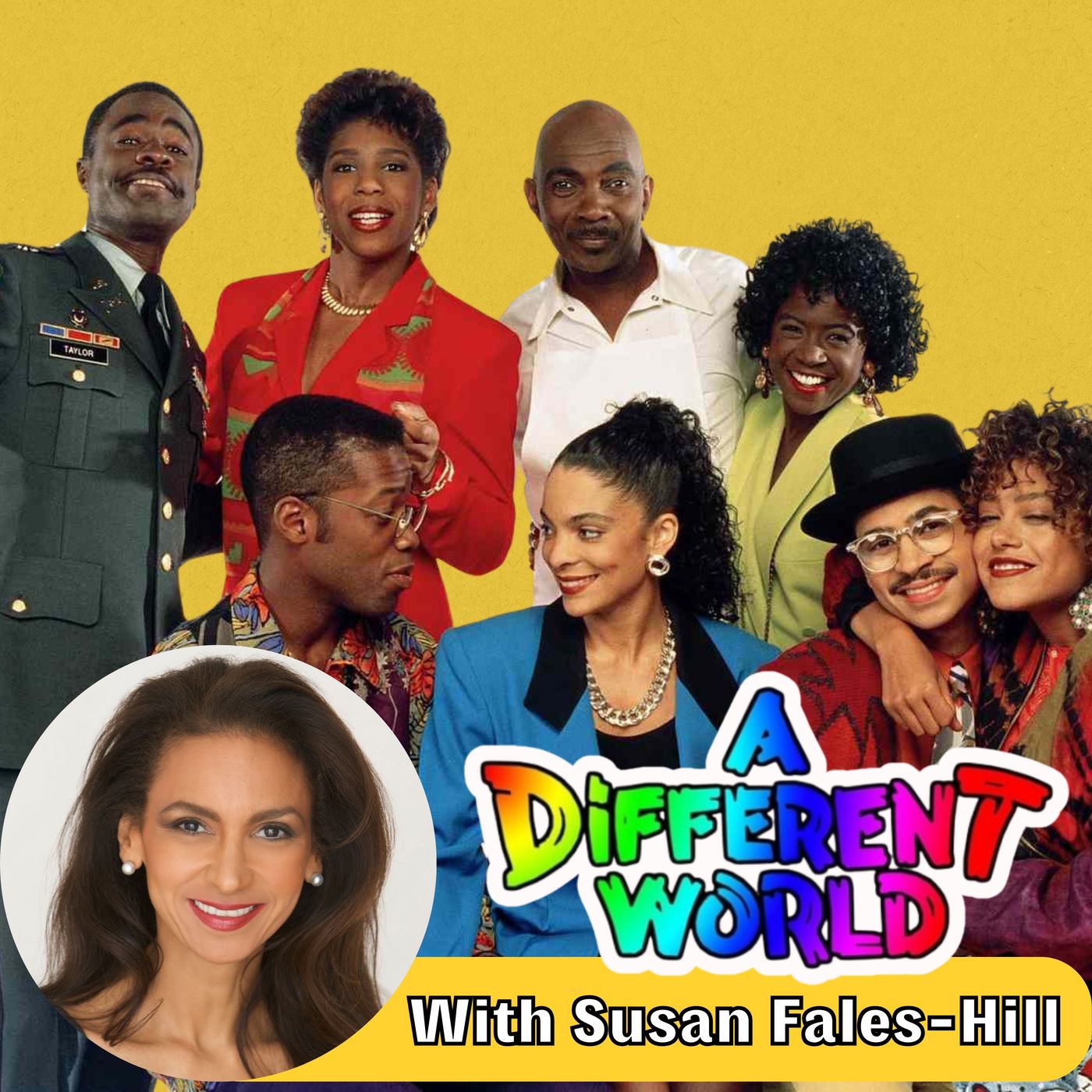
A Different World | Showrunner, Writer Susan Fales-Hill
About this episode
Susan and Sharon welcome writer and showrunner Susan Fales-Hill as they continue their look back at the classic 80’s comedy series A Different World. Ms. Fales-Hill’s writing career began on The Cosby Show and continued on A Different World where she rose from story editor all the way to executive producer during the course of the show’s seven-year run. Content Warning: Sexual Assault/Child Sexual Abuse. At approx. 53:00 - 58:00 short discussion of date rape and child sexual assault.
Susan Fales-Hill is currently writer/executive producer on HBO’s Sex And The City sequel series And Just Like That. She is also the author of four books including her memoir "Always Wear Joy." Susan shares stories of growing up bi-racial in a show biz legacy family, how comedy comes from pain, and the help (and hinderances) she got from men, women and people of color along the way…
THE CONVERSATION
- Being Whitley Gilbert’s alter ego: “She said a lot of the things I wanted to say -- but was too polite!"
- FINDING YOUR VOICE: Susan reflects on learning how to speak up in a writer’s room even though she was the youngest, newest writer -- and a woman.
- GO WEST YOUNG WOMAN: The “Big Move” from The Cosby Show in New York to A Different World in Los Angeles.
- THE IMPORTANCE OF A NEW POT: Sometimes you have to "re-plant" yourself to grow.
- HOW DO YOU SOLVE A PROBLEM LIKE MARISA? The challenge of featuring a white character attending an HBCU.
- JUST A TIME SLOT SUCCESS? Some people grumbled that ADW only succeeded because it followed the massive hit The Cosby Show.
- How Debbie Allen insisted the show be topical -- and the surprise when Bill Cosby agreed.
- The story of how Susan personally got Diahann Carroll to be on the show.
- Being told by her agents after running a Top Ten show: “We can’t get you on a white show.”
- On the joy of casting your own mom -- singer, dancer, actress Josephine Premice.
- Susan reflects on which “issue” episodes worked -- and which ones maybe missed the mark (looking at you, Los Angeles Uprising…)
- The network was adamantly opposed to the “Los Angeles Uprising” episodes -- and some believe it signed the shows death warrant.
AUDIOGRAPHY
Watch A Different World -- streaming on MAX.
Watch the classic 2-part Thanksgiving Episode “Faith, Hope & Charity” (S6; EP 9 & 10) -- with Diahann Carroll AND Patti LaBelle! on HBO Max.
Get Susan Fales-Hill’s books and find out about all her projects at SusanFales-Hill.com.
Watch Susan Fales-Hill “In Praise of Complexity” at the Met Museum "Met Speaks".
CONNECT
Visit 80sTVLadies.com for transcripts and more.
Sign up for the 80s TV Ladies mailing list.
Check out Instagram/80sTVLadies.
Support our show and get ad-free episodes on PATREON.
Find more cool podcasts at our host sight, Weirding Way Media.
Visit 80sTVLadies.com for more info.
Listen to 80s TV Ladies at YouTube. Subscribe and help us grow.
Don’t miss out. Sign up for the 80s TV Ladies mailing list!
Help us make more episodes and get ad-free episodes, video interviews, and exclusive content on PATREON.
Transcript
Automatically generated, so expect the odd misheard name.
Weirdy wed. An important theme to underscore is none of us are here on our own. I benefited greatly from extraordinary mentors of all hughes and all genders, and they helped shape me and support me in my efforts. Eighties, So Pretty Bai to the city, Good world. Welcome to eighties TV ladies with your fabulous hosts Sharon Johnson and Susan Lambert had him.
Hello, I'm Sharon and I'm Susan. We are continuing our look at the groundbreaking sitcom A Different World that premiered September twenty fourth, nineteen eighty seven, and ran for six sies through nineteen ninety three. It was a spin off of The Cosby Show, originally centered on daughter Denise Huxtable played by Lisa Bonnet, about the life of students at Hillman College, a fictional, historically black college. Today's guest is an award winning television writer, producer, author, and passionate and dedicated arts advocate. Susan Fayles Hill was born in Rome, Italy and raised in New York City.
She is the daughter of the renowned Black Broadway actress Josephine Premis and Timothy Fayles a white stockbroker. She began her career as a writer's apprentice and warm up person on the original Cosby Show. After two years on Cosby, she transferred to the spinoff A Different World, ultimately working her way up from story editor to showrunner, making her at the time one of Hollywood's few female and youngest showrunners. Susan has also so worked on Can't Hurry Love Kirk, Suddenly Susan with Brookshields, and co created Showtimes Link. She currently serves as executive producer writer on HBOS and Just Like That.
Susan is also the author of four books, including a memoir, Always Wear Joy, and her Vogue article about growing up by Rachel is pretty spectacular. Welcome Susan fails Hill to eighties TV ladies. Thank you for having me. This is so much fun. You went from basically story editor to showrunner of a Different World.
Yes, and that's a pretty amazing trajectory, both for the time, Yes, and just in general, like for anybody. Yes. So before people compare themselves unfairly, I don't compare your insights to other people's outsides. As they say in alcoholics Anonymous, I skipped a lot of years of fetching people's coffee, because, as I mentioned, I am a bit of an epo baby. I got my job as an apprentice on The Cosby Show by submitting a piece of writing directly to mister Cosby.
And I started my career as a writer's apprentice on The Cosby Show and then was made staff writer the following year, and then became a story editor. And then it was pure kismet that my voice and the subject matter of a different world, which is about life in college. And I was pretty fresh out of college, a very different college. I didn't go to an HBCU, but I understood the experiences for better or worse. I was Whitley Gilbert's alter ego, where she was my alter ego.
She said the things I might want to say but won't because I'm polite. And I had the support of Tom Warner and Marcy Carcy, and I was very focused on my work. At that point, I was story editor, then producer. In the following year, I was co executive producer showwrinter, so with a lot of support with Debbie Allen as our non writing executive producer and a woman named Deborah all as a non writing executive producer. So I was supported.
I was set up for success, I will say, and received the proper training, but took advantage and did the word no. I took the ball and ran with it. And it was pointed out to me by the gentleman who wrote the Cosby Show after I left that I was the only person. They had several subsequent writers apprentices, and none of them ever really became writers. So you have to have the stick toitiveness, you have to have the discipline, you have to have the drive and the desire and sometimes the thick skin that was necessary, but it paid off, and the talent as well.
Thank you. I appreciate that, and I will not deny that I'm talented, but I will say, Sharon, I grew up so many people who were so extraordinarily talented and never really got their due that I'm always cognizant that out there somewhere is somebody who could probably write rings around me and who isn't in the position to exercise their talents. So I think one has to acknowledge the great role of good fortune and being in the right place at the right time. So it's a combination. It's not are I just fabulous?
It could be both. We do a lot of book and looking at the eighties is so interesting because it was a time where opportunity clashed with pushback, similar to now in infuriating ways. But I'm just really curious, were you involved with a different world early on? Like, were you in the right? I was?
So what happened was the three head writers of the Cause Show were tasked with writing the pilot, so that was Matt Williams, Carmen Fenestra, and John Marcus. They wrote the pilot with all the directives that Bill Cosby was giving them because he was so enamored with HBCUs and had begun a big partnership with Morehouse and Spellman. And then the show was greenlit and they were spinning off Lisa Bune, Beautiful Lisa Bune, the Natural Evolution, And it was the middle of my season on The Cosby Show as a staff writer, and they said you must go West. And I actually didn't want to do it because I love New York and I was very seriously involved with the men. And my mother looked at me and said, you're far too young to pass up an extraordinary opportunity for a man.
You're going I always did what my mother said, and I knew she was right. And also I realized a prophet has never respected its own country. These men had trained me. I was their little baby apprentice. I had won them over in various ways, but they did not see me as a big, strong voice because I was very intimidated, and partially because they could sometimes shoot down ideas in not necessarily the most diplomatic ways.
Line's like, yeah, that joke, you'll have to sell it door to door with an instruction booklet to go with it, or maybe that's funny at Harvard or anyway. So I'm actually somebody who talks a lot that I'd been cowed into silence, and in some ways for good, because when you don't know much, you should be sitting there and learning. And I would keep the book. This was before PCs, so I had to write down I was a scribe. I was practically right on Papyrus.
Anyway, when the opportunity came up, they said, to the gentleman who was running the show, she is fantastic, she's super smart, she's a really hard worker. Don't expect too much from her in the room. I learned this later, and so I went out and the first time I pitched something, this gentleman said, oh, that's a wonderful idea. I thought, really, I have to sell a door to door. So from then on I never shut up.
And then he took me aside and quietly told me this is what i'd heard about you. I don't know where they got that impression. I said, well, that's who I was in that room. So sometimes you have to repot to become a different person. And by the way, I do not denigrate them, because it was like boot camp.
They taught me so much, and they also were so kind and supportive of me when I took over the show, and at least two of them have remained my very dear friends. That repot. That's a very interesting symbolism. I like that because it's true. You sometimes have to be you fall in your world.
Yeah, I mean that happens to us and our families. You're the baby sister, you're this, or you're that, and everyone has you frozen in amber as this she's Sharon is our thinker, and it sort of maybe Sharon wants to be the juggler in the clown sometimes and you've got to put yourself in a new environment. To do that, and it's hard for the people who trained you to see you as anything other than their baby basically, So do you happen to know why they wanted to make this show in la as opposed to New York, where The Cosby Show was shot. I probably, I don't know the mechanics of that decision. I can only assume that some of it had to do with economics, because at the time there were not that many studios in New York, so and I probably Tom and Marcy wanted to spend more time on the West Coast because many of them, they all had homes there and family there.
So I think it was economic and probably driven by the non writing executive producers and owners of the company because their offices were headquartered there. And so what lot were you guys on? We were on CBS MTM, and I had to return there a couple of years ago when I was doing twenties and they require now identification and I hadn't brought my ID with maybe I had a photo of it, and this young guard who was young enough to be my son, said no, I can't let you on with that, And I went to say, look, I'd built this lot you wouldn't have a job. What do you mean, I can't come on to this lot. This was my home for eighteen hours a day for seven years anyway.
But yes, CBSMTM, which it's mushroomed a bit, but it was a small lot and Roseanne was also done. It was very much dominated by the Carcia Werner company. It's my favorite lot because it's so it's so cute. It really is food, and it's intimate and it's you don't feel like you're on this huge campus where you're dwarfed by the other things that are going on. The CBS Radford lot is that the one okay, okay exactly now was a different world originally, so it was Lisa Bounet was the center of it.
Who was Denise the daughter. There was Jalisa who was twenty six and had been married and divorced because they wanted to show that older person who's reclaiming her life. And the Marisa TomEE, the brilliant Marissa TomEE laid Meg. Now. The straight jacket in which we found ourselves was part of the formula on The Cosby Show was to never really mention race overtly, and I think that was wise and one of the reasons everyone related to the show, whatever their ethnicity was.
It was never overtly stated, which works very much in a family context. You're not walking around all day long saying, as you know, we are African American. Of course you talk about your history, which they did. They had them all watching I Have a Dream speech. They actually did an episode where they went to church.
They had the artwork all around. I mean, black culture was very alive in the show, but they never had racial discussions on a college campus. Even then. It was all about identity. So to have this white girl there with no explanation, and there are actually Caucasians who choose to go to HBCUs, as we were told very indignantly by a lot of the students at HBCUs that we would talk to for our research.
Sometimes they're there to kind of correct their ignorance and because they feel like they've never been around people of color and they want to be there. But they all have a specific reason for being there, and we were never allowed to discuss why. Then, when she went to date somebody the network wanted us to hire a white person, she was indignant because she felt I would be dating a blackfellow, and they just didn't want the what would have been backlash at that point, and it was really doing no good service to this extraordinary actress. So for the second season, that character was let go, along with the Denise character, because Lisa Burnet was pregnant and married to Lenny Kravitz, and we discussed doing include the pregnancy, and then that felt at the time rates of team pregnancy adolescent pregnancy were extremely high, and we felt, this is not a message that you want to send, and how do we have fun with her in college?
She's pregnant and by whom, and it was just too messy and she wanted to go back to the Cosby Show anyway, So we lost those two characters. And then the very next year, Mursa Tome won the Oscar, so things worked out for her. I think that it all worked out for her, But the roster people who were in contention for that role, Meg Ryan, came in I remember one day and she chose she was not interested in it. Ultimately, she took the meeting and was just about to be on her upward trajectory. So yes, that's that's the backstory there.
And so at what point in that season, like you're on this show. It's coming off the Cosby Show. They're like, leave the most successful show ever and go start this new thing that may or may not work right. How are you feeling you've moved back out to California? Like, well, it was kind of exhilarating because I was being allowed to come into my own as a voice, as I said, and becoming far more confident in my abilities in that regard.
So that was really really quite thrilling. It was discouraging because we were very much resented and reviled because people felt we were merely a time slot hit. Creatively, it was a blast because I loved college and to be able to capture some of those experiences was fun. I also adored being able to portray such a range of African American experiences and people. That was beyond thrilling to have Princess Whitley.
We don't see a lot of black bourgeois princesses and there are reality so it was exhausting. And that first year was turbulent because the initial head writer was asked to leave and then God Rest her soul and Beats was brought in and she had absolutely no sensitivity to racial issues whatsoever, and we had a very strange cavalcade of people she brought into the room. It was insane. And then she left and Debian was brought in and that month, for God rest his soul, became our head writer. I think it's actually to be noted that Anne Beats, who was for all of her what should I say, oddities.
I had a good relationship with her and we had a really beautiful, honest conversation years later about what was good and what was bad in what she had done, and she was very open and received it all. But it's very telling that this gifted woman who was a pioneer in TV. She created square Pegs. She was one of the few women writers on Saturday Night Live. I mean, talk about a real pioneer who made it before women were really in those rooms, and it was just a bloodbath to be a woman in those rooms.
It's no accident that she passed away before her time, really and leaving behind a daughter and Fad Mumfort, who was one of the first African American writer producers. He worked on Mash and Alf and a bunch of other things. A very distinguished person that he also passed away early. And there are other African American writers, Judy Anne Mason and Unetta Boone, And that's just a part of the role call of people who I think were so marginalized by the business and went through such complete extremes of feast and femine, more so than their white counterparts at that time, that it took an extraordinary toll on their mental and their physical health. And so that's also something not to be depressing.
We'll get off this topic. It's like, Wow, an Afternoon of Depression with Susan Vales Hill. But I know, I think it's important to call these names and to acknowledge again how much more difficult it was for the Unettas and for the end beats's back then and these these women and in the case of bad men really paved the way and made it a better universe for the rest of us. Yeah, there's no question. But if not for them, things would not have moved forward so exactly exactly.
It's sad that it cost them as much as it did. But nevertheless, without them or not, you know, some of the things we've seen don't exist, so absolutely absolutely, and they all had their own individual stories and health issues etc. That predated their careers. However, I think the kind of exclusion and marginalization that they all suffered contributed greatly to their early early deaths in my opinion. Yeah, we know that that has an impact when you are constantly in that source of stress, stress, and I have to protect myself and I have to move forward.
I certainly felt it in the eighties and even nineties when I was starting out, and because you're like, I have to be careful and somebody's going to come down on the heart because people are gutting for you or telling you to your face you don't belong here and you never will, or completely denying you work based on your genitalia or your melanin, and it's very debilitating. So there was something you said earlier about the feeling that a different World was a time slot success. Can you expand on that a little bit. Well, obviously we had the dream time slot because we were right after The Cosby Show, the highest rated show in the nation and possibly in the history of television, and so and certainly mister Cosby had earned the right to have his his spin off placed right afterwards.
But we were not respected at all while we were on the air as a show doing intelligent work. And I will grant you that the first season was our least intelligent, and I contributed to that lack of intelligence with my fabulous episode Porky de Bergerac, which was back everyone running around in pig noses. And I honestly, I've never done a drug in my life, so make a blush to read this script. But at any rate, certainly from the second season on, we really challenged ourselves to take on the issues of the time, and there was always an intellectual integrity to the show and we never got the credit for being smart. And I think that's where I do see the role of Race, quite frankly, because people would speak of Friends as such a smart show, and I thought, last time I checked, they're not talking about the Amistad.
They're not doing shows about date rape, they're not doing shows about the end of apartheid in South Africa. There were so many things that we were touching on that really cut to the core of international events and who we are as a country and our history and our references. I mean, we had to battle the network sometimes. We opened one show with a discussion about the Amistad, and the first note was, can't Whitley and Dwayne just be flirting? And we say, no, They're on a college campus, and yes, sometimes they flirt and carry on, but at other points they're going to be having actual discussions.
And where else is this discussion going to happen. So for the entire time we were on no one acknowledged other than we were nominated for a Peabody, which is a very prestigious award for our many episode. We did get a Nancy Susan Reynolds Award for our from Planned Parenthood for our AIDS episode, So there were organizations that recognized us, and the public certainly was very appreciative, but critically and within the industry, there was this perception of it's, oh, it's those black people doing silly things. I don't know. I'm surprised, but I am because this is not the first, nor has it been the last show that has been a spin off of another successful show.
It's just that happens all the time, I know. But I do think there was a great resentment of its source, and there's just no question that race played a role in the resentment, and certainly race played a role in the complete ignoring of the content and the quality of the content, and the dismissal of it as oh, it's just another one of those urban shows. And I was very gratified. I think it was in two thousand and five. There's a woman named Emily Nussbaum who writes for The New Yorker, and she wrote this absolutely glowing reappraisal of the show in The New Yorker and it looked literally like my mother had written it.
The only reason that I knew she hadn't was she'd already gone on to glory and acknowledging the intellectual substance and the provocative social commentary. We did a show about the elections and it was based on a nightmare, and the men were all the first gentlemen, and the women were all the candidates. And it still holds up today. So it was really gratifying to see. And she actually in twenty sixteen said, if this election period is driving you mad, watch this episode of a different world.
So, and most importantly, there isn't a week that passes when I don't hear from somebody that they went to college because they watched the show. And I've heard it from black people and white people. So I know what the show did, whether or not we ever got an award. I mean, we certainly were pretty much ignored by the Emmys, except for Diane Carroll got a nomination for Best Guest Performance. But other than that, they didn't even look at us.
But such incredible talent, like you know, you w Allen, but also like just those young did Jasmine Guy and Jazzmae and who else had an actress who could sing dance. I mean, these women were all triple threats. Jasmine had trained at a Ley. She was a magnificent dancer, she could sing. Chris Summer Frank also great dancer, also magnificent singer Don Lewis on Broadway she co wrote the theme song.
So composer singer. She just did a turn on Broadway in the Tina Turner musical. So the talent was extraordinary. And yeah, that's the way the ball bounces. Okay, So can we talk about when Debbie Allen came on the show, Yes, and how the show sort of changed direction and what that meant to you.
Yes, So Bill brought her in and realizing she had been to Howard, she and her sister had both to Howard. They were legacies at Howard, as she knew that world extremely well. She was a director, she'd done such a brilliant job with the series Fame, and we were I remember we were all having a meeting with mister Cosby, and she's the one who said this show has to be topical. These kids are in college. They got to be talking about what's going on in the world.
Otherwise, why are we doing this? And mister Cosby said, you're right, and I almost fell off my chair because that had not been the way. But I think he recognized it's not working, and also hearing this coming from an eminence like Debbie and someone who knew that world so intimately, he agreed. So it was a great partnership because she would bounce ideas off of us, and she has a very good eye for comedy, and it was a very symbiotic relationship. And she also gave a lot of dignity and cohesion to the cast who had not necessarily been embraced by prior leadership.
And a lot of writers are very cruel to actors, which always horrified me having grown up around a lot of actors. But they would say denigrating things behind their backs, and oh, they're just stupid and oh, just tell them to say it is written. And she, having been an actor herself and still being an actor and coming from the world of theater, gave them all of this freedom to imagine their characters' backstories and really work on why they were saying what they were saying. And of course it was so much fun to be able to include elements of dance and performance because we had our own built in choreographers. So I love dance and I remember running one episode where Whitley does something with the Elvany and that she could absolutely recreate the wait in the Water sequence of revelations right there on stage.
It's just magical. That's amazing, and that the talent, just the kind of from guest star to your regulars so incredible. And the age range too. I love that you brought in existing legends like Diane Carroll and Patty LaBelle, like, so what was what was that? And was that you by that point?
So Dian Carroll was I'm going to own it. That was me because she was my mother's best friend and my mother's Josephine Primis and she played Dean Abernathy, who you may remember at any rate. We had decided we wanted to meet Wi Lee's mother, and we decided we wanted Diane. And Debbie said, child, you she's you're close to her, you know, go see her. So I literally drove up the hill to Dreusdale and said, yeah, to come and do this.
And she had very mixed feelings about TV because she always felt like TV is not an artistic opportunity. Is she said, it's an opportunity to make money. But I said, it's actually really important that you do this, and this will expose you to a whole new audience and generation who some of who may not have seen your prior work. And you'll bring so much to the show and I promise you're gonna have a good time. And one of the most moving moments for us on the show was when she came and did it, and of course she had a ball.
She loved all those kids, and she got a zerabola of champagne and she gathered them at the end of her first episode and she said, when I was making Julia, I was the only person of color on the lot and it was very lonely, it was very debilitating. And she said, now all of you are driving on your lot in your lovely, beautiful cars and walking around here like you own it. And you have a black director, executive producer, a black writer, showrunner, black people in the writing staff, black crew members, And it wasn't always like this, And I want you to understand the world that you're inhabiting and this moment, and none of them ever forgot it. They still talk about it. And again it's back to why this podcast not to say I walked through the snow.
You've never walked through the snow and make people feel guilty and like they're overprivileged, but more to say we have to look back, not in anger, but in amazement and in hope over how much had changed for her A generation before it had been a completely different experience. It was just a joy and having grown up around her and my mother obviously and Lena Horn to actually be able to write for these women and work with them and also have everyone else because in the case of Diane, nobody knew Diane's naughty. Everyone thought of her as just this beautiful, over glamorous ice queen. They had no idea how funny she was and what a team player and how game she was. So to have someone I love work with all of these people I was working with daily, was just beyond joyous.
The Thanksgiving episode with her and Patty LaBelle, I wrote that one so funny, Oh my gosh, no, and they had such a good time, and Diane ad lib there will be no oysters and black people stuffing today. I mean, they were the two of them just they had a ball and we had a ball, and I just had so much fun writing it. And it's just memories for a lifetime and things that people still quote and still enjoy. And I'm thrilled to have been able to show that side of Diane, who truly was one of the funniest women. She was Lucille Ball but dropped dead gorgeous and Lucille Ball was dropped dead, gorgeous and funny.
How did Patti Lavell end up being We just decided we came. I think Debbie came up with the idea of casting her, and she was such a joy to work with and acting is not her main pursuit, obviously, but she was just terrific and she completely owned the part of Adele and this the two of them, I mean, what better contrast. And also two Titans and a perfect world. They should have had their own show together. No, they should have had their own show.
Someone just sent me. People are always sending me clips and there's a clip of the two of them, and I'd totally forgotten we did this where they got drunk together, and I mean it is hilarious. So it was just really a lot of fun. But you'll appreciate this. When I had written that episode, and she, of course, Adele was a very overbearing mother, a good mother, but overbearing.
And one of our white writers said, I just want Dwayne to say shut up to his mother, thank you. And I said that wouldn't happen, or if he did, he wouldn't have teeth left. And he's like Susan, he's not like you, he's you know, they're from Brooklyn. There. I said, it does not matter father works for the MTA.
There is a line that a child of color does not cross with their parents. And I said, you know what, don't take my word for it. Let's take a poll in the room and there was only one person of color who had said shut up to their mother, and their mother was white. I rest my case. There will be no Dwayne saying shut up to Adele it just doesn't happen.
That's amazing. I mean, I love the mother daughter stuff so much in this show. Yeah, it was just really I love those scenes between Whitley and Marian and Marian yeah and I yeah, and I don't know. I just felt like that was some of my favorite parts of the show. And I loved writing it, and I loved how flawed Marian was and that in her own way she meant well, but she was a prisoner of her own value system.
And also to see Whitley, who was basically the little reigning bitch, absolutely cowering in the presence of this woman whose expectations were impossible to meet. And then I'd taken many elements from my own life, but one of them was when her father leaves her mother for a much younger woman, which had happened in my family a few years before, and just the pain of that and what that does to everybody, but also how it made her reconsider what she was looking for in somebody. So it was just a joy to write. And then also both of them were both such great comedians and also unbelievable actors, and so they could infuse it with all the humor. But then there were moments of extraordinary pathos and pain, and that to me is what makes really great comedy or television.
Yeah, I've been watching episodes. I was really struck by, even in the middle of some of those moments, with the pathos and the emotion, that there was still the funny there always yeah, no, no, and that because I mean, also, that's so true to Diane. She would, I mean, in the worst moment, she would, she'd be there, but then she'd say something funny. And my mother was the same way. So literally could be at depth's door and then something funny would come out.
And that to me is a very specific resilience that people of oppression have. There's a reason that I'm just going to say it. A lot of comedy writers come out of the Jewish diaspora, and certainly there's a lot of humor in communities of color because there has to be, because you have literally dealt with catastrophe and the only way forward. And not to denigrate, not to say that other groups have not, I mean everyone has had it, but often the best comedy comes out of a place of pain and deflection of pain. We've been watching a lot of eighties TV shows for the podcast, and we've both been somewhat surprised and really pleased how well the shows hold up, and this one is no exception.
Well, thank you for that. Yeah, it's really great, and I'm I was amazed again and rewatching some of the episodes in the discussions amongst the students and about the issues of the day, and how balanced some of the discussions. It's so and the funny again, so really really funny, and such great characters. And I just have to say, I grew up outside of Atlanta, Georgia Indicator in the seventies and eighties, but to my shame, I did not know about historically black colleges until I watched A Different World. I grew up in the shadow of Spelman and Morehouse.
But Susan, you're underscoring something so important. We have grown up in a segregated country. Long after the laws went off the books. People grew up in very separate communities, and so there wasn't a reason for you to know outside of people in your family being curious or someone hiring someone from one of those institutions. Now, of course, I'm sorry anybody who grew up there and doesn't know right where have you been.
There's no excuse now, but it is. And I'm working on it just like that now. And I realized it's the first time I'm working on a show that reflects my lived experience. I've either been on all white shows or all black shows. I have never been on a show that was a complete combination of everything.
And in fact, when a Different World went off the air, my agents were looking around for what's the next move. They literally said to me, we can't get you a job writing a white show because you're not white. You're not white, and you ran a black show. And I said, well, I ran a top ten show that had twenty million viewers a week. There were only twelve million black people in the country, So even if every last one was glued to their TV, said, there are eight million other people who are not black who're watching and liking it.
It was a show, it was a popular show, and you know, not to put too fine a point on it, those of us who are of color grew up knowing a whole lot about the quote unquote majority culture because it's what we live in. So we know you. You may not know us, but we know you. And in my own case, I had my own examples right in my home. My father's white, so and I'm very close to him and his family.
So what are you saying? And so I switched agencies and the subsequent agent said, I said, do you see a problem getting me a job running a white show? And they said, no, you're a woman, you ran a top ten show. Let's go, And within a week they had a job for me. But again, just to remind people today, if an agent from a top agency said to a client Susan, I can't get you a job running a show because you're a woman, or Sharon, I can't get you a job running a show because you're black and a woman, they'd be fired.
As this should be all right, we have to take a little break. We'll take like five minutes and come back. Okay, we're back. Let's jump right in. Okay, but back to comedy and you and comedy but also changing the world.
I do talk about having your mom on the show and what that meant for you and your relationship with your mom and who she was, well I was. My mother was Josephine Premie and she was also a triple threat. She began her career as a dancer, and her first performance was at Carnegie Hall when she was seventeen, in front of the then first Lady Eleanor Roosevelt and her good friend Mary mcclaud Bethune. And then she went on to be a nightclub singer, performing all over the world, and then began to do Broadway shows. She did the first straight play on Broadway.
She was basically in the vaneguard of all these big artistic movements, so innovations and dance, the explosion of black female cabaret singers who became international sensations and sang in multiple languages. And she worked with Joseph Papp when he was starting to do non traditional casting and doing Shakespeare in the Park. An extraordinary human being, anyone who put at a certain point when she married my father when she was thirty three thirty four, she put her family ahead of her career, which cost her quite a bit. So all of her she was on the cusp of becoming a household name and got off the track, and all of her friends went on to become household names. So I always felt, I won't say a sense of guilt, but a sense of sorrow over what I felt was her extraordinary possibility.
It must also be said she was a very dark skinned woman at a time when there was complete, blatant and open discrimination against that. She did a musical with Lena Horn, and when she first auditioned for it, the producer David Merrick said, you're not pretty enough to be Lena Horn's best friend, by which he meant she was too dark to be less friend. And she said, I find you can audition every other actress in New York and by the time you're done, I'll be the prettiest girl you've ever seen. And that's actually what happened, and Lena very much wanted her in the part. So a lot of blows to her career from all sorts of sources, and really just a woman ahead of her time, and so any opportunity I had to give her work or work with her was a joy.
She also was not in good health by the time she came into the show. She had emphysema, so I knew we were on borrow time at that point, so it was extraordinarily meaningful to have her there. And I think actually it was Debbie who said we're going to cast her, because I was always careful about nepotism, and Debbie said, no, your mom has to come and do this, and just loved her. And she was a very nurturing person and talked to everybody. And after she died, so many people said to me, your mother gave me a sense of myself.
Your mother reminded me of who I could be. Your mother told me I was beautiful when I thought of myself as ugly and so just this incredible spirit on the set. And then of course to have her interact with Diane, who was her actual best friend and kind of her baby sister. Again, just these are the experiences no one can ever take away. I wish I could have done more of it, but it was I'm so I feel so blessed that we had those opportunities, and she absolutely loved seeing the set.
And of course, as a mother and someone who she always used to say to me, you can be anything you want in this world, darling, but if you become an actress or a nun, I'll kill myself. She very much pushed me to be behind the scenes, which because she also believed acting was a calling. It was not something that you just decided on a lark and you want to try acting because it was far too difficult to road and for anybody, certainly for women, and then quintupple that for women of color, and so she pushed me to be behind the scenes and then see me succeed. She was just overjoyed. Any other moments or highlights or episodes that are incredibly special to you from that time, Well, so the Mammy episode for lack of a which I should explain quickly before people start writing you angry messages on X saying why is this woman talking about Mammy's in quotation marks ladies and gentlemen.
Our very wonderful writer producer Glenn Berenbeim came up with the idea of Whitley collecting this black memorabilia in the spirit of reclaiming the symbols of the oppressor. So obviously, the Mammy is a symbol that has been used to denigrate Black women and reduce them to the smiling, happy negro who's tending to your children and iron up the griddle. So I suggested, because she wants to do this exhibit of these pieces, and the character of Kim is very offended by it, as our other people, and I said, well, what if she discovers that she actually comes from one of the There was a small coterie of families in the South, black families that own slaves, and he loved that idea and ran with it. We did our first table reading and everyone was upset.
Every actor was upset. It was kryptonite. It was just they were in tears. And then and everyone was offering up a story of either colorism that they'd suffered or ways in which they've been told by their family to underplay their blackness. There was one actor who was not allowed to ever ever eat watermelon, and so many personal stories were pouring out that I realized we've hit the mother load.
When people are that upset, that's when you know you have to do it because it's going to be hard, but you're going to really uncover some magnificent truths. And so we rewrote it and the again, Glenn Burrmum did a magnificent job, and Debbie came up with this idea of doing a performance in which the Mammy, who was embodied by Kim becomes an African queen and I think she recites a NIKKOI Giovanni poem. So it became an episode about black history and colorism, and of course with Whitley, she had this extraordinary shame about coming she makes this discovery because somebody goes to the Helmet archives and discovers this about her family, that she didn't know that they own slaves and they were black anyway.
It just was a very powerful way to examine all of the ways in which our community has been cleaved. And it's one of the episodes I'm absolutely proudesst of because no one else was doing that, no one else to the date has done that. But I love history. And then, in a completely bizarre life imitates art, I discovered just seven years ago that my white Anglo Saxon Protestant relatives traded slave. So I had my own whity moment of oh, because I, like Whitley, was saying, I have to embrace our history, embrace our history.
And then I made this discovery white by accident, that yeah, they weren't just in shipping, they were shipping humans. And so I'm in the process of writing about that and processing that. But you know, these are American stories, and we were there telling them in what is supposed to be a frivolous, lighthearted medium. And of course anytime we had Diane completely special regret. I don't think that our episodes about the Los Angeles uprisings were successful in my opinion, and I wrote them, but or co wrote them.
If I had to do that over, I would say, no, let's not do this. It's the kind of thing that I would imagine it's hard to get right or the way maybe you would long term like for it to be or have been, when it's so close. It was so close, it was so raw, it had just happened, and there was a big push from all of us in the writer's room to what we need to address this because everybody looks to us. But in hindsight, I feel like we should have addressed it in a more tangential way as opposed to trying to put Whitley in the middle of it. There was no way for it.
To me, those are my least favorite episodes, and others may disagree with me. And it's no denigration of anybody's work on it. Everyone brought their all in terms of acting and everything, but it just didn't. And that is when that signed our death with the network. I was going to say, really, yeah, what was it?
They were adamantly opposed to our doing them, which was why we dug in even more. And at one point they said they who had not liked by the way the Mammy episode, suddenly were invoking the Mammy episode, which had been nominated for a Peabody and all these things that they held that up as an example of this is the kind of that you know, we're not afraid of issues. Look at this. And we pointed out to them, which I think was true, You're not uncomfortable with black on black animosity, but you're very uncomfortable with our addressing the big white black racial divide in our country. Were you getting a lot of pushback from the network over the years, Oh god, yes, they almost pulled our licensing fee for the AIDS episode.
Oh wow. And as I mentioned, when we did a whole opening that dealt with the amistad, it was can't we do something funnier, but that most of the time they would relent, and then to their credit, they would come around and say, actually, that was really good. We didn't see it, but now we see it. But this one they were adamant, and not necessarily for the correct reasons, But I think that was an example of I always say to younger people lose the battle and win the war. You're not going to compromise your ideals.
But sometimes you're dying on the wrong hill. And when I look back at that, that was the wrong hill, because I think it created such tension with the network, and I think it's not for that episode. We might have run another season or two and there was more. There were more stories to tell. So anyway, hindsight is twenty twenty and I'll never know for sure.
These are my conjectures. I'm not stating this as fact. What is fact is that they were not pleased. From where I sit when I look at the product, it's to my mind, not the best that we did, but it's done. So did the network give you a heads up in advance that this show is going to be ending at the end of the end of the season.
No, because we were even doing a kind of backdoor pilot. We had Billy d Williams and Leslie Ugghams in an episode as Dean's. We had a whole game plan because we had younger students for how to continue, and we didn't find out, as I recalled, till the very end, we thought it was still possible that we would return, and I again, it's not just because of that episode, but I don't think that episode helped. And fresh Prince of bel Air was going to college, so there was a little bit of overlap, and I think that also was a factor, But I don't think our Riot episodes helped well. And about the HIV as an episode if I should die before a week?
Yes, what was the reaction once you aired? Was there a particular reaction did that episode or any other episode? There was a huge well. As I said, we won the Nancy Susan Reynolds Award. We got call and letters from Planned Parenthood saying thank you for that episode.
After it aired, two hundred people came into the clinic to be tested. It was an overwhelmingly positive response and Whoopi Goldberg was in the episode, which was fantastic, So it became one of our most famous and well received episodes. We also had an episode written by Margie Peters, who was the former executive producer of Facts of Life Extraordinary Woman. She wrote the date rape episode. It was her idea and a year after that aired, we got a call from the District Attorney of Bucks County, Pennsylvania, wanting to know details what it had aired.
He was representing a little girl who had been raped by her neighbor while selling Girl Scout cookies, and she didn't understand what had happened to her until she saw the episode. And it was after she saw the episode that she told her parents, and then they were going to go and prosecute this man. So when you're a comedy writer, is you probably know, well, there are moments where you say, what am I doing with my life? There are wars raging, children are dying, there's poverty everywhere, what am I doing for mankind? And then you get moments like this where oh, our show actually gave a child the language to understand how she had been violated.
And I do think the images that people saw on the show shifted the way they perceived people of color. I had a Caucasian woman approach me at a conference and say she'd grown up in a very liberal household and her parents were always telling her that black people were their equals. She said, I don't have to have that conversation with my children because they watched this show. They aspire to be as smart as Dwayne, and as smart as Whitley, and as accomplished as these and that again we live into facto segregation and for people to just it's now scientifically proven by studies seeing you can go to traffic school for two hours and have a black female teacher and it will shift how you see black people in authority or the potential for black people being an authority.
So that effect that I would call it the Cosby different world effect, is gratifying. Yeah. And certainly, like I was watching an interview with DeBie Allen, and the rates of people going to college went up black and white went up after this show in significant ways. When we're being canceled, we got dozens of letters from public school teachers saying you can't go off the air. I have a classroom full of kids who now understand that college is for them because they watched this show.
So it's what Edward R. Morrow said that television can be a force for good. It's a kind of a neutral medium, and it depends on what our intention is and in terms of the ways we shift it and use it about sex and the city and what you're doing now. And so I'm very excited to be I'm an executive producer writer this year. I joined last season, I was not involved in the first season.
I joined the last season as a writer and consulting producer and strikes over. We're in the zoom room and having a lot of fun with these delicious ladies. And again, it's delightful to write about the quote unquote unseen, I mean no one. I don't see a lot of women our age on the big screen and on television. As a wonderful line in the First Wives Club put it, you're either babe or district attorney.
There are two ages for women in Hollywood. So it's exciting to be part of the movement that's saying wait a minute, these women are interesting and attractive and have rich lives. And as I said earlier, it's incredibly exciting to represent the world as I knew it, which is very multicultural and where we are more united by what we have in common than we are divided by the differences of ethnicity. And of course you come to the issues in your life with a slightly different approach depending on your background, and that that comes out. But women are women and we face many of the same challenges.
So it's a lot of fun. I feel like I'm able to play all the keys on my piano. And also the last show I ran was Twenties for Lena Waithe, which was a joy, but I literally had to do time travel because it was about women in their mid twenties and I thought, Lena, I am so far out of that war, I don't want to go back. And the central character was a masculine presenting queer woman. So I said, Sweetie, I'm smart, but this is not my lived experience.
So I want to get this right. So I filled the room. I was literally like the Nana of the room. Everything. No one was named Susan.
Let's just put it that way. I was the only Susan in the room. I think we can embrace Susan as like a benevolent Karen, as that older person, benevolent Susan. It's a benevolent Karen. I may not always get it, yep, a little out.
I'm not calling for the manager, but trying to figure it out, trying to figure it out, just trying to get it all straight. Yes, my oldest was saying, because we're doing a thing tonight, and they were like, you're not prepared, and I was like, no, I'm not. And then they were making fun that I was going to take a while to be ready for our game tonight, and I was like, you know what, I want you to be on top of it when you're age. Thank you very much, Stop with the shade and call me in forty years if I'm still alive. I know the nerve.
This has been an extraordinary conversation. When we started this podcast, I think we were not expecting or certainly not thinking that it would go in the trajectory it has. And you are, like all of our other guests, just this has been extraordinary experience and speaking with you and learning more about your career, and we cannot thank you enough for agreeing to join us today. Thank you so much for having me and asking such great questions. Well, we're huge fans of these shows, but also of the people that made them and broke this ground.
It was such a groundbreaking show, and it is so hard to explain that there was nothing there no that people don't realize, and then there was, but it was made by you and the people that were doing and Deddie and Glenn Barren Pim and Margie Peters and bad Mumford and so yeah, and that groundbreaking is physically and emotionally exhausting, as you know. I mean I walked away from it at one point because in two thousand, my mother was dying and I was gearing up to hitch stuff and I literally felt like a hooker who was, you know, getting ready for the next John, because it was sort of what do I even? You were trying to figure out what do they want? Not what do I have to say? And I had just done a pilot script with Whoopi Goldberg that was for Jennifer Lewis, pre Blackish Jennifer Lewis, but she was already a genius, and it was about a black Broadway diva who'd fallen on hard times and became a decorader.
And the network started lecturing us on what a black taba was, and I thought, oh god, I've literally died and gone to hell. This is my punishment for all attorney? Are you kidding me? You know, if this were a cop show, i'd take all your notes. But I have a PhD in this guy's you know, they and they couldn't see it.
They couldn't hear it anyway, very very interesting. So I was like, I'm done. I can't deal with us. And Reality TV was on the rise, and so it was I walk away, I walk away, and anyway, it's nice to see the landscape has changed. And now they pull you back in exactly.
I got pulled back in and realized, oh my god, while Rippin Winklina was napping, the whole universe changed. Yeah. I mean I started writing books because I thought I can't say the things I want to say in this medium. Was well, never going to happen, and that's not true anymore. So yeah, that's ass Yes indeed, And I'm just delighted we got to speak with you.
So thank you very Rachy. Have a great evening, Thanks you too, Thank you bye, Sharon. That was another. I mean, we're just so lucky to get to talk to these amazing people. Every episode was never anything I expected that.
No, I thought it you and me, Yeah, which would have been great also bouncing around like pinballs. But this is so much better and so much more interesting, especially for somebody like me who really didn't think a lot about anything beyond what was flashing on my TV screen, and for me who was very interested beyond what was flashing on the screen and how it got there. And I think for Melissa, who would have had to just sit here and listen to you and I time is fun, lots of fun. Yeah, but would be no, no, we would have been singing show tunes or something. I love that.
That should be fun for everybody. We will have to have that, okay. For our audioography today, you can find a Different World streaming. It's available on Max, so you have to have a subscription. The first two seasons, Sharon has said, are available on Hoopla via the library streaming, or for sale on Amazon Prime.
We definitely recommend that you watch the Thanksgiving episode of A Different World that we were discussing. It is so funny and to get to see Diane Carroll and Patti LaBelle together in this show is a treat you will be thanking us for later. It's called Faith, Hope and Charity and we will have a link in our description and we'll also have a link to the Met Museum video of Susan talking about her life in the in between. Please join us for our next episode. The incredible director Nima Barnett will be joining us for an amazing conversation.
Nima was the first black woman to direct to sitcom and she's got some fabulous stories from her life, her time directing in the eighties, and her time as producer director for Ava de Verne's Queen Sugar. So stay tuned, so we hope Eighties TV Ladies brings you joy and laughter and lots of fabulous new and old shows to watch, all of which will lead us forward toward being amazing ladies of the twenty first century. It's different. I'm from babies, dad's hands, pretty asta beating out through the city, every stabling, having train and getting where God hard for the money in a band world. Any Da



Similar episodes across the network
Matched by shared keywords.
-
Columbo Explains the Seventies
2 shared keywords: classic tv, pop culture
-
Episode 55: Old Love + Altercation + Bones
1 shared keyword: classic tv
-
Special Report: I Am McLovin
1 shared keyword: pop culture