
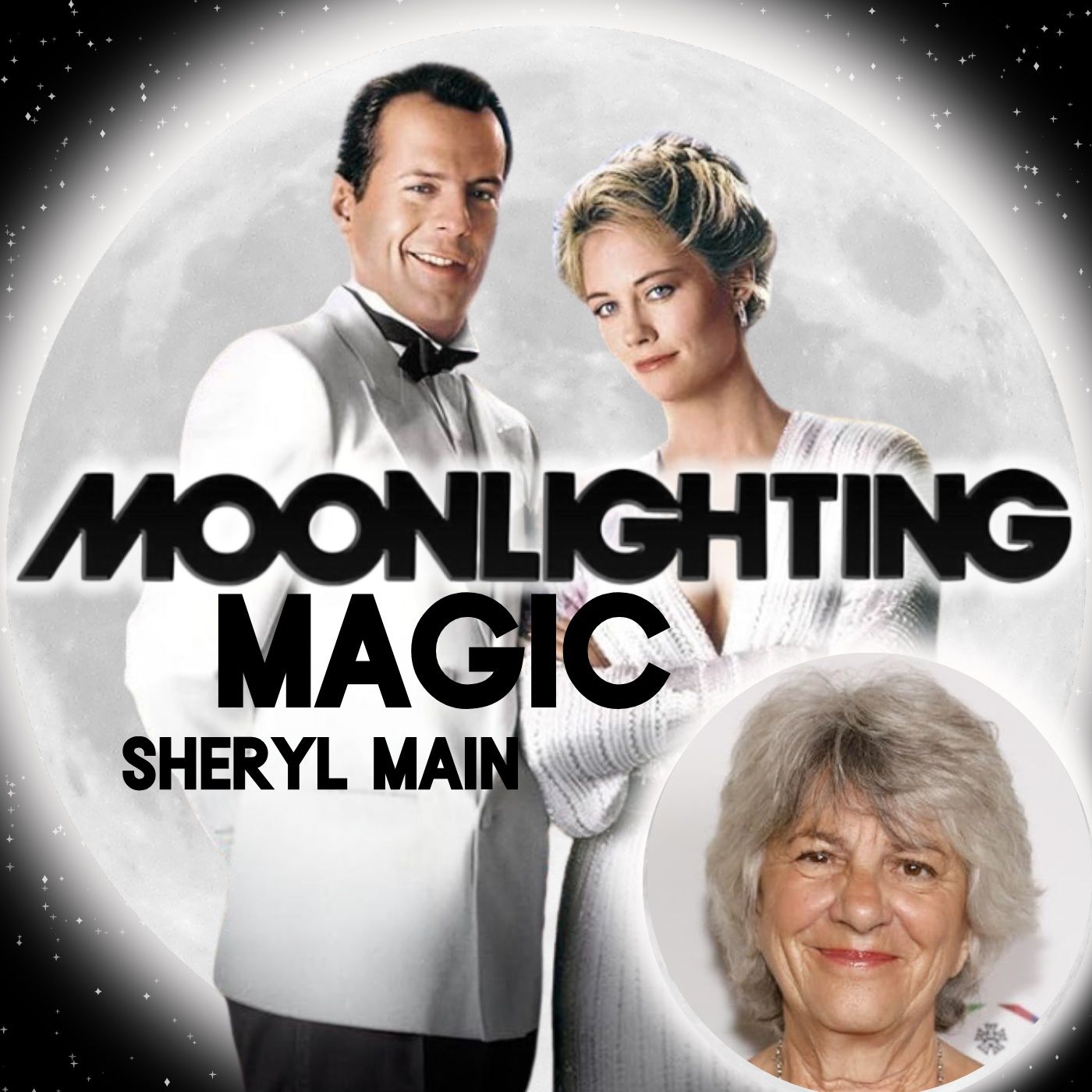
About this episode
Susan and Sharon take you “behind the scenes” with Moonlighting post-production supervisor – and legendary publicity strategist Sheryl Main. As a Unit Publicist, she’s worked on such films as Creed 3, Judas and the Black Messiah, The Expendables, Terminator 3, The Perks of Being A Wallflower and collaborated with hundreds of celebrities including Arnold Schwarzenegger, Sylvester Stallone, Clint Eastwood, Emma Watson – and everyone in between!
But she "cut her teeth" with Moonlighting. Sheryl talks about the “insanely creative” atmosphere created by Glenn Gordon Caron, the long hours and crazy good times – and the lifelong friends she “met on the way.”
THE CONVERSATION
- Experiencing sexism and harassment in the movie industry: The Pope of Greenwich Village director “Stuart Rosenberg sent me home for wearing pink jeans. So Mickey Rourke said: “$*@! him. Work with me. Be my assistant.”
- When she interviewed to be Bruce Willis’s assistant, she recognized him – as “Bruno Radolini” – his musical alter ego from New York!
- Moonlighting on Moonlighting: “The editors pulled all-nighters. They slept there. But we had fun.”
- On Glen Gordon Caron: “He changed TV when you think about it. Everything we did from ‘Atomic Shakespeare’ to the black and white episode to… well, we thought we killed Orson Wells.”
- ARNOLD AND SLY AND BRUCE AND ME: “They all impacted my career and my life in different ways."
- On Arnold the Governor: “We went up there thinking ‘Woo-Hoo! We’re gonna change the world! But the mechanism in place doesn’t want you to change the world.”
- On Bruce Willis: “He was a craftsman with words. He could memorize a scene in a minute. What’s happening with him… it’s heartbreaking. I wouldn’t have a career without him.”
AUDIOGRAPHY
Check out Moonlighting: The Podcast: https://moonlightingthepodcast.com/
Watch Moonlighting on Hulu.
Stream it on Apple TV or at Amazon Prime Video.
Follow Glenn Gordon Caron on Twitter.com/GlennGCaron.
80s TV LADIES NEWS
Susan’s new play Confidence (and the Speech) has been published!Now available for purchase and licensing at DPS via Broadway Licensing.
CONNECT
- Read transcripts and more at 80sTVLadies.com.
- Tell us your fav Moonlighting episodes at 8TL Facebook or via 80sTVLadies.com.
- Sign up for the 80s TV Ladies mailing list.
- Get ad-free episodes and exclusive videos on PATREON.
Visit 80sTVLadies.com for more info.
Listen to 80s TV Ladies at YouTube. Subscribe and help us grow.
Don’t miss out. Sign up for the 80s TV Ladies mailing list!
Help us make more episodes and get ad-free episodes, video interviews, and exclusive content on PATREON.
Transcript
Automatically generated, so expect the odd misheard name.
Weirdy Weird, Medium eighty, I'm So Pretty, Babies through the City, Get God, Then World, It's eighties TV ladies time join us as we explore female driven television shows from the nineteen eighties and celebrate those who made them. Here are your hosts, Susan Lambert had Him and Sharon Johnson. Hi there, I'm Sharon and I'm Susan. You know, I love hearing stories about how people got started in the entertainment business, particularly if they started in the nineteen eighties. And I like stories about people who shape their own destiny as a reinvent and redirect their lives.
Well, I'm hoping we might have a little bit of both. Today. We have to thank think our producer, Miss Melissa Roth, for introducing us to our next guest. Today, we'll be speaking with publicity and marketing strategist Cheryl Maine. Cheryl has over thirty years experience in both entertainment and politics.
She was a unit publicist for movies like Creed three, Judas in the Black Messiah, The Expendables, Terminator three, and The Perks of Being a Wallflower. Before becoming an independent publicist, Cheryl worked as a senior publicist and executive at Warner Brothers Pictures for nine years, and in between her film work with Arnold Schwarzenegger, she was tapped to be deputy communications director for California during his term as governor. She's an expert on international, high profile publicity campaigns. Cheryl's a communications consultant and strategists for many organizations, including IAZZI and the International Cinematographers Guild. And the last one is where you met her, Melissa, right.
Yes, we both served as national executive board members for IATSE Local six hundred, which is the Cinematographer's Guild. Publicists joined the guild. That's why Cheryl and I were together. Well, that's awesome. But if it wasn't impressive enough all that stuff that she did, Cheryl Maine is a true blue eighties TV ladies, which is why we are bringing her on to talk with us today.
In the early part of her career, she spent five years on the groundbreaking television show Moonlighting, starting as an assistant and working her way up to post production supervisor. That's impressive, Cheryl, thank you so much for joining us here today on Adies TV ladies. Thank you for having me. I'm so excited to talk to you guys. Thank you.
We are so thrilled you took the time to tell us about your career and your time at Moonlighting. But I want to start in that you were the co chair of the twenty twenty three Publicity Awards. Correct, I think for the last five years I've been the co chair. So and you know again on March eighth this year, twenty twenty four. I mean, it's just been a year in the entertainment industry.
Yeah, how did publicists do during this time of the strike? You know, COVID kicked it off. And actually I was in Cleveland when COVID first hit. I was doing a movie called Judas in the Black Messiah and we were across from Cleveland Clinic and they started talking about crazy stuff at what was going on, people getting really sick, and so that's when I heard about, you know, COVID, But we didn't think much of it until it shut everything down in March of you know, twenty twenty was it right March thirteenth for us anyway? And I was working on The Morning Show, which is a show for Apple, and yeah, we just got to fall and that's it.
So it was that part was tough, but they you know, the studios and their networks. I thought it was amazing. I'd never had this happen before. But like Apple paid us for several weeks, I don't think anybody knew what the hell was happening. And then when we got the call to go back, it was hard.
It really was emotionally and it was just psychologically. It was weird. But then you had this, you know, on set, you worked with this group of people and so it almost became a safe place, which is totally wacky, you know, but it did, you know, And the strike was a whole different world because we weren't on strike, but we were supporting the actors, the writers and their mission. But it was really difficult. You couldn't go to work, people were losing their homes, people were getting angry, weren't under standing.
But then this thing called IA Solidarity really started coming together and people started realizing that you have to support and you know, the IITs is going into negotiations on March fourth, and they're not afraid to say that they will call for a strike vote if we don't get what we should get. But then Mike Miller, who's vice president of the IA told us the other day that he feels that, you know, we're going to get there, but it's a little freaky thinking that maybe we're going to go on strike again and nobody's recovered because the recovery is slow. I mean, I know everyone thought this was going to be, oh, here we go, everybody's going to work in five minutes. But the things that went back were the things that were already in production.
And it's a little dicey still. But you know, I've worked in this business a long time. I've been through two strikes. It's not good. You know, there were folks that really thought we should have gone on strike the IA three years ago, and we're very angry about it, and they kind of changed their tune once they realized the collateral damage.
I mean, it's it's epic, it really is. And you know, is there a winner? I mean, you like to think negotiations are about negotiating. You know, we shouldn't be fighting, we should be talking and figuring it out. And you know, you can't a studio can't say we had the best year ever and then say, but safety and all that costs us too much money.
So you know, it's it's a conundrum. Yeah, that was one of the most frustrating things to me when the writer strike happened, that the studio is basically just walked away and refused to talk. As you said, you've got to negotiate. If you don't talk to each other, you can't negotiate. So I didn't and I don't understand that.
But I'd like to think that there's no appetite, especially on the studio side, at this point, to go through that again. Yeah, well they have a little bit of time, which is good, yes, but speaking to the producers, I mean when somebody came out and said, eh, you know what, letting me eat cake, basically it's like, dude, seriously, no, But that's you know, so anyway we're going to see I think, you know again, I want to maintain some positivity and this IA solidarity thing has really come to fruition and I'm happy about that. I think on March third, there's going to be an IA solidarity gathering in the valley at one of the parks, and I'm really looking forward to that. Thousands of people could show up, and you know, that's a visual that you can't you can't deny, you know, we're human beings.
So yeah, yeah, being in solidarity makes it a huge difference, you know. Well, even the Publicist Awards, you know, we had to find we've historically been at the Beverly Hilton. They hadn't settled their strike with their workers, and we told them upfront that we were not going to go anywhere where workers weren't paid a fair wage. And it's important that we all support each other's fight because you know, we've seen what happens when we don't. Right, Yeah, So there's that.
All right. Well, you are a powerhouse so unit publicist, an international PR expert, a crisis management expert. What are your favorite parts of being a publicist? Oh well, I don't think anybody's ever asked me that before. Well, first of all, I grew up wanting to win an Oscar.
I mean I used to get dressed up. Honestly, I was such a dork. But I would get dressed up and watch the Oscars and my mom would be like, you know, she'd feed into that. She was all into that as well. But I still believe in the magic movies.
You know, no matter what's going on, if I've seen it happen twenty times I still stand there and go, holy crap, how did they do that? I like the familiar feeling of working on a project. Everyone has the same goal. You don't have to like each other, you don't have to agree with each other, but working together proves that you can, you know, have a goal no matter what and make something good happen. So I like that aspect of it and being able to be creative and come up with ideas and strategically thinking about how to engage people to want to see or you know, experience what you're doing.
So it all came together in some very weird way for me, and I'm just I'm like, are you kidding me? I love what I do. I'll do it till you know I can't. And it's just the blending of perfect worlds. And when I mentor people, I try and make that point very clear that you know, you can do something that you love and like it and have fun, you know, yeah, I mean it's the entertainment business should be entertaining to be in.
It's not. And you know you know that as well as I do that. You know, especially back in the day, you know, the entertainment was harassing people. You know, Yes, So did you grow up in New York. I was born in Pennsylvania, outside of Pittsburgh and split my time between there and New York City.
I wanted to go to acting school, and so I went to New York and studied with Uda Hagen, and I was terrible, but I got in the world, you know, and there was an ad in the New York Times that said director looking for an assistant, and I thought, well, how hard could that be? And so I made an appointment and I went and turned out to be John Ableson, who had directed and won an Oscar for Rocky, and he was looking for an assistant, which I didn't know at the time he couldn't really keep an assistant, but you know, I took the job. It was my introduction, was my first job, and I learned a lot, a lot, a lot, and then I got the hell out of there and started work as a PA on movies. So I was a production assistant on Actually I was the director's assistant on the popa Greenwish Village, but they'd gone through three directors and Stuart Rosenberg who became the final director, Bless your heart, Stewart.
But he was a little bit of a misogynist and you know, told me to go home one day because he didn't like the fact that I had pink jeans on. So anyway, Mickey Rourke, this is the first time I felt like people took care of each other in this business. Is Mickey Rourke heard him do that? And he came to me and he said him, you'll come and work with me, You'll be my assistant. Wow.
And so that's how. Yeah, and that forged a relationship with Mickey that you know, I still see him occasionally. And so, yeah, isn't that amazing? Like the power that there isn't reaching out to somebody in that moment, that's huge. And it's always nice to hear people using their power, for lack of a better word, for good and to be of assistance to someone.
So that's really great that he did that for you. It happened to my Glenn Karen was like that, but it happened frequently in my career. But here's the thing I find really interesting. It was always men, never a woman. I wish I could say I'm surprised that stood up or that took you out, ah both, you know.
So I think that in itself helped me to like want to help women girls whatever, I mean, anybody really. But and I was a girl girl, you know, I mean, I you know, I grew up around a lot of guys, so I was feisty and I could fend for myself. But my girlfriends were my friends. But at any rate, that was that. So there weren't a lot of women at that point in the movie business.
Yeah, and so it mattered how you were treated. It mattered to me. And I wasn't afraid to lose my job. You know that that's the worst thing. You don't want to buy back because you know, oh, well I'll get fired.
Well you know what, if that gets me fired standing up for myself, then I'm doing then I'm not in the right place anyway. But it's also a popla grunge village. That's where I first learned about publicity because Shelley Kirkwood Jean Kirkwood's life was a unit publicist. Her and Howard Brandy, who was famous. Howard was a very famous publicist, and they would come to set, and every time to come to set, everybody was like, oh, we got to take care of them, and you know, and you know, it just created a hum and I was like, oh, I wonder what they do.
And then you know, of course I went up and said what do you do? And I found out about publicity and I thought that's a really cool job. But it didn't interest me at the time because I thought I wanted to be a producer. And then so Pope of grins Village and you worked on another film during that time in New York. Yeah, Pritsy's Honor Party.
Yeah, something big. That's actually how I ended up in California because John Houston, I mean that set. I can't even tell you. I mean, I learned that I have big balls because I could stand up to Jack Houston and he threw my walkie talkie away because he didn't want me to tell people that he was coming to set. But John Houston and John Foreman, who was a producer, I don't know.
I think they saw me as some goofy girl that you know, just was very earnest and I would always deliver. So they were coming to shoot Out, La, and they said, if you can find a place to stay, we'll fly you out there and we will pay you. And so my aunt and uncle lived out here in El Segundo and that's what happened. And you call him Jack? I did call him Jack.
Yeah, he called me a painting me. She called me all kinds of things because I don't think he can remember my name. But that was okay, you know, that is fantastic. Yeah, but why did he throw your He threw your rockie talkie. Yeah, Betty and Fishman and I were the two pas on the show, and uh, you know, we would run base camp basically and then do whatever needed to be done on set, and she was doing something else, so they said, go get Jack.
So I went to get Jack, and then, you know, I wanted to read professional. I pulled up my walkie talkie and I said walking to set and I said set and he grabbed the walkie talkie and flung it and he said, don't do that. And I'm like, okay, Yeah, I got to set and they said where's your walkie talkie and I'm like, I'm not sure was flowing? So there was that all right, Oh my god, that's you're just taking me back to the early my PA days. Yeah.
Listen, my first job as a PA was a parking PA in Brooklyn, where I had to tell people they couldn't park in front of their houses overnight because the trucks were coming in, and one guy came out and threatened me and said, you know I'm going to beat your I started crying and he said what are you crying for? I said, I'm gonna lose my job. And I ended up having spaghetti with him and his wife and two kids that night and didn't lose my job. I said, I'm Italian. He said I'm Italian, so then we were both Italian.
That was the end of it, all right, So Jack Houston, I'll get you out to la And how do you end up on moonlighting? While I was out here, somebody said, oh are you you know? Are you staying here? And like, hell, now, I'm going back to New York. That's too many blondes.
People are too slow. Nobody's awake. You know, in New York you have to be awake. You're walking on the street, you have to you know what's happening. You're aware, you're alive.
Here it's like la la la la. And it just wasn't my vibe. You know, I couldn't. But they said, well, you could really work a lot if you came out here, because you know, you I had a little bit of an attitude and and you know what, I have a great sense of humor. And again, I wasn't afraid to do something, and if I didn't know how to do it, I'd figure it out or find somebody that could show me.
So I was resourceful and resilient, and I think that's really important. So ABC Circle Films is who produced Pritsy's Honor, And so I got a call from somebody and they said, there's a new TV show. They just shot a pilot. The actor is going to be very hot. He needs an assistant.
Are you interested? And I'm like, yeah, okay, I mean I'll take the meeting. Why wouldn't I, you know, And so I took the meeting and I walked in the room and I'm sitting there and then this guy walks in and I'm like, Bruno, what are you doing here? And he said, well, what are you doing here? And I said, well, I don't know.
I'm interviewing with some guy named Bruce and he said, were you idiot? That's me. I knew him as the bartender of a cafe Central who had a band called Bruno and the Something others. We called him Bruno. I didn't know he was freaking Bruce Willis.
He didn't know he was Bruce Willis at that point, and so I you know, I mean, I knew him when he walked in, I'm like, what is happening here? What just happened? Anyway, we were both like, no, I'm not I can't. I can't work for you, you can't. But apparently he went to Glenn and said, could you give her a job?
And Glenn gave me the job as the writer's secretary. I knew nothing. First of all, I wasn't a very good typist. Oh my god, when I think about it, I don't know if I should be saying this, because Glenn's going to be like, I didn't know that, what's he going to do about it? Now?
That's true. And we didn't have computers, so they would type the pages, then they would give them to me with the rewrites, and I'd cut and paste and copy them and put them all back. And generally that was my that was my job. I don't know how good I was, but they were so nice to me, but not too and I didn't stay in that position very long, but I'm not surprised. And then I moved into post production, which I really knew nothing about.
But yeah, but that's the way it was. I mean, Glenn and Artie Mandelberg and Jay Daniel it was kind of like an open door, like, oh that's interesting, Well, okay, you want to see how that works, you know. And I mean it was such a crazy place anyway. It was just full of creativity and craziness that you know, the doors were just open and it was so wonderful that way, you know. So I took the opportunity to learn what I could.
Were by any chance you at the start, the only woman in post production at that time, No, Kathy Peacock was the post production coordinator and then she moved up to supervisor and then she left to get married, I think, or have a child. But no, there were a lot of women on our show. That was Glenn. It was just I think if he liked you, if he felt you could do a good job, and if you had that creative thing that spoke to him. Because Glenn was just a ball of genius creativity.
I'd never met anybody like him, and I've met some serious people, but I've never met anyone like him who could write the perfect dialogue, come up with the perfect story, find the perfect song, do the perfect casting it. And I'm telling you, when you're somebody like me from beaver Falls, Pennsylvania, watching that kind of it really sparks whatever you think you might have had, it just bubbles it up. It sounds incredibly inspiring. I'm so curious because clearly they just gave him a show like he hadn't made a show, and then they let him do moonlighting like we were Sharon and I were like, how did they do that? Yeah?
Well how did they do that? It was all meant to be. It was just symbiosis in full effect, you know, just I mean, how did he find these perfect writers? Roger Director, I love that man so much. He was so freaking funny.
He was Woody Allen without the creepy and you know, I mean just I just think about our dps. I think about our directors. I think about you know, Robert terteris our costume designer, and Bill Harp, who was our pop Scott. I think about these people, how they When you watch the show and you look at it and it looks like everything is supposed to be there, nothing looks out of place. Nobody looks out of place, you know it was.
It also gave me some lifelong friends. Dennis Dugan and I we have the same birthday. We just celebrated super Bowl together the other day. We're close to forty years. You know.
He was Sybil's Husbands when he directed. Yeah, all right, and everybody hated Walter Bishop and they had to figure out that. I think they killed him out. I don't remember what we did to him. But you know, Dennis had been this amazing actor Hill Street Blues and you know, Brockman and all that stuff, you know.
But yeah, so then he started directing, and that's when we really started having fun because he had such a crazy sense of humor. And Glenn by that point was becoming, you know, a movie director and giving Michael Keaton, you know, the role of his lifetime in Clean and Silver. Yeah, so you kind of stayed for the whole you were from, you know, just past the pilot to the end of Moonlighting. Is that. Yeah, Yeah, I would have never left.
I would have stayed for thirty years. I but you know again, when it ended, I had nowhere to go. I didn't have any I didn't know where I was going, and Glenn had a deal with Warner Brothers, and he said, well, you'll come and work with me, David Willis, myself, Melissa Jellano. We were like three musketeers. But yeah, Glenn did that, or I could house it for him if he went away to make some I mean, he always made sure that we were taken care of.
And then they did a pilot Partie and Roger director did a pilot called Mimi and Me and I worked on that and then when that ended, it was like I had nowhere to go, and Warner brother said, well, you can work here if you want to be a tempt But that's a whole other story. So what was it like working in post production on Moonlighting, because and talking to GLENNT, it clearly was all over the place in some respects. Let's say, well, production was interesting simply because they'd be sitting on set waiting for pages, I mean for post production. I think I was never so tightly wound as I was the night we literally transmitted the show from ABC directly to New York because there was no time to do whatever.
So that one was basically live. It was it was us, it was it was yeah, and that was like, okay, I don't think it's supposed to do that. We did it, and it was successful because Gunn believed in it, honestly, you know what I mean. And he told us, oh, don't worry about it. That was Glenn.
He was so laissez fair about it. Was like, I know, he must have been biting fingernails or pulling his hair out behind closed doors, but he'd walk around, you know, the office with his hands in his pocket and you could hear the change ginger man. I thought, Okay, I said to Muffy Melissa, he's thinking about someone, you know, and it's like, okay, they need the pages. They can't do anything. And then the pages would go flying down to the set post production.
I think back to the editors like Neil Mandelberg and Chris and Phil Neil. I mean, they pulled all nighters. They would sleep in the editing room to get the show on the air. But that's how committed everybody was, and that's how hard everybody worked to make sure that we succeeded in that Glenn success eat it, you know, and it was really that's really kind of why it was so wonderful. We've just started talking to people from Moonlighting but it definitely seems like it was a like a really fun circus you guys were all doing.
Yeah, we created a circus. Listen one night, I don't know what happened or how it happened, but I remember Clive our transpot captain. The next thing I know a few of us were in Sybil's motor home driving down having a party, driving down Pico Boulevard. After we wrapped, we did a parade. It was Curtis Armstrong Day.
We did a parade on the lot. We had I think I have videos somewhere, but it was yeah, we had we had people with cheerleaders, Sybil was, I mean, it was yeah, that's what we did. Yeah, it sounds like for all of the stress and drama of getting the show on the air, sometimes there was still this opportunity to just have some fun. Yeah, that's fantastic. Well, and Bruce made it fun.
Bruce was so fun and we just had a great cast, you know. I mean there were things that weren't fun, but I really think all of us think back to the fun and the problems we got through them. Okay, so we're gonna have to take a quick break because Melissa keeps nodding at me, but we will be right back because we have more questions and we're back and better than ever. So what was the most challenging part from a post production point of view in your mind particular to this show? I think it was time, to be honest with you.
Time really was the most challenging because you you know, we were doing color correction because we were shooting on film, so I'd be out in the valley until six, literally six in the morning, you know, color correcting. I don't know how productive that necessarily was. But we had some fun at room as well. You know, I mean, what do you do right? But the answer for me is time, because there wasn't enough of it and people got burnt out, and you know, we had to deliver.
If you didn't, there was no show if it wasn't right, you know, Glenn, little boy, you don't you know, it has to be right, you know. So there were a lot of challenges, but you know, everything we work on is challenging. It's just that back in Moonlighting days, we didn't have all the computers and all the technology that even though it complicates things, it makes a lot of things simpler. But we had such good people that you rarely wereorried about the quality. I mean sometimes we'd have a director who should have not been directing, and you know, trying to cut around that.
That's the editors, you know. Me, I was just there to finesse things and make it really look good and find some music and you know, but it was really on the editors. They performed some real magic. They did, they really did. And the music.
Speaking of the music, Glen said, three hundred needle drops in the sixty episodes. That was all Glenn. I started working with the editors and already our producer on music. But Glenn set the tone because the way you get music was interesting because I didn't know how to do that. But Glenn, I remember needed Sympathy for the Devil by the Rolling Stones and it had just come out on CD because CDs were fairly new, and he said, can you get that from me?
And I'm like, yeah, I know, I don't know. I mean, what the hell is CD? So but I used to listen to K rock. So I called the radio station and Jet the Fish, who was a very famous DJ at the time, answered the phone and I said, Hi, you know, I'm calling. My name is Cheryl, I'm calling from moon Lighting.
He goes where I said Moonlighting. He said, that's my favorite show in the world. I said, oh, I need a d I need a CD of Sympathy for the Devil. He brought it over the next day and then he became our biggest fan. Always talked about Moonlighting.
Freddie Snakeskin dj't a couple of our parties. Uh you know anyway, Yeah, oh my god, the Power TV. I was just thinking of the eighties. I'm so glad you did this funny that would not happen now. Nobody's at the radio station anymore, right, starting from there, but no one an office apparently, well, all corporate and fed in from somewhere else, and they rarely anyway.
We can go on for days about that too, but that's the beauty of the podcast too. We can talk as much as we want. Yeah. I love Editing as our friend. And you talked about Dennis Dugan and Glenn Gordon.
Karen, what are the relationships came out of Moonlighting for you? David Willis and I stayed in contact. I love those guys. I loved their mom. You know, they're just good people and good Jersey people.
His brother. Robert was somebody that we all knew and loved as well. You know, Melissa Jellano, her and I are besties and her husband and I ran into Buffy Snyder, who was one of the costumers. She was doing something for the IATSE and I was at one of the meetings and she goes, I'm puppy Snater, Like, oh my god, Buffy. You know, so I run into moonlighting people.
Maybe four years ago we did a moonlighting gathering, was the first one we'd done. I think it was twenty years since the show had gone off the air, and we all met Glenn and Roger and the writers, and David Bruce wasn't there because he was out of town. I think Curtis came. But yeah, I keep in touch with quite a few people. They became lifelong friends.
What changed for you during that time, I mean you went from being kind of an assistant to the supervisor of post production. Well, I think what happened is I realized that if you do the work and you get noticed by the right people, you can actually survive. I just tried to do the best job that I could. I tried to connect with folks that had the same I don't know vibe as I did. Basically, for lack of a better word, I wasn't interested in being you know, running the world or being the greatest.
I just wanted to do a good job. I wanted to do that job. I wanted to be doing it on something that I liked, with people that I could care about, not all of them. Again, you know, I don't even like all my family, so I'm not going to like everybody that I work with on a show. But you know what I'm saying, So I think for me, you know, all of it just really kind of helped me.
I wasn't a very confident person. I was ballsy, but not confident. I wasn't afraid. But I learned to be a little bit smarter, to think smarter, and I learned to play the game. And that was the most crucial because I in the very beginning, I took people for what they said or at face value, and I really learned some tough lessons and I thought, Okay, you want to play.
I love playing games. I can play. I'm good, and you know what, I started having fun with it rather than sending me home crying or you know, me saying, you know what, this isn't for me. It was for me. It wasn't for me.
Is the crap that people tried to feed me, or people would try and take you down because they were jealous, or they just didn't know that there's room for everybody. You don't have to be afraid of that. There's room for all of us. There just is so at any rate, you know it was it was life lessons, and everything that I've done has been a real life lesson that now that I'm at this stage in my life, I just feel really fortunate. That is so great.
Well, so, when you started off in this crazy business, as I like to call it, working on the feature side, then came here and worked in television, and after Moonlighting ended, had you formed any idea in your mind about which you preferred or did that not matter as far as you were concerned at that point. That's another good question. I don't think I thought about it. It wasn't by design, And I think because of my experience on moonlighting, because it was like shooting a film every week or every ten days or whatever we were doing, that I didn't I didn't have enough experience to know that there was a difference. And then once I did start working Warner Brothers, then you know, everything became feature oriented because I was you know, I was assigned features.
I mean that's I was in the international film publicity department. So Moonlighting very famously had a lot of challenges with actors getting along and actors getting along with Glenn Gordon, Karen and actresses. What was your experienceshing share El She's fishing. I always going off. Whatever dynamic happened in terms of people arguing or maybe disagreeing, it was always creative.
It wasn't personal. And now there were times when certain people were going through personal things and it became public and so that makes it even harder. But my experience was that Glenn was the godfather, and yes, you get pissed off at him and maybe confront him on a certain level, but it always had to be about something, not just because you were feeling like you could have a tantrum or you weren't feeling loved that day or that kind of thing, you know. So I never felt that it was any of that. And you know what, again, sometimes I was Pollyanna.
I could have been totally off, you know, off on that. But that's my experience and not because I want to sugarcoat it, because you know, I know the reality, I know what happened there. But my takeaway was just that everybody really wanted it to be good. It just wasn't always good. Well, Glennon did actually say the very same thing that, Yeah, ultimately it was about the work.
Yeah, yeah, yeah, oh good. I'm glad. No, you'm glad because yeah, but it was nuts. It was no boy. Well, and it's this.
It was big personalities doing creative work in a very hot pot. There was a lot of ego involved, and that's a big problem. But you know, we work in an industry where there are I mean, you know, it's a narcissistic world. There's a lot of things in people that become affected by it. Well, it's so interesting because you've gone on to continue to work with really really big personalities.
Yeah, so did you grow up with big personalities? I would say I grew up in a big Italian family, so they were loud and opinionated. I was always the one that just sat there and watched like I was watching a movie. You know, I just but I learned to talk, so big personalities perhaps, but more that we just did stuff. We just you know, went for it.
I never thought about, well, what's going to happen if that doesn't work. I don't know that that's a good thing. But that's how I worked. And then you would find out it wasn't always the positive thing. But you know what life is.
That's what happens in life. So yes, yes, all right, So let's talk about your transition to publicity and what drew you there again. I was having the best time, you know, Glenn's deal closed and everybody left the Warner Brothers lot. Warner Brothers said, oh, if you want to be here, you can go into the temp pool. I did not know what that was.
I had been a post production supervisor. If there had been another season, I would have been associate producer, right yeah, And I thought, okay, I mean Warner Brothers, I'm on the lot. Okay, oh okay. So they called me and said, we have a job for you in the glass building, which was a new building, and you'll be a receptionist. And I'm like okay.
So I went and I sat in this big desk. The phone never rang, nobody ever asked me anything. I was there for three days and it was just people moving and I'm like, oh, I don't I would go home and cry. Honestly, you know I would. I would think to myself, you were the post production supervisor DLin.
Well. Aside from that, I was like, but I don't know what to do. I did not have a plan, so I didn't have Okay, well I don't need to do this. I can go do that. I was letting things carry me along, and it's when I realized that sometimes you have to take a few steps backwards to go forwards.
Because I got a call from the temp girl and she said, I have a job for you. It's open ended, see you know, but it's an international publicity. I'm like, okay, I didn't really know what that was, but I like international and I knew a publicist Shelley Kirkwood from the Popa British village days. But anyway, I went there and it was a whole different world, something i'd never experienced, where you were in a creative world of people throwing out ideas and doing junkets and set visits to the sets. And I started out as the temp then I became they hired me.
Almost two weeks later, I became a junior publicist. And then they made me a senior publicist and that's when I took over my own films. So there were two of us and we would split twenty films between the two of us, and I ended up getting like Steven Segal Clint Eastwood, and she was getting the animated movies and the girl the flick chick Flicks. And I'm like, wha, wait a minute, I want the chick flicks and you know, all that stuff, and you know, until I met Sly and then I was like, oh, I get it, because then I realized that it was my personality and my lack of fear that kind of made me kind of nonchalance, like, Hey, this is the job. I'm this is what you got to do today, and if you don't want to do it, I'll tell the studio you don't want to do it, But honestly, I think you should do it.
It's your movie. You don't do it, who's going to do it? Right? So I kind of found my superpower, which was being logical and strategic at the same time, which doesn't always go hand at hand. And so, yeah, I had a blast at Warner Brothers.
I traveled the world, I you know, and I met Arnold Schwartzenager and then everything really changed. Yes, listeners, we're talking about stallone. Yeah, oh I'm sorry, Yeah, okay, I'm enjoying it. And you know, and Arnold is Arnold Schwartzenegger because you know, of course two biggest action stars history, me and me. And it's hilarious.
I mean, you know, but it was kind of what I had carved out for myself without knowing it. Actually somebody else carved it out for me. Putting people together wasn't an organic thing. It was a strategic thing, I guess, you know. And so yeah, I lucked out.
I hit the I hit the jackpot. Well, and you had the chops. I was going to say, to handle the situation. Yeah, So can you talk a little bit more about what it is that a unit publicist does. So before COVID and whatnot, you know, we would coordinate the set business where you'd actually bring press to the set and they would do interviews and you know, with the talent, you'd circle cycle them in and out and you could create events like on three hundred when I was in Bulgaria and they were bringing the Hollywood Foreign press and now the Golden Globes folks over to do the interviews with the talent.
It was like I got to create, you know, I asked the coutume designer, can you give me some wardrobe? And can we have some props? And can we do this? And we created a whole experience. So that was fun.
You know. I got to do that on terminator and on expendables, and you know, you I realized that, Wow, you get to use your creative juices to help the studio sell the product while you're in production, because once you're out of production, you do you can't go back, you know. And that's why we have behind the scenes they call it ePK. It's kind of a misnomer, but we have DP shooting stuff behind the scenes, and you have the unit photographer who captures these beautiful, wonderful images, and then you have the unit publicist that coordinates all of that and takes what the studio wants and makes it happen within the confines of the production because each production is really different. All the talent is different.
What they want, what they don't want, what they'll do, and what they won't do. You know, not every producer or director understood the value of capturing all of that information. You know, in production, you know, and the unit publishists job is to make sure that you gather this content, you create this content, you don't impact production that everybody feels comfortable. So I mean that's the part of the job. We write the production notes as well, so we tell the story from being on production point of view and getting quotes and anecdotal stuff that you would really know about if you weren't there.
So that's kind of in a nutshell. I don't know that that's a great explanation, but I told you all the fun things. Yeah, as the unit publicist, would you be the one that comes up with the plan for the content you want to get and how you want to do it, Like you mentioned the arrangements you made on three hundred. You know, it's a partnership with the studio, so you know, they'll say this is what we're hoping to get, and then you let them know what you know, what their constraints are for that or what you can make happen, or give some alternative ideas, you know, if that won't necessarily work. So it does become where you work most of the time, very closely with the PR departments at the studios and the personal publicis, you know, because you can't really do anything with talent without the personal publicis being involved, nor should you.
But it really is a collaboration and I love that part of it as well. And so you have to know when to you know, speak up, you know, and also when to shut up. There's that I'm usually good at one of those. I usually get both of them at the same time. Well.
And also then you have to keep up with production schedule just in case there's something exciting happening actually, you know, stunts or music or whatever. If there's something exciting happening on the day, you have to be there to cover it exactly. Yeah, And I think that's one of the reasons I became such a good unit publicist is because I had the background of how a studio works and what they need to function. And you know, I mean, to me, that was just that was a gift being at Warner Brothers, because you know, when I started working with the unit publicists, I thought, oh yeah, and then when I became one, I'm like, oh yeah, it all helped. That's good, It really did.
There was always something that I could take away that I think just made me smarter in terms of how I could function on set. And what were some of your favorite projects that you worked on both at Warner Brothers as an executive and then in your early days well Warner Brothers. You know, I was so lucky. I mean I worked on Unforgiven, which blew my mind. I worked on Fearless, which was a movie that haunts me still.
It was Jeff Bridges about an airplane crash and I'm blanking Rosie Perez. Powerful, powerful movie. I mean, I really had fun at Warner Brothers because I was people like Nancy Kirkpatrick, who she's the reason I met Arnold. But you know, they would look at this late and you know say, well, I think she'd be better at this one. You know, doing this one than this one.
I got some lightweight stuff and I wasn't very good at it. I need a challenge, I have to say it. I want to challenge. I want somebody to like make me go for it. And you know I like people to tell me no so that I can go.
Oh. Yeah, you know that was your training for Moonlighting. Yeah, well there's that, yes. But speaking of Fearless, I remember that scene where he is going to prove to her that she couldn't have held her baby and runs into Wad like I will always remember that scene. Yeah, yeah, so vividly, Peter where Yeah, You've also worked with some young stars or unknowns or people that were just popping.
I mean it sounds like your favorite is you know, the Big Gorillas. But you know, what's it like, how do you what's your approach different when you have sort of Schwarzenegger versus a kid who did a great Sundance film and now is you know, doing their next or I don't think that For me, there isn't a difference. It's it's it's a movie, it's a you know, there's a job to be done, and you know, I generally really really am fond of the people that I'm working with. I mean, the perks of being a wallflower was probably Yeah, I forgot about that, and I loved working on that movie so much. And the kids, as I called them, you know, I mean Emma, I mean she was one of the biggest stars ever.
And Ezra was the sweetest, kindest. The whole cast looked up to him because he was such a good actor. He was so good that you know, they just we all fell in love with them, but I don't. I think I do a little more mentoring with them, like I taught. I did some media training with most of them.
But my approach, honestly is they're all actors, because I think if I thought about it, I'd get freaked out. You know, I think, Okay, that's Arnold or that's Slide. These are people I'm like, ah, But I oh, it's my actor that I'm working with, and they need to do a job and I need to do a job. And so I think that's kind of what gets me through. Really Again, I get caught up in the movie making because that's you know, I'm just always just so in awe of the work that they do.
You know, seriously, are there ways in which the work that you do has changed for the good or for the not so good over the years. Well, I think some of the change was our fault, because you know, there are only maybe fifty unit publicis. I mean in the guild, I think there's around three hundred publicists that include studio and whatnot. Unit publishers are very very very small, and our skill set is different. But what we learned a few years ago is that you have to come together.
You can talk about pub us never wanted to talk about their rates. I mean I had one person say to me, I didn't know you could ask for more than the minimum, And I'm like, Eve, been doing this for fifteen years, How did you not know that? Oh? My goodness? Yeah, stuff like that, right, So we have become much more cohesive as a group now where we communicate more.
We started Unit Publicist Council within the guild so that we had a voice. We're the only ones that work on set, were the only on call employees. You know, we get affected when there's a shutdown. The studio doesn't the studio pubs they were they and bless their hearts. I'm glad they do because they contribute to the health and the pension.
You know, our healthcare stay strong because of you know, the people that work for years, you know and contribute. So but yeah, we we're learning to talk more about what we do. End up fight back when they want to bring on a social media person with an iPhone to not only do my job, but to do the unit photographer's job, and that's a hell. Now, well but they belonged to the actor. Well, then the actor needs to hire somebody and the job will get done.
So we have to be vigilant and we have to remind people that when there's an accident on set and you have somebody like a unit publicist, it's something that you can't buy with our expertise and how to handle the press and how to get people to calm down. At Local six hundred, when Helena Hutchins was killed on set, you know, on rust our DP, we created a war room. And you know, because I was a unit publicist, I understood what was happening on set while everybody else understood what was helped, you know, what needed to happen with and so we need to create messaging and to do the right thing and you know that kind of thing. So I always see a unit publicists just the most helpful person because we know so much and and we can dive in and we can you know, move fast.
And that's the power that unit publicists bring to everything. I think, Oh, that's pretty great. Yeah. Oh so we talked to Glenn Gordon Karen, Oh you got the big Kmuna. Yeah, that's awesome.
Yeah, Well, Glennon's storytellers, So I'm sure there was no lack of anything, because he can tell a story and he's funny. I mean, he's just he's so and he's so self deprecating. Sometimes it's like, oh my god, one of the you know, this guy who just like changed everything in TV. Really, when you think about the stuff that we did, from the Shakespeare Atomic Shakespeare to the Black and White Show, I mean we all thought that we killed or Wills. Don't we killed him?
No, we felt so bad he died right, he gave him one last one a little bit longer. I'll tell you. So you were on set with Orson Wells. Yes, I was. Actually I went over and spoke to him because that's Orson Wells.
Are you kidding me? I mean I don't, you know, and I'm not really that outgoing, but I was like, Hi, my name is Cheryl and I we're just so excited, you know. I was just an idiot, But but it was okay. I mean he was like, okay, thank you, where are my lines? We were all so mesmerized, you know.
But that was Moonlight. That was Glenn. I mean, you know, the Billy Joel song. And then he had you know, he had the dancer Stanley Donon and I mean, holy crap. I mean the crap that was going on, and we're like our heads are exploding, yeah, and looking back on it and remembering just how different it was from anything else that there was on television for a long time.
And nevertheless, the audience just loved it, really really loved it. I mean, I can't tell you as we've been meeting some of the people that as we tell them about the podcast there and everybody says, everybody says, are you going to do moonlighting? Wow? Before? This game is so unusual.
I mean, they really broke the fourth wall. There's a lot of things I don't know that anybody has done since, and you know, just anyway, I don't think they could and I don't think you know. I mean, listen, there were conversations with the studio. I mean, when you're spending a million dollars or whatever, you get some serious conversations. And you know, you see when the door slams and Glenson is office like okay, and then he come out with hands in his pockets, jingle and the change, and you know, everything was fine because they knew they bought into a creative process and we delivered ninety percent of the time.
There were a couple episodes that just because of what was happening, it just became really hard. But and you know, our fans were really vocal. Y ya, yay. You know, we didn't really have the internet, you know too much there, but our fans were very vocal. And that's how Dennis Dugan got the No Walter vision.
And then you know, the baby dying or the you know, the miscarried whatever it was. It was like, Wow, we're really tackling some serious stuff here and people are paying attention and is it entertainment to a certain extent, but it was, I don't know, it was also life lessons, you know, because that show just was so singular. There is a lot of heart to the show. It is very sincerely done, both in its goofiness and in its loveliness. Yeah, and willingness to go places and do things because somebody had an idea, this is great, let's try this.
It really was like, let's go, let's go out to the barn and put on a show. Yes, and we did, and you know, yeah, so again, I mean, when you have that kind of experience, it really stays with you forever. You know, it just does, because it really informs so much, and if I hadn't had that, I'm not sure I really could have been able to sustain her career in this business. But I was fortunate. The people that came into my life always made me feel like I belonged there and I could do it, and that I was a part of some thing that I'd be really proud of.
Wow, I mean that's a bonanza. Wow. Oh that's very nice. Do I mean, I know he's not that well. Do you keep up?
Were you keeping up with the Bruce Willis? Did you guys stay friends? I hadn't seen Bruce. I really well, I'll tell you the last time I saw Bruce was on Expendables and we came to Los Angeles and we did a scene in a church with Arnold, Bruce, and Sly And it's the three guys that impacted. If Glenn had been there, it would have been the four, right, But they all had impacted my career and my life in different ways, but very very much so.
And I have the greatest picture of the three of them. You know, I'm standing with the three of them. Arnold's looking at me, and I'm going like this, like, you know, I don't know how I ended up here and it's Bruce and slide and it was, but it really kind of encapsulated so much that moment and Bruce, you know, we were somewhere and I told him, you know, I said, look, I wouldn't have even had a career without you, because you went to Glenn and said give her a job, and I said, you were he was always supportive and and so I it's heartbreaking. This is a guy who could memorize his lines in a minute and who was just a craftsman with words. You know, Glenn's a wordsmith, but Bruce knew how to crap those words and turn him into a character.
And that part is heartbreaking because it just doesn't seem very fair, does it? No? No, because yeah, yeah, it's tough, hard, hard stuff. Speaking of hard stuff, you went and worked for the Governor's office. Now I was out of left, Bill, And tell me another one of those things that wasn't that was not on my bingo card.
But I went, so, do you really get a call? Yeah from your friend Arnold. Yeah. I had been at his house for his birthday party, and he told Bonnie and myself that he was and Maria that he wasn't going to run, and we were like, oh thank god, because you know, we were getting ready to go do another movie, right, And then the next day went on Jay Leno and said I'm running. And so I worked on the campaign a little bit.
I didn't really believe in it. I didn't think that somebody with a million dollars should be able to recall somebody who was duly elected. But that wasn't my call that, you know. So yeah, one day I got a call. I was on set and he said, so, why don't you come up here?
And I'm like okay, And I became the deputy communications director, and then you know, I took on some other roles. But yeah, I did that. I did that with a bunch of Republicans and I'm not It's not that I'm a Democrat. I'm a nothing. I don't.
I don't I vote, but I don't. I don't believe in two party systems. So there was a whole lot of learning going on there for me. How long did you do that? As long as you work for him?
I went in with him when he first started, and I left in July of two thousand and seven. Because politics is very interesting, but I started really not liking some of the reasons for doing things. And Arnold really was great because he always wanted to make sure that things were being done right and that he was listening to the right people. Because you get up there, we thought, hey, we're going to go change the world. Woo, and then you get up there and you realize the mechanism that is in place doesn't want you to change the world because if you change the world, they're not going to have a job or they can't tell other people what to do.
It was. It was a little weird, but you know, Arnold surrounded himself with old friends and people that he trusted, and he had Maria. Maria could level that playing field five seconds. People, nobody knows more than she does, Nobody's been through it more than she has. Nobody was a fiercer supporter of Arnold than she was.
And you know, love for California. So, I mean, you know, he he had a really good team behind him. But it was a struggle sometimes and I just a couple of things happened where I thought, you know, I did this. I'm happy, I'm fortunate. I learned a lot and it made me get more involved in local politics, especially where I lived.
I got really involved after that, so you know, I enjoyed it, and for California Grown, I helped put together a trip to China where they actually decided to buy our strawberries. It was things like that that you were gratifying and you could see how you could do really good work. But the flip side was the bad actors who weren't going to let you do the good work. And I think we're seeing that more and more now, which is really sad. Did it change the way that you approached movie publicity, Well, I'll tell you what happened.
It changed the way people approached political publicity. I think because people we're dealing with one of the biggest stars in the world who is now the governor of the third largest economy in the world. You learn that everybody in politics wants to be in the movies, and everybody in the movies wants to be in politics. And it was a little bit of a clown car every once in a while. But I think because again, Arnold had good people around him.
Arnold is a good person, and he had Maria that even when he would make a mistake, he would figure it out and make it right, you know. So my experience was really really good until it wasn't. And it wasn't because of him, it was because of other people that came in, and I just wasn't willing to compromise myself that way. I didn't have to. I hope that doesn't sound too weird.
No, and listen, I'm you know, we're asking you about stuff that you know is a little bit off of Moonlighting and Katy Stevie ladies. But it's interesting to us. But it's part of the journey. It's part of your journey, and that's what we're really here to talk about today. So I appreciate that absolutely.
And so since you are also like it's it sounds like you also have some crisis management to publicity experience. I do, okay, I have, not that any of us are ever going to be in that kind of trouble. You never know. But what's your top advice when things go wrong in a public way. Well, it depends, but most of the time it's don't say anything until we can figure out what you need to say if anything.
Yeah, very good advice. You know. People think they have to respond right, you know, and that's where you get in trouble. When somebody asks you a question personally, you have to ask yourself, you know, do I need to answer this? Do I need to answer it now?
And you know why? I mean, where is it going to get you? It's but again, people get nervous, sure, and they get anxious and they think they can be helpful. That's when you really get nuts. Any other amazing ladies that you worked with, who's the most fun, most surprising?
You know what? I fell in love with Alice Beasley. She just was that kind heart and she was Agnes de Pesto. I don't know how Glenn figured that one out, but she was Agnes de Pesto. Melissa Jellino, who was the producer's assistant, who knew.
I mean, she was there from day one and she's, you know, amazing and deb Frank smart, great writer. You know, we had a nice group of women on that show. We really did. Like I said, Glenn, it wasn't a guy show on set. I mean, it wasn't all guys.
It was. We didn't have any female dps or directors. But you know, back in the eighties that wasn't going to happen. But you did have a lot of ads. Yes, female ads.
So somebody was doing that on purpose, Yes, and it worked because that's what you need. Right. Any stories we haven't heard because we apparently have to stop talking now, we should stop talking because the stories you haven't heard of? The stories I can't tell? Right, What are you doing now?
What's coming up? I am the communications consultant for the International Cinematographers Guild. I also am the publicist for the California IATs Council, and I'm doing media training for the IATs for their surrogates who will be out there speaking about the contractification. Oh that's excellent. Yeah.
I also work with the stoke Hold Steve Austin, who I met on Expendables. I love him. Oh my god, I love that guy. So yeah that's me. Well, thank you so much for taking time with us and telling all your stories.
And it's just so great to meet you through zoom. Oh yeah, I just love you guys. I mean seriously, I think this is so great. I'm like embarrassed that you asked me. I'm like, boy, you couldn't find anybody else.
Oh no, Cheryl, you're an important eighties TV lady. Absolutely, who are first publicist? Exactly our first post production. Oh you guys are awesome. Melissa, thank you, thank you so much.
All right, guys, all right. For today's audio agraphy, check out the Moonlighting podcast at moonlightingthepodcast dot com, and the hosts of that podcast, Grace and Shauna, have just come out with a new book, Moonlighting an episode Guide. Check it out. Thank you all so much for joining us here at Eighties TV Ladies. Get ready for more moonlighting strangers that we meet on the way.
Who knows who will show up, but our next episode will be featuring our delightful friends who keep us very much on our toes, the nineties TV babies Tune in as always, we hope Eighties TV Ladies brings you joy and laughter and lots of fabulous new and old shows to watch, all of which will lead us forward toward being amazing ladies of the twenty first century. So pretty into the city,



Similar episodes across the network
Matched by shared keywords.
-
Columbo Explains the Seventies
2 shared keywords: classic tv, pop culture
-
Episode 52: Homeless + The Tontine + Examination Day
2 shared keywords: 80s tv, comedy
-
Good Luck, Have Fun, Don't Die - Kulture Meltdown
1 shared keyword: comedy