
Season 2 · Episode 27
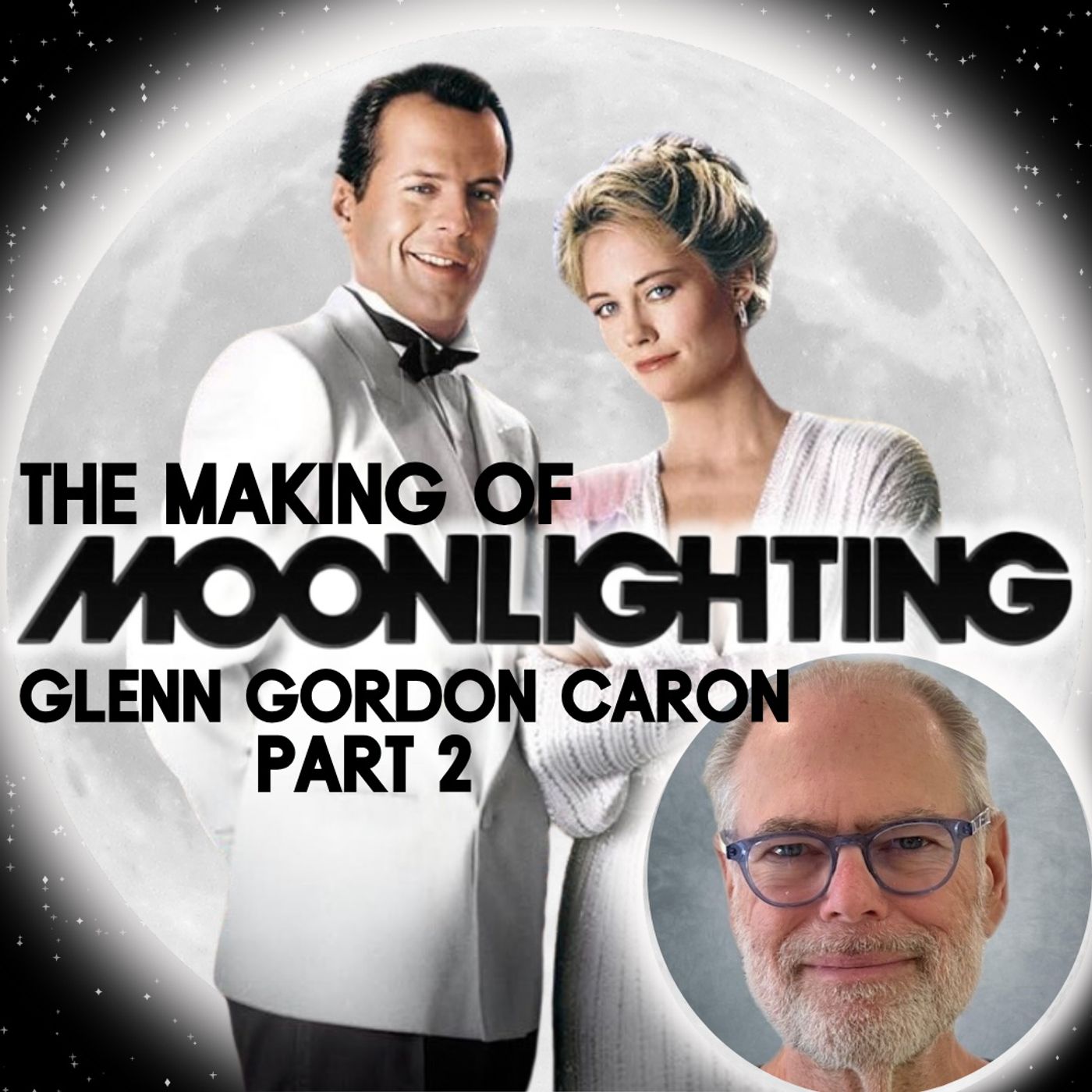
The Making of Moonlighting | Glenn Gordon Caron, Part 2
About this episode
And she said, ‘Yes. I am. Do you know what ‘Prima Donna’ means, Glenn? It means First Woman. And don’t you forget it.”
– Glenn Gordon Caron
In the second of our two-part conversation with Moonlighting and Medium creator Glenn Gordon Caron, we cover everything from Al Jarreau’s iconic theme song to sparring with Cybill Shepherd, to a forty-year career spent working with “audacious people”…
Moonlighting, which ran from 1985-1989 starred Cybill Shepherd, a then-unknown Bruce Willis, Allyce Beasley and Curtis Armstrong, and become a landmark classic of 1980s television. Glenn also directed movies such as Clean and Sober, Picture Perfect and Love Affair.
THE CONVERSATION
- Getting invited to the horse races by Cary Grant – who then dies before they could go!
- How dinner with Stanley Donen led to Glenn asking him to direct the dance sequence from “Big Man on Mulberry Street” as a favor. But what did Donen ask in return? That Glenn co-write that year’s Academy Award show with Larry Gelbart!
- How a chance meeting with Rona Barrett resulted in one of the weirdest -- and most talked-about -- episodes of Moonlighting ever!
- On Cybill Shepherd: “The topography of her life fit the topography of the story. She was a model. She became a huge movie star. And then she lost everything.”
- On Bruce Willis: “He was like thirty guys I grew up with. And I understood, underneath all that bravura, and all that jazz, there’s a genuineness that’s hard to resist."
- WHEN LES IS MORE: How Now and Again was born when Les Moonves told Glenn: “Write me a pilot, and if I don’t make it, I’ll give you one million dollars.”
- How for Glenn, the TV show Medium is less the story of a mystic – and more the story of a marriage.
AUDIOGRAPHY
Watch Moonlighting on Hulu.
Stream it on Apple TV or at Amazon Prime Video.
Follow Glenn Gordon Caron on Twitter.com/GlennGCaron.
80s TV LADIES NEWS
Susan’s new play Confidence (and the Speech) has been published!
Now available for purchase and licensing at DPS via Broadway Licensing.
CONNECT
- Read transcripts and more at 80sTVLadies.com.
- Tell us your fav Moonlighting episodes at 8TL Facebook or via 80sTVLadies.com.
- Sign up for the 80s TV Ladies mailing list.
- Get ad-free episodes and exclusive videos on PATREON.
Visit 80sTVLadies.com for more info.
Listen to 80s TV Ladies at YouTube. Subscribe and help us grow.
Don’t miss out. Sign up for the 80s TV Ladies mailing list!
Help us make more episodes and get ad-free episodes, video interviews, and exclusive content on PATREON.
Transcript
Automatically generated, so expect the odd misheard name.
Weirding, Wayne Media, so pretty Babies through the city, up and drained, getting good money. Man World. Welcome listeners to Eighties TV Ladies, where we explore female driven television shows from the nineteen eighties and celebrate the people who made them. You're your fabulous hosts Sharon Johnson and Susan Lambert had him Hello, I'm Susan and I'm Sharon. Susan and I were just at podcast and she Podcast Live to Indie Podcasting conventions, both held in Orlando, Florida in January twenty twenty four.
We had a blast meeting so many wonderful podcasters and meeting some people in person that we'd only known through social media. In fact, we had our very Eighties TV Ladies fan meetup. It was a last minute idea when I realized one of my favorite online friends and a big fan of the pod lives in the Orlando area, Miss Amy Hood, So we decided to throw a little meetup party at Cooper's Hawk Winery and Restaurant. Sharon, it was so much fun. Oh, it was just great.
So thank you too, Amy and Patrick, Lauri, Zi and Pike for coming out to spend the evening with us. And say hello and a big thank you as well to the staff at Cooper's Hawk who were very helpful with us, especially to our waitress who sang us seventies and eighties TV theme songs and took really great care of us. Go to Instagram and Facebook slash Eighties TV Ladies to see pictures and some fun for our trip, and let us know listeners if you'd like us to do more fan meetups. But now most importantly, we're back with part two of our interview with Glenn Gordon Karen, the creator of Moonlighting. If you want to start at the very begins, a very good place to start.
You can go back one episode to start with part one, or you can mix it up and start with part two. Either one is fine with us. We're diving right back in where we left off, with Glenn talking about how he handled the Lightning in a Bottle success of Moonlighting. Before I got into this business, I've never made more than one hundred and thirty five dollars a week in my life. You know, you're just completely unequipped, and then you're meeting people that you've admired your whole life.
I mean literally one day, one day back this is back before cell phones and all that. There's a phone sitting my office at night. He rings and I pick it up and I go hello, and the voice on the other end he goes, Hello, this is Carry Grant. Can I speak with Glenn Karen? And I said, I said, because I'm smart, and I think you know, I said push anyway, No, no, this is this is this is really Carry And I hung on called back and it was really Carry Grants.
And he was a huge fan of the show, and you know, invited me to go to the races with him in del Mair and I thought, I thought that the stock call races had no lock. They knew what he was talking about. And Jamie realized he was talking about the horse races and he would take he and his wife would take a train to del Mar every weekend to go to these racism And I said, I called my wife and I said, We've been inviting guard to the races from Carry Grant. I don't know what to do, like, what are you wear? What do you you know?
I well, first you said yes, yes, which is what she said, and so I said, I said yes. And that was like on a Tuesday, and he passed away. Here's another one on a Thursday. Oh oh goodness. You never had to go to the races with Carry Grant.
No, but and this is where the friendship comes from. My phone running about four weeks later, and it was Stanley Donn and the man who directed Singing in the Rain and innumerable movies with Cary Grant, including Charade, and here just a bunch of things. And he called me and introduced himself, and he was an enormous hero Meowray. And he said, look, I know you were going to go to the races with Carry and his wife. And his wife Barbara and asked him to call because she'd like to arrange a little dinner party.
She'd still like to meet you. And so we went to dinner. And here's who was his dinner Carry Grant's wife, Barbara, Stanley Donnan, David Beegelman, who had just been fired from Columbia Pictures for forging a check with Cliff Robertson's name on it. But he was prior to that. I didn't know this.
He was like a huge agent. He was like the Iri Manuel of his day, and you know, represent Elizabeth Taylor and Richard Burton and all these and but for me this was the thrill. The other couple there was Billy and Audrey Wilder and Billy Wilder. Again, it's just a huge here. The idea that I was sitting with Billy Wilder, that he had questions to ask me was just mind blow And I spent the whole meal squeezing.
My wife's so excited, and you know, just couldn't believe that I had fooled all these people. You know, it's just stunning to me. Was that how Stanley Donnon got involved in Big Man and Mulberry Street episode. Yes, I called him and said, will you do this? It was funny.
I said, I have this new musical number blah blah blah blah blah. Will you directed? And he said how much will you pay me? And I said, I can't pay you anything. He went and he laughed and he said how much time do I have?
I said, you have to you a day and he laughed again, and he ended up he ends up doing three days, and we ended up buying him a really nice gift and we became friends. And then he asked me. He produced the Oscars the next year, and he said, will you come write it with Larry Gelboord, so he did wow, sort of pay him back. People don't even know the oscars are written, but they are. And that was how the friendship with Stanley Donner and Wow happening.
He was such an amazing I would go in. I would be recommended from movies to direct movies and I would be unavailable or I didn't think it was right for me, but I'd say, you should talk to Stamley. It was. I thought it was criminal that this extraordinarily talented man wasn't making movies. But you know, he wasn't in fashion, if you will, which is insane to think, Yeah, but you know it's it's a business of fashion in any ways.
Yes, So before we get to my questions about Simple Shepherd, how did the title come about? And the song? The title is a strange story. I went in. I needed to tell you, you see, what the show was about.
We had a meeting. I told him sort of premise about this woman who is a model loses all their money, et cetera, et cetera, And they said great, and the meeting was over and I was walking out the door down the all and suddenly I heard a voice go Glenn what's it called. I swear this is the truth. I turned and I went moonlighting. I have no idea what I was thinking.
I don't know where it came from. Everyone doing it great. Later I realized it's a really good title in the sense that someone the Moonlights does a job other than their real job. And you know, it has all sorts of echoes and meanings and inferences that very much apply to the show. But again, I'd be lying if I told you that it was a calculation on my part.
It literally came to them spontaneously. I don't remember where it came from. Wow. And then how did the song the song was? I lived for a brief time in Chicago.
Eight months. I was working and I was also in the Second City Workshop, and there wasn't a lot of great television on. But one of the great television shows that was on was a show might have been on PBS called Soundstage or sound I can't remember, but I watched it religiously every weekend. One week there was Algiro and I was just sort of struck by him. And you know, a couple of years later, I was here, I was doing this show, and when I edit things, I use a lot of music.
When I write, I'll put on music, and that music so noow becomes part of the fabric of the show. So when we put together Moonlighting Algebra, I'd recorded a song I think it was called after All I Do Hey, that's what I tempt, which is the term for temporary music they use in the show the pilo with And when it came time to actually make the show, I called to see if we could get the rights to after All, and his people said, why don't you do a in the original song? And I said, oh, okay, and so Al came in. He had written these lyrics and some of them didn't make abundant sense to me. So I tried very generally because it was Algio and I was nobody, you know, And some of them we whiggled around.
The music was written by the gentleman who scored the pilot, whose name escapes me, who was a very very famous arranger. He would arrange for Barbara streisand he would arrange for all these people, but he didn't often compose. But he composed our score and composed the song with Al and my daughter. I have four children. My second child, my daughter, was born on February second, and I think we recorded the song on February third.
I always remember because I felt really conflicted about leaving and going into a soundseer because you have to remember, nobody had seen mon lighting. I had no reason to believe that anything was going to happen with no lighting. I was really thrilled and excited to meet now. Yeah. But anyway, so we all thought the song was like, amazing, somebody excep shoot.
And then we came up with that title sequence, you know, with that, and I remember put back to me be seeing they were like wow again, you know, you're in your early twenties and you just think I have nothing to lose. Let me see maybe al Jerral will do this. You know. It was a great experience. I remember the night really saying for the fact that I felt incredibly guilty not being at the hospital, it was an extraordinary experience.
Wow. Yeah. When our son was born, my husband's a TV writer, and he left for a meeting, but he wrote the script that he was working on in the room. Wow, for the dead Zone, I can relate these things happened. Yeah.
Yeah, So we were there and he was writing over there, and then I told him. He had to get out because I had to have a C section that was somewhat unexpected. And then they gave me vicodin and it made me manic and crazy. And then there was a moment he said something funny and I couldn't stop laughing. And then I literally was like, you have to leave the room and he's like what, I'll stop and I'm like, no, your face, you have to leave the room all together.
Get out, and then he did. And then we went home and they were like, she's got to keep taking her pain pills, and I was like, don't give me any more vicain and so I refuse to take him and then I felt much better once I got home. Anyway, that was a diversion. So four kids, four kids, two boys and two girls, actually my oldest and my young liasterwo boys and the two middle girls. So yeah, I see the love you dad.
Oh. I keep wanting to erase it because he you know, it gets a lot of scrutiny. But at the same time, I really don't want to erase it. I feel like it's there's something blasphemous and you know, no, but I will at some point have to erase it. You know, I don't want to.
It's very very sweet. And if you'r a fourteen year old wrote that, you can't erase it was my fourteen who's about to be fifteenth. So yeah, yeah, it has to stay, has to stay. Okay, So Sybil Shepherd, I know her. Yes, I know it was a challenging relationship.
Yeah, yeah, of course it was. Yeah, I think, yeah, it's been pretty well a staussed. Can you talk about when she first came on the show why you thought of her for the show? Even from the beginning, the topography of her life fit the topography of the story. She was a mild became a huge movie star, she lost everything in the sense that she was this huge movie star who miscalculated the nature of her appeal and overstated her welcome and actually got the audience to resent her at a point where she couldn't go work as a movie actor.
And I thought, that's close enough to Maddie, as you know, it just made sense to me, and you know, it seemed like a very very very good sad. Now that was interesting because I think I'm attracted to audacious people because and people forget this now, but in the trajectory of Bruce's career. You know, Bruce came on TV and ballimed me, blew up in a big way. But there was a moment when he started to make movies and he did Blind Date. Then he did a movie called Sunset, and then the feeling was people didn't want to see him in the movies.
They've had enough of them. He was so audacious in its television persona that they were almost worn out. And people forget about this. They forget that when Diehard came out, the original poster for the movie was a poster of a building. He was not on it because they were convinced that he would turn you off.
I mentioned this only because in my own life, I've worked with a lot of people who have gone through periods like this, where you know, I directed a movie with Michael Keaton and it was writ at the time where a lot of people went, you know, I've had enough of Michael Keaton, and what I was asking him to do he had never done before. I was asking him to play dramatic role This is for clean and so clean, yeah, which is pretty great, which was the role that got him Batman. That sort of changed his whole thing around. But it's interesting. I think the most dynamic actors invariably go through a period where the audience says, I need a break.
You'd each show me something else or you know. But that's what attracted me to Sybil initially was it just seemed like the contours of her journey were similar to the contours of the nineties, and the on screen chemistry between the two of them is pretty astonishing, even you know, looking back, and that's all mes. Yes, it is. And when they first met, if I'm beingblutantly honest, I knew it would be that way. She resisted meeting him for a long time.
She likes to tell people that she picked him. She didn't. She in fact, would a screen test with him. She was very, very difficult about it. She confessed to me.
At one point, I said, why are you doing this? They're going to cancel this show, and she said, Glenn, if you screen test me, you'll fire me. And I said, no, you know what, I won't. She said, yeah, you will. So it was one of the few times that I saw insecurity mm hm.
But I understood the nature of his appeal. The reason I liked him so much was he was thirty guys I grew up with, and I understood underneath all that bravura and all that jazz, there's a genuineness that's hard to resist. You sense, Okay, if I get into a fight, this guy's got my back, and not only that, he's gonna be a lot of fun to run with. And in Sybil it's a different kind of energy, but she's also in for the ride. So I just felt like, you put the two of them together, if they will start to fire, then that somebody should just buy me a plane ticket and I should leave, you know, Hollywood.
And I couldn't see why other people couldn't see. It was so clear to me. But I'm gonna take this opportunity to say something. You haven't asked me the question, but I'm gonna just yeah, pretend you did. Brus ended up being one of the people I'm closest to in life.
Sybil was a much more complicated relationship. I don't think she's someone who implicitly gets along with anyone who could be perceived to being any the boss. She's one of those people that it is dubious of all that kind of stuff, and I don't think I present that way, But I am the person that asked to sort of say, here's what we need to be, here's what we need to be there, and here's what you need to do. And then, of course I'm also the person who was clearly responsible for making it hard, for saying, yeah, we're gonna do I am at the time, Yes, we're gonna sing and dance. She literally said to me, why can't we just do a regular television show.
She had it in her head that this was somehow going to be easier. And I understand that instinct, you know. Having said that, and having now had an opportunity to go back and look at the episodes, goddamn, she's amazing. And then, and I'm not sure I was as clear about that at the time. I think I was so rewhelmed with all of it, but also with how difficult it was to get her from point A to point B, to get her to leave the motor home and come into the stage, to get her to take two.
He said, we need another, and she goes, no, I'm done. No, I'm going home. She was literally say I'm going home now, and you go, no, you can't go. We're not done. She said, I'm going home and you know.
I said, you're not leaving. She said, I'm leaving. And if I locked the door and wouldn't let her go because we had five more hours of work, she'd go, Okay, She'd come back here and she'd finished the five and then she'd call in the next morning sick and stay out for two it she'd show me how it was going to work on. I said, you know, you are a prima donna, and she said, yes, I am. Do you know what the word prima donna means?
Glenn? And I went uh, And she said, first woman. I am the first woman. Don't you forget it. I mean, I think she was right as often as I thought she was wrong, and I don't think I was as again, I just don't think I knew.
I mean, I knew she would be incredibly difficult, and I don't need to go into the whys of any of it. And I would just think, oh my god, this is just you can't do this because you're holding up two hundred other people who want to go home and see their kids, and blah blah blahlahlah and all this other stuff. But then I'd go into a projection room and I'd watch the dailies and I'd go, oh, oh, that's why, but that would go a pretty quickly because you'd have all these other problems. But now I watched the shows and I go, my god, she's amazing. She is amazing in the show.
She's amazing. We've since made up and all that up, by the way, but I'm just saying at the time, I think she consumed so much oxygen, so much energy, and I resented that because the show consumed so much oxygen so much. The enterprise was so debilitating, and you know, we were all swinging for the fences, so it was it was just hard for me to find a calculus that made sense for all that. And I've certainly worked with more difficult people since. But your work was astonishing.
Yeah, Sharon and I were just talking about just how beautifully it shot too, like she's shot basically. That's Jerry Finnemon. He was a real old school cinematographer, which is why we hired him. I wanted it to look like a Frank Kapa movie. Yeah, painting with light and shadow and all that, and Jerry was an old school deep painting and was thrilled to do it.
Sometimes we do it a little too much, and he was also DPIs back then the first thing they did was a made friend with the leading lady. They understood that that's where their power came from. So he sat Sybil down, he said, I will protect you, I will always make you look great, but you have to listen to me. So he would use all kinds of diffusion. He would do all sorts of things and sometimes he go overboard, and you know, I couldn't help but make jokes about it.
And we did that show with Runner Barrett the straight poop and Sybil walks out with the cause was stuff. But Jerry, Jerry was everything he wanted in a cinematographer. He was a perfect piece of pasting for that show. You know, that's fantastic to hear. Yeah, I think I owe that in large part to Jay Daniel, who was a producer I worked with for a very long time.
I think Shay was one who turned me on to him. Jay was very smart that way and sort of hear what I was coming up with, because we shot the pilot with a different cinematographer who used the techniques that were in that moment very much involke but made me crazy. It was use soft light, use long lenses, all this kind of stuff, and I said, yep, I loved the artifice. I wanted it to be romantic. I wanted it to be a dream, and I wanted it to be you know, and all that stuff took time.
So it was a nethla in the world of television. And I was young and stupid and arrogant sighting care, I said, I wanted to We'll take the time, you know, still young and stupid, but not really as arrogant. So the straight poop isn't interesting, Like it's an episode that basically starts with Rohona Barrett, who was who wasn't gms of her time? Her time, and she's outside the studio and she's going to get to the bottom of why Dave and Maddie aren't making more Moonlighting episodes. Yes, and I've told this story before, but in that period where we were not churning out with episodes as quickly as the network wanted or the viewers wanted, people were getting pissed off in a major way.
And I would shoot the commercials for the show. I was out of my mind. And I even shot this one commercial with I think his name is rayge Arden, wonderful actor. I put him in a sort of a gray working man's outfit with the ABC logo on his thing and his name on the other. And he's standing on a loading dock in the dark, and it says at two thirty five am, and you hear a voice from over the camera, do hey, what'd you do it?
And he looks up and he says, Oh, let's just waiting. What you're waiting for? He says, were blude lighting? And oh, is there going to be a new one? He goes, who knows?
And because they needed they needed a commercial to rhyme and they never knew if they had a new episode. Anyway. It was during that period and I went to an event, I think, honoring Brandon Tartakoff. And at these events, you know, you go in and yay, hek near the speeches and it's lovely, and then you come out and you wait in out line. There's three hours long to get your car so you can go home of la line.
And I'm standing in this line with my wife and I look up ahead and I see this little tiny lady and I realized it was Rohona Berett. I mean she was just this very petite, tiny lady, and I thought, wow, there's Roona Bearon. I have an idea, and I left the line and I walked up to us to excuse me. You don't know me, and my name is Glenn Town. I do this show Moonlighting, And then she knew who I was, and I said, are you free tomorrow?
And mind you it's you know, it's like ten o'clock at night. And she said why And I said, well, can you come over to twenty century Foxes sing thirty in the morning. I want to. I want to shoot a whole episode with you in a day. And she said, okay, I mean because I think in her line this is like a big scoop something's going on.
So she's up and I said, look, here's the deal. I said, everybody's asking about why we can't make these episodes, and they hear that bruson similar fighting, I said, and I sort of want to blur the line, and I'm going to put this earwig in your ear and I'm gonna feed you questions and we're going to have the three cameras on it, and blah blah blah, and at the end of the day, I'm going to use clips to illustrate these different things and hopefully we'll have a new episode. And that's what we did. Oh my god, it's great. It's a clip episode, but it's great.
It's funny, it's weird, it's meta. I remember at one point thinking do I do this? And then I went ahead and do it. I said, we're gonna ask him about his hair. He was losing his hair every day, and uh, you know, stupid stuff, you know, But we all had fun and we did we made an episode.
I thought, if I'm gonna stoop to do a clip episode, I wanted to be funny and special and I loved using the outtakes at the end. That was something that you didn't see anybody do back then. I mean people were like thrilled by it and shocked by it. And that's an episode where Pierce Brosnan appears playing Remington Steel. Yes, Yes, I love Peerce.
I just saw Pierce a couple of months ago. He had an art show. He said he's quite a painter, just a great guy and wildly underestimated as an actor. He also did Love the Fair for Me with Warm Baty In and At Benning and Katherine Hepburn. Yes, I was to play missus Lincoln.
So did you just call up Pierce Broston and say come do this? And the networks were okay with that? Oh, the networks were thrilled. Are you kidding? I mean I didn't ask NBC.
I just asked him and he said yes. And I don't know that we implicitly said he was right. No, No you didn't. He just sort of played Remington and then said, oh, I went up with Maddie. It was like I'm into Sila going out with other famous ditch.
It's stupid in he ought of conceit. But you know, we all got the joke. And then you got Peter Bugdanovitch. Yes than my other joke. Yes, I liked Peter a lot.
Peter would come around a lot, He spent a lot of time. Larry McMurtry came around a lot. I was gonna say, but she was not with Peter Bogdanovitch at that point. I don't know that Sybyls ever done with the men and hearth. You know what I mean.
She's one of these people who they seem to hang on. Okay, you know, the relationships don't define themselves in that way that Murcury would come around. Bogdanovitch. The only one that I never saw come around, and I think it's because he had passed away, was Elvis. But you called up Peter Bugdanovich and said come do this.
Yeah, that's fantastic, and he was thrilled. He was a wonderful, generous guy. So a love affair. And your movies, you worked with a lot of amazing women in those, yeah, Jennifer Anderson, Deborah Winger, Katherine Hepburn. Who are some of your favorite ladies to work with.
Deborah is someone I still consider a really good friend. She's just, you know, one of a kind. I adored working with Jennifer. I don't think she had a good time with me, but I adored working with her. She was I remember being like a little dumb struck because every actor has a different process, and typically in television you'll do two or three takes and you're hoping they peek around take three.
But that's kind of all you have. Movies are much more generous, or at least they were back in those days. And I remember starting Picture Perfect and I do six or seven takes, but she was started hitting all runs at take two and three. I never met someone who got there so fast. I realized a lot of it was because her muscles were so well developed.
Because Friends, you know, we did the movie in between the hiatus between the first and second seasons of Friends. I thought she was great. I bored her, you found out later. So again, like I say that, I did some things that ticked her off, which is inevitable, you know. I mean, everybody's gonna love you.
But I thought she was great. And it's not the best movie, you know, It's kind of a good double or maybe a good triple. I'm not sure. I did it largely because my oldest daughter was fourteen at a time, and I just thought I knew how huge Jennifer sort of wound. I knew how important Friends was.
I mean, people forget, but this sort of the second friend showed up. It changed the world. They let me make the movie in New York, which is where I was living at the time, and that was a huge thing, and I thought I just wanted to make one of those. I went to Kevin Bacon, who I did not know, and said, hey, do this with me, and he said cool, and we did it. Finish the Jay Moore has been talking of it all as we talked about a bunch, so, you know, I think that was one of the reasons Jennifer wasn't crazy about me.
Was we ended up making a movie with Jay, and there were people she really wanted more than Jay our part of the punt. But for me, it was a very pleasant experience. I wish the release of it helped, being a little more muscular. It was sort of half heartedly released. I felt like they should have put a little more energy into it.
But I like the movie a lot, you know, and it is what it is. It's you know, it's a small movie. It wasn't wasn't high budgeted movie or anything. It was her first movie, as you know, as a star, and she'd been in the Leprechaun movies. I think part to that, but she had never fronted a movie.
You know. The movie was you know, there was there was a Libido caucus, which was a great get and you know, we did the best recruit. But I'm still fond of the movie, and people still tell me they liked the movie. You know, there were people that just think it's gone awful. You know, it's it's one of those movies.
But I'm very fond of her. I've run into her a couple of times, but I don't think she'd never work with me yet. I just think people was can't make everybody love you. What you had mentioned earlier that initially you had wanted to work in movies as opposed to television, and so since you eventually had the chance to move into movies, I'm just wondering what your thoughts are about movies versus television. It's interesting because they've sort of switched roles in the sense that when I said that, and when I felt that television tended for the most part to be fairly frivolous and not terribly ambitious, movies were the place you went to get your mind stimulated.
It dealt much more with the business of being a human being. I used to say when I was a kid, when I was a teenager, even when I was a young adult, I would go to the movies to figure out what it meant to be an adult. Now we go to the movies to be reminded what it felt like to be a kid. Obviously that's a simplification, but I mean I would go being sixteen years old going seeing five thesy pieces and just looking at the screen of going, I've recognized his anger, his confusion, and I couldn't put words to it, but I related to when I was doing Love and Fair. I confessed to Warren Batty when I went and saw a Shampoo and I was a young man when I saw it that I didn't understand a lot of it.
I really liked it, but it was so outside my realm of experience. You know. It was a movie about, in many ways, about politics. I didn't know anybody knew anything about politics. I had never been exposed to that sort of thing.
It was about wealthy people. I didn't know much about wealthy people. It's about a lot of things that were completely foreign to me. But I always found that fascinating when you see a movie about things that were foreigner and you go oh, and then it's the things that nonetheless we share that make them. I mean, I remember going to see ten years ago when I see the movie about it gets in India and the kid wins the Quid Show and plumb out a millionaire, and just thinking, what great great movie, what a great, great story, what fantastic execution.
I mean, ending it with a musical number. I mean, it's just all these fantastic choices, and you never once, I never wants when I'm watching it going, I can't relate to you. I don't know what's going. It's instead you're leaning forward and sort of drinking in the differences. Television never did that.
Television was the definition of comfort for me. Television was designed I had people say this to me. It was designed so that you could do other things while it was on. And I've always sort of dedicated myself to the proposition, if I don't make this so compelling that you don't dare do anything else, I've failed. That was not the case when I got into it.
Now it's since become I mean, we've all seen I've seen television things that take my breath away. I mean, how do you being madmen? I don't know if you saw it, but how do you beat normal people? How do you beat the Queen scambit? Amazing pieces of work?
So, now, of course we're in a situation where filmmakers want to work in television. Everybody wants to working. And again I'm being simplistic, but if you're an American filmmaker, the studio system offers a very sort of limited menu of styles and types of storytelling. I mean, you couldn't make clean and sober today, that is the studio film. Might be able to make it as an independent and then hope that it gets shown on the Sundance channel.
The things that I'm interested in and attracted to for the most part, I mean, I love a good commercial movie, and I'd love to make up. I've never had a big I mean, Love Affair was supposed to be, you know, obviously a big commercial movie, but truthfully it was a disappointment. But the great thing at that time about movies, and I used to say this in television, you paint with a roller. In movies, you contemplate, and you paint with a very very very fine brush. You have the time to do it.
Now it's changed because the process has changed because for the most part, people aren't making and it's a crazy business. Twenty two of anything a year now. I was saying, just make eight and make them as good as you can. That was sort of what we were trying to do with Moonlighting, you know, the first one that sort of did that in a public way and wasn't being chastised for it. Was I think probably, you know, they did as many as they could do well, you know, which was you know, an attitude that I had.
I'm sure I'm not the only one who had that attitude, but I had it, and you know, it was sort of taking a task for it on the business side of the business. But I don't know if I answered your question, but yes, absolutely absolutely, I know that Sharon in particular is a big fan of Now and Again. I'm a huge fan of Now and Again. It's one of the shows that's on my list of shows that went away way too soon. I've never forgotten it.
I've just you know, gave up on trying to find it, and I just only recently realized it had been released on DBD in twenty fourteen. I think it was so love that show and I would love to know how that came about. What was the story behind that? Do you want to hear the story because it's a weird story. Oh yes, please?
So I'm I just finished Picture Perfect, I think, and I was kind of in movie jail because I had done Love Affair, which was a big, expensive movie and as I say, it didn't do what people would have expected that Warren Baby and that's banning movie, that's how to do. And I got a phone call from less moon Bess, who I did not know. I may have met him once prior to that, and he said, well, you have breakfast with me. I'm in New York. We have breakfast with me.
I said sure. So when I had breakfast with him, and he said he had just taken over CBS, and he said, I want you to write a pilot for me. And I said, well, I'm you know I'm in the movie because I really want to stay in there. I said, I fooled everybody once with Moonlighting. I don't think I have it in me again to fool anybody.
And he said, I want you to write a pilot. He said, and if you write a pilot and I don't make it, I'll give you a million dollars. So I went home and told my wife. She said, you can write anything, said right, whatever you want. So I wrote now and again and now and again.
It was sort of my riff on Damn Yankees. Damn Yankees is an old Broadway show about a guy he's in his forties or fifties, is middle aged. He watches the Seattle whatever the name of their team was at the time, the baseball team get shellac all the time. All he wants to do is see them be a championship team and help them be a championship team. And the devil appears, and the devil says, I'm going to turn you into a young man and you're going to leave the Seattle whatever they are is to the World Series.
He says, you're kidding. This is like the greatest moment of his life. So he goes, and indeed he fulfills that prophecy. He's like an amazing baseball player. But he gets there and he misses his wife, he misses his family, he misses his wife.
But he's like a twenty two year old guy. And his wife is you know, she's forty or forty two, whatever it is. And he's made a deal with the double and I don't even remember how it ends, but a very popular vice of musical theater, and if you stop and think about now and again, he's sort of about riff on that John Goodman, who was a friend, plays this guy who gets him by subway train and wakes up and finds that his brain has been held for government experiment and what they want to do is they've been trying to build a man who can fight wars for them, an artificial man, and they've done it everything except they can't figure out the brain port. They realize they need to harvest the brains to make it work, or at least to test it.
So they harvest this brain that used to belong to John Goodman. And you remember what John Goodman used to look like. I mean he used to you know, he weighed three hundred and twenty pounds, he lived in New Orleans, he was you know, he comes back and he's ever close this guy who weighs one hundred and forty five pounds, and he's you know, ripped it. All he wants to do is be with his wife, who has played I uh, Margaret Colin, and she's amazing, truly one of my favorite collaborators. And I loved the ache buried in that idea.
So we filmed the pilot. I directed it. I was very proud of it. And I got a phone call to come to LA because I was living in New York and come to LA and meet with Less Moon investors who I didn't know. I had to one meal with him.
So I come to La and I go with the head of the studio to meet lesson investing. He's kind of whole feelings of people around him, and he said, I can't tell you how disappointed I am. Terrible, terrible piece of work. Now, if I had a couple of days, if I had some time, I probably could fix it. I could probably maybe go out and direct some sequences and fix it.
And I was like, wow, Okay, clearly I've let these people down. And I felt terrible because I'm that's the way I'm wired, Like I feel badly if people don't show up, like like somebody gave you a lot of money to make a thing, and you made the thing and you didn't make it well enough. So I felt really bad. But the head of the studio, a guy named Kerry mcclugg, it was sat in the corner and he listened to Less do his thing, and he knew Less much better than I did, and he did. At one point he said, did you test it?
And I said, no, I didn't test that. I don't need to test it. I saw it. I know what I saw. And he said you should test it.
And the meeting was over and we were walking out of CBS Studio Center over there, and I said, I'm sorry. I said, I feel so bad. I'm sorry. He said, oh, whoa, Clinn, It's it's going to be on television. I said what he said, it's going to be on television.
I said, how can you say that? You're in the same meeting I was in. I haven't been talked to you that way in my professional life, maybe ever. And he said, glad. First of all, he's going to test it.
I said, yeah, And what's going to happen? He said, we tested it. Tests through the roof, he said. And the second thing is he wants to be able to announce that he has the guy who did Moonlighting's show. He's got his next show.
That's good for him. He said, it's going to be on television. I didn't think. So I went back to New York and I was getting a haircut and it was the first days of like mobile phones. I had a flip phone and it starts to go off in my pocket.
This is about three weeks later, and it's I want to say, it was Nancy tell In, one of those executives at CBS. Hi, how are you? And then I said, I'm okay, how are you, and she said, I'm good. I just want to make sure you didn't get the wrong idea from the meeting we had. I said, what do you mean?
She said, your show is going to be on CBS, and we just want you to know how exciting we are, and we want you to come to Carnegie Ole because they would do the upfronts at Carnegie. Oh blah blah blah. I go to Carnegie any my shoe was going to be on blah blah blah. Unless God is revenge, she put it on. But he put it on nine o'clock on Friday night after candid camera.
I mean, it had no lead in, it had known nothing, and it didn't do well, but because nobody knew it was there. But it was extraordinarily well reviewed. I mean Esquire wrote a piece on it. I mean, it's like crazy good reviews. And so he was able to cancel it.
Was he wanted to make the point, was I told you it was no good at least that's what I think. Less, if you're listening, I apologize, but that's what I thought. I'm not sure Less we'll ever listen to our podcast. Maybe somebody else. I don't know how, but I found it, and I was hooked from the very beginning.
You very loved it, loved it, loved it, loved it. We did it, and then it got canceled in and then I got a call saying, you got to come back to California. You want a Saturn Award. And I said, what's a Saturn Award? They said, it's an award for science fiction.
I said, I haven't done any science fiction. It must be a mistake, and they said now and I can, and I said, They went, oh, it's science fiction, isn't it. And I ended up sitting next to at James Cameron on one side of me, and a good friend of mine, a producer produced The Green Mile, and a bunch of other things on the other side of it. And I'm very proud of it. You know, it's a very it's a highly original piece of work.
As my wife said, it's almost as if you sat down and said, I would really prefer the million dollars. I was quite taken with it. But CBS, it wasn't down the mid you know, it was. It was pretty out there. And also you didn't know what to expect each week, which was I thought was exciting about it.
But they found it very troubling in that sense, and I insisted we make it in New York. And this was before all the tax credits, and so it was quite an expensive and difficult show to make. So there it isn't a nutshell. I'm thrilled to have the chance to tell you just how much I really Oh, that means, that means a lot to me. It means a great deal to me.
And I was heartbroken. I mean, I think by that point I was already at the point where I was I would find that the shows I really liked did not last. So I was prepared, although not happy about the fact that it didn't get a second season. But nevertheless, I've never forgotten about that show. You're very set, you actually trying not to gush too much, but yeah, love the show, love it, love it, love it.
Well, you need to get out more and see more things. But I'm very sweet now I appreciate that I've never forgotten both the ending and the beginning of it. The eggs on the subway with the kiss, That's what Esquire wrote about. They said that I think the headline was something like the most frightening two minutes and twenty seven seconds of television we've ever seen or something like this had some some ridiculously over hyped headline like that, but it meant a lot to me because I es Squire to me was like an estimable thing, you know. And the ending, I mean that was me trying to out smart everybody, thinking if I write a cliphanger, they can't cancel it.
But as we've all come to learn, you can't underestimate less mood. Best he'll cancel you don't care. And we actually did have the other chef that cliffhanger mostly worked out, Renee Chevalrio. It was a wonderful writer who I did that show with a long with a number of brothers, but Renee was really my major sounding board. He and I pretty much figured out how to dig our way out of that ending, which was pretty dramatic.
But I'm so glad you liked it. Yeah, absolutely, I mean you can secretly tell Sharon, no one else will hear. I would tell Sharon if I could remember it. That's why I keep invoking Renee's name, you know, but hopes that he remembers and then quickly. Although it was a very long running show, How did you get involved?
With Medium and a little bit about Partricia arkat Medium Mantatrish is all one story, and it's a great story. I was under contrast still to Paramount. Paramount was not port of CBS at that time. And they called me it said do you believe in psychic phenomenon? Do you believe in And I said no?
And they said both. And they said, well, we've we've met this woman who is the psychic uh, and we think there might be a television show in her life. Would you be all interested in coming out here to California and spending time with their meeting her? And I said, uh no, and and I hung up the phone, and my my curl wife stood to me, by god, you are you are really arrogant? Who would not want to spend time with someone who sees the world a little liberally than you do?
And let me let you know another secret, sir. Uh, women believe that they are intuitive. A lot of women believe this, and you shouldn't belittle it, you know. Blah blah blah. Long story short.
And I called them back, said okay, I'll meet this woman. So but but I am the original cynic. Just so you understand where I come from so I go and I meet the real Alice in Dubois, who's a fascinating woman, and I will go into all the nitty gritty of it. And I remained skeptical, but she was telling me in her world as she experienced it, and I basically sort of marched her through her life. I said, tell me about when you were seven, tell me about when you were eight, Tell me when you had your first experience, Tell me what it was about.
Blah blah blah. And we got to when she was a teenager, and she started talking about how she began drinking heavily because it would keep the voices of the ghosts down. And I said, has anyone ever prescribed hald All for you? And she said, what's howl All? I said, it's it's a drug used to control it's a phrenics.
And she said no, with a certain measure of contempt, which not unexpected given the question. And we continued to march through her life and then she told me how she met her husband, and I said, what does your husband do? She said, my husband is a physicist. He's a doctor of physics. And I went, okay, wait a second, I thought, she lays in bed at night and sees dead Civil War soldiers in the corner, and he thinks about the physical facts of the world.
What the hell kind of marriage can that be? That's amazing, because what is marriage? Marriage is you meet another human being and initially you're overwhelmed by all these feelings that you can make sense of. But they add at a point and they change their shape, and now the relationship demands that you make room not just for all the things that fascinate you, got to lure you, and but also the things that you can't quite make sense out of that maybe you don't agree with. I mean, it is in miniature sort of the model of what a marriage is.
And that was my way into it. That's what made it interesting to me. They had children, and having said that, I couldn't in good faith write about a lot of the things I heard, I found some of them dubious, so I sort of had to invent my own things. And it also had the problem of how do you do this on a television show? So I came up with this thing up she dreams these things, that's Alison doesn't do that, The real Alison doesn't do that.
And then I had to come up with a story you'd involve her husband that we could do for the poet. And then she called me and she said, boy, we'd love to watch some filmings. So I said sure, that seemed reasonable to me, and so she and her husband and their kids came to California. They live in Arizona, and they watched this film and they always remember that there was a scene between Patrician Jake and her husband leaned over and whispered in my ear and said, how did you know? And I remember thinking I meaned it up.
And I came to realize that to some extent, what Allison did was she became the character I created, and to some extent, my character moved to stuff that she did. I don't know what to tell you, but I was always worried because I always thought, I'm asking the audience to make a lead peer, and I'm content as a storyteller to make that leap, as long as we all understand that it is a leap. And I used it as an excuse to do all kinds of fantasmic work, things that I'm sort of interested in as a filmmaker. And let's do animation, let's do three D let's do this, let's do that, anything to sort of make those things evocative. Now, the same woman who said my god, you're arrogant read the first half three quarters of the script and said, this is Patricia Arquette, and I went, okay, great, Yeah, that's going to happen.
But I knew it was a great idea. And I suddenly realized that when I had made Picture Perfect with Jennifer, Jennifer was managed by a woman who also managed Patricia Arquette. She was one of the producers of the movie. And so I called her and said, look, I had this script and I blifted. Patricia read it.
I know it's a long shot. She said, oh, send it to me. So I sent it to her. Forty eight hours later, Patricia was in Wow, go figure. I'm grateful, really grateful to Alison Dubois.
I didn't mean in my remarks in any way to suggest that she's any less than she presents herself to be, but I would be disingenuous, and so I need to qualify that I am, by nature a cynic, and I think one of the reasons the show worked to the extent that to work, because it was a very successful show is that it gave the senex a place to stand. She was as uncertain of her abilities as the people in the audience who might not embrace the idea would be. And that's not true of the real house. The real Allison is a very Bravia doesn't have any secure bone in her body. Patricia, on the other hand, that are different people.
I remember having a conversation with Patricia and saying, here's the news, here's what you need to know, here's how I see it. We can argue about this. I can't imagine that God we give someone this extraordinary sensitivity and also make them in any way at all, all narcissistic. The what she is is the complete opposite of narcissistic. She's completely uninvolved in that way.
And what that means to me is she does not look in a mirror. She doesn't care how she dresses. The house is always a bit of a mess. It's like the real houses that people live in. There's always laundry that's stacked up because as have been cleaned yet, and other laundry are stacked up because it's been cleaned but never putt away.
You have kids, so there is this low level about thirty five decibetl sound fields that's just always going on. That's mixed with the sound of a television over here. And to this and to that, I said, you are at the least vain person there is. And she said she just had a child, and so she was carrying I don't know, ten or fifteen pounds more than she wanted to. And I said, I'm fine if you don't rush to lose that.
I want you to look like someone we'd know from church, or somebody we'd know from school meetings, or somebody we'd know in the grocery store, or that was my take. I said, And maybe maybe if we make her real enough and normal enough, people will give us this one thing she can dream the future. Because I thought that's the only way you're going to get adults to watch this goddamn thing if you pretend that she's all knowing and all. I mean, you know, other shows did it and they didn't worry about that, and they were successful, so clearly I'm wrong. But for me to do it, I needed all that other stuff to be.
I needed the kids to be. I used to call them primitives, you know. I wanted to cast children who hadn't gone to the Burbank school of smiling all the time, you know, you know who had all kinds of behavioral stuff that they would in because they were kids. And Jake Weber was she got it. She's the lead singer in the band, and here I am, and I'm gonna support her in any way I can.
And in many ways it was. First of all, Patricia has a work ethic. She's stir generation actor. It's the family business, so she has a work ethic that's fantastic. And even she would get exasperated with me from times time with the late diligious, but she was just so talented and we had the same north star.
And I would say to guest stars, I would say, watch Patricia. Her performance is this big. It's this big, it's so real. So you can't come in with all this because you're gonna look ridiculous. Watch Patricia.
She's the lead singer in the band. And he you know, and good actors got it, the instantly got it. I like to brag, so I will tell you that some of the good actors we worked with have gone on to become even bigger actors than when we worked with them. We did a show with a young woman named Riley Stone who was amazing, but for some reason, after doing our show, decided to injure named Mamma. She was like fantastic, and I wrote one of these huge monologues for her that she got the day of, and she just she was seventeen.
I think we used Jennifer Lawrence twice. I never used somebody twice, but she was so good the first time that I let her play young Patricia Arquat in an episode in another I mean she was another one like Patrician, just the three of them, I remember just being I did my talent so much. You know, I love actors, I love makeing stuff. So when you meet somebody like a Patricia Arcado or Jennifer Lawrence or an Amaztone or you know, and I'm not sure Ema or Jennifer would even remember me, but you just go, oh my goodness, this is just this is what it's all about. You know, that's amazing.
And I think while we'd love to keep talking because that's what we do, I think we're we are. You have been so generous with your time and answering our questions. I'm so appreciative. So Moonlighting is now available also on iTunes and Amazon now correct, Yes, it's on iTunes. There are a couple of places where you can buy digitally wellku, I want to say there may be another one or two.
Okay, but still on Hulu, yes, okay, awesome? And can people? Do you have a website? Do you do you have social media? Are you still on Twitter?
I'm still on Twitter. Yeah, I'm one of those idiots. Me too, Me too. One of these days I'll I guess I'll move over to Instagram or something, but that would require effort. And I actually liked Twitter tool.
I love Twitter, I love old Twitter, and I'm hoping that Twitter will survive somehow North back. Yeah, me too. I don't know a lot of strange ideas flying around. And anyway, thank you for being so generous, and thank you for offering to talk to me and whatever else. We'll do it again some tom if I do anything else worthy of discussion anytime, we would love to have you back if you're available.
So fantastic, Thank you so much. Likewise, thank you, thank you now strange just in today's audioography, we'll have links in the description for this episode to where you can watch Moonlighting on streaming. Just go to our website Eightiestvladies dot com. You can find Glenn Gordon Karen on Twitter, Twitter, dot com, slash Glenn g Karen. Thank you for listening to Eighties TV Ladies.
We're going to do a few more episodes looking at the five seasons of this groundbreaking show, so stay tuned for more moonlighting strangers that we meet on the way. As always, we hope Eighties TV Ladies brings you joy and laughter and lots of fabulous new and old shows to watch, all of which will lead us forward toward being amazing ladies of the twenty first century. Thanks for listening. Every stay below live down through the City, every staybul coping train at Getting we can Hard for the money, the band anything,



Similar episodes across the network
Matched by shared keywords.
-
Special Report: They Will Kill You (2026)
1 shared keyword: patricia arquette
-
Episode 52: Homeless + The Tontine + Examination Day
1 shared keyword: 80s tv
-
Episode 692: The Graduate (1967)
1 shared keyword: jennifer aniston