
Season 1 · Episode 623
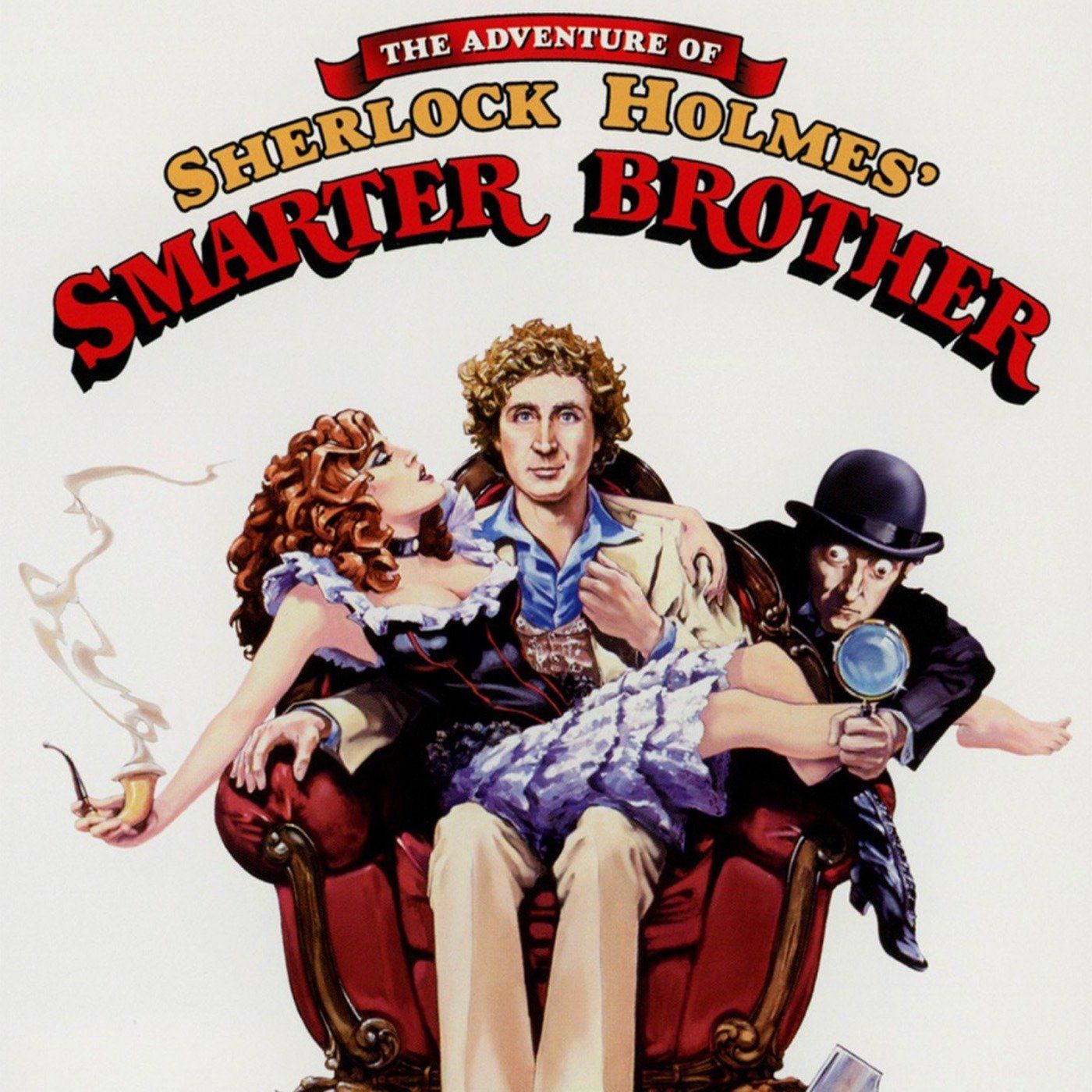
Episode 623: The Adventure of Sherlock Holmes' Smarter Brother (1975)
About this episode
Aaron Peterson and David MacGregor continue to lend their Sherlockian expertise to the conversation.
Transcript
Automatically generated, so expect the odd misheard name.
Old years, folks. It should time people pay good money to see this movie. When they go out to a theater. They want cold solders who love half half corner and no masters in the projection booth. Everyone for ten.
Podcasting isn't boring? No no off. For many years, people have believed that Sherlock Holmes was the greatest detective in the world. But is it possible that there could exist another human being whose mental powers go even beyond those of the Master? Hello?
What's this? It's your Lock Holmes smarter brother starring Gene Wilder. Do you have a brother whose first name is Sherlock? I do not? You do have a brother?
I do? Might I inquire as to his first name? Sheer luck Madeline Khan a n N readness letter gimble in as Jenny Hill. How do you do? My name is Bessie Bellwood.
Liar. Oh, you don't fool around, do you? Marty Feldman as a man with a photographic sense of hearing. Due to ill health, your brother has decided to take a short vacation in the country. Oh, not very long, two or three days at most, But he would very much appreciate He would very much appreciate.
He would very much a prediculi want a tale of amazing feats of deduction had Ard, unless I'm very much mistaken. Had Ard is the Egyptian word meaning to eat fat. Hey, I'm here, Dom DeLuise as the king of all the blackmailers. Don't put to the money. You're gonna love me fish and you're gonna love um tangaroo.
You're overrating now, but happout the ladies here the musical of the Adventure of Sherlock holmes Smarter Brother. Welcome to the Projection booth. I'm your host, Mike White. Choin me once again. Is mister Aaron Peterson.
Hey, thanks for having me back. Also back in the booth is mister David McGregor. Lovely to be here again. Thank you. We continue our month of discussions around the nineteen seventies interpretations of Sir Arthur Conan Doyle's consulting detective Sherlock Holmes.
This episode we are discussing nineteen seventy five, The Adventure of Sherlock Holmes's Smarter Brother, Written by, directed, and starring Gene Wilder. The film tells the tale of Cigarson Holmes, who I would say is not actually Sherlock smart brother. He's kind of adult really, and I'm not sure if the title is supposed to be a joke or not. I will talk about that and the movie also started some other familiar faces from mel Brooks troup of actors, including Marty Fellman, Madeline Khan, and Dom DeLuise. We will be spoiling this film as we go along, so if you don't want anything ruined, please turn off the podcast and come back after you have.
We will still be here. Aaron, when was the first time you saw the film and what did you think? I saw it when I was a kid, because I think, you know, like like many young cenophiles, Gene Wilder was a fascinating actor to behold. What did I think? I don't remember what I thought.
I thought it, I liked it, I didn't love it, and and reflection, I really challenged my own taste as a kid, you know, to a degree. I don't know if it holds up as well as I would like it too. I can't remember exactly when I saw it, probably late nineteen eighties, I would guess. As I mentioned in the last episode, kind of got more interested in Sherlock Holmes based on The Granada series starring Jeremy Brett, at which point I kind of assiduously tracked down as many Sherlock Holmes TV shows and films as I could to watch every possible incarnation of the character. So it was probably late nineteen eighties.
And what'd you think? I enjoyed it. It's clearly at variance with the vast majority of Sherlock Holmes output. You don't have. There's not a lot, especially you know, recently, a lot of Sherlock Holmes comedies.
There were a lot of Sherlock Holmes parodies at the turn of the twentieth century, and by that I mean, are you know, nineteen to twentieth But in the last you know, fifty sixty years, it's been this film. It's been The Dudley More Peter Cook, Pound of the Basketballs, It's been Without a Clue with Michael Keyton, Ben Kingsley, and then it was Holmes and Watson with Will Ferrell. Of all of those, this I think is the comedy that works the best. Really, Yeah, although I do like What Clue, Well, yeah, I would put Without a Clue ahead of this one. But this is a very affectionate film that's the best word I can apply to it.
It's very affectionate in its consideration of the character of Sherlock Holmes. This was the first time watch for me for doing it for the show. It was one of those that I had had on my watch list forever. I might have seen parts of it when I was just a tyke though that I might have been thinking of, like World's Greatest Lover. Another Gene Wilder film.
I was a huge Gene Wilder fan when I was younger. I don't know how this one slipped by me, but watched The Frisco Kid. Of course, you know two big ones, Blazing Saddles and Young Frankenstein. But this one just hadn't watched it, and I'm not sure if I like it or not. I like the idea of them taking the three earth Conan Doyle stories, the Adventure of the Empty House, the Adventure of the Navel Treaty, and the Adventure of the Second Stain and stitching those together because I've listened to all three of those and there are a lot of similarities, especially between Naval Treaty, where you've got a treaty being stolen, and then Second Stain, where you have a letter being stolen, so taking those, combining those also mixing in some empty house in there.
I was like, Okay, that's really smirt the way that you're putting these story things together. I just don't know if the humor necessarily works, and it feels a little kind of slapped together at times, and I'm just like, maybe it's because this is Gene Wilder's first directing attempt, but it just doesn't hold together that well. Like the Mandelinkan character is interesting because she is just the definition of a duplicitous woman because she's lying through the entire thing, and just when you think she's not, no, she actually was lying about something else. To the point where do appreciate whenever Wilder just starts yelling at her and calling her a liar and or just like repeating the same question over and over again until she finally tells them a version of the truth.
Now, then precisely, what is it that you want of me? Well, I have this friend Blick. Well, essentially, I mean she's Irene Adler is this version of it? And then you know you've got was it? Marty Feldman plays basically this the comedies version of Watson and Wilder is just doing his take on homes, so he's basically just spinning off his own take of Sherlock Holmes as associated characters rather than making fun of the characters of themself, because I think they didn't want to make fun of Sherlock Holmes at the time.
I agree. The humor is not consistent, and I think that's the problem. It goes so far left field, and then it comes back and it's a little bit more layered, a little more nuanced, and then it goes just crazy again, and then they're hopping. They're always hopping, and it's just like, I don't know what is doing here. I feel like you just wanted to throw everything and see what sticks, and I don't know if it sticks so much.
I don't. I don't like dislike the movie, but I definitely you know, after I finished it, I'm like, what was I thinking as a kid other than boy? When I was a kid, I really just I was open to anything. You don't think that critical lens, but still appreciate Mantelincoln for everything she gives. She's still the best thing that this movie has going for it.
She's amazing, period, and she's amazing in this film. I love her in this film, and she is I mean, she's comedic, she can sing, she's just terrific. I think, you know, we should we should emphasize that this is not a movie about Sherlock Holmes. Although Sherlock Holmes and doctor Watson are in the film, but they are kind of very much background characters. Sometimes all you see dipping into the frame is a pipe of Sherlock Holmes to let you know that he's keeping on top of the activities of his younger brother.
Why it's called smarter brother, I'm not sure, because he's clearly, you know, as you said, a bit of adult. He's not an ironings. Yeah, I would assume it's ironing, but it definitely thinks he's smarter. Yeah, And I for me, the appeal of the film is the kind of charming interplay between Gene Wilder, Madeline Cohn, and Marty Feldman. There are three people, three actors that have worked together previously.
They enjoy each other's company. They played off each other really well. Could it be sharper and I guess a little more coherent, Yeah, But to me, it was like I felt like I was watching three friends with a two million dollar budget fooling around for ninety five minutes, so I was on board. That would be part of the reason why I struggle with it. I feel like it's not consistent.
I wonder if Wilder was just, like I said, throwing everything to the wall and seeing what sticks, because I don't feel like it's coherent throughout the film, and there's there's large sections of the movie where I'm like, what is this even about? Like is it still the movie that it's supposed to be or are we just Wilder's doing a kind of a parody of different things. It was just kind of all over the map in many ways. It doesn't mean that it's bad, it's just not I don't think it's a very consistent film across the board. Well, I think he's he's riffing on the same as he did with Young Frankenstein.
I'll leave the correct pronunciation to you guys. He's taking I'm going to take a classic literary figure and I'm going to ignore it and I'm going to focus on his unknown relative. And it's the same basic setup. I'm not going to talk about Victor Frankenstein. I'm going to talk about, you know, relative of his and the same thing here.
I'm not going to talk about Sherlock Holmes and I'm going to be able to make a comedy out of it. And it's a really interesting idea in both instances. I think, all told, Young Frankenstein is a more successful movie from beginning to end. But I think this has its moments. Yeah, yeah, absolutely, I do.
Oh it is its moments. I would agree with you, and that I just like, like Young Frankenstein, We're a Frankenstein. Damn. It works as a whole. And this is more like sections because there are moments where I'm like, all right, that was really funny, that was really clever.
That was and then there's other moments from like what is are we hopping again? Hoppy? There's so much hoppy, but it was interesting. Let's talk a little bit about the plot here. So it opens up with the mcguffin this scroll.
We never I don't think we ever know what's in the scroll. He never opens the scroll. It's the sky Lord Redcliff and he comes in and he is practicing what he wants to say to Queen Victoria. So we have another Victorian story here. We saw her last week taking look at the submarine here she is handing the Lord Redcliff this scroll, and that sets up basically what our mcguffin for this movie is going to be.
After that, we go into the actual homes and Watson, as you mentioned, and this is probably one of my favorite parts, is when this hulking guy comes to the door and Holmes has these signs already at the ready and says that there's a six foot three maniac at the door, and just the way that Watson gives us by Jesus Christ, and then it's like the next Carrens is act naturally. And they also introduce Bessie Bellwood, the young music calls singer, So we're going to get that though. To talk about Charlock Holmes and Sigrison Holmes and who's murder and who's not, I don't know if Sherlock doesn't know that Bessie Bellwood has been dead for twelve years and that Madeline CON's character Jenny is using a alias or not, but just kind of let that fly.
But yes, he wants to pass on some less urgent assignments to Sigerson Holmes, his younger brother, we know Mike Croft, who doesn't make an appearance in this, but we'd have Sigerson who has been racked with jealousy of his older brother, and rather than Sherlock, he calls him sheer Luck Holmes, and that's really good. And we get a pretty early introduction to Orville Stanley Socker, the character being played by Marty Feldman, and I like that he's selling a newspaper, the Red Herring Staley some good stuff in here, like not you know, hilarious, but some pretty good stuff here. I do want to quick aside, when you know how he's introducing that he has a brother, and Watson's like, you never mentioned he had a brother.
He's like I did, never mentioned it and Micraft micraft until it was necessary or whatever. I like that because that that does work for the character of Sherlock Holmes, like it really does. He isn't running around having deep philosophical conversations about his family, you know, it's just not the character. So I did like that touch. And I would say the opening is is really calculated to appeal to fans of Sherlock Holmes because Sherlock Holmes and doctor Watson are played by Douglas Wilmer, and he was Sherlock Holmes and the BBC TV series of the nineteen sixties and his Watson's Thorley Walters, who had already played Sherlock Holmes twice previously, and two years after this film he was doctor Watson again in an episode of Silver Blaze with Christopher Plummer.
Is Sherlock Holmes. And you know the name of Marty Feldman's character, Orville Sacker. Well, if you look at the actual manuscript of the very first Sherlock Holmes story I study in Scarlet, Arthur Conan Doyle had written out while Sharonford Holmes was his first idea that got crossed out for Sherlock, and Doctor Watson was going to be Ormond Sacker and here it's Orville Sacker. So that's that's in fair you know, fairly deep minutia that you know Sherlock Holmes fans they eat that up. It's like he knows the character.
And Jan Wilder himself said he loves Sherlock Holmes. He means all the stories every seven years. So it's a very it's a very affectionate film in many ways. Well, even his name Sigerson, isn't that a alias that Sherlock Holmes took after Sherlock Holmes threw Professor Moriarty off the rich and back falls and was apparently dead. He went on the so called hiatus and assumed the name of Sigerson, a Norwegian explorer, which he mentions that to Watson when he comes back in the Adventure of Dante House Trivia that you know, most people watching the movie will have no idea where that comes from.
But for Sherlock Holmes fans, it's like an easter egg to be you know, uncovered just for you. I soon to remember that they played into that Sigerson name in one of the Nicholas Meyer books, that it's kind of that lost chapter between Reichenbach and coming back for the Empty House, and we get to see him in Paris. I think it's the one that's basically Sherlock Holmes meets the Phantom of the Opera. I think it's sad story mentioned. The other thing I think Shelock Holmes fans get a laugh for, you know that tickles them is that Professor Moriarity.
He's a mathematics professor, right and in the in the film you see that he is entirely incompetent if he can't do basic division and you know that's you know, that's played for laughs as well. Him in front of a blackboard the very first time we see him, and it's what four plus four equals nine? All the wrong calculations. Russia bids six hundred and twenty five pounds. Good seeing I'm a math professor.
Seven thousand, seven thousand rubles French. Thanks, thank thanks, of course, get the daily paper. France bids seven thousand French franks. What's the franco? And for today fank it is eleven point one eighth.
The frank is eleven point one eighth two the pound. So I simply put down eleven point one eight. Oh Christ, how do you do this? You put down eleven point one eight? Oh sure, I wouldn't know even to put down eleven point one eighth.
What I'm asking you, egyot, is whether your multiplier divide divide? Are you sure? Yes? I'll kill you if you screw this up? Now, then we simply divide eleven point one eight into seven thousand.
What do I do with the decimal point? You move the decimal point two places to the right. You mean I divide eleven hundred eighteen into seven thousand and seven hundred thousand. What will you add two zeros to the seven thousand to make up for moving the decimal point two places to the right. Well, what the hell did we move to decimal point for in the first place, to make it easier.
I was really glad to see Roy Keaneer as his assistant Ray Keneer for folks listening, he is mostly known for people my generation as Verruca Sult's father. So we've got this nice connection with Willie Walk and the Chocolate Factory or Charlie in the Chocolate Factory house. Screw up those and the good one, not the Tim Burton one. The good one. He's great, and he's a very idiosyncratic looking actor.
I'm not sure if you guys are aware, but he actually died making a movie. Yeah, a few years after this, he was thrown off a horse making yet another three Less Get Tears film and died from his injuries. Well we didn't. We definitely didn't need that either. No, he's one of many bald men that Moriarty surrounds himself with.
I don't know if that's supposed to be a joke in here, because there's the six foot three guy who then we see him like selling I can't remember what he's selling at the train station, and he eventually there's this like lady in the tiger scenario where but Moriarty opens up two doors. You hear a tiger at one, you hear this woman at the other. Of course, the guy goes through the door that he thinks has the lady in it, but it ends up being the tiger, and we get this little audio cameo from the Brooks there, which is kind of nice. And then he's quickly replaced by another bald guy. And then Roy Keaneer doesn't have all of his hair either, So I'm just like, is this supposed to be a joke that he only likes to have bald assistance or not?
Exactly sure? Studies have shown that bald men are more intelligent than hair. It was it only bald guys that participated in that. I think they're the ones who conducted and study. Yes, yeah, it was pure reviewed, but nobody had hair in that pure was quite odd.
Nicholas Smith is the six foot three guy, and then John Hollis is the other one, the one who is there with the gun at the end. And John Hollis also known for my generation as being lobot from the Empire strikes back. So good to see him in another silent role. I think if I ever heard John Hollis's voice, I would probably freak out because he only plays silent characters. For me, he's got a good look.
Oh yeah, definitely great look runs with it. Yeah. When we talked about the title earlier on if if it's ironic or not? Right, there are many moments peppered throughout where he is genius, just like his brother, and then there's other moments where the character is a complete imbecile, like he just does not he's got too too much hubris for for his talents. Really, so where where do you land on him as an overall character by the time the film ends?
Like, do you think he is up there with Sherlock Holmes or just a luckier version of an imbecile a lot of sheer luck so to speak. Yeah, yeah, he's not. He's not nearly as bright as Sherlock Holmes, but he's more human, you know, he's he's he falls in love with Madeline Kahn's character can't Blano. Yeah, I think that's part of the appeal of Sherlock Holmes is in many respects the often leton quality that he has. He's unmoved by human emotion.
He is a calculating machine. Now, obviously there's any riffs on that that try to put difference spins on it, but Gene Wilders, he's not going to be as bright as his older brother, but he's more three dimensional human being in some respects, and that he's trying, and that he's also capable of affection and fear and you know, the motions that are kind of rigidly excluded from Sherlock Holmes on a general basis when I talked about bald guys, and there's another bald man in this movie I forgot about, which is the guy who keeps coming to the door. And that's one way that we see that Sigerson isn't as smart as Holmes, because rather than him knowing who's at the door, much like his brother just did, instead he's just like, oh, there's going to be a knock at the door, and it's going to be miss Bessie Bellwood and no, it's this really interesting looking gentleman who I think he likes, the apartment manager or whatever, and he just keeps coming through the door.
Every time that Sigerson thinks it's going to be her, but we quickly get her introduction, and I do like when she introduces herself and he just screams liar right in her face. And then we get this whole like musical test where he's singing lyrics and then she has to pick up the lyrics and continue with those, and well, I don't think I know that one. Pretty the next time you decide to impersonate a musical singer, it has been dead for twelve and a half years, I suggest you learn her full repertoire. Won't you come in, miss liar? Thank you mine?
What a charming flat that was kind of delightful to me. And then also when it's him serving her tea and she's just like no, no, thank you and just takes the teacup and then you know, milk, no good and takes the milk. You know, sugar, no no no, and takes the sugar. It's stupid, but it's very funny to me. And yeah, you're talking about that chemistry between the three characters.
I mean, when those three are all in the same room at the same time and you know, going back and forth. I really like those moments, though sometimes they're just pure silliness. Everything that works in this movie is she's part of As far as I'm concerned, I feel like Gene Welder is hit and miss, and so's Marty Felman. I agree with you, when they're together works much better. When they're separate, it doesn't work as well.
But if men only Kan is there, I'm in you know, at any point throughout the film, I just feel like she understood the assignment better than everybody else in my opinion. Well, we should mention that part of Marty Feldman's character is that it's aside from I don't know what you would call a phonographic memory memory, audiographic memory, he's got complete recall of every conversation he's ever heard, and he kind of whacks himself on the side of the head to, you know, start a balky tape reporters keeping record. Yeah, so that's that's good. And quite honestly, for as as you were saying, like when they're all three in the room together, is there any actor that you could name that's better for reaction shots than Marty Feldman?
Oh No, He's just perfect. So that's great because yeah, there's a funny interplay between Holmsen and Jenny Hill, and then we can cut them Martie Felden's interesting response and it's it's funny. Yeah. His reaction too when she says that she wrote this spicy letter to a young paramore and said that she wanted to touch his winkles winkle, Well, yeah, we've all been there, haven't we. I wish I had more letters that way.
But yeah, so kind of playing into this musical test thing is all of a sudden, we break into a rendition of this old timey song, the Kangaroo Hop, which apparently is a real song, and I have found several versions of it now, so that was interesting to be able to track that down. But what a sad well you went down? That is my life. All the songs that he tests are with our music hall songs, yeah, nineteenth century. Yeah.
And for a while there it feels like this movie could be a musical because there's that, And then we take a little bit of a break, go to Moriarty, meet him, and then we quickly get a music hall sequence where we it pretty much full song, and then there's gonna be another one within a few scenes. So I was like, okay, and I was kind of almost hoping that he would keep it up and that it would be every few scenes we would get a different music hall number because the theater is huge in this there's you know her as a music hall singer, and then there's the Dom DeLuise character, who's kind of more of an opera singer, but then she's also an opera singer in that part as well. Yeah, it just it works, and I was like, oh, well, this is kind of cool that we're going to have these songs through there.
But I don't think it's consistent enough to really consider this a musical because there's probably what like four songs to the whole thing. It's like a movie with music, not a musical. And I will add one of the things that I really liked about this film is the fencing. Oh because in the first Sherlock Holms short story, Watson goes through here's the stuff Alms is good at, Here's the stuff he's miserable at. He's an expert fencer, and out of the fourteen Sherlock Holmes films that Basil Rathbone in defence once and he's as an actor an enormously adept fencer.
He fences in Robinhood, he fences in Captain Blood, he fences in the Mark of Zaro, and they never let him pick up a foil saber or at pay. Gene Wilder was actually a really good fencer. In fact, he taught fencing, He was a fencing tuitor. He was school champion when he went to the Bristol Old Vic Theater in England, and so yeah, he really wanted to showcase his own fencing building. In fact, I believe the music that he picked for the majority of the film, the background music, was he wanted something that sounded like the Errol Flynn Robinhood from the nineteen thirties.
So that's great, like you'd like to see the hero in action, and it's smart that he's playing to his strings. This feels I don't want to say that this is a vanity project, but this feels very near and dear to Gene Wilder's heart. Between his love of Sherlock Holmes and his love of fencing, his abilities for fencing. I'm sure he had a hand in picking out the songs that we're playing for the all the musical sequences. It just feels very much like he was so invested in this film.
Well, I mean he did a lot of off Broadway work, so I mean he definitely loves theater. He's a theater kid, and he's showcasing that here. I think the whole movie a lot of a lot of like is what you're saying, It's just him playing at what he loves, writing what he loves, because a lot of it doesn't make sense in the Sherlock Holmes world, even if it is by proxy. But it works because it's Gene Wilder's world. It's more his world than it is really Sherlock Holmes in many respects.
Well, I watched to rewatch the film. I watched it with his suck audio comment chary right, and at one point he says, and it's almost a wistful expression the way he says it. He just says, I love this film sweetness, the sweetness of it. It's his movie if he wants to love it, and he's welcome to it. The Moriarty character played by Leo McKern, he's got so many interesting quirks this whole thing.
How he does this like yeah, yeah, I'm not sure exactly where that's coming from. His robot or atomaton that he has that is a priest behind a confessional screen and a little card pops out and says absolved every time he goes in and confesses. I like that all the time for his crimes. And he's got that whole monologue about how he has to do nasty things every twenty four minutes. Here's why I'm such a master villain.
Here's everything I go through. It's very Bondian in that respect. And there's weird moments too, where like he doesn't like his sister to be taller than him where he's on this raised platform, and when he comes down off the platform, he makes a guy like hunched down so that he's shorter than he is. There's just so many interesting things that he's doing as Moriarty, and he seems to be having one hell of a time with this. And those scenes with his assistant are great with Roy Keaneer, but his scenes with Tom Delo, he's, oh my god, I was really having a great time with that.
I mean, dom Deloise is kind of like they talk about Gambetti at the beginning, or near the beginning, when she's talking about how she was blackmailed for the spicy letters. The Winkle letters. It's not until way later in the film that he shows up to the point where I was just like, who is this character? Yeah? Yeah, it took me.
It was actually my second viewing where I was like, oh, okay, he's Gambetti and he all right, I got it. So because she kind of like they set up a lot of the plot early on, and then we kind of meander off and we go through like the music hall seek uance, and you know, there's the one where she's going to be killed, and there's the sand that's coming out of the sand bag, and there's Sherlock Holmes in the front row and he just keeps picking up sand and throwing it in Cigerson's face, Like, Hey, pay attention to this, because really, like you said before, Sherlock is through so many of these moments in this film. Sometimes he has just like a pipe or a shadow of a pipe, but he's there in that front row, and we get a good glimpse at him, and I do have to say, between that and then later on when we see him playing the violin in the park, the makeup on him looks really good because I didn't recognize him as Douglas Wilmer.
They kept him very indistinguishable from other people in the area. The other way you notice him is because of the pipe. That's what the clear giveaway, which I thought was funny because you know, Moriarty's there and he's still got his pipe, so he's not really too worried about being given away. But his brother doesn't notice him because he's a you know adult he talked about, doesn't know what the hell's going on with that sand keeps the sad when it hits him in the face and he's like, oh well, I definitely got the impression with Moriarty and gan Betty. I have no way of establishing this, but I think felt like the inst actions from Gene Wilder were here's the basic outline of the seen, just have fun with it.
Yeah, and they had a lot of fun with it, especially to see where they're kind of mangling each other's faces. Yes, it's two actors. The best actors are the ones that are willing to go for it. They were both willing to go for Gene Wilders that Dom Deluiz's the funniest human being he'd ever known, so it made sense that he cast them as as gam Betty it's a small part compared to the overall film, but he makes the most of it. You gotta admit that he's memorable.
Yeah, he's definitely memorable. Yeah. Him coming in and just spewing all that fake sounding Italian and when he starts humping the chair, My god, that's our introduction to him. And I'm like, what is happening? Is he humping a chair?
He sure is, and then he like checks the score. He's like, oh, yeah, that's a good Yeah. I'm like, oh, this was you doing this? Okay, all right now I get it. Yeah, side Tangent, there's a lot of weird sexual stuff here where they're like finowing her breath us over and over again.
Throughout the film. He's something that cheered. There's a lot of weird seventies by the ass cheeks where they're they're grabbing each other's asses and as they're fully exposed and they're just massaging the buttocks. I'm like, Okay, this is definitely a seventies movie for sure. I did appreciate in that audio commentary how he was talking about how they had to make up their asses so you would like make them a little pinker and nicer look I'm making prettier.
Well for context for people that may not have seen the film, Seekers and Holmes and Ormond Sacker Orville Sacker, sorry, are dressed in tuxedos. They're dressed to the you know, for a very fancy party, but end up in a death trap that ends up sharing the back off of their suits, which they're unaware of. And that's the comedy is they enter into this very fancy dress ball, there's music playing, and everybody slowly realizes that they are completely bare from the back of their necks down to their knees. And they're the only ones who don't realize it. And the orchestra conductor, it is quite taken.
If you got the bear asked gentleman presenting themselves to him. So it works well, it works well. So when did they notice, like first squeeze, second squeeze when you when do you feel comfortable? If they they know that their bear asked up this bullet. When Saker introduces himself to Seegerson, Holmes and Secretson is blowing him off, he kind of placates him by saying, I really appreciated your handling of the case of the three testicles.
You're familiar with the three testacles, Johnny can only tell the truth when she sexually aroused A lot of material in that vein played for comedic effect. Yeah, there's a couple of good action sequences in there as well. There's the whole thing on the carriage where you've got the two carriages that are coming up and both threatening, and that was nice to see mister Deltoyd from Clockwick Orange as one of the carriage drivers. As I'm looking at at him, I'm just like, where do I know this guy's face? And then I realized he was all Remorris and I was like, still, where do I know this guy's face?
And find I was like, Oh, it's mister Deltoid and he doesn't don't think he's even got a line. I think he does it all silent in this role as this coach driver and the other coach driver is equally threatening. And then then a bizarrow fight with Roy Keaneer and Gene Wilder on top of the carriages and the giant hand or the giant glove and the giant boot that they had, and you get that nice button on the scene when he raises his giant hand up and so taxi. There are some good moments in this, and especially like getting kicked in the nuts with a giant boot as well, which was nice. You can never go wrong with fart jokes or blows to the grin.
There are some strange moments in that action scene, like how man Linkan Jenny Hill won't scream. She just keeps saying the words scream. That felt very odd. I was like, okay, but I can let that slide. Of course, when they when she gets nervous, she starts to sing.
When Orville gets nervous, he starts spewing out facts, So that just becomes this whole cacophony inside of the carriage. Not everything rings as nice as other things, is what I'm trying to say. Well, I feel like that's where you really notice the difference between Gene Wilder's writing and mel Brooks's writing. He's definitely trying to emulate mel Brooks, he really is throughout this entire movie, and there are moments when he kind of captures it. The giant feet well definitely as part of it.
Then there's moments where she's like that just does not work. It just doesn't work, and it feels forced, and I think that's where it's inconsistent in terms of the tone. It really just he's not as masterful with this kind of material as mel Brooks is. Again it's his first time out of the gate. Would directed absolutely, no, Absolutely, he absolutely had written stuff, And I did like the whole story of how mel Brooks is like, first you're going to write, then you're going to want to direct so that you can protect your own writing.
And it was just a matter of how soon until you start directing Gene, because I know you're going to do that. And it was kind of nice that mel Brooks seems so supportive of Gene Wilder and just you know, kind of like pushing the baby bird out of the nest. You gotta do sometimes so you can fly audiences like this. This was released out in nineteen seventy five. Is a holiday movie.
Like I said, I think the budget was a little over two million dollars. I think it made about twenty million dollars. It was way way more successful than The Private Life Is Sherlock Holmes, which well talked about. I think it only made nine million in the North America, you mean worldwide, And I would say, like of the films that we're considering Private life Murder by Decree in the seven percent Solution. This is the Palate Cleanser, you know, It's it's a completely different tone, a completely different film.
It's not presenting Home as a broken, disenchanted, disillusioned anti hero. It is what it is. It's his own little entity and probably not going to go down on the pantheon of great films of the twentieth century. But I found it enjoyable for what it was setting out to try to do. In two weeks, when we're talking about Murdered by Decree, we're gonna be like, where's the humor?
Why is it going to be so dark? They try to add to humor to it, especially in the relationship between Holmes and Watson, but yeah, it's hard to add humor to Jack the Rippers stories. Yeah, but yeah, we've talked about a lot of this stuff. We've eventually find out that Jenny is not just a music hall singer, but she is the fiance lord Redcliff, the man who got his document stolen. If you remember way back when I was talking about that document, here it is again Holmes Cigerson.
Holmes finds out about that really takes some wind out of his sales, but they kind of patched stuff up pretty quickly on a little boat ride that they have. We've got Sigerson and Orville breaking into Gambetti's place. That's where we meet dom Deloise, just this living cartoon character. And then yeah, when Moriarty comes in, and when we initially see Moriarty come in, and the way that Gambetti greets him, and you couldn't get two more different personalities the way that these guys are going. Moriarty has this great like twitch on the side of his face where it just looks like he's about to explode, and you just see, like looks like his muscles are just quivering there.
And I was just like, I am so impressed that the actor could do that, because he just looks like he wants to snap so hard. And when he grabs that vase and holds it up over Aunt Betty's head, that's such a great moment, and then just looks like, oh, what a lovely face. He's a great actor. I mean, oh yeah, I mean this is before his Rumpole of the Bailey years, But no, he's great. I agree with you.
That little mouth twitching because I'm thinking boy, how do you do that? Right? You know, I don't think I could do that on a bet, but it works just great. Or when fucking dumb Delawiz grabs those little scissors and starts trimming Mario Hardy's no says I'm glad he lost that to pay. By the way, because for a big portion of when we first meet don Deloize, all I kept thinking was Eddie from Rocky Horror Pitcher Show.
I'm like, is it it's so meat loaf like it's visual appearance. But then it's two pay comes out. I'm like, ah, there we go, there's damn Delowiz And then yeah, we're back at the music hall, and there's going to be this whole exchange where somebody's going to come up to Gambetty and sing, why don't we all drink some very sexy wine, And that's going to be the clue to Gambetti to hand over the scroll, the the Lord Redcliff scroll. And you know there's the infiltration and of Cigarson, but there's also a great Albert Finney cameo in here where he just turns right to us, right in the audience and asks is this rotten or wonderfully brave. I love that that's a phrase, why don't we all drink some very sexy wine.
It's so good, And that they sing it like three times. It's so awkward each and every time it just gets more and more awkward. That's the absurdity I love. If you look at the actual lyrics of operas, they sound magnificent if they're an Italian or German, but then when you look at the actual words, you're like, wow, that's that's really lean. That's really lame lyrics.
So they just put out there in English why not? And we get a nice sword fight going down between Moriarty and Cigerson, so that's very nice as well. This is fairly well choreograph for a comedy like this too. Yeah. I thought it was really well done, and it was nice that again we rely on the sword play.
It's not like we set up all this fencing through the movie and then they have a duel with guns or something at the end. So thank goodness, they actually carry through with that, and they're both very good fencers, or at least Moriarity can fake it really well. Thank god, the bicycling robot paid off. There's actually a fencer inside the robot. But yeah, Wilder did his I didn't think it was a real robot.
I'll tell you what I liked about the scene on the ledge with Moriarity is, if you are familiar with Sherlock Holmes at all the original stories or the or a lot of the films, Moriarity tends to plunge to his death a lot. Now this is a comedy, so he doesn't actually die, but plunging off of high precipices into rivers or the waterfalls, that's kind of moriarity. Stick that that's how he dies. He's always falling somewhere. Does he die a lot?
Oh? Yeah, but he gets brought back a lot too. You gotta have moriarity. I mean, that's how he dies. In the original story, he dies, he meets Sherlock Holmes at the Reich and back falls and they tussle, and that's where he ostensibly dies.
Yeah, you know, supposedly that's where Sherlock Holmes died too, because at that point Arthur Condyle was sick of Sherlock Holmes. He's taking attention away from my better work. Therefore I'm going to kill him. Isn't it ironic? Because this was his best works.
Like accept it, man, It's okay, he accepted, he does eventually, but well, he wanted to be known for his historical novel, you know, White The White Company was what he poured his heart and soul too. He found it irritating, as subsequent portrayers of Sherlock Holmes Dead, Basil Rathbone and William Gillette that they kind locked into this one character that you know, they'd be walking down the street and strangers would shout at them, Hey, Sherlock, how's Watson. Yeah, he found it maddening, and he eventually brought him back to life after ten years. But yeah, Morrie already tends to fall a lot. Also, like I mean Robert down junior movies.
Yep, Sherlock with decom Batch falls a lot definitely for an interpretation of moriarity than we had in the Sherlock TV series. Also a very odd character. The ending of this movie is very odd, and I'm glad that Wilder talks about it on the commentary as well, just that he didn't really care for the original way that it ended, but he wanted like a little bit more of a puncheon there. So we've got Jenny is going to get married to Lord Redcliffe. She meets Sherlock at this park.
She has sent him a telegram. It sounds like that said it was a matter of life and death, and so he rushes to this park, which I thought at first was going to be I'd ever sent the telegraph. That it was actually Sherlock that had sent the telegraph, and you know, he was the one trying to like push these two together. But apparently no, she sent the telegraph and just I guess wanted to say goodbye to Sigerson or you know, that's or try to get him back. At this point, like I said, it's odd so they're together.
She's like, oh, I have to get married now. She runs off. We've got Holmes and Watson, the real Holmes and Watson there in the park, and Holmes is playing violin. Watson's playing harp, which I never knew that he could do that at a portable harp, which was kind of cool. They are playing like an orchestral version of one of those music hall songs, which I also thought was kind of nice.
He's walking away, Cigrison's walking away. The music stops. He turns around. There's Jenny and rather than them just embrace and kiss and that's the end of the movie. They do a reprise of Kangaroo Hop.
Wilder even says, we shot this well after, like you can see the film stock changes, like it's not shot where they shot the rest this movie. They shot it in a park in California, I think, he said, and it just suddenly changes. They do this little reprise of Kangaroo Hop, and then it does a quick dissolve to Jenny and Cigarson embraced and kissing, and then bloom credits Off we go. Kind of got a little bit of whipblash from this ending here, just because of the pacing in the way that we jump into the Cagaroo Hop pun intended and then pull right back out of it to that other ending. It's like he wanted his cake and eat two, but didn't feel like I really flowed together very well.
I almost wish that they had shot the second ending or the original ending a second time to make those two things merry together a little bit better. The hop is ridiculous, which you know, fits a lot of well this movie. The ending is just kind of like, what is happening again? What is happening again? I was not a fan of the Hop.
I wasn't a fan of the first time. I definitely wasn't a fan of the second time, but I will admit that it is exceptionally well performed. I was pretty impressed with Gene Welder's flexibility. He's a very fluid performer. I really liked what they were doing with the camera in the early You're part of the hop when the camera's hopping up and down with them, it's almost like all of them are on trampolines because they really kind of It's like, obviously the camera is not locked to Wilder.
It's not some sort of snory at camera or something. It's just the cameraman seems to be keeping the right pace with Wilder. I thought that was great, even though some of the stuff in the movie doesn't work for me personally, and overall, I think it's it's a decent movie. It's just I just don't love it or whatever. But I admire that he's trying to just be himself, like he's trying to tell the story he wants to tell and as weird as he can tell it, and he's totally confident in his version of it.
That's something that does come through forever. Reframe is that he's confident in his version of it, whether we are or not, he doesn't care. I admire that well. I would agree that ending us a little giant. And all I can say is speaking in somebody that writes plays, screenplays things like that, you gotta end it, gotta gotta stop stop doing it now.
So some endings are more graceful than others, so you don't know what other forces were at play. You need a happy ending, you need the hero with a girl, and they accomplished that. There might have been given more space and time and what we're graceful way to accomplish it, but they accomplish it in the end, and that once again emphasizes that he's not his brother, because that wouldn't have to his brother. Have I even guys heard of a film. It's old silent film called The Mystery of the Leaping Fish with Douglas Fairbanks Junior.
No I have done. It's worth watching. It's available on YouTube, and it just reminded me of like the Full of hop thing, The Mystery of the Leaping Fish. It features it's kind of a character's a combination of Sherlock Holmes and a popular American detective of the time named Craig Kennedy, and it's all about drugs, and Sherlock Holmes spends up good portion of the film hopped up on co kinney and they literally had that in the title cards. And he's pastantly snorting or sniffing or injecting and hopping around.
It's, I want to say, about twenty five minutes long, and it's a it's a bizarre little film. But what's cool about it? Does it actually exists? I mean it's from nineteen sixteen and most films from that era are no longer with us. But you can just fire that up on YouTube any time you watch you want to see Douglas Fairbanks Junior playing a comedic version of Sherlock Holmes or senior.
Sorry say yesh senior. I had never heard of that one. I might have to check that out, especially because we're gonna be talking a lot about cocaine next week, folks. Can you ever have enough cocaine talk? Cocaine is a hell of a drug.
There were tons of silent films that use Sherlock Holmes because they could get away with it. You didn't have to pay our out the kind of Doyle and they just you know, the Flea of the Basker Bills was another one, and they all, you know, they renamed the character Padlock shows Padlock Bones Sherlock for whatever. But there were tons of those, and you know, they're ostensibly Sherlock Holmes, but not really. They're just riffs. They're sound a theme about a detective.
And the nice thing about Sherlock Holmes is he's so identifiable. You get that hat, you get the mandifine glass, you got the pipe. Everybody knows what that means. And so he was in a lot of parodies, a lot of parodies plays and films at the turn of the twentieth century. I do a podcast about Colombo, and you know, Columbo's got the cigar and the coat, and then they add things, you know, dog, the car.
They continually like build him out. But yeah, it feels like, I don't know if this is true or not, but it feels like Sherlock Holmes came out of the womb fully formed with all of those things. You've got the invermous coat, you've got the violin, you've got the cocaine and the fencing you mentioned. You know, it just feels like there are so many trappings to him that, yeah, you can just have, Like like we were saying in this movie, sometimes you see a silhouette of a pipe and you're just like, oh, well, there's Sherlock Holmes. You don't even have to have the actor.
You just have the symbol representing the actor. Well, those those iconic symbols associated with him. That was built up obviously the original the stories. He's going to have a magnifying glass. The hat was the creation of the illustrator the original Sherlock Holmes stories because he had his own deerstalker and put the character in a deerstalker.
And the pipe itself, that was a creation of the actor William Gillette, who wanted a big curved pipe because he liked to talk with the pipe in his mouth and he wanted the audience to be able to see his mouth. He's a stage actor. So there was this kind of gradual build up of all the symbols we associate with his character. Yeah, I never would have known that. It's kind of like how you think about Superman and the Daily Planet and then you realize, oh, the Daily Planet was made up whole cloth by the people that put him on the radio.
Nothing to do with comic books at the time. I asso see everything with Superman with Zack Snyder and his Oh well, that's what you have to do. Vision is vision of a perfect world with Superman in it. That's probably the best way to go. Sorry, I had to say, you can't mention the Superman without mentioning Zack Snyder's required by law at this point.
Well, I will mention just for trivia's sake that if anyone's interested. The very first Sherlock Holmes movie ever made in nineteen hundred is called Sherlock Holmes Baffled and it exists again. You can fire that up on YouTube and see it's about forty five seconds long or so. Very short watch, but it's kind of a play. I think it was probably created because William Gillette's play was doing so well in New York, and they just use camera tricks so that a criminal can pop into existence in and out of existence and nothing Sherlock Hooms can do.
So that's the first Shrlock movie, Shrlock Holmes Baffled in nineteen hundred and just so folks, though, like you can try to look this stuff up on IMDb, but Wikipedia is your friend. There's a fantastic site it's Arthur dash Conan Dashdoyle dot com where they have a very comprehensive list of Sherlock Holmes movies, Sherlock Holmes Purity, Sherlock Holmes on TV. And that's just one page. This site goes really deep. So if you are enjoying hearing us talk about Sherlock Holmes, this is the site for you if you want to dive deep into Sherlockeyan lore.
There's a gentleman in Florida who keeps a running database of every actor who has ever played Sherlock Holmes, professional, college, high school, two kids in a park with a video camera. I think. I think he's up to about I don't know, eighty five hundred and they're all there with names and photographs if you can track them down. He's as thorough as possible in his devotion to the cause. Wow.
And they on this Arthur Conan Doyle's site, they catch things that I never would have thought of, Like I'm looking at the parody stuff right now. And of course there's like even timy little things like oh, when Joel Gray was on the Muppets, you know he played a Sherlock knockoff. I didn't realize that in the Name of the Rose that Sean Connery's character was William of Baskerville, and he totally is doing a Sherlock Holmes in that. But having the Baskerville really tips the hat, or tips the deerstalker, I should say to the Holmes character. So I in sore in need of rewatching that film.
And this is prompting me. Is young acolyte? Is adds Adso so yeah, it's Holmes and Watson in a medieval monastery. Yeah, you know that the creator of that virtu echo, he's a semiologist heart. His whole academic training was related to the study of signs, and that is Sherlock Holmes is the definitive character of mastering reading the world.
So he had a really vested interest in the character of Sherlock Holmes. And that's why, Yeah, William of Basketball was his hero. All right, guys, let's go ahead and take a break and play a preview for next week's show right after these brief messages. Shortly before the turn of the century, two of the great nines of all time met and began an adventure that hist Sherlock Holmes, Ben Sigmund Freud. Together there tends their very lives.
The Universal presents the seven Percent Solution, Nicholas Meyer's best selling mystery from the personal memoirs of doctor John H. Watson. Person must guess the detense of my life with such uncanny accuracy kind of a get. It is an affording habit in destructive for the logical peculty s fall of commons. The seven percent Solution revealing for the first time the vile and destructive habit that almost destroyed the world's greatest detective.
What's the true identity of Sherlock Holmes, arch Nemesis, Professor James Moriarty Stent and the extraordinary circumstances surrounding they give it to the unknown affair be known every adventure to the seven percent solution, But good Nicole Williamson is Sherlock Holmes, Alan Arkin is doctor Sigmund Freud. Robert Duval is doctor John H. Watson. Bennetts A Red Gray is the lovely love of Heber Jeremy Kemp at the Baron bon lynslof Joel Gray at the possibly fictitious Lowenstein Chan Sir Lawrence Olivier gets Professor Moriarch persecuting me. I can put it persecuting you.
I see everything I am of the case, and you have face me there. Now you must covered my instructions. Sherlock Holmes Most Baffling Mystery and Mister Sigmund Freud's Most Curious Case, the Year's most Intriguing Motion Picture? Where was this trained originally heading? It is now and it's been no explanation for the seven percent solution until now, That's right.
Our Sherlock Holmes month continues with a look at the seven percent solution until then? What's the latest with you? Rarren? The Hollywood Outsiders my my normal weekly movie and TV podcast for re review films and discussed in our own zany way modern television and film, and we just got I just got back from south By Southwest along with my co host Amanda, So there's an episode of that that should be coming out where we talk over twenty five films and the festival itself that we saw, including jen Wick Chapter four, Evil Dead Rise as part of that conversation, and a lot of smaller films as well, and then presenting Hitchcock, which I do on a monthly basis, where we look at every single film in Alfred Hitchcock's catalog, including the silent films, which we were talking about silent films earlier, so we were almost done with every silent film as well.
And that's presenting Hitchcock and David. How about yourself, I've got I've written three Sherlock Holmes play. One of them is Premision in New Zealand. In a couple of weeks, I'm doing a presentation on Shrlock Holmes at a Shrlock Holmes symposium and Lovely Dating, Ohio at the end of the month. And if anyone's interested, Yeah, the Shrlock material that I've got is all available on Amazon books, fiction books, nonfiction books.
You know, I wrote a two volume nonfiction book called Sherlock Holmes The Hero with a Thousand Faces if you want to know more about Sherlock Holmes than anyone has a right to know. Most of the information is accurate, so eighty percent at least. Well, thank you so much guys for being on the show. Thanks to everybody for listening. If you want to hear more of me shooting off my mouth, check out some of the other shows I work on.
They are all available at Weird Ingwaymedia dot com. Thanks especially to our Patreon community. If you want to join the community, visit patreon dot com slash Projection Booth. Every donation may get helps the Projection Booth take over the world. Well, if you can do the job job, I know you know how to come on delated.
What it's called the kangaroo hop duo? Stop stop stop? Well know you Jacob y'all go back? Stop? Stop?
Where many if I want to know, dude, what's this kangar hot? It's hopping on a beard all night long? And when't you we're gonna stop? Wow, when Beachball's lodges, when Michael fella haven't gotta sit, when be stops seeing my EBow and we have a lady present death stop stop. We go to the room, to the cave room and the dam stop stop stop the cable room and the little shop in the room through the cave the room better by the bod
More from The Projection Booth



Similar episodes across the network
Matched by shared keywords.
-
Episode 5. High Clue
1 shared keyword: mel brooks