

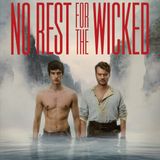
About this episode
Kalle built the film from an 1885 short story by Karl Heinrich Ulrichs — one of the earliest unapologetic accounts of gay love in print — and expanded its fifteen pages using the islands themselves: constant, unschedulable fog (created on set and in post), a 300-year-old stone village the crew stumbled on mid-scout, and composers from the Faroes so the score wouldn’t feel imported. Leads Egor Venned, a Faroese former model making his acting debut, and Danish star Pilou Asbæk (Game of Thrones) anchor the romance at the film’s center.
After premiering at Fantasia and playing its US premiere at Fantastic Fest, the film is headed to US theaters, with Kalle already writing his next two projects.
Transcript
Automatically generated, so expect the odd misheard name.
Hold your ears, folks. It's showtime. People pay good money to see this movie. When they go out to a theater, they want cold sodas, hot popcorn, and no monsters in the projection booth. Everyone pretend podcasting isn't boring.
Turn it off. Turn it off. Help! Help! Help!
Help! Help! Help! Help! Help!
Help! Help! Help! Help! Help!
Help! Help! Help! Help! Help!
Help! Help! Help! I'm just waiting for the next boat. Next hire.
But you don't have a family to look back to? No. Free as a bird. One of them is a Danish girl. He's trying to get a job.
No! Have you ever thought about leaving? No, I haven't. What now, Jerry? What are the Danes going to do after this?
They're in the dark. The people of Snedrad are good for you. You have to pray for the dark's strength. You're ashamed of your mother. You don't know what you're doing.
You don't know anything. Help me! Help me! Help me! He said he'd meet you.
In a bit. Hey folks, welcome to a special episode of The Projection Booth. I'm your host, Mike White. On this episode, I'm talking with Kasper Kalle all about his new film, No Rest for the Wicked. Oh, I've been there.
When I spoke with him, he had just had his screening at the Fantastic Fest down in Austin. I had a great time talking with Kasper. I hope you have a great time listening. And check out No Rest for the Wicked whenever it's playing near you. I hear that you just had your premiere.
Yes, it was really nice. It was such a warm audience. Yeah, it was at the Fantastic Fest, so it was lovely. I loved it. Yeah, I think we liked the film, so that was nice.
That's wonderful. Had you seen this with an audience before? Yes, we had our world premiere at Fantasia Film Festival in Montreal, and we've showed it in some festivals in Europe, but this was our US premiere. That was exciting. I didn't realize I was familiar with your work before because I've seen Baby Fever.
That's all over Netflix. Oh, okay. Yeah, I wrote that. How did you get involved in filmmaking? It has been my dream since I was like a child, actually.
Then I went to art academy. It's really difficult to get into the film school in Denmark. It's six persons every second year. So the competition is really a thing. So I went to art academy and then I got into the film school.
I've studied for a lot of many years. Were there any films when you were growing up that really inspired you and you said, wow, this is what I want to do? I remember the first film that I really enjoyed and where I also could see the director behind it. It was Natural Born Killers. That made a huge impression in me.
Yeah, I love that film. I love Juliette Lewis in that film. And then, of course, I grew up in Denmark, so The Dogma has been a big influence. Last von Trier, of course. So, yeah.
Can you tell me a little bit about the film that you made before this, C4? It's about a Danish king, Christian IV, and it takes place only in a horse carriage. So the whole film is set in this horse carriage. And it's about his relationship to his second wife, which was like a crazy love story. So it was like an experimental way to do a film about a king.
The film takes place like the last day in his life where he was going with a horse carriage to... to his castle because he knew he was going to die and then he he sends for his second wife and then we have a lot of flashbacks in the film but they all takes place in the horse carriage so for example the first time they met was in a horse carriage maybe they had sex for the first time in the horse carriage of course we fantasize about it but in that way we open up the story but everything is in the horse carriage. How did you come across the story that no rest for the wicked was based on. It was my producer, Lars Rabeck. He showed me the short story and I read it and I was just blown away about it because it is written in 1884.
It is one of the first unapologetic stories about gay love. And it was just so dark. But at the same time, it was like he proudly tells about this love story about two men. So I was really fascinated about it. And it was so perfect for a film, I think.
The atmosphere of the movie is just amazing, and I'm so curious how much of that was real, was captured on film. Did you have to supplement things with special effects? Especially the fog is so incredible. The fog is something really special about the Faroe Islands, because it can actually come whenever, in an instant, and you never know when it comes. And then it can be there for days, and you can't see a thing.
We actually didn't... tried that for three days. I was in Torsheim, the capital of the Faroe Islands, and I didn't know how the city looked like because we were just, yeah, this fog was just all over. So that's really a thing. But then, of course, to have it in a film is difficult because you have to make it yourself. Of course, we cannot just wait for the fog to come.
And it's like really windy on the Faroe Islands. So it was actually really, really complicated to create that fog. So it's a mix between fog that we made on set and then special effects. Tell me a little bit about your cast. The main character is Jäger Winnel.
He's a Faroese guy and he grew up on the Faroe Islands and then he became a quite big model and moved to Paris and then LA. And he has never done a film before, but he's just a natural, I think. He's really relaxed in front of the camera and he doesn't have to do much. It's like the small things. He really plays with his eyes, and I really love that about him.
And then Pille Westbeck is the other main character, and he's a Danish star. He was in Game of Thrones. And he's just so talented. And he has, like, another energy. He's really bubbly and high energy.
And Diego Vino, the other actor, he's really grounded. And therefore, I think they were the perfect match, actually, because they needed each other almost. How and when did you start to learn to work with actors? Because these performances that you're getting out of people is just fantastic. Of course, I learned a lot in film school, but I also think it's either you have it or you don't actually.
It is so much about psychology, but also just connecting with people and really like knowing what to say to make those actors relax and get in touch with those emotions. So I also think that's why some people think it's nice to be a director, but when they tried it, it's actually really tough. Well, yeah. Speaking of things that are difficult, other than the fog, what was the most difficult part of making this movie? It was definitely the weather.
We were shooting on small islands. We had to go with boats over there and it could be like raining whole days and you never knew when the sun came out and that's, Weather changing all the time, that's one of the most difficult things making a film because you can't edit that. So, yeah, the weather was a huge problem. Yeah. And where did you shoot all of your interiors?
We decided in the beginning because we didn't have a big budget. So we decided in the beginning to do everything on location that we had to find on the Faroe Islands. So we used a lot of time traveling around the Faroe Islands and looking for... the right locations and then luckily we found this stone village like 300 year old stone village on one small island and it was just so beautiful it is the most beautiful place I've ever been so that when we found that place I was like okay we have to make this film because it can actually become something really special. I want to know more about your crew can you tell me especially about your DP. Yes I have never worked with him before.
He's called Jakob Muller. And I've seen his work. He's done a lot of films in Denmark. And I was just so fascinated by the way he'd do hand-hold camera. His hand-hold camera is just so amazing, I think.
It's like he can really capture the characters in a really special way, I think. And the way he moved with the characters is phenomenal, I think. Tell me about the post-process. Because again, talking about the fog, there's such an atmosphere, and you feel like you're really in this place. It was actually really difficult to edit this film because we mix a lot of genre in this film.
It is like a romantic love story in the beginning, and then slowly it turns into this mysterious, a bit vampire genre. And then in the end, it's like a gothic, almost like body horror film. How can we take the audience on this journey without them not accepting this journey? So that was really difficult, but it was also really fun to edit. And then, of course, the sound is so important.
We had to be able to feel the nature from the Faroe Islands through the sound. It was important for me that the composers were from the Faroe Islands because I think music is so much a mood of a country, like American music or English music or Danish music. If I used a Danish composer, it would be so strange to put that on a Faroese film. But it is a really small country, like 50,000 people living there. And the Faroe Islands doesn't really have a film industry, so we couldn't find composers who had that much experience.
But I think the music is so beautiful, and it's really the mood of the Faroe Islands. Just the location itself must have presented a challenge. If you forgot something, it's not like you could run out to the store and pick it up. But there wasn't the film equipment warehouse, I'm sure. I don't know how they are set up for film production.
We had to bring almost everything in. And then because of the fog, you never know if the planes can land there or if you can leave the country. So the whole film crew had to be there for the whole period of shooting. So the whole film crew stayed at this hotel the whole period. You mentioned that it is cross-genre, and I really appreciated that, especially because of the atmospherics.
I was waiting for something to come out of the fog. Yeah. Was all of that in the original short story, or did you add that? No, the original short story is 15 pages or something. It's quite short, so we added a lot.
And of course, writing the script, we stayed at the Faroe Islands for a long time. And we're just inspired by nature. And then, of course, the fog that is so special of the Faroe Islands. For example, in the short story, it's a big storm in the beginning where Baldo is out fishing and then he meets Helium. But I think a storm would be too difficult for us to make and a bit too much like American, you know, with this big storm in the beginning and big waves.
So I think it was much more interesting with the fog, that it was actually the fog and the current that was dangerous and not the big waves. So we changed that. And it's really obvious when you read the short story that the author, Karl-Heinrich Ulrichs, has never been to the Faroe Islands. So he just heard about it and the mysterious islands. And then he wrote this vampire story set on the Faroe Islands.
But he's never been there. Short story, there are forests and there's no trees on the Faroe Islands. So we, of course, changed that and actually made it to a thing that there's no trees on the Faroe Islands. You mean you didn't take trees over and plant them all for.... No, but also we use it when...
Because Baldur, he longs for seeing something else and leaving the Faroe Islands. So he's imagining how a tree would look and feel. You've had two successful screenings, at least. And I'm so curious, where does the film go from here? Oh, it's actually on a lot of film festivals all over the world.
And we sold it to the States, so it's going in the cinemas in the US. And then a lot of festivals in Europe and Japan. So it's going a lot of places, so that's nice. That's fantastic. And what's next for you?
I'm writing on two films right now. A sci-fi film that I'm really happy about. It's a really good idea, so hopefully I'll get money to make it. And then I'm writing... on a queer story that is no horror. It's more like a drama.
Where's the best place for people to keep up with the movie and with you? So, yeah, my name is Casper Kelly. So maybe just Google me. Casper, thank you so much for your time today. This was wonderful talking with you.
I really appreciate this. Thank you so much. Thank you. Four o'clock in the morning and still we cannot sleep Turning over, turning round, just turning our sweat They say there is no rest for the wicked ones Dear God, what have we done? There is no rest for the wicked ones Dear God, what is this evil that we've done?
For the wicked ones. What is this evil that we do? Is it that we wanted more than we gave? Why did you put us then in this. Small town of pride?
Humility, is that what you want? Why did you make us then the. Way you did? Yes, we are pride! Yes, we are pride!
Is this our sin? Four o'clock in the morning And still we cannot sleep Turning over, turning round Just standing. In our sweats They say there is no left. For the wicked. Ones Dickon, what have we done?
There is no. Left for the wicked ones Dickon, what. Is this evil that we've done? The times that we've been out fighting Well, I tell you, all those times We. Never really had anybody Or is it that we were eating While other people were.
Starving Is this our crime? Is this our crime? Wicked Ones Dear God. What have we done? There is no rest for the Wicked Ones Dear Lord, what is.
This evil that we've. Done? Done! Oh, done! Is it.
The toys we laughed about at all? The jewels, whiskey, nightsong. Far away? That we must have done.
More from The Projection Booth


Similar episodes across the network
Matched by shared keywords.
-
Campfire Stories with The Haunting Season's Josh Bragg: Men, VHS, Stranger Things
1 shared keyword: folk horror
-
Men
1 shared keyword: folk horror