
About this episode
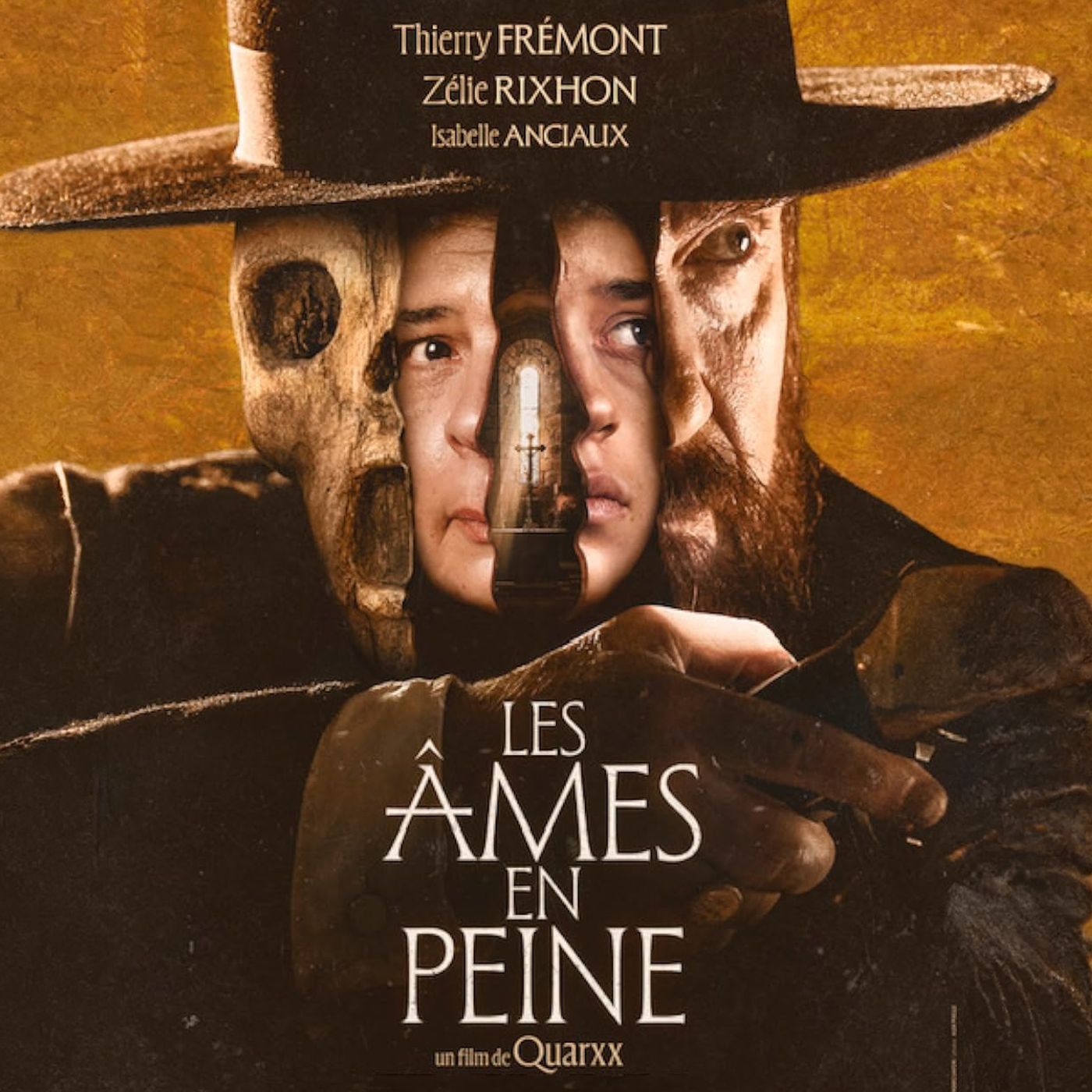
Quarxx came to filmmaking through a decade as a painter before ever picking up a camera, and this is his first script written with a co-author, novelist Frédéric Soulié, after years of collaborations that never clicked. He reunites actors Thierry Frémont and Zélie Rixhon ten years after they played an unhealthily entangled pair in his debut All the Gods in the Sky — only now she’s grown into the role that reverses their dynamic. The film’s plague victims wear masks designed and sculpted from scratch for the production, a deliberate swerve away from standard zombie iconography toward something that isn’t dangerous, just hungry and discarded.
Made on what Quarxx calls the lowest budget of his career after French funders balked at the material, the film premiered this year at Fantastic Fest following festival stops across Europe.
.Follow Quarxx on Instagram for updates on his next film.
Transcript
Automatically generated, so expect the odd misheard name.
Hold your ears, folks. It's showtime. People pay good money to see this movie. When they go out to a theater, they want cold sodas, hot popcorn, and no monsters in the projection booth. Everyone pretend podcasting isn't boring.
Turn it off. Welcome to the Projection Booth. I'm your host, Mike White. This time out, I'm talking with writer-director Quarks about his horror film, The Ones Who Grieve, in which the souls of the dead are sent off to die a second, hypocritically bloodless death, rather than be killed outright. The Ones Who Grieve made its U.S. debut at Fantastic Fest 2026.
I had a great time talking with Quarks, and I hope you have a great time listening. Enjoy. I want to know a little bit more about you. Can you tell me how you got involved in filmmaking? I had that in my mind since a very early age, I think about six or seven years old.
I said to myself, this is really what I want to do with my life, and I Until that moment, I just never let it go. I just followed my path in order to achieve and succeed what I promised myself when I was a kid. But prior of going to filmmaking, I think that jumping into filmmaking at a young age, it might be a little bit too early. I thought that I needed to have some baggage, some luggage on my shoulder in order to be able to create a universe and tell stories. So I went through... painting first.
I was a painter for 10 years. I wanted to understand how to control the light, how to tell a story by using one single frame. And I thought that was a very important process for me. Then I become a photographer. And then I started to experiment with short films and from short films to short films.
I made the last one that was called A Nearly Perfect Blue Sky. And this one pretty much changed my life because after that, we got selected in Sundance. We had 180 festivals plus. It was the biggest French short film or the most selected in the world at that period. And it was quite easy after that for me to make my first feature film.
It became really hard again to make the second and the third one. But for the first one, it went pretty easily because of that short film and the success that he had. So yeah, basically, this is a shortened version of my parcours, of my story. But yeah, it's like that. It's interesting to me that you're doing painting and photography, which can be very solitary.
And then you get into filmmaking where you have to collaborate with so many people. This is the second one is really my true nature. I never considered myself actually as a painter. I had a success actually with painting beyond my understanding. And I had like sort of this gangster kind of feeling because I thought, wow, this is working really well for me, but this is not really what I want to do.
And because I was making quite good money, it was kind of difficult for me to stop it and take the leap. You know, it was a leap of faith because I was quitting something that I had success in to start something that, you know, start from the scratch. So it was quite complicated. And I didn't picture myself as a painter because, as you said, I'm not a loner. I like to work with a team.
I like to be surrounded with people. I like to manage also like a team, you know. And so for me, I'm not a Van Gogh who needs to cut his hair in order to feel the pain, in order to create as a loner in his room. You know, that's really not my character. That's why it was just a step and not a final destination.
You write or co-write almost everything that you've done. I'm curious where you get your ideas from. It's actually, I wrote everything on my own until the last one. And for the ones who grieve, this was the first time that I had a collaboration with a co-author. And I was open for collaboration for a long time, but I tried with many different people and it never worked because I think I have a very... strange and typical way of creating and my universe is kind of personal and I try to make films that are original on my own ways.
So collaboration was really complicated and it never worked until I found Frédéric Soulier. I wrote a book from him and I loved that book so much. I called him and we started working together and it went really well on The Ones Who Grieve. And so I'm really happy about this collaboration. But to answer your question and where all those inspirations come from, you know, that is very difficult to answer because who knows, you know, who knows where really.
I try not to get too much influence by all the films that I've seen. But in some cases, I try to also have a conscious influence because I like to pay a little tribute every time in my film. to a genre or to films that I've seen when I was a teenager. For example, in my previous film, Pandemonium, it was really an homage to Lucio Fulci's vision of hell in the beyond, for example, that I really used in my film to really make her clander. I don't know if she said that, but yeah, pay a tribute to Lucio Fulci. That really influenced me when I was a kid.
And here it's the same with The Ones Who Grieve. There is this scene with the character of Henry, It's really also a homage to Bob in George Romero's franchise of The Living Dead, The Down of the Dead. I thought it was The Down of the Dead, where Bob is this zombie that has feeling. And I really thought about him when I wrote the part of Henry. But beside a specific part of my film, I try not to be too influenced by by what I saw or other people work.
And I really try to create my own path and invent something from nothing. This is what I really find it interesting during the process of writing. How was that collaboration? You said it was pretty good, but as far as how would you two actually write together? I got the idea first and then I wrote the overall story of the ones who grieve.
Then he came in and he made a little, you know, he changed little details and he worked on the dialogue also as well. And I think we lifted, we lift each other up, you know, all throughout the process. And we have the same vision as really the first time that I have a collaborator that I think, you know, most of the time, because of course we have huge arguments also, you know, and most of the time, of course, I'm right and he's wrong, but he doesn't understand it that way. He thinks it's the other way around. So we argue and then we, you know, but it's always like a very good vibe together.
And at the end, we always get to an agreement. And I think I bring a lot of things for him and he brings a lot of things for me. So it's really a cool collaboration and I'm really happy of the way it went. Tell me a little bit more about your cast, because you've got a really terrific cast in this movie. Thank you.
I really wrote the film custom-made for Thierry Frémont. Thierry Frémont might not be super famous in the U.S., but in France, he's a super famous actor. For example, he played with Brad Pitt in Allies. from Robert Zemeckis, and he did this big series for, I think it's ABC or CNL, Nautilus, where he played Nemo. So he's going a little bit international, but here in France, he's a very famous actor and he's very, very good. And he's a friend of mine for more than 20 years.
And he appeared in All the Gods in the Sky, which was my first film. But I didn't really have something substantial to give him. So he had like a little play, you know, he's like appearing in the film, maybe like five minutes. But I thought it was, I just wanted to have him, you know, so I gave this little part for him. But thinking in the back of my head, you know, this is just an introduction.
But someday, one day, we're going to do like a big movie together. And so from the beginning of my writing, I thought about Thierry for this film. part of Jacob. And I really wrote it with him in my mind. And after, for Zélie, who play, well, Zélie Rixon, who plays Zélie in the film. I thought also it was a good idea to take her and reunite her with Thierry because she always, she also played with Thierry in All the Gods in the Sky.
And at that time, she was eight years old and they played Thierry These two characters together and Thierry, there was a very unhealthy relationship. We don't really understand what was going on, but we might understand that maybe the character of Thierry in All the Gods in the Sky maybe kidnapped this little girl and have a very unhealthy relationship with her. And I thought it was like a method thing to bring them back together in another universe 10 years after where she now became a woman. and bring them back together because they have this really cool chemistry. And Zélie is an incredible actress, I think. Now she's working a lot.
She's doing a lot of movies. And I thought I was really blessed to be able to work with those two comedians. They're not the only one now. We have a lot of other comedians. Jean-Baptiste Meunier, that is great.
And Jean-Luc Couchard, who is my good friend, who had the lead role in All the Gods in the Sky. So we paid great attention to the casting, which took a long time to process. And that's how it went. The film has such a great look, and I especially love the masks. Can you talk about the masks a little bit?
When I had this idea that the ones who grieve, I mean, the grieving souls or the scavenger, they cannot be killed because religion says you shall not kill, you know. So they have to let them die by themselves by putting a mask on their face and deprive them of eating or drinking. And they're going to die on their own. So this is very hypocritical, an hypocritically technique of killing them, but without killing them themselves, you know. Yeah.
And so the mask, I started making some design. I designed some masks. I make some sketches and everything. And then I found a plastician, an artist. I don't know plastician.
You understand plastician? I'm not sure if you do. But more like an artist. She was like an artist. And I gave her all my designs.
And then we worked together. And she started creating, modeling, sculpting. And then, yeah, we ended up having those pieces that are really nicely done, very well-crafted. That gives also the atmosphere of the film because I wanted to play with the myth of the zombie. But without really...
I didn't want to really make them zombies. I wanted to reinvent a little bit the mythology of the zombie and turn them into something else. Something that are not dangerous, actually, because they don't attack people. They don't kill anyone. They're just eating dead flesh.
So I thought it was also a nice way of pinpointing the fact that sometimes the danger or the evil is not where it seems to be. I know that filmmaking is not the easiest process in the world. What were some of the biggest challenges you had making this? Challenge number one is really money, is finding, securing the budget. Because I'm doing very well overseas.
I'm selling my movies and everything. But for me in France, it's very difficult because all the... all the things that should help me and should finance me they never do because for some reason it's too bleak too dark too whatever they don't get it I think We basically found a private equity for this one. It's not always the case because my first one, I called the gods. It was produced by Canal +, so I had a little bit more money. But for this one, because maybe of the subject matter, it was really difficult to find the proper budget.
So fortunately, because now I'm in the business for quite some time, so I know some people and I have a lot of contacts and everything. And people, thankfully, a lot of people like what I do. We were able to secure a minimum budget, but it was very low, actually, very low budget. And so we had to be very creative in order to fit the budget and not having so many frustrations of not being able to tell the story that I wanted to tell. So I would definitely say that the main problem was the money.
But once the money was secured... It was a lot of work. It was a lot of many difficulties, but same as usual. I wouldn't say that it was so incredible, but really finding money is the worst. And that's why actually also probably the ones who grieve is going to be the last time that I'm shooting a movie in French.
I think I will for my upcoming project that I already work more working on. It's called The Pink Room. I'm going to shoot it in English. and I'm going to shoot it overseas because I'm tired of struggling like that in France. I am appreciated because the Elekindo Festival is working great and I have a lot of people that really like my work. The paying, the ones who pay, which would be the CNC, you know, Centre National de Cinématographie, and the région, which is called that whenever you're shooting.
I mean, the area of where you're shooting should give you money. It works like that. So with me, I think it's because of subject matter. And they would like something more political. They would like something more optimistic.
And this is not what I'm doing. And so, yeah, I'm having trouble. But at the end of the day, I'm still conscious that I can make movies. And so I'm really also I'm really blessed with that, you know, because there's so many people are just dreaming of making movies, but then they can't. And so I have a luxury of still being able to express myself, to make some movies that my movies are shown worldwide.
So I'm not depressed about it, but still I want to go bigger. And I think for that, I need, unfortunately, because I don't feel like it, but I would need to go overseas. How was the premiere? Because you had that, what, in Switzerland? We had the premiere in Nice.
Then we went to the Grossman Film Festival in... I forget where. In Estonia, I think. And then... Then I had the Fantasy Fest and we had the Etrange Festival in Paris.
So the premiere in Neuchâtel did very well. It was super cool. I, of course, realized that my film is very cleavant. It doesn't bring people together. It totally divides people.
Which is very okay with me because this is just perfect. But whatever, if you like the film, you're going to really like the film. And when you don't like it, you hate the film so much. And that's interesting because it really creates a debate. with people, I feel that no one gets bored at the end because even the people that hate it, I mean, they hate it so much that I feel that I can tell that it gives them a lot of extreme emotion, you know? Either it's positive or either it's negative.
It's all good as long as emotions are here, you know? It's the worst thing for me in the cinema is to create a boredom or like, I don't care, you know? It's just, okay, that's really the worst that can happen. And well, usually it does not happen with my film, but it's very Cleveland. Yeah.
I will be in CJES with the film in competition. And at the same time, that project got selected as well in CJES during fan pitch project where there's a few scripts that got selected. You get in and then after you pitch your film to investors, distributors and producers from all around the world. And so you have... you know, like easy access to many appointment and many people right on the spot in CJS for three days. And we will start from there.
We already have a little bit of, I would say like 20 to 30% of the budget that is secured. We have an international sales agent. That is 99% cleared. So we'll see how it goes. But yeah, regarding the stories and everything, I'd rather not speak about it too much right now.
Is there a good place online for people to keep up with you and your work? I have an Instagram, Quarks Arthur, Facebook, or just Google me and you'll find plenty of things. Thank you so much for your time. This was so nice talking with you. Thank you.
Same here. It was a great pleasure. The things about us
More from The Projection Booth



Similar episodes across the network
Matched by shared keywords.
-
108 - Jett Green - Matte Painter / Artist - Labyrinth, Willow, Temple of Doom
1 shared keyword: painting
-
Tales from the Darkside S01E02&03 (I'll Give You a Million - Pain Killer)
1 shared keyword: george romero
-
Campfire Stories with The Haunting Season's Josh Bragg: Men, VHS, Stranger Things
1 shared keyword: folk horror