
Season 1 · Episode 108
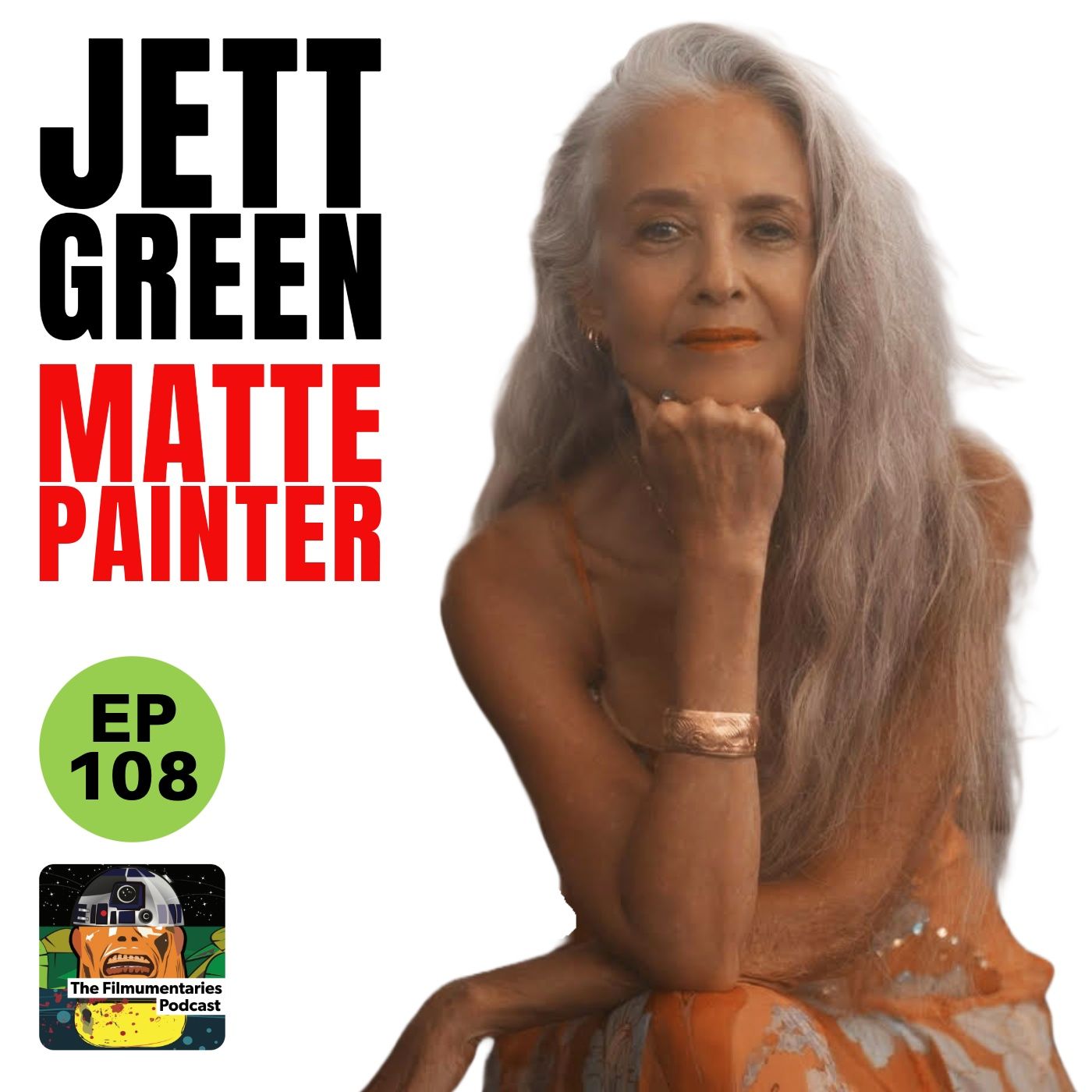
108 - Jett Green - Matte Painter / Artist - Labyrinth, Willow, Temple of Doom
About this episode
Links
All the filmumentaries links
https://www.caroleenjettgreen.com/
https://viewpointsgallerymaui.com/
Nigel Smith Cinema walks in London
This podcast is completely independent and made possible by listener support. If you’d like to help me keep making these episodes, you can join my Patreon community here: https://patreon.com/jamiebenning
Watch more on YouTube:
Check out the Filmumentaries YouTube channel for behind-the-scenes clips and extra content: https://youtube.com/filmumentaries
All my links
Transcript
Automatically generated, so expect the odd misheard name.
Weird Ingway Media. Welcome to episode one hundred and eight of the Film You Mentori's podcast. This is your host, Jamie Benning, talking to you as usual from my house here outside London. This is the second of three episodes for August twenty twenty four. Three episodes this month because in July only got one episode out due to a big family holiday.
As I mentioned in the previous episode, Welcome anyway, if this is your first time. If it is your first time, I'm kind of envious actually, because you've got one hundred and eight episodes to listen to. Think of this as an archive of film history interviews for you to dip into. Yes, you will pick the name of the people you are interested in first, but I guarantee you you'll find something to learn from people you've maybe never heard of. So just pick an episode at random and go for it, or carry on listening to this one and do that afterwards.
Thank you to all of you lovely regular listeners, particularly those of you who support the podcast on Patreon. This is work, albeit at work that I love, but it is work, and thanks to the one hundred and fifteen of you that support the podcast, I hope to expand this to two hundred and fifty people by now has not transpired, but I'm not going anywhere just yet. So please, if you like the podcast, just throw twelve dollars way for an entire year of episodes. I really think that's good value. I mean, I've supported several projects on Kickstarter and on Patreon over the years, and if we want, you know, those projects to thrive and to remain, that's what we need to do as fans.
Alternatively, if you just want to donate, there is a donate button, a PayPal donate button over at filmumentaries dot com. I really do appreciate your support. I went into London yesterday I met up with several friends. One was with Doug Weir at the BFI, friend of the podcast. Doug works in restoration and delivery at BFI, and the other friend Nigel Smith, a radio and podcast producer.
I met them both separately, but they both said something to me that took me aback. It was almost identical. They mentioned that they'd listened to the episode in which I talk about my visit to Skywalker Ranch Lucasfilm and Ranch at obi Wan episode one hundred and one, all about their epic three day trip I took back in April. Both said that they loved the episode and they found it really quite emotional. So Nigel Smith, who works in podcasting, as I said, also does guided cinema related tours in London.
Have look up Nigel find him on the show notes. Actually I pop in there and Doug are becoming good friends, and Nigel said he was particularly struck by the risk I took being that vulnerable and open and it being quite a different episode, and that's not really something I considered actually, but I was so grateful to both of them. And the amazing news is that particular piece of writing. Because I did write that episode, it's led to something very cool. Indeed, more on that in a future episode.
But huge thanks to both Doug and to Nigel, and also to Mark Berman, ex BBC producer who I also met with yesterday for lunch, who said in a WhatsApp after we left lunch, lovely to meet up. Really glad all your hard graft has paid dividends. Keep at it. You've worked long and hard for it. Now.
I can't tell you how much I appreciate those words from Doug and Nigel and Mark. I respect all of them, and Mark in particular supported me a lot at the start of this little venture of mine. He put me in touch with Nilo, for instance, and I think Dennis Muir and a bunch of people at the beginning there and kind of pointed me in directions I didn't really know about at the time. He's an incredibly intelligent and talented producer, so to hear those words from him really does mean something. And you know, I have real respect for Doug and for Nigel's work too, and yeah, I just I don't know.
I came out of it just feeling quite buoyant. So thanks to all of you who'd taken the time to review the podcast. I think the last review was left in June twenty twenty four, so if you could take two minutes to leave a review, I'd really appreciate it, and it also helps get it to more people's ears. In fact, while we're on the subject of getting the podcast out there more, I'm getting close to the idea of looking into working with someone on this podcast, maybe someone to manage the kind of social media side of it, or post them on YouTube. And because you know, once I've done the recording, I then edit the recording, I write the intro, I read the intro, I edit the intro in I then have to make a graphic thumbnail for the podcast, do the show notes, post it on the podcast platform, obviously adding details on where the adverts need to go and any jingles before and after in the music, and then I have to post on Twitter and Facebook and threads and Instagram.
Then I do social media clips, and it's really taking longer and longer to do all of this work. So if that's something you might be interested in, or if you have experience in that area, please do get in touch. Info at filmumentaries dot com is the email address. In fact, if you have any questions or suggestions, use that same email address info at filmmentaries dot com. Or you can find me on Twitter at JMSWB or on threads, Instagram or Facebook as Filmumentaries.
I just feel like I'm on the cusp of really getting this to more eyes and ears, and I just need a bit of assistance along the way. I would pay for it. By the way, I'm not making much money off the podcast, really, but I'm making a little bit, and it feels like I need to use some of that to kind of plow back into the podcast directly, and maybe getting somebody to help me is the way to best spend that money. Okay, So for this episode, I chat with the talented and beautiful Matt Painter Jet Green. Jet joined the ILM in the mid eighties and worked on a number of seminal films, including Temple of Doom, The Goonies, Howard the Duck, Labyrinthe Willow so Many and later on in her Chris she worked on a number of animation films, doing environmental art, in particular for dream works on films like How to Train Your Dragon, Rise of the Guardians, The Book of Life, All Loved in This Household Actually, and Jet and I had a wonderful chat a few weeks ago.
I think you're going to enjoy it big thanks though, before I throw to the interview to Jim Maxwell, friend of the podcast, also another friend I've made through this podcast. Jim and I chat quite a lot. Jim is a talented Matt painter, himself a good guy, and we chat a lot about movies and life, and you know, we kind of when we ask how you doing, we mean it, and we have a conversation about the ups and hands of life. So Jim was really kind and has been very kind in the past, giving me details of a few guests and putting me in touch with them, Jet being one of them. So Jim, thanks as always, and I appreciate your friendship and your help and support in me doing this podcast.
So here's my conversation with Jack Green and I'll be back at the end for a bit more jabbering. One. Did you grow up in a creative household? Did you? I mean, most kids kind of start their lives loving drawing and loving painting, and something happens along the way.
Maybe it's something to do with having parents that encourage it or not with you in a house that encouraged creativity. Yeah, my parents, it wasn't like they encouraged it. They just weren't very disciplined with me, and so they were really they didn't have a lot of rules and regulations like oh no, don't mess this up. I have pictures of me with a wall behind me that my sisters and I just drew all over the wall. And my parents did not get mad at us for that.
Creativity that started really like I was super young, like three. Yeah, And I think a lot of parents do struggle with that. Oh, it's a bit messy getting the paints out, and we're gonna have to tidy it up afterwards. Let's not make a mess. But part of being creative is making a mess, isn't it.
And you know, starting from that start point, I'm sure that's probably still the case for you. Now you get messy, right, it's part. Of I call it the hurricane coming through. Don't come in the house. It's like, but yeah, I basically grew up in a messy house.
My parents weren't. My parents grew up wealthy with servants in China, and so this is my excuse for them of not really being super disciplined around tidiness because they were used to people being tidy for them. Was that Shanghai then I read that? Right? Yeah, I thought i'd read that somewhere.
Ye. I visited Shanghai a bunch of times, actually, and there is a real kind of disparity whereas there is in almost every city now, but between the rich and the poor, and you do see some of the former kind of opulence of Shanghai. Did you ever go there yourself? You weren't born there at all? You that was when they know.
My mother was born there, and you know this is before the forties now, when it was a whole British colony and European and everybody met there and was they were wealthy, you know, people looking to they could be wealthy there because. I guess everything was cheaper. Yeah. Yeah, it's weird Shanghai that you go down some streets and you feel like you're in Paris. There is that kind of European influence there.
Anyway, Moving on from that part, so you're a major drawing on the walls at school? Were you kind of seen as a as a gifted kid in terms of art? No, I actually didn't do well in to me, I mean I got c's. Maybe I got to be an art or something, but I wasn't very good in comprehension and reading and things like that. And I was just like asn average kid.
And I did little art projects at home, but I was not the class artist. And I do have a memory of it was probably in fifth grade. We had to do a drawing of an object and I did something in oil pastels. I did like a kool Aid picture that was ceramic. I brought it to class and of the students they said to me, you didn't do that.
Your mother did that. I didn't know, you know, And so that's the kind of feedback I got was, you know, I was a little girl and there were I think the boy girl thing. There was more support for boys. But I didn't notice that as a child. I just knew what I knew and I did what I did.
But that didn't stop me. And I also had another experience in like first grade, we had to do portraits and the portrait I did, I messed it up and I ended up coloring it in. My face was completely. Red, like solid red, and the teacher held it up in front of the class and said who did this? And everybody started laughing, and I was like so embarrassed.
But these kinds of things didn't They didn't stop me. So I just want to say that. And then, you know, my parents were just pretty easy going and I was kind of playful, and they were more intense on my older sister and my two older sisters. My older sister. She was into math and was constantly she focused on math, math, math, and she should have been an artist.
Really. Yeah, it's interesting, isn't it What the sort of value people put into different kind of abilities that people have. Did you then go onto college to an art college to kind of, you know, find your way. I started at City College just taking art classes because I started drawing just on my own in a sketchbook, and I got influenced and inspired by an older guy. He was probably like seven years older than me, a friend of the families who went to art center, and I just fell on his work was so stunning.
I started just drawing on my own little objects like a shoe, and I could draw like I just it looked good right off, and I was in high school. Yeah. I wonder if that ability to draw has something to do with the ability that some people have some people don't, which is to be able to hold the concept of a three D image in their head. Yeah. I'm not a good artist at all, but I to a certain extent, I think I'm a visual person.
You know. I'm an editor in live TV and I direct a little bit as well, and I'm looking at sort of composition and what's going to work alongside another image. So I have a certain and sort of visual idea, but I can't really hold a three D image in my head. Did you do you find yourself visualizing or is the pencil or the paintbrush like the the output stream if you like? Is that well, there's like this if I take an object, you know, if I take an object and set it down and want to draw it exactly as it is, I it's there's a lot of focus.
It's like a meditation, and it's the ability to analyze and and then put it down on a two dimensional surface. Take this three D image and analyze it with proportions and does that make sense? Is that? Yeah? Yeah?
But do you start kind of sketchy or do you kind of go for the for the precision? Immediately when I was younger, I think I went for the precision. And then I learned from one of my teachers, who is a portrait painter from the thirties and forties. I learned the. Traditional way to draw proportionately.
Does that make sense? So really analytical and you start with lines and not a grid but comparison, and it's almost like for me to really do something, And that's realism. I'm not. I could be expressionistic, but I've been drawn into all realism. There's something about it that really feeds me.
Makes something look photographic and real. I'm looking in front of me now, and not everybody's gonna be able to see when I edit this. What I'm looking at I'll tell you in a moment, but a lot of people will be listening, so i'll describe it. There's this picture, this painting that you did as your test project to get hired at ILM, all right, which is this architectural It's this building and there's some graphs in the front. It almost looks like a golf course.
Next to it it looks like a bunker almost, but I think it's not. And there's some people walking through in a path. And then there's this kind of rectangular building going off with some perspective, and there's a flagpole with a flag on it. Now I'm looking at the painting you did next to it, and it looks at the resolution I'm looking at it right now, it looks completely real. In fact, I was looking at your painting for a moment and thinking I was looking at the photograph.
It's the other way around. But in there I can see, of course, there are little kind of subtle changes, like I can see the path on the left. Maybe it reveals a bit more of the of the path to sort of suggest more of the path there. But your ability to come up with something and produce something photorealistic kind of boggles my mind. But that was what was expected of you as as a way to get to ilm because the competition you're up against at that time.
Although that precision may not be needed in a movie because obviously you can have sort of broader brushstrokes and things for some of those matte paintings. But did you feel hugely pressured to get this like one hundred percent right? And how long did it take you to create this painting? Well, they gave me a month to do it. And there are some secret tools that mat painters that were we were traditional only artists painters, uh, not computerized all painting.
We have tools that make us look like magicians. And one of those tools is photography and a slide projector. And so that that test was the first time. You know, and Frank Or Dads, are you familiar with Frank Or He was my one of my guy friends at the time, and he's a brother and he's the one who said, hey, you know, you have an opportunity here and would you like to try out for the job, And then when I got that photograph in the mail, you know, and I said, Frank, I don't know how I'm going to do this in a month. This this is basically fucking scary, you know.
But I had all of the skills to understand color theory and values and all of that comparison, it's like multitudes of understanding of how to make something look real with values and color theory. But the one thing about drawing something like what you're looking at to go fast, I mean, get it done in a month. Or just a few days. You take a picture of it, make a slide and get your slide projector and project it onto your the surface, and that's all you're drawing is right there. That's how I did it as fast as I did, And how you know, I.
Was very precise with every square inch. It was. I not paint that painting like where there was breathing room to oh this is so beautiful, what a beautiful You know. This is a technical focus, almost like going into surgery. And and so you asked me, how did what did you ask me?
You asked me, how did I do that? Right? And a lot of it is the tools, you know, the slide projector. But even with a slide projector, when you're projecting, the lines are not straight. It can be warped because of the lens.
At the time, it was not iPhones, it was cameras, Canon camera and and the lines are a little warped because of a fifty millimeter lens. So I had to go in there with a T square and all of my lines on that building had to be done with a T square although I was projecting it. Does that make sense? Yeah, yeah, I think you know, even with. That kind of tracing, you know, using the projector, that's just the very first step.
I mean, just getting that level of detail and the suggestion of light and where the light's falling and the textures and all of that stuff. I mean, they're all completely different disciplines to just being able to draw well. Yes, And you know, as I learned from that one portrait painter. His name was Ted Lukett, and he was like an old guy. He looked like Yoda, you know.
When I was taking from him in my twenties, he was probably in his sixties, but I thought he was in his eighties, you know. Well, yeah, and when you were sixty back then, you were sort of eighty five. Now, if you know what I mean, I think people were older when, you know, yeah. Back in the seventies. Yeah, yeah, But I have to say, there's a method, you know.
So you start with the sky, and then how does the sky affect all of the forms? What is the weather? Is it a clear sunny day? Is that? You know?
You have to have all these questions that are answered in your head. And back then I was basically just copying, I really and I just knew how to match every single color perfectly. And that means if this one doesn't look right, if I'm still thinking in my head, no it doesn't match, doesn't match. You know. And then I had a photograph of that to you know, look at my color.
You know. I was in like I said, in surgery. Yeah, and it did. I spent a full month of my time every day, over ten hours a day doing that. Do you remember that moment giving it into Frank and the kind of the response.
Well, I sent it. And I remember when while I was doing that painting, I thought, if this is Matt painting, because I didn't know anything about Matt painting. I didn't know anything about cameras or film. If I was a newbie, and that's probably why Frank called me. I was like, perfect, a perfect little seed meen for them to you know, bring up and teach basically.
And so I sent it to them. It was like, do you know, I spent a full month and I sent it FedEx. I remember it was fifty dollars and that was a lot of money at the time. I think, by the way, well, I can just say it's I don't know it. See, the actual photograph was eleven by eleven inches and I had to blow it up twice the size that it was probably almost two feet by two feet.
I still have that piece, oh yeah, hanging in my studio. Yeah. And so Frank got it, and Frank was feisty. I'm going to say it like that. Frank was like, it.
Looks good, but it looks like something you spilled something in the sky. And I freaked out, Did you spill some coffee in the sky? And I said, are you kidding? You know? I had, you know, I think maybe either he was jealous.
I don't know where that came from. But I said, do you want to send it back and I'll fix it? And he goes, no, it's okay. I think he was a little bit like, Oh, this is really good. People say funny things.
Yes, I don't know whether it's jealousy or in competition or what. But I thought that was the weirdest. And I did have a cloud in the sky that was in it's in that photograph that looks kind of mushy. So I did it that way. And this was like eighty three eighty four, was it around, Yeah, it was between.
It was almost eighty four. It was the summer. So you're walking into a department that's like Michael Pangratsio, Chris Evans, David Fincher, Craig Baron. No, I mean. Fincher was not there later.
He came later, as you know, just a helper, yeah, an assistant cameraman. But a very male dominated industry and a very male dominated departmentarticular the Matt Department Island. Then, was that difficult navigating that When. First arrived, I had already been at a sweatshop in Georgia. In Atlanta, Georgia, there was like seven I was the only woman, young and pretty, you know, and and but I didn't consider that at the time, And I think I felt really comfortable with men and guys because I was my dad and I had a great relationship.
My dad was the one who encouraged me. My dad never put me down. He was a really kind father, and so I was not intimidated by guys, and I actually felt more comfortable with guys than than girls. Yeah. Yeah, I think you mentioned in another interview that I read that there was that they felt like brothers to you, big brothers in a way.
I guess some of them because they were there before you and they kind of yeah, mentored you. Was there anyone in particular whose work you admired amongst that group. Well, Michael Pngrazio. I find. He was incredible, like genius.
Like when I think of genius, I think of somebody. He was never wrong. You would say we need to do this, this and this. He was always right. And there was one time I argued with him a couple of years later and he said, you know, he was like, well are you questioning me?
And then I said, well, you always told me to question authority, you know, because he would have these little lessons that he would tell me along the way, and he was like a you know, the brothers I never had, and those guys were good guys. They were not you know, they had good boundaries. They did not they were not the kind of guys that pinched her butt or anything like that. They were had integrity, And I was really lucky all of them. I missed those guys.
I think I've talked to quite a lot of people that worked at ILEM at the time, including Michael and Craig Barron and Phil Tippitt and Ken Rauston and a lot of them, And I've talked about this a lot on this podcast. People seem to have been employed obviously on the basis of their talent, but also a personality type in a way, and a lot of people that went onto other effects houses and into other industries talk about missing that kind of collegiate kind of feel that ILM had at the time. Is that something you experienced when you were there too? Can you describe what you mean by collegiate even though I kind of get it, but can you be here? I guess what I mean by that is a kind of a fraternity kind of feel like you're all in it together, You're looking after each other.
You're not necessarily I mean, of course there's competition, but you're not necessarily there to, you know, outdo each other in some sort of nefarious way more that yours. You have a support network, I guess. I guess so, I mean in the model shop. But I'm friends with those guys still, some of those guys in the model shop again, they're also good people, my brothers. And in fact, I'm going to go to Lauren Peterson's eightieth birthday in September.
I just hung out with Lawn. I was. I was just at the ranch in U when it was it April or May. I got invited out to Skywalker Ranch and Lawn, who I'd interviewed a couple of times, he said, oh, well, if you're coming to the runch, Jamie, I'll come and hang out there with you. And he turned up at the runch and took me round.
And he's just the best. He's such a such a great guy. Is he's just and and. You asked me, you know, the kind of person that worked there at the time, and I felt pretty innocent, like I was thirty. I just turned thirty.
And at the time, in. The eighties, it was earthy. People heard about things and you know, I don't know how to describe it. They weren't preoccupied. They were preoccupied with their art form, you know, and they were all very I think, very confident because they they saw results and they had already won Academy awards.
And I know there were little feisty spatters between the guys with uppers, you know, management, and but everybody did their best, and I think everybody loved being there and working for George, and George was really pretty cool. I mean, even though you know, when he came around, we'd all get inspired. I mean, his movies already won awards, so it's this wonderful camaraderie. Or I just felt so honored to be there. I would have done any you know, you know, can I wash your brushes?
But I was never asked to go below the belt. It was always, like I said, respectful with integrity, and you know, I got teased. Michael would tease me. But the way he tease me was, you know, like about how high my voice was, or you know, it wasn't you would tease me about being a girl, you know, or. Which which probably says more about Michael than it does about you in a way.
You know. Yeah, That's what I always think. With those kind of tactics, you know, I tell that to my daughters all the time or so, and so you said this to me. I said, yeah, but they're not really saying that about you, that they're revealing something about themselves, you know, which is often the case. That that first film that you got put on them was that Temple of Doom.
The very first Matt painting piece I did was. For Star Trek. Three. Yeah, and. I was so scared.
They gave me a piece of glass and Craig set me up and I had to paint a set extension for some. I don't even remember. It was just why or what, you know. They just. Said, you're you know, this is probably the part that's you know, nowadays that would be considered not okay.
But you know, you're the girl. Just paint, you know, in other words, you don't need to know anything, Just paint, okay, okay. So I would just be given something and just you know, put the you know, the said extension of these pillars, and and that. Was such a big deal for me. I was so intimidated and nervous and but I did it, you know, it was all there.
And did that then lead to did you do the Golden Gate Bridge painting? That was later That was later on, but it was Star Trek three, The Never Ending Story and t those were the three movies in at the time. And I was an apprentice, so I would be given something and guided by Michael. I mean, how lucky could that be? And then Chris Evans would bail me out if I screwed up, and I screwed up many times.
You know that's what that's how you learn is absolutely yeah. Yeah. Do you know the first time I became aware of your work, and I've mentioned this program many times, is there was a show called How to Film the Impossible where they went to Ilm and they shot some stuff of you guys there and it was Temple of Doom, and I think it was a bit of Return of the Jedi as well that came before it. And there's a moment where I think in the British version there's a British voiceover, in the American version there's American voice over, and the British guy says, this is Caroline Green. She painted the map paint this marvel us matte painting, and it's that straight to that shot of your matte painting.
I think there's a moment of you painting, and then it shows that painting where the flood comes out and Harrison Ford's there the cliff, you know, yeah, the cliff. I mean that blew me away as a kid seeing that. I remember I was at my grandparents' house just watching idly watching TV one Saturday afternoon. I was like, that's a painting like it kind of blew my mind. You know, did you get to see the actual footage that you were going to be working with beforehand or did you just get a still of it?
Did you get a thirty five millimeters seventy milimeters still of it? We'll be right back and back to the conversation. There was all different ways to deal with Matt painting traditionally at the time, and you know, usually like Michael or Chris Evans would do sketches about that big like concept art and then we would have meetings all the time just us, just the four or five of us, and Michael and Chris Evans were the ones who were looking at the concept art that was done by the art director and then they would redo the concept art as a matte painter how it could look. And then and then everybody chooses, well, which one do you want, you. Know, I'll take that one.
You know. And of course Michael and Chris would get the big ones, the candy shots, and I was an apprentice, and so maybe I get a set extension, and then Michael would put me on something as crazy as that cliff shot, and I would just say okay. And there were several cliff shots that I did from an extension going down the face? Do you know about those? And Evans was doing some of those, and then Michael would put me on a medium sized one, and then there was that huge cliff face.
And I swear to God, every Matt pain I've ever done, it seems like I'm sitting there going I really don't know what to do, and it's it's just the way I work. It's almost like I channel in what has to be done. So I started painting on it. Okay, you want to know the truth about that shot. I don't know if you read what I've written about that before, but I think Michael was putting me on the big shots.
To help me learn. But he knew that if I screwed up, he would just take over. And I'm actually starting the shots for him, and while he's working on another shot. So it was a collaboration of all of us sometimes, especially because I was an apprentice, So sometimes the apprentice is in a position to start the shot up while the big guy is working on a bigger shot. Right then when I've taken it as far as I can go, then he takes over.
So on that cliff shot, I was working on it and we would have these critiques that were ver very truthful, and Michael said, it looks like peanut butter. We have to fix this, and I was I would just go home and practicing, okay, Or I would practicing yes, you know, but you just don't argue. Ever, you know, they're paying you, and arguing causes more tension, and you know what I mean by that, you know, So I would just agree. And so Michael took over. I had painted a lot of it, and I just didn't understand, you know, because you have to make up stuff you can't and usually I use photographs.
There was no photograph for this cliff face. I would just look at, you know, books and things. So Michael took over and put lighting in it, like cash shadows, and I was like wow. And that's how I learned, was watch him. And then Michael got tired of working on it, and he said, I can't this looks terrible.
I can't work anymore, you know, And and he was. That's what I learned from Michael was you're never satisfied going, never give up, just keep going and working on it. So he gave it to Chris Evans, and Chris Evans put final touches, probably you know, lighting that would make it look more punchy, you know. Or so there was three of us who worked on that. But it looks like I did the whole thing because they have that picture of me in all the books.
Yeah. Yeah, but did that happen? Did that happen regularly then, where you would work together as a team on a painting or was that quite unusually? No, it wasn't unusual, and it wasn't it was we did anything to get the job done, you know, I tell I've told students this, you know, you copy steel, you know, anything to make it look realistic, and anything to get it done and make it look excellent. But that was one piece that I always have to correct people and say I did not work on that completely.
You know, I had you know, my people, mean, Michael and Chris Evans were top of the line. So that's why that piece looks so cool. That's a cool story though, when you're doing these paintings and you're kind of sort of you know, in your sort of physical and mental bunk or almost you're working on something and you're in your meditative space, do you feel connected to the movie when you're doing this work because you're not going on the set, you're not seeing dailies, You're you're kind of so focused on this. I just wonder how sort of how you managed to stay sort of connected to make sure it fits within the movie. Well that's where Craig Baron came in.
I mean, as in the beginning you always Craig. Craig would have the film clips or whatever. There's different ways of doing traditional matte painting, but mostly we'd take one film clip we projected and figure out where the live action was going to be and what type of mat painting. Is it going to be rear projected, is it going to be latent image, is it, you know, going to be optically put together? And Craig, just.
One thing when you say latent image, is that when it's actually like in front of the camera and you shoot through it. Is that what latent image means. Yeah, yeah, and where they shoot the film of the live action, and half of that film is black, black and out, so it doesn't get exposed, and that's where it gets exposed again with the painting in it, so it's one to one and there's no graininess. That latent image was one of the favorite ways of doing something that would you know, Craig would always talk about Craig and Michael love that. Process given the results.
Yeah, it does. Yeah. I remember also seeing in that same TV documentary the Ewok Village, which I know is not one of yours, but just them lining up the kind of live action plates in the little holes that have been kind of left in the painting. Sorry I jumped in on you as you were saying something. Then, well, we we also had it was always looking at the photograph of the live action in a still image and then.
We had to match it. Here's the live action, and then you have to match it exactly up so that it's you know, there's you cannot see the line, the mate line you know that we we painted so that no one knew that it was painted, and that that's what's that's what I'm learning now as a fine artist. It's okay. You know you can have brushstrokes now, Jet. You mentioned Craig Baron there a minute ago.
Do you know I do my research Jet, And I emailed Craig, Yes, said you know, I was having a chat with you, and he's this is his reply, right, He said, Jet is an exceptional matte painter and we'll make for a fantastic interview. Although she could have be been overwhelmed at ILM while learning her craft under Pangratio and Evans, her remarkable talent allowed her to always create amazing shots. I just thought i'd pass on the love. Oh that's so sweet. Yeah, he saw.
What I went through. I mean we all, I think we all went through it. I don't know where that comes from, the ability to be under so much pressure and be creative and produce on time, you know, And that's where a team comes in. Yeah, and you were talking earlier on as well about that kind of always thinking I don't know how I'm going to do this, but there's this sort of weird kind of self trust, innate trust that you will figure it out. And that is.
Something that I think is taken away from some people at some point in life, whether it's through their parents' influence or their colleagues or partners or whatever. But I don't know. I'm just thinking like there's a little gate still open in your mind that allows you to kind of work. I'll call it my antenna's I mean, that's what I call it. I have antenna, and it's I always do this, And it is trusting the intuition and the voice, the voice that comes in, I mean, and Matt painting or painting is in the moment, in the unknown, the emptiness, and you have to be willing to stand in that vortex of the unknown.
And you know, when you're getting beamed up somewhere, you have to be willing to stand there and just go, I don't know anything, and then all of a sudden a thought will come in. Oh, just paint in the sky. Just start with the basic sky tone. Oh now, oh, okay, now do a grad and oh and now you know. And Chris Evans taught me a lot of Matt painting techniques, whereas Michael taught me more about how to make something look good.
But the techniques of loose brushstrokes that on film at the time would just kind of come together on film. You could just use a sponge or something and be really loose. And you know, that's where Chris Evans taught me all these different things that way. Yea, yeah, I was quite surprised recently when I was at Lucasfilm they had a few of Mike's and Chris's paintings there on display. I think there was one of the Jurassic Park that Chris had done.
I think there was the one from et of the kind of the City the Town below where they punched hole in it and put lights behind and stuff like that. And I was quite struck about how all in the film image how crisp it looks, but actually in reality there's some quite broad strokes in there. It's very loose. But it's about what's what you know can convince the audience and works for the camera. You know, you don't have to be mega precise, and that's an art in itself, I would imagine.
Yes, and it comes naturally when you like, I've been in love with painting forever and I people sometimes say to me, did you. Ever get married? And I go, oh, I didn't know, But I do tell them I feel like I got married to this creativity, that painting art, and when I was nineteen, I just fell in love with this process and so these brushstrokes and the looseness it's all part of By then, I I had been painting for like, I don't know, almost ten years, just you know, in art school and everything. And so there's some natural thing that happens when when you feel confident, it flows loosely, and you know how loose you don't think about it. Basically you're channeling.
And for lack of a better word, I feel like a lot of Matte painting for me has been in the moment. It just channels through. And that's why I Yeah, it was hard for me to teach matt painting because I would have to give. Demonstrations and. I'd just be sitting there and I had to do step one, step two, step three, step four.
Because in reality, when I'm Matte painting, it's all in the moment, like decisions that come, oh let's try this, Oh my god, I'm gonna go there. Well, maybe I can find some reference here. I mean, it's all in the moment. For me personally. Was there was there a particular piece or a particular film you worked on where you felt your in yourself.
I'm getting this now. I'm honed. I've honed my skills to a point where I'm feeling more confident. It took me about three years. And I remember on Howard the.
Duck Ah the telescope, right. Yeah, on movies, you know, And yeah, I projected that telescope. I found, you know, I just found a way to make extend it and do it. And I either used a photograph projected it. I don't know.
I must have used something that was on the set. Whatever decision making I did, I did on my own. And Michael and Chris they were not there. To help me. And I remember Dennis Mirren said to me, you're you know basically I don't remember in his words, but paraphrasing him is that I was getting it, that I was it was looking good.
Dennis would have probably said, oh, that's pretty neat or something like that. I don't know. I would have remembered if he had said neat. I like it when he says that word because it's beyond me what he's usually talking about. You know.
Yeah, that was a big deal. That's great. And I've spoken to like editors before who have to do their work and then have to kind of step back from it. Even some of them even leave the room and like wind it back one like thirty seconds, hit play, leave the room and then walk back in to just kind of get that immediate feedback from it. Is there something you do with regards to your work.
Do you step away? Do you leave the room? Do you go and have a cup of tea to kind of get those fresh eyes on it? Well, when I was mad painting back then, I remember saying to Michael, you know, Michael, this is this. You know, we all would always talk about how hard it was, and I said, you know, it's kind of like chocolate cake.
I really love chocolate cake, but I feel like it's been shoved down my throat and and and I think what fresh eyes for us At the time in that. Group, we had critiques. Like every morning, every other morning, and we'd look at the work and Craig would bring it up, you know, and and those were my fresh eyes were was the critique of the the guys because it was really hard. I feel I call it snowblind. It's really hard to see it after a while, and you don't want to overwork something and so there is something that if I didn't, if I needed to step back, I'd go take a break, walk around the building, go eat something, go have lunch.
Sometimes I would stay after hours. In fact, I was the only one that would ever do that. Everybody would leave on time at seven, and I would be like, Okay, they're gonna leave. I'm gonna stay here and work all night if I have to, because I could feel like I could think better if no one was telling me what to do or talking or walking by or Michael wasn't standing there staring at what I was doing. And sometimes often I would sleep overnight in the lunch room.
Really, but the thing is, when work finishes, there's other things that are going on in that building. I'm sure certain you know. People are being invited into the building, maybe some stars, maybe some directors to be shown several things. No, that's during the day. No, after seven, everybody left.
Once in a while. I remember meeting Cameron Noble. Are you familiar with Cameron? Yeah? I remember I was upstairs in the math department and I heard somebody downstairs in animation or something, and that's when I met Cameron.
I said, what are you doing here? Working? You know, and there's something I was so devoted. We were voted. We loved our work.
We loved the fact that we were working on the best movies in the world. I mean we were, like, you want to devote. I felt that it was very inspired. You talk about working on the greatest movies. I mean the list of movies that you worked on is kind of staggering.
I mean, through it again today, just going like, all of these movies mean a lot to me. You know, Temple of Doom, Never Runing Story, the Goony's Labyrinth, I mean that shot, that painting you did for the Maize in Labyrinth. I mean, you know, you talk about initially doing scene extensions and things like that, but then you're doing paintings for one. You know, Labyrinth is a good example where you're just setting the scene. You're showing the peril that the characters are in.
I mean, this is full front stage, isn't it by this point? Yes? And I have to say that when I was working on those films, we didn't know that if they were gonna make it or not. I mean, we just knew the past. Did George Lucas, Oh yes, this is cool.
No Star Wars and I came after Star Wars, but still like Goonies and how Are the and. Never I need story. We were just kind of go. You know, Michael would just Uhammet, you know, he would be like, Oh. This is gonna be a stinker.
No, And it. Was you know, it wasn't like, oh my god, we're gonna work on one of the most popular movies of all time, you know. No, it was more like if we worked on Indiana Jones, then we knew it was gonna be good stuff. Like Goonies that became so popular. Even Howard the Duck.
I've heard there's a following, or. Police films that still talked about to a great extent. I was talking to somebody about how the Duck the other day. I don't know what it is. Time.
We were just like, oh my god, this is terrible. Oh my god, why am I working on this movie? You know why is one of my favorite paintings in Howard the Duck, you know. But but then as the years went on, it was like, holy moly, you know, people love that. And then young Sherlock.
Holmes or oh yeah. Yeah, yeah, that was you know, with the Stained Glass Man. That was a first and I remember Chris Evans. One day, Chris Evans, we were all in the same studio space working. You know, we'd all be really super quiet painting, and one day Chris Evans just disappeared for a whole day and he came back in the afternoon.
I said, Chris, where have you been? And he he said, you wouldn't believe what I just did All day. I tested a way calm tablet. I said, well, what's that. And he said, he said, we're going to be able to paint on a computeter, you know, where you can work on a computer.
And I just said, no fucking way. In hell am I ever going to work. I was so pissed off on a computer never ever, ever. But years later, ninety eight, I started working on a computer. And I thought, oh, this is kind of cool.
Actually, it only takes me a second to do a grad where it used to take me three days, you know, with an airbrush, and I don't have any paint on my clothes. And I really I slowly fell in love with the com you know, the whole photoshop. Did you feel did you feel a kind of a tide kind of pushing you in that direction that you had to become a digital artist. Were you Were you late to it? Did you kind of finally give in at some point?
Yes? I I needed, you know, I needed a job. I think I took nine years off and I went into performance and studying acting and singing and dance and and I financially, I just like, you know, I said out loud, I need a job again, you know. And I ran into somebody who worked in the model shop. He was like the supervisor in the model shop at the time, and I said, do you.
Need anybody you know? I ran into him at my mechanics shop in sant Anselmo and he said call me, and I that was my way in. It was really hard to get back into Islem after I left. It was like nobody knew me. It was like starting all over again.
And I started off in the model shop in nineteen ninety eight and just doing flowers on feed City for that Star Wars, you know which one I'm talking about. And then I ran into Paul Houston. Yeah, and Paul Houston said you should come back into the mad department. And I said, well, I don't know the computer very well. And they let me back in and I was hobbling in photoshop with like three tools, using painting skills and just using three tools, and every once in a while I learn a new one.
But it was a funny transition. Did you have to take classes then or was it the people around you that helped you both. I didn't do extensive classes because basically, as a matte painter I should have been taught by a matte painter how to use photoshop, because there's mate painting things that you do to do what we do. Yeah. Does that mean?
Yeah? It does. Yeah. I'm just thinking in terms of like editing, I know, going from like a film bench to a computer piece of computer software. Some of those early ones they tried to replicate like a kem or a Steambeck film bench with the tool how you would spoil through it.
So they were sort of translating those tools into the computer world, and I think it took some time until Avid and Final Cut and people like that kind of said, Okay, we can leave that stuff behind now because we don't have any people that worked on film anymore that we're teaching. We're just going to go from those tools. But I would imagine that transition for you probably looking at those familiar looking tools, those icons like a paintbrush and a pencil. Yeah, the selection tool and how to select. And then Brian Flora.
Are you familiar with Brian Flora. He's a great matt painter, you know, he's he's a good one if you want to interview. He did all the concept work for the second set of Star Wars and some of the most beautiful theme City Matte paintings were Brian Flora. And but I remember the tools specific to the guys who taught me the tool. And Brian Flora taught me this thing about alpha channels and selections and how to take a photograph and selecting a cloud and alpha channel.
You know, that's a Brian Flora. You know, he taught me that. And and yeah, did you ever get in in the concept work at all as an artist? No? I tried, but I don't think I was actually, you know, there's something about me needy, you.
Know, I don't think I was good enough to tell you the truth. I mean, I there's you know, Joe Johnston was the guy at the time, and then Chris Evans and Michael and I think I was so intimidated by how amazing they were and now I think I could, but I still couldn't keep up with those guys. They were that genius level. I can do my own concept work from my own paintings, but there's something for me that is intimidating, to be honest with. You, When you moved on too working in animation, my daughter was so excited by the way that I was talking to somebody who worked on how to train your dragon.
She was very pleased about that. When you moved onto animation, did you find that moving away from that sort of trying to reach photo realism allowed you to be more creative or you still kind of hemmed in by the production designer and art director's kind of requirements. Well, the cool thing about animation at the time was like there's something more freeing about it, although very uptight at the same time. So you have art directors a dreams that are so over the top amazing with color, and they would have all their color keys and the sky has to be you know, if it has to be like moving from light yellow into a green, and the green has to be just with a little pink and a percentage. You know.
It was very very microscopic. But the part about it. That was really cool, was it. It has to have realism, but it doesn't have to be photo realistic. This is so there was a.
Funness in it for me, the colorfulness of it. And there was one art director, god, I don't remember her name, a dream where she was incredible, and I'd be in critiques with her and I would be just working on a sky and the clouds had to be you know, you know. They have to go out a forty degree diagonal. And I'd say, and then she'd say, and the blue is a little bit too. Red.
And then I'd say, well, how much percentage less? Well maybe five percent. I mean, that was the kind of conversation. I think I recorded a critique at DreamWorks once and it was so amazing, how uptight around these percentages of But at the same time, there's something freeing about animation, and I noticed it dream Works people actually at lunchtime were laughing, you know, like having fun, whereas when you're a matt painter at ILM, it's like, you know, just very focused and serious. And when you were at just go back to that.
Then in Ilem, when you were Matte painting, were you on your own in a room or were you sharing the space with the other artists. In the beginning with traditional painting, we were all in the same space together our easels. We had like ten foot easels and mine was next to Michael's, and then there was Chris Evans and behind me was Frank or Daz and then eventually Sean Joyce came in in the next room. Then I was put in the next room. So yeah, we're basically we shared rooms.
When it was computerized, it was more isolated and dark. Yeah, you had to booth kind of thing. Yeah, yeah, which I guess stifles a little bit creatively not having that sort of people to bounce off. But at the same time, maybe give you a chance for more focus when you're on your own, so give and take. Yeah, yeah, yeah.
You you worked in animation for a number of years, then what kind of made you decide you'd had enough of that and you wanted to move on to doing other work. Was there a particular moment or. Well, I have I'll be honest with you, it's not like I moved on. They lay people off. Sure, it was a huge.
Layoff at at DreamWorks, and you know, you'd hear about there's going to be a big layoff. That was like in two thousand and four or something, I think maybe two thousand and five. And if you didn't get laid off, he was like sure. And then all of a sudden, you know, or my supervisor, Ron Brown at DreamWorks, he got laid off and and so then with that comes in a new supervisor and they want to hire their people. And so I have to say.
There was one time when I went on a break and the there was like a manager above all managers, and he said to me, you know, if you go, if you've gone too long, you might not be able to come back. I said, that's okay, because I knew when I go into burning out, that means I'm not going to do good work, and that means my reputation might suffer, and that means I might get mad at people, you know, irritated, And so I knew when I was feeling like I just need to not do this for a while. And that was like. In two thousand and five ish, like there was a layoff. But then that was there was a time where I went to Santa Barbara and I was working at home, and I would drive down to La get critiques and go back to Santa Barbara and then eventually, you know, they they just didn't need me.
They wanted to use somebody else. And okay, And this is that thread, is that I was not keeping up on Maya and different programs that I needed to know as an environmentalist. If I had kept up on the programs like MAYA and all these different nuke at the time, I might still have a job, you know. But I just didn't feel like it was my true love. And I actually learned NUKE and I actually was learning MAYA, and I thought, well, this is pretty cool.
But I couldn't see myself sitting in front of a computer for the rest of my life. And I really wanted to get back to fine art and painting. I mean, I went into matt painting just because I knew i'd be painting every day. Yeah. Yeah, I loved painting.
So I took a chance and left. And where do we find you now? Where are you? What you're doing now? And where are you now?
I'm living on Maui and I'm actually a part of a gallery, Viewpoints Gallery, and I show my work there and I do large paintings, like I think the largest one I'm working on now is six by five feet and the other ones are three by seven feet or six by four feet and they're usually landscapes. And I'm working on a portrait. Of the Hawaiian Royalty for the November show and they're all oil paintings. And you know, it's really fascinating to me because I'm all these years, I haven't really. Grown the fine artist in me.
I'm a Matte painter. So what I hear people say is, oh my god, it looks so realistic. But when I get close up on it, it's really loose, and I just go, oh shit, I'm Matte painting. It's a fine artist. I mean, it's innate in me.
So my goal is to loosen up more and you know, let it breathe more. It's okay, it doesn't have to be super phutto realistic, but. I love it. I mean, I'm this gallery. Viewpoints Gallery is in makawaal Hawaii and on Mali, and the owners of the gallery, Joel and Oliver, wonderful people.
And they give me critiques, you know, if they don't think something's right, and I go, okay, you know, and I appreciate they're very positive input and support. And it sounds like you found yourself in a good place there. Yeah. I sold one big one and one little one and. I've been there a year, So wish me good luck.
I really it's a lot of work and I do love painting and oils. Yeah, thanks to Matt Painting, I've learned so much. Well, I do wish you the best of luck, and I appreciate you talking to me today. And I know people are going to have a real thrill listening back to this because your work is very much of my jet you know, the stuff that we have on our Blu Ray collections and things. And I look forward to seeing more of your work because I've checked out your website as well, So if you do, you want to just mention the website as well that people can find your work as well, or I can put it in the show notes.
That's fine, Yeah, you. Can put it in the show notes. I mean, I've got a map painting website, and then I've got some fine art work on Sachi and then at Viewpoints Gallery. They just recently told me they're going to put my work on their website that's probably going to be in a few months, and they have a movie of all of the work and you'll see my paintings in that movie. If you want me to send you that link.
Yeah, that would be cool. That'd be great. It's been so cool talking to you. You have great questions. That was great.
I'm just gonna hit stop record now because i don't want to screw this up. Well, I hope you enjoyed my conversation with Jet Green there. She was great to talk to, as I'm sure you heard, and you know, just taking the time to research and really look at her work was just a treat. I mean, there's so many of those paintings that I've seen hundreds of times watching those movies, and I've never stopped to really kind of appreciate them, and I hope you'll do the same. So I've left some details of her matt painting site and her Viewpoints gallery and Maui link as well, so do check those out when you get the chance.
Thanks to Jet for her time, and yeah, enjoy Lorn's party in September. He's eightieth party. I did chat to Lawn afterwards and he was saying, you know what a gem Jare is and she's just the best. There's just a lot of love between a lot of these people. Next up on the podcast, as I said earlier, is my chat with Doug Weir, remastering and delivery lead at BFI, and we were joined by his colleague Kieran web head of Conservation at BFI.
We talked about their work, of course, but specifically about a special thirty five millimeters restoration print of the nineteen thirty three classic King Kong that they're screening at the BFI here in London in September. King Kong, of course, is always one of those films that's mentioned by some of those ILM founders as being a huge inspiration to them when they were kids. Obviously, nineteen thirty three was a long time before they were born, but it, you know, it has been in the cinemas and it's been on TV over those decades that they were growing up. So yeah, real treat to talk about that movie, talk about the complexity of some of the effects, and to talk to Kieran about the restoration project that they've been doing on some of these prints.
It's really a fascinating area of film for me and just the importance of that physical medium. After that episode, I have my chat with concept designer and production designer Kevin Jenkins. Kevin worked on Rogue One. He worked on the Star Wars sequels of the Draassic World films. He did some concept work on the Edge of Tomorrow.
He production designed The Acolyte recently, and many many more. He's got some really good insights into the work that a production designer and a concept designer does. So come back for that one, keep coming back and keep supporting the podcast if you can. Patreon dot com forward slash Jamie Benning. The film you mention this podcast was produced, directed, edited, and pretty much everything else by me, Jamie Benning.
Music by Michael Hewitt Brown. Check out mb music embemusic dot com for Michael's work. If you want him to collaborate with you on your podcast, are your film or TV project. He's a great collaborator Mike and a talented musician. Just a reminder that I am interested in looking for potentially an editor, producer, social media person to get involved with the podcast.
It will be paid work, it won't be a huge amount, but if we grow that podcast together and that's going to increase. So give me a shout if you're interested. Info at filmumentaries dot com and thanks for joining me and I hope you can do so. For the next episode of the filmumentaries podcast Weirdingway Media,



Similar episodes across the network
Matched by shared keywords.
-
Special Report: Ones Who Grieve (2026)
1 shared keyword: painting
-
Episode 755: Return of the Jedi (1983)
1 shared keyword: ilm
-
Special Report: A Modern Art Masterpiece
1 shared keyword: howard