
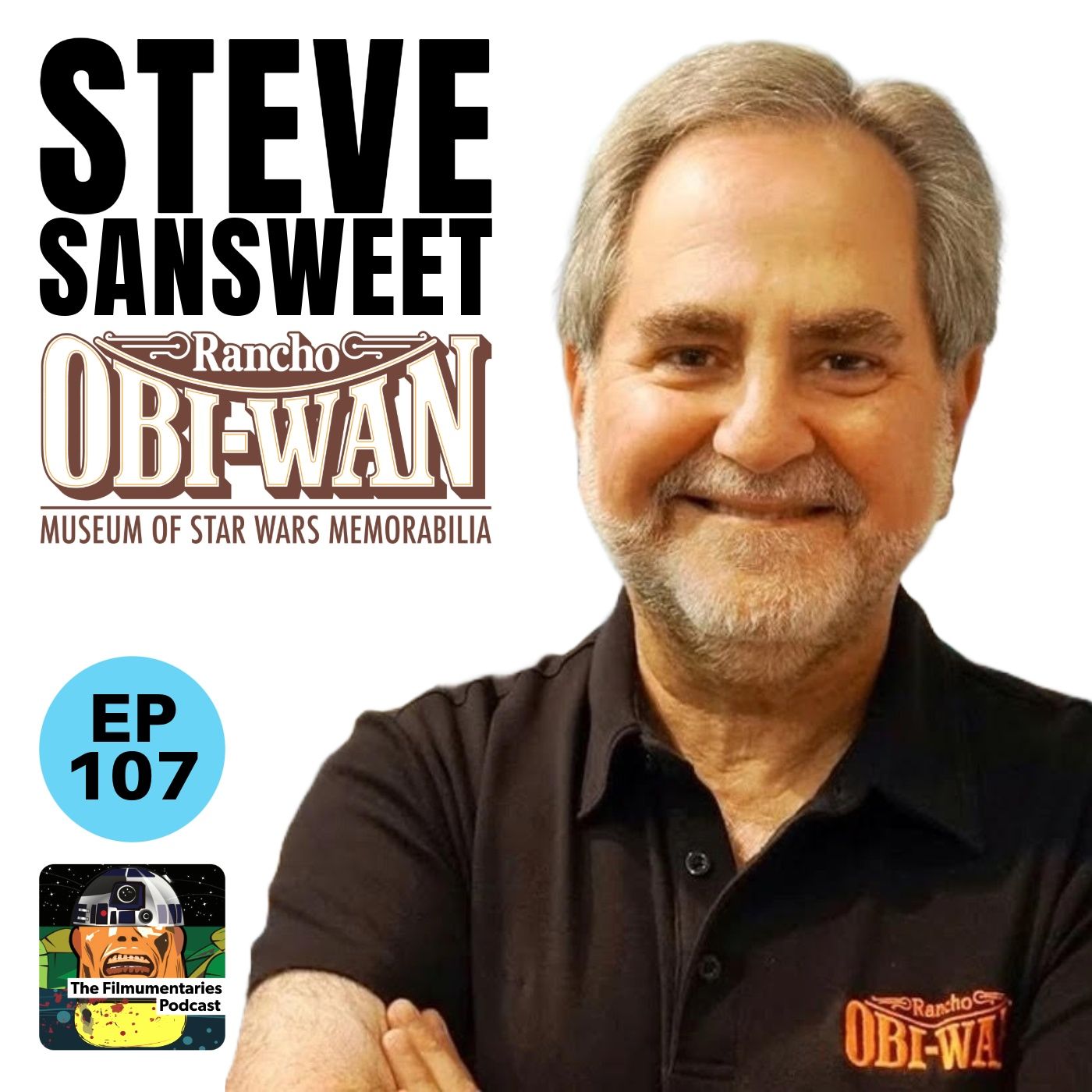
About this episode
Steve Sansweet, former bureau chief of the Wall Street Journal, shares his passion for movies and collecting, particularly Star Wars memorabilia. He recalls his childhood love for movies and science fiction, and how he started collecting science fiction toys and robots. He discusses the impact of Star Wars on his life and the collecting community, and his role in writing the book 'From Concept to Screen to Collectible'. Sansweet also talks about his time at Lucasfilm and his extensive collection of Star Wars memorabilia. Steve Sansweet discusses his favorite Star Wars collectibles, his role at Lucasfilm, and the growth of Star Wars fandom. He talks about his involvement in creating the Star Wars Encyclopedia and his time working on the special editions. Sansweet shares his experiences at Star Wars celebrations and the importance of fan engagement. He also reveals his favorite piece from the Phantom Menace era and discusses the challenges of collecting Star Wars merchandise. Sansweet reflects on his time at Lucasfilm and the future of Rancho Obi-Wan.
Links:
Donate Button
All the links
Rancho Obi Wan have a big fundraiser taking place in Seattle Oct 5th
This podcast is completely independent and made possible by listener support. If you’d like to help me keep making these episodes, you can join my Patreon community here: https://patreon.com/jamiebenning
Watch more on YouTube:
Check out the Filmumentaries YouTube channel for behind-the-scenes clips and extra content: https://youtube.com/filmumentaries
All my links
Transcript
Automatically generated, so expect the odd misheard name.
For everything in one location, daily news, reviews, interviews, podcast videos, social media beats, bookmark fanthatracks dot com for Star Wars News twenty four to seven, three sixty five. Weird Way Media. Welcome to episode one hundred and seven of the Film You Menors Podcast. This is your host, Jamie Benning talking to you from my home here in London, England. We just got back from a big family holiday, one that we've been saving for for about three years now.
So yeah, my older girls finished their school exams at the same time, so we felt like it was a good reason to mark that moment in their lives and we had a wonderful time for two whole weeks, our longest holiday ever. And now we're back to the reality of home life with some quite frankly deeply upsetting things happening on the streets in the UK. I'm not going to get into that, but you know, if you agree with any of these thugs, just stop listening and go and educate yourself, talk to some people, read some books. Moving on for this episode the first of three in August twenty twenty four three, because in July you only got one of the usual two episodes due to me being away with my family as I said earlier.
For the first of these three episodes, or hear my interview with the owner of rancho obi Wan, former Lucasfilm fan relations officer, author and all around nice guy, Steve Sandsweet. I met Steve when I visited Rancho obi Wan back in April during my epic visit to California. I still can't believe all of that happened. Really. We chatted briefly when I was there and I asked him if he would consider coming on the podcast.
So in June I had the chance to chat with him. As a reminder, I put out on social media that I was going to chat with Steve and gave you the opportunity to post a question, So look out for that about kind of towards the end, about eighty eighty five percent into the conversation. So here's my conversation with Steve sand Sweet, and I'll be back at the end for a bit more jabbering on Steve, Thanks for joining me. When did the passion for movies? Was there passion for movies when you were a kid.
Did you grow up as one of those kids that was always going to the theater. I went to the theater. There was a theater in the neighborhood and we could go to see the Saturday matinees for twenty five cents, and so I would go frequently with my friends from the neighborhood and go see movies. But the first movie I remember, there are two movies. I remember.
There was something called The Boy with the Green Hair. I remember nothing about it except I was fascinated that someone would have green hair, of course these days where he used to have green hair, and in public. But the first movie I remember was a horror movie, a classic horror movie that my dad took to me too when I was ten years old. It was them the Giant Ants the radio the radio active asked that attacked Los Angeles, and I remember in retrospect, strange movie to take a ten year old too. I'm sure I had seen other movies before that, but that just really made an impression.
And then I was very lucky. When I was at the Wall Street Journal in Los Angeles. There were frequent media passes for new movies, and so a couple times a week I would get passes to see these new productions, and so I loved going to the movies. I had a joint passion for science fiction growing up, reading science fiction novels and the Space Program, the real Space Program. I used to cut articles out of the newspapers.
Remember newspapers, there were things that you actually read that you held in your hand. So the science fiction asked and the real life Space Program sort of merged in my passions, and I started collecting science fiction toys and robots, and some of the wonderful Japanese metal robots and then the plastic robots the Battery operated from starting in the fifties and sixties and seventies. There was a frustration though, because when I would go to the toy store, the toy shows, the robots that I really wanted, the classic robots were always slightly out of my price range. Whatever my price range was, they were a couple hundred dollars more. And it was the advertising executives and the dentists and the doctors who were buying these things up.
And then Star Wars came out. It changed my life. To think that a movie could change your life and the direction of your life is pretty amazing in retrospect, but it certainly did. It's amazing isn't it So many affected so many people. But back when you were a six year old, it was the passion for writing that you had initially.
Is that right? That's what led to the Wall Street journel. Yeah. I one of my aunts was a good writer, and she encouraged me, and I started up the Hobart Street News, a hand lettered pencil news. I don't even know what to call it.
It wasn't a newspaper. It was a. NewsPad maybe on a piece of paper, and that I would try to sell to the neighbors for three to five cents. And I remember why, I next dour. I never said I'm not paying for that.
That's too expensive. What did it contain? What was it like? Local news and gossip and things like. That, things about the local pets and what people were doing and things of that nature.
There were only three or four issues. I gave up in frustration. But I had a passion for writing, and so in junior high school I worked for the school newspaper. High school, I worked for the school paper and the yearbook. And in college I became editor of our daily, four day a week newspaper, printed newspaper.
This was way before online, way before the internet. So I was editor for a year and went from that to working on a summer job for the Philadelphia Inquirer. I was a police beat reporter, fill in police beat reporter, and got my first byline, and that was magic, saying my name in print over a story, however glory it was. And then went to the Inquirer full time. And then I was in the Air Force Reserve and Air National Guard for six years off and on, but six months of active duty.
That was the Vietnam ear right. So I was fortunate to get into the Guard and not having to join the regular armed forces. And there was a problem that the Inquirer, one of the top investigative reporters, turned out to be a guy who was stealing the clippings from the newspapers library and selling them to bad guys. So when you if you had another problem in your record and the reporter pulled for the clips to see what the past deeds were, they couldn't find anything, so they didn't know about your past record. Bizarre.
It was a huge shake up and everything everybody went. Everybody was angry, and the guy who had hired me was sort of blame for the thing, although he had nothing to do with it, and I heard of an opening at the Wall Street Journal. Now I was not a business reporter, had no interest in business, but I loved the front page stories that they did, and I heard that they gave you sometimes days, weeks, months to work on one of these front page stories back in the day. And so I went to the Philadelphia office of the Wall Street Journal. I was hired, eventually transferred to Montreal for two and a half years, and then out to Los Angeles.
So I was in LA and with the Wall Street Journal for twenty six years, and it's there that I encountered Star Wars. What year did you join the Wall Street Journal? Then nineteen sixty nine. Okay, so you. Had a good ideas before Star War arrived and when that film arrived, well, you know, I've spoken to so many people that worked on the films and have been inspired by the films.
How did it hit you? What was your reaction to seeing that movie for the first time? Were you aware of the buzz beforehand, being a collector of sci fi and interested in sci fi? Well, I was. There was a publication called Media Scene that had done a front page story, was a tabloid newspaper size publication, and so I gobbled that up.
That came out either in late seventy six or early seventy seven. And then my first collectible really was a brochure or marketing brochure that Lucasfilm the twentieth Century Fox sent out to theater owners and managers to try to get them to book the movie in the theater, and they also sent it out to the media, and the guy who covered Hollywood for the Journal in the LA office looked at it, and I saw him looking at I was sort of panting a little, and then he threw it away in his trash can. I waited till he left for the day, sort of traped over to the trash can, and it was my first stumpster diving for Star Wars, but by far and overthelass. So I had seen all these wonderful photos and some sketches and paintings and things of that nature, and then got the invitation to a screening at the backlot of twentieth Century Fox in the Daryl left Zanik Theater ten days before Star Wars opened to the general public.
Wow. So it was before all the hype had started and I remember sitting in the theater and like almost everybody, all these hard bitten newspeople, and the star Destroyer goes overhead and we're all looking up saying where did that come from? And sort of laughing to ourselves. And I was hooked immediately. Amazing to be there before the phenomenon hit and already feeling its impact on you as an individual rather than this sort of collective impact.
Yeah, it really it just spoke to me. I mean, the visual effects, the fun story identified at least initially with Luke Skywalker. Here he was yearning to leave his backward homestead on a backward planet and going out and finding adventure or finding what his journey of life was. And I remember I grew up, I was raised and grew up in Philadelphia, which has turned into a much nicer city than I was when I was growing up. But I remember thinking all my friends and my schoolmates were staying in Philadelphia for the most part, but I needed I had this urge to leave and find what my true destiny would be.
Little did I know what it would turn out to be. Yeah, yeah, amazing to be there there at the time. I mean, this is the thing that is difficult for people of a certain age to to not really consider the landscape of movies being released at the time. I mean, it was if it was dropped out of space, this movie. You know, there was nothing like it, I mean that imagery.
You go through some of those early magazines like photo Play and some of those early publications that had images from the movie, and you look at the other films that were talked about at the time. There was absolutely nothing like it. It was completely individual. Yeah, and great that it, you know, spoke to so many people you included, and that set you on this journey that you're still on in many ways. I mean many of us are on that journey thanks to Star Wars in some shape or form.
So that was your first collectable in the trash can. From the trashcan, when did the collection begin itself? What was next? And because obviously there wasn't much around at the time when it first came out. Now, well, I was still buying the rockets and robots, and I'd built up a pretty good space collection by the time Star Wars came out, and it still collected some of that stuff.
In fact, about forty of my Star Trek toys were borrowed by these Smithsonian Air and Space Museum for exhibition in nineteen ninety and as a result of that, I had talked to the curator, who became a bit of a friend, and I said, what you should really do is a Star Wars exhibit. She said, well, we'd love to, but we can't get a hold of anybody at Lucasfelm to talk to about that. And I said, well, let me try, because by then I had started working on my first book for Star Wars, and so that led to the Star Wars the first major Star Wars traveling exhibit, The Magic of Myth and a book that was written by the curator. Going back to what the initial collectibles were, there was not much stuff out there except for cardboards, puzzles, a board game, and I can remember my first three dimensional items a board game.
And I can remember my first three dimensional item was something from a semi Schlot gifts store chain that was on the cash register stand and there were these necklaces that had little silver chewbaccas R two D two's three pos and they had moving arms on them. So that was my first movable Star Wars collector's item. And did you did you Were you around for the Early Bird Kit and all of that. Actually I never saw the Early Bird Kit until after it expired, and so I bought one in January of that year, too late to and I told the store, well, this expired, so would you give it to me at a discount and they refused to, but I still bought two of them. I opened one and kept one sealed, but I managed to get an Early Bird Kit.
I traded somebody for one back in the day when people were selling and trading Star Wars collectibles for nothing, approaching what they're buying the selling for it today. Yeah. I think the first time I became aware of being collectible it must have been nineteen eighty three. I was in on the south coast here in England, in a town called Brighton, and I didn't have a Jahua and I wanted one for my collection, and the guy in the toy store there said, oh, you'd be lucky to find one of those. They're real collector's items.
And I'd never heard that phrase before. And whether he was talking about the cloth cape or the vinyl cape, who knows, but it really struck me at that point that, oh, wow, people collect these things, they're not actually just buying them to play with or whatever. Because you know, I was I was one when Star Wars came out as one years old, so I don't remember. About it with knowing about all these dates, but. That collection then you were kind of in a sweet spot in many ways, because when we reached kind of nineteen eighty five, I remember thinking I'd grown out of Star Wars, and some of my toys were passed on to friends and cousins and things, But really I wanted those Power of the Force figures and I wanted all that stuff, you know.
But at that time there were there were action figures going for the equivalent of one dollar, bundles of them going for a couple of dollars. Here, I mean that must have been in the US buying stuff up. I was buying some of that stuff up I got from a collector friend in the UK I got or in France. I can't remember which one I got these from, but I got about twenty yak face figures and they cost me. And these were ones that were not distributed in the US at all.
On the tri Logo card and then on an Avian card with a coin, and I can remember buying them for like two dollars two and a half dollars apiece shipped. I thought I was making a probit. I doubled my money by selling them to another friend for five dollars. Amazing. Yeah, so, I mean we weren't thinking back then in terms of some people were.
Yeah. Well, what really became my crossing the rubicon, I guess was in the late eighties, when, as you said, Star Wars was sort of out of fashion. There were very few, if any new items for sale. And I came across three collectors, all of them back east in the United States, who were getting divorced and they had to monetize their collections for the worst settlement. And so I bought chunks of these three collections, one of which was the largest collection at the time, and I got the bulk of what became the start of my major poster collection.
I now have over three thousand posters, but from this one purchase and some other very interesting items. If I knew what I knew now, no, now, I would have bought a lot more, but that it was that sort of impetus. And then a couple of years later I heard via third party and then went to the second party and found out that the first party was selling some models that had been made by Industrial Light and Magic as gifts for friends of Gary Kurtz, the producer of the first two Star Wars movies, and well, Gary was back in the UK. These had been in storage in Los Angeles and he invited me over to his house and I looked at ten or eleven incredible models that had been made, and I said, let me think about it.
He told me what the prices would be for the individuals, and I thought about it that night, didn't get much sleep. Called him the next day and I said, well, I've made my decision and he said, well, which one do you want? And I said all of them. And that was the first time I got a second mortgage on my house. So now serious, what wow?
And what were those models of? Well, there there was a production size snowspeeder, there's a millennium Falcon. So some of these were from model kits that had been produced after the fact, but they were assembled and hand painted by the ILM experts, so they could have been used as secondary models, tertiary models. In some of the scenes where there were a lot of a lot of spacecraft so over the years, I've sold some of those and I've traded some of those. It's part of collecting.
You don't get to keep everything that you once had. I love the behind the scenes kind of objects, so I have more of those than I do with the actual models that I bought from the Gary Kurtz collection. Yeah, there is something about collecting, and I think, particularly with Star Wars, it's something about getting closer to those movies that we love, isn't it. You want to kind of reach out and touch those things. And like you said, whether it's something that was behind the scenes or something that was in front of the camera, there is something about just wanting to get closer to those movies.
But you've managed to leap over that chasm and actually influence the path of the future movies with your role at Lucasfilm. How did that role first come about, Steve? What were the circumstances around that. Well, I had been bureau chief at the Journal in Los Angeles for nine years. The normal period of time for a bureau chief was three four maxima, and so I was clogging up the system and it was necessary to give somebody else a chance.
But I didn't want to leave their role. They offered me three other possible assignments, going back to New York as a editor, starting up a local of the Wall Street Journald, which I didn't have much faith in, or becoming a super reporter at the same salary. And then I got a call from Lucascolm out of the blue, from the head of public relations, and she said, Steve, I wonder if And at that point I had written a number of books I had spent some time at Skywalker Rance that got to know the people there, and so sorry. Just to interrupt, So those books would have been from Concept to Screen to Collectible. The first one came out Concept of Screen to Collectible.
I had heard that Lucasfilm was considering doing a price guide, and I called. I called the head of PR, who I knew because I had done a phone interview with George Lucas in nineteen eighty seven for the tenth anniversary of Star Wars, and I desperately wanted to visit Skywalker Rant. So I said I'd be happy to fly up. Because she said, no, we'll do it on the phone. I said, but no, we'll do it on the phone.
And so George gave me half an hour to interview, and I wrote this op edit piece on the tenth anniversary of Star Wars, and I remember one of the things was that the Fox board of directors, at least several of them, didn't have much faith in Star Wars. They didn't like the title, first of all, because originally it was called the Star Wars. They thought it was like Elizabeth Keler being angry at rock hutson ER's you know, star Wars whatever. That provoked a letter to the editor from one of the former directors saying, we knew what we had on our hands, which was complete bs. But anyway, I had talked to the head of publishing and said, I heard you're doing a price guide and I think if anybody does it, it should be me.
And she said, and you are who? And we talked for a while and she said, what I really want is a price guide with anecdotes. And I said, you can't do a price guide with anecdotes. You can do a book with anecdotes or a price guy. And that led to doing from concept to screen to collectible the book with the most awkward title that I have ever written, and uh, well.
What a cover Steve. I mean I saw that in a well, I tell you, at that point that was the dark times almost of Star Wars. I think the Zar novels maybe had come out. But my friend and I were kind of chatting about our toys that we used to have, and he said, oh, I've still got my Star Wars toys. And then his brother walked in.
His older brother said what are you boys doing and we said, oh, we're just looking at the Star Wars. He said, oh, they're collectibles. Now, I've just seen a book in this comic shop in town, and we went straight there and we bought that book. And that's what kind of set me back on my love of Star Wars. Honestly, that book did.
Yeah. A lot of people say or thank me or blame me for that book. Well both. Yeah, it was a book that took Star Wars from the idea in George's mind to how it was translated to film, and then how that became marketed as a toy line. Really the first successful toy line for a movie.
There had been successful toy lines for television series, because that would be on every week for back then twenty eight weeks or thirty six weeks in your home. Movies would come and go by the time that they unlike today when toys for movies show up four to six weeks before the movie appears. Back then they would wait to see how well the movie did and then produce the toys. And it could be a year later that the toys would come out and people would have forgotten the movie, And so that was one of the problems. But it started a whole new way of marketing and merchandising.
Some of the early licenses were to help promote the film, like the Marvel Comics, the six issue of six issues of Marvel Comics, the novelization which came out in November of seventy six and sold out half a million copies in paperback. So there were things out there, but not the toys. In fact, the contract with Kenner Products was signed only a month before the movie came out in May of nineteen seventy seven. So it really changed the dynamics of the movie business and movie marketing and merchandising. And who was a guy named Charlie Lippencott who was the head of Dad, who was the guy who really figured out how to do it and how to market it.
To fans. Yeah, be fascinating to see more of his archive. I know his wife is kind of still trying to wrangle a lot of that stuff at the moment to get it right out to the public. But fast forward then to the nineties when you're talking about this price guide, Is that what ultimately became the Tomar Price Guide. Yeah.
I worked with Tom Tumbush and his son Tom and Tumblush, and we did two versions of the Price Guide and then a high and edition of The Price Guy with an insert of toys that were never produced. I remember that we I spent one day in Cincinnati at their headquarters. Tom n and I personally signed two thousand covers of the book for QBC, so that was another claim to fame. I did five years of QBC Star Wars collectibles show from the mid nineties to nineteen ninety nine, when everybody was selling Episode one product, so there was nothing too exclusive for QBC. Yeah, I'd forgotten about it.
Was there any reluctance on your part to release this price guide given that this you know, part of collecting is that kind of hunt, isn't it is looking for that item and maybe not necessarily the buy doesn't necessarily know the value, not that you're going to be dishonest to them, but there is that thrill of finding something and getting. It for a good price. But here publishing something that's saying this thing is worth x hundred dollars or one thousand dollars. The way I looked at the price Guide and conceived of the price Guide, it was more of a list of what was available that I knew of, rather than this is what you should pay for something. So we made it very clear that these are prices as of a certain date, and these things fluctuate, and it's willing buyer willing seller, and that the main function of the price guide, my view, at least, was to show people what they could buy, what they could look well, what they could hunt out.
And of course this was still a few years before we get something like eBay and the Internet and the availability to start searching for things online, and so it was an early way of looking at Star Wars. There had been something called the Official Price Guide that wasn't really official, wasn't lucasfelt that had come out from some dealers a couple of years before that, and the Fillmark Guide was important for its time, which was that sweet spot right before I think eBay took off in ninety seven ninety eight, so the price guides came out in the period of ninety four ninety five, and I think we're a valuable resource for the time. Yeah, definitely. I remember looking through that just going wow. I mean I would buy anything with the logo on it back then, and I just remember going through that and thinking, Wow, there were things that were only available in certain countries.
Like my world kind of opened up. It almost stopped me collecting at that point, I'll be honest, because I realized I didn't have the funds to complete it. And that's when people start going and focusing on collections. Where do you see your sort of boundaries of what to focus on? Because I've been to the Rancho Obi Wan.
I was there in April and met you briefly, and it's incredible. It's absolutely incredible the collection you've got. There was there ever a point where you thought, I have to set boundaries here, maybe I need to just focus on this one thing, or is it just a matter of anything that takes your fancy. I should have set boundaries, let's put it that way. I am a couple of my friends considered ourselves complete lists.
What that now means is that we like almost everything. Well, we certainly can't find almost everything. My friend Doccin Jenkins, who is in the lives in the Midwest, is a major collector, and so we both consider ourselves completed and we've tried to help each other. But he has a wonderful collection of international items, so some of the same items that were released in the US, but in foreign packaging. There's so much out there that even Lucasfell doesn't have a complete inventory or a complete list of everything that was made for Star Wars internationally.
And now with Disney and it's worldwide licensing and specific offices and major countries all over the world, it's just an impossible task to be able to find everything. There are high end items. There are now fifty five hundred dollar betoaled purses in the shape of R two D two, Sowarsky crystal purses, Yadro ceramic pieces, porcelain pieces for two three thousand dollars replica the Quetz Regal robot, one of my favorite new product lines. Yeah, Tom keeps releasing those busts. I mean, that's the collections growing.
I can't resist those. But I have cut way back since I retired from Lucas Golden and started running Grancho obi Wan with my good friend Anne Newman, who is the president and chief executive officer. Now I've really focused on things that, as you said, tickle your fancy items that I think fill a gap, trying to get some items, at least from the new series because in to come here say, would you as something from Rebels? You know, so we try to have something from all of the current series. Yeah, yeah, let's rewind then, just back we were making that connection between those books, creating those books and taking this job at Lucasfilm.
How did that come about? Exactly? So I was working on the first full Star Wars encyclopedia at the time while working full time at the Wall Street Journal, and it was coming along very slowly. I mean, there had been hundreds of books, comics, things like that. I had to read them all to know what because this was it was before things were I mean, things were always cannon and non cannon, but it was before the whole legends came about, and so I was desperate to find some extra time.
Meanwhile, things were happening at the Wall Street Journal, and Linhill called and said, do you know of anybody who might be interested in taking a guaranteed, one year only job to go out and talk to fans at fan conventions about the special Editions. So the call came in nineteen ninety five, and they had been working on the special Editions. At first it was just going to be Star Wars, and then George decided to do all three movies and make some changes, and I said, let's talk. And one thing led to another, and I figured that if I could they wanted. They said, if we could do eight to ten conventions.
I ended up doing about thirty five or forty that year. That next year, going all across the US, I did some international conventions and the whole idea was to use clips to promote the special Editions, and I also did some other promotional activities. So it was quite a change for me. But I would leave on a Friday to go to the event, come back on a Sunday or a Monday, and work on the encyclopedia the rest of the time. So I finally got the encyclopedia fetched then and I was still working out of my house in Los Angeles, and they had just at the end of the year.
At the beginning of the next year, they restarted the marketing department, which had been in the bands for many years, and they forgot to get rid of me for fifteen. Years because that was the time when like Star Wars Galaxy and Stars Insider magazines were kind of coming out and teasing that the special edition was on the way. That was an exciting time for Star Wars fans. Right And I was writing monthly columns for both publications on collectibles, answering questions and writing other kinds of stories about what was out there and what had been out there, and meanwhile trying to keep up with my own collection. And then the avalanche from episode one came at ninety ninety nine.
Oh my goodness, that was an avalanche. I mean, just in terms of merchandise, it was an avalanche. Have you got a favorite piece from the Phantom Menace era ninety nine? And my favorite piece is the tackiest piece in the entire collection that jar Jar binks tongue lollipop. Will you push the switch in the back and the tongue, the candy tongue comes out of jar Jar Binks's mouth which opens up, which I always thought was the tackiest thing.
I remember going into the office of the head of licensing and said, how could you make such an item? And he said, kids love roast candy. So it's true, it's true. I actually, I don't know if it was yours, Steve, but I saw that in a cabinet at Lucasfilm at the Presidio in April. There was like a box of it with a few of them.
We let them hung. Yeah, right, because we had some tongues replaced with acrylic tongues. Right, so we had somebody make some tongues for us. Yeah. So that role that you had there, that was supposed to last a year and went on for more than a decade.
It evolved over. Time, right, things got bigger and bigger in the Star Wars world. How important was it for you to always kind of have this presence. You became the kind of face of Star Wars fandom. You were on the ground with the fans, you were at the conventions, Star Wars celebration.
That would have been Colorado ninety nine, wouldn't. It nineteen ninety nine? Dan Mads and I worked on that so my boss at the time, the head of marketing, Jim Ward, said, as part of the approach to episode one, we really want to get the fans involved. How about doing sort of a fan convention. What ideas can you come up with?
And he he initially said, well, maybe we could do a fan convention in five major cities every weekend. We just moved along whatever you have and I said, that's a little impractical. Jim said, well, how do we do it in five cities on the same weekend? I said, that's even more practical. So I gave Dan Madison a call, and Dan had already been thinking of the same thing.
Dan was the head of Fantastic Media, which published The Insider and had a merchant, the merchandise catalog, the Jahua Trader, and I was getting a lot of buying a lot of stuff from Dan and from the Java Trader. We had an ongoing deal going and Dan said, well, we've been discussing that here. Let's get together and work on that together. And so we agreed to license it to Dan, and it was at Dan's Dan had to come up with the revenue for it. We looked, where are we going to have it?
And he said well, we really need to have it in the Denver area because we have one hundred people on the staff and we need people on the ground in advance working on this thing and being able to carry it out. And so we came up the convention center had already been booked. Because here we are nine months out. I guess, and Dan said, well, the only place that we can have it is the Air and Space Museum the Wings over the Rockies, and this had been the former Air Force base that had been abandoned and was being torn down. There were still the buildings that were still up, but the Wings over the Rocky Museum would have been a good place for the exhibits limited capacity.
And when I flew out there with my boss and we looked at some of the other buildings that they were considering using for a venue use for stages and things of that nature, they were all in really sad shape. And then we came up with the idea of using giant tents. No one was able to predict that this would be the week out of one hundred year reigns in Denver, and the tents, which were would have worked under normal circumstances, started to leak sounds. Like a start of a George Lucas movie making experience, doesn't it. A couple of times he had that happen.
Indeed, so it became our mudstock. But people who were there still loved it, and it was a great opportunity working together with the fan club, and it started our celebrations, and so it just became the kind of thing where, even though the fan club didn't do it for two and three, we knew that we needed to do it because it had been a relations success, even though we almost canceled it because ten days before the celebration, the column mine shootings had happened ten miles away from the site, and Lucasfilm was of a mind. The president of Lucasfilm at the time wanted to cancel it, and Dan, to his credit, got the mayor of Denver on a call to the Lucasfilm executives who had been meeting all day, and the mayor said, we really need this, so please do not cancel it.
And the president of the company left it in the hands of my boss, who said he was going to sleep on it. Came in the next day and was walking up to his office and he had this poker face, and I said, what is you decide and he said, I'll tell you. I mean, he kept the poker face and I was dying inside and got into his and they said, I may, I may regret this big time, but we're trying to go ahead with it. And as it was, we raised several thousand dollars for the families of the column by victim and we had a moment of silence for them. And one of the kids who was killed was a huge Star Wars fan, and so we did something in his memory too well.
So it worked out. It worked out fire. That's great, That's really great. And then it grew from there. I mean I went to the one in London last year, was it And I was in the very fortunate position that I was invited there by Lucasfilm to do a panel, so I was able with my posh guest past to look, you know, stand above and watch the sea of people.
I mean, it's incredible how that convention has grown over the years. It was colossal. Yeah, I'm not sure the Excel is the best venue us of the way that it's arranged with the large hall in the middle and then the squeezed rooms on both sides. But I've been to two of the celebrations at the EXL and one in Germany, one in Japan. Of course we're going back to Japan next year.
So it's been the kind of thing where the fans, I mean, it's not only the exclusive merchandise, so that that does very well. The panels get very well attended. There are great announcements, but what became very obvious at the beginning was it was the opportunity to meet and come back and reconnect with fans from all over the world that you had met and become friends with just in that three or four day period. And it's really a social gathering more than anything, more than most conventions are because it's very specific on Star Wars and it's all Star Wars all the time. Yeah, and there's enough of Star Wars for just about everyone these days.
You talked about on Sorry. The Star Wars has so many entry points. I mean, whether it's the original movies that you love, all the movies, all the TV series, the books, the comics, the toys, the cost playing, you name it. There are all kinds of entries for all age groups too. And now we have three generations going on the fourth generation of fans who have come into Star Wars at all these other points and have parents or grandparents who have They've seen their love for Star Wars and their passion for Star Wars and have adopted that.
Yeah, I saw like a guy a dressed as the Emperor who didn't need makeup. He was that old, and he had his granddaughter with him dressors like a tiny princess. Later, it's great. You mentioned the word announcements there, and it just reminded me you had that opportunity at one of the conventions to announce, didn't you announce the title of a certain. That was That's that was my favorite, one of my favorite times at Lucasfield.
So this was at San Diego Comic Con, which is a convention that attracts one hundred and fifty thousand people. It was in their new big Hall h which seats five thousand to six thousand people, and it was packed. And I was doing yearly presentations at Comic Con, and it was always what are we going to come up with? We've got to make some sort of announcement, something that's really going to excite the fans. And so that's when my Boston.
Ward said, we're going to let your name give the title for Star the episode three, And of course Star Wars titles for people who aren't fans and don't realize that that has become a major thing in the minds of died in the world Star Wars fans, because it gives you some hint or unless you start speculating as to what the movie is going to be about and what path that's going to take. And so I figured, well, there's got to be some way to tease this, so I did a double tease. One of them was we did a video and we did some scenes of episode one, or we started with four, five, six, one, two, and we showed some scenes from the movie and at the top of the screen it said episode four scenes of a New Hope, and then a New Hope going through with the episode number, and then some scenes and then the title.
And so by then people were getting the idea without me saying anything. And we did episode three, and we had some behind the scenes film taken from the set, and then we were about to spend the title and instead it went backwards deliberately, and then it came up and I was wearing an overshirt, and I walked to the front of the podium and opened my shirt and I was wearing a T shirt with the Revenge of the Sith logo, and I said, and by the way, these are now available at the Star Wars pavilion on the main floor. So first of all, there was a huge cheer in the audience. The title was shot on the screen, and then once I revealed the T shirt, there was this mass accidents. People were running for the Star Wars pavilion, and a comic on people said afterwards, I wish you would have given us a clue.
We would have had more security there. People were running and knocking people down and it was past pare pneumonium. But it was It was great fun. It was a wonderful panel. And so on the panel, I had Rick McCallum and Hayden Christensen and we had Carrie Fisher there to talk about some of the past movies.
Wow. So it was an extraordinary experience. Yeah, to go from somebody who saw that movie all those years ago, then you get a job there, then you get to reveal the title of a movie. I mean, you're right there in the middle of where every fan wants to be talking of fans, Steve, because you were part of Face Off Fans and fan relations. I put out to my followers on social media that they should be asking some questions, right.
So if you don't mind. A few people have responded, and I'd like to ask that question. One of them I've actually already asked David Griffiths. He asked, with it being the twenty fifth anniversary of the phantomnist, do you have a favorite piece? We now know it was the jar Jar Lolly, the gross candy.
There's something about that you just once you see it and play with it, you can't get it out of your mind. DJ says, does Steve want his old job back? I look forward to hearing the interview. I love doing my job. I left it in twenty eleven.
I came back for a year consulting in twenty seventeen. It's in very good hands now at Lucasfilm. They've got a good staff that does fan relations. There are people who do publicity who also answer fan letters, and there are people who helped to run celebration and other events, so they've really built it up. I followed in the footsteps of Charlie Lippincott and Craig Miller, who was the first head of the fan club, and they really established some great parameters and Lucasfilm, to its credit, has always been in touch with the fans from the very beginning, setting up the fan club newsletter which became Bathos tracks and answering fan mail.
And they still answer fan mail, which mostly comes as emails these days, but every one of these is answered at some point. In letters to George, at least when George was operating the company were always answered. So gaz m or Menzi's Garry as he's called, says, when concept to screen to Collectible came out, having a complete collection of figures seemed doable. How does it feel now that we have thousands of carded figures to hunt down? Impossible?
The problem is just figuring out what figures are out there, and what variations there may be, and what cards the same figure have been released on and do you count that as a new figure. When I was doing the Complete Action Figure Collection book with Anne Newman and had to open duplicate nineteen hundred action figures, pulling them off the card and taking photographs of them, I was working with a couple of other folks on that book, and it was still difficult to figure out how many Clone Troopers are there? Do you count the cloud trooper with the bullet the laser hit here? Here, one on the right leg, one on the left leg. There are four different figures for build your arri And then we got into somewhat of a little dispute with the publisher at the last minute.
They said, where's job of the Hut? Well, he's not an action figure. Oh yes he is, So what's an action figure? Yeah, the book's getting bigger and bigger as you go through. The book changed a lot.
At a certain point we were sort of locked in and if you're adding or subtracting one figure because of the template of the book, it would take you maybe forty or fifty pages that things would be like Domino's knocking down and changing everything as you go along. So it was a fraught endeavor at near the end, but we got it done. So I think that's the end of my book writing for Star Wars seventeen or books are plenty. That is a lot. David Ailing asks in the ever expanding nature of stars, have you ever found yourself having to draw a line?
We kind of talked about that. Okay, I'm not going to collect things from the New Incarnation simply in order to keep Rancho from growing to the size of Skywalker run. Well, we do have a size problem. Ratcha obi Wan is about nine thousand square feet. We have an off site warehouse that's about seven thousand square feet, which is also full and getting fuller.
And as I said, I'm not buying as much, but we get donations from fans and from other sources, so we rarely turn anything down. If we have it already in the collection, then it becomes something that we can use as a fundraiser. We also sell memberships Durancho obi Wan. We have fundraisers. We haven't had a galla since twenty eighteen, but I think it's safe to say that we're working on something special.
So you can sign up for our mailing list. You can go to rancho obi wan dot org. You can become a member, you can book a visit. We do tours on Saturdays. We have our tour schedule six months out and you can sign up for the mailing list without even having to pay for a membership.
The membership comes with an annual patch, a pin on your second year and a letter from. Me nice and I can recommend the toy. It's great. I had a great time that day. It was Yeah.
I mean I've been to the Ranch on the Thursday, to Lucasfilm at the Presidio on the Friday, and to Ranch or Ibi one on the Saturday. I think that's like the trilogy in my head complete. That's the trifecta, as they say in horse racing. Yeah, Gregor Wildman says, I'd love to know if Steve has an idea for a piece of merchandise that was never produced. Is there one that you wish was made.
For a long time, I said, I really want the holographic chess pieces to be made, and then Tom Spina took charge of that and they produced the wonderful replicas of the holographic chess pieces from real robot. Well, I had already gotten a guy in the Midwest it's scaulted ten of the figures and had done such a great job. They were very similar to the replicas, so I didn't buy the replicas at that time, but I finally have the holographic chess pieces. There is so much out there that has been made. I can't hardly think of anything that has not been made any kind of product.
M Walmart in Mexico, for a short period of time carried an unlicensed but cartoon figures on the packaging of women's personal products coptal basis. You can imagine if they can produce something like that with little cartoon layer figures on them, that just about anything is fair game. Yase. Same they didn't continue the collection of the C three po Celotate Dispenser like with other characters, that would have been good. Anthony Daniels is not too pleased with that.
It has never been too pleased with that. Is a good piece. The first time I saw it, of course, was in your book Ian Lowsen asks what's the object in your collection that is the dearest to your heart? I think the object in my collection that would be It would be the oldest object in the collection. It was done a year before Star Wars came out, and it's a canvas spanner that Charlie Lippincott had made up for the Conventions in nineteen seventy six, and it uses as art Ralph mcquarie illustration of star Killer, which was the early incarnation of Luke Skywalker cut out from a cast and crew T shirt that was made in seventy six and sewed onto the canvas banner, which has blue stripes on the top and bottom, a black background, and the early Star Wars logo in yellow, which was hand painted by Joe Johnston, who at that point was the art director of I Lem and of course has gone on to become a famous director.
Yeah, it's a great piece. I remember it hanging at your place when I was there in April. Really cool. And yeah, I think the film of that, one of those conventions with it hanging in the background, is somewhere online. I remember it being released a few years back.
Somebody found it. Chris g Allen asks were you ever involved in Bantha Trax? That was before your time, right. Bantha Trax was before I joined Lucasfilm, but then we resumed Bantha Trax as part of The Insider, and my number two at the time at Lucasfilm, Mary Franklin, took that over and was the editor of Bantha Trax when it ran as part of the Insider. Chris is an Indiana Jones fan, and he's also asked were you ever involved in the short lived UK Indiana Jones Adventure fan Club in the early nineties, after the Last Crusade premiered.
No, I never even heard of it. No me, neither me neither well, I always say. There was a UK version of the Star Wars Fan Club, uh Leon. So I'm aware of that, and I've got some of the newsletters and the merchandise from that. Mm hmmm.
I think that's



Similar episodes across the network
Matched by shared keywords.
-
Seasonal Differences, Shifting Fandom
1 shared keyword: convention
-
Father Malone's Weekly Guest Spot - Escape from New York - The Projection Booth
1 shared keyword: joe
-
Kuso
1 shared keyword: steve