
Season 1 · Episode 106
106 - Nilo Rodis Jamero - Legendary Designer - Part 2/2
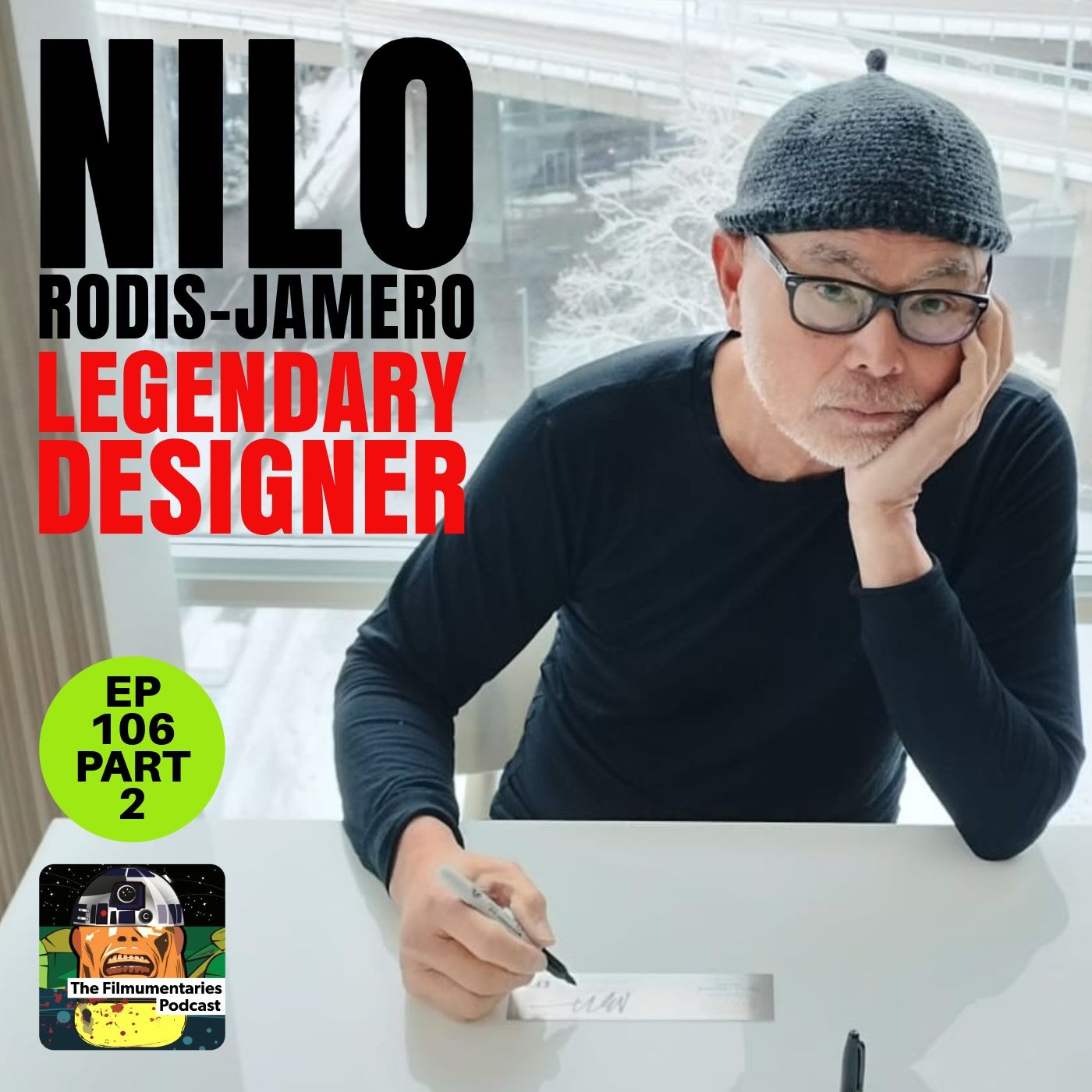

About this episode
On entering the gaming industry Nilo's focus was always about inspiring and guiding production teams to craft original and iconic characters and worlds. He’s real advocate for originality and imagination in design, rather than leaning on copying existing designs or using AI to assist those designs.
In our conversation, Nilo shares his experiences working with the legendary John Hughes, emphasizing the value of building relationships and understanding a director’s vision.
We also delve into the crucial role of production design in film and the unspoken code of acceptance when a director gives their nod of approval to a set.Nilo believes that good design should shake the viewer to their core, creating a unique experience. This means a lot of iterating and refining, but through this rigorous process, truly groundbreaking concepts can emerge. Collaboration is another cornerstone of Nilo’s philosophy. He believes that the creative process thrives on the participation of diverse talents, each contributing their unique expertise to the project.
This collaborative spirit is what drives innovation.Now you’ll know if you listened to my chat with Nilo in 2021 and last episode that he’s met a lot of key figures in the industry, in this chat he talks about n meeting influential figures like Hayao Miyazaki and Tezuka Osamu. These encounters have not only inspired him but also provided valuable insights into his design and storytelling work. But it’s not all work for Nilo—his passions outside of work, like Formula One racing, bring joy and fresh perspectives into his life. There’s a great bit at the end of this chat when I tell Nilo I work in F1, and he becomes the fan for a moment.So, buckle up and get ready to dive into the creative mind of Nilo Rodis-Jamero. This episode is packed with insights, inspiration, and a whole lot of passion for the art of design.
Donate Button
All the links
Peter Kuran's "The Thing" Kickstarter
This podcast is completely independent and made possible by listener support. If you’d like to help me keep making these episodes, you can join my Patreon community here: https://patreon.com/jamiebenning
Watch more on YouTube:
Check out the Filmumentaries YouTube channel for behind-the-scenes clips and extra content: https://youtube.com/filmumentaries
All my links
Transcript
Automatically generated, so expect the odd misheard name.
Welcome to episode one hundred and six of The Filming Mentory's podcast. This is your host, Jamie Benning, talking to you as usual from my house here in London in the UK. The tories out labor are in and there's some optimism in the air and also a lot of rain falling from the sky. You can probably hear it actually from where I'm sitting here in my loft. Yes, it's British summer time.
It's early July and we've already had twice as much rain as you might expect in July. But at least the trees that I can see from my window here and the grass are looking full and lush and green. Thanks for joining me for this episode. Welcome to any new listeners that have found the podcast recently, and welcome back to all of you lovely regular listeners. Huge thanks also to all of you that support the podcast via Patreon, dot com forward slash Jamie Benning.
By the way, I've just added a new exclusive T shirt design to the Film Youumentary's tmeal store. You can find that on my link tree. If you go on my Instagram or Twitter, you'll see that on there. If you go to the website. So if you'd like to support the podcast, but not via Patreon, maybe by buying yourself a great Et Be Good T shirt designed by my friend Pete Starling and check it out please.
Before we get into today's episode, I just wanted to mention about a little social media moment I had last week. So, in an attempt to try and grow my audience, I decided to post a few reels on Instagram snippets of my chats with these incredible artists over the lone last few years. And I realized one morning that it was the anniversary of John Carpenter's The Thing forty two years ago it was released. So I thought, oh, I have a great story about that from VFX guru Peter Koran talking about how he made the title sequence for the movie using some paint, a fish tank, some smoke, a garbage bag and some matches. So I quickly put together a video about it and posted it, and a few hours later I checked back on Instagram and amazingly, it had over twenty five thousand views.
I think one time when I interviewed Fred North, I got fifty three thousand views, because that's because Fred has huge following. Then over the next week with this Peter Kuran video when over fifty k, up to one hundred k, then to five hundred k, and it really was taking off. I had thousands of comments, thousands of likes, and it currently stands over two million views, so properly viral. Not only did this lead to a lot of interaction with people commenting about Pete's genius, he also led to five thousand or more new followers on Instagram and small spike in listeners of the podcast. It was small, but it was a spike.
I think, you know, people watch these short videos. They last thirty seconds, probably not going to lead them straight to the podcast to listen to an interview for an hour, but you know, it's all good. Anyway. I got in touch with Peter when it was nearly one million views and we had a nice chat, and shortly afterwards he got back to me saying he had an idea, and his idea was to remake the title sequence using the same methods he'd chosen forty two years ago. There was a group of people that tried to recreate it, and that was posted on YouTube some time ago, but Peter tells me they got some of it wrong.
So another week goes by it and Peter has just posted a preview of his Kickstarter to remake the sequence. He doesn't want much money, it's sort of literally the cost of the materials, so it's going to be launched in a few days, so please go and check it out and support it if you can. Peter is of course going to document the process as well as post the final results, so I'm looking forward to checking that out, and of course I'll post the link to Peter's kicks in the show notes. So yeah, please go and support that if you can. Okay, So, last episode you heard part one of my conversation with Neilo Rhodis jamiro design legend and wonderful person.
For this episode, number one hundred and six, the first of July twenty twenty four, you'll be hearing part two of our chat. So when we left the in part one, Nilo was talking about some of his work in the gaming industry. He goes on to talk about how he was always focused on inspiring and guiding the production teams there to craft original and iconic worlds. He's a real advocate for originality and imagination in design, rather than leaning on copying existing designs or you know, these days using AI to assist in those designs. Nilo shares his experience working with the legendary John Hughes, emphasizing the value of building relationships and understanding a director's vision.
We also delve into the crucial role of production design and film and also the kind of unspoken code of acceptance when a director gives their nod of approval for a set. Nilo believes that good design should shake the viewer to their core, as he says, creating a unique experience for the viewer. This means a lot of iterating and refining, but through this rigorous process he hopes that truly groundbreaking concepts can emerge. Collaboration is another cornerstone of Nelo's philosophy. He believes that the creative process thrives on the participation of diverse talents, each contributing their own expertise to the project, and this collaborative spirit is what drives is his innovation.
So you'll know if you listen to my chat with Nilo in twenty twenty one and the last episode, that he also has met a lot of key figures in the industries he's worked in and in this chat he talks about meeting influential figures like Heya Miyazaki and Tezuka Samu. These encounters have not only inspired him, but they've sort of provided valuable insights in his design storytelling work. It's not all work for Nilo. There's a bit at the end of this episode where I remind him that I work for F one and it's something that brings joy to his life. He does really enjoy motor racing, so we talk about that a little bit and Nilo becomes the fan for the moment.
It is quite fun actually, So buckle up, as they say, and let's dive into the creative mind of Neilo roodis jamiro This episode is packed with his insights, his inspirations, and a lot of passionate about the art of design. So here's my chat with Nilo and I'll be back at the end for a bit more jabbering on. They were actually responsible for making sure that there was no overtime. Oh on pay for over time and there was no union. I thought, okay, my career is over in the game.
And what happened? Nothing happened, you know, there was there was another There was another event that. You know, games at the time were really concerned about making sure that they were hiring movie people, and I was one of those that they hired. I was the earliest one that they hid, one of the early ones that they had. So when the movie people started coming up, I did because I was bored.
I did the history of FIFA mm hmm, the history of FIFA game m and I explained that on sevens a year, this game FIFA came up. And if you look at the game, all you see is a stick figure, a black stick figure, and you know that a flat, non three D character walk around, then kick the ball that is also square and moved that way and and that's the beginning of FIFA. And then I draw a line all the way to whatever year that was when I was there, and I said, this is where FIFA game is now. And what I showed was a freeze frame of the game. But what I also did, Jamie, was I did a freeze frame of a broadcast game, right, So I put that side by side because EA at the time was so concerned that all the games must look realistic, photo realistic, and I explained to them what I was attempting to explain to them that we are already there.
We're already there. So what I did was I showed two still images one look. One was a game, and one was a broadcast for FIFA, and I told him which one is our game and which one is FIFA. And they look at it and they look at it and they look at it and they couldn't tell it apart. And so you know this.
During this meeting, they said, well, what's your point? And so my point is when I press play on the broadcast, look what's going on? And when I press play on the game, look what's going on. The game looks silly, but it is photo realistic. But when you watch all the players, they're not behaving like real people.
So what I'm attempting to say to you guys is that we are already there visually. What we need is AI. What we need is all of these character must behave as if they're moving realistically relative to the ball. Yeah. Right, And and they said, you know, the reason we hire you is because we like movie people to make our games more realistic.
And I said, no, that's not the point to me. The point to me is you don't really need people like me. What you need is more AI and this is this look Oh my god, Jamie, this is ten years ago. Yeah, yeah, yeah, So I'm you know, I presented it to one of the executives and he said, have you shown this to anyone? And I said no not.
Yeah, you know because he he he came to my uh my workstation, so and wanted to know what was going on to explained to it. So he said, don't show this to anyone, and that can you do me a favor send me a copy. So I send him a copy. Then I realized that somewhere down the line he presented that that's his idea, and he just removed my name and presented that that his idea. And you know another yeah, you know it's it's you are more powerful.
If you're able to take somebody else's idea and elevate that person who had idea, you you are that much more powerful. But taking that idea that a footstoldier did and claiming it your own is not to me. Mm hmm, that doesn't make any sense to me. No, it's reductive everybody. Yeah, you know, that makes you a much better executive in my opinion.
I'm gonna go back to John Hughes. One day he asked me, you know, I want you to hang out with with Jackie Chan and I wanted to, you know, I wanted Okay, John, you know why? I said, Well, when we are done with this movie and you having having hang out with Jackie Chan or whatever three months for months on another show, that another movie that Jackie Chan was working on, separate to our separate from our movie, by the time that show is done and we now pivot to our movie, Jackie and you now have a relationship, And I thought, what a brilliant concept that is. I mean, what a brilliant concept that is. You know, you would never do that, you know, you know, we're gonna send you to Africa for six months and you hang out with this guy, and you know, by the time six months is done, we're ready for a show.
You have the relationship cemented already. Yeah, And m hm. John was a lot like that, And that's very much kind of George Lucas a way of me making movies. So it was very at home with John because we're able to abstract our conversation m hm. You know.
Unfortunately, like John was working on Captain Hook, he was working on the next one hundred and one Dalmatian. Yeah, and in his version of one hundred and one Dalmatian was completely Cg's dogs, right, we followed the dogs, don't follow the people at all. And I thought it was brilliant, you know. And his idea of Cup and Hook was brilliant. Sather Than and World War two and cuppain Hook is a German, you both commander.
I'm in, that's a great idea. And I mean ticks all the boxes, right, is John Hughes as well? I mean that's the thing. Though. You look at John Hughes's career and it's probably I don't know twenty films that he either wrote or directed or produced, but there's probably twice as many that didn't get made, projects you know, that were unrealized for one reason or another, you know.
Going all the way back, I think at one point he was linked to National Lampoon's Jaws three People zero, which is like which is going to be like a parody of the Jaws movie. And then I think like all the way up to there was going to be a Breakfast Club sequel, I think in the in the early two thousands as well. But it's amazing that somebody with his clout and his you know, experience in his box office and his appeal, it's still unable to get these maybe, But that's just part of the process, isn't it. In many cases, it's part of the process. What I've really learned was, you know, when when when I was asked the team with John, it was because Disney was h John and Ricardo who were getting into more and more expensive movies.
If you go back to John Hughes's earlier movies, they were made for very little money m hm. And they were just brilliant writing and brilliant casting and brilliant music m hm. Because that's that's what John is, you know. And John incubates his idea away from the studio. Yeah.
And John's idea of rewrite is there is no rewrite. Mm hmm. That's that's what I immediately learned from John. The script that he submitted to the studio is the final script. There is no at the rewrite.
So when John and Ricardo started making more and more expensive movies that Disney asked me to join them, and John was very accommodating. You know. My first meeting with John was he you know, I was asked, you know, I thought I was being interviewed for production design. So I went to Chicago and John started talking about gardening, gardening and garden hoses specifically. And I'm sitting there and I'm occasionally looking at my watch because I'm to turn around and go back to San Francisco the same night, and John continues to talk about and I'm sitting there with my portfolio.
Yeah, h and you started talking about, you know, garden hoses and what you should avoid and the kind of garden hose you should buy, because because he was into gardening, right. And then finally, and finally he noticed that I was checking my watch constantly, and he goes, what time is your flight? And I, you know, I said ten o'clock And I said, you know, you'll make it. There's plenty of time, you know. So the end of the conversation and he goes, well, I'm a good flight, you know, with chat again.
So I'm back on the car and the phone rings and it's my agent. You know, I'm being shuttled back to the airport. And you know, the agent goes, how did they go? And I said, you know, it was a complete waste of my time. I don't know why I'm here.
I don't know why you sent me here. I don't know why you think I'm capable of doing what what this is because we never talk about design mhm. And I went on. I went on on a ramp, and she allowed me to go on a ramp for a while, and then finally he goes to go. She goes, John loves you.
I said, what, Yeah, John wants you to produce this movie for him. I said what I said, Uh, when did you call you? I said, he just he just hang up and I called you right away, and I go, uh, what does he want me to do? I want to design this movie? He said, no, you're not designing that movie.
You're producing that movie for him. So that's how I run into John. I'm not you know, you know the same thing with the music thing. Yeah, you know, he was, it's whatever. What I've learned was it's not so much designed, but your understanding of what it is that they're trying to do.
Subsequently, when I interviewed for production design, you know when when you walk into the studio. When I walk into a studio for production meeting, usually Jimmie, they send you the script the night before and then the following morning they want to see you. Yeah, they don't. They don't give you much time to decide what the script is by the time you By the time I get there, I would see, oh my god, multiple Oscar winners in this in this studio waiting to be interviewed. I haven't got a prayer, you know, I nobody look at the guys and some of them are have a model.
Some of them the night before they made models, yeah, or they may sketches or they made new friends of this so and I realize that this interview is really any Anybody that's here is capable of taking on twenty percent of the production budget, is capable of managing his crew, is capable of designing movies. The only question is are you in sync with us? Yes? Do you understand what we're attempting to do. That's all that's in question, because everybody that's there is capable and qualified.
And usually when you take when when it's your turn and you sit down on the you know, in front of the producer or director Jamie, the seat is still warm, yeah, and you you sit there, you know, you get on what is you know, usually no more than three minutes Ober finnutes, it's Ober. They just want to know are you in sync with us? They just want to look at you in the eye and say, you know, can we choice you? Do you understand what it is that we're trying to do? And usually I turn around and I fly back to San Francisco the same day, same almost the same hour.
Yeah, you know, crazy, but it's yeah, it's about creating those relationships with people, finding that spark, isn't it and understanding, as you said, what their vision is. Rather than showing your kind of your skills in a model or in a sketch. It's really they just want to know are we on a level? Are we on the same level? You know?
And you know I used to I used to worry about what is it that I'm going to show to them? You know? And I realized that this meeting is really just yea, everybody's qualified, you know. Now it's just a question of are you on the same level with us? Know, and typically once you get that gig, you know, the production design or whatever.
My experience with good producers and directors that almost the last time you see of them. You know, there's some meetings here and there, but they leave you alone. You know. Yeah, it's it's you. You prespentd ideas you you you make quick models.
You. Here's here's another thing that I really like about movie making. There's an unspoken code about production design and sets. When you the day of photography on that set, there is an unspoken code that the director would walk around to see this set and then either agree or disagree or we move on. You know, can you fix this and we move on the other set.
Oftentimes they look at the set and they go, yeah, right, okay, let's shoot, and you, as a production designer, sit there until they turned the camera around. They turned that camera around, it means that they have accepted your set. Yeah, you know. It's a beautiful unspoken code. So I usually have to sit there for however long it would take them to shoot the first scene, and once the camera moves, then unspoken code that it's been accepted.
Yeah. If you're waiting for a pat on the back, you're not going to get it now. Yeah, you're waiting for that time for it to move on. One of the other things I was going to ask you about was working with Greg gene on the Star Trek three. Would that have been.
Yeah, he was the model shop supervisor. So Greg recently passed away and his entire collection of models and movie artifacts from across fifty years of film and TV was put to auction. What do you think about these things that you know you've designed and have been made into models becoming these kind of holy grails for people. I mean that X wing they found in his garage there. I think it went for like three million dollars or something like that.
Do you do you have a view on on that kind of prop collecting world. I've read about that. You know, Greg's was a good friend and I remember when I was doing my first Star Trek movie, was you know, I hang out with Greg because I was he he was from LA. I'm not from La, and he was that ultimate collector. Yeah, you probably have noted.
I don't have many Star Wars anything with me. I don't have any Star Wars memoriabiliar with me at all. Yeah, you know, I even the sketches, I don't have it because to me, they were paid for. But George, so everything goes there and usually you know, every two weeks when George was there, all the artwork are collected and they would just give us a zero's copy of whatever artwork we had presented, but the original go through to archives. I remember going to his studio and it's great.
An ultimate collector. Of all the collectors, I know, he had the most of everything. Yeah. I was recently asked a couple of years ago. I was asked by prop Store.
I don't know, if you're familiar with them, you know too, would I be interested in doing reimagining of Star Wars? Yeah, yeah, you know, and I you know, I was. I was very careful that they had the rights to do that. They assured me that they did. They did, and I did some artwork and they were very very specific that Milo, you need to date this to that day that you did this artwork, meaning don't predate it.
So make sure you you know, will will encapsulate all of these on the reimagining of Star Wars, and all of them had to be original, so I can't do them digitally, time to do them on pen and papers. And I had to tell you, Jamie, you know, just trying to get back to that world took me like a month or so just to get my head around how do you design this dime thing? You know? And what music was I listening to when I was coming this really just to recapture what they want, right and just just just even just how do I how do I use pen and paper again? You know, and there's no erasing, you know, I I literally I used to go everything.
I used to deny everything with both point pen. So I had to recapture that both point pen on paper, you know, and this. But it was good fun in the end, you know, and and and you know, then they auctioned it off and it was good, it was great, but it was I was very careful that they had the right to do that. M hm. You know, oh yeah, no, I'm all I have memories of all of those things.
Yeah, yeah, you know. Part of the issue I guess that I've got with people to have these huge collections. I guess Greg Gene included is he just kept that all to himself. You know, there was no look at this amazing work that's been done. You know.
I know museums are expensive to create, but maybe a donation to a museum, to are alone to a museum. It seems crazy to me that there are these multi millionaires with all of this stuff in their basements, you know, in Greg's case, in boxes, in bin liners, you know, in trash bags, just sitting there when it has a sort of cultural the culture. To me, the cultural value is far greater than the monetary value. I agree. I'm not sure what it is about people needing to sort of hoard this stuff.
Thank goodness he did in many cases, in Greg's case, because that a lot of that stuff would have disappeared. But now, of course it's spread throughout the world in multiple collections and probably will never see the light of day, which is kind of sad. Yeah, I agree. Do you do you think you know there's George's building, this museum of Narrative Art in outside Los Angeles somewhere, isn't it. I think I wonder if I wonder if some of the archives, some of your work will appear there.
I think it will, oh, very likely. You know, when I when I when I watch movies nowadays, Jamie, I'm blown away by the technology. You know, the technology we had what's so ar cave. You know, you know, I was lucky enough to be there during the transition from from you know, uh uh from what would you call it? Analog?
Yeah? And you know what I understand, you know, some of the technology. And you know that when I watch movies nowadays, especially when they tried to explain how it was made, I always go, you know, I wish they stopped doing that. Let me just enjoy the movie. You know.
I don't care how it was made. I don't care what the magic was, you know, I just want to watch enjoy the movie. I don't I don't buy and dissect the technical aspect of it. I find that incredibly boring. The talk kit of a modern filmmaker is so different now than it was.
Literally, literally the entire movie is previous, you know, and they just take take those little blocks of time and insert what they have shot in replacements. You know, the action sequences are there, the musical score is almost already there, and we didn't have those tools in you know, when I was around uh to even to even when I transitioned to e A, I was still doing what I'm bull point pen and I would have this and my ball point ten so that, you know, I can animate it. I remember doing a project where I had to animate this thing to convince e A this is a good idea to make it into a game. But I didn't want I didn't want the team to do it. Mm hmm.
I wanted. I wanted to animate it myself. And the only way I could animate it was to draw it by hand on paper and then scan it and then you know, literally cut and paste it into animatable this, you know, and you know it was a very crude but kind of charming, ar tic way of presenting ideas. And I presented this to them and it went on. It went on into production, but it was it was killed halfway through production.
So anyway, one of those things, M what is the game that you worked on that you think you're most proud of while you were at E A. I wasn't really sure why EA wanted to hire me. They initially asked me to give a talk at BA here and I fell in love with the place, I fell in love with the city, and at that time there was an offer on the table for me to to to to design this game that was made in San Francisco. EA San Francisco E a Redwood short but the idea of living in San Francisco and driving through traffic in San Francisco versus what I experienced here, and the one day that I was here, I thought, I take this so you know, they asked me to give a talk and after the top they they asked if I'd be interested in doing something with them, and I told them, you know, I honestly don't play games.
I don't understand video games. And they said, ah, don't worry about it. We're company of ten thousand employees and all of us know automatic games. We don't know what you do. So I was brought in and became corporate creative director and traveled all over the world from because they have studios all over the world.
And but that's what I did for almost seven years with them, you know. But mostly I tried to inspire them as to what the core idea is and is the core idea ownable? Can we own it? You know, because EA is its own company, it's its own production company, it's its own distribution company. That means whatever they create, the own.
But what they were doing was feava that's not theirs. Yeah, they don't own that, they just licensed it. NFL. They don't own that, they just license it. So what I really wanted to do was to create an iconic character and iconic world that that would be owned by EA.
But I quickly understood that EA was I was good in shepherding production. The first production that they dropped me into was a very troubled production. They were not having fun, and I wanted to understand why they were not having fun because I thought the the idea behind it was really cool, you know, and the visual cues that was was that I saw was really cool. So I remember taking the producer aside, you've seen you've seen very troubled. What is troubling you?
And I was there like a couple of days later, literally you said, you know, we're preventing from moving forward because of this one person. And this one person was you know, it was a studio that was recently acquired by e A. So the e A, the EA mechanism of how to do games, or the the EA culture was now all over this studio that had its own culture. I think they were burdened by the idea that they used to have their own culture, their own way of doing things, but now they had to do it the EA way. So there was an EA uber producer on top of that, an EA production designer on top of that.
You know, this became a burden to the crew that was trying to deliver a game so so he intimediate to me that there is this one person that seems to be blocking why they were not having fun. So I went, I went to the CEO, and I said, you know, we should reward people and move them to a bigger perduction if their contribution to what to one one game, you know, instead of instead of putting them in that game forever, why don't we move them away from that game and put them into another game as a reward, so that people would see that if you do good, you'll be moved on to a bigger production. Because we have multiple games going at the same time yet and you know, the CEO ask where would you move him? And I said, well, move into this game, you know, because this game is a high profile game and it's based on a movie, and you know he will enjoy that, and it's it's you know, you don't have to pay him anymore, but it's a reward, right and more importantly, the crew would understand that if you are able to do something, you're immediately rewarded by a bigger row, not so much money, but role.
So we moved it to one person and the crew went on to deliver this game and they sold twenty million copies of this game at fifty dollars at a piece. So the game, the game was a massive success, and they thought I had something to do with that success. No, I didn't have anything to do with success. I merely asked to move one person to another game. That's all I did.
They thought, what if we drop Milo into these other studios, would he be able to unblock those others? And so that was my role. Literally, I had had nothing to deliver, so probably that even though I didn't deliver, something that I did was very rewarding to me. Yeah, you know, the game I really wanted to make ultimately was not made. So that was a big disappointment, but that's how it works.
But yeah, just being able to identify that you were, you were integral to that, you know, to that game moving forward, you did like like you say, you unblocked the pipe there. I realized then, Jamie, that I have transitioned into becoming Because of my previous credit, they give me a leeway to steer productions into a certain direction. And you know, for a while, I was very uncomfortable that I was not sitting down and designing, and then I realized that what I really was ultimately asked to do was take my film experience and production film production experience, and can I mirror that into game? You know? And and you know, I've always been fond of saying that producing games is like herding cats.
You know. They're so young, Jamie m hm. And these are actually their first experience in creative slash production. But unlike me and Joe and Ralph, they grew up with Internet in my already in their world right. And what I've experienced is that Joe and I would take over Ralph especially, would take a sheet of paper and come up with idea using just a sheet of paper.
We we visualized what we had to visualize on our own. We didn't google and tell what does this thing look like? And then literally take that, copy that and paste it and then paste that shoes over here and paste. And you know, I was shocked at the games were made that way? Did you come up with this idea?
I just googled that? And I go, no, can you just take a clean sheet of paper and come up with an original idea? And what do you think then about the next leap which has happened in the time since we last spoke really, AI has very much arrived on the scene where people are not just googling for things, suggesting to a machine learning tool what they want to see and combining it with something else. And this can be done by non artists. This can be done with people who don't have imagination.
What's your view on that stuff? And you can tell that there's no imagination behind it, and there's no originality behind it, and everything is generic. You know. The most important thing to me about design is number one. Does doesn't it shake me to the core?
Does that made me go? Wow? I like that design. I want that ship, I want that world. I want to be in that world.
So when I see AI AI generated images, I go, I don't respond to it. Yeah, you know, there's nothing behind it. You know, it's well, maybe maybe in the next few years we're going to get but not right now. So when I look at this, and you know, a friend of mine is that he produces theater, and he showed me some some design and I go, these are really bad AI generated images. I said, yeah, it's you know, we just I said, no, don't do that.
You know, are really good designers, So that you're you know, I remember, I remember during Star Trek. You know, we were in New York and we had a day off in New York. The executive producer, the producer, the the production manager and myself who were in New York, and you know that morning they said, hey, Nilo, what what are you doing today? And I said, there's a there is a shown Broadway called N Butterfly. I'm going to go see it.
And he said what is N Butterfly about? And he said, I don't know what it's about, but it's designed by Echo Isioka and I want to see her design. Echooka used uh created director for sable Mm hmm, how do I explain it's a it's it's a store at a high end store that is very elegant and into modern design. And they used to Echo used to roam around the globe to shoot this commercial for them. I recognize her name from Bram Stoker's Dracula.
I think, yeah, didn't she didn't you work with cople Yeah? Yeah? And before that, she did a poster for uh Coppola of Apocalypse Now. And her design and Apocalypse Now for a poster made me want to go see that movie. And you know, it's you know, and and then she she ended up production designing Mishima for Copola.
Yes, yeah, yeah, yeah, okay, and I think I think she was nominated for an Oscar for that movie. And then she did Dracula, where she did costume design and she won the Academy Award for Costume Design. So we were in New York, and you know, I know Eclus work because that's where I live. I live in design. The rest of them didn't have anything to do with me, so they came along with me to see this play and becos design is so wonderfully simple.
The set, you know, when you go to a theater, you know, they had to move some some stuff around to to approximate the next set, and the next set her set, but only one from beginning to end, and nothing was moved, and yet it worked beautifully simple and amazing. You know. So one day, this is this is before I did Star Trek. One day I'm walking around at uh At, you know, at Ireland, and I remember kind of, you know, joyfully sliding into the hallway you know where you run and you slide, you know, because why not? And as I slid that way, here comes this incredibly How do I explain it?
Here comes to Echo and all all everything in the world Jamie went out of focus except Echo, you know, because she has a very striking presence. She's a tiny woman, but she has this presence. And I remember pointing at her and I said, you Echo, is she Oka? And she started that like, yeah, that's me. We became kind of friends, not very close friends, and I used to visit her whenever I go to to to Japan, nice and I just worshiped her design.
You know, her design is so iconic. Dracula like that seriously, Yeah, yeah, Dracula wearing that with that pair is that well she owned it, yes, and coupless movie ownd that you know, and that is the essence of good design to me. You know that it slaps you around and then makes you accept that that is that world. You know, there has always been an elegance about Dracula. He was captured until EPO captured it.
And how did she capture it? By bringing all rules, you know, by by taking a sheet of clean paine and without any copying or taking a snapshot of that Google whatever is that? You know, you couple up this, you know, this barrow that stolen images and you know don't do that, because you will not come up with any good, honorable, iconic design because you never really work to get that. You all you did was patched piece of a lot of things. Yeah, and you're training yourself.
That's not designed, you know, that's simply that design to me. Yeah, it's just amalgamation of things, isn't it. Yeah, it is. It is. It's a bad amalgamation of all of that.
Because you've seen all of that in my head, I go, I've seen that before. I've seen that before. I've seen this before, and all of them put together is very uncomfortable looking because they don't belong to each other. They don't belong to any coherent world, you know. So I remember when I the first time I went to London.
We had this big meeting and I didn't know how important this meeting was. There was everybody presenting the game that was all their games, all the studios was there to present ideas of the upcoming game that year. And I was invited to come there. And you know, a couple of days after I arrived in London, I have massive jetlines. I could not keep myself away that day and during the presentation, you know, I'm dozing off the back of the of the stadium or this big meeting hall, and I'm falling asleep.
And they were presenting this game. During presentation, the CE of the company raised his hand and he said, can I can I drive in this world? In other words, can the gamers actually run around and drive in this world? And they presented. The producer of this game said no, you can't, No, you can't.
And the SEA of the company pushed himself away from the desk that he was sitting, or that the table there he was spun around and like a picture a child, folded his arm and frowned and made I contact with me, and he goes Neilo, and everybody, now you know I was new. Everybody now look at me like, who is Neilo? I said, Neil, why didn't you step up to the stage and present your idea? And I will present what idea? And I said, you know the idea of the game that you presented to me a couple of days ago and I and I said, sorry, I don't have my presentation with me, so just wing it.
No now the big wrongly now awfully quiet, it's just the two of us. Now it comes over to me, and he said, come on, just present it. I said, no, I can't. I don't have my pensation with me. And he said, I just just go ahead.
And he's grabbing a little grabbing my coat to drag me there. And I said, this at today's venue is about games that were produced were about to release today this year. This is not about this is not about upcoming games. Yeah, you know. So he sat down and now he was twice as petulant as ever, and the presentation kind of oh crashed and burned.
You know, I didn't know how powerful this person was. He actually founded EA and you I mean, he is the guy who wanted company. So the presentation was finished and everybody from all over the world had presented the idea and they started streaming out, and there was one guy who came over to me and he said, hi, introduced himself to me. He shook my hands and he said, you are so fucked. He walked away.
Evidently, no one is supposed to say no to this guy, and I just did it public. So I said, oh my god, I'm close. You know, I haven't been here but a few weeks, and now I've lost my job. So that evening very frosty chili dinner. No one was talking dinner.
He's still pissed off. And he said to me, you're going to the studio tomorrow and you're going to give me a rep for as to what what that game about? Your opinion as to that as to that day? You know, So I thought, I guess I still have my job until tomorrow or anyway. So I got to that studio and they presented this concept gaming that I've never seen before, and it's called rip Amatic.
What the so you have a game title and this is a shooting game, uh, first person shooting game. Their idea of presenting it is to present a basic story, you know, Like to me, games don't have story. You you imagine what the story is, but there's never really a story because the game is a different animal than movie. So what the first presentation to me was different pieces of movies that they have cut and pasted and the color corrected so that they're all in the same color, you know, they don't jump around and and then smoothed over by music and sound sound design. So the first image they showed me was what's what an actor?
Yeah, I can come up with his name. Let's say, Brad Pitt, right, and Brad, this character is bad tip uh will be played by this guy, Brad Pitt. And and then he goes to this world and you know he's an assassin and so on and so on and so on. And I immediately raise my hand. Do you have Brad Pitt?
And they said, no, we're gonna We're gonna license his image, you know, with this for the game. And I said, the problem with that is that you know, you're assuming that the people will come in these You have Brad pit face, but what you don't have is the casmanship that Brad Pitt actually have. I said, no, but we have good animators. And I said, no, you have animators. I don't know how good they are, but they are not Brad pit.
So number one, stop with this Brad pit idea. You know, just just just pitch me the idea that you know it's this character, right, don't give me faces. Now, make me believe that this character does this in this world. And I told them, you know, this ripomatic business. To me, it doesn't work because you don't have that in the Actually, all you have is a gun in front of a first person shooter and you're shooting this thing.
And the beauty of your game is that everything blows up. Everything that I can pain blows up. Okay, I get, but don't teach me the idea that you have Brad Pitt and you have Brad Pitt's craftsmanship to go along with it, because you don't. So I started writing this, this, this report, and I remember one of the executives, j Me, came it came to me and I said, hey, what are you What are you working on? I said, you know, write this report for done?
And he said, hey, can I can I take a peek at it? And he said, you know, I showed him what I've written, you know, in my computer. And I said, oh my god, don't send this. And I said why not? And he said, you know, this is the entire process of how games I made here.
And I said, this process is completely wrong because it promises you the idea that you have the craftsmanship that Brad Pitt brings along in the movie. You have this charm, you have his you have his wing of the eye, you have the smile. You don't that's own by Brad Pitt. What do you just have? These aesthetic faith?
Yea, you know? And he said no, don't, don't send this to you know, and he turns around walks away. I pressed sent, because it's my job. Fire me, fire me. You asked me, You asked me for my opinion, and that I don't give you my opinion, then what is my job?
Ye? So you know I was whenever I sent an email to the CEO, there is a band of ccs, right yeah, And I see this other guy who said who told me had to send it? And the response came from the CEO was right on, brother, and he was the first guy to say, I told Neilo to send that to you. So what I've learned, Jamie is that to design properly, you have to be very honest, you know. I just I used to remember that Joe and I had this saying that the first design iteration, the first hundred design iteration that we both have are copies of ideas that we have seen before and they are not to be seen by anyone.
Joe would never send me his first iteration, nor do I send Joe showed Joe my first iteration. It's just for me, you know. And what I've learned is that, you know, you struggle for the first hundred Design ninety eight, Design ninety ninety, Design twenty and then you've finally run out of ideas, and then and then you start coughing up blood because because what I've learned, Janie, is that by by putting it on paper and exercise all of these stupid design ideas that i'd seen, Yeah, I've exercised it out of my head. But if I don't put them down on paper, there will always exist in my head. So I put them down on paper.
And then once I put them down on paper, it's gone forever. But now I don't have anything. I don't I don't have anything, and I literally, to me, you start coughing up blood, and then original design starts to emerge from there. You know, bubba its ship came up like that, sort of like a filtration process, isn't it just kind of filtering out all the bad ideas to get to the good one. It's it's you think it's I it's a good idea, but once I put it down on paper, I realized it's a copy of an idea that I've already seen.
It's a copy of that's a copy of this, it's a variation of that. Until finally I've run out of variation, and I go, okay, now what you know? And that's when original ideas start to come in. And what I was trying to explain to these kids that I was working with the PA is unless you go to that process, your design will always be something else that has been seen before. I feel that you have shorted your role as a designer, because your role as a designer is not a copy anything.
It's to come up with something new. So when I look at Ralph's idea, Ralph mccurin's idea, they Ralph's idea simultaneously look new h and look comfortably old at the same time. And it's a function of who he is or who he was, you know, he came from that era. So the era of design. My design is based on how do I manufacture this?
How would how would one manufacture this? You know? You know, George says this word for details. He calls it gribly or greedably, you know. And people always think that the design you have to have a lot of grebleys to be successful designs in Star Star Wars, No, you don't.
You need an iconic design. And then the Gribley comes up. The Gribley. Let let Laurn Peterson deal with that, because he is more comfortable he's in that one want than I am. I'll give him the specific or the the basic idea of what this is and then leave him alone to he knows.
He knows that better than I do, you know, And to me, that is their participation. If I if I go there and I see it looks like this, and this corner looks like that, and this detail looks like and if you take a microscope the detail goes like this, you will you will choke them to death. Yeah, And they have no sense of participation of what of what is intended to be done, much like George allows allowed me and Ralph and Joe participation really allowed Model Major to do to do that, and it frees us to go do something else makes sense. And I if I've not but if I've only learned one thing, it is that. And then that was amplified in movies, because you know, in in movies.
As a production designer, I don't comment about the hair, I don't comment about the costume. I don't comment about the lighting. I have I have other problems in mind. Yeah, yeah, it's not them, I think that's probably a perfect place to finish you. But I did have one other thing that I wanted to ask you about.
I'm not really sure it's a question, but I understand Heyo Miyazaki is also inspiration to you. Yes, Ah, is that somebody whose designs kind of fit what you've just been talking about in terms of, you know, creating something new but also iconic and something that looks sort of simultaneously old and new and refreshing. Because I look at some of those movies that he made throughout his career and they look like nothing else, and there's a simplicity to their design that absolutely captivates my kids and me. Yes. Yes, I have a very long story about iow me that you could actually make an episode of it.
Anyway. It goes something like this. This is a short version. A friend of mine told me that Heka's son was in somewhere in the in the United States's visiting the United States and Japan, and I shrugged my shoulder and I go, okay, I don't know who Tesa is. So she explained to me that Taka started animation in Japan a long time ago, and that he was in he was somewhere in the States giving a top and she said, it would behold me to find where he is, and wherever he is, go sit on his leading or go sit in his presentation.
So, because she was a good friend, I asked my assistant, can you find where mister Tessa is in the States right now? My my assistant found out that mister Tessa was giving a talk in Sacramento, and I asked, can you ask him to come over to I l m as our guest, you know, so that I can call my friend and said, you know I have done what you have to ask. And we're still friends, right because you know, whenever you asked me to go and you know, go see this, you know I'm I'm bound to have to go see it because you're a friend, right. So we I invited mister to come over. He did Astro boy, Yes he did, sin by the White Lion?
Right, did we did I tell you this story? No? No, you didn't. No. Oh oh.
So Tessa came to the studio at the Island and we have we have a photographer at Ireland, and I asked him, you know, canws shadow and shoot pictures of him everywhere? So if Tesfaca came over and we had a long chat. We had nice lunch, and at the end he presented me with with some cells of Astro Boy mm hmm, original cells from Astro Boy really as back of this Jamie Wow. And that was from like the fifties and sixties, wasn't it. Yeah, yes, yes, And so he presented another package with bowls in it and you know, very Japanese packaging here.
So this is for George Son, for Lucas Son, and I go, yeah, I'll hand it over to short. So he said, why don't you come over to my talk tonight. I'll be talking in Sacramento. So so I thought, I'll go to your talk, and to make me comfortable, I drag along a friend of mine. And during this talk, you know, I sat in the audience.
And then when it was done and I got up to leave, and Tessuca's assistant came over and he said, mister Testica would like you to attend a party tonight. And I thought, okay, I'll you no, I'll do that. And so attended the party, very uncomfortable and one of the few that don't speak Japanese in this in this you know party, and I thought I need to excuse myself. I need to go home. It's now past midnight.
At the drive home, and so I wanted to say my goodbye, and the assistant said, no, no, no, no, you can't leave the statistics. I want you to stay because he wants to talk to you. Three o'clock in the morning. Finally my turn came up and he said, so, what are you working on? And I thought, what an odd question, Jamie.
So if I said I have this idea, actually I didn't have any idea. I just started rambling about an idea and he said what would you like to do with that idea? And said, well, I'm thinking about the TV series. I'm just I'm just riffing. And he said, do you do you have do you have financing in place?
I said no, I don't have financing in place. I said, do you have a studio in place? I said that I don't have a studio in place, and said, tell you what, I'll be the studio and I'll finance it. So morning came the following day, car poles up. It's George h.
He said the sign was here yesterday and I said, yes, you didn't call me, and I said, should I have I said, do you have any idea? Who mister Tess? And I go, actually, I didn't know until yesterday George, and you know, George was making face. It's like I can't you know, I can't believe you just did it. So what did you guys talk about?
And I said, well, I pitched him this idea and I said, what idea? So I have that idea, you know, and George goes, can you pitch that to me? And I what you know, I would never in a million years pitch an idea to George. This is this is his movie company. An idea comes from him, not from me.
I'm just I'm just the guy that that's all this ogre while he designed this this big church and I'm designing this ogre that you know, he shows us his chirt. That's all I'm doing. So he said, you know, what did you get out of it? So I teach him the idea and George goes, I'll finance it, and to go, what alfinhans it? So?
So I asked the guy that I brought with me because I really like him, and he he really knows movies. I don't know movies. But this guy, his name is Phil nowood he knows movies. And I also brought in Eric to pitch the idea to George. Eric Luke wrote The Explorers.
So I called up Eric and said, I have this idea for you know, and can you come over and pitch this idea for me? Eric flew over. In the following day, we marched over to George and bitten the idea and George goes, Okay, what do you guys have in mind? I said, well, I need to go to Japan. What I need to go and I said He raised his hands and said, hey, whatever your process is, go for it.
So I asked Eric, what would make you write this series for me? And I asked him what would it take for you to direct this series for me? And both of them said, introduce us to me as Zaki? And I go, who is me as Zaki? Sooth?
So both of them, you know, like, George goes, I can't believe you don't know me as Zaki. So both of them schooled me, you know, watch this movie what. So a couple of weeks like a week later, the three of us went to Japan because that promised that they will meet me Zaki unless they meet me Zaki. They were not going to get involved in this production. No, you know my idea of production.
Right. So that friend who asked me to go see mister Jessica, her name is Michiko Michico. I don't know what why. Michigo has immense contact in Japan. I was able to meet mister Tamiya Micho because yeah, and you know, uh, I love Formula one and I know that mister Tamiya has the best collection of Formula one.
So I wanted to see him and literally sat on Formula one car, you know, in this in this office, you know, in this big building. And Michigo also introduced me to Bridgestone, you know, the Bridgestone entire company. Yeah, and uh he introduced me to so much. She introduced me to Sony. She is so connected.
So I told michikol you know, we are here because these two guys, Eric and Phil wanted to meet mister Miyazaki. Do you think you can arrange a meeting, you know, the three of us with me Iraki and she? How much time do I have a week? You know? And so we're walking around Tokyo like like tourists, and you know, day one, day, two day, three day four day five, and it's becoming clear to Eric and Phil that there is not going to be a meeting with me a Zaki.
You know, we're just we're just blowing time in Tokyo, and you know, I pretty much given up Jamie that this is going to happen, you know. So we were out gallivanting around Tokyo like tourists, and then one afternoon I called that Michiko, and Michiko said, hey, good news, mister mil Zaki would like to see you. But here's the deal. The only what to see you guys for fifteen minutes more So, I, you know, Mitchill said to take this train to the station and then this address. Now kneets you're there, and you know we'll go see mister Zaki.
So I explained to Eric and Phil that guys, don't waste any time, don't ask for more time. We are there for fifteen minutes, in and out, and they agreed. This was Sunday, and we knock on this big studio door and you know, an assistant came in and I should that's the waiting room and walks in. Miyazaki in a very foul mood because he was asked by mister Bridgestone to come and see us, not by not by Michigo, mister Bridgestone. Michigo called Bridgestone.
Can you call Muzak because you know that's how it works, connections upon connections. You don't walk in the bottom floor. Yeah, so he was obliged to see us, and you could tell that he was not happy. I could tell he's not happy to see us. He just wants to blow this meeting off.
So I said to the guys, fifteen minutes in and now mm hmm. You know, I reminded him. Two hours later, we're still there having we have having tea and cookies with mister Miyazaki. No way, Oh my gosh. Yeah, and he was and when we walked out, he gifted Eric a complete Bible and shooting a storyboard of Lapa.
Have you seen that? Of course, yeah, he was working in Yeah, he was working on that at the time. And and I'm hands off, you know, I don't know this guy. The two of them were talking to mister Mizarti and I'm politely outside the conversation. And once we were done, you know, we goodbye.
And as a party thought, I asked mister Mizarty you know, have you ever thought of doing a live action movie? And this kind of stopped him on his track and he thought about it for a second. J me and he goes, why hm hmm and why indeed, you know what for you know, to be troubled by studios and no, you know, this is his his his medium and he's good at it. And on my on my way home, Michigo introduced me to another person that she told me that, you know, you have to be you have to be nice to this person. Okay, So I sat down have a coffee with this person and this person was with Japan Airline and she was she was asking me, you know why I was there, and I said, I'm here, I'm I was you know, I was here to meet h the two Giants and she goes, who would that be?
And so mister Tessa and mister mea zacking because the day way ride, mister Tega was our host and uh uh. And the last day we were there, or the day before our last day, we were able to see in mister Miyazaki. So you know, I I told her that I was visiting the Land of Two Giants and she goes, would you like would you like to write about that that we can then publish for you know, those little magazines that they have in Japan Airlines or any airline. You know, there's a bit of article. It's it's very light, it's nothing heavy.
So I wrote. I wrote for Japan Airlines about in the line of two giants. That was incredible, long runabout way of mister Miyazaki. Yeah, you know, yeah, And have you still got the autic or somewhere some more? I'd like to hear that.
I mean, you just told me the story, but I'd love to see what you actually wrote. Amazing anyway with me and jack h there you go, bloody hell Nilo, you you've we could Oh my god, look at the time we've We've been talking for two hours and forty five minutes and I feel like we could do another. You're gonna have to edit that, hell I am. I know it's still going to be two episodes. I think.
Amazing. My goodness, me, do you know I have to come out and and get you by your dinner some someday in Vancouver and chat some more because I just love I love chatting to you and it's it's been such great fun. Oh that would be wonderful. Yeah, that would be really nice. Well let's let's let's stay in touch for sure, let's keep chatting.
And you know I do get around, as you know, and we still haven't even talked about Formula one. You know. I've worked in Formula one for twenty five years. No way, no way, no way. Yeah.
I work in thee I work in the television production side. So in the year two thousand, I buy a chance, got a job working for a company that provided technicians and editors and things to Formula one TV and no way, Yeah, this is my twenty fifth year working for them, because two thousand and three I didn't work for them at all because the company I worked for lost the contract. But yeah, this is my twenty fifth season. I'm in the middle of now. I've traveled the world for twenty years on Formula one.
No way, oh my god, wow, And then COVID happened, and now I do my job remotely from southeast London where I live. Just up the road. There's a there's a little airport called Big Hills, an old arif airport, and that's where Formula Onana base. So that's where I am now. So instead of going to Australia and Singapore and Japan and India and Turkey and all those places.
I get to go to Biggin Hill. But yeah, I mean twenty years traveling is just incredible. And it's been yeah, I mean it's been more than half my life. Formula one. Oh still smile in my face listening to you.
Wow, Yeah, it's crazy. I mean as a kid, you know, I lived in this little village called green Hithe in Kent, which is not far from the River Thames where the Dartford Tunnels. I don't know if you remember that when you were over here, but my dad was into motor racing. He still is actually still watch his motor racing and we used to watch the Grand Prix, like if the British Grand Prix was on TV, my dad would before the race would start, my dad would take me to the front door of our house and open the door and we could hear the engines revving from Brand's hatch, the famous British Grand Wow. And I remember hearing them pull away before they pulled away on the TV because obviously the TV was on a slight delay.
And then my dad knew that the guy who controlled the barrier. The security barrier would lift the barrier about lap twenty and we could drive up there and just drive straight into the Grand Brief for free. So I think I was probably like four years old the first time that happened. So Formula one has kind of been there all my life because I had the cars, I had the little cars. I had the Tami Eras Tamia cars as well Tamiyah and made the models and things.
And then yeah, as a twenty what was I twenty three, twenty four year old, I got that job working for Bernie eccleston. Yeah, now, I know, I feel really soon, I mean, but it's no I haven't got any Miazarki stories. Well, you know I did meet George Lucas, though I did meet George at Silverstone, yeah, twenty sixteen, twenty seventeen. Maybe I was walking down the paddock at Silverstone one afternoon, I think it was qualifying day Saturday, and I was like, that's George Lucas over there. And I'd seen him.
He'd been at several other races over the years, but I was always indoors working whenever I saw him, because you know, it was live and I thought I'm going to have to go and say something to him. So I just went and spoke to him and said what a huge inspiration had been the thing that you know a million people have said to him. And then I asked him about motor racing and then he lit up, you know. Then he wanted to talk about what I did and why he was there and what team he was supporting. And he didn't want to talk about movies.
He wanted to talk about cars. Yeah, you know, I used to pro for him. He used to what he had, you know, I would crew for him whenever he raised you know, he used to raise over uh race. There's a circuit in near us in Marine County for the name is it Sonomah? Yeah, and he used to race there with I don't know what formula that is.
It's not an open wheeld car, you know. But no, he's a great racing fan. Yeah. I noticed that a lot of the posters in the ranch are motor there's a lot of motor racing movies that he's got posters of in that amazing poster collection of his that's displayed all around the ranch. Yeah, amazing.
I didn't know that you were in a Formula one as well. Well, do you know what, Actually I found the original email that connected us today, and it was Mark Berman who interviewed you a few years ago for the BBC, and he suggested that we talk. And in that email he mentioned that I worked for Formula one and you said, and you said something like anyone who works in Formula one is a friend of mine or something like that. So yeah, we should do We should have a proper chat about that someday, just you know, not non recorded in a conversation. Yeah, no, I okay, it's quick.
Formula one. I used to I used to time my vacation for the Long Beach grant free when it used to be Formula one. And one day when and I would just buy a you know, a regular ticket, and then one day I managed to grape my way into the paddock, did you and and and you know my my, you know the that time it was Mario and Dretta, Jackie Stewart and you know, uh, Niki Lauda and uh and they were talking with one of my favorite designers of all time, Gordon Murray. He designed. Yeah.
Yes, so I'm standing there with my my, my, my, you know my, uh, what do you call that schedule for the day, you know, this little partly video and a pan and they were talking, and you know, I gave them some space, but clearly I was there as a fan. And Jackie Stewart turned to me and he said, hang on a second, you know, and I said yes. And then finally they turned to me and Jackie wanted to grab, uh, reach from my pan mm hmm, and I said, no, I want I've gotten married to sign this. And there were there are all the drivers, the drivers, you know, Nikola. They were like stunned, like what And I became Gordon Murray's guest for the duration of Long Beach Grand Prey that you no way, how cool is that?
That's very cool? Yeah? Wow, Im, I'm designing military tanks and said, well, you know it's it's it's the same thing. It's a very singular purpose. Yeah, yeah, yeah, yeah.
Wow. A lot to talk about, Jamie, Yeah, yeah, a lot. Thanks so much for doing this again, Nila, I really appreciate. But yeah, let's let's catch up over dinner or something at some point and in person. It would be really great to meet you, but I'll leave you to the rest of your day now.
Fantastic looking forward with it? All right, man, speak to you soon, tears ceious, Well, I have you enjoyed my conversation with Nilo there love that guy, really do, and I really do hope I get out to Vancouver at some point and meet him in person. Up next, there is a bonus episode of the podcast with Kelly Knox, one of the authors of the recently released Return of the Jedi Visual Archive, the book by Inside Editions. Patrons have already seen and heard this because I uploaded a patron's only video version of that interview a few weeks ago. That you get to have a listen to that now.
Then for the second episode of this month, July twenty twenty four, I as Steve sand Sweet as my guest. Now, most likely you know who Steve is, but if you don't, he's the curator of the world biggest Star Wars collection. He was also the chief of fan relations at Lucasfilm for many years, and he was responsible for the creation of Star Wars Celebration many years ago and many things over the years. Of recently visiting his rancho Obi Wan in Petaluma, California, I got in touch and we had a great chat. So look out for that in the latter part of July.
Please support the podcast if you can via patreon dot com forward slash Jamie Benning. You can get an ad free version of the podcast, exclusive video versions, and even some merch depending on the tear you choose. And I really do need your help to continue making this. Without you, this podcast doesn't exist and that would be a sad day. So yeah, if you can support the podcast twelve dollars just and that would help for one year, that would be amazing if you contribute that twelve dollars, I mean these days, what's that two coffees if you're lucky, pint of beer in London.
Yeah, so I really need that help, so please do check out the Patreon page. Thanks for joining me and I hope you can do so far. The next episode of the film Yourmentary's Podcast



Similar episodes across the network
Matched by shared keywords.
-
Linus O'Brien - Unsung Cinema
1 shared keyword: john
-
W Earl Brown - Unsung Cinema
1 shared keyword: starwars
-
Father Malone's Weekly Roundup - The Mandalorian & Grogu (2026)
1 shared keyword: starwars