
Season 1 · Episode 105
105 - Nilo Rodis Jamero - Legendary Designer - Part 1/2
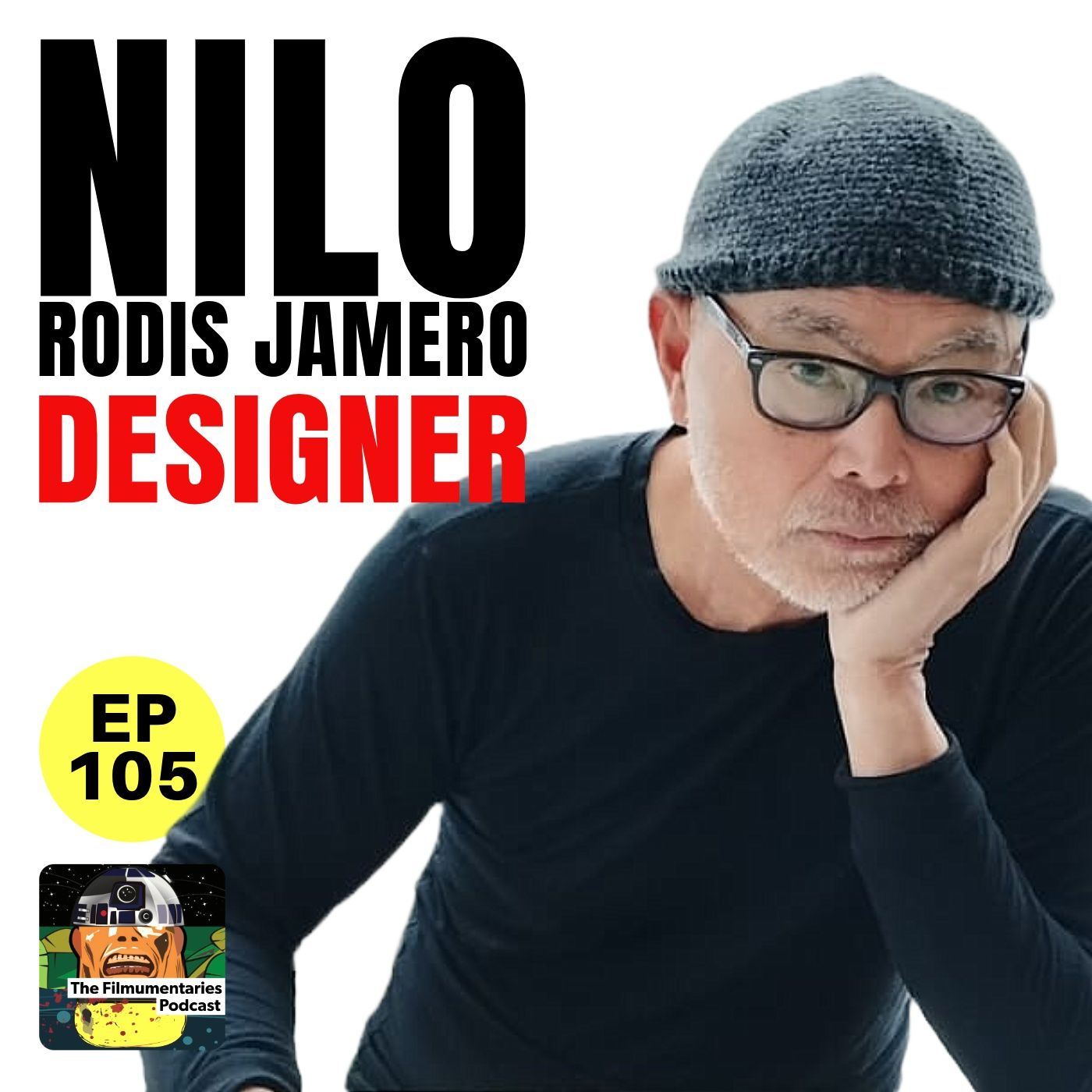

About this episode
They discuss Nilo's experiences working with George Lucas, Phil Tippett, and Joe Johnston, as well as his collaborations with other renowned designers like Eiko Ishioka and Hayao Miyazaki. Nilo shares insights into his design process and the importance of simplicity and iconicity in his work. The conversation also touches on Nilo's involvement in the design of the character Buz Lightyear in Toy Story and his experiences as a production designer on Johnny Mnemonic.
In this part of the conversation, Nilo discusses the challenges of working on movies with hard deadlines and limited budgets. He shares his experiences working with George Lucas and John Hughes, and how their approaches to filmmaking differed from the Hollywood norm. Nilo also compares working on Johnny Mnemonic and Explorers, both of which faced production difficulties. He highlights the importance of creative freedom and the impact of budget constraints on the filmmaking process. Nilo also shares insights into the differences between the film and video game industries, particularly in terms of discipline and the lack of a hard deadline in game development.
This is only part 1 of a long conversation. Part 2 is coming up soon!
Takeaways
- Nilo Rodis Jamero has had a diverse and influential career as a designer and production designer in the film industry.
- He has worked on iconic films like The Empire Strikes Back, Return of the Jedi, and Johnny Mnemonic.
- Nilo has rubbed shoulders with renowned designers and filmmakers, including George Lucas, Phil Tippett, Joe Johnston, Eiko Ishioka, and Hayao Miyazaki.
- His design process focuses on simplicity and creating designs that are easily recognizable and memorable.
- Nilo's work on the character Lunar Larry (who became Buzz Lightyear) in Toy Story showcases his ability to bring a character to life through design.
- His experiences as a production designer on Johnny Mnemonic highlight the challenges and dynamics of the filmmaking process. Movies are often made with hard deadlines and limited budgets, which can pose challenges for filmmakers.
- Working with directors like George Lucas and John Hughes, who prioritize creative freedom, can provide a different filmmaking experience.
- Films like Johnny Mnemonic and Explorers faced production difficulties, which affected their final outcomes.
- The film and video game industries have different approaches to discipline and deadlines, with games often lacking a hard deadline.
- Budget constraints can impact the creative process and the ability to achieve the desired vision for a film.
- "I like design that are very simple to digest and then reward the viewer with more details as they zoom in."
- "I work in an increment of a month. So, if, you know, can we agree on my terms?"
- "The essence of that character is right there. Facially, like his expressions, his costume, his stance, like it's all there."
- "Movies are literally backed into a hard date, which is the release date."
- "The way Hollywood movies are made, it's the opposite of that."
- "I learned how to do movies the way George makes movies."
Donate Button
All the links
This podcast is completely independent and made possible by listener support. If you’d like to help me keep making these episodes, you can join my Patreon community here: https://patreon.com/jamiebenning
Watch more on YouTube:
Check out the Filmumentaries YouTube channel for behind-the-scenes clips and extra content: https://youtube.com/filmumentaries
All my links
Transcript
Automatically generated, so expect the odd misheard name.
Weirding Way Media. Welcome to episode one hundred and five of the Film You Mentory's podcast. This is Jamie Benning talking to from my house here in southeast London spoiling hot today, and I'm up in my loft recording this, so I might sound a bit breathless. It's twenty eight degrees and in the loft it's probably about thirty five. I have an absolute treat for you today.
But first of all, welcome to any new listeners and welcome back to any regular listeners. I do appreciate you joining me once again, and a big special thank you to all of the people that support the podcast on Patreon, Patreon, dot com, forward slash Jamie Benning, different tiers. Have a look twelve dollars for an entire year of podcasts you can help support. That's all I'll say about that today, but do check it out if you're in a position to support the podcast, it would be very gratefully received. So back in the first year of doing this podcast, I think it was January twenty twenty one, well maybe yeah, the second year then, so I started in twenty twenty I spoke to designer Enigma Legend Nilo Rhodis Jamiro.
If you don't already know Nilo's work, he worked as a designer on The Empire Strikes Back, as costume designer or Return the Jedi, and he was production designer on Johnny Nimonic. He also designed a very well known animated character, which we're going to talk about. He then went and worked in video games for a number of years and has had so many adventures along the way, Like in this conversation alone, we talk about working with George Lucas and Phil tip here and Joe Johnston. You'll hear him talking about meeting Eko Ishioka, the famous designer, his years of working for EA Games, and many of the things that went on there, and you'll hear about maybe in part two, because this is going to be part one.
By the way, this is a big long conversation nearly three hours, so I've split it into two. But you're also here about how Nilo met Shinsaku Tamia and Osamu Tezuka and even Heyo Miyazaki of Ghibli Fame. I mean, Nilo has been around, He's seen a lot of things, He's done a lot of things, He's influenced a lot of filmmaking. You know, in this we also talk about working with John Hughes, the great John Hughes. Yeah, it's just the mind boggles.
Really do desperately want to go and meet Nilo in person and buy him dinner and have a chat and get to know more because we always have such a great time chatting. He goes on to talk about his developing role in the games industry and how he was employed to kind of unblock the creative pipe and being the wise Yoda like man that he is. He talks about so many of the lessons he's learned along the way. He's a phrase he uses quite a lot. And what I learned was so if you want to hear about all those lessons he learned along the way, this is the podcast.
Settle down, get a cup of tea, maybe get your headphones on. One thing I will say about this conversation is that, like the conversation in twenty twenty one, it was recorded over the phone. Nilo doesn't have a laptop for zooming or anything like that. It's not the quality that I would normally aim for. But for me, this is not about the quality.
This is about the actual content of the conversation, and there's so many wonderful moments in this conversation with So here's my conversation with Neilo Rhodis, jamiro and I'll be back at the end for a bit much Jabbring on, Hey, Jamie, I'm very good. Thank you. How are you? Yeah? Good good.
Nice to hear your voice again. Oh, thank you. Nice to hear your voice again. The rads It was great. Yeah, I mean I kind of I kind of almost can't believe that it happened in a way because it just came about.
I happened to be you know, the big, the big show that's in Vegas every year, NAB, the big broadcast technology show. I was, I was there, and I just happened to post that I was going to do that, and a couple of the guys at Lucasfilm said, oh, you should pop up and we'll give you the tour of you know, the presidio, And I thought, okay, great, that sounds good. And then the next thing, I know, one of the sound supervisors that i'd interviewed at the ranch, Max Smith, said Oh, while you're here, you should come up to the ranch and I'll give you the tour here oh no. And then an old colleague of mine said, oh, you can stay in on my boat in Sou Solito. So it just sort of all came together and with you know, sort of last minute.
Yeah, so it was kind of totally out of left field. But yeah, the I can tell you I'm not the most demonstrative person, but the ten year old in me was going crazy, you know, it was it was. It was great for just to be sort of in the place where all of that amazing work was done that I admire so much, you know, just walking into the Kurusawa room in the ranch and going up to the house and to the library. I didn't get into the archive unfortunately, but yeah, no, it's just very cool to be there's somewhere that you know very well, I'm sure very nice. Yeah, you know, I han't been to the sidio.
You've not been there. Oh yeah, well that is a bit more kind of upfront and corporate. You know. You walk in the front of the building. There's a Yoda fountain, and then you go in and there's a dearth fader there and some stormtroopers, and throughout the corridors there's just this huge display of props and models and Mate paintings.
That was the thing I love the most, actually seeing some of those mate paintings up close, some of Mike Pangratzio's work and Chris Evans work, oh yeah, the old map paintings, yeah exactly, and also some models, you know, like there was a space shuttle there from I think Deep Impact. There was some stuff from Galaxy Quest, stuff from Explorers, which which course you worked on. But yeah, no, it's just a very cool afternoon. And then of course they take you into the gift shop where where you in effect pay for your visit because you can't really leave that place without spending a bit of money on a Skywalker ranch mug or T shirt. Nice.
Yeah. Yeah, what have you been up to that much? I'm working on a project days in Italy? Oh yeah. Yeah.
So I'm working with a couple of film designers and and you know, I greatly admire them, so, you know, working with them has been good fun and totally out of my debts. I think all of us are out of our debts. Yeah, but it's good fun. I think that's the thing, isn't it. You know, your your com zone is where you die, isn't it?
Really? You have to be out of your comfort zone to live. I think in many cases, I've certainly found that out in later life, probably too late, that I should just throw myself into things more readily and just not worry so much about whether I can or can't do something, because it's like I think you you know, we had this conversation on WhatsApp, didn't we, you know, feel tipp its saying that you and Joe really had your shit together and he felt like he hadn't kind of got his skills down. And then you're telling me you felt like a fish out of water, and I'm sure Joe would probably say the same thing. You know.
Yeah, I remember meeting, so you know, he really changed my idea of film design. You know, I've been working a few months now at Georgia's house because there was no ILM at that time. Yeah, yeah, And every afternoon George would show up around one two o'clock maybe, and he would first visit Joe and then he would come down and see me. You know, George doesn't give assignment. He will just kind of tell your story for a scene, and it's to you to figure out how you're going to contribute to that.
Scene, and oftentimes, you know, because I didn't know anything about the film, I would just listen to him and I go, well, you know, great story, and then he would leave and I would go, what do I do now? Because he never really tell you that I want you to do this or that, and Joe does the same thing. You know, Joe and I don't share ideas until we meet with George. Until then our ideas are separately incubated. Yeah, well, that was the question I was going to ask you because I was looking through and I received a book this morning, good timing as a new book about Return of the jo I just come out, sort of celebrating forty years.
It's called a Visual Guide to Return the Jedi. And going through there, I could see some of your designs of the speeder bike and some of Joe's, and I could see how different they were. And I did wonder if you if you were sort of together when you were designing those, or whether you got together during a meeting later on and then kind of took the best bits of both and that that sounds like that's the sort of thing you did. Yes, that's when we were working. We were working separately until you know, a couple of weeks later, we would meet me George, and George would not explain why he would put a dot on a certain design, and those guarded designs have put aside to one side.
Then Joe and I would elaborate on those on those design direction. I think, you know, neither one of us know where it is going. It just George lives that direction will go there. And then Joe and I would separate again, and then we would come back two weeks later, and and then I would we would see each other's designs, and then we would converge again, and then would separate again, and then we would converts and then just the good bits are taken finally at the end. But Phil came in one day and I've never met him.
And at that time we were designing Yoda, yeah and jab at the Hut, and I always thought of them, Jamie as humans, you know, so I have the human variation of that design. And Phil showed up with, uh, you know, a caterpellar, the caterpillar from what's that Alice in Wonderland or something like that Alice in Wonderland, And literally it's a derivation of that design, you know, where his version of Jabada hat Is is a cad of fat caterpillar smoking a hookah, spitting literally sitting on top of a giant toadstool. And I go, who is this guy and what is he talking about? And George goes, that's a great idea, you know. And I was looking at him and Phil, you know, I've you've met him.
He's he's so I'm concerned mm hm about he's He seems oblivious about what's going on except what he's working on, or he appears to be. Yeah, and you know, and what he's talking about, he is totally committed to it, and he is, you know, miles and miles deep into that idea, you know. So and also Phil gave me the idea that actually designing, doesn't you know, the design process is not constricted to paper and pen. I can actually just take anything and present it to George mm hm you know yeah, no, he's an extremely good model maker. Yeah.
So when he showed up with Jaba thet and Java was now a slut, you know, it was like a exclamation point on my head, like, oh, I get it. Anything does yeah, yeah, the ceilings come off. I think Piel the talks as well in the past about how George reacted to three D little macquettes because he could hold them and look at them from every angle, whereas a sketch, you're always kind of wondering what's on the other side of that that sketch. So did you did you go down the route of sculpting things. I have made models, but not sculpting, so it would make very rough models of what I have in mind.
You know, in those days we just bash kids, so I would make quick models. George, Joe would make quick models also with both of us are separately frustrated by can and paper. You know, you can only go so deep with that can and paper. M hm. And the model shop is just down the corner from us, and we would just walk over there, and there is Joe working on his idea and I would work on my idea, but separately we never go So how about this, Joe, And you know we don't we convert?
We converted later on when George show's up and we would be joined either by Phil or by Ralph macquarie. Were you bashing model kits together like Tenny model kits and models of tanks and planes and stuff in the same way that the Island model makers were or were you making stuff out of card and paper and whatever else you had to hand, sometimes cardboard. It's whatever is conveniently, you know, whatever conveniently within my grasp, you know, Jamie. When I when I was in school, when we were given design assignment, like a quick design assignment, we were given like three hours to sketch the idea, but also model that idea as quickly as possible, you know, so we can hold it and you know, we can hold it and walk around it, and usually we just grab whatever it is that within our grasp, right, we don't go outside the room.
So you just make do with whatever you have. You don't have, you know, sticky tape, and you know you fold paper until you know it kind of resembles what you have in mind. So having all the time kids there was like heaven to me, you know, and having and having you know, those magic glue that you know, you can bash kids very quickly. But equally I just do that as as a vehicle to forward my pen and paper design. Now I can see around the corner.
Yeah, yeah, yeah, so yeah, it was fun. It was fun hearing Lawn Peterson when I first got in conu with Lawn Peter and I sent you this message, but I just wanted to read it out now, just so the listeners can hear as well. I asked Lornan to come onto the podcast, and of course I sent him a link to the episode of US two talking You and Me, and he said, Hi, Jamie just listened to the episode with Nilo and was nearly brought to tears. My voice broke up when I tried to speak. It was an epic thirty three years with many a milestone along the way, and every week brought new adventures.
Each day. Actually we got to work and live in Florence in the Renaissance. I'll be in touch in a day or two. So that conversation that you and I had really sold the podcast to him, because we had such a nice conversation that day. And you know, Laurn is on just on the other side of where you were, of course, in the place that you're describing right now, where you would go over to the model shop and bash to me your kits together.
So Lorne was there making the models from the designs that you'd come up with. What was your kind of reaction in seeing some of the work that Laurne did on your designs. Incredibly thrilled that lawn. How do I explain this? You know, Lorne especially lawn more than any other model maker.
I could walk over there with the sketch, and if I don't make a quick sketch, a quick maquette of what I have in mind, he will make that maket, you know, literally within hours, and then he would he would walk back to me and you know, it's just what you have in mind, you know, or this is my variation of that design. And usually I just go, I'm floored, like that's way more than I have in mind. You know, I don't have anything to add. Also, he he is practical in that when he does a version of the sketch, he has in mind how it's going to be photographed and how it's going to be mounted, and what is you know, what is the chance is holding that together? And what are the electronics that holding it together?
You know, And and I don't think about that at all. I just think of, you know, what does it look like, how does it behave? How you know, and how should it how should the wing fold? And all of that. No one has to figure that out.
While he is making this maquette or you know, a rough model of what we have in mind. So so you you're not you're not constrained in your initial design in that way then because you're not having to consider those No, I'm actually I'm more expensive because I know that they will take that idea and run with it. You know, I can only take my idea so far, whereas now they can how you know, like playing music with my guitar and then I take it to Loan and Loan make it into an orchestra. Yeah, yeah, you know, and there's there's really once once Loan takes hold of that design, I usually step back because I'm just at awe and what these guys can do. Yeah.
I wonder if one of those designs would be like the medical frigate that you designed for Empire that I think was was it Initially it was like going to be based on like an outboard engine or something, and then you expanded on that idea. Yes, you know, you're I like iconic design that that I usefully design with kids in mind. You know, if if people or kids that can't draw but can remember it, m hm. I feel that my design because it's just a visual idea at that stage that you know, kids can out draw it very quickly. I don't like design jand that that they, you know, the audience have to struggle to like what is that?
You know. I like them to immediately see what it is or grab grab the totality of it, and then as they zoom in you you know, they enjoy the details of it. Yeah. So that that ship that you were talking about, you know, I started out literally taking an outboard engine, an outward motor and then just tilting it sideways. I go, I love you know it.
It has a very nice readable shape. So how do I make this into a shift? And usually abstraction like that you can. I can take that to the model shop and they can run with it. And you have to leave them alone.
Yeah, because they have to interpret your design and you have to you know, you have you have to let go of your paper and pen design. It's now moved onto three D and they have better grasps than I would ever. Yeah. Yeah, I'm looking at that design now, and I guarantee that hundreds, thousands, tens of thousands of kids would have gone home after seeing the Empire strikes back for the first time, and they would have drawings in their little notepads and in the back of their school exercise books. And because those those designs are so iconic, aren't they.
I mean, I just as you're talking about it. I'm not an artist by any means, but I can. I can approximate the shape of that ship with basically, you know, five lines or something. So you've got that long piece on the back that's dangling down, You've got the sort of long bridge that's got a long tunnel kind of thing that's coming out the neck, and then you've got the head of the thing. And I can immediately I could show that to lots of people who were sort of movie aware and they would identify that immediately.
So you're absolutely right about that iconic nature. Yeah, you know, I tend to design that way. I like design that are very simple to digest, and then you know, reward the viewer with more details as they do. Then mm. Yeah.
But when we spoke last time, you you at one point I listened back to the interview last couple of days, you at one point went to mention that you were asked by I think it was John Lasseter to come in and design a character. And you didn't go any further than that, but can you describe that story? Tell us that story about designing a character for toy story. Yeah, I had for a couple of years, I didn't do anything but surf. I literally surfed every day.
You know. My my car was a rusty hulk of a car. After two years. It was just so you know, it was always an underwater uh you know, the be But one day I got a call from John Lassiter and he asked me, you know what when you got by the studio, and you know, I thought we were just gonna have a cup of coffee or something, you know, So went over there and we had a chat and he showed me what was at that time called Lunar Larry and John. John said that Captain Bream was losing patience with him because they couldn't get this one right.
And you know, can I have a can I have a crack at it? So I, you know, I explained to John that or John's produced there at the time, that I work in an increment of a month, so if you know, can we agree on my terms? And John goes, yeah, no, no, no, no, no problem. So I went home and literally still self encrusted you because I was serving that day. Came home and literally just just did a couple of sketches with what John and I had over John had given me as an idea.
Came home literally something like one o'clock. I faxed John a page of what I had in mind, of what I understood him to be to be his design parameter. And John hatched that to Katzenberg, and literally within minutes, Katzenberg wrote over it and said this is it. Stop h So John fact step back to me, and I go, great, you know. And at the time, all I was concerned about this can you give me my months fee?
So two years later or a year and a half later, they finally paid me. Wow, jeez, Because the argument that the Disney producer had been talk to me about was you know, how long did it take you to do this? Nego? And I told him, I told him forty years. Yeah, exactly, that's exactly the answer you should give, you know, and they you know, if you're two hours and I don't know, you know, you agreed on this, so this is our agreement, and you know, and and I really wanted to production design that movie.
Mhm. And that was my that was my understanding with John also, but because we got stuck on this thing, you know, like what was that I was supposed to bring to this project? And I told him, I don't think I mean you tell you what I could bring to the project. You know, I stayed this one character and anyway, So meantime, I went out to do John in Nemonica, and when I came back, we were still talking about it and I go, you know what, this is never going to go anywhere, you know, or I'm not gonna go anywhere with this project. So but it was fun.
And then years later, you know, a couple of years later that the movie finally finally was released and I ran into John at the airport one day and I was, Hey, did you see the movie? And at that time, I hadn't seen the movie. Did you get your did you see your name? We you know you were you were in that movie. We gave you credit, and I was really stunned, and I thought, wow, you know, and all the crew got a gift pack at the end of the show, and John also sent me that pack, and I, you know, I was really you know, I was really impressed by John Nice.
I'm looking at the design. Now, I don't know how early this sketches or I mean, you said you did it in a matter of hours, but the essence of that character is right there facially, like his expressions, his costume, his stance, like it's all there. It's all there in that those early concepts amazing. The proportion is there, which is what I was concerned about, and the rest of the details I don't. We'll talk about later, you know, but this is the proportion that I saw.
You know, this kid head and very simple could draw, yeah, and kid friendly, yes, yeah. That comes from your experience of making Ewoks Neela. Yeah. Yeah, that was another one. You know, one thing we didn't talk about, and you just mentioned it actually in passing there Johnny Newmonic.
That was a that was a big film at the time. You were production designer on that, Yes, and so that was a step up for you in some ways. It was. I remember being called to the fly down to l A and meet with this director. I've never heard of h but I'm I'm a great fan of William Gibson's.
So when I read the script, they founded the script the night before and I read the script and I thought this movie is this script is wonderfully written. It's how to explain this. The design is between words. You feel that you were there, but the way it's written by William it doesn't really tell you what it is. It makes you feel what it is, you know.
So I thought, I want to I want I want a shot at this. So I went down to the I and met with Robert Longo. Yea what my role was gonna be. I was just asked to have a meet, you know, to meet him, and didn't think much about it. And I got a call from the producer and said, you know, Robert really likes you.
You know, would you like to pursution design this? So if I go to Toronto and you know, at that time we started designing sets without knowing who the star was going to be. It's gonna be Johnny Mnbunnet And at that time there was crambling to figure out who Johnny Mnemonic was going to be, and they came come up with Val Kilmer. M hm. So Val Kilmer spent a week in Toronto and after a week he decided he didn't he didn't want to have anything to do with it.
So we continue production design and we you know, the shooting schedule is now coming ever so close. We still don't have Johnny mneumonic. And you know, I have to tell you, Jamie, what a wonderful script that was. You know, how do I visualize this world? And finally Piano Reeves sign up and you know, wonderful kid, he really is.
You know, Robert had had directed an episode of a TV series. I wasn't sure what it was. I think it was Tales of the Crypt, yes, and you know I never saw I never saw that. But I got on well with Robert. But Robert came from a very different discipline.
You know. I remember one day I started reading him about Robert and you know, he he would do theater design, he would do wax design, big wax model. He would do installation design. He would do graphite joined a big, really billboard size canvas. And I remember having a conversation with Robert and go, wow, you know so many disciplines that you you know that you control.
You know, however do you do this? And Robert looked at me quizically and and he goes, Neil, you have people to do that. I was. I was blown away. You know, I didn't know that you know artists in the past, you know, Lenardo and all of these people also did that.
Yeah, they other people do preliminary works and they would finish it. I didn't know that, and you know, Robert explained to me that that's how his world is. You know, you hire people that can actually go and you just directing to do that. And I thought, well, that's that's really interesting. But you know, I was in that show for almost for over a year in Toronto.
It was a good learning experience. Didn't quite match what I have in mind. Yea, and years later Matrix came up and I thought, that's what That's what Johnny Mnemonic was attempting to do. So do you think it was just a mismatch of the script and the director ultimately not wanting to point the finger. But he was a as you say, he was an artist in many different forms, but he was sort of predominantly known for music videos, wasn't he leading up to doing that Tales of the Crew music videos for Arin And yeah, you know, it's a puzzle to me sometimes, Jamie, how movies are made or how they come about to be made.
You know, oftentimes getting a movie made is more interesting than the movie itself. Yeah, because it's such high drama on how it got there for however many million, hundreds of millions of dollars, and the betting on it, on this script and on this actor. What I enjoyed about Johnny Niemonic was being able to help Robert realize what he has in mind or what he had in mind, you know, because Robert didn't know anything about visual effects. I was called in the George Lucas way of doing movies. You do a lot of pre production first, you know, don't hire anybody else, just just get the pre production right.
And then as as, and then you start feeling in the crew, you know, and you give that crew that you know. The way George does it is there's a big story storyboard. Everything is storyboarded, and that becomes that becomes biblical literally you follow that. Yeah, And oftentimes initial storyboard would literally end up all the way to the end of production. You know.
I'm always surprised how many of the storyboard that we did is transferred all the way to the end. But movies are not done the way George does it. George had this on the studio so he can fend off other people in the beginning. So there's just designers like Joe, myself and Ralph, and they would go on for at least a year, just just us all a year. Well, the crew is busy doing something else, and then once that bible is set, then George starts bringing in people.
What I finally learned, what Johnny Nemonic taught me, was that movies are literally movie schedule are literally backed into a hard date, which is the release date, then the green light the movie mm hm, that that's that actually with a budget that actually will not make that movie, yes, and at the time schedule that it's almost impossible to make. It's the opposite of how George makes movies. So I learned how to you know, I learned how to do movies the way George you know makes movies. Johnny Nemonic taught me that the way Hollywood movies are made, it's the opposite of that back into a high deadline with a limited budget and limited time. Now, the only other product, the only other producer I eventually ran into and worked with that had the same idea as George, was John Hughes.
Yeah yeah, and that John John would just sit by himself and you know, occasionally call me in for a meeting. I don't know if I told you this story about John Hughes. I think I think you mentioned him that you were you nearly worked on a movie together and the plug was pulled. Yes, a couple of those movies been uh actually three movies that I can on top of my head that we were working on. There was plugged.
I was was unplugged. But I remember John, you know, sent me a script and he you know, and then he called me a couple of nights later and said, you know, come over to Chicago, let's discuss this script. And you know, usually I would write notes, what is the most important part, you know, where do we put our money, and what is the most you know, what is the most iconic visual cue that you know that we can hang this movie? And I was so giddy with the script that that I read that I all, I went to Chicago with just a CD of music that I thought this movie should be based on, not not design, but music. So I couldn't come up with any design ideas, but I had an idea of what the music ought to be.
And I remember that was the first time that I, you know, flying to Chicago ago. This is committing Harry Carey mhm, you know, because I'm a designer and i'm I'm I'm gonna talk to John about music. So I met with John at his house and he said, so, you know, what do you have? You know, after all the preliminary conversations, So what do you have? What do you think?
And I said, well, I have this CD of this an artist's named Juan Garcia is Goubell and there is a particular music, a particular I think number six or whatever. You know, can you play that? And he looked at it, and he went to his cupboard in his studio and it's lined by a lot of CDs because John loves music, and he picked that one up and wouldn't you know it, it's the same CD and he hadn't noted it. And John mentioned that the music that I have in mind was exactly the same music that he had in mind while he was writing it. And that was my initial meeting with John, or my second meeting with John.
So he said, you know you should direct this movie. You understand this movie. And he said, John out, I'll produce that movie for you, but I don't want to do it. You know, I like the idea of helping somebody make the movie. I have worked with George that has a very clear idea of what he has in mind, very very clear idea of what he had in mind.
I was really how do I explain this? I was uncomfortable of taking John's idea and making it mine. You know, I can't get into his head, you know, And so I decline. The movie was never really made. It went from studio to studio to studio, and then it just sort of disappeared.
But it was a great movie. It could have been a great movie. Do you have a regret that decision? Or it sounds like it was the right decision, But do you ever regret not having that chance to direct? No, because I, you know, I didn't didn't feel that I had that calling, you know what I mean, And he was the better man for the job.
I guess I didn't have a brand he desired to direct. I'd like to sing it through and I'd like to guide it, you know. I you know, John sent me to New York one day based on this incredibly simple movie mm hmm called Tickets, and you know, he asked me to set up a set up a production in New York and yeah, I was there for almost six months, and then eventually the movie was called off. Mm hmm. We were getting ready to do uh, to start building sites, and it was called off.
And you know, it's high politics of movie making. You know, we like we like, we like you, but we want you to do a movie for us, and and I know you like to make that movie, but will help you make that movie. But what we really want you to do is this movie that we have in mind. Right, And oftentimes the studio allows you to move along with that idea, knowing full well that the studio will ultimately cancel that production. And you know, I've experienced that many times during my career in movies.
They would just allow you, the studio would allow you to go so far m hm, and then shut down because what they really want you is to do this other movie that they have in mind. Yeah, you know, I heard I heard that George Clooney is oftentimes makes a deal with studio. They will he will do a studio movie or two studio movie to his one movie. And oftentimes the movie that in this case George Clooney would make, it's not a big studio movie, but it's you know, a passion project. Mm hmm.
Now Johnnyknemonic was was was was like that to me where I didn't feel like it was ever gonna go. You know, I felt that they wanted William Gibson for another you know, it just felt that way that it just crept alone, crept along, crypt along, and I go, they can possibly continue to do this, you know, because it they had no momentum. Usually a movie has some momentum going in, you know. Ultimately, they were trying to figure out how could they the because it was it was shot here in Canada, and to shoot in Canada and get a production budget credit, you know where the Canadian government will give you x amount of money of a percentage of your budget if you shoot in Canada, but you have to have Canadian content to it.
You mean you have to have a Canadian actor yeh, Canadian uh, perction designer, Canadian cinematographer. So they eventually came up to me and said, you know, we have this problem you know where you know, we need Canadian content in this movie. And I remember it and I remember sitting now, why are you talking to me? And eventually they told me that to a production designer count as one point to getting Canadian attacks credit. And since I've already signed up on the video, what would it take for me to leave the show?
There was a question, you know, there was tables. So I called up my wife. I said, you know, I don't know if I told you this, but I asked her, you know, how how much did we owe on our mortgage in our house? And she told me a number. And I went back to the studio and said, pay me this and you got a deal, I'll walk out.
And I thought, you know, that would be a good deal, you know, for me as well as for them. But eventually they sided. They were you know, we were lucky that Piano signed to do the project because Piano held something like five points because he was the lead actor. Yeah. Politics, Yeah, never simple, is it.
I think people always have this impression with movies that you know, they're designed and they're made, and if they fail, then it's the thought of the filmmakers alone, not the actual you know, the studio or all the multitude of politics that go into it. I mean that film, you know, certainly, from a design point of view, that film certainly could have felt sort of more majestic, you know, it could have had a and just from its execution, it felt like the film almost was great. You know. It made a powerful director and a powerful producer in concert with a powerful director to realize it, because to make to make a movie, you know, you know, I remember, I remember vividly one day, towards the end of the show, the producer said something that shot me.
You know, I was operating on the basis that the budget was X amount of money, sixty sixty sixty cents right to the dollar. And what he told me was the budget was actually one hundred and I go, but I designed it around the smaller budget that you told me, you know. So that's another producorial game that I realized that also constantly being played, you know, within the productions, within the production of a movie producer. Often times, from my experience, sometimes they don't tell you the actual budget in the hope that it can be done for a smaller budget, making them look like a hero. I don't care about that, because to me, a movie, once it's committed to film, you know, you cannot erase it.
You know. So you may have, you may have saved the studio x amount of money, but you did not you did not achieve what the movie was trying to achieve. M you know, and that that learning to me was the realization that I really wanted to produce movies, not the direct movie, you know, because I saw the end and you know the political game that's been played. Mm hm, so you know, I like, So that's what I learned about. But that was a big learning for me.
Well, another film that you worked on that we didn't talk about last time, and I used to love this film when I was a kid. I haven't revisited I don't think in a very long time. But Explorers, the Joe Dante film. That was another film that was kind of troubled. I mean, this is what ten years before Johnny Numonic, but this is another film that troubled, didn't kind of get finished in a way the end.
I mean, I don't really remember the ending. My memories of it are the kids all getting together and building the ship and you know, all of that stuff and getting into space. That was the cool part for me. But that was that was another troubled movie, wasn't it. How What was that like?
And what was Joe Dante like work to work for? Well, Joe dan is a blast to work with. You know, he is good fun. He is a consummate. He is a consummate movie consumer.
And for me, Joe's religion is movies. You know, he he literally he literally he can dissect movies. He can zoom me in on a movie. And what he's really good at is looney Tuns kind of movie. Yeah, yeah, yeah.
And you know I didn't know Joe at that. I'm but reading the script by Eric Luke, and you know, I thought, what good fun is this? You know, this is terrific fun. You know, I want to work on this. And actually at Ireland, everybody wanted to work on it because Joe is such a such a wonderful fun person to work with.
And what what a wonderful read this script was. And we were in pre production and they did a screen test book. The guy who played the alien who is now on Star Trek played the dad alien and the boy alien. There was there was a girl alien and the boy alien. I was gonna say his name is Joe Icardo.
So uh, they did the film test. We did the film test and there he is is an alien and you know, the camera is just on a batic camera and he walks in and he does one liner after another after another up there, and he was hilarious, and I thought, oh, this guy is he's a comedian. This is great, this is gonna be funny. But I never thought that the movie would be changed because of that, because of that one passing, and literally the movie pivoted on that one character. Mm hm you know.
So he came in, it became luned tunes, right, just one joke up there, another another after another, and the script changed somehow, it moved towards that direction. But originally it was not. It was he was telling a story about these three adventures, and somehow it got hijacked by that. So the movie pivoted to that directions, and it was when it was screening a lot of a lot of the ass result was the audience. You didn't understand what was going on because it suddenly stopped.
It almost screeched a halt. And this comedian came in there, just one liner after another after another, and you know, I remember George Lucas and saying, you know, he watched the movie and it was good fun with the kids, and he died when the alien came in. And I thought, great observation. Yeah, that was Robert Picado. Robert Picardo, Yeah, yeah, and he ended up being he was in Deep Space nine I think.
Wasn't he one of the star treks? Yes, I think he played the doctor or something. I never watched, but he was not. But his talent is really a comedy. But yeah, you know, he transitioned into straight acting.
So also I realized that somehow during that production Joe Dante's idea of craziness, because you know, lunatants is crazy m hm, right, and but you have to embrace that craziness, you know, like Jim Carrey on the Mask, you run with it and you're just you know, you live in that world in the Yeah, and that movie, Derek looks a script for the Explorers, what was about exploring? But somehow it disappeared halfway to the movie because of Robert Picardo. Yeah, yeah, I think. I also read that the production didn't the studio change hands in the middle of production as well, and kind of the movie had to be finished quicker. I'm sure I heard Joe say that at one point, well, you know, we shot for over one hundred days, it was, you know, and all that time there was constant hassle with with the studio and Joe, you know, and that's never a good thing.
You know. I don't know what the reason behind that fight, but somewhere along the way the relationship changed and either Joe did not get the full support of the studio, or the studio changed its direction, or Joe Dantis changed his direction. But you know, I remember Eric Luke was the up and coming writer. You know, he was with happing a lot of movie blogs that you know, this is a hard writer coming up, and no, after the movie released, it just sort of disappeared. Yeah, yeah, yeah, it's kind of it's kind of amazing.
Like you said, you know, you sometimes wonder how movies get made. I mean, there's no it's no surprise that people have tried to make movies in the fashion that George and you and Joe and all those other amazing artists made, you know, in the Stars movies and in the Indiana Jones movies, because seemingly all the ingredients can be found, right like in the case of Explorers or Johnny Numonic. So the ingredients are there. But ultimately, yeah, yeah, but ultimately it comes down to finding a team that you can work with, but also a team that you can give that kind of creative freedom too, and creative freedom is kind of well, let's put it this way around. Budget constraints are the enemy of creative freedom in many ways.
And you know, as we know, this is business, and business and art don't always mix, do they. I appreciate, you know, we all appreciate budget constraints. That's how that's how the world is. We appreciate hard deadline. I you know, I really learned about hard deadline that when I moved into the start designing games of producing game but you know games.
Yeah, I'll come back to to what we were talking about, but it just triggered an episode that I I learned about games. That is what I've learned about movies is you do hard deadline. You do. You appreciate hard deadline, and you appreciate hard schedule and hard budget. These budgets doesn't move.
This schedule doesn't move. And the essence of this production is this right. It's about exploring right, and you bring in a director that you trust, and the studio and the director have a good relationship, and the movie is made. But what I've learned, what I've learned about movies is that there is a hard deadline that you must be accountable for, and everything revolves around that hard deadline. Ideas, budget revolves around that.
So in games, Jamie, there is no hard deadline, really yeah, because usually a game company like BA, they are also the distributor or in the game language, the publisher, right, they produced the game and they also published the game, or they distribute the game. And what I've learned about while I was at BA is that hard deadline is not really hard deadline. In fact, there is no hard deadline. There is this game. And I'm used to the discipline between the design, the lighting, the script, the all the discipline of movie making.
We once we are given that script, we don't fuck around with that script. Yeah, that's what we're tigned to do. And now we're gonna focus our talent and our time into that script. We don't change that. That's a given.
Now in games, because there is no hard deadline, there becomes how do I explain this? Because there is no hard deadline, you can't sort of me under and around. Yeah, m And this meandering, as far as I'm concerned, is a killer because it does not train people to immediately go after the meat of that project. You know, a sort of find the meat of that project along the way, and I, no, you don't. And also the discipline between producer, director, production, designer, lighting, we we don't.
I don't make comments about the script. I don't make comments about lightning. I don't make comments about the hair or the costume. That's not my department. My department is designed design the movie.
And we we we respect that border. In games, I remember my first production design meeting on Games. There was about one hundred of us in this room, and I saw them looking around at who makes decisions. Usually it's just a producer director. There's two people, and you know, and what comes out of that is the direction.
Here's what we're gonna do. And I remember after that meeting, I asked, who is building the game? Since we all have this meeting for two days. Literally the production grinds the hold because we're all of us are in this meeting. And you know, I remember somebody raising their hands and they said, I don't like green.
I go, who is that guy? You know? Oh, he needs a coder? And I go, well, in code, don't tell me about color. YEA.
Too many cooks, you know what? Way? Too many cooks So one day, one day, all the executives at EA was summoned to Vancouver from all over the world. They came here and we had a big meeting, and at the time I sat on the left side or the right side of the CEO of the company because they somehow it's a long story, but somehow that's where I ended up with. I ended up in this meeting.
And the question of the day was why does our producers suck? Literally, that's it. And everybody was someononed and now you know, so that question was asked, and then everybody was asked why, and I go, wow, I don't know. I'm new here, you know. But I had some observation because I'd run into these sort of problems during meeting.
But I don't know game. So I'm totally not equipped to answer any of these meeting, nor should I be in this room. So it went, it went around the table, but mercifully it went away from me. So by the time it circled back to me, it has been like forty five minutes or an hour. By the time it came to me, everybody had their say around the tap people.
So finally with it painted me and all of them said something nice couched in such a way that it was not abrasive, you know, by the time it came to me, and I'm the new kid in the block, right, and all all eyes now come to me, and I, I mean, the CEO, Don Metric asked me, Tonilo, why does our producer start? And I said, our producers start because there is no union in this game. There's and they go and everybody like everybody, you know, like cartoons where sweats are flying from everybody's head or faces like I had said something so wrong, and and Don asked me, can you elaborate on that? And I said, here's my learning on movie making. We have a hard deadline.
And because we are committed to that hard deadline, we don't dare go over each day. We don't go over allotted time. At five o'clock, we shut down whether we got it or not, because if we go over a minute now, we have to bring in we have to bring in catering, we have to bring in drivers, we have to bring in all of these other people. And that's what union does that and that's the hard commitment of a hard deadline. And and you know, I was asked to elaborate some more, and I said you for example, when you guys walk into this building, you walk into this corridor right, and in the corridor you saw big posters, big posters, but the corridor is lined with these posters that the producer of this game asks the production a production crew to do these posters so that by the time you walk in here you have an idea of what this game is about.
Let me, let me tell you how many times that posters were done because the colors were wrong, and the colors were off, or the funds were wrong. Did you guys pay attention to that? And they said, we didn't even see the poser. Of course you don't. But you know, the crew, the crew was killed by the producers to do that over and over and over again.
That they actually stayed overnight to redo that again just for today's meeting. You know. So a lot of people were killed taking this beachhead because we don't care, because there's no there is no there is no overtime, and because there is no overtime, the producers will just keep saying, do it again, do it again, do it again, do it again. Because when you look at when you look at the budget, you know, because there's no there is no overtime. It feels like, yeah, it was done on budget, but it's not a lot of people were killed along the way because we don't tabulate those those you know how many times it was done when when those producers moved on?
What the other crew has learned that you can actually do this When I become a producer, someday, when I become a producer, I can run the crew just like this. M So there's no discipline. I thought the discipline in games was lacking compared to movies because there is no overtime and because there is no union overseeing those you know, those overtime when you go, when you go, when you go over the scale you're shooting. There is serious money ramification. There is fudget dramification, and that you know, you don't go one minute over because the increment is actually not minutes, it goes into five hours, you know, or or whatever the union has agreed.
Right, And as a producer in movies, I've learned to discipline myself that you know, I learned how to make calls to stop, to stop it before five o'clock, make sure that we are not over over scheduled. M hm. But that pretty supposes Jamie, that we all know what is not what what we can give away, and what we should win for this, for the script or for this shooting date or shooting day, or or the entire movie. You know, I know that the visually, if you just walk away in movies after senior movie and you just you can visually explain what the movie is, that movie is successful. Yeah, yeah, true, you know if you don't.
Yeah, And usually I focus, as a production designer or a producer, I focus on that one key moment of that movie. I want to secure this and everything else I'm willing to let go, you know, I'm willing. I'm willing to put up a fight on those other fronts, but this one I gotta win. So as a production designer, I usually make sure that I design that set and the other one I let go. I let other design, you know, because they need to experience that also.
You know, as an art director, right, what I've learned about video games was they needed a bit more discipline. So when my time was up, they were looking at me, and they all look really scared for me, and I didn't understand why. And when everybody was left, when everybody was gone in that room, and I was sitting there. There was another guy that was sitting there all by himself, and he walked over to me and said, did you know that Don Mattrick and Chris Lee and Paul Lee, and did you know that the reason we don't have over time is because Don Matrick, the CEO of the company, made the deal with Vancouver. They were actually responsible for making sure that there was no overtime or they don't pay for overtime and there is no union.
I thought, Okay, my career is him the game? And what happened? Well, I hope you enjoyed my conversation there with Nilo as much as I did. That was just part one. Hopefully you're looking forward to part two, where he goes on to talk about so many other surprising things that I didn't know about him.
It's very difficult to do research on Nilo. As I said at the start, he is a bit of an enigma. But yeah, we've we've become quite friendly. And something incredible happened just last week. So last year, when I released my Return of the Jedi book, I said to Nilo, I text him and I said I'd love to send you a copy, and he said, oh, JB will do a trade, so I send him a copy.
And then just this June, the anniversary, first anniversary of the book's release came around and I said, on Nilo, did you ever get the book we never chatted about. He said, oh, Jamie, I forgot to do our trade. He said, I'll send you something in the post, And just a couple of weeks later, the most amazing package that's ever arrived on my door turned up. It was original drawings by Nilo done for me of slave one of Bob Affett in the Sarlac, of a snow speeder, of a speeder bite with an ewok hanging off it. Original drawings, some of them painted and colored, others just with a ballpoint pen, as he talks about in a conversation, and there for me.
He did them just for me, He said, I had a great time doing them for you and knowing how much you'd enjoy them, and my goodness, do I enjoy them. I'm now looking into getting them framed in UV glass and protected forevermore. I mean, these are kind of heirlooms. But regardless of the value monetarily, the value to me of making this friendship with Nilo, and him going out of his way to do that for me, it's just kind of mind blowing. His name is a name that I've known since I was five years old, reading it in books, you know, the making of the Empire, Struck's Back and Return of the Jedi a couple of years later.
And to think that we're now friends, chatting and he's sending me a gift, yeah, kind of blows my mind. So listen in for episode two of this conversation in which we go into even more amazing stories with Nilo. Thanks for joining me, and I hope you can do so. For the next episode of the film, we mention this podcast we are getting way media. H



Similar episodes across the network
Matched by shared keywords.
-
Seasonal Differences, Shifting Fandom
1 shared keyword: the
-
Resident Evil - Kulture Meltdown
1 shared keyword: the
-
Linus O'Brien - Unsung Cinema
1 shared keyword: the