
Full episode
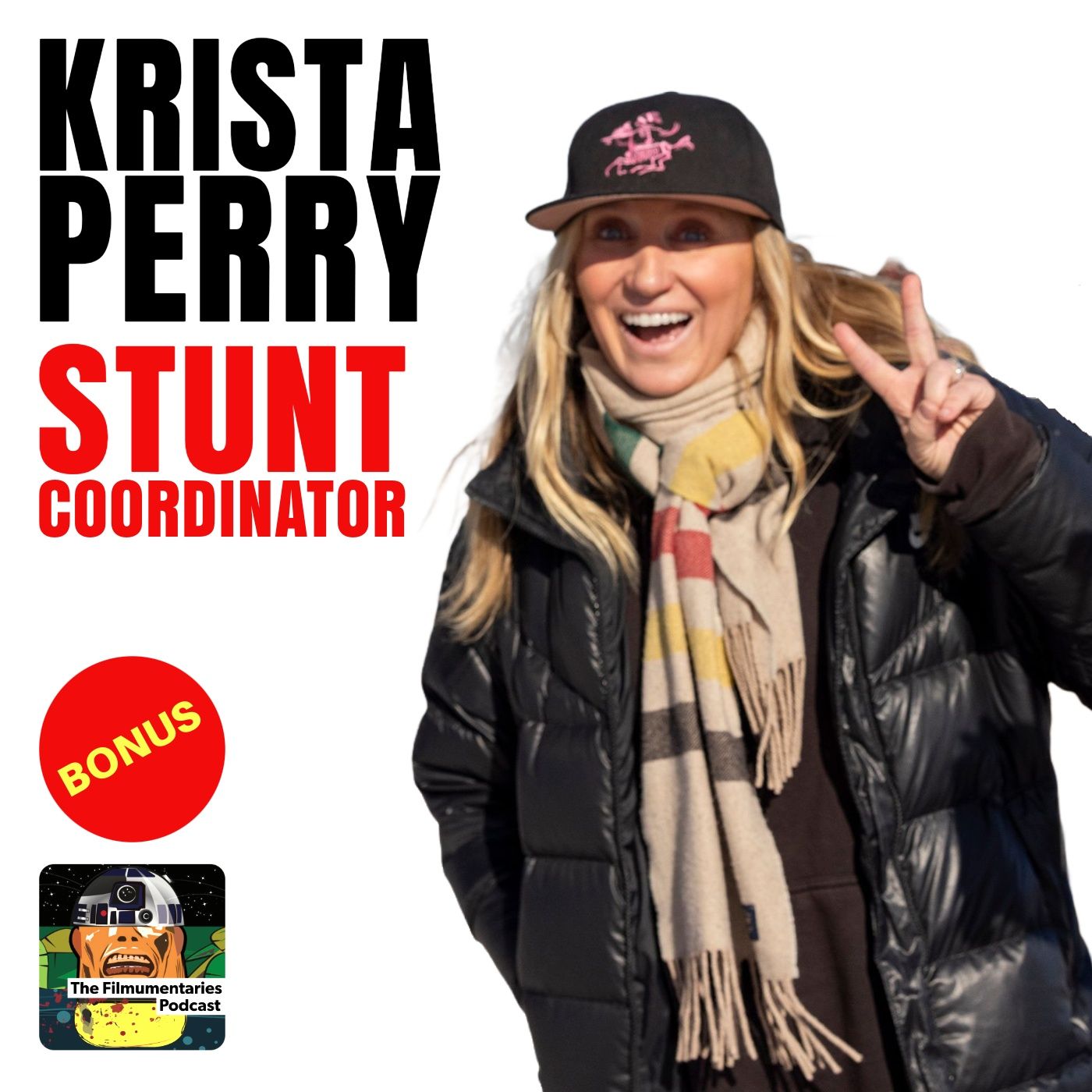
BONUS EP - Krista Perry - Stunt Coordinator on Reservation Dogs
About this episode
Sometimes I get invited to interview a particular behind the scenes artist and I've decided I should say yes to them and get them out as bonus episodes.
So in this bonus episode, I spoke with stunt coordinator, Krista Perry. Krista is a, native Californian, who grew up travelling the country at the age of eight for competitive swimming. Finishing out her career as an All American Swimmer in the state of California. She is now a stunt performer and stunt coordinator, most recently working on Killers of the Flower moon and the series Reservation Dogs.
So here's my conversation with Krista. I hope you enjoy it.
Takeaways
- The stunt industry is male-dominated, but Krista found her way into it through her background as an athlete.
- Discipline and teamwork are crucial in both athletics and stunts.
- Body awareness is important in stunts, and technology allows performers to analyze their form and make improvements.
- Working with actors who lack physical awareness can be challenging, but having a double provides a backup plan.
- Script breakdown and casting for stunts involve finding the right people with the necessary skills and background.
- The adaptation to VFX in stunts has allowed for more creative possibilities.
- Trust and relationships are key in the stunt industry, and working with familiar team members fosters a sense of shorthand and communication.
- Working on both big and small productions offers different experiences and opportunities for learning.
- There is a potential for Oscars for stunts to recognize the hard work and contributions of stunt performers.
Donate Button
All the links
This podcast is completely independent and made possible by listener support. If you’d like to help me keep making these episodes, you can join my Patreon community here: https://patreon.com/jamiebenning
Watch more on YouTube:
Check out the Filmumentaries YouTube channel for behind-the-scenes clips and extra content: https://youtube.com/filmumentaries
All my links
Transcript
Automatically generated, so expect the odd misheard name.
Hi, this is a bonus episode. Sometimes I get invited to interview a particular behind the scenes artist and I've decided I should say yes to them and get them out as bonus episodes. So in this bonus episode, I spoke with stunt coordinator christ Perry. Christa is a native Californian who grew up traveling the country at the age of eight for competitive swimming, finishing out her career as an All American swimmer in the state of California. She is now a stunt performer and stunt coordinator, most recently working on Killers of the Flower Moon and the series Reservation Dogs.
So here's my conversation with Christa. I hope you enjoy it. Christ thanks for joining me. How did you get started in an industry that is particularly male dominated and how was that transition from your previous career. Oh, my god, started in the industry based on being an athlete.
Prior in my growing up life, I was a swimmer and so I was chasing the Olympic dream. As we watched the the Olympic trials this weekend, I was like, Oh, there's some people from my team there. But that's kind of how I got started. And then I just let some stunt coordinators know my skills were and if an opportunity ever arose, I love a chance to be a part of it. And then three years later it did, and then I just went running with it.
And is that that start as an athlete? Were you an athlete that also watched movies? Were you a fan of movies? Because I know, being an athlete, not that I've ever been anywhere near one myself, but I know that takes up a lot of time, a lot of dedication early mornings, particularly with swimming. Did you have that passion of movies at the same time as well.
I like to watch movies growing up, but I feel like most of the time I was swimming or dry land, we would swim four days a week before school, after school for probably like five hours a day, and then the weekends it was like a three and a half hour practice. So it's very disciplined, which really translates into the stut industry of being a part of a team and discipline and you know, just being a good person all around. I think that's what the whole business is about, which is exactly what being an athlete is. Yeah, being part of a team as well. Like you mentioned seeing some of your team members they're doing the trials.
I guess just having that ability to sort of make friends and make connections with people is a big part of working in the film industry, right, Yeah, and being able to trust people that you're working with, and if they have your life on the line, you know you want one hundred percent trust that you don't have to second guess. It just comes supernatural. Just like when you swim, you have muscle memory. I feel like when we do stunts, it's the same thing. We'veheard, We know the beasts and we just have to do it.
We can't overthink it because we already know what to expect. And that reminds me of being an athlete. Yeah. I actually work in life sport myself in broadcasts, so I've shown many athletes their technique before. You know, I was on one event in Myanmar in Burma years ago and this woman was doing one hundred meters hurdles and she'd never seen herself hurdle before, and giving her a package of super slow motion shots of her doing that, which kind of blew her mind.
But I would imagine in the film industry, you have now in the digital age, you have that advantage as well now of kind of looking at playback and just just checking your form and checking that things feel right and look right. Well, I'll look right if they didn't feel right. That's funny you mentioned that, I just sparked my memory. As a kid, my swim coach would rig in a plastic bag underwater camera and he would watch our strokes. And so when we work with actors to teach them action, I always try to show them back what they're doing and something that we can improve on or correct or it's working, and how awesome it looks from the angles that we're selling it from.
So at a young age I learned that watching myself helps. So even when I'm on the golf course, I'm like, oh, I feel like I'm standing up, but then I feel like it's perfect. But then I see it, I'm like, well that was a horrible shot. I stood completely up. Where are the sticks?
Yeah? That body awareness must be it must be amazing to have. Some people just don't have it right. And therefore, what is the challenge in working with some of these actors who come on board of projects where maybe they lack a bit of that kind of awareness of, you know, the extremities of their body. You find that a difficulty sometimes working with actors who do or do not have those skills.
Well, that's the case that we throw a double in because we always have a backup plan. So yeah, most of the time, I feel like what we work with, they're thoughtical with how they see their character, that they're able to take direction because they have a lot of experience. But if it's not working, that's why we have a double. Being a double, I'm sure you've been a double on many shows and many films. Being a double, do you have to kind of have an awareness of the character as well, because of course you want to kind of and the person themselves the act to themselves because you want to kind of replicate their physicality, right.
Yeah, it's funny. When we are working on set, I'll usually try if I'm like a guest on the show, I'll grab what's called the sides and I'll read them really quick, and I'll be like, Okay, what's the scene. What's happening? Am I the hero? Am I a loser?
Like, just so I can understand what's happening for the day, And they usually always have those in the hair and makeup trailers, so I'll kind of read up on what's going on, and then I study the actress. So if we're about to, you know, go to picture and they're doing stuff before, I'll watch their movement. Are they left handed? Are they right handed? So if I'm going to grab a knife with my right hand but they're left handed, it makes no sense to do that.
So I really watch, like what their mannversions are, how their posture is, just things like that, And I think being an athlete correcting yourself really excels in this business for that as well. Yeah, you do, you get like a script fairly early on. Then, now that you're a stunt coordinator on like reservation dogs, for instance, do you get a script early on so that you're able to sort of hone those things that you just talked about. Yes, when I'm a stunt coordinator, I have the script far in advance because we have to go to pre production and meet with people talk about the meat of what they want to see, what we're going to double them, like, all the things that are needed to make it successful or if we need to alter it it all.
But if I'm playing on a show and I'm doubling, and I'm just coming in and out, I might not ever really know what's going on, and so I mean, I know what actually I'm gonna do, but I don't really know the story because no one that's not really you just don't read it. And I guess you've got the script early on as well as a coordinator, because you need to break down those scenes and kind of figure out what needs to be a stunt, what needs to be a the effect or a combination of the two. Do you ever find that you come across scripts where they're a little over ambitious for the for the you know, the level of stunt or even the the kind of budget aspect. I feel like most of the time people understand what we're working within in the constraints, so we really try to figure out with the director what is the most important things they want to see, and then we tailor it from there.
So we always I'm very like open with like, hey, this is what I'm seeing, this is where my thoughts are. What do you guys think? So then it becomes a nice conversation to find what the most important beats are for the storytelling and how has the effects which I mentioned in that question before affected your work, given that you know, a car stunt, for instance, ten, fifteen, twenty years ago, would always be of being a car, and now it might not be a physical car, it might be a v effects car. Has that kind of made the dent into your industry or have you just kind of found ways of adapting around that. I think we found ways of adapting around it, because we still shoot the previs which is called pre visualization of what we're going to do, and then they can go in and change things or make it different.
But we still you know, work closely with the actors and we're still practical. And I've been very practical with everything I've been a part of in my career. So it's been really awesome to be in that realm. Still. Yeah, I've read and I hope this it was correct that you started off in hair and makeup in the industry and then made the transition transition to stunts.
I mean that's a you know, pun not necessarily intended. That's a hell of a leap from there today. How did that come about? What was the circumstances? Yeah, that's, like I say, my best secret that people either figure out or they don't, so I, yeah, we're working in hair.
I work very closely with stunt performers and so I'm making them look the best they can. And then people find out that I do stunts or that i'm you know, my background is. And so I've been very lucky to have a group of people that have supported me, and you know, it's it's like, I have really awesome more for the stunt direction, but I can't help that I'm good at two things. I guess I should say because the industry does have a tendency to kind of pigeonhole people, doesn't it. You know, if you do one and I work in the TV industry as well, that happens there where you know, you'll do one job and that's all people see you as.
How difficult was it for you to kind of break out of that mold. I feel like I'm really lucky to work with people that know me. So I feel like people that know me support me and it doesn't become a thing, and I just pushed forward. I work really hard. I'm just I've been a very dedicated athlete for many years, and so I think once people know that, they're just completely fine, you know, it's not even a thing because I'm always the best that they can look for the person that they're doubling.
So it's you know, it goes hand in hand. Yeah, it goes back to what you said at the start, doesn't it about forging those relationships? So? What was that the first stunt you ever did? I mean, how do you suddenly decide, right, I'm going to do a stunt and what is appropriate for a stunt performer who's not done that work before?
So I had so bad grown in jiu jitsu And my first stunt ever was going through a door that was balsa wood and so we were painted like burnt witches on a show called The Pale Door. And yeah, my I rehearsed a bunch of times beforehand. Then I yeah, it was just it was it was a move through a door right before a banister, and it was in my wheelhouse of you know, hitting the ground pretty hard. And that was my first ever done on camera, which is pretty cool because sometimes you can be like nondescript and you're buy a car that's going fast. So I got to do some action for my first stunt and it was really great because those guys have been since hired me on their projects and we've built a really great relationship.
And I was actually just telling Aaron Coons the other day that you picked me. That's changed my whole trajectory of my career. And he's like, Oh, that makes me so happy because I get to be a part of that. Yeah, because I guess you know, like in any field, you've got that shorthand. Now with a particular team where you've got that sort of level of unspoken communication as well.
I'm sure you have to obviously speak a lot about the stunt you're about to perform, but it's good having that shorthand, isn't it. With people you're familiar with. How do you though, create that sort of level of trust that people have to trust in you as a coordinator that performers, you know, new performers come along. How do you foster that relationship. I feel like everybody that I work with, we're all in network, so we all know each other, and so it's usually through recommendation or references or someone knows that, oh I worked with this person.
I really never work with new people. It's usually like the same kind of circle of people that are pretty deep. But you know, what I mean, And so it becomes very family and trusting, and your network is really strong. So I feel like I haven't really worked with a lot of new people in a long time. Does that include working with animals as well?
That you work with animal the same animals again and again, because obviously when you're working with humans, you've got that certain level of control and communication. You bring in a horse, and of course it adds a you know, a sort of wild card to the situation, potential danger there with a with a beast, So sometimes worses can be the same. On a project I work on, it's called Jim Bridger. They the wrangler there, Dutch and his daughter Megan. They've been in the business since like last Mohagan's he has and his horses are just top notch.
They can take reactions to gunfire and so you know when you're working on his sets as a wrangler that he has awesome horses. So it's really teresting whoever's getting on the back of those horses are going to be super safe. But when you work on other shows you kind of have to figure out, like, you know, what kind of what what kind of worse are we spooking or you know, kind of get a feel for it. A lot of the work on Reservation Dogs seems to be about the action is sort of comedy action? Does that have Do you have to take a different approach when it's kind of comedic action?
Yeah, I feel like the timing of everything and when you're working with the act you know, for her, and it's what I like to do more visual work because comedy timing with action timing. Do you ever get involved in the casting of people for the show, you know, in terms of bringing certain people in that I have got certain abilities, like you know when a show like Reservation Dogs, you know, somebody's got to ride a horse potentially, and you know, do a certain amount of stunt work and be able to talk at the same time maybe in another language. Is that Is that something that you get involved with as a coordinator. Absolutely? That was one of the things.
When I'm breaking a script down and I see a tinier role, I feel like we need to put a stunt actor in here if there's action involved, Like why cast an actor and then double that actor when we can just use a stunt actor. So when I break a script down, I will make that known to casting and our producers and our director that here's a pot of people we can choose from that have backgrounds in acting and stunt work, so that they can choose somebody that's called a stunt actor. And so with reservation dogs, that's exactly what we did. But we were searching for such a niche with someone who could speak Spanish, someone who could ride a horse, and someone who can act, and we actually found a really great candidate, which was Eric Mandane out of Florida, and he did such an amazing job.
He was so funny, he had great chemistry with the cast, and so it was really fun to watch that evolve after weeks of prep. Great to be involved from sort of the ground up, I imagine, like on a project like that, and you know, it's really funny. His audition tape he was in a wheelchair. Then he was pretending to be a horse, and so it was so funny. I was like, Oh, he's got it.
Like I checked some references on him and I'm like, you're the guy. Like that was hilarious. Like he just rode around on like a wheeli chair during his audition and I was like that was it just like just like made it epic tick too, all the boxes. You also worked on Killers of the Flower Moon, which is, you know, a huge project with a huge director. Is that the work?
Is that work you kind of relish working on a big production like that and having a part in that, or do you prefer it when you're stunt coordinating on a smaller show that might require you know, more of your capabilities. It's tough to say. I like both because I feel like when you're on a big show, it's a huge team. So that was really awesome to work on. And then just that caliber of a film, Like being on that set, it was like transforming.
And I saw Leo walk past me and like whoa because I wasn't expecting it, you know, and watching Titanic as a kid, I mean, I ever get starstruck because it's just our daily life. But when you see somebody of Leo's magnitude, it is like shocking. Yeah. So I mean it was really great. And then you know, I take a backseat and I take direction, and you know, it's nice to learn from other coordinators, to watch other people work.
So I'm always like, I like both, to be honest, It's just it's a great thing to do both It's all feeding into what you do, isn't it. Whatever the size of the job, I guess, And you'll meet new people and bring them in potentially into other projects. A couple of last questions, Then do you think there should be oscars for stunts? That's the first one. Got any answer that first?
Yeah, go for it. You. I think that the stunt performers and the stunt coordinators for the last decades, they are so incredible that it would be amazing to showcase their hard work and their talents and their revolutionary like contributions to the industry of how things have changed. But at the same time, like those people, they're so cool and they're so badass that they don't care. I feel like, but it would be amazing to be like, this is the one, this was the best rigging, this was the best, you know, comic stunts, and then this was the best, you know, car work.
I mean, everybody has such a niche and all these great coordinators, they they do it for the heart and soul. But it would be amazing to like celebrate how amazing they've pulled off these feats to create amazing ensembles. M All right, that's the good answer. I agree with you. I think it should be in there.
And lastly, then do you have any aspirations to do you direct in the future, because you know, there's been stories in recent years with stump performers becoming stunt coordinators and then moving on to second unit and then onto directing features. Is that something that you've got your eyes on. I actually got to direct my first second unit project for a show. It was called the tag scene, and so it's at the end of the credits. I was kind of thrown it a couple of days before and I called one of my friends who's a director, and he was the same.
He was a stunt performer, stunt coordinator, second unit and then a director. So I was like, hey, you have a question. What do you think? And he said to me, take the black and white pages and take it into the room with you, and I was like, wow, that was deep. So then I came into the room, I visualized, and we put together this little action sequence that unfortunately never came out, but a part of me was like, this is it.
Eventually this would be a pretty amazing working towards. Oh well, I wish you luck and I appreciate your time today. Nice talk to you well, thank you so much. The Gran



Similar episodes across the network
Matched by shared keywords.
-
Special Report: Beware Boiúna (2026)
1 shared keyword: vfx
-
Jackass: Best and Last (2026) — "Welcome to the first day of our final film."
1 shared keyword: stunts
-
Bugonia (2025) — "There's Andromedan code all over your Instagram. You're barely even hiding it."
1 shared keyword: oscars