
Season 1 · Episode 104
104 - Ahsoka VFX and Sound - With Richard Bluff and Matthew Wood
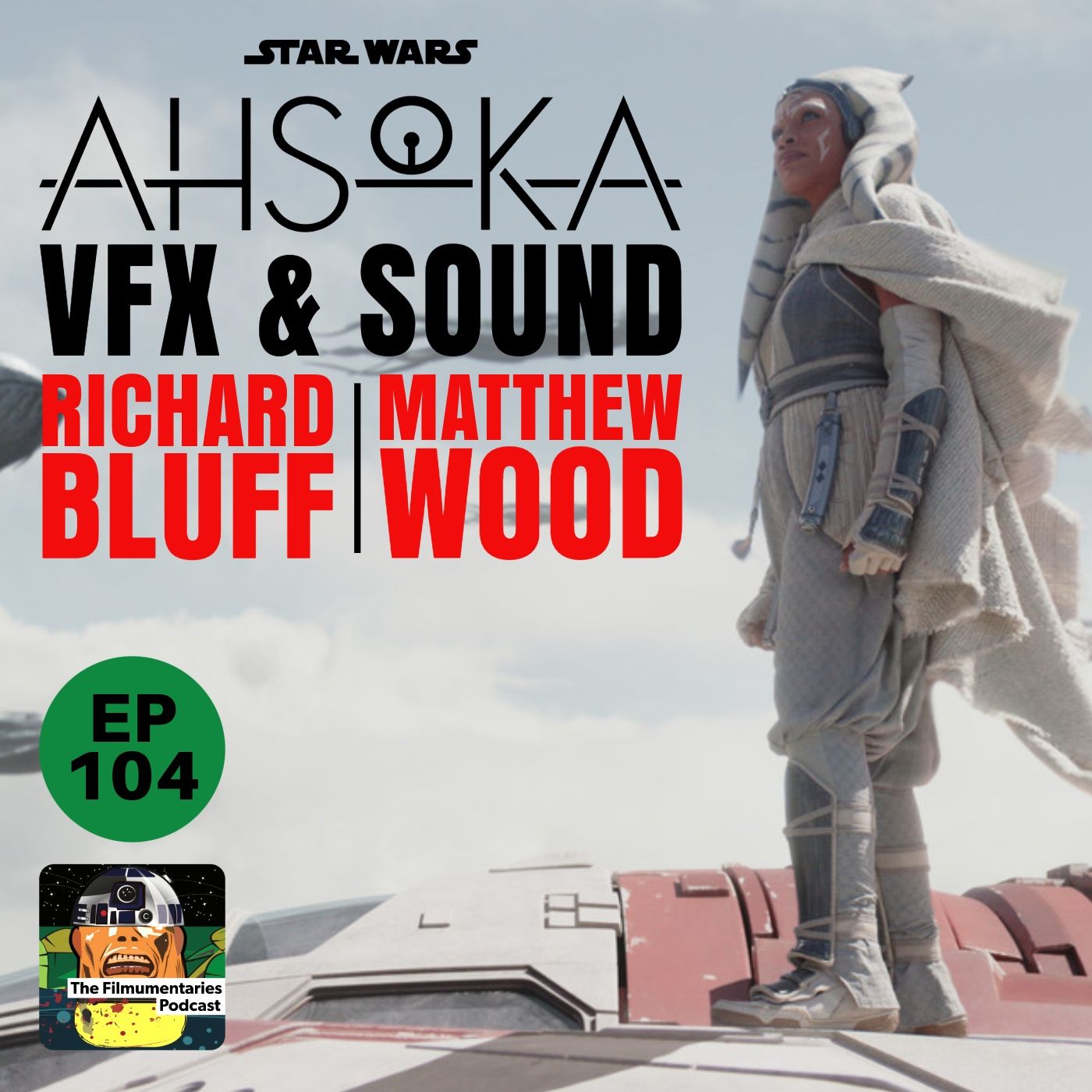
About this episode
Key takeaways:
- The collaboration between sound and visual effects departments is crucial in creating a cohesive and immersive experience for the audience.
- Early involvement of sound in the production process helps inform the visuals and enhances the storytelling.
- The use of practical effects, such as miniatures, can provide a unique and grounded look to the visuals.
- Designing and creating sound for ships in the Star Wars universe involves a balance between familiar elements and new, unique sounds.
- The organic and mysterious nature of the Eye of Sion and the witches' voices in Ahsoka adds depth and intrigue to the storytelling.
- The balance between using technology and practical effects is a constant consideration in visual effects production. The use of LED screens allowed for interactive lighting and realistic reflections in the visual effects of 'The Mandalorian' and 'The Book of Boba Fett'.
- Collaboration between the visual effects and sound departments was crucial in creating the desired effects and atmosphere for the shows.
- The Howlers were created using a combination of motion bases, horses, and visual effects to achieve a realistic and dynamic performance.
- The creative team is constantly looking for new techniques and technologies to improve the visual effects and sound design of the series.
Ahsoka is available to watch on Disney+.
Enjoy!
Donate Button
All the links
This podcast is completely independent and made possible by listener support. If you’d like to help me keep making these episodes, you can join my Patreon community here: https://patreon.com/jamiebenning
Watch more on YouTube:
Check out the Filmumentaries YouTube channel for behind-the-scenes clips and extra content: https://youtube.com/filmumentaries
All my links
Transcript
Automatically generated, so expect the odd misheard name.
Weirding Way Media. Welcome to episode one hundred and four of the Filmmentaries podcast. This is Jamie Benning talking to you here from my house in London. It is summer, although you wouldn't know it. It's pretty overcast and cooler the moment.
It's just been my birthday yesterday. I'm now forty eight, forty eight. Thank you to those that wished me a happy birthday. I had a good day. Spent the day with my wife's and my daughter, my youngest daughter, and we went for a nice walk and in a lovely park near us and had a nice cup of tea and a little treat amongst this lovely walled garden that we loved to visit, and whilst daughter was at school, we chilled out with some fun stuff on the TV.
And yeah, we went and saw Adam Buxton record a podcast with Louis through just a couple of nights before. It was a little treat that was really really fun. If you don't listen to the Adam Buxton podcast, you probably should. It's very good. And yeah, one I've been listening to for a long long time since episode one actually, and we're having a big family get together this weekend.
My sister is over from the States with her family, and my cousins are visiting with their new babies, and yeah, it's going to be really nice get together everybody. We haven't all been together for a very long time, so yeah, really looking forward to that. It's going to rain, but we kind of know that and we accept that. If you're joining me for the first time, thank you. And if you're returning, then it's good to have you back, and I appreciate you joining me again.
For those of you that don't support the podcast on Patreon, I just wanted to say that, well, first of all, please support me if you can, because it would be great if I could continue to do this podcast and make a bit of a living out of it. It is work. It's work that I love. It's work that I enjoy, but it is work, and if you enjoy it and you appreciate it, then your support would be appreciated by me. Patreon dot com forward slash Jamie Benning.
But what I actually was going to say was that I've started a little chat community on Patreon, So if you're one of the patrons, one of one hundred, and I think it's one hundred and fifteen of you, now that helped support the podcast. Then I just thought it was a nice little chance to interact in our kind of inner circle. And if you want to be part of that, in a circle, find out what I'm up to behind the scenes, who I'm about to interview some of the details. Given you also the opportunity to send me some questions to ask ask some of these guests see how the sausage is made. Then yeah, joined via Patreon.
It's one dollar per month for twelve months, so that's fifty cents an episode. So like twelve dollars, which you know you'll probably have spent by the time it gets to nine am most days, twelve dollars. If you could just throw twelve dollars in this direction, it really would make a massive difference. You know, of the several thousand people that listen to this, if say three hundred of you did that, my goodness, that would change things so much. I could get more episodes out, I could spend more of my time focused on this.
And if you can't support the podcast in that manner, then then just write a review on Apple Podcasts. That would be great. I really do appreciate your support. There's also just a if you don't want to get involved in the Patreon thing, if you just go to filmomentaries dot com there is a donate and I know a couple of you have done that. So thank you to you, Thank you to the patrons.
I really do appreciate it. Okay, So for this episode, the first one of June twenty twenty four, of course, I have a plan of what I'm going to put out, you know, weeks ahead of time, but I sometimes have an opportunity to interview somebody that I didn't expect. I was given the opportunity to interview the visual effects supervisor and producer of a Soaka Star Wars series on Disney Plus, Richard Bluff of Industrial Art and Magic, and the supervising sound editor, Matthew Wood. I've spoken to Matthew before a little while ago from Mandalorian obi Wan episode was that last year? I think that was last year.
I remember editing that whilst I was waiting for my wife, my wife's TED talk that she did look up Becka Benning. She's a health coach. She's amazing and she did a TED talk and I'm very proud of her and that episode kind of arose in a similar way to this one. So I know everyone's talking about the new series Acolyte at the moment, which is currently three episodes in as we speak. This episode of this podcast is about Ahsoka and about the effects work and about the sound design and how those two things interact, how those two departments have like a two way street between them these days, and how one can inform the other.
So today's the fourteenth. I'm hopefully going to get it out tonight before I drive up to Norfolk. If I don't it probably you'll probably be listening to this post the fifteenth. But I spoke to these two gents on I think it was the twelfth, the day before on my birthday, and I turned around the podcast and edited it pretty quickly, cut all the ums and as the mistakes that we made along the way. We did have a couple of technical issues with my laptop power dying and Matthew's computer saying it wasn't up to spec when he was clearly on a high end Mac.
There was a problem with the Riverside software that I used to record the podcast, but we got all those problems solved. I was able to get another cable, we were able to re start the recording and off we went. So without further ado, here is my conversation with ILM's Richard Bluff and Skywalker Sounds Matthew Wood and I'll be back at the end for a bit more jabbering on. Thanks for joining me, guys, let's talk about Ahsoka then. So let's start with the sound side of the show.
So, Matthew, you're working on the sound. You're the sound supervising editor. You do additional voices and a lot of these shows as well. Now, what are the kind of unique challenges in creating an identity for a show. Because we're in the Star Wars universe, we have all of that legacy of Ben Bert's work and Gary Reigertrom's work, and Randy Tom's and everything else.
How do you create something unique for a show like a SOAKA. Well, you know, this one was really fun for us because it was Dave Filoni really culminating like all the work that we had done with him on Clone Wars and Rebels and all that together, and I was able to get my dream team. I was able to have David A. Kord, who started with me on Clone Wars and then Bonnie Wilde who started on Rebels, and then so we were able to and mix actually in our carriage house, which is where Filoni first started working on the animated series almost twenty years ago. So it was a real homecoming for all of us.
And that was the main we needed to have those myself included all those players involved, just to have that shorthand that we have with Dave. And then he was creating a space that was going to be you know, in the Star Wars universe that now we're in an actual galaxy that's far far away from that. That's another planet where our heroes are sort of stuck on and a new character, you know, coming in from the books and the animated series with Thrown. But I think you know, always in Star War or Is it's always about creature voices and new ships and and that kind of thing. And I think we had a lot of opportunity in this one.
The you know, we had the pergole which were we're highlight to transport us from one universe to the other, which came from Rebels, and we got to expand upon that. And then also the other fact is we had Kevin Kiner, which was great too, and our music. So you know, Kevin Kiner and his family did the track for us, and we have a long legacy with Kevin from back in the Clone Wars days. And none of us show up like with a big ego like buying for space of the frequency range of the track. We just all worked together to play the to play the scenes emotionally, and there was a lot of scenes where we're like, hey, why don't we add a que here or take away a queue here, and just to just to kind of give it realism or take you down the fantasy of what we're doing.
So, you know, this was a real labor love for all of us and it was a fun a really fun mix and and not a lot of crazy surprises. Just really felt like a good flow that we had with Felony in that in the carriage House. Do you think then, Richard, that you know, given you're coming off the back of some features, you're coming off the back of another Star Wars shows Mandalorian as well. Was it a matter of kind of optimizing those and getting the team together that had worked on those shows to make sure you had the best chance of you know, creating exactly what you wanted or are you always trying to push the techniques that you're using forward each time you do a show like this. I think you're always pushing the techniques forward, for sure, but by the same talk, and I think you're always learning from the previous shows.
And you know, I'd worked with Dave on Mandalori in season one and then I did season two with him and then the Book of Boba Fat, so we'd had quite a long runway to get to a Soka the whole. While Dave would talk about what his vision was to bring a soaka to live action, so a lot of those ideas that he would talk to us about, and I've mentioned this before, you know, many many years prior to starting prep or even starting him starting to write it, those ideas lasted throughout. So to Matt's point, no surprises that there simply worked. And again I think that because we'd worked together for such a long time leading up to the show, we were both able to I think everybody, all the Hods, everybody involved in the show that was part of the decision making team were able to kind of zero in on where they felt the efficiencies were and what particular techniques or workflows were going to help Dave achieve his vision because every filmmaker is different, and I think just to kind of, you know, ductail into into what this conversation is all about.
One of the things that's really interesting and has been really interesting on this particular show was how how much sound and visuals played off each other. It was very much, you know, it flowed two ways, which is unusual for all the projects I've ever been involved in. Typically I don't hear the sound until it airs on TV or it's in a movie theater. Whereas the way that Dave works, and particularly the way that Lucasfilm works on these shows is that sound is involved very, very very early because we create a story reel and Dave obviously wants you know, Matt and everybody to kind of get involved early. So for us, you know, the typical visual effects workflow is we're constantly chomping at the bit to get the latest cut of the visuals.
But on this particular show that was always the case, despite the fact they would always kind of give us the visuals almost immediately when he had them. When he had a new edit update, he was always telling us, you need to get the updated sound. You need to understand what noises these creatures are making, because he's going to have an impact on how the animators in particular go away, go about what the performance of the creatures whatever they be. And that was different and unusual, but it was really rewarding and I think really helped the you know, to raise the bar and for everything to really feel cohesive. Yeah, it feels like I've talked to quite a few productions people worked on productions, not just luke'sfilm but elsewhere, just about how sound is being brought on earlier in productions just to kind of inform the visuals in many ways.
We would have seen a lot of press about the Dune movie with Mark Mangini and Theo Green talking about, you know, some of the voices that they did in their sound design and some of the effects for like the shielding when they're fighting and things like that that wouldn't have existed previously like this you like you say, you would have got your visuals and then the sound would have been kind of bolted on at the end. Does that sort of collaborative workflow happen because now we can do things in different timeframes? Is Is that why? Because it's not a destructive process almost like you would have with say film, But you've got a sort of two ways, a two way street if you like. Is it the technology that's driven that?
I mean tech makes it so we can incorporate our mixes in any of our early work fairly easily through the picture department and onto Richard's team. So it's it's definitely easier with tech. But I have to say it's also just an ethos that was done, you know, George Lucas did it back in the day. We started a year sometimes earlier or earlier on the films. I think Ben Burt started in nineteen seventy five working on Star Wars, the first one.
So I mean we we get incorporated into the script, we get we get to have pick our beats in there and just sort of and then when the animatics are created, we can incorporate into the air and then get the material onto Richard and his team at ILM. And it's I think that's that's something Kathy Kennedy is maintained. I mean all the sequel movies, I always I get to go out to the set and get to see the design scape, hold the props in my hands, go to the actual sets and walk on the Millennium falcon and whatnot. So, you know, an MBS where we did a lot of ahsoka, I got to, you know, do the same thing, be down there and talk to people and meet people. And I always try to get the early like even if if there's dialogue, any dialogue, I try to get as early as possible with the most highest quality version possible, so if somebody likes it, we can use it all the way to the end.
And that was one of the early sound design moments I think was with the Nody creatures, we wanted to make sure we had a nice language that was working for Dave, and so David Acord came up with this language for the creatures that then our voice team went and performed and we were able to get that over to ILM pretty early and use that and I think that that really helped. I mean, those those the voices and the and the visuals altogether really make these little cute creatures come to life. And and that was that was a fun moment for all of us too. Definitely talk about using the right tools for the for the for the right thing at the right time. Quite often in these chats, you know, because you've got a lot of tools at your disposal, Why, then, Richard, do you go down the route of a practical effect for a soaker's ship, because it seems that you'd have more control, perhaps as a CG model.
You might even have money saving involved if you used it as a CG model. Why do you go down the route of doing something practically? What's the attraction there and and how does that kind of help drive the story. It's interesting, you know, my involvement with miniatures recently, of course obviously joined Island twenty years ago when they were far more widespread. Book it was for the Razorcrest, and specifically for that ship, it was a very reflective surface, and so at the time John had lots of questions.
John Favau had lots of questions about how you light a chrome ship in space when everything that's reflecting off its surface is black and you almost certainly always have just one key, like a little bit of fill, but you're not really going to pick up the fill on something's reflective, and so it became a real conundrum for him. And at the time, you know, we brought John Nolan too to have these conversations with with John because he'd done that with Padme's ship in The Phantom Menace, and he talked about the trick that he used, and I think Joe was really interested at that time as to why a miniature wasn't used, and we got into a philosophical conversation as to whether the technology on the computer should drive the look of something and be trusting in the math effectively, or whether you should actually build a miniature model and get a DP to light it.
Because he's really it's it's it's it's an artistic problem to solve because he's not real science. And so John Nolan like I went away and said, well, why don't we pitch the idea of building a miniature and we have the DP light it on set with some black du vatine around there, and so it kind of it started to answer questions quicker rather than spending the time to curate the three D model and then have an artist start to light it when they have to kind of because they'll have to build, you know, a digital set whatever that is, whether it's deep space with key lights or with with fill lights. So so that was so we decided to do that as a lighting study, and then as as we very quickly started walking down this path, it was John Norlet suggested that, you know what, I could probably build a motion control rig and we could probably get some shots in camera like this that would also help informed the flight dynamics, because we knew at the time that Favreau wanted to restrict the motion of our CG spaceships to feel more akin to the original movies.
And obviously what made the original movies successful, And there's you know, thousands of answers to that question, but one of them was just the nature of the motion control, which was cutting edge of the time. But the more you kind of move away from from that restrictive flight style, the more everything feels a little bit freed up and doesn't feel like anymore. So that for us it was a grounding and then that proved to be very successful. And then as we kind of move forward to a Soca, Dave really felt it was helpful for him to have a physical model in his hand because he likes to use his iPhone to kind of frame up on shots, take a snapshot, and then he'll draw an image as a storyboard. So he's very much of the world of I like a physical model with a lipstick camera where I can kind of get in there and find my angles, because again, every filmmakers different.
At the same time, he really wanted to build this model to be used in the show. But on top of that, it was an easter egg at Celebration. Celebration happened while we were shooting the show. There was no press out prior to that show in terms of what the show was going to look like, and Dave wanted to hide the T six miniature at Celebration with all the other models and just kind of see what sort of buzz it was going to get, you know, to take the temperature, and so all of those things really factored into why it was made. But more importantly, it was made because we were going to put it on screen.
So we did get you know, quite a number of shots with that miniature, but it also helped in form the detail the lighting as well, and also it provided us understanding of what sort of guardrails we wanted to put around the flight of that of that ship. And then after that, you know, Gerald made a beautiful three D model that matched not only the miniature but also the physical set, which then ended up playing in over five hundred shots, so you know, many many, many many times more than the miniature. But we had a grounding before we got to that point. There was no question about how it was going to react to the light. It was a really incredibly helpful tour.
Yeah, I spoke briefly to John Goodson. I bumped I visited the ranch in April and I bumped into him. I was there with Lawn Peterson and they were catching up and he was talking about them order and just about some of the difficulties in mounting it because it's quite an unusual ship in that it rotates around that center point and is at that forty five degree angle. What were the particular challenges in doing that. I think that's honestly, John is the best person to speak about ourself.
But what's interesting throughout this process that John will highlight that there's a real particular challenge with with with with these miniatures. But because he's been doing it for so many years, there's just a complete trust in how he would go about executing it. And all he needed to kind of let John Nolan I know, is where the pickpoints were. And he was always concerned about wanting to make sure that there was more and more pickpoints in order to kind of hold the miniature on an arm on an armature so the motion controllery it could photograph it cleanly. And you know, I can't quite remember how many points there were to kind of pick this this ship, but it was way more than we actually needed and you know, proved to be beautiful.
You know, the wing even rotates. You know, even though the times when we were going to photograph it was largely going to be kind of locked in it see the horizontal and vertical position. Even the wing rotator around, and there was people sitting in the in the cab. It was just you know, it's a real reminder as to kind of where we've come and you know what it takes to make something that has such character like the T six, and it reminds you as well as kind of where the detail needs to live. You know, that's something that John Goodson has got so many years of experience bringing to us, and where the match of detail that he would punt to the model, it's kind of where we would put the same amount of detail into the CG version as well, so it doesn't get too busy, you know, it's it's a real interesting kind of back and forth and learning exercise for anybody that's spent their entire career largely in the CG world, you know, talking about these ships then, Matthew, you you know, you've got some great ships in this show.
You've got the Eye of Sion, You've got the Vesper, the Republic Cruiser, you've got the e Wing, which I remember, of course from the Dark Empire comics from back in the day. How much fun is it to you know, finally put some of those those kind of expanded universe ships on screen, and also to to sort of expand upon what we've seen in other shows with some of those sort of different versions of the ships, like the Chimera for instance. Is this you know, it's this modified star destroyer. What's what's the sort of story behind some of those? Yeah.
I think that our favorite to work on, our favorite ships, to work on, our favorite sort of genre in the show to work on, was all the Witchcraft. You know, it was definitely the iss Ion having that ready with all with the you know, hyperspace engers getting locked in, and then we wanted the tech in there to feel like it was generated by some other worldly force and then but also have some combustion like when it when it finally takes off in that one and in the episode where they finally get it working and it goes. I mean that was the handoff between music and sound effects was great there as we accelerate into that moment where they speed away, and I think, as I recall, we had, you know, we we culminated with like alarm sounds going also the you know, the the rising tone of the hyperspace engines, and then Kevin Kinder gave us a nice, uh sort of gap to put just sound effects in for the for the for the the launch, and I think, you know, all the all that stuff on the IF sign, all the mysterious like sort of holograms that are happening for the characters, because it's not a technical hologram, it's more like a spiritual hologram in a way.
So we made their their the voices in the way that they come in and out, similar to the VFX, being very sort of organic and mysterious and not tech in that way was a fun place to play along with all the voice of the witches we'd had, uh, you know, a witch in Clone Wars mother talsand that we made this really cool uh pre verb, you know, mysterious kind of thing where she would speak. And so this time we had three witches, so I was able to record all three actors at the same time, but I put them in isolated booths and so we would all we every single actor did all the lines of the other actors as well. So we had this moment where we could we could whoever was featured to talk, we would bring that into the foreground and then you'd hear the reverb and pre delay and preverb of the other actors in there.
So we made a we made it sound really mysterious, like it's in your head that way, and the game and that was a fun one to to do because it was every single line in the show. So they got to come back together and I got to watch them sort of set back into where they were when they were shooting it. Uh and they're they're definitely a linked trio. It was fun to watch them work and they knew their lines. They knew the cadence that there was a there's a part where they're they're rising the all the stormtroopers are rising from the dead after they've all been you know, laid out by our heroes and that they knew that they knew that chant like immediately in the exact cadence.
We had to get it into And yeah, just the voice a lot of the voice casts we have that additional voices cast that they let me use on all the Lucas from projects. And that's just a fun one to bring in because we had all these amazing, horrifically you know, scary voices from the the the Stormtroopers. So we had those like zombie troopers that we had to I don't know what we were calling them, not zombies, but I guess they're I'm not sure what we called them, but but they you know, they were rising from the dead and they had these screams coming through and we found a good very like piercing speaker flats to use in their headphone on their helmets as it's coming through this horrible these horrific screams coming through their their helmets.
That was another that was another good one. Yeah, it's pretty horrific. You mentioned a word in the actually organic that kind of came up when I was making my notes earlier today in terms of the visual effects. You know, you look at something like the hyperspace with the purgles, we're kind of look looking at, you know, organic beings flying through hyperspace for the first time. How how did you approach that, Richard in terms of sort of reinventing what hyperspace looks like?
David a very clear idea of kind of what that how that should appear, and obviously we had reference from the animated shows, So I think for us, the big question was going to be how literal do we want to kind of follow what's been done previously or do we want to kind of experiment with with with different versions of this. And one of the challenges actually was that we were going to be photographing scenes on stage in front of our LED screen months before we got into post work on that effect, so we we had to kind of have a number of versions of what the at least what the color could be to be able to play back on the LED screens because we wanted that interactive light and the reflections on the floor as well.
So, you know, very quickly kind of Dave started talking about chromatic effects light splitting as well, and so from that point he's really good at providing visual reference. So there was lots of imagery that he collected of beam splitting and of light shining through particular. So then at that point, you know, Island's got, you know, a wonderful effects department where you can kind of show them all of that material and kind of give them the gross guidelines, and they're pretty good at coming up with lots and lots of different versions of different flavors because you know, spinning particles and trailing paths and things that it's kind of it's what they do really really well, and explosions and stuff, so there's nothing that they haven't done before, and oftentimes they can kind of bring different ideas into that kind of mix that really kind of pull it together.
So for us, it came together rather quickly because Dave had a pretty clear idea of how graphic he wanted it and how realistic he wanted it. And I think from that point on the biggest challenge was how do we communicate the fact that the pergol feels like it's moving within that space and it's connected somehow. And we talked about windflow. Actually I kept talking about Formula one, and I kept talking about wind tunnels and flow of his paint and how if you could visualize the airflow off the cars, you know, when it creates the little vortices, we should probably be leaning into that. So we started clutching a bunch of reference, whether it's you know, F one cars testing in colder conditions where you see the vortices, or whether it's the little kind of effects that come off the end of jet wings.
We started collecting a lot of that imagery and also wakes coming off of boats, and started talking to Dave about how much or how little of this does he want, And then of course the effects artist created some beautiful patterns and beautiful images of how much we wanted to kind of see that, and very quickly Dave kind of decided to kind of tone it down a little bit and just have it kind of licking off of the kind of wings that we added a little bit like kind of cuttlefish on the side. You can kind of see them kind of kicking off of that, but you very quickly understand that the kind of flying in formation and almost like kind of how geese fly each pergo, that's behind the next as restricting the resistance the airflow.
So that was kind of vibe we were going for, and it all kind of kind of came together really nicely once we had some of those kind of key elements. I actually have a question for Malwood. Oh yeah, sure, what was what was interesting? When we were finishing up a season, we got to episode six and Dave was working on the edit of the introduction of Thron and there was there was there was something he couldn't putty. He couldn't he didn't feel like the entrant was grand enough for for the fact that we're building up to this moment after all those episodes, and he was seemingly happy with with what was photographed on the day, he was happy with the visual effects, and we had all these troopers out there, but he just felt like that there was something different he could do to really help with that moment, so to really kind of introduce him.
And he kept playing with the edit, and he kept playing with the editing. We did a couple of visual effects things for him, and it just wasn't right. And then one particular day he had it what he felt like, what I felt like was his Eureka moment. He said, it's the sound. It needs to be a sound cue.
I need to go work with Matt Wood on this and you didn't quite know what he was talking about. And then and then later on, I think at the end of the day he said, it's chanting. We need chanting to bring them in, and that for him, that for us, but also that for him really unlocked that entire sequence. And I was I think you were there as well. We were fortunate to be in those in those meetings with various key creatives where we got to kind of give feedback on how the show was feeling at that particular point, and everybody felt it took a huge step forward.
What was that like working with Dave trying to resolve that issue and how did it? How did it work out? Yeah, so early on we knew that there was going to be something special happening when Thron was revealed there when he comes down through all his troops, and we had been given a click track by Kevin Kiner to sort of a rhythmic, you know, highlight of where we should if we were going to do a chant where it should be, and so we came up with that additional voices cast, we came up with a lot of lines of dialogue to offset against Enux character. So Wes Chatham knew a bunch of drill sergeant type military exercise lines, and so we gave him lines of English, and then we also gave him just we wrote lines that were kind of almost in sanscript type evil lines that he could say, similar to something we did on Rise of Skywalker with all the acolytes in the background on the Palpatine scene.
So we made these chants out of like six I think I had maybe eight tops of voice actors, and so we just did them over and over again and layered them together off of Wes's a dialogue there, but we said things like we said myth was it myth thra narrodu or something, It's like Thron's full name. We used all these very strange like references that were to Thron in the expanded universe. You can't hear completely what's being said, but we just wanted the power of these like the zombie Stormtroopers, to be just completely entranced by him. And so we did it. Yeah, and we and we did it in a cadence that was going to work with Kevin's music and and and then it culminates right when he says his first lines of dialogue as he walks up, and but that was everybody working together.
I mean it was like editorial, visual effects, the acting, and the sound and music all to reveal this character and to make this moment of Thron's entrance, which was great to have Dave come and sit and work with us in the mixed room. So we had him right there in the car in the in the in the carriage house, and so he could come in and and uh and work with us on that screen. What was great about that is it it completely elevated that scene prior to you ever seeing Frongs originally in the original cup you saw him pretty quickly, whereas n you kind of building and building and building to that moment. So what once we were in a visual effects view in data is you, guys have got to hear the new sound that we've been working with Matt Wood and the Gang.
It's great. And as soon as we did, it became pretty clear that we actually needed to increase the number of troopers that we saw in there because the the the echo that you're putting in there and the voice and stuff. It was like, this needs now to be a bigger visual to to follow the sound as well. So that It was really fun to to kind of to be to watch how that was solved in a in a in a non traditional way from my perspective of how you introduced a character, because it was it was a really interesting process to go from one particular reveal to a different one that was all largely sound driven until you've seen several shots later, right, Yeah, and all done in the post process. Yes, pretty incredible.
Goes back to what you're saying at the start. They're just being able to use those tools and having that sort of freedom to have a two street between the different departments to achieve, you know, the best result. I was also thinking when I was watching back some of Ahsoka today, you know some of the other organic characters introduced, like the Howlers, you know, these half horse half dog kind of creatures. Let's talk about it from the visual effects perspective. First of all, is that was that a matter of having actors sitting on a gimbal?
Was that actual horses? Was it? How did you approach that? Well, it's it's a it's a great question because that was a question that we had in the back of our mines for a very long time. You know, it was I would get when Day was writing the first couple of episodes, and you know, we weren't even in preper that particular point.
He would send me text every now and again and say, get ready, we're going to be doing howlers as the day was a howler, and he would send me a sketch that he'd done of what these creatures kind of look like. So very early on our was kind of processing how we were going to achieve that. And obviously, you know, when you're the size of the scale of a movie, a lot of the solutions are pretty easy to find. But I think that the fact that we're eight episodes of a streaming show, and I understand that it's Star Wars' and it's it's not you know, it's not daytime TV in that regard, but we still have to be very very conscious of the resources we're using to it and how we execute. So it was very obvious from the beginning that we were going to need to have a motion based and obviously, working with the special effects departments, you know, it's something that we've done a number of times before.
But the question in my mind was once we start the previous process, if we if we reach the tipping point of of of a number of shots where we're galloping in theory, galloping and charging, because you could read on the page these these battles that we were going to have. But it's not until Dave really starts crafting the number of shots that you really know what what what you're going to be doing doing Uh, well, we'll sort of start to see the previos. It was very clear that we're going to need to have a different solution on set, that the motion bases weren't going to be able to solve everything that was going to work great for the close ups with the principles, and I suggested to how and Paul Cavanaugh, the animation supervisors, at the beginning of the show, we should probably investigate horses.
Now. I understand that the that the dog anatomy is completely different from a horse and the gate is different, but that way we can put our actors and our bandits on horses and and have that free range of motions. So what we ended up doing was we Hal Hickel sourced a number of long takes from various movies that had you know, riders on horses, whether it was walking, trotting, galloping, and we match animated that that we we camera match those takes, and then animators locked the howlers back to the saddle and the rider and then replace the horse with the howler moving underneath. And very very quickly everybody could see that it was going to work if we made a little bit of a change to the to the howler anatomy, which is going back to the design with Dave and Doug Chen.
But on top of that, we knew we wouldn't be able to make the trot work. That's the unique kind of motion the horse kind of brings that that you can't You can't if a dog does that. It looks strange. It just looks like you're you're mimicking a horse. So as soon as we kind of landed at the as soon as show Dave and it proved that that was going to be the solution, we actually had to change our production workflow because at the time I think we were we were basically earmarking a lot of these scenes for either on the volume or on a stage because we don't have a lot of space on the backlot.
We had a number of sets taking up that space. But very quickly we then knew we needed to build a much bigger Paridia landscape on our backlot and then silk the entire back which is basically putting a tent over the entire thing to cut the direct sun in la because we needed the overcast environment to kind of match the environment within the story. So that one decision of yes, we think we can kind of use horses had a massive knock on effects. They basically turn the production upside down during filming because this was all we're always working on, you know, souls to episode six, seven, and eight, when we're shooting episodes one, two and three. So but by the same token, I feel it worked out beautifully because I just don't know how we would have done.
It would have have been a lot more all CG. Which itich nobody's a fan of. To be very clear, you want to put the camera in front of the actors on a real environment and you know, put the creature in as the visual effect shot and do as much real as you can. Because having the actors just even sitting on the horse, and having the horse just stood still, shifting its weight, balancing, dipping its head, you know, shaking its head because it had the reins in it. We translated all that movement through to the Howler, which just gave it the realism that we needed, even though they we just stood that, you know, it was pro to be incredibly vialruable and we're not the first to do it, but it works really well for us.
Yeah, adds that personality, doesn't it. And then Matthew, you and your team come in to give it its voice. It's got kind of unusual, kind of like gurgling, purring sort of sound to a point, so where where do you start with a sound like that? It was funny because it's so based on one of Dave's actual pets. It looks it looks I mean, isn't that the one that looks like Wolfy?
Yeah? Yeah, absolutely, Yeah, So Wolfe was was one of Dave's dogs and was at it was over at MBS a lot in the production officers and terminator to dog right surely, Oh well, I know Dave really loves wolves, so I'm not sure if it's Yeah, Dave's a big wolf fan. So but we we ended up recording a lot of Day a Dog and actually used it for some of the more expressive moments. And then there's also you know, there's David Acord, the designer, likes to put his cats in the movies whenever he can. His cats have been in like Kylo Ren's Lightsaber and and and also these these particular creatures as well.
But it's we wanted to have that like, you know, that moment when it's trying to sniff out and find the nody. You want it to be somewhat threatening to the note because the nody kind of jumps back, but you also want it to be not you know, you're gonna have to love these characters too, so we didn't want it to be like horrific. So it was that balance finding between like watching and we'd watch what would come back from ILM based on some tempt sounds we'd put in, and we would actually, do we want it to be more cute there? Do we want it to be a little more menacing there? And then where the breaths are in terms of where the you know, the actual snorts are.
And so Dave Filoni was definitely involved in all the crafting of that, and just I think because we had there, I mean, it was so nice to have him be able to work in his production office at the ranch and just walk down we were right in the basement and he would come down and give us notes and I could tell he was just having a good time playing in the sound in the sound environment with his favorite players. That is a another really good example of the back and forth because again during our visual extraviews, Dave would often say, you need to get the new sound from Matt because there's a moment in there with a breath or a snort, or a moment when the creature starts to calm down and you can hear it calming down, and he wants to make sure that the animation kind of feeds into that.
So, you know, to Matt's point, you know, Wolfe was a lot of the reference for this particular creature. We would you know, we even put Wolfe in a photo booth down in La to capture photography of him to understand exactly how the hair flowed. And it was really funny, because was it funny? I guess it was funny where we were working on the the what we call the groom, right, So when when when ILM works on designing the hair, it's called the groom where you basically grow the hair out on the particular creature and you work on exactly how tangled it is or how floppy it is, or how matten it is, and every now and again. It wasn't a long process, but Dave would see the ladies working progress of what the hair look like, and then he would look down and his dog and say, no, no, no, it's mattered like this on his back.
I'm thinking that's because he's lying down, David, you haven't washed him a couple of weeks. That's when you reference we sent he was a lot cleaner, so we would work with Dave. But to his credit, Dave arrived and approved look really really quickly. But again to Matt's point, it was all about kind of Dave bringing his understanding of his relationship with his with his dogs over the years and putting it into that creature. Because there's such an interesting relationship between Sabine and the Howler.
In episode six where she's first introduced and you think this is a menacing creature, you know, is he gonna eat her or is it going to help her? And then throughout the course that particular episode, you know, it abandons her during a battle with the bandits and kind of leaves and then she is she scolds it and refuses to kind of, you know, to ride the creature or be anything or having to do the creature, and it's you know, it's it's uh, you know, he walks along behind her for example, and tried to kind of win back her affection. So all of that comes. The reference that we received from Dave was all about you know, humans relationship with their with their with their dogs, with their pets, and you know, it's it's it's not a surprise to hear that.
The you know, Dave was referencing that kind of stuff with Matt for the sound as well. Yeah, are you going to say something men? Sorry, Oh no, I was just saying, yeah, it's just yeah, we literally recorded his dog for it. So yeah, he's definitely in there. Definitely in there.
So looking every as everyone is now to season two. You know, despite the fact we have a new, a new and current star Wars is in the Acolyte, people have got a soaka season two on their mind. From your perspective, you know, behind the scenes there, do you go ahead with these techniques that you've kind of created in season one and optimize and shoot with using all those same techniques, or you know, are we expecting lots of curveballs from different things from from Dave and Co. But then again, you always strike me people that are spoken to at Skywalker Sound and I l M and Lukesfield, we always strike as people who relish that kind of challenge. Where is that sort of wheat spot between, you know, taking all of that technology that you've created for the first season and creating a smooth process for the next season and also kind of being ready for the big challenges ahead for Sound.
I think it's in the in the staffing and the people, because it's that I'd love to get people that have that have come through what we've already experienced. And also it's a great opportunity to sometimes bring new people into because Star Wars a lot of people want to work on it, and that's a lot a lot of people's dream to work on it. So I'd love to be able to facilitate that and also bring new energy into the project and get people to have ideas or something they might have seen and a previous thing that really affected them as a fan and then we're like, oh, let's highlight a little bit more of that, and but we have you know, obviously it all starts with the script and I don't really have that yet, at least I don't so, but but yes, new challenges are an amazing part of the job.
I love it when there's a new creature or a new location, or a new mode of transportation or something, or a new environment that we get to be part of and how to how to incorporate that into our universe. It is always a really fun part for challenge for us. Well, if you need an emotionally emotionally ambiguous British voice then do you know, do give me a call? Yes, indeed, I'm Richie. What about you in terms of the visual effects side of things for the next season.
You know, it's interesting from through the Mando projects into Boba Friendahsoka, they've all been back to back and large overlapping. And I'm sure same thing for Matt two. Never be at Sky Scout because we did have the strike right to the end of production. It's it kind of it delayed everything a little bit, and that provided me almost a year of working on different projects within ILM and working with lots of different people and you know, very very different kind of executables. So it allowed me to kind of just take a look at the state of the industry, the visual effects kind of where we're going, what's new, And I'll be honest, I've been really pleasantly surprised with some of the new techniques and some of the new technology that the ILM as well as you know, the Disney research team are developing, because quite a number of them are immediately applicable to what Dave's gonna want to do with season two, well at least what I know about that show right now.
So it's not necessarily it's it's more of a case of how do we continue to do things better and free up time and resources to to continue to you know, raise the bar because what we did in season one, we can't just repeat that. It's got to be better and it's got to be much better, because that's what everybody's expectation is and that's what it's like working you know, four ILM over the years. And so for me, it's been a case of let's kind of see how everybody else is working on projects and productions that that you know, haven't really had access to, and I can you know, go check out all the movies that we've worked on for a little while and find out exactly how they were done and just take the you know, the the best methods and the best techniques and see what everyone's developing and start applying it.
So you know, Dave can be bolder with his storytelling and and you know he can come back to either me or matt and say, yeah, don't worry, we can figure out a solution for that. Well, guys, I appreciate your work and I appreciate your time today. Thanks for thanks for chatting. Thanks Jermie, thank you well. I hope you enjoyed my conversation there with Matthew and Richard.
I did chat to them a bit afterwards actually, and sort of suggested that maybe they should come on the podcast in the future as a you know, kind of standalone episode for each of them talking about their careers, because you know, it's interesting to me that Richard is a British guy from Rotherham. He's ended up working for, you know, the very top end of the industry, for Lucasfilm and also Matthew. Would you know, he started as somebody who was working for LucasArts testing games and now he's a very well respected supervising sound editor. So I think that would be too interesting co sos right there. If you've been watching on social media, that's on Twitter at Jamie swb and on Facebook the Filmiamentary's page.
And in fact, if you've listened to any episodes recently, you'll know that I've spoken again to Nilo Rhodis Jamiro designer on the Empire Tracks, back costume designer or Return the Jedi worked in video games for a number of years and he's just one of my favorite people. So Nilo and I had a three hour conversation again. It was over the telephone as before. I'm not sure he was set in a cupboard this time. I don't know if you you long term listeners, remember Nilo was setting a cupboard for two hours last time.
We did it just because he wanted to dull the sound of some work that was going on over the road from where he was talking to me from. So yeah, he doesn't really have the tech to hand, so it is over the phone. So it's taken a bit longer and a bit more work to get this conversation usable, and work will be I think I'm going to do that over two episodes. So the second episode of this month, June twenty twenty four, you know, ten or twelve days or so, you're gonna hear Nilo part one talking about Miyazaki, talking about mister Tama and being in Japan and seeing both of those incredible legends working for EA Sports and revolutionizing how they looked at video games. Talking about George Lucas and Phil Tippett and how Phil blew his mind in terms of design and how to approach things.
Yeah, a really fun conversation and lots more to come. I'm interviewing Steve sand Sweet next week, you know, the boss at Rancho Obi Wan, which I was lucky enough to visit back in April. I've also got Aggie Rodgers, costume designer coming on. I'd actually booked her for June the tenth, and then I put it in my calendar as July the tenth, so that was my mistake. But she was very gracious since said the tenth of July looks good for her, so we're going to go ahead with that.
I've also got another ILM VFX wizard, Andrew Whitehurst. He has an amazing filmography too, so lots of guests pipeline and yeah, some other projects I'm chipping away at. As always here at Benning Towers, I don't live in Towers. Lots of things chipping away and hopefully some good news regarding some of those projects soon. So so do keep listening and do keep supporting the podcast.
You can do that via Patreon, Patreon dot com, forward slash Jamie Benning, or you could just kind of, you know, write a review, share tell people about this great podcast that you love. This entire podcast is produced, directed, edited, marketed, you know, I book, all the guests and everything all by me, Jamie Benning, with music from Michael Huett Brown and the assistance of the friendly team at ILM and Skybox Sound for this particular episode, so thank you to them and thank you for joining me and I hope you can do so. For the next episode of the Film Inventor's podcast, we are Conquay Media



Similar episodes across the network
Matched by shared keywords.
-
Special Report: Beware Boiúna (2026)
1 shared keyword: vfx
-
Special Report: Solo - A Star Wars Story (2018)
1 shared keyword: vfx