
About this episode
The episode features an interview with Woody Allen's friend and biographer Eric Lax who describes Allen's process and the evolution of Crimes and Misdemeanors.
Transcript
Automatically generated, so expect the odd misheard name.
Old you? Is it show die? People say good money to see this movie. When they go out to a theater, they want cold sodas, hot popcorn, and no monsters in the protection booths. Everyone pretend podcasting isn't boring.
Turn it off. Oh I do dream of you the whole night through. You told me over and over again you'd leave Mariam. We made planned you did. I know I told you this before.
But if you play your cards right, you can have my body. Wouldn't you rather leave it to science? Every song I ever, the woman won't listen to reason, Then you go on to the next step. What threats violence? What are we talking about here?
She can be gotten rid of I. Mean, I know a lot of people wanting you'll buy whatever's necessary. Not even gonna comment on that. That's mind bothering the. Content, dreaming away.
He doesn't marry me. I'm serious. I'm that's the only thing that was satisfied me. Marry me. I'm crazy about you.
You single? You know my marriage is not gonna lie. I gotta talk to you. I said, it's a human life. You don't think God sees?
God is a luxury I can't afford. And welcome to the projection booth. I'm your host. Mike White joined me once again. Is mister Keith Gordon.
Oh. Also back in the booth is mister Andras Jales. It been ben. It's funny if it breaks. The voice is pretty good there, I have to say.
We are wrapping up a month of Patreon requests and twenty twenty four with one from our very own ondress Jones whaty Allens's Crimes and Misdemeanors. Released in nineteen eighty nine, the film stars Allen along with Martin Landau in parallel narratives about a documentary filmmaker and an ophthalmologist, both with their own problems. They're tied together by a beatific rabbi who is going blind. We'll be spoiling the film as we go ahead, so please be warned. Go ahead and watch this movie before you listen to our discussion.
You won't regret it. Address when was the first time you saw Crimes and Misdemeanors and why did you pick it for your Patreon pick. I saw this film when it came out, and at the time, I'd seen almost all of what they Allen's films as they'd come out, starting around probably start us memories, and this was definitely a pinnacle at the time. It was profound and it was funny, and it still is. But for me watching it now is also like watching the Zubruder film and not knowing who the assassin is.
This film feels to me like it is become the meta text, has become the maxi text that makes any sense because the films it's a crime scene and none of its participants could have anticipated this because at the time they just couldn't have known what kind of a film. They knew the kind of film they were making, but they didn't know the kind of film that we would be receiving. And I think that because of that, and because it raises questions that are inherent to the film, I think that the film is going to inhabit a very unique place in film history that's going to challenge filmmakers from filmgoers for a long time into the future. And for me, I have We've talked a lot about my feelings about Woody Allen as a cultural figure, and so if you don't mind, I'd like to just take a moment here and take this grenade out of my pocket and pull the pin and just put it in my mouth so that nobody else has to.
My belief, based on a lot of research over half a lifetime of living through this cultural trauma, is that Woody Allen is innocent of the things he's accused. I also see no particular need to defend Woody Allen. He's had a great life. Even his controversial later life is like something that would happen to a Woody Allen character. If he's innocent, as I believe he is.
His life is a weird and challenging sex comedy. He's being given the gift America gives its greatest directors like Charlie Chaplin and Orson Wells. We allow them to make masterpieces for a time and then we drive them into exile. And poor Woody his curse is that he has to make films in Europe. Boohoo.
So he's fine, but the tactics that have been used against him are dangerous, and if I want to get this out of the way so that we don't have to deal with it later on in the episode. But to me, the greatest victims of the campaign against Woody Allen are not Woody Allen, and the main ones are the non white Pharaoh, adoptees who have been silenced and ignored in the narrative around him, and most rustl most frustratingly Sunyi Previn, but also Moses Farrow, who's written and spoken eloquently on behalf of his siblings, both living and dead and beyond the family. There's just the way that I see the campaign against Woody Allen has been the grandfather of the tactics of cancelation we live in now, and for me, I look at it as the similar to Charlie Chaplin in the way that the cases against him that drove him out of the country became the sort of strategic underpinning of the way that Hollywood went after supposed communists in during the Blacklist times.
And I see a similar trajectory with Woody Allen's case and where we are now. But probably, and this is the most important for an audience that would be listening to a podcast like this, feel like the misrepresentation and erasure of Woody Allen and his filmography from our film discourse means we just can't fully understand American cinema from nineteen seventy to two thousand, a period in which Woody Allen was the most successful independent American filmmaker in terms of commercial and critical success that this country may have ever produced a film a year for thirty years, and almost all of them at that really high and very unique level. His films are mostly nonviolent, philosophical sex comedies, and many of his scripts gave actresses who were past the age of male gaze fetishization, like General Rowlands and Diane Weist and Julie Kavner and Judy Davis and Mia Farrow even the roles no other major American filmmaker was even attempting.
And all of this made him extremely influential and makes him extremely import sortant to an understanding of film history. And pretending that Allan's influence was inconsequential or anti woman is I think a crime against cinema. And I say all this because when I watch a film like Crimes and Misdemeanors, it makes me think Woody Allen is guilty of something. And that's what makes me think it's a great film that Woody Allen, as an artist at the height of his powers, is exploring the concept of guilt, innocence, complicity and ambivalence, and is of course using his life to explore these themes, which, if he does it right, is going to make him look guilty. And I believe that's a sign that we are in the realm of great art.
And that's all I have to say about. That boy that escalated quickly. And Keith, how about yourself. I saw the film when it first came out. Every Woody film was an event.
I might have seen the screening before it was released. It's funny and thinking about this, there was how many overlaps I had, especially my earlier years with Woody Allen. There's a lot of people in my life who worked with him closely and he was a big part of their lives, and yet I had had very little interaction with him. So it's an odd thing because he's been very present in my personal universe and yet not in my personal life. But I've always been a huge admirer of his work.
I would always go opening weekend, but often I would get to go beforehand. Is long time British of Charles H. S. JOPPI is my godfather, my dad who's in a couple of Woodies films. A woman I lived with for a number of years was an assistant for a number of years.
Bob Whitey, who's like my oldest friend, made the GBS documentary on Woody. So I've been around people in the Woody world a lot, and yet I've maybe sent twenty things to the guy over my lifetime. But I've always been a huge fan, and I found the film devastating when I first saw it. I still find it devastating. We'll get into all of it, but I think it's got a very peculiar sort of genius in terms of the way it approaches some very complicated questions in very simple ways.
Doesn't make some questions any less complicated or the answers, but it really is the very accessible movie for a movie that deals with radically unanswerable things about the human condition and narcissism and guilt and innocence and morality. And yet it's really like a little powable in a way. It's not like hard to understand. So many of the films we've talked about on the show have been like whatever solaris or something where you're like, what does this even mean? And what is this shock?
This movie's actually very accessible, straightforward. It just presents a bunch of things that makes you go, oh, I have to think about my own life now, and that to me was very exciting. So I've always loved it and I've charged to do it over and over again over the years. I hadn't seen it in a long time. Has often happened seeing it again after fifteen years or something.
With age and stuff, you've noticed new things, and I found there's a bunch of new stuff for me, and that was exciting. I'm glad to be talking about it because I think it's a wonderful film that's gotten a little loss now with time. And I do think all the woody controversy, I'm just frustrated with the bigus. I feel like it's subsumed discussion and a great filmmaker and turned it until battle is over history. And I don't pretend to know anything near enough about the legal battles to say anything intelligent other than the guy who's never convicted of anything.
He was never even charged with anything, and nothing made me think he probably did the horrible things he's accused of, but I don't know. And to me, it's much more interesting to talk about the work and the art than the things that we will never know. Myself, I have a very spotty history. When it comes to what the Allen films, I'm there for pretty much all of it. But once he starts getting into interiors Manhattan, startus Memories, Broadway, Danny Rose, September, Another Woman, Alice, Shadows and Fog.
But then you've got me with things like Proporos of Cairo and and her sisters. Absolutely love that movie. I didn't see it until probably ninety one, ninety two something like that. Still, yet by day I've never caught up with those other ones, and I never saw crimes and misdemeanors until this watch. I was really excited to be able to talk to you guys about this one, because, yeah, I'm coming to this very cold.
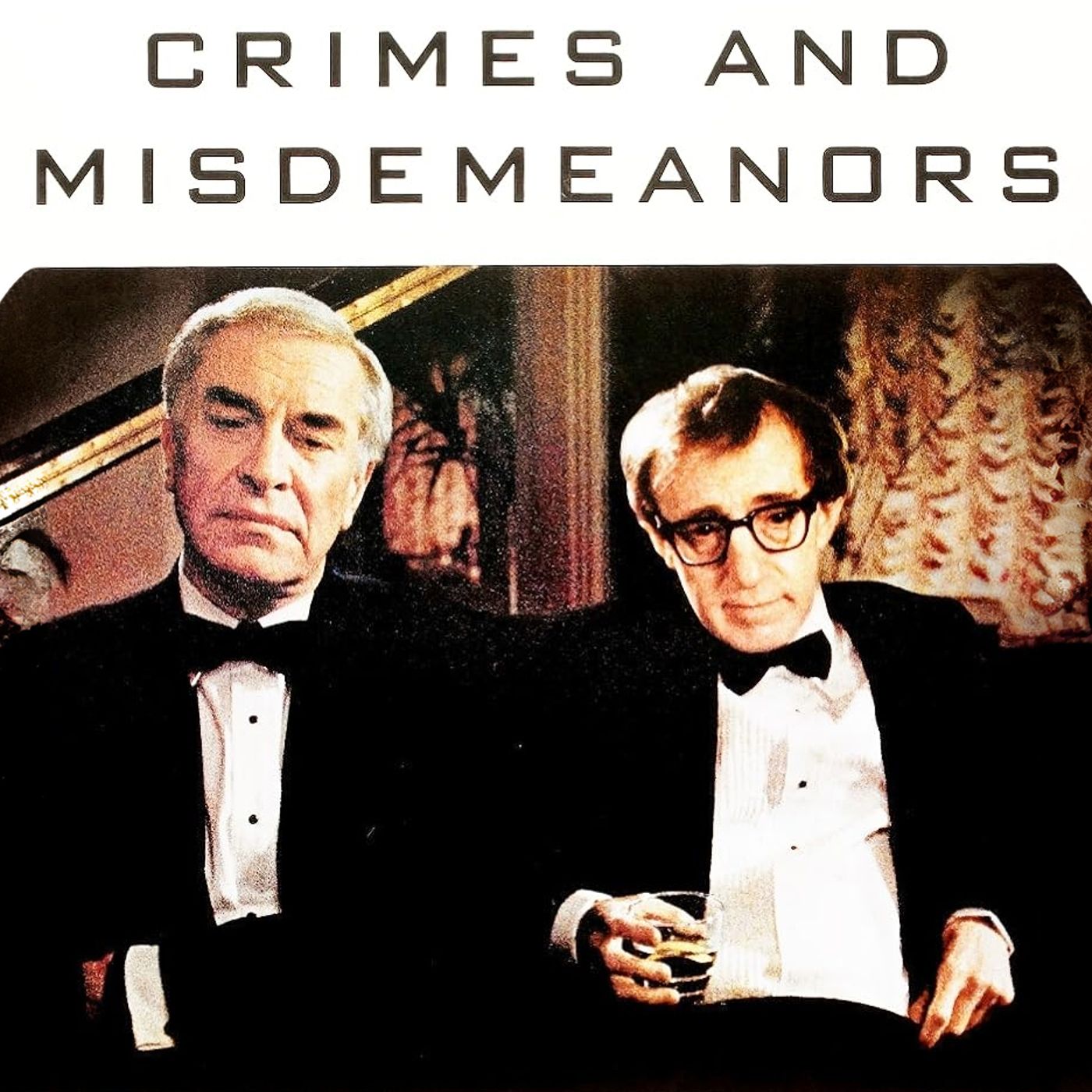
I didn't even expect this movie to be in color when I first started watching it, and having only seen the poster al lah the video box cover, I thought for sure that Martin Landau and Woody Allen were in every scene together, because there they are, just shull me on that VHS box cover. But no, we get one scene of those two guys together, and then we have some characters that tie them together. There's a lot of brother in laws in this movie. One brother in law connects one story, and another brother in law connects another story. But yeah, I really didn't know what to expect with this.
And you were talking about accessible, and yeah, it's remarkable how accessible this movie is, especially because it is the multiple storylines. And I have to really shout out the editing of this movie, just because it feels like it is perfectly paced. Once we get to the end of what feels like a very natural spot, we will switch from one story to the other. Sometimes there are interstitials a la the movies that whatdy Allen's character is taking his niece to and I think that those are great little commentaries on what's happening in the rest of the story as well, especially to see the Martin Landau and Angelica Houston characters going back and forth. And then you cut to mister and Missus Smith, not the one with Angelina, Joe Lee and Brad Pitt, but the original one, going back to the Hitchcock one, And yeah, it feels every time they make that transition, it was just exactly the right time to do it.
And I have to say, I'm a huge Alan Alda fan, and to see him play this pompous a hole through this movie, Oh my gosh, what a performance. I wish that this whole movie was just the woody story, just to get more of the Allen all The character, because he is so good. Yes he is. He's definitely a standout. It felt like great casting because he always had this kind of really good guy persona, but there's always been that thing where you could just imagine that, oh, but what if he's a Guido's really that that's a cover for being kind of smarmy.
I don't think. Yeah, I've actually never heard anything the nicest things about him, but he just there's a quality that what he tapped into that was perfect because he seems like a guy that everybody would love, and yet you could imagine, oh but underneath it there is a huge ego or there's a huge narcissistic streak. One of the things that I think what he did brilliantly over the years was casting, and I think it was a great piece of casting and really let all the show off things that he really got to do. And just while we're talking about the editing, that was Susan Morse and the casting was Juliette Taylor. So he's working with good people.
So interesting about what he is that he had such an unsemble in front of and behind the cameras and need people that he really would work with repeatedly, and I think it's often a wonderful they theems like a lot of great filmmakers would tend to do that, they would find people that would help bring out their best and go back to them over and over. But what he did that I think as much as anybody ever where you just see the same names fifteen movies later. Once fend His cinematography is just gorgeous. This movie looks so good and it's got this kind of almost like honey color to it. It just the scenes feel so very warm, even when they're outside.
It doesn't. It almost feels like studio sometimes, but just yeah, like pretty scenes, which there are many, you just get this kind of like warm glow to it. Even people will come in with Daryl. Hannah has this red dress, but it doesn't feel bright. It feels very much.
Part of it, and there's a lot of browns, a lot of darker greens, those kind of things. But even a bright red dress doesn't come off as this huge signifier or just your eye is drawn to, oh my god, the color red. No, it's not sixth cents or something. It's just feels very much of a piece, and I think that he makes this movie look gorgeous. And my Bergmann knowledge is limited, but obviously the connection between Woody Allen and Bergmann is something that he's spoken about a lot.
Do you ether you to recognize not just a general tone, but any specific influences for this film. I definitely see more of the Bergmann stuff in what I've seen of some of those films that I haven't seen, just the clips and stuff like interiors, I think is one. I'm just like, yeah, this feels very bergman esque when I've seen the clips. But as far as this goes, it's funny. I was reading a review by Pauline Kale and she was saying that he's not being a clone of Igmar Bergmann this time, but he's own of Arthur Miller.
And it feels very much like this movie is playing out like an Arthur Miller play, especially the Martin Landau part of it, and I'm just like, maybe I can see that, but it feels more like it's a Woody Allen film that it does Arthur Miller play or even a Bergman movie. And I think that's because of the comedy that you get even you get comedy even in the more serious Martin Landau story, And that's how I feel. Anyway, we yes obviously using sand like this to shoot this. It does underline the Bergmann connections, and there are thematically a lot of Bergmann connections just Bergmandale, with all the same themes about is there a God, is there morality? If there isn't, how do we live?
Those are very Bergmanesque themes. But one thing that is interesting, and I think you're right, is that the the film's very warm looking, and the traditional and perhaps more cliche thing to do with a film about the emptiness of human souls or the lack of morality would have been to go very cold, to go very distance, And what what he and Nikefist did together was to create a very warm world for people to act in very unwarm ways, which is really interesting. And I do think that when you think of some of provements up at least I think of it, and I feel like maybe somebody's gotten out there and point, oh, you're all wrong. But I think of some of especially the later Bergmann, as having some of that same odd things like Autumn Sonata, which is a pretty cool film of that a pretty difficult relationship.
But it's a very warm looking movie, so it invites you in and pulls you in before it hits you with all the pain in these people. And I feel like that's part of a two one here, too, is that the film is inviting in its colors, and it's inviting in its cinematography, and it's not some of the earlier Gordon Willis stuff that what he did was more distanced and more clearly symbolic and expressionistic and very wide shots, and you play the whole scene far away from everybody, and I love those songs that I love the way they look, but this is actually much more intimate, and that's a really interesting choice for a film that's about people's narcissism and inability to be intimate and to think of anything besides themselves.
And I think it's a kind of brilliant, counterintuitive choice that I really like and I think really enhances the movie. If we were to draw a line from one to the other, it would be this film as a very similar look to me to something like Fanny and Alexander, which also has that sheen of nostalgia to it, and you get a little bit of that in this film, because the other thing that we haven't mentioned is that this movie goes back and forth in time like crazy. There's one moment in the movie where I wonder if I'm in the present or if I'm in the past, But then I find out I'm in the present, and I'll try to remember to point that out at some point, But yeah, there are there's moments where Martin Landau is driving and he flashes back to the first time he met Angelica Houston's character, and then you get what she's doing now, and you've seen what she was doing, and you saw the scene with the letter already, and and you get her with her threatening phone calls, and you get this, is it the original days of their relationship when they were all lovey dovey and the thrill was there, or is it more of this.
She's panicking, she's calling, she's threatening, she's doing all of these things. And then even with at the very beginning, when he's talking about why he became an ophthalmologist and he's getting this big award, he goes back to an old time where his father is talking about how the eye of God is everywhere, and that he's always looking down at you, and that becomes a major theme of this. Eyes are a huge theme. I have to say. The other thing that's a huge theme that I picked up last night when I was rewatching it is telephones.
Telephones are like crazy and this, and there are so many phone conversations. And you think about now with us carrying around our phones with us all the time, but there are so many phone conversations or missed calls or catching up with somebody. At one point, what he Allen's character calls his service and he' said, oh, they never have any messages for me, but they do that one particular time. And it's nice to see payphones and phone boosts again. But yeah, just phone calls like crazy, which is an interesting thing too as far as we're talking about the eye of God.
But really so much of this has to do with the ears as well, in the way that people are communicating. I hadn't thought of it, but you're absolutely rubbing. Certainly, there is a choice that phones are very sentfral You know, it brings to mind some possible thoughts in terms of distance between people and black with human connection and Certainly the film is a lot about that. Everybody in the film in some way is seeing others the way they want to or themselves. But in some ways, the whole film is about how we all delude ourselves and how we all see the world very subjectively while we think we're seeing it very objectively, and certainly phones could be part of that same instruction.
I had thought about it, but it's good. I think it's interesting because I definitely caught the eyeing eyes of God. That's very obvious for me. A lot of watching this film is the relationship between the way it read to me when I watched it when it came out and what it is now. And it's funny to think that phones are a special effect now.
At the time, I don't know if anyone would have noticed them, but now, Yeah, all these antiquated phones playing such a part in the film is one of those things that I wonder if you would have picked up on if you'd watched it when it actually came out, as opposed to now. As approaching it, is it going to be useful to approach each of the individual storylines as its own thing, because I feel like they're both telling obviously they're both telling stories that have rhymes with each other in different ways, and I think the way that what he uses the two stories to balance them, to turn what's a pretty dark and brooding film into something that's also pretty hilarious. But how do you want to approach this?
Do you want to approach it looking at Leicester's Judas story and then looking at Lester's story, which I actually think of Cliff's story as Leicester's story, but maybe we can get into that. It was debating about that as far as should we talk about one story then the other story, or would it make sense to go back and forth the way that they have this structured. I don't know if anybody's ever done this type of edit for this film before. I know people fan edit like crazy, but has anybody ever gone through and edited one story out and left the other one just to see how they play without the other? Would this collapse if there wasn't a second story to it.
I'm very curious as far as what that would look like, to just have the Judas story, to just have the Chester story, what would that be like? Because really it's just minimal as far as the one scene where they actually connect. But then you do have the Sam Watterson character going through both of those, and Judas's story he is much more of There's even one scene where it feels like he's a figment of his imagination. He comes out from nowhere and starts to talk to Judah and I'm just like, oh, he was there. And there's some great camera work in that same scene where we focus on Martin Landau and it's just him talking for a while, and then you hear the Sam Watterson character talking, but you never go to him.
Then the camera moves over to him, and then Martin Landau keeps talking, but yet we're on screen with Sam Watterson, and then eventually they come together in a two shot, and it doesn't feel like one of those where now we've come to an understanding, so we're going to have the two characters on frame at the same time. It feels like a very natural way to end that sequence. And you get that same thing of voiceover over other people's scenes a few times, and it's not just phone calls. You'll actually get there's a rabbi and the Woody Allen part of the story where he is talking about his memories from World War Two and just all of what he feels about human nature, and that plays over a wedding scene later on in the film, and I'm just like, okay, again, are these two stories tied inextricably together.
Each of them could make a really perfectly good sale. The material isn't there now, but I feel like there's so much more for what they give each other. But yes, I do think each one could absolutely work as a movie. I just don't know that it would have the same power because I think the Judo one would in a vacuum. This is just personal taste, but I think would feel so unrelentingly bleak and start to feel a little one not okay, we got it.
And the Woody one is fun and funny, but the deeper words in it, and there are some little a deep one where you sort of looking at it and would be lost. And he would just be this funny thing about a guy who like is like a pumpus ass and a guy kind of elluting himself about how great he is by comparison. And you could make either one of those, but I don't know that either would have nearly the impact. And I think what the genius of the film is the alchemy of these two things and how they both enlarge each other past what they would be on their own. But I absolutely think you could do it.
And if I didn't know that Woody Allen likes to edit quickly and not belabor things, I think most filmmakers probably would do the exercise, and maybe they even did. I'd be curious of watching each story as its own thing. In the anything world, that is a very common thing when you have multiple storylines, you edited them together, just to see how they hold up as a piece and what isn't there, and I'd be fascinating. But I feel like the genius of the movie is the combination. Absolutely, and it answers the big question uestion that sort of hovers over the middle part of what his career that he makes jokes about and start us memories.
We like you for your funny movies, and he's like, but I want to make bleak philosophical dramas. And I feel like this was the one where he found the perfect balance. Yeah, that was at the time. Was the thing that struck me was like, this is it. He just absolutely nailed it.
This is to put it in songwriting terms, this feels more like a Lennon and McCartney song than just one or the other. And that's to me that because he has that comedic superpower that he can just there are several scenes in this film that are just I'm still laughing at even just thinking about them, I'll laugh at them. But for him, that's not what he's interested in. So being able to do both is just I think that's that You're right. I agree with you, Keith.
That is the true majesty of this film. And it makes the comedy stuff so deep because they sing it in kim. It's all very funny in the funny half, but there's a lot of serious stuff underneath it. And it's easy at first to go, oh, Lesture's this idiot buffoon and Cliff is this noble guy. And then you because of the more serious side of the film, you start looking more deeply at the comedy side of the film, go like, oh, things are more complicated than they might seem.
And Cliff has his own problems and meet his character as her own problems, and everybody's living in delusion in the hand with pleating their ego and acting self destructively. But those things might without the darkness to point you to look more closely. I just think you'd probably not see al either, or why don't you stop to think about and you just accept it at face value. But with the Judas story, you have to go okay, so, yes, I get how funny all this is. But what's underneath though?
Why is this here? Why is this paired with it? How does it relate to it? And then that's to me where a lot of the most interesting discoveries about the film in thinking about it later. And I do think that there are some I love movies that are designed to make you have to ponder them past the experience you're just sitting there.
And I feel like this movie, to me is absolutely designed as there's the experience watching it, and then there's the experience of it rattling around in your brain after. And I feel like Woody Dayaspoon was intentionally going for that. It was a great going to create a movie that you had one experience sitting there and maybe a very different experience the day, a week, a month later, or seeing it again and revisiting it and looking at it with the knowledge you have of where the story goes. And I love those movies. I love movies that I have to go, Oh, this is more complicated than I thought.
So I was saying Chester before. It's actually Cliff As the Woody Allen character. Apologies for that. I think if we didn't have the Judas story, the whole life of the adultery, that Cliff is really he's very into the idea of I want to sleep with Hallie, I want to sleep with the Mia Pharaoh character, and he just seems to forget that he's married or just pretend that the marriage is over. So he just really wants to have her, and I think if we didn't have the Judah story it might play different.
But instead, because we have Judah having committed adultery and his marriage is so threatened by the dolorous character, so much so that he hires his brother to end up murdering her or via certain channels. If we didn't have that, I think we would find this a lot more funny than we do now. There is more pathos to this and just the desperation. It really feels like he's desperate to get with Miya Pharaoh, and so when she quote unquote betrays him by going with Lester, it's the idiot. You couldn't have her anyway, you were already taken, you're already married.
And then there's that in line towards the end. The end of this movie really brings home a lot of different things. There's the line where the wife says to her brother, who is Lester. She says, Oh, yeah, I've found somebody else. She's also been on the prowl, so that kind of colors things differently.
And then Lester seems genuinely sad and upset. He doesn't know why Cliff doesn't like him, just like, wa, why is this happening? Why does he find me so distasteful? Because he thinks he's a genuinely nice person, and I think he thinks that he's very funny when it comes to all of his pontificating about comedy and things. And Lester Lester, thank you, Cliff, thank you.
If I misspoke, I really apologize in my notes. It is all just Woody Allen. Allen all done me a pharaoh. And it's so much easier for me to remember these actors' names than it is the character names. But I know they're not the people.
Yeah, even the Woody Allen character just feels so self and he feels very much like the Allen all the character, especially when he brings his niece the book about New York and oh, look at all these photographs. And I'm like, this girl's probably what fourteen fifteen years old? He's dragging her to see all these old movies. Okay, it's great that she seems to like them, but here you are giving this big, expensive book about New York photographs and stuff, and I'm like, Okay, what teenager is gonna really fawn over that? Maybe she's special.
As a young kid growing up watching Woody Allen movies, the scene and this is something that is in other movies. She's has nieces or nephews that he take that he takes to movies, and the idea as a kid watching it was the way I felt watching Meatballs. Oh wouldn't it be cool to have a cool friend like Woody Allen or a cool friend like Bill Murray to take me to movies and talk to me like I'm an adult, because instead of lay away, all the other adults in my life talk to me like I'm a kid and expect me to be into kid things. So I do feel like though, believe me, I think I'd love to get into the ways that I feel like Woody Allen is playing a villain in this movie wrote himself a villain role that is really fun.
But think of it as being less there and more like you were saying, Judah's brother in law pulls off a hit on his girlfriend, and weirdly, Cliff's wife hires her brother in law to pull off a hit on her brother. Ultimately she doesn't know it, but she basically hires him, and he is an assassin in this movie. But in the movie he makes about Cliff, even though that's my favorite thing in the whole film. He's using his powers as a filmmaker, destroyed someone that he thinks is Pampus, who is his wife's brother. He really is liked.
Every other character in this very seas thinks were very I'm not sure that Lester is as bad as Woody Allen's character. Cliff sees it clearly, he's got deep loss of a him of being. But I do you think it's interesting that the Maya Bara character act ends up with him. Now, maybe that's about Christian Allan knows, Maybe who knows, But we're seeing a very subjective reaction to Cliff by somebody who's incredibly to somebody who he's very jealous of, and he's incredibly self satisfied with himself. He's got his documentary he's making about this Jewish philosopher who's fascinating, but he doesn't even understand his own subject, the serious film he's making.
The discovery of the film is that Cliff doesn't even understand its own subject. The sky Shot thus a feat a film about and while he's so smugly is dismissing everything that alan all of this character says, yeah, dude, you're not the best judge of all humanity. And so we're seeing your version of Lester, which is horrible and funny. But I also couldn't believe there's another version of Lester that's a little bit less one sided than the very subjective one that we see, because we're seeing through your eyes. There's the eye of God because he as the director, he's playing a director, but he's also the director who is ultimately the eye of God in everything we're seeing.
That was the piece. And look at the kind of God he is. He's a cruel and very flawed to the point of being ignorant God, which if we go back to the story with the family around the table when Judah is remembering his childhood, and this debate of is there a moral underpinning to the universe or isn't there in this universe? We have to accept that Woody Allen is our flawed creator. Well, he has no empathy for so many people, even especially his sister.
There's that scene with his sister where she tells that story about the blind date, one of the funniest fucking stories, funniest fucking scenes. But the way that they resolve it, they don't resolve it. He is shocked by this whole thing. He doesn't give her her hug, he does and do anything, no kind words. The scene ends with her with this horribly prepet plexed look on her face.
Is he not going to do anything? Or does nobody care about any of this? And then he goes home to his wife AND's just my sister had somebody defecate on her, and I'm like, okay, now it's a funny thing, and it's just like all right, but yeah, no no empathy towards other human beings, and yeah, you're right, Keith, I didn't even think about that whole thing of like how he doesn't even seem to know his own documentary subject, the person that he has spent all of this time with, shot all of this footage with, and I'd love to that when it comes to trying to woo the Mia Pharaoh character, I've given up on names. He tries to woo the Miapharaoh character. Oh, come on over and look at this documentary footage that I have, and just like, how cool is this?
And it's just headshot of this guy just talking like no cuts, no nothing going on. I know this is raw footage and everything, but it's at the same time, it's like, dude, you're being offered a chance to shoot this documentary for PBS about Lester, about ellen Alda that can fill the coffers. You know. It's that old one for you, one for me type of thing. You got to take the hit, you gotta make this thing.
You got to make the money so that you can make the Passion Project. But instead he just wants the Passion Project, that he wants the kudos for the Passion Project, even though yeah, he doesn't even know what the hell's going on with this Holocaust survivor. Yeah, and he's completely misreading with the guy. It's so fascinating aftery buying out that character's killed themselves, it's gone out a window, and you start listening to your realist. Yeah, this man is in much more pain than Cliff has ever and Cliff sees of this, this beacon of live eat and this beacon of this guy who's got the answers, and the guy's actually saying yet, yes, in a world of terrible pain, love is the one thing that needy makes it make sense.
But the Cliff is somehow managed to take out in a world of terrible pain, is if that's not a big part of what that guy's talking about, And it makes you realize, Wow, Okay, so you're a very unreliable narrative. So I don't know you're a reliable narrator about Leicester. I don't know if you're certainly reading into how he's character that she's crazy about you and she's in love with you, and that you were a perfect fit. And I don't know wh where you're seeing that other that you have some things in common. He's decided she's the love of his life based on I don't know what.
He's very delusional, and but then so is everybody. So is the Laurus, so is every character in the film is delusional and in a very specifically narcissistic way. And I think in part of what I'm talking about is we all are We all live our lives seeing the world very subjectively. It's like part of the human condition. And how does that work in a moral universe, in the universe where we all experience things only in our very narrow view And to go with the blindness level and what we theme in the movie, how do we find morality when we see everything only through our own very narrow viewpoint, Whether it's Judah on the extreme as a murderer, or all the other characters who are maybe it's not crimes, but it's misdemeanors.
They're all seeing in each other what they want to see. And even in the Sam Waterson character, who is the one truly moral being at least on the surface and the piece, and what a wonderful performance, maybe my favorite Sam Waters performance. What it's so different from other things he's done. Even he says, if it comes down to God or truth, I'll say God, which to me is yet another way of saying I'll live with a lie a delusion rather than live with the truth. I don't want so, even he's embracing a certain kind of narcissistic, delusional way of seeing the universe, even though he's definitely a force for good.
So it's a really interesting thing that runs every major character of the piece, that they're all deluding themselves about everything and wondering why the universe doesn't make sense. And I feel like we all do that. I do feel like that's part of the power of the film is you sit there and at least I go, yeah, you know what, I do that too. And maybe I don't have people murdered, but I certainly see the world the way my brain chooses to and my very personal experiences. And I think the genius of great filmmaking is when it makes you go, oh, I don't really want to acknowledge this about myself, but this is so well powled that I have to start looking at myself.
It's like he's embracing the blindness. I don't need to see the truth. I just need to see what I want to see. I like to remember things my own way. But yet that's so dangerous and so inherently immoral and leads to people doing terrible things and yet it's so unavoidable because as human beings, we're not God, so we do only have our weird limited experience and our weird limited wants and our weird limited sessions.
Judas willing to kill to protect his little world and his wife is willing to be completely blind to what may be going on with him. What are your sister is willing to date a guy not see how deeply creepy he is, And everybody's doing that, and we all do it, and it's the most human thing, and yet it's the most amoral, it's not immoral thing about humanity. And I think what's brilliant about the movie is it doesn't have an answer for it. It doesn't even try to have an answer for it. But I feel like it's such a dark view of the fact that we are all amoral and do bad things because of it, and yet the very end of the movie also has this realm grong and we are also creatures of love, and we're also creatures that can find moments of transcendence where we do really connect and we do really find something that isn't just ourselves.
That last dance between the Sam Waterston and we go oh and there's that. And I feel like when Woody or any filmmakers at their best, they get those paradoxes of the darkness of life and the darkness of humanity. And yet bergmitted is best all the great filmmakers, if like capture that araft So we're horrible, bit awful and selfish and beautiful and wonderful and tender, and how does that all exist in one person and in one PCs? Are we at the place where we think that the two villains in this movie are Judah and Cliff, not Judah and Leicester, not Martin Landa. The villains aren't Martin Landau and Alan Alda.
The villains are Martin Landau and Woody Allen. To me, actually everything the movie has villainous moments. I don't think it's that neat. I feel like nobody gets left off the hook. In Braley, He's guilty, and Harley, even Judah set up in such a way where we understand how we get where we get.
We can't empathize it, that we can't say it's okay. But by making the Lauras as narcissistic and obsessed as she is, he sets up a thing where nobody to me is a pure villain and nobody is a pure hero, and that everybody's cloudy around and that's I think part of why I love it. All the characters are compromised, there's complicity, there's ambivalence, there's all kinds of things going on, but in terms of balancing the storylines, because when I initially thought about it, I thought this film is a story, like it's these two stories and with two sort of heavies. In the one story, in the dark drama, the heavy is Martin Landau and he has his and then in the comedy, the heavy is this pompous director who is being made fun of by our hero.
And then as I watch it, I'm like, no, Lester is not the he's the target of all of this, and Woody Allen, as our eye of God assassin is functioning. Just it shifted in my mind as to who the sort of central conflicted bad guy is in this, And the more we talk, the more I start to think, actually, the Alan Alda character probably is more like Alan Alda, a nice guy, and we're seeing him through Lester's eyes. Yeah, through Cliff's eyes, sorry, Woody Allen's eyes, the character's eyes, And what I think is his audience is we find comedy to be generous. It's a nice thing. It allows us a little bit of a break from the darkness.
But if you look at every really funniest stuff in this movie comes from the cruelty of this character. And I think it's the I hate to quote Lester again, but if it's the bends it breaks thing. Like Woody Allen, when you are a comedic character, you can do terrible things. And we are all complicit because we laugh at the sister's story about getting shit on, and we laughed at the screening where he makes the film comparing alan Alda to Mussolini. And yet when we look back on it, if that's somehow someone related to us who wasn't a comedic character, we would see them as self involved and self defeating and cruel.
But I guess in Woody's case, it bends instead of breaks. Yeah, It's like Margaret Duma was never a bad person or a mean person, or an awful person, but she was always the butt of so many of the Marx Brothers jokes, and you never felt bad about it. Of course, we never think about what happens five minutes after the movie ends as Margaret Duma up in her room just crying her eyes out. Oh they were so cruel to me and just how awful it was. But no, thank goodness, we don't have to worry about that.
But yeah, I think having this again, the counterpoint between the two stories, really does help to shine that light on the Woody Allen character and be like, yeah, no, he is a comedian, but yet he's taken a little too far here with some of this stuff. And then to have that scene at them at the end. Nobody's got a guilty conscience. Marn Lando somehow has overcome all the problems. He doesn't seem to feel bad at all, and only Woody Allen feels bad about Mia Farrow going off with Alan Alda rather what.
He still feels like the victim of the story. And it's also just funny to think that Alan Alda, his most famous role, basically had the same thing. We love watching him torture Hot Lips, Hulahan and Frank Burns, but when you really look back on it, you're like, God, that guy is just a horrible bully. But we laugh along. When you watch the movie and they do that tent gag to Hot lips.
You're just like, wow, that's really inappropriate. Yeah. Maybe back in nineteen seventy it was a whole different thing. But now when I watch I'm just like, yeah, that's a bridge too far. Guys.
Yeah, I didn't really struggle with Mash the movie. And I know that's really a popular because I know we'll just love it. But I always found those guys so cruel, and I wasn't always sure that. I don't know that Robert Oland did and that bought Maybe he does, but I always felt like Almo was just cheerleading and not really exploring. Yes they're really funny, and yes they were in a fucked up, completely stupid war, and yes you do whatever you have to do to survive.
But I didn't feel what I do feel in criting themes, which is the other side I don't feel when I watch Mash and that maybe buy dwing or buy but it's just funny. Because I rewatched him to the first time forever recently they thought, no, it still really bunks me. I still feel like it's brose cheering on bros. It's not somebody going, yeah, this is really funny, except not. Yeah, i'd be curious to do a rewatch of the TV show.
The TV tick it off on the edge is enough that you get away with it more. But the movie is well on like, no, these guys are bullies, and I like the movie saying way to go, guys, I'm supposed to going, Yeah, you're in the shittiest place in the world, but it still doesn't mean you can be horrible to other people. From what I've read, Alan Alda was riffing off of Larry Gelbart when it came to his leicster character, and a lot of those things that he says were right from Gelbart's playbook, which is just hilarious to me to think that he's getting inspired by that. There are very many moments with Alan Alda's character where I feel like Alda is just riffing and just completely like no script in some of these parts, especially on the park bench when he's just pontificating and going on and on and you feel like what he Allen's been there all day.
The statue with the guy with the hat. It's great, and I just I don't know if it was written or not, but my god, what a delivery, what a performance he's giving. Larry Gelbart was part of that amazing writer's room from your show of shows, the Sid Caesar Show with mel Brooks and Woody Allen and Neil Simon. Who there already is it sim of the things that Lester says aren't even wrong, maybey be a little obvious, and the way he says them is self satisfied, Smarve. So there is truth about Yes, you can laugh about things differently over time.
They're not the most profound things, but they're not as stupid as they sound, because the way that Cliff is taking them in Cliff is the one nudging, is in the ribs saying this is really stupid. Get it? Oh yeah, he's rolling his eyes all the time. And all that does is super self satisfied. But underneath it of actually saying those things in another context, and you could hear those same things in that context and yeah, that's true.
That's part of what the film does so brilliantly is it puts you in with And that's why I guess I feel like they're both villains. I feel like they're both anti heroes, that both Clip and jud A anti heroes because we do identify with we do understand that we do empathize with them in spite of ourselves, in spite of our going oh, that's fucked up, we still travel with them, not an opposition to them, and we may be horrified by what they do, but on some level there's an emotional connection. And that's to me with what makes anti heroes really interesting, because they're those characters that you don't want to identify with, and yet because of something in the way they're constructed and written and acted, and you find still going, oh, I don't want to understand this.
I don't want to know that I have to send me I don't, but I do, And that, to me is what's so different from when I hear the word phil and I think, oh, are not a villain, So I'm not like that when I think of an eighty heroes. No, the problem is I am like this and I don't want to be and that's when I think, what he's greedy. Here's two kind of brilliant anti heroes where you know, one funny, one serious, but you understand both of these men and we've all been then in some ways at some point in our life. And they really get away clean, especially Judah. Oh yeah, somebody else got blamed for the crime.
Everything's set. I feel no guilt now. Maybe God wasn't watching, or maybe he still feels that eye on him and he just doesn't care anymore. This is nineteen eighty nine. The bad guys have won at this point, not as bad as we are today, but this is a time where the yuppie dumb has flourished.
The whole idea of I gotta get mine before you ever get yours is way prevalent. This is American psycho time here, guys. It's a really good kind of commentary on we got away with it. And yeah, I could get away with it, and Judicut's away with it, and it does the because you listen to that last monologue, what's blawn to me is any hint of a soul, any hint a humanity. He seems like a robot net.
And yes, they'll go through his life and he'll have his comfy life, and they'll have his pretty wife, and they'll have his money. But boy, there does need to be any bit of humanity left. And you go from that Sam Waterston dancing with his niece and the humanity of that, that's what the Juda character's given up. He's gotten away with it, but with it with any hope of grace, of transcendence, And so he did pay a price. He just didn't pay the price that we think of.
I guess that's more how I take it. I wonder with the Judas story. To me, it's so complex. It shifts in my brain so much when I think about it, because if that character is supposed to be, as you said, an anti hero, a stand in for us if we were in a similar situation, I feel like one of the things the film does to let him off the hook if it was Michael Caine and Barbara Hershey and he was killing Barbara Hershey, playing wonderful Barbara Hershey but stressed out in the way Angelica Houston is, instead of Angelica Houston making herself look and behave in a way that makes us want her out of the movie. As viewers, we don't want her to be harassing Martin Lando, who may feel bad about him.
But the movie does a lot to put our sympathy on his situation. He is in a real moral quandary. I keep coming back to the debate around the dinner table with the family, like this is the essence of what he's struggling with and if he is a stand in for us and we're supposed to sympathize with his situation, it's funny to say, you say, at the end, he has no soul, and for that you're arguing one side of the dinner to that. We live in a moral universe where souls are a thing, arguing Sam Watterson. So if I choose between God and the truth, I'll take God, whereas Martin Landau has to deal with the truth for us as an anti hero who's in this moral quandary.
And would the world be better served if he lived a life of self indulgent guilt after he's made this choice and he has to live with it, or is he a kind of genius if he doesn't go around killing people all the time? If this was a horrible moral transgression when he made an impossible choice and definitely the wrong choice, but he made that choice, he lives with it, and at the end, has he done the most compassionate human thing and just decided to get over it and be with his family and try and keep the life going because you can't change what was in the past. I think it's a really interesting It's not what I feel from that scene because it feels like it's more about again, it keeps going back to narcissism, because it's all about it is stealing his field.
I don't feel like he really is worried about the feelings of his family. I don't think he's worried about his patience. He's worried about himself and his own ass and his own comfort, and so to me, I can't see it in terms of Hey, in some ways, the best choice is to move on, because he's moving on as he talks about it's all about himself. And that's what every one of these characters facts, is this monstrous sort of narcissism and seeing things only from that way. I think what you're saying is really interesting, and maybe it is in there.
I think the beauty of the film is how complex and so I'm not arguing that you're wrong and now bright, I actually think this stilm can fold a tone of paradoxes in terms of our reactions to it, and I think that's what makes it a great felt because films that just for say this is right, this is wrong are so uninteresting, and films worrias you can add these conversations and go they're like, you know what you're saying, but I have this other feeling. But for me to take what you just said, I think that last speech would have to have been very different. But I think at the end of the day, it's all about him. And because it's all about him, I don't feel like, oh, that's a morally okay choice to feel like I just need to move on.
It's still about dealing with what he did. I don't think it's about morality at all. There's a moment where he is just losing his shit and he's crying and he's carrying on and just, oh my god, I can't believe I've done this, and just is very shocked at his capability and his culpability with this. When I was watching this again last night, I was thinking, this doesn't feel real now. Martin Lando is one of our greatest American actors.
To me, and especially in this period of his career, he was just knocking. It out of the park. This is like Tucker time or a few years before at Wood. All of these performances are great, and there was a little bit of me saying, is this real? Is this him acting?
Over acting? On purpose to be like, oh what was me? Oh so you know, oh so lemeo type of thing, because I was also getting as I was reading the reviews, there were a lot of criticisms of Angelica Houston's performance, that she was on hinged and that she was hysterical. And there was even the Pauline Klee review I was referring to earlier where she was talking about how Houston was being sexualized, that there's so many shots of her rear end. I'm like, I.
Didn't recognize or see shots of her rear end that often, more often than anybody else in this movie. But whatever. But yeah, I was curious if you guys felt that Landau's character was being sincere in that moment, if it was just me not buying it. I know, I completely agree, and I think it's part of a big bit of brilliant performance. Is again, it's very complicated.
I think he is really freaked out, but I think he's really freaked out about fear of being caught. I think he's really frigged out about fear of losing all the things he has. I don't think he's in a moral world pool. I think he's in a panic whirlpool about having just had somebody murdered and am I going to get in trouble for it? Because again, he wants to think of himself as a good person.
He's trying to shepherd that into I've done a very bad thing. But I don't believe the moral panic. I do believe the panic. I don't think it's a moral panic. And I think it's a great piece of acting and writing.
We're watching a character try to reinvent how bad they feel in a way that they can then let themselves off the book on a deeper level. And I definitely feel that, absolutely the great and a actor that he could have played it in a way that just would have ripped your heart out and you would want, oh my god, this guy feels so bad, and you don't you feel like this is shallow and it's venal, and it's about, at least me, it's about It's still about him. It's not about a woman he's had killed. It's about him. That's why for me, I just keep coming back to that debate around the table with his family, when he's right there sitting next to his mother.
I get what you're saying there. I think you're right that the performance is there's something going on in that performance, like a person acting to themselves, like he's trying to cry for those people on the other side of the table to say, Look, I'm a moral person. I feel things. I know what it is to feel guilt. And also I live in this amoral universe where I have to make pragmatic decisions, which is basically that debate that's going on.
And because it's so consistent and he's talking about wanting to turn himself in, he's never going to turn himself in. I agree that all of this is the kind of play acting that we all do around certain things. If only this and then that, then I would totally do the right thing. But nobody does the right thing and we live in the real world. But that's why, what do you both think about that debate about the table?
Because I've talked about it a lot. I have to say that there were a lot of heavy things that were being discussed. I was able to follow the conversation, but I was more intrigued by kept thinking about when did Woody Allen start this style of comedy? As far as taking a memory and injecting yourself into it. I think it had to have been before Annie Hall.
Right. Oh, yeah, it's as early as you take the money and run, That's. What I was thinking. Yeah, okay, the way he's able to interact. Of course, you get stuff like Radio Days where it feels very ingrained in there.
But I love this idea of him having characters revisit moments in their past and be able to interact with them. And then I kept wondering, is this more of a Christmas Carol thing? Can they actually hear him? Is he interacting with them? And then his aunt, I thought that she was absolutely fantastic.
And to think, the last time I think we talked about her Keith was when we talked about taking Palm one two three. She was the mother with all the kids on the train, and I'm just like, my god, this like amazing character actress, and she has this great role in this. So I was just more like paying attention to the acting than anything else. But I don't want to pry dumb or anything here, because yeah, I think it is a very pivotal moment in the film. If one of the best cases of actually and I think this whole movie is one of the best cases I can think of a movie that constantly is putting its themes and its countrue trade is in very literal terms and yet not seeming obnoxious and well boring and lecture.
I think you finds the way to do it and really say, Okay, I'm going to my characters just say it flat out. Is there an eye of God watching? Is there some moral universe? Is this an amoral universe or an immoral universe? For the only responsibility we have is to fight for ourselves, and even in a righteous way.
That so I think the AMP represents not that you can conceive a universe without a God, without a moral center, that is still a universe that has good in it and that still has things worth fighting for it and all see if people sitting around the table saying and yet somehow it doesn't feel like, oh my god, I'm listening to a lecture. For me, That's what I find remarkable about it is that I'm understanding both sides of the argument. It's being put in very little terms, and I think, but because he's so masterful with that thing of having the character revisiting his past, and I find it really interesting as opposed to off putting. I know that some of that stuff. In similar reviews, people are like, oh, it gets so literal and the blind people who can't see it, And I feel like, yeah, but the whole pieces are parable, and terribles have been around for thousands of years and they exist for a reason, and they're a great way to tell certain kinds of stories and raise certain kind of questions.
And so I feel like he really pulls it off in those scenes, and you go, wow, those are important, interesting ideas, And yeah, Andedward was great. She's always done great work and I'm a big fan of hers, and yes, she takes that moment and makes it into something very special. Well, it's also interesting too that where he standing is behind her, so when his father's talking to her, it almost looks like he's talking to him. Another cast member who's a veteran of several other Woody Allen films is high Ansel. He played Joey Nichols, the famous Joey Nichols gives out the Nichols from Andy Hall.
Most importantly, Crimes and Misdemeanors and Deconstructing Harry are films that are talking with each other in certain ways. They're approaching similar themes and High Ansel plays Woody's father, who he writes a short story portraying as a cannibal, so he plays this other sort of more. It's funny to see him show up in this film and then think that later on he's going to show up as the cannibal father, sort of like another Judah type. And yeah, he's shown up. I don't even I'm trying to remember not.
I'm like, well, I'm teeing. I want to look him up on the computer. Because he's been in so many of the Woody movies. I think it may be even more than just those three, but I don't now, I'll look that up a leader. Yeah, Radio Days as well, and Bananas.
I love the irony that two of our actors who I never interact down here, Sam Watterson and Jerry Orbach, that a year later they would be in Law and Order. They go from crimes and misdemeanors to Law and Order and waters it just looks like a freaking baby in here. We talked about the plastic dome of Norma Jean, which was his first role way back when, but he's so freaking young in here, and Jerry Orbach is just such a small role. But like everybody else, he just kills it. And I just love watching him and watching the way that he's trying to interact with Judah and just judas the good son and Jack is the bad son, and it's just like, Okay, we're watching how this plays out, and it's not quite canaan able.
And I kept thinking of Judas the whole time they were saying Judah as well. I don't know if that was intentional, but I have a feeling. The other thing that I thought when I was watching at this time, when Judah goes back to and John Kay Houston's apartment. Oh, I was yelling at the TV so loud. When I was watching that.
I just felt, oh my, this feels like a Colombo episode, Like this is all that silent walking around the room trying to make everything good, and I'm just expecting Colombo to come into the scene right after that and be. Like, none, this is this is something off he It did strike me this time as amazing and a really interesting choice that the stupidity of not having thought of that before of Judas character, a man who's theoretically so smart, is like, oh yeah, go okay, have somebody go kill her and only Dan reelizes, oh my god, there's like pieces of me all over that place. It's a really interesting choice. If that wasn't something he even thought of, it seems understandable because he's never thought on those terms.
But he's also again there's a kind of willful not thinking about what you're doing. It's pretty interesting in it because he knows there's pictures of him, he knows there's letters, and yet he's like saying, go ahead, and Feller, it hadn't really bought that through. It's just an interesting choice for a man who's presented as an incredibly smart character. But is he I mean, yes, he's a doctor, but he's dumb from the get going, making dumb mistakes right and left. By the way, I completely agree.
I think that's the intant thing. It's that gap between the perception of smart or what we think are smart, and what the actual behavior is. So I do completely agree. Perfect villain in a Colombo episode, and especially obfuscating it by having somebody else killer, so you could have that evidence as well as the evidence of him going through and yeah, he's not really setting up an alibi this whole like, oh I got a run. It's not air tight here, he's not going around, he's not doing the famous Columbo thing.
I'm sorry, my watch broke. Do you have the time. I'm a very eccentric person. I'm asking you the time so you'll remember me in four scenes when Columbo comes knocking, isn't. It funny that?
Like? How bad? So I'm watching that and thinking, Okay, this is a Colombo episode, and then the cop who shows up is just really a bad is not Colombo. He's not suspicious, he's not curious, he's not paying attention. I was giving him excuses.
Oh, you must have forgotten that or something. And yeah, he's not doing that Columbo thing of here. Let me cast the line and just keep feeding you and then pull you back in because I've been feeding you a line the entire time. This is a Colombo episode. If Colombo didn't exist.
Colombo is appropriately being Mono, having just the one eye. He's the eye of God. And the thing is, I'm sure that cop is really what real cops are. Like, here's this rich, white, important doctor guy. Yeah, you're gonna follow up on it because there's a couple of phone calls, But why did you ever suspect that there was something more there, So you're doing what cops here, which is that's not where you're gonna look.
And ultimately here they the murder gouv blamed on a drift or he's like somebody else has hate him the fall and dates never saw. And that's another thing Judah is okay with, is that, oh, some guy you've already done other bad things, so yeah, he's gonna get blamed from my murger. But I'm sure that is true. I'm sure that you wouldn't look at Judah and go, oh, I think this, I'm gonna see if there's anything there with this guy. You'd be checking off a list of performance things to do and go looking for the poor guy or the black eye or the whoever.
Guy that's much more easy to you know, imagine, would do something wrong because this pillar of society, of course wouldn't. And to have him be Victor Argo just showing up for five minutes, I mean ourgo I loved him and everything, especially when he was the very people talk about Hardbiktell being an unbelievable speed of Judas in Last Temptation, but that Victor Argo was Peter. It's okay, sure this like tough Italian guy from them, from the Bronx or whatever. It's just like, all right, sure he's Peter Fisher of men. I know, I'm much more familiar with the New Testament.
I'm sorry, guys, I keep trying to go back to the Torah. Yeah, Faith, Okay, thank you. And we're talking about Columbow. The Judas story is like a Colombo story without Colombo. Thinking about the sort of deliciously funny narcissism of the characters in the Lester and Cliff story, that one feels so much like a proto Seinfeld.
That's the kind of cruelty that Cliff has. He could hang out with those characters and their petty grievances and their weird little attempts at revenge in that world. And going back to what I said at the very beginning, this is one of the things that makes me sad about the erasure of Woody Allen as an influence is I feel I watch so many things and feel his influence, but then when I read people talk about those things, it's unmentioned. I totally agree that it does feel very Siginfeldian, and it's very funny that he uses the word phony. Does Cliff think I'm a phony, and that's such the big word that gets thrown around at least one of those episodes, he thinks your phony, Jerry, a phony.
Actually, before we get into the uber Woody Allen ness of it all, I think it's interesting that there's a it's fun to watch sort of film marquees in Woody Allen films. And did you notice what was on one of the marquees in this one, the classic Phil Collins film Buster. I forgot, Oh, yes, that definitely dated it. Why. I wonder how that will read in years to come.
Like you wonder what I actually noted it? And I thought, oh, that's so randomly that I wonder if that was something that Woody picked or if it was something that's was really in the space that they were using. Because in a more almost everything has meaning, even little details. IT was looking at that, going am I missing something? I don't if they're present in the brain and I'm going to buster the word still Colin.
I couldn't come up with anything that gave it a meaning, which is weird. It almost feels like a still making glitch because everything in this film feels, oh this relates this. I was sitting there going buster, what does that is? That meeting that was just there? It's it.
Maybe it's just like, Okay, that's what the marquee and I know what, he likes to work fast and doesn't have big budgets. Yeah, rather than paying the change of the marquee, you were just gonna shoot it and you use it because it was oddly, but I had funny to mention it because yeah, it sticked out a bit like Crystal that moment. Yeah, I maybe that's like the shallow kind of Hollywood comedy that Lester would make. Maybe. But the actress Joanna Gleeson, who plays Woody's wife who's got one foot out the door when we start the movie.
In later life, she's played some real great heavies like in this, and I think particularly in Boogie Nights as Wahlberg's terrible mother, just fantastic, just like you hate her from the get go, which has always been weird because I remember her from like early eighties TV and when I was researching her, was like, oh, why do I have such fond feelings about her? What was it that she was in that I loved so much? And this is one of the I can't quite connect the dots, but she was. She played the same character in episodes of Different Strokes and then later briefly on TV series Hello Larry, and that was one trying to research it. I was not able to figure out who the character Morgan Winslow was and why she was in two of these shows that I watched as a kid who was glued to the TV in nineteen seventy nine nineteen eighty eighty one.
I'm I'm curious if either of you have a strong feeling about her as an actress, or her performance, or any insight into the character Morgan Winslow, who appeared on episodes of Different Strokes in Hello Larry. I can't say I watched a lot of Hello Larry. I definitely watch a lot more Different Strokes. I just know that her performance was really good, and she actually got called out several times in reviews saying that she was underused and underappreciated, and I was like, yeah, she is underused, but this is really much more of a and I hate to be this way, but it's much more of a story of men. It's not really focusing on the women characters very much at all.
I think Mia Farrow is the only one that really gets significant screen time, but the rest of it, even Angelica Houston gets overshadowed because she's dead meat and because she is playing this hysterical person. But yeah, I thought that the Wave character was fascinating. I really would have liked to have more about her, especially when Cliff is there telling that story about it sister, and she's just like mm hmm, okay whatever, and just turns off the light and rolls over and it feels like she's dead asleep within two seconds. That's funny because at the beginning you're saying that he just wants to have affairs. I'm like, he's in a loveless marriage.
I feel like, again, that's set up so that we are empathetic to him, at least early on. It's hard for me to feel too moral about somebody where you hear, okay, we haven't had sex in a year with the wife, and the wife clearly has no interest in being connected to him emotionally or physically, And then it's hard for me to feel moralistic about somebody going Okay, I'm gonna go outside the marriage because it's so clearly a dead marriage. It is on paper a moral question, but it can be. That's I think it's actually a very good choice because it again I think, what do you work hard to let us come to identify with a light flip early on, and then later we can look at these partss. Oh, it's looks weird and he's not really dealing with the wife, and he could just have laughed like other choices.
But yeah, they do a good job setting up a marriage worth for me. I don't instantly hate him for falling for the Bavaro character, because yeah, I think we get that marriage is just dead. But yeah, joere at List is a wonderful actress, and I get I saw her a lot theater at New York when I was growing up, and she's a tremendous rate. She's one of those people who did musicals, they usually did some soundline stuff. She's just really good.
She's had some interesting, cool little parts in movies, but she's a star in New York theater. There's a lot of people like that who pretty big stars in New York, even if in movies they're usual like the interesting but smaller supporting role, and she was definitely in that universe. I knew there was something to this lady, not just her chemistry with Arnold Drummond. All Right, fellas, let's go ahead and take a break, and we'll be back with an interview with Eric Lax. He's the author of a lot of things including Start to Finish, Woody Allen and the Art of Movie Making, Conversations with Woody Allen, his films, the Movies and Movie Making, Woody Allen, a biography, and on being funny Woody Allen in Comedy.
And we'll be back with that right after these brief messages. Get ready to dive deep into the life, career, and unforgettable moments of the one and Only Chevy Chase. Join us on an exciting journey through the illustrious career of this comedy icon as we explore his groundbreaking roles, behind the scenes stories, and timeless contributions to the world of entertainment. Each episode of the Chasing chevy Chase Podcast brings you expert analysis and nostalgic reflections on Chevy Chase's most iconic characters in classic films like National Lampoon's Vacation, Caddy Shack, and Fletch. Whether you're a diehard Chevy Chase aficionado or simply curious about the man behind the laughter.
Chasing Chevy Chase is your go to podcast for all things Chevy Chase. Tune in and join the conversation as we celebrate the life and life legacy of a true Hollywood legend. Don't miss out. Subscribe now to Chasing Chevy Chase wherever you get your podcasts, and let the adventure begin. Tell me a little bit about your interest in comedy when you were growing up, because I mean, there must have been a reason why you sought out Woody Allen.
My dad was very funny, which was interesting because you was at the school preview. But he had a wonderful, wonderful sense of humor, old a joke, beautifully, could find humor in so many things. I was an earlier appreciator, just a fifth humor. And then you know, in high school, I think I just really started. I suddenly loved reading really good year.
I started reading Drinks Ferber and other time I'm like, oh man, there's stuff that's really funny. I had a wise guy call him in the college newspaper. I was a movie reviewer, and I had to fill a column a lot the movies that were coming to town. The only problem was is the movies came to town the night, but the paper came out and there was no way to see the movies beforehand, so I had no like, yeah, what was there? So I had to map for four hundred words or whatever whatever they had to do, and it turned into a supposedly funny column.
I just always loved laughing and just appreciated would play and great humor, and when what he came along, I just loved it. Monologue and then he was writing the stuff that he woke for The New Yorker, and then when he switched to films, it really caught my attention. Hears if somebody had had a wonderful career as a stand up and then he was suddenly he started to write movies. When he did, you know what, because he had a movie, he said he could have made it twice as funny and half of successful they had followed in the script, and the idea of somebody who's making a switch from comedian to director interested me, and I went to the New York was interested in my doing something for the magazine, and we talked about a number of ideas that one of them was what he doing this?
And I went off to see him, and I was pretty new to journalism, and I was incredibly neurous, like because I admired him, and I had my list of questions in my tape recorder, and he was genuinely He's always been shy, but he was really painfully shy, even with that amount of success that he had. This would be about nineteen seventy one. And we sat down and I broke every or or he didn't follow every will wh or was. I didn't begin to. I didn't get him into conversation.
I just sat there with my list of questions and ran through them quite nervously. And as a result of that, his shortest answer was no, which wouldn't have been so bad. I guess that his longest answer was yes. That didn't seem very profitable. And I ended up doing another story.
But some months later I was in San franciscrib was nearly run over or buy a production car for play it against fam that I'd read the chronicle that was about to start filming, and you know I did. I did the kind of irresponsible thing that I think, well, I hope no other people don't do it, but I know they're so like you. Know, like I called the Times and said Wood he was ready to talk. And I called WODI, said the Time slip ready to do the feast, and they said, well come over and we'll talk on it. And well we'll do another interview.
And I met him in the baseball season with it was playoffs and we actually had a real conversation about the playoffs. And then Charlie Joffey's manager took me aside aku and said, okay, you can you know, you can come on the set, stay out of the way. If you had the way you have to go. And I said, all was fine. So the Time said, you know, commission the story, and I that on the set and I didn't do anything for their first four days.
I decided to take the salt lick approach, is that they're just to you know, sit quietly and see if anybody wanders over. And an Tony Roberts started talking to me, and I think I must have passed the Tony test, and pretty simply he started coming over. And this was about five or six days into this ABE seventy one. Again, we've been talking for fifty four years. I had no intention of obviously this being the case, right, It was to me it was a one off, and the problem was is that it was to be on him as a director, but played against Sam was directed by Herbert Ross.
It made more sense to write about him doing everything he always wanted to know about check. So I had two movies in a row have did the piece for The Times and turned it in the day that Time magazine ran a cover story on him and a journal of as a comedy. Timing isn't everything, and my thiming couldn't have been worse, and I'm the sort of Times killed the peace. They thank you very much, and I said it to him, to Woody and said thanks for all the time. I'm you know, timing was just terrible.
I'm really sorry, and never infected to hear fromhim, and I got a call two days later saying, gee, I'm really sorry. It was a really nice spiece. He said, you quoted me accurately and in context, and you honored all my jokes, which meant that I had applied the first thing that he had taught me, which is the most important part of good joke. There's not the punch line, but the straight line. Punch line is useless about a really good straight line, and you really need to build a great runway for it.
So I was free well in doing that, I think more than ending it's because I either honored the straight line that we've been talking. You were talking about the short and long answers. I'm absolutely fine with the long answers. It was the worst interview, and I laugh at it now, but I just wanted I said, what were you doing? You know, I mean, it was just it was so idious being in that room.
It was upstairs and his managers, well, they had a wonderful office on fifty seventh Street in New York and sort of the two floors of kind of of an open air off here a stairway that goes up that k eleven twelve floors, I think when he was sitting there in this very compiled here's a nice little room, you know, and it was a perfect place to have an interview. And you know, I had the list of questions, and I had the cape recorder, and I could have had a wonderful conversation with him if I just engaged him in conversation. That first book on Being Funny was pretty darn quickly after that, right in eighteen seventy five, I want. To say, after the Time's killed my peek because of the Time magazine teams.
I was cashing about for something to do, and I got a call from a publisher who said, John Cushman, who is my agent, says he'll never tend anything else to me if I don't talk to you. We didn't fuck it, I said, Cooper, you know, and we talked about paul whole book ideas, and I said, well, you know, I had another thing that I resolved interested in doing the compoint non Fisher, totally unrelated to Jovis. He said, well, that's really interesting. He said, but you know, this Woody Allen thing is that you spent all this time with him. He was sort it'd be interesting to you a book on on comedy because he's done he's done everything.
He's done stand up and he's written for The New Yorker, he's done movies, and he wrote jokes for other people and oh, he's active. He's as do you think he would go along with this? I said, I have no idea, I said, but you know, I ran into him on the street the other day and he said he was going to Las Vegas to do the last of his stand up contracted Caesa Palace and with kind of working to look three or four or five other places. It was going to be the last tool that he had as a candian. And I said, if you'll fend me a lot of Vegas.
And then I ran into Woody and he has showed me all this and he said, you know, if you're in Vegas, you go come by and say hello. Both of us thought it as a joke. I said, but I know he's in Vegas, and you know, if you want to send me out Vegas, I'll go talk to him and see what happens. So they Cobrosher gave me up money to build to Las Vegas. I convited him to get that's money to got there.
I called him from the lobby. He fell me she need a coffee shop in ten minutes and we talked for fifteen or twenty minutes, and he said, yeah, this makes this should be interesting. So I said, okay. You know how I stayed on. I did us there for two two.
Weeks I think ten days ten days. I went to all the shows, really got a sense of how Key dosband, which was really fascinating, and went on two of them for the for the rest of the performances they had, and then we degued into making Sleeper and I spent the next I guess the next year, then pretty much eight months. Anyway, that was the start of that. Out of that game in a book called On Being Funny, and I figured that I was done with him. The next book I did with on Boonemerat Transplantation.
I spent the better part of the era of the Boonemerack Transplant Unit c LA writing a book called Life and Death on ten West. And then after that came out, I had a call from saying with I, why didn't I do a biography? I'm sort of a middle term, midlife biography would I said, you know, gee, yeah, I've already gone a book on him. You know what, I know, what do I want my third book to be? The name is my first book kind of thing.
But it was an attractive offer and what he was interested in doing it, and you know that he had provide all the time that I needed, so I said, well, why not, let's give it a chance. So that's so that's one thing. Funny came out in the I think nineteen seventy six, I went to New York with my wife Karen and are less than year old thomb Simon for six months while he made crime to disdemeanors and then Alice, and out of that came what do you all on a biography? And I was really sure that I was done with the man, but we kept talking because it was I'll go to New York and we'd get together with Barry Palky and it. And we were in a we were in an elevator, and that in Nea Pharaoh Building at a time and a better time in life for all of them, he said, And I told him the only the only time I'd ever called him the joke, and I'm fairly never and he laughed, and I said, well, I'm never going to do this again.
Clenton will on my head the while we're in the elevator, he said, He said no, He said, nobody's ever ever done kind of a follow up on somebody, you know. I said, no, no, that's true. I said, do you want to keep talking? And he said, he said yeah, why not? So here we are thirty years after that.
I'm going to go to New York next month in January and send a few days in them. We just still keep up, you know, I don't know that I'll let anything more. But we've been talking now for as our said, I think four years. The last one that I read by you start to finish. You're there on set all the time.
Are you just kind of fly on the wall or are you allowed to ask questions like what when you're doing that, when you're doing you know, the biography, when he's shooting all of these films, what's your role in that? First one to stay out of the way, and the second one is toel free to ask anything. Maybe he's not in the middle of doing something. And in all of these we find some downtime when I could sit there and do a formal interview, so we'll do. We usually talk kind of a maximum of two hours.
Everybody's kind of talked out by then. But I've done, you know, hundreds of hours interviews with him. I've done four different books now on him. I did one with when I tried to concentrate on comedy, on being Funny, was really, here's a comedian at work doing his stuff, and through that you get a sense of how comedy works because you do the stand up and then he talks about what's going on during the stand up. What's going on in his mind.
For instance, Dory costs of what's going on when he's whiting and he's talking about what peasants. So that was kind of complete unto it Bill. And then the biography was just to look at somebody in midlife, mid career, and I tried to use kind of all the standing things. I talked to all the people in his life, and I followed him around and we did interviews for them. I went to all when I did all the research, and went to archives and did that.
And then again after the biography, I was certain that I were then and then my editor Cannop John Schiegel, I've been with him forty years, some wonderful relationship, called me one day and he said, sort of a matter of fact, I was in London House doing a research for a book called The Molden Doctor Forrest Code about the development of penicellum, and he called me and he said, did you know the Cameron Crowe book with Billy Wilder did very well, which is a series of interviews, And he said, we'd like you to do along with Woody. You know you guys were talking all these years you and I said, well, it's the best interesting. My first answer is is that I'm not interested because I'm doing this and I've already done in place.
But let's talk about it, I said, but all and also if I do it, I don't want it to be all new material. I don't want to sit down and start freshen it. I've got duck going back with this would be nineteen ninety four. Fill at the content, I said, I've got stuck going back twenty years of him talking in nineteen seventy one, and he'll talk about stuff differently than he would talk about it then, because it's like, so I really want to draw on that. And John said, you know, well that makes sense out of that game conversations with Woody Allen, which has broken up in the sections I found for the seven Aspects of filmmaking to tell his or in his life to talk about.
But it's all it's all the creative life and and all of each of the seven sections. I think the seven sections goes starts with nineteen seventy one and end with two thousand and nine or twenty ten, whenever that book came out. You get to see his progression over time. How we shin suck so then I said, oh, I'm really I'll keep talking and we'll keep you know, we'll keep talking and I'll file away interviews so they're there. And then I got another call from John saying, you know, we need a this is like twenty thirteen.
We've had a book on filmmaking that's been in Evergreen for like twenty years, but it's time for a new one. Why do you do one with Woody? And you know he spent so many films now and I said, look, that's sort of interesting. I went. I talked to him again and I said, here, here's another thing from Kannap.
What do you think And he said he feel like could be interesting. So and I said, the idea will take one film from the day of the idea until till the day it comes out. He said yeah. He said, okay, that's good. So that started.
You know, that would turn into a year and a half. And in the midst of that everything went bouth with the activation of Child of Yours fitting through it adopted Dylan. I will go on record here if I've done before, as I have read every thing in all of the trials, I talked to all the principles, I talked to people are in the house the day that this was a leged to have happened. You can be as mad as you want ed what he were taking up with SUNI and a lot of people are, and there's every reason they should be. It was here.
If you want a transgressive thing to do, probably kicking up with the adopted daughter of the paramore is they is a pretty good place to start. But I will say that they had been together now for thirty some years. They have two daughters. They have a light that has made what he used a word that I'd never heard of you as before. In that contemptment you say good to enquirement that I'm really content in life because of an e as I say, if if you have all sorts of opinions about that, and I think what happened to backlash came and nobody wanted to believe him about his daughter because they definely were mad again about what had happened with soon a in start to finish, I've got a on our ten twelve fifteen page some memory of why I think the charges are are not true.
I believe that that Dylan believes it. What I was going to get to as a result of that is that absolutely nobody was interested in a book about Woody Allen by the time that came out. And I can make you a very good offer on some remainder copies if you'd like. Why this was going on kind of right right as the movie started, this all broke and he was doing bullets over Broadway. I went on Broadway, and all of this was just at the beginning to look so anyway, the long and short of that muddled speech by me is that I wrote a book that by the time it came out, nobody was interested in dury At Canosen.
We're planning on putting together a four lawume set of the Woody Allen books and putting them all on the Fame binding and you know, selling the restart with lading all kinds of plans. Those have gone to the plant heard. But I like the book because it it accomplished what I set out to do. If you really want to see hell a film comes together, I hope you know somebody picks that up. They would it would do it.
It took me forever to figure out the title, which was in a sense such an obvious one. I first thought about beginning to end, and I said that sounds scenario, but one day I went, oh, start to finish, not from start to finish, but start defindish. There it is, that's clean, neat the found bite, let's do that anyway. Everybody was happy to go a longer. So that's litally got the title.
Well, it's such a such an interesting book. I mean, all of these are fascinating, but I really enjoyed start to Finish just to see that movie making process, and especially to see how he's changed over the years and now has this. I can't say it's streamlined, but he has a process to be able to make a movie a year for all of these years, day in day out. I mean, that's amazing. The opening sentence of Woody Allen a biography is Woody Allen lay on his bed writing a script in long hand, and you get all the way to the end of the book, and he finishes, he does the last of the edipon Klins and Midemeanors, and he goes home and starts writing the screenplay for Alice and the book.
The last of the book is Woody Allen lay on a bed writing at script in long hand. And when I got to start to finish the opening line is Woody Allen Land is there writing a script in long hands. And the last sentence is he went home and he has him Woody Allen lay on a bed writing a script in long hand. So there's my U. There's my little James Joyce Moldan from Ulysses.
I don't know if anybody who is more disciplined or dedicated to writing them. He is the creature of habit and discipline. He gets up, he does a treadmill, has the lightberder, goes up, get on the bed, put in the hours he doesn't, and he shows up and does it and does it every day. The other is that that he has this quite famously, has this drawer full of ideas. I'm seeing there the little scraps of paper or that he'll write an idea on or something, and he just closed them all in there, and when it's time to do another films, there's not something that absolutely presented itself and said I really need to do that.
He'll get a scrap of paper, he'll go through them, and you'll start thinking about it and go, oh, yeah, that's interesting, and sometimes put two of them together or whatever. So it's a it's kind of amusing to know that he has it sort of like it's like having a little bank account. You know, he doesn't have to throt first. He's got a bunch of a bunch of ideas to go through. He and Dick Caviot when they were both young comedians and this would been doing.
There were the o their twenties. They were both in Los Angeles and they had had a meal at Trader vic What do you were saying to Cavot? He said, you know, I'm not going to live long enough to wipe all the ideas that I have. And it wasn't doing in a bragging way. He was just kind of making the observation Cabot which said to me, like he said, he said, you know, he said, he says this, He said, I'm sure thinking of myself.
He said, God, he says that you wish I had just had one idea. And I know exactly how cab It selt, because I, you know, I just struggled with mine and the idea that what he just has been nearby the bag full and still does it's pretty pretty amazing. So tell me about the making of crimes and misdemeanors. What was that experience? Like being on set and and seeing that come together.
Did you see that one go from start to finish? That's the movie that I went back to see when we started the biography, so I was, yeah, I was on that on that set. Every day I look back on I'm trying to count how I've been on one, two, three, four, I've been on five films literally every day. I've a betty. I've dropped in on twenty five, more, thirty more like some of that time back, you know, I periagrees, are go do something else, you know, but it's always been instructive and interesting.
That was kind of fast. He was shot in New York. I moved my family there, and I just showed up on the set every morning and hung around the set, and then we went to watch the daily and when the gun went to watch daily from the day before, and then I went home and had dinner and got up the next day. Brum's washed repeat. This was a period Cranston's demeanor when he had what Bobby Green had to produce your called the grant is that United Artists would essentially put a few million dollars in the paper bag and go away, and he delivered them a film, and that was the deal that he had with and always in there there was build in enough for him to do reboots.
It was fortunate in crimes and this demeanors great. He's wondering in terms of his process. You got to fee it play out in the in the course of the film, in that he shot it all the way through, got assemblage together, ran this first cut versus rough cut. He was there, Bobby Greenott, I was there, the editor, Sandy Morris, one or two others. A light to come back up.
People turned to Waddy. He says. He says, well, there's good dudes and bad news because the drama part works great. He said, But me as my story is just awful. It doesn't.
It doesn't work at all, he said, normally said. I feel very despondent here, he said, but I feel very good for how the how the drama part worked out, he said. You know, he said, I think with the with some Finesses here, we can we can fix this. And there was a pause. Then he said, a million dollars at Finess's.
He basically rewrote it, but he threw out about a third of the movie. He had always he was always fascinated about the you know, the big ideas about his god there you need to lead them all life with their punishment if you're not caught this at all is interesting. And then of course the story with the Martin Lando story, the Judas story was there, and he was really happy with how that with how that came out. The story with Nia is just is just a mess for three weeks. She really kind of bub He started rewriting it and rethinking about it.
He first got around with his editor Andy Morrison sort of talked their way through the movie. And in the original version, the theopheric character Pally was she was a geriatric social worker, not a television produce as she was in the film. She's married to a magazine editor who knew the audience actually meets and is having an a fill with someone else. Woody is character Cliff and his niece Jenny, who was Jenny Nichols sort of you know, secretly trailers through Central Park. The documentary that Cliff is making that ends up in the final film with Alan Alda.
Lester was of excellent resilientations in a nursing home, not this film, within a film that he makes of his Bove Alan Aldo and and the ending had Clift Woody Allen passing himself off as a KEYZ producer and you know, there's this wonderful wedding at the end in order to he can tryed it started aazonal with an inspiring acts played by Sean Young. They're caught in in an delicate position when the curtain in the ballroom was accidentally open. I mean he gets this completely though it's latstick ending because the film is at end as you know the film. Then the last shot with Woody with Jenny is this young girl is only Neat, his only real friend, and him saying in the little girls of the hope of the world.
But there was a stir line between Woody and Uh and Jenny that was much stronger than came out in the World, and much stronger relationship with his romance seeking sister Babs. The long piece at the end where Woody and Martin Landau are sitting at the piano bench talking about you know, are you punnied for you not? What happens to blight. It was a small piece, but it had nothing to do with the ending that was there. And he went back and started rewriting and rewrote about a third of it, and Reshot and Reshot, And this was at a time that his that so many of the actors that he worked were there and he had this little.
Basically this little studio and stable of actors and they could all get together and reshoot. And he just doesn't work like that anymore. That they were they were able to come back and do it, and that he would do pieces the work in his he had it was a wonderful screening cutting room, editing room that he had in the in the sixties on Park having it that he's just finally given out that for all these years, and he would sit there in this little room and there were these boxes that had outtakes and reels of film as as it was changing. And over the weeks that he was reshooting, these boxer would grow and grow and grow, and characters would disappear from the film, new character for can In, storylines would change, and as this was going on, these boxes would get bigger beer and you started to miss these characters who you seemed before they weren't there anymore.
And one day I was joking to myself, like I was thinking, I can hear them yelling in the box saying let me out. I want to be back at the film, you know, put me, put me back in, send me in, Coach. My story was good, I'll do it better. So by the time it was over there there's a dozen boxes of out taches and characters who are now sitting in a warehouse in New Jersey. So it was fascinating how the how the film came with completely reconstructed and reshoots and re editing.
Kind of the most remarkable parts of the film were not there in the original. The documentary on Alan Alden, who just didn't exist, you know where you have any that you know that we're now often quoted line of you know, comedy a tragedy plus time. And then the braining donkey here that just wasn't there. And then the very moving piece at the end and kind of chilling where you know, basically a murderers is just saying that he feels no guilt for and nobody's coming after him. He was able to salvage that because he had done a cutaway in a close that earlier on that they were able to use to put without having to refilm that because Lando's so in fact, you could cut away you could do something else.
You could come back and they weren't just talking. You did you didn't pick up the conversation, so it was they There was a lot of There was a lot of good There was a lot of good luck in it. But of all the films that he's done, it's one of the I think, one of the most changed of any of them. And it was because three things. One is he had the actors of hand united artists, was was understanding enough to leave them alone.
The result, I think is one of more satisfying movies. What's interesting about it? And you have to look at crimes and misdemeanors in as a companion piece to match point. He was always interested in the topic. If you're not punished for immoral acts, nobody's going to come and get you unless you're caught.
How can life go on without being chaotic? And of course life is chaotic. Then he wanted to wrestle with this big thing about you know, is there a God? Does God? Is there punishment if you do bad things?
But he didn't have the confidence for that point to try to make that solely the movie. He relied, he said, on the comedic parts to help get him through and so by the time, even many years later, he comes to make match point, he has the confidence then. And that's one of the few times that when he saw the movie on the screen after he put it together, he was content because he accomplished what he set out to do. He said, that's you know, I remember, Timmy, he said that, you know, when I saw it for the first time, he said, the movie on the screen was the movie I imagined, and that that wasn't usually the case when you look at his movies. These two al should always be kind of a bookends.
If you're trying to understand his work and you see what he's done, that is fascinating. I had no idea about all the reshoots for that and just how much that. Changed, Yeah, everything, I mean, what had been kind of a beleft bending more like a television blackout schedule really than not the solid beast that you get at the end of this. It's always been a favorite film in line, just because you see all the movie, all the moving pieces of what he was trying to do. I've always had a great shot spot for he would.
At the same time, just to get some perspective here with crimes and mister Demeanors and Alice and New York Stories. All of these were happening kind of around each other. So all this stuff is going on. New York Stories was a piece each by Chrisfizzi and I Woodie and pull up so that we knew that was coming along it edited. But for these three films, at one point when you're go into the cutting room and you he had them up by the feeling there was a long line of just a little, you know, sort of two inch by twelve inch cards that had each scene and three or four words to describe the scene, and they're there and they're being moved around as it's being edited.
But there was at one point there where there are free movies up there well freaking on all of them. It's pretty interesting. When I watch Crimes and Misdemeanors, I get the feeling from the Allen all depart It feels a lot like he's ad libbing. Is there truth in that? So I'm all on what a lot of it?
Yes, there were some, but Woody wrote it pretty but he wrote it pretty thoroughly. But there was But what he always says, the words you're there get the gist of none. If you've got something that sounds better to you, go do it. The other a film that kind of fits into this. They all held and many of them have nothing but love and death.
In the early film of Woodies is for the farcical version of Primes and mysdemeanors. Woody and Diane Keaton characters have the opportunity to kill Napoleon, and the two of them, you know, they argue like q undergraduate philosophy students over the moral rectitute of their action. Ever, Inet the theme of this is is you know, something that he wrestled with through you know, throughout, all throughout, throughout, throughout his whole career, was. That the first time that he and Alda had worked together. Yeah.
He would also come back in what Manhattan Murder Mystery. I think Manhattan Murders one of the great things about Manhattan Murder Mysteries, you know, the jealousy between the witty character and what his character's jealousy of the Alden character. And there was a joke that was midway originally midway through the movie, we had Keaton delivers would he always have trouble with the endings of his movies, and he was unhappy with any on this one, and he went back and he tries something else, and he took he took that line, which was thean keidner walking down the street and the older character. You know, it was handsome and well dressed in tanned and you're but he says yeah, he says, yeah, yeah, yeah, he says, ye know, but tick out the teeth and the can and the heighten what do you have?
And she to rely serves him without missing a beat, says you And that's the line they go out on the perfect finger. You know, It's just just a great, great line for the relationship. I don't want to go through every single character and say, oh, well, what about this and what about this? But I'm so curious you mentioned the sister character. What more was there for her?
Because I always feel like there should have been more. He had very sort of tragic gating life in which all sorts of terrible things happened. The relationship between the children say pretty much the same, But her story was a lot harsher at one point. Harsher than the guy who took a dump on her. Uh were you around when he was making that choice to go kind of away from more of the comedy I mean, I love the I love the progression of his career, and just that the Woody Allen who makes Manhattan or Interiors doesn't feel like the same Woody Allen who makes Love and Death, and it feels like Andy Hall.
Is that turning point? Am I right in that? Or is there something else? It was actually started before in the first to take the money and run and bananas are just basically gag gay, gag gay gay, you know, film the gag, get it up there, get the last tell the story in fun way. But basically it's just a series a little of the little gags that are all hysterically funny.
And he didn't really care how how it looked. He was brightly lit, and he just didn't spend a lot of time on production values. In those two films, even with everything he always wanted to know about flex, he started paying a lot of attention to how the movies look. So there were you know, there were that Antonioni thing of shot in the very Italian manner with either the production designer Dale Anessy or as Jack Grosberg, who's the line producer on this what he was fussing about, you know, how he needed to look and to do it. One of them Church for being said after what he demanding, all the kind of artistic cages he said, did the butterfly has come out and he has red hair, And that was really the beginning he filled.
By the time the Sleeper in Any Hall, He's really concerned about how the film looked and help with the production values were the kind of the kind of camera shows he was making. I was with him for everything. I always wanted to know about section and I went to Sleeper and followed that one all over through. I wonder what I was doing in my life then, where I was spending all this time on movie fits well, can't being manchined anyway. But you know Annie Hall certainly, you know Any Hall, as you know, didn't even have Any Hall in it when it was a movie called Anadonia.
If I was somebody who just couldn't find any pleasure life, as he developed confidence and had experiences, he you know, just spent more and more, more and more time getting the look that he wanted. There's in everyone Says, I Love You. There's that scene down on the k you know, where Goldie Hawn is suddenly dancing in the air and Jo darshatovsk was laughing. He said, we rented every light in Paris. You know you do that.
Da had cranes, they had. He was going full stop on whatever wanted to get the look. And he's so good doing these films. You know, people are in their constant dialogue and talking, you know, multiple characters. The story is going on.
It's a it's a very sweet movie. I've always liked that. In Not a Gratual Party at the end, which is so funny. Everybody looks like Gretro Marx. Gosh, talk about balancing storylines.
I mean, all of the characters in Hanna and her sisters, and it really doesn't feel like anybody gets short shrift. I had a friend who was a Gray Big advertising executive and doctorate. There was the wonderful shove with the cameras going around. Their fisters are at the table. The camera's going around and you and the master shot you see each of their faces, them talking and then in a relationship with each other.
They built the doughnut that went around the table and the cameras on the dolly. They're just going around to get this very very slowly. On Darren daif Is, one was brilliant shots that he ever seen, and just in terms of hell, how you brought that together. The other thing about about about Hand and your sisters is that the third Thanksgiving scene, the happy ending didn't exist in the beginning. It was an unhappy ending in the beginning, and everyone with he said, I didn't earn the ending for that, but they had.
He was disappointed, but he had to go back and make a happy ending. So they were shooting that largely in Mia Faraoh's apartment, so they were just able to go back and recreate it much as he wanted to have a more dramatic ending. You know, that's where he was happy with. Match point for instance, is that that sinister ending. It's earned by it because the character knew honestly get you there any fact, but that the other story hadn't.
It had been too bouncy in some of the things that had done to suddenly just for everybody off the cliff at the end. I'm so curious, what are you working on those days? The most astoundaging thing has happened in that I was in my twenties when Woody and I are started together, and now I'm eighty and he just turned eighty nine with COVID, I stopped doing research books, which has had me traveling all the time. So I started writing a thing kind of out of my head, nonfiction. But and then I had to have my knee replaced, and that I will tell you that knee replacement has a certain amount of pain attached to a full lile, and it's hard to write at any rate.
I'm looking forward to getting back to this. I hope that my reward for being a good person of myself in twenty twenty five to finish it. Ever, we'll see it. I'm being a little opaque about it, only because I always feel a little superstititioning about projects. Until well, I got him down.
All right, we are back and we are talking about crimes and misdemeanors. Just so you know, that interview was recorded after this discussion, so we won't be referring back to it. I imagine it was a great time. One of the things that I'm interested in is reconnecting the dots of like where his influences are to me. One of the huge ones is Seinfeld.
You know it's Woody out, did I mention? Yeah? And I'm sitting there with Woody and I say. I turn to him and I go, boy, these pretzels are making me thirsty. Is that how you're gonna say it?
No, no, I'm working on it. Do like this. These pretzels are making me thirsty. These pretzels are making me thirsty. No, no, see that's no good.
You don't know how to act. These are pretzels. I'm making me thirsty. That was no good. I didn't say anything.
The movie that he shows of Lester could have been the climax of a Seinfeld episode. That's the premiere. It's like the kind of thing George Costanzo would do to one of his bosses. Oh yeah, but he would probably do it accidentally. He hires the Russian revolutionary filmmaker who swears by Eisenstein and hates America.
So when they're making the George Steinbrenner story, this is the guy who edits all these things together. Then they could actually have the real George Steinbrenner in the clips rather than just the back of the head thing. I went back recently a few years ago and rewatched all of Taxi, and it was crazy to me how much they referenced Woody Allen, how much the Vibe felt he had such a strong influence on so many things, particularly in comedy, but in just in general and culture and filmmaking. I'm just curious if either of you, and maybe more for Keith because he's watched more, but maybe you both have other examples of if Woody is an influence as a director and a writer a tour. I'm going to jump in real quick and just say that there's that character on The Simpsons who is complete Woody Allen character.
This gentleman here can write better fortunes than all of you put together. Show them. Okay, let's see. Yeah, the price of stamps will climb ever higher. Alone.
He's like a young nie. Please. Young me was a hat compared to this guy. Though he sounds a little bit more like the jerky Boy's character who goes to the Empire State Building and loses his shoes when he's getting his glasses. Yeah, Brian, you're doing the same thing at Mia Pharaoh did to that chinaman Woody Allen brought home from the Pecus.
Peter hold onto that thought, because I'm gonna explain to you when we get home all the things that I'm wrong with that statement. There's that and then I do a podcast on Barney Miller and we talked about the exorable show Fish, the spinoff from Barney Miller. There was a character in that who was just doing a dime store Woody Allen impersonation through the entire run of the show. I kept waiting for him to speak normal at some point, but instead, No, he just keeps up with the Woody Allen thing the entire time. But yeah, and I totally agree that there's a lot of influence on especially comedy, But yeah, I would say with drama as well, and especially some of the one film that I didn't mention before that I watched and I can't say I'm a fan of it.
I'll say I love the film, but it's not what I'm going to watch again anytime soon because it's just so harrowing his husbands and wives. Once you get into that era of Woody Allen filmmaking, it feels like he's making a lot of independent films, like before the independent film movement even takes off. This is still eighty nine. Like I said, we have yet to get the whole Spike Mike to slackers and dykes type of world that we're about to enter into. Well, I see a lot of influences.
Is people like Spike Lee. They're definitely to me a Woody Allen influence. Yes, it's a couple of different cultural reference, but that kind of self referential comedy but with a deeper emotional edge. But this is my experience that I'm suring it, but in a completely surrealized comedy way. What with real about them?
He is something that he said the stage for all sorts of people, and sometimes it's not an obvious thing, but it became part of the language much more. Most comedy went wood He showed up, but e there's had to be really dopey, and it's still often is very dope. He said to stay to ad a very smart comedy, but a comedy that also, especially by the time he got to things like Annie Cole, could also be an Academy Award winning movie and could be something deep and could be something emotional. It could be something that has stuff to say, and that wasn't really much of the language. There were the Billy Wilders.
There were definitely people who dea transcend it sought he invented it, but I think he popularized a certain kind of thoughtful comedy and complicated comedy that wasn't popularized when he showed up, And I think then people ran with it all sorts of directions. But I feel like when I think about movies when I was a kid, before what he showed up, there wasn't a lot of that kind of comedy that was this is a really good movie. Again, there were Billy Wilders, there were, except you know, absolutely couldn't make them once a mile long. But there's a certain kind of weirdly humanist way of being funny and still being heartbreaking that that got lost a little bit. So the early Chaplain had it, Keaton had it, and then it got a little bit lost.
And I feel like, in his own odd way it is some gradhic way, he brought a lot of that back to being like, oh, comedy can be this a fairly high art form. So to me that was a sort of more meta influence. We see a lot of specific people doing a certain pipe and with echoes in as a as an oxygen character. But that was the bigger thing for me. It was that like, oh, comedy doesn't have to just be broad and joking and all that, and it's insane.
I do say things like Seinfeld. I see them as spin opposite. Aren't really mining the emotional level of They're mining the sort of surface cleverness, and I think I feels great. But it's a different than what he had at his best was this amazing ability to combine very delectful ideas, a lot of emotion, a lot of snarkiness, had a lot of humanity. He was full of these very conjured, three paradoxical things, and yet somehow made them all work together in the symphony.
And I feel like that's still people struggled to do that well. But I think he opened up people wanting to try to do. That well when I talked about him in the seventies, and those films were so different, every single one of them. When you look at Okay, Bananas and take the Money and Run, you get that whole. These are a lot of little jokes that are building to one bigger story, which was a great way of telling these stories.
What's Up, Tiger Lily, I'm a huge film of Dittrment and VNA and what he was doing with can Dialectics Break Up Bricks? This is very similar to that, but just much more in a comedy. Vein to adapt. Quote unquote everything you wanted to know about sex, but we're afraid to ask. But really, when you get to like sleep or you've got the whole high concept thing of the man who sleeps too long and gets woken up in this future world where everything is different.
But then he's played by this nebish guy. And then Love and Death Chief we talked about that forever ago, but like this homage to Russian films and just all of these great jokes that are going on to set it in Napoleonic times and having the body doubles and it's like the Marx Brothers meets Eisenstein. It's just wild. And then yeah, Annie Hall, what the is that other than hilarious? But also all over the place, and just the making of that movie and the way that it was edited together to be what it is.
All of those movies are comedies, but they're all comedies in very different ways. For me, portly high levels of filmmaking as he went along made the early stuff has made you a little rapid, But but he gets a Love and Death that sounds that's almost sectacular looking. And again that was something I don't think people were doing. I think there were those attitude around comedy. Again, you can find a symptoms, but generally Jacques Tatia, it doesn't.
But generally in America, nobody cared how a comedy looked. Nobody cared about the cinema of comedy, nobody cared about the artistic style of comedy that early silent the comedians all out. But then there was a certain level where it was like bright and fast and funny, and he brought are very artistic filmmaking into very funny stuff. And that was a potent combination that really I don't think was around very much. It wasn't part of the of the lexicon before he brought that back in Just.
One More Real Quick Zelig in nineteen eighty three. Zelig was such a departure, such an experiment, doing Forrest Gump way before Forrest Gump and doing it in a much funnier way. Just that the challenge that he gave to himself to integrate himself into all of these old films and photos and to tell a story memory served. Zelli doesn't ever speak other than maybe in recordings, But I don't think that Woody Allen is there. Frittin He's zeleg of course, but it doesn't feel it's been so long since I've seen it.
I need to go back and rewatch it. But I don't remember. Hello, I'm Frank Seleig. There's none of that kind of stuff. It's just like this documentary about this bizarre little man that we know nothing about.
It's funny when you're talking about what sort of the way comedies were made before Woody Allen, and when you were talking about it, it made me think of Peter Sellers and the Pink Panther movies and Blake Edwards, great filmmaker, certainly someone who was very influenced by Woody Allen, and I felt like generally fell short in his attempts to try and make and as I feel like an attempt to make a Woody Allen type film, but it just it ends up being like the kind of comedy you're talking about instead of it whatever the au tour factor that Woody Allen brings to it. Two of the things that allowed him to do that was one. I don't know how familiar you both are with his stand up work, but I recommended anyone to check out and the absurdity and the intellectualism and the sort of all over.
The placeness that we see that you're talking about in his films was there in his stand up comedy and something about being a stand up comedian who had built a persona that you could build these films around. And the way that he chose to do that and that he was able to do I guess it allowed him to It gave him a star at the center of his films that he could afford, and because he wrote, he could make very cheap films that were purely about ideas and writing. I feel like Love and Death as you brought up is maybe one of the more ambitious production you know. I guess Spleek Sleeper is probably somewhat ambitious in terms of having to build sets, but he gets to the point where he's just making movies about people in the city that he knows really well.
Sotly Zelling again was while it was contained to a period documentary where you're putting yourself into images before the age of CGI. That's wildly ambitious, cinematic for it, and also startus memories. I think what's fascinating is that he would the long period of making things that were pretty epically cinematic but kept them with any budgets, very constraints, which is the whole other genus of something he did that people tend to talk about him think about. But you can just imagine the Hollywood version of Zela would have cost one hundred million dollars. But here they were he was working.
I think that was Wrdy Willis and he were just finding ways to do things that nobody had done up in terms of adding people to moving footage and making it look believable and doing it all on a budget. And I feel like that's part of what's fascinating about a lot of his films is they don't feel like little indie movies. They may be contained, but only in the way that Brugman feels contained. But I think that Bergman at the same genius. Bergmann made films that were not be but somehow the cinematic language was so strong that it's very transcendent.
And then there were films like Seven Seal that feel it's huge, And I think what he's like that somehow without ever falling prey to the Hollywood thay, and part of that is happening a stock company of crew and people and doing things in a very controlled way. But the technical achievements he did, especially in that middle period, really for me as a filmmaker, I look at that stuff just blows my mind. Yeah, when you look at it, what do you how do you think he's able to make a hundred million dollars aside from the actors are willing to work for him for cheap, and that he has a star that he can put in the center of his films. It doesn't cost him anything. What do you think it is as a filmmaker that is his trick, that he can make fifty million dollars one hundred million dollar movies for like a million dollars.
I think a lot of it was that he had a stock company of people. None of them were getting paid a great deal, not just the stars movies, but it activable for him essentially bird scale. His crew all worked for much less than they could have been making elsewhere, and he got some of the best cinematographers and technicians in the world to work on his movies and did not take a lot of money because people were so excited by his talent and by the things he was trying to do. We get low overhead. He wasn't going through a studio or a studio system where everything has to be exploded into the second you're making it.
In a studio system, you got huge sums of money that are going not at any day to do with what's going on to the screen. He was a very sub contained operation. So I think all of that added up, and he had a little determination to shoot quickly and then move quickly. I know for people around him, he loved to come you know, under budget. That made him feel very happy.
He felt like he didn't want to be burdened by spending too much money and then having people be nervous about what he was doing. So I think someone was just a determination to solve things without throwing money at them. I think that's something that Hollywood just doesn't do well. In Hollywood, the answer is spend more money. Well, we don't know how to do this.
Here's an actually couple of million dollars, figure out a way. I know that they were insane numbers of just camera tests and everything, were just doing whatever they could do about I'll do this without breaking the bank. I think that is something that truly exciting. What filmmakers can do is they can get people working with them much less expecsively because they want to be part of that experience. And I think they we'll forget that about what he because we think of them more naturalistic and humanistic sides of him.
But she was a very brave selmaker, and I think that's why you did. Like Lordon Willison said, I guess what he has shoot his movies because she was doing exciting things and he was actually pushing the envelope cinematically at the same time. Huh. I think he was saving all of his money through not having to pay that much for music rights, just buying these old songs, keep all the crackles on the record. He made lots of choices that help and that Polly had wanted more.
I loved the standard Woody Allen type soundtrack. I really appreciate that about him. I used to love what a baller he was when it came to the Oscars, when he was getting nominated all the time, and he would never show up because it was the same night that he was playing at a jazz club. I don't know what the truth of that is. I want to say it is because it just feels like the kind of person he is, and I thought that was a great thing, and this was yet another one.
I believe this was nominated for Best Director. I recommend his autobiography, Apropos of Nothing, and one of the things he talks about is that he's the kind of person who will go to a party and then just stay outside on the street because he's too stressed out about entering. I feel like, if if you don't want to go to the oscars, come up with a good story and a fun thing to do that night, that's a good excuse. But I have a feeling that he would just like that's that whole part of the filmmaking business is something that he feels. He probably feels very lucky to have been able to avoid because of the way that his career laid out, and if he probably had to do the things that other filmmakers have to do, schmooze wise to get films made, we would never have had these films.
He pretty much splat out and says it, Oh, he makes fun of our la and the awards for Best Fascist Dictator. He's pretty clearly contemptuous of the usual way of doing business than the Hollywood Schlse Award. I always felt, yes, it didn't go because he was playing our next he didn't want to go. I thought he was pretty open about the fact that the award, but he's said, I feel like it's all like, oh yeah, I awards is silly and they don't mean anything and they're fine, but not making films to win awards. And he was a very curbudgetally.
You have understandably curbudgeonally added towards like the way Hollywood would do things. And you recommended Woody Allen's stand up. I completely hold to that as well, and that whole persona that he created there also comes through very well in his books. I haven't read all of his books, but Without Feathers and Side Effects were two that I remember reading when I first got into college and just absolutely loving up there with Cruel Shoes by Steve Martin. Knowing that I was gonna be talking with you about this film thinking about that, I had to go back and watch Waking the Dead.
And I don't know if you meant it this way, but the film very specifically speaks to crimes and misdemeanors in that your main character is named Fielding, Pierce Fielding Malage being the role Woody Allen played in Annie Hall his most popular and famous film, and Hawkeye Pierce being the name of the character Alan Alda played in his most famous role. Were you aware of this? I wasn't aware of it, but I have to say, well, that is what one would just call a coincidence because it's from a novel. The characters named the novels field Ingers and the Actually there is meaning to that name, but it's much more about a kids who are working class world being given a very upward class name by parents as a show of their ambition, Fielding being not the typical son of a laborer's name.
So I do see that it is funny. It's a funny thing to point out, but it's not like I picked that name. That was picked by the novelist. And no, I can't claim that was a directed both. I wish there was a fleming, but it's funny because even Billy Krudub's hair in it feels very Hawkeye Pierced to me.
So whether or not it was intentional, I'm watching it. I couldn't this time. I never thought that when I first watched the film, but I guess the context changes everything. I still like what the effect on me as a filmmaker, not that most people listening I've seen my films, But I think it's more the kind of moral questions that he asked. When I was a kid and falling in love with his movies, the fact that he dealt with the complexities of everything from love with Namie Hall to characters that were more that was just very much a turn on for me.
Was that because he had these characters that you could empathize with but who did less than great things, that were trying to figure life out at and was very inspiring me just as a way of, Oh, yeah, that's I want to make movies that are about those kinds of issues. But it wasn't so much oh I want to do this style as much as I think it was more stylistically with by their filmmakers, But there was a kind of he managed to combine humanity and cinema in a way that I found very interesting because I was in love with technical filmmakers like Kubrick, but I always found my own sensibilities would also get pulled to a more human thing. To me, he was one of the only filmmakers that was about being technically gorgeous and provision and bold and yet still stay on a human level.
And so I think he was very inspiring that way. But it was less about oh, I want to do this shot and wor's just about a kind of ability he had to balance the sides of cinema that I don't think a lot of other people were doing quite the way he was. Yeah, I get that if you haven't experienced any other Woody Allen films and this was the one you started with, which wouldn't necessarily be a bad way to go, because I would say that it sits right at the center. From here on out, there's a different kind of filmmaker that exists. And before this, I feel like it's all leading to this.
It's not a bad place to start. All right, Let's go. Ahead and take another break, and we're going to play a preview of next week's show right after these brief messages. That's right, We are kicking off twenty twenty five with a look at Todd Haynes's Poison as we continue to take Patreon requests until then. I want to thank my co host Keith and andres So andress.
What's been up with you lately, Sir. I recently put out a new record called Recognize, de Escalate, and Decode that features a song called Dylan and Moses, which is addressing some of the Woody Allen nests that we have skated around above and through in this episode. I also have a podcast called The World Is Wrong, where we celebrate films and film artists The World is Wrong about and we aren't currently in production on that, but there are one hundred episodes featuring a wide variety of films, including several Woody Allen productions. Deconstructing Harry did an episode on that. We did an episode on The Front, a film he didn't direct but that he starred in.
I recently interviewed Marilyn Moss about her book The Pharaohs of Hollywood Their Dark Side of Paradise, which gave me a real education into the life and filmmaking of Mia Pharaoh's father, John Farrow, that I highly recommend checking out. And then other fun much maligned films like I Don't Know, like Tough Guys Don't Dance, or The Two Jakes or Mad Dog Time, which we covered on this show with you, Mike, Films that have an undeserved bad reputation or an undeserved no reputation, and I maybe we'll get back into that someday. And yeah, other than that, I'm just trying to surf the cognitively dissonant times in which we live and find intelligent conversations like this one with you guys. Keith. What if you've been up too lately?
Sir oh, I have the same boring answer I've had for years, which is that since COVID, I did in this kind of quasi seventy retired place where I try to get things made and trying to get things financed. But I'm also not worrying about that too much. I've been doing a lot of TV, doing well, making money, and now I'm going to go back to try and do my own stuff, and when it happens, I'll be really happy. And if it never happens, that's okay too. So I'm also working on trying to enjoy life and appreciate it and figure out how to deal with country in a very strange place that I don't feel a lot of understanding.
Not so right now is the funny moment for me, because it was given where we are politically, I feel very concus an alienated, and I don't think that's the most PRODUCTI thing, But I haven't yet figured out what am I going to do with that energy yet, hopefully something constructed. So that's the thing that's been most on my mind in recent weeks. For this, I know whether it's going to air. It's recorded not long after the elections, and I was like, Okay, America walks something very specific right now that I don't know how I relate to. So I'm trying to in a colms in a way figure out what that means.
Well, thank you so much guys for being on the show. Thanks everybody for listening. If you want to hear more of me shooting off my mouth, check out some of the other shows that I work on. They are all available at Winningwaymedia dot com. Thanks especially to our Patreon community.
If you want to join the community, visit patreon dot com slash Projection Mooth. Every donation we get helps the Projection Booth take over the world. All I do the whole night through is dream of you, and with a dawn, I still go on dreaming of you. Her every thought, here, everything, your every song I've ever seen. Summer went Hot in Spring.
Can wear them more than twenty four hours a day. They be spent in sweet content, dreaming away. When skies are gray, skies are blue morning. And my time too. All I do, the.
Whole days through. Historym of you. All I do is dream of you. I keep dreaming of you. You're everything here, everything you're.
Every song I ever saying, Summer. Went, I. Happen, Spring and one. The more than twenty four hours a day, they'd be spend in sweet content, dreaming away. When skies are gray, skies are blue.
Morning and my time to. All I do the whole days through. History, All I do is dream of you, the whole night through with the don sail go on, dreaming of you. You're heaving that everything you're. Every song I you ever sing, Somber away and spring and we're there moore.
The twenty people off for midday, they'd be SPADs, weep content, dreaming all wait. Guys on dreams gods on Lornay said, I'm not sure. All I do is the whole day through my dream. Ay you. M e ast me how I don't know?
I name parishes
More from The Projection Booth



Similar episodes across the network
Matched by shared keywords.
-
44 - Frank Pavich - Director of "Jodorowsky's Dune"
1 shared keyword: documentarian