
Full episode
ANTHOLOGIES ATTACK! - Guest Co-Host ALLAN ARKUSH -Flesh & Fantasy, Dead of Night, Kwaidan, Spirits of the Dead, Poison
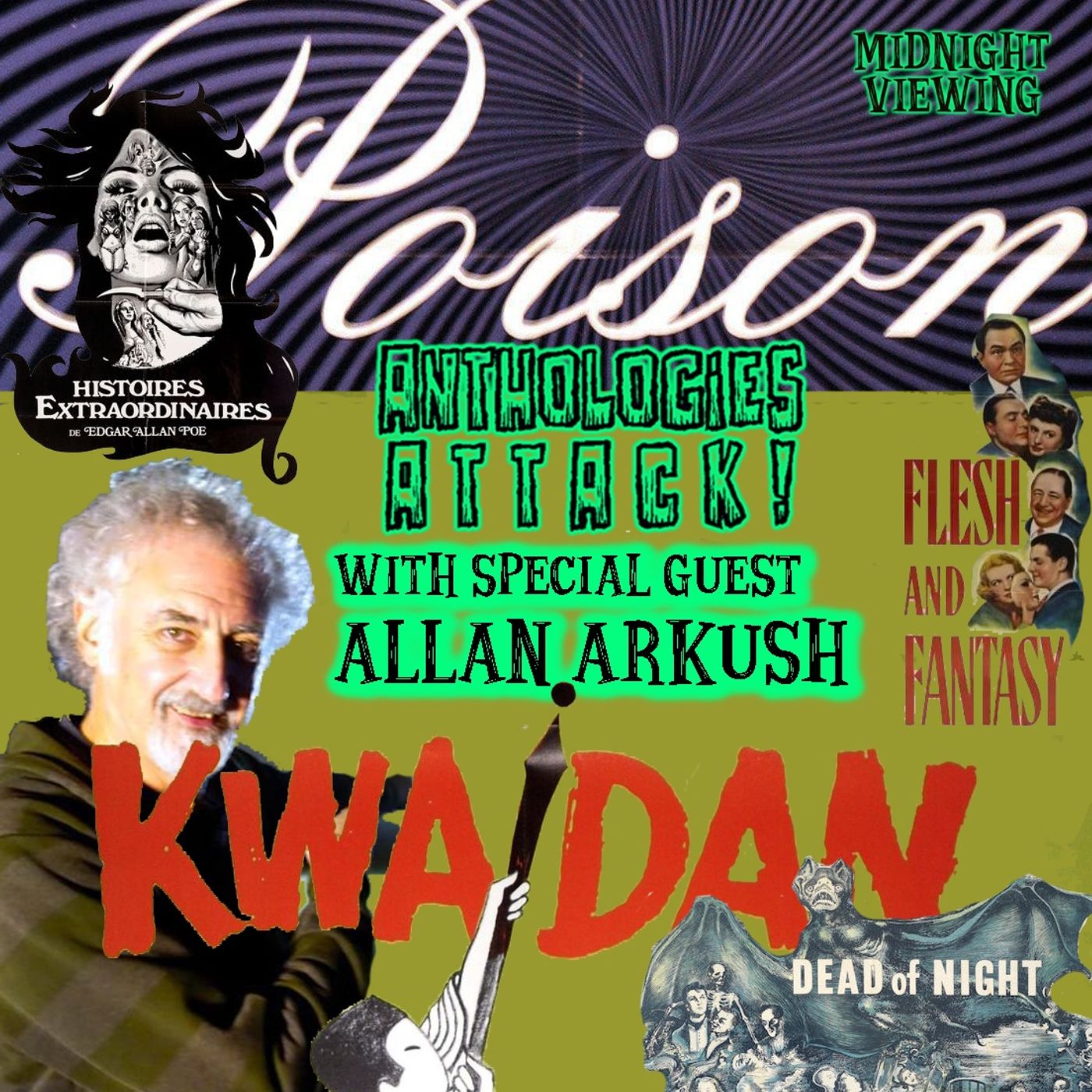
About this episode
00:00 Introduction and Tonight's Theme
00:29 Introducing Co-Host Allan Arkush
03:24 'Flesh and Fantasy' (1943)
05:23 Anthologies and Their Evolution
15:36 Exploring 'Spirits of the Dead' (1968)
29:59 'Dead of Night' (1945)
33:57 Discussing the Ventriloquist Scene
34:43 Mirror Segment and Gentle Horror
35:27 'Kwaidan' (1965)
43:23 Working with Roger Corman
53:39 Screening Vertigo for Truffaut
57:24 Todd Haynes' Poison
https://trailersfromhell.com/deathsport/
https://trailersfromhell.com/a-bucket-of-blood/
https://trailersfromhell.com/eat-dust/
https://trailersfromhell.com/eight-and-one-half/
https://trailersfromhell.com/far-from-heaven/
https://trailersfromhell.com/the-trip/
https://trailersfromhell.com/wild-boys-of-the-road/
fathermalone
fathermalone71@gmail.com
patreon.com/fathermalone
Transcript
Automatically generated, so expect the odd misheard name.
We're in Waybia. Welcome back midnight viewers. I'm father alone and you're listening to anthologies Attack Where were you examine anthologies of every genre media, not just horror. We like to fancy ourselves sophisticates here at midnight viewing a broad spectrum of entertainment is our goal. Now having said that we're doing five horror anthologies tonight, we're on a portmanteau pilgrimage, a short form sojourn.
But I can't do it alone. Antonio Lapour, my regular co host, is recovering from the forty eight Hour film project and he'll be back next week. So I called in a ringer. I'm not going to call you a guest. I'm going to call you my co host because it makes me feel like it's all My co host.
Tonight needs no introduction, but I'm going to delight in presenting one anyway. I bet everyone wishes they had seen the Doors perform live, or led Zeppelin or Janis Joplin. Well he did, and not from the cheap seats. He was in fact part of the crew of the legendary Fillmore East. From there and NYU Film School found his way west where he became part of the trailer department of New World Pictures.
By trailer Department, I of course mean him and Joe Dante. That's it. New World is, was, and forever shallby the domain of mister Roger Corman, a man who knew a thing or two about horror anthologies. It was there that the beautiful taglines like Ron Howard pops his clutch and tells the world to eat my dust were born. At that boy, I miss true exploitation.
Yes, he's a music man, a whiz on the flatbed or will you guys be using. Movieola's movie all Is? Then? Okay? My co host Tonight is equally a dent behind the camera.
Over the years, he's done incredible work both theatrically and on television, helming episodes of Fame, La Law, Moonlighting, Parenthood, Dawson's Creek, Ally McBeal. I'm skipping a lot. Go read his IMDb page if you want to grow a lot older, which is of East End, Nashville, a series of unfortunate events. I love that fucking show. Sonenfeld is wildly underrated, I think, as well as an episode of Twilight Zone eighty five, which we covered on this very program.
He also made TV movies like Shank Rattle and Rock, Rebel Highway, The Temptations, and Elvis Meets Nixon. Theatrically. He made Hollywood Boulevard with Joe Dante, Death Sport. Are you credited on that? On Deport?
Yes? Okay, Heart Beeps with Andy Kauffman, Rock and Roll High School, and my personal favorite nineteen eighty three is Get Crazy. He's a writer, director, actor, producer, a massive foodie, a professor. That's right, prepare to be educated, dumb dumbs. But about above all, he's a curator, which is a position we'd need more of these days.
Someone willing to collect and disseminate all the gems. Look at the vast collection of mixtapes he's amassed over the years, or the vast collection of vinyl he owns, or his vast collection of films, And personally, when I found myself stranded alone in Nashville, Tennessee for a few days, he provided me with the most comprehensive list of everywhere I needed to eat, and let me tell you, every single place was a fucking treasure. Midnight viewers, it is my deepest honor to welcome to the show, mister Allan Arkish, welcome to Midnight Viewing. Allan, thank you very much, thank you. I appreciate it, my pleasure.
What are we talking about tonight, sir? I there was a request for anthologies and horror anthologies. Yes, indeed, and you provided five A history of the horror anthology up to nineteen ninety, which is fantastic. I love all of your choices. One, however, particularly delighted me, and that we'll get to that one.
Do you want to do these chronologically or jump around? I surprise me. Well, let's start with the gentlest of them all. Let's start with Flesh and Fantasy from nineteen forty three. Charles Boyer, whose dream became a living nightmare.
Barbrus Stanwick chained to a deep dangerous secret. Edward g Robinson under compulsion to kill Betty Field, wanting yet fearing love. Robert Cummings taking beauty where he found it. Robert Benchley, who tried not to be afraid. Thomas Mitchell, who peered into the awesome future, Charles Wynninger, Anna lie c Aubrey Smith, Dave May Whitty, Edgar Barrier in a drama.
Of love, of hate, of terror. Of volcanic emotions that change eight lives. I had a dream too on the boat. Oh now, while I was asleep. Maybe it will come true if you want to do it.
Will I've never wanted anything more in my life. I had all things. It's sometimes better not to know. Spig Cark Man, what is in my hand? That's up?
Stars out tonight, King, Perhaps they're telling us something. I think we should listen. Now there was an whole omnibus spree going on in the studios then, right, yes. And the director of this, Juliane da Vivier, is a very stylish director, and I think he did a couple of different anthologies. And well he had done in Manhattan directly before this, did.
He really I'll pay that's it, that's it, yes, and tells him Mantan is pretty damn good, you know. And I just kind of like a stylish work I haven't seen, even though I bought it. I haven't seen this in like twenty years or so, thirty years, so my memory of it is very dim. Absolutely, okay, tails of Manhattan. It's we get a wrap around story, which initially evidently there wasn't.
Card I know, I'm talking about flesh and fantasy. Oh, flesh and fantasy. What did I just say Tales of Manhattan? Oh yeah, no, No, Flesh and fantasy is what I mean. Originally supposed to be four tales cut down to me, and initially there was no wrap around, but at the last second they threw one in with Robert Benchley who he and another fella are telling stories back and forth about the ris they've had and weird things that they've encountered in their life, and that gives us three segments.
The first one is the one starring Betty Field where she's a homely woman who's very angry, and it's during Marty Grass and there's a voodoo festival going on, and she's given a mask that makes her beautiful, and I think Robert Hutton falls in love with her. So Twilight Zone, isn't it. It's so and so EC Comics, Like for EC comics, they would do that one almost like word for word. Yeah yeah. And the thing about the Viva also, he's he's really got a great eye and I think he just where he puts the camera makes things more interesting.
Tells of Manhattan being a great example of that. And and that's the images. That's what I remember from this and these great cast Thomas Mitchell. You know. You know what's interesting about these anthologies, they seem to be very fluid in terms of how they were made.
They went through a lot of changes, and when one section was better than another, they may bring back that director or that writer team to do them, you know. And also they pretty much represented in a way that doesn't exist anymore, the studios that made them. You know, Palamont Pictures did six of a kind and a whole bunch of them, and they were basically every star at Paramount, you know, and they have a director do two or three of them, and then if something worked out, they might add a wrap around or they might do another chapter. So it's interesting in how it's the only kinds of film then that had so much again that word fluidity of how they changed along the way. It's not unusual obviously in a TV series today, because you'll go back and do reshoots, or you'll go back and recast.
But I think this was probably that the anthology was a bit of an anomaly in Hollywood at the time. Yeah, you know, they seemed to be sprouting up and then you know, well, obviously once television came around and you could anthologize television, so you've got Twilight Zone, you know, the Future and such. They became less necessary. But I think the fans of anthologies are hardcore fans of anthologies, and certainly the ones we're talking about inspired entire generations of filmmaker who love the form and no matter the public's taste of it, want to keep trying the form and the fluidity of it. What you're talking about is so good because you know how many times, you know, you spend what years of your life getting one film off the ground, where you get one story and you know you're married to that for years and years, and here it's like, here's forty minutes going down in a completely different style.
We don't really care. It's you're only holding one piece of the puzzle, you know. And you know, when you look at the amount of films people made, I mean, in the early thirties, A Warners directed by the name of William Wellman, did a lot of good, good movies. I think he made five films in two years and they were all pre code. And I think one that your fans would really like would be called A Wild Boys the Road.
I don't know this one. Wild Boys at the Road is the story of teenagers at the beginning of the depression and they realize that the parents can't afford to keep them in a sense of they the parents are so strapped and losing stuff, they decide to run away from home as a group to save the parents' money and effort. It's like Counsel and Gretel. Yes, And they hit the rails, okay, And there is a lot it's shot on location, a lot, and there is a lot of very harsh action. There's actually a rape scene in it.
And they end up going to these stops on the train where there is a whole community of lost teenagers and in these encampments. Now have I not heard this movie before? And it's got Frankie Darryl in it, and it's really it's really excellent. The studio made them make a change at the end. And the original version was very down like these kids in no Future, and the studio made it like, oh, everything's okay, the government's going to help them.
Sure. But I got on that topic of William Rowman and how fast these movies are made. Well, you know, certainly in the case of Flesh and fantasy that you know, this is a chance for one of my things, my favorite things in the world, which is sophisticated Edward G. Robinson. Oh yeah, everyone remembers the caricature, the bugs bunny impression of Edward G.
Robinson, the gangster, the thug. But anytime he considered put on a tuxedo and speak it like the man or born is really a treat. And we get a lot of him, We get double him here because it's him and his reflections. Yeah, and he he really as an actor had a very broad range as a sophisticated man. You have The Woman in the Window by Fritz lang you know, which is as good as Noir as ever talk about a surprise ending, you know, and loaded with Langy and paranoia, and that's a really good Edward G.
E Robinson performance. And then you have Scarlett Street, where's kind of a middle class guy who is not as much of what he wanted to be in life as he'd hoped, and he gets entangled with a really bad woman who takes him for everything he has and claims to be a painter, takes his paintings and sells them as her own. It's a fascinating movie. And Robinson is tragic in that movie, you know, So is this the end of Rico is the little Caesar guy? Yeah?
Man, but here but yeah, just a downbeating fella. We've covered him. He was in an episode of Night Gallery season two. Messiah is doing Mott Street where he was heartbreaking in the performance of the end of his Life old man. So yeah, to see him here too.
And you know the effects in this movie. You're speaking of the way this movie was shot with Julian da Vivier, it really sumptuously shot shot obviously, this is shot on the back lot at Universal, but it doesn't feel that way ever, And whenever we're on a sound stage, it never it's so beautifully list. This is a black and white movie that feels as rich and ravishing as anything we were getting in technicolor later. Yeah, and it takes place in this country that I call Hollywood, USA. Okay, there is a Hollywood Hollywood movie.
Now. I don't know how to break this to you, but Casablanca was not shot in Casablanca. Yes, I know, I want my money back, how dare exactly? You know? Trickster and Shanghai Express was not shot in Shanghai, Morocco not Morocco.
And this is a style of movie making where you accept the world creation of it and it it gives you a context for the ultra melodramatic parts of the story and the script. And I think that really really helps flesh and fantasy, you know. And in a way Roger Korman tapped into that with his poem movies, you know, I agree with that. Yeah, yeah, And they are the set deck and everything and the similarity of it from film to film makes them feel anthologized because their stylistically so consistent, you know. They do's Corman's poem movies in particular, feeling like all of one volume, like an anthology of anthologies.
Yeah, it's incredible in a way. I think it's Tomb of Ligia's shot on location at a castle. Oh yeah, with a with his tiny specks. I'll never forget that Vincent specs in that graveyard with the glass coffin. That's that's a really good movie.
And so is Mask of the Red Death. I think most people point to that as a highlight. I certainly think Mask of the Red Death is the best poem movie. It might be my favorite Corman movie of all time. Honestly, can you guess what mine is?
Can you guess the two that are my favorites that he directed? That he directed? Oh god, ah jeez, uh oh no, please please just tell me, because my every time Roger Carman, I think of Little Shop of Horror, I think of the lesser okay. Bucket of Blood. Oh my god, Yes.
It makes sense. Yes, it totally makes sense for you. One, you know I have to make in order to make art, I have to kill and Dick Miller with the beret. Come on, Oh, it's so perfect. You're right, Okay, that's one.
And knowing my background and rock and roll and so forth, would it be the trip? The trip? Wow? Listen, I know a lot of people from your vintage tell me that movie is terrible. I love that movie, and it isn't.
Okay, it's the distance from it has made the dialogue a little laughable. Sure, I actually think it improves over time. Honestly, Yes, yes. In a weird way. And anybody who dropped acid would probably think twice to have Bruce Dern be your guy.
I think in regular being. Yeah, you know, it's psychedelics and there's. A line in it that Joe Dante and I just love this one section. So Peter find that starts flipping out, you know, and he's taken off all his clothes and he runs out on this balcony overlooking Laurel Canyon, and Bruce Dern thinks he's gonna jump right, and he's going crazy, kind of typical acid trip stuff where you panic, and he's and he's helping him into the house and Bruce Den says to him, come on, let's go in the living room. And Peter Fanner goes the living room.
The living room, Bruce Dern laughs and he goes, why are you laving at me? Well, it's funny, goes, you're weird man. So Joe and I always you go the living room. It's so much like on acid where things take on extra meeting, you know. You know what, perfect segue.
Let's jump to another flick, shall we? Let's go to Spirits of the Dead. His Extraordinary. An outstanding cast dissects to Me of Terror, starring Bridget Bardeaux Alene Delanne. I proposed double or nothing, anything, I'll have you.
She gambled with life. He was fascinated by death. Terence Stamp, a man at war with himself to me, the devil is true. Jane Vonda, Peter Vonda. She owned the world, but found herself possessed by a love stranger than madness.
Who do you think you are? A happy man? A passion as consuming as hell fire, an extraordinary adventure, exciting, erotic, shocking, beyond your wildest night bears. Only the tortured genius of Edgar Allan Poe could conceive this orgy of unspeakable horror. Ridget Bardoux, Elene Delongne, Jane Fonda, n Stamp, Peter Fonda.
This is from nineteen sixty eight. Nineteen sixty eight. This is a trio of films directed by a couple of filmmakers. Some people might have heard Roger vadem, Louis mal and Federico Fellini alling tales of Edgar Allen Poe the first who. To be fair, it doesn't live up to its potential.
I saw it when it came out, and I've watched it again a couple times, and each time it doesn't quite I think it's the Roger videem one that is basically is, isn't my wife gorgeous? My wife being? You know? Jane Fonda? And how can I do the horniest movie possible with James Fond.
I agree with you about it. However, that happens to be my favorite segment of the oka. I actually think it's the most successful, just just on the level of Poe always dances with this weird marrying your cousin attracted to your family theme, right, And it's been that's a brother's sister thing, right, And it's been portrayed a lot in a lot of his movies. For the first time ever, you've got the full impact of it here when Peter Fonda and Jane Fonda are flirting with one another. It.
I hadn't seen this movie in for years and years and years. Like you, I did not like it the first time I watched it. Watching it now with that level of weird ironicism, God Jesus Christ. Well, I watching it again, I was struck by how fake it is, you know, and in a way that it doesn't overcome it. It just is like, I'm it's like a fairy tale but not.
You know, there is nothing real about it at all, which is not a bad thing. But at a certain point, you know, they're all running around, they all look perfect, they change their clothes for every scene. You know, everyone's lying around eating grapes, screwing each other. Yeah, what you're describing is great. Continue, I guess so.
And the dark haired woman that they seduce in the beginning and I can't figure out from the credits who she was is just stunning. Everyone in it is stunning. And they're always and then galloping through the countryside. There's lots and lots of galloping. If you want, if you have ever yearned to see Jane Fonda on a horse galloping on a beach, this is our movie.
Okay, And all fairness, you and I have to give credit to what a good horse woman Jane Fonda is. Oh my goodness, yes, effortless. Yeah, she's like Ben Johnson or something. You know, we just broke the bank. We went right over everyone's head.
Good, you go look it up. I told I said, you're going to be educating everybody. I think if you put a Winchester in her hands, yes, she would outdo Ben Johnson. Okay, let's really get obscure. Okay, yeah, please, Jane Fonda horseback riding in Spirits of the Dead is as good as Ben Johnson's horseback riding and wagon master.
Now you got me, I just don't me to one of the dumb dumbs now Wagon john Ford movie. Okay, Man Johnson is sent to get help, and it's a sequence of shots galloping across Monument Valley. Naturally, it's really him on the horse. And what makes it stand out is how it's edited. The woman who edited Dorothy Spencer, I think it was Drothy Spencer is one of the great editors of all time.
She worked Forget This Hitchcock, Ford and Aren Slubitch. I mean really, And what she does is as in the galloping, she jump cuts Ben Johnson from place to place and it's just brilliant. In any case, it's a great horseback ride. And he was originally a wrangler on the Ford film. That's how he got his part.
Wow, I didn't know that about him. That's fantastic. Yeah, you know. The von Deem segment here to me felt like he had watched Mask of the Red Death and thought and thought, more go go Boots. Thank you.
That's exactly more go Go Boots. And I want more nudity. I want to get away with what I can get away with. This is Europe. Then that film has more go Go boosts than Barbarella.
Oh, I actually think Spirits of the Dead might edge out Barberella. Okay, okay, it was it was enough. For me to go go go boots in my notes. Now, the next segment is William Wilson. This is Louis Malls segment, who evidently was not pleased that he had to do it in the end.
He wanted other casting. I guess okay, Elaine Delon was not his first choice, and I think that's totally insane because who could be more perfect for this role of I know. And the thing about it is, you get the feeling that, you know what's interesting you say Louis mal did not like it. It really feels like it was a party he was invited to and then wished he could go home. That's exactly what it feels like.
You now, he came here to make a serious movie and it wasn't gonna happen. You know. Sorry, it's still a twin attacking his twin, but you know, and a horrible person to boot. It's exploitation no matter how you dress it up. Enjoy enjoy it.
Yeah. Whereas the Felini one. Yeah, let's talk Fellini, Alan. My Fellini knowledge is wofully deficient. I know, I think I had an allergic grin.
I gotta go. I've got to meet some people who know something about film. That's unfair. Look, I've seen the strong I appreciate, I know, I know, but I feel bad. I actually feel guilty.
This is the one sort of area that the surrealist cinema just never really clicked with me. And I think the reason why is having grown up in the age of industrial light and magic, I wanted my visual effects to be seamless, and so when they're when they're going for artificial, my mind recoiled. I'm over there. Now. Let's do this briefly, now that you got me here.
Okay, for you and other people who haven't dipped their toe in Fellini, let's do it real quick, all right. You might want to start with Eva Toaloni, because Eva Tolloni was actually somewhat remade by by Martin Scorsese as Mean Streets. Eva Toaloni is about a bunch of friends who have reached a point in their life either grow up you know, or don't but petty gangsters and so forth, and one of them leaves town and a beautiful ending sequence and that's Fellini, So that's a great place to start. Lestrada is a great date night movie. Now I saw it, yes.
Exactly, and it's so touching and lovely, you know, and it's about a sad clown sort of you know. Nights of Cabiria has been remade as Sweet Charity and it's a story of a prostitute with a heart of gold and her life tries to crush her and at the end when she embraces life. It's one of the most beautiful ten minutes of film. You can imagine another movie that won't won't stretch your your brain into exploding. Okay, I'm definitely award to that.
Sweet Charity is one of my favorites of all right. So now we're getting into Lud del Tvida, you know, which is all about a decadence and to the point of where it's three hours long and it's a fascinating movie about the sixties in Rome, and it invented the concept of the paparazzi because that's essentially who Marcello Mostriani is. He's like a paparazzi. He's like a reporter for page six of the post. It's all about that, and the things that they cover are not just the wealthy and the rich paparazzi stuff, but things where these children have seen not Jesus, Mother Mary, and so press are trying to are waiting with her and these kids in this field for Mother Mary to appear again, you know.
And it's all about decadence and beauty, and Anita Ekberg is in it, and Rome is dazzling, and some of Rome was created on the movie set on set, so it's really the one that everyone made Felleen from being merely a very good director and he had been acclaimed before that movie into a worldwide phenomenon because it was so strikingly original. And it's in one of my favorite formats, wise screen black and white. Oh yes, and every composition is like, oh my god, I wish I had this on my wall, you know. So there's that, and it has the famous scene where Anita Eckbert goes swimming in the Trevi Fountain, which to this day when you go to Rome as a line, there's a crowd ten deep, you know, and then of course you have eight and a half you know that you've seen Now how many times have you seen it?
Once? Okay? It was during this period where I was trying and I was just like, I put this away for a while. I'm the frame. Same with Frank Zappa.
I can't get into it. I'm sorry. Yeah, that's an interesting comparison. I saw eight and a half on a double bill when I was in high school, and I really wanted to study film, but I was not getting any help from anybody because there was only three film schools. My father thought it was a terrible idea.
I don't need to go into my life story, but basically. I'll tell you on I don't care. Yeah. Yeah, So my friend and I went cut school, but technically we hadn't cut school. I want to make that clear.
Now, limitations is up? Yeah, oh all right, Well it was a Jewish holiday, okay, okay, And we saw this double bill Breathless, the Jean Luca darg and eight and a half, and halfway through eight and a half, my brain exploded. I was going to say that you had no knowledge of New Wave or any of this kind of cinema before this, right. And only the Vegas, you know, because it was happening, and I was reading early film books and I had gone my father had recommended that I see this movie called Citizen Kane, so I had seen it on TV. And then I realized I was playing in a theater downtown and Greenwich Village.
All good things in my life starting Greenwich Ville. And I went to the Bleaker Street Cinema and saw Cis and Kana in the theater and it was phenomenal, phenomenal, and there was a thing of coming soon. And I recognized the two titles eight and a half and Breathless, and I knew there was some you know, I was in. This is nineteen sixty five or six, so I was a senior in high school, so I kind of knew this, but I wasn't prepared for this to be as earth shattering as it was. And so to tie in this conversation all together, and to make this a bit of a humble brag, Joe Dante collects movies, okay, and back in the day with Joe, we'd watch movies every night on sixteen millimeter and he had a print of eight and a half come on and it was dubbed into English, which normally would be a sin, but we thought that this was a better verse because Guido, the main character can't decide what great movie he's gonna make next, and everyone is bugging him, and he and everyone all of a sudden realizes that Twido doesn't know what the hell he's doing.
Now. The way that it is subtitles, it's mostly what's said is what's on the subtels is what the main characters are saying. But in the dub version you hear all the background people and it's just like a movie set where people going, Oh God, he's what are we doing tomorrow? I have no idea. He doesn't know what he's doing, and so all that is in the movie.
So I saw that on a double bill with The Trip with Joe Owned right, huh, I love this, right? So these are two Wacker movies guests. Who is sitting on a beanbag chair in the living room with me? Who Jerry Garcia? Uh?
Because the surrealism wasn't surrealist enough? Right? Yes? And also I knew Jerry and Jerry was recording in LA and I knew his Rody Steve and everything, and they had a night off, so they all knew I had a projector, and so Jerry and I used to watch movies together, and so he came by and so we watched Eight and a half and I showed him the trip, which he did not like at all. But he loved Eight and a half.
So what was his complaint about the trip? Per se the depiction of the trip? Yeah, that's nice, of course. Okay, not to keep hammering on, mister Carmaner, you know, but. Who who better?
You know? There's your expert panel. Oh my god, I know, I'm so goddamned envious. Let's jump back in time, shall we, Yeah, let's jump back in time to what I think everyone considers the gold standard. I think if you talked to any filmmakers made an anthology film in the past fifty sixty years, they're going to say Dead of Night was their greatest sat exactly.
Yeah, the Dead of Night. Yeah, no, this pas word at all. Though I've never been here before. Like, since you're looking, sure, do you take milk and sugar? M milk and sugar is to craid?
Mm hmm, milco and sugar, mister craid. Still there? So it isn't a dream this time, I think your pardon, yes, it is a dream, misters wiping out in my mind. You see, everybody in this room is part of my dream. Gosh good already the next upkid.
It not all of us. I've only tell you that when I came into this room, I recognized you all instant having some more pogoss in the newspapers. I take it. Because you may have seen me on the sports paage most of raisings of my life. Mister rasp, Tell me if I think that's why I can be also.
A man who's people who accuse his life. Just you're not accusing me. You are sort of teamed up with him, aren't you? Him? My good man thinks nothing of it.
I'm just about through. With that cheap heam anyway. Oh okay, you'll deciding for this lady, you know, yes, that will job. Let's play a love the game? Yes, frightened?
Who's the high I heard I heard a. Show for one more in my introduction to Dead of Night was okay, so move. For those of you who are too young to remember this, movies were actually shown on TV, mostly all night long at a certain time because TV stations did not have enough programming. So from the early fifties on local TV stations ran lots and lots of movies. They would cut them to ninety minutes, you know, and they would never show them in the proper screen ratio, and even if it was color, it might be shown in black and white.
And that's my film history that in the East Coast there was that, in the Tri State area, there was a show called Million Dollar Movie. And there is not a filmmaker who gets an interview who grew up there who does not mention million dollar Movie because they ran the movies five. Times, five times a week. Right, that's a film education going on, right, Oh god. Yes.
So even when I was in film school, you know, we would compare TV guides what we should watch because you couldn't. Rent it, right, Oh my god, the TV listings was everything. I got to experience a bit of what you're saying. I was born in seventy three, so for me, I still had all the major networks went off the air at midnight or one, and then the syndicated local stations would show movies as well. So I'm living in I'm still in the Joe Dante era, Roger Corman ere of my life, and LA's got Channel five movies kind of all night, and I just used to put it on and I fell asleep one night after somewhere during dead of night, and I woke up in time for the part of it where it starts over again.
That's the best it was. It did everything that movie wants to do. Oh my god, that like they couldn't have made it better? Like what a better experience could anyone have had? None?
Yes, it's a movie, it's not a movie. It's a Mobius strip, you know. Yeah, there's a reason everyone points to this one as that gold standard. Because here's the thing about anthology films. I've been doing a lot of anthology movies over the years, and I can say the wrap around segment is either your most important segment for an anthology or it is the least important segment.
If there's a theme going on, I don't need to be introduced to any of it. But if you're going to take the time to introduce it, then watch this movie and think are we as good as this? And if not, don't bother go back to the other way. Because first, when you think it's ending, the credits start again. You're going, wait a minute, if I lost my mind as the station making a mistake, you.
Know, yeah, it's it really, I mean, you could literally splice it together and just watch. It over and over because it is a loop, you know. Yeah, and this is nineteen forty five in London ealing studios, which main mainly we know from their comedies, and here they decide, let's make an anthology of supernatural horror because evidently, so this is actually forty six, so this is after the war, because there was a ban on horror filmmaking during the war. Nobody wanted to see monsters or spooks when bombs are falling from the sky. Evidently, But we're given this film.
We're given five stories and okay, so what's the first one that comes to your mind? The ventral Quest, the vandrilical I mean it's everyone's answer. Yeah, Hugo, I don't remember much of what happened. Is there were seen in the movie somewhere. Yeah, it's it's pretty late in the game too, so like you've gotten through four or five four stories before you get to him.
Yeah, you know, I tried to find it. It's got a little hard to find, but it is the best one. Yeah, certainly, we're given a character who comes to a English cottage. There's a group of people there and there he tells them this dream he's been having and then they all relate their own stories and they all time. That's right.
So that's the dinner party thing that stays in my mind. Yes, with the German doctor who's there too. Haha. Science will disprove all of your theories. I want to point out there is one actress in it.
There's a segment in it about a mirror that when a character looks into the mirror, he's looking back in time everything in the mirror. Yeah, it is a marvelous segment. The entire movie is perfect for sort of gentle horror. That is still incredible. It does, but there's a feeling of dread about it, Yes, and that feeling that the Twilight Zone used to capture.
And I think it captured because the theme was so evocative, because the music, the way the music would hand over the story with that bump up on, you know, the music and the format contextualized it and made you feel concerned no matter what happened. You know, you knew that nothing was gonna captain That was. Good, right, And what I particularly liked about this one is the lack of music at times, the very conscious effort to let a scene play. I was talking more about the Twilight Zone men, No, because no, they're doing a lot of that too. There are moments of here it comes folks in dead of night, but there are just as many quiet moments that I just found speak.
We're going to see that a lot in quiet On as well. Quite On is a movie that I don't watch for the story. Okay, you don't read the Bible for the pros. No, it's just this world that's created on stage and the fact that there is no music, you know, that it's so quiet at times, and on and on, and that the wide screen cinematography in a way, you know, going back to Fellini, Okay. One that stands out in the later period after eight and a half is am Record.
And I haven't seen a record I like ad. Yeah, And I worked on the trailer for Amorcord and so that was during my Corman years. And there is a sequence in there where they're always talking about this great ship that's going to float by, and when you see it, it's clearly made out of wood and the waves are plastic that's been waved up and down, right, But everyone the music, as Nino wrote there, and so grand and wonderful, you know, and The phoniness of it is what makes it. Everyone acting like this is the most beautiful thing in the world, and so you go along with it, And that's kind of the qui don aspect of it. It's incredibly beautifully made, and the reality of the sets and everything has nothing to do with anything, right.
And here's where I think I could get into quite on much easier than it could anything with Fellini, because this is way more impressionistic than surrealistic in the way it's much more theatrical than I think Fellini was going for. Where here it's you know what's funny is I was about to say it's all artificial because it's all soundstage, and I rewatched the movie night, and that's not true. There are scenes fully shot in forests, and there's a there's an entire like horse riding sequence with archery that takes place outdoors. But the stuff that takes place indoors is so well controlled and so book beautifully realized. Just the backdrops, these giant glowing eyes watching over everyone.
Yes, it's so of its own piece, and I've shown sections of it to my students and they are impressed with It's a very hard movie to excerpt because everything takes a lot longer than you think it is because you're so engrossed and trying to figure it out, you know. And it's a ghost story in the way that there's a Kersauer movie. No, I'm sorry, it's miss a Gucci movie. Who gets it's a ghost story. You don't realize it's a ghost until it's too late.
Right, well, speaking of a kirakur sal and now he made it his own anthology film called Dreams. Yes, I have that right here on the show Yeah. In the late nineteen eighties. And in that he has a story about the Yugiona, which is basically the same story we get here, which is about the woman in the snow. This is a story that has been repeated a lot in a lot of anthologies, obviously quite on.
All of the stories in it are based on Japanese folklore, but that one seems to resonate. It keeps getting made over and over again, including up until John Harrison's film Tells From the Dark Side of the Movie did a version of it with Gargoyle and James remar as a sculptor where he has to promise not to reveal this gargoyle that segment. Interestingly, you said it's hard to excerpt this movie. When they first released the film, they found it too long, so they removed the woman in the snow segment right, which is madness to. Me, of course, removing anything right.
And while rewatching it, I kept thinking like, okay, what do you cut here? And as it plays out, it doesn't matter like you're either buying this movie or you're not. It's it is you're not watching the plot. It is this feeling. And what a crazy esoteric feeling he's given you.
I understand Kobayashiki, Masaki Kobayashi, who was the director of this film, like like he painted those backdrops himself. Wow, we are not worthy. I mean, have you ever seen the shot drawings that Krasawa did for Ron, I mean their paintings. Yeah, and almost every frame here is a painting. It's sumptuous, it's it is an embarrassment of riches.
Like this is a movie I think I watched once a year, and you know, it's funny. I can't some of the stories. I couldn't even even tell you what happens in them. Exactly exactly. By the time we get to the last water looks in it too, and yeah.
Yeah. By the time we're getting to a c but te, I'm like, what is even I don't know, I'm so lost in this world. I just continue. You know who loves that movie? Oh shit, there's a DP and he also a director now and he shot do the right thing.
You're talking about Ernest and Dickerson. Ernest, Ernest loves that movie. I'm trying, you know, Ernest Dickett. I'm on my main feed of the show. We're covering Tales from the Dark Side.
Ernest Dickerson was a DP. That was his first gig. We talk about him a lot. He is a fucking amazing filmmaker and an incredible DP. All of the stuff he did in Malcolm X, I want to go check that stuff out again.
Man, all the stuff in Mecca. It is incredible. And he's a very I mean, he's a really good director. His episodes of The Wire and The TREMEE and that zombie TV series, and we work together on Heroes and a bunch of other stuff. He's a trailer from hell guy, you know.
Oh yeah, certainly, Yeah, that's I'm going to plug that again at the end of the the show as well. I have a thing in the comments section for trailers from Hell, where you all guys are the trailer gurus keeping the trailers alive. I love trailers. When I was a projectionist, I was a predictionist in Santa Monica for the nineties, basically at the New Wheelsher Theater, and we had boxes and boxes of trailers, and if I had time alone in that movie theater, I built up fucking four hours of trailers and sat there, you know, put them on the platter and just let it run. Anyway.
Yeah, for me, making them as a real joy. You know, I love the film history aspects of it, and because I have edited so many trailers, you know, and know the form really well when I'm doing it, for that I have that rhythm right away. I have that sense of a little bit of what the movie is narrator, A little bit of movie is narrator. You know, what's what's your favorite trailer? You cut?
Favorite trailer? I cut? Good point. Okay, I really like Eat My Dust. Okay, yes, all right, I like that.
One a lot. I actually like the trailer, but not the movie of death Sport. Because speaking of the movie you directed, Yeah, okay, RCT. And especially all your people. You don't have to look at the trailer.
Just go to my trailer from Hell and that describes the experience. And as well, go to my trailer from Hell about Tufaux small change. This is kind of the thing that you might find really interesting. So Joe and I start at Corman in seventy four, spring of seventy four, and so we're cutting the tarts and Roger had just started his own trailer department instead of forming it out. So you know, got to keep the costs down.
What you got to keep the cost down? These kids are willing to do it. And his assistant said that, and that was John Davison. And John and I were at NYU in the film woor together, and John had begged, bar begged his way into getting a job on Jonathan Kaplan's first two movies where Roger Jonathan was the first of the n YU guys. So he says, we should just have someone on staff rogers get some film suits, you know, So he gets Joe and then they realized that it's too big, so they ask me, So now that's the trailer department.
John, Joe and I and we had to figure out how to make the trailers. Remember we had we had experienced a sixteen millimeter. This is thirty five millimeter. This is a form we've seen, but we have never done. So we have to come up with a methodology that fits in with the cost of what's what we have to do in a very specific world.
Because, for instance, when you shot a Corman movie, you shot it in color, but you edited in black and white. That's a procedure, yeah, because a black and white workprint was cheaper. So if you don't need color while you're cutting, it doesn't matter. Exactly you were there, you were on the set, come on exactly, and they. Give you two color shots, one interior one exterior.
Okay, so then everything should be fine naturally. Okay, So now we dupe the black and white, so we have something to cut. So we're having a dupe of a xerox. Okay, so you cut the trailer. You remember what it looked like before it continued, and now.
You have to do the TV spots, so you doupe the dupe. So what you have is these abstract black and white shapes moving around, no wonder, Yes, And we cut them on Movieolas, which had one soundtrack, right, So you cut all the explosions and the actions in there, and then while it's playing, you recited the voiceover. In the voice of the voiceover guys, you know, so it's tmt Jackson, She'll put you in traction. And we got good at imitating them, and that's how we cut them, you know. And Roger would come down to the editing room.
And there's one of these things as total bullshit as executives who say I can see a rough cut, I know how to watch it even though it's not finished. They don't. They have no idea. And now, with Avid and everything, you can do eight nine tracks. But Roger would stand there watch our black and white dupe with one track and have us stand there and read the narration and give us very specific notes.
And right, I bet what and I bet they were correct? They were absolutely correct. And since we knew his films, it gave us a leg up on what kind of thing he wanted to be selling. He didn't have to explain it to us too much. And what he did explain we caught on with really well.
And plus you had films by Jonathan Demi for instance, you know, and stuff, so that went along pretty well. And he had already bought Cries and Whispers, right, which I don't tell anyone was originally called Whispers and Cries, but we kind of screwed. It up anyway, Okay, that's what Criterion collections are for. Yeah, and so now he calls us up and he says, come down to the editing, come down to the screening room. I just bought another picture and I need a day.
We find out we need a trailer for Tuesday. This is like a labor day weekend of seventy four. And we sit down in the room that we've seen caged heat and summer school teachers and candy striped. Nurses and big candy stripe nurses. Well that's a classic, it is.
It's not bad. I'm not kidding. It's a great Okay. Oh wait, not candy striping nurses. Summer school teachers is better, but you know, I'm not get hearing them.
I'm just saying that one's good now. And plus candy stripe nurses also, and summer school teachers have the great Candace rilesome. So on comes Fellini's Amagord and we're like, holy fack, we got to cut a trailer on this. And it ends, and we're like beside ourselves, you know, and finally, graciousness, boys, boys, I know it's FORELINI, but we're still selling sex and violence. So I want the woman with the big breast, I want the racing cars, I want this and that.
And so we had a copy of this movie and we had to dupe the whole movie. We didn't have any separate tracks to mix. We just had to use the track right off the optical and had to cut it in over a weekend. It's one of the best trailers we ever did. So what was came very apparent is that this was a very fortuitous moment for Roger and his ambitions as a distributor, producer and us as young filmmakers.
We knew a lot, and he knew then that we knew a lot, and so it allowed him to have a shorthand and it allowed us to gain trust so that we basically there was two parts to the world. There was Roger's offices and all that, and there was the editing rooms, which was a power center because everybody cut their movies there and everyone would would talk at lunch about, oh, Roger wants this or that, and we would interpret you know, right, and it was a very great place to be for five or six years. You know, it's is how long we lasted there. And so when he brought us to foes Small Change, now we had already done adele H, you know, which is a very serious movie and a very straightforward trailer. Now we had we looked at Small Change and you know, it's a charming, wonderful movie and it's little kids, you know, And inevitably afterwards, in the session of toy, what are we going to sell?
It was a yeah, he was a car chase. Yeah, it was not at that We're well passed the point where he would dictate to us, you know, he would we would go back and forth, and we said, well, there's a scene where the kid falls out the window, but we put that in the trailer. It's so disconnected they'll think it's the wrong kind of movie. And so I said, well, look, this is a small movie, it's an art house movie. Let's sell Truffaux.
Let's just say this is a true faux movie and that every kid in the movie is like a character out of Truffaux, because he's a true auteur. So that's how we sold it. Now we said, we'd show a shot of one kid. We go, this is like Jean Pierre Leode and we put a show in, you know, Love on the Run or whatever. And that's kind of it now to have an executive of a company who owns the company understand what that wants a well and sign off on it.
Now, you know, yeah, you're not going to get that at Paramount in the seventies. Michaelser isn't going to understand that. No, And so we cut the trailer and Roger really likes the trailer and we're talking about a week. That's what you had to cut it. And he says, Truffau is going to be in town and I'd love to have you show him the trailer.
I said, he is, I'm gonna jump out the window. It would be great if he if we could get him to narrate the beginning of the trailer, no precere. It's all about his stuff, you know, it's about him. And and he goes, oh, we'll ask him. And we asked him.
And now your foak comes to the New World Pictures editing room. I love this story. Isn't this too much? And he watches the trailer with us, and he goes, this is very good, this is better than the French trailer. And then we take him over to the sound place and he does his narration.
We're big shots. We're going to take your foe out to lunch. How how hard are you fucking high fiving Joe after him trailer better than the friend. We usually went to lunch at Los Burritos, or we got hot dogs from the bowling alley. You know.
Hey Man. Went in room, so we all we paid for him to go. We had lunch with him at Hamburger. Ham Oh, I love Hamburger. I loved Hamburger Hamlet.
Yeah. So we're sitting there the whole time, and you know it, you know the book Hitchcocks Your Phone, Yes, And so it turned out to the Hitchcock your Phaue New World. We just ask him a million questions and so forth, and questions about small change you could only know if you've run it on the movieola, you know. And we said, okay, well, thank you, and so we can see it's like enough, guy. I appreciate the respect that I'm tired.
Now, yes, what can we do for you? You know? And he decides, I think to put us on, you know, and he said, what can we do for you? You're in town for like another day, and we'd love to reciprocate you know, your kindness. And he goes, well, I would love to see a technicolor I'd be technicolor print of Vertigo.
And this was at the point where Vertigo was not in distribution. And at this point in the seventies, Hitchcock had pulled Vertigo to catch a thief rear window and a couple other ones out of circulation, so they were not available. So he wanted a unicorn from you guys. Yes, And Joe Dante says, oh, I can get us to print the Vertigo, and he says, but it's thirty five we got so we need a theater to run it in now okay, So there's no money in New World. We know, calling a Roger and say we want to rent the screening rooms, you know, so he called, we called.
Can I just interrupt you for for a second, You guys don't have a screening room at New World. No, this is all movie ola stuff like you were describing. And there was a screening room classics that Roger would pay money to for screenings. But for instance, the director original direct of Death Sport never saw a numeral picture, let alone Death Race because Roger would rent the room. We made the sequel without seeing the original.
Ah okay, so imagine surviving there. I love this. Oh my god, I'm so envious. Okay, so Joe. So we telled John Davis and John and he said, we got this thing and he's going to do this now.
John, we called John, how's the lunch going? You know, how's it going? Maybe John was with us, and I think he probably was. I don't think he can miss this. And he goes, let me make a phone call.
So he calls up the new Art Theater on Santa Monica Boulevard and yeah, and he says, do you have any movies this afternoon that you're screening? Goes, now, it's the theater's empty and says, okay, here's the thing. I noticed this. We're here with France to watch your phone and he wants to see Vertigo in thirty five millimeter, which we can accomplish a Technicolor IB, but we need someplace to screen. He goes, I'm on my way, and we sat in an empty theater and watched it with him.
That's incredible. Can I just ask a questions about the Okay, So, when you're screening a trailer for Roger, let's say, right, and you're standing next to him, you're reading the copy. Right, the next time that copy was read, it was the narrator. There was never a temp of you guys doing it, was there? No?
Okay, I think this is something you guys should do over trailers from hell. You should recut or not recut, but redub all of the New World picks that you guys did, but in your voice. I think yes, I think that would be a treat for everybody. Oh God, our ability to do ron Ganza's voice. You know, I bet you're still right up there.
I need to hear that. What we could do John don Steele too. It's a screaming squeal and smash a thon. You know we could do that and then the smarmy ones, you know, title Wave, the whole country will not Oh wait, I mean here's a good one. Here's a Ron Dan's one cover girl models.
They don't need clothes to strike a pose. I won't have about a million dollar foldouts that never hold out. That one stuck in my head for some reason. Oh, my god, yes are they may be oh wait, they may be under exposed, but they're never overdeveloped something like that. All right, let's we got one more to go.
Now, This, this is the one that actually made me the happiest. No one ever includes this in horror anthology. What it was? It is Poison Todd Haynes nineteen Oh. Yes, yes, you know.
I am a big Todd Haynes fan. As am I. Yeah, as like a gentle provocateur, man like and always an interesting filmmaker to be. And I made a trilogy of Todd Haynes's trailers from hell just recently they've been aired. One was Velvet Underground, which I loved.
It was all about the art scene, you know, the trailer. And he did a great job on that movie. Velvet gold Mine, which I another movie which not a strong plot, but just fabulous and all that great music. And the great world to inhabit. He liked that.
Yeah, Far from Heaven, which goes my trailer about trail from Hell, about the influence of so, I thought, well, I have not seen Poison, and in watching it, first off, it may have supernatural aspects to it and horror aspects to it, but it is so tied to the queer experience that it uses the these horrific elements in terms of queer culture, and it's as such, it's also pretty experimental. So my feeling is that in watching it, it's so early in his career, not all the clips, the sections work as a whole. So what he did was he patchworked them. He goes from one to another, and that's what gives you this sense of overall view of queer culture that he is experiencing, that he is trying to bring to us, And that's what makes it such a bold visual or such a bold statement.
You know. I think the next one was safe was maybe you know, and I think, yeah, I think he had already done the Carpenter's. One Superstar that, Yeah, the Karen Carpenter story, which we're going to be covering soon. So I've been watching that a lot. I'm actually on sort of a time Did you find it through nefarious purposes?
When I lived in Los Angeles, I was a frequenter of Eddie Brandt's. Remember ay, oh, I love Eddie Brandt, me too. Eddie Brand's always had a copy of Caring Superstar, Aring Carpenter's Story. Let's say I might have. I didn't.
They're gone. I I duped it. I have a VHS copy of it. So that's what I'm on. And also sometimes you just forget to return something that happens for twenty thirty years.
If they go out of business and I still have it finders keepers, I figure. I think it's on YouTube. It is, actually it is. Actually Okay, look the thing about them getting pulled as it was, you know, I think nobody cares at this point, now that Richard Carpenter has expired. Yeah, so he was really the only one, and for a specific reason anyway, Poison, Yes, the queer point of view, not only the queer point of view, but the entire film takes the notion of your excluding us and embraces it.
Yes, and so all of that outside exclusion becomes the threat. And and he's using the stories of John Janney here, which yes, that's right. And the Jennet thing is really apparent, you know, particularly with the way that I've read, you know, and I have not read a lot of it, but if you know much about certain kind of literature and the Beat generation and all that, you understand Shannat's place in it. You know, and in this thing that is this overall flavor of what's that called. It's not called rough house sex, but it's leather boys and things like that.
Rough trade, rough trade, that's it, right, doesn't shy away from that. Nevertheless, as I said, I called him a gentle provocate tour. It never feels like an attack. His provocation is just to bear just by showing you the thing. Yes, yes, exactly.
Like I remember at the time this movie came out. This is the first film I saw move after I moved to Los Angeles. I should say that, Wow, I had heard about the superstar. I had heard the name and when I went to USC and as soon as I heard that this film was available, I went. I got on a bus and went downtown and saw people weren't prepared for this movie.
But no, it's like I said, it never feels like it's in your face. It doesn't feel like John Waters like, here's the bad taste of it all. But it doesn't ever shy away from the bad taste. Like you said, the rough trade. Yes, it's part of our culture.
I'm going to show that because we're going to indulge in that from time to time. These other aspects that you find unappetizing are part of it, and let's embrace it. Yeah, it's not unlike the effect of seeing And this would have been years, years earlier Scorpio Rising, you know, the first time you see Scorpio Rising, even though there is not anything bad happening, the implicit threat of these men and this being a sexual thing, and the irony of the pop songs and the way that they are fetishizing what they wear and everything, it has a strong overall effect, which Poison does in its own way as well. You know. Yeah, I don't know.
I marveled at this film at the time, and I think it doesn't get enough love. And his later work is more lauded. And of course the Karen Carpenter thing is legendary, because who gets their movie taken away from them like that unless you work at Warner Brothers these days? Am I right? Right?
And I saw Warner Brothers movie last night which they decided to dump, which is the Clint Eastwood movie. You know, what are they doing now? It's called Duror number two. Oh yeah, and they're just kind of letting it die on the vine. Yeah, yeah, good lord.
They were my favorite Studio Warner Brothers from the Golden Age, like How of the Mighty If and Anyway Poison. They had a great variety of movies and had great producers and. So forth, Row Walsh they had, they had. It was during my pilates this morning, I was watching the Drive by night. Okay, I think we've covered it all, mister Archistra.
Thank you so much for your time and knowledge and entertainment over the years. Oh, thank you. It was fun. It was fun. Thank you all for joining us here at midnight viewing anthologies Attack.
If you'd like to support the show, you can hit subscribe and like and give us five stars and say a few nice words about us on whatever podcast you're listening to Spotify or Apple or whatever. Or if you're feeling a little more financially generous, you can head over to patreon dot com slash father alone, where you'll get episodes early and commercial free end bonus content you can't get anywhere else. Our theme song was composed by HP. We're on the weirding Way Media Network Schools, Stasi, Stasis,
Similar episodes across the network
Matched by shared keywords.
-
Black Sabbath
2 shared keywords: anthology, horror
-
45 - S:7::EP::11, 12 "Confession" and "Ear Today... Gone Tomorrow"
2 shared keywords: anthology, horror
-
37 - S:6::EP::9,10 "Staired in Horror" & "In the Groove"
2 shared keywords: anthology, horror