Full episode
BONUS EPISODE - Tales from the Crypt - Television Terror with writer Randall Jahnson
About this episode
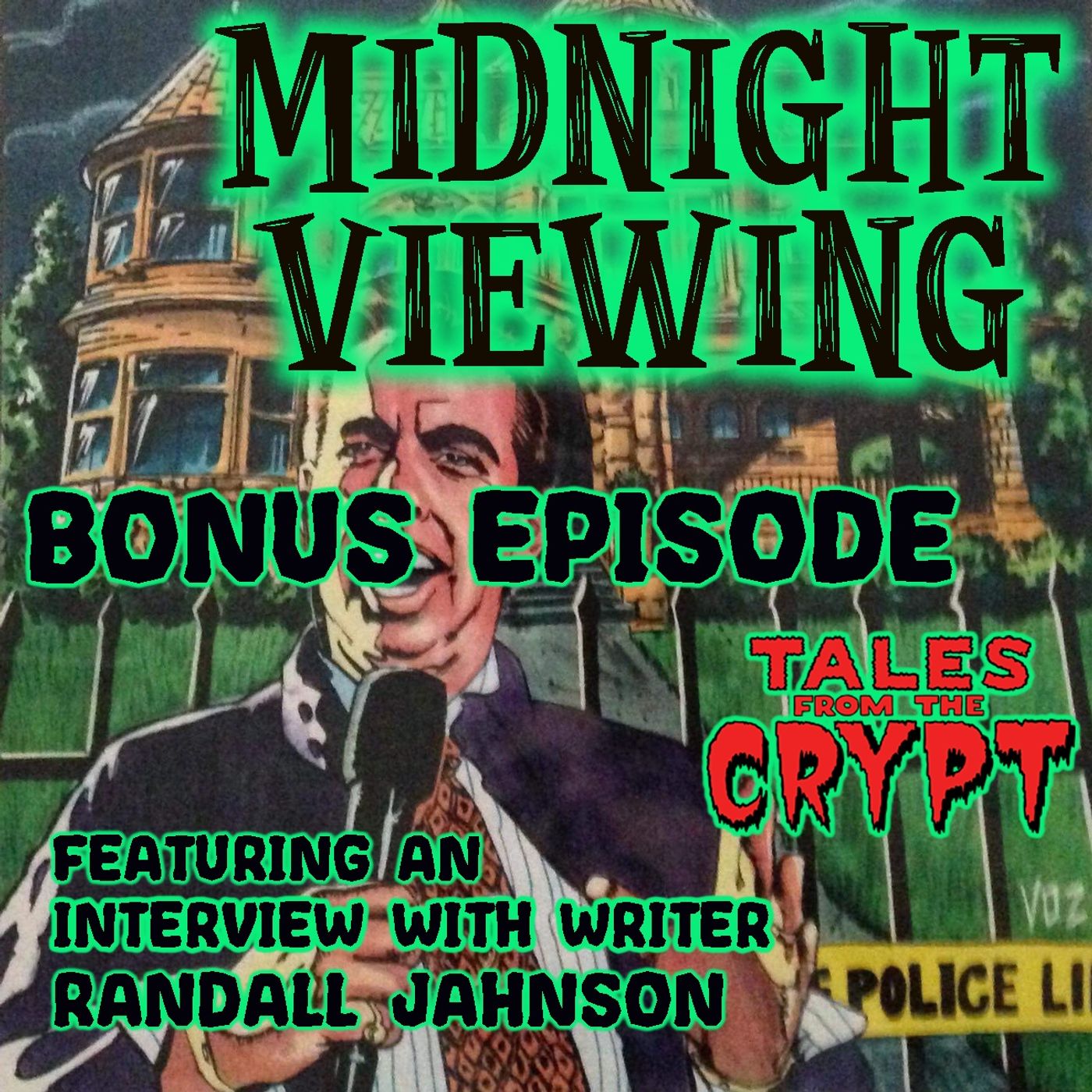
TELEVISION TERROR
Tales from the Crypt
Aired July 17th, 1990
Written by Greg Pruss and Randall Jahnson
Directed by Charlie Picerni
Starring Morton Downey Jr.
Originally published in Haunt of Fear and written/inked by Harvey Kurtzman, Television Terror is the story of a tabloid television journalist and the night spent in a haunted house as yet another ratings stunt. But this is Tales from the Crypt. And here houses ARE haunted. And they don't give a damn about ratings.
Joining Midnight Viewing to discuss this episode is author Randall Jahnson (The Doors, Dudes, Sunset Strip)
Transcript
Automatically generated, so expect the odd misheard name.
Dark Destinations. These may be end times Night's preacher. Why would a few more casualties struggle me because of their blood? Will join yours? A radio drama anthology.
You are wrong how you figure Every mark on Longo is hunting you down. Not you, your partner, he said, I didn't have a ray gun. Full cast performances set in the haunted corners of the globe. Darkness is coming for you. That's the fear that taunts me.
Dark Destinations by fatherm Alone at Weirdingwaymedia dot com. Weird Greetings, midnight viewers, fallom Alone here and I'd like to welcome you to a special bonus series. We've been slugging it out in the horror anthology trenches for years now and felt as though the chaff sometimes overwhelms the bloody weed in our discussions, we've decided to throw a spotlight on some of the more superlative segments from the various and disparate series. To that end, we're heading back to Tuesday, July seventeenth, nineteen ninety where do you gotta group whatever I can? Last time it flew you through the back wall of the theater.
At that moment, the number one film in America is die Hard Too, produced by Joel Silver. It's one of three giant studio action films he'd produce that year, and he'd have another three the followers. Joel Silver began his career as an associate producer on Walter Hill's seminal nineteen seventy nine action film The Warriors, and over the next decade he'd amass a Colonel Tom Parker like Power Over Eighties Cinema, Forty eight Hours, Weird Science, Commando, Lethal Weapon, Die Hard, Predator. If you find yourself nostalgic for the nineteen eighties, Joel Silver had a big hand in that, and as that decade came to a close, Silver partnered up with some Hollywood heavy hitters Richard Donner, David Geiler, Walter Hill, and Robert Simchis to bring to television or HBO.
The first adaptation of the ec comic style were Tales from the Crypt Since the emicis theatrical anthology in nineteen seventy one. In addition to acting as a cinematic playground for established cinema veterans, the series would provide a forum for an entire generation of emerging filmmakers, employing the likes of Fred Decker, Frank Darabant, Terry Black, Mary Lambert Scott, Nimafro, Gregory Wyden, William Malone, and Randall Johnson. We'll get back to mister Johnson in a moment. The first two seasons of Tales from the Crypt were overseen by a trio of producers Suzanne Todd, Marcus Keyes, and William Tyler. Tyler, as fans of Tales from the dark Side, will know was old hat at Anthology Horror, having produced forty episodes of Dark Side.
He'd go on to produce the Jumanji films as well as Zamechis's The Polar Express. But it was season two, Titler's final season on the show that gave us the episode that ran on that warm July evening television. Terror originally appeared in Haunt of Fear, number seventeen, seven pages forty panels, written and penciled and inked by future Mad magazine founder Harvey Kurtzman. It's a departure from the usual heavy line and liberal color of most of the stories that appeared in the comic television. Terror is etched by Kurtzman, giving it the feel of exactly what it's attempting to evoke black and white television.
Every panel is a television camera point of view, sometimes giving us extreme angles as the camera is fumbled and dropped by the protagonist, and tells the tale of a local television journalist entering a haunted house with a psychic doctor Poltergeist no less, he is quickly overwhelmed with the spectral presence within and hangs himself. It's a simple tale, effectively and economically told with style to burn. It's easy to see why a television adaptation was commissioned as such. It was initially given a draft by writer Greg Pruss. The draft I read is dated February nineteen eighty nine.
In his hands, the local news reporter became Horton Rivers, an amalgam of Harald Rivera and Morton Downey Junior, a reflection of the type of trash television masquerading as journalism that would eventually spawn the Jerry Springer nation. We've never really recovered from tonight's broadcast, Live from a Haunted House is run of the mill for Horton Rivers, sandwiched in between expose's on satanists and breast implants inside alone except for the cameras placed in each room. Horton is visited by the victims of the house's owner, Ada ridd They unfold the history of the house to him. Meanwhile, out in the TV control van, his producers and director don't see any of the spectral activity, only Horton, so when things turn malevolent and Ada Ridder appears, the crew are slow to intervene, and Horton Rivers finds his fate at the end of a makeshift noose.
It wouldn't film for nearly a year, and by then the script had been substantially revised by Randall Johnson told you, we'd get back to him. Johnson would streamline the story, cutting the ghost interactions and giving us the haunted history and bursts of dialogue as narration by Horton Rivers to his cameraman Tripp, who accompanies him inside. Slow Burn's psychological horror works great on the page, but this is television in nineteen ninety. Johnson gives us a spook show extravaganza with escalating horror that ends as the initial draft, with Horton hung for all the cameras to see. But here it's with his own microphone wire.
The episode would be directed by Charlie Pecherney, a Veterans stuntman and director of dozens of episodes of television, with assists by Tales from the Dark, signed veterans director of photography Robert Draper, and editor Pasqually buba Man. No wonder, this episode is so good cast as the Morton Downey Junior, like Horton Rivers was Morton Downey Junior, and he's perfect. The episode manages a nifty balancing act of tried and true haunted gimmicks and actual escalating dread, all the while giving us a found footage horror film that pregates that phenomena by nearly a decade. It was the combination of all of those talented individuals I mentioned and a great many that I did not, that made the episode so damned frightful, and I got to sit down with one of them, author Randall Johnson.
Midnight Viewers, I'm talking to Randall Johnson about a very special episode back in the day from Tales from the Crypt. We covered that long ago, Christachio and I, but we're pinpointing some of the more well just fantastic episodes of anthology horror, and we would be remiss if we didn't start with an episode about television horror, a television terror Tales from the Crypt, and our very special guest, mister Randall Johnson wrote to the episode, and Randal, thank you so much for joining us here at midnight viewing. And I want to ask you how you got involved with Talents from the Crypt, but how did you get involved with the writing process in general? Where it really starts a lot with what I call the four Rs, which is Ray Bradbury, Richard Matheson, Robert Block, and of course Rod Serling.
I grew up reading those short stories or He's the October Country, and Robert Block was immediately one of my favorite writers. I used to have these anthologies of that Alfred Hitchcock Presents, and they were all horror stories and stuff like that. I loved them, and they were illustrated, really cool and stuff, and so I grew up with that, and then The Twilight Zone just to change in my life. I had always written all through school. When I thought I was going to be a journalist, I was actually in high school.
I was writing sports for my hometown newspaper, but secretly always wanting to write and illustrate short stories, and then I took an introduction to the cinema course at a local community college suddenly, and I really the sound of screenwriter. It sounded to me, it sounded like a very specific type of writing, and there was there was something about it that sounded really avant garde, and I really I wouldn't just be a writer, I would be a screenwriter. And given that I was very much always into illustration and images and things that it just felt like a match. So I applied to film schools after high school. And at that time, this is like nineteen seventy eight, there was there were like three or four film schools in the world.
That was it. It was UCLA, USC AFI, NYU, and that was about it. I think Carnegie Mellon had a program as well, but I did it really Okay, you do cover the East Coast much more than I, so you wouldn't know, but you know, I mean, the East Coast was way too far away. I was born and I was born in the East Coast, but I was pretty much raised in southern California. My wife the Santa Diego area, So so why would you go east you wood?
And it's totally just fool's errand yes, yeah, notice I live in Las Vegas, even though I grew up on the East Coast. Oh okay, well it was writer Richard Broadagan I think, has said we are a West Coast people. There was nothing ocean out there, nothing but blue skies and ocean, and I like that. I just had an affinity always for the West Coast. Anyway, I couldn't afford most of the other schools, but my father worked for the UC system and we used to go up to basketball games at UCLA, and I thought UCLA sounds like maybe a place to try.
And plus I love the legacy that it had with Cobola and Colin Higgins and ful Schrader and people like that, and of course the doors. So yeah, my god. Yeah. And so I got into the school. I transferred up after two years of community college.
And there at that school at that time there was a high instance of people that would go on to success. And anyway, among my fellow students there were Fred Decker, Greg Wyden, Gregory Whyden, Highlander and absolutely a backdrop Yeah yeah, Greg with my roommate actually for quite a while. That's like when both of us were like aspiring writers and taking screenwriting classes. It was kind of like Spy versus Spy and Mad Magazine, because when one is working and the others like slack it off, one could hear the typewriter going in the other room and behind the door and this and that. It's like the guilt you would feel if you couldn't if you weren't there hammering away under your script too.
So that was it was pretty interesting anyway. But his script, Can I just stop about his script, God's Army that got turned into a prophecy or something like that. Greg Wyden, Yeah, God's Army was a great script, and that anyway fired me sor oh no, that's that's quite a right there. So there was a it was a talented cohort that we came through with and after pill school I got it. So I started in nineteen seventy nine and got out in eighty two.
Greg went on to graduate school, I think, and I didn't. There was no difference between the curriculums at the time. And so I got out and I got a job at the Academy of Motion Picture Arts and Sciences in their mail room, and I would as you do, yeah, as well as one does licking stamps and delivered the mail. But I could. I had access to a photocopy machine, so I thought, and you know when my years old, oh yeah, and oh it's just like it was great.
So I would go home and then write at night, and I was like writing a I started writing a horror script. This is my first attempt at a commercial thing outside of school, and it was about a haunted highway. It's called Slaughter Rally and about a ghost of a guy who haunts that road, stretch of road when he was killed racing on it back in nineteen sixty two whatever and stuff. Anyhow, I love this idea that that's that script. Rocket billy horror is where it's at, baby, Totally, totally that's it.
We've already talked about the Cramps on the and stuff. It was Cramps, the Gun Club and all those bands that really fueled it. Uninte oh the psycho billy beauty of it all. Yeah, specyway. I wrote that script, gave it to a friend of mine who I'd gone through film school with, who was aspiring producer who he was working for a producer at the time.
He got it, and if the producer liked it, they were going to make it. I learned a very valuable lesson just early on I quit my job. I say goodbye to the mail room. Oh no. I got twenty five hundred dollars to rewrite the script.
It was slated for production. They got Judd Nelson to play the ghost bad guy in it, Alexander Paul and everything. In two weeks before the start day, the money just went poof and evaporated, and I had to go back to the academy, my old job back. It was really humiliating, but it was a great lesson to learn how volatile of a business this was. Anyway, Greg, all those guys had gone out and were working, and I eventually I threw the movie dudes and everything else I got going.
When Tales from the Cript started happening, I really wanted to get in because those are my influences in terms of short anthology type horror and tales of irony, et cetera, et cetera. But Greg, I think, was the first one to get asked to do it. And then I heard about Fred, and then my friend Ethan Wiley also wrote an episode I think or two, and I just I feel the kind of like I got left out. But my script for slaughter Rally had reached the producer of A Bill Tyler. Okay, actually yeah, I remembered reading it, and the opportunity came up that Greg Pruss had written a script for television terror, but he got busy with something.
Greg was became more of a scriptor a doctor, so to speak, and was in demand. And so they said, we have a script that's that needs rewriting. Would you take a look at it? Which and I jumped at the chance and I read it and it said I think I can if it's okay with Greg, I would love to come in with it because I didn't want to rewrite. I know what it's like to be rewritten.
It's not fun, sometimes awful, but it is a necessary thing in the business that will happen. And I talked to Greg. We were acquaintances, and he said, oh yeah, I'm so dumb with it. I please go ahead and go with it, said, I said, okay. So lovely to have the opportunity to even speak to him to get the blessing.
Yeah. Well again, we sort of traveled in the same circles. I mean we were acquaintances, not close friends, but we would see each other parties, and we have a lot of friends in common. And he was at UCLA at that time as well, so it just seemed I love the fact that it's like your entire class from UCLA is basically just writing all of Tales from the Crypt for the first couple of seasons. Well it was I guess they'll think it was Fred that got close to Joel Silver and under his wing, and first of all, and then Greg kind of jumped at Greg had very big success with Highlander shortly after film school.
It took me a little bit longer to get things going, but and then oh gosh, who yeah, Ethan Wiley, there was just a bunch of us that just got rolling in. Shane Black of course, well naturally, yeah. So did you have any interaction with Joel Silver? I did I have to sort of roll back on this a little bit rollaway. Yeah.
I I remember having a meeting with him in his office, and I carry remember quite if it was before Tales of the Crypt and in regard to that or afterward, But I remember the Joe Joel's was just like the Great Showman. He was like a paint barnam of And I guess it's sort of maybe he's still but there was a larger than a life quality to Joel. That was really fun. And you go into his office out there and Warner Brothers and he had like a Robbie the Robot and all sorts of monsters, all sorts of shit everywhere, and so it was pretty fun. But I was in his office and I remember our conversation.
He had to take a call and then he goes, what are you kidding me? And then he helps the phone and he looks at me and get what movie it was? I don't want to say it was something that Shane Black did and he said such and such. It's broken all box office records in Singapore, the like Alert the Breast. I mean, it was just like everything should have been with Joel Silver.
Everything's an event with Joel Silver. It was really amazing. But I'll tell you where, really where my where he came invaluably in my situation with Tales from the Crypt was I had met with Bill Tyler, and I had met and Gale Lyon, who was the sort of the head of development for it, and they had sent me the script. I came out there and we and or I told them roughly some things of what I wanted to do, and they said, great, we're going to set up a meeting with you, us and you and Charlie but Cherney is going to direct the episode. And I said, okay, great, sound good.
And this one's really exciting to me because in the film business it takes forever to get films made, and it was always what was great about Tales from the Crypt is that they were just churning them out and it was just fun. It was just like a like an old studio system type of thing, and so there was a great rush of energy about that. Everybody wanted to be on board. So I was thrilled to have this opportunity. So I go out out there.
We had this meeting and Charlie set in, and Charlie had been Joel's stunt coordinator all for god knows how long, and I think Joel was giving Charlie now the opportunity to direct this. Okay. So they sat me down, and I guess they Bill and Gail had failed to tell Charlie that I would be rewriting the script, and so Charlie comes in and he sits down and they say, well, Randal's got all these great ideas for the script and what he's going to do with the rewrite, and Charlie kind of looked at everyone and said, well, wait a minute. I like the script the way it is. And they said, well, no, Charlie, we really feel it needs to work, and he said, no, it doesn't.
I'm directing this. I'm the director. I make these choices. And suddenly it just it goes south at a New York minute, and Charlie's up and barching around it, just like saying, just got it. I'm the fucking director.
I don't don't leave it completely. It just blew out of control. Yeah, I'm just sitting like I'm an innocent bystander caught in the crossfire. He had already done the work in his head, right, Yes, exactly exactly, and I'm I can understand that to a degree. That's all right, that's all right.
So I'm just witnessing this and all the things Bill's trying to do, scramble to do some damage control and what he and Charlie storms off down the hall and he's marching up and down the kind of custom like breathing. Bill goes and calls Joel Silver and so because Joel wasn't He was on location somewhere. I think he was on the East Coast and I remember that. Then Charlie was like really mad. But I encountered him in the hallway and he looks at me and he says, all right, tell me your ideas, and I said, okay.
So I said, first of all, I my feeling about the script is that we need to make this much more visual, and the al Capoe's Vault story debacle with Heraldo Rivera was still fresh in the zeitgeist when I said, but I said, we really need to take this and make this like a probe. We're going into you know, we're going into the alien spaceship and stuff, and where the camera is going to be the point of view. We need to see this on live TV as it's playing out, and is that And he goes, yeah, I get it, I get it. And then he just starts saying, yeah, I knew you were a good writer the moment I saw you. So it he and I just started hitting it off right.
Well. Joe Bill comes back out into the hallway and said, Charlie, Joel's on the line, and bring Randall in. And so they put me on speaker and everything, and I hear Joel just get to Charlie, like right away, Charlie Randle's a very talented writer. I don't think we had met yet. I think this is what that's what I remember, he said, Rentles a very talented writer.
We're very lucky to have him. Now you listen to me, Joel. You know you did, Charlie, you know you we're gonna do this and we're gonna do it that way, and you're gonna shoot this still, all right, Charlie's okay, Joel, right or right or right whatever? And so Joel came in and just immediately clamped down on all of the drama, right, and we got to work, and Charlie was a delight. I mean, he made that he made that episode just really rock.
It's fun. It is actually a very well directed episode. Yeah, he's Yeah, he's an interesting guy. Like he'd been directing mainly episodic television going back to Starsky and Hunch. Oh I didn't.
Okay, yeah, but interesting sort of crossover because edmund iveeren we're covering Tails from the dark Side right now. Actually a couple of crossovers here because Bill Tyler, Yes, basically ran Tells from the dark Side and on your episode. The DP was Robert Draper, who was the DP on sixteen episodes of Tails from the Telson, including all of the best ones, and his work here is spectacular. He's a guy who loves film noir lighting, like deep shadows and stuff, and it is deep in that. Yeah.
I watched it last night and I've had this was shot really well. It was scored well too. I mean, there were all there were so many different things about it, but that I was really happy with. When I saw the final I was I went to the set, Oh my night, and they were doing the stand up. I think it was the first time that they were doing the stand up outside the house.
That house, incidentally, it was just like a half a block off of Wheelsherm Boulevard in the middle of Los Angeles. I love Los Angeles just for that, because you're just everywhere you look and turn, it's like, yeah, that was in this, and that was in that. Like oh, by the way, the Nightmare and Elm Street House and the Halloween House on the same street in the middle of Hollywood. It's absurd. It it's absurd.
Georgia Washington slept here. So I mean every street, the names of every street have ended up as character names in every step ever era. Yeah, read like a Chandler a novel or something else. Yeah, okay, so but anyway, so that was a long winded way of getting around to Joel Silver and all of that. But yeah, that was it was a great experience at the top of that and I all just took command of everything three thousand miles away with a phone call.
Yeah. He was at the height of his power then, Like it really was. He truly was. And so all these guys Fred Decker in the Pad of Guys or you've probably heard about Shaye black Bun, they really they were his posse. They were they did a lot of work together.
Yeah, and that a lot of you guys, I just didn't feel like the unsung heroes of the nineteen eighties. Like we hear a lot about the fucking film brands, the Copolis, Scorsese blah blah blah part of that, and then we jumped to the nineties because the independent filmmaker felt like they had somehow created independent film. But like you guys kind of got lost in the shuffle. But there was some fantastic work getting done. You wrote Dudes, which is a punk rock, fucking Western man to cut released in theaters.
I know it's a good released everywhere, but I certainly saw it, that's right. I remember on our initial email you mentioned that in it was released at like only two theaters. I think one in New York and one did you see in New York? I did not see it in New York. It may have been a year later as a special screening.
Like I said, I grew up in Boston, so Cambridge had a lot of revival houses and art houses. And sure I had seen a poster for it in an actual movie theater, a showcase cinema. It was the Cactus poster, right, which is dreadful. But I went, oh my god, punk's in a fucking movie, come into movies. I was very excited.
So I saw it out when it eventually screens so well at UCLA great thing was when I got there. Alex Cox, director and writer of Repo Man, of course, was a teacher's aid and to one of the professors there, so I would see him around the halls a lot. And I mean, and there were bands within the film school. Some of the students had bands and things like that, so there was definitely a rock and roll punk vibe to the school at that time and all of Los Angeles. I mean, it was just the thing that was just ticking over in a sense.
But Penelope, Yeah, that was great. How that came about. It's like kind of a bonafide cold film note. Goddamn right as well, it should be, man like. I watched it again last night.
I liked it more than I liked it when I was a kid. Oh funny, that's well, I'll take that as a compliment. When I was sixteen or so seeing it, this is what eighty eight around. I guess I felt like the way Native Americans portrayed on screen sometimes embarrassingly, so in this case was so well handled. And I don't know, just a loving tribute.
Oh well, thank you, thank you for saying that. I three ghosts Native Americans on There were really cool guys, really cool guys. Arley Boniva was one, and he was a rodeo writer and a bronbuster and in Arizona, and the other one another one was an artist, a painter. They were just the coolest guys. They were so mellow and it was great I was out on that set for for a few few days.
I wanted to stay so much longer, but I couldn't, no doubt, because I was writing The Doors. I had to get it, and I was on a deadline, you know, on that point. But I so much wanted to stay out there for the whole. Penelope was great. She just said, come on out and stay as long as you want.
But there, I just didn't have the time, unfortunately. But thanks for pointing that out, because that was really important to me. Actually, that was an aspect of it that I wanted to bring you out because I'll tell you. And the one thing why it was, why is that punk rock and everything? It was sweeping through La at that time, it struck me as very tribal and the different You had the mohawk crowd, but then you had the skid heads, and you had there They were all these different posses or tribes that were around it.
Sometimes they would rubble and sometimes they would get together owo or whatever. But it's just there was something really tribal about it, though I thought was kind of cool, and I wanted to capture that subway, so I went to roll you sure, I'm saying that, but the like how well the Native American iconography is will handled, but also the Americana kind of iconography as well, because what I love about it is it just feels like this link between past and present as far as the sort of best the best aspects of what we consider like legend in America cowboys and Indians, like the spirit of that the Old West is totally within punk rock. It's like it's it seems so obvious and yet it took you to do it.
So yeah, but you know, I was inspired by the bands when the Vandal's doing an urban struggle you want to be a cowboy. Let me just say one of the greatest openings. The song is fucking fantastic obviously, but the opening of Dudes. I will sometimes listen. I'll sometimes just put on the opening of the movie, just the first ten minutes and okay, this is just turning into a praise fest, but one of my favorite opening lines in any move ever the I'm tired of this, I'm tired of waiting for the world to end.
Because I was at the exact same time when I heard that line, feeling that myself as like an eighteen year old like punk kid like I was more psychobility, but just like, where's this going. Are we actually waiting for the world to end? There? Yeah? Yeah, yeah, great, Thank you, thank you very much for leaving no doubt and na I went to the set that day too.
That was like the first day of shooting in the Punk Rock Club and they were still in LA at that time, and I went down there and it was not a real club. They had gotten like a sort of a practical stage setup. And I got there and I saw Robert richardson the DP in the wash pit where we called it a slam pit at that point with the camera. As they were rolling in, I thought, oh, this is great because we had somebody who had the nuts to get in there and really be in the heart of it. And John Fryar and Dan Roebuck Biscuit and Grant Characters and Milo they were in it too, but John flee knew what was going on with but John was new to punk rock really and Roebuck too, and they were getting pushed around a lot, but they shoot out barely got I don't recall seeing that, but at one point they went to Penelope and said, this is like really serious, and she said, yeah, you got the man up and get you know you're gonna get uh.
So she's always a stickler for authenticity. Yeah, maybe it was a good It was a good thing. It was fun. I always feel like if they if you when you cast John Cryer in the movie, there should have just been one edition in a line of dialogue that he's the suburban punk kid. He's just he's got mom and dad to go home to.
It just feels that way. He just kind of has that stage kid thing. No, no slamming against him at all. I love John Cryer, but in this particular role, I sometimes think Daniel Roebuck and he should have switched rolls. Yeah that's oh, that's interesting.
Well. He in his memoir John Cryer talks about dudes very favorably, but he's the first one to admit that I was totally miscasked. I didn't know what I was doing. It was a crazy, weird, fucking script, and I felt really out of the place. But I think he did the best that he could with Oh.
Yeah, it was interesting Penelope. He was just so gracious and allowed me in every stretch of the process. She had me. She invited me down to a casting call. So on one particular day, we saw Tim Robbins, Kyle McLaughlin, Michael debarre Wow, and Keeper Sutherland come in and read for Grant and there's also pretty good choices.
Yeah, yeah, totally. And Keeper Sutherland came in and I just for me blew me away because he had that intensity. See. I always thought that Grant, that biscuit would have the sort of the comedic he would be the comedic side of it of it. Right, Grant really had to burn and had a chip on his shoulder and all that, and I believe he for Sutherland to spin the VW around to go back and kill the motherfuckers who just killed his friend exactly.
He left and I looked at Penelope and I said, that's got and we disagreed on it. Yeah, I know he's really great, but I don't I don't know if he has a sense of humor. And so that's where suddenly, I think where Penelope started to Penelope like split a bit more in terms of the vision of it. Yeah right, well, directors me unfortunately, Yeah, oh well, like's full of this. These are three you know in the morning kinds of things.
Oh what of this? What if that it is what it is because not diminished the movie in any way. It doesn't. It doesn't, and I'm really it's I'm happy now, even years later, that's still finding an audience. I'll yell it from the rafters.
All right, let's talk this script. This is episode television terror. Yeah. Now, when you received the script, you knew you were doing it. Here we go.
Do they also hand you the Harvey Kurtzman comic? Yes, they did, okay? And what did you make of that? Because I think that's a particular bit of pop art genius that that particular comic book. I didn't what you would, I say you, yes, exactly what I got.
It was a xeroc oh of that of just all those panels. What is it? Okay? Is right? Right?
Yeah? And effectively for the listeners, effectively storyboards more than anything like you that most people like will just lump comics into that that they're interchangeable. They are not. In this case, it really is. There's drawn point of view from a like a television camera, correct, correct.
But I just I was not inspired by them. I gotta say. I felt that they were they were too dial and as I had pitched Charlie, I said, we got to make this really visceral. We got to go into these dark hallways with that camera probing going ahead of us. I really wanted to make place us there and get really immersive with this.
And he got it. He totally said, yeah, I get that. I get that, and I think that's what he brought. So what I didn't see that in that comic as much. But it's also a case where they didn't hand you the comic and say adapt this.
They said, here's this script adapted. He adapted to this. This is correct, okay. And as you probably could tell that that Greg Prusse had put in, we used a lot of his dialogue there in that opening bit. It's funny.
I mean hear mede the crack about Jim Morrison and it was alive and living embarrassed. And I found that very illuminating because of course when I saw that, when I saw the episode and saw your name, I thought, oh, well he was really he must have been in the Door. He must have been in the Doors phase at this point, and oh no, it was heat. It was very funny. Well, I mean it was after the Doors when I write when this happened, because I did my work on the doors back in nineteen eighty six.
Well, I wouldn't have known that. I just knew in nineteen ninety that or ninety one the movie came out, so it was around the same time in my Yeah, of course, of course, and that's what one would think. But it just was happenstance and Greg had already and I said, well that works. It's pretty funny. It's a little we're keeping that it does work.
Oh no, it totally works. It totally does. Yeah. So anyway, zeroing back or circling back on the script, Yes, the thing is that they didn't give you a whole lot of time. So it was television after all, and they had a schedule and it moved so we had to pound this thing out very quickly.
And I remember the experience was being yeah, wow, okay, this has happened. I did I didn't. I think I just did like one draft, maybe a little bit of polishing, the shooting draft, and that was it. It was pretty fast. Well, what's what's that time frame?
Week two from the time of that meeting that faithful needing to getting out there it was probably pre pride within the month. Wow, was pretty fast. Maybe it was fast. I forget where what's the date on this? On that shooting script?
Now, I won't look it up, but I used to have. I used to have all the shooting schedule for it and how many days in May sixteenth, nineteen ninety. Yeah, boy, I was working on a project about Nickel a tesla at that time as well, and this was that it was. And I think that's when they came back to me and do to do? Bill came back?
God, was that first? Maybe that's what it was. I'm sorry, father, because this is only thing thirty five forty years ago practically. And yeah, our listeners should know you technically have written two Tales from Crypt episodes, but as listeners of my show know, that's not actually true. You wrote a segment of a movie, a pilot for a show called Two Fisted Tales, And you know what that is, correct, and that I did that first, now that I think about it, and I remember, and here's the reason why.
Because Bill Tyler remembered slaughter Rally, my Haunted highwayscript, and he rang me up and said, we're doing a spin off of Tales from the Crypt, and it's called Two Fisted Tales and it's going to be based on action comics, and we want to do one with hot rods and cars. And I remember, you know slaughter Rally. He said, can we do slaughter Rally? And I said, well, we slaughter Rally had been under auction. There was some sort of guster or something, but I said, we can take elements of it.
Slaughter Alley is supernatural, correct, it is right, and this is and this, so that would be more Tales from the fifth anyway. And what they're asking is two fisted tails. You can't have fucking skeletons, right, right? People? That was so funny.
So I did it. I remember, God, I literally this is all coming back to me now. Thank you, father, you have blessed me with memory. I had literally finished my draft of the Nikola Tesla script and I had to I remember taking it and writing the in, taking it out and putting it on the site. And then I was writing on Emmanuel Smith Corona typewriter at the time, and sliding in a new paper to write the Tales from the Crypt episode.
Because they were calling me already. Uh, I said what are the locations? And I was just making it up. I said a railroad yard, yeah, And they go Yeah, that's great. That's really visual.
Yeah, that's cool. I said, how are we going to work God into this story? I don't know, an abandoned air strip for the driver? Oh okay, yeah, yeah that's cool. So I wrote that super Fast, took a lot of elements from inspired from Slaughter Rally and infused it in there.
They went and shot it and they were pleased with how that turned out. Then they said, hey, we have this other Tales from the Crypt that has not been made yet or something and so needs a rewrite. Kid, you do that now. And so that's how I think that played out. Yeah, it's just how it all.
Yeah, the sequence of things, so sometimes you back into it. So what happened then, is that Two Fisted Tails played on box television. I saw it, I taped it. Yes, yeah, Frank Darrabhant did his episode and then forget the third Yellow Yellow, which Robert simchis yes with Kirk Douglas and dan Ak cried, there we go wow. So it didn't do well in the readings.
This was network television suddenly now it was an HBO. Yeah, it was a weird move and they didn't advertise it at all. It was one like I said, I taped it and a situation where it was like next up, two fisted tails, and I jammed a VCR tape and AHS tape into the VCR right right, Okay, So I think there was some time that went past and then all of a sudden, I see that. It's like it's now end of the road is now it's a Tails from the Crypt episode. It was a what and so what this classic jewel silver thing.
Hey, we could just take this and we just we'll put bookend it with the cript keeper and make it. It was always ambiguous about the Brad Pitt character. Where was he real or was he not that cool? In Slaughter Rally, he was definitely a ghost. He was a rotting skeleton that was like a corpse that was behind the wheel, that's smoking cigarettes and eating baker with candy bars.
It just steppy glue and just like, why couldn't they have made Tails from the Crypt presents slaughter Alley. Well, I don't know. It's interesting. Greg Pross back to television Terror. He's also terrific artist.
And I remember Read Decker was very interested in directing Slaughter Rally at one point, and he had it was like an excellent fit. Actually, yes it was, and I said that that's way cool. I'm sure Ross had done. I think I may still have it. A's sort of a mock up of a one sheet or Slaughter rally.
And it was like a road with a centered divider, you know, going converging on the on the horizon with headlights and it was just this asphalt and then had slaughter rally, you know in read out to the horizon on the lon and it was pinny. It was really cool. I liked it a lot, and I was really excited that we might go to That was one of the opportunities. It would just never manifest. Did you turn that into your title page?
And I hope I didn't. It was too big. I didn't have this. Yeah, to reduce it. Come on, yeah, this is before it scanners, man.
I mean, look, we're still trying to have to zerock set like a four. Yeah, the other do all that. That's kind of stuff. Retape it, take a photo of it. Blow that up, shrinking Wait whit a very punk rock by the way, but you can look at the black Flag of Men.
Have been posters of that time period too. They got this. It's really the same thing. But it yeah, so so that that takes me back as well. So Greg Ross was in again that he was in in that circle I did.
Okay, back to television terror for for a moment for our listeners who, some of who might be younger, will not understand the fucking insane phenomenon that was Morton Downey Junior. Oh around the late nineteen eighties. He was the like Rush Limbaugh without the politics, but some of the politics, a lot of the politics, but not as pointed, he was just more of a freak show who liked to yell at people. What drove me crazy about it is he just stole his entire act from Wally George. Yeah yeah, just right right, But by that had burns in a while, remember him with that good God who was daughter?
Well no wait I did it one one point? Who risky business? Rebecca de Morney. That's the trip man that looks crazy? Huh Yeah, that was That was the rumor.
This is pre social media, all sorts of stuff at that point. If it's not true, it should be so so Martin Downey Jr. At this point, that show's pretty much over and now he's trying to soften his image and play on the image, and he's the perfect guy for this role. He was perfect. Yeah, I'm perfect.
Turns out pretty good actor too. Actually he did a really great job. But he didn't have to act a whole lot, right, He was really good and I'm just doing all the performing here. I have to say that night I went down for the to the and I met him and we were chatting quite a bit. The irony, Uh, completely unaware that he had been typecast.
I think, you know, we really you know, Uh that hurts a little bit. It was it was pretty interesting. Uh yeah, he I mean there was no low self esteem with with him. I mean an interesting guy. I mean I really enjoyed our talks with him.
But as we were chatting in between takes or whatever, I just said, Wow, this, I can't believe how lucky we are to get this guy. Yeah. I think he's really going to bring it, Like, hey, let's write a parody of Martin Downey Junior. Who should we get Martin Downey Junior sucked? Oh yeah, he wants to do it.
He's stoved. He doesn't understand that it's a parody. Yeah, and I don't know. Look, I'm young as well, so maybe I was. He was way way ahead of me, but he was lecturing me a little bit about the different things and life matters and whatnot.
It was very interesting and fun. I named the psychic on the show Doctor workschafter he was named after my agent. I was wondering about that. I went and looked it up in German. It means the economist of the fact.
That's great, that's great, doctor, you're mean doctor. I'm calling you doctor because you have a PhD. Father doctor, listen. I love that you go to that great extent. Normally, as a writer, I would contemplate very heavily about the meaning, especially in German, about what his name his last name would be.
But no, it was my agent at the time, David word Chapter. And anytime you hear a name that specifically, like okay, friend or what are you trying to tell me about that character, it's you bar in a stut viewer, There's no doubt about it. Yeah. So Morton was there with his also with his girlfriend at the time, and I remember something that was very interesting to me that, like you said, every day I teach her a new word and okay, that's good for you. Wow.
So that one's it was very that was very interesting, is it all? Yeah, but it brought it only heightened what that with the civil conflict was apart from the haunted house itself, but between him and the Sam character, now the greag prost his version of the script, which again thank you for allowing me to get a look at that, Like he kind of his tank seemed to be more intellectual in that it was what we were getting as viewers, were him interacting with the ghosts, not in a too menacing way at all, more like an interview almost where the cameras aren't picking it up because they're spectral images and we don't see it. So people in the truck are confused, but they're playing along because it's good television until it's murder.
Basically, thank god you came along and rewrote the script because first of all, like they had him in there, he had the script originally initially had him in there alone. There were static cameras all around the house. That's the terrible idea. We need to be handheld for this to be scary. And then he was chatting with these ghosts who should be there to fucking terrify and kill him.
So good on you for uh sharpening that stick. Well, that that was the thing. I felt like it just wasn't it wasn't scary, and it wasn't visceral, it wasn't cinematic. It was too much talk And I wanted this to I wanted that camera to glide around. It's really just where And as we were talking about the DP bringing in that film war those deep dark shadows, the that's the kind of stuff that I wanted to make make happen less talk and more about probe going into the forbidden.
The spectacular thing about Robert Draper is a DP is not only is he's got that noir grounding, but he started his career as a documentary filmmakers, so four years of handheld everything. So he was the perfect guy to do this, just like Martin Downy was the perfect guy. Yeah, it really kind of came together, didn't it. You know all that so I and also I was just I wanted so much to have this moment of where, hey, who's holding the camera? Who's that behind the camera, right, Because when you're in front of a camera and the lights on you, you can't tell who's really well, Ben, I just wanted to that to be a moment that could play.
But I saw it as as really a series of steps. We'll start small, blah blah blah, we'll set it up, but then we've done a little bit of phenomena, a little mostly sound or whatever, and then and then we'll keep building and building until the climax. I think it was Charlie's notion. I don't know you've read that script more recently than I have. I don't have the flashes of the killings in written into it, do I know?
No, I don't believe you do. Yeah, so those became an editorial thing. Charlie was really smart to shoot them and then interject them throughout throughout that except that I think I did write that he saw something in the bathroom when he goes in, but some of the other stuff. And by the way, I think it is Charlie who's amongst the group of ghosts that block Morton's oh escape. He's in the forefront looking with the dark hair and the dark circles under his eyes there.
I caught that last night. I said, oh my god, that's Charlie. After all these years, I would think we have quite recognid there's something in your script that was not in the initial and then doesn't appear in the final episode. It kind of drove me crazy in that when when Horton goes out the window and is hung you wrote that it's his microphone wire that hangs him. The initial one was just some rope and then what ends up happening is a curtain rod string and I'm just now feeling forever Rob h Well, I thought it was poetic justice that he would have some sort of a microphone in there.
That's the thing that he gets tangled up and like fighting off at a or read up, read up there we go at the richer, so I can see it's twitter, Yes, that there was. I just saw that he would get it tangled up and then just come out and just he was literally being hanged in front of on live television. But they wanted to have the chainsaw in there, and I okay, okay, why would they added the chainsaw because it does doesn't make any sense and I wish it wasn't there. She was holding nothing. Yeah, yeah, And I think that's how I wrote it.
And he got say she comes at him or comes short it, and he just like and it gets tangled up and goes out the window. Yeah, much more. Fact chainsaw is weird. The fact is it a ghost chainsaw? Is it running ghost gasoline?
That's the thing? Wow for a for an eighty year old woman or whatever she can rebal Yeah, one second, one second, hold on, I got to choke it. Just choke it, a little ghost choke it. Yeah. I was watching this last time.
My wife was watching it. A whole lot of sense. She been. We weren't married at that point, and I don't think she'd actually seen this whole episode, so she was kind of like, Okay, she missed the spirit of the whole of the proceedings, let's say. But yeah, the chainsaw was I was not happy about that.
I felt that was a cheat that didn't make sense whatsoever. It seem like it's always something that people who don't understand horror throw into horror. They just like if it's an easy thing, like if you go to any horror theme park around Halloween time, you're going to encounter seven hundred chains to the part where where you're becoming newer to it, just like, just put that downy agreed, Agreed, But again, the director is in control pretty much at that point, and they wanted the Chainsaw. I remember it being suggested, and I go, I really, but you get two actual great scares, might I say, the aforementioned who's holding that camera? Fucking horrifying?
And the other when Trip's legs slam into Morton Downey Junior. I remember gasping audibly when that happened. And I say this very rarely about horror anthology television when the when it's when the question is asked, who's holding the camera? Actual dread? I feel actual dread at that moment.
Great, that's near impossible in a two hour movie. Almost like like the statistics are pretty high for antbolancy television. So bravo, thank you. Well, this just goes back to a lot of old cinematic tricks. It just is like it we have to remember that.
Yeah, okay, it's stuff that we see, but you know a lot of stuff can happen off camera. It's what we don't see that sometimes they can have the biggest impact. And so it was really just slight of hand. Okay, kids, let's look over here. Okay, oh there's dripping water.
Oh there's something going on a little meanwhile, or Trips getting tripped up and taken away. We yeah, but most of those setups saying that we're spoiled because they're mostly clumsy. Look over here, and then it ca jumps out, this is look over here, Oh your worst nightmare is in fact waiting for you on the other side of the door. That's great, Yeah, good, thanks for putting that out. I just I was super super thrilled, super happy see how that work was done, and I and I know what's coming as well, but to see it again and again it plays really well.
The other aspect of the script that I liked that was not in the initial one is in the initial draft once he's being attacked, when Torton is being attacked, even though they don't see necessarily what's going on, they're doing their damn just to get in there, and it's a race against the clock to get hort And out before the ghosts get him, whereas this par truer assessment of the television industry is leave him in there. Sorry you understand that. Again, was something that I felt right from the very beginning that this had to be a story of everybody was waiting, everybody wanted this to happen, So that's why we had to just make him such a monumental ass that everyone would enjoy seeing him go down like this, especially on live TV.
So so again, this was at the time of the Shock TV show at Top Shows and all that, which just became I mean, what the which one had the big rumble with punk rockers on it and there was fights and all sorts of crap going on. The skin they brought in the skin heads and that, and that was goring and downy. Yeah, I think it wasn't you know that kind of sort of theater and manipulation of stuff, and I I, oh, Heraldo, Heraldo got hit with that chair, that that skinhead Melee, yes, and it's all supposed to be in the up and then we're just trying to get We're trying to talk here and get real. Well they got real all right, They're much Phil Donna Hue. I mean, no, no way, no way.
But I felt like, God, this is it's You're still being manipulated, it's still being there. They're throwing this stuff together to see what happens, and I said, Okay, let's throw this together and see what happens. And that's where I felt like. Also the big difference between Greg's script and in mind was that the producers were and the crew and the booth were all meant, I believe, And so I wanted him to have a female producer and somebody that he was sleeping with to bring in that kind of dynamic too. And that and this is post me too period out to look back on that and how that one's a good move.
I'm glad I did it totally. Man appreciate think all that, right. I just I always saw her mind just going having finally having that moment, having the power to not take his ship anymore. Just just like It's great because not only do we relish her revenge and the audience's revenge just on trash television, but dramatically I noticed this again. I felt really bad at that moment for Horton.
I just suddenly all alone in that house with ghosts. It's double term fig. I love it. I owns laughed and of it. I mean, Morton was just great.
He just he owned it. He went for it. And to hear him like you let me out in here just like it. That's like the most embarrassing shit in the world for an actor to have to do right and like in a non actor to like step in like and but he fucking kills it. Yell.
I did not have high expectations for it, but then, man, when this thing came together. I didn't see any dailies or anything in My only exposure to the to the shooting of it was just that initial night that I was there, and when I saw it all cut together, I just I think, I mean, I don't think it was a screening, even I think I was. I think I actually watched it on HBO Winter Premiere. So on July seventeenth, nineteen ninety, Randall Johnson, where were you watching your episode of Townshill? I was, well, that's You're probably better than I because I think we had a small group.
I think there was a small group that watched it, But I actually don't have the recollection. Can you believe that? Yes? No, I don't remember the eight each kids. They were great.
But yeah, so where were you? I was in my bedroom with the lights off, and I remember very specifically, my remote control was in my hand, and when the moment of who's holding the camera came on, I went fuck you and threw the remote control and flipped on the lights. Awesome, awesome, that's great. Oh, Maud, I love that. Oh it's been so happy.
Yeah, it may it worked to Bob Draper. He did a Talis from the Dark Side episode called Inside the Closet by Tom Sephenia, another episode of Fucked Me Up as a kid like I don't know, I'm like weirdly now talking to all these people who contributed to my twisted young mind and thanking them so thank you. Yeah. Yeah, well, it's glad to have a hand on that, stirring the rattitude or whatever. It's interesting.
Does he shooting? Is he shooting still stuff? Yes, he just did. He just did three seasons of creep Show, the Creepshow television series. Oh yeah, you know that's great.
Oh wow, Yeah, that's great that you interviewed him. Yeah, he's awesome. I love that guy. He every time I watch this again and again, this was shot really will and I often wondered if it was just Charlie because Charlie had done a lot of second unit and really new action and stuff, or if it was DP or both or bringing that quality to it. I'm sure mister Draper would say it's both.
But I'll say that the way it looks and some of the more effective atmosphere, well, I'm going to lay at his feet. Sure, sure, yeah, yeah, very cool. I had a question for you, father, and now it has escaped me yet ah end, but we will perhaps return to it when as we Indeed, I got it myself writing all this shit doing. I know what I was there was there was something I was going to say. When you were talking about the influence of how scared you would get, I mean, for me it was sometimes.
I mean I remember reading Salem's Lot and just I was simultaneously scared out of my freaking mind. It just like I didn't know whether to jump up and scream and love this. So I was like, this is what I want to do for my life or just hide under the bed. It was a great mix of stuff. But I remember when I met Robert Block, and Robert Block wrote the Psycho novel and he was a fantastic short story writer, and I just it hit the way his stuff read, and it was so satiric and so funny, and there would be word twists on words into this stuff he was and he always had a great twist at the end.
I met him at one point and he was very kind to me and he wrote. We corresponded for a while, still have his letters, and I was asking him at one point as I think I was just coming out of film school, and I said, how do I get a job or something like that. And I came across this recently when I had moved and gone through some letters. I came across it and he said, well, don't write a horror film. That will forever mark you.
It will limit you in terms of what the kind of work you can do. And it took me back and to go to mention this. I bring it up because that was kind of the mindset at that time early eighties, you were, the late seventies is like no horror films. I mean, this is post Halloween and that stuff that had made a lot of money, but now it had kind of gotten into a little everybody was doing it and there was it was kind of a creative ghetto, a little bit to it in a sense like no horror genre. Yeah.
Yeah, because it's low life. You want to aspire for higher stuff. And I ignored his guidance on that, and I'm glad I did because Slaughter Rally opened so many again it has never been made, but it opened so many doors for me to other work. That led to dudes, that led to dudes, then led to the doors, then this and that and whatever. So a lot of it.
I guess the bank of the world of the story is scare is good, horror is great, and it's the thing is like he told you not to write a horror script, but like it's different from writers than directors, because yeah, everyone's first at least for George or Merrow is going to be a horror movie and John Carpenter they wanted to make a horror movie. But you have less expectation as a writer, and more people are apt to read it because if it's cool, because everyone loves horror, right right, Yeah, And you're right, you can get away a lot with a lot more in a horror script or a supernatural script than visually dramatically twisted weirdness you really have. In fact, it's encouraged, how far kid you go?
Right, So it's all style like, and that's what you're trying to say with your first script. Look, how fucking good I am? Well right right, yes, I can do this, And in that sense it got its job done, but it's still it always circles back to reading again. Ray Bradbury Robert Block, Mathieson, Richard Matheson, Oh my god, just the beat. And he that's a guy who could do it all.
He was a great story a writer, a novelist, a screenwriter, a television writer. He had massive success in all of those, whereas the other guys not so much. Bradbury was great short story writer, arguably a novelist, didn't do a lot of screenwriting, always wanted to, but didn't do a lot. Oh but and they were a success full of it. The same but the same for Block too under us.
But Matthieson was just a versatile and had incredible success in every platform of media at that time. So good. He made it seem effortless, which is yes, damnable of him, because not only was he jumping from media to media or medium to medium, he could jump genre to genre. He could Yeah, here's a time traveling romance, and it'll be the best time traveling romance you'll ever read. Here's the Traps through the Afterlife.
Oh and here's the fucking scariest thing you're going to read. R And here's a western, a Western, you son of a bitch. Yeah, and then there, oh my god, there's a grimlin on the wing of my nerve plane. And it's all about madness. It's all about insanity, mental health.
He's dressed. It's just like so good, it's so good. Can I tell you a quick story, please, Matheson? Yes, okay, so I Chris Matheson, who wrote Bill and Ted's Excellent Adventure, was also at UCLA at that time, and we had met a couple of times there. He was more in the theater department.
The school was divided between the theater and the Felm's side, and sometimes they mixed, sometimes they did, but anyway, I it was a Duel is like one of my all time favorite felves. So the rumor when we were in film school always was that Duel was a very short screenplay. Now Mattheson, it was a Matheson short story, and then he wrote the screenplay for it for Spielberg to do for television, and they expanded it released it in Europe as a feature. And I heard it was literally like like thirty pages long, twenty pages long. You just had the dialogue and then something like and then they duel.
Right. I heard the same rumor in nineteen eighty nine. By the way, truly, I did yeah, and believed it until I read the script. Okay, yes, okay, so this is more Internet in all of this stuff. So we and I couldn't find the script.
So one day matheson signing books. I had a bookstore literally around my around the corner from where I lived at the time in Westwood. So I went over there, waited for made my pilgrimage to the Master, and I finally got it. Kind of a it's kind of for formidable looking. It's a little intimidating looking.
Bradbury just has this big head. Is Yeah, it was very kind of there's there's something there. So I introduced myself and I said I went to film school with Chris. And I said, I have to ask you something. Oh no, yes, oh no.
So I said, I'm a screenwriter. I've always heard that you were. Script for Duel was like only thirty twenty pages long, and it was just as I described it was just the dialogue and everything, and then it was something like and then they Duel. I said it it is is that Truett. He was signing the book and he just stopped and he put the pen down and he looked at me, and I thought I was like looking at Captain a Ab and saying, damn your way, And there was just this pause, and I just knew I put my book in my mouth so many times in this business, and I thought, oh, here comes another one, and boyd he just looked at me and he said, every fucking movement, every line, every shot of that movie is in the script, the old Benjamins and I look for the clearing that up.
I'm really glad to know that. I just was like, oh my god, it's just like I told Chris that years later Chris lives up here in Oregon. Now, oh a and he uh then he goes, yeah, yeah, yes, I could have wind you. Yeah, just like, oh my god, I don't approach him about that. Oh, And that that came in later on to when I worked for Spielberg and writing the Maskos or oh, because Spielberg was producing that and he was my person too in terms of he was the lead producer on it.
So I had meetings with him multiple times about that story. But that's off topic. But anyway, Yeah, so Mathison is like, I think this guy was just it was a genius in terms of you talk about president just about so many things. I'm doing these bonus episodes about the best anthology television of all time, not necessarily just the series that we've covered, but definitely from Night Gallery. There's a segment called Big Surprise, written by Richard Matheson.
It's also based on one of his short stories that is I think maybe eight minutes and is as effective as anything that has ever been put on television. So yeah, I'm a massive Matheson fan. Oh good good. I can't recall that episode. So I got it with John Carrodine.
Uh uh yeah, well I love John Currity. Okay, I don't want to. I don't want to say one word about it. Just discovering for yourself. It's it's beautiful.
And the title again was was a Big Surprise, Big Surprise directed by Jeno Zwark. Oh okay, awesome, that's way cool, Thank you, my pleasure. Is it on YouTube? Night Gallery? Where do I watch Night Go?
I have it on. It's not like Crypt, No with Crypt? What the like? Where can you even find it? These?
Is it off? We're in all the episodes like, oh I answer the crapt Yeah you can get I think you can see it on YouTube. I don't think anyone's taking it down because nobody's minding the ship anymore. Yeah. I think maybe Nightdown you might be able to find.
If not, I will send it to you will. Uh. Yeah, it's great, I know. Do we have more to talk about television? Terry?
Yes? Now yes? No, well maybe I do you have more? No, I'm trying to again, that's the writer. A lot of people always saying, oh, yeah, we were talking about like your first experience like singing and stuff.
So yeah, I mean they think, oh wow, that must have been really great. You're always on the set, like hanging out and stuff like. Sets can get really boring really fast for writers. And the best way that is the opening of adaptation to Charlie Kaufman wrote, and you see Nicholas Cage on the set of b John Malkovich, And basically it's like, hey, buddy, you're can you move here? This here?
This site line, It's like, abe, the fucking thing. It's it's so good. So around you drink some coffee and shake a few hands and stuff like that, and then it's just like no, everybody's going to work and you have nothing to do but just sort of watch. It's a long time in between takes, so after a while, a lot of that luster sort of rolls off or just like, yeah, Okay, I don't need to be there. I'd rather be all working writing or watching Night Callery and all that.
But you know, it's still sort of a thrill. But I was there, I was done and at that time, so I didn't see any of the shooting that went on on the inside of the house or any of that. I was always on the outside the whole time. But yeah, so so you got to experience it as a viewer like everybody else, Like, no matter how much you wrote, like once it comes to spooky time, it's kind of the director's dig at that point. Yeah, totally.
In some ways, I like to look at it that way. It's see, I don't want to I don't always want to see all the stage play that goes on behind the scenes. It kind of ruins it for me. I like to look at it with fresh eyes. And oftentimes it things are there's so much time for the time that you've written something to the time that it appears on screen that you've forgotten that you were even on the set or this or that or whatever.
But jeez, it can be shocking sometimes too. Think, oh, my god, they can what happened here? I've had that happen too, and it's not a pleasant experience. Yeah, Like it just sounds like the writer to stay away, I mean unless it's some sort of collaborative thing with the director. Yeah, we've come a long way that the business runs itself very differently than it did then talking nineteen eighties and nineteen nineties, and the vision is, I mean, the business now is it's trying to figure out what it is now in fact, but just how things were done.
Writers still had to tit a stigma at that time of like, oh, he's the writer, therefore they're not necessarily you're lead welcome on the script. Basically, hey, move aside, buddy, let the big kids play. Now out of the pool, let the big kids play. You don't talk to the actors? Yeah, yes, yeah, don't or don't talk to you, That's what I'm saying.
Yeah, and that if you really want to piss off a directors feel really uncomfortable. And all directors are insecure, believe it or not. Even though there's as much in command as they seem to be, they can be. They're RILLI insecure and you can go start talking to the actors, and that'll really wink like what I was thinking about when I wrote your character. I particularly love actors.
I love talking to them. And because they're actors are givers, they're chance takers, and they're storytellers. They just do it with their bodies a lot of the I'm big on body language and people just really inhabiting a cure. So it's fun to kind of write things into it. But yeah, but now so with so much success of series show runners who are writer directors again and again, and a tour directors as well, the writers have a lot more respect I think, on the set than they used to, and in fact that they're welcome.
It used to be a cliche of like like where you might have to mite. We need you on the set because we might have to have you do some rewriting. There's a keyboard right over there. We want you to found out some lines to rewrite this scene while we're shooting, or something like that. That really happens.
But I was I will go back to dudes for a second. When I was there at the punk rock club at the first first day, I think Flee was stumbling over his line or something like that. There was something that was going on, and he kept blowing a couple of takes and I was just standing there drinking some coffee. And then Penelope just looks over and says, give me another line, and she's appointing to me. But I couldn't think of another line on the spot like that.
And then five seconds passed, he said, all right, say this, and then he did it, and they're off to the races. And I thought, oh my god, I failed. I blew in an error in baseball. Let the ball go through my glovers? What they just fire back?
That's just not how that works. No, I'm supposed to be home with my coffee and I get to think about and to try or five different lines that see and pick the one that works. Well, it's a girl here playing enough. But it's like everyone, I mean something have to just throw it off the top of my head. Kind of drives me crazy about improvisers, Like, I know there's a there's an art to it, and certainly there are movies that have been crafted like Spinal Tap It's genius and the work of jet Appataw, But when I hear about the actors talking about improvising, sometimes I'm like you didn't get there without that script.
Put those words back in your mouth. Have a take for you. After there was some journalists who interviewed John Coltrane. I think it will played, and don't think they were particularly hip to jazz and what it was all about. They just thought it was all improvised, So like play, How do you just make up that stuff all the time?
You know? And he and he said, look, you have to improvise on something off of something. So in other words, you learn a structure, you learn thing, and it's by learning that gives you then the freedom to stretch out and start experiment. But you don't. It's chaos if you don't.
Everyone writing free verse poetry, write me a couplet. There you go, there you go, all of that and look, I guess there are ears for that. Okay, that's fine, but I don't want to hear Midnight Viewing. The Horror Anthology Podcast is a proud member of Weirdingway Media. Our theme song was composed by HP with an assist from Donald Rubinstein and Erica Lindsay.
If you want to hear these episodes early and commercial free, become a patron over at patreon dot com slash fotherom alone. Not only are the episodes up early, but we have extended interviews and bonus podcasts where we spotlight the best episodes of horror antonlogies from every series. But if you just like the show and wanna help, please share it with your friends and give us a rating on your favorite podcatcher. Together, we'll keep journeying through the places that are just as real, but not as brightly lit.