Full episode
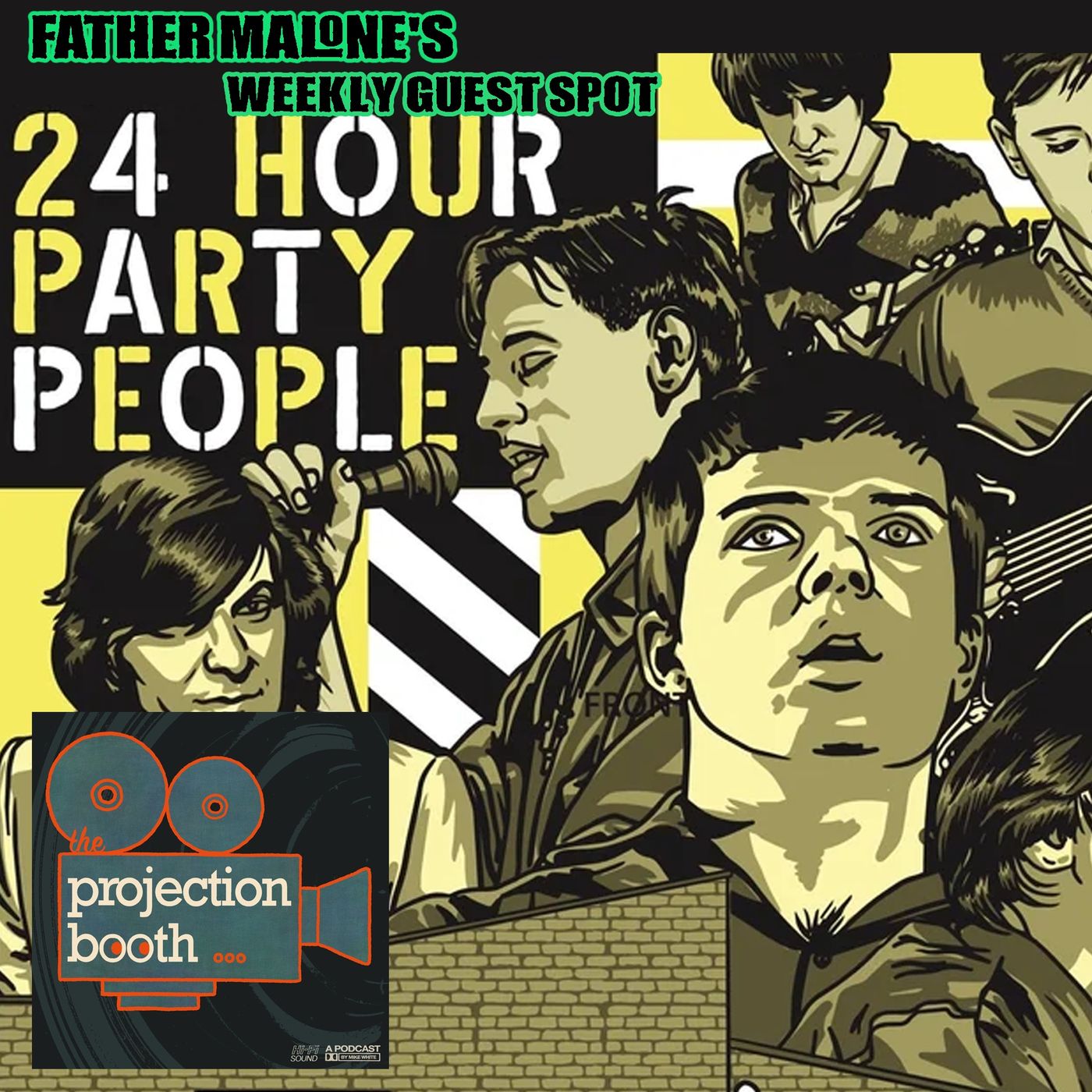
Father Malone's Weekly Guest Spot - 24 Hour Party People (2002) - The Projection Booth
About this episode
Guest Co-Hosts: Father Malone, Axel Kohagen
We continue another Patreon month with a pick from Andrew Henrickson: 24 Hour Party People (2002). Join Mike White, Father Malone, and Axel Kohagen as they dive into Michael Winterbottom's electric chronicle of the Manchester music scene, told through the eyes of the ever-charismatic Tony Wilson (Steve Coogan). From Factory Records to the legendary Hacienda, the film brims with unforgettable moments and a who's who of '80s post-punk history, including standout performances by Lennie James, Paddy Consadine, and more.
We were supposed to speak with screenwriter Frank Cottrell Boyce again for the episode but it didn't happen this time.
Transcript
Automatically generated, so expect the odd misheard name.
Oh years, folks, it's showtime. People pay good money to see this movie. When they go out to a theater, they are cold sodas popcorn in no monsters in the projection booth. Everyone pretend podcasting isn't boring. Its version Manchester birthplace to the railways, the computer, the Bouncing Bomb.
In nineteen seventy six, if you wanted to see the most exciting bands in the world, they were on a regional show coming out of Manchester. My show I'm Tony Wilson. During the fourth is Expostus playing Manchester for the very first time. There are only forty two people in the audience. Inspired, they will go out to perform wondrous deeds.
For instance, behind me a stiff Kittens, later to become Joy Division and finally to become New Order. That's John the Postman. He's a postman. Have you had a hate records? My label Joy Division New Order.
We are an experiment in human nature. You can't of muse it. You don't be bringing in sort of new way, kind of Indie Indian. But he didn't sign the Smiths. I've just seen God.
The United Artists presents Steve Coogan in the International smash comedy. It's like Scooby doing it because they like Adam Mustard. It is a little bit like Scooby does. It takes you back to the start of a movement. This is it the birth of rave culture.
This is the moment and even the white man starts dancing. At time when legends were created. You know, I think that Sean Rider is un powert Wba as a poet. Give him example some of the lyrics good good, good, good good, double good. And rules We're broken.
Really ought to be careful for that. Sean. You can take someone's eye out. Can I offer anybody like the best done? Judge?
I'm being post before. I'm passionable. When you have to. Choose between the truth and the legend, print the legend is he gonna hit me? Twenty four Hour Party People, Welcome to the Projection Booth.
I'm your host, Mike White join me once again. Is mister axel Cohagen always a pleasure? Also back in the booth this father. Alone, good good, good, good, double good. We are amid a bunch of Patreon picks with one from Andrew Hendrickson Twenty four Hour Party People.
It's the story of Tony Wilson and Factory Records, or is it really just a story of the music. From director Michael Winterbottom and screenwriter Frank Catrell Boyce, the film stars Steve Coogan as Wilson and a cavalcade of familiar faces in supporting roles like Lenny James as Alan Erasmus and Patty Constantine as Rob Gretton. We will be spoiling this film as we go along. I mean, it was kind of based on real life, so we can spoil real life for you as well. If we don't want anything, we're entered off the podcast and go watch the movie.
We will still be here. So, Axelent, when was the first time you saw twenty four Hour Party People? And what did you think? My friend recommended it to me and said, you're gonna watch this and then you're going to get into joy division. And he was absolutely right.
And I liked the movie when I first saw it. That was sort of the end of it. And then when I was preparing to watch it again for this podcast, part of me was thinking, I don't know that this is the kind of movie that's going to hold up as well for a second viewing, and I was a little cautious, but five minutes into the second viewing, I was absolutely hooked. I think this is actually a movie that I liked better the second time I watched it, and Father malonew about yourself. I saw this in the theater when it came out.
I intended with a friend of mine who he and I had had a debate about who was better New Order or Joy Division our entire lives. He knew that I loved Joy Division, but he also knew that I hated the Happy Mondays. I did not. I could not embrace the acid house scene that was going on in Manchester in the late eighties. But he was convinced that this would change my mind about that, and yeah, it really did.
I mean as soon as I saw this movie, when I got out of there, I went and bought Pills, Throws and belly eggs. This movie to me not to bury the lead. I think it's the perfect ideal of a bio pick music bio pick and could not wait for it to come out on DVD. Was was shattered shattered watching the movie when they mentioned DVDs. As a matter of fact, that was it, and all I could think about was getting one as soon as it came out, so which I've dug up and watched a number of times leading up to this, so I'm excited to talk about the movie.
I think it's it's just one of the best out there. This was a first time watch for me. I had never seen it before, and I kept trying to think of why why had I not watched this, and came up with a couple theories. One was, I think I told you this before father alone. I might have gotten mixed up with Party Monster.
The Macaulay Culkin, Yes, and. I guess that has something to do with rave culture, those kind of things. Also, I was not a big fan of the Manchester scene when it came to the stuff that was going on in the late eighties early nineties. For some reason, it just felt like too much like here's Charlaton's UK, Here's what was the uh this reds One, Stone Roses, Hot Dragons, Thank. You, House Flowers, And I just was like, oh.
Man, this is a lot of stuff that I really am just not into. And now Stone Roses total exception loved Stone Roses. Don't know why exactly. I liked them and didn't really like the rest of these bands. I had never heard of the Happy Mondays until I started watching this movie, and I thought at first that it was made up.
That's how much I didn't know. And even when they played their songs, I was like, I've never heard these in my life, because I mean even the title song twenty four Hour Party people. Nope, no idea that that was a song before. So I just felt completely out of the loop with this. I was somewhat familiar with Factory Record just from what they were putting out, but was not aware of Tony Wilson, was not aware of the Hacienda, so this was really brand new for me.
And man, oh Man, Tony Wilson, What a fascinating character this guy is. After a while watching this movie, was Steve Coogan playing this role? I just wanted to yell, will you shut up at the TV because he just won't stop talking. But I'm like, this is a great compelling protagonist for a film. Peter Hook from Joy Division and New Order described this film as about Manchester's biggest cunt portrayed by Manchester's second biggest cunt, and yes, I do think Tony Wilson is one hundred percent of fascinating character.
He describes himself as a journalist first and foremost did until the day he died, not you know, not record a company owner, not record promoter, not nightclub owner. And this movie is kind of in a bottle in that they have him as their central character, a character removed from the creative process while central to it, and my god, how lucky that not only do they was he just sort of a fascinating character, but he was on camera like so he's part of the media. Like in the opening sequence where where they're showing one of his little bits that he would do for Granada Television where he's hang gliding, we're actually seeing Tony Wilson in that sequence. Steve Coogan described it as I had Tony Wilson as my stunt double for my portrayal of Tony Wilson in the movie.
He doesn't shut up ever, and you want him to shut up. And at the same time, I could continue listening to him talk as smug as he could get. He's always funny and always informative, like the best narrator I've ever seen for a biopic. There's a scene in the movie where Steve Coogan as Tony Wilson, turns toward the camera and says, this isn't about me, this is about the Manchester scene. And I couldn't disagree more.
This is Steve Coogan's movie in my mind, and this is the story of Tony Wilson, a guy who was at the right place at the right time, with the right attitude and kind of captured lightning in a bottle. And yeah, it's a character study in Steve Coogan is amazing in this movie. Cougan is fantastic. I really like Steve Coogan. I can't say I'm familiar with all of the stuff that he's done over the years, because he's done a ton I'm not familiar with the Alan Partridge character.
But I'm curious how close Alan Partridge and Tony Wilson are because I know, isn't Alan Partridge kind of unaware of himself and like so full of himself but yet also unaware at the same time. I likened when Alan Partridge to the Larry Sanders character when he firstart air and we were seeing him on his talk show. He's evolved over time. He just had a movie recently, actually, and yes, he's kissing cousins with Tony Wilson in the sort of egotism, but completely unaware of it. Like the Tony Wilson as a character in this movie is knowing that he's in the movie.
But you know, Steve Coogan said, like it only makes sense for him to talk about the movie while he's in the movie. A character of Tony Wilson would be aware that he was in the film. So that self awareness is lacking with Alan Partridge completely. He's more of a buffoon that way. Alan Partridge, from what I've seen of him, reminds me a lot of Jimmy Glick.
I don't know if that's a fair assessment or not. In the fawningness and the sarcasm, definitely the bitterness that's lying just underneath all that happiness. Yeah, I do love that Steve Coogan as Tony Wilson is a character in his own movie. That he does speak to the camera like you're saying, and that he's so aware. You know, from the very first scene you're talking about the hang gliding stuff and when he's like, this movie isn't about this, it's more about this, and it just like lays out and by breaking that fourth wall in the very first scene, you're like, oh, Okay, this is what I'm in for.
And there are times where I'm like, are other people hearing him talk to the camera or is it just us? Are we the only ones hearing this dialogue? What's funny is it wouldn't be removed if people were listening. There might as well be somebody just standing off camera who he's just talking to. You get the notion that Tony never shut the fuck up ever.
Yeah, and he's so grandiose with his whole thing. I mean, the idea of the wheel that comes up constantly through this whole movie, and you're like, Okay, yeah, I can see him being very into you know, Greek philosophers, and I love too. At one point he says like. You're gonna be saying a lot more of that sort of thing in the film, although that actually did happen, obviously symbolic. It works on both levels.
I don't want to tell you too much, don't want to spoil the film, but I'll just say, Icarus, okay if you know what I mean, right, if it doesn't matter, but you should probably read more. I am so intellectually superior to everyone around. Me, you know. And that's part of that opening scene. It's the I just want to say Icarus and then the credits role it's like a declaration like I'm going to be this smug to you for the rest of the film.
I'm your lead character. It's very smart the way that they blend. You talked about how Tony Wilson is Steve Coogan's stunt double by them reusing the old footage from Granada. I don't know if it's Robbie Mueller, the DP or who it was that was in charge of this, but to blend the footage of Cougan with Wilson, I could not tell the difference between the footage because it looked like it was shot on the same stock, shot on the same day, the same lighting. I mean, it just looked perfect.
And you also start to add in like the footage of the six pistols at the Hall in Manchester, now that is very different the you know, it looks like super eight of the sex pistols, and then it's much better film quality or digital quality of the people in the hall. But I love those like quick pans that they'll do to go from the pistols to the people in the hall, and you're really getting introduced to so many of the characters, just in this very first scene where it's like, oh, well, here's Andy Serkis, and here's Constantine, and here's all these other people that you're going to see through this whole film, and it's just like, wow, this is really a smart way to introduce this and to integrate that older footage.
That opening scene, I know was filmed on a sixteen millimeter, so it matches perfectly there and you needed to do that. Going in the rant obviously was shot digitally, and of course this was made in like two thousand and two. When it came out in two thousand and three, so everyone was kind of reeling from twenty eight days later and the fact that Danny Boyle went and made a movie with video cameras. But it's my understanding what they did here was they then transferred this to film and then transferred it back to video so it would have this pass through film so it could match a little bit more. Because the scene you're talking about the Manchester Free Trade Hall, the Sex Pistols first show where they are blending it in some shots rather seamlessly, where we get to a close up of the band and it's clearly Johnny Rotten and then it switshpans so fast to somebody in character sitting there watching that you could believe that they had cameras there that night.
The thing I loved about these transitions between the real footage and then the film footage is it never felt to me like a gimmick or it ever felt like the film was winking at me. It felt very natural, not like say a Forest Gump where where they're trying to show you how clever they are. Yeah, I didn't get that. I did like two when they go I think it's also in that same opening sequence with the sex Pistols where it's like all of these people are here watching this show. It's kind of like when people talk about the Velvet Underground.
Like when people went to see the Velvet Underground, they went out and they formed bands. And it was very similar to this particular concert in Manchester Free Trade Hall where people are seeing the sex Pistols and then pretty much everybody that you see, what was it like all thirty eight people or whatever forty five they all go off and they do their things and we could see John the Mailman again. You get to see, you know, all of these different people show up. You know, the Andy Serkis character Martin, Like they're all there and it's just kind of this fire that gets lit under everybody. But even during that sequence, it's like, you know, oh, you know, this movie is about this, and it's about this, and we'll talk about New Order and then they cut to like a stadium scene of New Order playing and it's the actual New Order.
They'll show like the real Happy Monday playing. I love that they do that. And yeah, to your point, Axel doesn't feel like it's that we're gonna stop dead and try to trick you with this stuff. It's not cutesy or anything. It's just no, this is a matter of fact.
Like here we are at this shitty little hall watching this band, and look at what it leads to. Here's the stadium concert that New Order put on. However, many years later. It flat out tells you those guys over there, they're way ahead of everybody. They're the Buzzcocks, and like there's forty two people in the thing.
The Buzzcocks are one of them. Back there. Those guys they're wars Are they're going to become Joy Division, They're going to become New Order. These guys over here are going to be a huge band of that, and the amount of people who did become bands on that night is spectacular. I'm going to keep saying lightning in a bottle with this movie, but like you have this amazingly charismatic narrator, you can hang the whole thing on who was present at this event where all of these other bands proliferated all in Manchester.
I don't know, I'm getting ahead of it, but it's just it's spectacular, like that all of these things came together in this one moment, and that it's not the end of the movie. Well, and people are familiar with like Liverpool and everything, but not necessarily familiar with the Manchester scene. And just how again another city that was made by industry. And I love that this is very much a love letter to Manchester because we hear about the history of Manchester. You know, you get that sequence with the canals and all those things and that old guy who was working on them back in nineteen hundred.
But yeah, you get like all of this stuff about Manchester and how it was once this thriving industrial city and now it's completely run down. You know. I think there's a reason why House was so popular in places like Chicago and especially Detroit and Manchester because we kind of had similar vibes as far as once a great city, now really run down, kind of turning to the music as somewhat of a salvation. And just to have this whole idea of like the Pistols playing Manchester, having like so few people showing up just makes sense. But then to have this guy turn around and be able to show them on television, be able to book them on television, this little regional show.
You know, I'm sure it wasn't that little, but you know, we forget about how like even though England is a pretty small place, it's like, Okay, you got Granada TV over here, You've got this television company over here, and just people in the area were able to see this. It wasn't like it was being broadcast across the entire country, much less the entire continent. It's like Tony Wilson had this little fiefdom. He was a big fish and had a lot of gravitas. It makes him a unique character.
He's not Elvis Presley, He's not an international hero. He's the right guy at the right time. No, the right guy at the right time, and then bringing this music, this brand new music that really wasn't getting I want to say punk was banned from a lot of the BBC, So him showing this stuffing bands on Granada Television was a huge deal and it was one of the few ways that people could actually hear this new music. It's kind of like, you know, we're talking a few months ago about college radio and just how tough it was to hear new music when you were younger and before you know, the advent of the Internet and everything, where it's just like, well, where can I even hear these records? Where can I see these bands?
And here's this guy showcasing these bands every single week before he ends up, you know, getting fired from that. I think it was because of Iggy Poppy got fired from Granada or from that particular show, I should say. So it goes and then kind of goes into more of the music business itself, the music, the clubbing, those kind of things. Still working at Granada Television. I think, I don't know how many years after that.
So when they show those little, you know, slice of life clips of him interviewing people, and just like those you know, five minutes before the evening uses over type of segments, like the local color segments, and it's like that's how he made his living for a long time. And I love that. I was watching a documentary about Wilson and they would call those the let's kill Tony moments where they're trying to get him, you know, involved in very dangerous things like hang gliding, like you know, the elephant washing, those kind of things. They gave him his own segment called Kama Cosney. The hanglining segment was comic cowzy.
We're just going to keep circling around Tony Wilson because he's unavoidable here. But the love of the movie of Manchester is completely born out of Tony Wilson's love of it. Like, you know, he very easily could have shuffled off to London and made a career there. You could have come to America and been huge, I think as a presenter of something or other, and he always stump in that town. He was always presenting bands from the town.
And then when he becomes from when he becomes a promoter and starts hosting nights, when he becomes when it becomes factory, before the hac even it's all local talent, and I mean to his dying day, he stayed. He you know, he tried to get a film festival going in Manchester. He was always, you know, just the biggest booster of that town. So that's really admirable. The other thing, I think we watched the same documentary what sort of came home for me?
Watching that was as much as we're talking about Steve Coogan and his performance here Patty Constantine as Rob Bretton, who is the manager of Joy Division and eventually New Order, it is unchanny. I don't think anyone here is doing a caricature. No one's doing an impression here. I don't think even Patty Considine is doing an impression here. But he just absolutely ooses that guy.
That's my favorite character in the movie, Rob Bretton, and what a fucking performance from I sat up and took notice a considign like right then and there, and I've been happily following so much so that, like I remember, two years after this movie came out, him almost quitting because he was having a crisis of conscience and just thinking please, no, not, you don't you've wit Wow. I had no idea. I mean, I see him show up so often. He always just nails it. I mean even in small, relatively thankless roles, like when he's one of the two is he are they book called Tony in Sean in Hot Fuzz where they're the two cops with the mustache and just some of the looks that they give to Nicholas Angel and just them being completely thick.
I thought that he was wonderful in that because it takes so much to play a dumbass like that. He's got range. I mean, he was just recently on House to the Dragon, that first he is He was the king on that series. I think most people are going to recognize him from that. He's fantastic in that, but he's mainly frail during that, so you don't get to see how vital the man can be.
Rob Bretton was nothing if not vital. He's either completely bemused or ready to punch you in the fucking face with the same vigor. It's a hell of a performance and a hell of a character. It's funny because that documentary that we're talking about, and I wish I could remember the name of it right offhand, but it's like this movie. It hits so many of the same beats where it's like, Okay, we're going along, and now here's the signing of Joy Division and they're about to go on tour in America and Ian kills himself, and then there's New Order, and then there's Happy Mondays, and there's Factory Records, and just like gives you all those steps.
Here's the Hotcienda, but it focuses on Wilson, of course, but it doesn't spend as much time as this movie spends. But it's very funny to me that it's like, Okay, here's the straight documentary and then here's the biopic. I think that the biopic just adds so much more because you get to really feel like you know these characters and to have these stories and to have some of these things, and I know it's not one hundred percent true, and Tony Wilson will definitely tell you that if you listen to the audio commentary. How cool is it that they have an audio commentary with Tony Wilson just constantly. I never wore a quote like that.
Oh my god, I'm so excited. When I saw it. I'm like, wow, he agreed to do it. What's great about the entire movie. It's hard for people to get a regular bio pick made because they have to like count out to so many masters.
They you know, who owns the music rights, they they gotta clear it with them, and who owns like the person's biography rights. The family got to clear it with them. Like there are some there are made up stories in this movie regarding real people, and they're just like, go ahead, you know, do Howard Devoto never slept with Tony Wilson's wife in the bathroom of the of the club, And rather than say you can't use my image or my music, he shows up in the movie and says this didn't happen, and it only makes the movie any better. So it's another marvel of this film in that everyone signed off except the Stone Roses, and only because they signed on too late. Well and also them being what was it managed by his ex wife.
Yeah, like all the people who he didn't associate with anymore were the ones behind the Stone Roses. I'm like, well, that's kind of a shame, because, like I was saying earlier, they're the ones I like the best out of that whole Manchester scene, not including New Order and Joy Division of course, and having seen the anti Ironton Corbin film, I was like, Okay, that's a really good companion piece with this, where you really get some great you know, Ian Curtis and what was going on with him and his wife and all those things. But it complements it. It's not like, well, you can like one er, you like the other, you can't like both. I think that both of them tell very good stories.
The scene where Tony Wilson's wife is having sex with the guy in the bathroom and then the actual man speaks up and says, this never really happened. It's a brilliant case of having cake and eating it too. The quote that comes up after that is if you have to choose between the truth and the legend, print the legend, and I think that this movie plays it down the middle and it gets to tell us the legend and the truth at the same time, which I think is a more expansive view. And it's a way that film can sometimes tell the truth more than the facts. You know, some of these stories, they may not be factually correct, but they're the truth of what people believed.
I imagine that people who were familiar with this scene probably knew a lot of these stories. I wasn't familiar with Factory, I wasn't familiar with So It Goes, or any of these things. Tony Wilson. I wonder if people who were following this whole thing or other Man Unions, if they're just like, well, this is one hundred percent bullshit, or if they were just like, yeah, pretty close, you know, this is the best we're going to get and combining like different stories like oh, this guy fired at Tony with a gun, but no, it was actually this incident over here, But they combined the two because that's what we do. That works for me.
And I'm just curious what the general Man Union reaction to this one was. I can only imagine that they have embraced this movie wholeheartedly, Like I can't think of a better love letter to them, with all the unsavoriness sort of laid bare. It doesn't flinch for it from anything, you know. During the height of the Madchester scene, they were also called Gunchester because there was much gun violence that erupted around the scene, and they absolutely portray it here. This film is a celebration of all of this joyousness and the music and the place and everything, but never once, does it not give us the underbelly of the things driving it, Like, you know, start with like just Ian Curtis's like epilepsy and you know, the sort of casual in the nature that his friends are treating him with, you know, and just that the depressing nature of Manchester in general.
Yeah, that whole scene is really tough when he has the first big fit and I think they again talking about mixing fact and fiction, that they had that whole thing with the riot that was going on at the same time, and I think Wilson was like, well, actually the National Front didn't come in and do this, but you know, it makes for good drama. And I'm like, yeah, okay, exactly do what makes sense dramatically. It feels like you're holding the spirit of it close to you and you just need to move the story along. Yeah, and you know what, the movie is sort of obsessed with semionics, signs and signifiers, so oh yeah, So why not combine the minor controversy of Joy Division's name with a controversy that was also going on at the time in England, which was the Nationalist Front And there was a Ryan that occurred at a Joy Division show.
So putting them all together there. It is like it only makes sense, Like who would be offended by it? I don't understand? Are you not familiar with situationalism? I love when he's like lecturing the journalists, who why am I blanking?
Un Rob? Rob Crydon Crydon? Oh god. I always love them show up and man oh man, just him and Kogan together. Always the movies that they've made together, the appearances I've seen them do together.
It's always such a pleasure. He's barely in here, but whenever he shows up, I'm like, all right, this is this is going to be good. You're just fucking wrong. That conversation between those two, by the way, the George Epstein Brian Martin Bucker real conversation, is one of my favorite moments in the movie because it not only Lanesbaar the egotism of Tony Wilson. He's mad because the behind the scenes guy they can't remember his name, and he's worried that that's going to happen to himself.
But on a basic music nerd level, journalists suck and and this is a fucking music journalist he's talking to who doesn't know the difference between Brian Epstein and George Martin and has their names confused. I love that exchange. You know, we were talking about the way that the film looks before and things like the way that they use black and white during the Joy Division scenes, the way that they have those real shaky titles that will come up over things like when they have their first night with Joy Division and it says fact one on there, and I like that they don't have to explain that, or they don't explain it where it's just like, yeah, they they labeled everything at factory and everything had like a FAC number before it, Like that's really smart.
But they never take the time to say, Okay, the reason we're doing this. It's just like you know or you don't know, And it really doesn't matter if you don't know. It's not like they're hiding stuff from you. If you're intrigued by it, you're gonna go fucking read about it and find out about it anyway. Yeah, what's funny is it's the movie that is the most spoonful, or potentially could be, because we have a narrator breaking the fourth wall and addressing us, so this could be a hat on a hat, but it never is.
It's always innovating and interesting. I'm curious about one scene how you guys felt about this, the scene where he goes and visits his ex wife and his kid. That seemed to kind of come out of nowhere for me, and I'm curious what you guys thought about that one. I loved it. I thought the truth of something and the facts of something are different.
And you know, the story of Tony Wilson is this heroic, arrogant character, and then there's this this part of who he is, with his wife being ill and him looking like he doesn't have the best relationship with his son, and you realize that to get the narrative of him being this big fish in a little pond, you're leaving out well some of the places where he missed and where the legend doesn't apply. And it's a really awkward moment because I think sadly it gives the impression that his family just didn't fit into what he was doing. I don't think we needed to show what a prick Tony Wilson could be, but I think it's perhaps a counterpoint to because they do that a couple of times, like after the Howard Devoto sequence in the bathroom with his wife Shirley Henderson, who we should mention the cast is just fucking incredible.
You know. He says, yeah, we had crazy moments like that, but often we were just a normal couple. So we get shots of them just being normal and hanging out and whatever. So, you know, and that's when things are coming up, when things are bad, we get a view of his you know, how neglectual he was as a human. I think it's just part of the movie's philosophy of laying all the facts out for us so we can design for ourselves how much we like or don't like someone.
I also find it fascinating because of the Julie Henderson character. Most people will know her as moaning Myrtle, which is very unfortunate because she's so much more than moaning Myrtle. He keeps talking to her about having kids, and you know, we want to start family, and it'd be great if we had a couple kids running around. And when you find out that he did have kids, it's like, oh, how disingenuous that feels, or just like he wants to start kids, start families with all of these different women. I mean, because he's got her, he's got Lindsey, he's got the ex wife, and then eventually he's going to have and I can't remember the other lady's name that comes in later in the film when he does that very awkward let's say flirting but he has to tell her that he's flirting with her and.
Just very post thing. Yeah, very postmoderny. I think he even says that, right, yeah, like. He's setting up franchises around the United States, you know, or or I mean it's I like that we get that part of him where you can see that this is a man who was looking for a home life that he could use as stability for his you know, for his crazy work life, and eventually got that because they're still or we're still together until his death. Like so, but you know, obviously he had drunk the kool aid as far as it's you've got to have the kids in order to make it be happy.
Yeah, that is pretty creepy when he's doing the commentary and says, you know, oh yes, because he says in the movie, yes, we're still together, and then the commentary on top of that, I mean talk about like levels, right, the commentary is just like oh yeah, and we are still together like the few months or years or whenever he recorded that commentary, Yes, we're still together. And then Tony Wilson is not with us anymore. So hearing this voice from beyond the grave and I had to go look it up and I was like, yep, they were still together when he died. So yeah. But in the commentary he's saying like, I'm not sure if we will be He's saying like so contentious, like you know she can leave me in any second now.
Yeah, it must take a lot to be with him. I was a little taken in by his flirting in that scene because I think when I was single, that was kind of my approach. It's just I wasn't as successful, but using irony and self deprecation to try to sneak past defenses, I thought he was onto something there. It doesn't hurt that he can also say I look after a new order and the hacienda is my place. Yeah, I never had that one.
That's the thing though, when she says and you are, or like what do you do and he just goes, I'm Tony Wilson. Hello, you know Tony Wilson here. You know that's my job. My job is to be Tony Wilson. That's all I do all the time.
Yeah, just that whole thing too, where Tony Wilson wasn't in it for I mean, he's in it for himself. But at the same time, that whole contract that they draw up, you know, that really gets brought back, you know. He does that at minute thirty of the movie, so right as we're switching from the first act to the second act, and then it comes back as the third act where Keith is it. Keith Allen is the guy who I just every time he shows up in anything, I just absolutely love him. He was the guy who dies in Shallow Grave.
He did a whole series of commercials for the World Cup when the World Cup came to America back in the I want to say like ninety three, ninety four, maybe ninety five. They were fucking amazing commercials. And ever since then I've just been like, Oh, this guy's somebody to watch, and just to have him show up at the very end as this complete prick music producer radio or sorry, album label guy, label executive and just figure out that he doesn't need to deal with these assholes at factory whatsoever. That he can just go directly to the bands. It's so fascinating because you're basically watching Tony slid his own throat because they're not going to get any fucking money from this at all now because the bands own their own catalog, the bands own everything, so he's got nothing.
He doesn't have a leg to stand on. And even when when Keith is like, oh, you know, I'm going to pay five million pounds for all of this, and Wilson's character is like, oh, you know that princely sum, and I'm like, really, that's a princely sum. Five million pounds for everything they've built feels like a drop in the bucket. Feels like an insult to me. I think it would have been an insult if he had the rights to any of those artists music and regrets.
I knew he had to say he was going to have to tell element in that next moment, and you know, obviously that really happened. And it what it does for me is it allows me to appreciate how smug and egotistical Tony Wilson is. Because if you're going to do that basically a gentleman's agreement that will work together until we don't want to work together on it anymore, and you go your way and I go my way, and then stuck to it and didn't fight it, didn't try and didn't try to take to court the validity of the blood napkin. You know, like it makes me love that guy honestly, and you know, and you know, I'm sure you listen to the commentary as well, where he said it didn't quite happen that way. He went to them, So he's in their office and it's like a ring of executives watching him, and then they had to explain to him that he didn't known the rights because he thought he had.
It's even worse than what they gave us in the movie. Around that thirty thirty thousand pound table that they're at where I just love how Paddy Consadine is like attacking him and apparently Kugan didn't know exactly when he was going to get attacked. Steve Coogan said, like, yeah, he always felt around Patty Conson and like, I didn't know if he was going to, you know, attack me at any moment. But evidently that is in keeping with character with Rob Breton, So he was just that explosive. With the way the scene plays out in the movie, with the different narrative of them coming to Tony Wilson, that scene is is an amazing performance by Steve Coogan.
You're watching this guy with a great amount of pride and also just the sinking feeling of having lost everything. So he's you can in the scene, you can tell that he's still proud that he made this decision, and he's impressed with himself. He's stroked his own ego, and he's also very aware that he lost a lot of money. And Coogan just plays it perfectly. I never literally nor metaphorically sold out.
I protected myself from having to have the dilemma of having to sell out by having nothing to sell out. He eventually did get fired by Granada for that Iggy Pomp show, but the one he almost quit over was they made him put on the Stranglers, which is this British punk men. They're fucking terrible and so he didn't want to put them on. They so they did. Here's another clever thing in the movie.
So there's a montage of the artists that showed that were shown on Granada, where they showed Susie and the Banshees and The Fall and the Jam, and the last one is The Stranglers, which they then cut to introducing us to Sean and Paul Ryder of the Happy Mondays long before they're the Happy Mondays sitting and watching television and Sean Rider going, oh, they're fucking terrible. Turn that off. So they even get to get like Tony Wilson that gets a little bit of revenge through the film because of that moral standing. So it was there. I've never heard a certain ratio.
Are they any better in real life than they are in this movie? Because I thought they were absolute shite in this movie. Yeah, they are the butt of the joke in the film. They are before the Tropicalia kind of thing. They were kind of a pale imitation of joy Division.
They're okay, but yeah, they're kind of They deserve the jokes that are being sort of levied against them, not Nick Hucknall from simply read like that he deserves better and they really should have signed the Smiths. Yeah. I love that God talks to Tony at the end. I mean that is so appropriate that he has a conversation with God, and of course God looks exactly like him, and I never really thought about that whole God made man in his own image, So if you talk to God, he looked like you, but it was me, you know. And then there was a line that they cut out after Patty's last line at where Coogan as Wilson says, well, except for the beard and the long hair.
He's so self assured when he says, well, he looks like me, just like, of course, I'm this is my expectation for seeing God. Can I get that in writing? Yeah? And I loved our final scene is you know, just sort of another hangout moment, like even after everything everyone's been so they can just still hang out on the roof and smoke out and you know, just be friends. Where do you go in?
The record's over right, and here they're closing the club and you get to see just it's funny because another movie would be very sad at that point, and it is kind of melancholy. But you don't feel like they've been defeated. You know, you feel like, Okay, the system has defeated them, but at least they had a really good run, and at least they did make all of this great music and the whole thing that Wilson talked about with the Sex Pistols concert as well as all of the music that they were putting out from Factory, was Hey, somebody's going to listen to this and they're going to start a band, and then this other band's going to start, and then this other band's going to start. And he's just so much about the music.
So it does make me question that line that we're talking about before, where he's like, it's not about me, it's about the music. And yeah, it does feel very disingenuous, but at the same time, there is a little bit of truth there. It is about the music. I mean, we do take the time to spend the time with Joy Division, we do take the time to spend the time with the Happy Mondays and with New Order, So there is that to it. You know, could you cut Tony Wilson out from this movie?
No, absolutely not, because he is just such that driving force behind it. But you know, well, I thought about that other documentary and it's like, yeah, you can tell a documentary story about Factory Records and about the Hacienda and all these things and not have Tony Wilson front and center. But he's got to be there. And especially this movie where he is just so charismatic and and just driving you crazy. I mean, he's he's almost like an anti hero in his own film.
I know half a dozen nicknames from Manchester, England because of Tony Wilson, like the scene that he created out of a love for that city, did exactly what he wanted to do and continues to to this day. Because, like you said, the albums are out there. People are still listening to Joy Division, they're still listening to New Order. I don't know if they're listening to The Happy Mondays, but at least those two. And they're watching this movie and they're, like you said that that movie control about Joy Division.
Kids are discovering these bands in this town, and it's in thanks to a large to a large part to Tony Wilson. I love the whole thing of them producing the album, and that whole the arc of the Andy Circus character, and especially as he starts to move from Heroin to Booze and he gains all that weight and they've got him in the fat suit, which looks really good. It doesn't look like, oh, we're going to put Andy Serkis in a fat suit and it's going to be funny. It works really well. I mean, Joy Division is such a strange band when you listen to them, I mean, it's so dark so often, but then there's little poppy moments to it.
The way that Peter Hook plays the bass and is so different from anything else that you were hearing at the same time. And then yeah, the drum sound, and I love those little joking moments, like where they put the drummer up on the roof and Circus is like, don't worry, I'll come get you when we're done, and then they all pile into the car to listen to one of the songs. They leave and then you get to see the drummer still on the roof. They had completely forgotten them. I'm just like, yeah, there's little moments.
I mean, this movie is fucking hilarious. Even though it deals with things like Ian Curtis's suicide, you know, you still get the funny moments around it, and it feels very proper when they stop and have a serious moment versus when they have those comedy moments. I'd love to get a look at this screenplay because it is kind of a wonder that it's able to compress as much time as it does and doesn't seem to skimp on any characterization here. I never felt like, oh, why didn't we spend more time with Joy Division, you know? Or Martin Hannett, like he's only given two or three scenes, but each one is so impactful that they last.
But at the same time, it's come to my understanding that a lot of this is improvised, like a lot of the dialogue back and forth, and not just like the comedic guys who are known for it, Like everyone in every scene was encouraged to do it. So now what you've got is people improvising as lead characters, being true to those people that they're playing, while at the same time having to navigate their place in the scene. And then the greater movie and the fucking movie works, like how is that even possible? The way they introduce Joy Division is brilliant. It's very natural.
You know, we're just we're in the club. There's these guys there. One of them starts getting in Tony Wilson's face, Oh that's going to be and Curtis, and then it keeps developing from there, so you feel like you've watched them come into their own in a very economical way. It doesn't take them very long to set that up. No, the editing in this movie is fantastic for what they show us and what they don't show us when they take those little breaks and we'll cut to like the duck herding sheep and you're like, oh, yeah, he's still doing these segments on TV, Like this is kind of what's paying the bills right now?
Is him doing all this TV stuff? And then later on with the Wheel of Fortune sequence, and just like bringing us back to those things just to remind us that what is going on outside of the story of the music and what's going on with the story of Tony Wilson, because especially later on, there's like we're running out of money. We don't know where we're going to get any money from. And then boom cut to him on Wheel of Fortune and you're like, oh, okay, so he's still doing all of this posting stuff just to get the money to probably pour right into the club. And the way that they're talking about, like you know the famous story about the first New Order single where it's you know, every time they sell one, they lose five pence and he's just like Oh, don't worry, it's not going to sell that much.
And then immediately his voice over this was the best selling single in UK history. You're like, and you're losing money on every fucking one of them. But that's another part of his character that I kind of ignore, where he's you know, he sees the prototype and it's told this is going to be expensive. It's a trifle and you know, three color printing, and he says, I don't care. It's beautiful.
Beauty should have no cost. And yes, they did lose sentence per thing, which is crazy considering New Order never had a hit single bigger than Blue Monday. But at the same time, don't you love that it's out there? Don't you know that he put it out? I love when they bring in the posters late and he's just like, you know, hey, the gig is tonight, the gig is right now, and you're bringing me the posters.
But then you get to see the Factory Records logo on there and just that yellow and black color scheme and you're like, oh, okay, so he's going to take from this and be able to build on top of that, And that's just what the whole movie feels like he's just taking little ideas and like building, building, building, Like, well, they've got these clubs in New York, why don't we have this club over here in Manchester. So that's why we're going to do the Hacienda. By the way, New Order wasn't getting any of their royalties because we were plunking them right back into this club. It's like, oh boy, I'm sure that wasn't very appreciated at the time, but at least you're being very honest about it. That scene where Peter Savile, who was that for Factory Records, He was their main designer, and he pops up every once in a while, always late, which is I love.
And there are so many lines from this movie that now live in my head, starting with that one, which is when he unfolds the posters says it's beautiful, but it's useless, and as we know, nothing useless can truly be beautiful. Nothing useless can truly beautiful lives in my head. The line from Boethius, the Roman philosopher, the mutability is our greatest tragedy, but it's also our hope that lives in my head, Like so much of what Tony Wilson like just sort of spews and maybe it's Steve Coogan improvising, but like just lodged right in here. Oh yeah. To have the quote from Boethius both with the Wheel of Fortune thing obviously the wheel, and then to have Eckleson show up as the drunk or the street person and he's shouting about Boethius and the whole thing where he's talking about, you know, the wheel turning around and you're at your greatest heights and then pretty soon you're going to be right off of that.
And I'm like, well, that's this movie. You know, that's the whole thing with this movie, where it's like. That's Tony in this movie. Yeah, he's referring to the hacienda like that's the thing that kept us all grounded, and just like you're saying that that is to Tonson. He's the center of the of the wheel.
Exactly, and when he's at his greatest sight, he's going to come crashing down again and he's going to get back up there again. And that's this whole thing of like, okay, factory records, all right, the hacienda, Okay, you know, like as they're about to have their biggest victory with Joy Division going to the United States and having this big tour. That's when he and Curtis kills himself and it's just boomed. The wheel comes down again and then you move back and it's okay, now time to rebuild. Now we're going to be a new order, and we're going to do this, and you know, we're going to open up the club.
And it's just this constant repetition of him trying these different things, and I, you know, I love it. I love when people are that creative or that determined because you know, I talk about how he feels self deluded, but I think you need to be a little self deluded in order to push yourself to do some of these things. And not ever question is nobody going to like this, What if I'm doing the wrong thing? You just think it's the right thing, and you make it happen. And it feels like he had the right people talking about all of these other actors that are in here, these characters, these real people, had the right people around him in order to make these things really come true.
I think a lesser movie that wasn't as well directed and as well edited would not have been as cohesive as twenty four hour Party People is because it's really two stories. It's the story of the guy who discovered Joy Division and then it's the story of the guy who discovered the Happy Mondays. And it could easily be two movies sort of jammed together, but they actually use that to make the movie better. And with those metaphors of the wel you know it's the whole is more than the sum of its parts. When I had heard that they were making a movie about Joy Division and Happy Mondays and a New Order, I got really really scared, because it's very easy to fuck up a movie about any one of those subjects, never mind the total short shriftedness that could come with an anthology.
Basically, but did you ever feel like anyone was less important or more important than anything else, including our lead Like I mean, he is our lead character, and he is the center of the film, but it could just as easily have him fade in the background. And this could have been about Rob Bretton if they wanted to make it like that's the feeling I get, Like anyone who's been involved from a factory from beginning to end, like Albert Erasmus, it could have been his story just as easily, and I think probably with the footage they were given, they probably could have cut it in that way. Speaking of the editing mic, like, you know, there are some deleted scenes on the DVD. So there's a sequence where Happy Mondays are performing or rehearsing for the first time, and then they get into a fight, and then they end up doing ecstasy for the first time.
So that's the scene that was cut together from who knows how many tanks, and then what ends up in the movie is basically what two shots it's just bez going anyone wanted to have the best experience of their life, and then shots of them taking the thing. And that was like a three or four minute scene. So bravo to the editor of this movie, who, like who probably edited like how many versions before we got the version we got. Here's a sequence of the Happy Mondays and concert, cut to Tony Wilson doing the news segment about the canals, you know, and then like cut back to the Happy Mondays. I'm like, this is great.
Like the way that you're pacing this thing out, it doesn't feel like like you were saying nobody seems to get short shrifted. It is very like, all right, now here we are on the tour bus for the Happy Mondays. Now we're going to cut to this other thing, and just to keep all of those balls in the air at the same time and integrating the real footage, integrating the footage that they shot for this. I mean, during that Happy Monday scene, it's like, Okay, here's one of their first club gigs. Now here's when they're fully formed, and that might be actual, real concert footage for all I know, because the way that they integrate it so flawlessly.
Like I don't know one more thing about Bez than I did before seeing this movie. They basically hit on what you need to know about Bez. He can make ecstasy, he can give you ecstasy, and he can teach you how to dance to the music you're listening to. And that's all I needed to know. And I didn't feel coming away like why didn't we know more about Bez's home line?
So you're not clamoring for the Bez theme sequel. I would not say no to any Bez related entertainment. By the way, speaking of great introductions of a character, there was a UFO siding in Manchester at that time to integrate that into the movie, and as it pulls away, there's Bez. If you look at the spaceship itself, it's made to look like numbers and symbols, but it just as BEZ. I'm hoping that Frank Control Boyce will be on this episode.
We've been going back and forth via Twitter, but it's been a few weeks since I've heard from him, so as I've moved away from Twitter, I don't know if he's moved away as well. I sent him an email, So hopefully he'll actually be on the show, because I think that'd be a real cupe to hear those stories that Wilson is telling, and even the stuff that Cougan says on his commentary track, it sounds like Boyce was right there at the beginning, like with Cougan even saying Okay, we're going to do this, and so like getting ideas from Cougan even and Cougin's what was it His. Brother was in He was in a band that was produced by Martin Hannett, so like they knew John the Postman, so he's like deep. I mean Steve Coogan himself, his one of his first stand up gigs was at the Hacienda, so like he knew Tony Wilson like, yeah, you know, if that interview goes off, Mike, keep all the prey you can on Frank Control Boys for the screenplay and his line of children's books, which are very very good.
Well. Yeah, to know that he worked with winter Bottoms so many times, and the last time I talked with contrump Voice it was four code forty six, and you couldn't think of a different movie than this one compared to that one. I mean, can they follow this with a Western? Yeah? I mean the array of things that winter Bottom works on is just spectacular.
And I do appreciate that he doesn't do these audio commentaries that He's just like, no, I'll stay behind the scenes, you know, and just let the actors and the actual subjects speak for themselves. Yeah. I was reading some of the literature you sent along with the film, and the way they were describing winter Bottom's work, I thought, this, this does not sound like the director of twenty four hour Party people. This sounds you know. I felt like it was Michael Hannikey or you know, Werner Herdzog or someone like that, you know, twenty four Hour Party People has such a playful tone to it, even as it deals with some very serious things.
There's one line in the movie that really caught me when I was rewatching it yesterday, which was when he starts talking about the shift from you know, the bands to the DJ and the DJ culture and he's just like, people in this club are applauding the DJ. And I'm like, Okay, why is that so strange? But then I'm like, all right, yeah, I guess when you think about it, the DJ's not doing jack shit other than playing records. I mean, I know there's a lot more to it. You know, I've got friends who are DJs.
Obviously being in Detroit, I know people that are DJs. But it's like, you're not making the music, you're not the band, you're playing the band's music. And so that foreign concept for Wilson. When he's just like people are applauding the DJ, I'm like, yeah, that's a real thing here. This is kind of wild for you to be experiencing this, and that whole shift of the band on stage to the DJ on stage.
They were again able to roll with that no problem, but it just becomes this whole different mindset, and that's the way that so many clubs are now where it's like, oh, DJ so and so is playing or doing the music this night, and it's like, okay, you know, like I other than like some of the old school Detroit you know DJs. I wouldn't be able to tell you anybody who's a DJ these days and what they bring to the party. I'm in Las Vegas. The city is a lousy with DJs. Every single club is advertising specifically their DJ come to come here.
For that I mentioned movies the lines that live in my head. Another one is from that scene, Mike, the beification of the beat, the idea that now the music is is the medium being worshiped as it always had been. So it sort of points to a misplaced sort of celebration or some misplaced you know when it comes to these bands. But it is, as he said, like obviously Manchester, the whole acid house scene was pulled mainly from the house scene in Chicago. It was like a mashup of their sensibilities in those so it's not like they created that sound, but it is instructive that that's where we are.
I mean, look the Electric Daisy Carnival comes here every year and the entire city shuts down. So it is a way of music, and it is a massive fan base for that kind of music, and in many many ways, it began right there. I won't fight with you about Chicago versus Detroit, but you know, I just wanted to say Detroit's right in the mix. I guarantee you they were pulling from Detroit as well. How about that?
Can I just agree with you? That's fine, We can agree to agree. Father Malone, you said that this movie brought you into the Happy Monday's camp. Yeah, how solidly did you join that camp? I will listen to a mix of their music that I have made a playlist.
Not all of their stuff is fantastic, And obviously Tony Wilson is a man of much hyperbole because Sean Ryder, I'm of the camp that Seawan Ryder is mainly a fucking idiot, but on occasion weaves a little bit of genius. That that song Kinky Afro I can put on anytime, any day, any night, and it's it. It is actually slightly genius when you listen to those lyrics, which which I only like really understood after hearing Tony Wilson sort of described them to me, which is on that audio track, like once you once you've deciphered the Shawn Ryder code, that the songs do get a little bit deeper. Weirdly, see, I don't know. I thought this time might be the time that that I would catch the bug, and I tried to listen to some Happy Mondays.
I find them fascinating, you know, as characters. I just never never got the bug. I remember my friend Dave had I think it was the Live CD, and periodically when we were all hanging out in his basement, that would just kind of come on. And I think most of us did not side with Dave in that choice. Well, I wouldn't listen to Live anything other Happy Mondays.
They're lucky they were standing up right. Yeah. And when it comes to the whole Joy Division New Order debate, I'm usually much more in the Joy Division camp. There are a few New Order songs that I really like a lot, but that's not nearly as much as even with what the two albums that Joy Division had. Those to me are much more solid than the entire catalog of New Order.
But that could just be a personal problem that I have no I'm with you. See, I was part of the Joy Division is better than New Order camp. Then after this movie, to this day, I do like New Order and I love the story of New Order because I mean they say it in the in the film like no band ever survives the death of their lead singer. Well this one did, and they were just as vital. They're still performing today for Fox's sake.
I remember there was a concert that I can't remember why I couldn't go to, but it was New Order, Sugar Cubes and Public Image Limited, and I really wanted to go to that. Yeah. Talk about a powerhouse, right. Yeah, that's that's absurd. That's Sugar Cubes.
That's not even Beewer just birthday. Man, this movie musically changed my life because I had not been familiar at all with Joy Division before this. You know why. When I saw it, my impression was that all punk was sex, pistols, ramones, snotty bands with guitar riffs, and so that's what I was expecting going into it. When I'm like, oh, you know, punk post punk, and then they got to the Joy Division songs and I realized this, I like this, this is speaking to me here and it.
It kind of got me more into post punk and then other musical bands that I was fond of, like industrial stuff, Got Stuff. I kind of started to see where the roots of that were and see how they were all connected. So very grateful for this movie for opening my eyes to a lot of great music. You Know, one other thing I want to say real quick before we head over to a break is I also appreciate that they are putting in cameos by some of the real people that were engaged with this, and that they take the time at one point for Coogan's character to recognize that and then go back through and show you all of the cameos that they've had through this movie. Because like when Mark from the Fall showed up, I was just like, Hey, that's Mark from the Fall.
But they don't put a button on it, and they don't even like have it pause and like a close up of him or anything. It's just like, yeah, these people, Like every once in a while it'd be like, well, that feels like that must be somebody. Because the other thing is, you know we've said this before, this movie is littered with people who are familiar faces. You know, so many of these actors that we've seen in other things, and they just they're everywhere. I mean, everybody in this movie is somebody, and if they're not, they end up being part of the actual original bands or scene, which was really cool to be able to see, like, oh, this dude that just walked by that was the you know, the guy who's playing the doorman who's taking all the money, is the guy who was the doorman who was taking all the money back then.
Or like they even have somebody who is a stand up comedian or an actress. She's working the door at another point and she actually worked the door at the hacienda originally. It's just like that's great to be able to mix again this fact in fiction altogether. Yeah, and I'll say again, and nobody ever had a problem that nobody was bitching about the way that they were going to be portrayed or you know, you know, their legacy. Everyone just sort of like rolled with it here, which is just I don't know, like this movie just continues to just impress, Like.
And it happens so late in the movie too. Things are winding down and they by the way, you've seen these people, here's this person, here's this person, and so it kind of felt to me like, I don't know what I'm supposed to do with that information because we're we're rapidly approaching the end. I think it works sort of to destabilize the narrative. So it's the movie's way of saying, you know, don't be so sure what's real. And I think that's a good message for any biopicked sneak in there at the end.
They basically put a button on it in that scene with Coogan sort of going like, this was him, this was her, this was him, this was her, whereas they needn't have done that and just let the music nerds sort of geek out about it afterwards. Did you see so and so and such and such. But like, if like a regular biopick, if like Little Richard was going to be in a scene, it would be like, and here's the little Richard and. So many of these folks we know their faces from the music videos, and I like that there's just a little bit of nods to some of the music videos that they have, like when he goes into the hacienda and it's all the little kids there and it's just like, oh, okay, this is part of one of these videos and just to like get that.
And then even when it comes to like you mentioned the spaceship or the scene with God at the end of it, it feels so natural when it's just these odd moments show up. And at first I thought like, at least with the spaceship, I was just like, is this a music video? Are we like suddenly inside of a music video? No, but again it's like they're they're even playing with the forms in the movie. After Ian Curtis is dead, Wilson comes on and he gives us a flashback of here's a better time with Ian, like remember the good times with Ian, and they flash back to a scene inside in the movie, and I'm just like, oh, okay, like we haven't done flashbacks in this movie at all, and now suddenly we're going to do this, and it works.
It works really well. And while he's sitting like a video editing deck, like just another meta once removed well, and. He changes his hair is different in that scene because he's right around the time he gets a new hairstyle in the movie, and so I was like, oh, how far in the future is this, But it's like, no, it's however long between when he last saw joy Division and when he's going to the funeral, he gets this haircut, but yet there's that shot of him, yeah to your point in the editing bay. And then it's like, well, how long? How many months have passed?
No, it's just a few days. But things have changed, and now he's going to show us this little flashback before we go into the funeral sequence. Doesn't it work out that we see Ian Curtis commit suicide. Doesn't it cut from that to Tony with the duck hurting the sheet. No, because it's one of my favorite moments in the movie.
It's first of all, Ian Curtis's suicide is handled so tastefully and packs such a punch that it made me laugh and actually cry simultaneously. The next scene is, which is a scene invented for the film. Tony is interviewing a town crier and then has the town cry that's right, call out his death, which that's me crying over Eden Curtis's actual suicide is nothing compared to what a beautiful memorial that would be for anyone. Yeah, that was great, and that was surprising when they said that it was made up whole cloth, because I was like, that just feels so real, and to have that moment with Tony and his girlfriend together and she's just like, oh, that was such a beautiful tribute. I was like, oh, yeah, wow, that's amazing.
And then when I heard in the commentary that it wasn't real, I was like, Wow, Okay, what an amazing thing for them to come up with. Tell mister Boyce if you speak to him that it's just a fucking incredible screenplay, because that was the one thing that I assumed was true. Like I knew the hang gliding thing because you knew that they were mixing footage, but like, did he interview the elephant elephant Kenny Baker watching elephants? Maybe maybe not? Did he do the guy with the canals?
Maybe maybe not? This one totally sure that it was it had happened. Well, if we play our cards right, we're gonna hear from screenwriter Frank control Boyce right after these brief messages, come on back and hear the second part of her discussion after that. Hello, this is Aaron West. I am the author of the A twenty four New Wave.
In this book, I look at A twenty four's output and I make the argument that we are in a new wave movement right now. A twenty four plays a major role. This book has a supplemental podcast where each episode is a brief conversation about an A twenty four related topic, whether an actor, director, or even a genre. As I continue research for the book and conduct interviews, I expect to record podcasts episodes with people involved with the company. You can find the podcast at sindjourneys dot com or wherever you find podcasts.
And we are proud to be members of the Someone's Favorite Productions podcast network. Hello. My name is Kevin Tudor, and I'm one of the three hosts of Almost Major Film podcast, dissecting many major indie studios in the films they release. Every week, Myself, Charlie Nash, and Brighton Doyle discuss overlooked, forgotten or bona fide classic indie films via studio specific mini series. We've previously covered numerous films from Artists and Entertainment, Lionsgate films and New Line Cinema titles, including The Blair Witch Project, American Psycho, Dogville, But I'm a Cheerleader, Saw Record for a Dream, and Ring Master.
You know the Jerry Springer Film. Anyways, we have a fun time every week and we hope you. Will join us. Subscribe to almost major wherever you get your podcast now proudly a part of the Someone's Favorite Productions Podcast Network. If you're looking for more horror outside of the mainstream, look no further than Unsung Horrors, a podcast about underseen horror movies.
I'm Lance and I'm Erica. Every other week we'll cover a horror movie with fewer than one thousand views on letterbox. We'll even give you double feature recommendations to pair with the movies we discuss. From gothic to shot on video, from slashers to comedies, from Giallo to jay horror, We'll cover all the subgenres. So join us as we unearth these hidden gems of horror.
Follow us on Instagram, Twitter, and Facebook. All at Unsung Horrors available wherever you listen to podcasts and part of the Someone's Favorite Productions Podcast Network. Hello everyone, this is Malcolm McDowell. I just want to say that this is a request to listeners of the Projection Booth podcast to become patrons of the show via Patreon dot com, p A t R e o N dot com, slash projection booth. That's pretty simple.
I think you can do that. It's a great show, and Mike, he provides. Hours of great entertainment. So now it's time to give back my little drovies. Settle down and take a listen and have a sip of the old molocco and then you'll be ready for a little of the old in out and out real horror show.
Bye bye. All right, we're back and talking about twenty four hour Party people. I know we've really talked about this one quite a bit, but there's a few other things I want to talk about, especially the whole drug sequence with the cocaine where Tony's not a big cocaine guy, but he definitely is very high in this movie on cocaine when he is going to interview somebody from Thatcher's government, and the way that they shoot his story where he's telling you know, I talked about before the break about how he gave us a flashback to Ian Curtis after he had committed suicide. But this whole thing where you see these white lines of the freeway but they're actually like white powder going down. I mean, talk about the old Grand Master flash song, right, we've got the white lines and just he's out of control the way that the car is being covered in snow.
But then when you like look at the larger scene, it's just around the car. I just love the way that they put together that whole segment and how out of control he is when he's trying to kit around but also not kid around. It's like he's trying to do a one of those journalistic attack journalism type things where it's like, oh, yeah, I've got this government guy. I'm really going to give it to him, but he fucking blows it before the cameras are even on. Yeah, the whole sequence is pretty incredible.
It reminds me of the helicopter sequence and Goodfellows. It keeps doing the saw and it keeps tearing the sauce, and the editing picks up here just to sort of match this frenzy that comes on it with a good cocaine binge. But yeah, the mixed media kind of approach here, the jumping from this to that and the other and not only them, gets really impressionistic, where you know, he's trying to get to London by train, so the train becomes this metaphor for the drug use. And at one point they're using a tiny model and we pull out from the model to see like the real scene, and like the train tracks themselves become covered in snow, whereas the rest of the landscape. It's yeah, it's pretty remarkable.
Yeah, all the metaphors for cocaine all right in one sequence, doing rails, white lines, snow. Yeah, the whole thing of him being on the train and the conductor like, no, no, you're not allowed on here, but yet there's no way he could get onto the train. And I like that Cougan was saying that the train that they showed going fast wasn't even there. That's like probably one of the few digital effects at this well that probably had a lot more digital effects than I'm even aware of. But yeah, just to be like, no, no, that wasn't that thing.
And yeah, the model train, And I love how we're following the model train and just go up to Steve Coogan and it's like, I don't know if that was two shots or one, if they just blended that perfectly, or if they actually were following a model train on a table and then brought the camera up to Cougan's face. Boy sing it up. I mean, you know, a winter Bottom. Really, you know, he's the I haven't praised that guy. I keep praising the screenwriter just because that knocks me out.
But yeah, the level of craft of filmmaking here is just out of hand. People keep praising Christopher Nolan for all of his bullshit, Like look at this movie, Like if he had only done this, I would retire proudly go, yeah, I made that twenty four hour Party People movie. Now just do nothing. What else do I need to do? Right?
But yeah, this is just one of dozens of films that he's made, and each one has its own unique stamp to it. I mean, the I want to say, I can't remember if it was right after this one. You talked about how he did a Western, but pretty soon after this they did that whole Tristan and Shandy or Tristan Shandy film. That's right. It was twenty four hour Party People in this World code forty six nine songs, which I have heard a lot about that and I haven't watched it yet.
And then Tristan Shandy, which I remember when that played at the Toronto Film Festival, and that's like another you know, we're making this film, but it's the behind the scenes of the film, and you've got Coogan and Brydon both in there, and I'm just like, yeah, give me more of these two together. And they're both playing like, you know, one's playing Shandy, the other one's playing another Shandy, and it's just like all right and yeah, also playing themselves at the same time. I can't wait to check that one out again. That one has eluded me. Now I'm going to do that immediately when we stopped talking there.
For some reason, I was getting that mixed up with the one where it was Simon peg who's in this movie for like a hot second, him and Andy Serkis where they are grave robbers. Oh, the Burken Hair movie, Burke and Hare, thank you, the John Landis film man. Okay, I wondered why I turned that off right away? It was not good. That's that makes sense.
Then that makes sense. Okay, So yes, Tristram Shandy good, Burkenhair bad. All right, we solved it. Yes, yeah, So it's. Kind of like this.
I haven't seen Party Monster yet, but Party Monster very different movie, I imagine than twenty four hour Party People. I keep saying, what I marvel this film as as far as biopicks go, often my go to when it comes to a musical biopick is I say, as long as it doesn't do anything that they do and walk hard the Dewey Cox story, then you're on the right track, Like if you don't fall into any of those cliches. But what people really need to be doing is aiming for this level of biopick, the willingness to go in any direction to get the story told. It needs to be first and foremost with anyone trying to do this kind of a thing. I would think, I mean, obviously, this has is such a sprawling story that it lends itself to a fractured kind of narrative storytelling.
But good god, I saw one of the last movies I saw in a theater was a test screening for that Whitney Houston biopick. Happened to get tickets to it and went to it, and my god, man, it was punishing. I was angry by the end of that movie. So I'm glad this movie exists as a balm at the very least. I just get so sick of regular biographies, like book biographies, where it's like, Okay, we're going to start with the person, and then we're going to hear all about their parents, their grandparents, their great grandparents.
You know what, I don't give a shit unless it has something very pertinent to do with their life. But you know what, blend it in don't stop the whole thing cold by chapter two and bore me to fucking tears, and I'm just like fast forwarding quote unquote flipping pages to get to the next chapter where it's just like, please just give me the person's life. I want to know more about them, not their parents and their grandparents. Yeah, it's the Larry Karazewski Scott Alexander think. Don't tell the whole persons.
The person's whole life get picked. Why are we talking about the person to begin with? Tell us about that. Give me that Joan Baiez biography where it's like, okay, you know it's here's the return of Joan Baiez, and now we're going to talk about her life up to this point and then we're going to see the big triumphant concert and off we go. There you go.
Problem solved. Don't give me everything. I don't know. I kind of appreciate a kitchen sink approach, but I like it when it's framed like twenty four hour party people in you know, we're printing the legend and the truth at. The same time.
I don't mind. I don't mind getting all the bits and pieces, especially if they're contradictory, and that's I think that's fascinating when there are elements of a person's biography that we still don't know. Oh, I'm absolutely fine with that, Like, you don't have to tell me everything, Like that's why I don't need to see like, oh, little Tony Wilson grew up here in the suburbs of Manchester and when he was a kid, he was so precocious. It's like, no, just start me off with that hang gliding sequence and just kind of show the shit that he had to put up with and that he was stuck doing for this little TV station. And then it becomes the full movie and give me that like breaking of the Fourth Wall where he's just like, Okay, this is what you're going to see in this film.
I'm like, that works for me. So of course, there are going to be biographies that are completely different, something like The Complete Beetles, where they do go into the growing up of Paul and George and John and Ringo. But with that it seems to make a lot more sense, especially because they were kids when they got together, and to see Lennon and McCarthy didn't have that much time before they met, you know what, they were like fourteen fifteen, sixteen years old, and then they stayed with each other for you know, another fourteen fifteen sixteen years after that, it's like, yeah, this was half of their life is being together and forming this band, and there was just that little bit of time beforehand.
So you can give me that little bit of time beforehand before they met. But it makes sense in a story like that, I don't need young Tony Wilson and a story like. This, Yeah, well with that that movie The Complete Beatles, it's essential to know what they were like as kids. And it's briefly done and lightly done. But in any other biopink, can you really think of something they show in that person's childhood that actually affects what they end up doing as adults, or more often than not, we get a scene that will foreshadow, like we see them behaving like we know they're going to behave right right.
Like a young Elton John and that Elton John movie Rocketman or whatever. That was, right, or Tina Turner at you know choir practice like blowing the doors off the place, or Whitney Houston. Yeah they had they had a young women Houston. They certainly did. It's just like it's I don't know, just silly.
Oh yeah, you know what I was actual thinking. Speaking of Scott Alexander and Mark Karazuski in The People Versus Larry Flint, they give us him as a young boy, like selling moonshine and knocking out his father because they're drinking my profits. Like, oh, he's gonna be a cutthrow businessman, got it? That makes total sense. Yeah, But then when you get to ed Wood, it's like, I don't need to see ed in the Army.
I don't need to see any of this stuff before he starts his whole Hollywood venture. That's the movie. And then we don't get to see everything after that either, which is absolutely fine. You know, it's a slice of just a few years of this guy's life. That's all I needed.
You can go out on a triumph because everyone has them in their lives. You just stop the story there. That's all one way the film keeps Tony Wilson in check and keeps him from becoming too saintly. Is frequently, even after he's done amazing things, he will be insulted by a coworker or a strain for his day job as a journalist, like hey, nice job. You know you're a wanker, And you know it's peppered throughout the movie, So anytime you know Tony's getting to a point where you're starting to think very highly of him, the movie knocks him back a bit because it just shows that the people who see him, most of them or a lot of them, see him as a joke.
They have little to no respect for mister Wilson, including Rob bretton who's I think delivers the best one where he's drunk and he says, you know your problem. I know your problem, and you don't. You're a cunt, Like that's basically his business partner. And then Wilson tries to get one up on him like, oh, I already knew that, so you're not telling me anything. You had written on the thing about the the hedonistic debauchery of the Happy Mondays as they're traveling about.
That is a scene Father Malone that is directly from the dewey Cox playbook, but I feel like to reference another music movie. I feel like that scene goes to eleven and it takes it further than a lot of debaucherous scenes go. And I appreciated that in dewey Cox. No let that. This is my debaucherous period moment is also in a dewey Cox type parody.
Oh, like when the Happy Mondays are on the island and you get that title card that comes up that says like the Adventures of Ryderson Crusoe. Oh, I was thinking of when they're in the buses and there's all the girls and all the drugs, and. Yeah, when they talk him into doing cocaine. With a little bit of Charleston's year above that Tony. And I like how Tony and the commentary is just like, ah, you know, music wasn't good when it was fueled by cocaine.
Grass and acid, yes, great, you know, especially ecstasy, but cocaine was not good for the music industry. I'm like, okay, all before the whole heist of the lyrics, which I thought was just that whole thing when they are getting held up by their own band for stealing the tapes, the whole thing where he comes in like he's some sort of gangster, the guy from the Happy Mondays, and Tony's like, okay, listen, I'm going to give you all the money in my wallet. I've got fifty pounds here. He just folds completely. It's like all right, great, and you know, again another thing invented for the movie.
Like you know, Tony Wilson has said there was no ransom involved. It was just that they sent them the tapes with nothing on it. But there was a scene where there was an event where he fucking came in and shoon up the place. So like put the two together, Like just the inventiveness of the screenplays fantastic. But got he gets shot up, shot at by the guy from the Happy Money He's he gets shot at by Martin the producer.
It's just like, and this is not even the Gunchester sequence of the movie, which is crazy. During the Gunchester sequence, guns became very very easy to get in England. But but you really had to want to go get a gun to kill Tony Center at least scare him. Yeah. I love when when Andy Serkis is like, oh, I've got something for you Tony and he reaches into his pocket like he's pulling out a gun and instead he like flips in the bird.
It's like, piss off. I was like, that's great. It's always great to see Andy Serkis in these little roles like before he got big with Gullum and everything, just because he always brought so much to these performances and he still does. I mean, I love the guy as an actor, and I just think that he just goes all out whenever he's in anything, especially when it's this tiny like this. Yeah, he's so fucking versatile because we know he can go really hard with the performance.
But Martin Hannett is pretty sedate and incredibly funny, like he's the funny part of the movie nearly every or memorable funny line as that is like playing fasta busloa And yeah, this is the first time I think I saw Andy Serkis because the Fellowship of the Ring had already come out by the time that this would this one was. Yeah, I forgot that it was that late. I saw his name in the credits and watching the movie going like where is he? Where is he? Where is he?
Just trying to find where Gollum is. All right, guys, let's go ahead and take another break, and we're going to play a preview from next week's show. Hello Philthy movie lovers, my name is Gentry Austin. Now on in case he'scott, and we're. The hosts of the Sin Syndicate Film podcast.
For Something Weirdos Anti Criterion Bros. And Joseph Sarno Sionados join us semi weekly as we peer into the adults only theaters in sticky floored cinemas of the golden age of sexplitation, when the morals were loose, the laws were murky, and the intercourse was all simulated. Find us now on the Someone's Favorite Productions podcast network. The story of the two young reporters who cracked the Watergate conspiracy. They stumbled into leads.
Certainly it comes into a surprise to human counts of the cida. No no surprising. All they tripped over clues. We like to see all material requests of the White House following. Has transactions and confidation.
This holding as a coverup is run on our notes. They saw the greatest detective story in American history, all the presidents. That's right. We are back next week. With a look at something very different all the President's men just in time for the inauguration.
Until then, I want, I think my co host Father Malone and Axel. So, Father Malone, what is the latest with you? Sir? You can find me over on my show Midnight Viewing over on the weirding Way Media Network. That's a twice a week program when we look at horror anthologies.
Mike, you're one of our co hosts where we're looking at talents from the dark side. We do that with the Chris Daisho and Antonio Lapour filmmaker drops by once a week to talk about horror or anthology movies. And then I've got Father Malone's Weekly round Up, which is a weekly show I do with my dog Very. Cool and Axel. What's going on in your world, sir?
Well as every time I'm on this show, I'm still debating pulling the trigger on my own podcast, and every time I get on the show, I think this is the time, hopefully this is the time. I'm currently rewatching, not rewatching. I'm watching Myammivice the show for the first time and posting episode updates on my social media, which is delighting me because I grew up. I was born in nineteen seventy seven, So seeing things from the eighties presented unronically, it's balm. It's very nice.
I love your screen grabs and your descriptions of these things, especially seeing some of these actors that I just had no idea they were in Miami Vice. So thank you so much for doing that. Sir. Hey, it's the Lord's work. In the episode that I'm watching right now, the guest star is Miles Davis.
Wow, I remember that episode. I've heard of him. I was listening to his music after I started watching it and thinking, this is an amazing American innovator. This is someone whose name will be remembered forever. And he played a sex trafficker on Miami Ius.
As Father Malone said, if you want to hear more of my voice, please go on over to Waterwaymedia dot com, where you can check out all of the shows that I work on. You can also make a donation to the Projection Booth over at patreon dot com slash Projection Booth. Every donation we get helps the Projection Booth take over the world. Should you be. Sweat potting, guys can't smile?
The one song the twitching four love putting, the blessing their scouts. Sometime I'm going to church, So why you choyday yet can robbery church? So why don't you charge. Such a twitter pot lay their scout smile that sound the chatting. Blasting their scout smoll the.
What sop see you through the pitch? You went on your tip. And there's a brood. You you know the not art have. They'll be running on the race track.
They're running on the race track. But that mother to fay to fad, but that money to race to talk how pats of people lasting fans cats ways the way by. He's at a good dress, a pie and the self destroyed. But an PA's a people lasting friends cat smile the lights out Winter twenty follow up Patter. The One.
Time Time. Time No Days. A talk by Pa Laster For its kind smile or b