
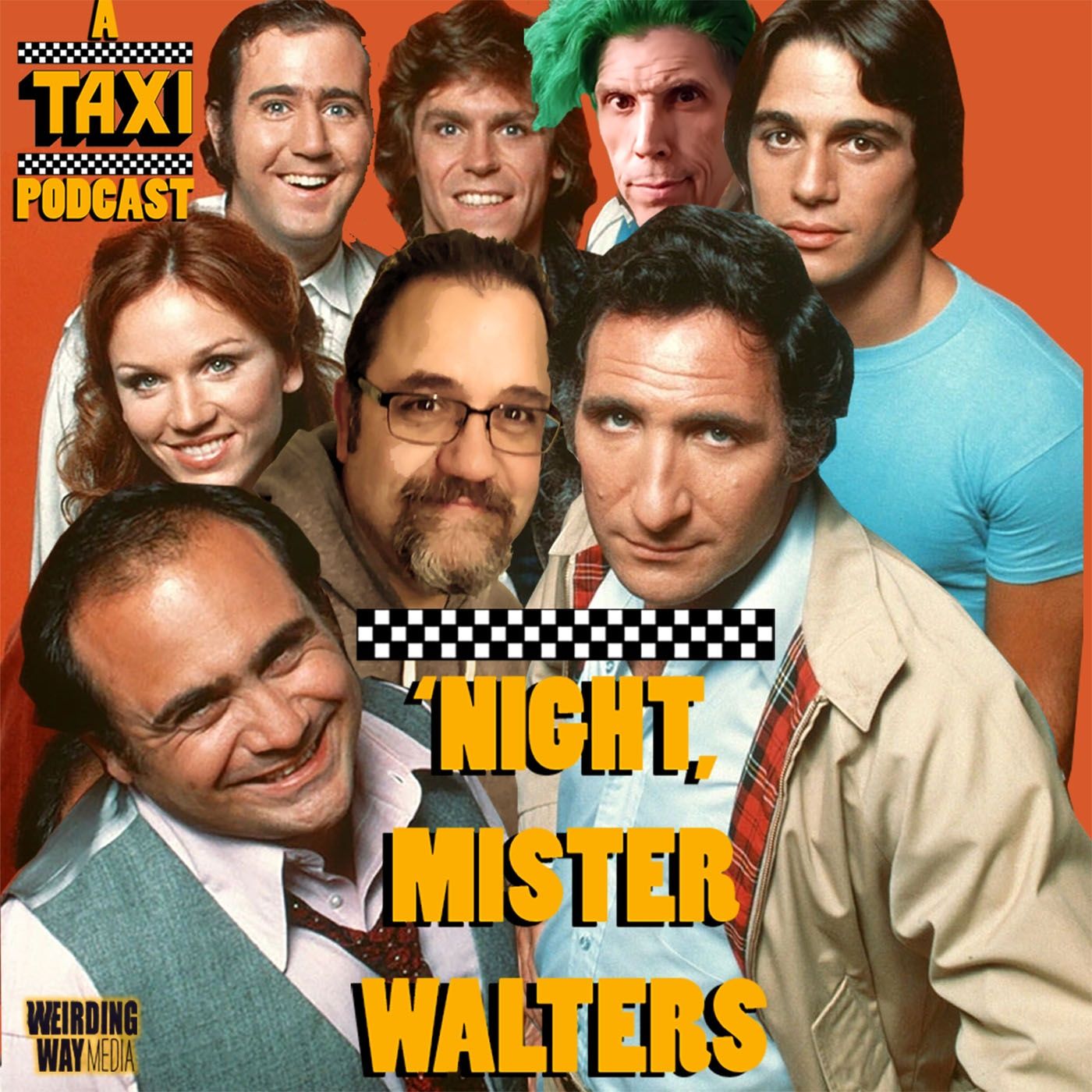
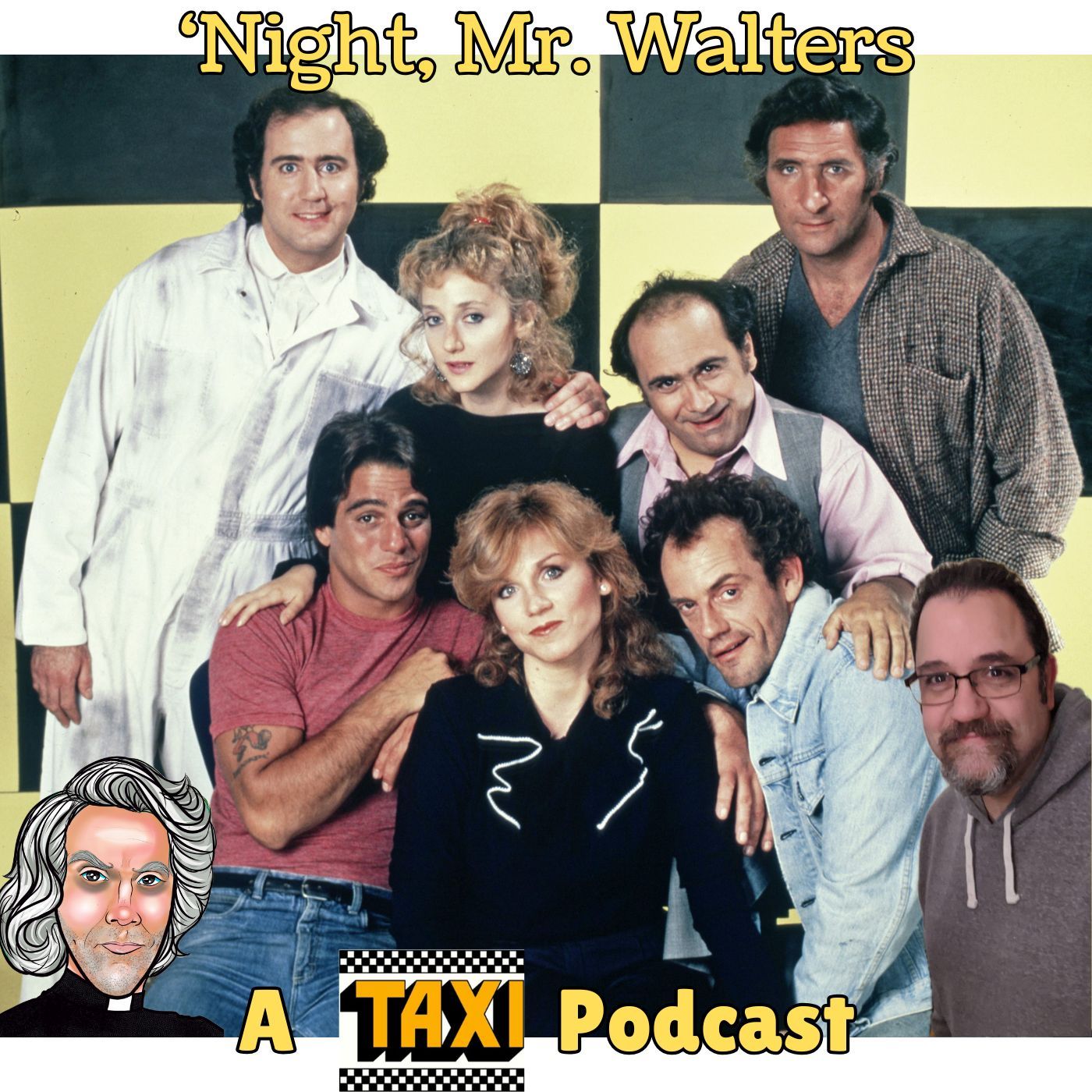
About this episode
Father Malone: FatherMalone.com
HP: hpmusicplace.bandcamp.com
email: hpmusicplace@gmail.com
Transcript
Automatically generated, so expect the odd misheard name.
Weirding Way media think mister Walders is that guy with it. He's an actor who got the phone ride by the new me. I'm a cant driver. I'm the only cant driver in his place. Hello, and welcome to good night mister Walters a tax podcast.
I'm your co host HP and with me is my co host father Malone. Hey, everybody, welcome to Taxi. We're gonna start off with a little bit of a bit of a potted history of Taxi before we dive into the episode. What's a potted history? What does that mean?
Potted history that is basically just a compact history of the show. Is it from potting soil? I don't know what it's from. Actually I heard it from a podcast about record producers. It was an English podcast, so maybe it's an English expression that I've I've grown to appreciate.
But this is a as I said, this is a small bit of history around our taxi if you will for it for all of you American listeners out there, as opposed to you English listeners who know what a potted history is for Taxi ran on ABC from nineteen seventy eight to nineteen eighty two. It was on on Thursdays nine thirty to ten pm. It famously then switched networks to run on NBC from nineteen eighty two to eighty three, and we'll get into that a little bit more as the podcast episodes go on. It was nominated for thirty one Emmys one eighteen, including three for Outstanding Comedy Series eighteen eighteen. That's a lot.
Three, that's a lot for five years of comedy. Man, we'll get into this, but this is a really this is a bananas cast. This is it's just one of those things where all the stars kind of lined up for them, and this is largely the cast that we're going to follow for the next five seasons or what have you. How many episodes is that? How many episodes did you ask?
It is one hundred and fourteen episodes over that time span one fourteen. Hear that everyone so buckle up, so they reached that. I think it's one hundred episodes to get syndication, which explains why this show keeps popping up and over the years on various like Nike ad Night. That was probably the place where I rediscovered it, and we'll talk a little bit about that. It was created by James l.
Brooks, Stan Daniels, David Davis, and Ed Weinberger. Period. Weinberger, that period is nothing but an affectation. There's no real meaning behind it. I often wondered that when I look at it, it makes me think there was somebody else in the writers Guild.
And he just went, Okay, well, I'm ed period. Okay, that's actually yeah, Like like Fisher Stevens was actually Stephen Fisher, but he had to flip his name. Yeah, Michael Keaton is actually Michael Douglas. You know what. I'd never knew that.
Yeah, I knew Ed Weinberger mainly because I used to see his name in the credits for The Cosby Show, which I think is, you know, one of his many claims to fame. Oh right now. A lot of these guys got their start on The Mary Tyler Moore Show, which is kind of the breeding ground for a lot of these sitcoms and really set the tone for sitcoms for years into the future. Without doubt, you can basically plot a line from Mary Tyler Moore which runs through Taxi, eventually making its way to other shows like Cheers and The Cosby Show like I just mentioned, and even feature films like terms of endearment and as good as it gets. So this is where we're talking.
You know, a lot of talent behind the scenes before we even get to the actors and the characters they play. So the show, if for those who are uninitiated, it follows a group of night shift cavies through the ups and downs of their lives in and out of the garage. You have you know Alex Reeger, He's the pragmatic Cabby Lifer. There's Bobby Wheeler, the aspiring actor. Tony Banta who's the washed up middleweight boxer.
Uh, There's a Lane Nardo, she's the gorgeous single mom with dreams of working in an art gallery. Did Jimmy Datowski who is the sixties drug casualty who's burnout nature masks a surprising depth. Laka Graves he's the sweet natured mechanic from an undisclosed European country. We never we never actually learn the name of the country he's from, right, this is true, Not that I recall. I thought I thought we did at some point, But may you learn a lot of the verbiage and the customs around the country.
But they always he always just said my country, right, or you know, yeah, in my country, he would say, you know, not not to get all Yakov spirenof as far from that as possible. This is the real dude, John Burns, who's the affable, slightly lungheaded New York transplant, and to my mind he's the obvious precursor to Woody boyd from Yeah most likely Yeah, and and and presiding over all of it is who Louis de Palma. Oh, you know, it's funny HP. You're reading this list of characters and each one is like more classic and than the last. You're like, oh, yeah, he's a great character.
Oh and Reverend Jim Oh my god, yeah, oh right, and Danny de Vito like killing it every scene. Yeah, it's amazing. I mean this to me, this is just an incredibly stacked cast, all perfectly suited to the characters. They play very well cast. Obviously the outlier, and this whole list of characters and actors is unfortunately John Burns as who is we'll see later on really they the writers admitted later they couldn't really find a place for him.
No, because you know what that we'll talk about it, I guess. But but that character is supposed to be like the proxy for the audience. Yeah, none of those guys were John Burne. Those writers, you know what I mean, Like they couldn't identify with the guy that they were using for the audience to identify with. So just make the show.
I just I found his, you know. And it's a shame because by all accounts, the actor who played him, Randall Carver, was was a very sweet guy, good actor. But the writers admitted that they just couldn't find a way to situate him within that cast. And like I said, don't don't get don't get too attached to him because he's not gonna be around for too long. But such is life.
Nice guy, go home and play with your kids. Yeah, don't don't come down into the garage because there's no place for you. With the hindsight, it's to me it's obvious to see the parallels between this show and Cheers. Obviously, Cheers and Taxi are about really a group of misfits kind of making a family for themselves in an unusual setting. In Taxi it's the garage, and obviously Cheers it's it's the bar.
Do you see any other beyond that? Do you have you seen anything within the show that that kind of seems like a like a foreshadowing of what you we would come to see in Cheers or even the Cosby Show for that matter, as far as like like direct sort of pullovers. No, I mean, you know, obviously the Woody character is the one that comes to mind. Also, Coach, I guess Pantuso, Ernie Pantuso, Ernie Pantuso kind of slightly resembles Alex Rieger in that he that's his job and he's not looking to do anything else and he doesn't really care. Yeah, I suppose, but even that feels like a reach to me, Like I think Cheers is like sort of whole cloth its own thing.
But yeah, I mean, you know, I know that Charles Brothers were involved from the get go, right, they were producers from the show from the pilot, right. Yeah. And Jim Burrows, who will talk about was one of the marquee directors of Taxi, and he went on to do a lot of work with Cheers as well. In fact, you could argue that he's more well known for Cheers than he was for Taxi. But from me, yeah, because I've given this probably way too much thought and to me, I see more parallels.
To me, Rieger is much more the foreshadow of what would become Sam Malone because he Rieger, when you think about it, and Sam to a degree, is really the star around which all of the other characters revolve themselves. Right. Yeah, they're both kind of the stable, constant presence within the garage or in the bar, and they've both kind of made their peace with who they are and true what they're doing in life. Rieger is as we'll see, Like I said, he's the Cabby lifer. He has no illusions about who he is or where he's going in life.
Yeah, I'll agree with you that as a central character they are similar, but as actual characters they can get in a further afield. I mean correct, I'm not. I'm not suggesting that these two are are are matched up as far as the types of characters they are, because obviously Sam Malone is a lady killer who was who was a famous athlete who you know, had a sort of fall from grace. He was an alcoholic and he's made a success for himself with the bar. Let's face it, like Rieger is the sensitive seventies guy that was popular at that moment, and then Sam is a little more eighties any he is.
But like I said, if we're if we're looking at these characters in these situations in the abstract, yeah, oh yeah, no, I agree. Like the Sam Malone's washed up nature and knowing that he's now a bartender and he's cool with that is very in tune with Alex Rieger just going I'm a Cabby, Like I don't, I don't have a pretension to anything else, like this is it. I've been a cabby. When all these people are gone, I'm still gonna be a cabby. So I get that.
Yeah, yeah, And there's a poignancy to that admission, which we hear in the very first episode, as we'll see. But I can also not to get too heavy into this, but I can also it's easy for me to draw a parallel in the at least in the abstract, between Louis de Palma and Carla Tortelli. They're both kind of these very abrasive, seemingly negative characters that do you know, as we'll see with Louie especially, he masks a surprising amount of pain and in some ways not that Carla is a desperate person. But there is a sweetness that they occasionally allow to show. Yeah, and we'll see that with Louis.
I mean, make no mistake, Louis is despicable and he does some really bad things in the course of this show. Oh, he's horrible. But as far as as far as the sort of pugilistic nature of that character, they are very much alike. Yeah, it's just that. Yeah, Carlo Tortelli is very sweet.
There is I will say there's one other character, and it's not in this episode. It's later on in the season, so I don't want to be a spoiler kind of a guy. But there's a character who shows up who is very much Nick Tortelli from Cheers on Taxi. I will get to it when we get to it. But there's a character.
While I was watching and I was like, this character is not working. The actor isn't right. And I was like, oh, it's because it's supposed to be what's his name on Cheers. So anyway, So that's basically what we're dealing with here. These are all the characters and their main sort of personality traits.
Now, what I want to get into a little bit is this show ran from seventy eight to eighty three. Essentially, we would have been about five, six, seven, eight nine years old when this was on TV, and I remember it being on television. I want to get into some of our childhood impressions of it, because I think we can agree both of us really embraced the show as as adults. Eventually when it was on in its original form, a lot of it was just over our heads. But for me, my childhood impressions of the show.
I remember hearing hearing the theme song when I was a kid meant that it was basically time for bed because it was at nine thirty. Got to get you know, got to get to bed, get ready for school the next day. Yeah, but that even now when I hear that, there's something very adult and I want to the forbidden isn't really the word, but there was something about hearing that theme and knowing, Okay, it's time for bed, but there's this other world that goes on after I go to sleep that this show is kind of a part of in a funny way. Let me let me let me peeback on your the theme song as a young person, because I was already a half hour into my bedtime, but would always hear the taxi theme, which meant that I was now past the point of no return.
Like you go when you're put to bend, there seems to be a time where you think you might be able to get up and get out of it. But once the taxi theme was going, I was like, oh, well, no one's coming to say man like it's right and the and the theme itself is rather haunting and melancholics. So for years and years I would hear that song and it would just bumm me out. I appreciate what a great tune it is now, but like early childhood into early adulthood, maybe like oh my god, Angela Jesus. Yeah, no, they're and you're not wrong about the theme.
I remember I was talking to someone about Taxi fairly recently, and there they were saying, how like depressing they found the theme, And I think part of that is because they're not. Well, I don't find it depressing. I think there's I mean, I'm a big fan of Bob James, and we'll talk about him in a moment, but I just always found it it was kind of urban, kind of hip, a little bit of a poignant feel. But I'm not sure how much of that is the music and how much of that is my associating it with the stories. Okay, here's the thing that characters the beginning part of the song, the you know the bit play it right now?
Yeah? What is that instrument? I think I could be wrong, but it feels like that's a flute, right, Okay? Yeah, okay. So here's the thing.
When people are saying this is like this mournful, sad, depressing thing, they're referring to the flute, not the funny part in the middle, which is great. Like, if you cut the beginning and the end off of this tune, no one could ever mistake it for sadness. It's it's like that, it's the sound like a lonely person on a hill, like I don't know, that's sort of more in full fluide. I can see that. Yeah.
So, speaking of the music, Bob James is responsible for all of the music in this and for so much more, and for a lot is He's a smooth jazz composer, arranger who had a career already before Taxi, but obviously Taxi increased his visibility and really kind of cemented his place in the pantheon. The theme for the show is actually you. You had already said the words. It's called Angela And this music was originally intended for the blind Date episode later on this season. The original choice for the theme was a song called Touchdown.
They needed to actually cut it in to the credits, and the Angela theme seemed to work so much better for them that that's what they went with. So what was intended to be the theme of a character in a particular episode became the actual theme to the show. To me, it sounds more like what you would see as an interstitial during the show, you know how they they cut to like a shot of garage and it's like the sort of peppy whatever, and then it goes in and then there's Louie, you know, yelling at somebody. For the listeners. Here is a little bit of Touchdown.
Okay, we're back about Bob James. According to who sample dot com, he has one thousand, six h twenty five samples to his credit, seventy eight covers and three remixes. Yeah, he's very, very heavily sampled. I knew he was popular in the hip hop community. I just didn't know he was that popular.
It's actually surprising because When you think of popular sample artists, you're thinking of James Brown, You're thinking of Parliament Funkadelic. These are all like the main stays, but there's no getting around the idea. It's documented on the site that he was very heavily sampled. In fact, the hip hop outfit Souls of Mischief recorded a song called Cab Fair. It remains the greatest exponent of sampling the theme to Taxi.
However, it also remains unreleased due to inability to clear the samples. But I happen to have a little snippet of it. So here's a little bonus. Here's a little bit of cab Fair by Souls of Mischief. Yeo, the jam was fly Yo line now with Zacle might matchup House Cuts Taxicab in anyway.
Episode one Taxi Episode one aka the pilot called Like Father, Like Daughter. Yes, good title. I like I like a pilot that actually has a title and not just pilot. It's so lazy. This is it.
We'll we'll talk about this. But basically, one of the things that I really love about this is that you're getting all of the elements fully formed that would kind of create the backbone of the show. For all five seasons. The script is economical to it of fault it is it is. It's a remarkable machine that it is an entertaining half hour that introduces us to everyone, gives everyone a fair shake, like you said, sets the template for the rest of the show, and still delivers a standalone story.
It's kind of remarkable. Yeah, you could. You could have had this episode the episode number fifteen in the series, or episode twenty five, and there would be no context setting. I mean, it still reads as a taxi episode. The characters have all of their traits and foibles fully formed.
It's fantastic. Yeah, these writers are like working at the top of their game. I mean, like you said, most of them came from Mary Tyler Moore or other shows whatever like, and they know what they're doing. Yeah, it's it's fabulous. So we have our first look at the opening credits.
Hey, who's driving that cab? Thank you? That was that's all you fantastic? That is actually, well who is that? You tell me who's driving the cab?
It's Banta Tony Danza. Tony Banzas got seventy two credits. That's who, of course makes the joke that they all called him that because he was he wouldn't respond to anything else. Yes, that is that is Tony driving. Can he do it?
Now? I wonder does he now? Like I know, you have to call the character Tony. I can, I cannot respond to anything else. Well, it kind of became it's just see right, he's got to be Tony no matter what it's This was b row footage from another episode.
Now this shot. What people some people don't know is the shot is originally too short for the credits. So if you look carefully, there's actually a couple of slight edits. Yeah, there's there's a there's some wildly bad jump cuts. The edits are not really art.
Once you see them, you can't unsee them. And now every time I watch you, yeah, I see it every single time, just like you pointed out in Um Satellite of Love by lou Reed, like, oh, that that's Bowie singing in the back there, and I go, oh, only shit, it really is, And all I hear is Bong Bong Bong. He produced it. It's fantastic. Yeah.
Anyway, so we get our first look at the Sunshine Cab Company. Louis, the dispatcher asks in the show is fantastic. I don't know who it was, but God blessed they did some good stuff. Man. That Actually, that's a good point.
Because the show was filmed in California. It was filmed on the Paramount sound Stage in California. They capture the essence of at least an imaginary version of New York because part of the reason is they cast New York actors Judd Hirsch, Tony Ganza. These are all flavoring the show with their New York essence, if you will. And to your point, the b roll footage where it's basically usually it's like a cab driving into the garage or some snowy street where they're pulling up to pick up a fair or something.
It does sell that. Yeah, certainly a lot of this show takes place during the winter when it's cold. There's several episodes where there's a blizzard figures into the plot. But unbeknownst to everybody this is this is a show that's being filmed in sunny California. Yeah, man, good good on them.
You know, like, obviously it's a set and whatever, but it looks great. In fact, I was looking just at there's a column by the telephone sort of in the middle of the thing. Right, this is a sound stage, so they had to build that column. It looks real, man. They like it like that looks like a sum There's little signs you can see all over the place, all over the dispatcher cage and the garage set would remain largely unchanged.
What we're seeing on episode one is basically what the garage looks like. At the end of episode one fourteen. This is the set, is what it is. The garage almost becomes its own character in the show because that's where we largely spend most of our time. There's different they go to Mario's, the dive bar, they'll go to somebody's apartment, so it's not it's not limited to the garage that would have become boring over the years.
We'll see Louis knows the place so well, oh my god, yeah yeah yeah, and his constant battle with the roach. There's always the owner of the garage, who is up those stairs in the sort of like at this high lofty perch, if you will. Louie is above all the cavies literally as well as in his mind figuratively. But then you have initially I think it's mister Mackenzie owns the company, and then it becomes mister Ratledge. I think later rights.
It's like the bar and cheers. It's this sort of comfortable environment. We know the environs, we know the boundaries of the place. We know everybody's got their own place to sit when they play poker and all this kind of stuff. It's it's very lived in Louise.
When the episode starts, Louise busting Tony's chops, Tony talks about a fight that he had and Louise remarked to him, is what's it like having a cauliflower back, which I think is a great opening line for them. Immediately sets the scene that we're not dealing with successful people. We already know that Tony is washed up just from hearing him talk about the fight that he had the night before. Louie putting him down conveys this impression that he's a loser. Basically, we're then introduced to John Burns, who's a yokel from out of town who can't pay alex Is Fair because he can't make the right change.
And then we see Bobby Wheeler, another loser, struggling young actor. It has to be said. As much as they might describe what a good actor he is, in the context of the show, he's really hammy. And I think that's that's part of the character is and this is maybe why he's still a struggling actor and he never really truly makes it is he's a ham The thing that I alluded to earlier in the episode that I found, I saw this and I can't unsee it after watching the show. Jeff Conaway comes in and he's talking to Alex about he's trying out for Equis and Jeff Conaway, if you watch the episode back, he has he's unusually for the character, he's just wearing a shirt.
Normally the guy the character Bobby wears like his leather jacket through the whole thing. Yeah, Jeff Conaway has the worst pitt stains through this episode. Like, if you watch it again, this is not a character choice, This is not something deliberate. This conveys to me how nervous Jeff Conaway was in this first pilot episode. It's so distracting and it's so gross.
So what happens is John discovers he has to call somebody to arrange to where he's going to stay in New York and he tries to use the payphone. He discovers that the payphone is broken, so they can call anywhere for free. This immediately kind of causes commotion in the garage. Everybody lines up to use the phone, and they've all got their reason why they want to use the phone. Bobby calls the National Theater of London try to speak to Sir Lawrence Olivier.
Olivier is in the middle of a curtain call when he calls, So Bobby, in a funny little bit, basically says, oh, I want to tell him is and then he just plats yeah, And it's like kind of a nice moment. It's pretty good. Actually, it's this conceit that there's a telephone that you can use suddenly, and like it should be noted that's a big deal in nineteen seventy eight. It was a big deal all through when we were growing up, like hauling people cost money every call, and like to get a pay phone that was messed up and you could just use it. Holy got and they do exactly what everyone wants to do, which is call as far as you possibly can for like no good reason at all.
This is a pre cell phone time, and this is you're right, this would be a big deal. A long distance call in the United States was really expensive and to make one overseas, Holy God, when he when when Banta calls Bangkok and he's like, okay, I'm putting in the money in now right, And he's putting in like a nickel, I think, and I'm like, ant, well, put in a quarter. It's gonna be quicker, Like you're gonna be there a while pumping that thing. And it's so true that for the modern watcher it might seem like kind of silly because why wouldn't I just pick up my cell phone? But this is a big deal.
And not only that, but as we've established, these are cab drivers. These aren't people with a lot of money. These don't want no no one one one wants to be there, No one wants to be a cavvy. They're all poor man. They're making making do like free phone.
Yeah, it's huge. So like I said, they all line up, as you said, Tony calls a prostitute that he met when he was stationed in Thailand, which is which is also a funny bit. And then we meet Elaine Nardo. She comes in, Louis doesn't know, he doesn't realize that she's a cabby and it's her first day, so he kind of sweet talks her, and then when he realizes who it is, he basically just says, a white waste of my time, you know, get over there, and I'll call you when I need you. So she gives lip back to him.
When we learn a little more about how she's really no nonsense and she won't take any guff from him lettle on anybody else. So it's her first day. As I said, as a captain, what does she do? She is working part time at an art gallery. Right, These are all aspirational characters, with the exception of one.
So she sits down and starts talking to Alex, and Alex delivers this is really kind of like the thesis of the character of Alex. How this person's an actor. And because she says to him like, oh, don't worry, I'm only here part time, like I'm not going to be, you know, here a long time, and he says, oh, yeah, yeah, everybody's here part time. That that guy's an actor, that guy's a prize fighter, and that's a hairdresser. And he says, and this is the important but he says me, I'm the only cab driver here.
Basically, he's the only one who understands who he is. It says a lot about the character's lack of motivation, about his pragmatism, about his really no nonsense way of looking at life. He's not sitting there saying, Oh, I can't wait till I get out of being a cab driver. I want to be a writer. I want to be of this right.
Which is not to say that we don't see some glimmers and other episodes of his unfulfilled passions and things he wanted to do in life, but ultimately, oh boy, don't we Ultimately he is a cab driver and he's under no illusion that he's anything else. Yeah, there's something, there's something noble in that. I've known people who are in that exact sort of scenario, who were doing something that they loved and everyone around them was just there to make a quick buck and then move along in their career, and it burned them. It's good to have him as our central character. That sort of character would be good no matter what situational comedy we were plugging him into.
What Rieger has on most other sitcom leads is that they stuck Judd Hirsch in there, and not only that, but like they've made him a fully formed interesting as interesting as all the crazy characters. Like ordinarily this straight man would just get lost in the shuffle, and Rigor does not. And it's all credit due to Judd Hirsch. He really is the glue that really held the show together. It's my understanding that when he was originally offered the part of Alex, he turned it down, maybe several times.
And there's something to me about this begrudging attitude that he had, I don't want to do this part. There's something I think that, in a funny way, might inform the attitude of like I don't really don't want to be here, but I'll I'll do it because that's what I do. You know, I'm a cab driver. I don't know how much about jed Hurst prior to Taxi. I'm assuming he was a stage actor.
He was. Part of his ambivalence was his experience doing network television. He did a show. He was on, a detective show called del Vechio. I don't think it ran for very long, and he was a stage actor mainly, Yeah, I'm gonna have to I'm gonna have to tie into del Vikio, right, you know, as as soon as we finished docking.
There's something about the grounded performance by Jed Hirsch that that even when things tend to shade into the unreal and the cartoonish, maybe in some cases, he always brings it back down to earth and connects you to the show in a way elegantly. He does it elegantly. There's a reason why his credit leads the credits of being of the show. I'm wondering about that. I'm glad you brought that up.
Obviously, he turns it down three times. He gets to say, okay, I'll do it, but my names first, it was if that ultimately because good, okay good, but like he deserves it. Is the thing. I don't know who could have played that part it like this and made me care for five years. Jeff Conaway.
Apparently years later after he left the show, he claimed that his name was also supposed to be on the marquee at the top, and that was apparently one of the conditions that he set out. I don't know that you could make the same claim that that Bobby Wheeler is the glue that holds Taxi together. I would give no credit to Bobby, but I put him at the end credits, like what what is he thinking about? His name comes up immediately right, it's he's the Yeah, you know, he's he's one of the principles. There's no, there's no, I'm not and I'm not diminishing his performance here on Taxi.
Jeff Conaway came to a very sad end and we all watched it happen, and it was awful, And that image has stuck in my head for the past twenty or so years. That was the Jeff Conaway in my mind. And I was rewatching this, but Conaway's great man like Pitt Stains at all. He's really he's really funny. And I've been using this word a lot lately, but earnestness, but not like sentimental, Like I think he's really really good in the show.
I think his character is actually really good in the show. I know eventually this is gonna not be so great for Jeff Conaway in the cast of Taxi, but here I think he's really good man like I like him And in fact, speaking of noticing things from rewatching this, episode too many goddamn times. In the climax of the show, there's a scene with Rieger and his daughter in an airport. Jeff Conaway is in the background, seated and has to sit there and react and he's he's out of focus, man, And I'm watching Conaway is fucking killing it, out of focus, not even really in the scene at all, and he's still doing it. So anyway, that's something I does about Jff Conaway.
So anyway, so Alex during this whole thing where all the all the cabbies are lined up, they're all encouraging Alex to use the pay phone and he's like, he doesn't. He kind of demures he doesn't really want to use it, but he does muse that he might want to call his daughter. He hasn't seen her in fifteen years. We learned that he was divorced and his wife remarried someone remarried and moved to South America. She basically pressured Alex to stay away from the daughter and let the new husband adopt her, which is awful.
It just does an awful thing to learn about this character. And Nardo kind of she kind of like, what a horrible human being you are? Abandoning your daughter. Yeah, she's a ghast and rightfully so. And this is a really sad situation.
Charres of of of his complicity in the whole situation. It's really sad for Alex that he really missed the majority of his daughter's life, but she wasn't. He wasn't a part of it. In fact, not only was he not a part of it, his ex wife told him essentially, stay away for the good of our daughter. Stay away.
This is a heavy, heavy pilot, speaking to the skill of these writers, Like these moments come up, they hit you heavy, and then they immediately follow it back into the comedy. Cheers was good at that too. There was a lot of it's really a funny show, but they had a way, they had a knack for mixing in emotional moments. We also briefly meet a lock of the garage mechanic Here we Go Baby, played by Andy Kaufman, not Jim Carrey. I thought it was still carry supposedly, and I don't know how true this is.
I suspect it's probably more true than false. At least this is the way it's depicted in Man on the Moon that Kaufman really didn't like being on the show. He found it too constricting, and it's easy for me to believe that that's the case. But I will say that he's still despite that. It doesn't show.
It doesn't show at all, because we'll see. We'll see over the course of this series, because he's featured very heavily, and he has a lot to do, sometimes carrying the whole episode, and he makes He's just tremendous, even some of the more dramatic pieces. You would not expect someone like Kaufman to be so effective, you know. I watched I watched an interview with Tony Danza specifically about Andy Kaufman, and he was saying how resentful he was at the time because generally, when they do a TV show, there is a read through on Monday, and then they block on Tuesday and Wednesday, and then there's like a rehearsal Thursday, and then they shoot Friday. And Andy Kaufman showed up for Thursday and Friday every week, right, and they had like a fake lot for the rest of the week doing an impression of him, and then like somebody just doing the stand in and stuff.
Right, So it's easy to see why they would be resentful. But obviously it wasn't necessary because Lanka is never like that intertwined with the characters. He's only sort of on the outside. That's kind of a good thing. He didn't want to do the show.
This is the only way he was going to do it, and as you said, it doesn't as the viewer knowing none of this wouldn't affect us at all, like it doesn't show, you know, there doesn't seem to be any discord. It's easy to see why the cast would dislike him in real life because when he was hired, he had all these stipulations. As you said, he wouldn't be there for a lot of the run throughs, and then he would kind of come in late in the process. He had he insisted they hire a stand in, as you said. More famously, he insisted that they hire somebody named Tony Clifton to actually appear in several episodes.
Now, who's Tony Clifton? Fought him alone. Tony Clifton is a lounge entertainer, rather flamboyant, dressed in the sort of tuxedo with the frills. He wears spectacles and all times he has a mustache and usually smoking a cigar. I think he had.
He had a two pay also really kind of an attack comic in the Don Rickles at School, but also styled himself a song and dance man in the Sammy Davis Junior Vein. By the way, he's terrible at all of them. He's perhaps the worst performer in history. And I don't know how he keeps getting work, but apparently it's because Andy Kaufman is stipulated that he show on the show. He insisted on hiring Tony Clifton along with him, so I think the producers saw in Kaufman like a rare talent and they really stopped at nothing to make sure that he was on the show.
And it's just even just in this one episode he's on screen for maybe three minutes, but he makes a huge impressure. He ends his bit with his famous thank you very much, which became synonymous with the character. Now the character grew out of his nightclub act. He used to have a bit called I think it was just called foreign man, Foreign guy, Yeah, and it was him coming out with this ridiculous indeterminate and he would say jokes and they were terrible jokes, and it was in line with Kaufman's confrontational humor. He would do this to the point where he would make people so uncomfortable because this character foreign guy would would get more and more upset.
It's such a good piece man with the bongos at the end. It's amazing. Man, It's it's so iconic for Andy Kaufman. And you know what, watching him as a locka it made me reexamined Andy Kaufman because he is this sort of very confrontational comic. His pieces are abstract in the extreme and you're the joke in a lot of cases.
But at the same time, he plays sweet, sweeter than anybody. He's the living embodiment of both extremes. He was like the guy who really reveled in being hated, but like was so good at being sweet and lovable. It's kind of insane. Yeah, if I had to compile a list of favorite Taxi episodes, I would say Locke is probably central to it two or three of them.
There's no hint as you're watching it that he resented the character or was he never phoned in his performance. He's always just so sweet and really embodied the character of Laca really in a special way and we see it from jump in this episode, we're already loving this character. It's incredible how much he does with so little time. So Alex, he finally gets the nerve up to try to call his daughter with his pay phone that is for free. He finds out from his wife that his daughter, Cathy is going to travel to Portugal for college and for some reason, has to fly through Miami.
Unbelievably, Alex essentially steals a cab with the other cabbies and drives down to Miami International Airport. Before that happened, they tried to borrow the cab and Louis says he's not lending the cabs out anymore, and then he comes out to confront them, and this is the first time we get to see Louis de Palma in his glory, where he opens the cage door and steps out and he's their height and then descends the stairs and they all surround him like giants, and he's still the most menacing person on screen. It's fantastic. Man, It's like watching Darth's Vader emerge from the smoke. It is a wonderful reveal because up to that point it's not as if any DeVito was a household name.
Nobody knew how tall he was. Man, it was just this, it was this looming presence in a cage. Holy shit, right, and then he comes out and it's like he's, you know, four foot nothing and whatever. Really kind of sets the tone for this sort of Napoleonic complex that you can see that this character is dealing with. They basically steal the cab from Louis and they drive down to Miami International Airport.
It's I think they say it's gonna be about twenty four hours, like a straight shot. Oh by the way, on the way there, Tony reveals this that he once had to drive all the way to Miami did twenty three hours. I did it myself. Took a bunch of upp us. When the guy knocked me out, I couldn't close my eye.
Okay, I just was. I think the word is gobsmacked. When I saw this show on network television from nineteen seventy eight, one of the leads is like, oh, yeah, I took a bunch of uppers, Like, no big deal, But you're right. That is kind of an interesting lead. It's sort of a bracing little thing because it's just a it's conveyed through a voiceover, right, which means it might not have been in the original script.
It was like something they thought of on the fly. Oh, let's throw that in the uppers the story. You could make the point that that's actually truer to what a cabby might actually have to resort to. All those guys are on speed. It's kind of thrown in is this voiceover as we're watching footage of the cab like driving down the highway.
So they finally make it there and there's a group milling in the waiting area and Alex picks her out, uses his quote unquote, you know, paternal instincts to pick out which one is his daughter because they're all wearing school uniforms. Yeah, but he finds her immediately, even though her back is to him. He taps her on the shoulder and says, hey, Kathy Kensuelos. She says, yes. Now, it's hard for me to get past this.
And this is another it's a silly point to make, but this girl was adopted at basically aged two, spent from age two to I think she's supposed to be seventeen in this, so she spent fifteen years in South America and there's no trace of an accent at all. She just which is you would figure Spanish would be her native or Portuguese rather would be her native tongue. Yeah. No, they instand picked the girl who's going to be in every after school special. I'm not talking about this actress specifically.
I'm just saying she was like the platonic ideal of the after school special actress. The character is played by an actress by the name of Talia Balsom. She is the daughter of Martin Balsom and Joyce Van Patton. Apparently only two actresses were auditioned for the role, Balsom and another relative unknown named Rosanna Arquette. Rosanna Arquette probably best known for Desperately Seeking Susan.
No, she's most known for that song Rosanna, or that other song in Your Eyes written for her or that other song. What is the mystical quality of Rosanna or I can't where every musician just falls in love with her and then writes an awesome song. I think they made the right choice with Telly Balsam, because Rosanna ar Kent I think probably as a better actress, but is in no way related to Judd hursh and we're going to call her Consuelos on top of that, just to confuse everybody. It's hard for me to get past the fact that she in no way seems like anybody who spent the majority of her life in Portugal. Yeah, but I mean she's you know what, she's fine.
She does what she has to do, and it's fine. And it's an emotional thing. When she meets her father in this scene, you're not my father. It's awkward. And there really is an unreality to the whole setup, the fact that they essentially stole this cat.
Oh no, no, no, no, no no, that's not the unreality. That's all great. I would do that, you would do wouldn't I would do that. I do that right now. I jump in the car and drive to Florida.
I'm not suggesting we wouldn't do it, but I would question the fact that the other four or five cabbies would go, hey, let's go on a trip. Yes, it is a bit of situational comedy going on, but I like all of that. I think it's the pushing the credulity is like trying to slam there. I wasn't there for you. You weren't there for me.
Relationship into one thing. Although they do it very well. I mean, you know, it's it is. The writing isn't ham handed at all, the performances are. It's just feels a little it's a little contrived.
Yeah. But having said that, Hirsh really sells the scene. Oh yeah, man, I believe him. Basically, she says to him like, well, you're not my father. You didn't raise me.
The man who raised me is my father. And you can tell he's really hurt by those words. And he says, you can't tell me that I'm not a father because I knew so much about you for those first two years. He talks about how she used to sneeze, what her favorite foods were. Oh yeah, he spills it like it's there, it's always on his mind.
So yeah, yeah, I mean, utterly demolishing the earlier Nardo and audience classification that this is a lacking parent. He's not at all. He's He's just a man who had to make a really tough decision. And he, you know, he and comps too that it was a fine decision for him at the time. He was not unwilling to give up that responsibility.
At that age. Ultimately, you're left with the impression that he really let himself off the hook by making that decision. So although it is a tough decision to make, he admits that he just knew it would be easier if he just cut it off and moved on with his life, which is sad and again really heavy for a fucking pilot of a comedy. But Alex really makes it clear that he's held tight to every moment of her first two years, and it's clear that he's he's thought about it a lot. So the episode ends, the phone is repaired, and everybody's wooing about it.
By the way, earlier in the episode, in fact, the end the opening scene when John is trying to make change and he's trying to calculate the tip on four seventy five and every Cabby like spills that made its seventy three cents a great moment, really real moment it is, and I love in every episode they put such a great assemblage of cavies that are waiting for their caves to come in. They are their characters, man, they are real human beings back there. Let's not forget these are the night shift cavees. Right. They're waiting for the cabs to come in from the day shift, so they're usually waiting around, but I love the texture of them in the background.
John comes in at the end of the episode and announces he's gotten his hack license. Hey yeah, yeah, here we go with the rube. Finally Louis gives out his cab assignments and we're off and running. And that is the episode. Now, let's talk a little bit about the episode things good and bad points.
Now, For me, I love that this show comes kind of fully formed, almost in the form that it was going to take going forward. All of the elements are there. I love that it's already kind of its own thing and its own vibe, and they didn't really change the formula too much because it worked. I agree. I agree with everything you're saying, and I love the episode.
I do think as a blueprint in season one they stick a little too hardcore to staying in the garage with everybody as like an office comedy, and then in season two they began to realize that taking them out and doing stuff with characters in the calves is just as interesting and in fact, in my humble opinion, even more interesting than just watching them in their shenanigans in one location after another. But this formula works for a very good reason because it's perfect, you know what I mean, Like, you know, the writing is going to be good no matter the way they present it. The other thing about moving away from just the garage and into more as they're they're picking up fairs, it really opens up the show and it keeps it from feeling two stage bound to that one set, and it opens up a ton of possibilities for different episodes.
And as you pointed out, whoever is responsible for conveying like the inside of the cab and like the headlights going by and the tracking work of that, it's really kind of brilliant. Oh my god. Yeah, we're gonna get to it more when we see and I think, but yeah, that poor man's process where it's just a black sound stage and they're shooting a car and like somebody's off camera just rocking the car back and forth, and you know they're pretending to drive. But if you watch on taxi, I don't know who the human is, but God bless them whoever is running behind them holding the headlights of what is supposed to be the car passing them or pulling up behind them. They're doing the lord's work man's It's real good because there these are night shift cabvies, so it's always going to be nighttime, so there's only so much detail you could convey through the windshield of the taxi.
It just really works, really well. It really does it. And you know, on most it comes that are sort of location bound, whenever they go out into the world, we're reminded that they're just in the world like we are. But every time on taxi it's always nighttime and they do a lot of location stuff. They'll eventually, like the b Roll stuff, will spill over into episodes where we'll get footage of them on the streets of New York driving the cabs.
So the bare similitude of that is fantastic. And like you said, this is a nighttime world we're in with these people. We get to experience that with them. So I think those are all good points, are great points. What didn't you like about this episode?
HB. I'm nitpicking a little bit, but well maybe not nitpicking is the word, but the scenario is just a little too unbelievable. Why did they Why did it have to go to Miami. Why they're in New York, like they'd say, Like his first reaction is she's going to Portugal. Well, she has to come through New York.
Yes, she did have to go through New York. Just set it in New York and if they need to do some business with cabs, then you know, make some traffic heat nonsense, you know what I mean. You're right, it's a it's a stretch to have him drive all that way for the for the meeting. We get it would have been better, honestly, had they gotten there and the plane had just taken off right, and then he would realize that he missed his shot. Yeah, he wanted to reconnect with his daughter and he missed it.
He screwed up. That probably would have been more thematically appropriate. I mean, we get, we get this reunion with these two, which is nice, it's sweet, and if not for the performance by Hirsch, it wouldn't have worked nearly as well. But I get it. I would have liked to have seen it set up more elegantly.
And to your point, it is a little bit stage bound. We'll see that will change over time. That will have all It's fine for this you know what I mean, Like, given the amount of information that they have to and do convey and make it entertaining and make it very funny, this show is really funny. Yeah, these are really top notch writers. So we're going to grave this on how many yellow lights it should get?
What does he know? Light me? Thank you, Jimmy Zatowski. Were gone graded on how many yellow lights? One being the worst, five being the best?
Father alone? What do you give this episode? How many yellow lights would I give? Like father? Like donor like?
Five is unassailable right, Like it's the best thing ever. Five is the quintessential episode of Taxi. If somebody says should I watch Taxi? And I go, yeah, watch this episode, that's a five. Yeah, okay, then this ain't a five.
This is a three. I agree, this is a three. This is a really high bar for a three, But this is a three for this series. Three might sound like an average grade, but this is we're grading on a curve here Taxi. These episodes and the writing is a cut above, So it's a very high bar.
I'm going to resist the temptation to say, well, maybe a three and a half. We're going whole yellow lights on this. It's either one, two, three, four or five. Okay, we're not gonna quibble and say, ah three at a quarter. I'm going to give it three yellow lights as well.
This is a fantastic introduction, wonderfully acted, well directed, some maybe finding their footing. Okay, so we're gonna give this episode three yellow lights. What does a yellow light me? Thanks again, mister Ringnatowski. The next episode we'll focus on episode two, which is called one Punch Banta.
But we hope you enjoyed this inaugural episode of Goodnight Mister Walters, a taxi podcast. I am HP and I'm Valla Malone. Thank you so much for listening. Look for you next time. Nine mister Walders
More from Night, Mr. Walters!: A Taxi Podcast
Similar episodes across the network
Matched by shared keywords.
-
Inside Scoop with Patrick Hinds: Golden Girls, True Crime, and TV Magic
1 shared keyword: sitcom
-
Marsha Posner Williams, Part 2 | Golden Girls, Hail to the Chief and Sherman Hemsley's Amen
1 shared keyword: sitcom
-
Marsha Posner Williams, Part 1 | On Golden Girls, Emmy Wins and Being a Television Trailblazer
1 shared keyword: sitcom