
Season 1 · Episode 128
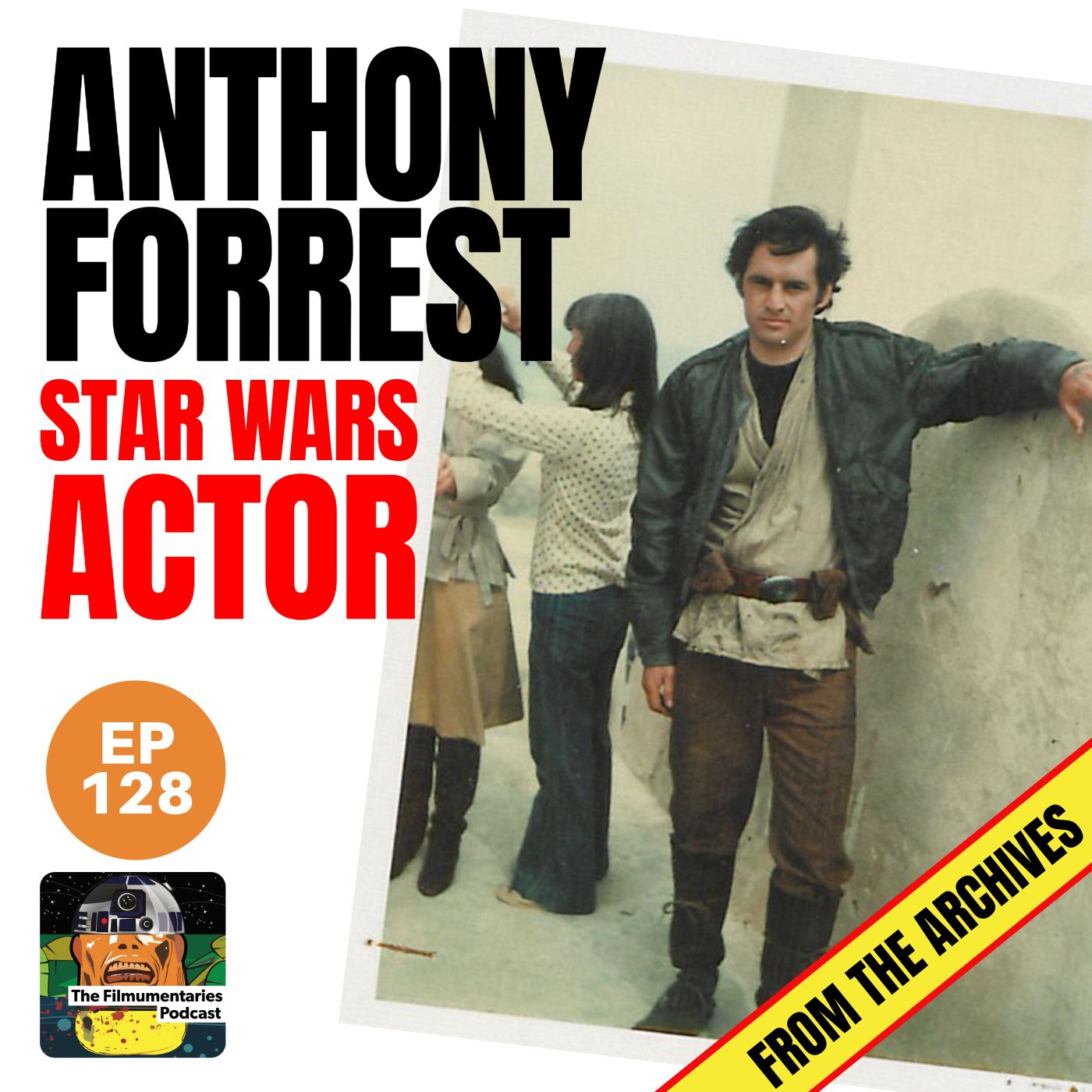
128 - Anthony Forrest - "Move Along" Star Wars Actor
About this episode
Listen in for rarely heard stories from behind the mask.
Mentioned in this episode:
- Deleted scenes from A New Hope
- Filming in Tunisia and London
- Busking and recording in the London Underground
- Alec Guinness and the 2007 Academy screening
- The Ballad of Bob’s Garage project
All my links
This podcast is completely independent and made possible by listener support. If you’d like to help me keep making these episodes, you can join my Patreon community here: https://patreon.com/jamiebenning
Watch more on YouTube:
Check out the Filmumentaries YouTube channel for behind-the-scenes clips and extra content: https://youtube.com/filmumentaries
All my links
Transcript
Automatically generated, so expect the odd misheard name.
Weirding Way Media. Hello and welcome to episode one d and twenty eight of the Film Youmentaries podcast. I'm not going to keep you long this week. I'm in a very busy period of work. I'm on a podcast in about an hour, the Projection Booth podcast.
Have a listen out for that. It's all about Return of the Jedi that'll be out later on this year. Then I'm straight into a three day training course, then into doing the expert panel the styles influence of the BFI. And then i am doing the Formula one Grand Prix Canada remotely at one key hours and then I've basically got a data pack and then I'm off to Martha's Vineyard for our Joe Alves shoot and there's a lot to organize with that as well. So this is an interview from the archives.
Is an interview with a gentleman called Anthony Forrest. He famously played one of the characters who was to be Luke Skywalker's friend at the Toshi Station. Of course those scenes were cut out, but he did appear in a storm Tuber costume as the guy that says these aren't the droids we're looking for. Move along, Move along. I had a chat with him, oh more than ten years ago.
Now. So this one, as I said, is from the archives. It's on a telephone call, so it's not the usual stand of the audio, but I hope you enjoy it anyway. I'll be back at the end for a little tiny bit more jabbering on well by Antonie Jamie. Hi, how are you?
Yeah? Were yourself? Okay? Thanks? Yeah?
I just this life seems crazy these days, really busy busy. Yeah, are you working on that film? Still? The film? But also I'm going into the recording studio.
In May for the music stuff. Yeah. But also there's a couple of events. I'm going to Belfat tomorrow for four days, but then in April I'm going to celebrate Anaheim. Oh right, you're going over there because you know, when I saw Anaheim, originally I thought that sounds like it's in Germany or something.
But it's California, isn't it. It's where Disneyland is, Okay, where the original Disneylanders, right. Got chat? Yeah, I'm out in Bahrain, I think when that's happening. So, yeah, conventions are not necessarily my sort of thing, but I would have thought maybe about going to that one, but I'm doing my Formula one coverage stuff, so I'm out in the Middle East.
Yes, yes, well thanks thanks for agreeing to an interview. I know that Toby's one has worked out really well. We got it picked up by quite a few websites and things, and you know, I just trying to do kind of one a month at the moment. Right, Maybe that's a bit too much, but. Well, it's got to be a lot of work tracking people down and trying to organize schedule.
Well, this is the problem. You know that. The advantage that I've got is that because my work takes me all over the place, I'm around at strange hours as well, so maybe I can fit in with people. So, yeah, did you have a quick look at the questions? Yeah?
I did have a quick work. Yeah, okay, I mean it's not limited only to those. As I said, what I've done with these interviews is that I've I'm recording both of us. I've got myself on one leg, you on another leg, so I can sort of get rid of myself as it were. Right, So when I ask you something like can you tell me how you got in Stars?
If you could say I got involved in Star Wars by you know, kind of repeat the question back. People won't hear my questions, So should we delve straight in? Yeah, yeah, I can do that. Yeah. Okay, So can you tell me how you got involved with Stars?
Did you have an audition or yeah? Tell me about what happened. Yeah. Well, the way I got involved with Star Wars was really through a combination of events. One was the fact that I've done a film called The Eagles Landed, which was John Sturgis was directing, and that was the song with people like Michael Caine, an amazing cast actually Donald Pleasants, There's a wonderful cast that was put together, and it was that was a follow on from something else I'd done at the BBC, But it was really I got called in through my agent at the time, Michael Anderson, and he uh I went into meet Irene Lamb and I got cast in The Eagles Landed and she happened to become the casting director for Star Wars and so that was really an introduction through Irene Lamb.
When George Lucas was in London looking at casting for Star Wars that he was he'd done casting in Los Angeles from my understanding and then I was he's was doing like secondary casting in the UK. Okay, and you were based in the UK at that point. Then, yeah, I was based in London at that time. I'd originally you know, having been born in and I was raised in Montreal, and I had originally come back in nineteen seventy four and I started on a series which is out of their sequel BBC sequel to Anna green Gables, which is Anne of Avonlea, which is a Canadian story, and that series was starring Kim Brayden, and so I had a small role in that in that series, and then I it was kind of things kind of spearheaded from there where I started picking up work in London.
I did the numbers in those days. There were a number of today they're well known. Director was Ridley Scott Adrian Lene. I did I think nearly twelve commercials. So they with Ridley Scott, which he's doing a series of commercials at that time for Johnston Johnson.
They were called the There was a deodorant I remember, it was called US and so they created this kind of fictitious rock band that had you know, some backing singers and had some musicians and having been a music being a music myself, I got cast as a keyboard player in the band. Great. Yeah really because really Scott I think he ended up to need direct the Hovis advert or something, the famous one with the cobbled street and all that stuff. Yeah, he did that was that was kind of that was really an award winning uh commercial. But that the commercial company that really Scott had and subsequently with his brother and him together that was an incredibly successful commercial's house, producing enormous amounts of commercials, which was always the springboard actually, I think for that enabled really to move into feature films, and that was similar to to a number of directors at the time.
There was Alan Parker, who was Adrian Lendy. These were all kind of a generation of commercials directors who were moving across into feature film because that was their real their passion and their desire. So when you were originally casting styles you were asked for the part of a fixer. Yeah, it was yeah, the fixer I had I had kind of read i'd met. It came a kind of a back and forth process where I went in a couple of times to meet with George Lucas and there was no necessarily specific reading for roles.
It seemed he was that he was just trying to get a handle on who you were and what the possibilities that you that you might offer. And so I think I'd read a couple of lines out of out of Hans Solo's role, I'd read a couple of lines from a different few different things, and so it's really, uh, I think that was something that was he was, you know, he was still probably just scanning what they were, surveying what the territory had to offer. Really, because I know that he cast you know, Mark, Cary and and Harrison as a as an ensemble really, and if he'd not gone for one of them, he might have gone for another three. And I wonder if George was also trying to cast you as he did with Ku Stark and Garrick Hagen as well.
I wonder if he, you know, was trying to cast you as a group as well, to see how you work together. Yeah, I think I think probably that was the case in this, in the sense that this was you know, this was supposed to be a group of these characters that knew each you know, there were there were friends knew each other they were, you know, in this kind of isolated environments, and so you know it was like a not so much like a club, but I mean, I know there was years later, there was you know, comparators to made to the the groups that were created during American Graffiti. Yeah, and so that probably was was something that that's kind of naturally occurred through the screenplay as well and the situation where there had to be some kind of level of either camaraderie or bonding between these characters.
Yeah, and I to send you traveled to Tunisia as a group? Is that quick? Yeah? Yeah, we did. We did travel as a group.
Although I don't have a lot of recollection of the traveling out there, to be honest, it was it's it's it's kind of you know, it's kind of gone into a haze in my mind, how you know what that first, the journey out there, I kind of remember the journey back. When I remember the journey out there, I think I was just probably I think I was probably just awe struck and being able to leave get out, leave the rain for a while. We get to the sunshine, and. I remember when I was down at the BFI watching the screening a couple of months ago that you mentioned on stage that you had a little excursion out one day with Garrek and Mark on horseback. Yeah, it was really I had this and this is just my my kind of vivid imagination where when I when I arriving into Nitby with.
With an environment that I've never been in before. But I think it was what occurred to me was the whole atmosphere of Tanis and that, and I was I was imagining Lawrence of I kept imagining Lawrence of Arabia and I was kind of seeing this. I was having all this imagery and so I thought, oh my god, these you know, You've got these fantastic Arabian horses and stuff like that, and so I wanted to go riding across the desert stands and I kind of roped a few other people into, which is not a great idea, I understand from an insurance perspective, But you know. You're you're in your you're in your mid twenties and you're reckless. What can I say?
Yeah, I was talking to Garrick about this the other day and he said, you know, I said, I can imagine you were sort of going through the dunes, but it was along the sea shore, wasn't it, Because you're in gerber I think, yeah. It was a beautiful place it. Trust me, it was actually a great thing. You know, had we filmed that it would have looked it really was a spectacular moment to to to just enjoy that. Yeah.
Yeah, because that I've seen shots that recently surfaced of up on the balcony as it were there, and that's sort of looking out to see which you don't of course see from the cameras view, the cameras looking with the sea behind it. So I think for quite a few people it's a surprise that you know, that's the geography of the place. Yeah, yeah, it is, because well it's like anything on film that there was so much cheating that goes on in terms of locations in camera angles and that that you know, it's sometimes when. You see the reality of where it was and where something was shot and then you think, oh that just our imagination allows us to imagine that a lot of other things, and yet the reality is quite different.
And I know when many people have talked about being on set that there was you know, they'd read the script, they didn't understand it and the English crew were kind of poohing Lucas and saying, you know, thinking it was some sort of low budget sub doctor who kind of production. What was your thoughts at the time, Did it feel like a big production you're on? Did it feel how do you hear that George Luke? Yeah, I had. I had heard of George Lucas, that was mainly through American Graffiti, but also remembering that I was at that time, I was, I was.
I think I'd gone back to visit family a couple of times in the course of the year, and so I was at that period movies were not being traveling there. It was like a six month wait practically before a film it was released in the United States that actually showed up in the UK cinemas, And so American Graffiti hadn't really traveled yet, and so I was aware of it, and it's the success that was coming off the back of that. So I was probably a little more up to date than a lot of the crew in that were in terms of what George's potential was and what he was capable of and in terms of telling a great story. And I think the thing that through a lot of people was the fact that we were still in a phase in terms of filmmaking where science fiction hadn't really evolved in the way it even has now, but in those days hadn't evolved in terms of special effects and the possibilities and the potential to actually bring an atmosphere and an environment to life that really felt realistic, That that felt like you were there and and and had the dimensions and the parameters and created a an atmosphere and environment is a cinema gore.
When you're locked in that cinema, you felt you were there and you felt that you were really experiencing it. Remembering that through the fifties and that a lot of sci fi had had been kind of done on was just still experimenting with it, and a lot of you know, you're going back to the days of paper plates on wires and things like that. That to you know, So in reading looking at the script, I can understand how people couldn't imagine how this was going to piece together, because it would it would be going from what would be an exterior situation to to a potential interior situation to all of a sudden, all of this activity that was in space in battle fights and things like that, would that everybody probably figured we're going to look incredibly hokey and very very b movie ish.
Where from from my understanding, the filmmakers in Los Angeles at that time, the young filmmakers, which which were people like Spielberg and Lucas and a number of others were had a great belief in the possibilities of working in special effects in sci fi, having been inspired by two thousand and one. And I think that was a film that really opened a lot of people's eyes in in in the younger film community to to the possibilities and you know, the the giving the the the go not the go ahead, but it was almost like a green light thing. We can do this, you know, we can we can actually really create another world on film and and make it feel real and believable. And they showed everybody what they could do.
So then how long did the shoot in Tunisi last? Because then you flew back to London to do the interior scenes. Is that right? Yeah? I was there probably a week or a little over a week.
They've been out there, they've been filming several weeks. I think before I was also constructing sets and look, you know, scouting locations and things like that prior to arriving to to to the Fixer scenes. So I was there. I guess it was a week or just over a week, I can't difficult And probably probably somewhere somebody has the schedule. Yeah, yeah, I could probably dig that out from somewhere.
And then did you go again to do the because you were then in a Stormtrooper? I mean, you know, talk to me a little bit about that. Did you know you were going to be a stormtrooper? Had you tried the suit on before? Yeah?
They well they yeah, it's interesting because it's it's stormtroopers sand troopers. I mean. The delineation of the various characters being stormtroopers and troopers or snow troopers, I think didn't really start to evolve until the merchandising in being able to define characters more clearly in terms of merchandising. But it was it was really that I was waiting to to do to do a sequence with the Fixer character when Robert Watts came to the hotel to get me and asked if I could come to the SEC because George wanted to talk to me. So we drove out to the location, and I was kind of it was it was really a do or die situation where George said walked up to the car as we were pulling up and said, with a script in his hand, he said, look to do me a favor, and that was and I said, surely, what's up?
And so he explained it to me and showed me the script in that and said not to worry because it won't affect the fixture's character because I'm going to be in uniform and so nobody's gonna be able to you know, going to be covered in a costume. And that was when, as I was actually looking at the lines and reading through the script and trying to to to get the context of the scene in my head, I was being dressed. I was actually not even I was practically not even aware of what they were putting on me. I was kind of that I was. I was concentrating on the scene and just allowing them to kind of address me.
And it was kind of then I started to you know, it was not until I was almost all, you know, pretty much dressed, did I started to actually see what I was the costume proper. And how was that in the he out there in that costume pretty unpleasant. I think, yeah, it was. The unpleasantness, and to be honest, was more in in the scratchiness in the in the the mobility, the lack of mobility. It was very the inside of the costume was very raw and scratchy, felt like I don't know if you've ever as a kid, I'd worked on a neighbor's uh with his neighbor's friends and I used to hang out and I remember their dad, Farber glassing a boat.
Yeah, and it was kind of like that. It's it reminded me of that material. The inside of it. It was very scratchy. Plus the day before I'd been in the sun and picked up a bit of a sunburn, so I was really feeling it on my shoulders.
But it was, yeah, it was. It was pinching in various locations behind in the knee joints, the back of the knee, and in the on the arm joints and things like that. I think, you know, Stars's cultural impact has just increased over the decades, and I think you know a lot of people like yourself have then become involved in the conventions and stuff in the in the two thousands, and I mean you know, your lines as a sound trooper in the film have become quite iconic. You know, move along, and these aren't the joys we're looking for. All those things, I think they've really they've been parodied, you know, they've been on you know, some of the animated comedies and stuff.
How does that feel to be involved with part of that? Well, I think it's very from just purely from an actress point of perspective, it is very rare that you do something and you're involved in something where you play a scene or or you have a moment on film and it becomes to a certain extent screen history, and the fact that it's transported itself into becoming you know, one of those what what you know, a lot of people like say, is an iconic scene in this in Star Wars. It's it's just so gratifying because you know, you do a lot, you work on different films or television and things like that, and a lot of it, you know, it it falls by the wayside. It's you know, not many people will pull it back out and you know, look at it years later in that and it doesn't really it doesn't kind of hold a place of memory in terms of of just a piece of product.
It kind of just it's it moves along, put it to put it. And so when you when. You actually are involved in something that that has that staying power, in that longevity and that kind of recognition is very unusual. I mean, it's it's, it's it's it's just interesting because I'm practically now meeting a fourth generation a Star Wars fan, and you know, that's that is interesting because it's become almost like a a right of past passage in the same way I think a little bit like you would find a rite of passage in sports families that are supporters of particular sporting teams. You know, if you're if you're a Chelsea or an Arsenal fan, or or you know in the States, if you're a Yankees fan, or you know, a you know, uh in ice hockey.
You know, if you're a ton of Maple Lice fan or a New York Rangers fan. You know, you're you're kind of your dad was a fan, and you become a fan, and then you kind of hand it on because it's part of your community as well. Yes, that tribal sort of instinct we have. Yeah, and so Star Wars is it has hasn't does have that element to it, and but it has it on a global level, which is which is you know, which is really very special. Just going back to that scene briefly, the move along with long bit, I mean, you know, you're you're standing there learning the script, being stuffed into this suit and then you have to deliver the lines to alec Guinness.
I mean, you know, you're you're film aware at that time. Were were you kind of aware of the the sort of gravity of the situation as it will, Yeah, I. Was, And I mean for me, it was just, you know, as a young actor, it was just such a great moment to be able to to you know, first of all, to meet alec In is to get to work with him, you know, to chat with him, and and it was just, you know, it was you know, you're kind of. You're you're, you're, you're, you're. Two things are happening.
One is you're in awe because you're you're getting this opportunity. But at the same time you're also really have to resolve your metal to to actually focus on on the moment and while you're there, you know, and to be able to deliver you know, just on the drop of the hat. And I suppose that's something that I had done in having really started in theater. That was one of the areas that you know, of of work that you that you do in theater is improvisation and and just to exponentially just carry something through and just to pick it up and go with it. You know.
It's it's it's kind of like that the show must go on attitude. So when you get dropped into a situation like that, it's really you know, you you've got to kind of hit try and hit a home run and just absolutely focus on that moment and and not let you know, not let all the extraneous stuff, you know, distract you, because it's it was so there was a whole lower and also you know, it was I was very fortunate because alec In this is such a wonderful you know, he's such a wonderful man and also such a great professional in the sense that he you know, he understood the situation that was being put in. But also so it was it was like he was he was a great leader in that respect. That's great and very very kind to me.
Great. I think you often hear that about elegance. I've read a lot on him over the years, and I think he you know, he's he he sort of feels back that knighthood aspect of him and the experience, and he's just it seems to come across as a very genuine, humble kind of guy. Oh yeah, he was. I mean, you know, it was you know, we didn't we didn't share that much time together in Tinta, you know, in in reality.
But it was interesting because years later I was doing an episode of Burgerac the TV series, and we were filming a sequence at Evening Studios and he was working at Eving Studios as well, and we happened to be in the in the same makeup room at one point and he came up. He when I walked in, he he absolutely knew and remembered everything, and you know, and that you know, when we had a chat, it was it was just one of those things that you know, he was. He was. He was incredibly down to worst and very real about the profession and and you know, a great humanitarian. Yeah.
I think that's part of his craft, isn't it. You know, he knows that part of the job is being a people person, and you know, getting good performances out of people and making your performance better. I'm sure he understands the mathematics of it. Yeah, it's it's a good you know, when you when you're working, you. Know, as an actor, it is it is about your human quality and and the give and take and the relationship that you create.
You're you know, you're there. It's about being there for the right reasons. Absolutely, you know, you you you know. Over the years, you know you and I have learned and I've seen the time again you leave. Everybody leaves there.
All the great people leave their egos at the door. You know, they don't bring it, they don't bring it into the moment around. It's it's all about sharing and giving each other the opportunity to do the best possible work you can. Yeah, I think in the opposite way of looking at it is it's you know, if you do, you're almost looking for somebody to blame when things go wrong. Yeah, it's it's a you know, well, filming is an incredibly stressful situation to be in.
Shooting digital is a little less stressful because but in the days, you know, when you're shooting thirty five millimeter film, that's an expensive process. It always was an expensive process, and so you were, you know, you're always limited to the amount of time and takes you although I've worked with directors who go way overboard on the number of takes, which in terms of what's printed versus how many takes to are. But that's, you know, besides that, it's a you know, you have you have an awful large responsibility to to to bring the bring the goods to the table at a specific moment in time, and to do you know, to to kind of nail down that moment. And so I do understand when when act you know, especially when they're playing those very demanding lead roles when they're on edge, because that's that's a great weight to carry on your shoulders.
And just a couple more questions, and anty you mentioned when we started speaking that you remember the flight home more and chuckled, I wonder if there was a story in there. Well, yeah, there is. As I recollect the the plane had a number of seats taken out of the front area, which would have been behind the cabin where there was probably I don't know how many roads were missing, but they were putting camera equipment in there, and they were putting. There was a lot of equipment that was going into that section where the seats weren't there, so there was a gap between us and there was in the camera equipment. But in amongst this was a creative champagne.
And it's now it's it's hard to say after you have that kind of experience, but I do remember. I'm pretty sure I remember correctly, but I'm pretty sure Mark Hamill would vouchedboards the fact that Alec and It's got up and he handed Mark and I each bottle of champagne and he had a puta champagne with his wife. And so when Mark and I arrived back in London, we were we we had we were quite jolly. That's great. We were.
We had also Mark, I think Mark and I had also discovered a box of triangular sticker shapes which was the Star Wars logo. You know, there's triangles with with with the Luke Skywalker holding the sabery into the sky in that and we had basically unpicked those and stuck them all over our jackets, on our arms, on our chests everywhere. Yeah. Cool, that's a great little story. So uh yeah, just two more questions.
Obviously, Stars has been changed a number of times over the years. I think that the BFI you told that little story about seeing it was some of the crew and somebody shouting out, you know, well you can explain. It, well, yeah it was. That was really. That was really in Los Angeles in two thousand and seven when they held the thirtieth anniversary, there was a the Academy Awards was screening Star Wars as an anniversary moment, and so there were quite a few people who were invited, and actually they had at that point they invite all the award winners, so you had all the special special effects people, the people from the editorial departments, et cetera.
Sound of that who were the Academy Award winners on Star Wars, and so it was it was quite a moment an event, and Carrie Fisher was there, Mark was there, also, Alan Lette Jr. Was there, John Dyker. I mean, there was credit, you know, an important ray of people. George Lucas was there, Gary Kurtz. There was quite an important rate of people who were involved in Star Wars.
And it was interesting the fact that when the film actually came up, there were a number of people in the audience who were quite vocal, and I got a feeling this is coming from crew and things like that, the more behind the scenes people that they were yelling out, you know, where is the fucking film? Because they were showing a digitized version of the film. And you know, these are die hard you know, filmmakers who love film and love the quality of film, you know, in its original format. You know, we're going back to, you know, looking being able to look at a film and see that occasional scratch or you know, the occasional flicker or dusts, et cetera. And so when the digitized absolutely clean, clean for came up, people, some people in the audience got vocal about it and saying, you know, where's the film?
Where's the film? And I guess the reaction to the fact that some of the original film effects had been replaced by digital ones. Yeah, that wasn't so much in that version. That wasn't in that version that we were watching. But what was you know, it was great actually to be able to be there because also there were some you know, I don't recollect them all individually, but there were some great stories of because there was quite a large panel of the award winners and then Carrie and Mark and George and that were up on stage giving it a talk in the discussion afterwards about the experience because mainly this was all you know, we're talking.
They were all talking about a new hope, and so it's all all really revolving around the experience of a new hope. And I know that Stars is one of the many things you've been involved in. I've just you know, wanted to give you the opportunity to kind of tell people what you do now and what you're involved with and what your latest projects are because you know, as I said to you from from a slightly cynical point of view, Toby's interview got out there to you know, nearly two hundred thousand people. So if there's anything you want to mention now. Then yeah, Well, in terms of what I've been doing over.
The last few years and more or less, what I've been focused on is is really my own work. You know, I came from a very fairly creative family and background, so I was always allowed to be able to explore my creativity is an individual and when I went to school, I studied what I was studying was was I went to When I went to college. I was a music composition and my instruments at that time were fluid and obo, although you were required to also have some key experience and keyboards. But and although growing up in the late sixties and that it was really about guitars and rock and roll. So in the last few years i've I've been kind of I tend to get dragged back into into working on music a lot.
It really came up. My reasserting myself back into into my music wholeheartedly really came about. I was directing a short film in Los Angeles and we didn't have it wasn't really the budget for the music, and so the producer turned to me and said, look, you do music, and you do put some music together for us for the film, and that kind of got I got my guitar out again, and that started. That's the dangerous thing, you get your guitar out of a case again to start playing, because it just kind of got all all the creative music juices go flowing again. But I have over the years, I've written a number of screenplays, sold some had some optioned in that and also in two thousand, we we went in and we filmed one of my screenplays.
It's a very very low budget film. It's called The Ballad of Bob's Garage. And I'm finally now, even after after all these years, finally getting the courage to actually get it completed. In that I think sometimes I get I get too I make that grave era of polishing things too much, where you kind of just especially when you get in with film and worry about editing and wanting to make it everything absolutely perfect. Sometimes you just have to do these things and let them go out there into the universe and live in their own lives.
Yeah, That's exactly how I feel with my projects. I've done some feature length documentaries and things, and you could spend hours and days and weeks and years tinkering with them, and eventually you just have to say, fucking. Yeah, it is that that tinkering is is really something that is such a danger. You know, when I when I was doing a screenplay. I've got a couple of books I've been you know, the fictional novels that I've been working on, and I will spend you know, I spend I'm teen of hours fussing over a particular piece of dialogue or just a sentence.
Sometimes so what I've done in May. I'm going into recording studio to record an album in a day, mainly because what I also do is is I have the opportunity to go busking in London, and so I have a license to busk in London Underground, and so I sneak into up into London, and I don't sta have to sneak, but I go up this, you know, and I quietly go busking in the London Underground station. Mainly it's one of the best places to rehearse your music. So these are all originals of songs that I do, and rather than just rehearse at home, et cetera. It's it's a fantastic place to go and rehearse.
And also you get you kind of get this feedback from from people as they're passing by. Is there any particular station you like busking at well? I like Bank Station. There's four different locations in Bank you can busk. I like the London Bridge that's quite good.
King's Cross has opened up, that's that's become quite an interesting station. Some are better for acoustics. Suthic is the station that not a lot of buskers bus but it's got fantastic acoustics in it. It's because it's it's such has such a large a trim. So yeah, there's there's there's a number of stations.
You kind of you it's it's it's kind of a phone in process as a license busker where you actually book by phone specific locations for for two hours two hour sessions. Well, I know that, you know, if if I hear a busker who's worth his sort, and it cheers up my day anyway, So if I ever see you are and make sure I've got some change in my fuck. Yeah, it's interesting that that. Yeah, I don't know how it's become, you know, having not done it that long. How it's how it's transferred for for buskers who have been doing it for a number of years now, and the fact that everything is now becoming carded, for instance, the Oyster cards and things like that.
So I don't know how if people are caring as much change as they used to in the old. Days where you need to get yourself a little PayPal terminal or something. Or sliping machine. So people yeah, so so they can actually you know, uh, contribute funding via the oyster card idea. I was actually looking I don't know, maybe if you know somebody.
I was actually looking to have somebody come in and film what I was doing with the recording in Brighton Studio because I thought, you know, I'm taking this, I'm gonna I'm basically going to do what I do in terms of busking, and that's the idea, is to just go in and knock the songs out in that same way. So I was doing on the fifteenth of May, I'm taking the studio for ten hours or you recorded, and then on the twenty first or twenty second, then I'm going back in the studio to mix. Okay, all right, well if yeah, if I can think of anybody, I'll. And it's it's in May, and it's just to really just so it was really just to have something that's kind of like behind the scenes, yeah sure, you know, fly on the wall kind of thing, and then to be able to maybe extract from that what can become visuals for music videos.
Yeah sure, sure, yeah, okay, all right, great, okay, all right, lovely, thanks Anthony. Okay, cheery, Chammy, cheers, yeah bye bye bye bye. Well. I hope you enjoyed my conversation there with Anthony Forrest an archival interview I think as one of the first few I ever did back in the day. Funnily enough, I ended up doing that recording of Anthony recording his album in one day.
I went down there with a couple of cameras, a couple of DSLRs and my friend Mark Tomlinson, who does what I do in TV as well, and he had a couple of radio mics, and yeah, we shot the whole thing. He recorded that album in one day, and we provided him with a footage. I don't know whatever happened to that. Maybe he made it into something or maybe not. As I mentioned in that, I met Anthony initially at the BFI screening in twenty must have been twenty fifteen and talking about the BFI.
As I said in the intro, the Star Wars influenced talk is at three point thirty of the BFI on the twelfth of June. Very soon. We still have bits to finalize on that. Doug where and I Doug Wear of the BFI and of this podcast many times, and then yeah, after Martha's Vineyard. The go fund me is still up.
Please donate if you can. We're being absolutely rinsed on the price of hiring a car on the island and hiring accommodation on the island. I've had to buy some new sound gear as well, so it's going to be an expensive trip. But I really do appreciate all of your support, those of you that have already donated, and if anybody else is able to help, just a ten dollars or ten pounds or something, anything will contribute and will be gratefully received. As I said, this is just a quick one, so I'll leave you to maybe go back and listen to an episode that you've not heard before, and I'll be putting another episode out on the fourth Tuesday of this month, June twenty twenty three.
I've got a few options and I'm undecided. Maybe I'll do something from Martha's vineyard. I've got a few ideas going on in my head, but maybe that's too much work to do as well as doing the shoot there. Anyway, thanks for joining me, and I hope you can do so. For the next episode of the Filming Entries podcast,



Similar episodes across the network
Matched by shared keywords.
-
Special Report: The Mandalorian and Grogu (2026)
1 shared keyword: lucasfilm
-
The Mandalorian and Grogu (2026) — "The old protect the young and the young protect the old. This is the way."
1 shared keyword: lucasfilm
-
Episode 755: Return of the Jedi (1983)
1 shared keyword: lucasfilm