
Season 1 · Episode 135
135 - Inside the Carlton Cinema with historian Nigel Smith
About this episode
- How London’s old cinemas became coffee shops, bingo halls, and churches
- The difference between “going to the pictures” in the 1930s–50s and cinema-going today
- How local archives, trade papers, and oral histories help piece together forgotten stories
- Why repertory and community cinemas may hold the key to the future of film-going
- Nigel’s Memory Palaces project, documenting almost 100 cinema buildings with photos and stories
memorypalaces.co.uk and Instagram @nigelsmithwalks.
This podcast is completely independent and made possible by listener support. If you’d like to help me keep making these episodes, you can join my Patreon community here: https://patreon.com/jamiebenning
Watch more on YouTube:
Check out the Filmumentaries YouTube channel for behind-the-scenes clips and extra content: https://youtube.com/filmumentaries
All my links
Transcript
Automatically generated, so expect the odd misheard name.
Weirding Way Media. Hello and welcome to episode one hundred and thirty five of the Film Entryes podcast. I'm Jamie Benning, your host, and this time I'm talking with cinema historian and friend friend of the podcast as well, Nigel Smith, who runs the brilliant website Memory Palaces and leads walking tours through London's forgotten picture houses. Nigel has spent years unearthing the stories of buildings that many of us walk past every day without realizing that they once housed thousands of cinema goers. Could be a coffee shop, a church, a Bingohall supermarket, all of them, in another life were palaces of the movies.
And what fascinates me about Nigel's work is the way he pieces together not only the just the architecture and the dates when things happened, but the culture of cinema going itself. He digs into archives, old trade papers and even community anecdotes to bring back the lived experience of going to the pictures. As we used to say here in the UK, or at least my parents' generation said that in the nineteen thirties through the nineteen fifties, people went week in, week out, often with little care for what was showing. It was about the ritual, the social space, the scale. Of the event.
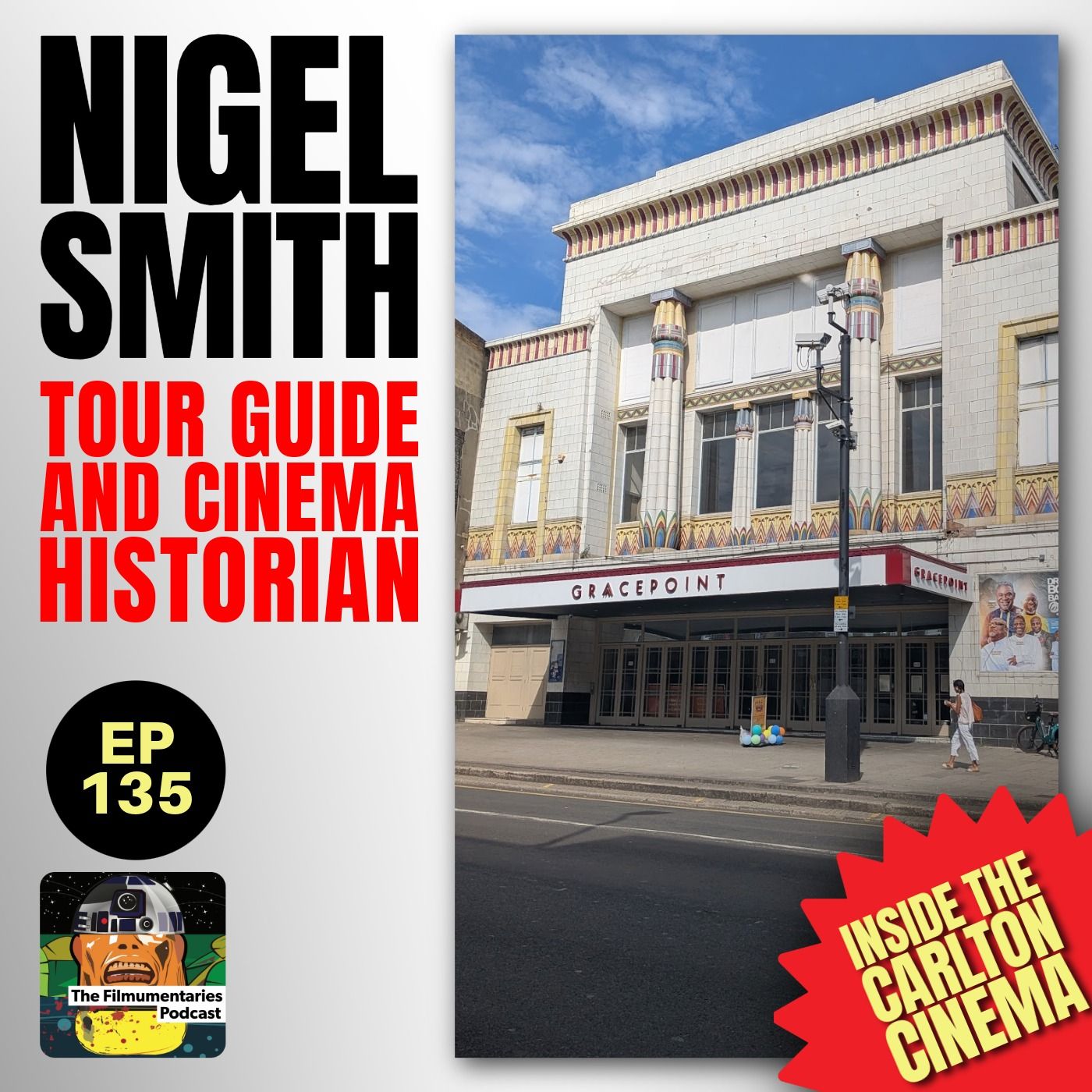
And you compare that with today's selective and sometimes prohibitatively expensive trips to the multiplex and you start to see how much has shifted in a relatively short space of time. In our conversation, Nigel shares how he weaves these discoveries into his tours, from the grand Egyptian revival facade of the Carlton in Islington to smaller cinemas, with stories of kids clubs, eccentric managers and community football matches. We also talk about what's lost when these buildings disappear, how they often find stranger after lives, and why repertory and community cinemas might be the most hopeful path for the future of film going in London. It's a wide ranging chat about architecture, memory and the social life of cinema, but it's one I hope you enjoy it now.
As I said, Nigel is a friend. He's been on the podcast before, but he's got this new tour inside the old Carlton Cinema in Islington. And it turns out my mother in law was a patron of that very cinema. She lived in the area when she was a kid, and yeah, she's I haven't sent the photos that I took while I was at the tour with Nigel yet, but I'm going to do that soon and you're gonna hear snippets from that tour as well as my interview with Nigel. So I followed him around whilst he was doing the tour, miked him up, and I'm not going to give away the whole content of the tour, but just to give you a little bit of flavor in between the interview segments.
So here's my chat with Nigel Smith, cinema historian, and I'll be back at the end for a bit more jabbering. On morning, morning, morning, Hi everybody. Well, first of all, it is absolutely lovely for fee you all this morning for this tour, by my reckoning, I think this is the first time there's been an actual, ever, a sort of a proper tour of this building that is more than just sort of like showing people on open house and having a little round, but is also trying to attempt to tell the story of the building as well. So you are this is like the not quite as glamorous as a premiere, but this is like a premiere, and as you can see in front of you, you're standing in front of the former Carlton Cinema, opened in nineteen thirty as a cinema Grade two listed building.
It's been a Grade two listed building since nineteen seventy four. And now a church. So the reason I'm wearing this this microphone is my friend Jamie Benning here has a brilliant podcast, and you're all film fans, I'm sure, brilliant podcast called called Filmumentaries where he interviews a lot of people who've been involved in production of films. He's just back. He was at he was on Martha's Vineyard, the location for the film Jewels for the fiftieth anniversary weekend of Jaws, hanging out with Richard Dreyfus and Joe Alves, a production designer who Jamie's making a documentary about.
So hopefully Jamie's going to make a little bonus episode out of this tour, which is why I'm wearing the microphone. Now. When you first started researching London's cinema history, was there a particular building or a story that made you think I have to share this with others. I started. Getting into the cinema history, and the walking tours was through Islington because it was the area closest to where I lived, and the buildings that were the sort of the really nice surprises.
In Islington. There are two coffee shops, Cafe Nero and a Starbucks ten minutes walk from each other, both of which used to be cinemas, which nobody would barely know, and that was definitely a hook. And then when you discover both of these cinemas opened before World War One and they had this really well one matter of very short history, one had a much longer history. So that was definitely a spark. And then when I got interested in doing walking tours, it's like the challenge is figuring out how do you make a is there a story that's all within a nice walking distance between an hour and a half and and two hours.
But yeah, so the Starbucks on up Street and the Cafe near on up Street were there too, sort of we're definitely catalysts. But then you know, in that same area you do have this building, the Carlton, with this incredible Egyptian facade. Yeah, that is so distinctive, You're like brilliant. Okay, well, if you can incorporate that, and when I do the walking tour and that's the that's the final stop. I was like, Wow, let's save the best building to last.
Opened it in nineteen thirty. The architect is an architect called George Coles, one of the most prolific architects of cinemas in Britain. It's now a church. One of the biggest cinemas ever built in this country. I mean, one of the most bonkers buildings on Essex Road, but one of those bonkers buildings in London.
You know, I would argue. Yeah, it's pretty incredible that facade. I mean, it's you could expect that almost to be on Sunset Boulevard or something, you know, down the Hollywood Walk of Fame or something like that. It's that Egyptian design and very grand and it it's a completely different time for cinema goers, a time that existed before we were born. I mean, it closed before we were born.
So this isn't particularly or necessarily a nostalgic trip for you. This is about something else. What is it about for you? I think for me the thing i've I I sort of discovered, although I already knew It was the fact that the more old cinemas I discovered in London, and specifically how many there were in close concentration to each other. You just realize that cinema going back in the nineteen forties and fifties, nineteen thirties, it's a completely different game to what it is now.
And something that I found myself sort of saying often when I was doing on the walking tours, was this difference between today, if people go to the cinema at all, they're typically making a decision. I'm going to go and see that film. I'm going to go and see this new Superman movie. I'm going to go and see that film that I read or heard an interesting review of. Back when these cinemas were thriving, people just go week in, week out, and you have that phrase, I'm just going to the pictures, indiscriminate of what was on.
So there's an element, like I said, it's not nostalgic because this is not a period of time that I. Have ended recollection of. In fact, you and I both grew up in an era which was literally the lowest time for cinema ever in this country. You know, ninety five, fewest tickets sold ever in Britain. That's when we were going to see like all these adventure movies and all this sort of stuff that we were into as kids.
And so it's about kind of revealing that history and making people think a bit about that and that sort of history of history of movie going and how that's changed, and then just looking at these buildings and thinking, wow they are they are relics and they're not that old. So you know, you can do a tour of theaters in the West End they're still theaters. You go do a tour of cinemas, they're not cinemas anymore. And a lot of them are listed buildings, like the Carlton, so they sort of. What can you what do you?
What do you do with a building that was designed to entertain two and a half a thousand. People and one screen? Like they were all one screen. Weren't they those big palaces movie palaces? Yeah, two and a half thousand people.
It doesn't I mean, I don't think I've been in a cinema with that many people since probably nineteen eighty three when I saw Return the Jedi, the Dominion. I mean, it just doesn't happen like that. Anymore. I think you mentioned on the tour that. Average number of seats in screens today is tiny.
Yeah, I mean the average, I think is about one hundred in the screen. Now, obviously you've got more screams any cinema you know, but but yeah, it's totally different. I saw Superman the other week with seven other people, I think, in a screen that only had the capacity for thirty. If you'd have walked through those doors any Saturday night between like nineteen thirty into the nineteen forties, you would have been in. A throng of hundreds, one hundreds.
The capacity of this when it was a cinema was two and a half thousand, two and a half thousand seats, and like all of the old cinemas, one screen. So just by a little bit of comparison, if any if you're a local, you might know the screen on the Green about ten minutes walk from here, one hundred and twenty seats. The Cursain in Camden, where I go quite regular because it's now where I live, five screens, thirty seats each. These tours that I've been on a couple of your tours now they always have a great mixture of storytelling and historical details. How do you go about piecing together these.
Narratives from you know, the archives and photos and local anecdotes as well. The basis is, I always you've got to get the basics right, So what actually happened? When did the building open? If it has architectural significance, what is that crucially when it closed? When it closed, and especially if you're doing a walking tour, all of these things start to collide like, oh wow, this was happening in nineteen twenty that was happening in nineteen twenty four, and so that's a way of sort of just bringing everything together and linking it.
But in terms of the archival research, the best some of the best resources are just local newspapers. So I've spent quite a bit of time in the Cinema Theater Association Archive, which is a wonderful place where they've got a lot of clippings. They have a file on every cinema that has ever existed in this country. It's incredible. And then the local history, so in Islington, go to the local archives, go through the microfilms, scrolling through and I always look at the ads because you used to have you know, maybe two pages just full of ads of what was on all of the local cinemas.
But you'll always come across little stories about, you know, the kids club football teams playing each other. Is Linketon getting a ten yel victory over you know, Hackney Odeon and all of those sorts of things. And then there's another brilliant periodical, the trade paper that's called the k In a matograph and Lantern weekly. And you'll have heard me quote from this on the tours that you've been on, and that's a trade paper, and they had things like they would the manager of a cinema back then was a really significant person, and they have like a column celebrating the managers or showmen that they would refer them to, so they'd always be doing stunts and so you just get together these little bits of stories, and again local history centers will often have some good oral histories of people whose memory.
So on the tour in the Carlton you're talking about the kids clubs, some of that was just first pan testimony that I that I'd read, which of researchers had done. And then the great things about these archives is just stuff that was because even the nineties years old now you know. So even a there was a great article that I found about when the Carlton Cinema was a bingo club, and it was just brilliant. It just so vivid about describing these self described bingo addicts who were coming. So it's a mixture of that and then yeah, just figuring out a story.
I'm always very conscious that it would be very boring. On the walking tours, we say, now here's a cinema that opened on this date. It closed on this date. So I'm always looking for sort of stories and narrative threads. And with this tour of the Carlton, it's an amazing story because you can see the building, so I really try to give a sense of like why it was built in this over the top Egyptian fashion, the context of moviegoing at that time.
It was part of the ABC chain, so I was already aware of the ABC miners and the kids clubs, and then this story of decline and so many of the old cinemas that opened in the thirties closed in the early seventies. The nine o'clock every Saturday morning, hundreds and hundreds and hundreds of kids would come in here. It would cost sixpence. The real heyday the for the kids clubs was the nineteen fifties average pocket money, but then was a shilling. So your sixpence you'd pay your six months for the cinema still have change for you know, your kiura and your sweet So I imagine hundreds and hundred kids all doped up on lots of sugar pentop excitement and it would have been this amazing experience.
They would have started by singing that song. The manager of the cinema would be on the stage welcome them all. If it was somebody's birthday, you came in for free, and I suspect everybody sang happy birthday to them as well. But in terms of supervision, you've got the manager, maybe a few wishers, and then some senior slightly more older children who would act as as monitors, and that was it. Often they wouldn't they wouldn't let the kids into the circle because there was so much sort of the weapon that I have read most about orange peel seemed to be very very popular for throwing at There's some nods of recognition here.
Yeah, you sort of mentioned it there, but I sort of see your churs as it's not just about cinema history. It's about the sort of London's broader cultural memory in a way beyond places that just showed films. And I like how you always put things in a context. And there are some moments in your tour this time as well where there's there's a little bit of theatrics going on as well, which I really enjoys. Is that something you like to introduce throughout these Yeah.
So I go on quite a lot of walking tours right for inspiration. And there is an absolutely brilliant company called Minimum Labyrinth I'm a huge fan of and their tours are a mixture of almost I always say, sort of guided tour, meet street theater, you know. So there's a little crew, there's the unexpected things happen. And I've just recently been on their most recent tour all around Lambert and I've been on one of their things earlier and what I love about it is this element of surprise. So, and they do some stuff that is quite gorilla, some of which I tried to I do a tour in Acton and one of the cinemas we talk about there, the Globe was built in the nineteen twenties, got huge again, over two thousand seats got demolished in the late fifties.
But I've got a really great poster for the opening night which advertises the musical artist that was but what's there now is a shopping center that was built fifteen years ago. And a few times I've stucked that poster up in the shopping center before the tour and I'm like, oh, look what we found here. And then the last two or three times i've done it this security it's only been a half an hour and it's gone. So one of the reasons that really appealed to me about doing this tour in the Carlton Cinema. It is indoors and I'm one hundred in control of the space, so little bits of just to manage expectations when we're saying theatrical Definitely, I'm not putting on any costumes, there's no it's just me, but little bits of surprise.
Yeah, it was great, and figuring out how to do it and how to introduce it was really fun. Yeah, it got a little round of applause one of them when I was there. I think people sort of underestimate how much you know a building like this can tell us about sort of social life and habits in the community that surrounded it. And I think what was great about the tour that I went on with you. Was that there was a real eclectic mix of people there.
There was a guy who'd been to that cinema and seen a film there, but so pre nineteen seventy two. There are people that have balked past it one hundred times on their daily commute. There are people there like me who'd never really known about it. I think I've vaguely been aware of it as i've driven past. Probably it was a bingo hall now a church, as you say in the tour.
But I think it's just. Really important what you do, you know, in telling these stories, because they feedback into the press as well, like you've had a nice article out today, So when people are researching in the future, you're doing. Them a favor as well by kind of gathering this information. What is great is the tours evolve because of the participation of the people on them. So you've been on my tour in the West End.
One of the best stops Prince Charles Cinema, and I start the stop now by asking pretty much, I mean almost everybody's been there. Anybody got any good memories from Prince Charles and the very so much depending on the age of the people. There was somebody, you know, younger person just talking so fondly about some Adam Sandler film they'd seen that, and then there are other people talking about like all nighters. And one guy remember memorably telling me about he went there before it was the Prince Charles and how his sister took him to see I think Emmanuel that. I think I was on that tour.
I think that was the very Toy. So all of these sort of feeding and even at the at the Carlton, right, I've only done that tour three times now the practice rather than two public tours. And somebody spotted something I had not seen already. Firstly, there was a great deal of interest in a bit of carpet that somebody spotted and oh that's a carpet from definitely the Bingo era. But somebody else spotted the tip up seat for the usherret.
Yes, yeah, And obviously I did the tour. You came in the morning. I did it again in the afternoon, so you integrated there, yeah, of course. And it's a delight for people, and people notice things on the facades of buildings that I won't necessarily spot. So there's a wonderful cinema in the West End, the Plaza on Lower Registreets now a view half.
Of its view half of its tesco. But it was opened by Paramount Pictures in the nineteen twenties and it's got the stars on the ya on this dome thing. I've done that tour and dozens of times, and within the last twelve months I was like, oh, yeah, but you look closely. There's also the mountain carved into the never spotted it, all of these little things. So yeah, people's interactions really build it up.
Yeah, so you're you're sort of it's sort of an active history, isn't it. That's a very good question, right, just been asked this. I love this details that I'm not even repotted it. Just been asked about the carpet. There's a little carpet remnant here, Oh, a bigger piece of carpet.
Let's take a picture. This to me exactly, this is bingo carpet. One Bingo carpet that's got that says mecha Bingo all over it, very very much the same colors. And again, if there's any sort of urban archaeologists among you, if you go around the back of the cinema, you'll you'll still see the mecha Bingo car park sign. Very exciting.
What do you think if we failed to preserve these stories, what do you think we risk losing not just in terms of, you know, the architecture, but in terms of I guess, sort of local identity and local history as well. It's the really good question. I mean, the one that is top of mind at the moment is the Odion in Camden Camden Town Parkway, and it's a pretty bog standard Odian a little bit. It has not been luxed, you know, like many of the other Odiens as a lovely Idion Hall theway road near where I live, beautiful building and now really beautifully restored. But Odion announced a little while ago that they're just going to close that cinema, knock it down.
Nobody seems to care less. But I do this tour in Camden, and when I talk about that tour and particularly it had this really unique time period, I think actually I may have talked like this when that's not on the podcast, but it had this really unique period in the eighties where it's an independent cinema run by this very very eccentric guy called Peter Walker. And it's like folk memory. And to some extent, when the building goes people will stop. The trigger for the memories gone as well.
So as you get fewer cinema buildings, the memory of what cinema going was once like will go, even if it's being shared by people of my age who never even experienced it in that way. But I do also see the flip of these buildings were designed for another age. I've just been updating my website. I've got the website called Memory Palaces, which it's basically chronicling the stories of buildings that were cinemas but may not be anymore. And I've just upload just uploading some more photos to this week, and so many of these buildings that were built in this period just not being used.
And there's like it was a nightclub for ten years and now it's not a nightclub anymore, or a tiny bit of it is a snooker club. So and often these buildings are listed. Yeah, so what do you do with a list in building that not has no purpose anymore? I don't have an answer to that, religious communities are answering a little bit because a lot of them are churches, but it's hard to find. Where are you going to find two and half thousand people to come to the cinema?
Yeah, it's funny that live span, isn't it. You know two and a half thousand people watching movies. Then you know potentially a half filled bingo hall, people praying to another god in a way, and now becoming. Churches as well. I think in this they are there, you know, and they weren't.
I mean that when on You're toy you say that that was bought by the church, the Carlton, And if it wasn't for them, who knows what would be left inside that building? Because there are parts of it, of course that we saw that morning as kind of little urban explorers, that that some of it is quite derelict. I've done quite a lot of archival research, and the most surprising discovery of my everything, of anything I've discovered about the Carlton was when I came across this advert Your date for Glamour nineteen fifty eight. Next Wednesday, your dreams come true when a new luxurious salon opens in the Carton Cinema. Elstree Studio hairstylists will bring your very own beauty to new life.
Whatever your type, there is a new hairstyle waiting for you. Jeanette Scott and John Fraser open the salon on Tuesday morning at eleven thirty. The appointment book is open. And if you know here that is it says ABC Services. That is the ABC logo.
So this is all a hair salon under the ulspices of ABC. And I mentioned John Maxwell, who was the founder of ABC owned Elstree Studios as well, so Elstree Studio hair stylist. So it's the people who've been working at the studio right here in this room. You can't believe it, can you. This is a final difficult question to answer.
What do you think is the key to getting people to go to the cinema now? Because I you know, I think I said to this, said this to you last time. My local picture is closed in Bromley. I recently, as I soon after that joined the sid Cup storyteller. I just got an email today saying that's also ending.
It's going to be taken over by another chain potentially again. It was like a little multiplex five six screens. I wonder is the key to the cinema's future having more of these repertory cinemas. You know, my daughter's sitting next to me here, she's not listening, she's on the headphones. She went and saw The Devil wes Pride last night in Peckham on the rooftop cinema and it's pretty busy.
They're all sat there with their headphones on and they're paying for comfany deck chairs and that making it a more experiential kind of thing. Do you think that's the key or do you think is the key? I think that has to be part of it. I think I think it's really cool. Actually in London that rep cinema seems to be thriving, the Prince Charles, the Garden Cinema, the BFI and in the last few months this bonkers cinema in Clarkenwell, the Nickel has opened.
I went there, you know, within a few weeks of it opening. Tuesday night saw Lee van Cleef Spaghetti Western. It's got thirty seven seats. Wonderfully, they used to be at the odeon Shaftbury Avenue, which closed not too long ago, and they show a different film every night they're not even showing. You know, that was your one chance to see Lee van Cleef that week.
Come from there's another Levan Cleef film. He made plenty of spaghetti westerns. But what was great there is Don the guy who's project it is, who's got it off the ground, who meets you when you go in. You go next door, which is where the auditorium is, and gave a really great introduction to the movie that was very personal and it felt unique. And then it's got a little bar area downstairs.
Had a nice chat with some other folks who had been at you know, went on my own, had a nice chat with them, and it was the whole experience. I've been really enjoyed watching the film, but I really enjoyed Dom's introduction. I really enjoyed chatting with a can of Laga afterwards. And I think that that sort of thing has got to be part of it. So somebody who actually works in cinema, I said to me recently when we were sort of having this conversation, he said, I think every film will have an introduction, yeah, in the future, and it's a really it makes it personal.
You don't get at home. I mean, I also think the prices have got to change. It's just not I talk a lot about on the tours. You know in the nineteen thirties and forties that cinema going it was an affordable luxury for people are luxury because these buildings are so spectacular. It's not a very few cinemas are affordable.
I've paid twenty five pounds recently for a matinee ticket at an odeon. The ticket booth where you'd buy your ticket, your individual ticket was here. The pay box that you'd have come through, a little ticket, one of these little paper tickets, a bit like these. You've all seen these because I normally give them way at the beginning of the tours. But you know, one of those little tickets, these booze on the side.
Those are essentially the overflow on busy nights. You might sell tickets here, but you really you basically have a pay box here. They weren't snack bars. If you wanted a snack, the. Usherret would come with a little tray.
In front of you and serve you in your seat prices so the cheap seats, the cheap seats of the chip were downstairs, so the stalls sixpence the expensive seats, and you're going to get a view from the expensive seats towards the end of the tour two shillings, so double, quadruple, quadruple the price of the cheap seats. So I'm not very good on predecimalization currency, but if I think I'm right, twenty shillings to a pound. Yeah, so twenty shillings to a pound average weig. This is a very you know, working class area at a time, average wages nineteen thirties into forties, three to four pounds a week, so going to cinema was a very affordableluxury. And your sixpence would get you a loaf of bread, maybe a couple of pints of beer, a shilling, you know, a big plate of fish and chips.
So those are sort of the price comparators. And again so it was an affordable luxury for people. Yeah. I think on Comode and Mayo's podcasts recently they were talking about family four costs the best part of ninety quid to go And it wasn't even on like a big screen. It was a local multiplex.
Because kids tickets no longer exist, you pay an adult price on the same price for everyone. Yeah, so if it's not affordable, I think if it's not an experience, but I think an experience that is I think the important thing for me, And I would say this is like the experience should be about the experience of watching a film, not eating a pizza. You know, there is an element of. The film is sort of like an adjunct to your sort of night out where you're going to get a meal and a cocktail and all of that stuff and nice. You know, like I like to have a beer while I'm watching a film.
Great, but I want the focus to be the movie, which is why I think like having somebody passionate about the film introducing or what's the equivalent of. I don't know if this is even interesting or feasible, but you know, what's the what's the DVD extra that you can get a little bit of when you go to the cinema that's different from home. Yeah. Just as a reminder, where can people find your website? You find your tours?
So my website is called memory Palaces, Memory Palaces dot Cody uka and I'm on Instagram at Nigel Smith Walks. So all of those places have got plenty around where the walking tours are about cinemas and if you go to the website you can have a really good delve through almost one hundred buildings. There's almost there's about a thousand photographs of cinemas and former cinemas in London to enjoy. Well, thank you Nigel once again for being on the podcast, and thanks for doing what you do. Keep doing it because it's great and I'll be certainly on more tours as they come, and bringing friends along to tours I've already been to, including my wife who really needs to come one.
Of great great I would like that very much, So I hope you've all enjoyed it rare chance to have a sort of explore of this building and hope to see you again for another tour at some point in the future. Thank you, thank you. That was my conversation with Nigel Smith. There you can find his tours and extensive archive, as he said, at memory Palaces dot co dot uk and on Instagram at Nigel Smith Walks. As always, thank you for listening.
If you've been enjoying my episodes lately, conversations with people from film history and people who are keeping that film history alive, please think about supporting the show at Patreon, Patreon dot com, forward slash, Jamie Benning and even a small monthly pledge helps me keep the podcast going, covers the costs, and gives me time to dedicate the time required to dedicate to bring these stories to you. And if you're already a patron, thank you so much. You are the people helping make this possible. Don't forget also to check out the YouTube channel Film Yourmentaries for video material clips from my interviews, sometimes whole interviews in video form, and I'll be back with some more behind the scenes conversations next month.
Until then, thanks for listening, and I hope you can join me for the next episode of the Film Yourmentaries podcast. We are Geting Away Media M H.



Similar episodes across the network
Matched by shared keywords.
-
Episode 755: Return of the Jedi (1983)
1 shared keyword: filmumentaries
-
Episode 754: Upstream Color (2013)
1 shared keyword: memory
-
Episode 675: Purple Rain (1984)
1 shared keyword: prince