
Season 1 · Episode 149
Ep 149 | Craig Caton-Largent — Jurassic Park Raptors, ET & Digital Domain
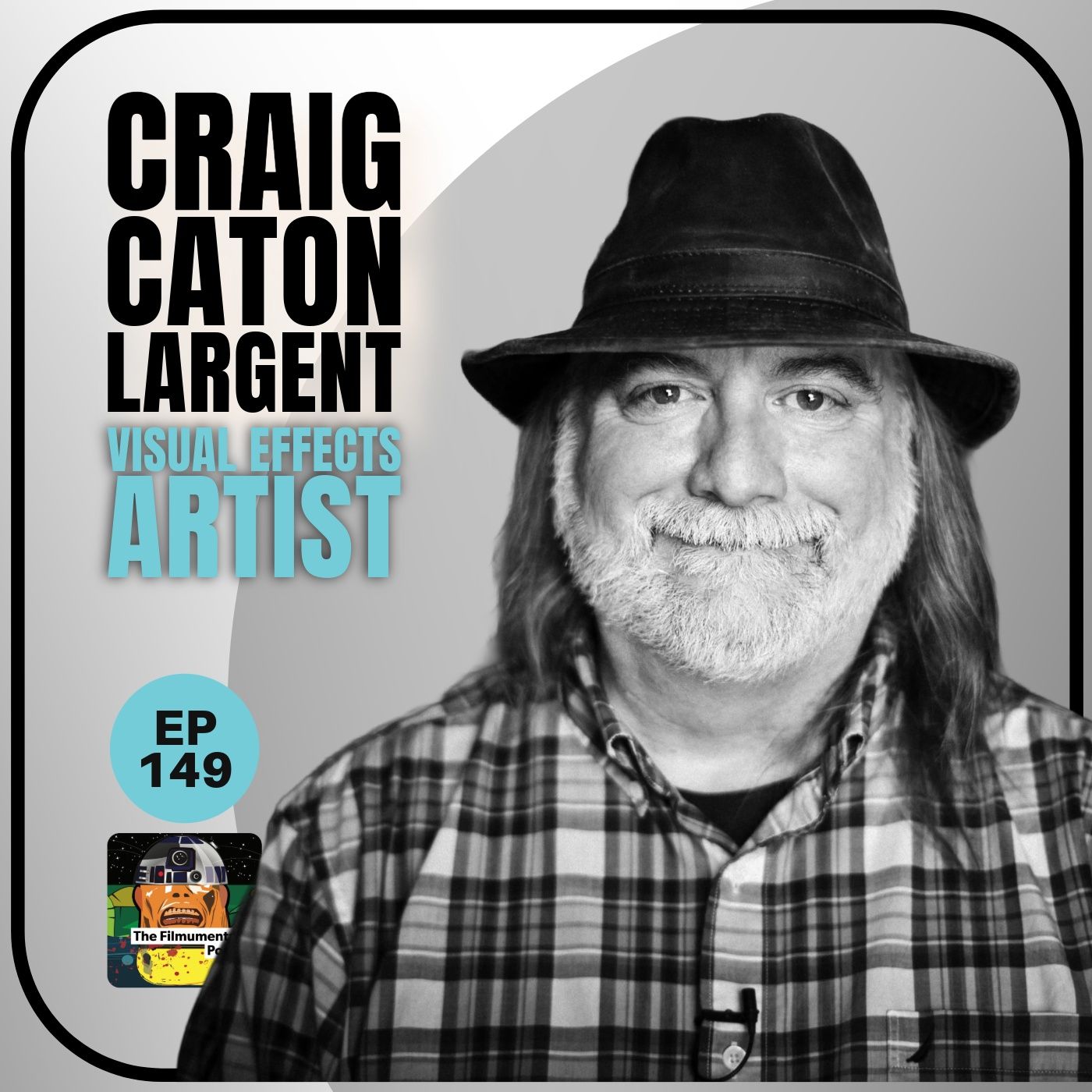

About this episode
Craig talks about growing up on a sheep and cattle ranch in Washington State, being captivated by the 1960s Batman TV show and then Planet of the Apes, and teaching himself prosthetics from Dick Smith's Monster Makeup Handbook. After tracking down Dick Smith's address in Who's Who in America, he wrote a letter that led to a year of mentorship over cassette tapes and ultimately introductions to Rick Baker, Stan Winston and Tom Burman.
We get into his first job on Charles Band's Metal Storm: The Destruction of Jared-Syn, working on the Olympic alien for the 1984 closing ceremonies, sculpting barnacles on Cocoon, building Spock's seamless silicone ears on Star Trek IV: The Voyage Home, undulating menacingly under shaving cream on Larry Cohen's The Stuff, and puppeteering Slimer's mouth on the original Ghostbusters. A big part of the conversation focuses on Jurassic Park, including the design evolution of the T-Rex, the helicopter convention moment that led to the McFadden motion base, the logistics of moving the full-size animatronic across the San Fernando Valley at night, and Craig's work as the Raptor puppeteer, including the now-legendary "head tilt" at the kitchen window that earned an on-set "It's like Alien, I love it" from Spielberg.
We also talk about Craig's twenty-year stint as the caretaker, or "doctor", to the original ET puppet, including the time the LAPD turned up at his garage door thinking he was running a crack lab while he was actually repainting ET.
Plus the story of how Stan Winston handing him a couple of SGI machines led, almost overnight, to him becoming one of the eight co-founders of Digital Domain alongside James Cameron and Scott Ross. Later in the conversation we move into Craig's animation career as a final layout artist and character TD at DreamWorks and Disney, with credits on Tangled, Rise of the Guardians, How to Train Your Dragon 2 and Turbo, and stories from working with Guillermo del Toro at DreamWorks. We finish on Craig's current role as Creative Director of the 3D Animation and Visual Effects department at the New York Film Academy in Burbank.
Topics covered
- Growing up on a Washington State ranch and falling in love with Planet of the Apes
- Famous Monsters of Filmland and Dick Smith's Monster Makeup Handbook
- Cold-writing to Dick Smith and a year of cassette-tape mentorship
- Arriving in Hollywood at the start of the "golden age" of effects
- First feature work on Metal Storm: The Destruction of Jared-Syn
- The closing ceremonies of the 1984 LA Olympics and Ron Cobb's alien
- Sculpting barnacles and cocoons for Cocoon (1985)
- Seamless silicone Spock ears on Star Trek IV: The Voyage Home
- The Stuff with Larry Cohen and "undulating menacingly"
- Puppeteering Slimer's mouth on Ghostbusters
- Designing the T-Rex around helicopter flight simulator technology
- Working with McFadden Simulation on the T-Rex motion base
- Moving the full-size T-Rex across the San Fernando Valley
- Building a 70lb Steadicam-rigged Raptor insert head for Jurassic Park
- Using parrots as reference for bird-like Raptor movement
- The kitchen porthole head tilt, and Spielberg's "It's like Alien" reaction
- Using Kermit the Frog's voice on set as the Raptor performer
- Twenty years as ET's "doctor", and the LAPD crack-lab incident
- ET's arm in a rifle case at JFK a week after 9/11
- Motion capture experiments and blood-spread effects on Interview with the Vampire
- A flying logo on an Amiga, and becoming a co-founder of Digital Domain
- Working with Stan Winston, James Cameron and Scott Ross
- Moving into animation: character rigging at Disney on Tangled
- Final layout and virtual camera work at DreamWorks on Rise of the Guardians, How to Train Your Dragon 2 and Turbo
- Lunches with Guillermo del Toro in the DreamWorks canteen
- Pre-vis on the Total Recall remake with Len Wiseman
- Teaching the next generation at the New York Film Academy, Burbank
- The unique "intergalactic award" Spielberg gave Craig for puppeteering ET
This podcast is completely independent and made possible by listener support. If you’d like to help me keep making these episodes, you can join my Patreon community here: https://patreon.com/jamiebenning
Watch more on YouTube:
Check out the Filmumentaries YouTube channel for behind-the-scenes clips and extra content: https://youtube.com/filmumentaries
All my links
Transcript
Automatically generated, so expect the odd misheard name.
We are Getting Away Media. Hello and welcome back to the Film You Mentories podcast. I'm Jamie Benning, Host Chief Jabra and man it keeps this thing on the road. And every couple of weeks I have a conversation with one of the behind the scenes artists whose work you've probably been admiring years without ever actually knowing their name. We're talking production designers, editors, composers, digital artists, puppeteers, model makers, and everyone in between.
And on today's episode, I'm joined by creature effects artist, puppeteer, digital pioneer, educator Craig Canton Largent, who's one of the eight co founders of Digital Domain, and he is currently creative director at the three D Animation and Visual Effects Department at the New York Film Academy in Burbank. Craig spent more than four decades helping bring some of cinema's most memorable creatures and characters to life. After being mentored as a teenager by the legendary Dick Smith, he went on to contribute to films like Metal Storm, Cocoon, Star Trek Four, The Voyage Home, Ghostbusters, Predator, The Stuff, Tremors, Jurassic Park, interview with a vampire, and even a stint in animation Tangled Rise of the Guardians How to Train Your Dragon two.
So in this conversation we talk about how watching Planet of the Apes Are the age of seven set him on a path with correspondence with Dick Smith that ultimately led him into Hollywood. He ended up sculpting Spock's first ever seamless silicone ears on The Voyage Home and twenty years as the doctor to the original et Puppet. If you wonder what the hell I'm talking about, keep listening. We also talk about designing the Jurassic Park t Rex around helicopter flight simulator technology, puppeteering the velociraptors whilst using a famous frog's voice, the legendary kitchen porthole head tilt that earned him an on set comment from Steven Spielberg, and how a flying logo on an Amager computer led him to becoming one of the founding employees of Digital Domain and his later moved into final layout and virtual camera work at dream Works, alongside some big names there as well, including a mention for Guilmo del Toro.
So sit back, enjoy the chat, and I'll be back at the end as usual for a bit more jabbering on. Oh, Craig, I appreciate you being here. We finally got round to doing this when I often asked the question, yeah, oh no, I'm pleased to have you. But I often asked the question to people like, where did this sort of spark first originate in you to sort of pursue a creative life. Ah, that's a super easy question.
Back when I was a kid, it kind of it kind of started with Batman. My interest was with was it the the the the nineteen sixties television show, Yeah, with that West and I was just like enamored by that. But then when I was about seven years old, the movie Planet of the Apes came out. Yeah, and that was that was it I saw, and I just I wanted to be a monkey. And so, uh, we had a magazine here in the United States called Famous Monsters of Film Land.
Yeah, and through it you could you could get this this, uh, this magazine called Dick Smith's Monster Makeup Handbook. Yeah, you're probably familiar with that too. And so I got that and and I went out and started practicing doing Planet of the Apes. And by the time I was about twelve years old. I had like almost a perfect Planet of the Apes makeup and and it was so fun and and so I decided that's what I want to do.
I wanted to come to Hollywood and make monsters. I was growing up in in Washington State on a on a on a sheep and cattle ranch and uh and so I went out and I trimmed my horse's maine uh for for the Planet of the Apes hair. So but yeah, that's how it started. It was. It was kind of like that.
And and then and then you know, I went to college. Uh, promise my parents I would get like a job that would like support myself. Uh. So I went down the X ray tech road, which was kind of actually fortunate because I I learned a lot about human anatomy and how things move and stuff just just say bye by like watching. And then one day, uh, I found a copy of Who's Who in America, which was this big book of names and address as a famous people, and and lo and behold, Dick Smith's name and address was in there.
I was like, okay, and so I sent him a letter and some pictures in and then like a week later, I get a phone call and it's Dick Smith, and at first I thought it was one of my college roommates pranking me. But but Dick, he he, We made a deal. He said, like, write your questions down on paper and send me those questions along with a blank cassette tape and your pictures. And he and we do corresponded for about a year, and I would do makeups and he would critique them, and he would give me new techniques to try out. And at one point, I see no reason for you not to go to Hollywood, and so I came down there and he provided me with introductions to Rick Baker and Scan Winston and Tom Burman.
Wow. Then that that's kind of how it all got rolling. What year was that. That would have been nineteen eighty or eighty one, I think somewhere in there. So okay, so we've already hit the kind of revolution of the second wave of monster movies, if you like, you know, Star Wars has come out, I guess, yeah.
Prior to that, he had the Ray Harry Howsen like Planet of the Apes as well as you said, so there was now a demand for this stuff as well. So it sounds like you hit the time we were it was perfect. We were entering the what I guess now they're calling it the Golden Age of effects. Yeah, yeah, and I just like, just before moving down here to California, I had watched I'd watched Alien and that was like, that's it. I have to come down here and make monsters and it was so inspiring and and yeah, so that's kind of how that all came about.
Was there any nervousness in writing to Dick Smith, like just kind of or did you just have this drive that yeah, I'm going to give this a go. Was it a kind of. There is really no nervousness, And actually I didn't I expected to hear back like three or six months later. It wasn't was and a phone call was completely out of the question. So that was that was very surprising, so amazing.
And do you know I interviewed another guy called Dave Barkley. Who was, uh, yeah, I know who that is. Yeah. Yeah, he was inspired in the same way you know, Planet the Apes did it for him. He made his own masks, figured out how to do them, made short films with his friends, you know, show that to Stuart Freeborn, and that's what got in the job on the East back, it's amazing.
Yeah, nah, that was. He was one of my heroes. Yeah, yeah, yeah, yeah, he was. His stuff was great. And wow.
There was another guy, another British makeup artist that I just really thought his work was great. I can't remember his name right now, but he did he did the Elephant Man. Yeah, he was. Yeah, I'll put that in. I'll insert a bit so that British makeup artist was Christopher Tucker, and he designed the complex fifteen piece appliants that transformed John her into Joseph Merrick.
Apparently it took up to twelve hours a day to apply. When you arrived in the industry, were you kind of surprised about how it felt being there? Because you know what I've heard from some of the people that walked into the effects world, is that just how kind of collaborative it was? And because obviously, when you're learning to do this stuff, if you're in your own garage or your own garden or wherever, you are just doing stuff just for you. But then you get to the point where you're collaborating with people, how was that for you?
Like stepping into that world? All? Well, actually, I'm going to give Dick Smith credit for that because he encouraged sharing, the sharing of ideas, there was there was secrecy going down everywhere. People were like, oh, I have my secret skin formula and all this stuff, right yeah. Yeah, And then Dick came into the scene and everybody wanted to to, you know, learn his stuff, and he said, well, let's be sharing his techniques with everybody.
And I think that that led to a h to plus then the fact that you know, like we would all like there would be a group of like a group of like twenty of us that did a lot of the work, right, and so we would we would go work at makeup effects labs for on a show and then we would dispears and some of us would go to stands and over the ricks, and so we were like that technology just kept flourishing outwards, and there were things like like like we came up with this interesting way to use stencils to do to do a couple of alien head makeups for Star Trek for the Voyage Home. Yeah, and then one one of our one of the guys, he went over to Stan Winston's and then they used that technique to do all of the Alien nation heads.
So they had a consistent look with that template. So we just kind of things just kind of like flowed through and it was it was pretty cool. Yeah, I guess there was enough work around by the sound of if you were flitting between different effects shops, there was a small nit group of you ultimately kind of a small world, small industry. Yeah, i'd say they're about maybe I think they're like they're the mainstay. There is like maybe like thirty or four of us, but I think overall there's like probably maybe one hundred and fifty people that were floating in and out.
But you would you would see the same twenty or thirty people everywhere you went, and then and uh yeah, and uh it was great because there were a lot of a lot of lifelong friendships that that form here. So yeah, yeah, when you go through things like that together, you can't help, but kind of gel can you, because you're in these environments together. It's like, you know, I've just talked to you before we recorded about my work with Formula one. I traveled the world with pretty much the same crew for some of them for twenty years, some of them for ten five. But they become your brothers and sisters, you know, it's you go through that same experience.
Yeah, you see them more than family. In some use. You spend like, you know, eight plus hours a day with them. Oh yeah, I dream of eight just eight hours, right, it's going to be coming through the audience. Oh yes, yeah, yeah.
I can't even do this stuff. I did my first nineteen hour day last year, which was crazy. Oh wow, crazy. But when you when you arrived in the industry, then what was the first movie that you worked on, Craig. It was.
A Charlie Band movie called a metal Storm, the Destruction of Jared's in and seen it. It was in three D, and I thought, you know, that was my first movie. I thought, I thought, you know, uh, and first, you know the three D movies back then, Man, it was like you needed like ten ten K lights to light the set to get enough fly. Yeah yeah, And I thought I thought all movie sets were like that, and I like, wow, well but it was just the three D sets. But yeah, it was metal Storm and it was kind of an interesting thing.
How when I when I came to Los Angeles, metal Storm went on like a hiatus thing, right, and the makeup effects lap said, well, we don't have anything for you. But we're supposed to start up in about two weeks or so on the the phinishist moving. If you want, you can just hang out and you know, organize and sweep the floor. And I said, I'll do that. And what happened was I, you know, swept the floor and I completely reorganized the place to to what I thought made more sense, like, you know, all the mold equipment goes here and all, you know, everything kind of got compartmentalized.
And the funny thing happened, by the end of two weeks, I was the only person who knew where everything was. I had a complete accident. But man, I tell everybody. Go do it. Yeah, that's a great idea.
Yeah yeah, become indisposable that yeah. Yeah. So that's how it started. And like two weeks later we we we went in and we did uh pick up pick up shots and insert shots for a metal storm and then everything kind of took off after that. Eighty three was the sort of three D year, wasn't it, because there was Jewels three D that year as well.
Yeah, and there was that movie just before that kind of said everything in the motion called Coming at You. Yeah. Yeah, yeah, that was that was that was hard to sit through. Yeah, three D has come and gone, said many times, hasn't it just a few years ago? Again, even in my part of the industry, we were doing three D TV shows.
It was like the next big thing and then kind of died again, you know. Yeah, yeah, I remember, like in two thousand and five, I spent about five months at Disney turning The Beauty and the Beast into a stereo thing, and there was no way to animate it back then, so we were all in on that the old program called Shake at the time, and we were and we were just every single frame we were just converting it. What one a nightmare? Yeah, I can imagine, but experience, Yeah, yeah, I mean it's always great to sort of learn a new technology and stuff, isn't it. One of the things that I was keen to know more about in your career, Craig, is that not only did you work, you know, building stuff, but you're also a performer as well, because I always think, like with the VFX creuwise, you know, we kind of go, oh, he or she is a stop ocean animator, or he or she is a creature designer, and but often these people are adding you know, in stop motion.
You're adding performance, right, I mean for Tippett's work and Ray Harry hasn's worked without their performative kind of stance on it, It wouldn't it wouldn't be as wonderful as it is. And you know, with your work working with kind of creature stuff, you worked as a puppeteer as well. Yeah, yeah, I got. I was fortunate and I got to play to do a lot of puppets, like I was the I was the mouth for the Slimer Ghost and the original Ghostbusters and and yeah, and I think my my pinnacle though was U was playing the Raptor puppets. And in the original Jurassic Park, well yeah, that was a lot of those shots were just me with a hand puppet, uh in Jurassic Park and uh.
And I used Kermit the Frog's voice sot on them set with the Raptor going everybody, we're the Raptors and we're coming into the pitch now. It probably helped the kids to be honest, not to be so yeah. You know what it was funny. The kids were they they were like they thought the puppets were cool, but the adults they thought, well, these are scared I don't want to look at it. It was it was funny, yeah, but yeah it was when I think what my my favorite goofy puppeteering story.
I was working on this movie called The Stuff for Larry One, and it was it was about this this white blobby stuff they found and they and and but anyway, what what we what we did was we would we would empty like like a case of Barbarisol shaving cream into garbage bags and then I would kneel on my hands and knees and they would cover me with a blanket and they would cover that with Barbisol shaving cream. And then the director, Larry Cohen, he would say, Okay, I want you to undulate menacingly. I'll give it a shot. Yeah, carry ridiculous. And so I played this blob character and like multiple shots and adulate menacingly.
I'm gonna have to see I think I was aware of that film. Maybe I'd never saw it, but that was in my video store. I remember where I used to rent videos. I was never a kind of horror guy, so yeah, I never rented. I don't think is the reason you ended up puppeteering in some of these shows like Ghostbusters, and Dassic part because you're involved in the creation of the beasts themselves, so you have an intimate knowledge of it.
Yeah, a lot of that. I found out that the guys that were doing the mechanics for the puppeteers were most of the time the guys ended up going to set the puppeteerum and not most of the time. Wasn't because they were good puppeteers, although there were some great puppeteers out of there. Most of the time was just because they were the mechanics. As something broke, they would be there on set to fix it.
But but for me, it all after a while, it all became about the performance of the puppet, Like how can I how can I build a puppet that performs for you and that you know, doesn't fight your performance and and and doesn't and uh and that was the fun part, you know. And like like the the insert wraptor head for Jurassic Park, that was actually I built a steady cam rig to hold that head up. The head was like seventy pounds, and so I built a backpack and I made it. I built a steady came rig that came off my shoulder and and it would just sit there in space and I just moved my arm up there and move it around. Oh, and I put power steering for the head turn.
So I had it on a on a big one of those big giant Saco airplane servos. And and and because like you can turn your I was turning the head with my hand. You can turn pretty far to the inwards, but outwards you can't turn the head very far. So I would just like do it in the head. It would just like whip around for me.
And it was looking at something. Yeah, what shots would we have seen that in? Is? I always think that the famous shot, of course is when it appears in that kind of porthole window. And yeah, I'll tell you the story behind that one, because there is that's that's I think that's my favorite shot of all time, I think, or or one of my favorite shots was we were we were on set and I I was I was the puppeteer and on operating the jaw on like these two one arm banded things for redundancy was crash mec Career, one of the designers UH and also a good puppeteer, and a guy named Chris was was puppeteering the the eye on remote and I said to them, hey, remember that scene in Alien in the end of Alien where Sigourney we was trying to escape with Jonesy the cat and the alien shows up and she drops the cat and and there's this really great shot from behind Jonesy the cat of the alien looking down at the cat and he turns his head and and and that moment when when he did that to me, when I saw that in the theater, I went, oh my, that's told me that the alien had some kind of sentence.
It was problem solving, it was trying to do stuff. And it really stuck with me. And so I told the guys, hey, guys, let's let's try that bit where we're like an alien word we tilt the head right, And they said, oh yeah, let's give it a shot. Nobody nobody heard. This was just a you know, everybody else was on the inside of the kitchen with the cameras and stuff.
And so I do it, and I tilt the head and someone yells out, you're tilting the head, and then Steven Spielberg screams out, it's like Alien. I love it. I brilliantly got it. That was so that was like one of the best moments. So so that that was really cool.
It's great to have that kind of symbiosis with a director who kind of understands what you're trying to achieve. Did you have much rehearsal time on on that show. Oh my gosh, it was the It was not not not so much with the actual puppets, but with everything else but the actual puppets. We we like one of the things we did, we took one of the stages before long before we shot the movie, we took one of the stages, uh, at Universal and and with cardboard and some some kitchen stuff, they made a fake kitchen set and then we came in there with life sized cardboard cutouts of the raptors and we we shot like animatics and that stuff that that that went along with like Phil Tippets animatics and stuff like that.
And and so we shot that and we kind of broke it down like, are you know, can this can our full puppet do this? Can the insert puppet do this? Uh? And we just we just rehearsed the heck out of those things, but not really with the puppets themselves. I guess they were trying it they're frantically building those and.
Yeah, yeah, we were, we were. There were quite It was quite the feet getting those. And and then just the logistics of the t REX were insane too, you know, because we had we had to, like, for instance, that Stan's shop, we had to we had to excavate the floor and sink pilings twenty feet down for the motion based so when you know, crack the floor. And then we had to raise the ceiling up of the shop to hold the dinosam. Yeah, and then UH they put it on the back of a flatbed at about four o'clock in the morning to drive it over to UH to the studio to Warner Brothers and and and I think they went down van on On Boulevard.
But what they had to do is the UH they had to stop at every every intersection and the DWP had to disconnect the power lines and they would drive through and then they would disconnect. And they did that all the way across the valley. And you would not believe how fast those guys were. Man. Really, they got this down the like to a science, like just connect gone, who.
Connect next one? And they and to take more than make maybe an hour and alf two hours to get across the valley. It was just, Yeah, you can kind of see why the digital revolution was kind of harnessed and embraced by Spilberg and Lucas because some of the stuff, you know, the crews had to go to to achieve this stuff. I mean that's crazy, just digging down and building up and transporting it across town. And I wonder if anybody saw that like coming back from a bar, you know, walking down the road.
I wonder, And I always wondered to get because it did go by this like really famous Irish pub and they were probably just closing. Spilling out onto the onto the sidewalk. Yeah. Yeah, when you were doing the Raptors though, I guess you were kind I mean, you know it's in the movie, isn't it that the dinah saws are related to or birds are related to dinosaurs, So you sort of you asked to include birdlike qualities in there, because then you have to come up with like a repeatable physical language, don't you. Yeah, that was actually that was all that Stevens said was that he's he said he wants bird like motion, right, And so I I had two parrots.
I had Amazon green cheek and a gaffey and gray and my secondary puppetary Jeff he had a whole like flock of parrots and con you know, pocketoos and stuff. And so we just basically based it off of what we watch with our parrots every day. Uh. And and one of the then and that actually comes into play with the with the window shot the portal because my my bird he would like he would like focus on one eye, you know, like oh, you know, and then he would like look at it then and and so a lot of that, all of it was, Yeah, that was all we were given bird like motion. Yeah, but then you're but then you're put performance informs the digital animation work that is to follow.
So what I know that course the island guys were on set looking stuff, but did they did you have direct interaction with the sort of the digital artists if you like? Well, Phil was there all the time, uh and so he was going back and forth. But the the really for me, I want to really give the big kudos and the big credits to a woman named Janet Heally. Janet Heally was like the line producer, was like Spilerber's line producer on a number of movies. And then she went on to executive produce a bunch of animation movies like uh like Dinosaur that I worked on Dinosaur, and then she did a lot of a DreamWorks movie.
But Janet ended up becoming our liaison up at I l m uh and and and so like like like we would like would take like a big piece of skin of raptor and then like on the first set, we'd like give it a whole base, and then the next section we give it the base plus the the you know, the next shading code and then the highlights and and so they would kind of have like a build a build by the number, paint by the numbers, example of what we were doing. And they got onto photographs and and and and I was the guy who kind of like helped provide provide uh those two janets so that Janet could disperget those. But I really give credit to her for for keeping I l ms uh look consistent, yeah, and and and keeping it in line with ours.
And the only time that that it really wasn't consistent was with the galim mimas because we didn't have any we didn't make any physical galamias. Yes, and so and and I think you can tell. Yeah, there is a different quality to them in a way, isn't there There is? Yeah? There?
Well the thing that, like a lot of colorists to point me up, pointed out to me that those shots were that it just were the gray densities need to be adjusted and it would be fine. Right, very interesting. Yeah. Anyway, then, not being a colorist, I'm going yea, okay, okay. You do they work for it?
That wasn't the first time you'd worked for Spielberg, though, was it? Oh gosh it did you work on you know that that was the first time I worked for him? And then and then in the middle Okay, So in the middle of shooting Jurassic Park one day, I'm sitting there on the on the kitchen set and waiting to shoot and this this uh, this lawyer lady looking person, very very business like, comes walking in and she starts talking to Steven and they both they're talking their boyf like looking at me, and I'm like, what did I do? Like did I break an NBA or something? And and the next thing I know, she's there and her name was Barbara, and she says, can you can you come with me?
And and it was it was great because Steven really liked my puppeteering and stuff on set, and she will come with me. And I walk over with her to the Ambulance studios and in the back of this giant crate that looks just like the crate that the Lost Arc of the Covenant is in. And there's a reason for it because it was made by the same guy in company. I really. He hands me a screw gun.
He says like, unscrew this, and I undo it, and she won't tell me what it is, right, and I open it up and it's et and she says, his finger light has burned out, and we're shooting a commercial in two weeks and we need to replace it. Can you think you could fix it? And I went, I'll take a look. And so I took et home and I unpeel his finger and I find out that it's just a very simple brake light from like a nineteen seventies Chevy car, you know. And so I go down to the automotive store and for like five bucks, I get two of them and come back and I replace it.
I put the skin back on the finger, you know, and it's already split perfectly. So I didn't, You're not much you have to do. Literally took more time to go to the store to buy the light bulb to than it did to to fix it. And I come back the next day and I give it to her and she goes, how much do you want? And I'm going like, and I wasn't you know, I was already being paid at the you know, the beyond SAT and all that stuff I thought was just part of the deal.
And so I was totally struck. I want, like, uh, forty dollars And she flipped out, She's like, what what what do you want? You want us to read us play or do you want stock options? What do you want? And like?
And then so I described I told her he's what I just told you how it was done. And she said, oh wow, okay, and then she said, you know, the last person who did this for us charged us fifteen thousand dollars. And and then she said, what are you doing in two weeks? And I said, buppeteria ET And that led to like this twenty year long stint with maintaining and Carrie taking care of ET and and we got to go to England and shoot a commercial there. We went to England to shoot a commercial for for Universal Osaka right right, And we were at this place called the Black Swan Studio.
Right, I don't know where that is. Yeah, it's now it's near Piccadilly area. Oh okay, yeah, okay, But I mean this is what ten or so years thirteen years after ET about ten years? Yeah? So was he?
Was he in pretty good condition otherwise? Oh no, No, he was falling apart and yeah, and so there I was constantly replacing servos and giving him new paint jobs. And there's actually a good story with the paint job there. Yeah. I would, I would, I would.
I had had this house and I had I had a garage with a pretty crappy door. I had like a twenty five dollars lock on it. Not not a not a garage that you want to keep like you know, a uh, you know, seven hundred and fifty thousand dollars propping you know, puppy. Yeah, right. Oh And the other thing, we were never we were always we were always told to refer to ET as as a living entity.
We're never we were never. We never referred to it to him as an it or a puppet or a prop et and I was et doctor, and Barbera was ET's mom, and that was kind of the whole coat thing went down. But anyway, I'm in my garage. Uh and I you know, and I don't want people to see what I've got in my garage and uh and uh and I'm giving Et a whole new paint job. So I'm having them up on that big box.
He's all in this t pos and I have my air brush out and it's got that usual really toxic mixture of stuff we used back in the day, or the reversent man with the hexaying, the acid tone and tri ethylene and the universal pigments and crap. And and of course I'm in my little white jumpsuit in my mask, you know, everything being safe, and I'm spraying him. My door is kind of like three quarters closed so I can get a little ventilation. And and the next thing I know, there's a knock on my door. It's like open up.
That's the police. And I go okay, and I open up my door and there's two policemen with their guns drawn on me and the one guy one the one policeman he goes is that Et? And they go yeah, and they and they go. What had happened is the neighbors across the street have been smelling the fumes and they thought I was operating a crack lab. So they called the cops.
Wow, that couldn't have been further from the truth, expecting a crack lab and seeing ET and. So long story start, one of one of the policemen went home and got his kids and came back and we had pictures and stuff. But that. And then you bought a better lock after that, did you for the. Yeah?
Fortunately, Yeah, we had that paint job lasted a long time and. So there was only one E t remaining because there was sort of multiple different ones, wasn't there The guy was in and yeah, we. And up until then we had a we were usually we had a puppet, and then we had a suit that had this wonderful uh little person named Margarita who wore it and it was very, very painful. Uh. And then we had a set of insert arms that were articulated and had the light on it on a on a real stat thing.
And I I went to UH. I went to New York a week after nine to eleven to shoot a Wendy's commercial for ET and and we only needed the uh, we only needed the arm, but we brought the whole body and everything right. And the arm is kept in a in a rifle case, and the rifle case rolls off the luggage thing in New York's airport work. And then I get to it. I'm it's surrounded by six policemen and they go, you got a rifle in there, And like an idiot, Nope, I got an arm in there, not any better.
And you know, but but there's a polaroid of ET's arm on the outside of the box because you know, for international reasons and and so, and they saw, oh, Et okay, and they let me go. But I'm sure they've seen stranger things come through the I remember there was there was a commercial just a couple of years ago, wasn't there. Didn't they have Henry Thomas in it as well? That was for the UK, that one. Yeah, yeah, that was I think that was a CG EG.
I think it probably was, wasn't it. Yeah. I would imagine. Yeah, you just get to a certain point where the puppet is or the robotic. Yeah, six seven years ago, they can't the puppet and uh yeah.
But you got to be ET's care for for a long time. Then Yeah, it was really fun and and like I said, one of the one of the big highlights was uh going going to England and puppeteeriing and and all the puppeteers they hired were from Henson's and and Nick Nick who was the guy the guy did the the effects and stuff for like far Escape and those shows back and then Nick Dudman or no, they were all of his people. Uh. And and it was such an incredibly different experience than working with American crews because the British, these guys they wanted they were just they're having fun, like me, They're like having maximum fun while creating a maximum performance, right And in the US are a lot of people just like really serious.
Yeah. I really have expected to be the other way around. Yeah, And I go, I go to the England and like all these guys are like, hey, let's like both bulbetier Et and like. And they did a great performance and they were fun to hang out with. They wanted me to go to the pub later, but I couldn't.
I would have always thinking about the PUBUS bring. That would have been a breed. Yeah, that would have been that would that's something on my bucket list and go to a proper with the bunet with some England guy. Yeah. The trick is knowing when to leave that.
That's that's the make your exit. You said you worked on Star Trek the Voyage Home as well, because that was Leonard moy that directed that certainly was Did you have direct kind of interactions with Leonard? Yeah. He came in the shop multiple times to to inspect the the uh that the heads and stuff. And his daughter also designed one of our heads because she was like an art design at the time, and so she designed this thing to it kind of looked like a welding mask alien with a mohawk head thing on it.
But but yeah, he was there and he was he was really nice, and we had uh and Mark Leonard was on the show and then and then playing Spock's father Sarak and and they they sent them they uh Richard Snell uh went to uh do the life cast of their ears and he came in and he did life cast every years so we could do the Vulcan ears. And they came back and we'd already agreed that one I was going to do Spox ears and I was going to do Sarx ears, Spox Father's ears and so, and the ears weren't labeled, and I naturally just took the older pair of ears because which I thought, you know, the older ones, and I sculpted them and they come back and abound it. I had sculpted SPO's ears. But here's the cool thing about the neat thing about that movie was this is the first time and this is all due to Richard Snell by the way, we created seamless Spockier molds.
So there there were seamless silicone with these two pieces of plaster that would, uh, we'd put them in and it would wedge the the the silicon against the ear to get a good, nice cut line. And so that was the first movie that you won't see any seam lines on spots ears. And I thought that was pretty cool. You know, yeah, that's that's a nice little one to have on the resume, isn't it. This was one of those movies where we came in and the first day, you know, Star Trek is this long running franchise, it's super popular, it's guaranteed it's probably gonna make its money back without anything.
The first day we show up that we're going to like we're doing we're doing sixteen over the head masks, we're doing twenty five sets of bulcaneers, we're doing twelve sets of appliance makeups, and you know, on and on and on, and then by the by the end of the first week they had whittled it down. Okay, you're doing four slip masks, you're doing two vulcans', and you're doing like a couple of appliances, which is okay, but but it was fun. Yeah, yeah, you had your work cut out. I looked through your films, like and there's so many great films that you worked on, like an an interview with a Vampire. I noticed, Oh, yeah, you did some motion capture on that was that?
Was that in the That would have been digital domain, wouldn't it. It really was? Yeah, yeah, yeah, that was we have We had a six camera system, uh from a from a company called Bechtel and and and they gave it to us to use and so basically I created the first permanent motion capture stage there. But most of the most of them, the performance capture we did on that show was it was actually optical encoders ain't stuff, and so so like we did this huge shot of the vampire the stat biting this woman on the neck on on the you know, back in the day, on on the dike outside the Mississippi River. And and this is that we were We were abusing the CG at this point because it was our new toy, right, and so you know, we could have you know, the the thing was like, com cruise is going to walk up this woman, bite her in the neck and she's gonna bleed, right, Okay.
We would always do that with you know, some carousyrup red food coloring, some tubing and a little syrane, you know, and we wanted and boom, twelve dollars later we got an effect. Not this time, no, no, this we got digital toys to play with. So I took a lumicrane and I put optical encoders on a luminicrane so we could record all of its motion, including the bend and the crane itself, because it's a thirty foot long crane. And we recorded that onto a We recorded the motion onto a Cooper system, the Cooper motion control system back in those days. And then uh and so the whole camera was was motion controlled.
We brought that back and then I took I took two picture frames and I stretched cheese cloth across them, and then and then I filmed, Uh, we filmed dripping India ink on those cheese cloth and watching the India ink spread. And we did like three of those plates, and then we gave them to a to a guy who was an expert in this program called elastic Reality, which is how he used to do all of those animal morphine things and Babylon five things. And he took those those ink plates and he hand positioned them and morphed them over the lady's plate and tracked them with our cracking and created the blood spread that way. So you know, we did something that twelve dollars then, you know, one hundred and fifty thousand dollars later.
We did it. Wow. Yeah, what was your leap into that digital domain if you like, because you know, up until then you were working on sort of creature crew on a lot of things. Yeah, yeah, that effects. That's actually that's funny because no one ever asked me how that came about.
You're the first still, you know, we're working at stands, we're at Jurassic Park. I had an old Amiga computer at home and I was working on three D and stuff on my own and having fun and just for giggles. One day I did a flying logo first Stan. It was like kind of like the Paramount logo where I had had Stan's logo come up from behind a paramount mountain and come over a lake and uh and and because of that, Stand thought I knew everything that that there was to know about three graphics, right, And so he said, you know, and hear at the end of the end of Jurassic Park. He said, he he wants he wants to do he wants to create characters in cg too.
He wants to do full by characters. You know. He wants to create uh, these full things. And so he said, go out and do it, Craig. And so I went out and I spent about two and a half million dollars of stand the money, and I got I got six s g I computers.
Two of them were like the size of a refrigerator, called the vg X Power series or something like that, and then a couple of smaller ones and we and we actually built a room out and stands studios so that was air conditioned and climbate controlled and we and in a in a in a clean room for the computers that was air conditioned, and and we got a couple of copies of the software called soft Homage at the time, which is what they did jassmarking, and and we started doing some stuff. And then like two weeks later, you know, we we get everything kind of going together. And next thing, you know, Scott Ross from I L M and and James Cameron come in and and stances that we're forming it. We're gonna we're making a company.
It's called Digital Domain. And Craig your for yours first employee, okay, uh, I mean if you want to be and oh yeah I do. And so so we moved the whole computer system down to to uh Venice. Uh uh there there's in Santa Monic area to the old is this old this famous advertising company called Chia Day and we took over their old building and uh they were they were famous for creating the nuture suite. Gumball had that propelled nutri suite to theme back in the day.
But so we we we we did that and we created a studio and like like the the very first thing we did was a logo for for Tim Burton and and and it was an exact kind of a it was a playoff of the The Beatles, like Helter Skelter album with that hand coming up like that, and so it was a logo like that. And then we made it for him and never got used. And then the next thing we came up was true Lies. Yeah, and so so I just it's kind of cool because I'm listed as one of the eight co founders of Digital Domain. Now cool and that's kind of a nice honor, I think.
And but yeah, so that's how it all came came about. Stan asked me to put together some computer as we did, and then and then that turned into Digital Domain overnight. Yeah. Well, and and then I see that you worked on a bunch of animated movies later on in the sort of two thousands, I mean in this house, in this very house, Tangled and Rise of the Guardians are two huge movies. I have three guys, they all love those movies.
So what does what is a layout artist a final layout artists? Well, it depends on whether you're working at what. If you're working at it's kind of a different job at Pixar and DreamWorks are Disney, but it pick DreamWorks, whereas working. What the final lay artists do is they're kind of like what they call the keepers of the shot. So the first thing they do is is they take all of the assets that everybody's made, and they and they and they put that in Maya and they create the world.
So like they take they take all of the the props and the sets that the model makers may and they take all of the rough animation that the rough layout artists have made, and we put that all into a into a set along with like the substitution geometry. And then we also do it like a lot of set dressing, right, and then we we we all of those assets go into the system so called MALI called the Maya Animation User Interface, which allows people to work on the same shot on different things at the same time. So an animator can be an animal animating one character on the one on the same shot while someone else is working on another character and they don't clabber each other's work. So we we set up that system, uh.
And so then after we get all that set up, uh, then we we became set dressers and then ultimately they we were the camera operators, and so they would animate all this stuff and then and then we would come back in and do the final camera animations and tweak them so and and uh and that was so much fun getting to do camera work, especially when like on Rise of the Guardians, our our executive producer was Del Toro was Guermo and and he was there all the time, and and that was so much fun working with him and and and so you know, you would be doing and so it's fun because I go watch I go watch those movies like like Rise of the Guardians and How to Train Your Dragon to uh Turbo, those those three movies.
I watch them, and I see my camera work, right, you know I did. I did tons at Disney. I was a character rigger in a similation specialist, and so I just lots and lots of character rigging. Of course, you go you see your characters moving around, but you don't see your skeletons hopefully, but but you know, but then when you go do final layout and you're doing camera, and you go, that's my camera. I did that camera.
But that's it was sot more creative and rewarding. I like doing doing like like like doing character rigging is like eighty percent technical and twenty percent creative. But in my opinion, and doing final layout is like the opposite is like eighty percent creative and twenty percent technical. And I liked. I liked the creative part of that, like being able to like flag cameras and and set dressing was kind of fun, Like when you're sitting there in the middle of the day placing pieces of straw and a haron for toofless and I wanted to see this piece of straw, I hope.
Yeah. Yeah. But it's those things that we don't sort of consciously have an awareness of, but if they're not there, then we notice, right, yeah. Yeah. And one of the fun things about the Rise of the Gardens is Del Toro.
He owns this car from an old seventies movie called The Car, and it's this giant, like weird, like monster Cadillac type of car that went around filling people, and he parked it in the front of dream Works every day, and I think I was the only person old enough to actually recognize what it was, and they're like, oh my god, it's the car. And then the other cool thing that Del Toro did when he was there was every Wednesday, DreamWorks has free lunch. They have a giant cafeteria, all kinds of great food and tables, and every Wednesday, Del Toro would have lunch out in the cafeteria. He would invite people to sit at his table and pitch their story ideas, and he would offer critiques and stuff. And that was just even just sitting at the table nearby and listening to all that was just so incredible.
Well, that's very cool. Yeah, he's just one of those incredibly creative minds, isn't he. And he lives and breathes. Yeah, we were I was lucking up by I. I I'm an instructor, a professor at the New York Film Academy here in Burbank.
And during COVID uh uh, you know, we were all teaching on zoom of course and stuff. But one of my instructors, I was the chair of the department. One of my instructors a guy named Tony Candelera. He was up in Portland, Oregon during the thing, working on Pinocchio for Del Toro. And and so he's having his his his uh, his class on zoom for his for his stop motion glass and it's thinking, you know, Tarle Delto comes up and he talks to the students on zoom for like an hour.
That was great. What an amazing opportunity for those students that they got. Yeah, that's what I've always liked about him as well. I always feels like he wants to give back as well, you know, when to feed into the machine with the next generation and everything else. Yeah, and he and he was like like like like like working with Spielberg and Ron Howard and him, they're like they're like working with like the biggest fans of the movies too, Like they you know, they're like they're like they're like working with your best twelve year old friend, and everybody kind of gets the same jokes and everybody wants the same everybody has the same kind of goal to make the make something cool and yeah.
But yeah, anyway, Yeah, that's it. That's great to be working for a director who's like, you know, as big a nerds as we are, you know. Yeah, Yeah, it was funny. I was we were like the the how Far It Goes? I was doing previews for a company called the Third Floor, and we were I was working on a remake of The Total Recall.
Yeah, and and I forget the name of the director. He was the guy who directed all the Underworld movies. Uh, wonderful man. And name Uhlen Wiseman, Yeah. Wonderful man.
And so we were in his like studio doing all of the previous and and and I'm gonna forget why I'm bringing this up, but we would be talking like the like different chase scenes as to do and and all of a sudden, like uh, we would say, hey, what what if the guy swings across and he does like that, he crashes he jumps across the building, crashes through the door like in the Born Identity And everybody gets it, right, Oh yeah that shot in the Born Identity. So we did it, and Len's like, yeah, let's do that, you know. And it's just that that everybody is a fan and we all have that we all speak the same grammar. Was pretty cool. Yeah, shared movie language, isn't it.
Yeah? Yeah, And everyone gets excited about like, yeah, you know that shot. Yeah, let's do that. And so yeah. Anyways, so you still working now or are you like used to working on movies now or have you finished?
Very often I will right now. I will do occasional consulting for movies and stuff. But I'm pretty much retired from that stuff. But I am a full time instructor at the New York Film Academy. I'm the I'm the creative director of the three D Animation and Visual Effects Department.
I'm also the artist and residence there, and so like right now, I'm doing a project between the acting department and the animation department. We're doing a performance capture project where we're doing a a Marvel team up and so we're just s we're of taking some old anime, you know, We're taking like The Black Widow and and and the Hulk and and rock at the Raccoon and Groot and and we're and we're having having all of the the actors do motion capture and then and then all my students are doing the performance I mean doing the motion capture post processing and putting the scenes together and and so it's like a regular little production there. But cool. But we're just it's it's fun because, yeah, I can not not dealing with production pressures anymore.
And it's such a different beast now than it was back in the day. Yeah, in which in what way, just that the tools are more accessible, more flexibility. More flexibility there there's like the last time I was on a movie set, it felt way more tense than the back in the eighties. I felt like, like back in the eighties, I guess maybe we're like on these big union shoots and everybody was more relaxed and stuff like that. But the last couple of shoots I were on, it just seemed like everybody was on pins and needles on the set.
You know, they've just put I think, I don't know, it could have just it could have just been that particular production. And also I don't work in television very often, and that was a television production. It was a it was an old production of ABC's Foster's Friends, and like, what yeah, I did? I did? I did an army of ants crawling down a windowsill and crawling over some fruit under a guy's bed, right, and and uh but man, it was you know, okay there the whole crew was like on pins and needles and like really like but the camera guys, the camera operators and the and the focus poll they were like, hey, yeah, let's do this.
It was like like nine and day difference, So it could it could just have been productions like that, and and maybe working in television has a little more time pressure involved because of their short, quicker turn. Maybe maybe. And in all of the years that you worked on all of these movies, did you ever come away with like a mento? Do you have anything on a shelf in your house that sort of indicates some of your work, like whether it like I don't know if it's an award or or a prop or or anything like that. It's covered with dust.
This this is my favorite thing. Okay, that's the Intergalactic Award for Best Puppeteer. Yeah, that's cool. Steven Spielberg gave this to me for puppeteeriing et. No way, that's awesome.
Yeah, that's very cool. Like there's only one of these. There's like four thousand plus oscars, there's only one of these. That's that's yeah. Yeah, that was really cool.
And it was a great acknowledgment. And and and and we we had Spielberg had a really bad taste in his mouth with puppeteers due to some previous experiences, most notably with a movie called Hook and Yeah, and it was it was a disaster. The pupp the puppets were breaking and stuff. That was from what I was told, and and and and so he when when he we he approached us to do Jurassic Parks, he was he was very he was like he was kind of nervous. I think about working with you know, and the Jaws Brewster Shark.
He was a total disaster. Yeah, and and and and oh and and the and the close encounter aliens. Yeah. Yeah, you know you don't hear you didn't hear Carlo Rambaldi talk about them very often. But but anyway, as I break politically sensitive subjects and uh yeah, so so yeah, and in his ancient history, so I know that that's that.
Stephen had a certain apprehension about working with pumpets. And but but we had you know, Stand's crew. We had been through through fire, and and we we want we built puppets that would not break, you know, and like said, like we had redundant systems like the Raptor had. Instead of just one jaw hands, you had to two pulleys and in case one broke, we could still use it. And U And that was from working on movies with James Cameron.
Uh uh and uh because you just you know, you just you didn't want stuff to break on Jim sets. That was that was bad. Yeah, you do. You do not want Jim in your face. Yeah.
Well, once you see it happened to somebody else, it kind of motivates you in a way to make sure it doesn't happen to you. Right, exactly. So, so so we had we had done that, and and and uh my, my my assist the second mechanic guy in my shop. But that my assistant guy, Jeff. He liked to say, we we make bulletproof puppets and the proven.
One time he took the neck mechanism for the Raptor out in the desert and shot it with a clock. I don't know why, but he came back and looked bulletproof. He had something. Yeah. Yeah, group boy.
But I seem like you worked on like Cocoon and Predator as well. I mean they were yeah, yeah, big creature movies as well in many ways. Yeah, Cocoon was like a It was kind of like a little side project. I wasn't supposed to be working on it. I was working for a guy named Robert Short who was I think his biggest claim to thing was making the ET's heart light out of a gourd or something like that.
But I was working for Robert creating uh uh the Olympic Alien for the clothing ceremonies of the nineteen eighty four Olympics. And in La Yeah, there's this big giant guy right and alien was designed by an alien designed by the legendary Iron Cob which was great. It was a could eat meat and work with ron, you know in childhood hero And but anyway, at the same time, we were in the chop working on oh you know the other thing that Robert Short did was beetlejuice. Sorry. But meanwhile in the same shop they're working on, they're working on cocoon and I was like, had a lot of downtime, and so uh they asked me, you know, can you help make the molds for the cocoons?
And so I helped make lay up the fiberglaska. They were the big, huge fiberglass molds. And then I ended up sculpting all the barnacles. I've sculpted this big barnacle plate, uh and cast up hundreds of barnacles and then glued them to the cocoons. And then took uh wall foam, the spray wall foam that he sprang between walls, and we splattered the cocoons with that to kind of like build them up.
And then I remember making a I worked on a mold for the one of the dolphin's tongues, but yeah, that's what I did on that show. The variety of things you get to do in your line of work is incredible, isn't it. You sort of become an expert on this one thing for a short period of time and then move on to something completely different, But obviously you're carrying knowledge with you each time. But do you feel that there was a film that you worked on where you really felt like we've kind of hit the ceiling here of what we're capable of doing with physical animatrons puppetry. Definitely.
It was definitely Jurassic Part because we broke so much new ground and stuff. But before that, my one of my all time favorite movies I ever worked on, and we had such a great time. I was such a close knit little family. Was tremors doing those worms out in the desert. I was like, yeah, like every day was like one hundred and ten degrees and and we're in between these two big mountain range, Mount Whitney and Mount Lompine, and so the sun comes up and at like around seven in the morning and was down around five in the afternoon.
And this was one of those rare movies, like one of the only monster movies I made that we shot during the daytime. Yeah, right, But Jurassic Park was was you know, we got Steven came in and he says, I just you know, I'll give me you the ultimate budget and all been time to make the best dinosaur as you possibly can. And that set us off to to to do all this stuff and and just like like the design just for the t Rex alone, that was such an evolution to come up with that. Like originally there was there was this old King Kong display ride here at Universal Studios in California, was this giant inflatable King Kong. You go into your tram and you're in nighttime New York and King Kong was like, ah that but he was a full size and he was he was a giant latex King Kong with some mechanics in them.
But they had giant river in the bottom. So he's basically a Macy's parade float and he was an hill and they would pump bananas scent into there, so you would smell bananas coming off his breath. And so originally we thought, Okay, well, maybe we'll do the t rex as a like a Macy's parade float. And I was like, okay. And then the next thing that then happened is like there was another tour stage show at Universal Speed Steven Spielberg movie called Five Ole Goes West, and it was and it was this.
It was like this two story tall cat puppet that would come out of the ground and menace the puppet the performers, which were like full size adults and mouse costumes, and and he was on a seesaw right, and I thought, oh, that's kind of interesting. We can kind of get them the t rex to move around and get up and down and stuff. Might maybe, but and then and then someone came up with the idea, Hey, why don't we take a look at like construction cranes and back holes and maybe try to turn one of those into a t Rex. And I went to to to an equipment rental place here and just and I looked at a back hole, you know, and I looked at all the first of first like it would be super easy to kill somebody, yeah, with that kind of mechanics.
And the second thing was like what we had this official word, like this word here in Hollywood for when you like, when you know, when you see a back hole, it goes like this, and then because think they need to kind of shake when they did that moving. Yeah, we used to call that wagga wagga, wagga wagga. And then trying to eliminate the wagga wagga from one of these these cranes or or back holes was looked like a living nightmare. And I was thinking, like maybe I used like garage door springs to put tension on them or something. Yeah, So for anyone who's who's listening and not watching, what we're talking about here is the kind of stopping an automated arm.
It's like you're sort of stopping the inertia, but then there's some bounce back. We have that TV industry, you know, where we put remote cameras in dangerous places on motor racing circuits and they'll pan and they'll wobble, you know. Yeah, so we have to, yeah, we have to work quite hot, or the mechanics have to work quite hard to kind of dampen that. And stabilize those yeah. Yeah, and to stabilize it.
And honestly, it's got up to a very good standard now. But when we first use those remote cameras, you really saw that wagga wagga, as you say. And if you're seeing that on a dinosaur on a rig in a film, yeah, the illusion is gone. Right. Yeah, they look like they'll have palsy, which later he did for a different reason.
But anyways, I was taking the weekend off. I'm a helicopter pilot and they were having the International Helicopter Convention down near Disneyland. I thought, I'm just going to go down and spend the weekend looking at, you know, cool helicopters. And so I go down there and I see a flight simulator and here's this flight similator and it's moving like this nine pound cockpit, just with the most amazing gray and adulity. And then right there I went, that's it.
That's the technology we need for the t REX. And so I came back and I told Stan and I told Steven, and they said, yeah, that makes total sense. And then I called up this company in Santa Fe Springs called McFadden that makes motion bases, and they hung up on me, and they're like, no, we we dealt with you Hollywood types before, I really And so the next day Steven Spilberg comes in and says, get me on the phone with him, and and so I called him. I was like, my boss, Steven Spilerberg wants to talk to your boss. And ten minutes later Steven hangs up to us.
We got a deal and we worked with that company, and then we also hired a We hired a really great guy that had worked on the motion simulator Rides Up, a Universal guy named Craig Bard. He'd worked on the on that the Back to the Future, which had like what twenty eight simulators going at the same time, right, Yeah, And when they all as the King time, it caused an earthquake, so they had to stick offs on them, and that happened, and but we had him, and so we did this great collaborate collaboration with U with McFadden and Craig came in and we bought some some amazing industrial welders, real welders, not as fake welders, and and we made the t Rex and and so that that they used and and the McFadden.
They had solved so many problems that we hadn't even dreamed of, like you know, like when you're using those massive amounts of hydraulics, the first thing that happens is those hydraulics they heat up and the oil expands, right, and that creates the hydraulics, makes them spongy. And so half the thing was like our hydraulic oil was going through these two gigantic air conditioning units to cool them down before they would go back into the t REX. And then they can only travel a certain number of feet through those hydraulic hods before they start losing pressure too. So inside the t REX were additional ballast tanks of reservoir oil so that the oil didn't have to be pumped that far and so and then of course everything had to be balanced out, and there were accelerometers and inertial sensors that McFadden had come up with you can control things and make things smooth.
And they had come up with programming for like like you know, like if you have something like on a seesaw, and like maybe like like I says, a dinosaur in his mouth opens, well, so now the weight that was here now it's over here, right, and so that changes the weight in the moment what they call the moment, and so that has to be calculated in when the dinosaur opens its mouth, they have to go always open his mouth, So we have to adjust the for that. You know, it's crazy that, you know, when people say Jurassic Park, people go, oh, yeah, CG Dinosaurs, people don't acknowledge the technology that you were pushing as well. On your side, I sees you're as we bring it up. Seven minutes of CD dinosaurs and fourteen minutes of real dinosaurs.
Real real dinosaurs. Yeah, but do you take the do you take the opportunity to kind of look back and feel proud of what you achieved in your career. I'm proud, but I also feel so incredibly lucky to have had this amazing career that that that that I did, because that was my childhood dream was to come down here and do this stuff, and and and everything just kind of fell into place and I got to work on the best movies at the time and pretty happy with the way things went. Huge thanks to Craig there for being so generous with his time and his stories. From the Planet of the Apes, makeups on the Family Ranch to the Kitchen Porthole head Tilt of the Raptors to co founding Digital Domain, What a career and what a lovely guide to chat to.
This podcast is completely independent. There is no studio behind it, no network, no sponsor making this happen. It's just me, a microphone, my laptop, and the good people who chip in to keep the lights on. If you've enjoyed this episode or any of the others, please do consider joining my Patreon community over at patreon dot com forward slash Jamie Benning For the price of a coffee each month, you'll get my undying gratitude, early access to episodes, bonus content, and the warm glow of knowing you're directly helping me keep tracking down those stories before they're lost. Patrons are genuinely the reason this show still exists, So thank you, sincerely to everybody who already supports it.
If Patreon isn't your thing, the next best thing you can do is hit the follow or subscribe wherever you're listening. That could be on YouTube, it could be on Apple Podcasts on Spotify. I leave a quick review or rating, make a comment, maybe the on the YouTube channel, and share the episode with a fellow film nerd. It helps new listeners find the show, and it costs you nothing, but it would mean a great deal to me. I have a look at my link tree.
You'll find everything there, including my articles for ILM and Skywalk Sound, my early documentaries, and all the back catalog stuff over at filmimentaries dot com. So that's it from me. Thanks so much for listening, take care of yourselves, and I'll see you for the next episode of the Filmmentaries podcast. We are getting way Media M HM.



Similar episodes across the network
Matched by shared keywords.
-
Father Malone's Weekly Roundup - Jurassic World Rebirth (2025), Miracle Mile (1988)
2 shared keywords: jurassic, velociraptor
-
Episode 701: Alien - Romulus (2024)
1 shared keyword: cameron
-
Lost Tape Chronicles: Mongolian Death Worm
1 shared keyword: tremors