
About this episode
The Kulturecast is a film and culture podcast from Weirding Way Media, hosted by Chris Stachiw, the Doctor of Podcasting, alongside a rotating table of guest co-hosts. Each week digs into where film and culture meet — and how each one bends the other. Now home to sub-feeds including Required Viewing: A 360° Film Study with Dr. David D. Perlmutter.
New episodes weekly.
Subscribe on Apple Podcasts → https://podcasts.apple.com/us/podcast/the-kulturecast/id931361376
Spotify → https://open.spotify.com/show/5wjxip9XVYapYuY12yEaGY.
Back the show: https://www.patreon.com/cw/kulturecast
Transcript
Automatically generated, so expect the odd misheard name.
Way wait not no. All right, now that we're here in the recorders on, Richard, you can stop saying those slurs. All right, every time? Every time? Every time, Richard, not every time, but like half the time.
I'm just like you, guys should hear what he was saying before I turned the recorder on. He has some really interesting thoughts about unions and union busting that I don't think a lot of people would agree with, especially Scrooge. Scrooge is the biggest union, but he's the biggest ape of busting unions. It's tiny Tim. Okay, it's tiny Tim.
Fine, what about tiny Joseph? What about if. Y'all could see Jackie and Richard right now, they're both doing the same thing. They're both holding their heads and going, oh man, this is gonna this is gonna be a long episode. Folks.
You know, have tiny Tim. If there's no geese to eat, they can always eat a dog. They could always go on down to the street and grab a dog and say we're eating dog tonight, and Tiny Tim will be fed. We don't have healthcare in this country, though, Tiny Tim, he's in trouble. None of this is gonna be in the episode.
Oh that's gonna be in the episode just for you, Richard. It's literally this is it is literally about a rich guy who has given an opportunity to change any changes. Explain to me the reality of this situation. How many more ghosts have to visit Elon and Donald Trump? Well, are you a ghosts?
You're telling me that you're a ghost. I don't believe you make something magical happen. We are. We are not turning this movie into a Let's talk about how this movie relates to what's happening this week. We all know.
We don't say it out loud. Richard, we know why you picked this movie. You're a fan of the proletariat. You're not your part, You're not You're We get it, we get it. I think in recent events, people are more psyched on creating more Jacob Marley's in the moment anyway, Yeah.
More Jacob Marley's, please, and less of the less of the scrooge kicking around. So, ladies and gentlemen, boys and girls, children of all ages. I am still your host of the Culture Cast, Christash you, much to the chagrin of two people who never listen to this show anyways, And I am joined by my two good friends all the way from Richard Adam's paranormal bookshelfs soon to be selling sexy Richard Adam calendars. Maybe I'm making promises for him that he's not going to deliver on your friend of mine, Richard Adam. You're going so seriously off the rails.
We're almost at the end of the year. You are skidding all over the road. And it's happening during the podcast about not only one of my favorite movies, but perhaps a foundational text in my life. Not talking about the book, I'm talking about the movie musical Scrooge. Man.
I picked a hell of a day to stop sniff and glue then, and also joining us all the way from Alamo Draft House somewhere Jackie. All of the ones in the Austin area at various times. Hell yeah, Jackie Stewart once again, back in the booth. No, that's the other podcast, back in the back in the saddle. That's where we put guests and co hosts on this show in the saddle.
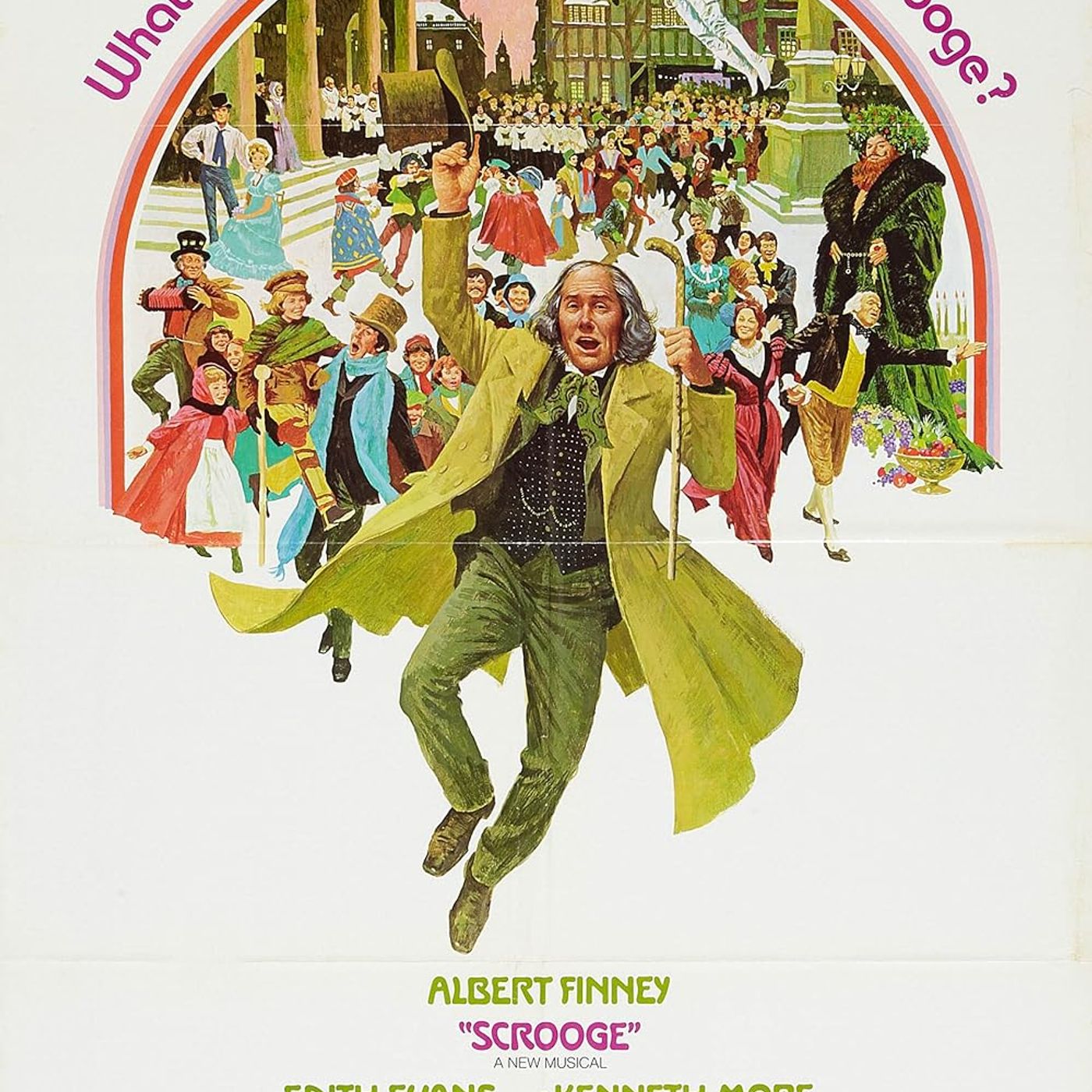
So yeah, on this episode, we're gonna talking about nineteen seventies Scrooge, not Scrooged Scrooge from nineteen seventy because Richard picked all the movies this month and I was like, sure, let's do it. That's Father Christmas. I'm playing and find a Christmas hand back. I hate people blood a hamber. There is no such thing as rich enough.
Pa. I paid you. I will repent you. Hm. You don't believe in me, do you?
No? I can't. We are going to look at your past. There are more good things in this last cruise than you can possibly imagine. It's Christmas eventies nearby.
Let's go and open your choice up. I've discovered I like life. God bless us Ever. Film is directed by Ronald Nemi Leslie Brickis. It is based on a little book you may have heard of, called A Christmas Carol, one of the most adapted books in the history of fucking books, written by Charles Dickens.
Stars Albert Finney as the titular Scrooge, Alec Guinness as Jacob Marley, Edith Evans, Kenneth Moore, Lawrence Naysmith, Michael Medwin, David Collings, Anton Rogers, and Suzanne Neve. And if you've never seen the story of A Christmas Carol, check your fucking pulse. Are you alive, like are you alive? Uh? If you don't know what it is.
It's the story of a Christmas Carol but turned into a musical, you know, just like Wicked, the movie that I thought was about Candles, uh, but isn't, or the movie that's about John Wick but they misspelled it. Also not that it's a musical based off of a book which is very popular in this day and age. So Richard, I'm not gonna kick it to you first, because you're I want to give you as much room as possible. So Jackie, the normal questions apply. My first time he saw Scrooge because you wanted to be on this episode.
You joined us intentionally, first time he saw Scrooge, what you thought? And then what did you think? Now? Rewatching it for the culture cast? Well, so that's that's the funny thing about it is that you know, especially with Richard calling it like you know, a foundational you know, part of you know, his life, you know, I was in there.
There's that voice in my head that's like, they're eight million adaptations of this story. I know for sure, several of them that I have seen, and a million of them that I may or may not have seen. And when I was going through the movie last night, once it hit maybe the halfway point, it all sunk in that I absolutely saw this a good thirty years ago, because I very much remembered some of the songs, particularly I like Life, like all the lyrics somehow came back to me. So I'm positive in retrospect that I saw this several times as a child, and I haven't watched it since for at least twenty five years. So it's and yeah, I I you know, it was a pretty enjoyable you know, like just the magic of the movie is kind of experienced the and I still really enjoyed it this time.
I love Albert Finnie so like that I was already kind of in on the ground floor either way. That was my main reason, was like, well, I gotta watch Albert Finnie do Scrooge. And it turns out I had already done that. I should do this. God, you said what you said, all right, mister HadAM.
I will give my opinions afterwards, but the floor is yours. When why how every question that you think needs to be answered, Go ahead, you have the floor. Give us your dissertation on Scrooge. The moment has come Scrooge was the first movie I ever saw. That's fucking insane.
That's what I figured you were gonna say. Now, what I'm saying is I don't even think i'd watched a movie on television. I'm fifty eight years old. So when it was when it came out in theaters, and I believe it came out of nineteen seventy one. You said nineteen seventy and you might be right, but for some reason, seventy one is in my head.
In any event, I do believe I was five years old. So I think what I'm thinking of is going to see it in a theater at age five, having never been in a movie theater and having never seen a movie, and this is what happens to me, is this movie. Now, keep in mind who I am, someone who you know is like you know, emotion plus and having just sort of understood what Halloween was all about, which is dealing with and trying to process fear abstractly for human beings. And as a five year old, it was the legend of Sleepy Hollow that kind of hit me. And then two months later I go to this with my cousins and my aunt and uncle and my parents, and this was such an overwhelmingly emotional experience.
And I'm talking primarily of being really really scared and then really really emotionally sort of overjoyed and experiencing that in a matter of an hour and a half as a five year old. I literally my body was vibrating for days like this. Nothing has ever affected me like this the first time I saw this movie, and I've seen it, you know, fifty sixty times since then, and so you know, obviously it's going to be I want to put that across. I think I can also talk about it objectively, but I want you to know how I'm coming at this, which is this movie made me and imprinted on me in a particular way that has affected everything I've seen, thought, read, and done for the rest of my life. So I have a follow up question for you before I give my opinion.
Has nothing to do with my opinion, given your opinion, Richard, on everything, given your thoughts on this movie, given that, and this is me like this is me as your friend asking you as your friend on this episode of the show. I have an immense amount of not defense for the movies I love, but trepid in terms of covering the things that I love. Did you feel any trepidation going into this episode? No, you know why, And I'll tell you quite honestly. I've done.
I've done. How many podcasts have you and I done together talking about movies? Tv shows? I mean, no idea, too many. I mean I am so Richard.
I would say I am grateful to not know the count, because it's been too many for me to count. That's how lucky I am. Same with Jackie. I don't know how many episodes I've done with Jackie either, but I'm lucky to consider any amount that I've done with you guys. So there's your answer.
There have been There have been so many, and there have been so many. Remember the first one, though, you remember the first one is that with Nona Ryder movie we did together, Lost Souls or whatever. Oh my god, but I want to see somebody getting their neck broken. That's the whole movie in my head. There have been a number of times where we've opened up the zoom and been ready to talk about a movie that I have typically really really really really really liked or loved, and I have experienced trepidation.
And yet I would say, if not one hundred percent of the time, then ninety nine percent of the time. If I have responded positively to a movie, so do you. And it's always something that you've seen for the first time. I'm assuming And Susan even asked, have you seen the movie before? I don't think you have.
So I sort of sat back and went, you know what, I'm not going to worry about this. It's a quality movie. He's gonna like it. He obviously knows as I picked it, so he's not gonna, you know, even if he didn't love it, it's not going to be like I'm going to eviscerate this movie. So no, I don't think I came into this with trepidation.
I'm curious as to what your reaction, both of you, you know't kind of how you experienced the movie. But no, not trepidation. No, So I would have a very different opinion on this movie if I had not earlier this year watched the movie that this film used a lot of the sets for a movie that reminded me of this movie, almost one for one, and that was Oliver from nineteen sixty eight, which this movie, mind, this is like you could watch Oliver and Scrooge in the same evening. I think it would be a bit too much. I think you'd be inundated with like a certain kind of musical.
Number that like all the flutes, the flute, you know what. It reminded me of it. It reminded me of Oliver. But this is really what Scrooge reminded me of. It was like what they did with Willy Wonka and the chocolate factory, you know what I mean.
Like it's that there's like a level of like whimsiness to this, but there's that dark undercurrent of. Like, but shit's still really fucked up. And again I mean, look. The Leslie Bricis wrote the music for both. Right, so and that's the thing for me, Like, look, you know, look, I'm gonna be straight up honest with you, Richard.
I wasn't excited to watch this, not because of this movie, but because of the source material, because like so many things, probably similarly to yourself, Jackie, Probably similar to yourself, Richard. I had to read this in high school. I read a Christmas Carol. Like I read it. I get it.
I get the story to. Your wife Susan's point, like there is a little bit of cynicism within me about the story of a Christmas Carol, because this guy has to be brought to the edge of oblivion to look into the void, and the void shouts back at him and it's like your n asshole, like and he reverses and goes back, like and I understand the cynicism surrounding the story because it's like, well, why couldn't you just be a good person all along? Like why do you have to be this unrepentant sack of fucking shit that you are? Like why, like again, because I don't think I am. Jackie and Richard aren't either.
I wouldn't associate with either one of you if you were like Scrooge. But my point being, like in our day and age, where there's a lot of people that remind us of Scrooge, it's hard to believe that there would be someone who would would sit idly by until things got so bad that literally people are joyously celebrating in the streets your death. That's what Scrooge has to see for him to be like, oh, people fucking hate me. And in my mind, like, again, I am not that unself aware, So maybe that's a that's a me problem. That's a subjectivity thing with the source material.
Like, and I get it. But unfortunately, and again I will disagree with your lovely wife Susan a little bit. There are people like this. There really are people like this, and these stories need to be told, not because of people like that, but because again, a, I think the timelessness of this story is very important, even for the people that aren't unrepentant assholes. I think the story is important because, like you've already said, Richard, it's about looking back and remembrance and taking stock a mental stock checks and balances of the year or years coming past.
And there are moments of this movie that I really enjoyed. And there are moments of this movie I really enjoyed. Overall, I enjoyed this movie immensely, Richard. I'm not surprised. It's a good movie.
You picked it. You picked it, so thank you man. You're welcome liked it. That means a lot. That's time I spent doing something because you asked me to do it.
Like, I know, people may make so much. I know, but here's the thing, and here's the genuine thing. Like, and I feel bad because Jackie and I have had a couple of recordings this year that we've missed, including a movie that I love immensely, and I'm a little bitch for not getting the recording rescheduled, not intent, not actually calling myself a little bit, but Jackie gets it because of what we're supposed to talk about. But so, after all the things I've been through this year, money is less important than time to me, and the amount of time that I give people is all I can give them. And sitting down to watch this two hour movie that to then have a conversation with you about it, Richard, is what I.
Can give you. And for me, it's like you've given me something to enjoy, so now we get to talk glowingly about it. There are some issues, but overall I enjoyed it, and I understand why you enjoy it, and I can also see how it would be a piece of transformative and or kind of pillaresque fiction for you that you've kind of put on a pillar because. I think it deserves it. It happens, I mean, it's weird.
It happens to be the first movie I ever saw, and it happens to hit on a bunch of themes that even as a five year old were compelling to me. And and the the feeling of I don't know, it's so strange. It's hard to describe the feeling of like being really scared but then but then being released into joy. So so for some reason, that emotional journey was very compelling to me. Now, you were obviously referring to a Christmas Carol by Charles Dickens.
And when you read that, and you know, and I've also read that many times and I've listened to it. There's this great audio recording by Tim Curry that's just fantastic. If you've never read the book but you're curious about what that is, I would say, listen to the audiobook because, by the way, it's a short book. The audio recording is maybe three hours. It's a novella.
I don't even think it's considered a full linked novel. It's no, it's no great expectations. It's not you. I mean, yeah, certainly. Thank God for Charles Dickens.
It's practically a short story, right. He wrote it very specifically, he wrote it right before Christmas. He sort of got the idea at the end of October and he needed something to publish that year. And in the publishing industry, if you will, in the eighteen fifties eighteen sixties, Christmas was a big time to publish a book as a gift. So his whole plan was and he was in debt at the time.
He was not doing great. His career was not you know what we think of as Oh he was Charles Dickens. He was no Stephen King at the time. Okay, excuse me. So he wrote this book and he more or less self published it.
He had two ways to go. One was just publish it really quick, cheaply and get it out to a bunch of people at a very low cost. Or make the book a gift in and of itself. And that's the way he leaned. He's like, it's the holiday season.
I want this to be sort of a premium item that people give each other. And he was somewhat well known, I mean, he was a name. He had again not money was not flowing out of his pockets. But he decided, no, I want this to be full color illustrations. I wanted to be illustrated.
I wanted to be hardback, you know, a read book. I want people to I want this to be special. I want this one to be special, and I wanted to be short enough to be read over the holidays, and so that's what he did, and he lost a ton of money. He invested his own money in it, and he lost that money, and within six weeks of its publication, it was being republished in various other versions by other people who were making far more money off it than he was, because there were no copyright laws at the time. Here's how Charles Dickens ended up making his money from most of the books he wrote.
He had to go on tour and he would do these live performances, because Charles Dickens was actually an actor every bit as much as he was a writer, and so we would do live performances and live readings of his books. And once this one written and became popular, and there were stage versions that were being basically plagiarized and ripped off and performed all over England and then in America. So the only way he could sort of claim his ownership of the title was to perform it and perform his version himself. So he would go around the first part of the show would be selections from his other novels written up until that time, and then the second part of the show would be almost the entire novella, you know, I mean, I guess it couldn't be because that would be three hours, so it was maybe another hour.
There's plenty of stuff you can cut out of here to get to Yeah, you don't have to have him walk in the streets getting accosted by people. You just have him show up and it goes to Christmas pass. All right, here we go, all right, moving on. He played all the characters, he had different voices, and I mean he performed it. You know, this is a one man show for him, and that is what ended up cementing this as the classic that it is because in those few years that he was able to do it both here and in Europe, it became his most popular story and it became indelibly connected with him, his version, and it is the one thing for a writer who is known for so many things that he did, it is the one thing he has remembered for more than anything.
So the text stands on its own, and of course that is why it has been redone a million times and when you're watching a movie version of it or reading the book, because the book is not narrated by Scrooge. It's narrated by an unknown narrator who is basically sitting across a table from you telling you this story in the first person in his own voice, so I guess it would be the second person. And his voice is so engaging and so generous that it balances out the character of Scrooge. He's basically saying, more or less, come here, friend, and sit down, and let me tell you about the meanest old man you've ever known. This guy was a piece of work.
And of course that's a voice we can relate to, and that's a voice that brings us in and we can enjoy. And what it does is it puts us on the outside of Scrooge, so we can observe him and go, well, that's not me, but I know people like him. But then what Charles Dickens does is, as he continues his story, you find yourself identifying with Scrooge more and more, not the mean old man who's who's miserly, but the guy who's lived a life and had events happen in that life that have shaped him. And he becomes more sympathetic. Throughout the telling of every version you ever see because you do get a little bit of his past and his present and his future.
And in that way we all identify, because that's how we think of our own lives. And so we see, Oh, I get it. He didn't have the best upbringing, He's had a few injuries in his life. He doesn't see the people around him in the moments. He doesn't see them.
He doesn't really know the Cratchet's life, he doesn't really know the life of his nephew and his nephew's wife. And in this night he gets to see in a way way that many of us become myopic and our own lives and don't see. And we begin to identify, and we begin to see things in ourselves, and we begin to see moments where we could have acted differently, and moments where we didn't take a moment to acknowledge someone else's situation, their pain, or something that they were keeping away from us. And then we feel what Scrooge feels, which is the intense desire to redeem ourselves, the intense desire to go you know what, I can be better than this. I've lost a little of my humanity, you know what I'm I do want to change you know what, tomorrow when I go to work, I'm going to be a different person.
Tomorrow, when I talk to my wife and kids, I'm going to be better than I've been recently. And in that small way, we identify with Scrooge, and we identify so much with the story of his redemption and the joy when he gets that opportunity. Yeah, I do particularly appreciate, like looking at it from from the point of view of, you know, relating to him, because as while watching it, I was I was sort of thinking, because it's a very easy to lament, like, oh, well this, you know, this is a nice story, but you know it's not gonna happen in the real world, you know were you know this doesn't happen. You know, they don't wake up one morning and say I'm not going to be a rich miser anymore, and I'm gonna get back to the world.
But I don't know that it's about that as much as it is recognizing how much of yourself is in it and the likelihood that you could become someone like that if you don't watch your own step. And the moral is less that and more that if he can change even that far along down the path like, we've all got the opportunity to do it if we recognize our potential for going down a similar road. You guys are so young, and I love how you say that, Jackie, Compared to me, You guys are young, and you know, it is sort of inevitable that as you get older you can get pretty cynical about the world and about the way things are going, usually because when you're a little younger, you somehow imagine that problems will be solved in your lifetime.
And as you get further into your lifetime, you realize, a they're not going to get solved, the big problems society, the world, they're not going to get solved. And you learn more and more sort of about what happened before you were born, and you realize, oh, this battle has been going on forever, and it will not end in my lifetime, and it will not end the day I die or a thousand years after I die. That is simply not the way of human beings. But you can also have more gratitude and more sympathy for human nature. And this movie book, any iteration, you know, the fucking Mister Magoo Special does ask you to reflect on that and just sort of go because that's the thing.
And you know, it's funny the fight that I have with Susan is between Scrooge and It's a Wonderful Life because they're sort of complete inverses, diametrically opposed. They're diametrically opposed. Wouldn't you say? Yes? Well, as what I so so wonderful?
Hey, I haven't seen a wonderful life yet. And after we got done recording that app episode, I was told not to watch it this Christmas season for obvious reasons, you know, I mean, you know, I mean, well, look, well, look when when you have a dark evening of the soul like I did, when you do similar things to what the character in the movie is doing, I'm not sure I want to watch the fictionalized version just yet. But at the same time, like I sit here and think to myself, like you put it pretty aptly last time, Rich when we talked about elf, like, Christmas is a time for a lot of and Christmas is a time that now for me is difficult because it's tied up in a lot of things that used to be positive that are now hard to deal with.
But at the same time, everybody around me is so happy and excited and again like it's it's again like Scrooge for me is less the story of a miser who needs to come to his senses, but someone who's just surrounded by the joy of the world and can't see it no matter how hard he tries to look. Because because he wasn't always like that, and you see it in the movie. He wasn't always like that. He became that way over time. So the capacity to be compassionate, the capacity to be empathetic, the capacity to care was always there.
It's not like Scrooge really changed. It's more just like he was forced to acknowledge it because so many people, myself included, and maybe y'all feel this way from time to time. People don't call us on our bullshit. They don't call you out, and especially if you have a big personality or if you have a very small personality in between, it's kind of different. But the people that are quiet or the people that are loud.
If you're loud, people don't feel like they can confront you because you're a lowed person. And if you're quiet, people don't know what to make of you, so they may not even talk to you. If you're in the in between, that's a different story. But I don't know. For me.
The way I interpreted this story this time was very different from the last couple of times I've watched it because primarily of the personal situation I'm in. But again, I wanted to try and see if I could not diffuse Susan's argument, but see if there's a way for Susan's feelings on this movie to sit within the movie and it's still be something that I think speaks to a transformative process, which I think it does. I just think some adaptations of a Christmas Carol, some adaptations, not all adaptations, don't nail the moment, the moment of change, the moment of realization that, oh my god, my entire like last thirty years of my life have been this complete fucking nightmare, and I've been a nightmare to other people.
So that's the thing. Scrooge realizes what he has done to other people, not what other people have done to him. If anything, everyone has done everything they can to try and placate his wills to an extent that people should never have had to do that. But the story ends up being about him realizing the links that other people have gone to to put up with his shit, because even his fucking nephew is like, see, but he's He's still a nice guy, I promise. And it's like, what God's name is making you say that he's like, Well, the goodness of people, the goodness of humanity, the goodness of people, is why, and like I feel like, especially given the world we live in now, it is hard to see any amount of inherent goodness in some people.
And I'm not saying we should, but I think sometimes it's less about people not seeing it and more about people just not acknowledging it, which can look like the same thing, but they are vastly different. And that's how I interpreted it this time was less him ignored les him ignoring it, or less him not ignoring it, but him not seeing it and acknowledging it, and just not acknowledging the reality of the situation, which is he's a fucking asshole. Nobody likes him. The only people that like him are people that are related to him, that defend him on the hopes that he won't be. Like this anymore.
I'll be able to change him. I can change him very much. That whereas he doesn't see any of the opportunity for changing the world or the necessity for it. That little bit of hope is what those people are hanging on to in him. Yeah, right, you know, Susan And when we watched it last night, I literally we were like freeze framing and going like frame by frame in the what would you call the third act the third Ghost?
Yeah, because Susan and she's kind of joking, but her argument is always he's a very, very rich, old white man. And then and then it's only when he sees his gravestone and basically a gun is put to his head. He's finally like, oh wait, wait, don't kill me. Okay, don't kill me. I'll be different.
I swear to God. Fine, don't kill me. I'll be here. There's no gun put to his head. Well, and I try to explain my point of view and my interpretation of the story, which is at the moment that happens.
In fact, at the moment when the Ghost of Christmas Future appears, ninety nine point nine percent of Scrooge's transformation has already taken place. He's he's understood moments from his past that he misplayed. He's seeing moments of his present life that he could be dealing with differently, or be present four, or be present four. And when he greets that third ghost, he even says, I fear you more than any other. But I know your your goal, your your aim is to do me good.
So I guess I'm just going to endure this and take me where you'll take me. And the horror of the future is not the fact of his death. For him, it's the idea that he's had this realization and will not have the time to act on it. M M. That is what is horrifying to him.
So when he is even in this version, when he's being backed toward the open grave for the sequence that is not in the Charles Dickens book m M. But when that was a wonderful surprise by the. Way, right, you know, well, you know, third act gotta make it big. But when he's being when he's being act toward this grave by the looming specter of the ghost of Christmas future, he says very quickly, you almost can't even hear it. I've seen the error of my ways.
I will be different, I will, you know, basically, allow me the chance for redemption. Don't show me all this, and for no reason, don't don't invalidate the first two ghosts by simply telling me I'm going to be dead. Let me take what I've learned and act upon it. And that is the crisis moment of the story where he then wakes up. Now I'm going back to the book, but we can talk about the movie version because we should, because it's fucking wild.
And his joy is not necessarily simply that I'm not dead. His joy is I've got a chance to take what I've learned and put it into action, which is what Charles Dickens wants. He wants his readers to go, don't be scrooged. You've got time. We've all got time, and as bitter and cynical as we can sometimes get, every day, we're given an opportunity to be different and to be the best version of ourselves.
So take the lesson from Scrooge, and you know again, for Charles Dickens, any book less than you know five hundred pages is you know, a short story, and in this case it's a fable. Things are kept pretty general. We're only given a little bit of what happened to Scrooge when he grew up. We get the sense that his dad was not nice to him. Okay, got it.
Then we are made to understand that he did fall in love, but in a very sort of general sense that anyone can relate to. Charles Dickens keeps Scrooge vague enough. He has a job and he's worried about money. Well, that can apply to all of us. We've all been there.
And when he's called on it by his fiance, he says a line that is so brilliant. I've never heard anything like it, he says, I've you know, there is nothing on which life is so hard as the poor, and yet there is nothing we attack so hard. I'm misphrasing it, but you know we're hard on the poor, but we're even you know, we're even harder on people who try to become rich. It's like, poverty is terrible, and yet when I try to do something to keep myself from being in poverty, I'm accused of being a money grubber. We've all felt that, and we've all spent our lives trying to balance in between the two things.
How much is enough? How much is too much? But when he finishes with the first ghost, he is a long way down the road. He's already realized. You know what, there are some carollers.
Last night, I should have given him a few bucks. My sister was a wonderful person and she died in childbirth, and I have never had anything to do with that nephew. Maybe was because I was so sad about my sister's death, But you know what, that's no reason to cut this kid out. So he's beginning to realize things. And I would say that the arc of his character change is distributed quite equally across Marley Ghost number one, Ghost number two, and again by ghost number three.
He's made his change. Now he's just begging for a chance to live as a different person. And also to that point, I don't feel that it's just the recognition of, you know, his death being celebrated that is that final turn. We're totally overlooking the concern that he grows very quickly over tiny tim like that. I feel like that's the other thing that because as soon as he sets himself right, one of the first things he does says, you know, by God, we're going to get that boy doctor I.
And you know what, though like and and you know, obviously obviously the connection between the two of them in this movie. Again, like there's some there are some character interactions between certain characters in a Christmas Carol that are the ones that are important. Obviously, the interaction between Scrooge and Jim cratch is important, but then the interactions between Tiny Tim and Scrooge are important as well. And look, Scrooge comes to this moment, like you've alluded to Richards, somewhat on his own. I don't think he's dragged kicking and screaming.
And again, it's not like like you said, it's not like he had to be shown his gravesite to have the change. It is that moment, and I think you perfectly recontextualized it, which is, let's instead of look at it as I had to show him his grave for him to change, it's that moment of realizing, oh my god, I am, I am, I am not gonna have the opportunity. To do this. I can't do anything, I can't fix this. And you know what, though, the problem is that then cuts to a different way you can take this story, because that's again me sitting here being in a very vastly different situation than I was a year ago when I watched this story and I listened to the music, and I listened to the way Scrooge conducted himself, especially around the ghosts.
To your point, Richard, you realize that Rouge again is not beyond reproach. It's that he feels like the world is beyond reproach with him. I mean again, he feels that the world around him is out of step with him. He does not feel like he is out of step with the world. People that feel the way that he does don't feel like they're out of step.
They feel like the world is out of step. And it's the idea of getting him to the point to realize, well, the world may be out of step. That's fine, but at the end of the day, you're more out of step with the world than you are in step with the world. And it's okay to be out of step with the world a little bit, but not to the point where you've isolated yourself in a room where you treat people like garbage. I'm not saying everybody has to go out in the streets and wish everybody a merry Christmas and anything else.
I'm more cutting to the idea of it's interesting to me the way Scrooge's transformation takes place in this movie, because it seems like he's a lot less of a dickhead to begin with than in the other versions I've seen. And I think a lot of that is the singing and the dancing, right. I mean, look, he's up there on an asshole, and I was like, all right, Dennis, we got it. Like calm down, Scrooge, like we get it. And there's something so delightful about making this a musical, which we haven't really talked about the fact that it's a musical.
We've talked broadly about the movie itself and the themes, but what I really actually love so much about this movie is by turning it into all singing and all dancing, I think it actually makes this not more palatable, but I think it makes it a more interesting story because there's some depth to the Scrooge character there that is kind of missing in the original story. It makes him an empathetic person, which again one would not think Scrooge is to begin with. That's the intention of the story one hundred percent. You're I mean, it is a bullseye what you're saying. The music.
I mean, I'm gonna take a step back and say that I think, you know, Leslie Bricus did the music and wrote the screenplay. I think this is his towering achievement. I think he's a wonderful songwriter. He's done a million things. And there are some Goldfinger Richard, he wrote Goldfinger Gold.
He wrote World of Pure Imagination. You Only Live Twice, Gene Wilder saying in in you know, Uh Willy Wonka. So he has written songs that when we hear them, we connect to them. I think, I think the songs in this uh, in this movie are every bit as good. I say, I think, Father Christmas, I like life, Thank you very much.
I defy you to get thank you very much out of your mind once it's in and and I but let's circle back to what you were talking about. What's in the movie that wasn't in the book? Well, a couple of things. There's a there's sort of a musical interlude during the Ghost of Christmas Past where we get a kind of a musical montage of his relationship with Isabelle, and we're really seeing it, and of course we're enjoying seeing it because we're seeing Albert Finney at the age he actually was when the movie was film, and we're enjoying the artistry that has given us Old Scrooge. I think his makeup as Old Scrooge is perfect.
Understated enough, right, but not over the top. You just look at the wrinkles around his eyes. Nothing about it looks made up. Nothing, his hair, the wispy long hair. I mean, on no level does it feel like, Okay, this is a guy acting through a mask.
I think it's beautifully done, but we really get a sense of he was a kind of an introvert as a young man, didn't you know, didn't feel like he knew how to dance, so he didn't really feel comfortable dancing at Fezziwigs party. But in his remembrance he appreciates that Feziwig made working fun. It's like when I worked for him, it was a pleasure, not a burden. So that was when he still had a little bit of I don't know, regard for his fellow man, and that helps us really feel for him, and it also weirdly makes it a little bit more inexplicable when he kind of lets Isabelle go. I always thought the move must have been cutting something out, and when I finally, a young teenager read the book and really understood it.
I realized, oh no, we're really not given anything more, We're just given. He had a bit of a fucked up childhood. He had a girlfriend that he let go because he was working too hard. I mean, think about that, Think about the people watching this movie and going, have I ever kind of fucked up a relationship because I was so focused on my career that I just didn't give that other person enough attention? And was that the reason it didn't work out?
And that can be a man or a woman, by the way, and that's kind of all work. Do they let women work? Richard? You know again, Charles Dickens was like, let's keep this vague enough so that everyone can find themselves in it somewhere. We don't want to get so particular that people are allowed to let themselves off the hook.
But Jackie, let's talk about the thing the movie puts in that's not in the book, The trick to Hell. Yeah, that was you know, all wordplay aside. It was a hell of a surprise. I yeah, I loved every second of that because, like I said, I definitely knew I had seen this long, long, ago, but it's also so long ago that without the memory of particularly the songs, like you know, you still have all these different adaptations I've seen over the years that all kind of bleed together, but none of them have this particular version of hell where he is damned to work in an office, which one of my favorite things is is you know, a bureaucratic hell that you know, the work you do on Earth continues forever, which you know time was.
I mean that they were doing that in the New Beetlejuice for me this year, but that he was given like the coldest room in Hell, the most frigid room in all of Hell. And then you know, they'd still been working on the gigantic chain of his up, you know, before he got here, and he got here too soon, and it takes it still takes them a while to pile that thing on, and just yeah, that's the vision that you know, all the other ones threatened that you never get. And I really really love the way that played out. I remember being so horrified and took me a long time to see the humor in that sequence. I mean, think about it for a second.
I mean, by the way, can we just call out Leslie Bricus again. I will never stop praising this guy. I learned so many vocabulary words from the lyrics in these songs. Scavengers and sycophants and flatterers and fools, pharisees and parasites and hypocrites and ghules, calculating swindlers, prevaricating frauds, perpetrating evil as they roam the earthen hordes. What this is a song?
I just I was about to make a really crass joke. I decided not to thank you. You know what I wanted to say, We all do and then and then even the Christmas present. I mean the number of words that I didn't know, but the emotion I totally understood. When he starts singing, you know, Ebenezer Scrooge, the sins of man are huge, a never ending symphony of villainy and infamy.
I mean it, just what is he talking about? What I was running to the dictionary? This is Leslie Brickis. This guy's a friggin genius And he doesn't do that in every song. But he's respecting language because he's like, you know, we're These words would or could be in a Charles Dickens novel, and this was a guy who was extremely literate and who got emotion across but never at the expense of vocabulary or wise literary illusion.
This movie taught me what irony was. The whole Thank You very Much sequence is pure irony. And what's interesting is that in the book Scrooge realizes he's dead. In the movie, he never does. He's just watching I Must Have.
And if you're watching the movie for the first time as a child, you're thinking, well, maybe what happened was everyone does love him because he changed. That's what you think up until the moment Tom Jenkins and his men carry the coffin out of Scrooge's office and it becomes clear Scrooge is the guy in the coffin, and then Tom Jenkins sings the greatest song of all time, thank You very Much, while dancing on Scrooge's coffin. Hell yeah, I'm gonna dance on your mother fucking grave. And Scrooge is dancing too. He's like, this is great.
I get a chance to be a better person and make everybody love me. And then he realizes, oh wait a second, no, maybe I don't get that chance. But we get to see in that moment that that is something that he likes. He's like, I must have done something great. What did I do?
And of course in the repro we get to see that he gets to start his life over again, so much emotion, so I mean everything from the moment he comes back and he's you know, I'm alive. I'm alive. I've got a chance to change, and I will not be the man I was. From that moment on, we get to see the joy of a person who's been given a second chance, and we feel it too, and we feel like, God, please just you know what, great I've got a few days before Christmas. It's a stressful time.
I've got work I've got to do, it's really expensive. I've still got to buy some presents. But God, please just give me a moment, a chance to make someone else not miserable. And it's such a payoff because in the book, when Marley shows up and shows him all the spirits in the street, it's really interesting. He shows him a ghost that is like wailing in grief, and the ghost is right next to a woman who is, you know, a very poor woman obviously experiencing pover holding a small infant and Scrooge recognizes the ghost.
He's like, I know that guy. I used to you know, I used to work with him. You know, he was just some other, you know, businessman in London. Why is he so upset? And Marley says, basically, well, he's experiencing the greatest torment that any soul can ever suffer.
He now clearly sees the pain of his living fellow man, but he's no longer in a position to do anything about it. And that is what he is wailing about, his inability now that he is dead, to do anything for that woman who is holding her child and suffering on our earth tonight. And it is a fucking punch in the cock to the reader. I know I'm not being very poetic when I say that, I think Dickens. I think Dickens.
I think Dickens would like that. Yeah, A good old shot in the Dickens. Shot in the Dickens. That's the name of our next podcast, Richard, A shot in the Dickens, Shot in the Dickens. As we cover all two hundred and thirty seven cinematic adaptations of a Christmas cast.
Jesus Fucking Christ, by the end of it would just be like, yeah, you know, he meets three ghosts in this one. He met three ghosts in the last two hundred and thirty. Gus, what he fucking he's gonna die? All right, here's the episode of Family Ties where Alex B. Keaton dreams that he's Scrooge.
Oh, dear Jesus, is that a thing? It probably is? Oh? Oh no, you say we've become like. Assholes in the future doc.
I mean, isn't Back to the Future really just a Christmas Carol? I mean well, I mean is probably al There is probably a college dissertation written on that very topic. I was actually gonna say it seems like for me, the opportunity has arisen for someone to do like a millennials version of a Christmas Carol? Like who better than us millennials to really redefine what a Christmas Carol means to everybody? Right?
Why you used to fucking Dick Scrooge exactly? Yeah, Dick Scrooge, You're such. A fucking But see, Richard, not everybody grew up in la like you did. So our high school wasn't like fast times at Ridgemont High. It was more real, unlike yours, which was actually being around people like Spaccoli all the time.
We never did that. We never covered Fast Time, No, we didn't. I love that movie. Oh my god, Fast Times. I love that movie.
Jimmy Buffett has one of his best songs. On that album, which one I don't know does the name of the song I believe, I'm not sure is on third Jackie. Thank you for a'bin Costello reference. Kids today just don't appreciate silent comedy, you. Know, dude, Chris, I think twenty twenty five is going to be the year I drag you backward into a black and white era.
Oh my god, I fucking watch mernow? Who now do what? Oh shit? Oh? I know, Sorry, my phone just tried to play something from Fox News for.
Fox as Tel eating dugs. They eating case on Christmas Day. We atto that people at England a dugs. I just I need it. I guess it needed to extol the virtues of rich people to me on the other to give the other side of the coin.
He speaking of rich people. God, I think at least for me, and obviously we have you know, we have such we have such a great adaptation here and I think Richard, you know, for me, I wasn't kidding when I said, like I was excited to watch it, but I also didn't get to mention I also really didn't want to watch this movie because it's a Christmas Carol, do you know what I mean? Like it's it I understand from the point of view of like right different with this exactly. And so it's where exactly when I realized it was a musical, it was like, well, you got a good shot, exactly, Jackie. And that's my point, Like I wasn't excited just based on like who doesn't know a Christmas Carol like the back of their hand.
If you're my age or your age, Richard, or your age, Jackie. Like it's a it's a thing that has been taught since any one of us can remember again, you know, since you know again, we had English literature in high schools and colleges around this country that actually tried to do something. They would teach Dickenzie in literature as one of the things. And this is an easy thing to teach. This is a very easy thing to teach.
And yes, and it is because of the length of the source material. And again, everybody knows this story. I feel like it's been adapted two hundred something times, Like Jackie said, like this is this is a story that it's less about the story and more about the execute at this point, and it's you know, it's yeah, it's like it's you know, it's like a restaurant that when you it's like raising canes or in and out, like you've got one or two things on the menu, but they're done really well. And so it's not so much the selection as much as the execution. If you do one thing really well, you could just do that one thing.
And this is a musical adaptation of a Christmas carol, and it does it really well. So it doesn't matter to me that it's a Christmas carol, even though I've seen this story told by muppets, by cartoons, by this, by that, by this by you know, at this point, we're just gonna just punch it into AI and give me another version of a Christmas carol that's never been done AI. Please be boop boo boop, and it'll spit something out like this has been done so many times at this point. They couldn't do a musical of a Christmas Carol at this point because it's already been done you know what I mean, like. Well they've done and look and there are other the Mister Magoo versions, right, it has songs in it.
But but I will say this for me, the versions that I see that a lot of material that were not in the original text actually don't work, and they work less and less. And I've you know, personally, as a professional writer, I've gone back into my mind just as a you know, sort of a thought experiment, like well, what would I add? And sometimes I feel like I would add more to his backstory, But then when I see visions that do it, it doesn't help. It makes it worse. It makes something explicit that should not be explicit.
And it took me decades to learn that. The genius of the book is its length. Keep it short. It's a bit of a fable. It's a story to tell on Christmas Eve in one sitting, and the narrator's voice, the fact that it's being told to you by someone who almost has seen it and is telling you again, sitting next to you in a pub just telling you this story.
And yet that narrator then, because we go outward from there in the book again I'm talking about we see Christmas is being celebrated. The Ghost of Christmas Present takes Scrooge around the world, right, not sexually, Chris, please, what come on? What does that mean? There's different different tiers, you know. I just watched Maniac last week for a few with the polar opposite experience.
They definitely explained around or they definitely bring up around the world and lets around the world of Richard. I'm not Chris. I'm saying no. I'm saying no to your to your sick, perverted interests. I'm saying in the book, literally we we we see how people are celebrating all and the one that is the most memorable is Scrooge has taken out across the ocean for what seems like hours by the Ghost of Christmas Present until a small rocky outcropping literally just a pile of rocks, it seems, in the middle of an ocean, and there's a lighthouse, and in that lighthouse are two guys who have clearly been commissioned to go man that i lighthouse, and and it's freezing cold, and the waves are just crashing against the lighthouse and it's pitch black.
But they've got a couple of candles in their lighthouse and they're toasting each other because it's Christmas. And the point is made so clearly and so beautifully and so touchingly and so cozily that wherever a thought of generosity, wherever a thought of humanity between two human beings is shared, there is Christmas. And that's all it takes. It's almost like the Grinch, you know, It's like it doesn't require presence, it doesn't require you know, fantoukers. Or wing wanglers and ding danglers and forefonglers.
Yeah, exactly, we don't need any of those forefonglers. All we need is the people of Whovill Christmas a lot and singing and and and it's like, oh, the Grinch is like, oh so I can't actually steal it. And of course we can talk about the Grinch later, but any the point being that our Grench Scrooge learns that, Okay, I've been equating every single thing in my life with a dollar value, and in doing so, I have missed out on a treasure beyond counting. And that's the treasure I need to focus on now. So how does that message translate to now?
Is my question? Well, exactly, I'm sorry, Jackie. Like I was saying earlier, I feel like the whole thing boils down to realizing it's not too late. Whatever that thing is, right. You know, the thing I think kind of goes unsaid is that, you know, they cut to the future and Scrooge is dead and everyone's celebrating it.
Like him changing his ways doesn't mean he's not going to be dead in a year, right, he might still be dead, but he you know, the circumstances, not the circumstances surrounding the death, but certainly the circumstances surrounding everyone's understanding of his death will be completely changed by that point. And you know, he doesn't for a second talk about like, oh, well, I've only got three hundred and sixty five days to do this. He just starts doing it because you know, he got that push. Maya Angelou, one of her most famous quotes is that when you die, people aren't going to remember how rich you were, or all the awards you won, or all the positions you held. They're not going to remember any of that.
They're going to remember the way you made them feel. And in a way, she is stating the theme of this movie in this book, which is don't worry so much about the money and the way your house looks, and is it clean enough? And did you say the right thing at the cocktail party the other night? Maybe you did, maybe you didn't. You've still got a chance to fix that.
How do you make people feel? That's all they're ever going to remember. They're not going to remember, oh my gosh, he was so rich, and he had the biggest crowd at his inauguration, bigger than anything. It was the biggest thing there ever was Own's going to remember that. They're going to remember the way you, not as a public figure, but as an individual in an interaction with another human.
How do you make them feel? How do you make that waiter feel? How do you make the kid who's you know, delivering your papers feel? How are you making your family feel? How are you making your friends feel?
That's what people are going to remember. And that's why I said the thing that I did about time, because that's all I can give to anybody right now is time. And time is all that any one of us really can give to one another. Like I mean, we can give each other money, but money is fleeting. We could give each other gifts, but that requires money unless you make it and then still requires money and time but mostly time.
But it's not like boy George. Time, mostly time. I just I feel, really I don't know the story of a Christmas Carol is one that for me, it's like the quintessential Christmas story. It is like the Christmas story I don't when I think of Christmas like and we talked to this on the last episode that we did, Richard and Jackie. You'll get to.
Answer this question at some point on the episode about like Christmas movies that we all watch it the holiday times, and you know, one of them for me was the Santa Claus And I had a long discussion with my family about how I didn't want to watch the Divorced Dad Becomes Santa Claus movie the year I got divorced. I'm just like, I'm just not here for that right now. Like I'm okay, I don't have a kid. But like I was, like, this is a boundary, I'm setting it and we're sticking to it. And like a Christmas Carol, I think for me is it's the story that every Christmas story that's ever been written is trying to live up to.
Which is the idea that like, there is a Christmas story out there that when it is told, it may make someone change the way that they are towards the other people in their life. And like, I appreciate that, Richard, you and I covered And you know what, I didn't realize this about you until later into our friendship, that you're like the Christmas movie guy. And I should have realized it when we did rankin in bass like like, I should have realized it then, And I don't know why I didn't, because I guess I just was under the impression like, ah, he's just in the ranking in bass, Like, No, this is the Christmas movies writ large. And it makes me appreciate you that much more as a person because you for what other people may think or have that interacted with you, you are an extremely insightful and thoughtful person.
And I think something like this speaks to why that's the case, because things like this instill within people the idea that even the worst amongst us can do better, should do better. And it's less about how we interact globally with each other, but more how we can continue to interact with each other directly on a daily basis in a way that doesn't drag each of us down collectively. And I think that you, Richard, as a person, bring that to our friendship and our working relationship. Same with Jackie, I would say, same with anybody we work with. Everybody I think we work with is very self aware of their position in things.
And that's really what Scrooge the story and a Christmas Carol is about, is about a man coming to terms with his lack of self awareness about the world that he lives in and his place in it. Motherfucker, you got all the money in the world, but it does not matter. It doesn't matter if people hate you. You could be the richest man in the world and people can still hate you. And you can't pay enough people for them to like you.
You can't pay enough people, and you can't pay enough to enough people to have enough. People like you. If you could by just being a decent person. And it costs nothing to be a nice person. It costs nothing to be a nice person.
And you see people, and we all see people in our lives and on the you know, in the larger theater of humanity who have everything and are so clearly miserable, and it does it brings it home it's like, well, why are we why would we venerate millionaires billionaires? Why do we automatically as zoom they made it. I don't understand either. I mean, I guess because it's the unattainable thing. It's the thing we don't have, So that must be what success looks like, because I'm not there.
But what's funny is there's a lot in our lives that's unattainable that we can attain by changing our point of view, by changing our outlook. Scrooge is able to change. And then you sit back and you go, Okay, in my life, if I want to be happy, do I really believe that having a billion dollars will do that? Or do I just do the in a weird way simpler things in terms of my relationships with people and how I see my life and how I revalue things in my life. Isn't that a quicker, more effective, and more rewarding path to the quote unquote unattainable.
So here's what it is. You look at the story of Scrooge and say, this man has all the money in the world, right, but he's an asshole. So, like we said, he the most personally miserable and this. Personally, right, He's a miserable asshole. He's a miser.
That's what being a miser means. We chalk it up to the money, because it's actually free to be a nice person. It's cheap and easy, and it costs nothing to be a decent human being. That's why I don't That's why I don't understand. If you see someone when you're out and they look nice, you don't just say, like, hey, I really like your shirt, because like that might mean more to someone than you could ever imagine in the entire world.
Like Jackie knows what I'm talking about. Yeah, like just being like, you know what, Richard, I really like your shirt at this time of year. I think it's very festive. That's me being serious and honest with you. Like that kind of shit like that costs fucking nothing, and it's easier to chalk it up to money.
Is the reason I don't want to be a good person than it is to just I just don't want to do it because it costs effort. It requires me to be in the moment and be self aware and be present. You know how hard it is to be in the moment and be self aware in this world when there's everything in the world dragging us away from being present, dragging us away from being present during a podcast, let alone a conversation you might have with someone out in public. Go go to a bar and sit down next to someone at a bar and try to talk to them and see what happens. Some people might actually just sit and talk to you because they literally have no one that they talk to on a daily basis.
And like, I don't know if that was the case forty years ago, but now it would be surprising to some people to learn that people aren't talking to people all the time. But there are plenty of people that just go through the day and no one interacts with them, and the smallest amount of kindness can get them to the next moment. And that's free. That's my point. And it's scary because it's scary to interact with people, but it's mostly scary when you think you're no good.
The less you think of yourself, the more interacting authentically with other people is a challenge. And as hopefully you know, you evolve as a person and maybe get to a place where you're like, you forgive yourself and you go you know what, I'm probably no better or worse than any other person out there. Suddenly interacting with people in an enjoyable way becomes much easier, and. You never know what happens when you're just nice to someone. I am literally friends with some of my closest friends here because I was just out in public and they were nice to me, and I was nice to them back, and then we struck up a friendship from there.
My closest friend here complimented me on my wrestling hoodie the first time I went into HobbyTown when I was here, and now him and his partner have taken care of my dogs for the last decade. It's because he came up to me and said, hey, I love your hoodie. Okay, that's it's it's shit like that that to me, it's like not being present, not being self aware, not being compassionate and empathetic is such an un under I don't understand people that are that way because I'm not that way. And it makes me sad to think about someone like Scrooge in the real world, because it's not about the money. It's just about someone who's like refuses to be unseelf aware, refuses to be present in the moment.
That's what this would be now, Chris. We would not be sitting here right now if I did not reach out to you and Mike about your Cullshack podcast and just go this is the most amazing thing ever. You guys are awesome. Thank you for doing this. I love this show and I love listening to you, and.
Same with Jackie and I. I mean, I think at the end of the episode we did with Mike, I was like, I really like what you brought to this, Like, I'd love to have you on my show at. Some point a good time. Yeah. Like, And apparently, by the way, that's not a thing that happens in the podcasting industry.
There are plenty of people that work with people and then just never work with them again or and again. I'm just like, I don't get it. If you like someone and they bring something of value to your life, and you bring something of value to their life, why not do it? And it's again, there's no money involved, there's no nothing. It's scary to be nice, it's scary to interact with people.
It's scary to be present because being present means you have to think about things you can't just put it off and put it off, like Scrooge does over and over again. Scrooge is just content to punt constantly to find an excuse or reason as to why he can't get better and do better. And then it requires three ghosts showing up going hey, hey, now you didn't leave the flu on your chimney clothed, You're not hallucinating, We're actually here. Like that's the thing I mean again, like it shouldn't take three ghosts showing up to make someone be a better person. But in fiction, that's what we have to get to.
In real life, that's not how this works. It's a traumatic event. It's something happening to that person. Often people change because they have to change. Very few people change because they want to change.
Wanting to change and having to change are two very different things, as I well know, as so many people have learned in the last ten to fifteen years, as we've grown up and gotten older as adults. Because again, Richard, to your point, Jackie and I are closer in age than you are. You and I are, so some of this just comes with living life and having life come at you. You don't necessarily like bad things, just kind of happen sometimes, and you have to adapt to it. With Scrooge, he just wasn't present in the moments that he had to be present for.
You see it with his girlfriend, She's just like I'm leaving, goodbye, do you care? And He's just like money, money, money, money. If you don't add anything to my bottom line, get out. Well. You know, we all live in the same world.
We all need money, and money is a way to feel safe, to feel like, Okay, life can't get at me because I've. Got a bill of money, right, the myth of stability. Yeah, it's like I've got enough bullets in my gun. Some of us are playing on hard mode. I had the wonder of graduating, and then a year later the house in crisis happened.
Yeah, and then everything else that's happened since then has just been like an expanding rank on Like it can't get worse, right, But still I'm keeping my head up there. I'm not giving into my most base negative instincts, and that's so hard to do. All the billionaires, you know, the ten, I refer to them as the you know the ten white dudes. You know, what are they doing? They're buying underground bunkers in News Zealand to live out whatever apocalyptic event might happen.
They're all in this way, and they all go crazy. We're watching a psychological meltdown of all these guys. When they get to a certain amount of wealth, they think they can beat death. That's what they're trying to do. And it's weird and grotesque and laughable in a way that these dudes think that somehow they're not going to die because they see it as the last thing they've got to beat.
An obstacle. And they've never been told no about anything else. Yeah, so whid and so now they've got to build their own living grave a mile beneath the earth for what well? And there are you know, I've seen way too much information about the actual companies that you know, purport to run cryogenics that you know, if you have enough money, you pay them enough money until the end of time, they'll keep that body on ice for you. We'll bring you back someday a maniac to catch a maniac.
As Charles Dickens says in a Christmas Carol, what's that so many of us forget that we are all fellow passengers to the grave. We're all headed there. There is no escape, and when you really get that, it makes all the lessons he has to teach in a Christmas Carol so much clearer and so much simpler. Because it isn't about him dying. It's about that he can't change it.
Yeah. Yeah, you know what, Richard, kudos to you. While it might be a little bit of a cheat, I don't think it's a cheat enough as far as I'm concerned. If I were grading your document based question as a AP film lit teacher. I'd give you an a plus.
Yes, counts raids. Now what really counts as being able to make a convincing argument and defend it with the evidence shown on screen. And that's the That's the way I've always approached anything I do. I mean, you talk about movies making an impact on your life and in reflection of the things that have made me the person that I am. There was a teacher that I had in high school who wrote in my yearbook never stop asking questions.
And in his class there were exams that were, you know, multiple choice, but ninety percent of the grade was to the essay, ten percent was on the written like the multiple choice brother, I nailed those things all the time because I like to write, and I like to talk, and I like to justify my position on things. So I even remember still leaving commentary on the multiple choices. Yeah, it's and that's my point, Like, as long as you can tell me why and back it up, you're fine. But it is a cheat. But at the same time, it's not a cheat because Dickens left enough room in the narrative for anyone who came along down the road to take it and do something more with it.
And that's the other thing about a Christmas Carol that makes it's such a great story. Is it is just a novella. It's just in a lot of ways, it's just the groundwork for much better things to come and much more different things and much more interesting interpretations in a lot of ways. Because again, Scrooge is a great interpretation of a Christmas Carol, which in and of itself is a per Again, I think a Christmas Carol might be a perfect story in terms of what it is trying to do. Richard, we talked about this on the last episode of or actually we talked about it on The Miracle on thirty fourth Street episode, and you echoed it on the last episode.
Some things are just perfect. They're perfect in their execution what they're trying to do. They succeed in it one hundred percent, and therefore it's kind of perfect. And I think a Christmas Carol as the novella is a perfect story. And look at how many other things have come off of it that are again just taking this, you know, kind of and then the next ghost, and then the next ghost, and then the next ghost, and then you see he's changed.
They just take that simple idea and run with it. I think that, for me is what makes Scrooge such a great adaptation, as they've taken it run with it, and they have Albert Finnie and Alec Guinness, and they have musical numbers, and they have versions of these characters that for me succeed better than a horrifying Zamechis Jim Carrey flying through the air ever could ever do. This production is so beautifully mounted, the sets, the costumes, I mean, just the detail of the Dickensian Street on Christmas Eve. My final word and my gift to the listener is to watch Scrooge the Albert Finnie musical version. Screenplay in music by Leslie Brickis, but also go back reread the novella or listen to it the Tim Curry version and really get what Charles Dickens was getting.
And I think I think these two versions, obviously the original and then Scrooge, are very very close and achieve the same emotional goals. So in all the movies we've watched and we've discussed here on the Culture Cast, I'd say start with Scrooge and then continue on. And I think also again to you know, kind of to your point, Richard, like the idea of this time of the year being reflective, right, And I mean like it kind of gets old watching Christmas movies after a while, but at Christmas time it's okay. Like I don't think i'd want to watch Christmas. Movies outside of Christmas because they're like there's something about it being cold outside, and there's something about I don't know, there's something about all of this that for me, like a Christmas Carol just kind of sums up.
And like you said, the production and all the it's just I don't know, it captures everything. It's just it if there's a board with a bunch of nails and it hits every nail perfectly, and you don't even I don't know when it's done well. It's just done so well that you kind of forget that this is a story from eighteen forty three. That's how good some of these adaptations can be. It's the conversation we had, I think it was on air.
It all begins to blur after a while. But how part of the miracle of Christmas is that it is one week before New Year's Day? Right, You can't you can't separate those two things. For us in the Western world, Christmas and then the beginning of the New year, those that sort of one following the other. Christmas is about looking backward, and then New Year's is about looking forward, and of course this story does both, and when you do one, you do the other.
But that's what gives Christmas movies power, because it is about a summing up. It is about reflection and coming to sort of an understanding of where you are in the moment and where you want to go in the future, the gifts you've been given in the past, and the way you want to pay it back to the world and pay it forward in the future. And again this movie does that so Anyway, I've spoken enough. Now go out and live your lives, and God bless us everyone. So Jackie, that that's kind of where my question to you now stands, because as Richard summarized his thoughts on Scrooge, what other movies come to mind at this time of year for you that maybe some of the listeners of the culture cast could go and check out that aren't programmed solely by one Richard s HadAM s quir.
I don't know, that's where I mean. I have a tendency to, like, I'm a firm believer in the school of anything that takes place on Christmas is a Christmas movie. Stop arguing all the goddamn time, because I'm tired of people needing to keep everything that they can. And so you know, of course, like I will throw in all like the dumb action horror movies and stuff. But you know it's even even in those like there are still things that have you know, kind of the message if you look for it.
I mean, nobody needs to talk about Diehard anymore, but that is a movie about a man trying to be with his family during the holidays. You know, there's you know, little bits and pieces here no matter how demented the story gets, you can still boil some of these damn to actual holidays here if you really try. One of the one of the very recent ones that that kind of flew into my my regular rotation immediately was of all things, that Guardians of the Galaxy Holiday special. That thing is incredible and brings me to tears every time. And you know, like, god damn you, James Gumman, Well, I agree with that statement.
I know not everyone loves the guy, but I you know, I was. I was a Troma kid from from the from the jump, so but I completely understand that there's there's probably a lot of a lot of controversy there, but dude knows how to get emotions out of me one one way or another. Also, I was, you know, being like the weirdo kid. The one I grew up with the most based on this story was you know, the Bill Murray Richard Donnery be Scrooged, which I do think is successful at taking things to a very very dark level and also giving a lot of backstory without it feeling like an overload, because that's just a case where even if he was a nightmare making the movie, Bill Murray is so good at getting that despicable that the exact casting of a despicable character who has the capability to get better, Like that's yeah, that's definitely my favorite non conventional take on that story.
Yeah, I'm trying to think there's there's just so many damn Christmas movies that you know, and I mean, you guys were ripping on the zamecas one. I even like that. I even like have a soft spot for the polar Express, like you know, as much as I love the weird and hideous in the world. Like I'm I'm a big rubbery sucker for you know, a well done piece of soccer and garbage. Yeah, I wish I had better answers, but it's It's one of those things where just every year I find myself kind of trying to watch new things on top of the old stuff.
I will say, if y'all want one with absolutely no real holidays here whatsoever, that I still like to purport to everyone because people don't talk about it. In the Dolph Lungren movie I Come in Peace, also known as Dark Angel, was shot in my previous place of living, Houston, Texas. Takes place during the Christmas season, you get to see the rare sixty five degree snowless Texas Christmas in the wild as he hunts down a drug dealing alien. That and I also loved the Chuck Norris movie Invasion USA, which is one of the only movies that has a literal war on Christmas. But yeah, as far as you know the classics, you know, we know them all.
You know, I'll watch Home Alone every chance I get. I only recently actually saw as we were discussing not watching earlier, It's a Wonderful Life, which you know has great message, but I was surprised to learn that that movie has no Christmas content until like the last five or ten minutes. Yeah, that totally. It was not a Christmas movie, and it was released in the summer, And for Frank Capra, the themes were not Christmas themes but were very much connected to the Second World War and the veteran experience, as then reflected, Yeah, so you know, it's, in other words, the story of someone who has given everything they can possibly give for the people, the country, the world, and the world is not recognizing that gift.
And how does it make that appreciation for your efforts. Yeah, I was sacrificed. In fact, after years of pooing that movie, it made me see it in a new way. So you're on the money. Yeah, that was, like I said, that was the thing that blew me away.
It was like this, you know, the the themes of this are timeless, you know, this is but yeah, the Christmas part almost, I mean it felt like an afterthought, and I guess it kind of was also not a movie as well, But I also do I probably the thing I've been watching the longest in life around Christmas is the Pee Wee Herman Christmas Special, the Peoples Playhouse Christmas Special, which, like none of us thought about it at the time, but when you look at the cast on that, it is no wonder like how my generation in particular got so comfortable with being like really weird and really queer. Like you're right, you're right, You've got just our generation. Oh yeah, I'm talking about my generation. It's people try to put us down, okay, but yeah, that.
Thing, oh it's it's still just such a wild weird you know. I mean, I'm trying to think, who all you know, Charro shows up, Katie Lang. People see that. Where where's it? It's on it.
I think it's back on everything now. I know that after Paul Rubin's passed the Shout Factory, they have the I think the rights to right now. I put I think they put it all on YouTube. I think it's streaming. Okay, all right, let me check because I know where to find this stuff.
I was gonna say, there's a thing that I haven't mentioned on any episode yet, and I'm actually kind of disappointed, Jackie. I thought that's where you were going. Oh no, no, no, you know what. I watch it the holiday times every year on ironically by myself. Normally Whipster, Whipster, Whipster.
It's the Star Wars Holiday Special, which you know what, we're celebrating life day on your planet. How much money are you paying me again, George? But yeah, yeah, back to the last point. Yeah, that Pee's Playoffs Christmas Special is kind of everywhere. It's on Amazon, it's on Peacock, it's on two B, so it's all over the place.
I'm watching it this season. I've never seen it good. It's so good. To Chris's point, I was gonna say, it's got that weird legendary sort of urban legend, like have you ever seen this thing, and I've never seen the Star Wars special because I'm not a Star Wars guy, but I am a pee wee guy and I'm watching this. You should watch the Star Wars Holiday special, Richard, because the people involved with its probably better that way.
Yeah, Like Harvey Korman is in there, Like. Yeah, it's because it's not for Star Wars fans, for fans of kitchen seventies, uh like TV specials, which I think it fits perfectly in. Like I you know, I I can understand why people think it's terrible, but it is a perfect example of what TV was already doing at that time. Like if you watch the paul In Halloween special, it's that same kind of everything in the kitchen sink humor. Like what are we doing here?
I don't know, but whipster, whipster, whipster, Harvey Korman all day and B Arthur and B Arthur. Yeah, she gets a whole musical number. It's like, actually incredible. I think, how old are you? Thirty six?
Oh my god? Because spiritually you're my age. I have a I'm very what's the word. I do my best to be as complete as I can with the uh, with any of the media that I might like in the world. I mean, when you're throwing down the paul In Halloween special, I'm rud Have you been you know, Richard?
Did you Richard? Did you forget that you regularly talk to people much younger than you about things that are from the age when you were growing up? I watched Barney Miller. You liked the Cold Track show? I did.
I'm thirty four. That shit wasn't on. I wasn't even born yet. Neither was Jackie. I saw Cole Jack as a kid because my channel used to show it all the time.
I saw I saw it as a teenager because of my dad. Like, but yeah, you know, Richard, you regularly talk to people much younger than you about things that were for people your age. Like so, yeah, but those specials are dead and lost to time. That's true. The WNUF one.
You guys seen that one? Or Okay, so from from my lofty perch of fifty eight when and the people that I know, and you know, the people I've worked with and writers, and you know, we're going from people in their you know, forties to thirties to twenties to teens, because those are my kids and people in their forties know the stuff that I know kind of from their own life because they still grew up in an age where there were reruns and they were sitting at home on a Saturday, and that's where they discovered stuff that I watched first run, but then they were watching it, you know, at three in the afternoon. Then you get to people you the age of you guys, which are people in their thirties. Now you're getting into a generation of people who who have to seek that stuff out based on their own personal aesthetic and interest.
And that's fascinating and it's of course rewarding that people who seek things out can appreciate it in perspective. You know, you're not appreciating it like, oh, this is what we consume as a nation. It's not. But you're going back and going, oh, I get it. And then when you go back just a little bit further to people in their twenties, yeah, there's a bit of a gap.
But when you get into people who are in their teens right now, these people everything is equal. I mean, you know, my seventeen year old son Dashel has playlists that have everything from modest Mouse to the sex Pistols, to system of a down to something that came out a week ago, and it's all just music. And then he started playing something. There was something in the musical mix he added, and I'm like, now, what is this doing here? And I actually had to turn to DASHL and go who turned you on to the Beatles?
And He's like, oh, oh, Murray, And he only listens to three songs. He only listens to God, what is it? Oh? Now like God, No, I'm the idiot who can't remember the name of the songs. Forget the names of the songs.
There are three songs. He likes those three and for him, that is the entire Beatles uber And I'm like, you know, you might want to check out Revolver because a couple of them are on that album. I think you might like it. So anyway, good luck to your kid. But I love that you guys and Chris.
I got to tell you one of the joys of podcasting with you is and you might I don't know how you feel about it, but when you tell me, oh, I've never seen a Jimmy Stewart movie. I've never seen a movie with Kerry Grant. I'm thrilled because it's like, great, well you found this is your doorway. And now if you'll like it, and if you're interested in that person, there's a there's a warehouse full of material for you to enjoy. And the fact that you're so open to this stuff and that you have used the podcast not as a way to talk about the stuff that you already know and love, but as a way of this is how I'm going to watch all the movies I haven't seen.
That is a fantastic way to approach a podcast. If I'm ann a bloviate, I might as well bloviated about stuff I don't know about. Yeah, yeah, I mean in the same way like for me the journey, it's it's very much historical, like what are the gaps that I missed? How do we get to the point where we are today? And you know, so every week, you know, I'll find myself going through it.
I mean, I work in a movie theater and I have not seen most of the movies that are out because I'm too busy watching, you know, like we show we pride ourselves on showing lots of older stuff, and I spend more time catching up on those than I do watching the new releases. So people will come up and ask me how's a red one, and I'll be like, well, I unfortunately don't have an answer for you. Sorry, what the rock does? It's the biggest piece of dog shit? You know.
I saw Craven the Hunter over the weekend. I couldn't tell you you were the one. Yeah, I was the one person who saw that movie. H I couldn't tell you a damn thing about it, Like seriously, like I get it, Like you know what, they're not building sets for movies like they used to. They're not making movies like they used to.
And like I got another another one of the off kilter Christmas movies that I finally got to see in the theater was Batman Returns and I was marveling at like just the look of that movie, Like we don't have movies that look like that anymore. Nope. And god, it's just, yeah, what. Are they using Shepperton Studios for these days? Let's go make a Christmas movie.
I mean, Ridley Scott, he's. The one using it. He's the one just constantly using Shepperton, that bastard with his cigars sitting there. Just I want to make another Alien sequel. So we're gonna do it, and I gotta shoot it at Shepperton.
We're gonna take up the whole stage and we'll build the entire the Prometheus will build the entire set on Shepperton. We'll have to tear it apart. It's like, all right, that's cool. I might not like Ridley Scott as a director, but I like that he's building a full set in Shepperton, just like Ronald Mimi did for this movie, just like. They did for Oliver.
Like there's something about that that, for me can never be replaced, no matter how hard Red One, with its snowman asses tries like. I know, right, the wrong kid time every fucking time. Yeah, that's right, Walk'll walk hard for you. So, now that you've given us a couple of Christmas choices, Jackie final thoughts on nineteen seventies Scrooge. I mean it's fantastic.
I mean, like like we were saying, you know, I mean like the story itself isn't a classic just as a story, but as an archetype of what that kind of story can be. And I think this kind of takes it to the most logical place of you know, filling out every aspect of that story the right way and putting the right spin on it, which of course is by making it into a musical, because I'm very much the kind of person that no matter the movie, no matter the genre, I think every movie can use at least one good musical sequence, and this movie has several of them, and you know, like just Albert Finnie alone, you know, I feel like he, you know, deserves celebration across the board for his body of work. But going in going if you went into this movie not knowing that he was what thirty three or so when they filmed it, like you wouldn't think twice about this very real old man with this very like the even the speaking style he put together for that screoge, like nobody talks like that.
It's incredible. It's just yeah, it's it's absolutely timeless, which I think is you know, both suits the story and this adaptation of it is it is it is supposed to be timeless, no matter the era, no matter the you know, the medium, if you do it right, you'll, you know, you'll hit it home every time. I could not agree more, Jackie. I think you put it aptly like the story is again it's a story we've seen. It's a story we've heard, but it's told.
In such a way and it's done in such a way that I resonated with it. Like you mentioned, I'm pretty big into musicals myself. Musicals are a thing that resonate with me, even if, like I said, you know, Wicked dot Com doesn't take you to Wicked the movie unfortunately, if you get my dress, it's pretty wicked though it's a pretty wicked website. But I love musicals, so this was again like a no brainer. And I'm a huge fan of stories that are trying to do something, and obviously a Christmas Carol is like the story of stories in terms of like trying to like have a message and a moment and a meaning and a thing that you can look at and go, well, if only I did this, or if only I start being this way, things might be different.
And so, I don't know, I enjoyed the movie. I think that at Christmas time, especially this year, it's been a little odd to watch these kinds of movies. But I also think it's very important to remind myself, at least and through Richard Adam's programming, that you know you know the world is not dark and dreary, and it's not gloomy. It can suck sometimes, but you know looking forward. Looking forward requires a little looking back, but not focusing on the past too much, because that's what Scrooge doesn't do.
He doesn't focus on the past. He sees the past for what it is, the past. He sees the present as things that he can deal with, and the future as something that, well, you might be able to change the way things are. At least people will be at your gravesite laying flowers there, not a grave site with nothing on it, because that's ultimately really the problem. It's a barren grave site.
It's not a great We're all going to die in the end. But if there's nothing there, then you didn't matter. Then people did care, and people have forgotten about you. And if people forget how they make you feel, then you never matter. To begin with, I like to.
Think that I am your ghost of Christmas present, taking you by the hand on a magical night and flying you through a world of cinema as we explore all of what we can enjoy this Christmas. I'm just disappointed you're not dressed up like a Peter pan because we're flying through the sky together, or be the Ghost of Christmas Present because that's a hell of an outfit. Yeah that dude, I know. So on that note, we'll take a break and we'll play a preview for the next and pen ultimate Culture Cast of twenty twenty four. From weirding Way Media, Cambridge, and with Shan is a podcast about two guys, obsessions, passions and hobbies.
Those two guys are. Mark Bigley, host of Wick Up Heavy Recollections of Horror. And Ronald Zuriggian, host of the Skelevator YouTube channel. Each month, we talk about the toys, comics, movies, books, TV shows, and other cultural phenomena that captured our imaginations and helped shape who we are today. From Masters of the Universe to Saturday Night Live, Star Wars, to Harry Houdini, the Muppets to The Elephant Man.
Ronnie and Mark dive deep into the recesses of their minds to pull out treasured memories of things lost but never forgotten. Join us on the first Tuesday of each month over at Weirdinwaymedia dot com or wherever you listen to podcasts. Join me Jamie Benning on the Filmmentaries podcast, particularly if you enjoy stories like design A Nila Rotis, Jamiro vincing George Lucas to push him around to help gain the support of his crew on the Ailing Howard the. Duck Plam, the door opens, It's George. Everybody gas.
George makes a bee line to me. I'm literally back against. The wall or here. Puppeteer Tim Rose's emotional story behind that iconic Admiral Acbar shot in Return of the Jedi. I believe it or something to be proud of, but not the cell.
Burg or how Star was. Editor Paul Hirsch tackled cutting so many successful films. The thing that I learned from work with the Parment is that tension depends on a clock. You need to have the sense that time is running out. Maybe Oscar winning sound designer Mark Mangini's insightful chat about his work on Blade Runner twenty forty nine.
Not a single sound from the original Blade Runner in the new film, A great deal of inspiration. That's the film you Menary's podcast with me Jamie Benning. Hello, Twisted Humans. Do you find yourself wanting to know more about the latest murder, conspiracy cult or haunting, then this is the podcast for you. In nineteen fifty two, there was a record high of UFOs reported fifteen hundred sightings.
There has been evidence of human sacrifice, double worship, and it is haunted by more. Spirits than can be counted. A family of two adults and two kids reportedly saw a giant flying thing with glowing red eyes. And meanwhile, the family's nanny that helped Veronica to care for her and Lucian's children, was found bludgeoned to death in the basement of their family home. I'm Militia and I'm Sierra, and this is twisted and uncorked.
I'd himself in big trouble when he gets a bad tip in The Lemon Drop Kid on WFX the Fox twenty five Boston. That's right on the second to last episode of twenty twenty four for the Culture Cast, and of December as the month we're gonna be talking about The Lemon Drop Kid. No, it's not a movie about how they make lemon drops. I'm disappointed. We're gonna be joined by our dear friend one third of ranking on Bond.
We've had him on here plenty of times. He's the reason I know so many of y'all. Mike White will be joining us of the Projection booth. So until then, where can people find you and the things that you work on? Jackie?
You know, I'm just this person. I mean, most of the stuff I do is probably not relevant. I mean, I guess I kind of had a bigger year for actually entertaining people than usual, but on a musical sense more than anything movie you oriented. I'm part of a band called Air forty seven, which is a very niche band, and that most of our music is related to old like doss games from the eighties and nineties. But this year, fucking cool.
We did an entire quadruple album redoing the entire soundtracks to the games The Seventh Guest and The Eleventh Hour, which you know, being the singer, there were actually songs in those games that I got to sing. And the biggest, the biggest thing for me was we got we actually got to go to a convention in Seattle. We got to perform some of this stuff like it was completely unexpected, and all all the developers were there. Most importantly for me, the composer George the Fat Man singer who was a legend in the field, you know, he got to be there for it, and he has told us that our version of his music is his favorite, like basically his definitive version of those scores, which is just the best compliment you could ever get.
So if you guys look up Air forty seven somewhere, you'll find that particular album is called soups On, which is a direct reference to a moment in one of the games. But that's the artistic endeavor I've been proud of this year. Otherwise, there is a lot more stuff in line from us. I'm hoping to put myself out there a little bit more to trying to swing some voice acting gigs. We'll see how that goes, and maybe get myself recording things a little more regularly than just once a year on Chris's show, which we'll see.
We'll see even if it's three times on the same show, it's gonna happen. I need to. I'm trying to get out there more. Well. As they say, Jackie, the door is always open if you ever want to do a podcast, not like you know, yeah, speaking of podcasts and doing them in twenty twenty four being a year of transformation and change, Richard HadAM.
This is your second to last, no yeah, no third to last opportunity to plug what you do. So where can people find you? Richard HadAM, speaking of things to do. You can find me on Richard Haddam's paranormal Bookshelf. Come for the books, stay for the oversharing the kind of things you heard me say.
Here you can hear me say even more and probably more eloquently when I've written it down in advance. Join me on any podcast platform you enjoy. If you like the paranormal, or you just want to sort of crack the lid on someone else's weird life, join me on Richard Adams's Paranormal Bookshelf. And as for me, here's where you can find me for the foreseeable future, hopefully forever, well, at least probably in some audio version, this will be playing as robots are squishing over our skulls. The culture never mind.
Yeah, you can find me at weirdingwaymedia dot com, where this and plenty other audio diversions can be found. Ranking on Bass, the Projection Booth, the award winning eighties TV Ladies, which Richard refuses to plug his wife's award winning podcast for whatever reason, I don't know why he's gonna have an opportunity every. Week and he just never does it, which is wind I'll do it. No, no, yeah, you can find me. I'm not on site, and.
You don't use it as an opportunity to just say you should check out my wife's show instead. Wow, you know, I think truly is dead Jackie, isn't it? The people you love making on their own? Fuck? That was an even better burn, to be fair, Technically, you're right Richard weird.
And Way Media eighties ladies. He looked at Susan and said, pull yourself up from your fucking bootstraps and do it yourself. Not pull yourself up by your bootstraps. What do you doing? Kids?
Like? Richard said weirding Way medias we can go to find everything that I work on, and a lot of things that a lot of other people I really appreciate and love a whole hell of a lot work on as well. I would say, though, like rate and review, subscribe, interact with your content creators whomever and however you find them. Be a YouTube, be at iTunes, be at podcast videos, whatever, Like rate and review it. If you can help financially cool Patreon is a great way to interact.
Patreon dot com, slash culture cast or projection booth or Richard had them great places to interact, but just interact broadly because you know what, times are tough and it costs nothing to be nice. It actually costs nothing. To leave a comment good or bad technically, and it costs nothing to hit the like button or subscribe. So that would be my uh my Christmas kind of challenged to anyone out there, is you know, like like a thing that you're listening to or share with somebody else, because in this in this industry, that's all we can ask for, because clearly we can't ask for money because fuck us, so boom can't ask for money because they wouldn't give it to us anyways. But uh, Jackie, Richard, thank you much, thank you much, Thank you much.
Now please go leave h thank you so much. I'm leaving this one in too. I don't care. It's the end of the year, you know what. Yeah, thank you both so much for joining me on this episode.
Jackie for joining me for the first time this year it was supposed to be like the third and Richard. Yeah, and Richard for programming the month and putting me through, you know, just having to be Christmas Spirit for the entire month. Boy, the miser this year hates you, but the little grinching here is listening. So it's fine. I got two more nights, two more ghosts.
I get you And uh and as always, we'll catch you on the next episode.


