
About this episode
To vote for 80's TV Ladies in the Webbys, click here.
———
The Kulturecast is a film and culture podcast from Weirding Way Media, hosted by Chris Stachiw, the Doctor of Podcasting, alongside a rotating table of guest co-hosts. Each week digs into where film and culture meet — and how each one bends the other. Now home to sub-feeds including Required Viewing: A 360° Film Study with Dr. David D. Perlmutter.
New episodes weekly.
Subscribe on Apple Podcasts → https://podcasts.apple.com/us/podcast/the-kulturecast/id931361376
Spotify → https://open.spotify.com/show/5wjxip9XVYapYuY12yEaGY.
Back the show: https://www.patreon.com/cw/kulturecast
Transcript
Automatically generated, so expect the odd misheard name.
Weird, weird. So the last time the three of us spoke, we joked that it wasn't a Julianers movie, And now we can't make that joke because it is a Julie Andrews movie. But it's also a Hitchcock movie, which means I have very little in terms of experience with Hitchcock. I have seen one other Hitchcock, which one Biko I know, and I think I've spoken to this a couple of times. It was just again, for me, it's just not something that I don't know.
It's not someone that I've had anyone ever be like, you need to watch these movies. This is a thing like you have to go with. Like again, I've never had anybody do that, so at least not for Hitchcock. I'm not saying other people haven't done that. I've watched plenty of movies on suggestion before, but for me, I had never had anyone be like, you need to watch The Birds or Psycho.
It's like, okay, I I've been on the Universal Studios backlap tour enough times to know that that Alfred Hitchcock's important. They always point him out. Uh So I know the importance of Hitchcock, But I don't know through experience of watching the movies, what is so important about Hitchcock, If that makes sense, everyone is left by now. They're just like he admitted immediately that he has no experience with this direct and we do not care anymore? Is how dare anyone be honest as a podcaster?
I'm curious of why Psycho you did find Was it just a it's a horror thing? I mean, it's like, you know, you can't have a conversation about the history of a certain kind of horror movie without Psycho coming up. For a whole multitude of reasons. You know, slashers, the use of blood, I mean again, just a lot, I mean again, pushing the rating board and stuff like that. All of that Psycho is in that conversation.
So that, for me is why I had seen Psycho. Again. Why I didn't go and watch anything past that is kind of beyond me. It's not for a lack of wanting to watch Hitchcock or finding that the kinds of movies that he's making, like thrillers effectively, are not something I stray away from, is what I'm saying. I just, for whatever reason, Hitchcock just never.
Word of mouth was never suggested to me, which is kind of strange. I think in some ways that made me generational. Like I grew up and Hitchcock was being re released. Hitchcock films were being re released in even traditional theaters, not all the time, but often enough that I saw more Hitchcock than I saw any in a theater than I saw other classic films, and they so that was more. Even though he wasn't our era, he was close enough to our era that we were hearing about those films being a really important part of filmmaking history and filmmaker history.
I don't think I've ever seen any Hitchcock movie in a theater. I think my viewing experience has solely been on television. Some of them i've and to a large extent. Initially anyway, my impression of what a Hitchcock movie was was probably colored by not just Psycho but The Birds, both of which I have seen and scared the crap out of me, because I'm easily scared. But I have seen I certainly haven't seen them all, but I have seen a good number of them, all right.
And I've seen Psycho, Vertico, Rear Window, the Birds, north By Northwest several times, rear window several times to catch a thief rope The Man who Knew too Much, and I'm sure a couple others. The Man who Knew too Much? Remind me which one it's it's the fifties, it's did he do it twice? Or it was done twice? It was done twice, it's the it's not the first one.
Or did he do both? Yeah, nineteen fifty six and nineteen thirty four, Yes, he did both. He did both. Yeah, okay, he did both of those, which is really interesting. I think.
I'm sure. I'm sure I went through a Hitchcock. I know I did. That's when I saw them all during some school was like, oh okay, I'm going down the Hitchcock lane. So I saw them both.
The only one I remember would be the second one, the fifty six, because once you do it, I know I've all of those except for I'm not sure if I've seen The Man who Knew Too Much. The title sounds familiar, but I'm I'm not sure that I've seen it, and some of the TV didn't. He the Alfred Hitchcock Present. I saw some lyrics. I've never seen any of those.
Again, they sounded scary to me, so I stayed away from the short, short form anthology stuff, right, yes, yeah, you know, kind of like the horror or the thriller version of the Tales from the Crypt Twilight Zone. Twilight Zone. Yeah, yeah, but I really enjoy the Jimmy Stewart Alfred Hitchcock sort of genre. Rear Window and Vertigo I think are really excellent in particular, and then and then north By Northwest is amazing, so that might be I'm gonna say, you definitely need to watch north By Northwest and Rear Window and the Birds. I would put those all up there before this.
But I mean, yeah, uh, Rope is pretty great too. Rope is pretty great too. Rope. You have to understand was done that. I think Rope is great.
It is both hindered by its conceit, which is it's all in one take, right, and I think it does a very good job with that, particularly for the time particularly, you know, it's really good, but it's still a little bit clunkier than slower than it needs to be. By the way, I just took a look, and I have seen the man who knew too much. So perhaps the nineteen fifty six. Yeah, well, and so that again like for me, it's for I was never opposed to any of these movies. I don't even actually know why I didn't see any of them.
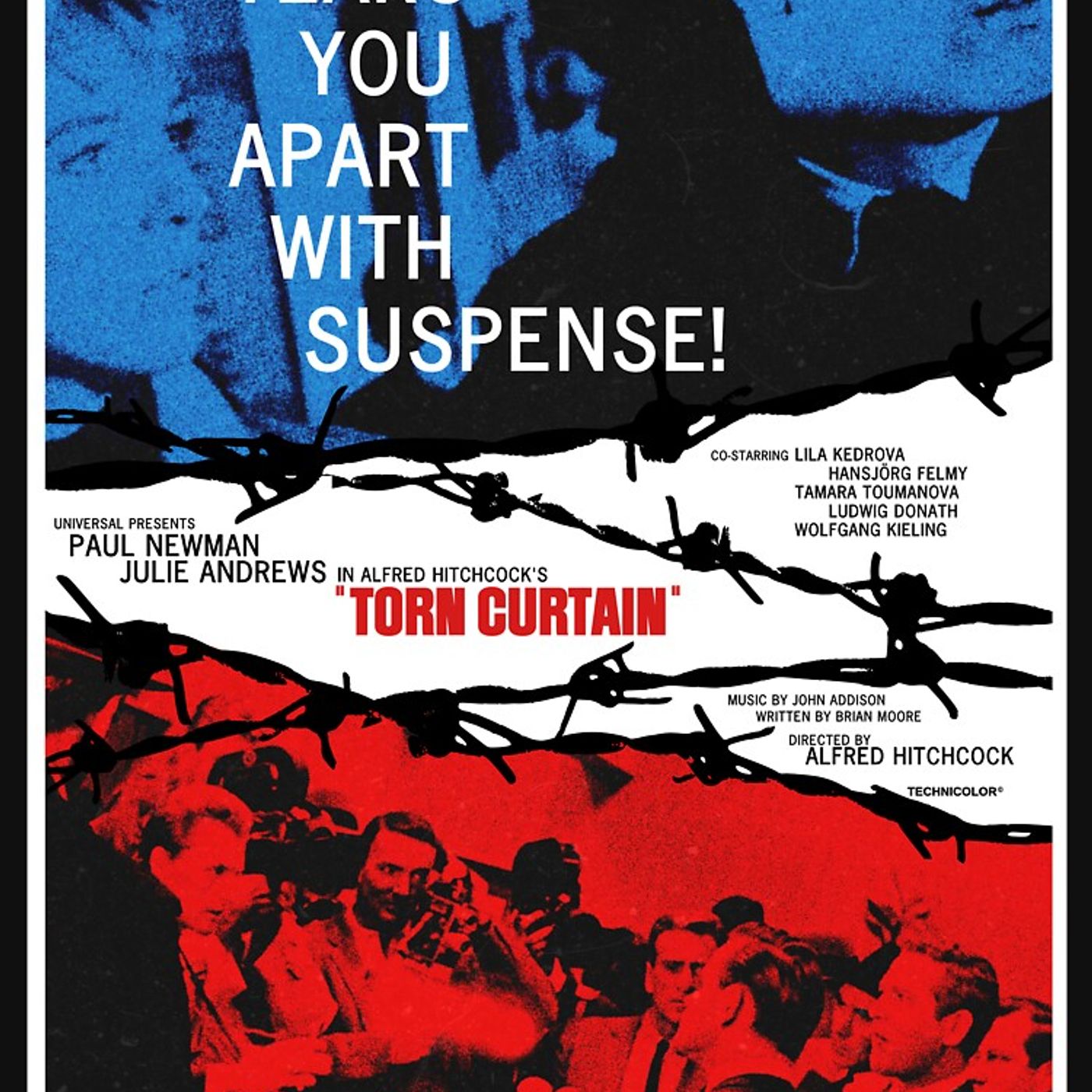
But on this episode of the Culture Cast, I am still your host, Christashian. I'm joined by the two hosts of eighty TV Ladies, Susan Lambert HadAM Hello and Sharon Johnson Hello, and we're talking about I guess the first time I'm doing a Hitchcock movie on this show, which good and for bad? For this movie, it has Julie Andrews in it, and it's from nineteen sixty six, so it's a later Hitchcock movie, and it's called Torn Curtain. What series of startling events would come to a climax in a scene like this. You lot a scientist or a teacher.
You're a scientist, and you're supposed to respect to natural order in all things. Breakfast comes before lunch, a marriage should come before a honeymoon cruise. Newman and Julie Andrews find love in danger and danger in love when they venture behind Alfred Hitchcock's Torn Curtain. And you stay away from me, don't talk to me when this plain Lands. You take the next one out anywhere, go home.
But she had to know what was happening to the man she loved. All right, what would you like me to do? I'll be back in time for the wedding in two months? Yeah, oh three, Michael, you certainly know how to make a girl feel wanted. Rat didn't the FAA tell you?
And doctor Cosker who is this? Professor Armstrong prayed for him. What possessed you to bring a girl on a job like this? Didn't? She followed me.
It blow up? We built it, didn't blow out? It worse four years ago we tried it on an off it blow up. I love you very much? Won't you please take me home?
I'm sorry, I can if I'm go next body. So. The film is written by Willis Hall and Keith Waterhouse, directed by like we've kind of mentioned at this point over and over and over again, Alfred Hitchcock, screenplay by Brian Moore, and it starles Paul Newman and Julie Andrews as a scientist and his girlfriend. Scientist scientist girlfriend who through I would say, hitchcocky in ways, defect to East Berlin and then have to undive defect to West Berlin or back to the other side of the Iron Curtain, as it were, through hilarious misdeeds. And again, I mean, this has got to be the Hitchcock thing, right, This is a I mean, like again hilarious.
I mean, like some of it's kind of wild and some of it's horrifying, but some of the things are kind of like, oh, that's kind of clever, that's kind of cute. But yeah, there's also a lot of this that's pretty brutal in a lot of ways that I was not expecting. But yeah, we're gonna be spoiling the movie obviously, and it's the kind of movie spoilers matter. It's a thriller. So just a heads up.
If you want to watch this movie, go and watch it and then come back and listen to this episode, because you're gonna have the entire movie spoiled for you. So, Susan, I'm gonna kick it to you first. Why are we watching this movie? Because I believe that is this is this yours? This is I think a suggestion that is combined all of ours.
Maybe I don't remember. I think it was combined all of ours. I think it came out of talking you having introduced you to Julie Andrews, You're welcome. Than we were talking about what else Julie Andrews could we see, and then we were talking about her having done a Hitchcock movie with Paul Newman, which I had never seen, and that was like, how did I not see this in my Hitchcock diet? And so I think I was excited about it for that reason, Sharon.
I recall that I was the one that brought it up, because I have seen it before and just based on initial comments, probably enjoyed it a lot more than perhaps two if you did, we'll see. But yeah, I saw it. I saw it. I don't many years ago, probably during whenever I was watching all sorts of older movies of that kind, and so I've known of it for some time. So Sharon, let's go back the other direction, Sharon, what did you think were watching it?
To talk about it? For this episode? First of all, I realized some of the details of the movie I'd completely forgotten about. I thought they were married. I didn't realize that she was his fiance at least I didn't recall that, let's put it that way.
But other than that, I may have forgotten some of the details, but I think that was really the only thing that I did not remember. But I didn't remember it being quite as oh for lack of bloated, if you will, in terms of some of the scenes. However, for the time was that was and I think looking at it now, Hitchcock was a little self indulgent about some of that stuff, but still it was. It had a lot of very hitchcocky and touches to it by you, Susan. And again I was surprised I had never seen it.
I had seen scenes from it, and so I did remember that, but I I actually and and listen, I maybe end up in the middle. I'm just guessing, but because I really enjoyed many parts of this movie. I always I mean, there's a level of craft in Hitchcock films, the cinematography that the state, you know, like there's just some really, really wonderful stuff. I love Paul Newman, I love Julie Andrews. I don't think they're Hitchcock stars, and it's odd to say what is a Hitchcock star, but there is there.
There are people he worked with over and over again, Jimmy Stewart being one of them, Carrie Grant, you know, and they were it is they met Hitchcock in the right place or Hitchcock them in the right place, and they work. And it's weirdly, I think a bigger, bigger than life movie star, movie star that is the personality, like, it's so odd that Jimmy Stewart did Hitchcock when you look at his other films and you're like, but how is Jimmy Stewart in a Hitchcock film? How would that ever fit? But it does, It fits really well. And I don't think Paul Newman fits a Hitchcock film.
I think that's the biggest problem I have. He is such a naturalistic actor. He is an amazing actor. I love so much Paul Newman, but I don't think he's a Hitchcock actor. I think he's not a He doesn't act like a star.
And there's something like Julie Andrews comes off really well in this, even though again I'm not sure she's a Hitchcock star or Hitchcock lady, but she at least kind of understands the level of performance that's happening in a Hitchcock movie. It's a crafted movie, and I think that Paul Newman, if he understood it, wouldn't do it, and so he's just walking through this movie. That's what I think is the problem of this movie. And so, yeah, and I think there are challenges in the movie because it is it sort of doesn't quite hit that pace that you want from a Hitchcock film. However, there are freaking amazing scenes.
There are sequences that are really really cool, and it's just so interesting that they're like that they're engaged but that's not even that clear, and that they're totally in bed together at the beginning of the movie and it's nineteen sixty sick and they're not married. And it's Julie Andrews, who at this point had played Mary Poppins and the Sound of Music and so she was like the goodest good girl in the world and shows up in this movie in the first shot in bed with Paul Newman, and they are clearly I have just had sex, We're about to have sex, and that is amazing. It's not that I did or didn't like this movie. I'd never seen a Hitchcock movie before as the adult that I am now, so I think I do recognize that this movie is a bit long.
And by a bit long, I think it's like a half an hour or too long, because there are some scenes that just seem to go on for a while. But outside of kind of the movie's pacing issues, I also realized I had really never seen Paul Newman and anything either. So there's that. I'm sorry. I know, I see a whole string of podcasts in your future.
I know I could sit and pretend like it's like it's what is happening is not the truth. But again I have no problem admitting it, because the only way you watch those movies is by admitting. But you know, at the same time, you know, you're a little bit younger than more, a little bit younger than I am. So you have had other movies that have come along that you've you've been watching, and it's it's, you know, the further out you get, the harder it is, I think to go back and try to catch some of that stuff of a different era because there's so much There are only so many hours in the day, after all, theoretic, I mean, if you have something on in the background the entire time, which is you know, I mean, again, that's almost what it feels like now is I'm always watching something and yeah, how I never managed to watch a Paul Newman thing or a Alfred Hitchcock thing is kind of beyond me.
But to your point, I mean, if I said to someone ten years younger than me, have you ever seen a Hitchcock movie, they'd be like who. I'd be like, oh shit, Like that's that I think is where it hit is too far? Is the generation one beneath me that are like in their early twenties that it's like they do they don't even fucking care, which is fine, I mean, I get it, like they have other things that they care about. I mean, that's why they had to put a disclaimer on the Moonlighting episode in the eighties saying nothing's wrong with their television. This episode is just going to turn black and white for a minute, because people would freak out when there was black and white on their television.
That's even in the eighties, because it was weird and different and feltal fashion. I don't know, you know, it is often a battle to get if we want to sit down and watch a movie, the first question that's asked by one of our children is is this in black and white? Because I'm out and you're like, what is wrong with you? So it does. And I saw a lot of these movies on television too.
They weren't rerun like this was. This was sort of a staple, right, Westerns and Hitchcock, Jimmy Stewart, those weren't staples of television, you know, on weekends and you know movie night. You said there weren't a lot of there weren't. I wasn't living in a place that had movie revival houses or a number of them, or at least ones I could get to that would allow me to go out and see these things in the theater. So if I wanted to watch them, I had to watch them on television.
And then, of course, you know VHS came along. So yeah, a lot of my a lot of my watching actually proceeded, not all of it, but some preceded home video. But Susan, getting back to something you said, it reminds you're reminding me that my understanding of not just film technique, film but also acting styles, et cetera, is very pedestrian. I watch something, I either like it or I don't. I'm entertained by somebody or I'm not.
But I don't really have an understanding of anything beyond that. I want to, but I just haven't made time or figured it out or gotten to a place where I really understand that. So that is a gap in my my my video television, movie watching that I would like to fill in somewhat. I mean, I was gonna say, like, but I don't I don't know if it's a gap so much as there's something wrong with me. There's not the people, No, but there are people that like because it is upset.
It is stuff that you know, Brittany and I in film school would talk about that Rich and I talked about in film school and still talk about today of like, you know, we're constantly breaking down scenes or films or moments of like why does that work? Or why does that not work? And and you you kind of you know when you're when you're making film or theater, you're particularly as you get further into it, it becomes very very hard not to be doing that all the time in everything you're watching. It's like and so in some ways it's hard to watch it just as a consumer, right, And so were are things that will that people will be like, oh, I got I love this and Richard, I'll be like, you know this and this this, and you're like, you know what.
People love what they love and they don't all have to break it down. So just some obsess people who want to know why things work or don't work. I mean, it doesn't make any sense that Paul Newman wouldn't work in this film, but I don't think it's the right fit. And sometimes it just comes down to that just whatever that fit is, as you said, whatever that thing is. I mean, for instance, you know, sometimes I'll hear somebody say, oh, that was a really well directed movie, or that wasn't a very well directed movie.
I have no idea what that means. I honestly don't know what that means. I just I just come out of the movie and go I like it or I don't like it. There's something maybe some things I can quantify or describe or but you know, at the end of the day, I don't have that vocabulary and I don't have that understanding, and I would like to have that a little bit more at least, But that's a that's friend of the podcast perhaps well. And I was about to say, like, like to your point, Susan, like watching movies has been ruined for me because I mean, I can't watch them the way I used to.
I can't the turning off at some point, like I was able to turn it on and off, but then when the expectation is always they're more than likely going to be having a conversation about this. You can never turn it off, and it's been turned on too many times. It just can't can't go back anymore. And it's fine. I mean, it does kind of suck to always be that person in a room who's like, we like this movie.
It's like why, It's like, hell, this guy, he's always there. But it's the thing, like we're not always there. Like there are plenty of people, like you said, that can just watch a movie and then they don't even think anything of it. I just watched a movie to watch a movie to pass the time, and I just and like, I wish I could be that person more than I am now, which is like there is very little in between. But again, when you sit and watch movies every day and end up recording more than not about something else that someone else has already made and your feelings on it, yeah, it's a lot.
Well, don't get me wrong. It's not that I because usually I am the person in the corner of the room by myself feeling the totally opposite way of most of the other people in the room as they feel about some movie or television show that everybody's consumed. So that often happens to me. But so I completely understand Chris where you're coming from. Yeah, it gets exhausting after a while, Like why I didn't like Batman versus Superman, I really have to tell you, Okay, fine, because you feel obligated to tell me why you loved it so much.
It's like, kay, you just love something. In my opinion, not fucking matter at all, Because again, that should be the way this works. At least I would think, Well, there are a number of quote unquote bad movies that I that I that I like quite a lot, and other so called good movies that I did not. That happens all the time, every single time. So it is what it is.
Well, And I think in the eighties, if I had seen this when I was sort of eighties and nineties, when I was sort of studying Hitchcock and watching a lot of Hitchcock, I think I would have liked this and sort of placed it kind of in the middle, mostly because of Paul Newman and Julie Andrews, and mostly because of Julie Andrews. She's great, She's so great, and again, it's such a it is a completely different kind of role than what she had become super famous for. So I think that was the other thing that made it exciting is like, wait, she did Mary Poppin's Sound of Music, Torn Curtain that You're like, what, And so I think it was really great to see her and to hear her like I kind of went and looked up some interviews with her talking about working with Alfred Hitchcock, and she's like, it was so interesting.
I just got an educ I just showed up and I got an education because he didn't want me to show up and do anything, like basically she saying, and you know, and she would be like he'd be like, Okay, so you're looking out the window and she's like, what am I looking at? He's like, don't worry, just turn and look and look something. Look like you're seeing something. He wouldn't tell her what he was looking at because he didn't he could make it work. It didn't need her to do anything other than turn to look out the window and then he would take care of the rest.
And and so I think I think that she was willing get able to go along with that style and be like, I got it. I'm just going to be in the room with averagagecock and do my best to enjoy the ride. And I think Paul Newman was like, no, but what am I looking at? Because I Am not going to participate in this kind of bullshit. Yeah, that was something that I gleaned to and some of the some of the reading that I did that he was that he was all, as you said, what's the meaning of this?
What's the what's And she was just like, yeah, just tell me what you want me to do. And okay, you know, because that's what I'm here for. I have a little bit of a hot taker. I don't understand Paul Newman's thing just by based on watching this movie. Yeah, well it's the thing, right, But what's what's the thing?
What do people want from Paul Newman? You know what I mean? Because again I've seen this and nothing else, so almost every other movie. Okay, so this is a this is a genuine outlier, is what you're saying, okay, in a lot of ways, I hadn't really thought about it, but it is on a sauce bottle at the store. There's a reason here, I mean, well, because, yeah, because he was a I mean, if you want a list of movies Paul humans to see, my top three would be Cat on a Hot Tin, roof Cool Hand, Luke, and oh the prequel to the Pool movie that he did with Hustler.
Hustler. Those are Oh there's another one that he did with Joanne Woodward and I for the life of me, I can't pull it. But Hot Summer Long, Yeah, oh my gosh. And then you've got The Sting and Butch Cassie and the Sundance Kid. The Sting is way too long.
But oh I haven't seen the Sting. But I don't even remember. I don't even remember it. At this point, that was really more of an ensemble as opposed to him, you know. But still, you know, some of the early stuff is what made him Paul Newman.
You got to go watch Cool Handble. Yeah, that's that's the Paul Newman that I think. I think, well that that's the one for you. Okay, Okay, Yeah, he's not much in this movie. I mean, like, by my approximation, like you mentioned, he's kind of sleep walking through it.
Like Julie Andrews is the one who shows up big time in a lot of ways, Like in she's the more interesting character in this movie. He's just kind of there. Like I get what he's doing, I get what the expectation of the character is. But what she's doing is more interesting because she seems to be And again, like both of y'all, I found and read the same things. She seemed to get what Hitchcock wanted and he didn't really want to deal with it, which I get, but you should not let that get in the way of a performance.
Now, maybe on the page, this character is just kind of like this, but him being detached, this isn't the kind of character that can pull off being detached, because that's kind of not the point of a character. Well, and I think it's it's interesting because they were all all of them huge stars, Paul Newman, Julie Andrews, and Hitchcock. This was his fiftieth film. He was at this point considered the greatest film director in America, probably the world, right, And yet I think they basically said, you have to make this film with these two actors. I don't.
It doesn't sound like that. It was a lot of choice for him. He didn't get his first choices. And so there's a feeling that even Hitchcock, this isn't This isn't Hitchcock at his best. This is Hitchcock.
He's he's allowing people to walk through some of those scenes. Well, yeah, that's good, and and and and I think he uh, you know, there was stuff he cared about, and then stuff that he clearly was like, yeah, I'm not gonna but is it worth fighting with Paul Newman over? Is the question? Well? It's so interesting because I think Paul Newman is such a different kind of actor at that point, he was not of the classic actor.
He was coming up in a very He's a very naturalistic actor. He's very much I'm out no. He his method, but he might as well have been. So he wanted to truly understand what he was doing, and Alfred Hitchcock did not want to have those conversations, and so I would My guess is that the flame could be settled on both shoulders there, and even with Julie Andrews, as great as she is, you couldn't tell me what she is thinking in any scene, and you but she's just she's just gainly doing her best to deliver the performance her director. Once she had two giant movies under her belt.
Paul Newman had been around, he had built that career. I mean, Hustler was probably one of his big breakouts. But ken On Huton Roop, I mean like, actually, there's so many he had done so many films that you know, it is sort of a shame that you wouldn't go as a director. I got Paul Newman, let me see if I can make Paul Newman shine, and let me see if I can shoehorn Paul Newman into this. But I think Hitchcock at that point again was also like like I film, I'm not gonna shuret I'm gonna do what I want to do, and I'm not And if you're not gonna play in my sandbox, you can just stand there and look like you don't know what you're doing.
This was also the stage in Paul Newman's career where he was I think at the beginning stages of going off and doing a lot of independent films. Yeah himself. So yes, he still starred in things like Bunch, Cassidy and The Sting, But he was moving away from being the movie star and really was trying to make a name for himself as a as a director and as you know, more of an actor quote act and quotes if you will. And so, yeah, he was at a totally different point in his career than Julie Andrews was, and he was closer to Julie Andrews is in many ways kind of one of the last of the classic Hollywood actresses, even though she's you know, been amazing all you know, she's still amazing, right, But Paul Newman was of that.
You know, he was basically wanted to go into that sixties new way, even though he didn't necessarily go all the way into it. He like whichcast and Sun Dance Kid is a movie about sending up Western It's it's about breaking the model, uh, and so much of I think that was what he was interested in. Is is a little more revolutionary in what he was looking for. Well, and that's the thing about his performance in this movie. It's like I can see that I see that version of this actor, but here it's just an anytime, it's just him in a scene it's kind of like hook him with the stick and hope he does more because it's like it's so it's just so kind of downplayed.
Which are the great scenes that you can remember, Yeah, a kind of goes big really right is on the plane when he comes up to her and says turn around, go back, and then does nothing else right like, but and then the the you know, incredible set piece of murder, the set piece of the moo of the movie is the incredible murder scene. And then with the professor when he's because because again it feels like stuff that worked for him to play right. It was both physical and it was and it was in it and it was something an actor could really grasp onto, like Okay, here's what you want, here's what you need, here's what is your obstacle. And every other time I think he was probably being told, we'll just stand there and then turn and look at her.
But he doesn't know how to do that because that doesn't that doesn't speed to his strength. I mean it is method, right, it's totally method acting. It's just I don't again, like I don't know he wouldn't call it that, right. Paul Newman wouldn't call it method acting. He would just call it acting, which I think is like, that's sense I method.
I mean, he seems too cool to call it method, you know what I mean? Like I will say, and perhaps as often happens with me, when an actor or performer has built up a certain amount of goodwill or persona. I thought he was great in this movie. I thoroughly enjoyed watching him in this movie. I like love the two of them together, and I bought everything he was selling or under selling or not selling.
I was right there with him taking the ride. Perhaps part of that, too, was growing up as a child of the Cold War and the whole evil East Berlin versus you know, heroic West Berlin of it all, and the whole iron curtain of it all, and the idea that there was this inherent danger in what he was doing, in what was happening, real danger, you know. It wasn't like some sort of made up danger that somebody did. Somebody really could die. They didn't know the meet he's on the other side of the wall, didn't care, and they would kill just about anybody if they felt like it.
But so anyway, so I when there's a performer that I really like. When I see them in something, I'm very forgiving. I guess about whatever is happening. I can't tell you how many times I've seen television shows or movies where an actor that I really like is in it and I'm like, yeah, I'm gonna go see this, even though maybe it's not so great, because I love that person, and I'm going, Oh, I could watch Paul Newman all day long. I mean, but this is not peak Paul Newman, That's all I say.
Yeah, that doesn't mean again, same with this is not peak Hitchcock. M so, and it's not even peak Julie Andrews, though she's the one that I think is working the hardest in this movie to try to make it work. And I think you can tell because you almost can't take her eyes off her in every scene that she's in. And again, I think with Paul Newman, it just wasn't the right fit. It wasn't the right fit between him and Alfred Hitchcock, and so it's so clearly a struggle.
But he's still like beautiful to look at. They made sure that they took his shirt off and beautiful ladies staring at him so you know, he's you know, but I think that it is very interesting. It's a very interesting film to watch because of the history, right, it really doesn't. I came a little bit behind Sharon, but I still remember that East Berlin, West Berlin, which doesn't you know, that conflict doesn't exist anymore. It's gone, right, So, especially at a time when there was a clear good guy and a clear bad guy, there was no ambiguity there about who was on which which side of that that equation right now where ambiguity, yeah, exactly.
Although I thought it was actually pretty interesting how how it was sort of like or the communists. They were just communists, right, so they were just like, we're just trying to do our thing, and if we can get you to come over and join our party, we're into that. And if you don't, yeah, we'll kill you. But that's only because you well, they'd go back and give our secrets away, right. So I thought that it actually was a little less evil communist than I thought it was going to be, because I liked all the characters in there, and because we saw so many characters in East Berlin that were clearly agents or undercover people who were revolutionaries within these brilin so you're like, oh, well, there's plenty of people.
There's a whole, entire buffload of people. And I actually had forgotten that, for all intents and purposes, Julie Andrews and Paul Newman were the only Westerners in this movie. That everybody else was a non Westerner, every other character, if you will, except for the guy out of the farm that I'd forgotten about him too. So, yeah, I did not remember that. It's been a long time since I've seen this.
Yeah, the farm sequence, the bus sequence, those are pretty pretty awesome. Well, I mean, I think that the movie kind of kind of feels like the whole point of the movie is the murder scene on the farm. I know, the Hitchcock said he wanted to make sure you understood how long it takes for someone to die. I mean, I get it. Sure, that's fine, But that point in the movie comes very early on, and it never gets back to that point.
And I'm not saying it had to get back to that point in terms of like watching someone be slow murdered on screen, but I kind of wish the movie felt like there was a little bit of a It kind of fell off really quick after that point, and that's such a high point in the movie that I wish it had maybe come later in the movie. I don't know, it's just I wish it wasn't the sole high point is what it feels like, because yes, there are some points towards the second kind of this end of the second act, the beginning of the third act that are kind of interesting, but that it kind of feels like that one scene is the entire movie in a way gets lost in that one scene. I thought the whole escape sequence was was really intense as they're trying to get out.
Agreed, Yeah, that was just it felt like that. It felt for me, that felt like it. It was good, but there was a moment I was like, this is getting a little and then and then and then a little, not a whole lot, but I feel like if they had done it one more time, because like the Baskets was like, that's the last straw. You can't do anything past this. Okay, fine, But I mean the effectively the end of the second act and the entire third act of the movie is them on the run.
I mean pretty much they never stopped moving, and I mean there are some pretty high tension moments, especially when they're at the post office and then when they're at the play, Like, those are pretty good moments, and the way that they're edited together is I think really interesting and it helps ratchet up the tension for sure. Well. And I think and you've probably read this too, that that the you know that Hitchcock was also trying to kind of he was like, he figured he couldn't out bond Bond. At the time, Bond films were really big, so he wanted to kind of he kind of do an anti Bond in terms of you know, it not being you know, a person who was gonna you know, suavely smooth their way out of was used to being spy man, right right, wonder kinspi man.
And so I think I think that's very interesting in what, you know, what audience expectations were at the time. I mean, this was a time when movies meant more. They just did they weren't you know, they were harder to make a Hitchcock movie. It was a big deal. Paul Newman was a big They were harder to see, but it was also but they weren't that necessarily they weren't necessarily harder to see.
They were just an event, right you it was an event harder to re see? How is that harder to rewatch? Right? You got to see it once and if you want to see it again, you literally went to the movie theater, or like you said, catch it on TV. Maye, you had your TV guide and kept a shop off exactly like the ability to just sit down and click this movie on and click this movie off and pause it at any point.
That has probably allowed me to not watch as many Hitchcock movies because I can watch literally anything else as well. At one point, it was just this for this kind of movie, and if you wanted to watch the best kind of this kind of movie, you would watch a Hitchcock film. I'm assuming. I mean again, there are other names that would come up, but Hitchcock is a kind of director of a certain kind of movie that that was his thing forever. Essentially, that's what he's known for.
It was also time though, when movies would stay in a theater for much longer. This is an extreme example, but Star Wars and the Star Wars State in the theater a year after it was released. Movies tended to stay for weeks and weeks, if not months, if they were doing well enough, but you still had to get out of your house, go to the theater and buy a ticket, and you could, certainly, but you also could sit through it four times if you wanted to a lot of times in a lot of theaters back then, if you had an inclination to watch it over and over again. But yeah, it was it was a different time for consuming this kind of content, that's for sure. Yeah.
And if you were a crazy girl, you know in Georgia who really wanted to see a lot of films, sometimes you might slip into another movie, fid I watch another film but the same press without going out a ticket. You might just spend all afternoon doing that. That Donna the Multiplex made that sort of thing doable. Absolutely, Susan began the downfall of the film industry right there in Georgia. Sneaking into extra movies.
I mean, that's the thing, though, it's like taking it for granted. Nobody even thinks about it anymore. And again, like that for me is probably the excuse I'll go with in terms of why I haven't seen these movies, just because there's plenty of other things to watch at this point, plenty of things. And I'm not saying that, And I'm not saying that Hitchcock's movies don't have any value in this day and age. I know that they do without even having to watch them, because they're still being mentioned in certain conversations all the time.
I mean, agat was just in La we read a podcast thing. I went to Universal Studios and they still talk about Hitchcock at the Universal Studios tram tour, still talk about Hitchcock in twenty twenty four. They could stop talking about it, and why why wouldn't they keep talking about it again? In a lot of ways, Spielberg and Hitchcock overlapped each other for just a moment. But then Spielberg picked up the mantle that Hitchcock had, which is a director who makes movies that you're gonna see.
At least for a while, people were seeing it because he was the one directing those movies, and Hitchcock is the same thing. People saw it because it was a Hitchcock movie. That's the way it works. The fact that he's in all of his movies, the fact that he's on the post No other directors are on the posters for their movies. That's not he's on the trailer for this movie.
It's like as much like they literally are showing this, you know picture of Alfred Hitchcock, where they're like Alvired Hitchcock does this, and Alvert Hitchcock does not a oh yeah, Julie Andrews and Paul Diman, but Alvid Hitchcock. He would be confused that to think Alfred Hitchcock is in the movies as the main actor. Like the way he's treated, the fanfare with which he approaches is you can't get out of the way of it with Hitchcock. That's the thing. And they're not just as there aren't that kind of movie star anymore.
There's not that kind of filmmaker anymore. May become known and you may have your big giant filmmakers, but they're not known the same way there is. Just Hitchcock had a lot of control and a lot of power, and if you know, it just represented something. Again, I think Spielberg maybe the last filmmaker, maybe Scorsese, but but in smaller degrees, there's just sort of nothing like the Alfred Hitchcock. There almost wasn't anything like it then, but now there's just nothing like it.
I don't know me. Did either of you pick up or pick up his his Hitchcock's cameo and this and this? I didn't. I did. I didn't either until I read about it later, and then I had to go back and find it on the gosh, No, no, it's early.
Now. What I did pick up is it's in the It's in the hotel in Copenhagen. I think in Copenhagen. They're walking in and you hear the Alfred Hitchcock theme play. He is sitting on a on a cow which kind of with his back to the camera.
He's slightly in profile, and he's got a toddler on his lap. Yeah, but I didn't. I didn't catch it eight I caught nineteen seconds. Yeah, I caught the music. But I didn't.
I wasn't looking for him. I can I've fought to look for him. I just assumed that he would be later in the movie for some reason, and which doesn't make sense because I think he was often early in the movie. I don't know anyway. You know, this is the problem I should have if we'd done this interview and nineteen ninety two, I would have been a very big hitch hot expert.
Yeah, yeah, because this is definitely somebody that I went down the rabbit hole of. This is a person I want because you know, you would, you'd be like, you know, you get an overview of film history in film school and you get some highlights of all the stuff, but then to get somebody's full So I did a full Jimmy Stewart, I did a full Hitchcock. A lot of true for me. So, but it's it's pretty it's pretty amazing how even if you don't know it, you know it like and that's because of The Simpsons, And that's because of you know, uh literally with me, yes, yeah, I mean The Simpsons is responsible for a lot of film history knowledge being passed on to the next situation. I mean they have a Hitchcock cameo in the episode that they do all the Hitchcock references, a street car named Marge, I believe in like the first or second season.
Yeah, I mean they have a bunch of Hitchcock, da have him in there. They have the thing with the babies that are meant to be the birds but the pacifiers. I mean again, that's just that was my exposure to Hitchcock more than anything else. More than having ever seen the movies for sure, and then having I mean again, I don't know if I saw Phantom of the Paradise before or after I saw Psycho. But de Palma does his own Hitchcock thing and Phantom of the Paradise.
I mean some would bristle at it, but Brian de Palmer probably is who picked up exactly what Hitchcock was doing. Yeah, Spielberg was at that same level of director, but De paulm I think, is the person who picks up the mantle for Hitchcock in terms of being known as that kind of film director. I think he might hate or like that, and I think a lot of other film watchers might hate or like that statement, but I don't think it's untrue either way. Well, who are who are the filmmakers of today? Like Chris palin Is, Yeah, I mean I guess I don't.
I don't like his movies, but I know people do. Tarantino another one. Again, Again, he's an old guard. These are all guards now. Tarantino is Greda Gerwig.
Is that count ed? Yeah? But again she's not given white the dude right, No, No, I'll be glad when she wins for something other than Barbie that's better than Barbie. Not saying Barbie was bad, but we all know the other things Greta Gerwick has directed were really good too. I would put Barbie as the best of her really interesting.
I mean, I think you can't make a case for it. Let's put it that way. I can't, So I'm not saying I don't think you can. This is my point, Like I think, I think you can make a case for Barbie being her best movie. I haven't seen all the movies she's directed, but I was.
I was really not a fan of Ladybird, Thank You. I couldn't remember what it was called, which I totally also get that as well. Yeah, I guess I don't know what they're to. I mean, that's the difference. It's a different kind of it's a different kind of world because these kind of the kind of movies that these the Hitchcocks, they're not, They're not really being made that there are.
The The scope of of the types of movies that are made today is much narrower. It's either going to be some sort of big blockbuster IP kind of movie, and listen, I like a lot of those movies. I'm not saying it's bad. I'm just saying that has sucked up a lot of the oxygen and I don't really see any true successors Hitchcock coming out of that, or it's going to be you know, much smaller movies like Lady Bird or Nomadland or Harrisite or you know what about Jordan Peele Pee Jordan Peele had Yeah, I mean, will you know, does he get to make another movie? Does he making another movie?
Yeah? It comes out in like December, all right, and it's like Jordan Peel, Jordan Peel's new movie. I mean no, Jordan Peele definitely all right, I mean yeah, Jordan Peele's I mean again, I watched that Twilight Zone. Yeah, well, I mean again, Yes, yes, James can't. Yes, but James Cameron also thinks James Cameron deserves like Catherine Bigelow a lot more if we're having that conversation, because at least she makes interesting movies, not just the same thing over it.
So I would put Catherine Bigelow again. None of them are near a Hitchcock, but in times Spielberg is really like right, and Spielberg again, I'm also going to put in a little bit of the old card, right, totally. If you're making movies in the seventies, you're part of the old card. Definition Bigelow. We have Tarantino, we have Christopher Nolan, I'll allow it, Robert Rudfrifes, Kevin Smith.
I mean these are people that they're like, they don't make that many movies. I yeah, so I don't think you can. But I don't know like that, but in my mind, it makes it like an event when their movie comes out, like Tarantino doesn't. Is not as Tarantino is prolific, but he's not. He doesn't have thirty movies now like Soderberg, like Tarantino, Scorsese, Spielberg, Like they make movies infrequently now.
So I think that's where maybe where the elevation is is just by the fact that they don't work as much as they used to. But I would agree with you they probably don't deserve to be mentioned by hitting the same term as Hitchcock, because Hitchcock made fifty movies. But I mean, like this is the fiftieth movie. I know he made at least fifty because this is the fiftieth movie, is my point, Like there's a different kind of prolific we're talking about here, he's prolific because of the output. They're prolific because of I don't know, I guess we in terms of this sexers eyes.
Are we talking about numbers? Are we talking about how most people how might know that name even if they haven't seen all of the movies. I mean, because I think there's a difference. I think more people have heard of Kevin Smith perhaps and have seen all of his movie movies that than perhaps, you know you might think, but I don't know how many people would would know who Catherine Bigelow is if you mentioned her name, not saying that she's you know, I mean, I I mean, I think that's a little bit because Kevin Smith is out there as a personality, right, exactly know him as a personality. Yes, that was intentional, right, I mean that was kind of part of it.
Hitchcock was out there as a personality too. Part of it was intentional. Rights in his own movie. I mean, Kevin Smith kind of copped the Hitchcock thing. Kevin Smith is in almost all of his own movies.
Yeah, but he's actually did Hitchcock thing in a lot of ways. He took Hitchcock idea and ran even further with it, right, like, I'll be a main character in one of these movies. Uh Paul fy uh Because again he has done a lot of different kinds of movies, but they all have a particular you could kind of go, oh, yeah, that's yeah. I don't know if he's still there, but he was there for a while. Jet appetite, jet appatoe.
Yeah, but it's not the same. No, it's really not. If your name is being used as a verb like hitchcocky in or I guess it's an adjective. But like Spielbergian like though there's not like, look, nobody's saying George Lucas directed, like nobody sits and says George Lucas was a great director. There's not direct that much.
So well, that's my boyt like But again, like there's also the thing of like, how do we make Tarantino? You like, there's a there's an expectation with the Tarantino mane. You can go out and go I want this to be filmed like Tarantino, and many people would know what you were talking about. I think quick Tarantino might be as well. Maybe okay, what if Okay, what if it's like Darren Aronofsky, I mean, and that's I don't know, that's pretty high up there, I feel like.
But that gets back to, you know, notoriety and familiarity with the name versus the fact that Aeronovsky has made a lot of movies, but probably most people have not heard of them right or heard of him. It's a different world. Some of these things are just like there, there was never going to be as much of a thing for Hitchcock being this big and pop culture if he was existing now it's hard for him to be again. Like some of this is you just right place, right time. Not enough things existing in that world.
Like how many content creators ten years ago that were taking advantage of YouTube would be lost in the shuffle now if they were trying to make YouTube. Same thing. When you don't have as big of a hose that you're drinking from, everything matters now. It's like, yeah, yoh, it's fucking a million things, including just going and watching Hitchcock's movies one after another because I want to with them. That was not a thing in sixty six and people didn't even think it ever would be to tell them, oh, you can pause it and rewind it and watch it over and you don't even have to have a physical thing like talk about fucking magic like Jesus, and so having film knowledge at that point was really you know it, it took a lot to be able to access the films, right.
You don't read a book in the library like that's I mean, Richard talks about it on his shows, Mike assigns it on his shows, like books about movies were the way you get that information. Not everybody could go on Google and Wikipedia and read everything that's been condensed down from all of those sources so that it's a manageable stream of things. I mean, yeah, it's we really are just living in a time right now where oh it's nice that we can just turn these movies on, have a conversation and then turn them off like there's nothing in terms of effort being put in. The effort is very minimal at this point, and your reaction when you realize that something you decide you want to watch or you're like, I can't watch this.
It's not bailable somewhere right, this is wrong? How dared? How is this possible? It's you know, there's an expectation that everything is available, and it's not right, Yeah, I mean i'd be curious how how many Hitchcock movies are available. I mean maybe the Criterion channel.
I mean like I'm trying to think who would have them all, or maybe they were all on Netflix. I don't know, not a guess a lot of Criteria, right, because that's the other thing, like Hitchcock's movies are important and Criterion, Keino Lorberd they tend to be where those kinds of movies come out. So let's go back and talk about the movie. Yeah, yeah, the movies. I mean again your podcast, maybe that's great, right, I want to talk about that murdercy.
I want to talk about that farm. Yes, let's talk about the murder one. I mean, well, and there's a couple of things. It is still astonishing to me that Julie Andrews was sleeping out of wedlock with the character of the Pulaments play and and I mean, let's just point out she's clearly a scientist, but really she's his assistant, right, That's what she is called throughout my this is you know, the scientists and my assistant, which is the role that women got to play in the sixties. Even if they were scientists, and they never define what whether whether she what kind of credentials, if any, she actually has.
She knows j Paul Newman, the assistant. You know, she's with her boss, right, Lucky So and his and and and it's Julie Andrews. It's Maria. She's a nun for God today. So it's very interesting that then this early on in the movie, and I think one of the things that might be early on in the movie is it really does establish not only the threat of violence, but that that that Paul Newman's character has gotten in over his head.
And what we've seen is Paul Newman and this random woman at the farmhouse murder a man slowly, inefficiently, and desperately. And that again, for audiences in nineteen sixty six, I just that people had to have time to get through the rest of the movie to just be like the ramifications of that right, Like, it wasn't cool, it wasn't stylish. It was brutal and scary and a presentation of sort of spying world that we had not seen a lot of in pop heure of the culture. Tossing at bathtub, tossing into a bathtub, a toaster is definitely this not this is not that. When I think of the spy stuff at the time, we're talking like Goldfinger with James Bond and the you know, haha, shocking, like that's not this, but that is pretty far from this in a very like, again, very intentional way.
I obviously I think I was very put off by the scene, but I had to watch it a couple of times because I was like, well, I mean everything of it. I mean again, like the length at which it takes to do that, and the fact that that is part of the intent behind making the scene that long is to like you said, it's an anti spy movie because this is the reality. It's not just you toss an electric item into a bat that was someone and they just boom, they're dead. That's not how this works. And I appreciate that that was kind of the point of the scene, and it does raise the stakes for the rest of the movie, right, you know, you you are sitting up a little bit more after that, for sure, I think as an audience number.
And what's interesting is then they but there's there's not as much humor in this. I know we just talked about, but like there's a lot of humor in some of the other Hitchcock films, that's wry humor. It comes, it's it's not quite the shocking. Uh, it's not a James Bond humor. But there's a lot of more character going on in other Hitchcock movies then there's going on here.
This one feels very straightforward in a lot of ways, and which is I think in some ways why sometimes the tension just sort of dissipates. It should maintain. I think that's one of the things that frustrated me. It's like, from that moment on year, shouldn't ever be off your seat right and then and it does, even though they're kind of on the run, they're kind of not and then they have the talk and then she thinks he's gonna you know, I did love the scene in the hotel room where she's like trying to convince him to leave, and just it was a very unusually shot Hitchcock scene because it was shot so far away. Where did that fall?
Which word the particular White movie it comes after it's when he when they're in the she knows he's defecting, but she's decided to go. I guess it's the moment she's like, I'm going to go back and I want you to come with Ah, okay, and so so she changes. It's after she changes, she changes her mind after saying Okay, I'm gonna stick around, and then she realizes I can't do this. Yeah, this is this is and it's just an interesting like on one hand, there's tension in that scene and on the other hand, because it's sort of his back is to her, and yeah, I think it's one where you know, you kind of want to break that down as a talker, You're like, Okay, is this working or is this not working? Is this working in this movie at this point or is it actually deflating some of the tension because you're not letting these two people who have a lot of stake in this relationship act like that in the scene.
And it's never very clear if he likes her very much, like to say them, the two of them together, like he it's not that they're at each other's throats, but like they don't have as much genuine chemistry as I would have thought. She feels like she's putting in the effort with him, and he is just Paul Newman. I guess well, when you think of Sound of Music, which we just watched, and you think of von Trapp and Maria at Captain von Trapp, and you're like, he didn't even like her, right, and there's so much chemistry you're there, You're so in love with the two of them, you want them together. I'm not sure I have a stake in, you know, I'm kind of like, girl, get out right, Like he didn't even they didn't tell you why to leave.
He just tells you, but until he until he tells her what's going on. He's playing a part and she she's going around going what the fuck is going on here? And I don't understand any of this? And he's just over the corner going thinking I can't tell you because it might they might kill you. I tell you, And he doesn't tell her until he absolutely has to or feels he absolutely has to.
So there's all there's there's different things going on there, I think for me. And he's way over his head too, like he's way in over They didn't didn't even tell the US government what he was doing, like night, if any if anything, If I'm Julie Andrews, I'm like, are you mental motherfucker, Like what are you Because if he's going to do any of what he's doing, why wouldn't he have the help of the US government? Like it makes it makes very little sense why someone who's like a top us scientist wouldn't just be like, hey, US government, I could theoretically defect get the information, and then you guys could help me get It feels a little contrived, and I'm sure that Hitchcock's movies have levels of contrivance to them.
It's just like, I don't necessarily think I would have asked that question if you hadn't pointed that out. So maybe next time, just don't point it out, and I won't necessarily think, oh, why, of course, why didn't you work with the US government? Like you shouldn't bring that up in the movie and hang a lantern on it like that's not great. Well, and there you're hanging a lot of uh like it's it's it's odd. If his original plan had worked, he would have just left her in Copenhagen.
No, she was not supposed to come right, No, but that's he's supposed to stay in the States, and she decided she was gonna come on her own, right and they talk about that while they're in bed, and you're You're just spending the whole scene going, wait, Julie Andrews is in bed with Paul Newman and you're not married, and I really don't know what to think. But yes, they were doing some exposition about how, but then it was also like, oh, because we're getting get married, and of course I should be here. And then he's like, of course, but then, yes, she wasn't supposed to be there, but now that she was there, he didn't seem to change his plan at all. No, I'll take his side and say, because his plan was to leave her behind, he was just gonna sneak off.
She'd be left behind without any information or knowledge that could get her in trouble with either the UH, with either the East Berlin, or with the American government because she doesn't know anything. Right. Yeah, but if I really love Julie Andrews, I would be like, I am risking my entire relationship for this, because if I'm Julie Andrews, I'm Julie Andrews, I'm like, m mmm, this does not get left behind for two to three months with no explanation, because that's about a thousand red flags even in the sixties. That's what I mean. Like that, he's the nuts, is my point, Like it doesn't make a lot of sense.
He seems kind of to me like the character in the movie that I'm like this, A lot of this could have been avoided if you had just done what any one of us would have done, which is talk to the US government, because who are you giving the information to? Anyways, I get that he doesn't like the US government because they hinted like they kind of shelved one of his projects. But to go and effectively do this like, Okay, it's a bit of a stretched, a bit of a jump. You're really that mad? I guess all right, but I will I will give him, well, I don't want to give him.
It's not credit exactly. But this was nineteen sixty six, and as evidenced by the fact that Julie Andrews played his assistant, men didn't explain themselves to women. They did their thing, and the women were expected to just go along with it. And I'm sure he fully expected if she had stayed behind, and if he had left for a couple of months, he'd get a hero's welcome when he came back when he explained to her what was going on, not saying I'm not saying it's a good thing, or he'd be dead or stuck behind the iron current, right right, Lausible deniability on her part, exactly. There's an element to Hitchcock films that are very stylized that right, very much leaps of faith Shakespeare on levels of tragedy, right, like yeah, and it is all kinds of nuts stuff like Psycho has that.
Like again like I've seen Psycho, like it has some of those things in there where it's like this is a contrivance in anyone else's film, but here it's kind of part of it. It's just part of it. Well, And that was the style that was very much the style of run that was very much happening in theater where it was presentational. It was here is this scenario we're painting for you, and it just go with us, and you would and you're like, yes, okay, that's the scenario. That's the world as long as you you know, suddenly you know.
And it was very much not not method and yeah, I'm Paul Newman, You're right, I think it is nothing. And it literally was an originator of nothing, but then he kind of shifted. These movies don't feel like the characters matter as much as what the characters are doing matters, and like that's fine, Like that is a way of making movies that would clash with someone like Paul Newman, because I'm sure Alfred Hitchcock just went, I don't fucking care why your character is doing this. Your character just does. It's on the page, do it.
So, yeah, I get it. But the picture literally painting a picture with light, and this is this is what I'm trying. I want to make the audience scared here and happy there, and release the tension here and make them feel this there and it. It had very little to do with actors. I will do it in post pro is like okay, sure, but yeah that probably rankles someone like Paul Newman pretty hard.
He's like, I want to act, let me act, please, I want to add I don't really care what you want. And in most of the movies of Paul newman' said I've seen, as I'm sitting here thinking about it now, have all they've been character driven. They've not been this sort of action y you know, let's get from point A to point B. Was it out what the character was thinking feeling in this world that they were living in. We'll hand Luca's a character study, right, you know, sometimes nothing can be a real cool hand.
Chris, Oh cool, I mean I did it that. I get Okay, it's got a story, but it's it's yeah, it isn't very much. It's like the antithesis of this movie essentially, is what you're saying. This is the plot is a fine tuned machine that is expected to you know, Rube Goldberg itself to the end. I mean, that's a thriller, right, Like the characters and thrillers don't necessarily matter.
We didn't mention Ryan Johnson and his movies, but I feel like that is similar in this case to like Ryan Johnson, the expectation his movies are meant to be, like you know, well oiled watches. This is more of a thing in literature than it is in film. Like now, I think like we've really seen the rise of like thrillers and those kinds of books taking the place of movies because like they're cheaper and you can do a lot more in the medium, and god, how many writers out there are just cranking out mystery thrillers once or twice a year, like plenty of authors, and they're really good too, not for pooing them, but like the literary's kind of scope seems to be where this kind of genre is now always being represented all the time.
Well, and it's so funny because I actually feel like glass Onion and Knives Out speaking? Is it Ryan? Is that you pronounce it? Ryan Johnson? Those are very old school movies.
Yep. They have a lot of new school flair, but they're just an old fashioned who done it? And it's so funny that we went and saw Knives Out and you know, and Rich walked out very unhappy, and I walked out going, well, okay, I mean that was kind of a little bit of a twisted thing. And in the end and our kids were like, this is the greatest movie that's ever been in the world. And they were so thrilled with it, and we're like, but it was like a it was like an Alfred Hitchcock road.
It was like a you know, it was like a Sharlock Collins movie, only like, you know, a little bit fancier. That oops, it turns out that there's you know that the bad guy with the White Guy. But you know it's uh, which you know, it's good, but it's very funny that that there is I think a want a desire for this kind of kind of beautifully built box, right, yeah, of a movie. I mean I think that we like those. I think that it even you know, a good story well told is still something that works, and I think a lot of people forget it, mostly our studio system.
But yeah, so, I mean, you know, it's but they just started funny. I could see like a you know, I would love to see a resurgence of movies coming back to you know, kind of beautifully built boxes. I'm a little sad that sort of knives out as you know, become a franchise, because it'll just become less and less. I live long enough to become the thing it wasn't intended to be. Oh well, I'm willing to hold out hope that it will continue to entertain in surprise.
I you know, when it comes to mysteries in general, I love a mystery that keeps me guessing until the end. And both of those movies did there were clues along the way that I missed or just kind of glombed over and got distracted by the shiny over here, which is the intent, and perhaps the fact that Ryan Johnson isn't having to crank out two of these a year like he would have had to back in Hitchcock's day, because that's how quickly they were making things. Maybe we'll see something good, you know, I don't even know if he's if he's if he's already looking at doing another one. I hope so if it's as good as the first two, because I did thoroughly enjoy both of them. I was going to say, the thing that I'm looking forward to is a as a book I read a couple of years ago that was again one of these like very fine tuned things, which was The Thursday Murder Club, which was a really good book, and it was about a bunch of u Again, this is the way it's essentially pitched.
It's a bunch of pensioners who saw the murder in their essentially like elderly care home. But it's that same thing of like, they just don't mix stories like this anymore. They don't do this thing anymore. And of course it's being adapted into a movie by, of all people, Steven Spielberg's production company so I think it. I think I think what's interesting is we are seeing that these kind I mean another thing we didn't mention, but I think it would stand to reason it's similar in scope and in vain to these Hitchcock movies.
Kenneth Brownack keeps releasing these Boireau movies that are very similar. Yes, like yes, maybe even two on the nose, Like some of the stuff in that first one. I was like, man, this is like really really on the nose. But I think that some directors are still carrying the torch for these kinds of movies. But this is now similarly to Western's just not a thing that's made as much as it used to be.
Similarly to musicals and a lot of the things we've talked about, really, but it's not a bad So I think Kenneth brown Eye was a really good uh point. He's not of the name, No, we a Kenneth brown Out film. You know what that means. And it's not just the parosta of him. If you go back to the Frankenstein and Hamlet well and much much ado I loved, I loved as much a dude and They're dead again, which was also kind of a that again was a little bit of an outlier, but a little bit of a thriller.
Yeah, even roped him into the MCU somehow and had him direct the first Thorr movie, which shocking in and of itself. And he was in the hair in the Harry Potter franchise too. Yeah, as the best character in the Harry Potter franchise, barnut. But I think he's an interesting example. But again, it's also interesting that he's I don't know, I'm assuming there's another poiro movie that will come out, and he's kind of keeping this kind of movie alive.
But yeah, you know, if Ryan Johnson wants to do another Knives Out, sure it'll be successful. I was with Richard. I was not a fan of the first one, so I didn't even embark on the path to see the second one. Neither did he, but the rest of our In fact, I get it. Family went on Thanksgiving and it was fantastic.
I get it. I know I am in the minority there for Glass Onion and Knives Out. I know that I am definitely in the minority because that there wouldn't be a second There would not have been a second one without the first one. In that movie's particular case. So yeah, and both nominated for writing I think in Original Caby Award.
Yeah, yep, so much that matters, right, Yeah, well they were great fun. We know how much award shows matter, as they would say, very very degrees of mattering. As I was gonna say, we take credit for the good ones, and we distanced ourselves from the other one plays not Coming to the Stage, Little known podcast Malcolm Gladwell, oh yeah, never heard of that guy. Who are way more important? They are exactly are the webbies are more important?
The webbies are what is the word? Uh, They're more recognized by more people and have been for a longer time than something that's been around for like two years, three years seemingly Listen, it's it's worth If I wouldn't necessarily start you with this Hitchcock, if I known it was your only your second Hitchcock, we probably would start somewhere else. But this is this is definitely a worth seeing hitchcock because it's sort of it's sort of pedestrian Hitchcock. It's it's standard, the standard Hitchcock fair with slightly the wrong stars in it, but they're very interesting stars. So it's an interesting one, Sharon, I would say it's certainly not perhaps Hitchcock's best, but it's still a really fun, really good watch, and a look in a very small way of the whole Cold War East versus West situation that is where all of the stems from, in the way that that uh that Michael is trying to get the information he needs and uh, sort of an everyman kind of character who is trying to find the information he needs to try to, you know, help his side.
If you if you like Paul Newman, if you like Julie Andrews, and if you don't, why not definitely give it a watch. And I'm just gonna echo what they said more or less if I wouldn't say that this is the best place to start for Hitchcock, but I'm also not going to be the person to ask what that best starting place is. I enjoyed it. I enjoyed it. I mean, I'm nothing else.
I enjoyed it. It was it was a it was a fun movie, and it was an interesting watch. And yeah, that kind of the big moment of the movie does stand out as a big moment. But I think that the movie for the most part pretty good, pretty well directed. There's some great scenes of tension throughout, and I understand by watching this movie why Hitchcock is who he is for a large group of people, if not to the cinematic landscape as a whole.
So, however, there is one more piece of business we need to talk about before we end this show, and that's where people can go to vote for something that y'all's show is nominated for us. I'll turn it over to y'all so you can give the particulars on where people can go to vote for your show. For the Webby Awards, we are nominated for Best Indie Podcast at this year's Webby Awards, the twenty eight annual Webby Award nominees. We're just released and you can vote for us for the People's Choice Awards. So please do you go to Webby Awards dot com and then you're gonna look.
It should be easy to go vote and then you but there's a lot of categories, so you can just search Webby Award Podcast abestv Ladies and you can probably find us. We'll soon have a link from our website yet, so we might even now by the time you release this, we might have a long good website Eighties Ladies dot com. There are currently links on our social media, on our Facebook page and on Instagram that will help you get right to where you can go to vote for us in the best Indie Podcast category. Really appreciate any support, and the link will be in the description for the podcast as well, because if you're listening to this show, you should be going and listening to their show and voting as well.
Because hey, we were just in a podcast thing where we didn't win anything, So now that y'all are nominated, we can tell people to go and vote for something that we are part of. So yeah, the link is in the description below. Other than voting for the webbies, where can people find what y'all work on? Eighties TV Ladies dot com. It's Eightiestvladies dot Com.
It looks back at female driven television shows from the nineteen eighties from a modern feminist perspective. Sometimes it's just Sharon and I beloviating, and sometimes it's we have very special guests song from filmmakers to costumers to the stars of the shows. So join us and let us know your favorite eighties television show filled with ladies that we should smell them. And as for me, you can find this show and everything else over at Weirdingwaymedia dot com, where you can find the aforementioned eighties TV Ladies, the Projection Booth, Twisted and Uncorked, and a whole host of other shows that I have essentially nothing to do with, hosted by people that aren't me. So Weirdingwaymedia dot Com is where you can go to check out all of that.
Go ahead and also check in the description below to go and vote for the Webbys because y'all are in second place as of right now, and I know we can get to first place. I know y'all can get to first place, and I just get to congratulate y'all. But yeah, that's where you can go to get all of those things done. There's only one thing you can't find over Weirdingwaymedia dot com. That's ranking on Bond, which I do with Susan's husband, Richard HadAM, the host of Richard Haddam's Paranormal Bookshelf, where we talk about James Bond movie once a month with our other hosts, The Projection Boots, Mike White.
Y'all were on a recent episode that's not coming out for some time, but in the future that will be a thing you can hear the four of us, five of us talking about. So until then, like rain and review the show wherever you get it. Susan and Sharon, thank you so much for joining me. Maybe the next time you guys are on an episode of the show, you'll be Webby Award winners. Who knows only you can help us there, folks.
So, like I said, go on over, check out the podcast description, go vote, and we'll catch you on the next episode.



Similar episodes across the network
Matched by shared keywords.
-
Episode 805: I Married a Monster from Outer Space (1958)
1 shared keyword: cold war
-
Special Report: The Lost Bus (2025)
1 shared keyword: thriller
-
Episode 765: Sweet, Sweet Rachel (1971)
1 shared keyword: thriller