
About this episode
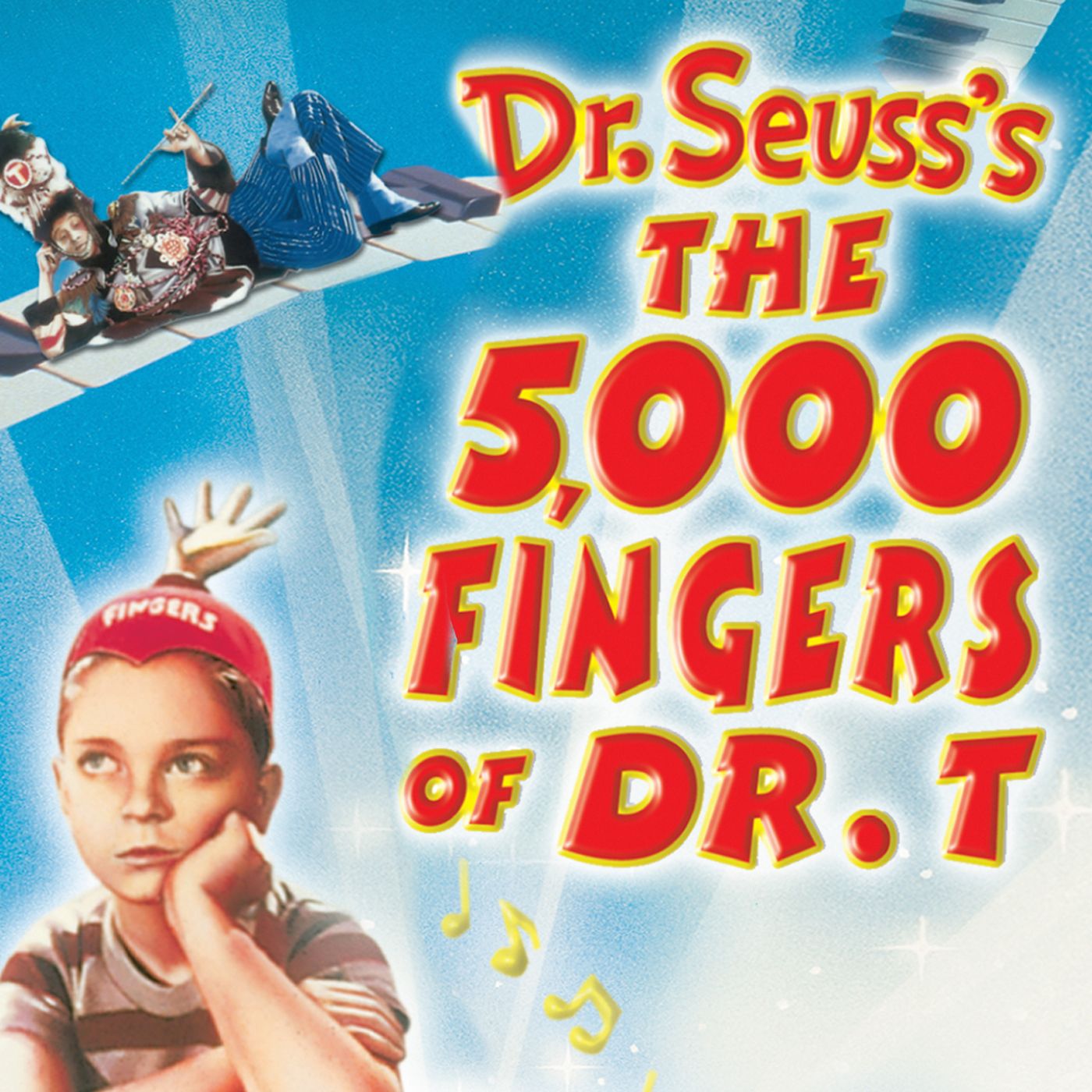
On this special episode, we’re diving into the curious 1953 fantasy The 5,000 Fingers of Dr. T. Produced by Stanley Kramer, directed by Roy Rowland, and uniquely penned by Dr. Seuss, the film stars Hans Conreid as Dr. Terwilliker, a sinister piano teacher who’s devised the “Terwilliker Method” for the obedient fingers of child pianists. Tommy Rettig plays Bartholomew Collins, an imaginative boy determined to derail Dr. T's grand plans. Join Mike, playwright David MacGregor, and critic John Monaghan as they delve into the film's quirky charms, elaborate set pieces, and iconic status.
Transcript
Automatically generated, so expect the odd misheard name.
Old you is, folks, It's show died. People say good money to see this movie. When they go out to a theater. They are cold sodas, hot popcorn in No monsters in the projection booths. Everyone for ten podcasting isn't boring.
Ut it off. It happens in an amazing castle with a ticklem to death torture chamber and a five hundred player piano with four hundred and eighty thousand keys. It's a musical Merry Garraus, sparkling with songs and dances, whirling you away to a new world of wonders. Have a smoke, have a cigar, don't mind if i'd. Something to eat something in degree.
Dr T is sweet on missus c. So is mister Z, the plumber who fixes sinks and knows all the angles. When the plumbers of Ladowski has installed the last sink, I want him to integrate Appam by apam. See the Dangerous Descent from the Sky Highlander. See the whammy duel between Dr T and mister Z.
See the eph Wonder of the Cinema World, The Startling Carrying wonder Ama in color by Technicolor. Welcome to the projection booth. I'm your host, Mike White jet me once again, is mister David McGregor happy to be here, also joining us for the first time as mister John Monaghan. Thanks for inviting me on this special episode. We are looking at the nineteen fifty three film The Five Thousand Fingers of Doctor T.
Produced by Stanley Kramer, directed by Roy Roland, and written by Doctor Seuss. The film stars Hans Conried as the titular Doctor T. That's short for Twillaker, as in the famous Twillaker method for happy fingers of child pianists everywhere. The film also stars Tommy Rettig as Bartholomew Collins, not Cubbins, an ungrateful little kid who wants to ruin Doctor T's grand plans. Damn that little pipsqueak.
We'll be talking about those plans and more as we discussed the film, So if you don't want anything ruined, turn off the podcast and come back after you've seen the film. You will be glad that you did so. David, when was the first time you remember seeing this film and what did you think? I cannot remember specifically when I saw this film. Obviously I didn't see when it came out, but I do remember vividly watching it with just this growing sense of disbelief.
It was unlike anything I'd seen before, and I didn't know where it was going to go next. I thought the imagery was fantastic. It was Hieronymous Bosh meets Salvador Bali meets Triumph of the Will, and I really enjoyed it. It's one of those films that when I saw it, I just I wanted to watch it again. In my film viewing experience, it was like Blade Runner or Pig in the City right up there at the top.
Yep and John, how about yourself, When was the first time you saw it and what did you think? Yeah, I can't remember exactly, but I knew I saw it as a kid. It was just one of those movies I stumbled on. I was a movie crazy since I was about age ten, and it just seems so different from other musicals or children's fantasies that I had seen, and it really spoke to me, just the weirdness of it. And I really liked Doctor Seuss at the time and still do.
And doing the research, I realized this comes out around the same time as probably my favorite Doctor Seuss book, which is grambled Egg super so I just think it has just the idea of a live action suits movie. We've had him since, but it was pretty much an oddity for about fifty years there. Or they made those god awful movies with Mike Myers and Jim Carrey. Yeah, those movies are pretty traumatizing, but this movie traumatized me. I didn't remember that I had seen it for a long time, and then I was watching it.
I think it was because David was writing a piece for me for Cashews to Cinema back in the old days, and as I was rewatching it, I was like, it came to the scene of the guy who's in the drum. I remembered that and I was just like, that's a horrible torture. And as soon as I saw that, I was like, oh, I've seen this movie. That was the moment, and it had just burned itself in my brain so much nothing else which is surprising, but that idea of a man being t inside of a drum that's being beaten forever and he will never be able to escape, that was pretty traumatic to me. And now watching it again, going to the MotorCity Cinema Society screening that was held recently, and being able to look at it and talk about it there.
Doing the research for this was just fascinating and just to see or to think about what this movie could have been. What's there now is pretty fantastic, but what could have been, Holy cow. So I'm excited to talk about that with you guys after we talk a little bit more about this fantastic movie. I think you're right, from a child's perspective, this could be a very traumatic watch. There was some really disturbing imagery in it.
And kids respond to movies much more primarily than adults. They don't just watch films, they live and breathe them. And you can fatigue my parenting skills. But when my son was little, he was watching Lasparatu in the Cabinet of Doctor and when he watched Alexander Nevsky he was dripping with sweat from re enacting the nights fighting on the ice scene. And when I.
Was a little kid, the two films that really freaked me out, one very cliche ish is The Flying Monkeys Wizard of Oz. That was terrifying. And then for some reason, I don't know how this happened, I had the TV on and the movie was House of Wax. We've been some price. In that scene where this woman starts beating on his face and his face breaks, I was like almost ill.
I was like bally, I couldn't believe what I was seeing. And I think this film has a lot of scenes like that as well that are very powerful, visceral scenes. What's funny about how kids respond might come back me up on this because I run films in a group called the Motor City Cinema Society. We show movies on Mondays and sixteen millimeter and there was one kid in the audience. His parents had broad me they probably liked this film, and Mike, you were sitting closer to him than I was, but he was I just wasn't having it.
What was the quote, do I have to watch any more of this? And I think he just says I don't want to see this anymore? And what has that impact on a lot of kids? My kids? I similarly, I showed him some pretty odd stuff as young kids, and yeah, they didn't respond to this certainly like I did.
And I found that with anybody I've recommended this movie too, either they really like it or they're like what. I think it's that kind of movie. I think it's polarizing. We've talked about these kind of traumatic kid movies before, like Secretive Nim or The Dark Crystal, where you're asking yourself who is this for? Because there's a lot of different things going on, and here you've got the whole story of little Bart, who I know, by the way, before this recording is over, I will probably call him Tommy or Timmy quite a few times, especially Timmy because he was the original as far as I know Timmy from lastly, so I might call him Timmy.
So please, I apologize if that happens. But a little Bart with his whole I don't want to play piano, and so you've got that angle for kids where it's just like, yeah, I understand this whole thing. You don't want to take these lessons, this is awful. You don't like your piano teacher. Your piano teacher has got your mother in his back pocket so much that it's almost like he's got her hypnotized.
You've got that whole story going on. But then there's everything with doctor Tuillaker and this whole World War two a parable that's happening at the same time, And so you're sitting here watching this going wait, who is this for and why is this movie so dark? And yeah, kids like darkness sometimes, I think. I know, I was a big fan of those aforementioned films, but yeah, this one, it just wasn't around that much. And so it is interesting how people connect with it or they don't.
Well, I think it harkens back a little bit to the original fairy tales of the Grim Brothers, that they're not nice, they are terrific, the horrific, and they involve evil witches, bring red hat shoes on their feet and dancing till they die, and cannibalism, which is that enjoy roasting small children and eating them. And those are fairy tales ostensibly for children, and this is ostensibly for children as well. But it has a really dark edge to it, as does the Doctor Seuss books. Right, there's a dark edge to a lot of those two. So it's not surprised he is such a hand in it.
And I know you've done a lot of research, Mike, I'd like to hear more what you found about exactly what his role was in this film, What was he what was his was he signing off on the designs on the film. Do you know much about that? I think he must have, because there's an early draft of the script where a few times in it he says or yeah, I imagine him, because he's the sole credited writer on the early draft from September twenty six, nineteen fifty one. When we saw your print of it, I swore that the Roman numerals at the beginnings in nineteen fifty two, but it's always credited as a nineteen fifty three film. I don't know if there was just a delay because of the re edit to it, but this revised second draft is what I'm referring to now, that has a few places where he says referred to sketch, and it feels like he probably storyboarded quite a few pieces of this or would draw out the designs because so much of the look of this movie, especially when you look at some of the paintings that they use in order to make the sets seem even bigger than they are, and there are some huge sets in here, but sometimes where they're using paintings to extend stuff, those designs, especially, I guess you would call them gargoyles.
Those things are right out of his drawings. He has such a distinct drawing style, and you just see that in all of the designs of these things. It really looks like he had a major hand in this. Of course, there are credited production designers set designs, but it feels like they were really going after his very particular style. Mm hm.
Can you mention you're in nineteen fifty three? When I think fifty three, I think three D, And whenever I watched Doctor T I always think, what just about a three D movie? Wouldn't it have been even better? Well? I think that particular year, nineteen fifty three part of the impact of this film, and partly because this bomb a big time it failed.
I don't know about you, John. There's a documentary on Robert Crumb just called Crumb, in which he talks about growing up in the nineteen fifties and talks about how safe and sanitized the culture was. And it was Pat Boone and Ozzie and Harriet and leave It to Beaver and coming out of World War two and the atomic bomb and the communist threat that Middle America wanted this incredibly safe and sanitized culture and it was only on the fringes that you had the beginning of Lenny Bruce and Clubs, or you had art of John Willie or Eric Stanton, and then you had this film that were clearly way out of bounds of the comfort level of Middle America at that time. So you're talking about three D and then we're also talking about a movie that is completely set inside of a child's imagination.
There's only two scenes in this movie that might not be him dreaming. I'm assuming that he's not dreaming in those two scenes. Otherwise everything's a dream. And that is so similar to another nineteen fifty three film, Robot Monster, that we just talked about on Sci Fi July, and that whole movie one three D. So yeah, it was definitely in the air, if not in the bubbles.
And then also this whole idea of it being a child's fantasy. And I know, even when we were talking about Robot Monster, people are comparing it to Invaders from Mars, and I think the opening shots of five thousand Fingers with the big ball that are the balls and the almost saucer shape and things, people are like, oh, that's very similar to Invaders from Ours as well. But yeah, it was fascinating to me that there are two I don't want to say that Robot Monster was a major film, but two very notable from nineteen fifty three that are all inside of this child's imagination, and everything is reinterpreting things from the real world quote unquote into his fantasy, even things like the pictures of his uncles that are on the piano, and that becomes a major part of the movie.
Yeah. I like that, And I don't know how you guys feel about framing stories when they're well done, like here Wizard of Oz candidate doctor Kylagari. I really like the efforts that are made to connect. The dream world with the real world. That the protagonist has just drifted out of.
I love the creativity involved in that, the connection between those completely seemingly disparate worlds, but there's these little tendrils of connection between them, and it's a filmmaker that's got to be a lot of fun to come up with those little hints and cues for the audience. It was interesting for me too to read this earlier draft of the script and see some of the things that are there, either in songs or they come up in dialogue, like at one point mister Zabladowski and we'll talk about him in just a second. But he starts talking about, oh yeah, I remember the Scout's Oath, and he starts to do the whole Scout's oath. That's interesting because that comes up in the next version of the script.
I think Alan Scott really deserves a lot of credit for probably shaping a lot of this stuff. But to have that be the oath that Bart has mister Zabladowski take and they have that whole blood pact, which is the one thing that comes out of the dream, that's one of the few times that I think And by the way, I just looked up Invaders from Mars also nineteen fifty three, So how strange is that. But to have like when Dorothy wakes up at the end, there's no remnants. She doesn't have the ruby slippers on anymore, she doesn't have the witch's broomstick or anything. So this is very odd that when he comes out of the dream world, it's like, how much of that was a dream?
Because they both have bandages on their fingers. Yeah, that's true for Dorothy. All the armhands surrounding the bed like she said, you were there, and you were there, that's the connection between Kansas and eyes. Yeah. Yeah, And here you've got mister Zawladowski and as well as his mom there and mister Williker, and then the uncles that we only see in those photos, we get to see them in real life.
So we should probably talk a little too. The beginning of this movie. The beginning of this movie actually was not supposed to be the beginning of this movie. The whole thing with the butterfly nets and these guys who are all dressed in green, and when you first see this Bart in his little beanie and he's creeping through this very surrealistic landscape, and there's a person on one of these big spheres that they have, and he has a spotlight on his head, like part of his head is a spotlight, and he's dressed all in green. I'm just like, this is almost like a prototype for the Grinch, with the way that all of these guys are dressed in pure green and the way they chase after him with these massive butterfly and that's all of different colors, very striking, and that whole part of this was actually supposed to be more in the film.
It was supposed to start in the real world, rather than starting with the dream sequence, coming out of it, and then going back into it. I'm not complaining about the way that they had that set up. I just thought it was interesting that they're like, no, we got to move this closer and we also, I believe that they reshot the opening to include doctor Tuillaker there because I think he shows up. If he just shows up in the dream world, is this guy even real? We see photos of him, but that's as close as we get other than they added that appearance of him at the beginning.
I'm sure you might. You're the maid, and you tell me because I've read that the original script was twelve hundred pages long, and as someone who's written a screenplay or too, it's okay, that's ten times longer than a screenplay. And I know original cut was ostensibly a little over two hours, and they hacked that down. But for twelve hundred pages, I can't imagine what they would have had in that. It seems very apocryphal.
Just me, Yeah, I don't know where you would have gone with that, because I didn't read a twelve hundred page draft. I'd probably still be reading that today if I had started that. But the one from fifty one is one hundred and eight pages. It's definitely a lot looser than the next script and then the eventual film. I want to say the next one was from nineteen fifty two, so with that one, it's a lot tighter.
He also has all the songs in there, so that starts to really firm up how things are. But yeah, I can't imagine a twelve hundred page age draft. And really, even when you add back in all the songs, I'm sure there's some dialogue around the song. So yeah, I guess a little over two hours does seem right, But it just seems like they would have not planned for it to be an epic at that time. It feels like a tight ninety is what they should have been aiming for in the first place.
So when I saw that, I thought, sometimes writers they go up. There's a story about Philip K. Dick having a what five second vision of God and sitting down and writing an eight thousand page book based on those five seconds, And so it's not beyond the realm of possibility when writers are incredibly inspired and they just go you never know, the first draft could be way way longer than it should be, but it just seemed a little excessive to me. Oh yeah, that second draft, revised final draft is this one credited to Alan Scott and doctor Seuss February twenty fifth, nineteen fifty two, so about what five months later, I guess that was. And yeah, this one is.
I think what they ended up shooting. You can see like things. It was interesting in the earlier draft, things like the line about the King of Persia. You know what he does, he stays in Persia, And in the earlier draft it's the King of Sweden doesn't step on my heels. He stays in Stockholm.
And I was like, oh, okay, I don't know why they felt that they needed to change Sweden to Persia, but okay whatever. I just was like, of all the changes, some of these are arbitrary. Yeah, but writers are arbitrary, Like that line, This sounds good. And I will say as an aside, that visuals story aside. I think there's just some great lines in this film.
And I when I first see him, when I heard him, I'm like, that's a good line and I wish I wrote that. Yeah, that's clever. I appreciate good dialogue. And there's some really terrific. What makes good dialogue to me is ay, it's human, but b it's perfect least suited for the occasion in this situation.
And it doesn't sound scripted. It sounds real. And I think there's a lot of instances in this film that you get to see that I wanted to talk a little bit about its. Origins and the whole Stanley Kramer thing behind it. It's like such an unusual film for him.
We think of him with those kind of message type movies that guess who's coming to dinner type stuff, and this is just such an odd picture for him. It's the same year he made The Wild One too, which isn't a real Stanley Kramer kind of movie. And I shared with you guys that picture that I swear I thought I had dreamed this picture. It's a picture of Marlon Brando with a couple of women wearing doctor T Beanie's with the little hands on top as across promotional photograph and it's one of my favorite pictures ever. But I only recently found it again online because it's just such an unusual pairing.
But yeah, Stanley Kramer was making a ton of movies back then. In a for Columbia, and again this is definitely one of the odder ones. And yeah, when I first saw the film, I not have associated it with Stanley Kramer at all, But subsequently, if you think about it, this is a message film Stanley Kramer. Yeah, you're absolutely right. Judgment in Nuremberg, Fascism, Ship of Fools, Kai Noon, the kinge Munity, et cetera.
There's a lot of message progressive thought in his pictures, and it's here because he is mocking as far as can be mocked, the whole pretense of leaders that dress up and the regular people that fall in line behind them, like August Sabladowski, and the whole the triumph of the will aspects of this film, with the scenery and the marching guards and the goose stepping, and he's making a mockery of it all and just showing you this is how ridiculous these clowns like Hitler, like Mussolini, this is how they look, This is who they really are. They're ridiculous clowns that we should laugh at. So in that sense it did fit in my view with Stanley Kramer. We've got a message film. I sometimes wonder if maybe this movie came out a little too late, because this was fifty two to fifty three or a few years north of v Day.
But yeah, the metaphor of Wartime and especially Hitler is just it does not take very much at all to find that, and in that earlier draft it's even more prominent. There are many times where Seuss calls to Willaker, Hitlaria, and then he even has Zabladowski, who for me, it feels almost like Zabladowski is America and he doesn't want to get involved, and there's this whole thing of just leave me alone. There's a song about I don't want to get involved. That's basically it. Twenty million billion years, this earth, it has revolved without my help.
So let it spin. I will not get involved. Let the darn things spin. Let the darn things spin. I will not get involved.
I'm an independent contract. Early in the film, he says, why did Hitler want to conquer the world? Hitler's racket And they talk about rackets and Terwillaker's racket. Hitler's racket was conquering countries to Willaker's racket is conquering fingers. Why I wouldn't know.
I'm no psychiatrist. I'm merely the neighborhood plumber, and yeah, you just like, yeah, whatever, I'm just here to put in the sinks. And as long as these sinks get put in, we'll get the AOK from the sanitation inspector and then he can start his camp. Basically, and this whole thing of and I think viewpointed this out originally to me, David, this thing of when all the little boys show up to the Happy Fingers Institute in order to play their piano. That scene is right out of like Shindler's List, This whole thing of these guards tearing open their suitcases and taking all their valuables out, and you know, these poor kids.
There's kids that are crying. There's that one incredibly unhappy kid that's at the piano and they just keep focusing on him towards the end of the film. That for me is just such a okay, all the buses are here, go in. It almost sounds like they're practically kidnapping these kids. In the earlier draft of the script, she does missus Talents does have a thing where she's talking to women on the phone, to other mothers on the phone.
I think that's still there in the final film where she's just like, you know, we're not having this, We're not having any of these no softballs, baseballs or hockey pucks, and it's just like, yeah, don't bring those things. Just these kids are here to do their thing. Work will set them free. I think zamb Ladowski as the plumber. I don't know if you guys have ever heard this.
And then there's we'll say it's a pack of for or whatever. Various people will say at various points that twenty percent of humanity are complete sociopaths that just want to destroy everything and everybody for their own profit, and twenty percent of humanity are the opposite of that. We're all together, they want to save the world, save each other. And then sixty percent of humanities in the middle, and their attitude is as long as it doesn't affect me, I don't give a rat sass either way. And that's August Abladowski.
He is disinterested until you can say that in this film, Bart needs August Abladowski to save him, but August Abladowski needs Bart to save him. And I like that kind of connectivity, that association between them. It's a very interesting film in the sense that there's all kinds of statistics about step parents versus biological parents and the damage that they can inflict on children. And that's why historically fairy tales it's evil stepfathers, evil stepmothers, and doctor to Willacker is the epitome of the potentially evil stepfather. And it's August Abladowski's job to become the good parent and save bart from this horrible fate of having an evil stepfather.
Even though he's pretty easily duped for the first time. It's a little bit of pickle juice, a little bit little bit of pickle juice, and he's good to go. Who hasn't been duped by pickle juice? Come on? And then his poor mother, who's I mentioned.
Oh, it's almost like he's got her hypnotized in the fantasy world. She's so hypnotized. And there's a whole song that it's not really a major song, but there's a little musical act in there where to Willacer is hypnotizing her that gets cut out, but we get the therem man in that. What I really like about this movie. And I don't even know if we've talked about the music that much, but the musical motifs that we have, especially with Terwilliker and the theorem man or or just that that, and sometimes it's a triple it at the end.
Sometimes it's not, but just okay, something's about to go down here with Trewillaker coming in, and I'm just like, then, who's she? Who? Did Hitler have buffaloed so much that everybody else was just like, can't you see what he's doing? That's the little kids and the adults in the audience, myself included, are just like, wake up, helloise, don't you see that He's got you under his power? And the I'm just like, what country was that?
Who was that? Britain? Was that Neville Chamberlain? I'm not sure what that is, but I'm just like, it really feels like there's a metaphor going out here. I think there definitely is.
It's the appeal of a cult hero, cult leader, cult bigger. And you might want to pretend otherwise, but. If you watch old movies of Hitler driving through the streets, the German people are hysterical with joy. They love that boy. He's their guy.
He may be a sociopathic piece of crap, but he's their sociopathic piece of crap and we love that. And yeah, people go along this mainly easily with evil as long as they think it's going to be directed as someone other than themselves. Or that they're going to get some money out of it, some pistolas out of it. San Ebadaski does put up a good fight, and he knows how to counter with the magic and the hypnotism when that dance they do. But then again he comes around to will O kers away and maybe he's hypnotized the bit by the beauty of Eloi's two.
But yeah, it is fun to watch his growth in the movie. For sure. She's the only female in the film. It's her, and that's an interesting call as a filmmaker, as a storyteller, I'm just going to have the one woman, easily swayed woman that will do what I tell her to do. Yeah, and that's why she's got to go on that lock me tight cage.
Yes. Once. Her dress is pretty schizophrenic that it's both a business dress and an evening dress all in one, depending on which shoulder you look at, which I thought was a pretty clever idea. Yeah, I like that. Yeah, when we meet her, she is missus cleaver.
I heels apron pearl earrings as all women wear normally every day around the house. She's the epitome of the domesticated nineteen fifties housewife. I mean in the real world party opening. Ye, Bart's father is obviously out of the picture. Are you guys thinking maybe World War two?
Maybe Korean War? But it definitely feels like he is obviously it's not a divorce. Feels like he died at some point. Yeah, this is early nineteen fifties and he's how olds the kid? Yeah it is.
It feels like about ten eight ten. Yeah, yeah, definitely, but you never hear just no dad. Yeah, this really becomes this edipal crisis for him, where he's just I need a new father figure. And I don't want it to be doctor Trewillaker. I want it to be August Zabladowski.
The whole thing where he pretends to fish and they have that wonderful bonding moment where they're both pretending to fish, and that Zabladowski has to be like, no, this is going too far. Next thing, I know you're going to be sick and get the sniffles, and I'm I have to take care of you, I don't want anything to do with this whole fatherhood thing and just wants to bow out. And that's yet another example of Zabladowski just flaking out. There are so many times where he's like, oh, I know the score, and then Bark comes in. He's just like my mother, she's hypnotized.
You have to go save her. And he goes up to basically to the tower of the castle to defeat the dragon, but the dragon defeats him, buffalo's him by offering him lit cigars on this almost like string slash candelabra that he pulls out, or he's got all the different drinks that they have, or the different food that he has. And I love how he like will hit a spot on the floor and this whole thing comes shooting up with all the different cakes. And of course the way that doctor Seuss writes this stuff, he really emphasizes the alliteration of things. But then he'll switch it and he'll go from all of these things say that start with the letter S, and then he'll just throw in something odd and then throw in something more odd than that.
Just with the way that he describes the drinks, with the way that he describes the food you. Make yourself comfortable, relax, have a smoke. Have a cigar. I don't mind if I do something to eat. Hotcakes, layer cakes, fish cakes, peanut brittle, the Little Plate special or chicken pot pie.
I don't mind if I do something to drink schnapps, sake, slip of its schepes, tequila tears, or just playing coco. I have no objection would wait for such a distinguished guest. The Pride of Our sellows vintage pickle Juice. And then there's two songs that really go all out when it comes to SEUs, because he starts to interject that nonsense language that only he can do so well. My favorite Sous book growing up was on Beyond Zebra, which is all of the letters that are past z in the alphabet, and he exposes what those are plus what they stand for.
So Z for zebra, then this letter stands for this animal, and it'll give this whole history. The word that always comes back to me is snood. Like he uses snood in this movie. He uses snood in his books, and it's just what is a snood? It's a maguffin that has no meaning, but he sure does use it.
A lot. Yeah, I really appreciate his use of language. When I started reading more literature than actor Zeus, I realized he was in the vein of Charles Dickens. In terms of character names, Ebenezer, Scrooge, the Grinch. They have such great names for their characters, really inventive names that are obviously so well suited and so popular that they have lapsed into common vernacular.
Now you know what a Scrooge is, you know what a Grinch is. They just made those up. I think that's really compelling evidence of just how creative these guys were. And I want to talk about the acting too. We've talked a little bit about some of the characters, but the actors that are actually portraying these folks.
So you've got Zawladowski and Collins, Missus Collins that is played by Peter Lynd Hayes and Mary Healy, who I didn't know. I must have not. Been paying attention during the nineteen thirties, forties and fifties to know that they were an act that they played I think at the Kopa for a while or one of the Vegas casinos. They were in movies together, they sang together, they both have very good voices. Surprisingly, so when they start belting out stuff, Oh who's singing this?
It's actually them. They have a whole series of records and all this. They wrote a autobiography together, but unfortunately, I think the cheapest I could find it was like forty five dollars, and I really could not bring myself to justify that. I wish there was a cheaper version of that available. I'd like to read them.
But at the same time, I saw an interview with Hayes and Healey. They're both getting up there. He's got a full head of white hair. She's still looking pretty darn young. But he's like when she's very entertaining and people keep asking her questions, especially the host of this program, and after a while, Hayes is just he starts acting up like a child, and it's just here, the attention needs to be on me, so let me do something silly or start to sing song or do an impersonation.
And it's while you're watching him and you're just like, he's being brat, a seventy year old brat. But at the same time, it's like, oh, okay, I can see why this guy was pretty popular because he is very quick witted even at that age, and is able to just rattle off these stories and belt out a song like nobody's business. Yeah, they had genuine chemistry in the picture. I love their scenes together. You can tell they're really comfortable around each other.
You make a good point. They're largely forgotten now. Most people have never heard of Mary Heally and Peter Pays. But they were like the perfect American couple. They were a real life couple.
She was missed New Orleans. He served in the US Army, in the Air Force, I should say World War Two. They were married for fifty eight years. They adopted two children. They were on Broadway.
I think they had two separate TV shows that were just about them. One in nineteen fifty one nineteen sixty. They were a singing team. They were like America's perfect coup. They don't show up much and just pop culture doesn't seem these days, they would just be seen as like ridiculously clean cut, too good to be.
True, almost, But yeah, they had one show was The Peter and Mary Show in nineteen fifty and then they had Peter Loves Mary in nineteen sixty and yeah, that's not going to fly today. Everything's ironic, everything sucks, So it doesn't really fit in with our current sensibility at all. But they were a big deal in their era, radio, Broadway film, They covered the spectrum. They were trans media phenomenon before that term even existed. Tommy Reddick, of course, had a career.
You already mentioned Lassi, But he's in a favorite cell noir, you know, he's in the window just short of this, you know where he's another kid that sees something that nobody will believe. The adults don't believe. So it's a cool companion piece. That is very frustrating for me, that trope of the kids that aren't believed. That's why I quit watching or reading the Lemony Snicket books, because it's just guys.
They are telling you what's going on with this Jim Carrey boy, another Jim Carrey reference, Jim Carrey character. Why aren't you listening to them? This whole movie could have been over in five minutes if you just listened to the kids. And I do like when Zabladowski's I'm going to listen to everything that you say now, even your lies. Like my second or third favorite line, I think my first one is when Bart plainted.
To the begst of Zabladowski. You're my only hope, Zabladowski says, I'll just give up hope right here, and then me. That's cold, baby, That. Is cold from the respective father figure. Yeah, it's just tangential.
But you guys might remember this. It was a TV show called Quincy starring Jack Klugman and my mom, God Rest her soul, would watch that and it was the same story. Every week, something really bizarre happened, inexplicable. Quincy would say, I think it's this. Everybody'd be going no.
And in the end, oh my gosh, look at that. Quincy was right. And next week, gosh, it was the same thing. And she loved that show. God bless Jack Klugman too.
But oh my god, that we don't believe the person telling the truth trope. I just I'm not a fan. I'm just not a fan. It's almost the opposite, because he's not a kid. He's definitely upper in age.
You don't believe them anymore, and you believe kids. It's empowering, though, isn't it for Bart to be right through the whole thing? He sees through Twillicker right away, he says he'd a racketeer before it, but even meet something. Yeah, and when we finally do get to see Twillicker in the dream world and you get that great low angle shot of him on that piano, just so many wonderful shots of Hans Conried, and Hans Conried. I cannot say enough good things about him.
I've gone and you know, John, you and I thought a few weeks ago and I had already started to deep dive on Conried. I've gone farther than that. I've watched even more of his stuff where he shows up, you know, a few seconds here and there, like he's the magician who gets shot in Journey into Fear, or he's one of Dobie Gillis's professors, actually a pretty important professor, which is great in the affairs of Adobie Gillis. Which was I want to say that was nineteen fifty three, which was like a huge year for Hans Conried because he had affairs Adobe Gillis. He was find a couple of shorts and everything.
Five thousand Fingers of Doctor t is one of two starring roles. The other leading role that he has was the exact same year, which was the Twinkie, which I don't know if you guys have ever seen the Twonky, but it is oh pretty remarkable though reading I was reading a biography of Hans Conried, and sounds like arch Obler just was not directing that the way that he should have. He was not bringing his actors in and letting them know that it was comedy. We're just pretty bad. Yeah, I thought it was a great film, even though it sounds like it didn't come together as well as they wanted it to.
But I thought it was fantastic. And then, of course he was Captain Hook and Mister Darling and Peter Pan that same year, and I wish that they had the footage because they would have him in costume. They had almost all the characters in costume acting things out, like we've seen footage of I can't remember the actress's name who was in Alice in Wonderland and we've seen her being animated over kind of thing. They had all that for Captain Hook and Peter Pan as well, and I've seen images of him dressed in as Captain Hook costume. Gosh, I wish I could see what that would have looked like, him just pretending to be hooked before they animated him.
I wonder if he thought of this film as being anything special in his career, because it is to me, it's a right moment. I think he was hoping this would launch him off into greater projects, but the act that it bombed so badly. I think at one point he compared it to There was a nineteen fifties film called Wilson. It was a biography of Woodrow Wilson Noble, which did not do well at the box office. Between that and this film, he pretty much was reduced to supporting or character roles.
But he had actually met Zeus like six years earlier. He provided the narration for a film called Design for Debt. It was a documentary. In fact, it won the Academy Award for Best Documentary Feature in nineteen forty seven or forty eight. It used confiscated Japanese films and Henri Hans Conried was one of the narrators in the film, and that's his first association with Zeus.
Do you think this. Film would have maybe done better with a different director who had more of a noticeable style. Because Roy Rowland, who had made some really good films, he didn't really have his own kind of voice as a director, as a workman, liked the directory direct He one of my favorite film wires called ninety nine River Street, and he directed Our Vines Have Tender Grapes. This really surprisingly great performance by really soft performance by Regie Robinson. It's always odd when I see him attached to this picture.
I've read that he was basically tired because he'd done well with the Kid movies and there was some issue the studio had an issue with Creamer directing the film himself. But I've also heard that Creamer did direct a lot of the scenes himself, and that Rowland had some kind of issue or had to step away from the set for a period of time, and that Kreamer took over. The extent to which that's true. Or verifiable, I don't It's such a busy time in Kreamer's life. He's making three or four films as a producer.
I think that year alone pretty crazy. But I didn't realize he had such a strong feeling for this particular project. That's really interesting. Yeah, he definitely did. I know that he and Zoos were both unhappy with it.
They blamed studio meddling and whatnot is typically the case. So they weren't happy with the final result. But he was all in initially, same as Zeus. They were fully committed to this and it just didn't turn out the way they wanted. And obviously when it premiered.
I don't know if you've read Hans Conried's comments about the premiere, he literally said, maybe he's exaggerating. By the end of the film, only one little boy was left in the theater and he waited for his mother to come pick him up. That's a grim way to open it. It reminds me of I like reading reviews of premieres of film and how people reacted, and it was a lot like one of the reviews for a Raserhead that people could not start leaving the theater fast enough, like ten minutes into the film. This had similar kind of reviews for the premiere.
So Cormbia pretty much gave up on this picture, even though they tried to re release it as under the title Crazy Music in a second release. Do you have a handle on how that all went? Town? Now, all I know is this was famous and typical, not typical. I think that's one of the things I love about culture is that the way time can have such a redemptive role in making us.
We look at things that when they came out they were completely dismissed. And that goes for this film. It goes for films like Blade Runner, it goes for novels like Moby Dick, and novels like Kate Chopin's The Awakening that they were just no, this is crap, get it out of my sight. But then seventy years later people are like, Wow, this is pretty great, this is really cool. Yeah, I guess we should be clear.
It's not just the three of us that really love this picture got some pretty high profile health fans. I've been hearing about attempts to make a Broadway musical out of this thing for the last at least twenty years. That cracked me up when I was watching those extras the Indicator Blu ray of this. By the way, for folks at home, if you enjoy this movie, it's a great transfer, and the extras on it are great. I was so shocked when Michael Feinstein shows up and I'm just like, what, He's a huge fan of the movie and he shows up in one little documentary.
I was like, Oh, that's pretty cool. And then he shows up in another one that's just dedicated to the music, and he just walks us through that, and of course I can't stop thinking of the gammera versus gear on episode of Mystery Science Theater three thousand where Mike Nelson was playing Michael Feinstein and talking about the incredible intricacies of the Gamera theme song, which I just absolutely love. But there he is just Oh yeah, I've been trying to get this staged. I found the original score. I've been trying to get somebody to play the ballet that happens in the middle of this, the one down in the Dungeon, because I swear there are like three ballets that are mentioned.
There's the Butterfly Ballet, which is the guys with the butterfly nets. There's the Dungeon Ballet. And then I want to say, no, I might be wrong here. There's supposed to be it might be an operetta. But a little song in there about Missus Collins massaging doctor Tuillaker's arm.
There's like a whole song written around that, which is wild. His baton arm is crucial. Well, he's got he's got a scabbard for his Baton. I love that, but I love that little detail well. And this was the last time that Doctor Seuss allowed a live action movie to be made out of his stuff until I think he was already dead by the time The Grinch and the Cat and the Hat came out in two thousand and two thousand and three, and then after that is a state.
It might have been his daughter. I'm not sure who Audrey Giesel. She's yeah, that's it. No more live action. So that's why everything since then has been all animated or computer animated type stuff like The Loraxe and this subsequent like prequels to How the Grinch Stole Christmas and It's Oh okay.
I guess those were just too much for people. I think that some people really like How the Grinch Stole Christmas. I'm not one of them, but I have yet to and I'm sure this will get some people to comment on this episode. I have yet to meet anybody that likes the Cat in the Hat movie, except for maybe Mike Myers himself. I don't know anybody, and I will really admit I'm completely tainted by the cartoon version of The Grinch and anytime you got boris Karloff and I'm that's it.
We're done to stop right there. Oh and Chuck Jones's animation style plays with Doctor Seuss's style, so wow, really yeah, it's all the ending. Who was it, John, Because before you showed five thousand Things of Doctor t you showed Jerald mcboying Boying, which I think won an oscar that in fifty three or fifty two. Yeah exactly, that's that upa cartoon their based arm Seuss. And yeah, that's pretty astounding.
That captures the whole SU's thing. I think even better than in those cartoons that we saw the Cat and the Hat, those ones that were made I think in the sixties or early seventies mm hmm. And I didn't realize how crazy popular Gerald Mcboingboing was. He had a whole show that I saw in one of Doctor Seuss's biographies, they reproduced Gerald mcboying boy meets mister Magoo. I was like, really, that's a pretty amazing pairing.
He probably doesn't even know that kid is around, and he's just freaking them out with all those sound effects. Yeah exactly, he was. He's assigned a babysit, And we showed that actually in the cartoon festival last year at the Redford, there was a hoot. But I love those old upa cartoons, those ultra modern shoes that also collaborated on the Warner Brothers cartoon one of the Horton I forget which ones in the forties. Plus he did those Snap Foo cartoons during the World War two.
And boy, we even unearthed at another animation festival some advertising he was doing for the car companies and for oil companies with all sorts of sus type preachers in it. So what a career. And this comes out. It appears like when he is before he's a household name, before he's I think this is four years before Kat and the Hack comes out. So he's just doing all sorts of things, even all sorts of types of entertainments back in the early nineteen fifties.
So I was watching Jeopardy. It was the Jeopardy Invitational tournament repeats that they're doing right now, and one of the clues was to complete the line quick henry the blank and I was like, oh, the flit. And I only knew about that because doctor Seuss in his advertising career, created this flitt. Is a pesticide, Yeah, bug killer, and it was like, oh yeah, that became like a popular catchphrase of the day. So I was like, oh yeah, it's the flit and then Ken Jennings, of course nobody got it, and Ken Jennings was just like, there's a lot of cranky octagenarians right now, and I was like, fuck you, Ken Jennings.
I thought you were going to tell me that there was a Jeopardy question about doctor T. And that would have blown my mind because where does it show up in pop culture? Is it in the Simpsons, Simpsoms, shit reference everything? Have they gotten to the round of doctor T? I wonder if Bart was named after berth al Mwcubbins sometimes because yeah, he's not Cubbins in this he's Bartholomew Collins, but Bart barth Oulemew Cubbins was a pretty popular Doctor SEUs character.
I read one of those in prep for this called what was it Berthelamew Cubbins and the it wasn't oohs, but basically it was oohz. It's this king who gets tired of it always being rain or snow or sleet that's coming down, so he wants something new to come from the sky. So he hires all of these magicians and they he's a king, of course he's got magicians in this court, and they create this stuff that was basically green gow that falls from the sky and it's really super sticky. It's like green glue comes down and it won't go away, and it's sinking the whole thing. It's Bart can't raise the alarm because whenever he goes to somebody and they're supposed to call out, the goop will get in their mouth and they can't breathe them Again.
I'm like, wow, that's really dark. It just goes through all of this where he's trying to save stuff until the king. He finally makes the king say that he's sorry and that he was wrong, and that dissolves to goop right away. Oh okay, but yeah, Bart Collins Bart Cubbins right there, and yeah. I don't know if Bart Simpson was named after him or not, but I know that there are definitely if you go in the Connections tab on IMDb, there's tons of Oh, they're watching it in a Pineapple Express or something.
Okay, I didn't know that, Oh this film they're watching, Yeah, because it just doesn't seem to show up that much, and it just seems like still a well kept secret, and that's what makes it, I think, even more special. Even among cult films. It hows few people still know about this. It shows up sometimes, like there's a Monkey's episode where Davy Jones just happens to be randomly wearing one of the doctor Tuillaker hats with the hands on. It must have just been a prop hanging around at Colombia the time when they're making the shout.
So it shows up sometimes, but I just feel like it's still the secret. Sippardy did make a reference to it back in season thirty three in the category movie numbers, so there was a five thousand fingers question. Wow, I wonder if anybody got it. And then we should mention for your adoring viewers that if your interest is peaked by our fascinating discussion, you can find this film in its entirety just on YouTube. And the same goes for Gerald mcbeinwin, which is I think seven or eight minutes.
Just look on YouTube. Everything's there, Fire. It up, check it out. I can't believe we've talked this long without talking about the Domino Duds number, which should be more famous than it is because it's just brilliant. These songs are so hetchy.
I had the Happy Finger song stuck in my head all day today. Yesterday I had the Domy Does song and I'm trying to oh. Then even this morning I was singing the Dungeons song as well. But yeah, Domy Do Duds. And that's unfortunately.
That's one thing that gets taken out of this version that we see too. There's a song where doctor to Willaker is singing about his favorite notes. Some people love fa, some people love so and all this, but his favorite note is me and so it's this whole me is my favorite thing. So that plays really well into the domy Do song too. Holy cow, don't me fa faw faw faw.
Sun folcusing foies and all the sweet dear fall. They say, coy baby. You are that. I know. How much prefer.
Good old go. Why not? Still I've heard them say, your. Finest note of all is. It's not for me?
I disagree for me. There is once persion note I love it ringing in my food. Of all the wondrous notes, that are my very favorite note, by far, my favorite favorite note. Ha ha ha ha. He's not going, he's not glossy.
My favorite notul is me me Me my favorite. Song to give your you know, listeners a thrill if you're wondering about the song. It includes lyrics like come and dress me in my pekaboo blouse with the lovely inner lining made of chestat peak mouse, I want my polka dotted dickey with the crinoline fringe for I'm going Domey doing and a Domey dough Binge. Doesn't get any better than that, does it. When he's there in his what is a green T shirt and purple short, looks like he's dressed for being the joker in that color combination.
When they put on his lavender spats, which lavender's always been coded as very gay, and this does show up in certain gay movies of the fifties books. But he Conrie does this little thing where he's checking himself out in the mirror and he moves his feet around to show himself his spats, And it's just little moments like that where I'm like, oh my god, that is so nice. Just little things. Even when he's having that hypnotism fight with Zabladowski and you see He's in the background and Zabladowski is there and I actually, I take that back. I'm thinking of the get together.
Whether when Zabladowski is dancing with Hallowe's Collins, with Missus Collins and to Willaker's in the back. I cannot take my eyes off of Hans Conrie because he's doing all of these little things, this face where it's just oh, this is okay, Wait a second, he's dancing too closer. I need to get in there, and you read all of this stuff on his face and I'm just like, this guy is amazing. I love him. Yeah, he's terrific.
And when he's finally all the way dressed, he is like a nightmare version of Heinrich Himmler meets Liberachi. It is a wonderful and appalling at the same time. I want to talk about Judson and Whitney, the two twins, and we talked a little bit about how this is metaphor for World War Two and these Judson and Whitney characters. They have a whole song to themselves, which unfortunately gets cut out. If you watch the movie knowing that things have been removed, you'll see some occasional weird cuts like one of the first times that we see these two guys.
To describe these to the audience, it's two middle aged, slash older gentlemen who wear these like bowler hats. They're on roller skate and they have one tremendously long beard that goes from Judson to Whitney and Whitney back to Judson, connected by a terrible Siamese beard. As the lyrics to their solo song go, which is unfortunately we don't get that song. We get a little piece, very little piece, right before we see them skate side by side down this long hallway. These guys are amazing roller skaters, and there's a little musical motif for them, which is that it's yes, we are the Guards, and that will play anytime that they show up, and you just get a little slice of that before you see them take off, and it's, oh, that was their whole song.
And then John, you even have a still of Judson and Whitney at these tiny little pianos, and you see these pianos in the movie in front of I guess it's the corridor to their domain or something, and they had a whole song that they were doing that these little pianos with the long beard in between. And the reason why I keep focusing on this beard is and I believe again, David, you brought this up all those years ago when you were writing your piece, that this was a common thing for Seuss to do. He had we didn't mention that he also did a comic strip called hegh Eji from nineteen thirty five. He had two billy goats in there that had a shared beard. But what really got me was his political cartoons.
And he has one that is a person in a suit and it says Nazi Germany on it. He's got a long beard, and that's going all the way to another person who has America First, because that was Charles Limberg's whole political movement, the America First movement, which oddly it feels like I've heard that again recently. I'm not sure how that comes about, but this whole thing. He hated Limberg, and he knew that Lindberg was a Nazi sympathizer. So this cartoon of America First and Germany sharing the same beard, and I'm like, I think that's what Judson and Whitney are showing, this alliance type of thing.
The Nazi Party had a big conference or celebration in Carnegie Hall in the nineteen thirties. Many Americans were fully on board with fascism, disturbingly so, and that hasn't changed quite Frankly, I don't think anybody has ever seen anything like what happened the other night at Madison Square Garden. The love, the love, the love in that room. It was breathtaking and you could have filled it many, many times with the people that were unable to get in. Maybe it's just me, but one of the things I like about Judson and Whitney is it it throws me back every time I see them to the art and the work of Edward Lear, just the absurdity of it and the visual of it and the playfulness of it, and it's just so creatively done.
And the two brothers that play the twins, they're just magnificent. They are tremendous roller skaters. They've got no lines, but they are, you know, for me, one of the iconic images that appears in this film, and. I love that they're killed by cutting their beard apart, and then you get that great moment of Conriid. The famous Shakespearean actor Hans Conriid right, A last, Poor Judson, I'll last, Poor Whitney.
And even the way they died, the way they spin a top of the top stopping you can join twins them apart they die. Yeah. I love the use of the thereman in this film. I love theremon in general. If you're unfamiliar with the term.
It's that creepy sci fi a wailing sound that's there on the Day the Earth Stood Still. It's there in The Lost Weekend and Spellbound, and they make really or maybe a little bit in the Beach Boys good vibrations. Although that's technically an electrotherremon, it's just used so effectively and it just creates such a mood all by itself when you hear that sound. So it's mostly associated with his hypnotizing of eloise, right, isn't that kind of almost exclusively used in those scenes. It announces him a few times when he walks on screen you hear them noise of the therem Man.
What a great invention. Obviously, you can be appalled by humanity every minute of every day, but once in a while, it's like someone comes up with something like an instrument you don't actually touch and it's just super cool and wonderful and it makes your man. That's I'm glad, I'm a human being. That's an amazing invention this movie. If he makes me feel that same way, such a special self.
And we got to talk about the Dungeon ballet scene because that's one of the soussiest things in that whole all those crazy instruments and costs, and it's dark and it's surprising. And one thing that I talked to Mica about this, I can never really spot George shakiras in there, but I know he's one of the dancers. Maybe not credited, but it's well known that this is one of the movies where he was doing his time before West Side Story. I had a chance to interview him last year when he came to the Red Shirt with West Side Story. He has no recollection of anything related to Doctor t He was like, yeah, I was just like our Tuesday, So it was totally unmemorable.
But to me, it's such a highlight of the film. I love the way it ends, I love all the different instruments. It's just full of wacky ideas, like one hundred the ideas and one musical number. The guy who has to put on the pince nez in order to read the sheet music and then uses a gun to shoot a target in order to make a note. Or the guy who's on the swing who swings all the way across the screen and the camera has to follow him across, and that's after several other movements of quorns and all this, and he swings across and just hits a little and then he does it again.
I'm like, oh my, oh. The guy who's wearing the football helmet with antlers that have bells on them and he gets choked, gets choked in order to play his instrument. Is how yes? And who knows? Why?
Why don't kids love this movie? It's right. You get those guys with the color multi colored gloves that are playing that major marimba that they have. Everything's out of proportion, that huge harp and everything. And I mentioned a huge drum that the guy's in.
And I want to talk about the dungeon guy who I mentioned. Hegi the comic strip and he's a recycle of a character named Strogo from that those Strogo in this is that I believe he's the guy with the hearing aid who's also great, but the guy who runs the elevator looks like this character Strogo, who was able to walk up and down walls, which was neat. But this guy, only black actor in the entire movie, doesn't even get to wear a shirt. He's all greased up and he built like a brickshit house, which is great, But then he's wearing this crazy hat that it almost looks like he has a triangle for a head. The way that this is, and these eyes sticking out of this mask, or the eyes are the only thing that are exposed, it is a nightmare.
And then to hear him sing this song about all the floors of tortures that doctor to Williker has, it's amazing. And you taught me something I didn't know that there's a miss if you listen to the song, there's a missing floor in there, right, So they cut a line, and what was in that line? In that line, it is a discussion. So each floor has this whole thing of oh, jewelry department. So we've got ankle chains and wrist chains and these chains and those chains, and yeah, the missing verse talks about household appliances and there's against chamber mention in there.
Just like, oh, as if we couldn't layer on this Hitler thing even more that he's talking about. Here on the third floor, we have gas chambers. You know, a movie for their kids. Yeah, oh yeah, mister Bungle does a cover of that in their live shows. I can't find a really good version or else I would end the episode with mister Bungle doing that song.
But I was just like, that seems very appropriate. It feels like Mike Patton would probably be a very big fan of this movie. But you talked about the World War two like and analogies, but like the whole atomic thing, which help me out with this because it always seems like just thrown in there. It's atomic when they're making their concoction. But how are we supposed to feel about the basically an atomic bomb going up to the end of the film.
Is it just silliness or is that saying something? At that point in American history, the Soviets, thanks to a spy, had copied the Eroshima bomb, and they had the atomic bomb, and it is a genuine fear. You guys have seen the They seem ridiculous to us now, But little kids hiding under their desks, duck in cover and atomic bomb drills were a very real part of little kids going to school. If people were too terrified, you got this mushroom clouded death hanging over your head. As the Cold War escalated, so it shows up just everywhere.
Even at the end of this movie, I want to talk about how resourceful fits Bart is with all the contents of his pockets. It's sort of the funniest bits, like how much stuff he's got spocket to make his concoction. He's got Batman's utility belt, everything you could possibly want, And you know what, it's obviously it's ridiculous, but I love it because it's just the absurdity of a little kid who's going to have all manner of crapp and garbage and nonsense in his pockets and he can pull anything out. And then they mix it up and it starts to small. It's just it's ridiculous, but I love the ridiculousness of it.
Now, I think this might have worked a little bit better that earlier draft, the fifty one draft. When so to tie the dream to the real world, what happens is that Zabladowski isn't that great of a plumber, and their boiler blows up, so the explosion of the music fix is tied to the explosion of this boiler. Conveniently, now this is actually way better than the real movie. Conveniently, it destroys the piano, and Zabladowski talks Hellowies into not replacing the piano. They go off on the town.
Little Bart goes out does his thing to Willaker's defeat it because he's not going to take the piano anymore. And that's the one thing about the movie itself now as it stands, and even the uncut version that was released or shown in some of these test greetings to Willaker is not defeated to. Willaker is probably going to be by the next day with his happy fingers. There's nothing like Bart. Yes, he might have a different stepfather now, but he's still stop playing the piano.
Oh, Mike, Mike, Mike, No, Mike, listen. August is going to give Hallowise a. Ride into town. It's over and Bart. It's like this iconic ending.
He's out running down a tree line suburban street with his dog and his baseball, Mit and his baseball. It is a happy ending. Trust me, August and Halloweense will come back and that's the end of. Tow Willaker right now, But what does happen to Twillaker? He's swarded with this big premiere, but he's still there, right he does.
It's not like the Wicked Witch. Those little kids drag him away, helping to tear him apart. That's what I'm thinking, is I think, just rip him from limb to limb. But I'm not sure who could kill a child all of a sudden in this It's pretty disturbing the way that they carry him off. I have to ask you, guys, and you can strip straighten me out.
Did you guys read Maybe it's just anecdotal that they had all these kids whatever, They had three four hundred kids at the studio, and all the kids stuff themselves silly on hot dogs at the commissary, and they came back to shoot the scene and one kid started puking, and that all the other kids started puking as well. I read that both in Stanley Kramer's autobiography All Right. He tells the first part of it where he says that there were it sounded almost like food trucks, But commissary probably makes more sense, where they just stuffed themselves full of hot dogs. And then doctor Seuss himself finishes the story. And I read the quote in one of his biographies, which was and then these kids started throwing up.
And once one kid started throwing up, another and another, and it turns to that scene from Stand by Me. I would they'd film that? Yeah, it sounds like doctor Sus himself did not have a good time on this film. And yeah, he was so disappointed because this was such a this is Doctor SEUs. You see Doctor Seuss in every frame of this.
Film, absolutely, and I think that's part of the magic of it. It's that's what I love so much about the first time I saw it is I have not seen this in terms of a story, nor have I seen it in terms of set design, and it popped off by Hans Conried's performance. It was just refreshing and different and new and unexpected. And I guess those are qualities that I appreciated about it a great deal. Yeah, I really take a fence to so many reviews and summaries of the film that call it like just a fascinating disaster.
I think it really works and if you look too deep at it, you can seats a lot of the cracks. Wow. To me, it just it works all over the place, and I don't want to make apologies for it. I think it's just a brilliant film as it stands, even with those cuts. Yeah, even with the cuts, there are still enough there that you get so much of this, even without seeing Zabladowski doing more of the hypnotism.
You understand that he's sypmatizing the mother, and you get those little looks that he'll do, and she'll straighten up and fly right after he shoots her looks, she'll suddenly drop that happiness that she has and just becomes this automaton. I found that the remake of this didn't work nearly as well. I like JK. Simmons a lot, but I think that changing this from piano to the drums and making that movie Whiplash just didn't work nearly as well. Yeah, he didn't make the Dometo duds part of greatly.
Oh man, I did make that connection there, it is. Yeah, that's good. Another thing I'd like about this movie is it doesn't even make any attempt to offer socializing messages for children like so many cartoons, especially Disney cartoons. If you watch snow White, Beware of Strangers. Washer he is before you eat, say your prayers, before you go to bed, and this bed doesn't even bother.
It's not trying to socialize kids at all, and that's nice. Let the kids be kids. Yeah, it wasn't really selling piano lessons very well with it. Oh it was. No, it's quite the opposite that song that Little Bart sings about hey were kids quit picking on us?
Some of the lyrics of that are a little clunky with that. Just because you can grow a beard doesn't mean that you're that cool kind. Of but. I appreciate that. He's just hey, man, quit picking on kids, Like we've got feelings too.
Luckily, it's not like when was the kid power movement? Was that more like nineties early two thousands, where every cartoon which is like, yeah, kids are doing it for themselves, get out of here with that noise. I don't need any of that stuff. Well, like every little kid. I tried, there's Mother's Day, there's Father's Day.
I tried to run that past my parents. What about a Kid's Day? Kids Day? Now, get back in your dungeon. That's right, David, you said you showed this movie to your kids, because again I didn't have much of My kids were really into it.
Did you show this to your kids? Yeah? Oh, I showed her to my daughter, My poor daughter, who I love so much. She came home one day from school and said, wait, she's in junior high. The kids are talking about this really weird movie.
They saw it, and she said, I was trying to think of if I've ever seen a weird movie. And I said, I. Got a movie you can watch. You want to watch it? She goes, yeah, So I showed her a racer Head.
She went to the next school the next day bully armed. Oh, you guys want to talk about a weird movie. So I don't think I showed her this, but I showed it to my son. He didn't like as much as he likes the fighty stuff. He'd like Alexander.
And that blows my mind. They were showing kids that that's crazy great. I took my son, at age thirteen, to a midnight screening at the main of eraser Head, and yeah, my kids says that this. So that was a real major moment and growing up. I don't know if that's good or bad, but definitely a movie had an impact in it.
That definitely worked, and that's not so much five thousand fingers, but definitely a racer. The beautiful thing about kids, and I recommend this to any listeners out there, is two three four year olds. You can show them silent movies, you can show them Charlie Chaplin, you can show them Buster Keaton. They're cartoons and they love them. There's a Chaplin film called One Am.
The whole film is just Chaplain coming home drunk and trying to navigate his way through his house. I showed that to my son, he's four. He was in hysterics because it was so funny, and it's just it's a live action cartoon pretty much. Yeah, the kids were. Wean my kids ween Don Buster Keaton, and a good gateway movie for kids I always found was Singing in the Rain.
It's just because that's another live action cartoon. Yeah. Absolutely, Plus it's got some history in it. But we digress. We're getting off the Five Pus and Bingers.
A doctor t the greatest movie at the fifties. I would not be surprised if George Lucas and Stephen Spielberg saw this movie because there's a lot of times you mentioned you're my only hope. I was just like, oh, that sounds like a familiar line. There's also when it comes to Spielberg, there's a lot of Indiana Jones, like Art popping up in the porthole like Indy on the boat, or you've got him almost not being able to make it underneath this door. I'm surprised he didn't drop his little beanie hat and grab that.
You know, that's right. It feels like there's one other Oh I know. It's when Art is being chased and he goes up and up and up and up that ladder and then jumps off at the end. I was just like, oh, that kind of reminds me of Luke in Best Bin when he's running away from Darth Vader and takes that gigantic clunge. But Luke didn't have a fantastically large shirt that he was able to pull out and make a parachute out of it.
But again, I love that. What little kid has not tried to jump off a garage roof with an umbrella, Oh yeah, and float gent into the ground. But just the imagination of it, and this is how a little kid's mind works, and it's there in film and it's magical. Doctor Zeus's ability to tap into the psyche of a little kid remained undiminished, and let's I find that really admirable. It was built as the wonder.
Musical of the Future, for what it's worth, but I don't think that really captured the essence of what this film was about. Yeah, they didn't really know how to market this thing, that's for sure. The poster is I don't know, it doesn't really It's always been on my wallle It's like one of two posters, but it just it doesn't really capture it. They did try to release this again in nineteen fifty eight, called Crazy Music, and I think it did just as dismally in the second release as it did the first. I don't know if they didn't know what to do with it.
I don't think, yeah, how do you market this? I mean, now you would have played up the su seed miss of it. It would have been like a Doctor Seuss book cover if I was designing the poster for this. But it's again, looking back at it, it was the wrong film in the wrong place at the wrong time, and it needed a. Little bit of stewing, a little bit of marinating where people could appreciate its qualities.
It's inventiveness, it's creativity. I'd love just little stuff like you gotta suck down some pickle juice to get your courage up. That's beautiful. It doesn't get any better than that, at least for me, in terms of creativity, and not just copying, because so many films, as you guys know, are their remakes of their adaptations or we'll just do this again. This stands out on its own as you had never anything like this, And I think that's it, both its strength and its weakness in terms of its popularity.
So I think it's going to be a musical someday, don't you. There are out of ideas so much they're going to finally turn to doctor t and make a musical out of it, don't you. Maybe not in our lifetimes, but can you picture this on Broadway? So I haven't There are so many odd musicals out there. As I'm doing research for this show, it's like and they turned it into a musical, I'm like, what, like, oh yeah, Forbidden Planet, Return to Forbidden Planet, the jukebox musical that premiered in England in the nineteen eighties, or whatever, Like, what are you talking about that can't be a musical of Carrie Get Out of Here?
Nope, sure is. Yeah, there's going to be a musical breaking bad as it. And speaking of someone that works in theater, I'm fed up with musicals. I like plays that tell stories and have characters. I will recommen and to I recommended the Indicator disc.
Yes you can find this on YouTube, and yes you can even find it at archive dot org. But I'll say that the soundtrack, there's a three disc soundtrack out there for this from film Score Monthly. It is amazing because it is all of the incidental music, plus the songs that we've talked about through this whole thing, all the songs that we're familiar with. Plus it's all of these songs that were cut out. And not only do they have the whole movie basically start to finish, but then they on the third disc of this, they have what they call musical or composer sketches.
So it's all what was the name of the gentleman that did this, Frederick Hollander. It was all his early versions of this, and they seem so completely thought out. And when you get to the things like even the Happy Fingers song. It is so different, but it's a complete song and it's amazing to hear where his mind was going with this stuff. And we should probably say too.
Frederick Calander very well respected composer, and most people I think would know that he wrote falling in Love Again, the song that was made famous by Marlena Dietrich, the song from the Blue Angel So be sorry to record it, but there was visualist to go with them. They had actually filmed the sequences, but those have been lost the time. But we still have the music game, we. Still have the music. And yeah, that's unfortunately, as far as I know, no one has ever turned up the actual footage of these songs.
And yeah, it sounds like they are lost of time, which is very unfortunate because everything is there. I love the person that went out and they have on YouTube the Dungeon song and it's all live action, and they just stick in a still of that nightmarish elevator operator and they played the third verse of it and then they go back back into the video and let the song finish out. I'm like, thank you for doing that. I wish that they could do that for this whole movie. Do that A Star is Born, the Judy Garland version where it's all the still images, or our friend Roger Ryan from Lavonia.
I believe in what he did with Magnificent Amberson's where it's like, here's a still image, here's what's going on. Here's some of the music that you might have heard. Maybe we have the dialogue from the script and we'll act that out. I was like, that's great, and I wish they would do something like that for this. Until we can get that footage of that will ever turn.
Up beas Manja a Bond. I want to thank my co host David and John for joining me to discuss this fantastic movie. Until we speak again, gentlemen, David, what have you been up to, sir? I am currently educating the masses at Wayne State University in Detroit. I've got plays being produced in Golden Colorado, weis Baden, Germany, and Dover, Delaware.
Later this year. And John, how about yourself? Well, I can't compete with that. I'm working a lot with the Redford Theater. As you come to so many of our streetings, thank you so much, and we show these.
I'm most excited about the little Film program that we started next to the Redford in a little storefront. We're in a fifty seat theater. We show sixteen millimeters prints of some pretty oddball stuff, including Doctor t I'm also teaching again at College for Creative Studies. I teach a class in the history of Animation. So after thirty years a teach in high school English, they drag me back in and I'm going to start teaching that class again next week at CCS.
Yeah, we should probably say that the fall schedule is up at Motorcitycinema dot Org. Some real good stuff coming up. I'm hoping to make it to at least as many as I possibly can, but things like Back to School, I know where I'm going, Bucket of Blood, Coal Miner's Daughter. This is a super incredibly eclectic mix of films, and I am there for and stuff that we've covered on the show, like Scarecrow, and then just so many good movies, and I'm super excited for all of the October stuff with so many good horror films. Yeah, Evil Dad, which of course premiered at the Redford.
We're excited to bring that back. But you already did an episode on Scarecrow before you did five thousand fingers of Doctor Tea. I know it's weird, right. Congratulations on your anniversary too, six hundred episodes right, seven hundred, baby, I'm sorry it's short changed you. It's okay, keep it up.
You're doing great and thanks for having me on. Well. Thank you so much folks for being on the show. Thanks to everybody for listening. If you want to hear more of me shooting off my mouth, check out some of the other shows that I work on.
They are all available at weirdingwamedia dot com. Thanks especially to our Patreon community. If you want to join the community, visit patreon dot com slash Projection Booth. Every donation we get helps the Projection Booth take over the world. We are guards are terribly terrun.
Do terrible Twitter. We're a terrible. Tiumpies here, Oh we are. We're roughly You could not call a friend one sium. Each where it's just in need.
We happy that way since the early, Yes, early Yes, he's your beers. So that is the unfortune of trend. Sire. He speakers with. The twins, went on you jail.
We are actor where the curry lequers land. We need to make sure, and the boys will not get. Out of time. Don't try to get pressure in no land, in no language, and or if we'll get shot by the being of the twin twins, siam mes, people, we're not terrible. Ten on each a.
Come on and dress me, dress me, Dress me in my finest arraye because just in case you haven't heard today's. Doormat all day, dress me in my silver daughters. Dress me in my diamond studs because. I'm going don't be doing in my dome meadow duds. And i want my undulating undies.
With the marrable frills. I want my beautiful. Bolero with the porcupine quills. I want my purple nylondurle where the orange. Blossom buds because I'm going don't be doing in my dome meadow duds.
And then. Come on and dress me, dress me, Dress me in my pinka boo blouse with the lovely interlining made of chestapeat mouse. I want my polka dotted dickie. With the criminal and fringe. Or I'm going don't be doing on a door meadow binge.
I want my lavender spats, and in addition to them, I want my honey colored gossip with the herring bone hem. I want my softest little jacket made of watermelon swede and my long persimmon placket with the platinumbraid. I want my leg of mutton sleeves, and in addition to those, I want my cutey chammy booties with the leopard skin bowls. I want my pink brocaded bodies with the fluffy, fuzzy roughs and my gorgeous bright blue bloomers with the monkey feather cuffs. I want my organdy snood and in addition to that, I want my chiff on mother Hubbard line with Hudson Bay rat.
Dress me up from top to bottom, Dress me up from tip to tap. Dress me up in silk and spinach for two days. Dormy dough, Domy. Doll day, Domy doll day. So calm and dress me in the blossoms.
Of a million pink trees. Come on and dress me up in liver mass and come on, bet cheese, Come on and. Dress me up in pratzel. Dress me up in both the A sns. Causing small.
Moby done. He's going hold they don't
More from The Projection Booth



Similar episodes across the network
Matched by shared keywords.
-
Warrior Women & RJ Stewart: Xena and Gabrielle's Impact on 90s TV
1 shared keyword: cult classic
-
Episode 13: Three Amigos (1986)
1 shared keyword: cult classic
-
Bless The Beasts & Children
1 shared keyword: stanley kramer