
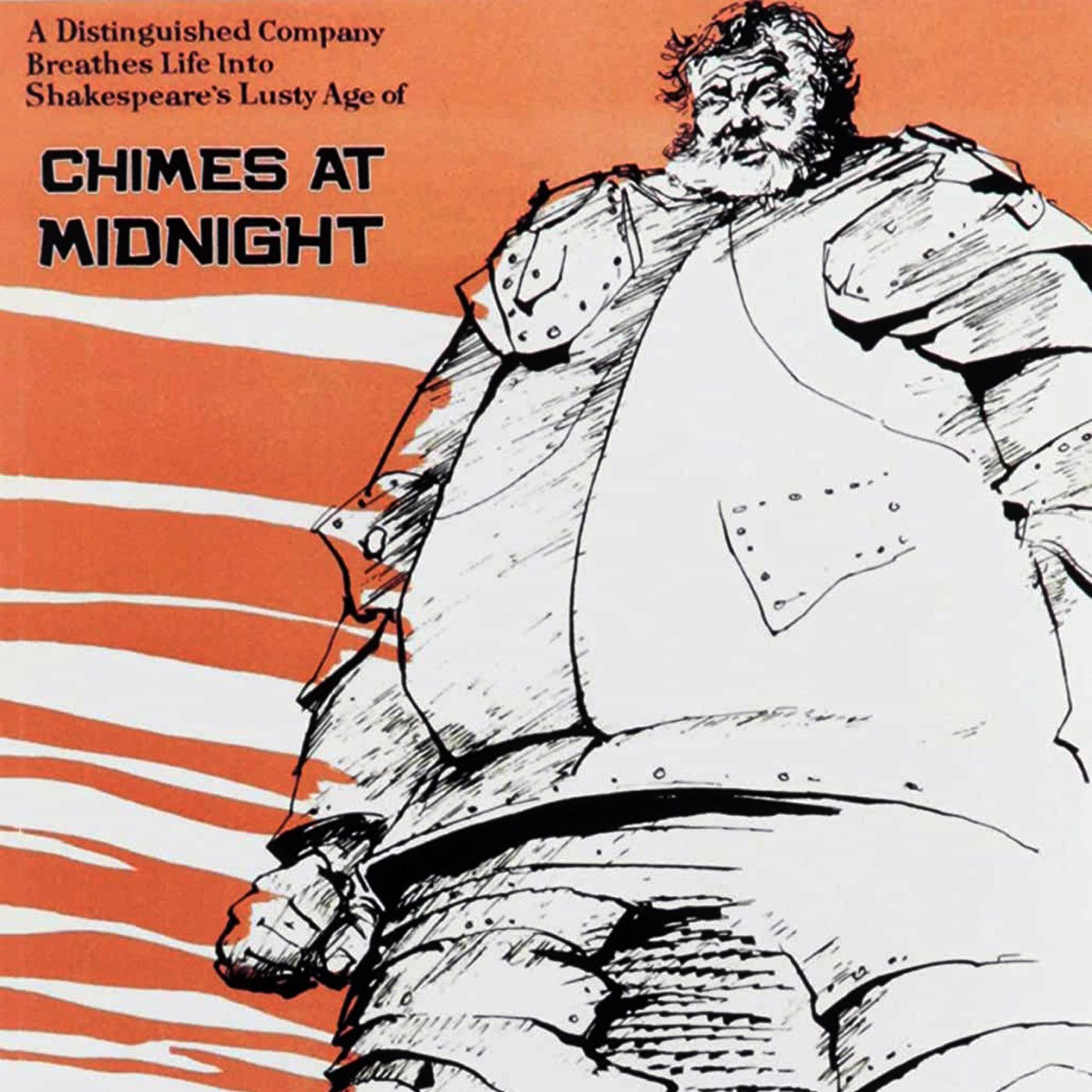
About this episode
Mike talks with Spencer Parsons and David MacGregor about the film's three-decade gestation across stage and screen, the filmmaking ingenuity behind its legendary Battle of Shrewsbury sequence, the autobiographical dimensions of Welles's performance, and why Chimes at Midnight now stands for many critics as the greatest Shakespeare film ever made.
Transcript
Automatically generated, so expect the odd misheard name.
The Projection Booth podcast is sponsored by Scarecrow Video. Try out scarecrows rent by mail service, Choose from over one hundred and fifty thousand films and give Blu rays, four k's and DVDs delivered directly to your door. Visit scarecrow dot com today. Oh geez, folks, it's showtime. People say good money to see this movie.
When they go out to a theater. They want cold sodas, hot popcorn, and no monsters in the projection Booth. Everyone for tend podcasting isn't boring? Cut it off? Where is the Prince of Waves?
We do not know. The monster taverns, but there they say, he daily does frequent with unrestrained, loose companions. Our bastard side. Of the case, that villainous, abominable misleader of youth. Sweet Jack Foster Kai Jack, faster true Jack, faster Jack Falster.
Thou art going to the wars, And whether I shall ever see you again or not, there's nobody cares. We have deceived our trust, made us off our easy robes of peace to crush our old limbs and ungentle steel. And if we live, we live to tread on kings. If I brave death, my Princess Douglas, I speak to me, my mom. Welcome to the Projection booth.
I'm your host. Mike White joined me once again as mister Spencer Parsons. Fuck Bosley Crowther also. Back in the booth as mister David McGregor. Lovely to be here.
Thank you. We continue a month of looking at films from the nineteen sixties, where they look at Orson Welles's nineteen sixty six film Chimes at Midnight, also known as False Staff. It's a mashup of sorts of five Shakespeare plays into one story and was something Wells had been toying with since his very early days. It tells the story of Prince Halson of Henry the Fourth and his friendship with the larger than life Sir John Falstaff, also played by Wells. We will be spoiling this sixty year old film as we move forward, so if you don't want anything ruined, please turn off the podcast and come back after you've seen it.
We will still be here. So, Spencer, when was the first time you saw Chimes at Midnight And what did you think? My first time seeing it was luckily on the big screen, I had been trying to seek it out on video for quite some time, and in fact had watched a little part of it on a bootleg VHS that I rented in Austin, Texas sometime in like nineteen ninety eight, and it was just so hard to watch, you know. It was like a dub of a dub and I couldn't do it. So then I waited many years.
I did try. I wasn't only waiting. I did try to see it. This is a film that was for a long time just like really hard to track down. And then there was the restoration of it that hit theaters several years ago before the Criterion release, and I saw it in a theater for the first time all the way through, and ultimately there was a feeling of it once where's this film been all my life?
And chiding myself for not tracking it down sooner. But on the other hand, to see it on a big screen for the first time, it was so incredible that it was like, oh no, this was worth waiting for. And I saw it three times that week at the music Box while it was playing, saw it a second time because I was like, I want to commit this to memory. I probably will be coming out on video soon, but I really I loved it so much. And then the third time was to drag a friend along to go see it with me, to just confirm my feelings about it.
And then as soon as it came out on the Criterion just came out. That was like one of those pre orders. Snapped it up immediately. And at home, I don't always watch it all the way through. Often my home viewing is in pieces where it's like I want to reference something again, but home is so distracting for me that I tend to view in little chunks.
So that's been my relationship to it over the last couple of years. Last night was the first time in a while that I watched the whole thing again all the way through. But I've now seen it several times and it's probably my favorite of the fiction narrative Wells films at this point. That's a bold statement, I. Guess it is, but I don't know.
I think I share that opinion with a number of people. I think I'm far from the only one. David, how about yourself? When did you first see them? One?
You think I couldn't put a year on it, but it was in the nineteen nineties on the VHS, and there was such a kind of hullblue about it in film circles because so you can't see it, it's been missing or lost or this mythology had arisen around it. So I got to see this and I did and I thought, wow, this this could be something once it gets into post production, because it was not good. Print quality was bad, the sound was terrible, and you could see even if you didn't know it was an Orson and Wells film, or the fact that he was in it, just the way it shot, it's like, that's an Orson and Wells film. But I was very, very underwhelmed. But then when Criterion came out, I think that was in twenty sixteen, I picked that up and that was like almost watching a different film, and yeah, this is really good and you can see why people think so highly of it.
So first impression not so great, but that was because of the poor quality of the print. And after that, yeah, it's a remarkable film, a remarkable film. So this was totally new for me. I had never watched it until this episode. I don't know why I hadn't tracked it down.
I think it might have been because of that. When they announced, like, oh, here's this restored thing, I'm always just like, Okay, is this the definitive one? Or will we get another one in six months kind of thing? Or I was just talking about Megalopolis before this, and it's like, Okay, now there's Megalopolis Unbound, which will eventually come out. What is that going to be?
Like? I just never decided that I needed to see this until this year talking about it now, and I'm so glad that I did. I'm glad that I didn't see that version, that earlier version that you're talking about, David, and also Spencer, the muddy VHS kind of stuff. What we even get now with this restored version. At times it's rough, it's a little rougher on the edges, but you definitely see what he was going for, and man, there's some great, great stuff happening in this.
The dubbing at times is a little distracting for me. Master Swallow, I think, or just a Swallow especially, is very grating for me when I watched this movie, and his voice just really grinds my gears. Jesus, the days that we see I said, Job said, I will. We have heard the chimes at midnight, Master Robert Shallow. That we have that we have, that we have in face said job we have.
And for whatever reason, Jean Moreau's voice sounds a lot like Eliza Doolittle once she speaks, and I'm just like, who was the actress that did Eliza Doolittle? I was like, are you idiot? It's Audrey Hepburn. But it's a different person singing. It's not a different person speaking.
And it was like, sounds a lot like Eliza to me, Oh, Captain, all that kind of stuff. What an amazing thing. And I knew that, having read about Wells, I knew what a passion project this was for him, going all the way back to when he was you have so young, nineteen thirties, fifteen years old. He's putting on a three and a half hour combination of these plays called The War the Roses plays called The Winter of Our Discontent. Nine years later, the Mercury Theater is doing it with Burgess Meredith as Prince hal They had music from Aaron Copeland and it was what five and a half hours putting this together.
And he tells a story in one of the extras. It's from I think what merv Griffin or something where he's, oh, yeah, we had this rotating stage and that really wasn't working, and blah blah blah. It just took so many iterations for it to come to this, and I think each time he was doing this he was perfecting it. So now at almost two hours, very solid story. I would never know, because I'm not that familiar with a lot of these plays.
I would never have known that this was more than one thing combined because he does it so seamlessly. The character of false Staff I think appears in five of shakespeare plays. He realized how much people loved that character when he started out False Staffs based on a real guy, and the problem he had was the real guy was a remarkable person. He's a guy named John Oldcastle. He's a buddy of Henry the fifth and fights battles with him and their their pals and chums.
But John Oldcastle he what was known as a lollard before Martin Luther and the Protestant Reformation, there was movements in that direction in England, and that's heresy. So he got convicted of heresy and he was hoping maybe his buddy would bail him out. But that wasn't going to happen. He was going to be burned to the stake. So he escaped the Tower of London, and then he turned on the king and he wanted to foment revolution.
So now he's a heretic and a trader. And he hid in Wales for about four years. And when they finally caught him, they back in those days, they couldn't figure out, we want to kill you in so many ways, and it's a little unclear that they hung him. They burned him alive. He was drawn and quartered.
But when Shakespeare put that in the original play, one of John Oldcastle's descendants, who I think was a censor for Elizabeth the First, said, we're not doing that. Figure out a different name for this guy, because that is not my ancestor. The real guy was amazing, but certainly not the false Staff as depicted in Shakespeare's plays. Yeah, because the false Staff here in this film is gregarious, larger than life, but also at the same time just a real slacker, just enjoys drinking, enjoys women. He is all of the earthy qualities of life.
And I love We've talked about this so many times when we talk about Wells, just the duality of so many things. And in this movie you've got Prince Hal in the middle, and then you've got Falstaff, his friend, who is this really good and bad influence at the same time on Prince Hal. And then you've got his father, Henry the Fourth played by John Gilgod and just the stark difference. He is so about the politics, he is so about keeping his power, he is so cold, and just like the difference even between the castle that Henry the Fourth lives in the cold austere. You can see the breath coming out of him when he's talking at times, those long banners that they have that makes everything look so tall and gaunt, and even just Guilgood himself compared with the roundness of Wells and the earthiness of the tavern that he holds cord in, and just how much of a stark difference there is between these two things, And how to me is taking the best of both worlds.
And he even says, very close to the beginning of the movie. So when this loose behavior, I throw off and pay the debt, I never promise it. My reformation, glittering on my fault shall show more goodly and attract more eye than that's which have no foil to set it off. I also a fan to make offensive skill. The deeming time when men think least I.
Will eventually I'm going to have to reject you. Is pretty outright when he says, at some point, I'm going to cast off all of this stuff that I'm doing with you, and I'm going to assume this throne and it's going to be a whole different thing. And I like that he puts that out there because it's it's basically a ticking clock that they put in this movie where it's at some point Hal's going to betray you. And just this idea of betrayal, especially amongst friends, is such a thing that Wells would talk about a lot in his films. And then this idea of father figures we think about like Citizen Kane even and just the different father figures, like the Thatcher character and just how he's rejected, and also the friendship between Jedediah and Kin and how that goes back and forth.
He definitely has his themes and they play out so well with this film. I would weave into those themes something that runs throughout for Wells. Additionally, which is obviously related to those but authority. It synthesizes a lot of the notions of authority that run through Amberson's sid and Kane, obviously the Trial War, the World's for that matter, Wells's desire in his storytelling to undermine authority, and also in this one especially, I guess very much like Touch of Evil to play the problem with authority as a problem of betrayal, that the authority figures betray the purpose of their own authority at some point, and that that that we have hal At once betraying Falstaff. But this is this is also a larger betrayal of the people.
I think in the way that this works, I don't think that's necessarily Shakespeare's point, because Shakespeare is building up to Henry the Fifth, which is providing a very different kind of picture of authority that has a lot to do with hal being both of the people and of royalty, and that that's part of what makes him such a good leader in Henry the Fifth. But this we're cutting off before that point, and so the. Betrayal of Falstaff is also a kind of betrayal of the people that that hal has been coming from throughout the narrative, and and that that threat that he's eventually going to cast all this off. It's not just Falstaff, he he's casting off the common people. Within Wells's version.
Of the story Shakespeare, he's deeply, deeply concerned the historical ramifications of what he's positing in his place because he's writing for a tutor, queen Queen Elizabeth. I. So the Henry plays there in large part to justify the reign of the Tutors. Now Wells, obviously he doesn't have to care about that at all. That gets dropped the political implications, and he focuses more on the triumvirate of Henry the Fourth and Falstaff and Prince Hell and focuses on their personal stories.
Henry the Fourth, the Gail Good character, did pretty much say straight up in this film. He murdered, who is it Richard the Second at this point, I don't know. I don't have the mnemonic device of all the kings. Willie, Willie, Harry, Stee, Harry, Dick, John, Harry three one two three neds, Richard two, Harry's four or five six? Then who Edward's four or five?
Dick the bad Harry's two ned six, The lad Mary, Bessie, James, you Ken, then Charlie, Charlie James again, Will and Mary Anna, Gloria, George's four, Will four, Victoria, Edward's seven next, and then came George the fifth in nineteen ten, Ned the eighth soon abdicated, then George six was coronated, after which Elizabeth then Charlie three since Lizzie's death. Yeah, so he murders the previous king. There are two sons that the previous king had who are then the rightful heirs to this. But he's just so I have the power now, and you guys can basically just fuck off. And so the Percys and this movie become the bad guys, but they're the most ambiguous bad guys that there are.
Oh. Absolutely, Yeah, I feel for Hotspur. I feel free Percy. Yeah, I am totally team Hotspur in this movie. And his death is really wonderfully disturbing.
This is one of the things about the movie that actually means more to me every time that I see it. The first time I saw it, I was struck by how sympathetic Hotspur was and that was something that really hit me. But in this most recent viewing, the. Key turn for how is in killing Hotspur, how he kills Hotspur, and how Falstaff misreads the room at that moment, and it's the essential pivot and Hotspur's death not only is it really staged beautifully first as a fight and then as a soliloquy that How gives over his boy, but that moment, this is one of Welles's big tools throughout the movie. There we cut to a sudden and very eruptive kind of close up of Hotspur's face as he's saying his last words, which are that he's gonna be food for worms, and he doesn't quite finish it, so that Hal finishes worms for him.
But it's this. Eruptive close up that that really stops everything cold. And then, oh man, that performance Norman Roadway. The performance in that moment one of my all time favorite death scenes, I have to say, not just because the context within this movie, but boy, such beautiful subtlety. And it relates to one of one of Wells's big things where he said that, like what you are seeing in film acting is a person thinking, and I'm.
On seeing somebody think through their moment of death. That's that is like one of the things that's going on here and thinking up until the moment where it's like the light goes out. And I cannot believe this performance. It's very very short, it's just the length of this one close up, but it is for me. It's so affecting, really one of the all time great deaths.
And yeah, then it's the pivot of the whole thing. It's the pivot of the tragedy of Falstaff. This is Wells breaking a big Aristotle rule. This is a tragedy about a common person, which doesn't exist in tragedy for Shakespeare. But Wells is putting a common person at the center and creating a tragedy for him.
This is the key moment where Falstaff makes a mistake. Pal is headed in this direction. But I think it's a mistake that helps, ultimately within this movie to give that sense of leading to Falstaff's death, to his broken heart. And so it's an incredible moment. And yeah, Hotspur is a great character in this movie.
It's that very often that you see a character die of a broken heart. Between that and then you know all the weight and everything, I'm sure that Falstaff wasn't in the best health, is doctor. No matter what we could come in with the cold and his doctor and be like, you need to lose some weight, that'll help cure your common cold. I've been there, I've been there, orson. I love that the idea of him being this common person that does die of this broken heart, that he is at the center of this tragedy even though he is not a prince, he is not a king, and we are talking about the nature of this politics throughout so much of this, but really he is just such the heart of this film.
I had to say that Keith Baxter does an incredible job as Prince Hal and he is on even ground when it comes to working with Wells, who just he could just chew up this entire movie if Wells wanted to, because he is literally a larger than life presence. He gets some of those great close ups. I love the beginning of this film when they start in that field, the white field, and I love how important snow is to Wells as well. But Falstaff and Shallow walking through that field and coming closer and closer, and you start to see them, and then at one point they sit down and Wells is right there in that massive close up, and I just love seeing that the wear on his face. We've seen young Orson Wells, we've watched him grow up through films, and now to see those kind of crows feed at his eyes and of course I'm sure some of this is makeup, but at the same time it looks fucking fantastic.
I would say, of name great Hollywood actors and stars, he just has presence. It's there partly in his later years due to his size, but it's also his voice. And obviously at this a certain point Orson Wells became a character that Orson Wells was playing, and you certainly see that if you've seen any of the interviews with him, and he has a ball and he just makes shit up left and right. He doesn't care what's true, what's not true, is it a good story? And so that performative side of him is really embraced and celebrated in this film the way that he characterizes false Staff, who is again an entertainer.
He wants to make people happy, and that's what Orson Wells wants to and the film is Susan Kane. The character Kine at one point says, I think it will be fun to run a newspaper, and from then on you realize. For Orson Wells, I think it will be fun to make a movie, and that joyousness comes through despite all the hardships and the difficulties he had with funding, that essential joy of creating something comes. Through for him. It became almost a sickness when Wells started off as a child.
Obviously acting appealed to him very early on. Writing was there, the stage was there, the radio was there. But then once he gets out to Hollywood and makes Kin, I don't think he could do anything else. It feels. Yes.
Of course he was working on other projects here and there, but for the most part they all had to do visual entertainment, and just that became his life's work. I don't think he was happy unless he was making a movie or talking about making a movie. And this is such pure movie. That's one of the things about all of his Shakespeare's are very cinematic, and quite frankly, much more cinematic than a lot of the other Shakespeare adaptations at the time. An obvious thing I think to compare Chimes at Midnight with is is the Henry the Fifth by Olivier and also Olivier's Richard.
Iid his Hamlet as well, those movies have movie cameras and stuff, but on a certain level they really remained a kind of filmed theater. And in Welles's conception over Othello and Macbeth as well, which are highly cinematic, but cinematic in some different ways that like again I think, really synthesize in Chimes at Midnight. There is a real purity to a cinematic approach to the material of how we cut from one scene to another. That is not simply going from one scene to another in adapting the play, which has its own scene breaks and connections between them, but really thinking about the cinematic qualities of the imagery and the line that you leave on and the line that you pick up with, and the kind of lightning fast transitions of cutting.
And it's not like it turns this into a big cross cut kind of thing. But the editing in this movie is really profound and works in concert with the moving camera, not simply to create, for instance, like beautiful long takes where everybody can act and act and act, and this movie has some really remarkable long takes, but it also then has like remarkable beautiful fast cutting in which the cuts are eruptions and comments upon the previous stuff that the editing is really propelling things forward. And this is an extremely fast approach to the material. A lot of the time it does slow down. But one of the things that I just can't get over is how fast this is.
And it isn't just that Wells went for fast talking dialogue. It's that the camera moves with the characters. The characters move quickly, and we then cut quickly when we need to in order to keep up with them. So the camera follows in a really intense way, and the cutting is there, and so ultimately this is a very purely cinematic approach to the material, with lots of attention to contrast visual contrasts of the castle versus the inn, and the way that people are shot in the castle versus the inn, and the way that the castle is shot in a way that is extremely abstract. So they're shooting in a real castle, but Wells is choosing angles in a way of working with that castle, not to use its realism.
He's using its shapes and. Its graphic quality and creating, you know, like beautiful lighting. They create shafts of light across the space. But it's one of the things about the use of the Castle is it's almost abstracted at times to the level of Derek Jarmon's Edward the Second, which is obviously in a black void with a stage set that is extremely artificial, or moments it looks again like I'm going to go to Derek Jarmon, but as a production designer the Castle and the Devils, which is a very abstracted idea of a castle to put across a particular idea, and the end, while it doesn't have a lot of decoration and furniture and whatnot, it has a character as an actual real place, and the angles that Wells favors when we're in that place following the action are very much at the eye level of characters, whereas in the Castle we get mostly low angles but also high angles looking down upon the action that are really suggesting these power relationships and then also abstracting the power relationships and abstracting the space itself to emphasize lines more than stones and grit, and that in cutting between these two places we get a very you could get similar kinds of effects on stage, but a very direct cinematic kind of effect when you can cut from one location to another and use angles and framings and lights in each one very differently to create radically different feelings about you know, who is here and what is going on.
Yeah, the one really big thing for the tavern for me is just how low the ceilings are. Prince Hal pretty early on and he's in the basement of the tavern with all the wine barrels and he has to hunch over. Beatrice Wells is there and she's just a little girl at the time, playing a little boy, and she is able to stand fully upright, no problem, but Hal's hunched over. Then you get to the main floor of the tavern and you can just reach out, like barely over your head and touch the rafters. It is very enclosed.
And then yeah, you get inside of the castle and everything seems like you're dwarfed by the architecture. And I love that there's one shot where they come out Pal and Falstaff come out of the inn and you see the castle in the background and you see the kind of the stone shapes going along the sides of the castle and they're almost mocked by this. The shapes of the fence that's outside of the boars Had tavern where they all have these little points the fencing does, and it's this is my castle, Falstaff's castle versus Henry the forest castle versus the royal castle, and which one would you rather be at? How I know which one I'd rather be at? Well, I think from even Citizen Kane.
One of the most remarkable things about that when people saw it was Jesus an awful lot of ceilings. I'm not used to I'm not used to seeing ceilings and films. And there's a practical reason for it, because that's where you have lights and microphones. But he liked that look, and he clearly especially and the boars had been he brought that back, that kind of low ceiling, and it magnifies the characters within that particular space. So the fact that he came back to that we add one thing really quickly.
Just because I'm a playwright who's not dead yet and I've adapted some of my plays into the films. That's one of the things that really interests me when I watch films like this. It's a play, but how do we reimagine it as a film, and how do we keep to the story and the characters, But how can we best exploit the ctic cinematic possibilities here, and this film does a great great job of it. Shakespeare gives you a lot of possibilities because nowadays when people they see a play and they're like, oh, let's make it into a movie because it's a play and it takes place in one room, and then there's how do we make it interesting visually. In terms of that, this I would say of any of the Shakespeare based films I've seen, it makes the most of the cinematic possibility these.
It really does, and on a really low budget. So it's interesting too because some of the strategies that he uses are thematic, like the low angles in the castle versus the eye level angles in the wars head tavern. But then this pays off for him on the battlefield where he can create shots that are low angle where he only needs a couple of people and some of those spears in the background and some smoke in order to create a continuity with the material that also has lots of extras. So there's like a beautiful practicality that also goes in with keeping it really cinematic and your point. Early on you talked a little bit about some of the rough edges of this film, But I will take the rough edges of Chimes at Midnight to the perfections.
Of a whole pile of other movies. The rough edges here are wielded in ways that are for me so much more full and imaginative and like part of a coherent vision than a lot of other movies that like use their money to create a smooth and hygienic tone and surface. This also is great in terms of the tone, because these are taken from the history plays, which have different kinds of tonal variations than like the tragedies of the comedies, for instance. But in taking from all these different plays, we get some really radical shifts in the tone, especially early on, that are actually setting us up really nicely for the final I don't know if Shakespeare has five acts, and I'm used to thinking in three act structure, but the I guess from the point that Hotspur dies onward, I'm going to call that like the third act here, even if it's not quite accurate.
I think for Wells it's a third act. But as we shift into the really melancholy third act where things have really gone wrong, the tonal variations of going from Falstaff. To King Henry and back and planning. Battles and also soliloquizing about battles in ways that are funny and. Undercutting of honor and whatnot.
It really is setting us up really nicely for this fall in the tone. And part of. That is Shakespeare, because Shakespeare commanded tone in ways that I think, honestly, so many writers now are really afraid to try. At least in cinema we get a lot more even kinds of tones now, But I think Wells pushes that and pushes it. For a dramatic and cinematic effect.
To go back to what David was talking about plays versus movies, just the idea of what can we see on a film versus what can we see as an audience at a play. Like I don't imagine that there are a lot of winks in play, just because it's so hard to convey that from twenty thirty forty fifty feet away unless you do a whole body wink kind of a thing. But here, like little wings, little asides. I know that there were several speeches that characters would have where they were supposed to be soliloquizing. So no one is there hearing this except for the characters saying their thoughts out loud at times, Wells is taking those moments and putting these people with other characters.
So like how talking about his betrayal he says it in front of Falstaff. It is not a soliloquy. It is not privy. We are not just privy to it this time Falstaff is as well. We've talked on this show so many times before about editing, and especially the Wells and his love of editing.
You know the famous story of Otello where the character opens a door in Spain and he comes out in Africa kind of thing. The editing of this movie is so crucial. And this really this is nineteen sixty six. I don't know when he starts working on other side of the wind. I think it's more into the seventies.
But my god, when we've seen we've talked about the editing in Touch of Evil. Obviously there was the whole recut that Merch did and all that from Wells's instructions. Wells had this iron trap brain of this should follow, this, should follow, this, should follow this, And here he's doing the exact same thing. This for me feels like a middle ground between what he was doing earlier was something like a fellow and then what he would be doing later was something like other side of the wind. Because the editing in this movie is so crucial, and you brought up the Battle of Shrewsbury scene, that is just this torred a force of editing.
But apart from that, like you said, it is very important. Now we're in a close up. Now we are going to a long shot. Now we're coming to an extreme close up. He knows exactly when to move the camera, when to cut to these different shots.
I mean that John Gilgood was only around for what ten days? I think they had him, but it feels like he's there the entire time. The judicious use of him when to bring his character in and Guilgood to pick two more different actors between Gilgood and Wells, I love that they were friends and that they were able to collaborate on this because they bring such different energies to things. That's an interesting thing about this. This is almost it's It reminds me a lot of Red River in presenting radically different acting styles in a way that is that ultimately is.
Thematically satisfying. I think Wells goes even farther farther with it in having these dueling father figures in it. And one is Gilgood, who is playing high Shakespeare and doing it so well and every word is understandable, but he is also like our he's he is that traditional of Shakespeare. And then Wells is playing this on a level of it's certainly not method acting, but his false Staff is a regular guy in this movie, and a regular guy who happens to be very big, because that's that's Wells. But the but the performance is very is very grounded and in the moment and constantly reactive in ways that are extremely contemporary, which which I think is is an interesting thing given the like nostalgic quality of fal Staff representing an idea of Mary old England, a falling kind of thing.
But nevertheless that this performance is more contemporary and of its moment than the performance of Henry the Fourth by Gilgood, which is tremendous, which that is the performance that's more of the past in both cinematic and stage terms of the time. And I find that that contrast to be like really really interesting, and yeah, I love both of their performances and that meaningful contrast. And then one of the things about Keith Baxter that I really love is that Baxter does both. In the movie he and you can watch the shifts take place where he goes from being completely lived in and knock about and at Wells's level of living in front of the camera to icy cold and the traditional kinds of Shakespearean readings for tragic moment of betrayal by the end, and a real hats off to Baxter for threading that needle.
Gilgod is clearly oral Shakespeare company, and yeah, I would agree, Wells is more in the direction of method acting. And what complicates it all is it's Shakespearean dialogue. And I'm not sophisticated enough that I can just read or listen to Shakespeare and understand it as cleanly and clearly as I would anything else. It's almost like a foreign language that I translate in my own head as I'm watching it. So I've got this weird little dichotomy whereas I like Wells's delivery and the kind of the human quality that it has, but in a weird way, I appreciate the fact that I can understand everything Guilgood says because it is so clipped and clean and well enunciated.
So I like that contrast between the two a lot. Both of their voices are so musical and so engaging. Guilgood I grew up with knowing Guilgood from one thing, Arthur. Arthur, Yeah, you're gonna say, it's. Interesting that the other thing I know him most from these days is Caligula.
And we get a very similar scene in this to what we got in Caligula, with the whole idea of Tiberius dying and Caligula coming in and trying to take the crown, and we get a very similar thing and hear much less diabolical, but seeing that, oh, my father is dead, I'm going to put this crown upon my head, even though he doesn't necessarily know that his dad isn't dead yet I'm not dead. But yeah, these the musical quality of their voices, the whole idea of Henry the Fourth always speaking in I am pentameter, whereas Falstaff is always free verse. And yeah, like you said, that shift of the actual speaking voice of hol from free verse into I am a pentameter that he knows he can code switch, right, that's the term for it.
These days, he code switches into royalty and he already knows. Going back to what you were talking about earlier with the death of Hotspur, Hall already knows the Falstaff is a liar that he makes up these stories. We have this robbery at the beginning of the film, and at first I was like, why is this robbery scene in here, other than to just show them having a good time. The four or five of them dress up as monks and they ambush these people that are going through the forest, and then Hal and one of his buddies turn around and then ambush the ambushers. And when they get back to the end, Falstaff starts telling this story.
And it's great because to talk about another Wells film, it's almost like a trial scene because of the way that Hal sits on one side of the table and Falstaff and his buddy are on the other side of the table, and it's just, oh, tell me what happened. And then Falstaff starts to tell this story and first becomes oh, yeah, these two guys were in the forest, and then it becomes five, and then pretty soon it becomes seven. He just keeps inflating this story. So the idea later on Falstaff claiming that he was the one that killed Hotspur, this very important moment for How and then Falstaff comes in. It's just like, oh, yeah, oh, here's this dead body.
I'm going to claim that I murdered this guy. Yeah, what you really for me was like that rift between these two friends. Yeah, it's a it's a great moment. This also speaks this idea that that Wells has but that isn't precisely from the Shakespeare that Falstaff is a kind of unquestionably good character where his his flaws are interesting and fun flaws, but ultimately without great malice. And I think up to a point, the lie about killing Hotspur doesn't have a great deal of malice to it, but it's also a lie, and it's it's it's a lie that without his understanding is is has the effect of malice on on How under the circumstance, which is really it's really interesting.
And I think Wells can fight against Shakespeare all he wants, but Shakespeare has ultimately given him a more rounded and flawed character than I think he wants to create. And that's one of the wonderful tensions of the film. I think it actually it's something that where I think, if if obviously Wells pulled together and redacted this script from multiple sources in a beautiful way. But on a certain level, he's not the writer. Shakespeare has has written this material and and Wells has shaped it, but has not shaped it away completely from those shakespeare and intentions.
And I think it's one of the things that makes the movie even richer is that Wells's intentions are not fully met, that Shakespeare is still going to have a say in a moment like this, And I. Really I admire that about it. In a certain way. As a performer, it makes perfect sense for Wells to decide that the character is ultimately like very very good and that his flaws are minor. But then again, in this.
Key moment, the drama is about a flaw that is not minor anymore, and that Wells can play it as if it's a minor flaw is part of what makes the heartbreak of it so serious and really makes it so affecting. That's Wells. That's when he was doing his play version of this beck in the thirties with Burgess Meredith and they're like, oh, they had all kinds of issues. Why do they have issues? Because Orson Wells was out drinking all night with Burgess Meredith, and he's failing his own team and he's not showing up and he doesn't know the lines.
But I'm a lovable guy. And that's I think part of why he loves Falstaff so much. He's a deeply flawed at character and false daff the fact that he's, Oh, I'm friends with the Prince, but I'm a congenital liar. It's not a friendship like Sherlock Holmes and doctor Watson. It's not like Frodo and Samwise gamgee.
You know, he is not entirely trustworthy because he will say whatever he wants in the moment, and he's not a trustworthy guy. But I think part of again why Wells like that is because he saw a lot of himself in that character. Going back to the Shakespeare of it, I love that there's the We've seen this in Shakespeare before, most notably for Me and Hamlet. The whole idea of the play within the play, After this whole robbery thing, after this quote unquote trial that they have, they end up putting together like a little play scene inside of the inn. And I love Falstaff with that big pillow on his head, at one point to represent that he's the king now, and then he pretends to be the king with a saucepot on his head, and everybody is there.
All of the prostitute in the end are all lined up along the edges, along the rafters and giving their applause. Margaret Rutherford is there in the front row kind of thing. And then we switch and then suddenly Hal's the prince and then Falstaff is the interlocutor, and it becomes this whole like insult fest for Falstaff, and we have that several times through the play where it's just like people insulting Falstaff repeatedly, especially around his weight and everything. He's kind of like the Sarah O de Bergerac was fat instead of having a big nose, he would be very Falstaffian. Back to Keith Baxter's performance, his impersonation of Geel Good in that scene is phenomenal.
It's just incredible and works so beautifully within the drama for him to impersonate, for how to impersonate his father and for Keith Baxter these two different levels, while we've also got to play within a play. Impersonating Geelgood. Really really beautiful and so funny and also playing the father figures within the play as foils there that in one moment Hal is really lampooning his father, the King, and then in the next is insulting Falstaff over and over and over. Really really great intense scene, and also setting us up for his meeting with his father just a little bit later. On Wells when he sits down to be Henry the Fourth.
At first I was like, did they use Gilgood's voice? Because he in the first few sentences he sounds so much like Gilgood, which is so funny because we've talked about this when it comes to Wells before. He loves the control things right, the control of the edit, the control of the voices. This is all post dubbed, and it's great. Always whenever you watch an Orson Wells film, listen to the voices and see how many of these voices are Orson Wells.
There's a reason why he was on the radio. He can do voices very well. So all of Fernando Ray completely dubbed by Orson Wells. You know, Yeah, I love just his mimicry and just how much he sounded like Gilgood when he started to speak in that role. I do not only marvel, Well, I'll spend my time.
But also how though I was. A company, Wells tells the story of when he was the most in demand voice actor in radio that he literally hired an ambulance to get from studio to studio because he could then go through New York sirens blaring, white flashing, because there was nothing that's said you had to actually be injured to be in an ambulance, but that was the only way he could make it from radio station to radio station to do all the voices that he was so superb at. Yeah, I had the exact same reactions when I saw him impersonating Gilgood, and it was just one of I don't use the word lightly, awe, holy shit, this guy's good. This is that's amazing that he can do that. Yeah, I love that part.
But let me add this just so we know what a horrible liar Wells was. Yeah, that whole ambulance story, I'm just like, that's a really good story. In terms of getting this film made, oh yes. As always looking for money, he hooks up with this Spanish film producer, a guy named emilianol Piedra, and Emiliano is like a little dodgy on the whole Shakespeare thing. So Orson Well says, well, you know what, same time we were making this movie, I'm gonna make Treasure Island.
How do you like that? And the guy's, oh, then here's your money. He had no intention, none's zero of making Treasure Island. But in the moment, is he willing to tell you that to get what he wants? Absolutely he is.
It's he's so unwise and such a Falstaffian kind of character flaw. But his intense suspicion in every situation of authority results repeatedly in creating his bad luck making movies, and this is one where ultimately he did get away with it. But on mister r. Codden on Aberson's when he dealing with Harry Kohane on The Lady from Shanghai, his total disrespect for authority going into making a movie. It's just you're here to give me money so that I can make this.
You're here to give me resources so I can make this, and I don't give a shit about you. This is this is again like one of. The fascinating things about how. This movie comes out, and I think one of the reasons why it ends up being for my money, his best, second in my heart ultimately to f for Fake, where it's it's the liar on full, just going in every direction. And we've done an episode for Fake before.
But one of the things it's it's great here is that it really is nakedly autobiographical, like he's using there's there's autobiography in his other films from Kine onwards, so he's he incorporates that, but there's there's something about inhabiting false staff and and the way that things play out that that that I think this is really a key work, even in looking at like how Wells rose and failed and rose and failed, and one could be so lucky as to fail well style, because there is the mythology that that go after because Amberson's being fucked up, you know then and then there's no real career anymore. And people still seem to believe this, even though the work is now available and it's just so clear that that's absolutely not true.
And I'm sorry you can't for me. A run of a touch of Evil to the Trial to Chime's at Midnight Get Out. Other directors should be so lucky and I'll do this is my hot take, every single one of those. All three of them are better than Citizen Kane. And I love me some Citizen Kane, but like that run, these three films are better than Citizen Kane, every single one.
Of them flaws and all. I won't hear an argument about it. I'll just think you're dumb if you try to tell me that Citizen Kane is better. For that matter, Amberson's, while Broken, has moments in it that are sublime and far better than anything in Citizen Kane. I would love to I mean, like a lot of people, I'd love to see the finished.
Amberson's because it's like Man Alive. The acting in that movie. Is incredible and the moments that remain that were not screwed up by the studio incredible. But this one really brings everything together as like a very self aware or maybe he didn't even know how self aware. He was like a beautiful kind of hijacking of Shakespeare to create a self portrait.
And so you need to work on having stronger opinions. Yeah, really, so wishy washy. If Wells was around today, he would be diagnosed as what's know was odd oppositional defiance disorder. Yes, absolutely, he did the best he could while pissing everybody else up. We talked about how far this story goes back to the nineteen thirties and everything fifteen year old orson Wells, because that's what you do when you're fifteen.
You're just like, you know what, there's this character through all of these plays, and I really want to just combine all these plays into one big thing. Let's just do the War of the Roses as a stage production. That's what I remember doing when I was fifteen. I don't want to be an armchair psychologist, but when you think about how important fathers are inside of Wells's work, and then you think about his relationship with his own dad, this feels very much still working out issues around his own father. On our Magnificent Amberson's episode, we talked about how Booth Tarkington with some with at least one of the characters in the In Magnificent Abersen's that tarkingdon knew Wells's dad, and so there's a lot of stuff where Wells is like, I think he's talking about my own father in this book, and then he comes to this and he's seeing Falstaff and he's just I see a lot of my father with this, and I see a lot of myself and Prince Hal because of the way I froze out my father just like Prince Hal did.
And then it's like putting his own pain on display through playing his father rather than playing Prince Hal, because obviously he was probably a little too old for Hal at this point, playing Falstaff and having his heart broken when his surrogate son says, I know thee not old man. Yeah, that's what Wells had to do to his dad, because his dad was the man who broke Monte Carlo from the song in Amberson's he was the person that was drinking and crousing and doing all of these things. It's so much so that Wells's friends at the time were just like, you got to tell him straight up and fly and that did not go over well. The relationship between Wells and his father is well known back on it less so is his relationship with his mother.
And he was a prodigy as a child, a musical prodigy. His mother was a concert pianist, and then when his parents separated, he was with his mom and he was headed down that track, the musical track. But his mom passed away when he was nine and he just dropped it completely and turned his attention to theater. And many people, maybe they don't know this, but people that saw his productions with Mercury Theater in the thirties, many people said, he's the greatest director who stage has ever had. You don't know how good he is.
And then he just shifted that into film once he got exposed to that. So he's a remarkable guy artist on numbers of levels. And he always knew who to work with too. We talked so much about Greg Tolan when it comes to Citizen Kane and just how important that relationship was. I think the relationship between he and Edmund Rashard the DP on this film, and also, yeah, importantly on the Trial.
I could not say enough nice things about how great the Trial looks and this movie equally. That's the shame when you're talking about these shitty VHS copies that were out there and you look at a shot like there's a shot in here where Gilgod is standing there, and you've got these shafts of light coming through a window or something. It could be a cuclorus for all I know. And that they would they would take aluminum dust and throw it up in the air before they would start a shot in order to capture that light. It looks gorgeous.
The black and white photography in this movie is some of the best I've ever seen. I talked about that close up of Wells's face with Shallow right next to him. This movie just sings when it comes to how great it looks. You can just turn off theolume altogether if you wanted. I don't know why you would, but you could just watch this.
And also there's this interesting I've not looked into this as much as I would like to, but there's this interesting Boonuell Wells combination. Edmund Richard also did that obscure object of desire, the discrete charm of the bourgeoisie. You've got Fernando Ray in this, and in those you've got Jean Moreau, who was a frequent Boonwell actor as well. They're both making movies in Spain, probably around the same time. I would love to have been a fly on the wall if those two had martinis together.
Yeah, the Bunuell Martini. This is Wells at his peak. Control of visual. Elements in a film, the camera movements, the blocking. This is I just feel like this This is the best.
Blocking in any movie ever, and it's NonStop, and it's it's like whether whether it's a still frame where everybody is positioned just right, or it's one of these amazing long takes following Falstaff and how through the inn and the way that they're just circling each other constantly, and whether we're in a two shot, a really tight two shot, or a wide shot, the movement through the frame is just thrilling. And it is not only about that kind of blocking and camera movement, but also is then setting you up for these beautiful close ups or crowded close up two shots. Mike, you mentioned earlier how soliloquies are turned into dialogue, but the way that those moments get staged begins like an over the shoulder on Hol and then turn into a two shot on Hol and Falstaff as Hal gives his speech and we get Falstaff's reaction that Hal can't see, but we can really building all these wonderful, intense kinds of feelings and using the entire frame.
The frame gets can be very wide at times, as in the opening where we're seeing these frail figures against the snow, and can also be like so crowded, like three people in the space that you would normally get a close up or maybe a two shot. This comes partly from our cotton. There's a lot of circling. People are constantly circling one another, and the cameras movement in relationship to people has a feeling that even when the camera is not circling them, it feels like the camera is circling them because of the way that they move around each other. There's a kind of mailstrom swirl.
But in our cotton it definitely works. It's beautiful to look at. But in Chimes at midnight it's effortless. You can see a little bit of the effort and the artifice in our cotton. In chimes at midnight there's this beautiful, effortless quality to the way that everybody is circling one another.
At least in the end, that's not as much. Again, he changes up the coverage for different kinds of drama, which is interesting. So we don't get that as much in the castle, but man, it's really thrilling in the inn and at the battlefield and all the places outside of the castle. We get this beautiful, swirling kind of quality. Can we talk about why it's called Chimes at Midnight.
Yeah, please, because I know it was released as Falstaff here in the US versus yeah, Chimes of Midnight or vice versas. Sorry, Yeah, it's a weird call, but it's also that's from the Shakespeare play. That's from Henry the Fourth part too, and that's how the movie starts with false Staff and Master Shallow and he says, we have heard the chimes at midnight, Master Shallow, And I love that line. That's a beautiful double entendra line. If you hear the chimes at midnight, either you're ready to party with your pals until dawn, or your life is coming to an end.
The day has come to a close and you don't have much time left. And I write stuff I like really good dialogue. That's a terrific line. We have heard the chimes at midnight. Not only is it reaching our end, Master Shallow, but it is the end of an era.
We Wells has talked about that in other things like Amberson's The whole introduction of the automobile puts the old life behind us, and this whole idea of Henry the Fourth to Henry the Fifth, I mean it is the end of an era. It is the end of what false Staff represents, this whole thing of as the critics we're calling it Mary Old England. It's like Mary England is done for. This is now a new era under this new king. We're done with the old ways.
The chimes of mid I have wrung on this whole Merry England idea. I think there's also another interesting quality to this in the relationship to nostalgia. Obviously this is a nostalgic story, but part of the nostalgia. Is also forward looking. Part of what's going on here is the foreclosed future, and I think the future that Falstaff sees for himself with the next king.
He knows that Hal is going to become the king, and he's in with him. And while obviously there's been this kind of separate life when he invades the castle near the end, there's really this belief that he might be brought along with Hal's new status. And I think this is a really important element of the story, is that the nostalgia is not only for the past. The nostalgia is also for a future that now is not going to happen, and it's for an imagined future. He has imagined things, and all those things that are imagined very much like the memories of the things he's been through before.
All what has come before is at an end, and the imagination of a. Future is at an end. And I find that to be a very unsettling quality to this as tragedy, and that's connected with heartbreak. I kept trying to think of another movie that I had seen where it was, hey, our friend is getting this new position, this new promotion, this rise up in the world. We're going to go with him on this thing, and this whole Entourage type idea, and I finally remembered what it was I was trying to think of.
It's when Tommy is getting made and Goodfellas, they're so happy, they're so excited for him, they can't go along with them. They have to get the phone call about what happened with Tommy ceremony and everything. And yeah, I talk about tragedy there with him getting shot in the back of the head. But this whole idea of Okay, great, yeah, this is fantastic. How's now the king we are made in the shade man, We're gonna start picking up all these great positions and stuff and just yeah, I get totally turned away and kicked out in the cold.
Instead. When people talk about Mary Old England or are nostalgic for the past, that's usually complete and otter bullshit. Ask the original Falstaff John Oldcastle about the Mary Old England getting burned at the steak. Yeah, not so much. It's always better in hindsight now currently when people do that, they look back to the nineteen fifties.
Wasn't that a great No? No, there's always this kind of nostalgia for one's youth, but in reality, a lot of times it's way way darker than the nostalgic betrayal depicts. It reminds me as well of the moment in Touch of Evil when Marlene Dietrich says to Wells's character, Honey, your future is all used up that that that is That's a really interesting kind of thing that runs runs through these these movies. The nostalgia is definitely there. Wells knows that the nostalgia is bullshit on a certain level.
I think this idea of getting left behind has a lot to do with one's view of the future as well, and I think I think view of the future is something that's important to think about in relation to these stories and the future that he's not going to dramatize. But that is in the Shakespeare. Of Henry the Fifth that that also weighs on this. And I think about the battles, comparing, for instance, Olivier's rousing kind of battle and Henry the fifth verse. This is the battle in this movie, which is awful, and that emphasizes it's only because it's black and white that you can look at it and not think about it as gore.
But there are moments of spraying blood coming out of wounds on soldiers. They're really there is there's like spraying and dripping blood and then they get covered in mud to a degree that that also can be red as blood. And this is not a The battle itself is not beautiful and heroic, and we're going to conquer the other side, and also how much do we really again, I'm on I'm on team Hotspur. The idea of defeating his army under these conditions is ambiguous at best, but the battle itself is really nasty. And one of the things for me with this movie, and I don't I don't know that it's a direct ripoff, but.
I'm a little. I get a little mad at the attribution of it is an amazing battle and saving Private Ryan, but I feel like in Chimes at Midnight Wells does it first. And it's because the film is less well known obviously than Saving Private Ryan, that we don't talk about it in quite that way. And I have. Wondered at times like how much did Spielberg rip this off?
Because the construction. Of it, the way that it works, how it really emphasizes the pain and the ugliness of the death of common people so that the so that this fight between different nobles can come out again. As much as I'm team Hotspur, I'm way more team Soldier. And the build up to this, with Falstaff trying to pull together a bunch of these poor motley folks to go into battle so that he can contribute to this like war effort, it's kind of like, oh my god, fuck off. This is ugly, this is really terrible.
And I love that Wells plays this in that way, and with Olivier's Henry the Fifth in Recent Memory as a kind of propaganda film, and no question that Britain needed to go into World War two against the Nazis. That's not my argument but Henry the Fifth served as a kind of propaganda film at the time to really rally people as the English against the Germans, and to see this kind of battle in this setting with these characters as a very anti propagandaistic, propagandistic depiction of war. That's another element that I find that We're Wells is really deeply questioning authority. And at the time that this comes out, the Vietnam War is starting to heat up, and this is like a lot of anti war movies to compare with Saving Private Ryan.
Ultimately, Saving Private Ryan opens with a kind of sequence where you can be horrified and feel like it's anti war, but the trajectory of the movie is to absolutely make you root for our brave soldiers. And truly anti war movies are rare because they tend on some level to build up the experience at least as a thrill, even when it's supposed to be terrible. And this is one where you know, sending the main character hiding out to not be in the battle, and then see the ugliness of this battle. Yes, also thrillingly shot and cut, but for all those thrills, it's ultimately deeply ugly. And then we treat Hotspur's body as a kind of scalp or talisman that can just be traded.
It's a trophy that can be traded from one person to another among our protagonists. This is really deeply ugly picture of warfare that is not. Making the warring authorities really look particularly good in a movie that is very much about what it is to assume authority and where the future for Shakespeare's prince hal is. This is the great King, This is the great King who then justifies the tutor ascendency that Shakespeare lives under. And I find that to be really interesting and challenging for for Wells to end where he does, and for.
The final words about. The state that are the history comes back over the end, and it's at best it's a very ambivalent picture of the success of one of the main characters at the expense of our common man who is also our tragic hero. If Shakespeare is not your thing, and a movie with a bunch of dead actors is not your thing, if black and white films are not your thing, you should check this out, just for the Battle of Shrewsbury, saying it is iconic. The propaganda as such is that the combatants are indistinguishable from one another. It's just a bunch of strangers killing one another in a field that generally is the history of war.
There was a film that came out, I think a year after this, nineteen sixty seven, called The Red and the White, directed by me klose j Yancho, and all the battles scenes are shot and long shot and you can't tell who's who. It took place after the Hungarian and Bolshevik revolutions, and he's supposed to be making a film about that, but it's really about the mindless slaughter of regular schmos that get dragged into these conflicts between powerful people. And I would you guys say, battle scenms like five minutes long. It's a there's no dialogue, it's all action. But it is worth watching just for that.
It's an amazing sequence, the whole. Thing of him hiring soldiers and hiring some not very good soldiers in order to save some money and basically skim off the top. I love that. I want to read that doesn't sound like ice at all. No, not at all at all.
Yeah, I want to read part of a review that talks specifically about this. Let me just quote here the film is a near masterpiece. Wells's direction of the Battle of Shrewsbury is unlike anything he has ever done, indeed, unlike any battle ever done on screen before this time. It ranks with the finest works of Griffith, john Ford, Eisenstein, Crosala. The composition suggests Ucello and this and the chilling ironic music is a death knell for all men in battle.
The soldiers, plastered by the mud they fall in, are already monuments. It is the most brutally somber battle ever filmed, and it does justice to hotspurs great line, Oh, Harry thou hast robbed me of my youth. That was fucking Pauline Kale writing about this movie, the woman who've spent so much of her life trying to tear down Wells, but could not deny this film, which is just remarkable that she was one of the few people that came to the defense of this film. And you started off this episode saying fuck Bosley Crowther. Yeah, he really helped damn this movie of why why are we talking about this?
Why was this such a revelation in twenty fucking sixteen instead of nineteen sixty six. Let's talk about that story. Bosley Crowther won because the distributor was just like. I can't go up again this And admittedly, this. Is one of the things that we can see now with the restoration.
The first reel of the movie at the time. Was misprinted so that it was all the dialogue in the first reel was out of sync, and especially for an American audience dialogue it was already going to be somewhat out of sync because of the way that Wells worked. Having a first reel that was totally out of sync. Is this This was genuinely a real deal breaker at the time, and that's one of the things that the restoration has corrected is and that's that's a thing where I have my questions about past restorations of Wells work. Obviously, there was that rest restoration.
Of Othello that was really problematic, but this is one where it's no that we're correcting something that they didn't have money to correct at the time. They could not reprint. That first reel and all the reels to go out for distribution initially, but man Bosley Crowther really tanked at least per the decisions of the distributor. After that in response, really tanked the prospects of this film being known for so many years. Well, for the sake of clarity to all of our beloved listeners, there did exist an era in which critics mattered.
That has passed, and I think people are they're listening to what are these clowns talking about? Who gives a rats ask what a critic says. But in both theater and film there's stories, legendary stories of playwrights. They're plays opening on Broadway, they're walking the streets till four in the morning, waiting for the morning edition to come out because it will make or break the play. And if that sounds ridiculous, fair enough, But that was the reality of it.
And a guy like Bosley Crowther, yeah he could tank a film and it seems pathetic in retrospect. But now I've read like, in the past few months, oh, the New York Times has a new film critic or theater critic or the New York it does. And people on the East Coast, maybe there's a handful give a rats ass, no one else does, and you're supposed to pretend it really mads what they say. But here in Flyover Country at least no one gives a shifts. Yeah.
Absolutely, the distributor didn't distribute Chimes at Midnight very well in the US. Ironically, Harry Saltzman one part of the Saltsman Broccoli combination of producing the James Bond films. I was very shocked to see Saltzman's name on this, and yeah, this is a film that exists as opposed to a lot of Wells's other films that we have yet to ever see. I don't know how far he got with The Deep, but I would love to see what all exists from that. I know his Don Quixote.
I've still been told, like, don't watch don Quixote, it's not the version that Wells wanted. Franco. Yeah, so this coming out as a restored version in twenty sixteen. It's twenty sixteen, and we're finally getting to see this movie much more the way that Wells wanted us to see this movie. He's the gift that keeps on giving them.
A few years ago we had Other Side of the Wind finally, and then hopefully we'll have some of these other films that eventually show up that they found what was the one that he made that Fountain of Youth, but like that that little short film that he made before he even made Keane, Like they found that just a few years ago. It's just like, holy shit. And I know, for better or worse, people are still hunting for Amberson's and now there's that whole AI thing that's supposed to happen Lord. Yeah, but it's just amazing that he produced such a rich va of material that we're still talking about it to this day and still anticipating the release of certain things that he did. We're not even getting a release of the Hopper Wells movie that was put together.
He didn't edit it. It was just from footage that they found while working on Other Side of the Wind, which still doesn't have a disc release, which is a real scandal, I think. But yeah, Hopper Wells, I thought for sure after it played a number of festivals that it would get some kind of release, even as an extra on some other Wells title, and we've heard nothing about it. I'm very confused. Always has a rough time, always like Wells can never catch a break.
It's like even when they finished the Other Side of the Wind, which you can have issues with over how other people finished it, and that ultimately, Yeah, it's not fully a Wells film. He couldn't finish it himself, but it is this incredible approximation and there's a lot of great material in that movie, and great material that has affected other films. The Oya Coodar seduction of the Bob random in the front seat of that car scene has literally affected other films. It is influential now because it finally is out there, so regardless of Well's finishing it that film just for that scene, but I think for other things that are going on, and it is already out there in a way that is affecting other movies.
But Wells somehow cannot catch a break. The Criterion Collection, which has the exclusive rights to Other Side of the Wind, is not releasing it on disc because the guy in charge of Criterion doesn't like it very much and has decided that they'll never put it out on. Disc, and so that's what's holding it up. At least. This is what Jonathan Rosenbaum told me, and I tend to believe him on this because he.
Worked on the whole thing. And it's also kind of shitty because the promise to people who helped fund the finishing of the Other Side of the Wind. The promise was that they were going to get a disc, and none of those people have ever gotten a disc because of the way that Netflix took it over and then handed it to Criterion, and so even the people that helped a crowdfund the completion. Of that movie have not received it. And Rosenbaum, who I think is totally right about this, because I have seen the uncut Wells's original version of the Oyakodar Bob random seduction scene in the front seat of that car, the one that's in the finished version of Other Side of the Wind is not complete, and I've seen the original version, and I'm sorry, guys, why are you cutting?
What are you doing here? This scene is so thrilling. I'm sorry. It does not create a pacing problem for this movie. It's not the liver or Die kind of thing.
It's just this thinking about everything as totally a commercial product that has to be brought to heal. Ultimately, that happened with that. And Rosenbaum was hoping that when the disc would come out that there could be the complete rough cut version of that scene included, which he really fought to. Keep in Other Side of the Wind, and it didn't. Sorry, I've gone off so much, but it's just like Wells, after all these setbacks in his career, after he's dead, there's continued trouble, cannot catch a break.
It's really it's really wild, what bad luck this work has. And then we have to see pieces of shit like manc come out. I'm sorry and I like Fincher, but mank is a piece of shit and. Work in this realm of. Dumb, bad mythology that's totally unnecessary.
There's a good betrayal story in that where Wells would be a villain and they miss it. They just tell the dumb story. There could be a beautiful betrayal story of Wells seducing mank into doing something that will ruin his friendships with everybody, which is actually, I think a little bit closer to the truth. Wells acting as a as a mephisophiles figure, seducing Wwitz into revealing too many secrets that then hurts both of them in relationship to Hurst afterwards. But instead it's like Wells is a big baby and not actually that talented, and Mankowitz is the real talent behind the thing, and it's just come on, these myths there are pieces of truth to them, and I'm not going to say that Wells was a great person.
Again, back to how this is a Chimes at Midnight as very much an autobiographical reveal of yeah, how and why Wells created a lot of bad luck for himself. But even beyond the bad luck that he created for himself, there is this ongoing messed up bad luck for the films, and the films don't deserve the bad luck. The films are great. You can denounce Wells all day for whatever crimes you choose from his biography, which come on, there are many other filmmakers who are acclaiming did great who did similar or worse kinds of things. But the work itself deserves attention, and we've got more out there than ever, and yet there are still problems.
I love the story that James near Mortell's on the audio commentary that this movie was so unknown for so long because it had its thing in can and then died shortly thereafter. He tells a story about how Charlton Heston came to Wells and was just like, listen, we're doing this whole thing about Henry the Fourth and you are going to be false Staff, this will be fantastic. I know you've always wanted to play this character. And this is after Chimes at midnight, and Wells is just yeah, a little too late, little too late on that one. It happened again with Immortal Story too.
I'm forgetting who it was, but somebody was like, orson, I know know you love Isaac Dennison. Let's please make the Immortal Story together. And it's done. It's already, it's already done. It's already out there.
I'd say the line from this film that kind of resonates with me the most is when false Staff says I shall be sent for soon, and and that's Wells. It's just he was on the outside. He's brilliant. Of course, of course I'll be sent for soon. No, no, you won't.
Yeah, it's a very poignant line. This is this is an interesting thing, and I guess this is like one of one of my own ways of looking at both Wells and also some currents in film history. And it comes from this idea actually came from of all things, Vice magazine making fun of Wells. They included that Paul Masan video in like a lineup of outsider artwork, that's available on YouTube, and they were being mean, but they were also exactly right wells ultimately as an outsider artist, not simply an independent but within the normative. He started as an insider, but he ended up as a total outsider artist.
And I think Cassavetties is very similar in being an outsider artist who because of the nature of film at the time, you had to be an insider artist to become an outsider artist. And I think this is a serious way of looking at things, and a big part of it is economic. The economies of filmmaking are really brutal, and so to treat filmmaking totally as artwork in and of itself becomes almost an outsider artist move because so much of what's necessary is the financing, playing nice with the financiers, making sure that everything goes well, and that's something that was never able to do. And really treating this. Art form as an art form is to if you're not careful, is to become an outsider artist.
And that is also part of how there are techniques in these films that are not quite avant garde exactly, but are outside. Of what is normative and narrative cinema. I believe there are there are moments in Chimes at Midnight, but for instance, an Othello when he reached the point that he's having to push the camera along in front of him and creating this like crazy stuttered sequence where he knows that the camera is going to be so shaky that he's going to have to figure out a way to a way to cut it, and that he's thinking of it thematically as being a seizure for Othello is really thinking outside the box, not just in terms of this is the only way that I can get it made, but also esthetically just throwing out all the normative filmmaking rules to come up with solutions to problems.
And I think we see some of that in the Great Battle scene. In order to capture it. There are things that he does that are pretty wild and then edited together in such a way. This is pre Bonnie and Clyde and Arthur Penn shooting the end sequence where they get shot in so many different frame speeds, but Wells is shooting in a number of different frame speeds throughout this sequence to. Manage the ebb and flow of the battle.
And there are some points in it where because he goes with an undercranked fast motion frame speed. It can almost look silly for a. Moment, but he cuts it just at the moment where instead of looking silly, it's surreal and strange. And I think also so anticipates that saving private. Ryan use of the shutter, super fast shutter that looks where we see every grain of sand popping up into the frame and giving us stuttered is it's still twenty four frames per second.
It's not a different frame speed, it's not under cranked, but it has this stuttered intense quality because the shutter is at an angle that captures the light much more briefly and thus can expose things like flying blood and flying sand in a way that is different. Wells really is. Pulling a lot of interesting fast ones in his work, and I think part of that is as bad as the situations could be with his financiers in the making of the films, at some at various points, he just had freedom to do things that probably if you had been working with the studio would have never possibly been on the table. People would have looked at the dailies and said, no, worse than you're reshooting that. That's crazy.
Happened on The Lady from Shanghai with Harry Cohne, as. Wells once said, I started at the top, and I've been working my way down ever since. And then F for Fake, my favorite of all of them, this is from scraps of somebody else's documentary that then he hijacks and shoots all these sequences with himself swaning around in a cape and a hat and at once looking really ridiculous playing the figure of Orson Wells. That's actually remarkably like the figure that ends up showing up in The Man Who Saw Tomorrow and The Late Great Planet at Earth, these like really low end kind of conspiratorial documentaries that he ended up in later in a weird way, he did the more intense and beautiful version of that in himself in F for Fake, and he cobbles it all together with all these pieces of little things that he shot, little things from a hijacked documentary and is then ultimately forging a big lie and revealing that it's a lie while throwing down for the art of art forgery.
By the end, he's on this path to the bottom that I don't know for me is the top. I'll take that bottom to a lot of tops in cinema history. I love Ralph Richardson is the narrator, and he's a guy, another Shakespearean actor, and he it's just I'm really appreciative of, especially compared with Gilgen and Orson Wells in the same film. There are three of the great voices out there in cinematic history. He gets short shrift in this film, but he does a great job with it, and I just want to acknowledge that Ralph did a great job well.
And it's another one of the voices of authority that undercuts and then also is undercut in the shape of the whole film. So absolutely a great choice there. But across the cast, we've talked a lot about Keith, but if we're going to talk about actors, here for just a moment in a movie through full of amazing performances, back to Hotspur, I think Norman Rodway is really really incredible here, a performance that's also has a number of different kinds of notes to it, really really fun and also resentful, commanding. He's introduced as a bit more of a villain, but then that next scene that opens with him when the tub and then he's going around just wearing towels and is even naked at one point in the sequence, having this this this kind of beautiful love scene with his wife and also getting ready to really go up against the king and do battle.
This is this is a really incredible performance, and I think really really goes toward the authority issues throughout. I definitely agree that his performance is fantastic. I kept thinking, where do I know this guy from? And I had to go look at his filmography. His Mother Knight, the Keith Gordon film.
He is in that as Werner North at Oath, and he's fantastic in that. Like every time every time I've seen this guy, which has n't been a lot, he knocks it out of the park. And he's so good in this. I think we could add to the extent that and I think he says is true or reliable. Wells was asked, like I think in the nineteen eighties, eighty two maybe interview, what's your favorite picture?
And chimes at midnight was what he said. He was famous for saying one thing one day or I saw one interview with him and someone said, well you said this, and he said, was it in French? Because I was just pretending I understood what was being asked. So he's just making stuff up all the time. For the record, at least once he said this, of all the films he made, this was his favorite picture.
What I was going to say earlier was that the Ralph Richardson part to me, Yeah, you said, it adds like this verisimilitude to it because of he's not reading Shakespeare. He's reading from this history of that period of time. Actually, that period that history, from what Narramore was saying, goes all the way back to Antediluvian times. Yeah, it's like, all right, great, well he's reading the chronicles of Rabbie al Holland shed if anybody wants to look it. Up, some light reading for you for whenever you want to dive in there.
He gets the opening, he gets the close and that opening. It's very interesting that this movie is contained within a lot of this movie. I think it's a beginning of the film to around the beginning of the third act or maybe in this case, the fifth act. Because of Shakespeare. It's a flashback.
We've got this idea of shallow. I mentioned that opening shot of them in the snow Shallow and fall Staff. We rejoined them at another point in this film to come back to that moment to hear them talking about having heard the chimes at midnight. So it's such a nice way to frame that part of the story. In this we are recounting these are the happier times, and then we get to the sadder times.
When it comes to that post flashback point of the story. You're going to do all this stuff and you're going to add a flashback because you know, why not, Because it's another thing in Wells's bag of tricks in narrative storytelling that you can use, and he uses it effectively. It is not distracting. It's very very well done, and it really helps set that tone of the entire film that this is two guys around the fire telling a story to each other. I'll also throw in some praise for Margaret Rutherford, and this is a thing with Wells generally.
I love her performance as Mistress Quickly. She's such an incredible presence, and Wells really was very attuned to bringing older actors into his films and really giving them room to play, and she is just incredible and has such a wonderful face. Getting to play a role that could be traditionally cast younger, but she brings such amazing presence to Mistress Quickly. And also the place of children throughout the movie is interesting too. There are no.
Real there's just the one little role for Beatrice Wells that we talked about a little bit earlier as a child within the movie, but there's there is the wonderful scene of the play within the play where again a kind of beautiful radical thing to do is to have all these sex workers and children mixed together as the as the audience for this play, recreating that sense of like the groundlings at the at the Globe, the people from the lower classes all being up close and being intensely involved with the performance, their responses being involved with the performance. And I think the inclusion of a number of children in that audience is a really beautiful move. And with. An actress as old as Margaret Rutherford at the time playing Mistress Quickly, we really get this wide range of ages throughout throughout the world and the story that I think is really really important and a beautiful thing that Wells is bringing to the Shakespeare.
I'm curious about the doll tear sheet role because it feels under baked a little bit. You mentioned the Marlene and Dietrich role in A Touch of Evil, and at first I thought the dull tear Sheet was going to be like that, like his counsel. But her role is interesting to me. She's in and out and then and she seems angry a lot of the times. I'm not sure I'm exactly picking up on everything that's going on between Deltaire, Sheet and Falstaff in this film.
So it's great to see Jean Moreau, and I love that Wells had this relationship with her, that she was in all of these things, including The Deep, which we can't yet see. But it's great seeing her. But I would love to know a little bit more about her character. It seems as if the intent was for there to be more depth and more interaction with false Staff, but that never transpires, and it just feels half a character almost. But I will say this, if people want a good time, if you can find it on YouTube, look up Orson Wells having a meal with Jean Moreau with the Ritz Carlton in Paris, and you will see Orson Wells in a full flow eating, drinking, smoking a cigar, and half the stuff he says is just fabricated, but it is the essence of the man.
But back to the very famous Paul Massan wine thing, there's more to the story behind that. But I gotta say again to the anti authoritarian character of Wells doing a commercial. And being that drunk. It's not just that he's slurring his speech or he's missing the lines or whatever. He is gone in that video.
And no, I'm not going to. Say that it's art precisely, or that it's some act of performance art or whatnot. I'm not going to try to take it to that level. But even the Paul Massan wine ad is remarkable as a fucked up performance. And again relating to F for Fake or to this conversation with John Moreau over some food, there's that wonderful bit in F for Fake where in the middle of telling a story he says, please take this away and bring me the stick take off wave.
It's one of my favorite moments in the movie, and it's his his yeah, lust for life, his appetites, and again, very Falstaffian kind of thing. We see this even in the most embarrassing kinds of moments like the Paul Massan ad. I know that Wells and Dean Martin were friends. He famously is on a lot of those Dean Martin ross which are fricking hilarious. But he was actually on the Dean Martin Show after this movie came out.
I think his show ran sixty seven to sixty eight, and he Wells was on the Dean Martin Show doing a whole thing where he makes himself up as Falstaffed and does a whole Falstaff speech. Where's that on the criterion disk? That? I would love that to have been preserved for this release as well, being a Dean Martin fan and being a Wells fan, it's such a great artifact. It's just, yeah, let's see more of this.
What other things out there? You could probably do an entire documentary or an entire film of just appearance is that Wells would do on other people's stuff, and just he was everywhere for so long, Like the era that I think the three of us grew up in, he was just this presence that would be every place. He would show up in the freaking Muppet movie me in nineteen seventy nine or whenever the Muppet movie came out. I don't know necessarily who this guy is other than maybe he's the guy on the wine commercials, that's it. But they knew what they were doing.
To have Orson Wells as the head of a studio and deciding whether he's going to give the muppets money or not, that's pretty radical to be like, Okay, now you're in the position of authority. Now you're the one that's greenlighting these projects. Are not I love it? You want a presence higher Orson They put him into Casino Royale as Lishifra and it's just great, and he's mocking himself. And many people don't know that.
He was a big fan of magic, and according to him, he would attend Hollywood parties with his pockets stuffed with tricks to amaze people. And he once said, yeah, I went to a party and with a rabbit hid in my coat helping someone say more, Orson show us a trick, but no one ever asked for a trick. And so the rabbit was peeing down his leg and he went home and he never got to pull the rabbit out. So he's got all these amazing stories. His production of Faust apparently was just full of stage magic tricks.
That's one of those where it's of course theater, so it's it's gone. But man, if there's anything from theater that and the little bit of film that there that there is from the Voodoo Macbeth, those those are productions. I really, I really wish there was any way that they could have been preserved. Yeah, reading about what he did on stage with those magic tricks is incredible. There's another one of his projects, The Magic Show, that, like the outtakes that I've seen from it are really beautiful and remarkable.
These unfinished projects, they have such beautiful stuff that I would really settle for a disc of odds and ends. That material is so good and who cares if it's finished. It benefited his finished work. Painters get to paint studies. There's not just one version of the Scream.
There are multiple versions of it, working up to the main or authoritative Edvard Monk the Scream. Painters could work in that way, but filmmakers like not finishing something for wells. The finished work is remarkable. There's a lot of it, and then there's. The unfinished work, which I mean, ultimately would be nicer if it was finished, but and if fitted the finished work quite often and that would be fantastic to see, but I know that there are rights issues and the Munich Archive that holds a lot of this material.
They every time they have tried to do public shows of this kind of the odds and ends and the partial work things like the Deep which they have in their archive, it turns into such a nightmare that they're only making the work available to scholars. They're not showing it publicly because for whatever reason, it's such a fight and people are fighting over money. Every time that like two frames. Of Orson Wells material gets shown publicly, it's a real shame. Ne'er More brought up something that I hadn't ever thought of before, which was the FBI files on Orson Wells because we've talked about this before.
His kind of quote unquote radical politics that he had at the time. Yeah, I won't even say quote unquote. They were radical politics for the time, and he probably would have gone in front of the House on America Activities Committee if he had stuck around in the US. I would love to just get my hands on that FBI file. I haven't looked for it yet.
I hope that it exists out there. I don't know if I have to file a Foya for that one, if the government is even still taking Foyer requests. But yeah, I would love to see what kind of dirt the FBI was trying to put inside of his record. That would be so fascinating for me. This because he was everywhere, he was all over the place, and it's like I was talking about with his little cameo appearances and showing up and this and that.
Spencer. You mentioned those documentaries in the seventies. I still remember that line of Orson Wells reading those nostrodamus predictions and just. A femine so great and so long that men shall become a man eat. I'm still waiting for the man in the blue turbine to wipe us out, like per the Stradamus stuff all those years ago.
That really fucked me up as a kid man. So that's how absolutely I watched I think a thousand times save. Yeah. All right, we're going to take a break and play a preview for next week's show right after these brief messages. Looking for something superior to streaming at place with more than five times the selection available and all of the streaming services combined, check out Scarecrow Videos rent by mail service select from an unparalleled collection of over one hundred and fifty thousand films again Blu rays, four k's and DVDs, delivered directly to your door.
Get in on it now at scarecrow dot com and rediscover the wonders of physical media. Hey boy, I stipped my collar, came hi man, Michelle, uh h. Jay I first my brother Monte the gam They can not leading a show that comeau by carry started in the last page. Cost come my first start, kiss a lot of time, So yes, exac my first, No machaes Nima or Sports of Danis uh guns and jack knife Folknja makes a cope So five starsacos pulling away? What what are?
What are. And what are motor Hi motorist thought nay. A. Sorry. We'll be back next week with a look at the Romanian film Reconstitutaria.
We'll talk more about how to pronounce that and we will talk more about the film, including Spencer will be on that episode. But until then, David and Spencer, I love that movie. I'm gonna say, definitely listen because that movie is great. You should know about it, you should seek it out. Definitely, And Spencer, what's the late this with you.
Sir, making my way to the end of another school year, and it's intense. I'm teaching a class in weird horror right now, and it's the second time that I've taught it, and I've shaken everything up, and it might be as much work for me as it is for the students, and I'm starting to feel bad for them. So what is weird horror in your syllabus? It's out of the Weird Tales tradition. But the weird Tales tradition is I'm capacious with it because it's not just like weird for the sake of weird, or horror that happens to be funny or whatever, though there is a lot of that.
It's like really really getting into. How HP Lovecraft introduced a kind of horror storytelling that is great in cinema that is about a kind of confrontation with the unknowable and the eternal monsters that you cannot defeat but maybe only escape by the end sort of. If that so, that kind of tradition of horror in which we included Wells's radio broadcast last week. Neil Verma, one of my colleagues who's an expert on Wells's radio era visited my class and we all listened to it in the dark, and it's. I think it was challenging for my students to do that.
Every time I hear it, I get more out of it, and it's that's a remarkable and again politically radical piece of work, which I'll just say very quickly in relationship to In relationship to Chimes at Midnight is a kind of radical view of authority and a radical view of war where I think HG. Wells meant this, but Orson Wells is doubling down on it. The way that it is. The war of the world is not between the aliens and humans. It's between aliens and the unthought of creatures, the bacteria on Earth.
But then further than that, it like really it really radically, almost like The Red and the White introduces characters only to kill them for a good almost forty five minutes, and then the last fifteen to twenty minutes comes back to a character who you thought was dead from the first act. And I think tracks with certain ideas about warfare and authority in. Times at Midnight. But any rate, Yeah, weird horror is this kind of Lovecraftian thing that has existed, whether intentionally or not intentionally. I know, I don't think that Wells was necessarily reading Lovecraft, but weird tales were very much in the air at the time.
There were other writers were actually more. Successful than Lovecraft who were putting out cosmic kind of horror at the time. H. G. Wells being even earlier and a kind of cosmic horror writer.
Yeah, so dealing with the cosmic, the unknowable, the numinous that cannot, that cannot be easily overcome. In the third act, We're not going to bury Freddie on time so that the dream Warriors can defeat him while the two Dads also bury him in the Sacred Ground by midnight. That's not what this is about. This is this is the tougher This is the tougher kind of horror where we don't have nice pat answers. In the end, And David, what's the latest of you, sir?
For reasons I still can't adequately explain, I once wrote a trilogy of Sherlock Holmes plays. Those are they have upcoming productions in Texas, Kansas City, Scotland. I've got a new play premiering at the Purple Rose Theater in Chelsea, Michigan in January. It's a dark comedy takes place in a Rundown Detroit bar. It's called Mildred Whiskey and my last dark comedy play, The Antichrist cometh.
Apparently there's a couple of guys trying to make a movie out of it and they want to shoot it in Germany in October and somehow they got their hands on a castle. So you tell me, I'm just the content provider, baby, That's all I do, so things like that. I was fortunate enough to see The Antichrist play at the Purple Rose and had a wonderful time seeing it. So I look forward our tickets on sale already for Mildred Whiskey. No, they haven't even officially announced their season yet, but they had to put it out out to the Union to let people know when auditions are.
It's a problem play, so it's in the problem slot. It's a little dark, and they're concerned that some people might get their feathers ruffled a wee bit, but that's what I do. It's amazing how easily offended people are, and not the people that people think are easily offended. Well, if you want to see Mildred Whiskey, let me know, as the esteemed playwright. I get a couple of tickets to every show, and I'd be happy to get you some tickets and recommend places to eat dinner.
Fantastic. Yes, I'm on the list and I know the playwright. Yes exactly, I love it. Thanks again, guys for being on the show. Thanks to everybody for listening.
Do you want to support physical media and get great movies in the mail, head on over to scarecrow dot com and try. Scarecrow Video is incredible rent by mail service, the largest publicly accessible collection in the world. You'll find films there entirely unavailable elsewhere. Get what when you want it without the scrolling, and yes, of course they have chimes at midnight. If you want to hear more of me shooting off my mouth, check out some of the other shows that I work on.
They are all available at Weirdingwaymedia dot com. Thanks especially to our Patreon community. If you want to join the community, visit patreon dot com slash projection Booth. Every donation would get help some projection booth take over the world. Kings the Frost enough in the deal in such secure the cho the ch did and when her at chapter Ard Hut, over and over and over year up and us, Kings, clean kings.
Don't look at. The corners as your ARBs to the crowns. You know your siller and your hammer at chucked. On, just over and over and over you upward, love, because you're over over already open us. Can you see the clean?
Can you see the clue? Can you see the clanhole? You should. You? Should you shoot?
You shoot
More from The Projection Booth



Similar episodes across the network
Matched by shared keywords.
-
Forbidden Planet (1956) — "We're all part monsters in our subconscious, so we have laws and religion!"
1 shared keyword: shakespeare
-
Haider
1 shared keyword: shakespeare
-
Moonlighting | The 90s TV Babies
1 shared keyword: orson welles