
Season 1 · Episode 647
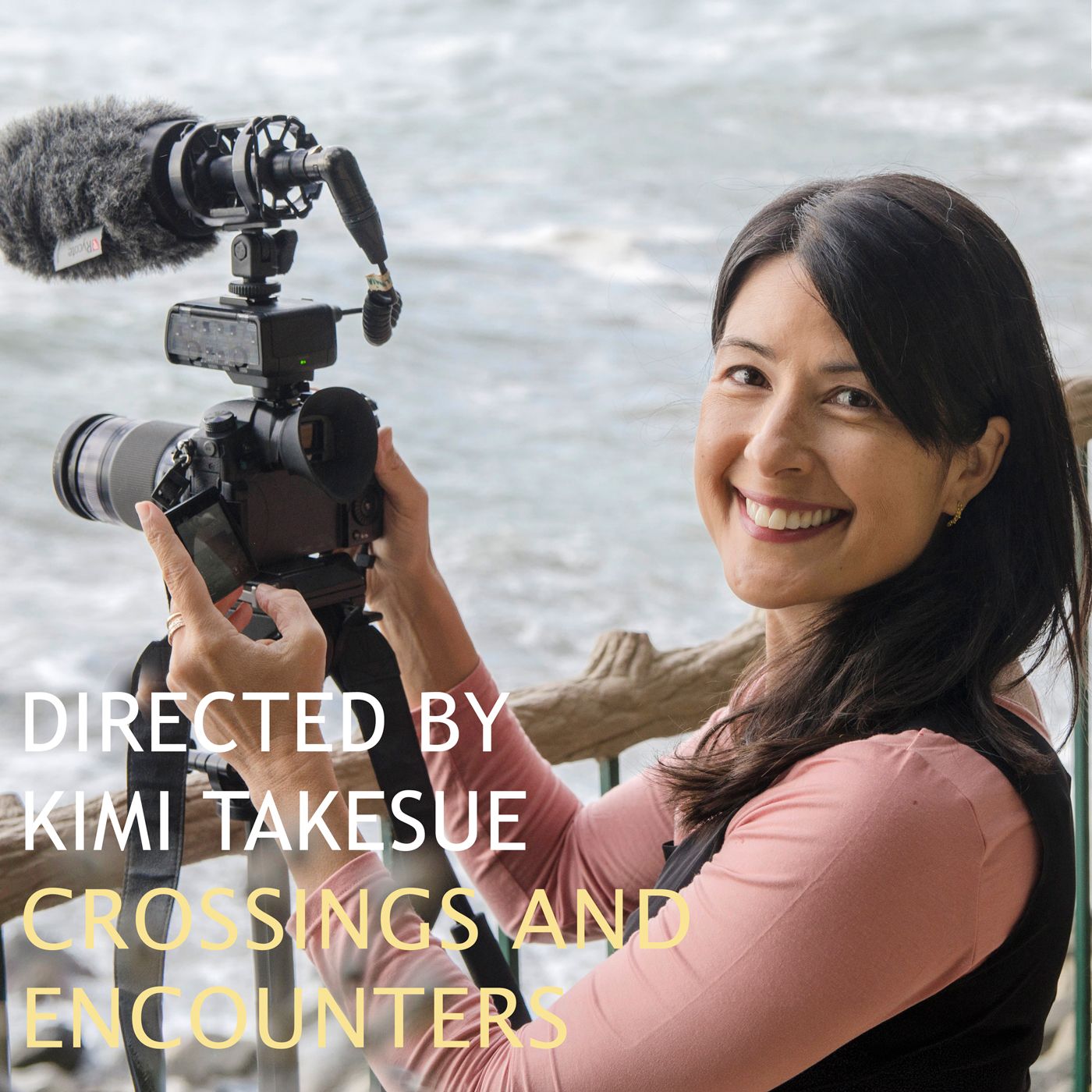
Special Report: Kimi Takesue: Crossings and Encounters
About this episode
Her films, including Where Are You Taking Me?, 95 and 6 to Go, and Onlookers, examine those encounters through an observational lens, tracing the power dynamics and unspoken tensions that emerge when tourists and locals share the same unequal terrain. Takesue discusses her practice of traveling without research or agenda, letting one thing unfold into the next, and how a devastating failed fiction project directly led to the making of Where Are You Taking Me? She also talks about the rhythm and formalism of Onlookers, the tension between aestheticizing beauty and critiquing the tourist gaze, the influences she only fully embraced later in her career, and her current work-in-progress following tour guides at Cambodian atrocity sites.
Transcript
Automatically generated, so expect the odd misheard name.
Oh gee is folks, it's showtime. People say good money to see this movie. When they go out to a theater, they want closed sodas, hot popcorn, and no monsters in the projection booths. Everyone pretend podcasting isn't boring. Got it off?
Hey, folks, welcome to a special episode of the Projection Booth. I'm your host Mike White. On this episode, I'm talking with Kimmi Takasue all about her body of work, which is now on the Criterion Channel. There is a special retrospective of her stuff happening right now. This is May twenty twenty six.
Definitely check that out and please check out the rest of her stuff or at Kimitakasui dot com. Fantastic experimental filmmaker, makes narrative movies, makes documentary films, really really great stuff. Had a wonderful time talking with her, and I hope you have a great time listening. Thanks so much. Before we start talking about filmmaking, I would like to know a little bit more about you and what your journey is.
I grew up as a child in Honolulu, Hawaii. My father is Japanese American third generation, and so I'm fourth generation and then my mother is of Italian German heritage and she grew up in Kansas. And then my parents divorced when I was about seven, and then I moved with my mother to Massachusetts, and then I shuttled between Hawaii and Massachusetts. So it was a very kind of cross cultural experience really growing up, and a pretty sort of fragmented experience in a lot of ways. So I think this sort of biracial, cross cultural perspective definitely informs my filmmaking in a very critical way.
I went to college at Oberlin College. I studied cultural studies and women's studies, which is actually how I initially got into film, was more from an academic and theoretical perspective. And then I lived in London for five years and that's where I made my first film, Bound, And you can see that as a reflection of more of that kind of academic background where I was. Really it was a time in sort of identity politics, where in the early nineties where people were really looking at kind of questions of identity, and me, as a young Asian American woman, I was interested in what does it mean to create more nuanced, complex representations of Asians and Asian Americans on screen, and then just these kind of other questions about the politics of representation and sort of documentary across cultural representations.
What are some of the complications and questions around that that were really being raised, particularly by filmmakers like Trincy Minhaw who were both theoretical academics but also filmmakers, and then crossing over into visual anthropology. So that was really my starting point, and then I went to graduate school at Temple University and got my MFA. That's the start of my filmmaking journey. Your films are so interesting, and I'm so curious were you inspired by any other filmmakers? Growing up?
I was really interested in theater. And one of the things that's interesting to reflect back on is that my mother is a retired film professor academic who with two kids, went and got her PhD later in life, and she actually her area of focus is Frederick Wiseman, an observational documentary. And it's interesting because she was just giving a presentation over the weekend. It was around Frederick Wiseman's films, and you know, people naturally think I was really influenced by my mother, but she was really modest and discreet while she was going to school, and so she actually never discussed her research. So as a person in high school, I was interested in theater and I had no interest in film, you know, so, like I said, it was really more of an academic entry.
So I was not a film buff. I had not seen many films at all. And then when I got interested in film, I almost protected myself a little bit and shielded myself from looking at too many films early on, because I do think there's something very powerful about what your natural inclinations are and sort of understanding intuitively how you express yourself through film, and I wanted to protect that for a while, to see just naturally how I evolved. And then it was like later in life being exposed to a lot of films. So I just recently got to go to the Criterion Closet as part of this Criterion retrospective.
So it's like a moment when you get to reflect some on the influences. And so the people that I chose, for example, were Kirstami where is the Friend's House? And I chose Beautravi by Claire Denis. I chose Wan Kharwai in the Mood for Love Chantel Akerman, News from Home and Tokyo Story by Ozu. And so I think all of those films you see reflected in my interest in filmmaking.
There's like the poetry of cinema, like these sort of big philosophical questions in a way that are just embedded in the very ordinary, every day relationships between family members. In ninety five and six to Go, you see some of the my interest in kind of lush like visuals on someone like wankar Whi and just like color and sort of a sensory element of just beauty. I think with Ozo some of that, like the quietness and the sort of meditative space, and like what is actually said in the unset and in the in the in the quietness of moments in a film like Beautravill with Claire Deni, where you just again like the sensorial the textures and then again choreography, and like the beauty of bodies in motion.
So I think those films kind of if we if if we speak of influences, those are for example five. So much of your work for me feels observation of other people, of other cultures. And then even back to Nannook of the Norse some of the earlier documentaries, it's like, how much does the filmmaker by pointing their camera influence what we're actually seeing? Are you telling us what to look at? Or are you telling us how to look at things?
And I appreciate that kind of tension in all of your work. So many of the films are about the active looking right and what does it mean to see? What does it mean to look with more clarity? So many of the films in a sense come from a frustration of living a life that is distracted, that is, in a sense in tunnel vision. And that's one of the reasons why the films often emerge out of travel, because I find that in the experience of travel we regain our ability to see things.
Travel activates our senses and we get out of that tunnel vision and we're able often to see very ordinary moments that actually are endowed with so much like meaning and beauty and poetry or complication, and you find yourself more in touch with your senses and the sense of color and sound, and the ability to appreciate gesture and like human communication in all of its facets. Yeah, the films really are about the act of looking and I'm so interested too in that interplay of the observer and the observed. So it's not just me looking, but it's also how I'm being looked back at, and that a lot in the films as well. That kind of answers my question as far as how you choose your subjects. Is it all through travel or do you have other ways of saying, I really want to look at this and make a film about this particular subject.
There are some fiction films, for example, in the Retrospective, and obviously those are planned and everything, though a lot of my films still emerge out of a certain randomness in the sense of they often emerge out of a failed form or project. So even in some of the fiction, there's two fiction films, Some of the Serpent and that which ones was, that are part of the collection. And for example, Some of the Serpent has two characters that are actually from a different script that I had been working on that failed, that never got made, that I then extracted and put into another location and saw as an experiment, what if this bodyguard, this Japanese bodyguard, and this little girl were somehow met, somehow met at a swimming pool, and then he would be such an anomaly because he's this bodyguard and wearing a black suit, and what would happen between them and what the circumstances be.
So even that, there's an element of randomness that often emerges in that which Ones was. For example, it's taking the role of a Japanese ice carver, which is part of another film that's referenced in ninety five and Sixtygo a fiction project that never gets made, that that never got made that film, and so I ended up using that character and transplanted it into another project. In the observational documentaries, they really are driven just by curiosity. I really try to intentionally go without intention in this sense that I really don't do any research. I don't do I really try to go without an agenda, and the only thing that's driving me is, oh, I'm interested in going to this place.
Where are you taking me? Was slightly different because it was commissioned by the Rotterdam Film Festival, and that was a film that the idea that was an interesting project because basically a wonderful curator there, Gertien Zuilov, who was a really important curator Rotterdam, had this idea that he wanted to bring more African cinema to Rotterdam, and he thought this a great idea would be to basically have ten or twelve filmmakers from around the world who were capable of making films just individually, with very little money, to go to different countries in Africa that had really less developed film infrastructures, and for the visiting filmmakers to research the local film scene and then introduce Rotterdam to a local African filmmaker, and then they would commission that film maker to make something for Rotterdam, and then while the visiting filmmaker was there, you'd make a film.
And so that one I knew I was going to Uganda, but again I went very specifically without an agenda, and just knew that I didn't want to make a film that was about a sensationalized topic around victimization or horror. So that film just was me following just one thing that unfolded after the other. And again the films are like in conversation with one another, because that film, for example, is a reaction to ninety five and six to Go, the fiction feature that never got made that's referenced in that film that was so devastating for me that I almost gave up filmmaking, and so what happened is that I had this opportunity then to swing into this other mode of kind of a more self sufficient form of filmmaking that was just kind of coming back to myself.
And that's how where you Taking Me emerged. I had this opportunity to travel to do this project, and it was a direct response to a failed fiction film that where I had spent years in conversation and development and mythologizing a project that never came to be that was devastating when it didn't happen. And so then I very intentionally was like, I don't want to work in that way anymore. I actually want to work in a looser way that is just very much not about building up expectation and just respond to things as they unfold. And so this has kind of that was really the starting point too, of a whole body of work that is developed in this way of just trying to be open to really what one authentically is interested in.
When you are kind of like going to a new place and like things unfolding and one thing leading to the next, discovering some kind of structure or thematic kind of Center. Yeah, that's what I really appreciate about this Criterion collection of your films is that I feel like I can start at the beginning and work my way through. I don't know if that's everybody's preference, but that's usually how I approach a filmmaker's work. That's very cool, right, That's one of the things that it's such a privilege to be on Criterion and to have the work available for people to see, because it is really interesting for any filmmaker to see how how one film goes to the next. And in my work, I think it surprises people sometimes because I might move between genre and they can, on one hand, feel quite different, and some of them are very highly produced.
I do have a couple fiction films like ones on thirty five millimeters, one is on the red camera, and then I have these a larger body of work that's really intimate, that's very handmade, right with just me being the director, producer, cinematographer, sad record as editor, right and it had those films have a different quality, but they really do thematically. All of the films really deal with different kinds of cross cultural encounters. Going back to my first bar at the beginning the origin like my origin story, right, and about this kind of active looking where where the characters are, whether it's me as the maker or the protagonist in the film, they're all keen observers, right, They're people that are looking from the margins and pulsating between like connecting and not connecting, but sort of intimacy and I sort of disconnect and a voyeurism.
And they're all like very visually driven and tend to be very sound driven too, and sensorial. And then they are also responding to each other in terms of life experience, right of like the disappointment of a project, how does one recover from that project in the sense of going into a different mode of making? Right, Oh, the fiction thing where there's so much talking, talking, mythologizing, and then wanting to then move into something that is just loose and exploratory, or maybe working more at a distance and then wanting in a way to get more close and more intimate in some way. There's a lot of room for the viewer, right to engage and to interpret and to do some of the work in the sense of there's a lot of space I think to interpret the films in different ways and hopefully to reflect and contemplate.
They're moving at a slower pace right there requires some patience, but I think at the same time they're quite accessible as long as you take some time and have that curiosity, because that's very important to me in making a film, and I think it's one of the challenges because there's no doubt that voiceover is an easier way for the audience right to consume and in a sense to be told and to engage them on an easier level to keep their attention in terms of the audience, and it's challenging then if you don't work in that way. First of all, just like in terms of structure, how do you hold a piece together in a way in terms of an ed it, but also how do you engage them in other ways through other forms of sound for example, but also the accessibility where you're challenging the viewer.
But at the same time I'm very conscious of accessibility. I really do want there to be many entry points into a film. And it goes back to the beginning when I said that my starting point in interest in film was more theoretical and academic, and I did feel that a lot of the films that I was inspired by in a way they were most appreciated when you had an accompanying essay, and I made a decision. I appreciated that kind of filmmaking, but I decided that's not really what I wanted to do. So I want there to be a kind of conceptual foundation that people some people will appreciate and understand more than others, but it doesn't feel exclusive.
It's not if you don't if you don't acted in that way, it's not like you can't appreciate it, perhaps aesthetically or in terms of some of the emotional qualities or other dimensions. So I'm really trying to create a piece that has a lot of points of entry for the accessibility. You talked about editing, and I'm so curious how you find the rhythm of the edits. I'm thinking specifically of Onlookers and just the It definitely feels like there is a rhythm to it, and I'm so curious how you determine when you're going to make those cuts. Each film is different, So, for example, Onlookers on one hand, is it's a look at travel and tourism and laos in Southeast Asia and in some system degree it's critique, but it's also very much about again the active looking, the act of being present in a place, and that piece.
For example, I went to Laos, I was interested in going to Laos. I brought some equipment, and to some degree, the style of a film can be dictated by the equipment and my relationship to the equipment. So for example, I was using a camera that I like to have on a tripod, and so it has and I'm kind of drawn a lot to a certain formalism. But this was then very formal, right, and I started to realize that I was shooting also quite at a distance, because I really wasn't very engaged with people. It was more of a distant observation and looking at some of the patterns and choreography of tourism in all of these different ways, right in locals and tourists and how do they intersect, how do they stay on their parallel paths.
So then I start to see a pattern in like the way that I'm shooting, right, and then I start to kind of see like thematically. That's interesting because it is about travel, and in a way, these these are almost like postcards, right of static images, static tableaus, that are where something unfolds within the tableau, and sometimes I use the comparison to like the Bresson Henry Cartie Bresson and the decisive moment, and instead they're kind of decisive scenes that unfold that then becomes the structure of the film. These kind of like moving image postcards, but hopefully that in some cases kind of reflect the postcard desire to aestheticize, exoticize, and then there's also like critique of that that's embedded in the film.
Right. But then so then in terms of rhythm, then you have an interesting challenge in a film like this because there's no dynamics, because there's all long takes, and because in another film, for example, like where You're taking me in Uganda, it's looking very much at the the rhythms of travel that move between say hyper stimulation and kind of confusion even and then moments of pause and reflection and contemplation. So I'm playing with that in the edit, right, So you'll have moments that are very fast and dynamic, and then you have moments to slow down that really are reflective. So that has a different quality of rhythm than for example, Onlookers, which has a steady rhythm, right, and it becomes difficult to kind of structure and rhythm is challenging because you have to kind of think about rhythm in terms of the cut, you know, and sometimes it's like a shot kind of blending into the next through sound or you know, creating in a way like dynamic cuts in terms of sound rather than in terms of duration, because they're all long shots, you know.
But I'm also just thinking about like the kind of rhythm that's happening within the scene itself. I'm thinking about like rhythm visual rhythm too, in the sense of even color or graphic qualities. It's each which film really has different challenges in terms of editing and in terms of rhythm. And then also with that one in particular, the color is just so vivid everything, but especially those monks robes justp so beautifully. Yeah, and I think the film again, it's about that in the context of Laos, the sort of cultural signifiers of Laos are the monks, right, And it's the way that from as an outsider, one is just so seduced by the beauty of the ritual of monks giving of them, giving alms to monks on a daily basis in the morning, and that ritual is so beautiful, and I film that, but at the same time, I'm critiquing it, right because you see a lot of the ways in which even the impulse to estheticize and exoticize that act is like, I'm guilty of it too, But I'm also commenting on it because you're seeing how people are like really commodifying it and kind of intruding.
And I hope that you see that. It's like there's a certain self reflection that's happening there too. But at the same time, one can't resist as a filmmaker, I'm attracted to beauty. It's like that is the core of it for me, is yeah, I love to produce beautiful images, so it becomes attention and it's a complication that I address in the film, but I think that, Yeah. The other thing that I'm trying to focus on is that you see the monks in their robes, for example, in these rituals kind of interwoven.
But moreover, you see the people, the people who are waiting in the morning at five in the morning every morning, who have prepared rice, who are sitting on the side of the road to give the rice to the monks on a daily basis, And to me, this is what was fascinating because it reflected this graciousness and generosity of time that was so unique to the Loo people. And so that's the framing device in the film. Are these people that a lot of times you don't quite understand, like who are these people just sitting there on the side of the road, Are they waiting for a boss? What are they doing? And then it's revealed too at the end, like the whole ritual and the whole act.
But to me, that was such a powerful reflection of something that was very distinct about lou culture in terms of generosity. With all of your work being on Criterion right now, I'm curious have they done or have you been a part of other types of retrospectives, And I'm so curious what audience reactions are to your films overall. It's such a rare opportunity, right to have your work really seen as a retrospective, and this is the first time all of it has been seen, you know, because usually it's like there's a concentration on, you know, some of the features, maybe a couple of shorts, you know. So I have never had all eleven films, you know, shown together, So it really is amazing just to kind of as you're saying, I think for a viewer to see like how a filmmaker kind of moves and evolves, it's just like going down memory lane.
Right. It's like really interesting because you see just different points of your life and what was meaningful to you, and they each film is a reflection of that phase in your life. And there are things that you look back at that you're like, oh, you've developed in certain ways as a filmmaker, but then there's things you've lost as a filmmaker too, right, because there's a certain energy and innocence that's part of early filmmaking. Like I'm saying, what are the intuitive impulses that are so powerful? That's what I see in my students because I teach too, and that's like, really it's a different energy, right, and you can't retrieve that ever as you get older, but then you have hopefully other strengths and other things to offer.
But I did have the pleasure of two recent retrospectives that were smaller in scale, but one was at the Asian Film Archive in Singapore, and that was really wonderful and it's a beautiful archive there, and so I showed some work there and it was also there was a couple pieces that were shown at the Nannying and Tu Contemporary Art Center, and then I just recently had a smaller retrospective at Cornell Cinema and Cornell University. And so I think, again, it's like, even if it's so, it wasn't the entire body of work, but it's still really really nice, like when people can see several films and again, how they're working together in conversation, the ways in which they connect, the ways in which they're really different.
But it's a real pleasure to get. To do that, since you're not taking people by the hand and hitting them with a voiceover or setting up with the opening scroll or any of these things. I'm curious, are there ever any misunderstandings that the audiences have that you've heard where it's like, oh, this thing happened and you're like, that's not what I was going for. There's no doubt. I think that the films leave a lot of space for people to project their own issues into the readings of the film.
So I learn a lot about the person based on how they read the film. One of the easiest examples is onlookers, what we're just talking about that here's a film that's about the impact of tourism in Southeast Asia. And what I'm trying to do in this film is show the whole spectrum of the kind of tourist experience, whether it be of pleasure, moments of intrusion, moments of awkwardness, moments of existential distress, moments of just sheer exhaustion, moments of just feeling totally awkward. And personally, I'm making this identifying with all of those experiences, some of which are embarrassing or offensive or insensitive, because I think honestly, if you've been a tourist, you have engaged in some of those behaviors, right, And it's not a condemnation.
It's not me trying to separate myself like, oh, I'm not like that, I'm a good tourist. No, for me, personally, I am trying to show everything that I identify with, and it's like, hopefully with a kind of compassion and a sort of I hope that the films again are connected in a certain humansay, I would hope that that's what I feel is I'm really filming things that I'm genuinely interested in and feel compassion for. It's like I identify with the different You ask the question about subjects that I didn't really answer because I don't generally have real points in the documentary, like particular people that I'm focusing on, except for ninety five and six to Go that is about my grandfather. But generally it's not like I'm focused on a specific person, but I'm attracted to them out of genuine interest and curiosity and respect.
Really, So I find that in a film like Onlookers, it's fascinating because some people really it stirs them up in a surprising way where they don't in any way want to self reflect and feel that they're being implicated in any way, and it will generate a really strong reaction that's surprising to me. So I think that's an example of they're free to interpret it in the way that they want to. But I do think that the films, because there's a lot of space in them, it reveals a lot about the viewer. I love all of these observational documentaries where you are this kind of one woman band doing all of the roles, but when it comes to your fiction films, and I'm sure even with some of the documentaries, when you have to work with other people, how do you find the folks that you like to work with.
I have had the good fortune in some of the fiction films. For example, I actually had worked on as an assistant on the film Jesus's Son, and I met a number of wonderful people, including Bobby Siretta, who's a really really established gaffer in New York, who then shop both of those films, Some Aer of the Serpent and that which ones was, and then he brought his whole team of people, and then Panavision came in and it was like all free lights, and I got free film stock on my own from a cinematography award I had won through Kodak, and so it was like again really amazing high production values, but basically people were like donating and I had the really good fortune of working with some excellent people in those films.
Some of them emerged from graduate school. Several of the films have someone who I went to graduate school with, k Chi Kondo, who's the actor, the Japanese actor in both Rosewater and in Summer of the Serpent. And he had such an amazing quality to him. He just had this silent, stoic beauty that was both melancholic and just to me just so beautiful. And in the same way that I'm responding to what unfolds around me in an environment, I think I respond to people in that way and the way I can past him.
So it's like building a film around a quality that someone has. And in then writing Summer of the Serpent, like I said, I extracted two characters, but the character of the bodyguard I always had Kichi in my mind because if you see him in Rose Water, there's one scene that's a really crazy scene where he's smoking a cigarette in a junk yard and he just looks like yakuza. He just looks like a cool yakuza guy. And again, the origins of that film were super strange because it's a series of cinematography exercises that then I ended up collaging together once someone surprisingly sent me a dozen long stem roses, and so I had roses and I incorporated them into these cinematography exercises that then I wove together in a very experimental way.
But that film also like developed around Kchi's special quality and then when I wrote Summer of the Serpent, for example, I wrote this character of this Japanese bodyguard thinking of him, but I ended up trying to cast it in a more open way with a professional actor, but no one was as good as him. So he's in that film as well, and so you know, but I think that it is challenging. I've been really fortunate. Part of what's so cool is I'm doing this screening ninety five and six to go this week at DCTV and inviting people who've been generous to me over the years on collaborated and so they'll be a great collection of people that are going to be attending. But I think working in this more self sufficient way, I really work with almost no money.
I really work because I'm working without expectations. There's no grant proposal to write, there's nothing to write, there's nothing that is urgent about what I'm doing. So I really don't get grant money for these films. And part of it is a choice about working in a way that it's going to be very difficult to get grant money for without a kind of what seems a very important subject and certainly not one that's even articulated. So you know, it's it's difficult finding collaborative is in some ways too because I really don't have money to pay other people.
But I still there have been like different companies and people that have still been very, very generous, and so I just want to do a little shout out to Red Hook Post Tom Evenger, who's a really important re recording mixer in New York. He's worked on a lot of my films recently, like post works of Pete Olshansky really really was generous when you talked about the color and onlookers like they contributed a huge amount. So I've had different people who've been really really great. I know you've got the retrospective going on, you're teaching. How many film projects do you have in your head going or are you actually engaged in anything right now?
I am working on a project that is about tour guides who in Cambodia who take tours to atrocity sites, and so again it's an extension of some of my interest in different aspects of tourism. This film is different for me because it does actually follow three people specifically that are engaged and tourism motivated to their work. In different ways, so it is different. It's not like a deep, deep dive into the history into their personal lives. It still is about focusing on kind of the interface of what's happening between them as a tour guide with tourists.
But that's a film that I'm working on. I'm also working on a film that is could be like an installation, but it's a series of video portraits of low people who work in the tourist industry that are just these kind of long takes of the act of looking in a way between me and them, and they're these sustained long takes. But that's definitely a film that's like an extension of Onlookers. And I recently lost my partner and it's been a it's been an incredibly difficult time for me, and I've been gathering, I've been traveling a lot, just been a healing mode and thinking a lot about grief. I'm thinking a lot about I guess in some way I feel like I need to make some project that taps in to this really intense experience of loss and greet you.
May thank you so much for your time. This has been so great talking with you. Thank you so much. For your time and interest, and thank you so much for looking at the work. I really appreciate it.
Can't sh USh
More from The Projection Booth



Similar episodes across the network
Matched by shared keywords.
-
Jackass: Best and Last (2026) — "Welcome to the first day of our final film."
1 shared keyword: documentary
-
Melania (2026) — "Here we go again."
1 shared keyword: documentary
-
An Unknown Compelling Force (2021) — "I think these theories are weird."
1 shared keyword: documentary