
About this episode
Chainsaws, trains, diamonds, and geopolitics collide in one of the wildest action films of the 1960s.
Transcript
Automatically generated, so expect the odd misheard name.
Hey, this is Emily sowderback of Scarecrow Videos Viva Physical Media. All right, this is Matt Lynch, co host of Viva the Projection Booth. Podcast is sponsored by Scarecrow. Try out Scarecrow Videos rant by mail service. Choose from over one hundred and fifty five thousand films and get Blu rays, four k's and DVDs all delivered directly to your door.
Visit Scarecrow Video dot Org today. Oh you is both its showtime. People pay good money to see this movie. When they go out to a theater. They want cold sodas, hot popcorn, and no monsters in.
The projection Booth. Everyone pretend podcasting isn't boring? Got it off? These men are heroes or higher Violence is their specialty. They are paid to be brave and brutal, Julie.
Mercenaries will do anything for money. What are you talk as we're going. To pick up fifty million dollars worth of diamonds? You said anything about. Giving you hand?
I may go, I may stake. You go. I'll be there right. These men are mercenaries, brave, brutal, the best in the business. Or their profession.
Danger is their specialty. Fifty million dollars in diamonds. Is their mission, Adil Captain. Three days. To keep the Congo alive.
Danger is there nine to five job, And there's nothing more dangerous than diamonds. The diamonds. Broady, Broady. We don't kill him, him, not kill myself. We need will Yam.
He kind of danger since. I came down out of trees by. Invitation, and I don't kill anybody who tries to send me back up again. Violence in the tempting beauty of a woman. Why are you we wait?
You wait? Wait? Why? Violence in guns and bare hands of hired heroes. A strike force of cracked mercenaries, fights the hottest battles, and all the blazing hell of today's drive, torn Congo and.
Dark of the sun. Welcome to the Projection Booth. I'm your host. Mike White joined me once again as mister Andrew Netti. Don't cross swords with me, hurry.
Also back in the booth is mister jedediah Airs. But this was to go back on You've earned it. This one is a request we've had from Andrew Netti himself for the last few years, finally getting to it on this episode. We are looking at the nineteen sixty eight film from director Jack Cardiff, based on LB Smith's novel Dark of the Sun. The film stars Rod Taylor as Bruce Curry and Jim Brown as Rougho, two mercenaries who come to the Congo in nineteen sixty four, where they're hired to retrieve a cash of diamonds and get them back to the new government.
They put together a small team, including a Nazi and a drunk doctor, before taking off by train to parts unknown to get the diamonds and save a group of white people from the dangerous Simba tribesmen. We will be spoiling this film as much as we can as we move forward, So if you don't want anything ruined, please turn off the podcast, track down the movie, watch the movie, and then come on back, turn the podcast back on and listen. That's so simple. So, Andrew, when was the first time you saw this film and what did you think? I'm so excited to be talking about this film.
And yes, I have been nagging you for I think two or three years to do an episode on this film, so it's great to be doing that. I think I would have seen I'm sure I would have seen this film on a Sunday night back in the late seventies or early the eighties with my parents. Sunday night movie was a big deal back in the seventies in the eighties, and it's how I got exposed to many amazing films and films that were probably completely inappropriate from my age, and one of these was Dark of the Sun. I've lost track of how many times I've seen it. I see a lot of people online, including Martin Scorse Aisy, talk about this film as a guilty pleasure.
But I love this film. I think it's a great film, and I don't feel guilty about that at all. I don't believe in guilty pleasures when it comes to movie watching. It all works for me. It's got a great cast, it's got a great score.
It's a great, gritty war film that doesn't have an ounce of fat on the entire narrative. It's still, I think, got the only chainsaw fight I've ever seen in a film. It's beautifully short. It's a great man on a mission film. But I would also argue that in its own why, it's also very political and it interrogates everything from the ethics of being a mercenary to the nature of global imperialism in Africa.
I love Rod Tyler. I just love the whole film. It's a great film. I'm really looking forward to talking about. Us and Jet how about yourself.
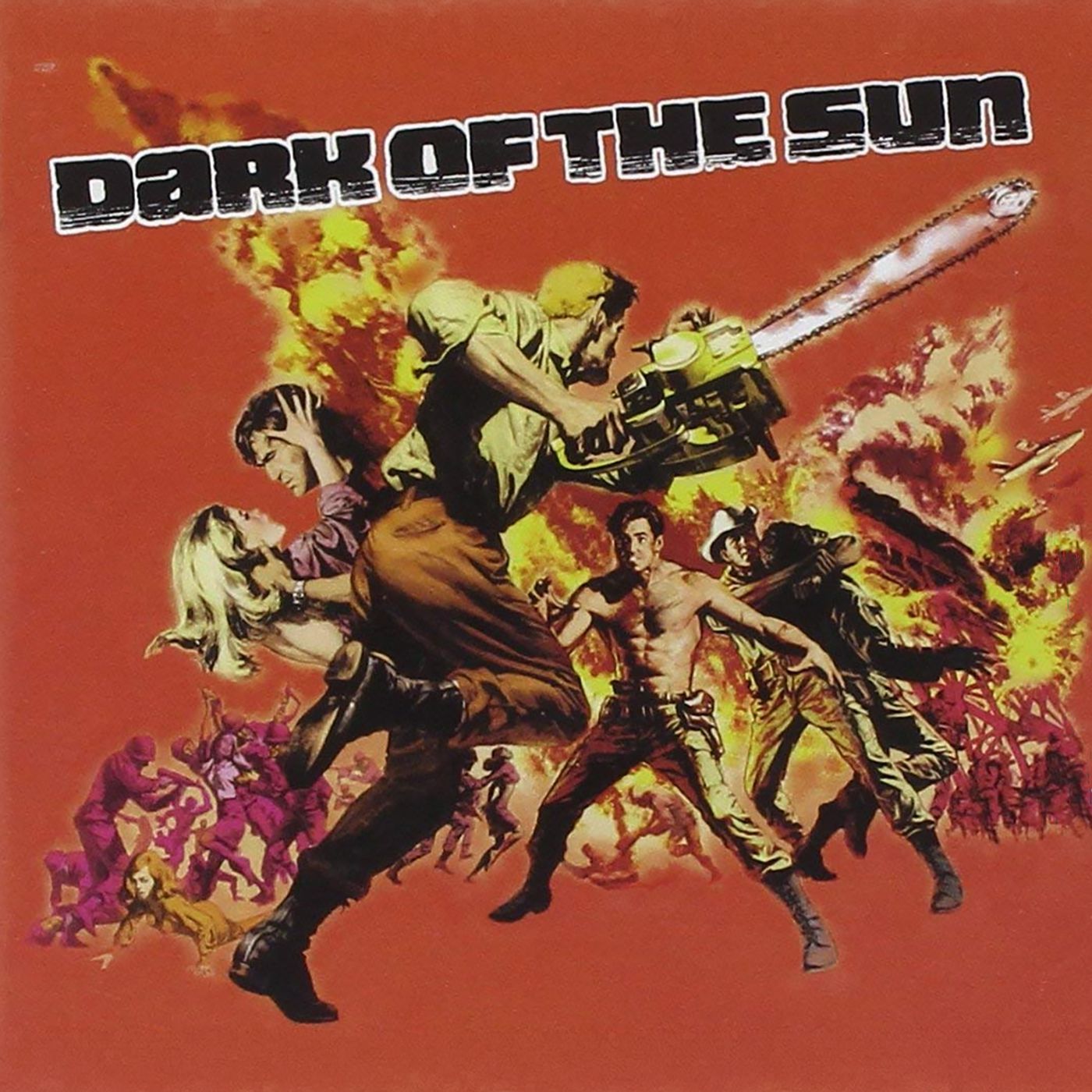
I'm sure that it was at the urging of Andrew that I watched this film a couple of years ago, two or three years ago, as soon as I saw the poster for the film for Andrew Netty to recommend a film. But when I saw the poster, I was like, I have to see this movie. The poster was incredible, the chainsaw, the explosions, the just I love the style of it, and I do Men on a mission. Films I really love were Eagles, Dare and Dirty Dozen and Play Dirty and things like that. This really does fit in right at the top tier of these types of movies.
Once I saw it, was one of those rare times when you see a piece of pulp art advertising a book or a film and the product absolutely lives up to the the artwork, which is very rare. But yeah, it's great artwork, and it's a Yeah, it's a really wild, violent, dark. But also moving, a moving film. So I've watched it several times since most of those preparing for this this podcast. But sometimes I watch films several times preparing for a podcast, and I like the film less by the time we do an episode.
But that's not the case with this one. It. I really do think this film is firing on all cylinders and yeah, deserves to be champions. Thanks Andrew for getting me to watch it. And that poster we should add that poster art by the great Frank McCarthy is a stunning who did a lot of posters in the nineteen sixties and nineteen seventies.
I think a stunning poster though, all those people on top of the train barreling into oblivion, explosions and jets and chainsaws and yeah, all kinds of good stuff. Yeah. I had never even heard of this film until you brought it up, Andrew, And like you, Jeddediah, I the more I think about this film, the more I've watched this film, the more I like this film. And I agree with you, Andrew. Not a ounce of fat on this movie, and they did.
The more I think about it, the more they did a great job. When it comes to the adaptation of the Wilbur Smith book, I think it starts to differ quite a bit in the third act, but otherwise I think that Quentin Whirti Courty, he does a great job. One of my favorite writers. Think about him all the time whenever I use my keyboard. Now Randall McDougall as Quentin Wherti.
I think he was maybe mad at some of the rewrites of some of the things that were going on, possibly some of more of the Rod Taylor stuff, because I think Taylor has been on record saying that he helped write the screenplay for this, And when an actor comes in and says I wrote the screenplay, that's never a good sign. I don't know what role Adrian Spies or Spies played as far as the screenplay, but yeah, I think that it really captures a lot of the better action scenes of the book. They do a really good job of featuring a lot of great set pieces. The makeup of the team is different than it is in the book, and obviously the setting of it is a little bit different as well, though you wouldn't necessarily know because it's still Africa, it's still the Congo.
Just the movie is set in more sixty four sixty five, whereas the book, I think is set more sixty sixty one, and by that time in Congo, things had already shifted around as far as the political affiliations and things. And this really gets into the movie. Like you said, it's more of a heist film when it comes to there being the diamonds at the center of this. The diamonds are there in the book, but it feels like they're almost secondary to saving of people, whereas this one is much more cutthroat when it comes to, yeah, there's diamonds. We're going to go get these diamonds and maybe we'll save some white people along the way.
Yeah, it's a very cynical picture. I do think there's such a thing as cynical romanticism, and I think that this kind of fits that we are. I am enamored of understanding I'm being cynical in the way I view a situation and still participate in the adventure of it. So it got me there. Yeah, it's gross that the real motivation here is that everybody acknowledges is we're going for diamonds, but we got to have the cover of we're going on a rescue mission to save some lives that are going to be lost if we don't go rescue these people.
But yeah, as Rod Taylor's Curry asks at the very beginning, he's being hired to take a train to a remote town and pull out the settlers there and bring them back to safety before rebel forces come in and kill everybody. And he's like, why are we going to this town? There's so many towns, we could go to a dozen towns. Why this one? And it's because there's one hundred and fifty million dollars worth of diamonds that we're going to collect from this vault.
They set two clocks in this movie. There's the we need to get these diamonds back in three days, and then there's also once they get to the town to what is it, Fort Reprieve, there's a timelock safe which has been set and there's another three hours. So it's like, okay, now you have to wait three hours in this town before you can leave with the diamonds and get the hell out of there. As I'm watching this, I kept thinking, it helps that the opening of this movie is, for me, set up a lot like a spaghetti western. Like the animated credits that we have really remind me of like the Leone films, The Dollars trilogy.
When it comes to the way that these credits are running, the music by Jacques Lucier is very more cone to me, to the point where Tarantino used it on the Inglorious Bastard's soundtrack, and he was very much about recycling other people's scores or his own movie. He still is, but that was like his thing, especially in Inglorious Bastards. I remember getting into fights with people who thought that that was all written for his movie. I'm like, child, please pay attention, this is not It even says theme from Dark of the Sun in here. There's this idea of the people at the we'll call it a fort, and the Indians are massing outside, and now it's time for the cavalry to come in and rescue these people and get out.
So I really felt like this whole Western idea was going on here and we're just transplanting it into Africa and it becomes this more like men's adventure type story where it's it's still the same idea as we need to save these people from these savages, and this whole idea of the savage group of Simba that are coming, and you hear it's more in the book, I think the whole idea of the drums and the drums always happening. But my god, these guys, these Simba warriors are just I've seen picture of them, and they do dress like this. I thought for sure it was all one hundred percent made up for the movie, because they look like they're going to fight the warriors if the warriors happen to come into their territory, if they walk through Harlem, the symbol would be the group that attacks them.
If you read the comments, which is always a bad idea actually, but if you read the sort of reviews and the comments on things like letterbox or about this film, is a lot of US grad students who have done post colonialism studies and who are quite happy to bag this film out. And I think that there's maybe a bit of basis to that. One of the things that fascinates me about this film is just how closely based on reality aspects of it is. It's prosaic things. Like you say, if you actually look up pictures of the Simbols on the internet, they actually look like they do.
I've actually seen pictures of mercenary trains going through the Congo and they look exactly like this mercenary train. The setting of the film is quite somewhat accurate. It's Ba the Congo in the nineteen sixties. Congo's first post independence leader, Patrise La Mumba has been killed by Belgian mercenaries who are working for working with the man who would go on to have an incredibly corrupt Western backed rule thirty two year rule of the Congo. A guy named Joseph Mabutu.
Mambutu kills Patrise Lamumba. The Americans wanted to kill him. Dwight Eisenhower had authorized his elimination in nineteen sixty as a quote unquote Soviet stooge, but Abhuto got to him before the Americans could. And then after the killing of Lamumba, basically there's an uprising in the part of the Congo that La Mumba came from. That's a Simba rebellion led by followers of Lamumba in nineteenth from and it goes from about nineteen sixty three to nineteen sixty five, incredibly violent and it's put down with the use of foreign mercenaries that Mabuto basically pays here to put down the Simbers.
Yeah, an enormous amount of theres a lot of realism and the characters. I think we could talk about the fact that Curry is based on a character called Mad Mike Kore, who is a an actual real life British mercenary who worked in the congr a Christian and a rabiedh anti communist letter led a group of commandos, a group of mercenaries called five Commando who had a reputation for looting and not taking prisoners. He's also the only mercenary trained as an accountant and a member of the Institute of Chartered Accountants for England and Wales. And also the other character that is based on reality is the character of Heinland, who's played by who is that pick? By German actor Peter Carsten, and he's modeled on a real life iron cross wearing German World War Two veteran who was a mercenary in the Congo for a while called Sigfree Muller.
I actually I haven't watched them at There's a South. There's a East German film about Muller called The Smiling Man Confessions of a Murderer, which I haven't watched for a while now, But you watched it, I think a bit more recently, Mike. Yeah, I watched that one last night, as well as a one called Commando fifty two, which the two films really go well together, because the Commando movie is more about the entire group of these guys that Muller brought together and the different specialists that they had, the one guy who loved cooking skulls, and they had human skulls all over the place, and of course Muller is just like, oh, yeah, this guy gave me a skull and I was using it as a flower pot, and I'm just like, oh my god, these are human skulls that you guys are dealing with, And of course he's trying to be like, oh, yeah, no, no, these were all just we found these skulls.
It's amazing how quickly the bodies decompose over there. And meanwhile, there's interviews where it's no, no, he would take the heads and boil off the skin and the flesh and everything. And there's a whole part in the book about collecting ears, which really then reminds me of Vietnam. And this is taking place while Vietnam is happening, both the real conflict and the filmed version of it because Vietnam went out for so long, and I really started to see a lot of parallels. This seems like it's the fun version of Vietnam.
Oh, we're a bunch of adventurers and we're all going to come to Africa and we're going to make money and we're going to save the white people and all these things, as opposed to the quote unquote dirty war of Vietnam, where it's no, no, we're not going to talk about that. We're not going to make movies about that. We will make movies about how fun Africa was. Though I'll admit that the real context was something I looked up and got into a little bit afterward. I was purely here for the pulp men's adventure, and I'll admit when I was young, some of my earliest really profound film impressions were from similar sorts of Bojest with Gary Cooper.
There was a hugely influential movie on me. Just the guys in the fort just being swarmed by the dark Hords were coming to overthrow them, and there was no help coming or Zulu, and especially Zulu Dawn. I didn't even see the films, but I saw ads for them on TV and just British soldiers out in the open. They're not even in fort, they're just out in the open being mowed down by armies. But just like these little snippets were so terrifying to me as a kid that, yes, it's something pretty primal that I'll admit I definitely responded to and is tapped into here in Dark in the Sun, but fascinating to learn after watching it about the close mirrored reality of it.
Apart from enjoying the pure adventure film aspects, yeah, I. Don't think we need to bake the cake too long here. It is a great adventure war film, so and I'm quite happy to have it as that. But I think it's also the background too. It is fascinating, and I think it's in addition to that specific Congo background, it's also a sort of real throwback to that era mercenaries.
We still have mercenaries now, but of course they're they're these people who operate these massive multinational conglomerates now and they're into high tech surveillance and they have HR policies and all that kind of thing now, whereas back in the day, back in the sixties, mercenaries. It seemed to be much much less of an organized thing and much more of a people would just go off and try their hand at being a mercenary. I can remember when I was young in newsagents looking at that magazine Soldier of Fortune, which was even then struck me as the most outrageously right wing rag. But I was fascinated by all these reports of just people. And there are ads in the magazine for people to go off and fight this GPO box if you're interested in going and fighting in this particular Latin American country, or I've got a dirty job that needs to be done in an African country, if you're interested, to write me a letter here.
And I just thought, how does this all sort of work? And I suppose that character of Congo Muller too. It also talks to the fact that we're only twenty and a bit years out of World War Two, which when it ends, leaves just a huge number of people, including a huge number of Nazis, with no discernible skills other than what they can then use being a mercenary. And Muller was one of those people. And there are hundreds and hundreds of thousands of German soldiers who are left after World War Two, and the ranks of various spy agencies and mercenary outfits are just absolutely full of them.
As a terrific book by an academic called Danny Orbuck. I'm just looking up at my bookshelf called Fugitive, which chronicles what happened to all these Nazis after World War Two. And they don't just disappear. They disappear, but they disappear to spy agencies. They go and work for the Egyptians, they work for the CIA, mossat the KGB, British intelligence.
Africa is full of them, The Middle East is full of them. Congo Muula was one of those people. Yeah, real throwback to that sort of era. Yeah, it was very fascinating watching the Laughing Man to see him mention. Because the documentary is mostly just an interview with Muller.
He mentions Mike Hohrer during that interview a few times, and then he even mentions, I think it's wual tierro Jaco Petti, or it might be Franco Prospati. One of the filmmakers behind this documentary called Africa Audio. He also they directed a lot of these guys were behind a lot of the Mando movies, and we even talked about him on our Manningo episode because they also directed the Farewell Uncle Tom and Africa Audio, also known as Africa, Blood and Guts. It chronicles a lot of the shit that was going on in Africa at this time. It came out in sixty six.
I want to say they were there in sixty four, and there were all these accusations of them staging stuff because these were Mondo movies. Some of them were stage some of the more real life footage, including working with people to make sure that they could film the execution of some Simba soldiers and they had to keep rescheduling so they could get a better day to shoot the footage as this person was being executed. So there was a lot of controversy around this film, but yeah, it was just amazing to see how all of these things tied together. Mad Mike Kore's son wrote his auto or his biography. I was listening to an interview with him and they're just all skirting around all of the atrocities that were happening.
And thank God for things like Kanowski and his partner doing these documentaries because it's look at here's what was really going on, and I feel like we're just seeing the tip of the iceberg when it comes to this. And the other reason I'm concentrating on this is because the big difference between the book and the movie for me is in the book it's a South African guy who's kind of the troublemaker of the group, and in here they went for more of a realistic thing and brought in Henlin, who, rather than having an iron cross, they put a schwastika on him, and that becomes a major thing in the film and you keep I kept wondering, like, why are you bringing this guy in? What's going on? But these mercenaries knew that you had to pair up with other people, whether they were distasteful or not.
But I think Mad Mike, Kore and Mueller really got along in real life. Wouldn't surprise me at all. Man Like Paul wrote I think eight books about his various experiences as a mercenary and with something again going back to that and by no means glorifying this, but going back to that Soldier of Fortune period. He banged out a number of books which were all in which were in the newsagents, and then he was acting, and he was seen as something of a hero, I think because he was a he was an avowed Christian and an anti communist as well as probably what today we probably call potentially a war criminal. But de parlayed that he was a technical visor on another great mercenary film called The Wild Geese, and the character of Richard Burton and The Wild Geese I think is also based on Mad Mike Kore.
And he would go on later to get into trouble and I think he almost did jail time for planning a coup in the Seychelles, which is an island in the in the Indian Ocean. He was around, and the fact that I had heard of this guy, and I think I've got a couple of his paperbacks at home, and there would also be these weird instant books what you need to know about mercenary stuff like that. The film's more than that, too, isn't it. Because while you've got Curry, who is a sort of the mercenary who's doing the job for money, I suppose the moral center of the film is the character of roof Folk played by Jim Brown, who's a conglese person who's gone to America and being educated and come back. And for him, it's not about they talk about money.
Curry says to him, we need to talk about money. You're cut if we get these diamonds out as such and such, and Rufo says, you keep it. I'm not doing it for money. I know for you it's money, but for me it's this is my country and I'm trying to basically pull the thing out of the fire and make it work and save it. Which is a great tension that they set up in the film.
It's a romance and attention between the Curry character and the Rufo character. But you've also got that other triangle of the relationship, which, as you say, is this absolutely despicable Nazi character Heinland played by Carston, who is as bad as you imagine he can be, and who you just know at the very beginning of the film when he finds out that they're going to get diamonds and he says, oh, I'm coming along with you, because when they put the train together, a great piece of logistics porn at the beginning of the film, they put the train together and they get a sort of unit of Congolese soldier and Heinland says, I'm coming. I wouldn't miss it for the world, of course, and you just know he's going to fuck you over.
He's coming for the diamonds, and you've got to watch this guy. He's a complete snake. They do a really good job of setting up those tensions, of putting them there at the beginning of the thing, because Jim Brown, Ruffo and Curry Rod Taylor do have a really nice brief scene in the bar where they're just over a couple of beers. They're sketching, they're making little plans on a napkin of they've got to put this mission together really quick, and they're just and you can tell they've. Got a real history, a real affection, a real bond.
But there's also that split, that difference of motivations, and they bring it up right there that what would happen if you were paid? I think Jim Brown says to Rod Taylor, what would happen if if you were paid to fight against me? They agree, Yeah, that's a real possibility that could happen, and I wouldn't like it, but yeah, we might find ourselves in that in that situation, and it really encapsulates a pretty thorny and interesting mix attention to their relationship before throwing the Peter Karston, the Hindland character in there, who they're obviously united in opposing. Yeah, so many, so many nice, little, tricky moral and thematic complications are are seeded into the beginning of the film and are going.
To pay off later. It's funny. In the book Ruffie I believe as opposed to Ruffo RUFFI is, he's much more I would say comic relief almost, And so I listened to the book, I didn't re and the guy when he's doing the voice of Ruffy, it's almost like a Rochester type of voice that he's doing, and it's interesting. It's interesting too because I don't think he knows how to do a South African accent, because he makes the character of Heinland is Wallly something. They have these very normal names like Wally Keith Bruce for him.
He makes him sound like Jason Statham for some reason. So I wasn't getting South African at all, much less German. But I think them changing him to a German character was really smart. I think he's undercut sometimes in the movie because he's being voiced by Paul Freese, So there are times where he literally sounds like Boris Badenough, especially when he gets angry and starts screaming what. About Soljos the last few days?
Ask your lunch guests if they've seen Soljos and trucks. Making It's funny. We just talked about some like It Hot a few weeks ago, and I never knew that Paul Freese was doing the voice for Tony Curtis whenever Tony Curtis is drag and so now we have yet another film where a character is being dubbed over by Paul free So more power to him. And I always love talking about Paul Frees. I talked about him a lot when we did the ranking on Bass Show because he showed up in so many of those specials.
But yeah, every once in a while you'll really hear Boris baden off when he starts yelling about stuff, especially when he and Yvette Mimeeu are going at it later on in the film. Sovet Mimeeu is in this film really for no reason. She's sort of the romantic She's the romantic interest, isn't she She's the romantic interest. Yeah, but she's especially when she's wearing those white pants. Yeah, so the book, the character is much more important to Curry's.
Their main relationship in the movie is definitely Rod Taylor and Jim Brown, and that's the. Rich relationship to explore. In the book, we learn about the Curry character through the Mimu character, and that's really why it is a romance. It is a pretty sweeping romance that is greatly leaned on in the book that honestly, if you took it, if you took her character out of the film, I don't know how much you'd lose other than she's lovely and nice to have around, but is not not near as important to the film as the character was to the book. And I'm not sure if I Yeah, I think I you're partly right about that, But yeah, her character doesn't do a lot.
I'm not I'm certainly not going to disagree with that. One of the things I really like about this film is it it just goes there everything. It goes to every bad place that possibly you think is it's going to go to, and it does go to those places. They get strafed by their own plane from their own side. There is an incredibly brutal chainsaw battle between Heinland and Curry, which Curry wins, and then he proceeds to put Heineland's head on a train track in front of an oncoming train wheel and Rufo has to pull him off and say, no, we need this guy.
But there's that scene in Fort Reprieved. We can talk about that later when they think they've got the diamonds but they haven't got the diamonds. There's the scene where Heinland shoots those two little African kids because he thinks they're spies. So it goes to all those places, and I think Taylor is good as this sort of almost animalistically violent person, but there's a balance there. With Mamou.
You often think, oh, maybe he's not that bad, maybe he's not going to go to that place. I think she's there to bring some tension. In terms of Curry's character developments. You actually think, oh, Curry's mellowing a bit. He likes this woman, and maybe he's prepared to not be quite as much of a brutal bastard as he actually can be.
But as things turn out, he does become that brutal past it. So I think she does have that role. Is important in terms of adding some tension I think into the story. I would never. Complain about having her, No, no, absolutely.
It also helps make that relationship between Curry and Rufo les gay. It becomes this whole idea of well, she's she's really the romantic interest, not Rufo. But really they both love Curry a lot, and I think Curry loves both of them a lot. It's interesting how they do a switch between the book and the movie as far as later on in the movie, at one point, Kurry goes off and that's when Rufo gets killed by Henlin, and he also Henln also during that portion attacks of a mimeou and in the book he rapes her. I don't know if he Yeah, I think he does kill Rufo.
But as far as like the body being laid out, when Kree comes back, it's more like her and people are concerned about her and her attack and her face is all bloodied and all this kind of stuff, Whereas in the movie they switch it and it's Rufo who's laid out because he's been killed at that point, and Rufa becomes the Now it's personal type of moment. We've already had some Now it's personal type moments like those two little kids that get murdered. But yeah, when it's Rufo who gets murdered by Henlen, then it's okay. Now I have to take care of this. Now you mentioned animalistic, like, he literally turns into an animal for a few seconds.
There's a moment where he's like in front of a river and he like shakes his head. He looks like a like a dog or like somebody from the island of Doctor Moreau or something. So yeah, he really Now it's really personal if you attack Rufo because he's my guy. Yeah, I don't think Rufo is killed in the book. I think that was a big change for the film.
But yeah, that murder of the kids is really like the oh shit, we are in for it in this movie moment of the film. Yet they stop the train too. I forget what they're doing, getting some kind of minor repairs or. Water for the boiler. But yeah, these two little children are screaming off in the distance and they come in.
They're afraid of the soldiers. They think that the soldiers are gonna kill them and neat them. But Jim Brown picks them up, holds them in his arms like a like a protective big brother and gives them candy bars and talks to them all sweet and it's this really touching, little cute moment. And they set the kids down and set them on their way. Curries, Yeah, give them some food they can take back and have something to eat later.
And it's a warm moment. And then you hear a little. Smaring machine gun fire off screen and they curry and roof Will go to investigate what happened, and you find heinland standing over the slaughtered children with blood pedals on the ground and he's he's just calmly wiping down his gun and cleaning it into you. And there's no way I was gonna let these these kids go. They use these kids as spies.
They're they're endangering the mission if we let them go. And it's such a especially for films from from the time, I think fifty sixty years later, watching this movie, we're conditioned not to think it's ever gonna get that bad on screen. They're gonna they're gonna threaten things. But but yeah, as to Andrew's point, it goes there. It absolutely goes there in this movie.
And it's it's a moment where it's early enough in the film, you're like, is where else is this going? This would be the horrible climax, the crescendo of evil in most films if it ever got there. But these tass us off pretty early in the film, and it's really unsettling. And Rufo is the moderating influence there, because Curry wants to kill Heinland then and there after those children, and Rufe says, you can't do what we need and the mission is more important and justifies the means, all that sort of stuff. And of course when Rufo is killed later on, Kyland kills Rufo because he thinks he has the diamonds but he doesn't have the diamonds or any moderating I suppose Claire is not that much of a moderating factor.
At the end is year, any kind of moderation on Curry completely goes And I think it's a you're right, jet it's they've already been strafed by their own sides. It's getting bad. But when those kids get killed, yeah, then there's the chainsaw fight. Then they get to Fort Reprieve and they find as you say, and I love that scene where they the guy who's in charge of the Belgian community and the Diamond train in fort Reprieve. They've got this massive safe underground with this wonderful b movie time clock that's set for three hours, which gives them some time to have a bit more drama, a drama with another aspect of the story.
But then they get the Diamonds. They get on the train just as the symbols are attacking. I think it's incredibly well shot sort of action sequence, and they're on the train pulling away. The symbols have got mortars and they're firing mortarshells at the train, and they cross the bridge and a mortarshell hits the coupling of the train that's carrying the majority of the civil villians. And I still remember, I can remember this when I was a little boy watching this film with my parents, just absolutely mouth completely open that this scene when the train slowly slides back down the railway track towards Fort Reprieve, where of course the Simbers are waiting for them, and also, unbeknownst to Curry to Curry at that particular time, the Diamonds are on that carriage as well, which means they have to go back into Fort Reprieve.
Later that night and get the diamonds. But that scene of the train and the civilians on the train realizing oh shit, and Curry and everyone else going oh my god. And yeah, there's that terrible scene where the train rolls into fort Reprieve and of course the Simbers do terrible things. Actually, that's a much worse from memory. I haven't read the book for quite some time, but that scene of what the Simbers do to the civilians, et cetera after the try and rolls back into fort Reprieve is is dealt within the film, but it's will with Smith, the book's author, really goes into excruciating amount of detail about that in the book.
Oh yeah, they're talking about guys that are queuing up to rape these women and they've had four and five times. They are back at the back of the line and waiting. Yeah, it's awful. It's awful and unnecessary. But as a piece of actionhow I just want to go back to the drama of that train sliding back.
I just remember going, oh my god, that's incredible, and again it goes there. It's the screams that get me, the screams of all those people in the screams that you still hear when they get back into Fort Reprieve later on, and you just know the worst things. It's bedlam. It's the worst nightmare you can imagine. Is the scene back of Fort Reprieve when they go back in to get those diamonds.
Just the chaos, the screaming, the fires that are burning, it is just, yeah, it's total nightmare fuel. It's vagually surreal as well. But you've got that very haunting, low pitched soundtrack and everything's happening, all the terrible stuff is happening off character. By and large, you can vaguely see an outline of it, but you can't really and it's just it's all misty, and it's just it's quite like they've stumbled into hell. And of course it's a great piece of screenwriting, because yeah, Smith's book just tells you what's happening there and it's terrible.
But the film creates a scene where Jim Brown decides his idea they need to get in there and find the diamonds and set up a diversion, blow up a bunch of stuff from the inside. And in the book they just wait until everybody's passed out and sneak in and blow things up. But in the film they give Jim Brown that the idea of the I'm going to pretend I belong here. Yeah, And he and Brod Taylor strip off their shirts and he drapes Rod Taylor over his. Back like he's a dead body.
A prize, a trophy, Yeah, and he just he carries them through this chaos, all the screaming, all the horrible violence that one guy gets is like a fiery arrow put through his mouth, like right off screen. And there's like nuns being carried off and torn clothing and there's just tons of just horrible stuff right out of you. Where is this just this massive bodies that And it's lit it so beautifully, so luridly as he's waiting through there. And that's why it's really a great. Decision on the part of the screenwriters and and and Cardiff and and everybody involved in representing it.
It visually great change, great little change that that that makes the scene better. One thing I didn't really pick up on until I was listening to the book was the whole idea of the doctor character Mike in the book. Can these guys have these normal names? Mike and he used to be a drinker, and he has been on the wagon for years. And I didn't get that the the when I was listening to it earlier, and then I was finally when because I was mixing up the book in the movie because the doctor character here absolutely drunk.
They first time that they meet up with him, they're drinking, and they his price to go on this mission is two boxes two crates of this liquor, and which eventually Rod Taylor throws away really pisses this guy off. It's more in the book of it. He's on the wagon until they get to Fort Reprieve, and then the Henland character basically forces drink on this guy and then he suddenly gets really super drunk. I think it works just as well to have him drunk the full time, because then his change when he does go to so while they're waiting for that three hour time clock, that time lock on the safe to expire, that's when Henland takes him in and they get drunk in this bar. And that's also when Taylor and Mamou go to a mission and they find that there's this woman there who is really pregnant.
She's been in labor for three days. They need to get a doctor. So they come back. They sober this guy up. I did like in the book where he just like forces his fingers down the doctor's throat and he throws up all over his hand and to try to sober him up.
They don't have that in the movie, thank goodness, but they take him there and when he's just complaining, what am I supposed to do? Da da da da da, and he like puts his hand out, like what do you want from me? And the woman grabs his hand, and I think that the guy who's playing the doctor, he just does such a good turn at that point, like you see him struggling with this as far as I'm a drunk, but people actually need me, and he has That's his big moment is when they are okay, doc, baby's delivered, let's go, and he's just, no, I'm going to stay. Here like this. The baby needs help.
These people need help. And it's basically he knows. I think deep down that it's a dessence because if the Symbli find this mission, which they do, they're all dead. I don't even know if the baby. I think the babies did too.
There's definitely some baby killing in the book, I think everybody's dead, and he just basically finally he's okay, I've come to my piece. This is what I need to be doing, is helping people, whether it costs in my life or not. It's a really poignant homete. Chainsaw fights and killing children are one thing, but showing vomiting on screen that you can't do. That You got await for John Waters to do that part.
Yeah. I read the book some time ago. I must mean I didn't refamiliarize it. I didn't revisit it for this podcast because I didn't like it that much to want to read it again. So Wilberg Smith was a Rhodesian born British South African novelist.
I didn't think that Dark at the Sun was that good a book, but his books were everywhere, these sort of men's adventure sort of books. My father had, I think the entire set on his bookshelf, and he's dead and you still find them in the second hand bookshops all over the place. That novel is so Dark of the Sun. Smith's novel that was actually banned in South Africa for eleven years because it was too violent and gritty for the South African centers, so you can imagine how hardcore it must have been if the apartheid golplement basically banned it. That doesn't help either that the Hanlin character is South African in the book and he's the biggest villain that you could come across.
But that doctor scene is great, and again it adds another layer because it's interrogating the sort of the motivations about why all these people are here and what they're doing. And of course later on they get back to that to the mission where the symbols have killed everyone, including the doctor and Curry. Basically it's a great scene. Curry basically says that look at him, that that's what his morals got him. He got killed.
He didn't get very far, and Rufo says, I think he did. And then Curry's got that great scene where I think he picks up a rifle and he says, look, the gun's Chinese, Rufo paid for by Russian rubles. The steel probably came from a West German factory built by Frank Francs. Then it was all flown on an African airline, probably subsidized by the United States. So sort of the economics of global imperialism.
We just flot that in there quickly. But it's a great sort of dramatic sort of scene, and that as you say that doctor suddenly realizing I'm a doctor. I have to be a doctor. I'm not a drunk even though I'm going to be killed. It's nice in the book they just omit that.
At one point, curis, should I go back to the mission and see if everyone was killed there? No, I'm just going to pretend that everything is okay. I'm not going to even check, And he just kind of like says, no, No, I'm just going to think to myself that everyone is fine there, and they never go back and find out here having found out, I think actually makes a big difference. O. Trump must have read this book when he started that war in Iran.
Yeah, well Trump would have won Vietnam. I just wanted to inject one ant Trump into the into the projection both just it. I mean, we can talk about how the promise of money to these mercenaries and the good pay and all that stuff. Basically we have Ice is our own mercenary corps here in the United States. The one character we haven't talked about is Andre Sirier who's played by Olivier Dispal.
I think is how you say his name. He is barely in the book, he's barely in the movie. There's a really just fascinating scene in the book where the Henland character is talking about his feet and he's got Athletes's foot and it's coming back, and so he has this ointment and it gives the ointment to Andrea, and he's just, hey, put this ointment all over my feet and is making him basically serve him. And they start talking about Andre's past and that Andre had lived with a man I think in Belgium, and so he just like suddenly becomes a soul. Oh you're homosexual, you don't deserve to live, basically.
And his end in the book is also horrific because he's the guy with the diamonds who gets left behind. He's on that railway car that comes back into the fort. What the s is due to him is truly horrific, and of course it's all humiliation and sexual humiliation. Basically, the general just like stomps on this guy's testicles and almost kills him. But then Andre gets his revenge by being the guy who sets off for grenade and kills this general and kills the guys inside of this hut that they're in or house that they're in, and his last words are still a man, but it's like he's proving his manhood by killing all of these guys.
And it's so fascinating to see just like the embrace of manliness when it comes to what Smith was doing and what a lot of these I read up a lot on men's adventure stories and just see what the themes were and stuff, and just this whole like I'm not gay, I'm a man and I'm going to prove myself kind of thing. So it's like his redemptive moment for him being gay. Man. There's a character like that, not exactly like that, but there was a very gay character in Wild Geese who but it was. A Benny Hill type character, wasn't he.
He was like sort of the doctor. Yeah, but he was like his whole he was very out and and made no bones about it, and but was also very much part of the team there for the there for the rough the rough stuff, the rough trade. Treated differently there for sure. It is fascinating to compare those two movies, just to see even Hardy Krueger in there as the German one, and that they saddled him with carrying around this African leader that they're trying to rescue, and all the racial tension that's going on between those guys. I was just so fascinated slash distracted by Richard Harris's glasses through that whole movie.
I just I was like, can you find bigger glasses than the ones that you're wearing presently? I don't think that you can. Folks. Michael Caine here, you know, when people look at me, they often say those are bloody large glasses, Michael, and I tell them exactly, Michael Caine, bloody large glasses new from Foxley. Believe you me.
I know a thing or two about giant glasses. They're about power, aren't they. And they're about the bloody powerful blokes you wear them. I'm one of those bloody powerful blokes, aren't they. Well it's kind of a triumphrent, isn't There Of the Mercenary film, I think there's Dark of the Sun.
There's Wild Geese in nineteen seventy eight, and then there's the Dogs of War in nineteen eighty. They are the three, So there's lots of other mercenary films, and of course the Italians did a whole wave of spaghetti mercenary films and I watched them. They're not called spaghetti mercenary films, but I just labeled them. But those three films that core mercenary films, and they all have similar themes, don't they. And nod to that time when you could just get a copy of Soldier of Fortune and there'd be in a po box for someone wanting people to go to an unnamed African country to fight.
Were you tempted? Andrew probably a bit young? I think I did find that the sort of ads fascinating, and they were also blended in with ads for like radio equipment and spy equipment and surveillance equipment. And you could buy iron crosses, you could buy bayonets, you could buy all that sort of stuff, which for a sort of fifteen year old boy in the sort of early in the late seventies, that was all work. Wow, how does this work?
Yeah, the iron cross thing. I think we mentioned this a little bit as far as Henlan wearing a swastika. So Mueller did not wear a swastika, but he did he wore an iron cross and there was a swastika in the middle of it, and here they just remove all doubt and just make it a big old swastika. And I'd love that when they meet, When Curry meets Henland, he's just you got to take that off. And there's this very pointed, literal pointed moment of him just like pointing at that swastika.
You've got to take that off. And then after he murders those two kids, just put the swastika back on, just like you said, Jed, put the swastika back on. You've earned it. The structure of this story is so smart when it comes to these different beats that they have, and each one is just leading to the next, to the next. That speech that Jim Brown gives about Yeah we need this guy, and just him talking about my father and how his father had his teeth sharpened and stuff.
And I went down this whole rabbit hole of looking up teeth sharpening stuff as far as what was that, and some tribes they had teeth sharpening was more of a decorative thing, and then other tribes it was we sharpen our teeth because we're cannibals. And I don't know which one Jim Brown's father was, but just Jim Brown being like I didn't sharpen my teeth, Like he's trying to be westernized, like he got educated in the West. He knows what four languages they say at one point, so he's able to translate these things. He's able to understand the bastards at that bar at the beginning who are talking about him, well, you got yourself a big one, those kind of things, and it's just no, he's very educated, tries to distance himself from his father's generation.
But at the same time, like you said, this is his war, like he is very invested. This is his country. He wants to see his country succeed. He wants to see probably even the leaders like the Calvin Lockhart character. He's the one who hires them to go over and get these diamonds.
And with that white guy who's there with Calvin Lockhart, you're just like, Okay, Calvin Lockhart looks like basically either like a Soviet or a US stooge, like when they are playing out the Cold War here in Africa. It's the whole thing, like you were saying before, Andrew. As far as this one was viewed as being backed by the Soviet Union. This leader was being looked at like he was being backed by the US. So it's a chess game that's happening with this freaking continent.
His teeth were found when he was twelve years old, and when he laughs now he puts his hand over his Mouthe like this because he's ashamed. But when the time came, he wouldn't let them found my teeth. He's still not getting to the point. Are I come from a tribe that used to believe a lot of them still believe that if you eat the heart brain of your enemy, his strength and wisdom will be added to your own primitive savage tribal beliefs based on ignorance. Blackdown no different than himlines primitive savage tribal beliefs.
His teeth were fired by his mom and Papa. Wiped down. His father protected him. That's a great Sunday. We're jumping back to the beginning, But that is a go on the great sick pace.
When you've got this really sleazy president, Calvin Lockhart, who's smooth and urbane and sweating fat Belgian banker. He's really the bad guy of the story and a lot of respects the work, along with how handline, because of course the Belgians were the colonial power that ruled Congo for a long time and did some absolutely horrendous stuff. But yeah, that's it's a great and the and the way that that banker says, of course, it's the people. It's the people. The diamonds don't matter, it's the people.
He's sweaty suit. That's fair. Pull the other one, mate. Can I ask what do we think about as direction? Because he's pretty.
It's pretty because he's best known as a sort of cinematographer. But he's really got he really hasn't he. I think it in fifteen films of nothing really amazing, but knocked it out of the park with this one a bit. It's easily as best. I love some of the direction in this, just the putting together of the train scene and some of those shots of Jim Brown when he's got this smoke coming up from the smoke stack, but then he's got some more smoke behind him, and I'm like, I don't even know if they shot this with a real train or not, Like I know that they did, but there were certain insert shots where I'm just like I don't know if this train was moving, what was going on, but it just looks so good.
When I think back to this movie, I think about it being much more lurid in terms of color. But it's a great, great, beautiful, colorful film. These locations, and this is all shot in Jamaica, I believe, because they found a guy who had a steam train that was set up to go through Jamaica, and they just there's not that much as far as they do the smart movie thing, as far as Okay, here's the station, we'll be back here later. Here's this bridge, we'll be back here later. Here's the town, We'll be back here later.
So it's just like they keep moving from one to the other because they're just retracing their staf as they go back. The one thing I didn't necessarily understand from the movie is why they got so upset about the fuel truck being exploded, and that plays out a little bit more in the book. As far as okay, the train is put, we're going to have to now hoof it. They steal at least in the book, they steal all of the generals jeeps and vehicles and stuff, and they're like, okay, we better have enough guests to get back to civilization. So that makes the big difference in the movie when they explode the truck.
Yeah, those scenes like we were talking about of inside a fort Reprieve, where it's just absolute bedlam. I don't think a slacker director is able to give you that tension. This tension in this movie, you can cut it with a knife. I didn't go back. Jed, you had recommended a film that Cardiff directed earlier in his career, which was absolutely bizarre.
I did try to watch the sense of mystery, Smell of Fear. No, that's thank you. I was thinking of The Naked Gun sent a Mystery. I read his book Magic Hour, and I didn't know really anything about him before doing this. I just I looked into his filmography as a director first, and I was like, I have other than Girl on a Motorcycle which came out the same year as Dark as the Sun, and talking about showing the difference his range hard to get very very much different than those two films.
I really was not familiar with his stuff, but I was a philistine didn't realize that he had been a very influential cinematographer working with the Archers on the Red Shoes and a matter of life and death and black narcissists and being very influential on film going forward and in the way things are shot and colors used and things like that. But yeah, his book Magic Hour was really fun, full of stories about tricks in filmmaking and things like that. But yeah, the bit about Scent of Mystery. It was a film made to be shown in and I forget what if they called it smell a Vision or not, but Odorama that might have been what it was, was that John Waters thing, But anyway, it was literally it was meant to be the next big evolution of.
Cinema. Was you would go to I guess combat people watching things watching television at home. It was like, no, you come to the cinema because we've got sense interjected into your film. And there'd been a big demonstration of the tech by the person who developed it and was excited about it, and the producers were excited about it, and they put together this adventure film called Scentive Mystery. And by the time the film was ready to go, they had sold off the technology, sold off the company that was producing the smells, and the company was now just they were not doing a good job, and like everything, all the smells ended up being pretty much the same and not really smelling like anything.
And the movie was. Released and it was just an absolute disaster. Of course, when you've got scent in the title, their reviews can be very savage about yeah, it's a stinker, things like that. But the film exists now without the smell of vision, and it's really bizarre to watch because there are just these out of nowhere lingering shots on like baggettes or flowers or a woman putting perfume on or something like that. That it's a very surreal sort of film that for that reason, and I would say worth seeking out and checking out just for the experience and trying to imagine what it was like, trying to imagine what the best version of this was in people.
Why was that so exciting too? Cardiff and the producers to be on the cutting edge of this technology that probably thankfully didn't go anywhere. But yeah, very strange film that he was a part of. A weird little footnote in cinema ministry. If I'd done at the Dock of the Sun, it just would have been sweat.
Well, the swells everyone is always sweating so much, except he's an alcohol yeah, who never smells, who never looks like she's sweating it all. And even after she's nearly been killed by the symbols, looks a million dollars. She's wearing those white pants, and I'm just like, how impractical. I don't know if this is after laboring or not. Let's hope not, but just those white pants.
I'm just like, God, those things should be filthy by now. But even after she's like running and being pulled into train cars and all this stuff, pretty pristine. Incredible shot of her in the jungle as they are waiting for Curry to come back from radioing to get gasoline drop up to them. She it's just like people are like just like lying on the ground everywhere. It almost looks like carnage.
Everyone's hot and miserable and passed out. And she's leaning, you know, back against a tree stump, smoking a cigarette in these pristine white pants and her shirt not at all Ellie May at the navel and yeah, what a fucking movie star. It's a pretty incredible shot. And just so people don't yell at us, yes we are aware that her name at Mimou inspired the was it Emmanuel Mimou from The Inglorious Bastards. Yes, we're aware of that.
We're just we're not talking about it, that's all. We didn't say a thing. She was an interesting character. I don't know if you guys saw many of her films. I had not seen many of her film before seeking him out for this, but I watched she made in the late sixties and then seven these as she was starting to age out.
Of the angenue roles. She actually wrote a couple films for herself to star. Ind she wrote a couple TV movies and they're not bad. She did one called Hit Lady, where she plays an assassin who wants to retire, and yeah, it's television production and all, but it definitely capitalizes on her beauty. She wears three different amazing bikinis in the film and things like that.
But yeah, a very cool, little, surprisingly sturdy, little crime movie made for TV. And she did one called Obsessive Love where she plays a woman who's obsessed with a soap opera actor. It's in love with him and delusional about his recip prepeating her affections. And anyway, she was I thought that was cool, good for her, went out and wrote her own movies. I saw her in The Time Machine.
That was the film that she hasn't in a sense got a great She plays one of those sort of childlike humans in the future being eaten by the Morlocks. That was which, of course Rod Taylor was also in. That was George Powell's The Time Machine. That was his breakout film. And I think I've seen her.
I've seen the images for hip Woman or was it Hit Lady, Hit Lady, Hit Lady? Of course, sorry, yes, of course hit Lady. I think I saw her in Jackson County Jail with Tommy Lee Jones, a fairly hardcore sort of woman in southern US prison film where you know, anything that happens in those films happens to her. Always had a weird ethereal presence, even in Jackson County Jail. Yeah, it has a really interesting sort of presence.
That was actually spaun off into a TV show, which is wild to think about. It didn't didn't really go anywhere. I think it just just had a pilot episode. But and I don't think she was involved with it, but the director, Michael Miller was, and it's a movie i'd seen. I don't know.
How I wouldn't have guessed that that film was one that somebody wanted to spin off into a television show. It must have made a bigger splash than I was thinking it had. I knew her from The Black Hole, the Disney film that I enjoyed. It is a weird movie. I watched it again for that, and I will say it's obviously a different thing seeing it now than seeing it as kid when it was new and I was eating up anything that kind of looked like or sounded like Star Wars at the time, I was a sucker for.
There was a lot of kind of nostalgic pleasure and seeing that stuff. But it's a weird. Movie that I think deserves to survive on its own strange merits. We haven't really talked about Rod Taylor and what a man of action Rod Taylor is. I know that he worked with Cardiff a few times.
What was the name of that movie that they did, The Young Kid Liquid. But of the Spy vaguely almost a euro spy sort of comedy film. I think they were very big. Look, I'm a big Rod Taylor fan, Sydney boy working I think he was a working class Sydney boy made good in Hollywood at one point in the nineteen sixties. I think he was mooted to play James Bond, but I think I'm just about saying that just about every single major male actor in the nineteen sixties, so Dark of the Summer sixty seven, and he was a boozer.
I don't think he was a big boozer and a bit of a brawler. And as I think maybe you or like you alluded to, he had an ego that was commenced for it with the size of his stardom at the time, and you can tell, and it actually works to the film's advantage. He's starting to lose his youthful, boyish Australian good looks by the time he does Dark of the Sun, and he's looking a little bit alcohol soden and puffy and a bit the miles are starting to show on his face, which I think is a really is a good thing, and I feel like he aged out very quickly. He did another mercionary film in nineteen sixty eight, called To the Hell with Heroes by Joseph Sargent, which I've never managed to track down. A copy of it, and then he did Travis McGee and Darker Good Travis McGee.
I thought in Darker and Amber in nineteen seventy, but didn't do a whole lot after Dark of the Sun. It was sort of a bit of a bit of a slow downward slow by. I get the sense I had that role as a brisky point. When was that Whomen's a brisky point? I had to be right around this time.
I think seventy was it. Yeah, it's a small role. I think. I definitely Dark at the Sun is the peak of his acting career. Films.
There's been more famous films like he was in The Birds and he was in, as we said, the Time Machine, but Dark of the Sun is his best acting work I think. And I absolutely love Jim Brown in this movie. He's like coming directly from The Dirty Dozen to this one. He's great. I love him when I see him in things obviously The Running Man or like I said, the Dirty Dozen, He's I really enjoy a lot of the blackxploitation films that he did, but unfortunately, I guess he didn't like working on this.
There was an interview that he gave with Roger Ebert where he was just like he canceled his plans to support the film. He said, I just didn't like the movie. It's the only film I've ever done that I didn't like. If I'd come here to Chicago and some guy had said, I don't like your flick at all, how could I disagree with him? If you put yourself on the line, you have to be able to believe what you say.
But if you know the movie is no good, you have to say it is, and that eats you up. What didn't he like about it? I know it says it in that article. I can't remember what it was, though. See he said, when I read the script, I thought it was going to be a political movie, and I thought we might even have a hassle, but the director simplified it to brutality and bad taste.
Oh Jim, come on, come on, Jim. Those certainly a strong, a strong opinion given there by him, And I'd heard that before. But I was a little hardened to see that that interview was from like right when the movies coming out it was. It was from the sixties, and he'd only been in a handful of movies at the time, and I would be curious down the line what he thought by working working in movies for a few decades near nearer the end of his career, what did he think of it, Because obviously a lot of a lot of actors get oh, and a lot of people working in films are disillusioned by experiences on it didn't turn out the way I thought, and walk away from careers or make hard decisions about the their careers based on those disappointments.
I'd be curious what he'd thought later on, because I certainly think it's a quite a good film, and I think I think he is very good in it. I think he is such a magnetic personality. Mike and I recently were talking about Parker movies based on the Richard Stark books, and he had starred in The Split as McLain, the Parker stand in for that, and I guta say, I don't think that's a good Parker adaptation. I think the movie is good. It's just the movie's enjoyable enough, but it's not great as an adaptation of the book.
But man, he is just a real movie star, especially in those early films. Yeah, and after he dies in the movie, you really feel the loss because it's interesting to replace him with another guy, because really he is the conscience for Brod Taylor vet Memou, but it's most Jim Brown, and he's the one that repeatedly is no, you can't kill Henln. We need him. He basically stops him after Henland kills the two little kids. He also stops Taylor when Taylor and the chainsaw fight, which is, yes, such an incredible set piece, that chainsaw fight, And like you said, he's got his head on the Henland's head on the tracks and he just signals to the guy who's driving the train, just like, Okay, I guess i'd be a conductor.
Okay, let's go, time to move the train. And yeah, Jim Brown, in that kind of odd slow motion shot, is the one that pulls him up and is just like, no, you can't do this. Once he's killed by Henln, he's on his own batard, then it becomes all right, you and me, Katina, we're going to we're going to track this guy down. We're going to make sure that Henland pays and Katina becomes this kind of conscious figure and he's the one. It's just after Curry brutally murders Henlen, even though you don't see it very smart, just the idea of this blood in the water, which that you then learn is him washing his hands, now Curry washing his hands.
It's I'm not going to follow you. You cross the line. I'm not going to be able to support you at all. Sorry about that. And that's when eventually, like a few minutes later, it becomes Okay, I'm going to turn myself in.
I'm going to go up for court martial. And that's Taylor basically or Curry, I should say, saying Okay, I have gone too far, I have crossed the line. I do need to pay for my crimes, and this is what I'm going to do. And that's when Katinga gives him the final salute and these you don't need to salute me because he's at that point no longer Captain Curry, because he's going to be going to trial, and he's like, no, you earn this. Basically, it's such a nice moment to this and I think I didn't realize that Continue is there.
Throughout the rest of the movie. You see a few shots of him, but he is so backgrounded until Jim Brown is dad, and it almost is will just swipe out the black guy kind of thing. And Brown was really on a roll in the late sixties. I was just looking at his filmography. Only think the same year, a year after this film, we did Ice Stationed Zebra and there was that cracker.
I know he didn't lie. I'm not sure if he liked it or not, but I'm a big fan of one hundred rifles. Yeah, he didn't like working with the Raquel Welch. I think that was hard, but a lot of people there that I think would be in that boat. He also did this Have You Got Us?
In this weird film he did call Kenna ker where he basically is going to India. He's a merchant marine and he goes to India to go and track down someone who's killed a friend of his and he ends up befriending this little India boy. It's shot and you did kind of very weird, sort of I don't know what he's So he's in a blockbuster like Ice Station Zebra, and then the same year he's in this sort of quite strange film called Kenna, which is fascinating because it's all shot on location in New Delhi. So it's a nice little film, but he did a lot of stuff. He didn't do a lot of particular, a lot of political stuff.
I might add a propos of his comments to I don't. Know Three the Hard Ways pretty political, well, I mean politics. I think he was talking about capital P politics. We all know that all movies have a political subtext and policies can be read into them. A lot of the people that review this podcast don't think that there are politics in movies at all.
I know, I know, I don't know what. Just shut your mouth and quit talking bad about daddy. You do get that a lot, and I do my best to drop and actually encourage that. But I think there's obviously other people who are doing that as well, which is good to see. Yeah, great movie podcast, shame about the politics?
Is that should be your next projection? Both t shirt a great movie podcast, shame about the politics? Keep your stupid comments in your pocket. So yeah, I did watch The Wild Geese. Not nearly as good as this, No.
Not as well, and also in a small p as opposed to a capital P way. It does interrogate the politics of imperial intervention in Africa and being a mercenary, but not nearly as much as as this kind of film does, and not with the sort of consciousness that this sort of film does. Yeah, Wild Geese strain. I loved it. My father took me to see My Wild Geese as a boy, and I thought it was fantastic because of many aspects of it.
And it also has a great scene. Possibly the one thing that Dark of the Sun lacks is a scene where they're all recruiting the mercenaries. I do like a good mercy mercenary recruitment scene is all recruiting the men for the mission. But yeah, Wald the it's a strange, very British sort of film. I almost couldn't make it through the opening credits.
That song, Oh my god, the theme from Wild gamele Oh, that was wretched to me. I was just like, why are you catterwauling? I don't understand this. But no, the score for this one super solid. Really enjoyed the music of this.
And Yeah, to go back to your early question, the direction by Cardiff I think is really well done. I was curious to see more of his stuff, But now after I've seen what was the other name for Scent of Mystery, I think it was Holiday. Yeah, yeah, tracked it down under that title, and I was like, yeah, this is rough. Man. I felt so bad seeing Peter Lourie because it was just like Final Days of Peter Lourie.
Yeah, he had a heart attack on that film and they finished it with body doubles and things like that. Going back to the whole idea of this being a heist film and a war movie, it's funny to compare this to like a Kelly's heroes and to have like the Nazi in that, but the Nazi is so later on in the movie, and the whole idea of we're going to use this guy to help us with our tanks and all that kind of stuff. It's this whole like looting in war is okay kind of thing, the monuments Men, those kind of movies where it's just like over right, yeah, we're protecting the gold, or we're protecting the stuff, or we need to just steal this stuff out right. I know you're a fan of Three Kings Jedediah, because it's been a while since I've seen that one, but I remember liking it.
Yeah, I like that a lot. I revisited it recently preparing for this, and I liked it a lot when it came out, but I was expecting it to have diminished, I think because of David Russell and the things I know about him now. But no, I think Three Games is a really great blackbuster movie for just a But yeah, I do love the combination of a heist movie or a crime movie within a war movie. Rowning kind of fits into this. Subgenre with international espionage and mercenaries, and it's very much a heist film too.
But yeah, pre special, special little subgenre that's right up my alley. The film that I if I ever got a chance to program a double feature with Dark of the Sun, the film that I would really push his play is Andrew de Toffs Play Dirty. It's not a heist film, but is strongly in that genre of films where I war basically and I think one of the characters the commanding officer and play Dirty. It's basically set in North Africa. Nigel Davenport is the is not the commander but he actually is the commander, and then Michael Kaine and they basically go but have to go behind enemy lines.
I think, can blow up a fuel dump and then at a certain point the British High Command decide that actually we need that fuel, but there's no way of contacting the group of men that we've sent to go and blow it up, so I think we're I think at one point of that they just suggest betraying them to the Germans or something like that. But it's a play Dirty is it's a great film about war as a criminal enterprise and all that terrible things that accompany that. But it's also and it's another film like Dark at the Sun, which which goes there consistently goes there in places that you wouldn't think it would would go. It goes. When you're talking about an Andrew film, I tend to get a little disappointed when I I doubt it's in color rather than black and white, because he made such striking looking black and white films, and some of the yearly color stuff is a little flat.
But Play Dirty is a beautiful color production. And it's worth noting that the cinematographer on the film Edward skeef Skiff, I'm not sure how to pronounce his name, but he was the cinematographer on Dark of the Sun and on The Dirty Dozen, So sixty seven, Dirty Dozen sixty eight, Dark of the Sun sixty nine, Play dirty. It's that's a great a little run there of top of the line men on a mission movies. And he shot the Oliver Reed movie Sitting Target which he shot that absolute. Fuck out of that movie.
It's it's really stylish and beautiful and very that's a movie. I'd love to talk to you about, Mike, if you want to do an episode on Sitting Targets sometime. If you haven't covered that, yeah, I'll put. It down for next year and we'll come back, and this time I'll remember to hit the record button. It's us good to have a dry run a few weeks early.
Rehearsed in front of a law studio audience. That's wrong, all right, We're going to take a break and play a preview for next week's show right after these brief messages. Matt from Viva again and Emily looking for something superior to streaming a place of more than ten times the selection available on literally all of the streaming services combined. Check out Character Videos rent by mail service, select from an unparalleled collection of over one hundred and fifty five thousand films, and get Blu rays, four k's and DVDs delivered directly to your door. Get in on it now at Scarecrowvideo dot Org and rediscover the Wonders of Physical Media.
No. Eighteen seventy seven in San Marcos, California. Something is coming, something frightening, something appealing, Something from one and. Five years in the future. Is not the Devil.
Time Writer The Adventure of Lyle Swanner, a man who found his future in the past ragged PG. That's right, we'll be back next week, but they look at time Writer The Adventures of Lyles swan Until then, I want to thank my co host Andrew and Jedidiah. Jedidiah, what's been going on with you, sir? Getting a few gigs on DVD releases or Blu ray releases that you. Can check out.
Mike and I did commentary on Arrows new edition of The Outfit, John Flindsay Outfit. Very excited for that. I don't know if that'll be out by the time this episode comes out, but coming soon. Coming this summer looks like a real murderer's row of people involved with that one that somehow includes us. Thanks again for the invite for that.
I appreciate it. Yeah, it was good, good thing. And Andrew, how about yourself working on. A new book, new nonfiction book, and plugging away on trying to get a novel out there, which I'm making slow but steady program as Fell. This is about an Australian who's living in Berlin.
No, it's got no Berlin content at all. Is it another chance? No, it's something completely different. It's no. It's an historical noir set in Melbourne in nineteen sixty nine.
Let's just say that. Thanks again, guys for being on the show. Thanks to everybody for listening. If you want to hear more of me shooting off my mouth, check out some of the other shows that I work on. They are all available at Winninglymedia dot com.
Thanks especially to our Patreon community. If you want to join the community, visit patroon dot com. Slash Projection Booth. Every donation we get helps a Projection Booth take over the world. Mother Mother, Mother, Mother, Let.
Don't Mother Mother, Mother, Dog, Sam And Game to


