
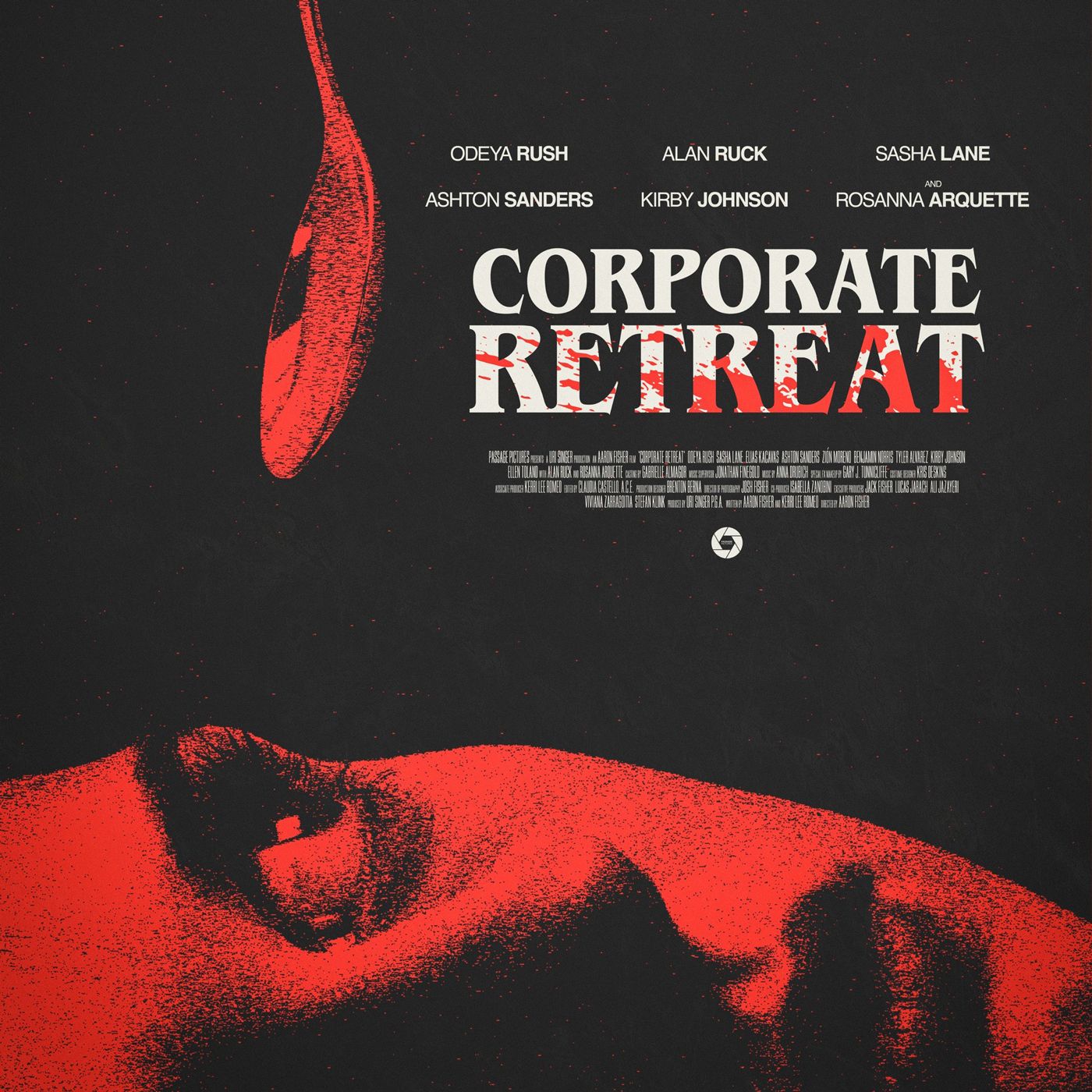
About this episode
Mike talks with Fisher and actress Ellen Toland, who plays COO Aubrey Johnson, about a one-room thriller in the spirit of Saw (2004) born from his father's 2008 financial collapse, blocking the carnage with chalk drawings and action figures in a backyard, Gary J. Tunnicliffe's practical gore, parodying summer-camp trust falls after consultants quoted $250,000, and a Brussels crowd that treated the premiere like a midnight-movie party.
Follow Aaron Fisher on Instagram and follow Ellen Toland on Instagram.
Transcript
Automatically generated, so expect the odd misheard name.
Hold your ears, folks. It's showtime. People pay good money to see this movie. When they go out to a theater, they want cold sodas, hot popcorn and no monsters in the projection booth. Everyone pretend podcasting isn't boring.
Turn it off. We're gonna have a nice romantic getaway. So what are we waiting for? You'll see. You brought me on.
A corporate retreat? It's okay, baby. Just relax. How can I relax, Cliff? Join in on the fun.
All right, everyone. Today we will make our way through a series of experiences that move us from the physical realm to the spiritual. Close your eyes. Breathe in and breathe out. Might be uncomfortable, but it's worth it.
You possess everything you need to survive. It's good to see you all again. Arthur? You freed me from the company, and I want the same. For you all.
What the hell does that mean? You know what? I've had enough of this shit. Did they lock the door? Watch out!
You'll choose. one person who will leave the human realm. We're not going to play whatever sick game you've come up with. You're wrong. No BL team building experience. Wait, what if he can feel it?
Do it. What is everybody doing? We want you transcendent. These bitches are crazy. Arthur's got you brainwashed.
I said shoot in the leg, not kill them. I got nervous. We will get out of here, physically or spiritually. I'm so excited! We're not done yet.
Thy eye, cast it from thee. I can't. Don't be a party pooper. Where exactly did you find this corporate treat? They were highly reviewed.
Hey folks, welcome to a special episode of The Projection Booth. I'm your host, Mike White. Today, I'm talking with some of the folks behind the film Corporate Retreat. First up, we're going to hear from a director, Aaron Fisher, and then one of the film stars, Ellen Toland. Had a great time talking with them, and I hope you have a great time listening.
Thank you so much. Enjoy. Aaron, tell me a little bit how you decided to become a filmmaker. My dad always worked in film, but I I think it was really when I was like 11 or 12 and it was the first time I saw 2001, a space odyssey that I really wanted to direct. Cause I saw that when I was a little kid and it blew my mind.
And then I begged my parents for a mini DV camera so I could just, I just shot a ton of silly videos and edited them. And it was like every day I was shooting stuff and editing and, I think that's how I got started, really. Other than Kubrick, who were some of your influences? I have a lot of favorite films. There's Bonnie and Clyde, The Graduate.
Those are always in my top five, top three favorite films. I love a lot of films and music, too, from the late 60s. Tell me about some of your short films. I made a bunch of short films. college student short films I think I always focused on this idea of feeling like an outsider because I made this film called short film called prom night where this kid is like he feels out of place on prom night and this is a long story but and then I made my thesis film and sort of like segued into making my first feature film, Inside the Rain, because I acted in it. And it was about me struggling.
It was like, you know, loosely autobiographical, like the feature film with me about my struggles with bipolar disorder. So that became a thing. Yeah, I find it very interesting that while you're doing all this writing and directing, you're also acting quite a bit. I would act in my screen films. And as I acted in my first feature film, where I played a character who's loosely based on myself.
And Inside the Rain came out in what, 2019? Obviously, there were a lot of things that happened in 2020 that probably put the kibosh on any sort of filmmaking at the time. But I'm curious, when did Corporate Retreat come about? I was thinking I wanted to make a horror film, because I just feel like horror is having a moment right now where there's just so much uncertainty in the world right now with technology and AI and politics and stuff that people are freaking out. And I think that's why they gravitate towards watching horror right now, because it's kind of a reflection of what's going on in the real world.
And then I was thinking I wanted to make a film on an indie budget. And I was thinking about how I could do that. I was influenced by movies like Saw, where it's like a lot of it takes place in one room. And I was thinking, how could I tell a horror story that takes place in one room? Because by doing that, you can cut back on a lot of the costs for company moves, like where you're paying for the time and... just to move from location to location with all the equipment and the cast and the crew.
Instead, if you're shooting in one room, you could be shooting most of the time instead of moving equipment. And yeah, and anyway, so I was thinking like, how can I have people stuck in a room? And then I was thinking about my father's financial collapse in 2008. He lost all of his money, he lost the company he made. And I know he had, I think, He had some bitter feelings about losing his company and everyone hating him because they felt like he was the one who screwed up and that's why the whole company failed.
So I was thinking like, what if my father in that situation, what if he was like a psychopath? And then I was thinking like, how would he get revenge on his former colleagues? And I thought he could trap them in a room. And the way he could trap them in a room is by holding a fake corporate retreat, which is basically the premise of the movie, Corporate Retreat. So in real life, my family is very close-knit, and my dad is a very nice guy.
Obviously, he's not a psycho killer. No, my dad was very supportive of the film. He was on set a lot. And also, it was funny. I introduced my father to Alan Ruck, and I told Alan Ruck, I said, your character is It's not based on my father, but it's inspired by my dad's situation.
So they got to meet, which was funny. Can you tell me a little bit about the casting process? Because you have such a strong cast overall. We had a casting director we worked with. But I'd like to give a shout out also to Uri Singer, our producer, who was amazing.
He was able to get a lot of connections to agents. And it was... made it very possible to get all these actors. So Uri was a big help. Also, I'd like to, while I'm at it, I'd like to thank the whole cast and crew is like excellent. And my older brother, Josh, is the cinematographer and he's amazing.
So I'd like to thank him. And, but yeah, casting, it was just like, it was just, yeah, really a lot of the, Being able to get the name actors was the producer, Uri. Tell me about Ellen Toland, because you've worked with her before. She's an amazing actress and a great friend. She plays one of the leads in my first feature film, as you noted, Inside the Rain.
I wanted to work with her again because I just think she's excellent. And I thought she would be great for the part of Aubrey in Corporate Retreat. Ellen Tolan has this quality of being very empathetic. And I felt like Aubrey's character could use that. So I thought that was a good match.
And yeah, we're good friends. We became good friends. We shot the film together, and then we went to film festivals together, and then we just started becoming just more in touch. Tell me about your co-writer on this. Carrie is a good friend and she's very, I started writing with her because we just had a similar sense of humor.
And we also, we met in acting school. We went to, we had one acting class together, but at the Barrow Group. And we just kind of, I don't know, we kind of have a similar sense of humor and we just started writing together. It was a good match. How did the story change as you wrote it and then shot it?
Things changed. because of limitations with the budget and locations and stuff, I definitely had to rewrite the script a lot as we went. But there was never anything that changed the trajectory of the plot and who survives and who doesn't. And none of that changed, but it was just certain, there's just certain things that were like limited by budget. And I was like, okay, I can't do this. How can I make this work?
And, yeah, and also, as I was, like, for example, I was also, like, once we had, when I was writing the script, I didn't know what the great room would look like that they're stuck inside of. But once we scouted locations and we found that location and we fell in love with that place, then I went back to the script. And then I was also using, I don't think I'm the first to do this, but I was using, in my backyard, I was using chalk. and drawing out rooms and the spaces, and then using action figures labeled with all the actors' characters' names, and just figuring out, because the whole movie takes place in one room mostly, I had to get very creative so it wouldn't be redundant shots of just the same blocking of the actors every time.
I wanted to help tell the story. not just get stuck in this idea of, oh, here's person A talking, here's person B talking. I wanted to have something more organic. So, you know, I played around with the action figures a lot in the backyard. And then even I even took photos of them sort of as photo boards. But also, you know, the actors on set would have better ideas than me sometimes for the blocking.
At one point they decided when someone gets shot, they were going to scatter and like kind of hide on the floor. And I hadn't thought of that beforehand, but it made a lot of sense. I was like, yeah, they would jump out of the way if they just saw someone get shot. So then I had to change the shots a bit on set instead of sticking to the original plan and it works much better. Did you have much time for them to rehearse and get to know each other or because this was so low budget, did you just have to throw them together?
We just had to throw them together because it's low budget, but everyone gelled very quickly on set. Like everyone really liked each other. Fortunately, they all became friends, good friends. And yeah, if I had the budget and, and stuff like I would definitely do, I'm a big fan of rehearsing. Like, If I can, I rehearse usually as much as possible.
Have you ever gone to a corporate retreat or did you have to do any research about that? No, I've never been on a corporate retreat. Carrie and I, my co-writer, we were thinking about, oh, I wonder if we could just pay one of these corporate retreat places to do one for us just to get... And I looked into it and it was like, you need to spend at least $ 250, 000 and you need. You need to be like from Apple or Google or whatever.
It was like really, just really big things. There was no such thing as a small corporate retreat where you could just pay $ 1, 000 and get a little mini thing. So obviously that was not in the budget too. So yeah, so I didn't do that. I just kind of made it up.
But I also... I was also kind of making fun of trust games and stuff that I played in summer camps and on school trips and stuff. So it's kind of like that. I have to ask you about your gore effects because they look fantastic, especially the eye trauma stuff. Gary Tunicliffe.
I'm not sure if I'm saying his last name right, but Gary, he's a legend and he's really good at what he does. He's a real artist. And yeah, almost all the violence in the movie is done with practical effects. And yeah, You can, and it, and they work really well. And the eye thing, it was actually surprisingly simple the way we got the eyes out.
Cause first they, I don't know if this is interesting or not, but like basically first of like, I'll just go through a quick step-by-step of how we did it. Like first they're just holding a spoon. We just gave them a spoon and they're holding it to here. you can't really tell that they're not actually holding it to their eyes, just like here. And then it, then we swap that out and it cuts, it cuts around, it always cuts around so that we can get deeper. Then we give them a spoon that's sawed in half so that it is like it, and so it goes like, it looks like it's like halfway in.
Then then it cuts away to like a puppet we had puppet faces of all the people taking their eyes out and when you actually see the eye coming out of the with the spoon it's like a glass eyeball and it's just like a puppet's face and you can't tell it's a puppet because we're we shot it all the way over like this so you can't it's if we shot the whole puppet face it might have looked fake but because we're like right here like you couldn't really tell And then they would go, Gary would take them aside for 20 minutes to his little area. And then he put the, the op, you know, put the thing over their eye to make it look like that there was no eye and had the optic nerve with the eyeball hanging off of it.
And then they just rip that off. And then finally we had them rip apart their shirt and tie it over their eye because when you cover the eye and make it look like there's no eye, if you show it for too long, it kind of looks like if you're shooting from straight on like this, it like can look like there's. A hole there. But as soon as I move like this and you can start, we can see the, the thing, the special effects makeup, like sticking out a little. So it's, so that's why we had them.
And also like in real life, I think people would cover their missing eye. Yeah. Yeah. So, yeah, so I don't know if any of that made any sense, but that's how we did it. And it was, and I didn't, also when I was writing the script, I didn't know how we were going to do it.
It was just when I first spoke to Gary, when we were looking to hire someone for special effects makeup, he just literally just walked, talked to me, talked me through the process. And I said, oh, wow, that's pretty, it's much simpler than I was imagining. No, sorry, no visual effects needed. When did you first see this with an audience? The first time I saw it with the audience with the film being finished was in Brussels at the film festival there where we had our world premiere at Biff.
People in that theater were very loud. They were chanting and screaming. But I think at Biff, I think they're known for that. But they were counting down with the film. They were yelling things like, I even heard a few horns.
There was a couple of people in the audience that were like, I'm like, it was really, it was like a carnival or something. It was really, it was wacky. Me, the cast was there and I was there and we were all like, oh my God, is this really happening? It's, there was a really funky audience and it was huge. It was a lot of people.
I've spent like all year so far, I've been like flying around the world basically to film festivals, like every other couple of weeks. Do you know what you're going to do next? It's too soon to say, but I am working. I don't know what I'm even allowed to say exactly, but I'm working with a writer who I think is really excellent. And I had an idea for something that's, it's kind of like something from Black Mirror.
And it's, I don't want it, but it's too soon to say what it's about. And I'm just working with this writer right now on a treatment. So hopefully that will work. we will make that film, but too early to say what it's about. Aaron, is there a good place online for people to keep up with you and your work? You can follow me on Instagram.
My Instagram handle is Aaron Cine and it's spelled like A-A-R-O-N and then C-I-N-E as in cinematic, like Aaron Cine. So Aaron Cine is probably the best place to go. Aaron, thank you so much for your time today. This was a real pleasure talking with you. Yeah, thank you, Mike.
Thanks for the interview. Obviously, I want to talk about Corporate Retreat, but can you tell me a little bit more about you and how did you even decide to get into acting? I'm from Texas. I'm the youngest of seven. A lot of performers and my brothers were musicians.
My mom was an actor. So I think it's a game of blood to want to make stuff. And I originally came out acting through dance. I was a dancer before. And I think around college time, I was like, do I want the life of a dancer or do I want the life of an actor?
And I chose actor because I felt like there was more longevity in it. But I do think dance probably informs me as an actor the most. What were some of your early roles like? My first role, I think, was in a short film with this great director named April Maxey. It's so exciting to book your first role.
I got to slap someone and really, it's nice to think about actually though, because it was just really simple then. So I think I'm kind of getting back to that place of just play. And when did you meet Aaron Fisher? I met Aaron right before COVID. We shot Inside the Rain right before COVID and That was my first lead and a feature, so it was a really exciting opportunity for me.
Yeah, and Aaron and I just hit it off and went on this journey. How is it working with somebody who's doing both the acting and the directing at the same time? Had you experienced that before? Yeah, I have experienced that. I think it's hard to juggle that.
It's hard to take yourself out of your performance mode into a director mode. I think Aaron was lucky in the fact that his brother was a cinematographer, so I think they had a good language for that for Inside the Rain. It would make me very nervous to do it. I feel like it's a really hard balancing act because, I don't know, you're just watching your face so much. Are you one of these actors that you're just like, no, I'm going to stay away from the premiere.
I don't need to see myself projected on screen that big. I think I'm like a 20 percenter. I can go see it and then I don't need to watch it again and keep dissecting it. And same with the monitor on set. I think it's okay to look at it, but it's just you don't want to start seeing everything from that perspective because I think you start tweaking yourself in a different way.
I think social media has already probably burned a lot of that too. Trying to keep as much sacred as possible. So when it came to corporate retreat, was it just a natural, like since you had worked with them before, it's like, hey, I have a part for you or did you have to try out for this one? He reached out and he said that he was thinking of me for something. He was like, could you just throw it on tape so the producers can get to know you as well?
And so I taped for, I think I taped for Amber too and sent those. And then like three weeks later, he was like, I love them. And do you want to come jump on board? And the cast was so exciting. And it's rare that you get to work with a bunch of people your age and get to hang out in L.A. for six weeks.
It's pretty special. It was really fun. Really fun. When did you actually shoot this? We shot it last summer.
So about a year almost to the date. That's got to be pretty typical, the long amount of time between, right? Oh, that's actually really short. Yeah, I went to something the other day and they were like, yeah, this is taking three years, especially for indies. You're trying to get the budget for coloring and editing.
And sometimes you just have the budget for the shoot. And then it's another whole haul afterwards. So you piecemeal it together. And yeah, so this was actually pretty fast to do festivals and then start doing distribution and stuff like that. So rare.
When you play a character, how do you find that person inside of you? First, I read it. I see what comes up initially. I like to memorize by writing out the lines so that they become as intuitive for me. Sometimes I'll journal as this person.
Sometimes I'll make a playlist. Sometimes I'll just run and gun it, see what happens on the day. have an idea of what you want to do and then throw it away the minute you start shooting. I don't know. It's different for every, everything you do. With this being an independent film, did you have a lot of time for rehearsals and getting to know the rest of your cast before you started shooting?
For indies, a lot of times you don't have that luxury. So we kind of just all jumped in and we were lucky that we had chemistry and we liked each other for horror in a weird way, like gore. It's like, It's vulnerable and a totally different thing because you can feel silly. So you're trying to make it as real as possible. And if you didn't feel comfortable doing that in front of people, it's...
So I had the luxury of knowing Aaron, so I was more comfortable and Josh and stuff. So there's familiar faces on set. But no, everyone was super professional and great. And yeah, it was easy, that part. It was fun seeing Kirby work.
She was beautiful acting, and I've always admired Sasha, so it was exciting to work with her, Ashton, Sion. Honestly, there was no one that everyone had a moment to really pop. When you had some good old-timers in there, like Alan Rock, probably more my age. Alan was a dream, so exciting. The other thing, too, is when there's like a A veteran that comes on, everyone gets buzzier, and I think that helps with fear and all those things.
So it was great working with them. When you're in a horror film, I imagine you have to go to some really extreme places with the screaming, the reactions, those kind of things. It must be nice to have that support network to allow you to get that big with a performance. Yeah, for sure. And I think music can really help with that.
I was listening to Patti Smith's Because the night over and over again, like a weirdo, because there's something about that song that makes you, I don't know, state of fear or something. What were some of your favorite memories from the shoot? We had such a great practical effects guy, Gary. And so seeing him in action, he's like a legend. So Tyler's open chest, eating grapes was a top, pretty funny.
Kirby's a contortionist, so she showed us some of that on set. We went out for a couple of dinners and stuff too. That was really fun to all just get to know each other. And hang out. And shooting in LA is, I've never gone to do that.
That was so fun. And yeah, I feel like that's the indie rhythm of it. You go to camp and you shoot for over the summer. And then you, I've had that upstate and in Massachusetts. So this is fun doing West Coast.
When did you finally get to see the movie with an audience? We got to see it in Brussels at the Biff Festival. It was so fun. It's like seeing Rocky Horror or something because they have all these traditions that they yell at the screen and they're also yelling in French, so that adds a whole other element. Oh, it was so fun.
Going to a genre festival with a genre film, there's... nothing like that because the audience is so game. And so they're screaming. So good. I can't remember. Had you done horror before this one?
I've been the beginning of a horror. I did mid century. It's even like, and that was really fun. That was another veteran actor. That's so good.
When they're a villain, they're very scary. It was fun to work with them. But no, I haven't really done... This was my first gore horror. I'm trying to remember how much gore you have to interact with in this one.
I mean, my eye. I witnessed a lot of the gore. I didn't have to partake. And Ashton had the hardest on this. Each gore... new level i was like oh poor ashton so sticky and.
So what's next for you i shot. Something in texas last fall and i'm excited for that to come out it's called deep eddie and then got a pretty cool ep on that which is link later and it was really fun working with a bunch of texas actors sasha was on that too because sasha's also texan and then i shot another thing in texas so we'll just see i don't know if these things are gonna be a A year out or two years. So it's always a gamble. Where's the best place for people to keep up with you online? Just follow me on Instagram.
I'm Ellen underscore Toland. I'm not on all the other things. Ellen, thank you so much for your time. This was great talking with you. Oh, lovely talking to you, Mike.
Good questions. Everybody seems to like me. Coming Tuesday, I feel better. Even my own eye looks good. Wednesday just don't go.
Thursday goes too slow. I like Friday on my mind. Gonna have fun in the city. She looks fine tonight She's all the time to me I've been my friend tonight I'll leave my head tonight I've got to get tonight One day I'll have Friday on my mind Who's up out this night once more? I know I'm nothing else that works more More than working for the rich.
Man Hey, I'll change that soon, hey Today. I might be mad Tomorrow I'll be glad Cause. I've got Friday on my mind. I'm gonna have fun in my city. Be with my girl, she's so pretty.
She looks fine tonight. She's all the time to me. Tonight, I'm in my bed. Tonight, I'm in my head. Tonight, I've got to get tonight.
Monday, I'll have Friday at my night. I'm gonna have fun in the city. I'll be with my girl, she's so pretty. I'm gonna have fun in the city. I'll be with my girl, she's so pretty.
More from The Projection Booth
Similar episodes across the network
Matched by shared keywords.
-
Episode 19: Nothing But Trouble (1991)
1 shared keyword: horror comedy
-
The Menu
1 shared keyword: horror comedy
-
Rockula
1 shared keyword: horror comedy