
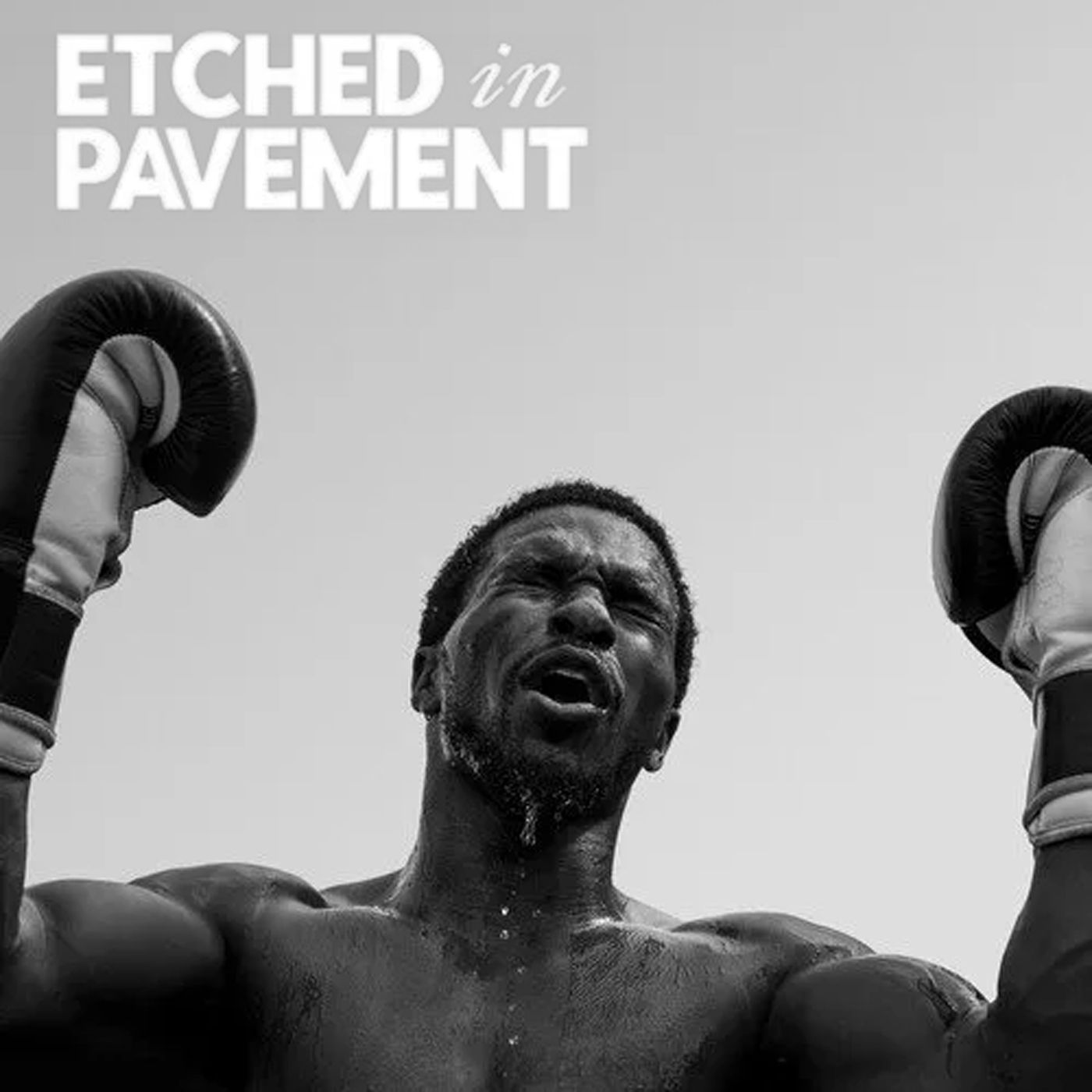
About this episode
Mike talks with Sippel about two and a half years of shooting, screening the first rough cut for his subjects in his living room, an $80,000 post-production budget raised through boxing gyms and Kickstarter, and Joe Louis's children speaking on film about their father for the first time.
Visit the film's official website for more details.
Transcript
Automatically generated, so expect the odd misheard name.
Hold your ears, folks. It's showtime. People pay good money to see this movie. When they go out to a theater, they want cold sodas, hot popcorn, and no monsters in the projection booth. Everyone pretend podcasting isn't boring.
Turn it off. How many people have you lost. On this road? On this road alone? Um.
One, two, three, four, five, five, six. That's how I. Look at it. I'm just doing what I can. What I know how to do.
I always grew up fighting. I grew up gangbanging. I grew up loving aggression. Because it was like, either I'm going to kill you or you're going to kill me. And that's the environment we grew up in.
We got shot at with over 100 and something bullets in less than 24 hours. You don't see nobody. You just see flames coming. Out the gun. In Southwest, we're the murder cap of America, bro.
Like, it's real out there. Out of nowhere, I see this PYP stuff. He's like, man, it's a gun's down, gloves up. Checked it out, there's real fights. There's so much for people to live for.
There's other ways to let out your anger. Right now, with everything going on, A message like this is something we need. When we lose in this room, we're not losers, we're learners. You're paying attention to them. How can I be mad after I just went out there and unleashed all this thing away?
How can I be mad? That hat and that ring, where I live for that. Shit, man. I don't know what my family left behind me, so I created my own thing. You understand?
Just getting to this point that I'm at now was just a dream. That's the best legacy to leave. That spirit of struggle and creativity and vibrancy continues well beyond the time you're gone. I think I am who I am because of my father. Joe Louis.
For all the leaders and everybody that puts in all this hard work for everything that they do in our community. What would happen if there was none of them? What would happen if I was to stop doing what I was doing? Chaos. I don't know.
I don't know how to explain it. Like, I'm going to leave my mark on this earth before it's all said and done. Hey folks, welcome to a special episode of The Projection Booth. I'm your host, Mike White. On this episode, I am talking with John Sippel.
He is the writer-director of the new documentary, Etched in Pavement. It is a discussion of some of my fellow Detroiters and about the legacy of boxer Joe Louis. Thank you so much for listening, and I hope you enjoy this interview. How did you decide to get into filmmaking? I've been doing art my whole life, more traditional.
And then I pick up photography. And then I went to school at College for Creative Studies in Detroit to pursue art direction and learning all facets of production. And from there, just kind of dove into making movies with friends and that all navigated into nonfiction storytelling. How did Etched in Pavement begin? What was the origin of this story?
In 2020, with everything that was happening in our country and the world at large, I found myself leaving the house with my photography camera and just roaming the streets of Detroit and meeting people and capturing their stories and sharing their stories and hope to find some sort of common ground in the, in this pretty politically charged time. And along that way, I met Dwayne Taylor and we just gravitated towards each other. And then one day he hit me up a few months after we met and say, Hey man, I'm going to start these guns down, gloves up events. And, Detroit. Do you want to come hang out, photograph, have some hot dogs and be part of the cause?
And that's where the whole rabbit hole started. It was like at the end of 2020. So it was getting right into like winter. So we had a couple, every other Sunday we had fights in Delray, you know, by the new bridge here. And then winter hit, the cold weather hit.
And it was like, wow, that was a really great experience. And then in the spring of the following year, he called me and said, hey man, we're doing round two. And we shut up and there was hundreds of people there from all walks of life. And I knew that what was growing was something special. So I assembled a really small crew that was already amongst the scene and a part of this and switched to video and went down the rabbit hole together.
Joe Lewis is such a symbol for Detroit, but we tend to forget what he represents. And this film really captures that and also just really captures the spirit. We call the fist the spirit of Detroit, but we forget about what the real meaning is behind it. Oh, yeah. And a lot of people don't even know that it's this.
When we're immersed in fighting a humanitarian effort in Detroit, there's no greater name than Joe Louis. And myself, when I started, I knew his boxing impact, but I didn't know that he changed the world, that he was a leading force in desegregating the U.S. military. He was the first person of color to play in the PGA. And so my hopes with this film is that there's Easter eggs of Joe Lewis, obviously, throughout this whole film and starting off the film. And then towards the end, it all comes together to coalesce into these young men carrying the torch, if you will, and featuring all of Joe Lewis' children speaking about their father for the first time ever on film.
And my hopes is that the seed is planted for people to dive deeper into Joe. and learn how important his legacy is and how inspiring it can be for so many. It sounds like your subjects were pretty open to you being part of their lives. That's for sure. Like I told you how I met Dwayne and then D Mike was just, he was there with his wife and his two young kids. And when you start a documentary, you interview people.
So I sat down with Dwayne for three hours and we just talked about life and where we're at in life and our intentions. And then, D-Mike, the next day, I met with him just as a fighter. It was nothing more. And because I was going to tell the smaller story about what was happening just in the streets via short film. And then D-Mike's story was resonating so much with not only Dwayne's story, but mine as well, and how we were all losing people to gun violence in the streets, to addiction, to mental illness.
And it was just It was a spiritual thing. We all came together and realized their thing was fighting, boxing, wrestling, and mine was storytelling. And so we were connected, and we are connected for life. We're brothers, and the kids are a part of my life. And yeah, it wasn't just subjects by any means.
It was we were in this thing together to try to move the needle in a positive direction. How much involvement did they have when it comes to the filmmaking? Or were you just like, okay, this is my bag. I'll show you the finished product. Oh, they were very much a part of it.
I'd like to say I wasn't a fly on the wall. You know, I was immersed, you know, and the guns down, gloves up, moving, they're building in the street. I was me and a lot of the members of the crew were a part of that. Not just playing the fly on the wall, but helping making it grow. And so throughout the process, it was just like, I was always around.
We're always hanging out. We were But then, obviously, the word legacy started coming up. And then, obviously, in the film, I'm there with his whole family. Dwayne has a lot of siblings. So then I became a part of his larger family.
And we filmed for two and a half years of principal photography. And spontaneously, they're like, hey, I'm doing this. John, are you available? Yeah, I'm available. Hit the streets.
But as far as how deep the Joe Lewis thing went, when I showed them the first rough cut, It was just me, Dwayne and D Mike sitting in my living room watching it. And to show someone their life like that was pretty unbelievable. And they didn't, they knew what we captured, but some things they forgot and other things they didn't realize and the Joe Lewis component. So it was a trip, man. Was there a point where you're just like, okay, I have to stop or I should stop.
But what was that point for you? It was pretty much, I felt like I had enough for the pieces of the puzzle and to dive into the edit, to tell a story. I knew that the film wasn't going to end with Dwayne's or the one big fight. It wasn't the Rocky story. So I knew that maybe I'm not exactly sure all the pieces of the Joe Lewis yet.
I know there's something deeper there, but I need to at least identify what we have before I keep filming. That kind of thing. Can you talk about the post process and who you worked with on that? I'm an editor as well, so I had that mind the whole time. And I knew that where I was at with my career, I wanted to keep everything local.
And I wanted to have someone that could bring a perspective that I couldn't bring to this. So I literally put a post out locally on Instagram saying, hey, what editors are out there? And I had Surprisingly, you know, almost 40 people reach out, had some meetings, and I just knew that Josh Beebe was the one. He's a Detroiter. He's incredibly talented.
He has experience doing documentary work, which is a whole different beast. Very quickly, this wasn't a job for him. He was invested. And all the funding for this film was completely grassroots. And we paid Josh.
It was an independent film. We reached out to local boxing gyms, did a Kickstarter, and we raised about $ 80, 000 for post-production and for an independent film. And they didn't owe anybody money at the end. They believed in the cause and what we're doing and the people a part of the film. So it was grassroots just as much as the movement of the story of the film as well.
When do you get to see this for the first time with an audience? And what's that like for you? The first time that I saw it with an audience, funny enough, was in the Boston area. It was at the Woods Hole Film Festival. It was a trip to have a Q & A afterwards and to have people asking questions that I couldn't even, that I never thought they would ask and talk to me specifically about like the music and things like that.
It was really beautiful, but nothing compared to a little less than two weeks ago. We brought it home. We had our homecoming in Detroit. It was at the Charles H. Wright Museum and we packed the house and there was strangers.
There was people, a part of the film, siblings. And it's hard to explain showing somebody that were involved, like their life. And all these people that are like, what's that film you're working on for four years? Here it is. And there's a lot of tears.
They really moved people. And then days following, just people messaging me saying it's still resonating with them and they're still thinking about it. So what more could you ask for? What's next for the film and where can people keep up with it? We have a very wide range digital streaming release October 13th.
It'll be available for rent and purchase on Apple TV, Amazon Prime, things like that. A lot of the Vizio TVs and those kind of platforms. There's going to be free platforms as well. There's probably a dozen opportunities. And then we're releasing the soundtrack, completely original score and soundtrack, original music.
It was written, so that's coming out fully on the 16th. But my whole goal with this was essentially if someone came up to me and they asked, how can I watch it? They'll be able to watch it. That it was widely accessible. We have a Spanish version as well.
The Southwest Detroit where we took place is predominantly Hispanic. So that was important to us. So at the end of the day, people Google Edge and Pavement, they'll be able to watch it. And how about you? Where can people keep up with you?
I'm around. I'm in the streets of Detroit with my camera. John Sipple, J-A-W-N-S-I-P-P-E-L on Instagram is kind of my day-to-day. I don't post too much on there, but you can keep up to date with me. John, thank you so much for your time today, sir.
I really appreciate this. Yeah, thank you, Mike. I appreciate it. Take care. Can you punch like a southbound freight train?
Tell me just one thing. Can you move anywhere like a hummingbird's wing if you need to? Ooh, that's fast. Can you bob and you weep and you fake and see when you need to? Well, you might as well quit if you haven't got it.
So you want to be a boxer? Can you pass the test? I can tell if you got it in you I've trained the best When you work and you sweat and you bet Cause you trained you a buzzsaw Then you near lose your mind When you find that your boy has a glass jaw So you might as well quit If you. Haven't got it. Put him in the ring, Joe, look at what you found.
We can use the fun, Joe. Pushing him around. Empty ropes and destroy his house. Put him in the ring, Joe, give the guy a chance. Let him do a stink, Joe, we can make him dance.
Put him to bits, then he'll call it grits. For sure, Joe. So you want to be a boxer, want to be the champ. There's a golden boy inside you, not a punched out tramp. If you listen and you learn, there's an honor you can earn in the pen here.
When you do see the crown, you're a king, not a clown or contender. But you might as well quit, if you haven't got it. Put him in the ring, throw something in a bunch. Let me have a sweet joke. Then we'll go to lunch.
Make it quite swift. Then he'll get that drip. Put him in the ring, Joe. Chicken on the cart. Let me have a wink, Joe.
Tearing him apart, that chick.
More from The Projection Booth
Similar episodes across the network
Matched by shared keywords.
-
117 - Colin Cantwell - Concept Artist - My chat with Sierra Dall, his long term partner.
2 shared keywords: documentary, legacy
-
65 - Rose Duignan - ILM Production Supervisor
2 shared keywords: documentary, kickstarter
-
19 - Joe Alves - Legendary Production Designer on Jaws and Close Encounters
2 shared keywords: documentary, legacy