
About this episode
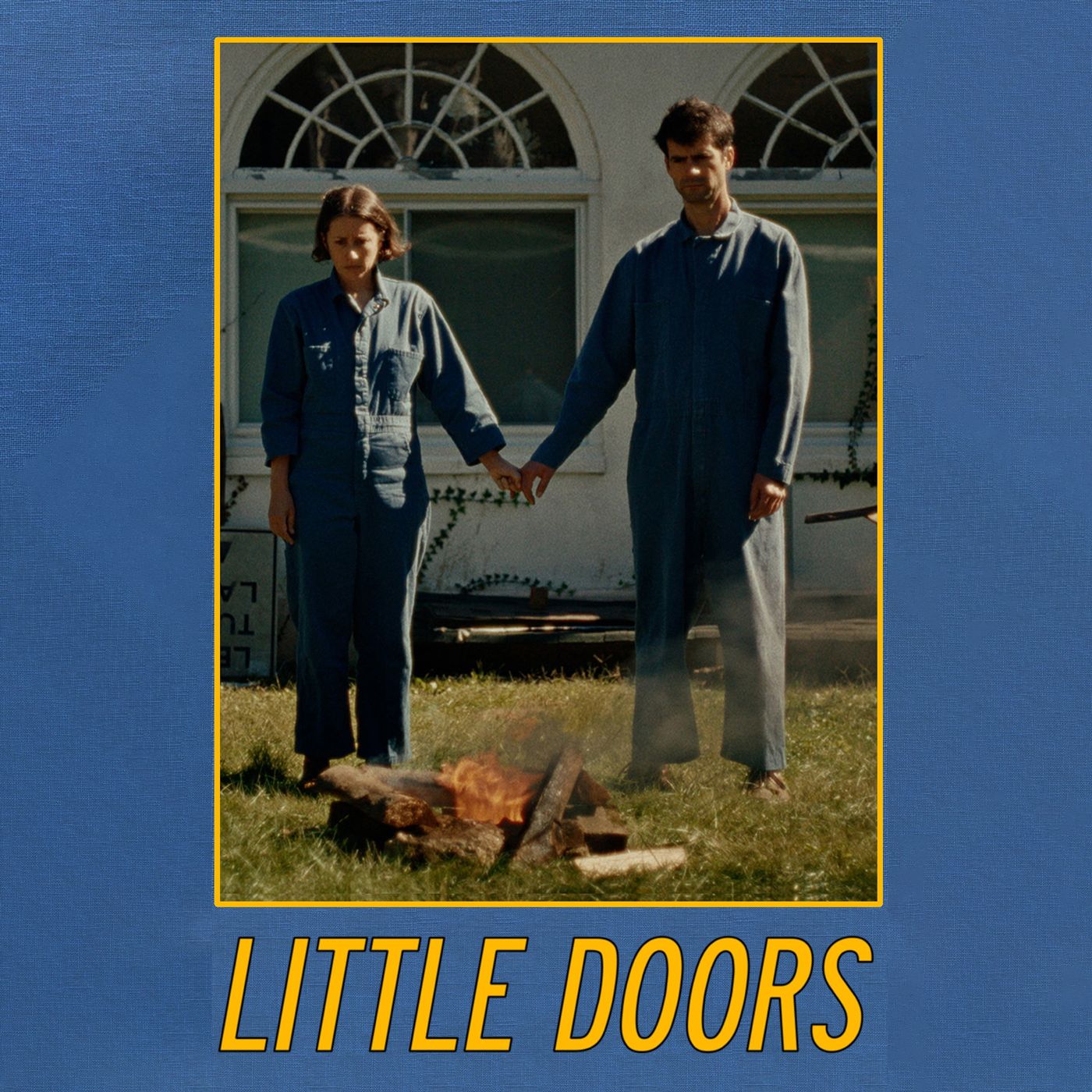
It’s the feature directorial debut of Oberbeck (Dad & Stepdad, the Reveries trilogy), who wrote, directed, edited, and co-stars in the film opposite his real-life wife, shooting almost entirely inside producer Eric Cotten’s mostly empty Baltimore house because emptying a room, Oberbeck found, was cheaper than dressing one. The same logic put both leads in identical blue jumpsuits for the whole shoot — sourced from a used-workwear tent in the City of Industry — so nobody had to track continuity or hire a wardrobe department. First-time film composer Lars Finberg, of garage-punk mainstays The Intelligence and Thee Oh Sees, scored the film from demos of his own next album, handing them over with “use whatever inspires you.” Oberbeck cut the whole thing from his bed, having no desk, while directing his own wife forced an early, blunt conversation about where “lead actress” ended and “spouse” began.
Little Doors had its world premiere at the Calgary Underground Film Festival before playing its US premiere at Fantastic Fest.
Follow Anthony Oberbeck and Megan Koester on Instagram for screening updates.
Transcript
Automatically generated, so expect the odd misheard name.
Hold your ears, folks. It's showtime. People pay good money to see this movie. When they go out to a theater, they want cold sodas, hot popcorn and no monsters in the projection booth. Everyone pretend podcasting isn't boring.
Turn it off. Is there any going back after this? Or is it the end? People are fleeing, leaving behind their homes. Where there isn't violence, there are ghost towns.
As cities are evacuated, communities abandoned, we have to wonder. What happens to the people who are left behind? Everything's fine. Okay. I don't want you to.
Worry. Okay. I don't know what this is. It's a little door on the side of your body. Hey folks, welcome to The Projection Booth.
I'm your host, Mike White. Today I'm talking with Anthony Oberbeck and Megan Keister. all about their new film, Little Doors. All about a woman who finds a door in her side and has to decide whether to open it or not. It's a wonderful little horror movie, I suppose, and I had a great time talking with Anthony and Megan all about their film. Keep an eye out for Little Doors when it plays near you or lands on streaming.
Enjoy. Can you kind of tell me how you got involved in filmmaking, both of you? Yeah, I was in sort of the comedy world for a long time. I always, I wanted to write and direct movies. And then out of college, I started, I moved up to Chicago and started taking improv classes as a way to meet people.
And I fell into performing. And then the next like 10 to 12 years, I kind of just performed live comedy, moved to New York with a bunch of friends. And it's sort of like live comedy morphed into like doing video sketches and then short films. And then I found myself back to filmmaking after a long time. It went from like, yeah, shorts to, I wrote and produced some comedy movies, Dad and Stepdad, and a trilogy called Referees, which is like a very experimental, weird comedy art film series.
I was involved with those sort of as like the creative head, but Not fully as director. And so this is my first wrote, directed, edited type feature. Megan, how about yourself? I've been doing comedy for an egregious amount of time considering how unsuccessful I am. There's sort of like the doing stand-up to acting pipeline.
I was forced to join the Screen Actors Guild for a pilot that never got picked up, etc. etc. So. Yeah, I mean, I do it when people ask me to do it, but I don't pursue it necessarily. I mean, I like doing it. I think I'm quite good at it.
But also for the purposes of self-preservation, I can't, like, try. You know what I mean? I hear it. Yeah, I saw some very familiar faces in the movie. I'm a big fan of Inspector Ike.
Oh, yeah. Inspector Ike Ribs. Yeah. So good. I was so happy to see, and I'm not going to tried to pronounce the gentleman's name, but to see him in the film, I was super happy.
Oh yeah. Uh, catch a coup. Where did the idea for little doors come from? I mean, the door itself, I think that was just sort of a like image that hit kind of out of nowhere. I had been approached by the producer, Eric cotton and his partner, me hollow Donald.
And they said, if you want to come out to Baltimore to make a movie, we'll finance it. So I sort of wrote a script. They had seen some of my short film work and reached out. And I wrote a script kind of based around what I had at hand. I knew it was going to be very, very low budget.
I knew that Eric had this big house we could shoot in, which myself being in LA, it made it very hard to spend a lot of time there to like set decorate and stuff and also like budget constraints. I was like, what's the easiest and cheapest way to make this look interesting. If you can't add stuff, why not just take everything away and set the movie in like a very empty giant house. Baltimore itself lends itself to like apocalyptic type scenarios and settings. Yeah, so it was kind of collecting ideas that worked within the constraints we had, and then that kind of just mixed with, I guess, a weird brain waiting for images to pop in and sort of put it all together.
This year I've been watching a lot of films from Fantastic Fest, and I think this is the third time that there is what I'll call the quiet apocalypse. Like a vague apocalypse is happening at the same time. It hasn't happened. It's in the midst of happening. And it just sets the world apart somehow.
But it feels very, let's just say it feels very familiar at the same time. Yeah, we are living through a quiet apocalypse currently. Yeah, I think maybe, especially the people making the movies are not quite aware of it yet, but like, Yeah, we went from movies that are like, what will it be like when that horror happens? We kind of skipped right ahead to just like, well, this is what we're living in. Right.
And we're like, we don't even have to deal with that part of it. That's the background. And I appreciate little things like, I don't know why everybody's wearing a blue jumpsuit. That was financial also. I was writing Meg's character sort of based on stuff I knew about her.
I mean, I also, you know, recreationally wear a blue jumpsuit and smoke copiously, so. It was kind of inspired by that, and then I had written my character as a locksmith, and I was like, oh, a locksmith would probably be wearing, like, maybe would be wearing a jumpsuit as well. And it clicked, but I was like, they could be dressed exactly alike. And then it also clicked that If we wear the exact same thing throughout the whole movie, we don't have to hire a wardrobe person or ever have to think about what day the scene is taking place on or switching out of costumes and keeping continuity. Yeah, I was wardrobe in that I had to drive to this pick-apart place in the city of industry where some guy sells used workwear out of a tent and buy our wardrobe.
Were the white resin chairs supplied or did you have to bring those as well? Oh, Eric, those just happened to be in the, I think I'd written it into the script as two of those white, the classic plastic white chairs. And then I got to his place and he's like, Oh yeah, we got a couple of those sitting around. How was it shooting in Baltimore? I imagine they have a lot of good film crews down there.
We had a lot of fun. There's a, I think a really good scene there. There's like a ton of talented people. Yeah. And it's one of those cities where there's not really an industry ruining people's creative impulses.
So everyone's just like down to make stuff. Yeah, they're doing it for the purpose thereof as opposed to doing it and just trying to become financially successful. We assume. We assume. Or they might be in it for the money, and they're just dumb.
I don't know. I knew some of them. That was one of the challenges, is we're going to give you a very, very tiny budget to make a feature, which already is a challenge, and then also... Right out of the gate, you have to take some of that money and fly yourself back and forth to Baltimore to like meet crew and scout locations. But luckily, I knew, you know, a lot of those people were friends of friends and had seen previous stuff I did.
So everyone was willing to jump on board and make this movie. Yeah. And everyone was incredibly good, especially the. the woman who did sound Camilla was the most professional sound person I've ever worked with. Yeah. My entire, I just want the record to state a lot of sound people will be, you know, there'll be a car outside and they'll just say, roll.
She won't let you do that. We got to wait for the car. Yeah. Tyler Davis, DP. Can't say the names.
Yeah. With this being such a quiet movie throughout so much of it, the music is so important. Can you tell me about the score? That's, Lars Finberg, currently of the band The Intelligence, which is his band, formerly drummer of DOC's, which is a big West Coast psych punk band. Formerly my ex-boyfriend, which is interesting because now Lars and Anthony are like best buds.
So it's kind of like, it's extremely. Modern, man. Are you a throuple now? God, I hope it never comes to that. No.
We're two couples linked by me in the middle. Right. Me and Big now are a romantic couple, and then me and Lars are a creative couple. Lars is great, and this is the first movie that he's ever scored. So it was a very fun process.
He sent me basically work-in-progress stuff of the next album that he was working on, and it was like, use anything you want, or if anything inspires... anything you want so it was like yeah me having never directed a composer and then him never having scored a movie it. But then it turned into a magnolia we got a magnolia but not as long how. Was it directing your first feature pretty easy i. Thought he did a real good job i didn't know how the fuck it was gonna go it was. You know it was nerve-wracking and I'd done, yeah, I'd like produced or like wrote, produced, starred in a very low budget comedy feature that was like very heavily improvised.
That's Dad and Stepdad. And then me and my buddies made this trilogy of like weird experimental comedy movies. So I'd been sort of at the head of like bigger projects. But yeah, I realized that Even if you're at the head, if you're collaborating with people, it's so easy psychologically to distance yourself if it ever gets scary. If there's ever a moment of doubt, I just be like, oh, well, it's their movie.
Like, I'm just along for the ride. Were you able to disconnect at the end of the day and actually have like a I don't know if you have a regular marriage, but like actually not talk about the movie for a little bit? No. Let me answer your question. No, because we're also staying in the same house we were shooting in.
And A lot of things that we were shooting like day for night. So there was just like constantly blackout in the window. And so, I mean, that helped, you know, my performance in terms of I'm supposed to be playing someone who's losing their fucking mind. But no, the only like respite we had was there was a. TGI Fridays down the street.
That had 25 cent wings on like a certain day. And like, we were just always looking forward to going to the TGI Fridays. Yeah. Monday nights was like Monday nights. Yeah.
Yeah. We pretty, we, we did figure it out kind of early on, like before we started shooting, I was starting to panic and going through the, like, you know, cataclysmic thoughts and, and, I would be, I went ahead to Baltimore first, like in the week leading up to the shoot and was just like texting Meg constantly, all good. The self-doubt and all the like, we're fucked. This movie is going to be so bad. What the fuck am I doing?
I can't believe, oh my God, this is. And she finally one day was like, hey, I either have to be your wife or your lead actress. If I was someone, you know, if I was a random actor you hired, you wouldn't be constantly texting them about how bad this is going to, like, she was like, you gotta. The emotional labor. I can't be there.
Was a little, a little much. We chose, we chose, yeah, we went with actor over wife, I think, when it came down to shooting. How long was the actual shoot itself? 12 days. It was five and then two off, five, two off.
And then two extra days. And then about a year later, we went back and shot like three additional days. Yeah. While we were shooting it, I was like noticing that he wasn't really getting B-roll. And I was like, maybe that's a stylistic choice.
I don't want to rock the boat. I'm just the actor, you know. Then it turned out, yeah, we did need B-roll for sure. I mean, honestly, like I said, it's not that I had no expectation. Obviously, I hadn't worked with him in this context before.
But I thought that he did a really good job of, like, taking care of everything. Or, you know, like, a good job of his job. Considering how, like, nervous and, you know, neurotic he was before we started filming. Once I was actually there, you know, yeah. It was a.
Oh, go ahead. Say, how was it directing yourself? Pretty easy. Maybe there's something I didn't do that I should have been doing, but it, I've been, I've acted a lot for so long. And I think especially doing improv on stage, you sort of learn to split your brain and be like acting.
And then also sort of reserve part of your brain. That's like aware of what's happening and like aware of what the show needs. So it feels easy and kind of natural for me to be acting in a scene. And also part of me is like, I'm aware of what this looks like. And yeah.
Are you like watching dailies or are they editing while you're putting this together? Like any creative thing or any big thing that you take on? I think people want to be thinking about it more than they have to. And so like so much of your brain, you think it's like good that you're firing on all cylinders, but so much of that is actually just unnecessary overthinking. And so it kind of helps to like as an actor to just be like, I don't have any choice except to just like let my instincts dictate what's happening.
Did you edit this yourself? That sucked. Edited it in bed. Okay. Because he didn't have his own desk at the time.
And I'll tell you why. Because there was an area of the kitchen that was just. Full of trash. For about two years, there used to be a cactus. The cactus died.
And there was a big pot with the dirt still sat there with detritus around it. And perfect place to put a desk. For some reason, it didn't occur to us until right after he was done editing it in bed that he could have been sitting at a desk the entire time. Now he has a desk. Yeah.
In theory, I love editing and I love the idea of the images coming together, but I hate being in front of a computer and it just feels so tedious to me. Tell me about your dance choreographer. Same as the intimacy coordinator. Didn't exist. Yeah, I got no choreographer.
Well, yeah, just my own instincts. You know, I like to do physical stuff and it's fun for me to get lost in that stuff. And then Eleanor Pienta, who plays the woman at the end, she was part of a comedy dance troupe called Cocoon Central Dance Team in Brooklyn for a long time. And her whole thing is dancing in that way, in this kind of good but also crazy, funny, weird way. And I think I had written it I hadn't even put it to get like, I'd written it in that my character kind of gets fixated on this weird dance and I'd already written it for her to be the person at the end, but kind of late to the process was like, Oh yeah, duh, this is perfect.
Was there a fear of getting too close to this with you being the writer, director, editor, star of this whole venture? On one hand, I love collaboration and I, I, I believe in collaboration a lot. On the other hand, I'm a big proponent of like an individual vision or I guess even if it's like a group collaboration. like letting letting that be what it's going to be and not getting like noted to death or like needing to do things the right way or i'm trying i'm protect when i'm working on something i'm protective of the vision from people who might try to make it quote-unquote right. I like things that are done quote-unquote wrong and fucked up. That's, yeah, I think I'm very protective of letting things be wrong and weird and unique.
It was scary. I was, and I was aware that I was like, this is gonna be a thing where it may be off-kilter or weird or there might be moments that are like clumsy or whatever. But I was like, this is going to be the thing that's as much as possible just comes from my brain. So I'm going to try to do as much of it as I can, like isolated. And yeah, just sort of let it be what it be.
When did you guys first see this with an audience. At Calgary underground film festival earlier this year? That was our, it played good. Yeah, it was fun. It was, yeah, that was our world premiere and our, our, First time seeing it with an audience.
Played there and then pretty much right afterwards we found out we got into Fantastic Fest. So we kind of had to hold everything and let Fantastic Fest be like the U.S. premiere. And sort of like unofficially like the next big... Yeah, we couldn't really play anything else until then. We also are going to get distributed by Yellow Veil, which we've known since Calgary... but we haven't officially announced.
So I don't know if that's legal to put in there. I mean, not legally, but like, yeah, we're waiting. We got to do the official like deadline announcement or whatever, but. Oh my God, we're going to be in deadline. Yeah.
And then now we have a bunch of stuff lined up for the fall and like from here going forward. But do you know what your next project is going to be? I'm finishing a script right now that I wrote for me and my, friend who I made dad and stepdad with. And I'm trying to get started on a script for Meg and a couple other friends. And I'm sort of halfway through a script that would be just me and Meg again that I want to shoot.
We have like a huge collection of old Hi8 cameras and VHS cameras because Meg collects a lot of junk and odds and ends in her line of work. I have a garage. Yeah, we have a garage full of stuff. Well, I hear there used to be a corner of the kitchen that was filled with stuff, too. Right.
Yeah, now that junk is in the garage. Meg, how about yourself? What's next for you? Oh, you know, I'm going to continue to do comedy, a little fanfare, sell garbage on the internet. You know, just doing my thang.
Where can I keep up with you guys online? We both have Instagram. We do. That's the law. Yeah.
I'm at Anthony Oberbeck. My name, because I joined Instagram late. Once people realized you should just use your name as a handle. And Meg is feral because she was on social media early when everyone was like, our handle should be a weird thing. And now she's stuck with it.
I don't mind it. But also mostly, yeah, the only thing I really post on Instagram is like pictures from the Craigslist free section. Megan, I grew up on a street spelled K-O-E-S-T-E-R. and everybody could not pronounce it, could not agree on the pronunciation. We called it Coaster. A lot of people called it Keister.
How do you say your name? You've heard people call it Keister. Okay, I call it Keister, but I always thought that, you know, my father's side of the family is wrong. I mean, I'm stuck doing it, but it's improper. All right, I will make sure to call you Megan Keister then.
Yeah, yeah, that's technically my name. Again, I loved this movie. I had such a fun time watching it. This is one of those where I'm just like, I can't wait for more people to see this. I just thought that it was so much fun.
And it just hits me in the right spot. Just that kind of wry humor and just the perfect amount of weirdness. It was so much fun watching this movie. So I really have to thank you guys so much for making it. Yeah, thanks, Mike.
That's great. Enjoy yourselves. Thank you so much for getting up early and talking to me. I appreciate this. Oh, yeah.
Thanks, Mike. Bye. You can give your love to another You can break their hearts like before You can make me cry till I run dry But don't you knock on my door You can wave to me from your window And call me names like before You can throw yourself down at my feet. But don't you knock on my door. Ready to start again but this time it won't be easy if you knock on my door you'll have to break it in you can send me pretty letters with love forevermore you can give me a ring on the telephone but.
Don't dare knock on my door. This beating of my poor heart tells me you're ready. To start again. But this time it won't be easy. If you knock on my door, you'll hurt the brain. .
More from The Projection Booth
Similar episodes across the network
Matched by shared keywords.
-
Hairspray (2007)
1 shared keyword: baltimore
-
Episode 1: When You're Lost in the Darkness
1 shared keyword: apocalypse
-
30 - Walter Murch - Sound Designer / Editor / Director / Legend of Film
1 shared keyword: apocalypse