
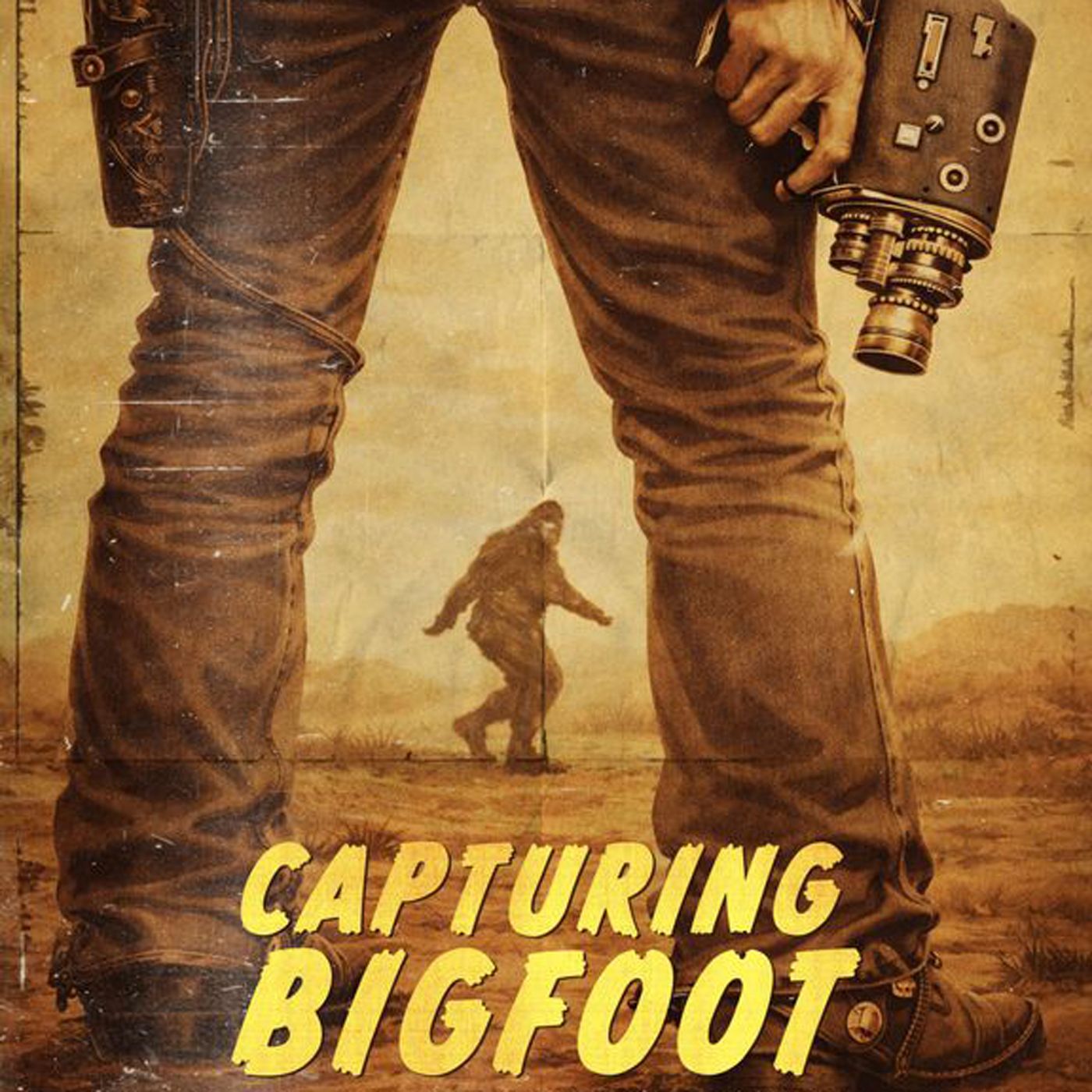
About this episode
Mike talks with Evans about the email from a colleague that started it, 130 interview tapes from researcher Greg Long, how Patterson's son Clint became the film's emotional heartbeat, watching the new footage on camera for the first time, being shut down by a bank president mid-interview, and why Evans pulled the film from festivals to protect its secret.
Visit the film's official website.
Transcript
Automatically generated, so expect the odd misheard name.
Hold your ears, folks. It's showtime. People pay good money to see this movie. When they go out to a theater, they want cold sodas, hot popcorn and no monsters in the projection booth. Everyone pretend podcasting isn't boring.
Turn it off. This is gonna change everything. My dad, he was hunting for Bigfoot. We have an expedition forming right now. It's a wild story.
The goal was to prove that Bigfoot existed. We came around the bend in the creek and there stood a big, hairy, human-like creature. This image has become as legendary as the footage of the first moon landing. It exploded on the American scene. It went viral before the word viral existed.
It was in movie theaters around the country. Every one of them was sold out. Al Diattoli was the promoter. He made hundreds of thousands of dollars. He f * * * ed my family out of a bunch of money.
This is a story about money and greed. Was this all a fraud? I just want the truth known that it was a fake. He's a f * * * ing liar. We couldn't do that with a costume in 1967.
Maybe you can't find a hoax because there isn't one. Everyone close to us felt it's damaged their lives. My mom disowned me, and it's over, that's all. I don't want to talk about that. I think there's fear.
There's some prominent people in this community. Some real nasty things went on. They wanted to protect the film. He threatened me a lot. He had enough power to have me bumped on.
They're shutting us down. All right, start packing up. What would it take for you to accept the truth? It would have to be something major. Hey folks, welcome to The Projection Booth.
I'm your host, Mike White. Today I'm talking with filmmaker Mark Evans about his film Capturing Bigfoot. It is a deep dive into the enduring mystery of the Patterson-Gimlin Bigfoot footage clip. I know you've seen it. We all have.
You know exactly what I'm talking about. Now you're going to hear all about what happened behind that legendary 1967 film. The film is absolutely remarkable. There are interviews with eyewitnesses, Teresa Brooks and others that were close to Roger Patterson. The film premiered at South by Southwest earlier this year, and then something mysterious happened to it.
Ooh! It's going to be streaming exclusively on Amazon Prime Video on October 20th, 2026, which I found out is Bigfoot Day. So happy Bigfoot Day and enjoy this interview. This is not your first rodeo. You've been making documentaries for years.
How did you even get involved in filmmaking? Yeah, my film school was essentially my first project, which is where I caught the bug. Started a project in early 2010. Previously, I wasn't in film, wasn't in documentary, was working a job I didn't like. And my older stepbrother, though, was somebody that grew up knowing that he wanted to be a filmmaker.
And he moved out to L.A. After college, sweeping floors and all that kind of thing. And he made a movie, and I think it came out in 06, called Americano, that had Joshua Jackson starred in it. It was one of Dennis Hopper's last films. And then my brother kind of pivoted into commercials.
I quit my job, started hanging around, learning how to edit on some of his commercials. And then in January of 2010, my stepdad, his dad who essentially raised me, passed away. And that was at the same exact time as, if you recall, a big earthquake in Haiti that killed a couple hundred thousand people. And so we're home mourning the loss of my stepdad. And on TV, we're watching the images in Haiti.
And there just felt like some sort of a call. And I just had this idea, why don't we. Go down there? The naive thought of let's go, maybe we can go help with our cameras or something. And that project we finished finally.
We're still kind of working on it, but it's pretty much done, but 15, 16 years. So that, but that was the film where I learned how to shoot, learned how to edit, fundraise. Again, like I said, that was my film school, but it's also where I just caught the bug and thought, I want to keep doing this. I like telling stories. And this format, the documentary format, was making a lot of sense to me.
And from that point on, I was just looking for projects, looking for stories. So that was, what'd you say, 2010? That was 2010, yeah. Okay. And then...
15 years. The Glamour and the Squalor comes out in 2015? Yeah. So that started... That was almost a five-year project for Plus.
Because September of... 2011 is where I had the initial idea for that to be a film. I was listening to it. It's about a radio DJ named Marco Collins, who was instrumental in the nineties for breaking the music that came out of Seattle. And that, yeah, that idea came from a radio show.
It was a 20 year anniversary of that station. And all the stories that the DJs were telling were just awesome stories. And that was the music I grew up with. Loved that music. And so that's where that started.
Can you tell me about Cow by Bear? I can tell you a little bit about Cow by Bear. You've done your homework. I guess I mentioned it maybe in my bio. But Cow by Bear is a still-happening dining experience experiment that is... run by the now world-famous Chef Bear, who, you know, depending on who you ask, it's a chef in a bear suit, or it's an actual bear that learned how to walk and cook, and serves now 20 people on Friday and Saturday night in San Diego for a while.
It was also in Seattle, it was in Savannah, Georgia, and we haven't told the full story of how all that came to be, but Someday that might actually be some sort of documentary. It was meant to be a mockumentary, and then it became a real thing. And it's still going over a decade later as well. How do you choose your subjects? Because you seem to be, I don't want to say all over the map, because I'm sure there's some sort of logic, if the logic is just you.
Yeah, I think it's the logic is what's the through line. It's just that it's my interest. And so. do realize the the projects certainly that have become feature films at least that i've directed so that'd be the glamour of the squalor clay dream the diamond king and now capturing bigfoot there is some sort of personal connection that stems from my childhood in each one of those the glamour of the squalor was the music clay dream was these characters that will vinton and his studio created in the 80s and 90s like the california raisins and the i guess that just these claymation characters, the domino pizza noid. And then The Diamond King was a movie about the artist, baseball artist Dick Perez. And that started with my son looking through my old baseball cards.
We came across these cards called the Donruss Diamond Kings that Dick Perez painted and made in the 80s and 90s when I was collecting cards and just thought, what's the story with this artist? And found out he's got a great story. And maybe it's worth pursuing as a film to kind of tell the history of baseball through his work and his life. And that's what that film became. And then The newest one, Capturing Bigfoot, I was never intending to make a film about this subject, the Patterson-Gimlin film.
The film happened because this new piece of footage that had been locked in a safe for 50 years somehow found its way to me. But when it did find its way to me, there was an interest because I was born in Yakima, Washington, where that story takes place. And my dad worked for a construction company when he was in his 20s, where a lot of the story kind of took place. And so he told me stories about this when I was a kid, about this famous Bigfoot in the Patterson-Gimlin film. So when this new footage that's at the heart of our film got to me, there was already this interest of, yeah, I kind of know a little bit about that story from when I was a kid.
Somebody else pointed out to me, shout out Jeff Gilbert, who I think is maybe the best documentary editor there is. A friend of mine, he actually edited The Glamour of the Squalor, but he said, He can draw a through line in all my films to the underdog as the protagonist. Somebody that maybe has, whether it's a chip on their shoulder or just has a lot stacked against them. In some ways, I see myself that way because I'm a bit on the outside of things. I'm not making films like in Los Angeles.
So maybe I could feel that way a little bit. I like those underdog stories. That makes sense. With Yakima, Washington being the Palm Springs of Washington. Yeah, exactly.
The Palm Springs of Washington. Now, did you catch that sign or did you already know that slogan before? Oh, no, I caught that sign. I was just like, that's pretty hilarious. I love that.
I was going to say maybe when it comes to the weather, but I don't even think you can say that because Yakima gets a lot of snow and Palm Springs doesn't get snow. I like that you're part of the documentary. I hear your voice. I see you a little bit, but this story is not about you. But I want to know so badly now that you say it, how did that footage get to you?
Pure chance. I got an email in June of 2022 that I'm trying to think of what the subject line was. It was like questioning about a film that is almost 60 years old or something like that. And it was a woman named Teresa Brooks. I didn't know Teresa, but she teaches at the same college where I teach film.
She's in a different department, but she knew that we had a film department. And her initial question was really, can you help? Does the film school have an ability to project this 16 millimeter film? She was very worried about it getting damaged because it was so old. And she wanted to see what was on it because she hadn't seen what was on it.
And her family story from when she was little was always that this was either related to the famous Patterson-Gimlin film or that it was that. But certainly that her dad and her uncle were involved in that whole story. But those weren't names that had ever been linked to the Patterson-Gimlin mystery before. These would have been new names. That was the initial email was just, can you help me see it?
We didn't have that access, but I had just got done scanning a bunch of 16 millimeter footage from my previous film, Clay Dream, with a company called AV Geeks out in Raleigh, North Carolina. And so I was like, hey, why don't we send it to my guy Skip over there? And yeah, you can see what's on it. And so we overnight it and Skip gets it scanned. And then we see this film and it's not, certainly not the Patterson Gimlin film, but it's got a lot of similarities and the date code on the film is from a year earlier.
So it just raised a bunch of questions of what are we looking at here? And so that mystery and just that question of let's find out what this is and what it means and how it's linked to Roger Patterson and the Patterson film, that was the initial spark. And then again, you combine that with the stories that I heard as a kid from my dad And it was just like, this is something I want to pursue. But what's funny was that I started both the idea for my movie, The Diamond King, and this email from Teresa were both June 2022. So the fact that I made and released The Diamond King, which came out, let's see, that was released in January or like April 2025.
So made that film and released it while making Capturing Bigfoot. which goes to show that I wasn't 100% focused just on capturing Bigfoot immediately. It took me a little while to be like, figure out, yeah, there's definitely a story here. I want to make this because the biggest thing there was these characters I just loved. These cowboys from Yakima, Washington, living and dead, were just awesome. And then as I'm trying to piece the mystery together, that's where it became.
I remember one day telling my wife like, If I was smart, I'd be focusing all my attention on this project. And it wasn't long afterward that became what I started doing. You were talking about how you had heard of this footage and stuff before. I kind of grew up with it. I think I'm a little bit older than you.
So things like In Search Of, those kind of things, it was all over the television. And obviously you point out that this is such a part of pop culture and has been for decades now. But what was the first time where you're like, oh, that's the big footage? My awareness was mostly related to just the pop culture of it. Born and raised in Washington State.
I lived in California and San Diego for eight years, but have been back here now for quite a while as well. And so you can't escape it. It's on almost every single car. I swear has not just Bigfoot, but like the Patterson Gimlin Bigfoot pose. The famous what's called famous 352 frame 352. the stories that I heard as a kid were my dad and the topic of Bigfoot would come up and he would kind of, Oh, I know the deal with that famous film.
And I realized as I made the film, like he got some of that stuff, right. He got a lot of it wrong, which is the case with rumors, which is all he was hearing at the time. But yeah, but I, I can't say that I really had watched those shows. Certainly once I started making everything, I, and get my hands on just from a research standpoint so I would know everything that's ever been said on the topic, which is always my first approach. If I'm going to work on a project, I need to know everything that has been screened or made or written about it.
So that was really a lot of that first year. I started doing some interviews and everything, but even those were more exploratory. Just those early interviews that I did, we ended up reshooting those later with those same people because they were, in fact, more of just kind of research. That's a steep learning curve to have all of those. And I'm not just saying cryptozoology or whatever, but it's just like all the years of things that had gone on around that footage and just all of the echoes throughout history of that footage.
It's just, that's a lot to take on. And you compare it to the Zabruder film, rightly, because it's just such an archive. But it's interesting that you're talking about getting this footage transferred over, the footage from your co-worker. That was the thing when they were talking about even the Patterson-Gimlin film. I'm just like, where did they get this developed?
Is there more? Are there outtakes? What's the rest on this reel? I just want to know so badly. There are certainly outtakes.
I can talk about outtakes for our film. But then outtakes on either one of the... There is some missing. There is a missing second reel with the Patterson film that pretty much went missing immediately. And then even the famous reel, That original film has been missing now since the 80s.
It was with an investigator, Rene DeHinden, who's a character in our film. And he probably, I don't want to say he stole it, but he probably kept it at some point after getting it in the 80s. And he's been gone since the late 90s, I think, but his sons have all of his old stuff. And then there was this missing reel. So actually, when I got this email and she was explaining what it was, I thought it's probably going to be one of those two films those two reels and so when it wasn't that was obviously very interesting and then what we what in the film the first time you see this new footage you see the whole thing which is about it's about 40 seconds or so and that's all there is on that and then when it comes to our film we have a three and a half hour cut early on and not even early on an advanced three and a half hour cut where if you watch it it was like oh this thing's actually moving pretty good And there was talk, so are we going to make this a series or is it going to be a standalone feature?
And ultimately, we decided on a standalone feature, which meant we're going to have to do a lot of cutting. We have all these deleted scenes that I'm sure people that are really closely related to the Bigfoot story and the Patterson-Gimlin story are going to be wanting more as it relates to proving stuff with this new footage. And so we have a lot of deleted scenes related to that and just related to everything, really. There's so much great material. So those will come out on a Blu-ray.
It'll come out. We'll release those at some point here in the next six months or so. You just make a list of here's all the people I need to talk to and how does that list start to expand and how are these people to track down and actually get in touch with and how reticent or open are they to speak with you? Sorry, that was like six questions. No, yeah, it's a good question though.
So at the beginning, we have this film and that's what kind of launched this project and just trying to find answers to that question of what is it. And so that starts with Teresa Brooks. Teresa's both her father and her uncle who were involved with this had both passed away. So obviously we weren't going to get access to them, but their norm, Teresa's dad, his best friend was still alive and he's actually since passed away. And he kind of claimed to be the only person that they ever talked to about this.
And so even before I knew that we were making this film, I did go out and interview with, did an interview with him, which I'm so glad that I did because like I said, he was, he was, he passed not that long after that. And so that was a big interview just to get that on the record and make the connection between some things. I read a book called making a Bigfoot, which I, came out in 2004, written by Greg Long, who was also a subject in our film. And that book was. Really controversial in the Bigfoot community.
But Greg's research, nobody would have really done the level of research that he did on this story, where he spent five years interviewing everybody that was close to Roger Patterson, friends, family, his brothers that. Are no longer alive. And he recorded... audio of all those interviews. And so I connect with Greg Long, did an interview with him, and he mentions that he's got these audio tapes, I think about 130 of them that were all 30 to 60 minutes. And he said, listen, you can have these.
And so that was a big part of the research is not just reading his book, but hearing all the raw materials. And there were some really important connections made between this new mystery film and Roger Patterson's and the Patterson film that were in those tapes that Greg Long would not have known that was pertinent information because he knew nothing of this mystery film. But in different contexts, there were some amazing things that came out of that. And so then that's when we knew that there was a film. I took it to XYZ Films, my producer there, Tamir Ardoan.
He was really excited about the project, had his sizzle reel, I think, at that point. And then there was just the archive, the archival that's already out there. There's a couple of websites, one including the Sasquatch archives, that has done a really good job sourcing and putting up content related to Bigfoot, but a lot of Patterson Gimlin film there. So I knew, okay, there's actually a lot of archival material. We're going to have to probably figure out how to get the original versions of these things so the quality is as high as it can be.
But it exists. And so that was enough to think there's a project here. And then not that long after, we connected with the Patterson family, which was not something that we thought was going to happen. We just assumed we're doing this project. They're probably not ever going to participate because Roger Patterson's widow, Patricia, had never done an on-camera interview.
She had never participated in a documentary before. And then there was three kids, Clint, Brad, and Sabrina. And same thing with them. And they had never appeared in any sort of project. And so we just assumed they don't want to talk about it.
That's that. I still have a lot of family in Yakima, Washington. My uncle lives there. And I thought maybe he might know how to get in touch with this guy, Vail Thompson, who was Clint Patterson's cousin. He was a nephew of Roger Patterson.
And I knew that he was involved with this story. He was somebody that kind of when they made a documentary that included the Patterson film, he was one of the people that helped take it around the country and show it to sold-out audiences. And so I thought, why don't I start with him? Maybe he'd be interested in being part of this film. And if so, maybe he is our connection to his family, the Pattersons.
And so we met with him. We met at a Sherry's or a Denny's or something. He was my producer and I. He was just kind of checking us out. And we hit it off pretty well.
And so he said, hey, I want you to get in touch with Clint Patterson, my cousin. It's Roger's son. And he'd like to talk to you guys. And so what we didn't know is that for about the eight years prior, Clint had wanted to tell his story. He'd wanted to get out under some of the things that he felt were really holding him down.
And so us making this film, especially with this new mystery film, it was this great opportunity for him to come out and tell the story that he had been wanting to tell. And. When we got Clint on board, that. Opened up a lot of doors. There was people that probably would have been a little bit more skeptical to talk to us had Clint not been part of the project.
And ultimately, that leads to his mom. It leads to Bob Gimlin. It leads to all kinds of other people that, again, we probably never would have got to. And it leads us to a treasure trove of archival materials. We had boxes of audio tapes and pictures and unprocessed 16-millimeter film that we were able to get access to.
The archive looks just beautiful in the movie. The footage, the old footage that they shot around that, it just looks so amazing. Some of those shots of them on the mountain and everything, it just looks great. I just love working with archives, so when you can make an actual 4K scan of the original 16mm, there's nothing like it. It looks so good.
What was Bob Hieronymus like in real life? Well, Bob Hieronymus, we had him in the film for a couple different interviews and then have been able to spend a pretty good amount of time with him since the film has been done. We had a little friends and family screening in Yakima before South by Southwest because people like Bob and his wife weren't going to be able to travel out there. And we wanted them to see it, of course, before anybody else did. So that was great.
And just a handful of times being able to meet him at a, have dinner with him and have a couple of beers with him. He's just kind of a good old boy and good guy. When we first met him, his health was not great, and he's had some health issues even since. But I don't know if it's the project that has helped rejuvenate him a little bit, but it's been really fun to spend that time with him and see him. He's been doing really well and loves the film, so that's nice, too.
And then, yeah, Clint Patterson, for all intents and purposes, he's the protagonist of your film. Yeah, I would say him and his dad both, his dad through archive. But really, Clint is the subject that carries us through it. And that was early on before we got Clint. I like to just like edit as I go from pretty early on, just spend some time putting some things together.
And so it was a lot of archival materials. And I have the Greg Long. Interview and the Teresa Brooks interview and her dad's best friend. And then I think early on, I think we did get a Bob Hieronymus interview before Clint. But that was probably it.
So, and I had all these tapes. So I'm just trying to edit the story. Like, what does that story look like? And then we went and interviewed Clint in Montana, probably. Eight hour interview at least.
And I remember like within the first hour, I was just like, okay, when I get back home, that edit I was working on, that's garbage. Yeah. Because this film has fundamentally changed. That's where we found really the emotional heartbeat, his relationship with his dad, his relationship with his mom, his relationship to this film that has been a part of his life, his entire life. And yeah, that really changed everything when we interviewed Clint and just realized that's, again, the emotional heartbeat and he is just such a great character.
Does he know that you have this other footage when you start talking with him? When we first met with him, We didn't yet tell him. We wanted just to hear what he wanted. To say and tell him that we're making this project. I think we told him then we had a dinner with.
Him and then had breakfast the next morning. Yeah, this is out in Montana where he lives. And I think we told him at breakfast, hey, there's one more thing we want to kind of talk to you about. And we'd hit it off the night before. And so I think we figured...
This is seeming, it was still months. It was like nine months, I think, before he agreed officially to come on and work on this project with us. So it wasn't like it happened overnight, but it did feel like right then, this seems like it's going to go in that direction. And then when we did the first interview session with him in Montana, he knew obviously already that we had this, but he hadn't seen it yet. And so that's when we showed it to him.
So when you see him viewing it on camera in the film, that's the first time he's ever seen it. I just interviewed a guy a few months ago who wrote a book about the Zodiac Killer and basically was like, yeah, there really wasn't a Zodiac Killer. It was this, it was that. It just kind of blew up the Zodiac research game. And I'm just like, here we go again.
You might as well tell me that Santa Claus isn't real either. We're not trying to say Santa Claus isn't real. There's been a couple of people that have said that. And listen, the question of Bigfoot, we're not speaking to that at all. Yeah, this is obviously... a very important piece of photographic evidence for people that a lot of people do prop up as being the best evidence for Bigfoot.
But there's all kinds of other things that are out there. The footprints, the experiences, the sightings, not just like in the last 50 years in America or North America, but all over the world for hundreds, if not thousands of years, keeps the dream alive. I don't have like an opinion necessarily. I love a world where Bigfoot could exist. But our film, it's telling this one very specific story about this one piece of footage and this family.
I have to applaud you, the way that you tell it, and just the editing of it. You withhold and share information at exactly the right times throughout this entire film. Thank you for that. It's a big credit there to Michelle Witten, our editor. Michelle was awesome.
I know my producer, Tamir, had wanted to work with her for a long time. And so when we found out she was available and interested... We jumped on it. And she started basically with the three and a half hour version that I had been cutting. And I like to edit as much as I can.
I rarely, if ever, have gotten a project like 100% there. And it's kind of by design. Like I want to maybe get it, call it 80% there, or at least 80% of my vision there, I should say. So an editor can then understand, okay, I get the movie that Mark is trying to make. And then you work with somebody like Michelle and she puts her just magic on it.
And she's not married to anything. When I get something 80% there, then I'm like, I don't want to touch anything because I know how hard it was to get it there. She comes in with fresh eyes and she just tears it apart. And at first, oh my gosh. And then it's, oh yeah, she just made it so much better in every way.
And yeah, any sort of compliments on the editing is all Michelle. And I know people are so protective of this story. We literally see people shutting you guys down. We see Gimlin's wife standing in front of the camera, arms crossed. No, you can't film this kind of thing.
How many no's did you get when you were trying to ask for interviews? And how many times were you shut down? Very few no's, at least initially. And being shut down, you see that. You do see both those instances you're talking about or the two times.
That it happened. But there was nobody that we didn't get to interview that was a no as far as right off the bat. We got access to everybody. We would have liked to have a round two with Bob Gimlin. We went for that several times, even at the very, very end when we had before South by Southwest.
Just we, Tamir, the producer, called them up and just wanted to give them the heads up of here's the messaging that's going to be in this film would love to again offer an opportunity to talk about that we'll be we'll invite them to the there's going to be a screening in yakima actually a month from today when we're recording this so we just giving them opportunities to comment on our conclusion of our findings and and they didn't want to participate in that and then in the film, the wife of Al Diattoli, who's a central figure in the story. She agreed to an interview that was asked by her nephew, Clint. And we go, and we're just having these great conversations as the crew is setting up the cameras.
And then it kind of catches wind that she's going to do an interview about the Bigfoot film. And before we know it, the local bank where they're probably the biggest account at the bank catches wind and they show up house president of the bank and says you can't do this there's no approval she needs to go through there's a process to interview her and so we said oh okay we'll go through the process we put the request in and of course and then immediately denied so they're hiding something there i don't know what but but yeah there is a segment in the film that comes before that totally gets shut down and we had to make sure that that could be legally. Used, and the attorneys approved that, which we were grateful for.
Ultimately, when is the first time that Clint gets to see the whole thing, and what does he think? First time Clint got to see it was that family and friends screening just a couple days before South by Southwest, so he was in Yakima. Clint, to his credit, full trust. When I would ask him to do some stupid thing on camera to try something out, like, why am I doing this? But trusting everything, and.
That's an amazing thing to have, not having somebody that you feel is like looking over your shoulder, questioning everything. And so, yeah, he saw nothing until that Friends and Family screening. And so that's a little nerve wracking when you've got these people that you know are giving you a lot of trust. What made it extra nerve wracking was last minute, his mom, Patricia Patterson, said, hey, I think I'd like to come to that and see it too. And we thought, yeah, great.
Okay, shit. That's scary because for a good while in the film, it's tough on her. It's critical in a pretty harsh way. And we had made the comment to her, or at least, I can't remember if we told her directly or had Clint, we did tell Clint, hey, sit next to her and close your mom's hand. Boom.
It's going to be tough. But make sure she knows if she can see it through, if there's a payoff on the other end. And so they watched it, sit next to each other, cried together. She came up to me and Tamir after the film and held her hands and just told us how wonderful she thought the film was and what a great job. And then we had a little after party at a tavern nearby.
And she reunited with Bob Hieronymus for the first time since probably they were kids. They all grew up together in Yakima. All these people grew up together and have known each other for a long time. And there's been so much just bad blood. And as someone says in the film, like anybody that's really been close to this film, it's damaged their lives.
And there's so much damage that had been done. And hopefully this is a beginning for a lot for, certainly it already has been for, at least some of. The people, a big healing process. And we hope that can continue. And what's been the reaction to the film when you've taken it to screenings?
You've shown this in different festivals around, have you gone around the world now or just in the U.S.? No, we. Haven't gone anywhere. Really? So we basically shut it down after South by Southwest.
We had committed to a couple other festivals that were going to happen right after, but then at South By, and then immediately in the Bigfoot community, it really just caught fire. To an extent where Business Insider and the Times of London, they were writing pretty feature stories about how this Bigfoot community is torn apart by this new documentary that none of them have seen. Because one person saw it at South By Southwest and shared the news to the. Rest of that community, and then they've been essentially arguing ever since. But there was a lot of talk about, let's show up to the next one and film it or use metaglasses and pirate the film or show off this new footage in a way that, obviously, as soon as the film comes out, that's going to be everywhere.
But we want the film to come out. We want it to be presented the way that we made the film. We just thought, we're not going to show it anywhere else. So we did have to pull out of two festivals, one that had already announced, which was really unfortunate that we had to do that, one that hadn't announced yet, which, thank goodness. But I think we've.
Had 100-plus offers, and we've just decided to hold it until release, which is now October 20th. We will be doing some screenings in advance, even, some pre-release screenings. We're starting October 13th in San Francisco, so we've got San Francisco, Portland, Spokane, Livingston and Missoula, Montana, Seattle, San Diego. and then on October 20th in, I think, seven different markets with Alamo Drafthouse, and then a run in. New York after that as well. Do you know when it's going to be streaming?
Also on October 20th. Yeah, so that's... We couldn't pick another day. Day and date, it's National Bigfoot Day. It's the day that the Patterson-Gimlin film was supposedly shot.
I don't know if it was really shot that day. That's the day they came out of the mountains and said, we got one on film. which is why it's National Bigfoot Day. And so we thought, what better day to release the film than then? Is there a website for the film where people can kind of keep up with these screenings? Yeah, we've got a great website, capturingbigfoot.com.
It's got, you look at the sightings page, which is where you can catch a glimpse of Capturing Bigfoot. So that's on there. And then all of the, on October 20th, it's going to be exclusive to Amazon Prime Video. You can check it out there as well. And, Are you currently working on two more documentaries, the way that you worked on the baseball and the Bigfoot one at the same time?
A little bit, yeah. I don't have what I would call my next bigger project lined up, the one that would be like a two- to four-year deep dive that I would maybe consider the follow-up to capturing Bigfoot. Not that it's going to have anything to do with Bigfoot or cryptids or anything like that, but just something that I feel like is really, quote-unquote, more commercial or... and then just like a multi-layered more pop story that I don't have lined up yet. I've got a couple of ideas, probably pitching some of those, but I am more a short film about a photographer that was shooting Ellen's when it erupted his final four photos that he shot as, as the surge is coming towards him. He was able to save those by covering up his camera and, in his final moments.
And then 17 days later, his body and the camera were found and those were published in National Geographic, which was a lifelong dream of his to be in National Geographic. So I had read about that story back in October and I was like, wow, that's fascinating. I want to know more. And it's just thousands of pages on the internet telling that, but nothing else about Robert Landsberg as a person, as a photographer. And I was able to connect with his family who had never publicly talked about the story before.
It's just really hard on them still. And So there's like a three minute and a five minute kind of sizzle reel, but it's almost like a mini film in and of itself that I've already put out there on Instagram. It's called 8.32 AM, The Last Photographs of Robert Landsberg. But I'm actually making more of a 20, 25 minute film about that. So we'll be shooting some recreations at Mount St.
Helens for that soon. And in promotion for Capturing Bigfoot, we have all these extra materials. So there's a companion film that we're rolling out kind of chapter by chapter. It's a 22-minute film that's being released in 13 segments. But that will also be something that I want to kind of fine-tune and make that its own film.
And then something else that I just participated in, which was really cool, and I love how it turned out, was a film by another filmmaker who basically picking up on a story that I had to give up on. It was this film I was making. I was calling it Kodiak about almost 30 years now. And I had been working with XYZ Films and my producer, Tamir, trying to get this financed for years, and it just didn't go. And in my frustration and in the mourning of having to let that project go, I wrote this maybe 7,500 word essay.
And then I was maybe trying to see if somebody would publish it, and it found its way to this filmmaker, Harag. He was like, hey, I want to make a film about this letter and you and your process of not getting this all made, which was like me writing an apology to the subject, Mac. And so we just shot that, and in record time, he put together this amazing rough cut, and it's really great. And so I also have the idea to maybe put those three films that I just mentioned together in more of a feature-length package, almost like a novella book, where oftentimes you'll see three short stories grouped together. So just kind of trying to play with format a little bit.
I haven't done short films before. And so doing a couple short films, and then one through a line with... There's a couple through lines with those films. One is that I'm in all of them, which is not normal for me. And they all have to do with a vision and...
I'm calling it three exposures, because it's a vision and one is Roger Patterson's I shouldn't say a vision, I should say an image. Roger Patterson shoots an image that's not real, but it lives forever. Photographer Robert Landsberg shoots pictures that are real, and he dies from it. And then you've got this Kodiak story. This person was convicted based on the vision, the image that a psychic had, which was just crap.
So I felt like all three of those projects have this connective tissue that I wonder how they'll be viewed when they're seen together versus when they're seen apart. And so I wanted to put them all together and just see what that says about them. Mark, thank you so much for your time. This was so great talking with you. I'm so glad we were finally able to do this.
Yeah, me too, Mike. Thanks for sticking with it and being patient with me. I had to kind of say, we're not ready yet for many months, but I'm glad we finally got to do it. Oh, I married a Bigfoot. I gave birth to my mother.
Donor wants his kidney back. Golf cart on a rampage. Couple fleas talking bad. Sleazy pushers are swapping shrunken heads. Four, go, game.
Make others do your bidding. Yeah! Yeah! I am a lure pit. Killer granny freak.
Pregnant mom to be executed Hundreds watch UFO battle Sure fit and rate old snake handlers Play guitar in seven days Never gives dog and ate his son It's hubby's law He will execute GD1 Non-stop weight loss Gold bar looking like a horse. It's an A-Mazing Bigfoot diet It's an A-Mazing Bigfoot diet It's an A-Mazing Bigfoot diet Oh. Yeah. Oh, oh, oh Oh, oh, oh Oh, oh, oh Oh, oh, oh. Mom gives self cesarean.
Girl kills brother on the TV channel. New Sunday, there's bean to a pump. 100 bites, crocodile's eyes out. White bees evil, heavy to the sharks. Princess convicted of beating her mate.
Mom nags our day to death. I married a Bigfoot. I married a Bigfoot. It's a dingleberry chapel. Ah, let's all say it now.
B-I-G-F O-O-T-I Come on, lose weight now All you gotta do is ask me how The amazing Bigfoot died The amazing Bigfoot died The amazing. Bigfoot died The amazing Bigfoot died Bigfoot's here, Bigfoot's there. Goddamn Bigfoot's everywhere Do. The Bigfoot, do the Bigfoot burger Do the Bigfoot burger Yeah, yeah, yeah. Oh, yeah.
More from The Projection Booth
Similar episodes across the network
Matched by shared keywords.
-
Rings of Power S2E4 Recap: "Eldest"
1 shared keyword: prime video
-
Rings of Power S2E3 Recap: "The Eagle and the Sceptre"
1 shared keyword: prime video
-
Rings of Power S2E2 Recap: "Where the Stars are Strange"
1 shared keyword: prime video