
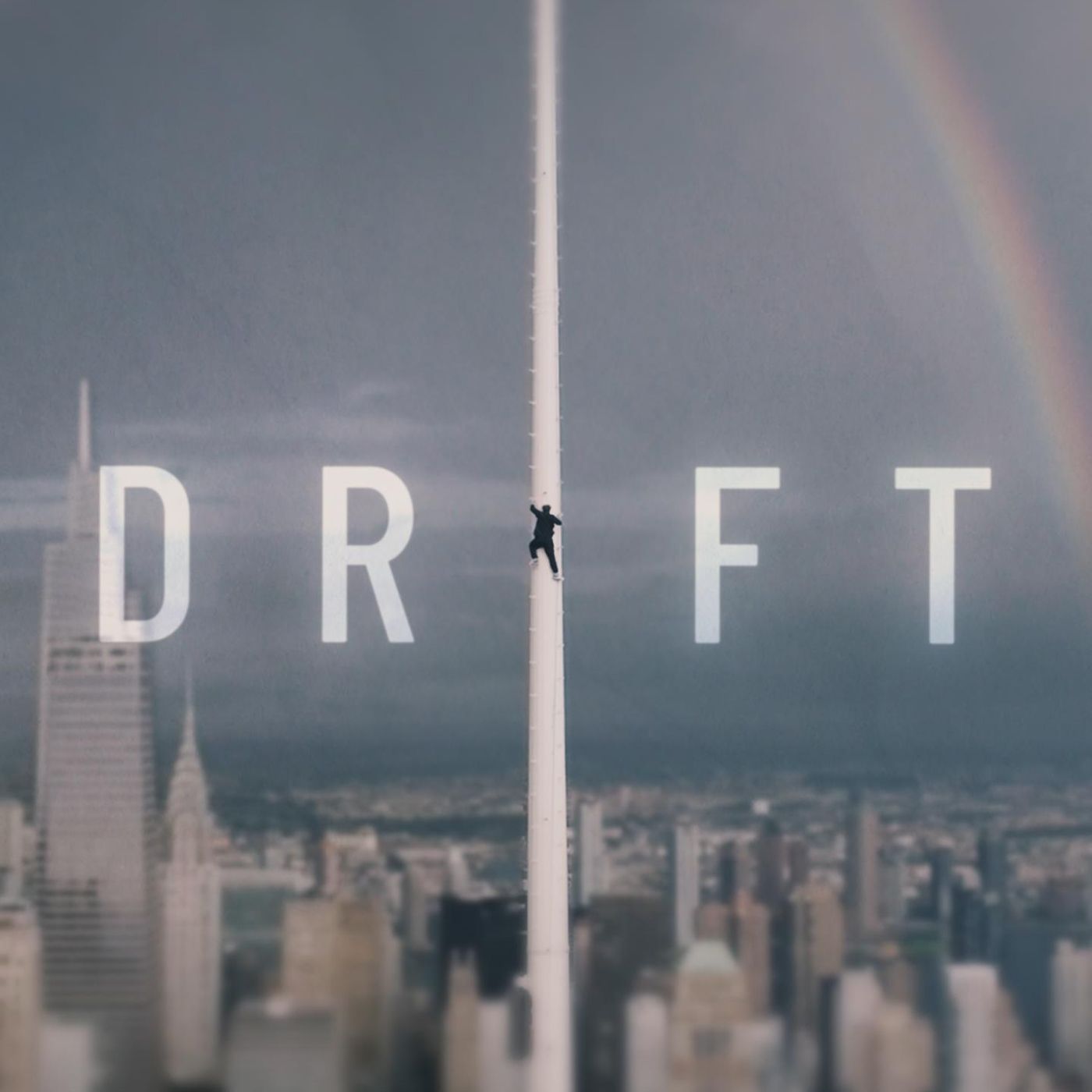
About this episode
Isaac "Drift" Wright is an Army veteran and self-taught photographer whose trauma finds an outlet in illegal high-rise climbing — scaling some of the world's tallest structures to capture images from vantage points no permit would allow. The film documents his pursuit of art and healing while tracking an escalating confrontation with law enforcement that puts his freedom at risk. It premiered at South by Southwest in 2026.
Follow Wright on his Instagram at https://www.instagram.com/driftershoots/
Transcript
Automatically generated, so expect the odd misheard name.
Oh jee is, folks, it's showtime. People say good money to see this movie. When they go out to a theater. They want clod sodas, pop, popcorn, and no monsters. In the Projection Booth, everyone for tend podcasting isn't boring.
Got it off? Hey, folks, welcome to a special episode of The Projection Booth. I'm your host Mike White. On this episode, I am talking with Martin Bean and Kevin Hebberd. They are the editors of the new documentary Drift from twenty twenty six.
That is not the Drift, which is a narrative film also coming out this year. This is about Isaac Drift right. He is an Army veteran who loves to climb. He climbs a lot of tall buildings, take some absolutely stunning photographs. His stuff is all out on Instagram.
I'm going to link to that. It was fascinating talking with Martin and Kevin all about how this project came together and how they work together to help shape this documentary, which was directed by Dion Taylor. As more details of the release come out, I will be sure to give updates otherwise. Thanks so much for listening, and I hope you enjoyed the interview. Kevin and Martin, I'm so curious.
Tell me, how do you guys know each other? Why did you first start working together? And we met a while back. We were on a I think it was We're here. You don't know, it's been a while.
I love Martin for at least a good five six maybe even longer than that. Years now. We were working on a either it was an Amazon project or an HBO project, and he was the lead on it. And so when I came in i met him. I always say, he's like always rough around the red edges, but you're always.
Gonna love him. And that's exactly who he was. He like, he is who he is, and that's who what I love about him so much, so he doesn't just word it's what I love. We've known each other for a while. It's been really nice.
Honestly, if we've done I don't know, five or six projects together at this point, so. It's quite a bit. Yeah. Is that pretty typical to work with co editor frequently like that? After I met Martin, I wanted to work with him all the time.
When we were on Escaping Twin Flames, an editor had backed out and I immediately called Martin. I said, you got to get on this project. So he's this great editor. How do you guys work together? How do you split up the project?
I don't know, Like it's more just taking scenes and seeing what, like we played our strengths. We don't have an unconventional approach to this. I don't think. I think we just we We compliment each other really well, and we work well together, and we understand each other's sensibilities instincts well enough that like we don't end up having to redo a lot of work. We can match tones, and we can retrofit sequences and work story in similar ways, and we communicate well.
And we've worked well together long. Enough that like we have a we have an ability to communicate and like a shorthand that goes a long way. I imagine you both have to be working on the same type of software, are you both like Avid guys? It depends on what are the project calls for The last one that we did, Drift, that was all Adobe Premiere. For the most part, it's been Avid, but now Premiere is making its head away into the dock space.
With this last project, there were so many different formats that we were working with. It just handled it like a pro. So yeah, there was go pro, drone footage, body cam docs, documentations, home movies from wayback in the early nineties. So what it could just handle any format it was. It handled it really well, thousands of hours of stuff like really, it chewed it all up and made it usable real quick.
How did you guys get involved with Drift? So the last project we worked on, which was Escaping Twin Flames with the team and out Lesseners got involved with the company hit An Empire, and this project had started. There was like a loose rough cut of it, and since we had just worked with her, she reached out to both of us and said, this project would be great for you guys. So we're all like minded but have different We'll come from different you know, ethnic backgrounds and culture backgrounds, and we all just kind of like meshed well with the storyline. And I think that's another thing that why she reached out to us.
And what kind of shape was the story in when you got. To it was it like wow, it was very long. It was a very long rough cut and so pacing story A lot of it was all over the place and it just needed to be reconformed, rethought a different way through, and Martin had started, actually had started before I did, before I came on. The previous editor did a really good job, but they didn't have enough time to really get the traction. They needed to figure out what the story was going to be and explored the story.
And so got lucky because Martin was the one that sifted through all the footage and he parsed out a lot of the stuff that may not be necessary sadly for him. That's what I know, but I enjoy that, so it's my favorite part. So yeah, now, is that all the four hour cut footage or is that the raw footage? Are you going back to studs for this? Both end up using some of the framing that had been done, but yeah, no, a lot of it.
Regardless of what you end up doing, right, you have to know what you have to work with, because otherwise you can never trust your decisions because like you're constantly second guessing yourself and saying, oh, because you accidentally explore it all the time. You got to be able to look at it and say, Okay, we're gonna approach this a certain way, and without an informed ability. To make that decision. You just you just hoping and praying, which is no way to get anything done, honestly. Yeah.
No, we took sequences and stuff, but yeah, for a lot of it was just rebuilding it. Have you gotten into a project like this before where somebody else would come in and done stuff and then you're being brought in to finish things up a few times? Yeah, yeah, a few times. Yeah. Yeah.
It's usually because they just want to see another way through, get another editor's vision on at what you would do differently, how would you tell this story? And most of the time it's like how would you tell it more succeedingly? More like just type how tight can you make the storyline and bring it down? Like we had it was like a four hour cut, and so we needed to get it pap sharpen it and refine it into into something that. Arcs a little more cleanly and lands a little more succinctly and you know, moves more with more intent.
A lot of times things get lost in the sauce a little bit and you have really good ideas, right, but it's this big thing that like, and things fall apart for a variety of reasons. But like a lot of times things become forest for the tree situations, or things become too precious with certain people. It's difficult to do this right, Like it's this artwork. Yeah, especially with docs. The amount of hours of footage that you have if you can make you go crazy to think of, like how do I even start building this plane?
Like with just the first edit, look at number one, so she when you know Isaac Wright, the main subject of Drift, he alone have what like two thousand photos that he had taken? How do you parse that down to what makes him who he is? Well, and turn it into a storytelling element, right, give it an arc and let it reflect the arc that you're trying to portray. You know, this guy gives us a bunch of photos that he likes, and so it's like, okay, how do we turn this into a thematic element? How do we make it part of the whole instead of just pretty stuff?
Well, how do you even organize your thoughts around something like that? Are you doing like note cards or right now? How do you even decide this is how I'm going to start approaching this or how we are going to start approaching those I would say. No, cards are usually like a good start. I don't know if we used a lot of note cards on this one, because there was already kind of like it was already somewhat built, but I would think, like, no cards.
There's like a program called MIRO. I don't do you know this? A mirror board was like we use that. I remember Martin when he first took it on, he was you just want to I just want to know how Isaac is able to do these things, And that was like, how does he get into a building? How does he take these photos?
What is it that he does to even get to where he's at now? And that kind of was like ground floor. Right. When I go through things, I just take tons and tons and tons and tons of notes, not even because I'm necessarily going to use them again, but just because it helps me to like embed things in my mind and process things. As I'm watching footage, I'm constantly writing things down, just streams of consciousness, ideas for things or like shots that might match up with other things or anything really, and the mirror board helps tremendously.
But at the end of the day, yeah, it's really about finding a hook for your beginning, right, because you used to know where your story starts, right, But in terms of constructing, like mechanically the beginning, you need a hook, get the audience in, and then you really got to be able to find a turn into your end, and you've got to be able to land something right. And if you can get those things together, then you can start stringing things together and finding pivots. Because to your point, like when you're constructing something, it's your pivots in your terms, which are really like the mechanical things, like not the story things, but the mechanical things that like can actually get you through a story and gets you through a doc.
So it's about it's really about finding and isolating those things, and then you build into them. And build out of them as you can. I always start with what like grounds the subject. I guess what's like the human element, like what makes it evoke like some type of humanist to everyone that could easily understand. And once I find that one thing, then I can start building from there.
That's pretty much actually the entire story of Isaac, right, It's like, why is he doing what he's doing? What is the cathartic moment that he would take the risk of climbing buildings to take photos. I don't want to spoil anything, obviously, I don't know what, but his reasons for doing it is what I latched onto and I could build from there. He battles with PTSD, he battles with childhood drama, and I don't want to speak for Isaac, but that's that's what grounded beginning of the narrative of his story of why he's doing these things. We expand on it more and you get to see how he got to where he is now.
But yeah, I've looked through a lot of the images that he's taken out on the Instagram and it's just amazing. Some of these shots just start rap picking. We were all in that group text and occasionally he'll just show us what he's doing video wise, so you'll see him. He'll say, lick what I did today. He'll climb like he was climbing Times Square a couple months, like maybe a month ago.
He was just like, here, here's some footage, you know, not not to put in the film, just to show that he's still doing. Martin, you talked about the whole idea of building in versus out kind of thing, and I'm curious as far as what what How did you decide like this is what we're going to do, or Kevin, you talked about like here's the one thing that I hooked onto and then that gave me the grounding basically to start you're building. How did you guys decide, Okay, we're going to do this scene the scene, or are we're going to do the overall package first? It's there's a lot of exploring this scene work because a lot of times you're directed by your limitations, right, It's more about what you don't have than what you have.
You say, oh, okay, any one of these scenes can hit this plot point or hit this idea, this character point, but like, we only have one scene that can do this one thing, right, or we only have this moment that isn't even a scene that anchors this this other idea, right, And so it really becomes often and I can't give you a discrete example right now, I'm sorry, but it becomes often filling holes, right, and then backing into figuring out how to build the most complicated, most difficult things. Right, you say, Okay, we got everything we need. We think we think all of these things can execute these emotional ideas of these plot points, and now we got to fill these holes, and we got to get this idea across across the entire narrative.
Now the whole narrative has to reflect a larger idea, so it all grows up together. And again it's all through communication and discussing over and over what these things are, not only what they're supposed to do mechanically and the plot points. That they're supposed to hit, but what they're supposed to do emotionally in terms of the larger arc. As you get closer and closer to the finish, you tighten it up and it all starts to resonate through itself with a hopefully at least right a singular idea or. Some sort of philosophy.
Right, So it's not just the worst thing a documentary can be, in my opinion, is just a list of shit that happened, and so without any emotional, full or real real thought, right should make you think. So it's like really all about trying to get to that point. The story is pretty linear. In his lifetime, we kind of made buckets too. It was like buckets of information that we wanted to deliver when it was at We didn't want to put everything up at the front because of some algorithm.
We wanted actually to get dold. You get like parts information out when it was necessary. And so I think that's what made this experience a lot easier, is because we weren't beholden to any kind of narrative style. And I think that's what the director dion. He also mentioned too, he didn't want it to be like your traditional dock.
He didn't want it to cut the same way as a traditional dock. Things that you would be that were expected to happen. Granted, there are some moments at the top. We obviously do need a hook, and we obviously need a little cold open, but going on forward from that, it was basically you've just let us have fun and tell the story how we think it should be told. And then working with drift, Isaac Wright, he would go He was present the whole way through making sure that his story was being called properly.
And he's an artist too, so he in a sense of almost like an editor where you wish you could edit it, just like when we even take a photos. I wish I could have done it this way, I could have colored it that way, and That's what the best part about editing is is that with flalls and all, you can still make something beautiful from it. We're of two different worlds, but brothers in arms in the trenches of telling his story. He always knew he wanted like his story would be told on a filmic level. And I think our first watchdown he was in love.
And I gotta say, it's so hard whenever you're having a subject, here's a mirror against yourself. Enjoy watching this yourself for another for an hour and a half to two Our first cut was like two and a half hours two fifteen. Wasn't crazy, and he took it like a professional. It was very interesting to see his thought process through the whole. Just like I said, having a mirror pointed her at yourself the whole time.
I can't imagine, as you can see, we suck in front of the camp. So yeah, I would probably crawl out of my own skin if I had to watch myself for two and a half hours. That's wild, especially when his story, like we had a couple of breakthrough moments in the interview that we didn't expect, especially dealing with his childhood trauma that no one knew happened. It's just Dion and the was Kate co producer. Kate, you know, just got this information about his past that really solidified why he's going up there to climb and what it is that he needs.
It's almost like you have the hole that you need to fill and this is the way he was able to fill it. Not to get too much into the brass tacks, but I'm very curious as you guys are working together, and I imagine you're working remotely. You're not sitting in the same office, back to back, fingers on keyboards kind of thing. We cut this a lot in the office. Granted it was like maybe three days on and two days in the office, or three days in the office and two days at home, just so we can take our informations to cutting and bring it back together.
But it was, like I said, like Dion wanted to make sure that it was like a family cutting this film together, so he'd ever wanted us to be at home cold time, like cutting docs. It's very hard to cut a dock isolate in isolation. Having each other as sounding boards has got to be great. And then how often does Deon get to see stuff and or the producer with Kate and they give notes on their stuff. It was every four days.
Dion wanted this to see where we were at. He would come in and I call him like the idea. He's like an idea man. He's got these ideas, and then it's a hard job to take it back and see if we can accomplish it what he was asking. So Kate was.
Working arm in arm with us every day, going through footage and grinding out story with us. And then Dion was coming in and wanted to keep himself fresh, so he he he would watch sections, but he wouldn't watch the whole thing, And so he gave us a lot of freedom to approach it the way we wanted to and the way we found, like to find our path through the subject. And then he would come in and give us notes on the whole thing, very like I don't know, it wasn't that common right to sit down and screen the whole thing and give full notes. So it was it was really the freedom was really nice. And he would come in and give us ideas and we worked to execute him and we'd meet each other halfway and all this stuff.
But no, we had a ton of freedom to explore it and really figure it out, which I think is really what made it possible Honusly. Fortunately, I don't think there was a moment where he didn't like what we were doing, which is I think he said this south by Southwest, which was he just at one time he wanted to work with only people that he knew, and then he realized through cutting this stock that he wanted to work with people who are like minded. I think that was like his discovery in this process of cutting the stock, and it showed throughout the whole process. He would just throw an idea as crazy and wild as it could be and see if we could do it. How often were you guys at each other's throats and just screaming and yelling at each other and just like, no, it's got to be this way.
No, No, it's going to be this way. I don't think we've ever gotten to that where we'rever at it like a standstill between what I want and what you want? Really right, Yeah, we're like we're. Below the line. None of our ideas are really going to survive anyway.
Like we've been doing this long and yeah, we'll disagree about things and carry it through the whole thing, and it'll be like, I knew we should have done this with that instead of the other thing. But it's everything. Becomes subject to the to the thing itself, you know what I mean. Our preferences are really neither here nor there. And there's only one thing ever fought for in that whole project.
That was it. It was only one and it was ten seconds shot of Isaac running a touch like running football into a touchdown. Like, then, did you win that fight? I did? It went pretty good.
Yeah, that was one fight. One thing I wanted to keep in this whole doc is just little Isaac running with a football and scoring a touchdown. It gets bigger later of that same scene. But I don't know why I was so passionate about that. That said part I was talking about about grounding people in the cathartic human elements.
I'll fight for those. Honestly. We don't yeah, get at each other very much at all. It's not I'm just happy to have somebody share the work. And that's the other thing I was about to say.
The only thing we actually do ripe about are always like notes, it's never us since the problem. You know, it sounds like you guys had a real sense of freedom on this project. I'm curious, is that fairly typical? Do you often have that amount of leeway? No, this is actually the first time I feel like we got to cut what we wanted to cut, and for the most part we in the film is what we actually cut.
It was. This is it's very rare a lot of times. For one, it wasn't under the guise of a network and so it wasn't against some type of and the timeline we just had to We wanted to make sure it was going to get into a festival, so we had a lot of leeway to get to cut. I guess you would say, I don't remember there ever being any part where we were told not to do something because we didn't have the time to do it. I guess we were free to explore like we had to do internal notes, and internal notes are always difficult, right to get everybody in the same place as always a complicated feat.
But like Kevin said, nobody owned this, so we didn't have to deal with network notes or like really any kind of over like larger entity coming down and telling us what this was supposed to be. So we just had to get everybody in the building on the same page, and that was pretty good. Yeah, every wonder came in to see the I think it was like the two hour she was happy the first time I had never received notes from a company, and I think everybody just enjoyed. It's like you get a dock like this every decade, like something that's just it's you to where you can either a cut it like your standard dock, or b take it to a different level, and that's what Diana wanted to do, so we were all for it. Well, I can't see a subject like this being cut like a regular dock, just the like I was talking about the images and the just the awe that is being inspired by his work, but then also by the person too.
Yeah, I just wish you could have seen here's the thing, Like there's a plus. Cutting with the different formats was also very helpful. You're seeing it from the police perspective, you're seeing it from his at the and concurrently at the same time he shoot a drone or a go he's got his GoPro cameras and you have the police camera, so you're seeing everything happen in real time when he is doing what he's doing, and it's like a pretty cool feat that we actually were able to accomplish. That would Kevin cut a whole sequence that is like a chase sequence where you cut between different perspectives all time and it's all as tribute to it there archival producer who got all this bodycam footage Morgan and security cam footage yet Morgan?
Yeah no, And so Kevin was able to put together this incredible sequence that it feels like something out of a narrative film. It's doc work, it's it's you don't get futaged to work with very often. Maybe that's why this dock was so fun to cut was because it was like a nonscripted narrative film, I guess you would say. And a lot of interesting problems to solve right with like really really incredible footage. There were a lot of problems with the narrative and with the footage, but overall the visual aspect of it and the power of the visuals like may make it all doable, right because you can lean on that power.
So easily to bridge whatever you need. Honestly, footage is so incredible and the feats are so amazing that it's just sort of like whatever failings it has, it's like it's easy to move through because you're just you're in it. I think, I hope also with Isaac being pretty much the only character in the doc for a good forty five minutes before you'll hear from his dad maybe once, but he's carrying the weight of this whole film. And to be able to do that, someone that's not from this world able to carry a carry a film like this is impressive on its own. And what do we have, like two hundred hours of interview footage from him is quite a bit.
Plus he's also just talking to his GoPro sometimes while he's climbing, so you have that going up on like these climbs he and cutting like a narrative. A story like this kind of gives you the ability to like just start fresh. As an editor, I guess you would say, like, how do you how do you reinvent editing a little bit? We didn't really reinvent it, but it's like, how do you reinvent a doc that's been in a different way. This whole idea of the police footage and the dram footage and the copra that just sounds amazing.
There have been climbing docks before. That's the thing, and it's like, how do we what's different about this? It's he's he's going up there. It's not just like a solo climb or or to climb something. It's more like, I'm, I'm the climb.
Is is is the journey and the and the photo is the destination type of thing. Can you tell me about working with your sound designer? Marn and I love sound, so we gave him a path, like we showed him like, here's a blueprint of what we really okay, because we since we had the time, we actually soundscaped everything too. They actually, you know what's cool is I hadn't seen in the theater until we went to south By and to hear that in that mix of seven was it five to one or seven to one? It sounded amazing.
So he more worked, he worked closer with Dion and he did with us, but he did take our blueprint and just elevated it. Working with GoPros so much right for it to feel like even in the screenings, for it to feel like to have the power that you need it to. It was like you you wanted to fill out a lot of that audio, so it didn't sound tiny and detached, but like you wanted to hear the wind and like. The atmosphere of all these places. And then it's like you give it to the sound and designer and have him continue to build it out and separate it a little bit more.
Both we had a very small small crew. It was just mart I, Kate Are and are what was Morgan's role, perably and two other and Dion so was very small and once we realized, oh, this is going to have to get mixed, and he came in and I think he sat with us a couple of times, and so he just he was He took our notes really well, so a lot of the notes were make it louder. We wanted to feel like we're in this climb. And so the mix alone was just aces on it. And then he talked about how you saw it for the first time at south By Southwest.
Can you tell me a little bit about that experience. What was that like for you? I don't want to see you for it because that's not what it was, because we had seen it before, but never in this soundscape. I think it was actually oddly enough, we had left the projects towards the end, so we're still a couple of legal notes. And I remember Caitlin, the producer, she was just so concerned about what had to be let go and what didn't.
She was concerned about us for some reason, like what if we were going to be upset about what was missing? And for me, I was in for the ride the whole way through. My wife had come with me and she it was like just like an amazing experience to watch it with her, because you're like, every day you're in the grind, you're looking at the same footage over and over and over again. But to have someone else to watch it that has no idea of what the story is going to be, where it's going to go, and to see it through that eyes, that's I think that's the experience. I think that was amazing for me to experience.
Do you never really know whether something's good or not when you're making it, or at least I don't. I never feel like I never have confidence with it, and so seeing it as south By well because I can never tell if anything's good. Whenever I'm watching stuff in my own room or in my bay, I'm always moving on the room or like changing the orientation to try to trick myself into having a sort of genuine experience, and so going to south By and seeing it on a big screen with an audience, And also it was the first time we'd heard the composed score. Eighty percent of the music had been. Swapped out, which is always extremely traumatic for me, because yeah, you work with music so closely and then it gets a little like swapped out, like it's nothing, and you're like.
Oh Jesus Christ. But it was like it was really neat because I was able to see it fresh in a different kind of way, in a way that like I hadn't seen it before. I was like, oh, no, this is really good. This is this is good, Like people were responding to this and I was. I felt I felt a little detached from it, which was really nice.
Actually, I felt it was it was maybe done, which was a good feeling. We had a test screading a few months before, and it felt like it was a completely different experience watching it this time at south By. For some reason, even though we had seen it recently. The music, the Tempt music was still in when we had the test audience, but it was the first time we'd ever seen it with an audience, and that's the other thing we had it with like industry. The audience was with industry people to see if this, if the story was tracking, if this that was not pushing the narrative further far farther enough.
Yeah, I don't know. I looked right you sat with me. He sat right next to me, and I was like, it's pretty good. There's always going to be something that you would want to change, But for the most part, the audience doesn't know that they're they're seeing it like this is the cut. So I loved it, Dune, And I think that's the other thing is when we started this project, we knew we had something, and to see other people now you know how it is, it's like it's it's not ours anymore, it's the world's and Dione, even the director had a different experience watching it in the theater with everyone too, which was an element during the Empire Stig climb.
He always questioned one of the characters reasons for not doing something and hated that person for it, and then he saw it in the theater and he's like, now I understand how I love it. Nice. Even when the director finds something new about the movie. I think he made peace with the character in there finally. Yeah.
But what are you working on these days? All? Right, now, I'm on a Hulu project. I can tell you much more than that, but it should be hitting this year. It's pretty good.
It's going too so it's another one of those cathartic human stories. I guess you would say, Yeah, always fine when you get the drama. And Martin, how about yourself working on my house, the industries and shambles? Yeah? Could you just use AI to edit all this stuff going forward?
Yeah? I know, right, that's the problem. I don't know what anybody's fussing about. We could just have one company own everything and use it. Yeah.
No, I've been redoing my bathroom so it's been good. As soon as I'm wrapping on this project, all also have time to do my bathroom. Kevin and Martin, thank you so much for your time today. Guys, this was great talking with you. I really appreciate that you.
Thank you or anything? Could d. L U s expanis. N oh. Goo anything?
N Christ. Can you rest N three
More from The Projection Booth



Similar episodes across the network
Matched by shared keywords.
-
Jackass: Best and Last (2026) — "Welcome to the first day of our final film."
1 shared keyword: documentary
-
Melania (2026) — "Here we go again."
1 shared keyword: documentary
-
An Unknown Compelling Force (2021) — "I think these theories are weird."
1 shared keyword: documentary