
Season 1 · Episode 409
Special Report: Georden West and Russell Sheaffer on Playland (2023)

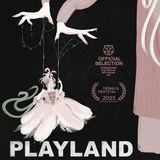
About this episode
On this special episode, Mike talks with filmmakers Georden West and Russell Scheaffer about the 2023 film Playland, a dreamy documentation of a queer bar in Boston. The film recently played at Tribeca and will be at festivals around the country soon.
Transcript
Automatically generated, so expect the odd misheard name.
Old years Boots. It should time people pay good money to see this movie. When they go out to a theater, they want cold sodas and a hot pop corner and no monsters in the Projection Booth. Everyone pretend podcasting isn't boring at off. Yeah, I'll call me just in time, shiven Off the back of the Slim.
I was born in Boston, and I used to the racism people keep saying, I Boston. I can't believe that. And those of us you know, who knew, would look at each other and smile. No performance, no sales, no umbrella expect way last time it rained, I went on vacation till sixty five. Where did you do time?
Paris? They were rowing money with me every which way, money dollar built, and I'm down my hands and he's picking up the nickels and dimes. I stood up, the fell and fell on the floor again, and I was opping my hands and he's opting down. For over twenty minutes, the place was exterical. They were going crazy.
Hey, folks, welcome to a special episode of the Projection Booth. I'm your host, Mike White. On this episode, I am talking to writer, director slash editor Jordan West, and editor Russell Schaefer, who also does a whole lot of other things, but for this film Playland. Russell and Jordan were the editors on this Jordan was the writer director. It is a really interesting, very beautifully put together film, all about a space in Boston that was a queer club.
It deals a lot with memory with senses. Like I said, it's really a knockout. Thanks so much for listening, and I hope you enjoy the interview. Jordan, can you tell me a little bit about your background and how you got into filmmaking as a child. I definitely was a pretty passionate writer and pretty determined to write this next great American novel.
That's not quite happened yet, but it definitely led me slowly into a more visual field. As my work got more and more descriptive, I needed to find other avenues moving through when it meant to translate the real world into myself as a conduit for those experiences. So slowly that became the moving image. I went to undergrad for film, ended up at Emerson College where I did my masters in film. I started working in fashion media and I interned for Show Studio in London under Nick Knight, and that really was esthetically one of the most enriching experiences I've ever had.
And as I professionalized my work and as I developed the faculties to reach the vision that I had in my mind and close the gap between the disconnect that sometimes happens between an idea and its actualization. Who was really instrumental in that process? And I started collaborating with a fashion designer named jamal Oscar Holme and we made a series of shorts together and it was around that time that I started putting together the bones for a larger and longer piece that still had that esthetically rich sartorial edge and explored queerness through set design, through the garment, through the performers themselves, of course, But that sort of esthetic richness that came into my practice such a formative time has informed the work that I've done up to this point.
And I had the idea for Playland, and Russell's work was something I became familiar with throughout Fest. We screened in the same section one year, and Russell has a background and archives is a rich filmmaker himself, has his own practice and really has a history of supporting boundary pushing work and filmmakers who are testing cinematic language and pushing it in new ways. So it really felt like match made in heaven. So I sent a cold email and here we are and Russell hop about yourself. What's your background?
As Jordan mentioned, I come out of this sort of place of making and thinking and being deep inside of archives, which I think are some of the sexiest places. And similarly, like from a very young age, wanted to like get my hands on cameras, wanted to play took a class in high school. It's like very fortunate that we had a video class in high school and felt very supported early on and that sort of just play around, just figure it out kind of logic. Went to undergrad at UCR Mine, took a year off to work on some documentaries. Some of my earliest formative professional work was in theorial departments of documentaries, and then went to NYU for a Cinema Studies master's degree and Indiana University for a PhD, where I was the archival fellow at the Kinsey Institute, which is really beautiful place of all different kinds of records about gender, sexuality, reproduction, anything you can think of.
In that capacity is housed in this one building in Indiana, in the middle of Indiana, and they're always in this sort of precarious situation where they're in the middle of a state that isn't particularly welcoming to them, and so being in that space thinking about what it means to be archiving, thinking about what it means to be a queer person in an archive, a queer archive in the middle of state like Indiana. I think it was also a very formative experience for me. And in terms of making, I think, like Jordan said, I have my own practice. I think of myself as a sort of visual artist first, although I work mostly in moving image work, I personally have no real priority is over features or shorts.
I think work takes the form that it needs to, and I'm most interested in making and supporting other artists who are experimenting with what the grammar is that we use as media makers, like how do we find new ways of communicating, how do we find new ways of framing those sentences that were also familiar with And Jordan's work was immediately in that camp, very obviously in that camp. It's funny because I also find archives very sexy but this one sounds like it's literally sexy with all of the Kinsey stuff. Such a fascinating place. Like the first time that I went to the Kinsey Institute was on an independent study while I was still a master student at NYU, and I like took a week long trip to Indiana and it was like so hard to get there.
The plane that I was supposed to be on was literally struck by lightning, and they put us on a party bus going to Bloomington, Indiana from Chicago. It was like the weirdest experience to get there. And then I made it to this space, right, so this like I'm like at the holy grail of the stuff. And it's one little tiny room, the reading room, and they put you like with a at least at that time, with a TV where you can watch through whatever it is that you requested. And there's a little glass booth in the corner where the archivist is like sitting so that they can see you watching the things that you're watching.
And it was both like the most wonderful, voyeuristic, strange experience, sexy and not all at the same time in a very interesting way. Did you have to keep putting quarters into watch the stuff you're watching. Goodness, that's a different story for another time. It was incredible. It's incredible, Jordan.
Where did the idea for Playland come from? I knew after I had done my first two shorts that I knew I one of my first longer endeavor to be about a gay bar in Boston. I was working as a server in a gay bar myself, and was just such a rich place, especially temporally being in the service industry, being in the tip industry, which you know is already a preparious existence, but also bearing witness to people who were having their first gay bar experience, mingling with people who are having a later in life more memory based experience, and treating the space like a memory palace. Even watching the dance floor, I always think of it as like tree rings in a lot of ways. A center of the dance floor is the youngest, most energetic people, and as you slowly move out towards the fringches that dance floor, you see the demographics across ages manifests.
So I thought it was just such an interesting space to get to explore. But as a server and as someone who the first archive that end up pulling when I started doing initial research was of a fellow server. I pulled the archive of Sylvia Sydney, who was a very notorious drag queen in Boston in the twentieth century. She was known as the Queen Bitch of Boston, so a lot that's a big personality, but a lifetime cater waiter and very active in her union as well. So I knew I wanted it to be from the perspective of people who weren't just moving through the space, using it and then going home.
But really I wanted to explore what it meant to be a steward of that space, for that line between public and private space to start to blur, and what it means to have the most mundane day at work where everyone around you seems to have an expectation that they're having the time of their lives. So I really loved that dissonance that happened in my day to day life as a server and what seemed to emerge from the archives as well as I was doing initial research. But it was very lucky that the first archive I've pulled Sylvia's archive. You know, her exploits would always end at the Playland Cafe and I've lived in Boston long enough to note that, like, I've never heard of this bar. I've never seen it.
They say it's on Essex Street, what's going on? Going down and looking at twenty one Essex where the bar should have been is now a parking garage. And what emerged from that was really the story of a lot of inner cities across America who had these gay villages and the role that urban renewal government intervention played in decimating those spaces. And it's something that is still happening right now. So it really became the story of not this particular bar, but bars in a more gay bars in a more general sense in these sort of the value of brick and mortar gathering spaces.
But of course we're viewing it from the perspective of people who are not having the best time, but really people who are the backbone of making this magic trick that is a Friday night happen for the patron's offscreen. And why the way that you shot at just this kind of I think you described it as a brick colage. Love that you are using that term for this film. When we started discussing like what it means to utilize different archival pieces in the voices of the actual archives were the things that we're going to be the prominent voices of the film carrying us through. It really meant creating these vignettes, snatches of life from the service industry, backstage moments in which we're getting the glimmers of a life, but in an uncanny way where you can project your own expectations or your own experiences within these gathering space as yourself.
I don't think it as ever or intention in any way to have a hyper realistic portrayal of the interior of the space. Also, there aren't a ton of interior photos that even exist at the Playland Cafe. So it really was what does it mean to speak to the archival silence that is there? What does it mean to create speculative fiction between the gaps of what you're able to find, who gets to be archived and who isn't there anymore? So we really chose an esthetically very rich approach where we were using high fantasy mixed with the lowbrow expectation of a gay bar performance in order to realize the sort of liminality of what does it mean to be a race?
Then? What does it mean to speak to erasure without speaking over it? So that was something that we were really committed to. I didn't want to conduct any new interviews. I wanted to utilize and highlight what exists in the archives already and speak to the gaps that exist as well.
I think that's one of the things that I really loved too, Jordan. Just to add to that is that like from the very beginning, having conversations around like what you do when a space isn't documented, when people don't want to be documented in a space at a certain time, when it's dangerous to be seen somewhere. What do you do then twenty years later, thirty years later, when that history isn't so clearly mapped out in the f emera, do you throw your hands up and go, oh, we have no history? Or do you let your imagination run wild? Do you decide what the fantastical possibilities could have been?
And I think there's a lot of beautiful queer energy in that imagining what our own histories are. The aesthetic richness of the film is part of that causal chain linking as back to clear history. I think there is an article that came out recently that I was like, thank you get it. But style really is a huge substance of this film and is a huge link back to not only moving image history as queer people and referencing different moments and queer moving moving image history, but also linking back to historically queer moments in Boston, using garment, using set design, and allowing that sort of sthetic drive to be part of a conversation of a lineage. So both of you are credited as editors on this film, and I'm very curious how you approach that and especially how you work together.
What was that actual working relationship, Like, yeah, yeah, we'd hand over versed huge files to one another, like I think every time, we like just passed it back and forth. It really was highly collaborative. And as I've said before, there's not a part of the film Wrestle hasn't touched, and there's not a part of the film I have not touched. We didn't Divide and Conquer. It really was our hands were within sometimes every single shots, like we really were going in and every image that ended up in the film is curated and is specific and has a lot of love and intentionality in it.
So it meant we were very much involved in every single moment and every single beat in the film. I think that also really allowed us to then think about the implications of changing anyone given edit, instead of segmenting it up into this sort of if we even could have, I don't even think it would have been possible. There's no logic to it to have said I'm taking the first act, you're taking the second act, because it doesn't really operate that way. But then what it allowed us to do is to say, Okay, if we shorten this beat, or we elongate this beat, or we change this element construction early in the film, what are the repercussions of that thirty minutes later, forty minutes later, Because so much of the edit is about crafting this mood, about crafting this pace that sort of ushers you through.
And I think doing this full handoff allowed us to be surprised by each other, to see something that somebody had done and to be like, oh my gosh, this edit that you did at minute three, all of a sudden dramatically impacts minute sixty eight. Right, There's this wild correlation, and sometimes we wouldn't even see it for ourselves. I think like we'd make some little change and then when we'd watch the whole thing through again and be like, oh, something new is blossoming, and we'd give ourselves the time to play b role additions to the film. Russell shot all the title cards in the film on sixteen that I like was like hand designing and in design. So it really was highly collaborative process throughout even post production, as we like filled in the gaps and met the demands of what the footage was asking of us.
Were you even sitting in the same room or are you divided by the distance. We started together right after the shoot. We booked two weeks together in a lake house in Massachusetts, and we did our very first assembly there. But it was very clear to us, I think at the end of that two weeks that piece that we had shot and the archive that we were playing with really demanded a much slower and much longer gestation process. And so Jordan and I made mirror drives together at that lakehouse and then wandered off in our respective directions.
And then Jordan was editing in Provincetown in Colorado. I was editing in San Diego, and we just passed across the country to each other. What were you actually editing in Adobe Premiere exclusively in Premiere? Almost everything including the effects in the film and the mass and everything are all built in premiere. How much of what we see was captured on camera versus what is post because it feels like there's definitely a care to every single shot.
Oh, thank you. No, we did color with Harbor, so we were really lucky to find fabulous collaborators in them. And Andrea over at Harbor was absolutely incredible, and Jojo Urdp had worked on the lot that we used throughout the shoot before. But I think the level of entanglement that happened between costume, set, design, camera team like Chrissen who was our production designer, Edwin who was the costume designer, and then Jojo of course who was a DP. Like the inshot look was already very striking.
What we were doing in throughout post was more or less having to do with timing and really strengthening our relationship in post production to the more temporal nature of the piece and playing with sound and playing within the shots as well composite wise to get that timing really just down. But I would say the in camera look was already extraordinary on set, and during that time when we were in the lake house, I already knew We both left knowing what parts of the footage we were going to use, so we had already established wish shots were the best. So it really was about taking the time and choice production to strengthen already gorgeous imagery in the shots. And if you can't see any sleight of hand in it, I don't know if I want to reveal it.
You mentioned the sound, and the sound design is amazing, and I watched it with headphones on, which I know not everybody's going to be able to do, but wow, what an experience when you were saying, oh, did you have to put a quarter? And there's something like very Nickelodeon about this film where I think having an individual viewing experience like and really being enraptured by the sound design and having that personal connection to it is something that the sound really lends itself well to. And Russell introduced me to Aaron Michael Smith, who is a previous collaborator of his, and Aaron created an archive of sound for us, so like before we even added into the shoot, we had an treasured trope of sounds to play on set, and that's what we did play on set.
It was in the dressing room, it was even underneath some of the shots that we were taking to conjure a very specific mood, especially because so much of the acting is non verbal. It's really gestural, it's really bodily movement oriented con laying, and so I think working with Aaron and having initial discussions that we wanted the sound design and whatever soundscape emerged from his mind to be entangled. We wanted them to be inseparable elements. And we worked with the sound designer named cal People who was able really to work within that initial design that really never really changed throughout. That was something that was conceptually there from the very beginning.
Yeah. Yeah, It's one of the things I loved about working with Aaron on it as well, is that it really like, at every stage, every element that we were pulling from felt like its own archives. So, like Jordan was saying, by the time we were shooting, I think Aaron had composed something absurd like eighty tracks or something. It was like an incredible wealth of material that was all just totally inspired by these beats that we were talking about that Jordan and Aaron had discussed that are in the script where Aaron's using his imagination running wild, and then we could pull Okay, let's try this moment again on set with this piece, with that piece. See what that elicits.
It really did feel like every stage is a new archival experiment. Every stage is a new play with a new archives, And there's so many sonic elements that I'm like, ah, I couldn't put them in I couldn't make them fit in here. And there's still so many beautiful pieces. So I hope we get to release us eventually because Aaron's work is really extraordinary and very singular. Have you already premiered at Tribecca?
We have. We had our first two of three screenings. We have one more on June sixteenth tomorrow, and then we had Provincetown and then into Frame Line immediately after Russell. I'm so curious about your work. Where can I see it at?
A lot of it is available on Tianna Pete if you wander into that sort of educational realm that we run a company in San Diego called Artless Media, and a lot of our work is also available there. The work that we've supported before as well as my own so artless media dot com is a good starting place, and then Jordan, we're the best place for people to keep up with you. You can check out my website and also anything on art lists as well has more information about Playland. But like Jordan, which is spelt wild Jordan Ewest dot com, my body of work is largely unreleased that way can continue to have a robust life in the gallery space and also to continue to elevate the work of my very talented collaborators, Jordan and Russell.
Thank you so much for your time. This is great talking with you, and congrats on Playland because it's a wonderful film that I hope a lot of people see. Oh thank you, thank you, thank you so much. Down we should put back to the tea. Down and down and down.
Don live down your drilling. If there's a charge blowing up to a break again again we got come a lot ear love, come a life, come a life, Come alive Star. She was electivity chat out to play down. She said to come around around, around, come around to decide to dr suppose to hire blade again. She real
More from The Projection Booth
Similar episodes across the network
Matched by shared keywords.
-
Jackass: Best and Last (2026) — "Welcome to the first day of our final film."
1 shared keyword: documentary
-
Melania (2026) — "Here we go again."
1 shared keyword: documentary
-
An Unknown Compelling Force (2021) — "I think these theories are weird."
1 shared keyword: documentary