
About this episode
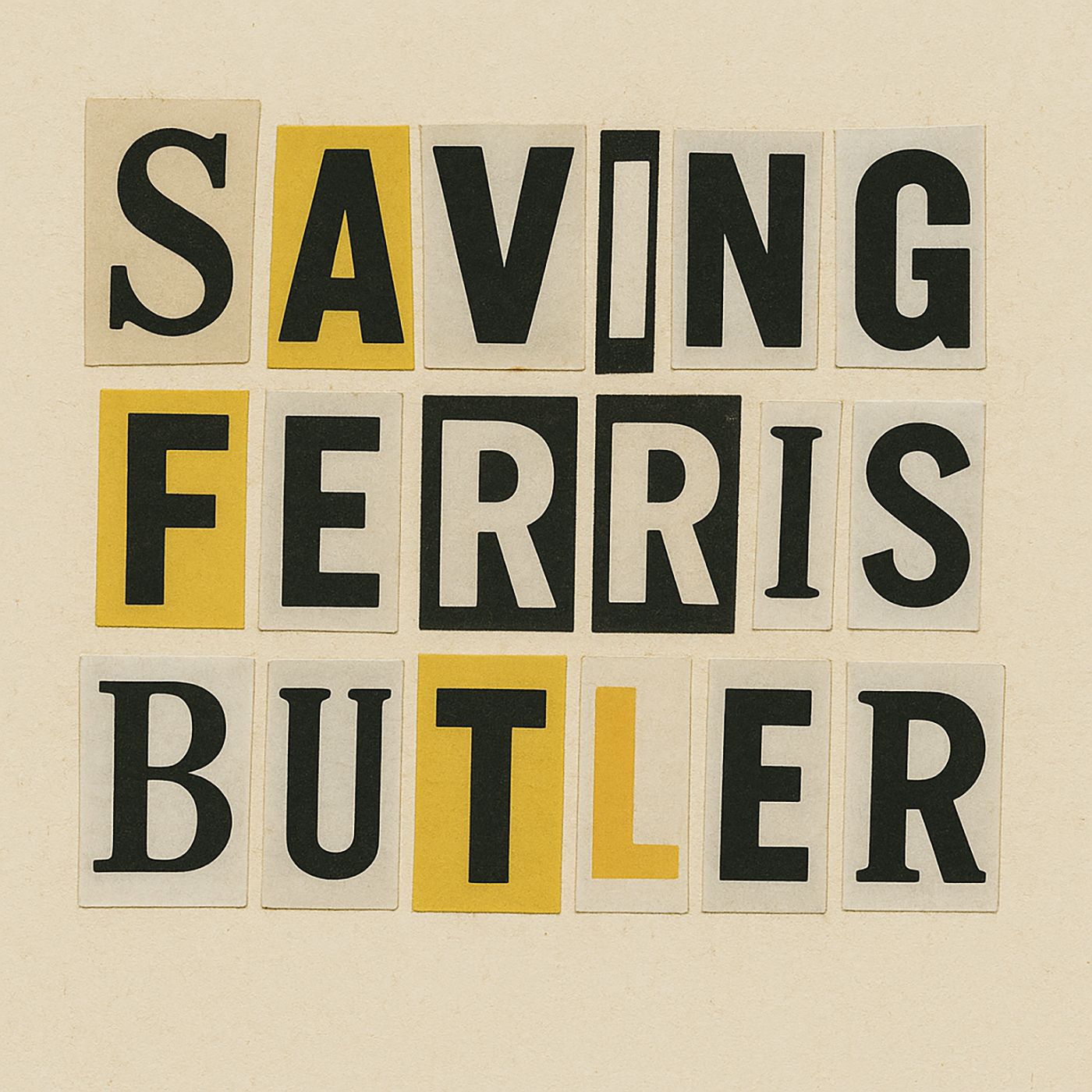
Visit https://savingferrisbutler.com/ to find out more.
Transcript
Automatically generated, so expect the odd misheard name.
Oh he is bolt it show die. People say good money to see this movie. When they go out to a theater, they want cold sodas, hot popcorn in no monsters in the Protection Booth. Everyone pretend podcasting isn't boring it off. Life moves pretty fast.
If you don't stop and look around once in a while, you can miss it. I first met Ferris through a. Comedian I've known a very long time. I'm the real Ferris Bueller, so I play. That's another thing because I was on Saturday Night Live.
Say that's John Hughes. He loves me. He said, I'd like to do a movie based on you. Yeah, let me turn on the radio. Yeah yeah, let's you'll get a sponge.
Yeah no, I think I have some. But he look no pity. He is looking for face Tuesday. But you can figure of it. Hey, folks will came to a special episode of The Projection Booth.
I'm your host Mike White. On this episode, I am talking with dB Frick, executive producer and Julius Olivas director all about the new film Saving Ferris Butler. No. I did not screw up something, Believe it or not. Gentleman's name is Fairis Butler, and this documentary explores who Ferris Butler was a former writer at SNL.
He created some thing called Waste Meat News that you'll hear about. And you're gonna have a good time hearing this and look for saving Faris Butler when it plays around you. I'll be sure to plug it via the Facebook group, also Blue Sky, Instagram, et cetera when there are screenings available. So keep your eyes peeled and enjoy this interview. Bhebie, what's kind of your background.
I'm an actor, writer, comedian. I've written some jokes. My first big thing that I got to do was as an intern. I wrote a couple of jokes for Kno O'Brien. Yeah, those were Year two thousand jokes.
And I drew some children's drawings that they loved that were a little racie and that got online. So after that, I did a lot of improv and then I worked with the National Lampoon for about ten years with Tony Hendra. Had a great time there. It was an amazing opportunity to write with him. I got to write songs with him, I got to write sketches, produce and perform and I've got a lot of stand up, and I also taught improv at both UCLA and Cambridge Universities and Amherst and a couple of other places.
But at Cambridge and UCLA I did a lot of sitcom production with students and sitcom writing, and then I did a lot of improv. I started doing improv when I was thirteen, been doing it pretty regularly ever since. I started teaching it when I was like fifteen, teaching at for fifth graders at high school. Because I excelled at it, the teachers allowed me to do that, and I was teaching with a group. But that's how it all came about.
Where did this project start? Who started this? I met Ferris about fifteen years ago at a comedy open mic in New York City through a friend, and I met him a few times and we got along. And the moment you meet him, he starts talking about how he's the basis for Paris Bueller and that he's contended this for forty years, that he was a writer for ESNL, and he goes into his cable Wastemeat News, cable access show, waste meat News. He goes into all of it.
Once you meet him, he loves to talk about it. So I was immediately interested. And then he added that he was married to a woman named Beverly Ross who was this great songwriting legend. And you hear all these things and you're like, Wow, this guy's lived such an amazing life. And he's always contended since I met him that first day that he thinks his story is something that needs to get out there that people would be very interested in.
And I agreed. It has so many things attached to it, from Sat Out Live to Ferris Bueller, to Beverly Ross to cable access. He has all these things and this great he's a forgotten voice. He's someone who was out there making in the late seventies and he was a YouTuber before YouTube existed. In the last year, how Ferris Buehler and how Ferris Butler Saving Ferris Butler's come about?
Is? I was introduced to Julius, who has directed the piece. My good friend Neil Gumbel, who is a screenwriter, another forgotten voice in the history and the honors of entertainment. Julius did a documentary last year about Neil Gumbel, who's a screenwriter, and he has a lot of great stories about Hollywood and that documentary is called Inky, and it's now on some platforms. I know it's on Plex and Too Beef and Amazon.
Julius could probably clear that all up better. I didn't have much to do with Inky other than it's what brought both of us together on this project. Neil had just done his documentary and it just was kiss Me. It just seemed to make sense that I would jump into this with Julius. At the time, he was in New York with Inky at the East Village Film Festival.
So that was the first time we met last October. So right after that, within weeks, we got into the archival footage that we have, which is unending of Ferris, from his Saturn Live stuff to the waste Meat news stuff to the talk shows that he did in Vegas and New York after that. So there's so much and the Beverly Ross stuff. There's so much footage that we had, and Julius did an amazing job of pulling all of that footage together, probably thousands of hours. We could make other parts if we wanted to, and the only reason we haven't was time and money.
Once independent films, you run out of time and money have to work with the project that you have where it is, so we are expanding upon it. Even after our call today, I'm planning on a theatrical run in Chicago. We're calling all the theaters big and small. I think I'd rather have this film in an art house like Jeans Siskel's Theater in Chicago. But we'll see what happens.
Those calls are happening today for the first time. And Julius, what's your background? My background is I've always made films as a kid. You grow up, you love movies, you want to be making them, so me and my friends would go and make movies. I eventually applied at USC to get into a summer program at Warner Brothers, where we learned a lot about production, and I fell into documentaries.
Just in the last year, Neil Gumpill approached me to make his documentary. And I know Neil for the better part of a decade, so it was a no brainer. I knew him well and the subject was there. We did it very fast, in about a two month turnover. From there, I met dB and he brought this story to me about Ferris Butler, maybe the real Ferris Bueler, and I thought that was insane.
And in Saane Hook. I didn't really believe it at first. I'll be honest. It's not until you dive into the archives and the stories and the people that knew him that you get a sense of who he was and just how free and that sense of freedom that he gives to others, even when we met him in Nashville. In the film, there's a sense of humor that he has that you can start to see where somebody would be inspired to write a character based on his personality.
So whether or not I believe it, I think it's still a debate. I think in the film we lay out a couple of different points of view, including Ferris's point of view, and it's a debate I think we can. I don't think Faris Bueller is based on one person, but I do think that Farris Butler may have potentially inspired a lot of writers, not just for Ferris Bueller, but just in general. For season six of Saturday Night Lives, he was quite active. That's a little bit.
Yeah. Farris contends that Dell Close, who was a consultant on SATA Lives in nineteen eighty and eighty one, came to him and said, Hey, your persona. The character you are is great, and I think that we could turn it into a movie. A lot of people might know that Dell Close is in Ferris Bueller's day. Often was very close with John Hughes, who was only up the block at the National Lampoon doing his thing at the time, writing movies.
And all these guys knew each other and were hanging out. And if anybody who knows you're hanging out with creative people, pieces of their thing, like pieces of them fall into your personality. As a comedian, I've taken on a lot of different pieces of personalities and whatnot and tried to make them my own, both knowing it and not knowing it. It happens both ways. Can you talk a little bit about Waste Meat News and what that was and the importance of it.
Waste Meat News was a cable access sho on Manhattan Cable Access in nineteen seventy four. I believe that's when he started doing the weekly sketch show. He did it for four years. These would be subversive sketches about making fun of movies and TV. It was a lot of it was satire or absurdist satire.
He really wanted to do in the beginning a news show, but that news show became a bigger sort of sketch show. And one of the great points that we have in the film is in an article in TV Guide they talk about how if you want to watch Saturday Night Live sketches before they're out, go watch Waste to Meet News. We have that article in the movie, and we have that paper. People were obviously taking stuff from him already, So this idea that they would take a piece of his personality for a movie, isn't that absurd? Because we take pieces of what we come across in our writing and in our performance.
It makes sense to me that John Hughes would use an amalgamation of many people. And the name is just too close. I don't know a lot of people named Ferris, do you just the guy who did the wheel and that was like in the eighteen twenties or something like that. I think it was a long time ago. But we even were going to go into the history of the Ferris wheel at a point.
We were going to add that into the documentary too at the beginning, but we had to edit out so many things. How was he to work with on this? Ferris is great. The most recent that I've seen Ferris in person was in Nashville and December Julius and I went out there with the crew, and a lot of that is in the film. Ferris recently had a heart attack about three weeks ago and isn't really doing very well.
I know that, and that sort of works into the lore of the movie and the whole save Farres thing. But he's in Nashville right now at a place called Blakeford of States, and he's okay, but his heart's not great. He's gonna be seventy eight next year this year and he's still here, but he's tired. Something to note to you in Nashville, and we didn't make it a point to discuss this in the film, is that Ferris is struggling with Parkinson's at the moment, and his medication that he's on makes them more lucid and stabilizes them a lot. And during the course of our conversation in the film, we've tried to show that with the camera work and different things like that, trying to put you in his perspective, but certain points it becomes extremely lucid, and it is quite hilarious.
He's still sharper than ever. He's still hilarious. He's got bits and different ideas that he wants to put out there. I know he even wanted to do a show at theted Living facility that he's at. He wants to put on a show there.
That was hoping in the beginning that BB had mentioned to me this is before the heart attack. One of the greatest things about Ferris is that him and Beverly were both like this, and it makes you really hope for your own old aged noness. Ferris was still talking about, how, you know what, I'll probably see Martin Scorsese again someday. Beverly in her mid eighties, was talking about, Yeah, you know what, I'm probably gonna meet with Taylor Swift someday and we're going to do some music together. Now those aren't impossible things, but even in their old age, they believed that they were still going to continue to make it.
And I love that. I'm still sitting over here, gobsmack that you said you started this project in October and we're here in June talking about this. That's an incredible accelerated timeline. It is something that every day, I think at least thirteen to fifteen hours wouldn't be an exaggeration of me sitting at the editing day and just sorting out all the archives, looking at different footage. It was a devotion is finding the story and finding the piece of the artist that Ferris is that can resonate with anyone who creates any kind of art, whether it's writing, television, YouTube content, whatever.
There's something in faris the story that relates to the base of all of those people working outside of the system, finding your way in the system, but you still don't fit in at SNL for example. And then you know he has quite interesting I don't want to give it all away, but he runs into quite an inheritance and goes on a spree, and there's so much in his life that eight months isn't enough to tell it all. So truly, I feel like I wish we had more time, and that's something I think every film maker or anyone and you create anything the wishes for is more time with the story. It's just amazing that you guys were able to get so many interviews in that amount of time as well. And I have to say it was fantastic seeing Denny Dillon again.
I remember that season of SNL and it was so great to see her show up in the dock. We have to give a lot of credit to Andy Hogland. Andy Hogland is a writer for Entertainment Weekly, Daily Beast and Vulture and many other places. He's an incredible writer. He got us a lot of our interviews.
He got us our SNL people, he got us Tom Bones Malone, he got us Denny, he got us Patrick Weathers, he got us you think who wasn't there that year. But he's an Emmy winning writer for SNLS. So his feedback was amazing to be able to have. So without Andy Hogland, we have a different documentary. We'd still have it, we'd still have made it, but it would have been a lot of podcast interviews, which would have been fantastic.
But we had all these SNL people, and what ended up coming out of that was that we have two songs in the documentary from original SNL writers and performers from that era. We have Patrick Weathers, who was a writer and performer. He was a National Lampoon guy too, and he was an alum of SNL. And Neil Levy, who was an original writer and worked on the production and was on in the show those first few years, they wrote songs that we have in our movie, Beautiful Songs. There's a Vegas piece where we do talk about his inheritance and what happens, and it's sad and it's underneath this beautiful song these visuals of Vegas and this song by Patrick Weathers, a walkout in the Wind.
It was really great. We recently did have a sold out world premiere at the Quad on June eleventh, which was the fortieth anniversary of Feris Bueller's Day Off's release. So that was very important to me that we did it that day on June eleventh, because I really wanted to bring in that idea and to sell out an indie film selling out is that's crazy for me, that's huge. And we did it in the middle of the Knicks finals and the World Cup happening in New York Peace, so we had a lot to contend with. But I think it also was great and it took nothing away from what we created, but it was definitely It's definitely been an amazing road to get to that point.
Something amazing about that premiere that I took away from is that we had Neil Levy there and also Patrick Weather so they both got to hear their music in the reaction of the audience and talking with them afterward. They couldn't have been happier. I was just beyond ecstatic when I heard that they loved the way that their songs were. They had an SNL reunion yes with Andy there and those guys hadn't seen eachgether in thirty years. They hadn't seen each other since nineteen eighty three.
Patrick Weather's and Neil Levy and they work together on another project that Lauren Michaels produced, a show called The New Show that Patrick Weathers was on that Lauren Michael's produced, even though he wasn't a producer that year. Which there's so much story there too. There's so much story about Gene domanim and Dick Eversoll. Ferris was personally fired by Dick Eversoll. That's huge, That's so cool.
One of the biggest producers in history, and he was such a well known guy. He's still around too. I believe the great lights we have in the documentary is and I don't want to give it all away, but Patrick Weathers have something to stay in the documentary about the famous Save Ferris, where that might have come from, so that there's something in there where even when he's getting fired, people still revolking for Ferris for his writing talent or his personality. They didn't want to let him go, but they fired much all of the staff and everyone from that season, as you guys. Know, everybody except Joe Piscophone Eddie Murphy.
They even got rid of Gilbert Godfried, who's another great kind of indie comic but huge, but just like Ferris and him were very good friends. And we were trying to get Darrek Kravitz, who was married to Gilbert, to the show, but she wasn't able to make it. But there's a connection there too. And one of the things that we weren't able to do with this movie, which if we had any money, we would have liked any real money, would be to buy those SNL sketches that Ferris wrote and put them in the movie. But you can go to the Pali Center and see them.
They are at the Pally Center sitting with all of Ferris's material from Waiteesmeet News, and we're hoping that this documentary is gonna be there too. We've talked to the curator over there and once we have a theatrical run. He said that he'd love to have it in there, but that's one of their criteria. Tell me a little bit more about the premiere. It is remarkable that you sold out.
I mentioned the audience ate it up. The audience did eat it up again. It was July eleventh, the fortieth anniversary of Ferris Buela's Day. Offic release is at the historic Quad Cinema in Greenwich Village, which is a beautiful theater. We filled one hundred plus seats, We had standing room only, and we also had a Q and A.
Afterwards, we were with Patrick Weathers and Andy Hogland, who I talked about that Q and A went fantastically. We had a red carpet opening, we had interviews with everybody. We've made some promos from that. It was amazing that we were able to get that out of it, because again, this is such a We spent about less than thirty thousand dollars on this movie so far, which is a real feat in any film that's trying to be taken seriously, and we believe that we have an incredible story here that's very niche but involves a lot of very big products like Satil Live and Ferris Bueller and Beverly Ross and those products. I think once people hear what Ferris has done, they would be interested in the story.
I think it's also in every man's story because everybody feels a little forgotten somewhere in something, and we forget so many of the important cultural things that influence our time and the way we are. And I believe that Waste Meat News influenced not Necessarily the News, which was on HBO and another sort of niche comedy thing. I don't think not necessarily the News would exist without waste Meat News, and not necessarily the News one of my favorite things as a kid. When I was seven years old, I was watching Not Necessarily News on HBO because my parents would steal cable so we were able to watch it for free, and I watched it alone all the time. And I'm laughing at this stuff as a seven year old political satire and stuff.
I wasn't getting all the jokes, but I got some of them. And Rich Hall at the end of every episode would do sniglets, and then at the end of Biglitz, they would ask you to submit you want to submit your snigglets, So as a seven year old, I did my first writing submission to Rich Hall of not necessarily the News, and my mom mailed it out. They didn't use anything. It was only seven. I can't even remember what the things were that I sent in, but I did that.
And I think seeing so wastemeat news influenced not necessarily the news, which influenced me to be a writer. That's a crazy progression, and I do believe without those things I would have been influenced differently in a different way. With Ferris, heming had his heart attack. Was he able to attend this premiere? But he wasn't able to attend the premiere?
No. Six months earlier, we were in Nashville talking about him being able to He will talk to press, but it does take a setup. We have the timing and the time of the day that he's best is very important. We did make a lot of calls to press and distributors and such, so we have distributors that are interested. Press was very interested.
And I don't know if you know this, but Ferris Buehler is in the zeitgeist in a lot of ways. Because there was a Chicago Tribune article that came out last week that talks about another guy who claims to be Ferris Bueller. And then Jason Klam just came out with another book called Ferris Bueller You're My Hero, which talks about different people that claim to be Ferris Bueller. He doesn't talk about our Ferris Bueller, but he does talk about our Ferris Bueller. In our documentary.
We got Jack to be one of the interviewers, which is perfect because he just released this book a few days ago and he's on a book tour and we're connecting those things. And then even satur it live. So many documentaries recently, everybody's getting a documentary. I think you have one coming out too, Mike, We're gonna do one. We have, So there's so many documentaries.
Martin Short, Chevy Chase, Eddie Murphy, Lorne Michaels. Lorne Michaels actually uses one of Ferris's sketches in his documentary. You can see it. He's because they talk about the sixth season when Lauren leaves, so they used Denny Dillon and they show the bit the leather Weather and that was the iconic sketch that people call the worst sketch ever on SNL, which is crazy and stupid. In my opinion, I think it's so many bad things that it would be like a top fifty bad things.
You couldn't just call one thing bad. And I think it's an iconic sketch that people remember. I even remember my dad joking about the sketch in the early eighties at dinner, talking about the level the guy was on and he was in leather. I remember my father talking about it at dinner. I didn't see it at the time.
I didn't see it till recent years. But it is an iconic sketch and had Getting Denny Dillon to talk about it was great and so difficult. It was very hard to convince her to talk about it, and to get a lot of people, really hard to get a lot of people to talk about their years at SNL. A lot of them have anxiety about it. And that sketch that I forgot who that he did at the fiftieth an Verse there was a sketch about how being on SNL is just riddled with anxiety.
It's a song that they did, and I think that it was hard to get people to talk about it, but in the end we got Denny and there's a lot more of Denny, we did about a forty minute interview, so we have more of her. We put about five minutes. When you're doing a documentary, there's only so much you can feature on any like. We have so much. Even Tom Bones Malone, the stories that he tells, and he a story that I tell didn't make it into the movie where I snuck into a Santa Live party.
I snuck into the twenty fifth anniversary of Santa Live when I was an intern at Conan and Lonnie Ross and I, who starred on thirty Rock, snuck in together with the Blues Brothers band. I literally snuck in with Tom Bones Malone. Didn't know it and talked to him twenty five years later interviewing him for the documentary. I didn't know he was in that. Who I do remember was in the Hiratio Sands and James Van Derbeek were in that elevator, and then I went to hang out and watch the band play.
They thought I was a roadie. I just stood there with the band, and then once I moved, a security guard took me aside said sent me downstairs in a security elevator. Then when I got to the bottom, I was like I'm going back up. The guy that was in there with me didn't know what was going on, and he was like, fine, I went back up. I snuck in again.
That same security guard then throws me against a wall. He's really pissed this time, and he pulls me to the elevator doors, but a different set this time. And this is when people were leaving, so standing there is Bill Murray, Dan Ackroyd and Martin Short and they're about to get on the elevator and the security guards you better not say a word. You better not say anything. And I couldn't help myself, and I'm like, guys, I'm being kicked out of SNL.
Can you do anything? And Martin Short, without a beat, says, everybody eventually gets kicked out of Sating It live, so you're fine, and we all one laughs. The security guard laughs, I'm laughing, and we're all laughing on the elevator down as I'm getting kicked out of this potty. It almost sounds like if there was an angel investor that just showed up and said, hey, let's give you some money, because it sounds like this documentary. Yes it's finished, but it sounds like you could expand it without even thinking about it.
Oh yeah, we could death. There's so much footage, like with any documentary, but this particularly the amount of people that we tried to get in the documentary. We could have gone further down the rabbit hole and just made it all about season six that deserves its own documentary. I think EP and I were discussing just how interesting that season really truly was. As we were doing this.
A third of the documentary is maybe a little more is about sat at Live and that sixth season, and as we delved into it, there's so much more there. I called Gene Domanian's office about twenty times to get an interview with her. Everybody was like, Jean's not going to talk about it. She hates talking about sat at Live the year. She doesn't want anything.
It was only thirteen twenty weeks of her life, so you know it, and it encompasses so much of what people come at her about. But we did try to get her too, and I think and I truly believe that as people see this movie, this could be an ever growing thing where other people talk and talk about Ferris. One of my good friends, Ian Framilch, who we did interview for the movie. Does Essenhou does interviews with former writers, and he just interviewed Ferris's writer's assistant from nineteen eighty and I haven't heard that interview yet, but I would love to. I'm really interested in what that person had to say, and I would love to chat with that person.
Never even thought of going to the writer's assistant or trying to find writer's assistants for the documentary, but it's perfect. Julius, what's next for you? I'm sure you're very busy. I know you shoot not just documentaries, but a whole lot of other stuff as well. Sure.
Yeah, we're developing a few different fictional things. I got three scripts, one of them from Enrique and one of them from mikel who are book producers on this Time documentary, and they both have very unique visions that we want to try to do in the fiction side, but on the nonfiction side. The more I dive into the Farris, the more I dive into US Now season six, it makes me want to do something in that vein. I know dB and I also discussed potentially having a Beverly Ross documentary. Currently, my last film is about a forgotten Hollywood writer, Neil Gumpel, who ghosts wrote a lot of important moments in Hollywood, including what he claims that he split Killed Bill in two.
He was the one that talked to Tarantino that night with Harvey on the phone and split Kill Bill into two films instead of one giant film. You could watch that on Apple TV and TV called Inky I n k Y about his messy life as a writer. And he's kind of forgotten there in the history of Hollywood. But we did now a TV writer who's forgotten in TV history, and we kind of, you know, we're saving his file, so to speak, in the. History.
And having Beverly Ross, the co writer of probably the most popular pop song of all time, Lollipop. My three year old child knows Lollipop. I know Lollipop. I think it's generational, It's going to stick around forever. But having Beverly Ross kind of take front end, center stage and talk about her life as a writer and as something important in the documentary.
Without Beverly Ross, there would be no Lace Meat News. She put up the money for Ferris to publish his work, so without Beverly there would be no Ferris. Just to talk about her as an artist, as a person would be something I would devote a year or two of my life just to find more about her and her connection to music history. And dB, I know you are definitely supporting this movie. Like you said, you're going to be calling some theaters in Chicago this afternoon.
What else is up for you? I have two things. Do have a Farris book that we want to put out this year, but stories. I talked at greater length about the Saturd Live experience and a lot of his stories from Vegas and short stories by him and his experiences. I also have a feature film.
It's another forgotten story. It's called good Night, Mister President, and it's about the September eighteen seventy two arrest of President Ulysses S. Grant by a former slave and former soldier, William West. So the president of the United States was arrested in eighteen seventy two by a black man. And I think that's another forgotten story that needs to be told.
But my main focus, especially for the next six months, is this. In festivals, we've won several festivals. We were the winner of the Bluebird Film Festival. We got honorary mentioned in the Caravan Film Festival, and we are I'm forgetting another name right now, but we're also in the Megaplix TV and Film Awards. We're also in the eleven eleven Awards, and we want a couple of other that I'm forgetting right now.
But we've gotten honor I mentioned in three. So we've got another fifty film festivals that were part of over the next year. I do hope that that's fruitful, and we are hoping to end up at a lot of bigger festivals in New York. Again. We're really working on getting this movie to people because I think the independent way to do it right now is theatrical releases.
In many That's what it's been suggested to me, that there's a sort of a theater split that they're doing right now where there's no upfront cost and it's I don't even have to make money on this. I don't care about that. I want people to see this movie, especially in Chicago. People in Chicago are so interested in the Ferris Bueller thing, and this is the fortieth anniversary year, so I would love to see how that goes. Those Really, that's where all of my attentions are going to.
Those three things, the book, the documentary and the hopeful Ulysses s Grant film. Where's the best place for people to keep up with the documentary and where it's showing. Definitely go to the website www dot Savingtharis Butler dot com. That's where we're going to update everyone when it's finally on a platform. We were considering doing a physical release for a limited time, so that means Blu Ray Collector's Edition with the interviews that couldn't make it, potentially being on a second disc or on the part b if you will.
We're going to start releasing Ways to Meet News sketches periodically, so they're going to be available on the website more probably pretty soon. We'll see when we're going to do that, but that's something that we really we have the access to all this stuff that people really need to see, and I think there's there would be a real interest and seeing comedy from fifty years ago that's somewhat similar to what's become of comedy today. Streaming has become a huge thing in the content world because you can stream and then clip. But Ferris was almost if you watch a lot of his Wastemeat news, it's so real, it's done so well. It's almost like you're watching a stream cut into clips.
He was really ahead of the curve when it comes to knowing what people wanted to watch back then, and I can. I could still watch it now, and in fact we did. We sat down Enrique Guzman at Cal Franks and myself watching all that material and we only kept the parts that we really laughed at or thought were really could really make it into that documentary. The three minutes that we do show waste neat News, but there was so much more. This is about five years of a man's life, creative life that he just put out there for us to examine.
So waste steak News something to look out for. Julius d B. Thank you so much for your time. Guys. I really appreciate this.
Thank you, Mike is a really big deal. You invited us on and I hope we meet in person. You're out in Detroit right correct. I've never been to Detroit and I'd like to, So if I ever get to Detroit, I'm gonna connect. That might be another city that we consider doing a theatrical release.
You may. You mean you the large Bad Lug Down Its bad Large Di
More from The Projection Booth



Similar episodes across the network
Matched by shared keywords.
-
Episode 11: National Lampoon's European Vacation (1985)
3 shared keywords: comedy, john hughes, national lampoon
-
Jackass: Best and Last (2026) — "Welcome to the first day of our final film."
2 shared keywords: comedy, documentary
-
Episode 18: National Lampoon's Christmas Vacation (1989)
2 shared keywords: john hughes, national lampoon