
About this episode
Sukkar tells Mike White about matching Natchez's genuinely low-budget sheriff's station — a converted mechanic shop dressed by production designer Julie Tosh with taxidermy and desk-drawer trinkets — to the film's own scrappiness, shooting nights capped by hours limits for underage cast, and editing across four cities (Mississippi, New York, Mexico City, and LA) with editor Javier Velasco, chasing a different room each time to keep the same footage feeling fresh. He also talks about living with his real-life close friend and star, Duke Nicholson, for the length of the shoot, and the nationwide theater tour and Q&A run following the film's September 25 release.
Transcript
Automatically generated, so expect the odd misheard name.
Hold your ears, folks. It's showtime. People pay good money to see this movie. When they go out to a theater, they want cold sodas, hot popcorn and no monsters in the projection booth. Everyone pretend podcasting isn't boring.
Turn it off. Don't get too many bodies out here. You sure don't. I'll notify the family. Toby, you watch the body.
Has anybody shot Luke Jordan? Dad? Yeah? Why aren't you watching the body? Sheriff's gonna be pissed.
Oh, you think? You dumb.... I know how bad you want to get put on salary full time. I just need you to show me a little more rigor. You understand?
Yes, sir. You do? Yep. All right. Thank you, Sheriff.
Jordan's body's just gone. That's what you're saying to me? Maybe you need to find something different. You have a family. You ever see that car before?
No. Why? No luck tonight? Oh, Lord. Why are you even going out again?
Every time you go out, it just gets worse. There's some strange activity going on. Put that away. You're not smoking in here. I don't care what you've been through.
Do your job, because that's all you can do right now. Watch where you step. Son, you're a piece of work. I'm a police officer. You're a part-time deputy.
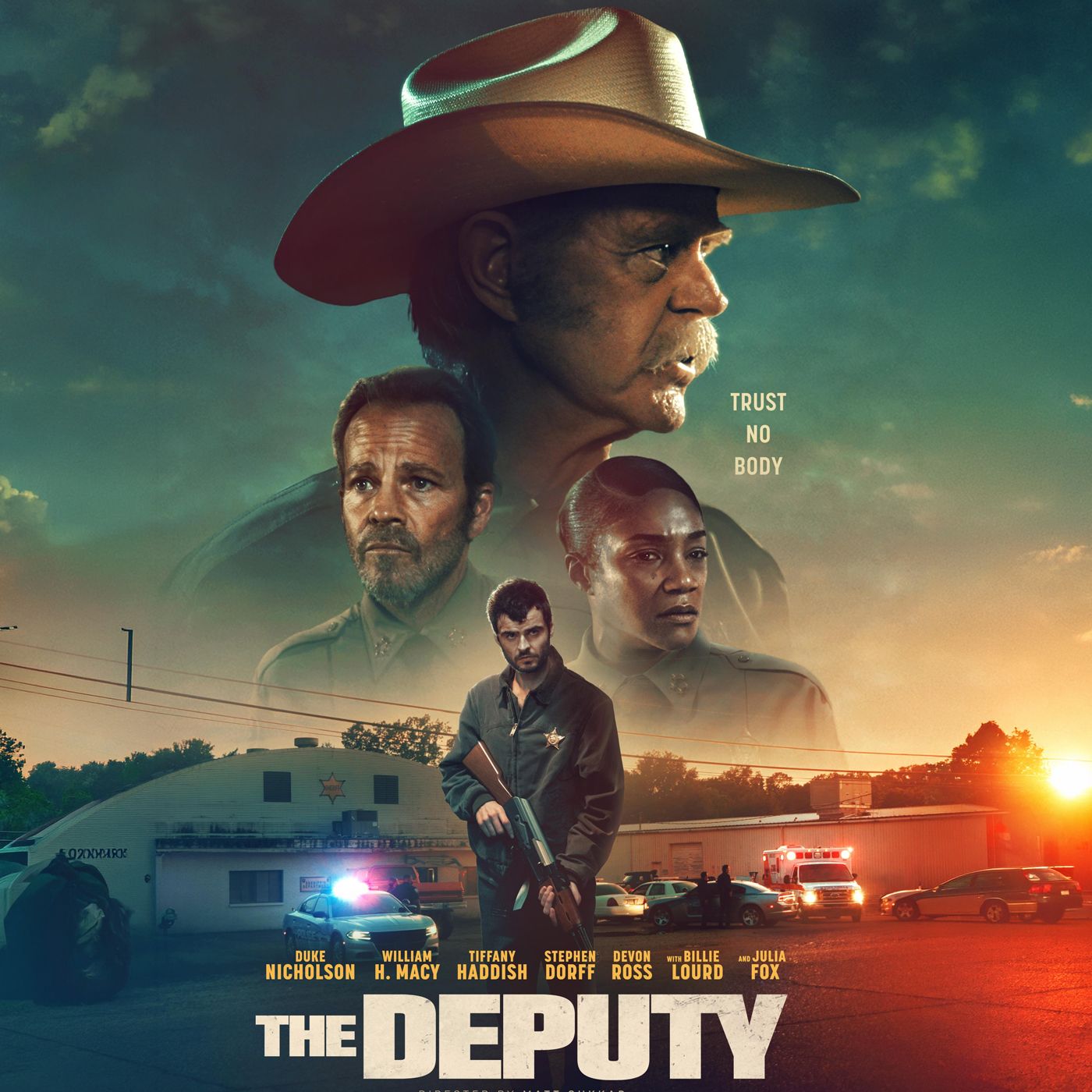
Damn it. Hey folks, I'm your host Mike White, and today I'm talking with writer-director Matt Sukar about his debut feature, The Deputy. Shot on location in Natchez, Mississippi, and led by Duke Nicholson as a small-town cop having the worst night of his life, The film also stars William H. Macy, Stephen Dorff, and Tiffany Haddish. The Deputy hit limited release in VOD on September 25, 2026, with Matt now taking it on a Q & A tour from LA to New York.
Visit wellgoosa.com slash film slash deputy for more information and to find out where the movie is playing near you. I had a great time talking with Matt, and I hope you have a great time listening. Enjoy. So I want to talk to you about The Deputy, of course, but I want to know a little bit more about you and how you got involved in filmmaking. I was a kid with a video camera for my childhood.
And when I was 14, I made a movie at summer camp. And after that, I decided I'd be a director, or I was a director, and started out with music videos for friends of mine who were singers or whatever, and then did commercials and shorts and documentaries. And now my first film comes out next week. How did you run across the story of the deputy? The deputy was sent to me by my manager in 2022, November, 2022 for me to read.
And, um, yeah, pretty soon after reading it, like I picked it up and as soon as I was reading it, I was like, yeah, I want to do this one. Um, it was, I loved the story. I love the character. That really is what drew me to it, is this unique character that's not one that you see very frequently. It felt very original and cool, and I knew Duke would do a great job with him, and so that was kind of the early impetus to get it going.
And did you work much with Carlo Bernard on the adaptation or the script once it was handed to you? So Carlo had written this film years prior, and I guess... they, you know, the film industry, like these stories will have their moment. You don't know when. Um, and by the time I got it, he, I think was busy doing other things. And so, uh, gave me a lot of freedom to do my own pass and, uh, was, was super chill about whatever, whatever I wanted to make with it, you know?
And so, uh, I actually did a lot of work My approach was, as I would cast characters, I would rewrite the characters to adapt them to the actors to try to highlight their skills as performers. Yeah, that was kind of how I got through the writing process early on. What were kind of the factors that allowed this to actually happen? I mean, because you have been making shorts and music videos, documentaries for years, but obviously there has to be something that pushes you into this whole feature world of it. Yeah, I mean, I had been trying to make a different feature for a while.
And then, uh, for a myriad of reasons that didn't happen. And this one kind of came my way and the factors that kind of moved it along were just like, like relentless drive and pursuit and, uh, tunnel vision, I guess I would say. Was there anything you had to do differently to prep for something like this versus prepping for a shorter film? Yeah, absolutely. Like, you know, it's like making a film where, you know, like no matter what it has an audience, like I've made so many little films that I've just like never even released, but knowing that you have an audience and knowing that like, now there's like real professional people involved that are taking it seriously.
And it's, it's, you're employing all these people and building these jobs and have all these people that are now passionate about it, um, creates a collective drive to, to get something done. And, and for everyone to, you know, build on it through teamwork is a rewarding experience. Well, how was it getting your cast in place? Because this cast list is amazing. I love William H.
Macy, love Stephen Dorff, so many great folks in this. I appreciate that. I love the cast as well. The goal there, or the vision behind it, was to kind of create this town that was full of these eccentric weird but real feeling characters that each have distinct energies um that are like a little bit dialed up from you know your baseline human and i thought that that toby would always maintain as kind of like the unusual like kind of like dumb sloppy straight man that kind of passes through but but what i really like about how we approached it was that like everyone else was, was always giving this high level or, or turned up energy. And Toby always kind of stays the same up against all of them, which, which creates a nice consistency that helps us ride his journey through the film.
But yeah, the assembly of, of Macy and Haddish and Dorf and Billy Lord and Julia was, was really like cold approaching. I mean, I wrote, Bill Macy a letter pretty shortly after getting formally attached to the film. He was my first choice for the role. I thought that he would play an unexpected Sheriff Kruger that wouldn't feel one way in the beginning and then a different way at the end. Everybody else, I kind of just started to assemble one by one by asking for favors, trying to get them to meet with me and trust me to take on the project.
What was the biggest surprise for you making this movie? Every day there would be like 20 surprises, but I would say like the biggest would be just like the overall of like really understanding how much goes into the process of making a movie. Cause you know, there are few people who really know what it feels like. And I have a lot of gratitude to that, but the amount of work and the amount of people, that it takes is just like an unbelievable experience you know it's like you have to get so many people on board and so many people excited and passionate and i have so much gratitude for. That experience where did you actually film this.
This was filmed in natchez mississippi once we decided it would be filmed in natchez i did like a mississippi pass of the script so that I wouldn't have to be thinking about... Originally, the book was written for Oklahoma. Victor Gishler's novel was written for Oklahoma, but I didn't want to be like, does this look like Oklahoma every time we were setting up a scene? We changed it to Mississippi. The city of Natchez was super film-friendly, and we worked with their local stage for our holding, but everything else was shot on location.
We didn't have many builds. The police... station was a mechanic shop that we built into a police station. I thought that the building looked cool. So we built that. But everything else was just straight up whatever it was meant to be.
Those interiors for the sheriff's department are great. You can... feel how cheap some of that wallpaper the paneling and things like that it just feels like okay this is the perfect environment for these guys to be living in. Totally like our low budget film matched their low budget town police sheriff's station so it was a great and uh my production designer julie tosh was such a she like really got how to make it uh look kind of nasty but still cool and bring some fun to it with the taxidermy or with trinkets on the desk. She did an amazing job. Curious, what kind of films you like and what kind of films might have helped inspire this?
Yeah, I kept going back to American crime movies from the 70s where a movie that's a genre movie can still be a character movie. And I think that's what makes this feel really distinct. but something that's not really what we're used to these days. Like, action stars are action stars now, and I feel like I was really drawn to this because Toby feels like an anti-hero and a fresh approach to that. So I was referencing or watching a lot of The Long Goodbye, Pelham 123, The Brinks Job, Assault on Precinct 13, After Hours. Scorsese's After Hours was, like, maybe our biggest inspiration because it's, like, just... one-night structure, bad decision leading you on the course of a night where the protagonist is trying to get things back to normal and reality is becoming increasingly absurd the entire time.
So that was my favorite reference for it. But of course, it's a different genre. But to me, The Deputy is a character study above everything else. You're not making it easy on yourself. I mean, you've got scads of characters... that you have to balance and work with all of these different actors.
I know you've worked with actors before, but this is a lot of actors. And then you're doing all these night shoots. That is never an easy thing. I think what was so funny about it was like, we were going through this intense, grueling experience on the filmmaking side, and that was mirrored by the character of Toby. You know, having this one night of hell.
And I think over the course of the filmmaking process, the crew was starting to relate to him more and more, and this unique energy was created through that experience where everybody was like, yeah, that guy, I get it. Life is tough right now. But we were all in pursuit of a shared goal of making a cool film, and the experience was wonderful. Well, how was it working with your main actor? Because he's on screen, so much in the movie.
I mean, trying to even think of scenes where he's not in there. No, there aren't any. He was the dream. Duke is a close friend of mine, has been for a really long time, and getting to do this side-by-side was amazing. We had the best time.
We were constantly having fun. We lived in the same house while we were making it. There was no separation. We were totally in it together from the start. It was honestly really helpful to have each other to support one another as we embarked on these new, bigger chapters in our careers.
How was the post process for you? The post was cool. This movie was edited in Mississippi, New York, Mexico City, and LA. That was just based on the unique schedules that Javier Velasco, my editor, and I had. We kind of like built out this plan that we could keep editing and like still be in different places that we had to be in.
But what I would say about that experience is that, you know, you're sitting there watching the same footage every day and all you can really change about that experience is your environment. And so by doing that, by like jumping through cities, it felt fresh every time we sat down in a different room. And I think that like building off of that, actually helped us keep it exciting and not like dip into, you know, just exhaustion from, from watching the same stuff over and over. And then the post sound process and the color was really awesome. You know, like just kind of tying up the bow on something that I'd spent so much time on.
It was really, really rewarding. What's kind of the story with the movie now? So the movie now comes out on September 25th in a limited release and on VOD. And then I'm going on tour with it. I'm going on like a road trip from LA to New York and stopping in different cities and doing special screenings and Q and A's.
And then it will come out on streaming in a couple months. I don't know if that's announced yet, but it's coming. Is there a good place for people to keep up with you in the film? Yeah, you can follow The Deputy Movie on Instagram or me on Instagram, Matt Sukar. Fantastic.
Well, Matt, thank you so much for your time, man. This was great talking with you. It was awesome to talk to you too, Mike. Nice to meet you. But I didn't shoot no deputy.
Oh, no, oh. I shot the sheriff. But I didn't shoot no deputy. Ooh, ooh, ooh. Yeah.
All around in my hometown, they're trying to track me down. For the life of a deputy But I say Oh now, now, oh. I shot the sheriff. The sheriff. But the sheriff wasn't subpoenaed.
No, no. Ooh, ooh, ooh. Yeah. I said, I shot the sheriff. Oh, Lord.
And they say there's a capital offense. Ooh, ooh, ooh. Yeah. Yeah. Sheriff John Brown always hated me.
For what? I don't know. He said, kill it before it grows. He said, kill them before they grow. And so....
But I swear it was in self-defense. Yeah. And I started out of town, yeah. All of a sudden, I saw Sheridan Brown aiming to shoot me down. So I shot, I shot, I shot him down.
And I said. If I am guilty, I will pay. I shot the sheriff. But I didn't shoot the deputy. I didn't shoot the deputy.
Thank you. I say. But I didn't shoot no dead.
More from The Projection Booth



Similar episodes across the network
Matched by shared keywords.
-
Bringing Out the Dead
1 shared keyword: martin scorsese