
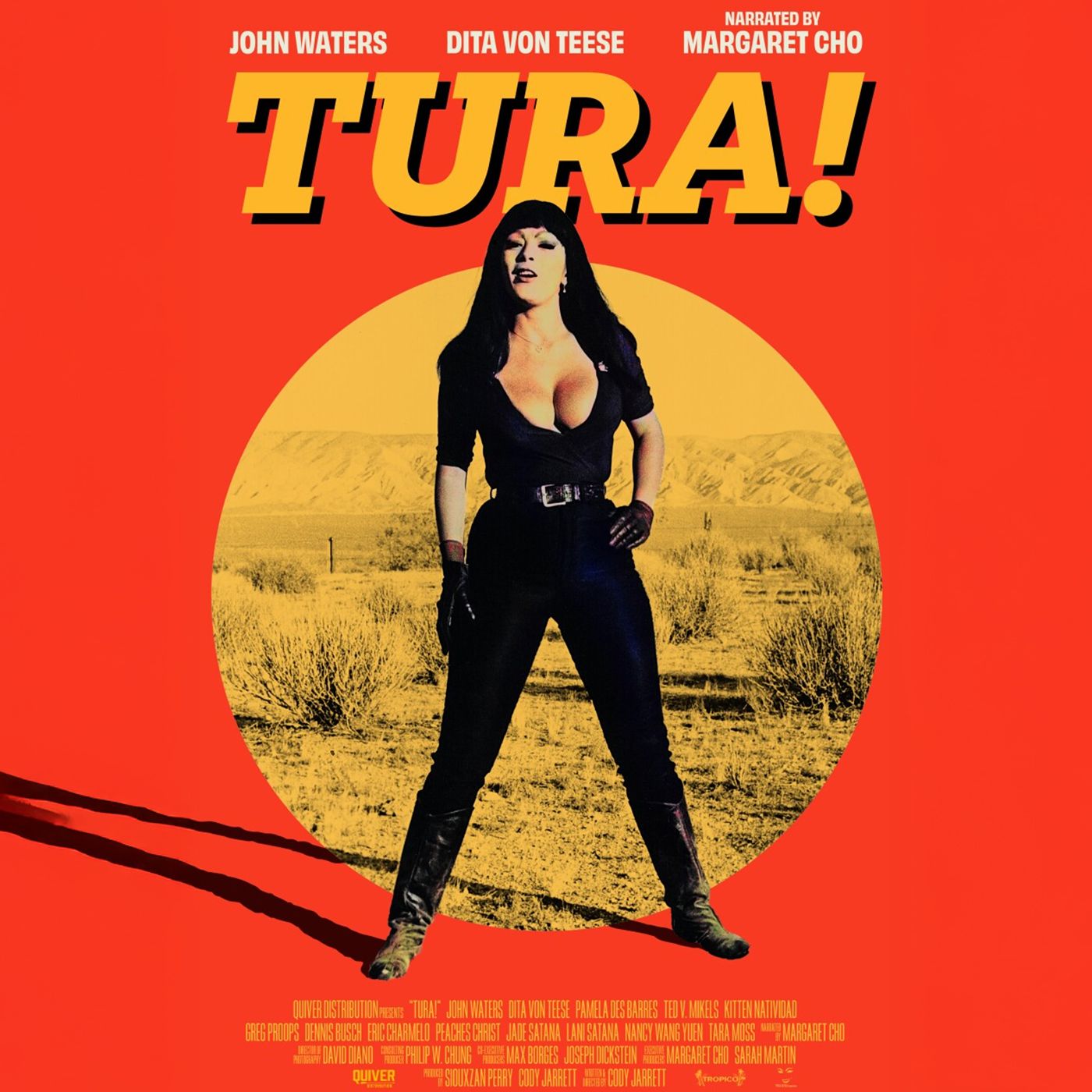

About this episode
VIsit https://turamovie.com/ for more details.
Transcript
Automatically generated, so expect the odd misheard name.
It show died. People say, good money to see this movie. When they go out to a theater. They want cold sodas, hot popcorn, and no monsters. In the protection Booth, everyone pretend podcasting isn't boring.
Got it off. Fast a pussy cat. I could never get tired of watching it. Tour was a leader, and she was sexy, and she was in control. She was out there kicking some butt and looking great.
She's the strongest character in this film. She was a radical warrior, feminist. Good, let's get it started. Toy was scary and people but whoa who is this? She was good actress and she was good at being a cultnov star.
Oh what a woman. She wore the black gloves. I loved it. She was a fantastic feminist role model. She was the one in control.
The fact that she's an Asian American woman that was able to get in. The pictures and even do what she did, it's inconceivably significant. It's such an incredible story. She's a real thing. Hey, folks, welcome to a special episode of the Projection Booth.
On this episode, I am talking with Cody Jarrett and Susan Perry. They are the co producers and mister Jarrett is the writer and director of the new documentary Tura. It is a doc all about Tura Satana and I'm sure if you're listening to this episode you probably know who the heck Tura is. If you don't, she was an amazing actress, dancer, entertainer, and she is mostly known for her incredible role in Russ Meyer's Faster Pussycat, Kill Kill. If you need to know more about that movie, check out our episode on that.
But you really need to see Faster Pussycat, and you really need to see this doc as well. Thanks so much for listening, and I hope you enjoy this interview. Cody. I can't tell you how excited I am to talk with you because I am such a huge fan of the adventures of four Word fair Late. Oh my god, thank you and wow, a lot of that's been coming up lately for some reason.
But no complaints about that. It was an amazing experience. I want to know, how do you two know each other? I used to manage all the Russmayer women and men, and I got an email from Cody about wanting to use Erica in his next feature, which was Sugar box Erica Gavin, and I said, oh, so he sent me the script and I read the script and then I said, I'm not sure if she's going to be able to do this one. But I said, why don't you come over to my house.
I had all the russ Meyer women in my house and I had a big party and Cody came. I said, okay, take your pic, just pick somebody, and he chose to and Kitten and that was it, and boom and here we are, how many years later. That's pretty much the simple part. What's the complicated part is that how the documentary comes about Kina. Yeah, obviously I cultivated a relationship with Tura and Susanne at that point, and there was a big supporter of sugar Box.
She came to the premiere and was outrageously fun and everything. So we became pals and I knew tourist daughters as a result of me being positioned there. When it was time for the documentary to happen. I started on that back in two thousand, with Tura talking about she wanted to have a movie made, she wanted to have a movie made of her life, and then working with Cody, it was just a simple choice. I said, do you have to come in this with us?
You have to? And that worked. Ra adored Cody. I adored Cody not so much now getting no. He just ripping on me today.
I know, I don't know what. Just help fun. He's like my little brother that I never had. But so it worked. I mean, the combination worked.
We did some shows together in San Francisco with Cody and Tura. It was just obvious that he should be in this pie od. I know you've done a lot of films before. You mentioned sugar Box and Frog I believe was another one. But had you directed a documentary at this point.
I had not done a documentary before. It had all been narratives. The only thing that was even close was I did a ten minute sports promo documentary for MMA fighter Misha Tate way back in the day. But this was definitely this is my first doc Some. People compare making a movie to almost winning a war.
Being in a battle. How do you come up with your battle plan? How do you work to say, Okay, this is how we're going to make this movie. When I first started the documentaries, one of my film attorneys actually gave me great advice. He said, documentaries are crafted in the editing room, so you might have one idea with where you're going to go with this, but then it might end up simplar totally different, And he was right.
Ta had an unpublished memoir. It's never been properly edited. Parts of it are like a thirty page run on sence. It's a very extream of consciousness. It's everything she was thinking just flowed out.
We did have that to work from, and the whole point of the film was just because we were the insiders, right Like I knew TURA's family, I'd worked with Tura, and because of Suzanne and TURA's daughters, I had access to all of TURA's stuff. The point from the beginning was to not take the outsider's perspective, but to flip it around, to flip the script completely and put the viewer right in the front seat along with Tura, so that they could experience everything that Tura experienced and share in the feelings that she felt as this crazy life of hers unfolded. It took a long time to get it to that point, because, again, have we been outsiders, it would have been like, oh, this was TURA's satana, she did the astro zombies, she did Faster pussy Cat, Kill Kill, you know, she did all these other things.
But we had the opportunity to express HER's most innermost feelings and how all of this stuff affected her. And it took time to get there. It's like, I'm a huge fan of Robert Evans, you know when he talks about like you have a chance to grab the brass ring, you have to do it. So this was our brass ring. No matter how long it took or how hard it was, you had to stick with it until we got there.
We did the best job we could with that. Susan, going back a little bit, how did you become a representative for all of the Meyer women? Beyond the Valley of the Dolls was my absolute favorite film that he made, and I thought, why don't more people know about this? Why isn't it on DVD? And I just started gathering all the cast members.
I first met Cynthia Myers and started working with her and ended up being a photographer. I started doing shots of her for a second round of her posing playboy stuff, and then we just started finding everybody from the cast, and when we did, I started taking him out tours on the road, and our chant was BVD on DVD. Finally I got the call from the Fox. They wanted to bring it in house and produce it into a doubles DVD, and that was it. I got the cast paid, I got to direct some of it, I got to write some of the stuff, and I coordinated everything.
And it was after that we took it. On the road and did more with it, and it just kept touring. So that's kind of how I met Toura as well. I met her at a show I was doing and we clicked, and that was in two thousand. She just called me up the next day and said, I made up my mind, you're going to be my manager.
If you don't say no, I just okay. And then that was. It, and we said that she had been talking about a documentary since two thousand, So when does this project actually come to what you would consider like these are the first steps. I think right before she died, because she died in twenty eleven, and she was already pushing us to do something. So I can't speak to the time before I knew Tura, which was I knew her from two thousand and six on two thousand and five on.
But the sentiment was already there for sure, and something's happened where it got sidetracked for a little while, and then she passed away. Unfortunately it never really got happened while she was alive, but I'll tell you, like, as soon as it did come together, which was not that long after she passed away, it's like you could feel the planets align, like the energy was just so powerful. It is just like feell snapped together. And the first people we reached out to were John, Dita and Margaret and all of them were immediate yes, so we just knew, yes, this is We're totally on the right path. You could just feel it.
How did the documentary change and get shaped as you went along? Because you've talked about the importance of the editing room, but how does that kind of morph as you go along? As you you know of Tura, her life is extremely complex. There are parts of it we will never know anything about. But it is like an an onion with so many layers where what we just talked about comes in.
I would be working on something and then we'd learn something else about her life and it's like, oh wait a minute, So that means we have to change these other things to sort of make this fit. And then we'd learn something else and it's like, oh, wait a minute, that means that doesn't work, so we've got to change this. So that happened a little bit, and it was frustrating for sure. Then the pandemic hit and sort of everything shut down. But we use that time, you know, when we went out to the Mojave Desert and got the aerial shots of by the Pussycat ranch and stuff.
But also it kind of occurred to me during then it's like, you know what, it doesn't matter if something happened in December of fifty sixth or January fifty seven. This film is not about that. This film is about TURA's feelings and TURA's emotions and her recounting of that. So at that point we switched a lot of the narration, which had been about Tura. It was during that period where we switched to first person to TURA's words, and so that big shift happened during the pandemic.
Yeah, and that made all the difference in the world, It really did. It was so nice seeing so many people, and especially so many people that have passed on just to hear their words and to see them on screen. That must have been quite a challenge, just to make sure that you're capturing everybody before they unfortunately passed on. We did lose a lot of people during the course of this film. Unfortunately.
I didn't go into any of the interviews having any predisposition that someone was not going to be with us anymore. Like I knew Ted was a little bit ill. I did not know he would end up passing away the next year, or Angel Walker. I didn't know those things. So we just went into the interviews with a great spirit, and everybody was so on board.
And I've got to tell you all the interviews, everybody was so into it and so good. We could have made nine of this film. There is so much stuff, like if we have an interview an hour and a half of John Waters talking, it's an hour and a half of brilliance that we could have used. But it's like, you only have so many minutes in a film, so. We still can Part two, right, ooh and three?
Who was your crew on this skeleton crew smaller than the crew of Fast or Pussycat Kill Kill? The DP David Diano, who shot most of the film. Unfortunately died a year and a half ago. David was probably David shot both my previous films. David was like some when I met on a movie set years ago.
At one time was the president of the Hollywood Camera Operators Guild. David was just one of the most respected cameramen in the industry, and I was used to joke how funny he get dragged into doing these exploitation movies with me, but he enjoyed it. I think he wouldn't have done it. So there was David. Johnny Cornwell, my brilliant musician, is in the Bandig and Team Machine with me.
Did most of the audio. Tom Stratton, one of our Kickstarter backers, has been incredibly valuable crew member. There are other camera people Joseph Gura, Darryl Orange, both friends of mine. Scott Walker did our sound for John Waters in San Francisco. It was not a big crew and not everybody worked everything, but everybody was really into it.
So that helps. What are you doing as your because obviously this process is taking decade more. What else are you doing? What's your other jobs while you're trying to put this whole thing together. I'm in the editors Guild, so it'd edit all day and then edit all night, edit all weekend.
So I haven't slept much in five years. But and I'm not ready to start catching up on sleep yet but soon. I remember, Susie, when you sent out the original kickstarter for this, but I don't remember what year that was because this has been going on for a while. Is it twenty fourteen? Noe?
Okay, okay, but I was close. I was close seven I missed. Wow, Oh my god. We just did a show in San Francisco. The film screened Wednesday.
The kickoff event was in San Francisco at the Alamo Draft House for a weird Wednesday screening a faster Prosscat and Kill Kill, And that was amazing. The draft House let me pitch the documentary, and that night, like San Francisco came in with so many pledges. It's like, wow, that like really just started the film on the right foot. So last week when we went back to San Francisco, I've got to say it was incredibly gratifying to be able to say, hey, look, you helped pay for this film. Here's the film at the same theater, same audience, basically, And it was just really wonderful, and just I was so grateful.
I'm still so grateful to all those people because it's like they've just had people like yourself. It's just stuck with it. Yeah. I was talking a little bit to Susan before you got on and just how awesome Peachus christ is and just that must have been so nice to come back home to that. He was a huge Tura fan and he was doing his Midnight Mass show and he called Tura and her husband said no, and then he called me and I said, oh, yeah, we'll be there.
That happened. We all met and he did Midnight Madness with Ura Idol Worship and it was Terasatan. It was a huge, big deal, and then we just did another show. But he originally started this craziness of his mass, his show Midnight Mass in San Francisco, So that crowd stuck with us through the Kickstarter and through this and so having Peaches and we wanted it to be kind of a memorial for her life, a celebration of her life, because we never did a memorial for her after she passed, and so this was kind of like the perfect event, the perfect place, and of course Peaches. It just did a full circle and we were all so emotional.
It was something. It was probably the best event that we've had for this. Well, when was your premiere for this? There was an unofficial premiere which was the San Diego Asian Film Festival last November, but that was a festival premiere. That was the first time the film publicly screened.
Once it became a theatrical release. That actually happened on August eighth. We premiered at the Music Hall Theater in Beverly Hills, where it stayed for five weeks, which is bloody in right off the hole. I mean, I looked at the list. There's only like seventy five documentaries that even got theatrical releases this year, and it's so grateful to be part of that.
It's amazing. I also have to ask us of folks, and I know that it's an unfair question, just because, like I said, making any film it's very difficult. But what was the toughest part of this for you guys. Aside from you know, kind of making sure because we always knew we wanted it to be like a very cinematic film and wanted it to be Toura's feelings and Toura's words and that kind of power. So shifting into that took a little bit of time.
But also when you're making any indie film, like no one's throwing bricks of money into your lap, you know. So it's like, you know, we before the Kickstarter, we had, you know, whatever stuff we had completed on the documentary. First we did out of pocket, you know, we just did out of our own pockets, and then the kickstarted help finish it. So, I mean, money is definitely an issue because not having money makes you be creative, but having a little bit of money lets you not stress things as badly. But that's a good one.
That and I think the loss of so many people through the journey, because each loss was like what and having to recover from that and just and realizing, oh, it just kept happening, you know, not only in our personal lives but with our cast. Yeah, there is so much, but mostly it was just like this great, fun project, and you know that there were bumps, but it was basically the spirits were all there. Everybody had high spirits for this, and everybody that joined in after, like Data and all the other people, they were like, yeah, let's go, let's do this, so it kept lifting the spirits. It was a joy. Buddy, What did you actually cut out?
Three different machines? Actually, I have incredibly antiquated and dinosaur esque, but I still use Spinel Cut seven for some things just because I came up on that, and I have a couple of really powerful macs, and I have one totally dialed in for final Cut seven so I can just fly through certain things on that. I also use DaVinci Resolve quite a bit and Avid Media Composer. Everything has their strengths. So whatever part I needed to do on whatever, and I think I ended up finishing in Resolve.
The film looks fantastic, and everything just has. It must have been such a challenge just to make a film over so many years, because I know, equipment changes, codex change, just it's it's always such a hassle to freaking things that you shot probably in twenty fifteen, twenty sixteen, twenty seventeen, and then we are in twenty twenty five or I'm sure you finished this up earlier than that, but just yeah, the equipment just kept changing. That is true. While we're on tech talk, you know, everything we shot was pro res so ProRes HQ or ProRes. That quality level has not really dissipated since when we started.
And also there's a lot of actual film in eight millimeter film in the film, not just the home movies, but I also shoot black and white eight millimeter film, which kind of compliments the other pictures and other elements of the film as long as you do a really high quality capture on that. Obviously, film is timeless. So were there any people that were hesitant to talk to you guys about Tura. I don't think hesitant. There were some people that just flat out said no, I'm not interested in doing it, and then there are people that were very close to doing it.
Martin Scorsese was this close to doing it. Yeah, it was just it was that moment where like all the strikes are happening, and all of a sudden, the whole industry was down, and you know, there was a tiny window there where it could have happened. It didn't happen, but it could have, so you know, that would have been great obviously. How about for you, Susan, what were some of your biggest wants for this? I wanted Carol Burnett, and I said that at the show last Wednesday, and the audience was like what huh, and Teaches was even like what.
But Carol Burnett and Tura did their first movie together, which was Who's Been Sleeping in My Bed? With Elizabeth Montgomery and Dean Martin and Carol Burnett and Tura taught Carol how to dance for lesque style like. Magazine or Look. Magazine did a huge article, like a four page article and pictures of Tura and Carol. So she said it was right during COVID and that because she's older, we just couldn't get to her.
She wanted to do it, but we could not get to her. That and Paul Rubins because he was ill and no one knew he was ill, and we had connections to Paul, but that didn't work. So those were the two that were bummer. But otherwise I think we got everybody. There's such a wealth of archives, images and film clips and everything.
Is that mostly from the daughters or was there another rich vein of Tura material out there. When I started working with Tua, when she said I want you to be my manager, she said, I'll be sending some stuff to your house, and I'm like, oh, okay, oh no, no, big boxes full of everything. She gave me her scripts, there was this photos and personal photos, and she would every time she'd come visit, which was like twice a month, she would just come in her van and just hand me stuff, and it just got bigger and bigger. So I have most of it. And when she died, she left me her rights and everything because the daughters really they didn't want it and they trusted me, which is what means the most.
So I had everything here with all the rights. I've got her writings, her book, her costumes. I've got every script she's ever done with her writing and notes and personal pictures. And then one of the daughters sent us, she goes, I have some canisters here. I think it's film footage of moms and she sent those down.
So that's where we had all the home movies. So it was just she just gave me everything. I think we had already known we were going to do this at some point, but thank god, I even have the Faster Pussycat script and her jeans and her glove. So yeah, she just gave me everything to sort of store. It's still stored.
So yeah, we had everything we needed. We had the daughters we had all of that was that was it. We're going to be, you know, moving because we're in a condo which is two small, so downstairs we have everything packed in and the next house. I want to have a room where I can unpack everything and see exactly. What we have.
And yeah, I want to do like not it almost like a traveling museum, but blown outs and let's do an event and somebody can have her jeans and there. Yeah, definitely, so many people want to see. It, especially when I see those genes. Yeah, I just know they were Wrangler jeans size eleven slash twelve. Now that was out there in the drawer.
I know it's something to see that stuff because when she threw them at me, I was like, she goes here. She would always do this, you might want this. She gave me this shirt somebody designed for her. She kept everything. Let me just say that much.
Yes, And so I've still got boxes. I haven't even unpacked because when they arrived here, we just stacked them in this room downstairs, and I'm like, really want to get into that. And because of the film, me and my wife, who is associate producer on the film, we both work and Cody. All three of us worked seven days a week on this day jobs, you know. But I did graphic design and social media for companies and also website design, so I was still doing that.
We were all working and it'd be like a weekend, let's go down and look at those boxes, and then we'd realize, oh no, I don't think so we can't get out of this in an hour. So that's going to be fun to have that downtime to look in there, because I'm sure I'll find things and then I'll say, we need to do another movie. Look what we've got scary. Fortunately too, there was a lot of stuff that Ura had digitally archived. So between her scrap books, Suzanne has everything, her daughters had, those eight millimeter home movies, and Ra's digital stuff, we had quite a bit of material to the home movies.
What was really incredible about those is I had previously interviewed Lannie and Jade. We did those interviews not knowing that the home movies existed. Then when the eight millimeter films came in and I had them transferred and I saw what was on the film, I just like I got chills because everything that Lannie and Jade had spoken about in the interviews was right there on the film, and it was. It's still getting goosebumps right now just thinking about it. It still leaves me speechless.
Besides it being like a movie gold mine to hit something like that, the material there, what they talk about is so personal and so moving and so emotional. Being able to see it as they speak about it was again still is incredible for me. I remember it used to send me text messages, Oh my god, just that's how I have a whole string of these, and it's like what wait, oh my god. And then you'd send any little clips of it and I'd be like, that's amazing, how did that happen? Magic?
He really was. Those two are really the heart of the film. To see how they grew up and to hear their stories, it's just they're such remarkable ladies. Absolutely yeah, And they were totally forthcoming. They didn't hold anything back, They didn't try to sugarcoat anything.
That was just And that's what we tried to do with the film is not be exploitive but also candy cold anything. Just be very frank about everything and just very present about these everybody's feelings, the things that happen to Tua, what toa experienced, what she did with her life. So the one question I can hear my listeners already screaming at the radio is where can they see it? Is there a website to follow, social media all that good stuff. Please lay it on me.
If you're in the United States, you can see Toura anytime. It is available for download an Apple or rental on Amazon, Fandango, at home everywhere, so you can basically get Toura anywhere in the United States. Now, we're still going to be doing select theatrical engagements like where at the end of this week it plays Brisbane. Not very helpful for us here, and I think we'll have, you know, more theater showings, more movie theater showings, you know, as it continues. And the official website for the film is turamovie dot com.
That's where you can find everything about Tura toa merchandise toa theater dates, you know, updated news. And then the Instagram is Official Tour Satana and that's like probably that's the thing, Like I update to Instagram and then they update to Instagram. I think first is it pretty much Instagram. First Facebook, Instagram and it's also Tourisatana dot com is another place where you can find more stuff, and all our socials are at the bottom of that as well as on tour movie. But Instagram is very active, as is Facebook.
They're all good. I am so glad to have finally been able to see this movie. I've been waiting for it for so long and I'm just it lived up to all my expectations. Susan, We've been talking via email for I don't know how long, so it's so nice to finally meet you. And then Cody, it's great talking with you.
I really appreciate this. Thank you. No, it's a great speaking with you too. And got the nod to Ford Fairley and forget it. Well, that makes my day completely.
Twist. Glad you're trusting him Black to broach a wood off and got. Duman test to kill Yeah, just to kill Man's room in the dead of Blacks. To come home to a Satanic come out to come out to the Sadana. Tell if you're Vitu the Texas pus.
You can't downs to the top up read crack up with you're cracked up with tails, try to get support the seas to. Come out till a satana come out. Just to come out, tis. So down. You can fool his head.
She can say she's strange, and she stainly wills to. Come home till a Satana come out, So come home to a Satanda. So come home until the Satana come out, So come home to a Satanda. My wish
More from The Projection Booth



Similar episodes across the network
Matched by shared keywords.
-
The Murder of Elizabeth Short
1 shared keyword: dita von teese
-
Vixen!
1 shared keyword: russ meyer