
About this episode
Watch the movie on YouTube: https://www.youtube.com/watch?v=go0Yesa9m0Q
Transcript
Automatically generated, so expect the odd misheard name.
Welcome to the Shabby Detective, yet another Colombo podcast. I'm your host Mike White. Joining me, of course, is mister Chris Dashu. It's me, it's me. I'm here from Playhouse ninety.
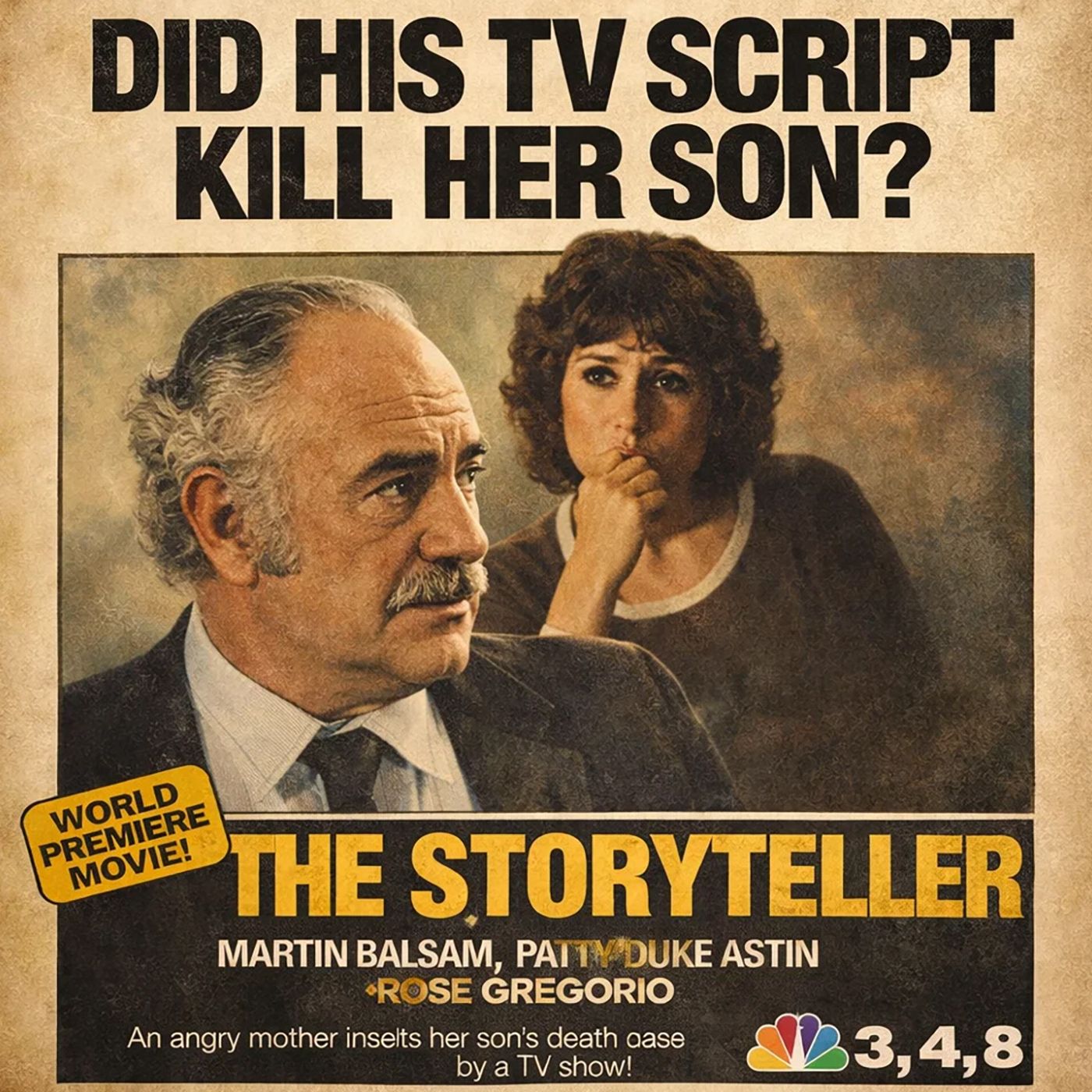
This month, we are still on a little bit of a break from Colombo, and we were talking about a movie that was written by Richard Levinson and William Link directed by Robert Markowitz. It was a TV movie from nineteen seventy seven, aired on December fifth, nineteen seventy seven, and it is called The Storyteller. This is not Jim Henson's The Storyteller. If you go out and you start looking out, the storytelling, and that's probably gonna be the first thing that comes up. This was from seventy seven.
That was from eighty one. This one stars Martin Balso. Of the other one stars who John Hurt I think is on the cover of that or Mike Michael Gambon or something. I don't know. John Hurt and the Puppet Dog.
Good name for a weird indie band. And I'm sure that a lot of people love that. I have not experienced that one at all. I have experienced this one a few times. This TV film, which interestingly enough, is very much a self examination, I would say, by Lincoln Levinson about violence on television.
Jack Thompson somewhere is enjoying this. For those of you who don't who Jack Thompson is. Jack Thompson is the famous American lawyer who would sue video game publishers all the time for violence and video games, which is essentially this nineteen seventy seven's version of that nineties mid two thousand's like back and forth. We can have this conversation oddly on this episode or on any episode of the show that we do. But I think Levinson and Link have always been very smart about the way that they do things, and I think that for two people living in nineteen seventy seven, they were very well dialed into what was going on at the time.
And to your point, like they're quote clays in things unquote, I mean again, Levinson and Link weren't making things of the time I think that were quote overtly violent unquote. However, that's not really the point of this. The point of this is more where do the responsibilities lie with media for the things that happen in real life? Subsequent to the media coming out that mimic or replicate or mirror media. I mean, I, you know, as someone who enjoys the television show Dexter a fair amount.
Once that show came out, there were a rash of people who did the same thing. They weren't killing serial killers, they were just killing people because of course they were and they were quote inspired by Dexter unquote. That prompts the question in my mind of the mother of the character who passes away who dies to the arson, you know, says it to Martin Bolls and he's like, who wrote it? You did? Where does the responsibility begin?
Is the question that this asks, and it also asks the question of where does the responsibility end? And how many people are responsible? I mean how many entities, because it's less people specifically, but entities as well. I found this very interesting. I don't know if it's necessarily the most entertaining thing on the planet, but I think, and again I think that's primarily because a lot of this is a vehicle for the discussion that we're going to have less a trying to be eminently the most entertaining hour and a half on television at the time.
So I enjoyed it, but I could see someone watching it and kind of finding it maybe a little not a little dry, but maybe a little plotting. Also just mentioned to the listener, this thing is impossible to find again, Mike mentioned trying to search for uh, trying to search for it's hard. Good luck finding it and watching it. Yeah, I think I'm gonna have to upload this to YouTube and hope that it doesn't get a copyright strike. I don't know why it would, because this seems like an abandoned piece of media.
I mean to be honest, I don't even remember where I found this at, and you can tell that this was definitely been around. Like looking at the provenance of the actual video file itself, you see breakup that comes from a VHS recording, but you also see like a countdown beforehand, so it feels like we're watching a sixteen millimeter transfer of it. But then you also get a little bit of a commercial break that breaks in at one point, so you're like, Okay, so was this taped off of BV or was this taped off of sixteen? Or like, how how did this thing even come to us? And I'm not exactly sure.
It's tough to tell. How we got our hands up on this. We've talked about this on your show, where you cover more of these kinds of things than I do. But on your show you tend to cover things that are hard to find out of print. I mean, you have to search around for things.
And I always kind of bristle at that because I like talking about things that people not that I don't have to have people go out of their way to find. But you know what I mean, like this is a thing where like you got to really hunt this down. Yeah, I know, I know you're really pissed off at me about what we're talking about next Wednesday. That obscure media, The Dark Knight Rises. I'm so sorry.
I'm so sorry, one of the most obscure films I have ever heard of. To be fair, on your show, like that does not dissuade you from talking about things the ability for your audience to find it. This is genuinely one of the things the few things I've talked about I think ever, and including especially with you, that's like, I don't even know how anyone like you don't know how you found I don't know how anyone else would find it. And I think that you know the the reason I bring all this up and kind of labor. The point is that is probably the most unfortunate thing about the Storyteller is that it has kind of been, you know, like you said, abandoned or lost to time, because the conversation it's having is still one that people are having now still in twenty twenty five.
There is political violence that happened this year that was blamed on TV and video games. Once again, we're right back here forty fifty sixty, seventy eighty ninety years later. Like, as long as people have been making content, people have been ascribing meaning of other people doing similar things to that content and saying troubled minds. It's like, well, troubled minds interpreting content are always going to interpret it troubledly, Like there's not going to be any sort of rational thinking when a troubled mind interprets something. So how does one fight that?
I don't know, I'm curious what did you think of the Storyteller and the message that it's kind of trying to get the audience to engage with it in. I'll tell you the first time I watched it, I I can't say I was bored, but I felt like it was plotting. Once we get into the story, there are some very long sequences, a lot of dialogue, Like you're saying, this does feel like something that they are setting up for us to talk about around the water cooler. Kind of one of these. You know, tonight on CBS, there's a very special movie about violence on television.
You should watch it with your family and discuss it. And which were things you know that I'm sure you know of the phenomenon of very special episodes. Oh my god, this is crank, We're not Coldcaine. I mean that's I mean, that's not an episode of Pee Wee Herman, but you have pee Wee Herman advising children to not do crack. So that was always the like very special moment with pee Wee Herman.
Or I mean I always think of the Michael Jordan me and the stop stop it, get help, Like it's in that same vein of like again, prostolytizing, preaching, don't do drugs, don't care bears, was no stranger danger, and don't take candy from strangers like the very special episode. I do miss it in a way, you know, on a very special eppisode of How I Met Your Mother, Barney Stinson has aids, you know, there's none of that anymore, even though you have like Neil Patrick Harris playing the world's most promiscuous character on television. So it's kind of falling out of fashion. I don't know why. I guess he just google it now, he just google information.
We'd have the teenage fan Ninja Turtles telling me about my credit card data being stolen. I could just search on the internet about it. Hello, I'm James GANDALFEENI to night. On a very special episode of Sopranos, we talk about the effect of violence can have on your community. The character that I played, Anthony Soprano, gets into a little bit of trouble and you really need to be careful when it comes to just how you use your words and actions.
He's just a character on TV, folks. I'm a nice man in person. I mean, we kind of got that a little bit in some of those Barney Miller episodes. Like by we did one hundred percent. But luckily they blended a lot of stuff with the humor.
But yeah, thinking I'm I never watched what was the one with a C. Slater and those. Folks, But like Saved by the Bell, and they had. The one is that Elizabeth Berkeley was on like the caffeine pills or something, and. The final destination, like joke music video that's Saved by the Bell has the character dying because of those caffeine pills.
So I'm assuming that's where that's from another show I've never watched, but I'm assuming they had. They had to have had at least several of those episodes, right, Like. Well, and I was very scarred by the I think it was a double episode of different strokes where the guy that was mister Carlton on w k ARPA in Cincinnati basically was trying to molest two of the characters, including Arnold Drummond. That fucked me up for a long time. The fuck yeah, oh yeah, this was a real thing.
This was very like you would just be watching you know that meme of I think it's like Henry Cavill standing there talking to a reporter and you've got Jason Momoa in the background, like sneaking up on you. That was how it felt when you were watching television because you never knew when one of these things was going to happen, and then it would just be like boom, very special episode. You know, Richie's taking heroin, you know, something like that, and you're just like, what the fuck is going on? Yeah, and a very special episode the gang gets hooked on crack. So this one it's not as heavy handed.
And that was the one thing that you can kind of look back at some of those episodes of very special episodes of Facts of Life or Different Strokes or any of these kind of things and be like, Okay, that was super heavy handed because you had to fit out in all this stuff within thirty minutes, or in the case of Different Strokes, it was a two parter. And that also kind of screws you up when they don't conclude the story in a nice brief thirty minutes. You know. But I don't think that the storyteller is that heavy hand, and I think they're very smart when it comes to telling this even when you look at the structure of the story and you're like, within the first five minutes of this movie, you have this man on the street interview this Fox popular thing where it's like, okay, well, what do you think about violence on television?
And then you get these people talking they're obviously actors. I recognize a lot of these folks that are talking, and then you kind of go to black and you hear Martin Balsom just giving this pitch for a story, and he's definitely layering in a lot of violence in this story. You kind of come out of the credits into him in this room pitching this story to what looks like a television exec. They're like, Okay, yeah, sounds great, let's get going. And then you go to this school where you see all of these kids who are picking on another kid and they're bullying him, and I think it's the kid who, eventually, like you said, burns down his school.
You see him up at a window closing the window. Before that, I think you see his teacher looking down at these kids and not doing anything. He just yells at them to basically stop doing that. And then as the kid closed the window, and you see the kid and the look on his face. And then you cut back to Martin Balsam who's left the studio and he's going by this wreck on the side of the road and all of these reporters rushing over with their news cameras and it's great to see like actual sixteen millimeters news cameras and stuff here in nineteen seventy seven and just sticking their cameras in these people's face where they're going through like one of the worst things in the world, Like this car is on fire, they've got the jaws of life, try to get this person out and all this stuff, and you're just like, Okay.
Within the first few minutes of this thing, you're setting up all of these things like who's responsible, who's responsible for what? Why? Why are these reporters sticking their microphone in this person's face? Well, because it sells, Like all of this stuff is like because it sells, and like they do not pull any punches when it comes to talking about the violence of like a Star skiing Hutch or any of these police cop shows. To your point from earlier as far as like Levinton and Link, they make their money off of murder.
Like here we are talking about Colombo. In every single episode, one or two or more people get murdered, but it is almost always off screen. The violence is at such a minimum, And I love that towards the end of this you actually get a reference to crime and punishment, which is what started off this whole discussion of Colombo. I would it have been too much for them to mention Colombo. It might have been.
I wondered. I wondered that to myself when I was watching this, because I was like, are they gonna, Are they gonna? I guess it's are they do they go to that ex stent? Because that's I mean again, you know, Deadpool can be meta, but Deadpool, there's there's a limit to which the metainness of Deadpool works. And this is like, again, this is the discussion.
This is a meta discussion. This is a television TV movie about TV violence, and like, this isn't violent, but this is a television this isn't just a documentary. This is a television movie about television violence. That's meta in and of itself, like it's it's it's it's turning the it's turning that high powered lens on itself, which I really appreciate. But I was wondering, like if they were gonna mention Colombo in any capacity, I kind of I don't know, I was kind of curious your thoughts.
Like I almost wish they had, but I understand why they didn't because maybe it would have been like, ah, too much on the nose. By this time, like Levenston and Link weren't that involved with Columbo, like they created that, but it was going through and we'll talk about this next month, had gone through so many different show runners. They were just about to start on their new showrunner, who, for better or worse, didn't light the Colombo formula. So he's going to shake some things up. Yeah.
I don't know if it would have been smart or not to bring Colombo into it. I just you know, like you said, we've spent so long talking about their show, which is a show about people who are being murdered and a cop solving the murders. Even though there's not a lot of direct violence, You're part of this conversation, even in a kind of sideways way. So yeah, it's interesting. I will say I like Martin Balsam a lot.
That's not surprising. I feel like every time we see him in something, either separately when I'm seeing him in things, or because we've talked about him several times together on our show with Father Malone Midnight Viewing. I like him here though, and I like Doris Roberts too. I wish she was given more to do. But I like Martin Balsom a lot in this.
I love Martin Balsom as an actor. Every single time he shows up in anything, I just know that he's going to be good. And you know, things like the Ticking and pelam On two three, or even a small role in Psycho, like, yeah, you always know that when he shows up, you're like, Okay, yeah, I'm here for whatever you do. I'm here for you. And he's just as Oh and I think he was also in Twelve Angry Men maybe.
But that's right, he was. Yeah, and yeah, he just has a lot of gravitas playing this kind of everyman character. And yeah, you've got top notch people because playing his daughter's Patty Duke, who is just given a great performance as well in this whole debate that they're having as far as yeah, I don't allow my daughter to watch television after supper, and basically it's like I'm trying to keep her calm and not present all of this stuff that my own father is responsible for, like the mayhem of it. So I like that, But there's that kind of like your own daughter doesn't support what you're doing kind of thing. And I like that they're running these parallel stories not too much with the kid that burns down the school.
But you do get him again one more time where he comes in. First thing he does, and by the way, no one at home. It looks like, you know, he comes in and turns on the TV. First thing, lays down and starts watching television. And it's like, all right, yeah, this is what this kid's doing.
This is all that he's getting as far as this interaction filling in his head with this. And I also really appreciate seeing the old spot for conserving water, which still is a problem in California. You know, if only they'd break their forest, they wouldn't have these fires. Just turn the hose back on. Isn't that all that water that's in the north, It just flows down from Washington.
You know that big pipe that the internet comes to us through, Mike, The internet is on the top half and the water is on the bottom, and it all comes from outside of that ring of Arctic ice that encircles our flat earth. Right. I just heard that LA has finally gone away from coal power all together. But they are one hundred percent renewable energy, which these days is the most surprising thing I could possibly hear, just because of the war on renewable energy because people don't fucking understand how the sun or wind works or power itself. Well, you know what they say, education, Mike is a hell of a thing.
And without it, people commit violent crimes that they copy from things they see on TV. I guess I don't know. I you know, one of the things I was thinking about, and you know this is you know, the high I guess the in my mind, and I know you and I kind of differ on our I wouldn't say interpretations, but I think the way we receive the film, it's one of my favorite movies, Hi Fidelity. I think the question that John Cusack asks at the beginning of that movie, I think is a very apropos one. Why is all of this directed at movies and TV?
Like it realist? And this is you know, this is me speaking as someone who is going through some kind of turmoil and heartbreak right now. I don't resonate with anything as much as I and even movies which I watch all the time, Like music hits me like a ton of bricks more so than I mean, I can hear a song and bang, I will just be full on in a completely different emotional state, Like it'll be like please turn that off like that will just it'll bring me right back to some moment or something. Television and movies don't do that for me. And I wonder where that disconnect is, because again, like we're talking about this from nineteen seventy seven, when people were concerned then about people copying the things that they were saying on television, you know, the thing that I find interesting.
And I went and read some letterbox reviews about the film, like the five that there are, and someone said something I think is very interesting, which is it feels like a little bit of a dodge here what they're doing. And I will agree, the thing that they should have been talking about is not arson, should be gun violence. And then I think this might not have been lost to time because imagine if this had come out in nineteen seventy seven talking about gun violence in schools. Again, everybody talks about Columbine. Columbine obviously is kind of like the watershed moment for violence at schools, But things like this were going on before that.
The guy went to the tower at UT long before before those two assholes were shooting kids in Colorado, like that guy was shooting at four Texas students long before Cleebolden Hair has decided to go act like assholes and trench coats. Well, you know, they weren't the only shooters. I read that in Sanity the other day that there's a whole thing that it's being covered up there is more shooters in there. I'm like, what the fuck are you talking about. I mean, we talked about the gun back in Anuary of this year.
It's kind of interesting that we're ending the year where we started it because we've talked about the gun, which was also this Lincoln Levinson thing from seventy four where it's like, look at how violence is affecting here and how this gun moves from person to person to person. I agree with you gun violence would have been a little bit more interesting. But at the same time, I'm like, okay, yeah, this whole repetition of what you see, but then also being a different interpretation because it wasn't you know, it was somebody who was burning down something else that wasn't their school. It was a very you know, a different circumstance for. That, right.
I guess it doesn't take a hard enough stance for me with the thing that's happening on screen being replicated in person. And that's where I'm a knock on it. It's just a tad hollow because again, you know, if it had been gun violence, which again Lincoln Levinson are one hundred percent already clearly willing to discuss like that's the thing, you know, again, to go back to the point of the gun, like they already had that discussion. So maybe that's why they don't do it here. But this is a that wasn't so much a discussion as much as look, look, this is this is what can happen, and this is how this happens in violence.
This is much more kind of as we've said already, this might be a little plotting, or this might not necessarily be as sharp or as cutting as it could have been. Otherwise, I think this is more cutting than the gun was. I think this is a little bit more focused than the gun was because the gun, I mean the gun, I think it was a little bit more not esoteric, but the gun was a little bit more hands off with its message. This is very much like and he's the main character, and he is the one who wrote it, and we're going to go see everything that he does, and we're going to stay with him pretty much the whole time. Like it has a different kind of context to the way it's playing out than the Gun did.
The Gun was very much like vignetteses, and some of them you could kind of see from a mile away how bad it was going to get. I appreciate what this is doing more in terms of the commentary that it's adding to the conversation about violence on television being replicated in person. You're talking about like, oh yeah, way before Columbine. I mean, in my life, I have heard so many different excuses for what causes violence, and so many things to be blamed. I mean, there's the whole thing of like, oh yeah, suicide solution by Azzie Osbourne, or that's the thing that caused this kid to shoot himself in the head and the bullet ricked the shade off, and so he's still alive and he's all fucked up now, and it's like it's basically as face from the Preacher comics, you know, and it's like okay, And so it's like for a while it's like oh no, no, no, it's the music that's doing it.
And then no, no, no, it's the TV shows that are doing it, or no, no, no, it's this movie like, oh, Natural Born Killers is going to cause people to go out and murder people. And it's just constantly one thing after another after another. I mean, speaking of the Dark Knight Rises, I. Mean through my life, I've seen you know, the PMRC and the congression hearings around music being such a horrible thing and people being exposed to like oh my god, to Pergore caught her daughter listening to Darling Nikky by Prince How horrible is that? Or like this music is causing violence?
Or now? And then it became video games after a while, and it's like I always wonder like Falcon, like I don't know, the fourteen hundreds or something is that, Like oh my god, this kid looked at a tapestry and then went out and shot someone with the crossbow, Like well, how far back does it go that we have to blame things on things that people see? Or are people that simple minded that they just and I know that they are. I know there are people that are so simple minded that they will see something and be like, oh, that's so cool, I'm going to do it myself. You know, there are people that dress after movies.
They will wear their hair because of a certain music video, like any of those kind of things. But it's just like, all right, can you just blame that? Like, how how much do we have to protect people from themselves? The idea of violence and how pervasive violence is. You know, violence is so pervasive in our media that we've kind of just given it almost to pass.
And you know, this film is not yet rated one of my favorite documentaries of all time. Spends half of that movie just talking about how we're more focused on the violence, or not focus on the violence, frankly, I guess, and more focus on the sex of it all, and are like the puritanical nature of our country. But I don't think for me. I think for me the thing that this comes back to, and this is something again I struggle with. You know, someone who's diagnosed with borderline personality disorder.
I think people are just generally mentally unwell. I think people are generally unwilling to take care of themselves, take responsibility for their actions, take responsibility for the way they do things or treat people, and for the ways that they react to the things that they see. I mean, you can blame TV and movies and music, but we should be blaming the people who react to them the way that they react to them, because no one, unless it's a snuff film or an audio recording of someone being murdered, is actually being hurt in the process of making these things. There are literally guidelines in place while they're making these things to ensure that people don't get hurt, because when people do get hurt, it often doesn't go very well.
It goes quite poorly, like Vic Morrow in fucking the Twilight Zone movie. Like, people aren't getting hurt in the making of these things, So why can you blame the media where real things aren't happening on the real things that happen Because people who, like you said, are I again simple or just I again? I empathize so much with people with mental illness, obviously as someone who is you know, diagnosed this past year with it and I struggle with it on a daily basis. But when you do stuff like this, that's just your inability to handle it in a healthy way. And not only are your inability to handle it, but your inability to even communicate to someone else that something is wrong.
It's unfair to media to blame media for people's mental health struggles. Not being taken care of because you know, like you mentioned with gun violence, you know, thoughts and prayers. Thoughts and prayers always what people are saying after a gun violence is perpetrated. Frankly anywhere at this point, but especially in schools, people should be saying, you know what, thoughts and prayers, but honestly, like, go talk to a therapist, Go speak with someone who's unbiased, Like I'm so glad that I can that I have the privilege of being able to speak with someone who's an unbiased opinion once a week who will tell me is what is going on with me? And being able to see the externalizations that I have.
I think if more people did that, this would be less of an issue. I don't think violence and television is to blame. I think unstable people will do unstable things because unstable people are ultimately unstable. It's that statement that you hear all the time. Hurt people, hurt people, they do, and hurt people sometimes tend to be people with mental illness, and they don't talk about it in this movie very much, but there's clearly some of that that's going on here, like and it's just again it's easier to look at something else.
That's so I wouldn't say obvious, but loud and then blame that versus like the quiet thing we're talking Like talking about the quiet part out loud is important, especially in this day and age, because we live in a day and age of people just having their worst mental health crisises. Essentially you know, I don't know, like explained away by just like well, that is just what it is. It's like it's not and if we continue to act this way, these things will continue to happen and we'll continue to have these conversations where violence is being blamed. Real life violence is being blamed on people slashing at werewolves in a fucking movie with Kate beckhamsale, Well. The whole thing of who's to blame, Like immediately, who's to blame, who's to blame, who's the blame, and the whole thing of like, you know, you have any sort of violence that's happened right now in the real world, especially in the US, and you're just like, well, I hope it wasn't a person of color.
I hope it wasn't a transperson. I hope it wasn't this. I hope it wasn't that because they're already getting all of this shit just being thrown at them, and it's like as soon as that happens, it's like see see look at this person, look at this yeah. Yeah, and it's like going back to Oklahoma City, Like as soon as that happened, it was like, oh, we are looking at all of the Arabic people that are in our state, and it's like, uh, yeah. It ended up being a couple of white guys from Michigan, you.
Know, Mike. They're still looking for that third guy. And we still have all of these fucking militias around here. And yeah, Michigan just within the last few years, we hadn't the incident at Oxford. We just had the whole thing with the guy crashing his truck into the Norman Church Better Day Saints Church and burning the place down.
I mean that I was just talking before we started recording about some of the people that I work with that was one of my coworker's girlfriend's grandfather was one of the victims of that thing. So it's like it's getting closer and closer to home every single time one of these things happens, and it feels like it's just a matter of time until it happens to you. I am recording this podcast from my parents' house in Allan, Texas, where not but five miles up the road, the outlet Mole that I go to every time I am here was the site of gun violence perpetrated on people for no reason with a assault rifle. A fair amount of people, like essentially an entire family, but one of the family members was murdered and the one that was left alive was like a small child, always very sad, but this is one of those like overwhelmingly sad things.
Every store at the OUTLETMO has an alan strong thing still, like five years on, I don't even remember. It's been so long. And to your point, like my parents go to that OUTLETMO, there's nothing to say say that they wouldn't have been there. There's nothing to say that I couldn't have been visiting and there as well. And it's scary to me because to your point, like it does feel like the net is ever kind of shrinking and closing, and at some point someone I know will be directly inaffected by it.
And like you said, you know someone who's been directly affected. But I mean, like even more directly affected, like in like a cause, like that's like third ring of people in your life, like you're I'm talking like first or second ring of people in my life. And that's very scary because you know, again, like we don't have the discussion about mental illness country enough. We don't. And I think it's a shame because I, as someone who, like I said, has diagnosed mental illness, was with someone who struggled with their mental illness.
I will continue to struggle with my mental illness. It's a conversation that needs we had on the open, because if we're willing to have this conversation out in the open and blame again just to use an example that's so outlandish. No one should be using this as a real example. But people pointing twigs at each other and screaming spells and the spells flying out of the ends of the ones and them flying through the air after being hit with them. No one should look at that and go, if someone commits violence, it's because of Harry Potter like or something like again in that similar vein of like this is now just fantasy violence, and yet it's being kind of characterized or blamed for things if we're willing to have this conversation out loud about television shows and movies that are violent affecting the way people are, then we should be willing to have the conversation about mental health.
To your point, though, I think the other thing that's interesting about this is this asks a question that rarely gets asked, which is how many people are to blame for these things coming out? If we want to take the stance in the argument, I think it would be interesting to discuss that a little bit. Is let's take the stance that television shows are to blame for violence? Right where does that start and stop? And I think that that's what's interesting about this is this is having a conversation about that which most things never have because, like you said, like we can point at Martin Balsom and say, well, it's his fault, but really, like there is a system and entities in place that are allowing all of these things to happen.
Because Martin Balsom didn't just ride it and then it appear. There were people that everyone came to set. Everybody was on set, everybody, the editors and everybody, and the producers, everybody, everybody okayed it. But Yeah, here is Martin Balsom just being piled on. And it's very interesting because they the lack of accountability is very interesting in all of this because do you think anyone on Natural Born Killers of Violence had happened in real life?
Do you think that the Craft Service people felt bad if it did? Like again, it's the old conversation from clerks that Kevin Smith has, like I did all these janitors on the Death Star deserved to be blown up? Like again, you know, there are people that are just doing a job. I'm not saying that that's okay, but sometimes that is part of the conversation. So I'm curious, Like it's it was a curious thing for me because they don't they don't talk about that very much, and these kinds of things.
No, I've got this whole thing of like, well, you've got the network, you've got the advertisers, you've got the exacts, you've got the producers, you've got these people that approved all these things, you know, And then is it the parent? Do we go back to the parents. Is it the parents that allow this kid to do that? The parents weren't home, the parents saidn't know that the kid had left YadA, YadA, YadA. Is it reporters?
Is it the media that is creating this thing to this environment for of these violent TV shows? Is it's just a reflection of the news. Like I like that conversation that Balsam has with the He's he talks directly to two reporters at least through this film. There's the woman who lies to him and says that her car is parked down by where his car is parked, and he pretty much calls her out at it, and just like, well, I know you're lying to me. Your car isn't around here.
You're just following me, trying to get an interview, trying to get a sound bite. And we live in like not even just a world of sound bites anymore. Now, it's just you know, rage bait had lines and send bits, can you. I've been having the worst time lately seeing new quote unquote news of things, of stories that are kids old. Like I'm seeing news stories today the day we're recording, I saw this news story quote unquote news Jim Carey almost quit The Grinch because of the makeup and how awful it was.
And I'm like, how long ago did the Grinch come out like this was news? Then why is it twenty twenty five and we're talking about that network? Like the other day I saw this article and it was like, did you know that the woman who played moaning myrtle in speaking of Harry Potter and Harry Potter was actually thirty seven years old. I'm like, yeah, that's not hidden information. You can look that up and I did, probably fifteen years ago.
It's like, why are you guys to doing this? Is there nothing going on in the world that's maybe a little bit more important than a new story that's two decades old. Come on, it's weird. I saw a headline today that said Donald Trump still president. I was like, that can't be true.
No, no, no. Oh, no, that says today's headline. It's not ten years ago. No. Speaking of mental health, I mean, we have an insane person in charge of things, and this whole idea of if you admit that you have mental problems, you are perceived as we you know, that is your problem.
Why can't you get better? You know? Why can't poor people buy more money? I as someone who is struggling with mental health, who caused a relationship to end because of mental health, I have been availing myself to be more accountable, and it really bothers me when people aren't accountable, because accountability, the ability is the first motherfucking step. And that's the thing like with this that I think is interesting is while Lincoln Levinson don't mention Colombo, this is them taking ownership of their part in any of this by saying, look, we can't necessarily do anything about it because we want to still create content.
And I don't think it's a good idea to say, like, well, we're censoring all violence now, because that doesn't work out well for anybody. I mean no one. You know, good content is made in bad and hard times, that is the truth. The best content even is made in good and hard times. But I think the censorship of content is a very slippery slope.
And the fact that we already have a censorship board in existence with our content as it is that doesn't seem to be very fair and unbiased, would lead me to believe that any further regulation in terms of violence would just lead people down the path of micromanaging away what is considered violence to the point of like, where do you draw the line at what is and isn't comic violence or comic style violence or whatever weird qualifiers they give now with G and EG movies where it's like comic style violence not directed at the head or face, And it's like, what specific piece of information is this for, Like there are already those things out there, those like Christian moms watch media, you know, where it's common sense media, I think is what it's called.
You know. I actually don't have a problem with websites like that. If you want to watch these kinds of movies with your family, and that's the kind of thing that bothers you not knowing what's in something ahead of time, maybe just watch it. But I understand if you have some sort of secondary vetting process. But I think all of that to say, when we have violence in things, blaming violence is like blaming the smoke on the fire, like the fire's still there.
You're just blaming the smoke, and you can die from smoke inhalationians smoke takes away the ability to inhale oxygen. You can die from smoke. Nobody's not. Nobody's saying you can't. But the fire of violence in our country directed at people, for me, is mental health more or less the underlying issue because mental health is the only thing that all of us share.
Not everybody even has guns. You can't commit gun violence if you don't have guns, which is I think maybe the benefit to the violence in this is that it's not gun violence, so that it is just kind of while anyone could go light a fire. See, if we get rid of guns, people are just going to start stabbing each other. And if we take away the knives, then pretty soon we're just going to chase each other around with pieces of wood with nails in them. That board with the nailin it may have defeated us, but the humans won't stop there.
They'll make bigger boards and bigger nails. Soon they will make a board with the nails so big. It for this. Well, I was gonna say, if we take away all the guns that win the zombie Western fight reanimate, we won't be able to defend ourselves. Also to quote the Simpsons as a child of the nineties, as someone whose parents took away their copy of Mortal Kombat that they were gifted for their birthday for their PC as a child because my parents quote said it was too violent.
Unquote. I have always had a hard time with this topic because I hate that anyone would watch a guy who can freeze you with his hands, ripping someone's head off and going, see, I could do that in real life. Unstable people do unstable things, and if they see something they're just honestly, it just makes them more creative. That's it. That's all it does.
Like doss it, don't you blame the movies. Movies don't create psychos. Movies make psychos. Poor create if you're predisposed to this because of untreated mental illness or other things. It does.
You know, you could see Elmo hitting Grover over the head and go, that's enough for me. Like if that, if your brain and mental health are so unstable, that's enough in that capacity. So it's you know, I wish the conversation would change, but I think that's a much harder conversation to have, which is why we don't have. That's not a fun conversation either. I really like how they keep doing these little vox popularized spots throughout the whole thing.
It's interesting. I don't think that the IMDb has credit for William Bogert, who I mostly know as playing Matthew Broderick's dad in War games, but he had been in a ton of things, including Dog Day Afternoon as a TV anchorman, which you know that was such a do we put this person on television because they're so violent? Or do we not do that? And like this whole thing of like and they watch the television and get information from the television, and like we're I'm going to be putting together an episode pretty soon about a real life case that inspired the film dead Man's Wire that's coming out from Gus van Zandt. And there's just commentary and they're talking about like, oh, yeah, the guy who is holding this person hostage is they're listening to the radio, and the radio is giving him all of these updates about what the cops are doing.
So it's just this like can you not report on this? No, No, we have to report on this. And it's that whole like how far can the media go when it comes to these things? You know how much of the media also is stage when it comes to the whole idea of like I carry around a teddy Bear in my carb so I can throw the Teddybird bear down and take a picture of that in front of destruction, just to be like, look at the human factor of this. It's like those things really happen, or you get like broadcast news where William Hurt's making himself cry and it's like, Okay, this is the b roll William Hurt, so they can cut this in just to show him, you know, so greatly affected by this.
Even though they shoot these interview segments versus the question segments at different times, Yeah, when they pull back the cover like that, it's always just like, that's fascinating to see just how much we're being manipulated. Not only are we being manipulated, but we're manipulating ourselves, you know. I think about again, something that's I think one of the most like horrific things all of Western society saw together kind of at once, being those planes crashing into those World Trade Center towers. I mean I always joke with my mom, but that just kind of banal hepid Alan Jackson, where were you in the world? Like good lord like way to way to minimize and trivialize what is I think one of the most disturbing things any one of us has ever seen, which is thousands of people's lives die, like being snuffed out in an instant, not to quote Star Wars.
But I mean, it's one of the things that you can't unsee it now that you've seen it. But there's a weird thing about nine to eleven that some people tend to forget, which is there was a whole uproar about images of the people jumping out of the buildings being shown, including the jumping Man, which there was is a fantastic kind of like shorter documentary about it where they were kind of like trying to figure out who the identity of the hit his was because they had never really known. But there was such an uproar about a picture of a guy falling. But yet I wasn't necessarily not aware because I was eleven at the time. But correct me if I'm wrong, Mike.
If memory serves, they were looping those planes crashing into those towers over and over and over and over and over and over again, to the point where I can if I close my eyes right now, I can see that picture and picture shot of the two towers, one already on fire and the plane slamming into the other one. You know what I mean, I can see that in my mind. This is really morbid. But the day that the Challenger exploded my friend Leanne was telling me, is like, I've got it timed now because they keep showing this footage over and over again. I've got it time now that I can do a finger gun and basically make the challenger explode.
And that was how they were doing things like when you just have that little bit of information, as you know with nine to eleven or I know, with like Reagan being shot. They were parodying that on Saturday Night Live with Buckwheet, the Eddie Murphy Buckwheat character being shot, and they just kept showing the same clip over and over and over again. And it was supposed to be funny, and it kind of was because it was, you know, Eddie Murphy. But at the same time, it's like, this is really upsetting because this is how the news media works. They're trying to period it, but it's so bad that it's almost beyond parody.
Good evening, I'm ted couple. Surely everyone knows by now that Buckweight is bad. But for those of you who have not seen the videotape of Buckweight being shot, let's take a look. This talks about the created violence in the media, right, I mean again, Martin Balsom is you know, the fingers being pointed at him. All of this footage that we see of I don't know Nezuelan quote arc terrorists unquote being blown up, or any amount of footage coming out of Gaza, which if you have not exposed yourself to it, you should, because I think it's very important for anyone in this day and age to be exposed to that, even in the minorist form.
Are we allowed to look at that footage because as far as I know, what the Israelis are doing is perfect and wonderful and just you need to shut up, you anti Semite. Yeah, I've always considered myself a little bit more of a yo Semite as opposed to an anti Semite. I don't understand. I guess why it's so easy to blame fictional violence, which is being made for people to relieve the stress of the real world and relieve the tension and strain of the real violence. Why we don't just look at that as a positive way to unwind as opposed to somehow one in one parody with watching people literally being killed, people literally dying, the jumping man on nine to eleven, like, people got up in arms about that footage being shown, but nobody said fuck one about those the footage of the planes, you know, being run over and over and over again.
You know, it doesn't make any sense. And again I think our society is so much more looking at the result as opposed to the cause, looking at how it ended up as opposed to how it started. And this, you know, the storyteller, I think, says, look, everybody's to blame. There is no one person here who is not to blame. It is Martin Balsam's fault.
It is anyone who produced it. It is anyone who had and it's not everyone, I guess it's anyone who had a hand in doing something with it where you could have changed it in a substantive way. Producers, editors, writers, and again what level of blame, how big of a scoop of pie do they eat to say this is the shit pie that I've created? Or however the people in this are interpreting it, because again that's not me interpreting it. That's the way the people at the end result who are saying violence is you know, people are to blame for the violence that they see on TV.
I think this takes a more interesting approach than most things, as was saying, it's not Martin Balsom's fault, it's kind of everybody's fault. Martin Bolsom's just kind of part of it. Part. I think it's about halfway through the movie where he gets to see the audience watching one of these movies or TV shows. With the little dials the dial.
Yeah, and I've done that before. I was actually in Vegas. They have a center and I don't know if it's still there. I used to get emails from them all the time, but I haven't gotten one in years. And yeah, it's like, you know, very dull, normal, good, very good.
You know, it's just like this dial that you turn to be like, oh I like this, I don't like that. I watched the pilot for a TV show with Malcolm Jamal Warner, Rip and Alexander about a sports radio show or something like that, and I was just like, Oh, this is interesting this whole like I like this part. Oh I'm kind of bored. Oh I like this one too. And I'm just like trying to spike it around some of the better jokes and be like, oh that was a bad joke.
All right, I'm gonna turn that dial down, but yeah, him just watching these people just kind of oh, I like this, So I don't like that. And then you know, they're using que unquote science in order to prove what people like, in order to tune their programming appropriately, because I mean, at the end of the day, what Martin Balsom is trying to do here is make money, support his family. The network's trying to make money. They're trying to find out the best ways that they can make money. I mean, everybody says it violent sells, you know, and they're they're enjoying this, soh yeah, I'm very good.
Oh this is kind of dull here. You know, it's kind of like me watching this TV movie and I'm just like, oh, this is a little dull. But oh, here's an interesting part, Like here's here's the parents. All right, Oh this is great. You know when.
I see those moments with the parents, and it's interesting that we see them separately, that we have the stuff with the mom I really like the stuff with the other reporter played by John Orcas, I think it is, and he was terrific. I was really glad he's got the beard and everything. Very much. The different generation from Balsam you know, it's that young, upstart type of guy. Hey, Woodward Bernstein, what are you doing?
You know? But I've seen him like a thousand times. And Martin Balsom, though kicked it long ago, unfortunately long ago. He was a force for a long damn time. But the thing I was super happy about.
So, like the woman that plays the mother, very very good performance, very cold, you know, like her child just died, all this kind of stuff. Everybody's trying to blame her, trying to blame the parents on this stuff. But this scene towards the end when Tom Aldridge comes in, one of my favorite character actors of all time, and we talk about him very often on the hopefully soon to be released What No Fucking ZD Show? That's right, and my guy from The American Astronaut. It was so great to see him.
And I'm just watching this performance, I'm like, this guy's great. Who is this? And finally, as I'm listening to his voice, I'm like, this is the guy from The American Astronaut. All right, Carmilla's dad. Yeah, it was great to see him, and that scene wore the heart out of me.
So this guy walks into a bar and he says to the bartender, Can I use your phone? Bartender says sure, so he wipes his ass on it in the bar. What shit, I just told you the pufflon then telling us joke, so fucking a long. I know, I suck it up anyway, want to hear something really weird. But that's the scene in this I felt like like in terms of like the back and forth performances, I mean, again, when you have him and Martin Bolsom back and forth like opposite one another.
I don't know, I mean it's again it I think it's the I mean, it tore your heart out it I mean, obviously it's it's emotionally arresting, and I think it's the kind of it's kind of the the moment that this thing, you know, the thing being the storyteller. This that the storyteller should have been remembered for, like, this is the thing that you would like point to that and be like in terms of having a discussion in a time before having this discussion was kind of a thing that was vogue for the last twenty years. That scene what I think have been the thing where people would have been like it was that from the storyteller was a thing worth holding on to, and it's it's a shame because this this doesn't it's not it's not that this isn't anything to hold on to, just this hasn't been held onto, so it has kind of just been lost.
And you know, I you know, there are plenty of boutique labels out there. There are more and more every day. Literally everybody's looking for somewhere to shine a new shoe. Here's a new shoe that needs a little bit of shine in folks. So I think I figured it out because as we're talking, I'm watching this at the same time.
I think those countdowns that we're seeing, I think those are actual intentional things because they introduced two of the Man in the Street segments, so I think we're supposed to be clued in on that. I don't think that this was a sixteen transfer. What there is that little blip of a commercial, there's the breaking of the control track, and right around one hour and eight minutes, there is an on screen thing that says Channel two WBBM TV Chicago, so this is a TV broadcast. It was that countdown that really threw me off because I've watched a lot of old movies where they are transferred off of sixteen and you do get like a legit countdown that happened sometimes even between reels. There's a movie we talked about on the Projection both last year where you could see the real changes and they would have countdowns between every single reel.
I was like, wow. I mean, the first time I ever saw Jean Pierre Melville's Magnet of Doom that literally looked like somebody had projected it onto a sheet against a wall and somebody else video because the video recorded that it looked terrible. The print was pink, you could almost smell the vinegar coming off of it. It was awful. The storyteller, I think, is up there for me in terms of one of the stronger cases for worst quality things I've watched for any podcast.
This was a rougher thing. And we I mean, you know, we did the ranking on bass podcasts and there were some things in there that were hard to track down and didn't necessarily weren't being done any favors by the quality of what we were watching. But this, yeah, I'd like to see this get some sort of reappraisal. I mean, I think, you know, Martin Balsom's a big enough actor. I mean, guy won An Oscar was in.
Like we mentioned plenty of things, Psycho, you know, all the President's men, I mean those two, I mean, you know, twelve angry men. Plenty of things that are better for having him in it. So it is kind of weird that this got lost to time, as it were, But I'm glad that we were able to talk about it because I think I think Levinson and Link add something to the conversation here that they always do, which is they add a little bit of their own perspective, and I think that they have such a unique perspective on things that their perspective, especially given that they are purveyors of television violence in some capacity. I think it's important that creators avail themselves to do something like this from time to time, because while it might seem a little well, you're making a thing to make money about a thing, like it's like very meta in and of itself that you're making a thing about a thing about a thing.
But I think it's important that creators, I mean again to go back to the whole accountability of it all, Like, I think it's important that creators hold themselves accountable and you know, don't blame yourself for the violence that's committed in the real world based on the things that you make. But if someone asks you to hold yourself accountable, say well, I made it and that was my choice. Like it's you know, Martin Bolsom says it in here, you've already said it. I'm here to make money and that's my job to call. This the storyteller and to think about the importance of storytellers in the world and just that there have been storytellers.
You go back to another show that one day we might talk about, but looking at Amazing stories, you know, the Steven Spielberg produced thing, the opening credits of that, you know, you've got the basically caveman sitting at a fire telling a story to the people around him. We live through our stories as I've talked to you about things and you've talked to me. Tonight, we're sitting here going, oh do you remember this, Well there was this thing and this thing happened, and we're like telling each other these stories. That's how we connect and this is how Martin Balsom makes a living. But also, you know, when he's talking with his granddaughter.
He's telling stories like this is so important to tell stories and hopefully they just don't lead to violence. I guess it's like all right, but Martin Balsom as the Storyteller, I would really like to see this get a proper release as well, though, I think ultimately, at the end of the day, if I'm going to pull anything from this movie at all, it's that start skating hutches to blame for all the violence. Yeah, I mean David soul singing is don't give up on his Baby. I mean, hey, I like that song, but I get that it's not for everybody, especially not Owen Wilson's cover in the todd It start scanning outs movie, which is way better than it has any right to be. And if it has caused any real life violence, boy, wouldn't that be a meta strange bit of metonis I think to your point, my big takeaway from the Storyteller is, like you said, for as long as people have been around, people have wanted to be entertained and had stories told to them.
And those stories sometimes they're violent, sometimes they're funny, sometimes they're sad, sometimes they're horrific, and sometimes they're all of those things all at once, you know. Indian cinema for me, is always like the great melting pot of everything. The genre, the concept of genres I don't think exists within Indian cinema, not in the same way they do here in the States. You can have everything under the sun, including violence. I saw a film last week that was three and a half hours long that children were there and there was graphic violence.
But at the same time, when society has just accepted it as part of the conversation and moved on to other things, we don't necessarily get all bent out of shape when we see it. And I think that something like the storyteller is making the case that yes, it is important to focus on the violence, and yes, I think that there are people to blame for the violence. But at the same time, we need to look within ourselves to take accountability of our part in this, like Martin Balsom does, like so many of the characters do, Like we do here. I mean again, we're sitting and trying to make our you know, scratch here as well. Like what we're doing is telling stories, no different than anyone else trying to make a living at doing it.
And so there is a metanist to all of this, frankly, but the one thing I take away from this is, you know, Martin Balsom hell of an actor, game that this leading role of his is not being given appropriate kind of reappraisal. So if you're listening out there in indie movie distribution land, I don't know what the cost of the rights for this are, but there might be pretty cheap. Well, when we come back next month, we are going to be going back into Colomboville. We will be talking about the first episode of the seventh season, which actually aired I think about a month before the storyteller did, and that is called try and Catch Me. So until then, first, what are you up to these days?
All the things that I work on can be found over weirdingwaymedia dot com, where this show and all the other shows that we work on can be found. Your show, The Rejection Booth, my show, The Culture Cast, Father Malone's show Midnight Viewing. If you're a fan of his or have heard us mention his name like eight million times on this episode given Midnight Viewing came up with Martin Bolsom. If you want to see more Martin Balsom and hear us talk about it. That's where you should go.
What about you, Mike? Pretty much the same thing other than the one thing that amused, which was our Patreon exclusive which is at patreon dot com, slash culturecast and patreon dot com slash Projection booth where once month we talk about ranking on Bond, which is our James Bond podcast, which you can get at the ten dollars and above level. So come on over. We're quickly running out of bonds. We're gonna have to figure out what else we can do as a Patreon exclusive.
I've been proposing that we cover all of the Elvis movies, but nobody wants to listen to me. I'd listen to you. Send again, chip inside ahead, get switched to overload, and no oldbody's going to do us go on today. She's going to make them stay. And Daddy doesn't understand it.
He always said she was good. It's good and n can see no reasons because the no reasons, what reason do you need to be shown? Tell me why I. Don't agnimer Is, tell me why I don't like? Then why I don't like?
Man is a water shoot? The w day down. Jem's machine is kept so clean and it types to a waging and let it feel so shocked. Father's world is what? And the dogs turned to their own little girl in Sweet sixteen, Nick, that be chinky no eggs, so need to admit tom n can see no reasons because they ha no reasons.
What reasons do you need? Won't tell me why I don't like birthdays? An I don't like Mondays? Why I don't like Mondays? I want to shoot.
The day down, down down, shooting out town. Another plain stopped in the playground up. She wants to play with the tagle man and skoos out early and soon we've been learning and the lesson today is to die. And then the book. Home ickles in the captain tagles with the problems and wife and Nick can say no reasons because the arm no reasons?
What reason do you need to die? Die? And the silicon chip man side ahead get switched to over load. Oh, nobody's going to go to school today. She's gonna make films day ever, and Daddy doesn't understand there he always said she was good.
It's cold and NI can see no reasons because the arm no reasons. Why reason do you need to be sure? Tell me why I don't like Many, tell me why I don't like man nay I don't like. I don't tell. You why I don't.
Why I don't like. I don't tell him. I don't tell me why I don't like. Many don't want to shoot the whole day down
More from The Shabby Detective: Yet Another Columbo Podcast
Similar episodes across the network
Matched by shared keywords.
-
Episode 765: Sweet, Sweet Rachel (1971)
1 shared keyword: 1970s tv movies
-
Episode 18: National Lampoon's Christmas Vacation (1989)
1 shared keyword: doris roberts
-
Episode 725: All the President's Men (1976)
1 shared keyword: martin balsam