
About this episode
Transcript
Automatically generated, so expect the odd misheard name.
You like Stephen King. Unlike me, I read Night Shift. I mean I've read them. I've read them before. I just didn't read them today because I've said it before.
They say it again. Stephen kings short stories are his best stuff. Even though I have read it in the last month and a half, his short stories are still the best stuff that he's written. Why is that because he knows how to end them and often they end on like big time bummers. Oh yeah, they're They're definitely more in that super downer phase.
Yeah, I mean The Mist this, these two movies all have endings changed for screen that I again, I think you're kind of my ledge will vary with you know, these two movies and then The Mist. But it's funny like The Mist is very much in the mold of these two movies in the way that it was done and the way that they kind of did the things that they did. Because apparently everybody, everybody thinks Stephen King doesn't know how to write a short store or an ending to his stories. Right after Yeah, I'm trying to think I read. I think it starts mainly around the IT time though for me, at least because I was keeping up from like pet Cemetery on and also being able to go back to earlier stuff from the previous you know, ten or so years.
I don't think he had as much of a trouble ending things until the mid to late eighties. Yea, So so was it it is it where he became unable to end things because it's like it just kept going. I mean, that's the joke, you know. And yeah, that's my perception of it from just being at Stephen King reader through most of high school, probably started, if not seventh grade, by seventh grade at least, if not earlier, because pet Cemetery came out I think in eighty two, and I bought the hardcover because I was already way into Stephen Kings So that was the first new release that I was like, oh, snatch that upright, and then bought all of the hardcovers at least of the horror novels through to like like I've mentioned before, Tommy knocker Is in or Skeleton Crew once we start getting into the early nineties, and then I stopped.
But yeah, so that that's always been kind of my perception is that it sort of starts then. And I remember telling myself, you know, if Tommy Knockers ends like it did, I may be done. And I can't remember exactly. I'm sure I could look it up, but I don't want to mess up my computer. If Skeleton Crew came out after But again, a lot of those stories were written, you know, well before the book came out, because they were like the stuff from Night Shift in magazines, right, exactly, kept submitting stories to magazines and stuff, even by that time when he had already made millions of dollars.
So I think a lot of those stories and that's the collection that the Mist comes from, if I'm not mistaken, But see from Skeleton Crew. Yeah, yeah, see the Mist was changed, but it was changed into a downer, right, which is the weird way. Yeah. Well, and that's the thing about the Mists that everybody always gets hung up on is the ending of the Mist is strangely positive for a Stephen King's story. And then because again you have something like Children of the Corn and you have something like Trucks the story that Maximum Overdrive is based on, that end in such bummers.
And what's funny is in at least in Maximum obor Drive, not so much Children of the Corn. They show the ending from the book as like part of the story, and they and they don't end the story where the book or the where the novella ended. So on this episode of the Culture Cast, we're gonna be talking. I'm your host, Chris Tesh. I'm joined by my good friend, the host of the Wake Up Heavy podcast All Things Horror Movies, mister Mark Begley, who made who Chris?
Yeah, Hi, I'm Stephen King and I'm a huge fan of ac DC apparently apparently, And on this episode of the Culture Cast, we're gonna be talking about two Stephen King films. Were calling this the Nightshift double feature. We're talking about Children of the Corn and Maximum Overdrive. Every child is afraid of the dark, the unknown, the nightmare and get them Nebraska. That lightmare is in the Corn Stephen Children of the Corn from Stephen King, the author of Carry the Shining the Dead Son and Christine An Adult Nightmare, Children of the Corn Stephen King, Children of the Corps and Adult Nightmare Coming Suit from New World Pictures.
So Children of the Corn was released in nineteen eighty four. It is directed by Fritz Kirsch. It is based on the story of the same name by one mister Stephen King, and it stars Peter Horton, Linda Hamilton, John Franklin, and Courtney Gaines as adults and children, adults being the ones that get murdered and or hunted, children being the one who are doing it in a shockingly fictional town in Nebraska, of all places. Yeah, so that's where the title of the Corn comes from, the children being murderous children. So, mister Begley, tell me a little bit about your experiences with children of the Corn.
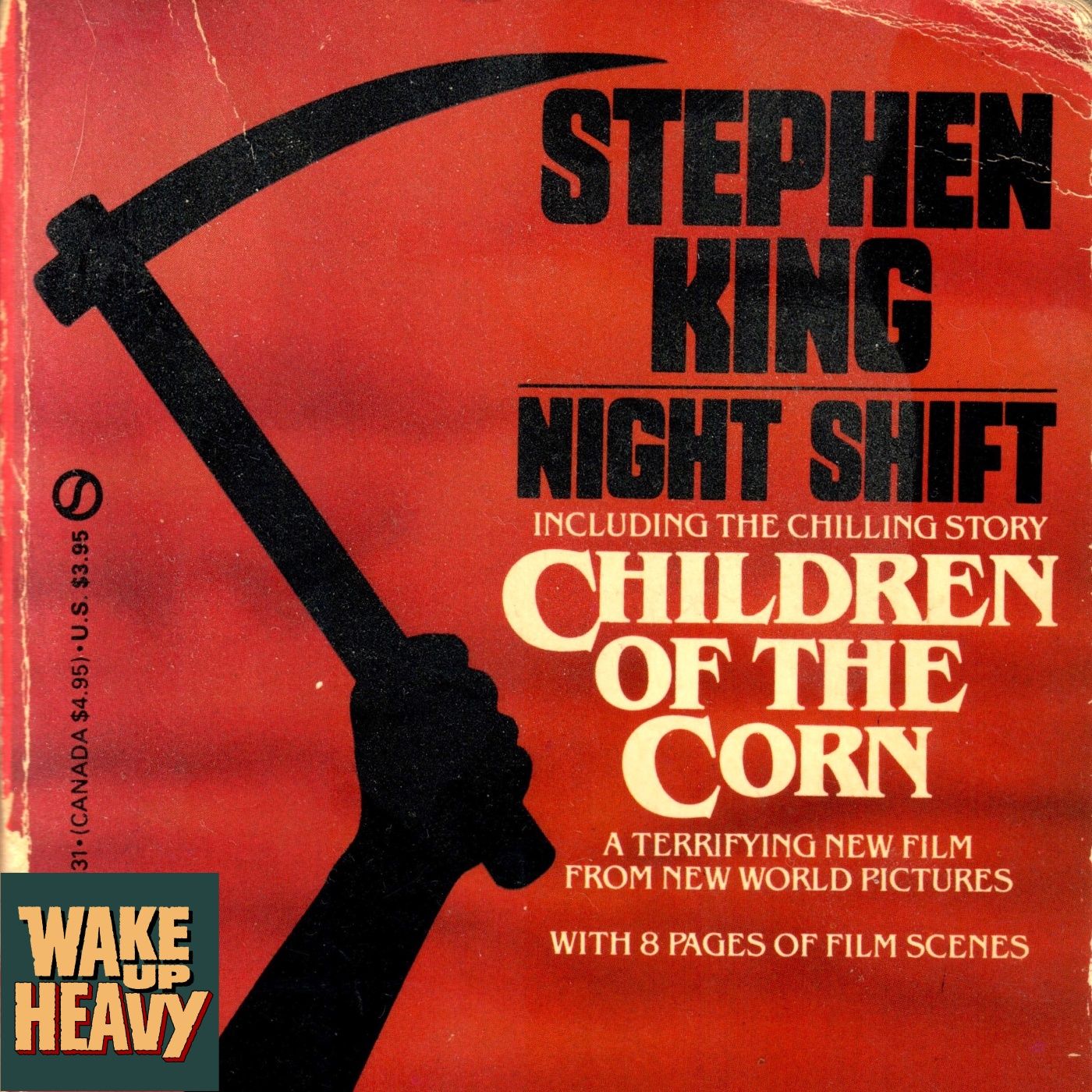
I would have had to have rented this one probably shortly after became available on VHS. I had the book tie in book, so it's got the poster image, popular poster image and eight pages of pictures from the movie in it, and most likely got that right around the time the movie came out. I wasn't old enough to see the movie in the theater, even though I had seen Christine the year prior. But I think that was just a weird situation where we were with an older kid and he got us in. But anyway, I rented this quite a bit because at that time we didn't have as much of a Stephen King saturation in media.
And remember enjoying it and It's one of those ones that I throw on when I go on Stephen King jags. It's not one of the better Stephen King adaptations, but it has kind of a nice little charm to it, and so I'll watch it fairly off and every couple of years or so, and watched it this time with my daughter so that she could experience some more. We've been going through a lot of his movies over the summer, and these were the last two King films that we squeezed in before she went back to school. So I have to ask where you give where I give you my thoughts of what did your esteemed daughter, the budding film critic think about Children of the Corn. She enjoyed it.
I think if I were to ask her specifically where this fell on the ones that we watched so far'd probably be further down the list. I think she started to kind of tune out after a little bit. There's a lot of it's what we call padded yeah, in movie parlance. That's a nice way of putting it. These stories, just to mention real quickly, are fairly short.
In the collection that I have, which is a mass paperback book Children of the Corn. I think is around twenty seven pages, and trucks is twenty or less than twenty around that. So if you relay that and you can't, I know, it's not an equitable exchange. But when people talk about movie scripts, you're genuinely looking at a minute per page. Obviously, movie scripts don't have detail and background and descriptions of people, land or locations.
It's usually just you know, screen direction, dialogue and so on. So it's not comparable, but still I would think maybe double it. Even so, you're looking at maybe fifty minutes worth of film here, and it's at least an hour and a half if not longer. Say, it doesn't feel like it feels like a two and a half hour movie. And so as you mentioned the kind of I mean the endings of the stories are presented in the movie.
There's so much more in the movie that's just padding. We have additional characters, we have way more driving, way more exploring the town, way more this than that. You know, there's a kind of a cold open that isn't a part of the story. We don't we aren't told how the kids kill the adults in the town. It's more implied in the him searching through the church and the church scene.
It's tolly different that none of the kids have names, there's nothing. We don't read the names Isaac or Malachi until the last two or three pages of the short story. Right, they are not central characters in this at all. It's really about the couple and they're dissolving marriage and this last gasp attempt to salvage that and this, you know, this faith that they meet by going off the main highway. And again that's even changed in the movie because they're not married.
They're they're a couple and having problems. It's not really a severe it's commitment issues. It's more are we going to get married? As opposed to our marriage is dissolving and we need to fix it, which I think I don't know. I think it was sort of just because they're both kind of assholes in the story and that's not necessarily fun to watch for an hour and a half, but it would it would have given it a little bit more of a dynamic feel if they had stuck more with that from the story.
I don't know the reason to change it, other than to make them both a little more likable. We have to care that they're going to get killed, might get killed. I think that must be what it is. They have to give us a reason to care, because in the short story they both eat shit like they die. So again, you know, if memory serves me right, in the short story, neither one of them are very like.
No, neither of them are right. Which you can, I mean, you can do a movie that way, but you're setting yourself up, in my opinion, for a much steeper climb if you do it that way, as opposed to giving the audience at least one character to serve as the kind of audience surrogate. And you know, I was expecting it to be Linda Hamilton in this movie. It's not. It's Peter Horton, who is Okay, I haven't seen him in very much much else.
I never watched thirty something, which I know is kind of the thing he's done for. But you know, he's he's a good audience surrogate. But yeah, the short I remember the one of the short story. It's like these but again, like, that's okay. The characters don't have to be likable in the short story because they meet kind of a fitting end, right.
The characters in the movie, if they're nice, like you don't, you know, you don't want them to get fucking crucified and lit on fire in the cornfield or whatever the hill happens to them in the short story, because the short story keeps going after they die, they're they're they're not even present for how the short story ends, so and end it ends differently than the story as well. And I think he works mostly as a director now, Peter Horton. But I did watch most of thirty something, so I'm pretty sure. I'm not sure if I if it was out then when when I first saw the movie, though, so I don't know if I was all that familiar with him when I saw it, and even Linda Hamilton, I probably hadn't seen Terminator yet, even though I had come out a couple of years prior.
I don't know if I had even rented it or not by that time. But yeah, it's it's one of those. Like I said, we start with the scene of the children killing the adults in town. I thought was pretty effective. It wasn't too bad, you know, it's it's I don't know, it's it's unbelievable because the only people that could get away with killing adults would have to be teenagers.
Like five year olds can't kill their parents, you know what I mean. And that's right, that's well, that's the problem with the Children of the Corn, I think as a premise is when we're talking children, that's a broad spectrum, and frankly, the children in the Children of the Corn story are teenager. They're not even children. So that's I think that's kind of always been my issue with Children of the Corn. The first scene in this movie does a pretty good job in making it seemed believable that this could have happened, because for me, the issue with Children of the Corn always was, at least a short story, the kids killing the adult is kind of unbelievable, really unbelievable, and like unless presented in a way where it's like, yeah, okay, so they're drugging them and killing and they're poisoning them, like okay, so they're catching them off guard, but like, I don't know, believably.
I guess the only way a kid could murder their parent is if their parent is sleeping in bed and a kid comes and stabs them to death, like a six year old stabbing an adult to death. Like it's just that's unrealistic. Even for Stephen King. I feel yeah, and I don't think it's really explained and the story at all. It's him Bert looking at their diaries in the church and something happened.
They figure out, and it takes it's a much longer time period like this happened twelve years ago, right, is basically how it goes in the story. And so there's no real clue as to what happened and who did what to whom it could have been maybe the older kids going from house to house, who knows. It's not explained, and all we really see in the movie is the one is diner scene. And then again you can sort of speculate and extrapolate out as too, well the older kids went around maybe and help the younger kids, etcetera, etcetera. But again you're not that's all created whole cloth for the film because and it's good to do that.
It gives you an idea of what's happened. But this is taking place not They have longer hair later on, so it's been a while. It's not like immediately that that our characters, the adult characters show up in their town. Three it's three years later, which which doesn't make sense because the kid those neck boy does not look three years older. It airs longer.
But well, and also, I mean again, there's this whole issue of the premise I feel like, and then again, like, you know, I didn't really give my thoughts on Children of the Corn, but I think for me, as someone who does like Stephen King and goes to bat for his short stories, this is a bad short story by Stephen King. And it's a bad premise that just is dumb. Like, I have a hard time buying this premise because the way the book presents it makes a little bit more sense the story with it being twelve years as opposed to three, that makes a little bit more sense. But this story would have to take place realistically in like the tens or the twenties for it to make sense, for it to be believable. Because let's just put it this way, this story takes place when the mid eighties, so when the movie came out like eighty four, right, let's just say, right, okay, let's just say mid eighties is when Children are the Corn The story takes place even then, How could anyone anywhere, for any amount of time go off the grid as a town completely.
It's just like the conceit of the story is so it's it's hanging on by a thread. It's very wishy washy, and the moment you start kind of asking questions, it feels like it falls apart. And that's unfortunate because Stephen King has a lot of premises that sound really like they're not gonna work, but then they totally do. And this one is like, it kind of feels like a slam dunk in a way. But I think because the conceit is children murdering their parents, it's just and then like this town essentially disappearing.
And in the movie they do this weird thing where they're like going in circles, even because I guess he who walks behind the roses doing it, maybe it's I don't know, it's a very weak conceit. I feel like even for Stephen King, it's I was thinking about it after reading the stories and then looking at the rest of the stories in the collection, It's like, what what was it that, as opposed to some of the other stories in here, what was it about these two that they thought, oh, let's turn these into feature length right films? Because there isn't much to this. It's really an afternoon A couple gets lost, stumbles upon a weird religious cult and get killed, and obviously you have to expand on that, but what even about that particular their story makes you think, oh, this would be I think it really is just let's mind the Stephen King backlog and start getting movies out, and which I think is like something that we've kind of touched on a couple times, but I think, you know, we can touch on it now given that I think this is the first not great Stephen King thing we've watched together.
The over adaptation, the over adapting of Stephen King, I think is a is a thing worth talking about from the eighties and nineties, not so much the seventies, but the eighties and the nineties. Man is just like, we don't need to adapt every single fucking thing. This guy writes like, we don't we really not only do we not need to the fact that we are is devaluing essentially everything that he does. Because now we have some good things and then so like so many bad things and so many middling things, and this is one of those. This is the middle of the road.
It's pretty fun to watch. I think Cleo enjoyed watching it. It's not very gory, so it doesn't have that going for it. You know, the opening scene is pretty tame as far as when you see somebody's face or neck slip. There's no Tom Savini esque special effects.
It's just it's just the old trick of you have a little blood squeezing out as the knife goes along. You know, no open wounds there, I mean there are some. When they run over the kid at the beginning, he's pretty cruci actually that that scene, Uh caught Cleo's attention because of the dummy being run over and we always love that and so that it's nice when they you know, edit it properly and it looks like somebody got hit by a car. Real. It's real brutal too.
Yeah, it's pretty rough and it's you know, it's a kid. So yeah, this movie doesn't hesitate to kill kids, right right, I get them because they're evil, so right right? Are they possessed? Are they evil? Well?
I interpret it as possessed. Oh really, I don't know, Like I guess not like being manipulated. I guess it's like the woman. It's like the Marcia gay Harden character. In the mist, like is she evil or just like miss uh, you know, misinformed?
Misguided? Like is is the is the what's gonna call him? Malachi? Is the adult actor playing a child Isaac actually like possessed? Or is he just preaching the will of He who walks behind the rows?
That's what I couldn't figure out. Not that it matters, right, I just think it's it's, you know, your typical cult. It just happens to be run by younger people. Yeah, and it goes toward that. I mean, clicks and kids that get real close to each other at school, even in elementary schools.
Sometimes if one of them is a little bit off and suggests, you know, we should go do this, Let's go torture square, you know, bizarre stuff like that, and everybody else is kind of like, okay, I guess we'll do that. Right. But you know, you mentioned the time the time frame for the story, and it's it starts in like the mid sixties at least, the cataloging of the kid's birthdays, because in this world, for them, once you turn eighteen or the day of your nineteenth birthday, you have to sacrifice yourself to He who walks behind the Rose and that's how Bert and the story kind of figures out what's going on. Like, okay, so at some point they got rid of all the adults. That's why the town it's abandoned and there's nobody around.
And then oh, what's this weird diary of you know, birthdates and then death dates and the changing of their names to a biblical name, and oh it's all you know, they're all dying when they're the day of their nineteenth birthday. So it's it starts in the mid sixties and goes up to that twelve years, which takes us into the mid to late seventies. And even then, like you say, a small town just disappearing scenes unlikely. I mean in the middle of nowhere Nebraska, I don't know. I mean I live in Nebraska.
I feel like even to the little the little bumdill towns I've been to, like they're still connected to main high I mean they're still on a main highway. The people were driving and stopped to get gas. What happened, well, and that's what they broached that in the movie, though, I have kind of a solution for that with the old man right Armstrong, But like it doesn't really make sense. Yeah, I think he's there for misdirection, and oh, well, go to I can't remember the name of the other town that Hemingford, Yeah, that they're trying to get to when they go through that kind of loop the loop. But yeah, I think he is there to misdirect people that get too close to the town.
And it's it's the old trope of we're not on the main highway. We're in the middle of nowhere, surrounded by hundreds and thousands of acres of cornfield, So who would notice this town that was barely a dot on the map in the first place. Isn't really there anymore? Right, It's still there, but it's not functioning like a normal town anymore. Right.
But that it's the part that really struck me this time watching it, is that they drive around for so long or they get into the town and it's like, come on, guys, this is why you don't take a story like this and try to turn it into a feature length film. Either that or you need to even go further back. We start with them in a hotel room again, which is not in the story at all. Get some character development. So we have those two scenes them in the hotel room, the diner scene, but then you have this long stretch of them driving around and finally getting to Gatlin, and then when they get there, it's walking around and trying to find somebuddy to talk to and then finding these kids who aren't characters at all in the story.
Nope, they are added into the movie, and boyd they I really love the precocius shitthead child vibe, don't you. I mean again, I don't know what the point of adding these characters to the story is. They add nothing other than like the like cute see little ending. Yeah, and it is a cute see little ending, the way that they oh, I guess you could live with us for a week, Like oh God, come on like that for me? Like that, for me is like the kind of stuff that I'm I'm talking about when I say like these kinds of stories should not be adapted, because the fact that that is where this story went is like nuts to me.
I wanted to squeeze in and I didn't get a chance to, and I forgot this morning. I wanted to squeeze in. A viewing of the Disciples of the Crow, which I believe was a dollar baby that came out prior to this, right right, I saw that to see how you know it functions as a short film. It's on YouTube, but when I looked it up on IMDb, it said thirty minutes, and the one on YouTube was only eighteen, so I wasn't sure if which one was correct, But I'd still like to check that out. Some of those dollar babies can be pretty fun, like the Frank Darabont ones.
Well, and that's and that was the other thing I was going to say, you know, this story has been adapted one time before this, then this time, and then a Sci Fi Channel version, and then they were doing another one that's like a loose remake that was supposed to come out in twenty twenty. I think it did, I want to say. When I was looking on I are on Wikipedia, I believe there were three titled Children of the Corn. But then you know, let's let's not less we not forget there are actually how many of these movies? Because this spawned a franchise of movies that were being released up until twenty twenty.
I guess that's the one we were just talking about, but a sequel was ring released until twenty eighteen. Children of the Corn, Runaway, Children of the Corn two, The Final Sacrifice, three, Urban Harvest, four, The Gathering, five, Fields of Terror, six six six, Isaac's Return, Revelation, Genesis, Runaway, and then they did the old chestnut of just the latest one is just Children of the Corn. Yeah, and mindally, I've not seen any of them. I see people chatting about them and which ones are kind of fun to watch, and I don't think there's enough pull for me in that original film to get me to watch any of the sequels. Well, and that's the and that is the issue I think for me with this story, the way it's presented is in this movie is I did not I didn't like this story.
So I don't want to see another adaptation of this story again, because they would have to do something vastly different than couple shows up, finds out the town as all kids, the kids try to sacrifice them. Two versions of the story their successful or they're not, and that that leads to various versions of the story. I don't if you were to make this, I think you would have to have one of the two characters get sacked. That's what makes sense if you want to split the difference because yeah, people, for whatever reason, cinema folks feel really cheated when characters in a movie die, all of them. When it's like every character in a movie dies, people feel real cheated.
I don't know why, you know what I mean, I don't know why, but like mainstream audiences feel that. So I feel like you could get away with that. Maybe maybe I don't. I don't know, I don't know. That's the thing, Like, I just this story is just so kind of let to me, like I wouldn't I there are other better Stephen King stories that need to be adapted than just going back to the well again.
I would be curious to see how the other iterations, not the sequels so much, but the other iterations of the story end, yeah, or even how they kind of tackle the padding in those as opposed to this one, where it's mainly just driving around and running around, right, and a couple of the scenes with the kids to pat it out in their house and well, and that's the thing, Like there are some fun performances from the kids, you know. I mentioned Isaac played by John Franklin, totally not like a thirty year old man at the pot or anything. Uh, But I think it's like twenty four. I think he's he's pretty good. Yeah, he's decent, and he's creepy.
I mean, he's this is why you're here right outland we have Yeah, it's so weird, Like what that is what that actor is known for? And that's it. Like, I don't know Courtney Gaines. You know, I looked at his IMDb and it's like, what what? Like, I swear to God, I thought you were an other things.
Yea, he is, unless I'm confusing him with someone else. I know he's in some stuff that I've watched, but I'm older than you. Of course he's in, isn't he in? Yeah, he's Can't Buy Me Love. He's the creepy kid in the Burbs.
He's barely in Back to the Future, and I think he still pops up from time to time on a lot of TV shows. But I guess maybe I'm confusing him with the actor who plays Scott Farcas from The Great Story, Zach Ward. Yeah, but no, they should play brothers in something. Corney Gaines has a great voice. He plays I believe he plays kind of a nerdy kid and Can't Buy Me Love.
So he's got some range. Play a nerd, I will I will say. The other thing about the role that he has is like he has to be an intimidating kid because that character in the book is not It's not not that it's not the same, but it's he's not being asked to do the same things that he is in the story the movie back, I mean, they don't. They barely do anything in the story. They like literally you find out their names in the last two pages of the of the story when they flip the script on their cult and say, oh, well, now instead of your nineteenth birthday, you need to sacrifice yourself on your eighteenth birthday.
And there's all these eighteen year olds there in the crowd going, oh shit, now we're doomed, right, which, like you say, is outside of the leads or the protagonists of the story are already dead. They kill and I can't remember her name in the story, it's Burton or the chick's name is Sarah, so I was gonna call her Sarah Connor. She's been killed, Vicky, Yeah, she's been killed by them. He gets killed by he who walks behind the rose, and then they're a sort of a epilogue to it. That we finally get to know who Malichi and Isaac are.
But I mean, there really is nothing to any of them. You don't get You don't picture the Isaac from the movie in this all of the kids where those sort of amish outfits, and you know, and really Isaac, I mean, Malachi doesn't fare any better. It's just like these two are the ones that Isaac is the preacher, the one who started it. Malachi is the one who sort of does all the dirty work. And then boom, everybody's gone and Malachi's widow is left.
They're pregnant, and then it ends. So none of that is in the movie. No again, it's like a completely different story. And just I sit here and I say to myself, if you were gonna do, just do this story, but don't adapt it as hard, Like make some more changes then like go outside, I don't know, like add some more characters in or something. If you're gonna change it, already change it some more, like make it an actual interesting narrative, because like I can't even imagine editing this film together at the end being like, oh this is fun.
The climax of the movie, where Peter Horton is taking the nate like the gasle hall and throwing it at he who is behind the rows, like who cares. It's it's so so poorly edited that you watch him like throw the moltop cocktail, but he didn't throw it. He tripped. And then the kid goes and gets it and brings it back and he's a thrower now and it's like this whole thing but it's not throws it but it doesn't break, right. Yeah, he trips in the throat.
It's pretty. It's a clumsy movie. It's it's very clum It is something that I know I enjoyed as a teenager because it was Stephen King, because of the creepy Isaac. I'm it was fun. I was waiting for him to show up in that first scene in the diner outside the window there to kind of gauge my daughter's reaction because he is I mean, he's has some form of Dwarfism or something, so he looks unusual and talk has a strange voice, so she was just kind of like, Oh, what's who's this guy?
What's this all about? And I was like, he's the leader, sort of explains maybe why they want to keep everybody young. Maybe he's perpetually young. I don't know, but I think I think he was like twenty four twenty five at the time. Yeah, he's like an adult.
He's an adult. Yeah, he has a growth hormone deficiency. And I don't think that Courtney Gaines was probably all that much younger either. So Courtney Gaines would have been nineteen at the time, so close. They killed him on set because he was nineteen.
So, you know, I don't know, Like you said, it's it's a clumsy movie. It has some it has some fun parts, but I think overall, you know, I think there are much better Stephen King's stories that have been adapted. I think there are better Stephen Kings stories to adapt to begin with, like, you know, just going from the source material, Like I can't believe that they released it by itself, holy shit, like in a trade paperback like that to me is wild, you know what I mean, Like that you're sitting in it's is it just Children of the Corner in that book and nothing else? Well, now this is night it just has the this is Night shift. Yeah, so it just kind of okay, like good book.
They destroyed a good book with a terrible cover. Yeah, Yeah. The original mass market paperback cover of this is awesome with the hands, the bandaged hands, and then you open it it's like a step back cover, so the opener and it's got all these eyeballs in the hand. Yeah. I, like I've always said before, like Stephen King for me, he is the man when it comes to short story.
But I'll tell you what, if anybody else had written this fucking story, they would never have adapt not in a million years would they have adapted it if it wasn't a Stephen King's story. And there are some Stephen King stories that that is totally the case that they're only doing it because it's Stephen King. I mean he has dollar babies. For those of you in the audience who don't know what that is, there are Stephen King stories that you can option to adapt for one dollar and there is a good list of them. A lot of them you may have never heard of, but they're pretty good.
Funny story mister Begley, Father Malone and I actually had one of those. We did it at the end of twenty nineteen, and we were to do it in the spring of twenty twenty is when we were going to do yep, whoopsies. Yeah, so you can see where that went. Yeah, we did it. I mean I sent it everything.
I sent the dollar off and had the paperwork, and then COVID happened, and like we never heard anything. I think everybody just kind of assumed, you know, hands washed, all good, whatever. But yeah, dollar Dollar babies. I have a little bit of a I forget what the one that we picked was, but yeah, we were going to do one, and then you know, twenty twenty happen. Yeah.
I think a lot of the same stories get optioned multiple times, so you'll find, like on YouTube, you'll find some of them, and the Boogeyman is the Boogeyman is one, and of course now they're making a feature length feature film of that. From this collection, I talked to a guy who and I don't know if he ever came out either, because it might have been scheduled for around the same time. But I interviewed a guy who optioned Oh shoot, I can't remember the story, but it's in one of my Stephen King's series episodes. And I didn't dive into the night Shift collection except to mention the ones that I've seen sort of briefly, like children in the corn and like Maximum Overdrive. But when I look at we talked about this off podcast last time, there are actually a few more that I forgot about.
So Jerusalem's Lot, as you mentioned, has been turned into the Chapel Weight series on Epics. I believe, and my wife and I started watching that and we haven't finished it. It's pretty good. Adrian Brody just haven't gotten around to finishing it up. Graveyard Shift, he's a good look for he has a good look for gothic core.
Adrian Brody does yeah and yeah for that time period. It actually works really well. He just has like his looks crow, yeah, his facial features for sure. I love Adrian Brune. I'm a fan.
So Graveyard Shift has been turned into a full length feature film. The Mangler has turned into a full length feature film. Sometimes They Come Back, which is the one I forgot about. That's decent. Tim Matheson and Brook Adams and I believe that was an HBO original, you know, from back in the late eighties, early nineties, and it's pretty good, pretty good.
The Ledge and Quitter's inc ended up in Cat's Eye, which they work very well in that format of an anthology. They're only like twenty or thirty minutes long, The lawnmower Man, which bears no resemblance to the story at all, and King had his name removed from and Children of the Corn and Trucks. So maybe half of the stories from this collection have been adapted in one way or another. And a lot of dollar babies have been made from these stories, like the Boogeyman, like gray Matter and the Woman in the Room and that was the So when you do a dollar baby like as you know, Chris, you're not supposed to make money off of it, I think you. I don't think you're allowed to, you know, I think you can enter them in festivals, but you have to give credit.
Everything has to be credited to Stephen King. And I believe, like I said, I believe if I memory serves me correctly, because I get I've seen the contract, because I have signed one. I want to say, yeah, there is the whole You can't make money, think, I think you. I think it says clear as day, you can't make money off of this right period. So the one exception was there were two and I never rented them when I was a kid, but I remember looking at the covers because they were kind of creepy and surreal.
There were two VHS releases called the Night Shift Collection. There was a one in two and I think and you can find these on YouTube. There were either two or three stories each. One of them might have had two, one of them might have had three. But the Frank Darabont Dollar Babies are on those elections.
He did the Boogeyman, and I want to say the woman in their own it's not the woman in the room. It's one of the different seasons the breathing method. So the story about the woman who's pregnant, I'm going to have a baby and she ends up getting decapitated on the way to the hospital or something like that, but but continues to live until she has the baby. I think he did those, and so the Boogeyman is available on one of those collections, and there was. However, they worked out that agreement to release those and Stephen King gave his permission and whatnot.
But anyway, that's probably a better way to go about a lot of the stories in the book because they're not complete. First, you know, one, two, three act kind of structured stories there. They are like a chunk of a of an idea, and you've really got to work at fleshing them out to make them super interesting well and that and that for me is kind of the issue again, where you have I don't know, you know, you have this story that I think is a it's not a great premise in a book of great premises, and all the other ones get adapted or are turned into adaptations eventually, and this is the one that gets kind of left behind. So maybe it's a good thing. I've never seen any other franchise movies.
I'm sure they don't have anything to do with anything, so who knows. Maybe they're good, Maybe maybe they redeem, maybe they redeem this summer. I mean, I'm assuming that most of them maintain the idea of a religious cult of younger kids. I like that. I think the idea is interesting and probably why I returned to it as a teenager.
The idea of a religious cult just in general is fascinating to me, and one that's murderous for another thing is interesting yet horrifying. And the fact that they have made this cutoff date of how long they can live and none of us ever explained though, what is the reason for why it? At nineteen you know, I think you have to assume it's just to keep the corn their livelihood going. But why such a young age. Why?
But it is fascinating to me as like, why why at nineteen do you get sacrificed? You're going to run out of people at some point by you're not pro creating, you're not letting kids get old enough. Well yeah, I mean they are that in the book, they are pro creating, but by the time your kid, you're going to be gone before your kid is even of age to understand. I mean, mother and father are both going to die. There's only a short period of time where you're able to have kids, so you know, I mean, let's say you can get pregnant.
I mean, I know, you can get pregnant as young as nine years old, but you still only have ten years then, and so you've got to pass all that. How does it get passed on? Blah blah. It just doesn't pan out after a while. You're gonna lose your whole flock basically at some point.
But I do think that that idea is interesting. Of a cult built around kids with bad ideas and twisted biblical ideas, it's just maybe that's what they explore more in the sequels that whole concept and how wacky it is. Yeah, well and and that and may and maybe that is what it and you know, if that's what it is, cool, I think I think for me this one, you know, I had never seen the movie before. I had read the short story, but I had never seen the movie. I'm glad.
I'm glad that this movie was one that I had never seen. I knew the Outlander thing, but that was it. So for me, it was like, you know, we're I'm finally watching it. But the short story didn't jump out at me when I read it originally, you know, when I was in high school. So it's it's not, you know, not one that anybody was ever like.
You need to watch it, like The Shining like it, like so many adaptation. So but yeah, so let's move on to the staff where we're gonna be talking about. Let's talk a little bit about Maximum Overdrive. Hi. My name is Stephen King.
I've written several motion pictures, but I want to tell you about a movie called Maximum Overdrive, which is the first one I've directed. Why the Dickens are going on around a lot of people. I've directed Stephen King novels and stories, and I finally decided, if you want something done right, you ought to do it yourself. He was driving. I don't know.
It was my first picture as a director, and you know something, I sort of enjoyed it. I don't know. I just wanted someone to do Stephen King right. I just want to get the hell out of here. So come and spend some time with me and my friends at the Dixie Boy, spend some time in the dark.
Yeah, I'm going to scare the hell out of you. And that's a promise. You're going to get us an awful lot of trouble. Man. We already travel maximum Terror.
Jesus coming in is Maximum King. Maybe tomorrow will be our world again with me. Dino de Laurentis presents Stephen King's Maximum Overdrive. So Maximum Overdrive is directed and is directed by on a screenplay by Stephen King based on his story from his own story. Yeah, Trucks and it's the Emilio Wests, pat Hingel, Laura Harrington, Chris Murray, a whole bunch of people.
Frankie Fazon's in there speaking of our silence of lamb Ricky good Old Yardley Smith, and yeah, it's about a bunch of trucks and electronics that come to life in the wake of a comet. So yeah, well I saw this in the theater. It was one of a handful of Stephen King movies I actually saw in the theater. I think at some point I tried to get to most of them. Saw a Running Man.
This was a time when again we're mining those smaller motherloads or not even motherloads, baby loads of Stephen King stories. And this is always fascinating to me because it's one of the day Laurentis Stephen King movies. So he was smart and snatched up the rights to a ton of King work in the mid eighties. And Dead Zone is in that group, which I think is probably the best of at least the De Laurentis group. I was about to say, I would be inclined to agree with you on that silver Bullet fire starter this one.
And I know that there's others I'm forgetting. But smart guy, smart businessman, bought up a bunch of Stephen King rights, put a lot of them out around the same time, and gave us a glut an overabundance of Stephen King. And again diminishing returns. I think as we go on and have already you know, the big movies, those initial novels that created such a stir are gone. Now we've done Carrie, we've done the Shining Salem's Lot came out on TV.
You know, you've got the Dead Zone. Kujo, alright, Coujo, I don't. I'm not sure about if that was a De Laurentis one or not. Fire starter. So these early eighties films are coming out now faster and faster on top of each other.
Those books all came out in the early eighties, their movies came out about a year too later. Christine the movie and the book came out the same year because those rights were optioned before the movie was before the book was even published. And so again, you know, eighty four eighty five, there were just gazillions. This was what eighties seven or eight eighty six. Okay, So I was old enough to go see rated our movies on my own, went and saw it and have always enjoyed it.
Again, a lesser property. There's not a whole lot to the story, right, and I would say even less than with Children of the Corn. It's a shorter story. It is basically just again a one day, maybe overnight tale where we don't get the reason, we don't get an explanation, we don't get character background. I don't think we get character names in the story.
Everybody's just called that, like the counterman at the diner, the truck driver, the young couple, the salesman, the girlfriend unimportant. Yeah, so it's it's funny in that way that no one is even we're not even going to bother giving these people a name because they're pretty much all gonna die, right, and so we have we've got to add all that. For a movie, you have to know who these people are, what they do for a living, why they're here. And it's a lot more successful than the Children of the Corn adaptation insomuch. And I know it's a mess of a movie.
And Stephen King, you know, derives it to this day because it was directed by Cocaine. But so says him, it's it's fun I think if I ask Cleo, which one of these two, since we watched them over the same weekend, which one of these two did you enjoy more? It would be this by a mile. And she even said at the end, you know, that was a lot of fun, So it succeeds on that level. Like I messaged you, you know, say what, say what you will about Maximum Overdrive.
But it's a ton of fun. And I think that that is I had seen this movie before, so this one is not new to me. I had read the short story before. I didn't reread it now, but I remember the way it ends, because the way it ends, I think is the best part of the short story. And the movie still has its problems.
Uh, it's not great. Oh, I didn't know what he was doing. He had no idea how to make a movie. No, And like that's it's clear to me as it should be clear to the any any audience goer that I don't know. It's that the conceit of the story is dumb, and the way and like the way, the reason the way things happen the way that they do isn't made clear enough quick enough, and I'm not a fan of that, and I wish more was made clearer sooner.
Well, it's that to me. It's as I've told Cleo when we're watching, I said, they're doing the same thing they did at the beginning of the Thing and of the Predator and they're prefacing it with story that we don't need, Like I don't need to see the thing flying into Earth's atmosphere, you know, tens of thousands of years ago or whenever it did. I don't need that. I don't need to know why the thing is here. I don't need to know.
They do the exact same thing in The Predator they open with the ship flying into Earth. I don't want to need to know that. No, this, I don't need some wacky ass tail about a comet and its tail. I just wanted to happen, and it does, and that there's none of that in the story. It's just happening.
Shit happens in these stories, and you either buy into it or you don't. I don't need the explanation that gets like double tracked or backtracked. At the end of the movie, when they start talking about a UFO and a Russian satellite and a Russian satellite blowing up a UFO, it's like, well, was it fucking Aliens or was it the comet tail? I had to stop it and read it twice, and I still don't understand what it means. Well, that's what's not clear to me, and that's what's not clear that I think to one in the movie version, in the in the story.
In the book, it makes a lot more sense, like they're they're sentient. And I'm pretty sure in the story because this is something that drives me crazy in the movie. In the story, it's just trucks, it's not cars, and it's not every other electrical thing. And in the movie it's not even just electronic things. It's any sprinklers that aren't electric in any way.
I guess maybe the sprinklers are on a timer, but usually those kind of lawn sprinklers aren't connected to timers. But I don't know. Because when the kid is writing down the street after he's left the baseball game and is trying to get home, there's set up and it's a cool visual. I mean, that's what that's what I almost say that that's that's this movie, and it's entire right that I was just going to say. That sort of sums up this whole movie.
It's a cool visual. It's fun to see as he's driving along the sprinklers going on behind him, and then as he turns his head they all go off. Okay, so everything sentient, little tiny electric cars, lawnmowers, soda machines, bridges that yeah, okay, because of whatever reason, that's great. Fine, everything in the diner is gonna at some point turn itself off or on. The story keeps it simple.
I'm pretty sure it's just trucks because all of the people have arrived in cars, but their cars are all disabled or dismantled. They're not cars aren't showing up at the diner. Just trucks are, right, which is why the story is called trucks, eighteen wheelers and smaller. You know, somebody mentions a bus at some point, so it's yeah, big automobiles. In the movie, it's everything.
Everything that has some electrical component comes to life, becomes sentient or whatever you want to call it. So that's one of the additions to sort of pad things out. But then you have extra characters, and you have characters with actual names and functions and jobs, and there's a lot more workers at the diner. There's a love interest for the lead who again whose name we never learn, but in the movie, you know, everybody pretty much works at the diner, plus all the people that have somehow made it there. But it is it's a it's a great, big ball of dumb fun.
And even the you know, talk about Stephen King not knowing what he's doing. I think in his book Dan's macab I know I read it somewhere, and I don't believe it's just a Wikipedia entry. He talks about his experience of doing this and how he got so much help from the cinematographer, the stunt people, and I think even the editor had to like come on set and say, hey, you know, you need coverage for this. You need to have something that's going to connect these two shots. Otherwise it's not going to make sense this, this, and that.
I mean, it's I think if they didn't have if he didn't have all that help, and if the people, the editor and the cinematographer were just as incompetent as him, it would be a mess of a movie. But it's still like, I don't see any glaring holes or mistakes. It's just kind of a jumbled up mess, but it's done in such a way that it's still a lot of fun. Well, and you know, the whole thing with the cinematographer getting blinded isn't great. You're talking yeah, yeah, and you were well, I mentioned it only because you mentioned the lawnmower scene, because that's when that's when it happened.
But I would be inclined to agree with you. I think if it were all a bunch of folks who didn't know what they were doing, collectively, I think maybe this movie wouldn't be even fun. I mean, that's the thing. I think. This movie's fun.
I don't know how successful it is outside of being fun, but it is fun. Yeah, that's my take away from it. Yeah, it's it's because like the effects are fun, the idea is kind of fun. You know, Emilio Estevez motherfucker, I mean, and stuff like that's fun. It's all right.
I mean, how many times is Emilio is going to be the lead in a movie that's kind of and again, you know, it's a Steve let me put it this way. It's a Stephen King adaptation of something that's very King but not at the same time, like it's very not Gothic horror. It's not not a house. It's not not kids fighting a clem, vampires or werewolves. It's yea an energy, demons, none of that.
Yeah, it's very different for Stephen King. You can see. I think the good. A good scene to sort of dissect is that opening bridge scene where a lot of cool stuff happens, a lot of great stunts. Cars toppling on top of each other, people flying out of their cars, people flying into cars, watermelons flying all over the place, smashing through people.
The special effects are pretty good. We get a bit more gore in this than say Children of the Corn and they're bloodless R rated movie, but they're you. It's a credit to the editors that the scene makes as much sense as it does, which it really doesn't because multiple times the same cars fall people falling through the bridge really shouldn't be falling through the bridge at that point, so on and so forth. But if you just kind of sit back and let it wash over you, there's a lot of going on in that first scene, and it's I think it's covered by the editing because there would be a lot of there already a lot of goofs. But it could be a total cluster fucking not make any sense at all if the editor wasn't on top of things, gotcha and made it look like, okay, this is this is the way things happened, and you get you know, you get an ACDC van in there for extra fun.
Well, I mean why not. That's you know, we were making that joke before we started recording. Stephen King massive ACDC fan. Hey man, he gets he gets a CDC in one movie, he gets the Ramons in another movie to write songs for his movies. That's got to be pretty cool to have that kind of cachet.
Yeah, well to be the whole score. They do the whole score for this movie. Have they ever scored anything else in their lives? I don't think so. And it's and it's fine.
You know, I'm not the biggest a CDC fan, but I like a lot of their music and who made Who's a decent song? They're throwing some old classics in there. Hell's Bells fits in. They said Hell's bells at one point in the movie. There you go.
They said Hell's bells and I was like, oh my god, they're doing that thing. They're doing the arrested development thing. No. Well, and that's the thing that is the thing about this movie that I do appreciate is they don't try to make these nuts a stupid but silly premise because it's a silly premise. I think that they don't try to make the silly premise very serious.
They say it's silly, it's over the top, it's completely couca bananas. It makes no sense, it doesn't need to make sense. And you know what, here we go, like right, like you said, the music's by ACDC. They lean pretty hard into they know that this is a pretty un serious premise that doesn't need to be treated seriously either. Right, yes, it is not taken very seriously.
This isn't it. I mean, I'm not saying that it is super serious, but like it's more serious than this. Yeah, I think the conceit is more serious in that. And here sort of have it both ways, where yes, the conceit is ridiculous, they're not. We're not playing it for laughs.
But we're going to have a fun time while we're making this. Hopefully it's a fun time while you're watching it. And that's really all we're going. If they were gunning for more than that, they didn't succeed. But if that's all they were gunning for, they succeeded in spades.
Well, I best I can tell you know that in my mind, that's what Stephen King was gunning was just to make a kind of fun lark of a movie. I mean, you've got pat hingele in there. Just look at the cast and think, Okay, we're not Carlo Esposito, who doesn't last very long unfortunately, but very young, yeah, very young. I saw him. He's in Taps, the movie with Sean Penn, Timothy Hutton, and Tom Cruise.
They're all like super young, and he was. I was like, oh my god, I totally forgot. I used to watch that movie all the time. I was like, I had no idea he was in this. But that was like four or five years before this movie came out, so he was even younger then.
But the yard Lee Smith, I mean, come on, one of the you know, getting ready to make a career out of being Lisa Simpson in a few years. And it's just silliness all around. Well, and that's the thing. It's like, I don't need any more from the movie that it gives me in regards to the way it approaches the story, Like it almost is a zombie movie in a lot of ways. Like that's what it really is is It's just a zombie movie with this kind of weird conceit that the zombies can't get in and look, I think we would both agree the way the story ends is way better than the way this ends.
But the way that this ends makes sense for the screen. Yeah, it's in the story. I like that. It's very like it's honestly very Simpson's tree House of Horrors, very twilight Zone. I mean, it's a twilight Zone story, right, Like it's Stephen King doing a twilight Zone story.
The short story the movie is something else entirely. I mean, if you want to, if you start to think about the ramifications of who made who, right, which is the conceit of the movie? Like we made you? You can't do this to us? So what are we talking about here?
Are we talking about trucks and cars and electronic things or just a matter of we've gone too far in the direction of comfort and ease and so now this stuff controls us. I mean, this is way way way before everyone had a computer in their house, way way way before anyone had internet or smartphones. But is that the conceit Stephen King himself gets called an asshole by an ATM, you know, is it because we're taking steps to remove ourselves from these transactions where you used to have to walk into a bank, wait in line and talk to a teller to get your money. But now all you have to do is go up to this fancy computer, punch in a few numbers and get the money, and then go to the store, go wherever. I mean, you know, if we want to get into the ideas behind these is that what we're going for or is it just Hey, I have an idea.
What if cars, the cars that we rely on, suddenly turned on us. It doesn't, I mean, it doesn't have to be any deeper than that, right, and it doesn't get any deeper than that. But it's not just the cars. It's everything, right, It's everything, But like that's not explored, and I in the in the short story, remind me, is it everything in the short story? No, That's what I've been saying as far as I could tell.
And I basically read the whole thing last night, So I may be forgetting some I got the indication because of the descriptions of how people ended up there. Now, most of them are there because their cars are disabled or got disabled as they showed up to the diner. So it may just be that their cars can't run anymore. But everything that they're describing are large vehicles eighteen wheelers. Somebody mentioned seeing a bus going down the highway in the wrong direction and just taking out cars right and left.
A bulldozer does show up, and that's too kind of similar to the movie where it gets into the diner itself, not really to kill people, but to tell them, like, hey, you need to pump the gas because they're voting on whether or not they're going to pump the gas for them. Let them just starve. But what's keeping them from breaking in here? And which we don't which isn't really explained all that well in either iteration they mentioned it in the movie. They say something to the effect of like if the truck were to come in here, because it weighs so much, it would like crash into the basement and get stuck and then it wouldn't be able to get out, which like, okay, how does there's a basement?
Though, well, that's I mean, that's my that's my point. It's like, okay, sure, I mean that's the problem with this movie. And that's kind of the issue with this movie that I have is the conceit again in the story, I can get an I can overlook the conceit in the story, the written story, but I can't overlook the conceit in the movie because when you see it visually, it's hard to overlook the cars just going around like this, and it's like, why don't they just fucking ram through it right right? And they don't like catch wise to the fact that they need to pump gas until much later into the story, so it's not like they're like two minutes into it they're like, oh my god, we're gonna have to pump gas for these fucking things.
Like they don't say that until, like, you know, three quarters of the way through the movie, which is how the story ends in the book. And I think that's what I always keep in my head as the reason why they don't kill everybody is because they know they need people. They still need people to take care of them right right in the most basic way, which is to pump gas. At some point, they would need people to repair them. So they can't kill everybody.
So that's not really their ultimate goal. It's just to be in charge now. So you're going, yes, you're going to survive if you're not stupid, but you're here to serve us basically, instead of the other way around. But yeah, I really think that in the story it's just supposed to be trucks. Well that's why it's called trucks.
Yeah, right, but I don't think that's not as interesting. Well, but they don't do anything with it though. Oh the turkey carving knife goes haywire, Like that's not interesting. I mean, it could be interesting, but they don't do anything with it. Jim Carlos Bozito dies to the Arcade machines, which is kind of neat, but like the whole thing with the turkey knife or you know, the the obligatory Stephen King cameo as they called me and I asked whole which I think is you know, it's funny and it's fun that he's the first thing you see on screen in this movie from a actor perspective, as you see the ATM looking up at him, but they don't do anything with it, and that and that that's you know, that feels like there was an X Files episode where the machines were telling people to kill it was like an Exiles episode where the machines are telling people to kill other people, which is not what this via the ATM, I think, right, not mistaken, at least in one scene.
That's not what this is, but that's what this could have been. Well, they definitely explore, at least with the kid, the other things that are going on as he's by writing through town after the baseball practice when his kind of enjoy the soda pop shotgun scene. So I think this is the first time I noticed when their coach gets beamed in the head with a soda can it actually dents like he was wearing a prosthetic. Yea, it went in. But the the paver I'm not sure what those machines are called, that runs over the kid that got cut because you're supposed to see his top of his head pop off.
That would have been cool. I was more surprised, you know, I always forget that this is in the movie, but man, it's it's a really good scene, like, yeah, surprise, it's surprising. So as he's leaving there and realizing something's up and driving through the streets of blue velvet, yeah, pretty much. Since they were both filmed in Willington, North Carolina, and this one states that explicitly that that's where this takes place. Yeah, but one of the streets, I swear it was like, it's straight out of the neighborhood, that it looks kind of free and what's her say, what's her name?
Walked down at night, but you know, he sees people, you know, whose cars have wrecked. He sees some girl up in her window with a cord wrapped around her neck from the hair dryer. All these other indications that this is widespread, it's not just cars, and that electronic devices are killing people, which sort of gets left in the dust once you reach the diner and then it's just back to trucks and cars and for the rest of the movie essentially, right, I wouldn't like if it's checked back in, Yeah, I mean it, it'd be kind of neat to see more stuff do weird things in the film. I mean, that's why I would watch a movie like this if it weren't. But I feel what it was about.
Yeah, if I didn't know it was based off of a story solely about trucks, my expectation would be it's going to have electronics killing people in inventive and weird ways, and you don't really get that, So why did they put it in the movie? That's the real question. If those are the padding aspects of this, like that whole story with the kid getting trying to get to the diner because that's where his dad works and he knows something's up. He doesn't go home, or maybe he does try to go home. I don't know if that one house is supposed to be his or not, but you know it takes him forever to get there, so we had That's to me, that's where the padding idea comes out.
It's more interesting padding than that of children at the corn, but it's still how do we fill up the time here to go from a twenty page short story to an hour and a half long movie. Well, it's with these let's extrapolate out with him who's not even in the None of those people are in the story, the kid and the dad that works here that gets immediately taken out by the one of the trucks. Okay, just not listening after he's had diesel in his eyes and his red inflamed eyes. I love it. I mean, it's just the other thing is this movie also really benefits from having poorly written characters.
Like I get that they had to create the characters for the movie, but then they're not even very well written, like tell me what Emilio esteve as his character is like, he's a parolee who's working at the diner, and that's about it. It's taken advantage of by his boss because he is a parole and will have to work over time without extra pay. And that's it. That's the beginning and middle and end of his character essentially. Yeah.
Yeah, which is weird because King is not one to King is not one who poorly writes characters. He's not. I think the problem with Stephen King is he needs a long runway to really do it right. Yes, I think that's and that's why the short stories are so good, because it's like if he's if he knows he's doing a short story, that means he can make changes to the way he writes to lean into or lean on, you know, quick character creation, which would essentially just be characters without names or characters that are very broadly written. But then you have something like it where it takes a thousand pages to tell the story because he's describing everything and giving you the most in depth character creation humanly possible.
Yeah. Yeah, but he needs a long runway for it, like his long stories are long for that reason. His in depth character stories are fucking long, right, because you get twenty pages of background on one minor character here. Like I mentioned, none of these characters even have names. The lead, which is supposed to be I guess in the movie, the Emilio Esteva's character.
He doesn't work at the diner, he doesn't have a love interest. He's just another guy that ended up there because his car got taken out, right. And he's just the lead because the story is told in first person narrative and he's the one telling it, and no idea what his name is, what he does. He's not a parolee, he's not working at the diner. Nothing, nothing, nothing.
They are really just pawns in this little short chess game between people and trucks. And that's the problem with this movie is instead of saying, okay, well, the source material really doesn't have characters, so we are essentially given carte blanche to create these characters the way we want. Let's do something interesting with them, and they don't. And that's the problem. And this all, I mean, the failures of this movie almost solely sit on the shoulders of Stephen King in a lot of ways.
And you know what, when you're the one who's writing and directing the film, I think you need to be the one to shoulder that blame. And I understand why he's disowned it. Yeah, I think he I think he owns it. I think I mean, as far as the failure of it, he's been asked, you know, how can you never directed anything else? And he said, go watch Maximum Overdrive.
Right, But that's the thing, Like, I'm sure it's he sees it as like a massive failure for him. But even in it being not great, it's still pretty good for Stephen. It's a weird Stephen King short story adaptation, it is, and it came out around again around some of the weirder ones like Running Man, which which is a Bachman totally diverts from the original, right, I mean the original Schwarzenegger action movie. No, Yeah, no, it's it's very different and for my money, a lot more interesting in the story. It's the novel itself is more interesting.
I would like to see that one redone actually and be more faithful to the story. I think it could be a really cool concept. The things that it's inspired by is not what the movie is inspired by. Yeah, I mean, I mean I don't even know what the movie is inspired by. But all that again, all that stuff is coming out late eighties, when things are changing in the in what we expect from movies.
So let's throw all that garbage in to these really simple, stripped down stories. I mean, even The Running Man the novel is a stripped down right, it's a novella. It's a novella. Yeah, I mean it was released as a mass market paperback, so I don't know how long it is on its own. I only have the collection, but you know, they were all quote unquote books.
But the Yeah, I think he owns up to the failure of it. And you're right, it is solely his because he's writing a script based on his own story and then directing that. So even though he had help kind of technically speaking on set, all of that stuff, it's all the script. Poor character development, poor dialogue, poor character motivation, that's all on him. Yeah.
The only character in this kind of going back to you know, no one being named or anything, is the salesman. The salesman and the story suffers the same fate basically of getting knocked into the ditch. But it's it's not even utilized in the story as anything other than he chimes up a little while later like he does in the movie and then just ends up dying in the ditch. They don't go try to save him, which in this case in the in the movie leads them to rescuing the kid they need up at the same spot where the salesman is, and they're able to take him back to the diner, where unfortunately his dad is dead. But he helps move the story along by being the one who knows Morse code, which becomes a big part of the movie, and helping them understand what the trucks want from them.
And that is pretty much the same in the story, except it's our lead guy who knows Morse code because he was a boy scout. It's a broom. I'm curious as to how a truck would know Morse code. Well, again, is it a truck or is it an alien? Yeah?
Well, and it's an alien and they're using it to like clear off the earth and then eat all the resources, which like, yeah, okay, like we've seen this story a million times, but that doesn't make it any less interesting that yeah, in the end, in the story, it's not a it makes more sense in the movie because it's that little military thing, the gun holder car. It's like a it's like a like a what are they called. It's a jeep, but it's like a kind of jeep, a wily jeep. Yeah, it's a little flatbid thing, but it does carry around a gun like in the center, and so it shoots them up. Yeah, which I guess makes sense, But it sort of makes sense that something from the military would know Morse code.
But in the story it's just one of the diesel trucks that's blasting it out on its horn, and it's like, how do you know Morse code? That's man made? Did your truck driver tap it out on the steering wheel? I that's again and again that's for me. The issue with this movie is similarly to Children of the Corn, when you start to think about the premise and really like spending more time than spending more time than the movie would like for you to spend.
So that's the thing. Maximum Overdrive does a good job of holding your attention. Children of the Corn doesn't, and that's probably I think both of the premises are pretty tenuous. I think they have different problems. This movie.
The issue is why don't the trucks just fucking run them over? And also, why don't the trucks you're telling me that the pump that's electronic couldn't figure out how to get over to the trucks somehow, like somehow somehow. But again, I'm not trying to be cinemason's guy. But like, again, the movie is spending a lot of time doing all these other things, and specifically in the movie it's not just trucks. In the book, it makes sense because it is just trucks, but the moment it's like electronics and stuff.
It's like, well, why don't they just filled the up themselves? Anyways, all of that aside, Yeah, all of that aside. It keeps your attention better than Children of the Corn. But they're both immensely flawed premises out of the gate, and I think rather weak premises out of the gate, this one less so than Children at the Corn. Yeah, they're when you read the stories, you really understand.
Okay, this was these things were written to send off to mainly Men's Magazine, right, Cavalier, stuff like that Cavalier, and then he moved up to Penthouse and Playboy, and then he ended up getting into Cosmo and other magazines that actually had lit sections, you know, the big name writers got into. But he was paying the bills with these stories. And yes, they're fun and they have interesting ideas, but it wasn't I can't imagine that any of these took that long to write initially. I mean a lot of his early novels didn't take long to write, and a lot of the Bachman books didn't take long to write, and he was writing them when he was getting out of high school and going into college. I mean, the guy had all the knack and talent for writing early on to be able to spit stuff out so quickly yet still still be a decent storyteller.
So I think it isn't sort of important to look at the reason that these were written. They were to help pay the bills. He got him into places that probably paid a decent amount of money and found food on his table, and they weren't really you know, the editors of those men's magazines probably weren't using the red pin a lot on the stories, probably just taking what they got. I mean, I knew that they could sell. If it's a long story, it takes up more space in the magazine they could sell a few more copies with the Stephen King story inside.
Yes, So not to be overly cynical about this, but these aren't great works of literature. Well, they're not meant to be adapted. I mean that's the other thing. Like, I don't think Stephen King when he wrote the story, was like I can't wait for them to adapt trucks. It's like and again, like you know, he's the one who adapts it.
So maybe he was just like, I'm gonna app the thing nobody would expect me to adapt, which I kind of also really admire that he's just like, I'm gonna adapt something of mine that's really weird. I'm sure it came in a package deal with De Laurentus, like, right, okay, by all these let me direct one of them. Okay, do you direct this one about the cars and you'll get this much money and don't spend it all on cocaine. Yeah, but he did apparently, and that's that's and that's I think the ultimate issue, you know, his issues with cocaine and substance abuse aside and him not liking this movie and kind of you know, feeling like this movie was a failure. I still think this movie's all right.
He directed a better adaptation of his own story than other people have most most of most of the bad Stephen King things are worse than this by a country mile. This is at least fun. Like you said, it's fun. That is Its biggest benefit is it does not take itself at all seriously. And frankly, children are the one probably could have done better by being a little less serious on its own as well.
It's just, you know, starkly angry as a story, right, And even though they soften the characters and that one, it still has that Like I think as a kid, I didn't really pick up on that, that bickering and stuff between the leads even though I had read the story, and they're even worse to each other and that. But the softening of that is what makes it as digestible as it is, which isn't you know. It's going to get stuck in your crap for a little bit, but not as bad as the story itself. But you know, it's I think again, it is just a matter of let's just keep cranking out Stephen King stuff. And there's a plethora, you know, from the things that have been adapted from this collection.
It's for me, one of the more enjoyable I'm not going to say better, but it's one of the more enjoyable adaptations Graveyard Shifting, the Mangler are rough. Mangler is a weird one to adapt, and sometimes they come back is pretty good. Like I've said, but you're not You're not dealing with the cream of the crop here. Even in its collection that probably sold millions and millions of copies and it has some fun stories in it, it's not top tier king material. And that's the thing.
I mean, this is the guy who has dollar Babies, So even he kind of admits some of his own stuff isn't top tier. So again, like I don't maybe he's like, I'm not going to adapt something of mine that's big time because I don't want the pressure of fucking it up. So he went and did the most obscure thing possible, which I totally get. So story saying he made his own dollar baby kind of feels like it in a way, just with like a kind of big cast. And again, Amlio Estevez, there is a version of the film of the story out there called Trucks, and I watched it years ago.
On Prime and I remember absolutely nothing from it. I don't remember. If it's more loyal to the story, it might be stripped down and less. I mean, the main image from this movie, from the advertising and from everything else. If you think a maximum r would you think about that huge joker face on that truck, you know, and green goblin face.
But it's but it is, but it is like but again, like if not for the fact that it's Marvel, it would just be like a generic clown face. Yeah. Like, and it's supposedly the logo for this toy store, yeah, which is weird Marvel's green Goblin's Marvel stuff and probably not pay all that much for it. Yeah, I love that that. I love that.
That is the villain of quote villain of the movie unquote is a green goblin writs and licensing use questionable, but our van I guess eighteen wheeler. I love that because it's so it's so such an iconic part of the movie, Like it's the thing you remember if you remember. It's almost more memorable than anything else. The design of that truck is so memorable that the movie, like everything else, is kind of almost outshined by it. Yeah, it's a.
It's a head scratcher. Like even back then, I remember thinking why is this the truck? Why is this the main truck? Wird and it's weird now it's weird now in a post MCU universe, it's very weird. Now it would make more sense that it was some kind of clown face and mighty even be scarier, to be honest with you, right, yeah, I mean again, that's the thing.
I end up focusing on the face more than I should, but like it's just so it's so striking and weird. And then the eyes light up too. Yeah, the eyeslight up. Read they do it mostly during the day, which is ineffective, but it's still kind of cool. Yeah, I you know again, I'm I can't fault I can't fault King for the visual as the visuals of his movie.
I can fault him. Honestly. It's kind of funny, is for someone who's good at writing the script really failed him because honestly, like his directions not that bad. Maybe maybe it was pure dogshit when it got into the editing bay. Right, That's that's kind of my question.
Is you know, Evan A. Lattman is the guy who ends up editing the film, and he edited The Exorcist, So yeah, I don't think the guy who edited this movie is not good at editing. Just put it that way. Yeah, I think the people behind the scenes really helped a lot. And that's where it could have been an even bigger mess, as if competent people who couldn't figure out how to put together the bridge scene or some of the other more action e scenes to where they made a lot of sense because he probably wasn't thinking about how shots need to connect to each other to tell a coherent and cohesive story.
You know, the one eighty rule. He had to be told about, the one eighty rule. He had to be told about this, this and that coverage, you know, all this kind of basic film language stuff, which is fine. Like again, like that is that, I mean any one of us would need to learn that, but like, yeah, we I mean filmmakers take it for granted, just like just like podcasters take certain things that we talk about and or do for granted, like audio editing stuff Like I can't sit here and tell you I don't take it for granted, so I can only imagine, like I've had I've had anxiety and tacks about like trying to edit video before because I'm like so outside of my depth. So yeah, you know, and like you and you get it too as someone who doesn't primarily audio editing, it feels like the deep end of the pool.
Yes, exactly, So yeah, you can understand the fear of trying to do that as well as not only figure out how you're going to shoot something, but then to direct the actors to act out your dialogue and all that other stuff. So and you know, the cast does fine there. It's not like this is Shakespeare, so we don't need right, they work well enough. I always every time I start watching this, I'm like, who is the girl? And I remember mainly what I know from as What's eaton Gilbert Grape.
She's one of the sister, one of his sisters. And that's about it. I mean, I can't really think of her being in much else. I mean, the other the other faces, Frankie fazon Man, Frankie's in there, not not very much, but he's in there. Pat Hingele, I mean pat Hingle has been around forever, and mainly know him from Clint Eastwood stuff.
They worked together quite often. He's a great character actor. Yeah, he's a shit heel in this, but that's okay. I think he kind of always plays a shit heel. He gets blowed up by that weird military gun turret.
I mainly know him as a Commissioner Gordon. Yeah, he's the bad sort of told Cleo. I'm like, he's Commissioner Gordon in the Tim Burton Batman movies and all the way through Batman and Robin, which is def which is it? He's no, he's He's in it, and he's in Batman Forever too. Yeah.
Yeah, a that was early comic book movie money. Yeah, I hope he made a bank. It just I don't know why I'm bringing this up, but it just always makes me laugh. That one of the characters in Suspiria is named pat Hingle. Time I hear it mentioned, I'm like, wait a minute, real person pat Hingle?
What? No, that the character's named pat Hinges. It's supposed to be Patricia Hingele, but they call her pat Hingle And I'm like, wait a minute, I know that name from somewhere. That's a real person. Yeah.
I think my other, I think my other kind of my biggest issue maybe with this movie is the way it ends They're like, it's like a very Pucci on the Simpsons ending, right, it kind of is like, holy shit, the way this movie ends is described in a title card, right, like an end credit card. It's like those yeah, and then six days later it was gone the end, like what like what? Wait? What for real? Like that that's it?
Okay? Like yeah, I think that wraparound stuff was an add on by De Laurentis himself for somebody involved in the productions, saying, you, you've got to explain kind of what's happening here, and then you've got to I don't think you have to the right right, Well, you don't have, do you You don't do you think they have to? No, Like I said at the beginning, and that kind of stuff drives me crazy. I don't need to know where the thing came from. I don't need to know they're there.
The thing is there, predator is there. It's a modern audience thing. Trucks start moving on their own. Why nobody knows. Don't explain it because I'm pretty sure they had to add in that stuff with the green sky too.
I mean, they mentioned it, the characters mentioned it, but you know, I think at some point somebody said, hey, you got to do this stuff so that people understand why these why this is happening? Right, it's always scarier to me, not that this is scary movie, but the idea is supposed to be scary when things aren't explained. Why is this happening? Nobody knows. Even in Romero's zombie movies, when they try to explain why things are happening, it's like, why bother?
Just who cares? For some reason? Corpses are reanimating? You liken this to a zombie movie. For some reason, electronic devices are fed up with being used as tools for us, so they're going to flip the script and make us their tools.
Okay, why don't ask Just fucking go along with it. Right, We only have to buy into this for an hour and thirty minutes. Right, You don't need to explain the hierarchy of the trucks and how everything works. It's unneeded. And if you're and if it's written well enough, it's implied, and you pick it up at some point, Right, you can drop a dialogue line or two and get away with it, which they do in plenty of zombie movies and other things.
Just horror in general, where you don't need to explain everything. Oh my nude fucking thing, It's like it doesn't need it. Sometimes the best way is to just say less, less is more, show don't tell yeah, and less is more With this movie, like this movie, this movie could have been. I think if this movie had just trimmed some of the stuff out, really narrowed the narrative down to it's just the trucks. There you go.
You're gonna have to work work within the constraints of it's just the trucks. Don't make it more complicated for yourself by all of a sudden saying well, it's also the other electronics. It's like, Nope, it's either just the trucks or it's something else entirely. And I think for me that's the issue, is like, the promise of the other thing is so good. The fact that they don't do it feels like a missed opportunity.
But then in the movie that it's supposed to be where it is just the trucks, the fact that they give something else opportunity on screen in that interesting premise is also a missed opportunity. Can't win either way, Yeah, do they I know? We see a plane crashed into a vehicle at some point, But do they ever explore like planes being a threat in this I don't really doing the story, right. They kind of in the they remade the story in that sci fi thing, and I was reading about it, and I guess they kind of lean into that where it's like they get into a helicopter and there's nobody in it, and it's like, okay, so you're answering the one that's called trucks, Yeah, the one that's more of a face. I don't remember any of it.
Yeah, but again that's again when you open up, when you open up the box of it could be things other than trucks. Then you have questions that need to be asked and things that need to be answered. I don't know if they thought maybe that that was too easy of a way to escape, like just go out the back there. There's tunnels obviously that they can access, right, they all could have escaped out through the tunnels and into that ditch. Yeah, they went one by one or two by two.
Trucks wouldn't have realized it very quickly. It's just some of the conceits in the story are just too much again, that was the whole thing. It's like, when you read it on the page, you don't ask some of those questions because it's not a question worth asking, because the movie doesn't, because the book doesn't present it as a question. But then the movie goes, well, they're in the building, but there's sewers beneath it, and it's like, oh my god, like you're now you're just going way too far. Like, yeah, it wasn't that part of it, not so much getting trapped, although that is a part, but also that they would end up blowing the whole place up if they did that, right, I think, so again, how would they know?
How would they know this particular diner? Well? And why not well? And why not just go to the next diner or the next diner or the next diner or the next diner or the next diner. Because again, that's the other that's the other issue with this premise is why just this diner, Like there are millions of Loves truck stops all over this country, even in nineteen eighty six.
Yeah, And I think at some point, at least in the story, he kind of has the idea this is happening all over every world, everywhere, And I guess that's what they are showing us at the beginning with the kids bike right through the town. Is it's not just right this diner, it's this whole town, which you can then speculate outward is happening everywhere. They get some news reports that indicate that as well. Yeah, all right, Like you said, if you start thinking too much about it, it all falls apart like a house of cards. But don't think about it.
Just sit there for an hour and a half and be entertained by a pretty fun movie. Yeah, I mean that's the thing. It and Children of the Corn have a lot in common, but it is fun. Children of the Corn is not, and it is good, and Children of the Corn is. It's okay.
This movie is better than Children of the Corn. And it holds my attention throughout, which means I'm not going, well, why did they? Why did they? Just it's just why don't the pumps just pump it automatically? Yeah?
Electric? Right? Like, I don't ask that when the movie is entertaining, but when the movie is like Children of the Corn. So, I mean, if if a soda machine has enough sense to fire soda cans at people, then I think you can assume that a gas pump has enough sense to stretch out the hose. The thing with the can is my whole thank Yes, maybe they can't get the caps off their gas tanks.
That's the only thing they can't do. Maybe again, change they can't change the oil either. Well, I will say I will. I will say that while the questions that this movie has me asking are less, they're less narrative based with this movie, as in child, Children, Child of the Corn, but Children, Children of the Corn. It's like I'm asking all sorts of narrative questions because the movie is just dragging and grinding to a halt when certain actors and characters are on screen.
This movie just it goes at a nice clip. It's really something else. The script is not great. If you want to be mad about something, Stephen King, be mad that you, a writer, failed at writing a script for your own movie. Don't be disappointed with your directing, because his directing is pretty good.
It's not like the most competently directed film ever made, but it's it's pretty workman. Like you're not going, oh what you know? Like right? People are in Frame follows the basic rules for the most part. He does up his game, at least in this scriptwriting department with pet Cemetery, so you know, things get But I'm trying to think some of the other scripts that he's written for adaptations doesn't do it a lot.
For one thing, right, oh, we just watched one, but then gets angry when movies are made the way that he doesn't like the shining. Yeah, not too many of them, but that one for sure. I mean, that's that's in his craw right, Yeah. And I have a theory about that, and I think I talk about it on my Stephen King series episodes. But so I won't go into it here, but because well I will go into it a little bit.
Why yeah, go for it. I think this is total just me spitball on here. But that story, the characters of that story are so close to his real life writer, you know, teacher trying to become a writer. He ended up doing it pretty quickly and successfully, but trouble with alcohol. He admits that he hurt his son kind of in the similar manner as this probably wasn't the greatest husband in the world at the time to his wife and father to his son.
I think a lot of him is wrapped up in that Torrance family. And I don't think that he liked it being portrayed as psychotically as Jack Nicholson does in that film. I think there's a it's more of a personal thing that that's my little sort of just at reading stuff about who he thinks should have played it and his complaints about specific thickly, that characterization just leads me to believe he sort of takes it personally. He takes it personally that Stanley Kubrick was like, he's just a crazy writer. He's just yeah, he's just a crazy asshole drunk, which I mean that's the character though in the book as well.
Yeah, like, well, and that takes them a little longer to get there, but he gets there just the same. You have a lot more time to do that in a book than in a movie. So I don't know, I mean, it just all speculation. I don't disagree with you. It's a It's a plausible theory as any, just as plausible as there's a minotaur and that one poster in that movie, you know what I'm talking.
I mean Room two three seven stuff. There's a minotaur in that poster. Yeah, yeah, great, What does that have to do with anything. Your explanation makes more sense as to why the movie is the way that it is more than their explanations. It's about Native American land grabs or something.
Well, I mean, as far as his reason for disliking the movie so much, I think it's the one that sticks in his craw the most, any adaptation, also because it's the one that's like the movie adaptation. It's the one that broke free of everything else, you know, you know what the actual problem is. I'm not sure anything Stephen King has written is as like important as The Shining is to filmmaking. Like he's written a lot of stuff, but Stephen King didn't reinvent anything. Like I'm not saying Stanley Kubrick did, but Stanley Kubrick's filmmaking prowess.
I mean that The Shining has influenced a lot of things. And that might be a hot take or controversial opinion, but like, I don't know, it's two two it's two greats. Two greats never worked well together. That's the other thing. Like it's just interesting to me that that's the one that he has the biggest issues with when, like you say, there are plenty of adaptations that are a lot less.
Yeah, well made. You know, what's your issue with the Mangler? What's your issue with Graveyard Shift? What's your issue with Because you don't. I think he's one of those type that understands the director and the writer are going to do something different by nature of the two medium and they should be allowed to it.
You shouldn't feel like I Yeah, I don't think he has an issue with that, with changes in story and things like that. Right, So it, like I said, it's just curious that this is the one that he has seems to have the biggest issues with. He and and again it's like, you have a big issue with this movie. And I have never even heard Stephen King like concede it's a good movie. He just like outright refuses.
He's like he will never let it go proud, Right, I mean it broke free of it's the Stephen King's story that it doesn't even matter that it was written by Stephen King. That's how important of a movie it is, right, Like, it doesn't even matter that's a Stephen King's story. Yeah, And you know what, ultimately the movie is nothing like the book. From everything that I've heard, I've been told not to read the book. I've been told that the book is a slog in a lot of ways.
But I'm maybe I'll read it. But I know it's not like the book. I know the movie and the book are very different, so maybe it's also just a little bit of that. Like Stephen King is a big name. Stephen King is like the pre eminent American horror author, and somehow Stanley Kobrick was like, I'm gonna make my own thing.
It doesn't even matter that you wrote it. Like they're they're vastly different but also very similar. I mean, I don't know. I read it fairly recently and hadn't probably read it in a long time, and it's I mean, it's still the same basic story thing. I think most of the changes are just because you can't do this stuff on film the way you can write it.
Right Well, that's I mean, that's one of my favorite. Don't think it's fundamentally I don't think they're fundamentally different, right well, And I mean I don't, you know, I don't even know what that movie looks like. You know, a lot of a lot of movies that I really like, like say, No Country, for Old Men. The book in the movie are very different. The book works on one level, the movie works on another level.
Like I think, I think that's the way I look at the Shining is like you can work separately. They right, and they need to, like they don't devalue one another. I have always said that about those two in general, anything really like you can and you can. You should be able to enjoy both for what they are and not have to pick sides on an adaptation. And we still have one.
It's like Heather Draine says this. You know Heather, you know you know she She always says like, no, I still have the original, right, And that's the thing, like you still have the book. Like the adaptation is never going to be what you the watcher wants or what you the creator of the source material want, unless you're the one writing the script cough cough, Mario Puzzo. But even then, like I read The Godfather earlier this year, if you're Mario Puzzo and you don't say like, okay, yeah, like do what you want with it, whatever, I bet you're Mario Puzzo and you're pissed that way that movie turned out, because the book is nothing like the movie. That Godfather book is fun and upbeat and crass and fucking weird and made by I mean, the movie is made by Italian guy, but the book is definitely written by someone who's Italian.
He gets the Italian inner family working thing as an Italian, he gets it really well. But if he watched Godfather the same way Stephen King watched The Shining, he would hate it, like he would fucking hate it. And that's the problem here with Stephen King. It's like, dude, you at some point you maybe do need to get over yourself, like and just concede that, like someone took your source material and did something with it that maybe even you couldn't have contemplated they were gonna it's It's again one of the few that he actively tried to take back by writing the NW you know, the the TV version and have someone directed who really does adhere to what's on the page. For Rris is someone that really takes tries to stick with what the story isn't and I think it's a detriment to a lot of his adaptations.
But again this is my opinion personally on the things that I've watched of his based on Stephen King material because we know mc garris is a good director on his own. It sticks too close because as much as I like Stephen King, a lot of his dialogue and his books is really corny and cheesy, and that stuff stays in mcgarris adaptations and this stuff that falls flat as dialogue in a movie. But it's interesting to me again that that's the one He's like, I'm going to write it the way I see it and have my friend directed who sticks close to my vision, and this is what you're gonna get, which is what else is he doing that for? Right? Like, it's fine that Stephen King and mcgarri's worked well together, but yeah, Mick rris is rather workman like at least with Stephen king stuff, and that shows a great respect.
He has a respect for the material, and that's fine. I think you can still respect the original material and go into a different direction. But ultimately, when you've had as many things adapted as Stephen King has, you're gonna have good, you're gonna have bad, and you're gonna have middle of the road. And I think maximum overdrive hughes closer to better. Children of the Corn hughes closer to middle of the road, if not on the lower end.
I mean there are real bad Stephen King adaptations. I even I don't think Children of the Corn is that bad. No, I don't think either of those fall under that category. For me, at least, I enjoy I'm with you. I'm with you.
So, mister, mister Begley, if you're not here, where can people find you? What's going on over the Wake Up Heavy podcast? Well, let's see, don't really have anything official coming up soon. I'm laying the groundwork for a bunch of episodes to come out later this year and at the beginning of the next year. My daughter is back in school, so I'm home alone and I have a little bit more time to think of some stuff, So maybe something will pop up.
But you can keep track of my movie watching and news and notes on our monthly episodes that come out at the beginning of every month, and they can find all that at wikipheavy dot com. I don't know what I'm talking about today, Well you plugged it well enough. As for me. See stash dot com, cstac hiw dot com. That's my link tree.
Go there for all the things that I work on with Mark, with Mike White with all kinds of people. As for this show, culturecast dot com, Patreon dot com, slash culture cast, all the places you can go to support us monetarily or if you want us, rate and review on iTunes, because you know, that's really all that matters. Mister Begley, thank you so much for joining me. This was These movies were kind of, I guess, pull of our ideas, so yeah, yeah it's fun. I'd never you know, never seen children in the car and so I'm glad we watched it.
So yeah, end up catch on the next episode.
More from Wake Up Heavy

Similar episodes across the network
Matched by shared keywords.
-
Night Shift Double Feature (Children of the Corn & Maximum Overdrive)
3 shared keywords: children of the corn, maximum overdrive, stephen king
-
Episode 775: The Langoliers (1995)
1 shared keyword: stephen king
-
Special Report: The Running Man (2025)
1 shared keyword: stephen king