
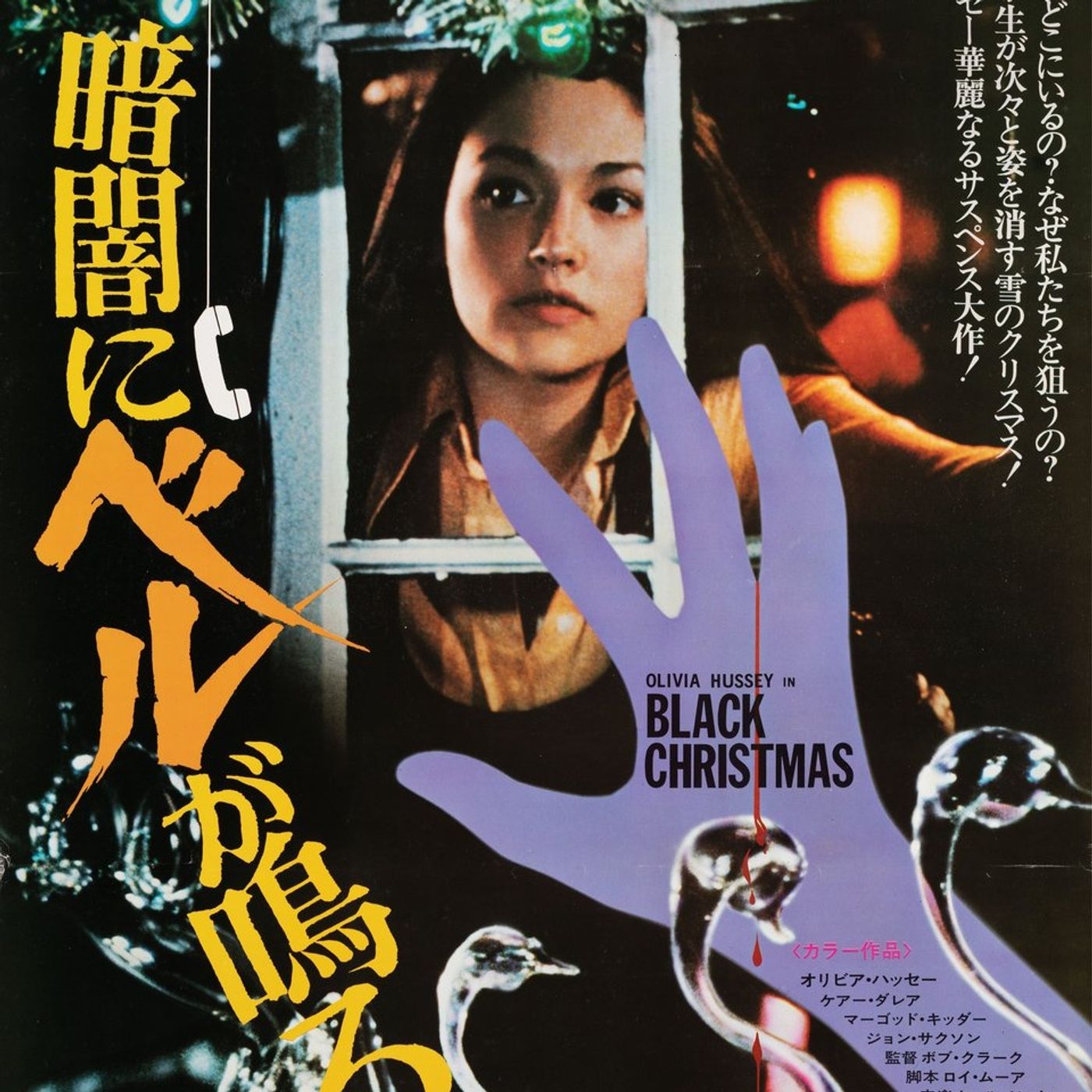
About this episode
Transcript
Automatically generated, so expect the odd misheard name.
Oh Jear's books. It's should time people paid good money to see this movie. When they go out to a theater, they want cold sodas for the pop popcorn, and no monsters in the projection booth. Everyone pretend podcasting isn't boring off Black Christmas. There was a little girl murdered over in the park tonight.
Yes, I heard of the high school girl has been murdered. Mister Harrison's daughter is missing, and now if the house where she lives, the other girls are getting obscene phone calls. Hell, remember those idyllic scenes out of your childhood chrisp Winter nights, sleigh bells, crackling new lugs, Remember those? Remember them well after Black Christmas They'll never be the same again. For Black Christmas.
Starring Olivia Hussey, kid Julet, Margot Kidder, and starring John Saxon as Lieutenant Fuller. If this movie doesn't make your skin crawl, it's on two tight. Welcome to the projection booth. I'm your host. Mike White joined me once again.
Is miss Maitland McDonough always a pleasure? Also back in the booth is mister Mark Begley. Ho ho ho shit, it's the reason for the season as we talk about Bob Clark's nineteen seventy four film Black Christmas. It's the story of a sorority house in the United States where a killer has snuck into the attic and slowly picks off several of the sisters, in between harassing them with wild phone calls. We will be spoiling the film as we go along, so if you haven't seen Black Christmas, please watch it and come back.
We will still be here. So, Maitland, when was the first time you saw Black Christmas? And what did you think? You know? I don't remember exactly when I saw Black Christmas, although I know that I did not see it in a theater, so that means it was either video or DVD.
All I remember is thinking, well, God, damn, that's a Christmas movie for me. Because honestly, I'm not a huge Christmas fan. I don't hate Christmas. I'm not the total Grinch, but there is something about the forced gaiety of Christmas and the length of time that that forced gaiety exists. I mean, it starts right after Thanksgiving and it just does not stop has always rubbed me a little bit the wrong way.
I love your Christmas trees. I have some nice Christmas decorations that I like to bring out. I enjoy seeing my family and friends, but the relentless ho ho ho tis the season to be jolly wears on me a little bit. And Mark, how about yourself. I finally got to see this sometime early twenty sixteen because I broke down and bought the Blue Ray.
Bought a Blu Ray the day after Christmas in twenty fifteen, and I bought the Blu Ray because I was having trouble finding it streaming anywhere at that time and had been looking for it on streaming for a good two or three years. Once I had gotten back into diving into horror and trying to see a lot of things that I had never seen. And as I've mentioned on the other Bob Clark allen Ormsby episodes, it was one of those movies. It's not on my secontronic Encyclopedia list, but I became aware of it around the same time as those and searched for it along with those couldn't find it back then. Figured these days i'd have much more luck.
Had a handful of streaming services at that time, and it would just never come around and I thought, Okay, I need to see this when I had seen Death Dream a little while before, and probably Deranged or Children one of the two, and so I ordered it. Must have watched it fairly quickly after I got it and was a like death Dream, underwhelmed by the film. And again, it's not a fault of the film. That was just different than what I expected, even though I had read about it for years and I had all these glorious write ups for it, and it's you know, everybody would say, oh, Halloween is the first slasher. Oh, but actually there's Black Christmas.
And being a huge fan of Halloween, being a fan of Clark's other films, including A Christmas Story, I thought it would hit me. I had more of an impact than it did. But I kept returning to it and returning to it and was like, oh, okay, I get it now. This is a me problem. I'm catching on here a little bit.
The pace is a little more languid than modern slashers, or well what I call modern eighties slashers, or even modern remikes of those slashers, And okay, I can appreciate this for what it is, and I have to say it's probably within one of my top ten horror films. This was a first time watch for me. I had never seen Black Christmas in any of its forms. I remember a few years ago when the twenty nineteen version came out, people were kind of tripping all over themselves on Twitter to talk about how great or awful it was. I don't really remember when the two thousand and six movie came out, which is interesting because I think that was right around the time that there were a lot of horror remakes that we're going on, like what my Bloody Valentine or prom Night.
I did go see Texas Chain Saw remake. I even saw that horrible name Aaron elm Street remake, but did not see Black Christmas. And then kind of your point, when I was watching it for the first time and I've seen it several times since. For the show, I was, yeah, kind of also underwhelmed, and then it really took a minute for me to realize, oh, this was nineteen seventy four. This is way earlier than other things like when and I'm glad I said spoilers when they say, oh, the calls coming from inside the house, I'm like, Okay, well, I've heard that line before we've traced the call it's coming from inside the house, but this was one of the first times the call was coming from inside the house.
I'm like, oh, Okay, now I realize why this movie is so groundbreaking. Now I realize when we're seeing POV shots from the Killer, when we're getting these killings in this sorority house. And then I'm thinking even more as far as well, I really kind of like this too, that we don't ever see the Killer, that we don't really get his backstory. And then you watch and I know we'll talk more about three makes later, but you watch the two thousand and six version, and it's that same rob Zombie Halloween problem where it's like, Hey, here's everything about the Killer that you ever wanted to know. Here's their entire childhood.
No, I don't need to know that much, and thank you for not telling me. Thank you for making Billy the Killer be completely a cipher, and that you never really get his entire backstory. You can try to piece things together, but he's just basically a malevolent force living up in the attic. And I'm like, Okay, I'm here for it. I like this the thing that made Black Christmas stick in my head was that it was something I must have seen very early in the period of my life, and I really discovered that I absolutely loved horror movies, that I loved everything about slasher movies, jolly old school horror films.
You know, I had always liked them. I liked them as a kid, although what I liked was limited to what you could see on television when I was a kid. I was a kid in the sixties and early seventies, so that was not the kind of thing you can see on television now. But those were movies that always stuck in my head and formed, I guess my psychic landscape. And Black Christmas played into both that and the fact that, to be absolutely honest, I'm not a huge fan of Christmas.
Christmas in my family was always fraught in one way or another, mostly in ways when you're a kid and it's most part of your life. You don't even know how to put your finger on what it is. It's troubly new about it. But there was a lot of family conflict and a lot of things that were went on said, and Black Christmas clearly tapped in to that. For me.
It tapped into all those anxieties about holidays that you're supposed to love, that are supposed to be a time when everybody's united in enjoying this holiday, and yet there's a whole bunch of stuff that a lot of people aren't enjoying that makes them anxious, that puts them on edge, that makes them wish that this holiday were over so we could get back to normal life. And I think that that's the root of why Black Christmas really spoke to me in a very powerful way. And even looking at it now, when I have all kinds of knowledge that I didn't have them, it strikes a real note for me. Well, and you get that a lot from the characters, and we don't have a huge group of characters, but they're all experiencing problems during this time.
We have Claire, who is dispatched first and doesn't have much screen time, but she's concerned about introducing her boyfriend to her family, and we got understand why that is once we're introduced to her father, and then Barbe is abandoned by her mom and they obviously have a strained relationship, and we get all these nuggets of their backgrounds so quickly in the film, and I think that's stuff I didn't catch first, And like these characters are so well rounded with just the minimal amount of effort from the script to the direction to the acting. It's there, but you have to be thinking about it. And of course Jess with her unwanted pregnancy, and this is all going around when you know it's Christmas break and we're going to go skiing and we're supposed to visit our families and be having fun, and really, none of these girls are having fun right now except maybe Phil Right the Andrea Martin character.
And I was so glad to see Andrea Martins show up in this because I was I was a huge fan of of SETV when I was growing up, so to see her in any sort of other role, I was very happy. And that she's pretty serious and pretty down to earth quite a bit, and here it feels like she's the only one who really kind has or shit together. She seems like the intuitive one. She's picking up on what's going on with all the other girls and is finally the one that says and breaks down and says, oh, you know, I think that Claire is dead, and how sorry she feels for her father, and that struck me these few times I watched it this week with having that father figure there the whole time. His main concern is his daughter drinking and paling around with boys, and it's just so much worse than that.
It's every parent's worst nightmare. And when I start thinking about that, the reality of what that situation would be, it just kind of heartbreaking. And one of the things that's nice about seeing Andrea Martin in this film is that of them. When you see people who became well known for something else, it's really hard to divorce them from it. And yet she is completely and utterly invested in this film.
You completely buy her as a character. You never think of her as oh right, SCTV. She is just the person she is, and as you said, very grounded and very empathetic and sympathetic. She's a really, really great character who is never overplayed, never takes you out of the story. She's just somebody that you really you would have liked to have known her had you been in that house with those girls at that time, or in any similar situation in your life.
And to your point, Mark, I never got until maybe the third or fourth time that I watched the film, I never heard Margot Kidder talking to her mother, Like I knew that she was talking to her mom, but I always missed that lyne about something thing like gold plated horror or something. I'm like, if you're a real gold plated horror? Yeah, and it's like, oh okay. It took me a while before I ever caught that. I'm like, oh, all right, because I didn't realize that there was tension at home and that's why she is probably the way that she is because Marco Kidder is playing basically the bad girl.
She swears, she drinks, and she has every reason too and every right too as well. But it was just amazing to realize, oh, okay, there's problems here. I went away to school when it comes to college and stuff, and there was always that weird time around Christmas or around Thanksgiving, Who's going to go home? You know? I had people living with us that were from out of state, and so when Thanksgiving comes around, it's like, okay, you guys just sticking around or your folks coming up?
Are you going to Chicago or wherever you're from? And then around Christmas, it was always that who's going to be the last person in the house, and for whatever reason, I usually was, so I kind of liked having the entire house to myself. Luckily, we didn't have any serial killers in the attic that I know of, you know, it's funny. One of the things to me that was exotic about this movie is I was born and raised in New York City. When I went to college as an undergraduate, I was living with my parents for the first couple of years, and then I moved in with a friend of mine in a loft down on twentieth Street, and there were a bunch of us living there.
So I was never isolated from the place I was from. Even when I was not living at home, I was still living in the city in which I was raised. So that entire idea of going away, not only going away to college, but living in a sorority house or a fraternity house or in some other kind of on campus housing was completely alien to me, and it was fascinating to me in this movie. I looked at this movie in other movies obviously that I saw at the same time that took place in Nelio's like that that weren't horror films, and felt I said, Wow, this is completely a fascinating situation for me that, oh my god, all these girls and their house mother with her little liquor in her book, and all of these little eccentricities.
You see, I could hardly imagine what it would be like to be in that situation period, let alone in that situation when lots of people have gone away for the holidays already and there is something very very scary going on, namely that there's a killer in your house who's targeting you and your friends. And they set that up really well in the film where it works as a plot point where you don't know who is supposed to be there or not. It's again a credit to Clark and to Roy Moore with the original script, but that idea of okay, we're tipped off Declaire not being where she's supposed to be because of her dad. If her dad hadn't been the one to come and pick her up, if she was going to leave Missus Mac does, they would have had no reason to realize that she hadn't left.
But with the Missus Mack thing, we get that simple line. As Phil and Jess and Chris the boyfriend are going to go to the search party, she says I may not be back when you get home, and it's like, okay, easy, and it's a simple thing and it's done in movies before, but it just works so perfectly in this And when they get back, they just assume that she's caught that taxi and left to her sisters, and they're under that impression the whole way through the film. I really thought that I was going to dislike the Missus Mac character, because at first, when she comes in, she just comes in like, Hey, i am channeling Shelley Winters and I'm going to be super loud and obnoxious, and then you kind of get to know her and even though yeah, she's a raging alcoholic, she still really cares about the girls that she's watching over and I kind of fell in love with the character.
I really like her. And then especially I like that awkward moment where she's calling for her cat, calling for Claude and starts calling Claude a bunch of names, which you do when you are calling for your cat and your cat's not coming, only to have mister Harrison behind the door or whatever, like basically catch her. When she's calling Claude a little prick, It's like, oh, Okay, that was a good moment. And I like that there are all of these laugh moments in this film and it really keeps you off balance as far as is this going to be a funny scene or is this going to be a horror scene? And of course we know that the two you know, the scream and the laughter are very closely related, but this movie there's a great job to keep you off your feet, especially at the beginning, and not to focus on a detail.
But yes, I absolutely have to say that the Claude moments are so dear to my heart because I have two cats and I can't tell you how often I have called one or the other of them little fuck, And that, to me is such a human moment in this movie. I can completely identify with it. You love your cat, but you really want to smack your cat and say, Jesus fucking Christ, why are you doing that. We just got a new kitten a couple of weeks ago, so I'm really feeling that right now. Yeah, you little fuck is part of every cat owner's every hat companions vocabulary.
You were talking about Phil and Jess, and I'm just like, oh, there's there's a lot of male names for female characters in here. I think they played it up in the twenty nineteen version a lot more. But it's always interesting to me when you have these kind of generic names that could be male or female. Even to the artendal character of Chris. It's like, oh, okay, so you never know when you're talking about these characters.
I'm almost tempted to call them by the actor or actress's name, just because it's tough keeping the gender straight sometimes. Yeah, they really played that up in the most recent remake, all the four leads of unisex names, and I guess that goes to this too, And I always forget when I first saw the movie, I was so confused by the name Phil and it was short ful phillis dub but I didn't care, like, why are they calling her Phil? But the characters in this are just so I keep going back to that because every time I watch it, I pick up on something else. And Mikey mentioned that phone call and I had to watch with subtitles because more for the phone calls themselves, because I was trying to parse out some of what the caller was saying in them and that phone call scene between Barb and her mom is a little bit.
There's a lot of stuff going on, and we're hearing it even where we're not on her. The camera's not on her, so it's easy to miss a lot of that stuff. But again, this is one of those films where I think the filmmaker really gave his audience credit and didn't dumb everything down for you know, the matten a crowd or whatever. The everyday filmgoer. It's like, yeah, you might have to watch this a couple of times to catch everything.
I know I certainly did and probably miss that whole thing at the beginning. I feel like at the beginning, I'm not sure exactly when it happens, but it's early on and Jess and Phil are kind of close to each other and they both look very concerned, and there is no real indication of it that I feel like, this is Jess telling Phil I'm pregnant, and really there's no context to that other than they seem concerned and there's nothing going on at that moment that is concerning. I don't know how early Jess knows, if she knows before the movie proper has started, or if this is all news to her that day, and maybe that's why she's coming in to the sorority house and to the party late at the opening of the film.
But just yeah, their interactions. It's just kind of one of those lightning into bottle things where they got the right people for these parts, and you can not pay attention to any of the character dynamics and still have a great horror film, or if you watch them multiple times and you start picking up on that, just think, wow, this is you know, Barb is masking all these feelings of inferiority by being that quote unquote bad girl and raising hackles by telling off color stories, or you know, or just ignore all that and think that she's just the jokey character, like as well as Missus Mack. So what you're saying about Barbe in particular is absolutely true. And it's also something that I think you see in horror films of this particular time that you don't see even five or six years later, which is that because these movies were still very much underrated, nobody really cared about that, nobody was talking in any serious way about well what these stock and slash movies were about, other than there are movies from people who just want to see a lot of people get killed in a lot of girls, particularly killed in a gory way on screen.
I think they were afforded of freedom to play with characters, to play with subtext, and to talk about, particularly things involving women, the way in which women are affected by being vulnerable, the way in which women are targets, the way in which women are frightened of things that men aren't frightened of. You know, if you put five guys alone in a fraternity house, the dynamic probably isn't going to include we're scared when we hear that noise outside the door, we're alarmed when we see that shadow outside the window. Because they're guys, they don't have, specifically that fear of sexual violence, or that fear of just being targeted by a masculine hostility against women. And I don't want to turn this all into a discussion about misogyny, but misogyny is something that looms large in horror movies.
Generally in a movie like Black Christmas, which on its surface looks as though it might be a misogynistic movie about a bunch of women, pretty young girls in an isolated place being victimized, Actually isn't it. In a lot of ways is a discussion about that fear of violence and how individual women in this context react to it. There's Billy, the killer that's in the house. Oh Billy, But I don't think that Billy is involved with the killing of the little girl. So I think that there's that external threat of violence as well, because that's another plot point that we have going on, is that there was a little girl murdered in the neighborhood.
Now I could be wrong. He could have murdered her on the way to the sorority house, but it feels like that might be a whole separate case unto itself, which is just another Yes, violence happens against women, be they Missus Max's age or all the way down to a little girl who is going to school. I'm completely with you on that, and that is something I hadn't thought about until I watched this movie in preparation for this discussion. I had completely forgotten that little girl who was killed in the park, and I had also frankly forgotten Missus Mack. The fact that this violence against women completely covers the age spectrum.
The little girl. It's an older woman who is a matronly figure, is not particularly sexualized, and it's all these pretty girls living in the sorority house. It is very striking. And not only do you have to worry about violence coming from outside, from these unknown forces, but that they use Peter the care Delay character as this red herring throughout it. I mean, he gets unusually angry, especially when he starts smashing the piano.
Oh, I'll never get it, never at all. I mean, I know he's got a lot of pressure from the conservatory that he's enrolled in, but then he now has the quote unquote pressure of Jess wanting to abort their baby, and he seems like a loose cannon. I mean, there's a reason why he's a great red herring because you don't know where he's coming from. And caire Delay, he's got that calm demeanor. So when he starts being threatening, when he is calling her crying and all these things, or there's a reason why he makes this perfect red herring because you don't know where this guy's coming from.
There is a moment where it's like, is he going to possibly hit Jess? Is he that upset that he's going to smack her around? Is he that much of a loose cannon. Is he that much of a loose cannon that he could be murdering all the girls in the house. Possibly, He obviously isn't at the in the movie, and even throughout the movie, it just doesn't add up.
But there's a good reason why they put him in that position. I also like the fact that it's ker Delay who is incredibly pretty, and that just plays into that gender role thing that's going on throughout this film. He's not the big, butch boyfriend. He's not the football team boyfriend who's upset about this. He's not androgynous, I would say, but he is definitely not your big, tough boyfriend.
And yet his hyper sensitivity about this whole issue of pregnancy and whose agency counts for more in this situation is made kind of ambiguous by the fact that he is as pretty as he is, and he has the seventies long hair and a very slight bill. He's tall, but he has us very slight frame. Back to that murder of the young girl in the park, it took me a long time to kind of match up the timeline there as to when things happen and the killer gets into the house that first night, and I could never remember when that mom is at the police station what the timeline was for her. It's the next day, and the girl goes missing that day, and that always kind of makes me think, Yeah, it's probably not him. It's very possible that he could sneak out of the house, but it's daylight at this point, so I don't know.
I like the idea that, yeah, this is not him. And to your point, Mike, there's violence all around, and we were just starting to get into that. In that time period of the early to mid seventies, there were serial killers active. We may not have had a name for it, or it may not have been widely reported like it is today, or even just a few years later with Ted Bundy, who would kind of play a factor in the airing of this film at one point. But it's scarier to me, and I kind of like that idea of having it be a little bit scarier that it's completely somebody else.
That also made me think when they get that first phone call from Billy or the first phone call in the film proper and just says it's him again, the moner, and I'm like, well, is it the same guy that's been calling before? It may or may not be. There's no real way to know from the context of the film. But I kind of like to think, though, they've just been getting of scene phone calls, because that was definitely a thing in the seventies. I received of scene phone calls in the seventies.
A lot of people mistook me for my mom when I answered the phone, so I think they thought they were talking to a girl and I would just hang up. But that was a thing. A lot of people got their kicks that way in the seventies, So they were talking to your mom. Yet that's really awes right, So you know, I don't know, it's I kind of like to think these are all separate events, and that's just another whether it was intended or not. It's another angle that makes me appreciate the script and the film itself so much more.
This film does capture something that was very much of the seventies, which is that there was a shaking up of gender and sexual norms that made a lot of people very uncomfortable, and it fueled a lot of anger on a lot of front. It made a lot of men angry that women were not asking for rights but taking those rights and assuming that they deserved them, They had every right to them. There were also a lot of women who resented the idea that the roles that they had grown up with were suddenly not acceptable. There was a very serious anti feminist backlash at that time. All of that was very much in the air, and there was also a lot of gay liberation stuff going on at the time, so there was a lot of challenge ing of traditional social and sexual norms that made a lot of people uneasy.
And I think that you can feel that in this film. I don't know how deliberate it was, but it very much reflects the time in which this film was made. These uppity broads are going to college and think that they can get some sort of education and a job afterwards, when they should be at home cooking and cleaning and taking care of babies. I mean, that just shows a right there that they're all out to get men because they're all going to this college. They're all selfish bitches.
Mike, and this is one year past row v Wade, And I'm not sure what the situation was like in Canada, though this is supposed to be set in the United States. I would like to think that Canada is much better when it comes to women's rights. I really hope so, because I don't think you can get much worse than the US at this point, or even at this point in twenty twenty one as we're recording this, But there's definitely something there that these are college girls, and yeah, this does play. This is like closer to Bundy than to dis Salvo, and way closer to Bundy than Richard Ramirez. But just this whole idea of having sororities or groups of students or nurses being terrorized by serial killers.
It's an awful thing. And it was too frequent of a thing that it could name three people a terrorized young women's students, three too many. The agency that Jess is given in this film, it's I'm hard pressed to think of another film, especially of that time, and even more so in the eighties films where she is allowed that throughout and doesn't cow tew at any point. And it's just always about her plans that she had that they talked about, and that's where they're talking in the sort of house by the Christmas Tree, and she said, remember those plans. I still have those plans.
Yours may have changed because you think you did bad at your recital, but mine haven't. And she never says, oh, well, we'll keep talking about it, or yeah, I think about it. When he leaves in a huff, she is still determined to terminate her pregnancy, and there's not a moment in the film where she reverses that. And I really appreciate that I tweeted and I think you saw it yesterday that when I was watching it with my daughter and she's kind of half paying attention to the film and playing a game on her computer, and I was curious to see what her reaction would be during that scene in the recital hall, and Peter says something to the effect of Jess, I want us to have the baby, and my daughter just chimed in it's not your decision, though, and I was like, I just just sat there and didn't say anything, and was like, give her my thumbs up.
You know you're reason or right? Mark, Yeah, I don't know, she's picking it up somehow, you said, especially at this time. But falso, especially in this genre, because horrors are not and especially stalk and slash movies are not known for empowering their female characters, and yet in Black Christmas these female characters really are very much in charge of themselves. They're very together. They're not like the kind of silly girls that you see in a lot of later horror movies of this kind, whom you look at, or I look at, I should say to own it and say, oh, dodn't mind it, you're so effing stupid.
I really don't care if the secret stalk or whoever he is, picks you off. All the young women in this movie are very together. Sure they have their problems, sure they have the stuff that they're dealing with. But they're not silly. They're not backed.
That's the thing that I think struck me most. They're fully realized characters. They have ideas, they have things they want to do, they have things they're dealing with, they have friendships, they have relationships. They are very much young women who have everything ahead of them and who are shaping their own futures in a very real way. And you see this sketched very quickly in this movie.
I mean, it doesn't have a lot of time to waste on telling you who these girls are, what they want to do, what their futures might hold. Because this is a horror movie, we have to get to some stalking and slashing. But unlike a lot of lesser movies of this kind, you really do know who all these characters are, and you really don't want awful things to happen to them because they don't deserve it. They're not dumb girls, not silly twits. Yeah, you genuinely care for these people five minutes after you meet them.
And I think Clark is very smart to have the murder of Claire so early and so brutally and be the icon for the film. But then also he spaces out the killing so it's always a threat there, but then to even turn up the heat a little bit more with the phone calls, so you don't necessarily need to see as many murders as long as there are the phone calls. And I like how the phone calls start to increase as the movie goes on. He knows pacing so well and knows when to inject those phone calls and just really ratchet it up. And you don't get five phone calls in the first twenty minutes, No, they're spaced out throughout, and then they just get wilder and wilder, and all of the different voices that Billy is doing, and sometimes it never really makes a whole lot of sense.
But then you get that moment where he starts to repeat things that Peter had said, so you're really, you know, just is very much questioning that, like, is this Peter or and she doesn't really make that connection. Is this someone who heard my conversation. Knowing a little bit about some of the spoilers of the film before I watched it, I didn't really pay attention to Peter so much because I knew that he wasn't going to be the killer. So you do miss some of that bait with the red herring. If you're like me and go into the film that way, then I think, well, this is kind of a cheat.
That lasts all the way to the penultimate scene of the film where Jess has ended up killing Peter, and you're still thinking, oh, well, it was probably him. He was in the house that one time during a phone call. We know that the phone calls are coming from in the house, although we don't really see him make a phone call until after that. But again, if you've read about it, you know that that's one of the lines. It's always using reviews.
The callers are the calls are coming from in the house. I try to remember, you know that this is we are set up to believe it's Peter, and that Clark's intent was to have us question whether it was Peter. And then you start thinking, well, does can this work out? Can he be in the house and be here? And he mentions in I think the audio commentary it was important for him not to show Peter when he does call, because there are multiple calls from other people as well, that every time the phone rings, you're like, oh, am, I going to hear this creep again and it's Peter or it's Barb's mom or whoever.
All the cops start calling as well. But he didn't show Peter at his location like we so often do in films, and then you're going, oh, well, where is still At this point if you're watching the move for the first time, maybe don't realize the calls are coming from the house. But to not show him where he is is smart because then you can think, at least at that point when he comes down the steps after a call, oh maybe it was him that whole thing with the phone. Not to get into the sequels too much, but I kind of like, how they approached that with the current technology, because you think about something like that, how would you do that today when we're not stuck on land lines or possibly having a house that has two lines or maybe three, Because that's kind of a confusing point for me.
When we do finally see Billy or the caller make a call, he is in missus max room. But he couldn't have been making the calls from her room the whole time. They would have heard. I mean, he's so manic and so loud and so weird, you would think that somebody would hear that coming from her room. And he also risks her going to her room until she is dispatched.
But I don't like kind of trying to break down things like that. Oh does this make sense? Could he have been the killer? Could he not have been? It would have been nice maybe for a definitive Oh he was here at this time, It could not have been him.
You never really get that moment because you see him lurking around the house, you know, disembodied voice on the phone, so on and so on. But I love that at the end, the cups think the crime is solved. Oh well, Peter's dead, Okay. I guess everything's fine, and then everybody leaves and then the phone starts to ring again. I mean, that's one of the best endings.
It is so great when the phone starts to ring one more time. This is going to keep going forever. I'd love it. As far as the logic goes, I was like, well, how does he know the phone number of the phone downstairs or what the line is? And I was just like, yeah, forget it.
Don't try to even into that stuff because it's just gonna fall apart. But who cares. It works, It really works. But you know, interestingly, when we talk about the logic and the mechanics of things, I love how much time and I had completely forgotten this until I watched it again. This film dedicates to the police trying to trace those calls and those amazing shots showing you what it took to trace a call back in the seventies, those enormous shots in those trunk line where houses or whatever those things are.
I wonder whether people who are in their twenties and thirties looking at those shots even though what the hell is going on there? Plus you get less Carlson so as our lineman Bill Graham, who I just love, And yeah, I think that's one of the things that I really enjoyed from the get go of seeing this. Oh there's less and oh we get to see him run around and do this fun stuff. It's not like what we get in when a stranger calls, where it's just all in the house and the police and the tracing is all done, you know, completely separate. I mean, it's basically the same story taken from the same urban legend.
But I love seeing the mechanics of things like that happen. And it's a great point to that you bring up about the police and how different that is from so many horror movies where they're not just completely dismissive. And we get that with the Nash character, the bumbling idiot who gets the fallacio lines thrown at him and all this other stuff and doesn't make the connection that we've got this girl missing from the sorority where these calls are happening, we've had a girl murdered in the park. Come on, buddy, let's take this seriously. And Lieutenant Fuller does, and it's such a great perform one of my favorite performances from John Saxon because he is so low he and so genuine and seems legitimately concerned and caring about what's happening to these girls, and you don't often get that.
He does ask the probing questions about Claire, or like, what she's seeing other people? Could she be checking up somewhere? Does she have emotional problems, which cops are going to ask. I think that's part of their duty as well. But he's serious about taking this seriously, and his only real goof is dismissing the fact that there is a second line in the house.
Now, I completely agree, and I love John Saxon in this movie. John Saxon is one of those actors. Frankly, he's done some really great stuff. He's done some very bad stuff, and he's done a lot of stuff in the middle. But I think this is a movie in which he acquits himself really, really well.
He is a voice of reason. He is the guy in a position of authority who in a lot of horror films is the guy who says, ah, man, those kids, they're just fooling around. Who cares this is nothing? He's the voice authority who says, we need to look into this, we need to investigate I don't know what's going on, but we can't dismiss it out of hand. And he does it in a really low key and really effective way.
You know, I look at him here and I look at him in Tanna Bray frankly, and this is a really wonderful moment for John Saxon in his career where he really does acquit himself extremely well in a genre film. And I like too that he listens to the phone call between Jess and Peter and then it doesn't feel like there's judgment in his voice afterwards. It feels like he's genuinely concerned about her more than oh, well, young lady, you really need to make your boyfriend happy kind of thing. There's just none of that. That he is genuinely.
It's kind of the even though we do have a literal father figure in the film, he's the closest to a real father figure that we have throughout the movie. That he is so caring and protective for me. That also plays into all of those scenes in which you see the police really trying, with all the technology that they have at their command at this time in history, really really working to figure out what is going on. There is none of that dismissiveness that you've see in a lot of horror films where the cops to say, oh man, it's those crazy kids, Oh man, it's those girls. Yeah, yeah, Yeah, they're always complaining about something that's always so frustrating in films.
I just find another way around it. And they do it so well in this well, even though you have Sergeant Nash who's kind of an income poop, which is fucking hilarious, and especially when the one cop is laughing at him, I absolutely love that that guy's great. These cops are actually affect that they find the little girl's body, that they can have a search party and you don't get shots of I don't know, a couple of yahoo's with shotguns that accidentally shoot each other or something, some sort of comic relief part in that. I mean, it's a very serious scene and they pull it off very seriously, and that they actually find the little girl's body. And the screams in that scene are some of the best screams in the film because they feel very genuine.
It feels like this what you would do if you came across the girl's mutilated body in the park. Yeah, and the inner cutting of those scenes that in particular is great, and it happens a lot throughout the film where we switch locations, and the cuts and the sound design are so great. And I think we go from up in the attic either right around the time missus Mac is getting murdered, and then we get screams and it's the girls in the park discovering the body, and then the mom up after mister Harrison, who is of course falsely relieved that it's not Claire, and the mom comes up and she opens her mouth to scream, and then the phone rings, so it's the phone ring versus her instead of her screaming, and he does at a number of times.
And having watched this after watching those other three Bob Clark and or Alan Ormsby films, you can just see the progression of his technique and style and grasp of the language of film so much more in this. And this is again right around the same time as Death Dream and Deranged, only a couple of years after Children Shouldn't Play with Dead Things, and I mean really right on the heels of at least the release of Death Dream that had been filmed a little bit before. But we get a lot of moving roving camera just in that little staircase landing even and it becomes a little disorienting after a while. I'm trying to figure out the layout of this space, and he'll do a one eighty or a three sixty around that landing up to show the attic door again, and you're like, wow, you know this is it's great.
There's some split diopter shots in there, and it just seems like his style and technique was really ratcheting up at this point. I listened to the audio commentary, the one with While I listened to both commentaries, but there's one that has Clark and then there's one that has Saxon and Delay that are kind of cut together obviously two different interviews or two different sessions, and when they aren't talking, you can hear the audio of the movie and listening to it, and I know I said the exact same thing when I talked about Lady from Shanghai. It sounds like a radio drama, you know, the music, the sound effects, the dialogue. It is also rich and so layered. And I love with this one too.
You always have like Christmas Carol's low in the background, or the amazing score. I love that Peter the piano player really kind of informs how the score goes because there's so much piano and so much deconstruction of piano sounds to this. I think it's probably one of the best scores for these Clark films, and so far we keep saying like, oh, the score is amazing for these Also, the use of Christmas music in this film is exceptional. It's very easy to do a cheap use of almost any Christmas song you can think of, but in this film, those songs are so thoroughly integrated into the flow of the film that they never jump out at you. They never jump out and make you say, oh, man, God bless you marry gentlemen.
Wow, that's a cliche. It never works that way because it is so seamlessly blended into the visuals, into the camera movement, into the way that this film is together. It's it's really remarkable. And they tend to be inherently creepy if you tweak them just enough, or even just have them playing low, and I think it's it's another one of those aspects of the film that just ends up working so well as a plot point to have just pulled away at just the right time by these carollers, whose rendition of that that carol is just amazing. For one thing, and at the opening with the Silent Night, which I believe he uses again in a Christmas story.
I think a Silent Night as used there as well, and kind of a similar nighttime scene. I noticed when I played this with subtitles, it's it's like a second or third verse of that song, which you know, usually if you go to church on Christmas, which I did for years, you don't necessarily do the second, third, and fourth verses. But I was kind of struck by the lyrics and that part of the song and wrote it down. It says shy where the mother mild watches over the Holy Child, and it may again be completely just by happenstance, but it goes to Billy's calls, and it goes to Jess's situation, and obviously Christmas songs are about the birth of Jesus, but having that mother child lyric in there just struck me this time, as we're dealing with that throughout the film, and what is the deal with quote unquote Billy and Agnes and the baby and what happened and that I like that It's still kind of a mystery to me, even now having watched it multiple times in the past and three times this week.
What is he talking about having happened? Like you said, Mike earlier, we get way too much of that in the two thousand and six remake, and I like that. I'm still thinking, well, did he kill the baby or is this a sexual assault like it appears at one point, or what exactly is going on? Or is it just the ravings of a madman? He does say at one point, it's used a couple of times the line don't tell them what we did, Agnes.
That's the thing that kind of makes me go, oh, this might be something else. This might not be an accidental or even purposeful killing of a baby out of jealousy. This maybe ikey stuff. And I have to say, the icky stuff that I always think about his incest, right, That's That's what I'm kind of beating around the bush about. And I don't know.
I'm like, is that what we're talking about, or again, is it just ravings? Is what he's relating a story? Is it a story about him? Or is this just weird stuff that he's throwing out there to freak these girls out because they are freaky calls. I think the use of the multiple voices is probably really the freakiest part.
I don't know if it's the content or the full that is stranger. I think it might be a mix of both, and I think they do a really good job of playing with that and having the voices changed so that it feels like and I know for a fact that they didn't have just one person doing the voices that you could switch over to another voice and layer things on top of each other, because it is you know, I was talking about radio play. Those phone calls themselves are just like little mini movies or little audio dramas throughout the entire movie that you've just put in there, and it feels like it is telling a story. It feels like we are getting a linear narrative through there. But yeah, it's not very clear.
And yeah, I was thinking incests as well, even before I saw the two thousand and six movie. I was like, Okay, it feels like Billy and as maybe a little sister Agnes and maybe they had a baby or I'm not exactly sure, or maybe there was an abortion with that, or I don't know, physical skitter in the closet making babies, and I saw one of the babies and the baby look at me. But it definitely felt like Billy had a relationship with Agnes and it was not a good thing to have happened. I'm completely there with you because to me, and I haven't seen either of the other films, I've only seen this one, there is something deeply family oriented, and I see incest all the way through it. Frankly, it's extremely insular and extremely close, and all those shots of the attic emphasize that.
To me, it's that we're all trapped in here together and it's a repeating cycle of some kind. I suspect that probably is the thing that I found disturbing when I first saw this movie all those years ago, but didn't parse and articulate for myself. But I think that that is what made it stick with me the way did And unlike some things that I saw a long time ago that stuck in my brain, this is a movie that is as disturbing to me now as it was to me. Then. I did an episode on this for my show a while back, and I believe that one of the viewings that I did for that I watched it real late at night.
My wife and daughter were asleep, all the lights were off, and I just put it on as a lark. I may not even been preparing for the episode. I think I just did it to watch it. I really felt those phone calls that time and ended up having a nightmare that night in my sleep, and that is really unusual for me. I never really even had nightmares as a kid.
It wasn't related to the movie, but I woke up. I had to wake myself up out of this dream. It was so disturbing, and I thought, yeah, maybe I shouldn't watch Black Christmas in the dark of night by myself. And I was surprised because I could really feel it digging in and even thinking, Okay, there's there's a couple of rooms behind the living room where the TV is that are in pitch black, and I just kind of peek over my shoulder and have that that irrational fear that someone was in the house. And like I said, it rarely happens.
So with the right setting, this is a movie that can dig in. And again nineteen seventy four, there's not a lot of gore. There's most of the kills are off screen or off you skated in some way. It's mainly those phone calls. They're just so they dig in so well and are so disorienting.
Again, like the camera work, and with that layering of voices. Now again we're going to do the fifteen things wrong about Black Christmas. I don't know how somebody can manipulate their voice that way and overlap, but it works for what they're going for, which is the effect and that overall feel of the disturbing phone calls. I will say that on a personal level, and this is really personal, I'm asthmatic, and all that wrapped in plastic part of this movie really, if I were prone to anxiety attacks, watching Black Christmas again really would have triggered one in me, because those sequences where you have that suffocation in plastic and that inhalation with plastic wrap really really anxiety producing.
Clearly, you know that's not a thing that is going to trigger everybody, but I also think that a lot of people can identify with it. The idea of having a plastic bag over your head is something that is extremely anxiety producing for most people, and that was the ad image that sold this movie. Then you have barb having and asthma attack as well, so you've got it doubly in there. I was years to see what my daughter would think because she has pretty pad asthma too, so she didn't. I think she was playing her game at that point.
So there is a lot of breathing trauma in this film. And yeah, to your point, it isn't that kind of slasher porn where it's like, oh, how can this girl get it? And oh can we see I don't know, an arrow go through the back of somebody's head and come out the front, or just any of those which you see. I mean, it's almost to the point of parody now when you watch something like I don't know, like a Your Next or something and it's just like, Okay, we're gonna do this, or all the final destination movies where it's like, Okay, well, how is this guy gonna get it? And what kind of weird Rube Goldberg mechinations are going to cause more head trauma or the person's chest to explode or something like that, Like what is going to happen to this?
And in this movie, it's very very simple, and Guests leaves a lot more to the imagination which I'm fine with. I really kind of like that. Yeah, I love that. I think it's clear's death where they go from her dying. You're talking about those shot cuts of audio where they go from that to the rest of the group laughing and screaming at something in the in the main room.
It's like, that's really nice and that, Yeah, to your point, just happens again and again. It is really well done, and again obvious skates the sound for the rest of them, and so you get why no one is hearing any of this stuff. And also to speak to that, that's the horror of suffocation. It's quiet, and it's also something that I think almost everybody has experienced in one way or another at one time or another. You know, whether you were faced down on the bed and woke up feeling like you couldn't breathe, or you were in a pool and you were underwater for a moment more than you wanted to be suffocation And I think I'm not sure whether you can hear it.
I'm in the middle of a very bad asthma episode right now, so I am wheezing kind of badly, which makes this extremely relevant to me. I think a lot of us have experienced that feeling of oh, I can't breathe in one way or another, and that is really primal. And I can tell you every time I look at the ad that was the main ad for this movie, it brings it right back to me. That face wrapped in plastic with that little indent, you know, where she's trying to breathe in. That is a really disturbing thing.
And I'm guessing that probably people who never even saw this movie saw that ad and in some way experience the anxiety that that image produces the idea of somebody putting a plastic bag over your head and you not being able to breathe. I definitely know I saw it decades ago in video stores on the wall, never found the video, but I know I I was familiar with that poster and it is and I had an experience as a kid. I was in a sleeping bag and these are those old nylon sleeping bags that aren't very breathable, and a couple of these kids were had wrapped kind of wrapped me in it and really panicked because I could not get a breath. And so when I see that kind of stuff, that's the thought that I go back to and it's, yeah, it is, it's horrifying.
It's it's a scary thought well, and it's so much more effective to have that that's called pain, the pain that you know versus the unknown of like I've jumped into water that is too deep and I've gone too far and have had panicked trying to get back up to the service to breathe. I've never had my throat slit. I've never had an arrow shot through my head, so I can definitely appreciate that first death and realize, like, oh yeah, that's really fucking scary. That image is very terrifying, much more so then getting a unicorn shove through your head. And it's an image you come back to in the film.
You see it more than once, oh yeah, lots of times, and as we said, it was the image that was in the ad. I like that they go back to it, not for that reason, but you get that overwhelming sense of dread and doom that she is still undiscovered. Missus Mack is undiscovered. When is anybody going to find them? Is it?
I don't like to extrapolate beyond the movie, but I kind of can't help it with this one. What happens to Jess, And if Jess is killed, somebody's going to come back and find that, And then are they going to search the house? And then are they going to find Claire and missus Mack and will Billy be gone by then? And so on and so on, And I have seen it's kind of like the end of the thing where people have used these clues through the film to say whether one of them is infected. And there's a line of dialogue and I think it's Saxon.
I think it's Lieutenant Fuller that says, because he's still thinking that Peter did it, oh, he must have made a phone call after each killing. And I think people have taken that as gospel and relate every call that Billy makes in the film to a death or to a killing that he's just made. And I'm like, well, that doesn't really work. It doesn't really matter. You could say they're coming before and after because he breaks into the house, kills Claire, makes a call or makes a call and kills Claire.
What difference sys in Mclaire is still alive when the first call is made. I think the thing that I had read was putting the death of that Girl in the Park a day before, which I don't believe is correct. The point was that, Okay, he's making a call here at the end of the film. Again that means that Jess is already dead, and I don't read it that way because we have just seen him in the attic and we're doing that crane shot coming out of there and then he makes a phone call. I don't think enough time has passed for him to come down and gone in the room, killed her, etc.
Etc. But again, it doesn't it doesn't matter. You know that it's highly likely that something is going to happen to Jus at this point, but they could get out of it easily if they were to ever do a sequels. So since it's not shown, all right, we are going to take a break and play a trio of interviews. First up, we'll hear from Simon fitz John, author of Bob Clark, I'm Going to Kill You, And then we'll hear from actor Art Hindle, and last but not least, we will hear from David Hastings and Paul Downey, authors of It's Me Billy Black Christmas Revisited.
And we'll be back with all of those right after these brief messages. Hello, this is Mark Bagley, the host of Wake Up Heavy, and I'd like to invite you to listen to my show over on weir Newwaymedia dot com. Wake Up Heavy as a show about my horror movie obsessions from childhood as well as new to me discoveries from the past and present. My guests have included fellow Weirdingway Media hosts Mike White from the Projection Booth podcast, christash You from the Culture Cast, Heather Drained from Noise Chunkies, as well as Sam Deagan, Sam Panico, and Simon fitz John. Every once in a while, my daughter Cleo even joins me, Hey, that's me.
Find Wake Up Heavy and my other show Cambridge and was sewn on Weirdingwaymedia dot com or wherever you listen to podcasts and don't forget anything can happen when you Wake Up Heavy. Welcome to the interview portion of the show. First up, we're going to hear from Simon fitz John, the author of Bob Clark. I'm going to Kill You. Simon FitzJohn, tell me more about you and especially how you go into film writing.
Well, it's I mean, it's always been a passion of mine, like film has always been a passion, And I think the passion for horror came from my parents without a shadow of a doubt. I suppose that may be the case with a lot of horror fans that they're they're sort of reared on it, if you like, from quite a young age. But yeah, I mean the pivotal film moments for me when I was a youngster was of you know, I had a younger brother and we used to sleep in bunk beds. My sort of mum was a huge horror fan, more than my dad was. But they used to go to horror films together when they were dating, you know, as as you do.
But my mum always kept that passion for horror going. But as I said, she never really she wasn't a fan of the genre in terms of I must go and see the latest John Carpenter movie, or I must go and see all the latest agenda. You know. She wouldn't know the names of directors, she wouldn't even remember the names of films sometimes, but she would just absorb these horror films and remember moments and bits and you know, and that's what she would feed off to me. But yeah, like I say, my earliest memories was she would come up, like on a Friday night, nine ten o'clock at night when I was nine ten and sort of say, you know, tap me on the shoulder to see if I was still awake, and that my younger brother below me was asleep, and it was like, right, put your dressing gown on, you can come downstairs, you know.
And it would be things like the thing being shown on TV or Halloween and you know Jaws Alien, you know, these like seventies eighties films that were getting like a TV screening over here in the UK. And I remember the only thing I was told, you know, she just kept talking to me and saying, you know this isn't real, right, you know, this isn't real. And again a very British thing that she was more worried about, say Halloween, for example, no problem with Michael Myers putting a knife in poor you know Bob and hanging him on the wall. When some boobs gets shown, suddenly it's close your eyes, close your eyes, you know, sort of, which is a very British thing, I suppose, But but that was it. I mean, I was hooked.
I remember just watching It was probably Halloween actually that I remember just watching and thinking, I've never seen anything like this before, because my film experience up to that point was like Disney, you know, and and and suddenly you go from Disney Disney to Haddenfield is quite a quite a swerve. And that was it. I was. I was then hooked, you know. I was absolutely hooked on horror and have been my whole life.
Really, you know, I was never able to go down the film route as I made a film at university purely for fun, as because I did a degree totally unrelated to film. But a friend of mine, he was a huge film fan, and we just said, well, why don't we just make a film. Let's just make a bloody slasher movie, you know, setting our whole of our campus, you know, with a mass killer going around killing as many people as we possibly can. And we did, and you know he actual Funnily enough, the guy I made the film with went to film school after because he enjoyed it so much. And now he is an editor in Hollywood and editing the Mission Impossible movies and Top Gun and and everything else.
While here I am sat in my bedroom talking to you about that about films. But it's funny our life goes, isn't it. But yeah, that was it. I've just never got rid of that passion. And although I was, my career took me down different pathways into teaching.
You know, I work at a university. Now you've got that option of like you have with podcasting, you can keep that passion alive. And so with me, it was less right about films I enjoy. And so that originally started with setting up person a website at a newspaper I was working at, where we did some podcasting and bits and pieces, and then that just expanded to writing for magazines and I've written three books and I continue to write for The dark Side magazine, which is obviously a British magazine, but I know it's got a fairly decent following in the States, you know, a sort of the retro horror sort of thing, which is which is what I enjoyed writing about most, because you know, my real passion is like researching the stuff really, Mike, you know, not necessarily reviewing like modern releases, although I watch as much modern stuff as I can.
It's more finding out how this happened, you know, how did this get made. Whose idea was this, you know, this game changer? Where did that? How did that come about? And that was what led me to Black Christmas really, you know, and writing a book on Bob Clark.
I'm not sure anybody ever else has written a book on Bob Cards, so I might be the only one that that sort of has. And yeah, here I am now talking to you. Was Black Christmas? Was that your first Bob Clark? No?
But interestingly it was the first one I heard about, because, as I sort of referenced earlier, my mum would always be throwing me these clips and moments from films that she would remember. And this was pre internet obviously, so you couldn't just google search, right, and so she would always talk about there was this film I went to see, you know, and it was amazing, and it's about a set of college kids and there's phone calls and it turns out the guy is in the house, you know, in the attic, making the phone calls. And she said, but I can't remember what it's called. And so at that time, this was probably mid nineties, and so I was talking to friends I knew, people I knew, you know, going into reference by poking around in books, couldn't really find anybody that knew what I was talking about, until one person came along in a sort of I used to work originally when I left college.
I worked in like a DVD sort of store, you know, DVD and CD store. And yeah, one of the people I worked with said, I don't know that film. It's called Black Christmas. So there was my lead, but it was unavailable, It wasn't available, It wasn't available on VHS in the UK, it wasn't available on DVD, totally unavailable. And so then a sort of VHS label sort of started up are coming the name Redemption possibly that started releasing you know, retro stuff and rereleasing things, and that they released children Shouldn't Play with Dead Things, which was the first Bob Clark I actually saw.
But still I'd never seen Black Christmas at this point. And then lo and behold, I think it was I still remember, but it was Christmas Eve nineteen ninety seven. That's how pivotal a moment it was to me, Mike. I can remember the date it got shown on TV in the UK on one of the lesser channels over here, and I remember the colleague who told me about the film, faxing me again. So this is dating the story, faxing me to say, you're not going to believe this.
Black Christmas is on Channel four at like eleven thirty five on Christmas Eve, and I thought, wow, this is it. This is the seven or moment. But I thought I was prepared to be let down, you know, because so often when when you build things up in your mind, certainly with films, I think if you're if you missed the hype train, as it were, and you come to a film late, very often you're like, you build it up into something it can't possibly be in terms of its quality. But Black Christmas it was the opposite. I thought, crikey, if anything, my mum has undersold how good this is, and and watching it with the like, how come more people don't talk about this film?
You know, when it's it's sort of like you think of all the films it came before that have sort of copied elements of it, and you think, well, I've got to do something about this, and so you know, and so from that point on, anytime anybody said we've got any films to recommend, you know, any horror films to recommend. It didn't matter if it was in the heat of summer, it'd be like, yeah, Black Christmas, you know that, that's one to watch. That's one to watch and then learn the whold years later. That then leads me down the path of writing a book on Bob Clark. Yeah, how did the book come about?
Because it's one thing to be a fear of the films, but to take out a whole book project as something completely different. Well, it was partly down to the publisher that I worked for. So there's there's a company over in the UK called Hemlock Books and they'll be absolutely delighted. I'm giving him a shout out there as well. So, but it's run by a guy called Dennis Nicole, who's like a real old school horror guy, like he would be on He was on set when the Hammer films were made, you know.
So he's interviewed Cushing Lee, you know, all all the greats. And so he has a horror company which they import horror mags and sell them, but they also published their own stuff as well, and so he was involved with dark Side Magazine, which I started writing for, and then they said they were coming up with these ideas of a new series of what they called horror companions, where the focus would either be a specific director or a specific genre, a subgenre of sort of horror. And so I originally went to him and said, can I write a book just on Black Christmas, purely on Black Christmas? To which the response was no, because they didn't think there was a market for it to do a book just on Black Christmas.
But I said, well, okay, then we'll considering Bob Clark did Children Shouldn't Play with Dead Things and death dream and murdered by decree, you know, and there was the Black Christmas remake you know, had been around at that time, and then there was lots of other offshoot bits of these deranged There was a bit of popcorn you could work in, you know, that the nineties film. And I went back and said, well, how about a book on Bob Clark then? And they sort of relented on that, so, you know, I didn't get I got a pitiful amount of money for it, Mike, I don't mind admitting that pitiful, but it was allowed. I mean to write about something I was passionate about, and you know, and you know, whether it be I think and This is the thing that it's the passion of the people that keeps this stuff going, whether it be writing for magazines or podcasting or whatever it is.
You know, so often people are doing stuff for free because they love it, because they love the genre. And suddenly I'm I'm talking to Olivia Hussey, you know, about Black Christmas, and you're like, well, you know, i'd a paid to do that, not not be paid, you know, not had not actually be paid to do it. You know, I'm happily going to do this because I actually love it and being able to big up a director that I think sort of got the recognition but too late. You got the recognition too late. You know, he basically got the recognition and then he died, you know, when people started appreciating what he'd done in the sort of seventies.
You know, it's just a shame, which is what I wanted my book to be to say. If you look at that run of movies he did, from Children to Death Dream to Black Christmas Deranged, you know, it's like that that's a hell of a run when when you're not working with much money, you know, which he wasn't doing. It wasn't the for Black Christmas like six hundred and forty thousand dollars. So it's just such a small amount it is. But interestingly, Bob Clark said that was quote a monumental amount of money because you know, when you think the previous films he'd done, Children Shouldn't Play with Dead Things was done for about one hundred grand, one hundred thousand, and then Death Dream and Deranged were both around the two hundred thousand to two fifty.
So suddenly you've gone from two hundred thousand to triple that for Black Christmas. You know, and as he said, what it allowed him to do was get people on board involved in the film, certainly the casting of it that if he was making a two hundred thousand dollars film probably wouldn't have happened. So and you know, and you know from watching the films, you know they get every last penny out of it because a lot of it is so enclosed. You know, they looked out or not looked out that because they found it. But the house sells the film.
You know, if you find a house like that and they and dress it up like they did and put sort of track camera tracks all around and just have that camera moving around. You don't need expensive effects, you don't need millions of dollars because it's it's it's it's gritty, you know, it still has that grittiness about it. I literally watched it again last night for the god knows how many times I've watched it, and I was still watching it, thrilled by it. You know. I remember I mentioned it last night again saying I'm just shaking my head time saying that this film is so excuse me, so bloody good, you know, so good.
It's so good. It's like it's still gives me the chills now when those you know, when the phone calls start and the you know, the calls it to a piano scraping sounds come in. I think, like, this film absolutely nails. It absolutely nails creepiness totally. It's an amazing cast in there, and a lot of faces I wouldn't necessarily expect.
That's very happy to see Henry Martin and there, Yeah, exactly, and that that was one of I think either a first or second film. I think she certainly hadn't done much and she only stepped in as a late replacement actually, because I think it was Gilda Radner was going to originally play that part. And then there was a couple of examples of that with people being drafted in last minute. John Saxon, for example, he got drafted in literally two days before filming started because the original Lieutenant Fuller. They had an actor called Edmund O'Brien who was Oscar winner, you know, veteran veteran actor, and they cast him.
He was agreed. They met him at Toronto Airport, took him for dinner and realized he had the early on set dementia. And so it was like they said, he didn't when they when they met him at the airport, he didn't seem to know where he was, you know what. He didn't know at the lines, and it was like, oh my goodness, you know, we can't. We can't have this guy, you know, we can't have it, have him.
And now, luckily for them, John Saxon had originally tried out for the role and been turned down, so they went back to John because he was friends with Karl Zitro. Actually John Saxon and basically said, look, if you want the part, it's yours, but it means you've literally got to get on a flight to Toronto like now, and he said that he arrived, went straight into makeup, and then two o'clock in the morning he's doing the scene in the park where they have the search party, and he's got the megaphones saying there's gonna be sets of dogs and there's going to be you know, that's literally five minutes after he landed. He's doing that. But you wouldn't know, would you, from his party. He's so good at it.
He's so good in it as well. When you talked about how this movie precede so many other horror films, and as I'm watching it now and twenty twenty one, and I'm just like, oh, which came first? Him in that role or him in the same role in what was the Nate Marion elm Street exactly. I mean, he's just a just a great actor. And I think it's yeah, it's it's it's a I think I wrote in the you know, the chapter that I wrote on the book, I said, it's it's rare to see a horror film where the acting is so strong across the board.
You know, there isn't really a dud form and stare you know, you've got Olivia Hussey who's phenomenal. Then you've got that, you've got Margo Kidder, who's not the comedy character, but she certainly gets a lot of laughs out of her character. And you've got Keia Delay, you know, and and yeah, it's it's it's it's just an incredible cart you know. It's it's you know. They like to use that phrase ensemble and throw it around a lot, don't they.
But that's very much what it was. And I think what helped with the film, and certainly from Bob Clark's perspective when you speak to the cast, is there weren't any real egos on the set, you know, certainly not from Bob, you know, basically, you know. And then Margot Kidder said that with you know, with Barber character, it was basically Bob would say to her, look, as long as you say these lines roughly, I don't care what you add to it. You know, you can put it, you can swear, you can, you can do whatever you want, you know, just make the character your own as long as you hit these points, these plot points that need to be explained in the in the script. But apart from that, just do what you want.
She loved that she said she absolutely loved it, you know, having that freedom, especially with like the scenes on the phone and sort of you know, it said just great stuff. Bob was always keen to cut modest I suppose is the word I'm looking for. He was. He was a modest director. You know, he was very quiet, He was very easy going.
You know everybody on the set of Black Christmas, you know the people. I suppose he said it was all you know, not necessarily relaxed, but there wasn't stress. There wasn't stress, and he was keen to give people credit. So even you look at the script for the film, for example, so if you look on the credits of the film, it's it's credited has been written by Roy Moore. His creditor is right in the film now Roy Moore.
He originally he came up with what was the original version of the film, which had been knocking around the studios about three years without anybody taking it and biting on it. But originally it was written very differently. It was original written as a film called The Babysitter, and then it was about a psychotic who was stalking people at the house of his former doctor or his doctor. That's so it's a similar sort of idea, but the characters and the and the the concept was sort of different, if you like. And it was Bob that stepped in and said, no, what we're going to do is we're going to make this college kids you know or you know, and it's going to be a sort of sorority house and it's this and there's there's gonna be no doctors involved.
And he rewrote it, you know, and added the Missus Max scenes. That was all written by Bob, but he's not credited on the film as having anything to do with the script, you know, Elis let Roymore take the whole credit, you know, which again is you've got to be comfortable within yourself, I think, to be able to just sort of say, well, look I don't need the credit for this, you take the credit for it. It always felt like Clark liked to work with the same people and just kind of evolved like his regular cast of characters behind this the scenes and even in front of the camera. I know, Missus Mack was the same actress who was in Deranged Were There are other people that kind of held over from previous films into Black Christmas, not so much into Black Christmas.
I mean, obviously you've got Carl Zitro did the who did the score, you know, did the score for for all of Bob's well, all of those early films, but not really you mean, you didn't like Alan Ormsby. Wasn't there in any shape or form. I think it was because partly because he'd full blown moved to Canada for this, you know, as opposed to you know, Children and Death and they were filmed in Florida, and then obviously Derange was filmed near Toronto, but even that started sort of moving away from the the sort of Bob Clark pack, if you like. But I think it was more just that, you know, with with more money opens up more options of who you can bring in. So I think, you know, with the early films certainly was something like Children and Death dream it was like calling in favors, you know, Oh, and you've got a haven't you right?
Well, can we borrow that yacht and then you can be a zombie in Children Shouldn't Play with Dead things if we can borrow your yacht for one of the scenes, you know, and that sort of thing. And you know, you had the whole crew that had been doing drama and theater in the Florida area, which is how Bob and Alan Rms be and that's at Jeff Gill and that gang all got together. But when it moved to Black Christmas, suddenly there was a lot of money involved, and there was companies involved, and there were bigger names involved, and I think it was just a gradual not necessarily getting better, but he had more options, I suppose, is the sort of best way to describe it. But couldn't get anybody better than cars It for music, because the score for Black Christmas, as I'm sure you'll agree, is is again one of the one of the most memorable aspects of the film.
One. I like how he uses the piano and there and it really ties to that Delay character and especially has mental instability, absolutely absolutely, and it's actually cars It. You know, the scene where Key Delay is doing is examination recital for the sort of well examiners I because that's actually cars It to playing the piano in that it's only the sort of wide shots that they actually had keya Delay. When it's the you see the hands furiously hammering away at the keys, that's actually Carlsitra playing that. So you know, there's a few bits and pieces like that, Like the first time we technically see Billy it is when his silhouette appears at the window, doesn't it, Right at the opening scene of the film, before he climbs the trellis up into the attics.
So the silhouette that appears at the window is Bob Clark, you know that that was him, And then it became the camera operator, who in effect was a bird dunk, who was in effect Billy quote unquote for the rest of the film because they were able to set up this rig where they put the camera on his shoulders, so he was able to actually move because I maybe jumping ahead he might But you know, the whole POV sort of thing again, is not necessarily the first time a killer's point of view have been shown in a film, because you I'd argue there's like peeping tom or sort of stuff like that. But in terms of how effective it is and how we come to know the killer's hands, the classic slasher point of view, that probably was the first time because you know, steadycam hadn't been invented, and they somehow came up with this rig where the camera's on his shoulders.
You can see his hands, you can see, you know, everything he's doing. And again, it's just another one of those things where I think every time I watch it or tell people to watch the film, I sort of say, look, remember this is nineteen seventy four. Halloween doesn't come out for four years. When a Stranger Calls doesn't come out for five years. You know, remember that.
Not sit there and say, oh, that's cliche. That's cliche. And it's like it wasn't cliche when it came out because nobody had done this before. But Christmas was that part of what they would call the Canadian tax shelter films. I don't think so.
I don't think there was any There were Canadian companies obviously involved in the funding. I mean it was multiple companies put like one hundred two hundred grand in each. I maybe proved wrong there, but I don't think it was. No, I'm not aware of that, Mike, I'll be proved. You're honest with you.
Well, it's nice too, and I know you point this out in your book, how he removes violence that could be there, that he cuts around the violence as really as it's necessarily a bloodless film, but it's pretty close to it. Yeah, absolutely, And it's very similar to Halloween, really, isn't it. You know when you when you think about it, and and again it's like I was thinking about this, thinking back to when I saw you know, Halloween Kills recently and thinking like, you look at the amount of violence in that compared to say seventy eight Halloween and seventy four Black Christmas and you know, Halloween Kills. I'll have you know, I shrugged the shoulders when I watched it. You don't need it, you know, the story is always the thing, and yeah, it's bizarre.
I think with Black Christmas, what's bizarre. As a couple of there was a couple of the reviews when it came out with which were which were negative reviews? I think it was riety and they sort of said it was you know, they said, this is like a blood bath, you know, a necessary kid, and it's like blood bath. Did you actually watch the film? You know what, at what point apart from apart from a little bit of blood on a unicorn glass unicorn, you know and streaming on key face, where's where's the blood in the film?
You know, where is it? And I think that to me was testament to the mood the film had created, similar to I would argue it similar to like Texas Chainsaw Massacre, you know, the first one, Mike, where people think of that as being this absolute carnage blood bath and it isn't. How much blood is there in Texas Chainsaw Massacre, you know, there really isn't is there. But it's such an intense film, and I think people have distorts people's minds and they think of it as being so much more graphic and full on than it actually was, purely because they were they were sort of caught up in the moment, if you like, when when they were watching it or even upset, even upset by it, certainly scared by it, but yeah, you don't need it.
I don't think it were And that was the same. That's what disappointed me with the with you know, the Black Christmas remake in you know, which you know, I understand trying to do something different with a film rather than just rehashing it, but I don't know what you think might but I just wasn't a fan of the remake at all. It was like, right, let's take everything that worked in seventy four, so we don't know who the killer is. There's just lots of hints and there's no real blood, But it's all about the tension and building and building this claustrophobic sense of that they're trapped in the house. Let's throw all that out the window and let's have loads of door and let's show exactly who the person is, you know, And it was just like, right, okay, I don't know what's going on here.
You know, you've you've lost me, You've lost me. What were some of the most surprising things you found when you were doing in research? What's a rise? Me? Was?
How again? And this happens so often with horror films, doesn't it? How how so few people liked it when it came out. You know, That's what always surprises me with these things. And it's not Black Christmas is by no means a one off in this.
You know, you look at you know, I was amazed. You know, I had to do a book chat. Well. One of the other books I read I wrote was a book on the Psycho franchise, and you know, and the character of Norman bates from ed Geen to Robert Block's book to the Psycho books right up to Bates Motality TV series. And again you look at the reviews when Psycho came out, and they were absolutely vicious.
You know, the reviews were vicious. You know, you think of the reception the thing got when it came out, you know, absolutely slaughtered. And now these films are held up as like top one hundred films of all time, not horror film, all any genre. And it was the same with Black Christmas. You know, nobody had a good word to say about the film until it turned up a year later on its American run.
Then it got us at a few nice reviews. But what Yeah, I was just amazed at how how really, how really negative the reviews were when it came out, to the extent that you know, I read articles in like the Toronto newspapers at the time where you suddenly had the producers backtracking, you know, in terms of oh, you know, it wasn't intended to you know, and all this sort of stuff, and it's like, we'll hang on, you know, it's it's not your fault that these people haven't appreciate, appreciated what they got in front of them. And the audience, did you know, it was a huge It was a huge hit in Canada. Aside from that, nobody else seemed to know what to do with it. And I think that's the thing.
I think it's just a you could argue this is because was this because it was a game changer, you know, So it wasn't like, right, well that film has been a success, therefore we just need as many imitators as we can and we'll back them to the hilt. People didn't really know what to do with this, and like certainly when it went to America, because Warner Brothers took it on for the American release like a year later, and they tried to get everything changed. So they went back, they went to Bob Clark and said, right, we're going to release this. It's a big studio. There's more money behind it, you know.
So the first time Bob had ever worked with the studio before. And they said, the only thing is we want you to change the ending, and like, what do you mean change the ending? And it's like, well, we can't have this ending where you don't know who the killer is, so you're going to have to go back and shoot something where you get shown who the killer is. And they suggested Art Hindle's character that's who Warner Brothers wanted Claire's boyfriend, Chris, because he's at the house at the end. If you remember when when Olivia Hussey's has been sedated and he's there and he says, oh, I has anybody contacted this parent and I'll contact them, And they wanted him to sort of stay in the room and then sort of shut the door and sort of say, you know, oh, it's me billy sort of thing, and it's and Bob was like, you must be joking, you know, you must be joking, and that just ruins the entire point of the film if you're doing that, And so they said, okay, fine, they changed the title from Black Christmas to Silent you know that the sort of silent night, evil night.
And because this was this this was my the funniest moment when I was doing my research, because they changed the title because they thought audiences would think it was a black exploitation film. So they said, we can't have this film called Black Christmas because white audiences will think it's a black exploitation film. And it's like, what, despite the fact it's been shown, it was the biggest hit in Canada last year, you know, right, okay, so Silent Night, Evil Night. They then said, oh, to hell with it, we just don't really have We aren't fussed about this film at all. So they released it in August, August seventy five, you know, which is obviously when everybody wants to go and see a Christmas horror movie, isn't it in August.
What that did mean, though, as I saw some fantastic promo shots of people in Santa costumes going around La Beaches handing out badges saying, you know, black Christmas is coming sort of thing, but it's sort of pretty much died a death everywhere else, you know, other than Canada, until this whole DVD resurrection and suddenly, you know, Bob Clark gets reappraised in like the nineties, and suddenly then everybody's sort of clamoring for get his opinion on things. But no, I think that was what surprised me the most was how how again, how negatively received it was when when it was first released, And what was the most surprising thing you found out about Clark while you were researching the fact that nobody had this sounds bad to say it was a surprise, but the fact that nobody had a bad word to say about it.
It was refreshing for me to think that somebody could get to the position he had and make the films he did without being an asshole, you know. But it was this camaraderie, everybody having fun, you know. I think Olivia Hussey, I said what was you know, I said, what was your biggest memory? And she said, the biggest memory of making Black Christmas was how much fun she had and how Bob Clark would take her to a Chinese restaurant every weekend, you know, and and you know, and it was just little stories like this where people were with him, wanted to with him again, you know. The and I think that was what surprised me the most.
And the shame is that because he didn't get appreciated for what he was, suddenly his career went all over the place. I mean, you know, we're talking about a guy that made baby Geniuses for God's sakes, you know, and like Karate Dog, you know. And it was just when I was going through his filmography for the book, it was just mind boggling the straight to DVD nonsense that was that was coming out later in his career. And then suddenly, as I said, the Black Christmas gets reappraised, then there's the remake, and then suddenly it's all Bob Clark. Bob Clark.
Let's let's Fangoria are going to do a retrospective on it, you know, and then he's in a car crash, you know, and suddenly he's dead, you know, killed by a drink driver. That's, for me, is the shame. When you look at the films he did in the seventies, you think, if there'd have been enough awareness of what he was doing and what he was capable of, we could have been talking about Bob Clark as you know, like I said in you say the names Carpenter, Hooper, Craven, you say all these guys, and everybody knows who you're talking about, you know when I say, well, actually one of my favorite horror directors is this guy called Bob Clark. Who you know, who you know? And it's like that's that's That was the shame for me, which was another one of the prompts to write the book, you know, really just sort of to right the wrong as it were.
Was there a moment in his career where things suddenly took that turn? I mean, because obviously Porky's was a huge hit, a Christmas story, you know, I remember seeing that at the theater. I don't know if it was as popular then as it as now. I remember Ryan Stone when it came out Turk one eighty two, loose Cannons, I was a little fuzzy ann and then it just kind of after that, it seems to kind of dip down. Yeah, I mean it was.
It was all over the place. I mean, yeah, I mean, to be fair to Bob, he never set out to be a horror director. You know, he never said out to be a horror director. You know, he didn't start in horror. He made these absolutely bizarre exploitation films in the sixties which very few people have seen, you know, you know, totally off the wall films like she Man, Shanty Tramp, you know, you know absolutely Now this was before children shouldn't play with dead things, you know, this was this was you know, he was making films where the studio was part of a funeral parlor, you know, where he started making films in Florida, and so he he saw horror as the means to an end.
You know, it was like, I want to be a film director. I haven't got much money to play with. What type of films can I make? So I can either make In his words, he said it was either horror or pawn, and he said, I had no interest in pawn. Therefore horror it was.
And so that's where he started. And then after Black Christmas he went straight into I think it was a film called Breaking Point, which was like an action sort of one of these vigilante type he was involved in, like this forerunner to The Dukes of Hazard, bizarrely called I think it was the moon Runners or the Moonshine or something like that, but like that what became the Dukes of Hazard. Then he sort of dips back into it a bit with Murder by Decree. But then after that, like you said, Porky's and suddenly the whole landscape changed for him. You know, Goodness knows how profitable that film was, you know, like crazily profitable, and that became an industry in its own right, the Porky's films, didn't it.
And you know, there was even a Porky's computer game, which I didn't realize, you know, for the Atari. You know, I think a Porky's you know, the mind boggles on, that really, doesn't it. He seems to have worked with some incredible people, but just in very poor films. So yeah, and there was even a bizarre Dolly parton Sylvester Stallone, you know, you know, I think it's like that was that was the thing for me that was staggering when I was researching him was just the hot footing around the genres and types of films he was making. It was crazy.
But yeah, Cannons, that's the gene Hackman sort of dan Ackroyde and I think what was a great story on that. I don't know if you're aware of this, but because the film was such a bomb, they had cans of the film that they're just buried in landfill. Yeah, because they just because no, no cinema wanted to show it. You know, it was a complete box office dud. So they just said, well, like literally just bury this film, literally bury it.
And then like years later there was this new story where some guy working at a waste disposal site came across one of the films, came across some of the celluloid and sort of found the bitter strip of the celluloid, which was a scene where one of the characters was being tortured or killed in the film, and so then went to the police saying he'd found a snuff movie, and there was this whole news investigation and they even had Dan Akroyd involved. Said no, no, no, no, no, no, this is it's not a snuff movie. It's this film Loose Cannons. But it says, you know, it belongs in the trash or something in derogatory sort of said, you know, but you know, my goodness, you know, the unbelievable stuff. I spoke with Rannie Coox here as a go and I was asking him about some of his best and least favorite times and films and he was telling me, oh, yeah, there's one movie I don't want to say the title, and he was just talking about how awful it was, and it just was like, was it Loose Cannons.
He's like, yeah, yeah it was. You just sit and what you sit and watch some films and you do just wonder, don't you like? How did this get made? Who green litt it? Did nobody realize this wasn't good a good idea, you know?
And I think I think what happens is so far they just get so far into these things when you think, well, we've spent this much money on it, We've just got to finish it, you know, and then maybe it'll make something back somehow. But yeah, and I think I always have to remind myself that for the vast majority on these films, it is just their job. It is just work. It is not something they are necessarily passionate about out and you know, it's we're passionate about it, and we're emotionally involved in it. The people making it aren't necessarily emotionally involved in it.
For them, it's just a paycheck. And where do I go? What do you want me? What lines do I say? I'm not even going to watch this film when it's made, you know.
And so I think, you know, it's we just need to keep reminding ourselves sometimes that that's it's an industry, you know, at the end of the day, it's a business. As someone who has seen so many about Clerk films, and we've talked about how all over the map he was with the films that he chose to do or ended up doing, did you find certain themes? Were there things that interested him that he would explore throughout his films, not really I didn't really find much in the way of theme. I think there was certainly an element in his films of you know, he had a very troubled upbringing, so I think, you know, childhood was something that or you know, pre adulthood was something that interested him. How young people, young people interested in full stop, you know.
Yeah, because he had quite a trouble, don't thing. He didn't really have much time with his dad, his mom. You know, they moved around the country a lot when he was young, bounced around. And then because I think he was you know, he ended up in Florida, but he wasn't born there, you know, he ended up in Fort Lauderdale, and that's when he suddenly became a bit of a film fan. But so I think that's what he wanted to do with Black Christmas, actually, because he said, you know, that's why he rewrote it.
So it wasn't adults, like full blown adults. It was college or we can't world in college kids as such company, but you know, students, students, you know, because he said that, that allowed him to sort of open the film up a bit because they're more playful, they're more fun. The characters, you know, they've got their lives ahead of them. You know, it's more tragic, you know, when they're in peril can be so so not so much films, but I think it's themes might but I think more because his childhood had been so turbulent that I think that's suddenly paid. I'm certain.
I don't think I could possibly work baby geniuses into this argument about it. You know, you never know your book came out and what twenty fourteen, I think it was. It's been out of print as long as I remember. I've been trying to get it for years. And that's going for almost a thousand dollars on Amazon, which is which is preposterous.
It's congratulations, yeah, which is totally preposterous. Yeah, I don't I don't know how that happened, to be perfectly honest with you, but yeah, it's a nice calling card, isn't it. Somebody else pointed that out to me once, and I was like, what what are you? What are you talking about? You know, you know I can scan and send you a copy if you want, you know, there's sort of a you know, it's ridiculous, but no, I was just glad that.
I was just glad to do my bit really, you know, for Bob, because yeah, it's he's somebody that does need to get talked about more. And certainly Black Christmas, you know Black Christmas. It's it stands up so well. Now you know, you can watch it. Like I said, I I literally watched it last night because I thought, let's give it another spin, you know, before talking to you.
And it's still fresh, it's not dated. You know, it's still hits in the right places. You know, it still creeps me out, you know, and the phone called start. The thing that has changed to me over the years of watching it is the first time I watched it, the Missus Mac character annoyed me. Okay, that was the thing that and the regular little droplets of humor that a sort of dropped it, you know, Sergeant Nash for example.
It is sort of like the bumbling cop with his you know fillat show, you know, except scene etc. You know, all those bits. And I thought, I thought the first time I watched it, because I was younger. I think when I first saw it, I was like, yeah, yeah, yeah, yeah, get on with that. I don't care.
Abouctually stashed a bottle of whiskey or something in the toilet, you know, just get to the next person being killed. But then again, over time, as I've watched it again, I've matured as an audience, if if that makes sense, Mike, and I think now I appreciate the pacing of the film more, you know, And I know the comedy stuff stuff to Bob put in to the film when he rewrote it, and you know, and he said, well that's real life. Real life has comedy and horror and scares and people just goofing around and seeing. He said, you know, I'm going to I wanted to put scenes in the film that didn't necessarily advance the plot, but just built the characters. You know.
So so these are these are proper characters, you know, you think of the you know, the Olivia Hussey, the Margaret Kid, and Andrew and Mark. These are real characters in that film. You care about them, you know, they're they're they're not knife fodder as you see so often in slashes where it's like I couldn't even tell you anything about that character, what they couldn't even remember what their name was, you know, if you say Phil and Bob and yes, you know you remember those characters because the time was taken to sort of develop them and let them breathe, and then you start picking people off. You know, the body counts not great, is it? I mean we have like what three four people being killed and yeah, and then you have the ending, of course, you know, which which we all love.
Yeah, And so I think that was one thing that definitely changed my appreciation of the film. If it's the right phrase to say it's a very adult horror film, I think really, you know, it's not a it's not a like a teen slasher. You know, it gets lumped in with that a little bit at times. You know, it's being like the grandfather of it all, but it's not really. Well the Clark book ever come back out and print Oh, you'd have to ask Hemlock.
I think. I think the books were done on a bit of a Clark esque shoestring budget. They basically printed as many as they hoped to sell. I think was what I got told. So if you see any of the books still on the website available, technically that means it's underperformed, if that, if that makes sense, because there's still some there's still some available to buy.
So the fact that my Bob plot one isn't available. Gave me a little bit of a kick because you know, I never I was never told there was no commission basis. There was no royalties for me. It was just one one poultry upfront fee and that was it. And so the fact that it isn't available, I thought, oh, well, actually then that can't have done that badly.
They all went so you know, it was there. It was it was worth it doing for them as much as it was for me. But now, I mean, if anybody wants to get in touch with me, you know they're by all means. I've got all the chapters and everything on my laptop, and you know, people have got in touch. There's you know, people I'm good friends with, you know, like Mark Begley, I know, you know, for example, and you know, every so often somebody says, can he send me the chapter on this?
Can he send me the chapter on that? And I'm I'm more than happy to you know. It's like if it's getting the word out there, you know, then that's that's that's fine by me. What are you working on now? Do you remember many It was a good few years ago now, Mike, when you did a one are your podcasts on Full Circle.
Do you remember that? Yeah, you had Keiler on, didn't you? And you I have been working on trying to get Full Circle released now four just over five years, five years, and that's working with Richard long Crane the director, Peter Fetterman, the producer, And yeah, that has proved a logistical nightmare, an absolute logistical nightmare, because we've we've found the negative that we are unable to restore it and rerelease it until we prove who owns it. And that has been five years of lawyers, legal mumbo jumbo, red tape, bureaucracy, people shutting doors in my face because everybody who originally bankrolled the film, or the people who originally bankrolled the film are all dead. And so suddenly you've got this situation where technicolo who have the negative are saying, well, according to our records, the owner of the film is this person, and it's like, yeah, that person died in twenty sixteen.
You know their their company was liquidated in nineteen ninety nine. And they're like, yes, but we need we need a chain of ownership. Who did he sell it to? And it's like, he didn't sell it to anybody you know, he just died, He just died, His company was extinct. Therefore, why can't we have it.
Nobody's going to come forward and say you can't rerelease this because that's my film. Technical have just dug their heels in, you know, and just said, unless we can provide some paperwork that says this is the person that now owns this film, they're not going to give it to us. And it's infuriating, absolutely infuriating, because, as I've said to them, how am I ever going to be able to find that paperwork? You know what paperwork? And I said, does somebody even have to file paperwork if they hand over the rights to a film?
And they're like, no, they don't. It can just be word of mouth. And it's like, well, well then, how on earth am I going to How on earth am I going to provide you with some sort of document that says Julian Elzac gave the rights to Full Circle to this person on his deathbed. And so it's desperately frustrating because that is a film, you know, Full Circle or Haunting of Julia, you know, is a film that I hold just as dearly as Black Christmas. And yeah, and I've written magazine articles on it.
I've got, you know, the separate Twitter feed and Instagram account just for full Circle, because I've I've like interviewed apart from me and Pharaoh, I've interviewed absolutely everybody else that was involved in that film, from Tom Conti to literally the script advisor to the wardrobe person. You know, so yeaherhaps madness. It's madness. Mike is like that, don't be impressed because it's madness. You know, it's it's absolutely insanity that I'm doing that.
I could that, I could you know that I get excited because I spoke to somebody who designed one of the coats that me and Pharaoh wore in the film, and it's like, who else is going to be excited about that? You know, it's just madness? And this is the thing, isn't it? And it was the same with Bob Clark, you know it was you know, when I was writing about Bob, I tracked down I don't know how it happened, but I tracked down that you can't even call an actress because she wasn't an actress. But the woman who played the zombie bride in Children shouldn't play with dead things.
She's there's literally a zombie that comes out in a wedding dress. If you remember in the film, I somehow tracked her down that she works in an art gallery in New Orleans. And I remember phoning her and saying, you know this bizarre you have this bizarre nervous weight while you say, you know you are Joe Blogg Sue Smith. You know, would you happen to be the same person who is a zombie bride? It's a zombie bride and children shouldn't play with dead things?
And there was this there was this pause on the phone, and then she just went, oh my god. She said, you're the first person that has ever asked me about that that film. And that was you know what, forty years later. And then I said, well, you know, what do you remember about it? And she said, well, give me a few days and I'll put some stuff down in writing five thousand words.
She sent me five thousand words of everything from how she got on with the people to how she was buried in the ground, you know, but you know, and it was just insane, you know, to the to the the the like the premier quote unquote that they did that she went to where they had people dressed up on chains, zombies on chains, you know, outside the driving you know it was. And again that's when I get the buzz might you know, when you think this woman's and she was so excited to talk to me about it, because she's like, you know, nobody's ever heard of the film, let alone talk to me about it. And there's me like getting like a kid in a candy store, you know, sort of a because I'm talking to this woman who was in the film about twenty seconds, you know, and you know, in a in a sort of horror in a cheapass horror film, you know, in nineteen seventy one, you know.
But but that's why we do it, isn't it? That is that is why we do it because we're so passionate about it. So in three years from now, when all of this legal stuff just goes away, something happens and suddenly all the Domino's fall and you can release full Circle, get a restored, beautiful four K. If they're even doing four K, it mightbe I don't know, eight K. By then, are you going to also put together like a companion book with all of these interviews and things that you've done for research.
I'm toying with the idea I might have to go down like the self publishing route, right, has to be honest, and this is no word of a line. Now. I actually have at the house what is referred to as the full Circle couverard because there is so much stuff in there. I mean, my wife loves it because I'll be just trawling the internet for oh my god, I found the Argentinian one sheet for it, but it's one hundred and forty dollars or something, and she'll be like, right, that's your Christmas present, you know, And she absolutely loves it, you know. And I've I mean, I've got I've got more stuff on that film than, as I say, any you know, I could open a probably art gallery, you know, for the for the amount of stills and lobby cards and stuff I've sort of gotten.
And they're not easy to come by because the feel I had such a small release. But but yeah, I mean I've got French posters, Italian posters, Mexican posters, Argentinian posters, the American one, you know, the British one, the French one, you know, and it's and and yeah, I would love to put a book together. Funnily enough, I went to the company, you know, Hemrock, and said what about a book on black on Full Circle? And I got the same response when I originally pitched my Black Christmas book idea Mike. But interesting enough, there is somebody else.
I think he was currently working on a book about Black Christmas. I think sort of somebody I know, which is going to come out at some stage in the future. Possibly, But yeah, I don't know. I mean, I'm almost I'm almost bunkering down and saying, right, this film is going to get released, and then all this stuff is going to be special features, you know, on on the Blu ray, you know, whether it's be scanning this stuff in as a gallery or just going back to these people and saying, well, you were kind enough to talk to me before, can we do something on camera? Now?
You know, nearly a nearly everybody has said yes, you know, because you know when I when I speak to the people, I always tell them why, you know, why am I doing this? You know, it's because I want to rerelease it. And the BFI, which is the British Film Institute over here, which is like the government film body if you like, they've said, you know, if it gets sorted, they want to show it, they want to screen it, you know. And yeah, so I you know, I remember joking to somebody I think it was, I can't remember who I was talking about. I joked somebody once I said, you know, if I ever had managed to pull this off, then this is going on my headstone.
You know that. It's like so he Eli Simon fitz John, you know, a very sad horror fan, but this was the guy that got Full Circle rereleased, you know, and then people can come and pay their respects in years to come, because yeah, you know, it's it's it's just crazy how films can get forgotten like that, you know. And thankfully Black Christmas didn't happen. It didn't happen because it did get picked up, It did get DVDD, it did get Blue Raid. You know, even the soundtrack came out.
Vinyl rereleased one of these like Death Waltz Records, whoever it was that was released it. And so that gets the appreciation it deserves. And you know, I've yeah, I've always that's I've always seen I've never really been interested in talking and writing about new films, you know, it's always how obscure a film? Can I get away with that? The magazine will say, yeah, you can write about that.
Simon fitz Chan, thank you so much for your time. This was great talking with you. Yeah, no pleasure. I enjoy your podcast, Mike, and it's great, you know, real thrill to be part of it, to be honest, So yeah, thanks for inviting me. Next up, let's hear from the actor that played Chris, mister art Hendel.
How did you decide that you wanted to be an actor? I have to give some credit to my mom, who always when I was a teenager, she always told me that I should be an actor. I guess I used to tell her stories and I used to I used. She loved movies. That's how I became full fell in love with movies.
But she used to take me to the movies all the time. And she had asthma, so she didn't do well in theaters anymore, so she couldn't really go to the movies anymore. But I would go and then I would come home and tell her what happened in the movie, and and she would laugh until she had an asthma attack. But she'd always tell me that she thought I should be an actor because I portrayed the character so well and all that kind of stuff. And the other reason was that I had an uncle who was an actor, who was a Canadian actor who had some success in the States, worked with Kirk Douglass and in a film called Lonely or the Brave that was one of Kurt Douglas's actually favorite movies that he did that, And although he was of no help to me, there was no nepotism involved.
It's nice to know that you know somebody fairly close to you succeeded, and you know it can be encouraging, you know. One year I was getting an award for something in Canadian television and a young man came up to me who was part of a comedy group called the Kids in the Hall, Dave Folly, if you know who that is. Dave came up to me. I didn't know who he was. Actually, I'd been living in la for a long long time at that point and didn't even know the Kids in the Hall or anything like that.
But anyway, they won an award that night, and he came up to me afterwards and with the award and he said he owed it to me, and I was taken aback, I, you know, didn't even know him. And I said, how how do you figure that? And he said, well, when I was a kid, I wanted to be in show business and and thought it was so far away and so remote, he said, but your kids and I had for them at the time, and they lived in a small town in Ontario. When I had moved to la I was separated from their mother and them, and I was worried about them living in the big city. And they had responded so well when I lived in a small town for a summer doing Stratford and doing shakes Stratford Festival.
We decided that they might do well in a small town. So they lived in a small town. I used to visit them quite often and get them all together and head over to the local park, and there'd be other kids there, and I'd organized little baseball games and sports and things like that and fun stuff. And Dave Foley was one of those little kids. And he said he realized then that, gee, show business isn't that far away.
I can almost reach out and touch it. So he says that that encouraged him to think that he could do it. So so I guess that's how I got started in it. You know, I kind of went through trying to figure out the way to do it. It was in Toronto back in those days, and this was late sixties sixty eight to be exact.
I was a stockbroker. I was a very successful stockbroker, a very unhappy stockbroker. And one day I saw one night, I saw a play and just decided, if I don't do it now, or don't try it now, and I'll never try it. So I went back to that same theater company and told them I said I want to be an actor. I'm willing to do anything.
And they said anything. I said anything, and they said, well go here, go to this address next week and you can get going. The guy there will tell you what to do. So I thought, oh, that's easy. So I went back to the office the next day and told everybody I was leaving.
I was going to be an actor. And I showed up at this place and basically the guys said, oh, you're the guy wants to be an actor. I said yeah, Well, he says, I said, you tell me, You're going to tell me what to do? He says, yeah, grab a shovel, and what we were going to do was clean out an old building that had been closed for a few years and they had bought it and they were going to turn it into a theater. So we had to go in there and clean out all the whatever has been in the building for about a few years it's been closed in, including a lot of residue from animals and things like that.
So that's kind of how I started. But you have to start somewhere, and that was it, And unfortunately I got involved with a terrific acting teacher who had worked at the Actors Studio in New York but had emigrated to Canada because he'd fallen in love with a Canadian girl, and he set up class and I got involved in that, and then he set up a professional class and invited me to be a part of that, and so that really kickstarted my career in terms of developing my talent and being able to go out and get what few parts that were in Toronto in those days. There weren't many films or television roles going on. There was a lot of theater, which I did, but that was about it. Well, it seems like the early seventies is when you really started to make your mark, things like The Proud Rider and Foxy Lady and Face Off all coming out in seventy one.
I mean, what was that like for you to just suddenly break onto the scene. It didn't involve a lot of money, Mike, that's for sure. You know, you didn't get paid a lot. The Proud Rider was turned out to be a Union film, which I didn't know, and I didn't I didn't even know about my union, which appear is called the Actor. I didn't know that they actually even oversaw movies because their acronym stood for the Association of Canadian Television and Radio Artists, and they didn't mention movies they now do.
It stands for the Association of Canadian Cinema, Television Radio Arts. So I ended up I did the film and then I sort of ended up getting suspended for three months from from my union for doing that. It was an opuntive film, it was a chance to do something. It was actually working with a real motorcycle gang. It was a very tough shoot, and think I forget I think I only got like a few hundred dollars a week, And then Foxy Lady was really only a couple of days work, as I remember, that was Ivan Rayman, one of Ivan Rayman's first films.
And then Face Off was really I think I got just paid scale for that or you know, minimum. But I did work for about two and a half months on that one, so that was a bit better. And but then basically it was the odd television show, very odd television show, and mostly theater commercials. We were doing a lot of commercials in those days, industrial movies, you know. I did one for Uniroyal where I was the young man who didn't put rain tires on his car and eventually I have an accident and killed my girlfriend, you know, that kind of thing.
I wish I could find that film if I think it's about fifteen minutes long. But I haven't had no success, you know, So that's about it. That's that was kind of it. In fact, if you look at my my IMDb page, I think it, you know, it's very telling. I think the first few years of my work, say from seventy one to seventy four, I think there's one, two three, I think it's six, six or seven credits in that time.
And then when I moved to California in seventh late seventy four. So starting with police story, I think I matched everything in two years down there, everything I had done the previous six years and actually connected to Black Black Christmas. Margot Kidder, who I met on Black Christmas Doctor Me one time and she thought I was from the States and I told her from Toronto. She said, do you work here? Off?
And I said, there's not much work, Margo, and she said you should, you should move to la She said you you would work all the time. So she was right, and I thought I'd try it. Can you tell me how did you get the role for Black Christmas? Auditioned for Bob Clark, I actually there wasn't for the part of Chris Hayden. There wasn't any sort of bunch of lines and a theme where I could audition for him.
So I actually read the part of Peter played by kier Delay and Bob kind of flattered me. After I finished reading the scene, he kind of shook his head and I said, I can do it better. I can do it better, you know, And he said no, no, He said you did it great. He said, I kind of wish you were doing it. He says, but we've had to hire an American for to get some publicity and stuff like that, and so we hired a very good actor and kier delay so but he did.
Olivia Hussey was coming back from not having worked for a couple of years done any acting, and she was nervous, so she asked Bob if she could rehearse quite a bit ahead of time. So Keire couldn't make it up to Toronto, so Olivia had me rehearse with her so she feel more comfortable. What was that experience like for you being in Black Christmas? You know, it was like going to school really. First of all, we had the house, it seems to me, for a week or two before we actually started filming in it, and that's where we started rehearsing.
Olivia and I with Bob, and every so often somebody would come to be interviewed by Bob for job on the film. Found guy or whoever you know, camera guy or whatever, so I Bob was hilarious. Would he would have him come in and do the meat and Olivia and I would just sit there or see. Sometimes Olivia excused herself to go off and do something, but Bob would let me just sit there and listen to the conversation. So I learned hell a lot.
And one of the things I did learn very clearly was Bob Clark could probably play at any craft on a film set, from sound to camera, to lighting to a craft service whatever. He could do it all. And in fact, there was sometimes remember talking with he was talking to the sound guy and if you remember in Black Christmas, there's a there's a scene where there's a choir singing at the front door, and he wanted a kind of a sound special effect there, and he was talking to the sound guy about him. The sound guy wasn't sure how it could do what Bob wanted, and Bob gave him a suggestion. I don't I don't remember that you know technically what it was, but he said something about it.
You could put the rewire the re estate into disease on and then feed it back into the goo Bob, you know, and the sound guy sat there for about half a minute kind of picturing that, and he said, you know, you're right, we could do it that way. You know. It was It was amazing, and Bob was very open and very open with me. And you know, sometimes after somebody'd leave, he'd talked to me about that stuff, so you know, it really encouraged me, and I always said some day, you know, I want I wanted to do with Bob Clark does, which is direct, and eventually I did get a chance to do that, but that was many years later. So I take it you two got along since you would go on to work with him and at least one other film, if not more.
Yeah, I did. I did a few films with him. I did his biggest film, Fourties, and also we did one down at Tino de Laurentis's studio in North Carolina. It was called from the Hip. And he was always trying to get me into his films, and yeah, eventually, Bob for a while there didn't work at all.
He couldn't get any of his films off the ground. You know, he was trying. He wanted me for the dad in Christmas Story. The powers that be wanted Darren McGavin, and that was I think that was actually a great idea. I think Darren proudly did a better job than I probably would have done.
I think he was great in it. Even if there wasn't a role for me. He would have me do screen tests with the actresses who were up for parts and things like that in it, you know, in different films that he did. So we got along quite well. We were good friends, and it was tragic for those of us who knew Bob that we lost him and his son, that that terrible accident.
I have to ask you about the coat. The coat, Okay, it's actually my coat. I think my mom gave it to me as a matter of fact, because I don't suffer winter very well. I'm not a winter guy. I never stated, which was ironic because I did one of Canada's great hockey films, playing the best hockey player in the world, the number one draft choice, so that took a lot of acting.
But she gave me that coat because I always suffered in the winter, and and so I used it in that in Black Christmas, their wardrobe budget was small. And also I used it in the Hockey movie too as well. I wore it in the Hockey movie, so it got a lot of use and still sitting around someplace in my house here. Would never wear it because you know, because of Peta, you know, their labor to attack me with it. Yeah, you don't want red paints all over you.
No, But it came in Andy, especially that the scene where we were in the park searching for my girlfriend was missing. That was actually John Saxon's first night. As you might might know from some of the stories that had been told. He replaced Edvan O'Brien in the role of the detective and did it kind of last minute and he flew in from la and arrived and went directly to the set and did that that scene in the park where Olivia and I and I think Andre and Martin I think she's there too, were kind of gathered around a barrel that's kind of got burning, some burning some stuff, so we're keeping warm. And it was in the there's a big park here, it's kind of like Central Park in New York.
It's called High Park, and we were filming there and it was an incredibly bitter cold night, so that coat came in handy. Olivia wasn't used to the temperature either, and I was able to open it up and put to put my arms around her and put the coat around her. Super warm. Yeah, I was curious how much of that was acting and how much of that was it's bitterly cold out here. It's wonderful acting pretending to it.
Looked like we were really cold. That we were. It was. It was terrible. Now, well, funny enough that that window there wasn't much snow that winter, and so any snow you see around the house is some kind of weird foam that they they hired somebody to lay down, and you know if you walk through it, you know you'd end up.
You kind of looked down and it looks like you've got a kind of a white pudding around the bottom of your shoes. I heard a rumor that they wanted to do reshoots and bring you back and have you be Billy the murderer at the end. No, I never heard that. I mean, not only have I never heard that rumor, but I don't think it's true. It was never never passed by me.
It can't be me, first of all, because in the last scene, which is one continuous take, I'm sitting in the bedroom taking care of Olivia, and then the camera tracks down the hallway to the attic door that starts to swing open. That's where I am. I'm with Jesse in the bedroom, and that that's trapdoors starting to swing open. But we know nothing's going to happen to Jesse. Jess because because I'm there with her.
But there's been lots of talk about about sequels. People have talked to Olivia and I and about sequels. Most John's now gone, there's a lot of people gone from that. You know, nothing's happened. I know it came close.
A few times. They were going to have me and Olivia in the new film years later and never happened. I think it's nice to leave it the way it is anyway, you know. I mean, even remakes for this film have not succeeded. You know, I haven't seen any of them, so I don't know.
I'm just just what I'm told. You know. People say, don't go and see it. Yeah, I don't imagine it's something you would rush out and see. No, do I understand.
Andrea Martin was in one of them, and I think in fact that one I think was done on the West Coast someplace mistaken. I think I think they even gave Bob Clark an executive producer credit on it, although Bob told me that he wasn't very much involved in a day to day or week to week or month to month. It's just I guess it was just to kind of buy his support you know, from what I understand, it was a huge hit when it came out, at least in Canada. I don't know about that. When it came out in Canada, I wasn't here.
We finished filming it in the late winter, maybe February March and there of seventy four, and by the end of November. By the end of seventy four, I was living in Los Angeles. I had moved. I decided to take a chance and moved to Los Angeles. So I accumulated as much cash as I could.
I sold my classical Porsche. I sold that. I even drove cab for a couple of months. I went to a cab company and told them, I know how much money they expect from their car every day, so I will guarantee that if you give me the car. Twenty four seven.
So I used it both as a cab I got my license, and also I used it for a personal transportation or for taking my kids in the movies and things like that, or taking my girl on a date. And I wouldn't I wouldn't wasn't adverse to picking up a fare while I was doing that at the same time. So but I needed as much cash as because I wasn't sure how long when I was going to be able to work in la You know, it was kind of a jump with both feet and see what happens, you know, But ultimately you were very successful. I was. Ultimately it took it.
There was some setbacks. I know. Almost right away. I auditioned for and was told by the director that I got a I got the lead in a film that was a sequel to a big hit film called Macon County Line. It was produced by Max Bear, who was Jethro and Beverwey Hillbillies, and they were doing a sequel called Return to Macon County and it was done by American International Pictures, and so that the director wanted me to It was a kind of a buddy movie.
The director wanted me to read with other actors that they might hire. So I did that for a couple of weeks and then one day fall me. He said, okay, he says, I'm bringing the two selections you and the other guy in to meet the executive producer, the guy who owns AIP. So I went in there and he said, a guy, a little short guy with cigar. He says, so I understand you're going to be working for me, and I I jokingly said, I think I've been working for you without any pay, and the director was behind him and he was waving his hand, you know, like no no.
The next day he fall me. He said, the guy doesn't like you, he doesn't like your joke, and so we're going to hire this other guy is insistency. He has the final word, So we're going to hire this guy, Nick Nolty. So off they went. So a couple of months later, though, I run into this guy accidentally.
The director. He says, what are you doing art? He says, well, and I said, I'm actually trying to find a house to live in because I'm tired of living in these apartment hotels and stuff like. I don't do well in them. And he says, that's Quincy.
She's just bought a house that's right next door to me. I was worried about some hippies that were living in it. They were going to burn down, So why don't you come and live there? He said, I bought the house and I said, oh, the rent bee and he said for you nothing. So we ended up very good friends and I ended up living there.
I think I ended up there about four years and I didn't pay any rent, so that was lucky. And then, you know, and then I started getting getting some gigs, you know, like I think my first one down there was Police Story, and then Starsky and Hutch. I think I was on the first season of Starsky and Hutch. And I think my first Hollywood movie was a movie called Small Town in Texas Susan George and both Hopkins and Timothy Bottoms. So that was kind of fun.
And then I did actually did a really well received movie called Law and Order, which has nothing to do with the successful series later on, but that was with Darren McGavin, who played my father, and that got a lot of good reviews and that kind of set me up, and you know, I did every I got to. Ended up doing a series with the Raymond Burke called King's Confidential and so on and so forth. So I kept going like that. It was it was good, good times. One of the first times I remember seeing you in movies was Invasion of the Body Snatchers.
Yeah, that was that was a big one. That was one I really really enjoyed and working with Brooke Adams and when Dean Boy and Jeff Goldblum. That was great. How was Philip Goffman to work with? Oh, fabulous, fabulous guy.
He very relaxed, easy going, sharp, great ideas, listen to your ideas. The thing one of the things I liked about that, of all things, was not just Phil and Jeff and Leonard Nimoy and Brooke, although at that time I guess Donald Southern was going through something. I don't know what, but he and I didn't kind of hit it up. That's okay. But the great thing about that was working with the cinematographer Michael Chapman.
He was fabulous and I remember one time. He used to sort of be attached at Phil Coffin's hips, you know, and he was always right in the middle of rehearsals and watching and all that kind of stuff. And so one day he's we're working on something and he says to me, or can you moved this way really slowly when you do that thing? And I said, sure, Mike, But how come he said, I'm changing the light subtlely at that moment to accentuate the mood that you're in or the mood you're going to go into. I thought, oh my god, that's that's crazy, you know, but it's probably something that you know, cinematographers have been doing for every but it was something new for me, you know.
I mean, he's great, he's he did Taxi Driver, he did Raging Bowl, the Wanderers, you know, I think he did some of I don't know if you remember the last detail. Oh yeah, that was that hell Ashby Ashby written by Robert Town and it was him and Otish Young and Randy Quaid and they're delivering Randy Quaide back to the stockade or something like that. THEIH actually shot I think they shot some of that in Toronto. As a matter of fact. Anyway, Matt Michael Chapman was great.
Working with him, was fabulous. You work in Toronto, or are you work in Canada? You move away, you go down to la and then at some point Toronto and Canada becomes Hollywood North. When does that happen? Well, partially happened because the Canadian government started handing out tax credits and things like that really tried to promote the industry.
They saw a good thing when they had it. When these they came up here and spent, you know, spend two or three million dollars in Canada. It seemed like a good idea, so they offered them tax credits and they're still doing it. And it's I think, in fact, there's so much work here in Canada, in Toronto, particularly in Vancouver, of course, that if there had been this much work in Toronto back in nineteen seventy four, I probably wouldn't have left. I probably wouldn't have done a lot of the things I did in the States.
I would have had a pretty good career up here. I know a lot of my peer group who stayed here and worked well. I mean, they did well considering they were in Canada, let's put it that way. In and they certainly have a name for themselves up here. Although although I just posted a face on Facebook, I posted three of Canada's leading actors in a photograph that I took where I was with them.
They were all interacting with me, and they're all in a line, and I had one American friends say to me, who are they? They're actors, I know, but who are they? You know? All three of them have received what's called the Order of Canada, which is like I don't know the equivalency in the States, but it's the highest honor you can get in Canada, you know, so they're you know, they're all name actors up here, but not so much known down in the States. The other thing that kind of went against me in Canada was my looks weren't conducive to getting roles up here because they like they as Margot Kidders said, you know, I'm the perfect boy next door with my looks in those days, whereas up here they wanted the mechanic next door.
They wanted a kind of a kind of a rougher visage type guy. They wanted to kind of charactery young guys, things like that, and it was always tough for me to get. It always worked against me. They thought it might be a little too good looking in some ways of places. So in La you know, they they that was that was what they wanted down there.
You know, I loved it because they're casting people and everybody. They didn't know if you were weren't if you were the next card gable, you know, so they treated you really well. They used to send scripts to my house and it was great, total opposite up here. You know. Sometimes you'd go to waiting rooms here back this is back then, go to waiting rooms, and they wouldn't need me any chairs for you to sit and wait.
You know, I remember for some commercials we'd all be sitting, you know, be a big cattle call, and we'd all be sort of sitting on the floor with our backs to the walls. And I remember I can remember one particular one looking down the line of people and seeing Ackroid, Eugene Levy, Gilda Radner, and Martin Short, Catherine O'Hara, and so on and so forth. You know, just a day of people. They are just all trying to get into some probably a beer commercial. What it was back in the day.
It was pretty rough, but it was like night and day in Los Angeles and Hollywood. And I love the weather. How can I go wrong? It's perfect for me. I didn't even need I didn't need my fur coat.
Was the Clone Master? Was that your first leading role? In a way? I guess you could say it was, you know, I was number one on the call sheet clone Master? Yeah, I guess it was.
I guess it was. It was. It was a pilot, of course. How many clones did you have? Thirteen?
That just happens to be, you know, half a season, right, you were kind of Orphan Black before Orphan Black happened. That's exactly right. Yeah, you know, I think in those days they usually have twenty five twenty six shows in a season, so you would have had those those characters, those clones would have and they all had different personalities, and that was going to be the plan that you know, there would be they were scattered to the four winds, that was the plan at the end of the movie. But they communicate mentally with each other, no, that kind of stuff. So all kinds of plans for dramatic things happening around the country and maybe even around the world.
I don't know, but it never got to happen, you know, but I guess you're right. I guess that was kind of my first lead role in Hollywood. Was it kind of the same thing for The Power Within? Was that a pilot as well? It was, Yes, it was.
That was Aaron Spelling, And that was just a lot of money. There was a lot of money. And that was right after I just finished shooting The Brood in Toronto. And that was an accident, accidental that I did that because I was actually I was actually up here in Toronto. My girlfriend had gotten a job in Canada and a film.
I was up in Toronto visiting her. It's kind of incestuous because she was up here doing a film with the director who had done Faceoff the Hawk, my hockey movie. And you might even know the movie, and I'm just trying to find it here. It was called it was a sci fi movie and it was called The Shape of Things to Come, kind of secure. But she was up here doing that, and out of the blue, somebody got touched something and asked told me that David Croneberg wanted to see me.
Heard I was in town, He'd like to meet me. Yeah, Shape of Things to Come with Jack Balance, Carol Linley, Barry Morse, John Ireland. Anyway, I went to see David Cronenberg and he basically all he asked me was if it was true that my brother was Lang Hindle, who he was a most motorcycle racer, very well known motorcycle racer. And I said, yeah, he's my brother, and he says, oh great, he says, so he wanted to do this film, and you know, I was in town, so I thought to myself, Hey, sure, why not. It was but it was gruesome.
It was gruesome, and it was it wasn't much money. You know, I used to call myself the King of the Indies. You know. It wasn't much money at all. But then got back to Hollywood, my agent called me with the offer from Aaron Spelling for The Man the Power Within, which also had another title I think called Man with the Power.
It was kind of a ridiculous thing. The guy, the guy the doctor finds out, explains that he was exposed to a nuclear blast. His mom was in Nevada when the nuclear blast happened. She was pregnant. He got a dose of radiation from that.
And then one night he's changing a tire in a storm and he gets hit by lightning. He's taken to the hospital and then suddenly he has this power in him. And they were able to put a device on his wrist to control the power within, so then he can turn it on and off with this thing and and zap people. If that was going to be a pilot too, It was a pilot, but it didn't go. How did the pandemic affect you, because you once you started working, it feels like you never stopped.
It affected me last year in the sense that while we were in the grips of it. A couple of things got canceled. A series I was doing, they canceled that season, and then I was supposed to do a film and canceled that because it started in mid March, and then but then in September, this other series came up and I was able to do that, and that was kind of an interesting premise for a series. It was on the Sci Fi Channel and was called Surrealistic like surreal like gu and then a State and it was about a real estate company who can get rid of ghosts, exercises ghosts and spirits out of the house so that the house can be sold. I mean, that's a simplistic explanation for it, but it was a lot, a lot darker and deeper than that, and it had some interesting things like, for instance, the lead character, the lead guy who owns the thing.
At the end of some of the shows, he's he ends up. He's talking to his dad. The only problem is his dad is passed away, but he has this ability to to see and talk to people that are dead. They agree anyway, I played the dad. Yeah, anyway, So so we're seeing if that gets picked up.
I think they did eight episodes, but that was good. And then and then this year it's been pretty busy. I've been doing I've been done three films, and I did that series that they canceled last year Drop picked up, so I did that, and and now I'm kind of taking a break and kind of looking at things that they're sending me and trying to figure out because it's really you know, one thing I did find out from doing all our work is it's it's the set isn't the same as what it used to be. I used to love the set and actually I always joked that a set is my Disneyland, and it's become less so now because pick me on this one series, well, on the series, we're wearing masks and shields either for rehearsals.
And the one series that there was a kind of a kids show, it's called Holly Hobby. We were we had to wear two masks and a shield even in rehearsals, which which was awful. So it's just not as much fun at it is. So I'm just kind of, you know, at this point in my life, like I'm gonna have the ability to be able to say no or sit back and relax and wait for something. You know, all of the stuff that you've been doing lately, is this all in your backyard?
Is this all Canadian stuff? Yeah? I have a couple of kids, well growing, they're growing adults, and one has two two kids of her own. I have two kids that live in southern California. One is an actor, but he's also taking studying law.
My youngest his name is Zeke Hindele, and he's really become kind of an entrepreneur's he's producing his own stuff. He's writing, acting, producing, directing, you know, all that kind of stuff. So I had to laugh at him because he said to me one day he was actually flew me down to be in his his movie, one of his movies and missus and you don't even been acting for maybe a year and a half or two years, and he's doing this damn thing. And he says to me, he says, I don't I don't seem to beginning anywhere like you know, you know, you know. And I said, well, you know what I think you're mistakenly doing is you're comparing your career to my career.
I said, and let me tell you something. My first two years in the business, I had troubled convincing people I was even an actor, you know, I started in nineteen sixty eight. I didn't do Proud Rider, my first acting job, until nineteen seventy. And then while I was doing that, I did a little I did that Foxy Lady on a couple of my days off from Proud Rider, and then the next thing I did, Face Off, wasn't until nineteen seventy one. So three years later, I mean, you're you know, you're way ahead of me, and you're producing all your stuff.
You know, back in the day, we can produce something we would have had to, you know, get big lights and get a big brand of big camera and everything you guys can do with your cameras practically in your hand, you know. So I said, you can't compare to your career with what my career became, you know, So don't do that to yourself, you know. I mean, as he had to shovel up stuff out of an old building exactly. Yeah. And the funny thing was that after we built this theater and the stage and the dressing rooms, and I did all that, and I was basically their gopher, and I was working for no money.
I was I was living off made a ton of money as a stockbroker. My wife was thinking of leaving me and I had because I had We had two kids and a third on the way. When I did this, she thought I was insane. One day I came into, you know, into the theater, and you know, I said, after you want me to go get your coffees donuts? This is the thing I did kind of you know, gopher, what can I do this?
Knowing you had nothing to do? Why didn't you go in and watch a rehearsal? Right? And I went into So I went, I said can I do that? And they said yeah?
So I snuck in and I was watching it there in the dark and they were rehearsing, and what that director was having a really really bad day. He was yelling at the actors and grabbing them by the arm and shoving it up here and showing him what he wanted and twisting their heads. And I didn't I get enough what I what I wanted to do, and I just took off and ran out of theater and never came back. They must have wondered what happened to me? That was that?
And then I found that actors studio guy who had moved up to Canada and had changed the whole course in my career. I might I might have even stopped acting at that point, but somebody said you should go see this guy. So I did, and he saw something in me, and and you know, so it was all good. Well, at thank you so much for your time. This was great.
I'm so glad that we were finally able to connect. Yeah I did. We didn't stay on Black Christmas very often, but that's okay. Last but at least let's hear from David Hastings and Paul Downey, the authors of It's Me Billy Black Christmas Revisited, which is available January twenty twenty two. Where do you guys know each other from?
Originally an independent filmmaker based in the West Midlands. We're we're both based probably about forty miles from each other. But I run like a website that just like horror reviews and interviews are not like and David Dunna the Halloween fan film called One Good Scare I Think It Was, which is based on a comic book which is kind of an adaptation to the Halloween universe, and we kind of got in touch and done an interview and obviously found out that we kind of had this mutual appreciation for the Halloween series. I mean, Dave was like a He's like on the next level to me in terms of Halloween knows things that I don't. I couldn't even fathom.
But at the same time we found out and just just forget and to know each other and becoming friends and you know, attending like film screening conventions things like that, that we both really enjoyed Black Christmas. And to be honest, the book, they never kind of come up until about it was around the twenty nineteen. It was around the tail ender twenty nineteen we'd work together creating a fortieth anniversary fan documentary around Halloween's anniversary with it per twenty eighteen. Just a nice thing to do, and I kind of rallied the troops, and then Dave helped to really mold it and put it together and edited any films from like insert segments for it, like you know, because he's days a filmmaker and aren't not kind of have in the back of mind, are you you want to kind of work together?
And then i'd started together around the tail under twenty nineteen, Dave would ask me about it. I'll keep him updating. And then then like the year after he kind of what might have been twenty ninety probably was actually in twenty nineteen, and Dave said, are if you ever need a hand, let me know, and it kind of like and I quickly realized with the Beasts that book became that I do need a hand, and I need somebody I can can't kind of trust it knows their stuff, and just seemed like a really natural fit in terms of what he was going to bring to the project, because he immediately had ideas that I adn't even considered, and that was kind of the genesis of it effectively. I think I just kind of got jealous and muscles and said can I help?
And you said, yeah, sure, why not? And I was like, okay, cool, let's let's sit down and get an idea together and go from there and see what angles you want to come at it from. I know you wanted to include the remakes. I was more concerned with the original. I understand why you wanted to put the remakes in and stuff, or I kind of left you to it for that bit.
There was a few ted bits I kind of did, but Paul was kind of the master mind of everything. I've just kind of been following his lead for the last two years now or something something like that. Best part of three years really, I mean in terms of where it came from, because initially all it came from I was doing some emailing around and I just wanted kind of some Christmas content from my website and the you know Christmas Sarah you know, gets good traffic around the sun the year, and had spoken in the November I think it was, it was out the twenty eighteen of twenty nineteen, I think to Lyn Griffin, who's one of the stars of the original film, and she was like more than happy. She did this great interview for me, really detailed, and then kind of started to look around about who else I could talk to who hadn't maybe talked about it before.
I found out there was context for the guy who designed the poster, you know, the iconic poster of the you know Claire with the bag on ahead with the wreaths, and an actually uncredited screamad who had never talked about the film before. The knowledge was out there, but no one ever felt the need to interview. And I was like, well, this is an opportunity here initially for the website, but then when these these interviews started accumulating, that was when I found that it really had legs. And I always find that with projects like this is, you get to a point when you when you if you accumulate so much information, which we had, they're like, this, there's something more than maybe we thought it was, because initially it was it was just going to be a series of articles of the website, and then it got to a point where we'd accumulated so many interviews and started doing the research process like this is and this was just on the seventy four film.
At this point they were like, this has got serious legs. So you know, we're gonna have to, you know, figure out a plan basically. And then then for me, the continuity for adding in two thousand and six and twenty nineteen was to tell this basically, this fifty year journey if if we could, you know, and try and give people a timeline that you know, and and filling the blanks areas they might not have been aware of. And because when when we're covering the remake and also the twenty nineteen film, we go into how they came to be so so like the Journey of two thousand and six begins in around two thousand and two, you know, it might have been slightly beforehand, and we tried to go into a bit detail there.
You know, we're filling the blanks in terms of you know, the VHS Serra reasons that people might not have seen Black Christmas in the UK before. So there's there was so much to go. It was it was crazy. I mean, I never thought when when we first started we'd find all these like these nuggets of information and it putting them together, hoping that we would put this comprehensive guide of the Black Christmas universe effectively together for people to read. You guys are of the age where you were directly affected by the video, and estis correct.
You weren't allowed to see a lot of films. We weren't allowed to, but my mom had to let me. That's the difference my mom And the only one my mom and dad always said no too was the first Elm Street and the reason being was because there was always the implication of the first one of the child molesting the trold predator. With Fred, we've obviously was left four beyond when she got to know Beutly two and everything. That's the only one that they kept back for me for a few years.
Remember it was on Channel four late one night at ten o'clock, and I couldn't watch it because I go to school the next day. So I recorded it and I spent all that day at school going on, need to get back into this film, because I remember just watching that first little bit where you see his shoes and he's making the noives and the glove and everything, and they just I was like, I need to watch the rest of this film. This is crazy. But I remember the video and asked, is stuff like we had issues with child's play free and all kinds of stuff because we had a I mean, it was a real tragedy over here. We had the killing of a young lad called Jamie Bulger, and the newspapers just went ballistic at the Daily Mail, of course all this is filth, Fit's vial and stuff like that, and they were The interesting thing about the video, nass is a lot of people just thought they got banned out right, They weren't a lot of them weren't banned.
They were just quietly taken off the shelves. So you could see them and find them somewhere every now and again if a video shop just hadn't took him off. But they weren't outright band. They were just quietly with my band. But I remember the video nasties because if I think for me as a horror fan, being quite young as well, I was like, well, I've never wanted to kill anybody.
Why would I want to hurt somebody? Because I'm watching a film that makes no sense What's And that's why my mom and dad were exactly the same. That's why I watched hammer horror films all the Friday the thirteens. I mean, I remember watching Halloween when I was six. I just meant want to go and everybody in our street and for all of that and stuff like that.
But that seemed to be the primary message from the newspapers and stuff. It's like we were all deviance all of a sudden, and it was just it was heartbreaking more than anything, because as a horror fan, you always feel like the outsider anyway. So to have this extra kind of pressure of oh, well you are really an outsider, you know, Bacco, it's kind of like, oh wait, really, I mean, you know I and the beauty of the horror community is I I know, so many people in the whole community are some of the best people I've ever met, who were some of the most kindest, you know, caring, happy people I've ever known, and they would go to the end of the earth to help you and stuff. You know. So from my experience as a kid to know and stuff and everything, I'd never once in that image of us all being weirdos or freaks and stuff and things like that, do you know what I mean?
And I just think it was it was a cruel way to kind of categorize and isolate a bunch of people who just like celebrating horror films. You know, I don't remember that. I don't know if anybody else feels like that. It's just you know, I mean, I watch these films, going, God, that's amazing. I want to know where they made that stuff.
I want to know how Jason takes somebody's head off and it's a prosthetic. You can see it for a few minute seconds. Oh wow, that's cool. I want to do that. I want to make that stuff and be creative and just tell the story and anybody knows it's fiction all and stuff like that.
But good old Daily Fail was Black Christmas directly affected by that. It's not effectively by the video Nasties, because it's kind of even it's like physical release as far as aware, it's pre the video Nasty But there is a really interesting story which we're going too in the book, which was basically the debut of the film was meant to be I think it was chatter Dates, but there was an incident in the UK called the Hungerford, Maaska, and basically somebody went a bit a bit crazy in an area called Hungerford, you know, as in the Hunger Alaska. And basically what happened was that happened on the day that Black Christmas were going to debut on the BBC, I believe. And basically there's a there's a newspaper article where there was a statement put out there basically they said that it wasn't being poor taste for Black Christmas to be shown on that day because of what had happened, even though that you know the instance, aren't you know, it wasn't anything to do with like you know, like college campus builds or whatever else.
But yeah, not not so much in terms of video nasties. I think it was just more it was just obscure, I think more than anything, because the rights holders didn't really until like the advent of DVD, they didn't really push it. So there was like, you know, there was beta match releases of the VHS. There was VHS releases, but they just kind of came and went. It wasn't until really Tart and DVD, which it was now like a defunct label, took it on and was working with some like really passionate collaborators which we got to speak to as well, that the film really started to gain traction and gain that that new audience, which is a lot of the audience you find online now.
I think a lot of people we've talked to are people that maybe have discovered it like post two thousand and I think if people didn't know about it before that, it was kind of like so obscure that you wouldn't see anything at conventions or anything about it or stuff. Just be that kind of one of those undergoing films that people kind of knew about and so forth. I think the Hungerford massacre was August nineteen eighty seven. I think it was that one. I think I think it was abound in August nineteen eighty seven.
They kind of banned guns ever since then, if if I remember right, and might belong, but I know there's a big thing about guns. At that point. It was a complete no, no accustomed board. But it was I mean, you could understand why they took it off that day. By the time you guys decided to start this project, Black Christmas has been out.
There were there any people that you talked to that were kind of surprised by the amount of fandom that the film had, People like Ling Griffin and stuff. They kind of kept involved in, you know, supplement to for DVDs and Blue Race. I think she's kind of known what it is and stuff. But I think, I mean way with the camera operator on the original film, he was quite surprised that we wanted to and have a chat with him over scope and stuff and things like that, because it's I think, I think for them, they know they made something special. But because this is not like Halloween where it was mainstream.
You know, you've got Nick Castle coming back to play Michael in the new films and ole brief bits and stuff, and you know this legacy that goes on for decades and stuff, because it wasn't as widespread as that. I think it was, like I said, because it was underground film. You know, they knew they'd made something special, but I think that was all they kind of observed of it. And I think now in post two thousand worlds and stuff, I think a lot of them who was still with us badly know. I've started to kind of clock on both this is actually something that we should be paid off across the board.
Bob Clark suddenly knew he was he'd done something special, you know, and thankfully so. I mean, it's so sad that he was taken from us a few years back and stuff. But I think Bob Clark knew, and I think John Saxon probably knew, because John Saxon would talk about it and he would go to some of these screenings and stuff. But you know, some I think some of it they've kind of just over moved on to other things that they're well more well known for. And I kind of just maybe there of starting to see effective had on people since we've had these nice special editions, blue veys and things that are coming out and stuff.
I don't know, what do you think Paul. A lot of the initial responses we were getting back on emails us that was a million years ago, or you know, I can't believe you're still talking about that film because we talked a couple of people and and you know, and full full disclosure, we approached our Tindal and kier Delayer. They either never got back to us. I think it was Art basically said I've kind of said all I wanted to say on it, so he'd kind of made his peace with it and moved on. Unfortunately, we'd get John Saxon before he passed, but we've managed to use archival interviews.
You know, somebody like Olivia Hussey was very hard to pin down in terms of here availability. So again, luckily she's got an autobiography where she has spoken about the book, and she's too fair. She waxes lyrical and interviews about it. We just couldn't get on with her. It was just fundid things.
But the people that we did talk to, I mean, what's quite interesting about the book is that we've managed to, like say, talk to some of these people like Stan Cold, the editor, the production designer, Karen Bromley, who haven't really spoken about the film at length before, and they have given us so much information. I mean the interviews with certainly with them them to Nick Mancuso who does the voice of Billy or one of the voices of Billy, and also Albert J. Dunku Dave alluded to there. They're just like their fountains of knowledge and the fact that they can remember even half of this stuff is incredible to me because you know, I can't remember what happened last week. Did you ever run into that kind of rash from situation where you've got different points of view, so different versions of the same story.
I think the most notable one that I can think of is one of the questions that we asked is basically, who is the eye in the door in one of the fen in the finale, when basically when when Billy comes after Jess. We asked multiple people who is the eye in the door, And to be honest, we get we got different answers from different people, and it's very it's very interesting because there's one little tidbit and I'll share I'll share this with you because we got it from like a verified source of such. We spoke to a guy called Dan Duffin who basically used to run a website in the early two thousands called It's Mebelly dot com, which was the resource for black Christmas fans. And that was one of the websites that you know, me and David out ironically without knowing it's both frequent, quite frequently during that time.
And I managed to track Dan down and speak to him. But Dan spent a time getting to know Bob Clark, and he'd interview over the years, and he actually spent time on set of the two thousand and six film Which Is, Which Is, which is a full chapter in the book where he tells us what it was like on set. But he spoke to Bob Clark and he and even he asked him, he says, well, who's the eye in the door? And Bob Clark apparently I think I'll come from them the stray up. But he basically he asked him, is it you?
And all he did was wink at Hi when he walked off. And that's one and he never never disclosed to anybody before he passed who the eye in the door was and that and that's just kind of like it's that kind of like childhood kind and not that childlike mischievousness. I think out of all the questions that we were asking, that one was the one question that we seem to have kind of pinned out and across the board. I'm not going to say who we found out it was, but the person who was who basically told us who it was was that Dunk, who was a cameraman because he was there on set shooting that actual shot. So he was the guy on the floor with the camera on him, pointing it at that door, with they cracking the door and the eye looking through.
And there was only one person who we interviewed who said it was somebody different said, and everybody else across the board that we prem spent to like adamant that it was this person. And there's some reasons why in it as well, which they all kind of humorously kind of recall for a variety of feason. So because it's one of those kind of iconic parts of cinema, that eyepiece. You know, whenever you type in black Christmas into Google, it's over there as a gift, or it's there as a screen saver or somethingthing, and it's like, wow, that's quite interesting. And there's so many things you can just point into that kind of image a lower So who is the person who was it?
Because Billy's made up of a lot of different people. That's why I think people seem to forget that. You know, you've got Birt with the bloody camera stuck on his shoulder all the wall, climbing up the side of the house. But did a lot of his hand shots and everything. Somebody did the eye somebody was I think they said sometimes some of the set people or people in the crew were doing the shadow as a billow and stuff in it because it's quite interesting.
While the amounts time since this research, I've seen Billy more in that film than ever before. He's always there somewhere. If you look, there's a bit where they're talking to John Saxon, and I think it's that one John Saxon there on about he's on about Peter the boyfriend. You look in the background, he's there, He's standing there, shadows there Billy, which because then is we grew up on this with VHS, so you don't see this in standard definition. But the more you get onto these blue rays and stuff like that, you look in the background, he's pretty much there.
Because that's how he's listening in on the calls and stuff, you know, like it's just like having a walk removed and stuff like that. Clarke talks about it quite a lot that he positioned him into certain areas. So Billy's not just an eye in the door or climbing sort of a house. He's actually there quite a lot. You just need to kind of just look for him and stuff.
And I've I've seen him multiple times in different places. Now I've been properly. Not that I did before, but now I know where to look at the stuff. I've been. Oh my god, there he is.
That was him, are right? So that's where he's getting that information from. O guy. God, this guy's a whack. One thing we were debating on the show was the death of the little girl.
Is that Billy who's responsible for that? Or is there another killer that's out there in the world. General consensus is Billy and it's him on him on the way to that house, because it's not just it's not a house that he picks like specifically, it's a random house. I think that's that's one of the beauties of this film. It's almost it's like Halloween, and since the first one is it is completely random, and that's quite scary, is that you know, somebody could walk outside your house and go, yeah, I'll agree down and murder them stuff like that, you know, and stuff.
I think one of the most chilling parts of that when they you know, they say, oh, there's a girl that's been killed in the park and here or the screaming and the search party, and you never see the body. You just see the reactions to it. So you know, whatever they're looking at must be inhumane, and it just adds to that kind of that brutality of Billy. So when he's upstairs in the attic and he's having that three count and he's just you know, like that throwing stuff, and you know, what was he doing with that little girl? Was he doing the same thing?
Was he just kind of ripping him apart and stuff? And that's got to terrify you, you know, And I think Clark always motion was the same person. It was Billy, which just he did that before the attack on that sorts not who missed the merch other people, but who were your favorite people to talk to? Who was the most delightful interview that you had? And honestly, this is not like a political kind of it.
I can't tell anybody abroad because everybody had so many different ways of telling us new information, and they were giving they were talent with so much passion. And you know, I almost gratitude in a sense this film, this little film that they did, you know nearly fifty years ago, was getting a book made about it, and that he's still inspriving people today and people love it still today. And you know, everybody said stuff with so much enthusiasm, and everybody gave the time up. Everybody was so passionate about all their stories. You know, because you're talking to actors, so you get the actor side of it.
You're talking to people behind the scenes so you get their reactions to it. You're talking to Karen Bombley, so she's talking about how she worked with Bob to create an overall look at the film and why there's certain reds and greens and stuff. So for me as a filmmaker, you know, I find that really interesting, like from both sides of the camera and stuff. So everybody was that unique that I couldn't pick somebody out, but that's not me kind of b Essen and stuff. I just there was so much information being given in it from everybody that it was just a joy to kind of hear it in any way, shape or form that we were getting it.
It was really nice in terms of the conversations that we had. We had the skype conversations with Bert Dunk and Nick Mancuso, which were great. Bert Dunk was particularly fascinating because he showed us production schedules that he had kept from the film and he still he still got them in his office and it was like, and I could see Dave's eyes just light up, like when he just brought them out of this like this rusty old folder at the back. The rumor was like, you've been sitting on these for nearly fifty years, and just was just fascinating. And again he was just really he was very knowledgeable.
But also at the same time, like Dave said, it's that it's that it's that gratitude. And I personally think that, you know, if Bob Clark was still with us today, he would wax lyrical about this film now because I think he will have understood its legacy, where maybe fifteen years ago, twenty years ago he might not have got it. He might have known he'd made a great film, but at the same time he might not understood the effect it's had on the on the genre and you know in cinema really, you know, it's crazy. I think social media and the Internet have helped this film a lot, because, like I said, like there's so many there's little fan groups out there on Facebook and stuff, and people are starting to realize this film that they liked, that they thought was you know, some de grinds at all, you know, brilliant film has actually got more people around the world are also loving it for exactly the same reason and stuff.
So I think the Internet had a massive, a massive way of opening it it's it's legacy, you know, and turning it into an even bigger cult film than it is now. Like I know now that like in the last fifteen years or so, I mean, I certainly I've done this is my traditional Christmas Eve is watching that film regardless. I just I have to watch that film on Christmas Eve with a glass of wine or something or a red red red wine just on a barber and I just want a barb and you know, and and and just and yeah, it's a big glass and just just take it in for Christmas and stuff, you know, and then then I'll watch it on Christmas Day night again, even I watched it twenty four hours earlier. I can't get enough of this film at this time of the year.
I just think it fits in perfectly. When you put your tree out, you've got your decorations of you've got the lights off, you know, so you've got if you've got a fire at home, you can see all the shadows at the wall and everything stuff, just like in the film you're looking for Billy's shadow somewhere and everything in the background just adds to it so much. I find it. I find it very difficult to watch this film July. You try watching this film in July.
It's weird. It's weird. It's weird when it's still white out slides and everything. It's it's crazy this time of the year. It's just it's just perfect.
It's perfect film anyway. But in terms of watching it, and went to watch it this this Sunda year, you can't punk along with it. I'm a bit strange than the scent and every book about this, but I haven't really watched the film since we've watched it to Enjay in three years now, so I'm quite looking forward to watching this year because every time we were watching it, we went through common trees and we went through reanalyzed it, we were looking at scenes and then it was very arduous and it and you don't enjoy a film when you're doing something like that because it's very meticulous. It's you know, it's it's it's an exercise. Whereas now we're kind of done with it.
Like the other day, I watched The Black Christmas two thousand and six just and I just had it on, you know, just kind of had it on and just kind of like watched it. So in a sense, the more surprising things that you found while you're doing your research, I think for me, I'm a bit of a soccer for troubled productions, and seventy four seemed to go like a dream, but the other two didn't. And we go into quiet detail in terms of the two thousand and six and twenty nineteen films and basically what went wrong in the sense that and I found them stories they like, like Dave alluded to earlier, I kind of like took the lead on on them and he kind of just like added bits in here and there, and obviously made sure they're just kind of like, you know, making narrative sense.
Talking to a lot of people from them sets who was a real eye opener in terms of the way that Hollywood works, that, you know, the way that the systems changed, because they're come in very in very different cycles, but they're also quite the same in the sense that the two thousand and six film was part of the kind of the two thousand remake cycleway. But Halloween has changed from asking at on Elm Street at the thirteenth and then when twenty nineteen comes around, it's off the back of Halloween making this massive hit at the box office with like a like a fast forward sequel, and it's almost like Blubhouse trying to cash in, and it's a very rush production. There's a lot of problems on set, you know, the writers and the director were under a lot of pressure.
And then it kind of they are so divisive that people will maybe see them in a different lade. They don't have to like the films, but I think they can maybe appreciate what they could have been. I think that's that's the way I'd like to see them, because you know, and then the day artists subjective you know, where we love films, we hate films, you know, and we're all different. So I think having them in there, i'd like, you know, say, a structure to basically what like people like Glen Morgan who went in there the best of intentions and just got completely shafted for lack of a better in the in what they wanted to do. And you know, April Wolf and Sofia Taquel, you know, we're given this, you know, this stupidly tight schedule to work too, which doesn't seem possible, and then had to flip their story, you know, in about three weeks I think it was.
And then basically we're on set in New Zealand. Of all places that you know, not in an America, they were in New Zealand, so you know, foreign country, never been there before, you know, and you know, and then obviously problems with the cast and it's just yeah, we delve into that, and I just found that kind of stuff that was kind of like, you know, that was kind of like putting in my hand. It was really nice that people were very open to talk about it, because because twenty nineteen were so fresh when we were talking to these people in the year after some people were a bit apprehensive, but than others were really open towards it. Like we spoke to April, what and she goes and hear it here. Interview is actually one of the best interviews in the entire book for me, because she tells us where the story comes from, and it comes from a very dark place, which you know, I won't disclose here can read about it in the book.
And she really came at the project. I'd approached Sofia and they had approached April. Sofia was quite stung from the project and she'd obviously she'd received a lot of and so in April as well for this matter, and received a lot of online abuse, which you know is something that I don't condone. Pierce. When I watched the film the first time, I didn't like it.
I've watched it since and I found some merits in the film. But at the same time, when I was talking to April, you separate yourself from that. You talk and talk about the film, you talk about the ideas. You don't you don't say, oh, I really hated your film. You know, it's like you don't go out things like that.
That's just a professional And yeah, here interview is is fascinating. She puts it all on the table, and it's quite a bold moved because obviously she's still working in the industry, and you don't know if that could could scolder down the line with the way that Hollywood seems to work, you know. And because there's people like Glenn Morgan who would have loved to have talked to him, but he's so divorced from the project because of what happened that he doesn't want to talk about it. And I can kind of understand him in it in a way, but it just would have been great to talk to him, you know. And then we there's a few people that we we've kind of given the offer to that We've said, you know, if you want to talk down the line, you know, Olive your Hussey, you know, the offer is still there.
People like Dean Phrase whoism remakers, I'd nurs you know in the obviously Glad Morgan and James Wong, you know, if they want to talk in the future, then you know, the doors always opened for me and and and the same goes for any of the original cast because as we know, you know, well no one's getting any younger. Are they it's nearly a fifth year old film. So that was the heartmaking thing about John Saxson, as we you know, we chased him for the best part of two years, probably not knowing that he was probably quite ill at the time or you know, or you know, and then he passed away and it was it was it was just a bit. It's sad anyway, because he's such an icon cinema. Never mind that it was really a great to talk to him.
There's definitely enough material if we have went back for a second printed, there's enough there. And I would personally be asking Bert if I could have some of some copies of his production schedules from that time. I would that to me is kind of like a holy grail which we which we're just literally just asking for. Prince. I put them into a second print, ever, put the box so you guys could see the eggs that things that were being shot on a certain day as you know, as filmmakers doing stuff, you know, so you know, oh, I don't know when was the OI sequence filmed exactly, you know that specific date and stuff.
I know it sounds really kind of weird and stuff, but you know, for people who love these things and films. It's like, you know, it's like wow, that's you know, if it was filmed on do you like the twenty seventh? You know, I can guarantee people would stop watching that film and syncing it up to that point. Do you like the twenty sevenths of it? Just so you'd have that shot at exactly the time it was shot fifty odd years ago and so forth.
So because I'd do it, you know, I just think that kind of information. You know, it's it's not for everybody, don't get me wrong, But then the beauty of these kind of books and projects is for the people who do want to know about that stuff. It's there. Then it's it's there forever, and we haven't lost it. It hasn't been lost.
It's there for us all to enjoy it. It seems like a really good covered project because you could do these interviews via escape and you didn't have to necessarily leave the house that off and to be able to work very diligently and putting this all together. I was literally sitting here for these interviews and stuff where I and to have Nick Mancuser on Skye do the billy voice in front of your life. It's quite an honor in a weird kind of way to hear him say, you know, start just randomly going off into the billy voice and me going, oh my god, my in a nerd, in a nerd, he is doing the billy voice, trying to look professional at the same time, but inside I'm going, oh my god, oh my god, oh my god. It's quite cool.
That was very surreal, actually, because when we spoke to him, and I think Nick's living in France at the moment with his wife, and he was kind of like it was a very very interesting because he kind of he went up on so many little tangents. But within the first two minutes, without prompt he started doing the voice, and I was like, we need to record this, We need to record this and save this. This is I'm sure I probably for days. I want to say that he genuinely sent a little chill down this mine because it was exactly it was like it was on point. After all these years.
Surely your time, you know, your voice changes as you get older and stuff, but it's like it was exactly the same. And I was like, this guy is infamous. This guy's gonna live forever with this voice. I'm shocked that he doesn't do cameo or anything, because he'd make a fortune on it. Do you know if people vanging, you know, asked for him to do a Billie Birthday message or something, he'd be making it in with money.
Honestly, I swear to God he would. And because for the first customer had probably been me Christmas greetings from Billy, they're fantastic, Happy Christmas, you pig. That was quite because last night, and it's very rare that it gets to them other screenings here and last night about forty odd miles away in a place called Nott and Go, they did a one off screening of it at the cinemas last night, and I was like, I've got to go. I've got to I've never seen this on the big screen. I've got it.
This is like a bucket list thing. And I think they're going to train do it again next year because poor Paul couldn't make it. But honestly, you could hear a pin drop for the entirety that's screening. Nobody was talking. Everybody was fully engrossed in it, even the bits like Fallatio was all the jokes for you being got especially I love that bit.
The flatio is augent national everything. But everybody got it, you know, all the scary bits of people jumped, the funny bits of people laughed, the chilling scary bits. People got it. And it was just it was. It was such an experience to watch it on a big screen with people who were appreciating it and stuff, you know, because you know horror fums today it's it's bang bang jump, bang bang jump.
That is a pure kind of like a kettle in a sense. It builds and builds and builds, and then at the end it's just some leakshits and stuff. And you know, I think because it's it's difficult for audiences to maybe watch something that kind of slow burning maybe today, but at the same time of our people out there who do want to get that stuff still and they were up probably all their last night because it was. It was a fantastic atmosphere, was fantastic evening just to see on the big screen. It was.
It was good. So tell me more about the book one is it out? And where is it? The book is will be available on the twenty eighth of January twenty twenty two. The publishers It's a port called bare Man of Media.
Basically the I think we're looking at possibly hard back, pickback, and e formats all through their website, so they've got social media. But if you just search for bare a Man of Media, it's bare manner as one weird media on Google, you'll find them straight away. We did initially potentially look up a before Christmas release, but just to make sure that everything's kind of okay, you know, crossing all the you know, the eyes and the teas and whatever, we all kind of mutually agreeing on January because at the end of the day, once it's out, people can bite anytime they want. And then hopefully by the time next next Christmas comes around, who knows, we may have an expanded edition. But you know, as I've said to Dave, and it's really weird once you kind of finished a project, because you almost kind of especially a creative one, you almost have to kind of divorce yourself from it a little bit.
And the way that in terms from a creative point of view, I've kind of divorced myself from Black Christmas. I can go back to and enjoy it again now because we've kind of scratched that itch based basically to get this information all down on a page, and it's it's more comprehensive than I ever thought it was going to be. I just thought it was going to be this maybe two hundred page book at best, you know, that it was just going to be about the seventy four film, and it's become so much more than that. I mean, Dave has put together a full critical kind of analysis of the seventy four film. But it's something it's something that I could never write that I just have.
I am wired that way. In terms of them an academic interview, you know, David's you know, in terms of the education of from film. Davis is far beyond you know, my levels of just enjoying films and analyzing them. I didn't ask college with films. So he's put together this really comprehensive look at themes that run throughout the film and the way that characters interact and then really gone to town in the analysis of how the film was put together as well, you know, in terms of shots, sound design, production design, and you know, reading into themes as well, like like say, we alluded to obviously abortion theme is a kind of a an underlined one obviously, you know, the kind of the loss of innocence, you know, you know, very strange time, you know, and especially the fact that it's a Canadian film as well, you know, it's a that's a really obscure Canadian film becomes this this beast.
You know, it was just fascinating I think to work on, you know, and and and I've said day multiple times, and it sounds you know, in times it might sound egotistical. I don't know, but I said to him, said, I think we've done all right here. You know, we we we wrote something in keeping it with the spirit. What it is is it's the first ever chronicle or that Christmas that you know, is it's probably put together pieces that other people have written over the years, but also we put our slants on things and tried to come up with something that's hopefully you know, gives people answers to me the questions that they've had for years, and then you know, longs people enjoy it, you know, it's great. If they hate it, you know, it's it's fine too.
One of the things I'm really happy about is a lot of answers to stuff it's never really been answered before. And we've got people talking about this stuff that they might have talked a little bit about in the past, but these are quite extensive things that they've really gone into, you know, they've gone into for us thankfully, and with many thanks from us as well, you know, because there's a lot of DVD supplements out there and things like that, which are great in the wrong way, but everything seems scattered across different things, whereas this book kind of brings everything into one place. And yeah, hopefully it'll enhance your enjoyment of Black Christmas along with all the other things that have been said about it over the years, and you'll get to uncover some of Billy's secrets.
Still they've still got for you guys. Next, Are you doing a book now about the Parky series. I'm going back into filmmaking again a little bit, because this kind of like I've never wrote, I've never had a book, and there's like this before, and I've enjoyed it a fantastic experience. I think I'll probably go back to it with Paul one day. For the time being, I've got some films.
I've got a film coming out soon, Gordi on My Sunshine that I'm kind of in post production on. We should be finishing it in a few days, so I need to spend a bit time on that, and then I've some scripts I need to rips, so I'll probably be doing that for a bit next year. And there's another film that we're finishing next year for next Christmas called that Event, which is Christmas Anthology. I am going back into horror film making, so I can't say anything else. I just wanted to see Christe else I'll be I'll be battered.
Probably ironically, I've never seen it. I watched The Christmas Story last night for the first time. Talking about Bob Clark in journal, I've seen the Pokies when I was in school, all them years ago, and never never joined the Dots for about ten years, you know, before like the this is like just when the Internet was starting to be a thing, and never joined the dots for years that he did Black Christmas as well. How can this guy who's done Porky's this crude and wonderful teenage comedy in which I love it. I think it's fantastic.
So it's so crude, you know, it's you know, you look at things like American pie and that and Porky's was doing it twenty years before then, you know, in terms of how how far ahead of its time it was. And a friend of mine has got the he's got the trilogy box set of pork He said, he's worked it around before, and it's like we've we've watched the sequels and the first film is so fantastic and and I suppose maybe that's the beauty of Black Christmas and the Wind that hasn't ever been a sequel, so it's always got this kind of like it's got this time stamp where it's that you know, you basically it's there. Even if people do go back to it, it's always going to be there. You know. It's it's it's like and it's like any original you know, we can we can you know, argue about remakes and sequels until the cows come home, but you know the original is always going to be there.
And it's the same with Porkeys. You know, he's created these three amazing films that are so diverse, is but they've all got this this kind of like this little wink of like mischievousness about them. And even with Black Christmas, like we say, with the Filatio part the whole character of Barbers is just like, you know, she's she's like she's a force of nature. I mean, as Dave says, he loves the flatio scene. One of my favorite scenes in the film is when she's getting really drunk and the dame trying to feed children booze and they're you know, trying to sit on Santa's lap, and it's like this really offbeat kind of humor.
It's like, this is in nineteen seventy four, when it wasn't like you know, you know, you could probably see yourself getting your knuckles wrapped for that. You know, maybe ten years fifteen years later, you know, you can't do that. And you know, because it was this low budget independent film that was you know, being done with the best intentions. But it obviously for Clark, it gave him a career as well. You know, it was it, you know, as low key as it was, it gave a talented filmmaker careering her and a lot of other people too.
You know. It was really nice watching a Christmas Story and noticing in the credits a lot of the same people were still in a Black people at the end of to Stand Call, you know, we're coming back into the folding from the production, so obviously, and we've done it as part of the book is we've done a little chapter on Bob Clark's career basically in the way it kind of went in what we've always found going through his careers if if he finds you worked well with somebody, always manages to work with them again, and that's you know, that's the sign of like a bit of an auty, you know. And then again someone who gets on with his casts. And we found that a lot, like a lot of the people who we interviewed were on the crew and some of the cast talked about how he would always come back to them because he knew they could do the job, you know what I mean.
Like there was this kind of a bit of a family uniqu gwing on throughout these films. It was quite fascinating to see that because I worked with the same people when I'm doing films, like I work with the same production signer, same producers, stuff like that. So it's quite nice to see that we're not just doing this, we're not making our own stuff up as we go along, but actually following, you know what people like great directors like Bob Clark was doing and stuff in the film world, in the indie film world, and a sense and stuff. It's quite interesting to see that kind of kind of family linkage grewing on with all these films. I've been kind of chipping away a couple of projects whilst we were kind of pointing the finishing touches to them, to the book for Black Christmas.
So I've just finished the first draft actually ironically tonight actually when we've been talking and a book about George The Revenge of All Things. So that's kind of been a this weird, kind of offbeat obsession with that film, and I know it's terrible, but it's I find it quite fun. It was really interesting, like we were talking about earlier about talking about troubled productions, and George's Revenge is a very troubled production. And it's been really fascinating because basically during the research process for Black Christmas, I managed to get a few like old newspaper clippians and started to had an idea in my mind. I was like, I wonder if I can do something with this and then put the pieces together and hopefully that's going to kind of come together over the next twelve months the rough drafts, and I'm just kind of waiting on a couple of interviews to come back for that.
And then also I've tentatively started a book on the Maniac Cop trilogy as well, because there's so many people who were involved in them films. The amount of interviews for that already is is mind boggling. You know, it's almost double what there was for Jews. Because Jaws is it's stricky, because it's again it's nineteen eighty seven. It's weird because we managed to get so many people to talk about Black Christmas, which was released in nineteen seventy four, and when I tried to get a lot of the people from behind the scenes of nineteen eighty seven's Jews The Revenge, a lot of the people have passed away.
And it's you know, it's not it's a younger film essentially. It's obviously it must have had a lot of older heads on it in the sense which is it's a shame, but you know, it's it's very interesting. It's been very interesting to look at it with an analytic lie, you know, especially going from a film so revered as Black Christmas to one that's you know probably you know, across the board quite universally hated and they're trying to give it a voice. I mean, there's been books about Jaws, the books about Jews too. It was a lot easier to find information about Revenge, and I actual preferre Revenge to George three D.
So it kind of felt like a natural fit and it was I found the writing process quite easy, and it's been the same with the Mania Cop series that and I know that me and Davill Will will collaborate again in the future. We're just kind of we've been twinned with different ideas. You know, it's just a Black Christmas was it was. It was a good opportunity to as well as well from me, you know, it's from a commercial pod view. It's good to look at a gap in the market essentially and and not exploiting it.
But you know, we like to feel that. You know, there are companions for Halloween, these companions for Elm Street, finally the thirteenth, and now people have got a companion for Black Christmas. So that's kind of hopefully what we have we have given people then you know, if they you know, if someone ever wants to write a book in the future. That's you know, they've managed to get other and choose the nose and then that they might use us as a reference point. I don't know.
You know, it's like I say, once it's released, it out there, and you know we're just gonna, you know, ride the way of braise and criticism. Davenport, thank you so much for your time. This has been fantastic. Fifteen years ago, on Christmas Eve, his family became his victims. What do you do?
No, all roads and airports are officially closed. This one is not gonna let up a group of college friends. That sucks. Everyone should be home for Christmas, are about to discover las. Why don't you have in the present?
We got you their house? I got it? Is he his home, always called always bright? Who is in my house tonight? Don't you have lots of toys to deliver to good little boys and girls.
You really shouldn't provoke somebody like that, And on December twenty five you're definitely getting punkeed sant Santas right, dere all he wants for Christmas is Meghan in a room. Is a new family he can treat like his very own. Sure, my family now Black Christmas. All right, we are back and we are talking about Black Christmas, and Mark you mentioned before the break, the whole idea of a sequel to this. Yeah, we've gotten, well, we've gotten a couple of fan films that are sequels.
But more than that, we've had remakes of Black Christmas. First and foremost the two thousand and six Glenn Morgan remake, which ironically, Glenn Morgan also was behind the remake of Willard and behind Final Destination three, which I was talking about all the creative kills that you get in the Final Destination movies, and the two thousand and six Black Christmas kind of goes along those lines. It's got that Rob Zombie. Let's devote all this time to the backstory, and it does nothing but deflate the atmosphere of the film. To not know who this person is.
To barely see Billy at any point in the original. You see his legs at one point, you see the famous shot of the eye a couple of times, and that's it. And to get this whole story of his childhood and his liver disease and being yellow and the baby, the incest storyline, and it turns into a Boy in the Walls story as well. I don't dislike that remake. I kind of give it credit for being really way out there and really stylized.
It's got a lot more style than I think it needs a lot of times, But that aspect of the film I do not like. I don't want all the backstory, and I do blame Rob Zombie for that, and it's just uninteresting to me. A cipher is much more interesting. Of course, I'm reminded of the yellow bastard from Sin City as we see Billy. The very first time we see Billy, I'm like, is he yellow?
What the hell's going on? I kind of like the stuff in the insane asylum and that his room is decorated with Christmas lights, and that it gives a little present to one of the guards. It says, you know, I'll be home for Christmas. By that time, we've already had one death, so as soon as he escapes, I'm like, okay, well there's obviously two killers. So when there's a twist, I guess it's supposed to be a twist.
And Agnes is out there as well, I'm like, yeah, okay. The only thing that surprised me is that, and this was very much a cheat. They go from that kind of kookie girl with the glasses. They cut from her to the past, and then I want to say, to come back to her. So it's like, Okay, that's obviously her memories.
It's not. It's just that they cut away and they cut back. I'm like, okay, you're cheating, but whatever. And I want to say there was around the time that we learned that Agnes only had one eye, so I'm like, well, she's got two eyes here, so definitely this isn't adding up. But yeah, and then all the eye trauma.
I mean, this is like a fulchy film going on here, with all of the eyeballs being removed and the baby doll eyes and all this kind of stuff. I didn't hate it, but I think they could have called it something other than Black Christmas and been okay with it. I was very confused. I watched it. I might even watched it before I watched the original, but it's been a long time, so this was only the second time I had seen it, and I was extremely confused at the beginning, and I thought, are we gonna are we operating on two different timelines here?
And it's going to merge at some point, because, like you mentioned, we had the kill of the Claire character in this one, and I think she's the only one with the name from the original. I could be mistaken, though, and other than Missus Mack, I'm assuming that Andrew Martin is Missus Mack. Again. She is, but then we're going back to the asylum, so he hasn't escaped yet, And I thought, what's going on? So obviously I didn't remember that part of the film from the first time I watched it, and I didn't honestly remember that Agnes was the main killer in this I thought the same thing.
This weird girl is going to be Agnes grown up and no, because she gets her head chopped off, So that was wrong. And then I thought, okay, yeah, now I get it. There's two of them. Agnes is his daughter from this incest to his relationship with his mom. Okay, I mean we talked about implied violence in the first movie.
We talked about not really knowing what's going on with Billy and his life. You know that there's implied incest, no implication. This is full out. This is mom comes over to little Billy, Little Yellow Billy and just boom takes off all their clothes. All right, Billy, let's do it.
And it's like, holy shit, did you have to go there? Like, yes, they went there in the first one, but did you have to go there so much in this one? Like again, implication is much more powerful to me than this one, where I'm almost laughing at how out there that they had to put things. It felt like this was where the people in the back row who just weren't going to pick up on any of these other things. There's no subtlety, and it's that one up and ship like you mentioned the Final Destination films and all that, and we are so beholden to that these days in horror films, where you have to have the inventive kids.
I mean, look at the Halloween, the New Halloween movies. It's the same kind of thing. Halloween, like Black Christmas, was virtually bloodless. You see a couple of the killings, but there's two strangulations and there is some knife insertion, but it's again, it's very quick, mostly bloodless, and that's not the point. And I think John Carpenter definitely took a page from this and was apparently a fan of Black Christmas, and nowadays it's like that's what people go to see, and we have to make them creative and how do you just have to keep ratcheting it up?
And it's a detriment I think to this film loses all subtlety, and so much so that the characters, and this again, unlike the characters in the original, are so one dimensional that I couldn't parse out who am I supposed to think as the final girl here? I don't mind a switch up, like, oh I thought it was going to be her and now she's dead. It's like like Maitland, like you mentioned earlier, I don't care which one of these girls dies. I want Mary Elizabeth Winstead to survive because I'm a news stand But I couldn't remember, like who's going to be the final girl? Are we going to have a final girl?
We usually do? Didn't didn't care, didn't matter, And the one that it ends up being was like one of the least interesting characters in the film. Yeah, I thought for sure, like, Okay, you know, is it going to be because in the first movie you've got a living hussy and you've got Margo Kidder and I know Hussey was somebody before Black Christmas, so she's a known quantity. I want to say that Margo Kidder was as well. I want to say Sisters was right around the same time, and I'm not sure what Kidder did necessarily before that to put her on the map.
Watching it with twenty twenty one eyes, I was like, okay, well, these two are going to have to survive. So when Marco Kidder ends up biting it, I was like, oh, okay, that's kind of interesting. Well, you know, we're for sure place and all of her bets now on Hussey. So when it came to this movie, I was like, okay, well, I know Lacy Chabert, I know Mary Elizabeth Winstead, and I know Michelle Tracneberg. Which one of them is going to survive?
Little jokes on you, Mike. So it's like, all right, great, thanks A. Lott's my privilege to teach you this semester Julia Winter breaks and Merry Christmas's ladies excited for tonight. It is our last day of our last fall semester of college. Ever, right, can you take a photo of all of us?
Of course, where's Helena? But she was tieing back exsodas earlier, but she looked really good. Cheez. We shouldn't have let to go back by herself. She's fine.
Come on, a little little Helena hasn't gotten home yet. If I were missing, and I'd want you to unleash the bloodhound and track me down. She was at ko last night, still creating problems. Huh right, hello, Hello, I'm worried that something bad happened. It's winter break.
Could just be a delay of some sort. Snow, my friend is missing. Nine times out of ten. The girls just with a boyfriend. I will bring you to your niece.
There's some one in the rocks. What can't be real? The other movie, The School has two hundred years of history. Many sacrifices have been made to keep on traditions alive. You're alway in safe.
I'm tired of hiding, I'm tired of running. Blah blah blah, Oh ho ho. You mess with the wrong sisters. And then there was the twenty nineteen movie, which I watched for the first time today, which again doesn't necessarily need to be called Black Christmas. There are some interesting nods.
There's a bag over the head at one point, there's a cat, but there's not a whole lot more. I don't even think there's rather than phone calls. It's more like manic dms. But they're not from Billy. There is no Billy in this film unless the rapist.
I don't think his name Brian. It's not Billy. So I don't know why they felt the need to call this one Black Christmas. I think that they could have called the things that were similar. They could have called him homages done the Tarantino on it, because there is not that much similar between this film in nineteen seventy four or even two thousand and six.
It's that most cynical of reasons they got the license for the name. And I vaguely remember when this happened. I heard about there was going to be another remake, and I thought, well, that's odd, because I mean, did the two thousand and six one really do that well? And it turned around quickly like that, It was months. It was much shorter than most modern films get turned around.
It was the Weinstein fallout where Dimension Film or whoever held the rights at that point, they were going to be dissolved, and Blumhouse snatched up the rights to Black Christmas got this and at the time, he had made some insensitive comments about female directors and you know this whole thing, so approached this female director to take on this film. You can do whatever you want. There's no script. You write it and maybe kind of connected loosely, so they didn't you go along the original storyline, which can be a good thing, can be a bad thing. I'm trying to think of an example of a film that is a reboot or a requel or whatever you want to call it, where it kind of works, was not connected or not the same beat by beat story.
But this is so removed. I'm thinking, yeah, why call it Black Christmas. I was thinking, oh, they had a script and it was too similar. But they didn't even have the script. They just had the name and the rights.
And the only thing you get, like you said, are the cat. And in all three films we have a glass unicorn and that's like tick time, the one connection for all three at least. And multiple nods throughout I think, with maybe a line here or a line there, and I tried to catch as many of them as I could, but and they're superficial nods. Like you said, there's no Billy and it's DMS through yip yap. I thought they were getting texts.
I'm so out of it. My wife asked what a DM was just the other day, and I was just like, well, duneamaster. Yeah. They started saying dms and I'm like, oh, I thought you were getting text messages. They looked like texts.
I just have to put this out there for all filmmakers. If you're going to put text messages or d ms or anything where you have to read it on screen, please make it a lot easier to read. Because even on my TV, which is a fair size, I'm not reading any of these things. I can barely make out what's going on. It's like you got a lot more room, bring that phone closer too.
There was a lot of screen and quick they were quick. I'm like, I kind of like it. It's a little bit intrusive, but I sort of like it when they just show up on the screen as the text. I'm fine with that. That's good.
Yeah, it makes it easier to read, and we're all so accustomed to it staring at our phones all day anyway. It's it doesn't break the fourth wall, I think maybe as as they might think it does. But yeah, it's an interesting. It is an interesting thing. And I was surprised that, and I think this is in the book, the new book that we read, and it's not an interview with the director, but that she's not a big horror fan.
And I'm surprised by that because the only things I've seen from her prior to this are horror films. So I was like, oh, well, okay, well you've done at least three films now that are horror related. Maybe one of them is more of a psychological persona esque kind of thing, but I mean, to me, that's I consider that horror. I'm thinking, Okay, so we picked someone to direct this who's admits to not being a huge fan of horror, give them carte blanche on the script. But then they were hamstrung throughout their production where they couldn't do a lot of the set pieces that they wanted to do.
And then at some point they made the decision to cut down the violence to make it Pg. Thirteen so that young girls who were the target audience could go see it, and all those things I think combined just make it not a total disaster, but really castrate the film. It has no impact and you can see pretty clearly where the edits are made to the violence that you assume was there. And we talk about how it's nice that the original is virtually bloodless, and really the only violent scene is the death of Barb, but we don't see penetration. We just kind of see her thrashing around and the franticness of Billy.
But this you don't see anything. It's hard to tell what's killed the people that are dying. Is did this guy gets shot in the head, because I don't. I have no indication of an arrow going through this person's head. I have no indication of this woman being stabbed in the eye or whatever it is that was originally there.
They've cut it so much that it's completely gone. I don't even get an implication of how they died, And that to me was when against the power of the film. I think I might have liked it a little bit more than you. I was reminded while I was watching it a lot of promising a woman that whole idea of and the empowerment and this squirrel that had been raped before. Though with promising young woman, it's the girl's friend, even though you think it might be the girl the main character for a while or Woman, the very promising young woman.
I was a little surprised that they went a supernatural way in Black Christmas twenty nineteen, and it really felt like that ending. I think to your point, it felt very rushed. It felt like it came on very quickly, and then just felt like it got really rushed really fast throughout the last bet. And here I was just like, all right, yeah, cool girl power, and let's attack all these frat guys and just murder these a holes. But it just felt so fast.
I really wanted more of that. I was like, Okay, this is a good time for Catharsis. Nope, didn't get that. I'd like some of the ideas. I like Karri l was in this.
I always like imagine Poots and whatever I've seen her in. I can see why people liked it, and like I said, I think I might have liked it a little bit more than you did. But I still it's not one of those where I'm going to go back to it anytime soon. I enjoyed the message of it, I just think it some of the lines were chew on the nose. We get this was around the Kavanaugh thing and Brock Turner and I'm all for that empowerment.
But the boyfriend of one of the characters, who's who's a you know, an ally through most of the film, at some point he starts kind of getting affected by this thing that's going on, and you know, has some stereotypical toxics male lines, and at one point he's like, I like beer, and it's like, okay. There's a few other examples where he tells his girlfriend, you know, you're being hysterical. All those lines that men throw at women when they're expressing these things and trying to take that agency away from them, So I get it, but some of the lines were just so on the nose. I just kind of rolled my eyes a little bit. My daughter asked about the sequels, and I said, well, I don't think we'll watch the two thousand and six one, but I said the twenty nineteen one.
It's interesting. It's very different from this. It's a different story basically, and it's PG. Thirteen, So I mean, we can watch it if you want, so, I'd be curious to see how she sees it. So apparently there was there have been two fan films about this, one of them I've not been able to find, which is called Black Christmas The Night Billy Came Home.
That's from twenty sixteen, and there is another one called It's Me Billy, a Black Christmas f in film. I didn't get a chance to watch that, but I think he did Mark I did, and I liked where it was going at the beginning. And if I remember correctly, it's the main girl in this is supposed to be Jess's granddaughter, and so in this universe, Jess survived and I guess she had the baby or this might be a different baby, right, No, And I think that's the implication, is that she had the baby. I'd have to watch it again now now you're making me question that, or maybe she didn't and that was a source of problems later. I think it might be a different one, and that's there was.
There's a strained relationship I think between this girl's mom and the grandma who's supposed to be Jess, and that might be why the grandmother has died and willed the house to this girl. So she's going there with her friends to check out the house, I guess, and maybe you put it on the market or something like that, and they end up spending the night there and oh, Billy is still there in the house. Billy's got to be so old by this. He is, he is, It's it's again, It's it's kind of funny. He's got this really long hair and it's really old.
And there's phone calls and so on and so on. And I enjoyed where I was going at the beginning. It left me a little cold by the end. They try to replicate the phone calls and it doesn't quite work as well. You have the multiple voices.
But I think this gives a lot of credit to whoever mixed then and edited those calls, because it just kind of misses the mark a little bit. And then there's a twist at the end, which since you haven't watched that, I won't spoil. And I'm may be relating the whole thing incorrectly, So if if anybody that's listening, you know, wants to correct that stuff, they can. They can write to you about it. Yeah, they'll slide into my DMS.
You know. The one thing that we didn't really mention when it comes to Black Christmas is the second word in the title, and just that I'm not sure how many Christmas horror films we had to that point, but now it's ridiculous. I mean, Silent I, Deadly Night, that's a whole big franchise. I mean, there have been so many films, horror films specifically set at Christmas, and they've all had a little bit of well, the early ones had controversy around them. I don't know if Black Christmas had that much controversy though.
I know that they changed the name of it when they were going to What Eric on TV, and then they ended up not airing it anyway because of the Bundy murders. But yeah, I always found it interesting, like how people would get so offended by a Christmas movie that is also a horror film. The only Christmas horror movie that I can think of that predates this is the one with Mary Warnoff. Maybe it's Silent Night, Bloody Night. All of the Christmas movies use some variation of the Silent Night, Blank Night, so it gets confusing, but it's sort of similar.
There are phone calls in that as well. There are a bunch of the Warhol Factory people in the film. John Carradine is in it, and it's kind of interesting. I think most of the prints out there are really really bad. You can watch it just about anywhere.
But it has a little similar kind of creepy vibe to it and is pretty pretty interesting. And that it has phone calls in it as well, threatening phone calls is a curiosity. I think, Yeah, I see that Candy Darling's in there as well as Mary Warnoff. And yeah, the IMDb says, a man in here. It's a mansion which was once a mental home.
He visits the place begins to investigate some crimes that happened in old times, scaring the people in the region. The creepy mansion phone calls. Okay, that's interesting. I love the little anecdote that when Black Christmas came to the States first, they changed it to Silent Night, Evil Nights so that people wouldn't mistake it for a blaxploitation film. I mean, that'd be a great movie.
I don't know why there isn't a Black Christmas, black black exploitation film that would be great. That sounds pretty good to me. I'd watch it on my episode. I relate that I had read the story about Bob Clark and John Carpenter talking about Black Christmas and how John Carpenter asked if he would ever do a sequel, and Bob Clark was both against sequels and at that point already out of the horror game. But if I were to do one, I would do this, have Billy institutionalized breakout, come back, start terrorizing again, but this time it takes place on Halloween.
And I called bullshit on that story because I could never figure out the source, and I just always kept taking me back to a bloody, disgusting article online, and I'm like, well, is this on a commentary somewhere. I've watched Halloween with commentaries. I've watched all the documentaries on Halloween. What's this from my blu ray that I had? Doesn't have that audio commentary because I would have found out that it's a Bob Clark's story.
So I had always heard that Erwin Ya Blondze had given Clark the title of Halloween and said to place it during that time of year. So having listened to your Fade to Black episode, though it seems like Erwin YOUA blonds likes to take credit for a lot of stuff, so whether I'm not saying he didn't, it could be two people have the same idea. But I was wrong. According to Bob Clark himself John Carpenter, and he had this conversation. At some point, you're big enough to admit it.
I told people if they know where what about the story, to let me know. And yeah, I get so much response from my own show that it's it's over. I couldn't. I couldn't find at all from from all the responses. Oh, because it was overwhelming.
Okay, I got you, I got YOUA So do love the whole idea of holiday horror movies. You know, your Christmas, your Thanksgiving, your Easter, Paul Day. It gives a nice little something that you can tack plot points onto or have a gag, a sight gag, or or even a kill New Year's Evil. There. I mean, there's a ton and they're sometimes a lot of fun, sometimes a chore to get through, and sometimes they're completely unrelated to the holiday that they're that they've tacked onto.
The title. All right, let's go ahead and take another break and play a preview for next week's show. Join us spot Up, Fantastic Adventures, Up Blush, Slash uses Football, Do Fight His Enemy? Minims of a studis Are you a man on the light by the Mills who Flash Years strateg you are proved successful? Will he survived?
Find up? No what a Viater near You? Music by Queen Rated PG. That's right. We'll be back next week with a look at Flash Gordon.
Until then, I want to thank this week's co host Mark and Maitland. So, Maitland, what is happening with you? Ma'am well? I am putting together a substack platform that is my introduction to gay adult novels of the seventies, and I invite everybody to please come and take a look at it starting in January. I am so old.
I don't know what a sub stack platform is. Is that you like yip yap? It's like substack. It's a subscription newsletter thing where you can look at material produced by right is like me on a regular basis. And Mark, what's going on with you?
Sir? Well? If anybody in your audience isn't aware that we just did a Alan ormsby Bob Clark series over on my show Wake Up Heavy, I want to make them aware of that. We talked about children shouldn't play with Dead, Things, Deranged and Death Dream with you as a co host on all three and with a third co host, different co host for each one. So Children had Heather Drain, Deranged had Christas Show, and Death Dream had Sam Deagan.
Those are all available, and I also have the Simon FitzJohn interview that runs through each of those episodes. I now have it up as its own track. You can listen to that whole thing all the way through and coming up, I believe I'll be talking to Anthony King again, the host of the Movies podcast, and we're going to be doing an episode on Rolling Thunder that'll probably be out sometime around the same time as this episode. Well, thank you so much folks for being on the show. Thanks to everybody for listening.
To enquire about advertising on the Projection Booth. Email sales at advertisecast dot com. Thanks especially to our Patreon community. If you want to join the community, visit patreon dot com slash Projection Booth. Every donation we get helps the Projection Booth and Billy take over the world.
Other days, don't kill me with chill, I'm killing chill with great ron deal the time of year, can see your friends, my fasts A turn to tell kill a ways. Something here is fair from print to st blast, there where I'm thinking nights, wait to see brother up the drips from the Christmas bread. Yeah, I just don't joy for me christ Us, fly for me, no hope, no chill, Christmas seas flaver yell sitting now all the don't in your house, no body stroll and dart all balls, got no money, you got no friends, got no do don't get you go for tel, sit l all alone, tron you adorn around your ball and your father. Send me your drowned in homes. Don't get the head of my back back room down this no joy for me Christmas in fly for me, no home, no shit.
Chrismack is flack. Every girl and no one dies on Christmas and only his time on yew And it was cries on Christmas halls, chrispas on Christmas t girl with stake the halls with boughs of black your sier step to deal of flagsta, don't do it just eighteen. You want to hear what you can hear? Ho stranger your family way, it's body chip teen, Oh wonder where you body? When you go wrong?
We can we do you talk with strangers? You don't, don't you? Yeah, it's not a joy for me Christmas flack for me, no hope. Don't share Christmas flight every Gell
Keywords
More from Wake Up Heavy
Similar episodes across the network
Matched by shared keywords.
-
Episode 552: Black Christmas (1974)
2 shared keywords: black christmas, bob clark
-
Episode 625: Murder by Decree (1979)
1 shared keyword: bob clark