Full episode
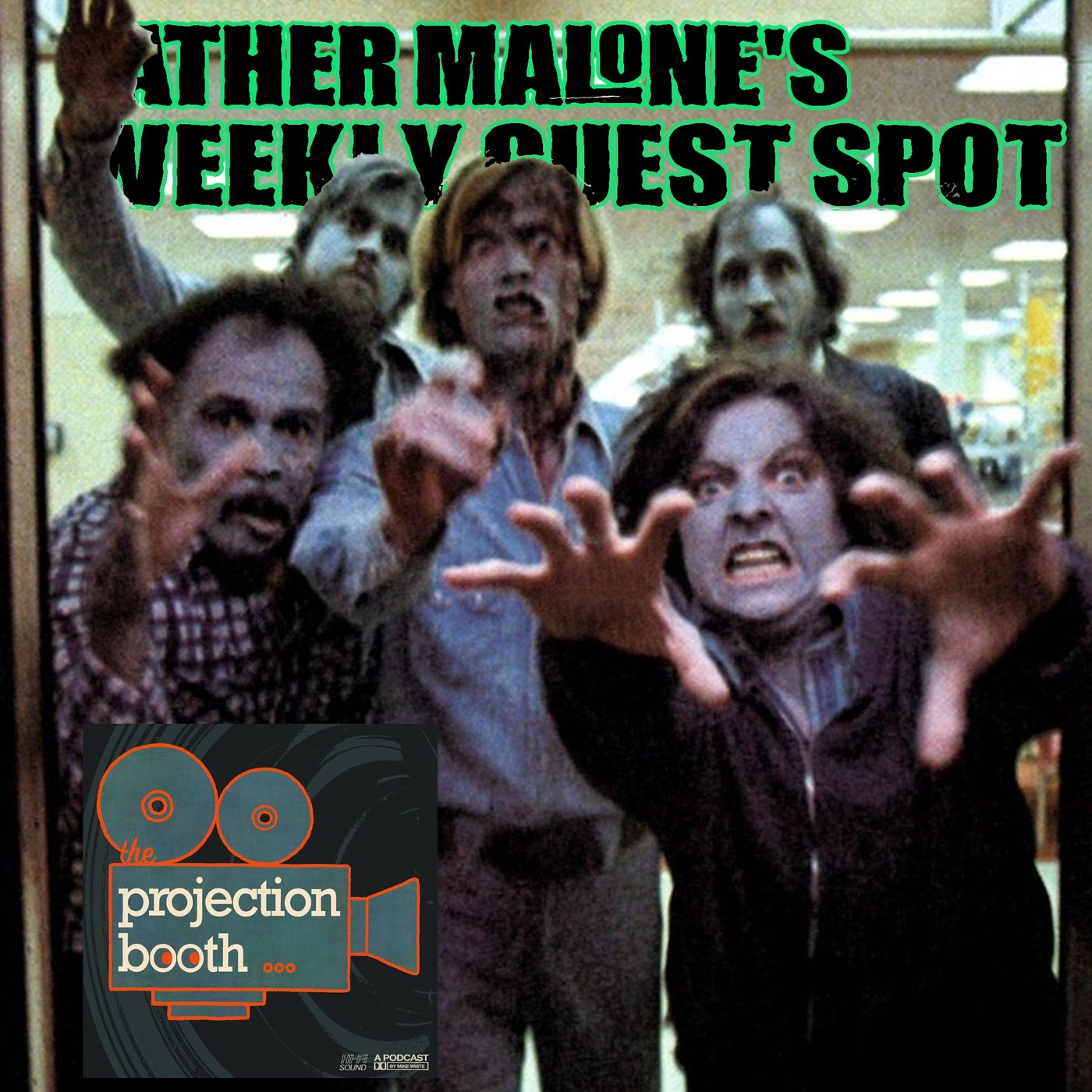
Father Malone's Weekly Guest Spot - Dawn of the Dead (1978) - The Projection Booth
About this episode
Special Guests: Gaylen Ross, John Amplas, Jon Towlson
Guest Co-Hosts: Jamie Russell, Father Malone
We’re continuing #Shocktober2022 with an episode on George Romero’s Dawn of the Dead Released in 1978, the film is a stalwart of the zombie film pantheon. Ostensibly picking up after the events of Night of the Living Dead, the film stars Gaylen Ross as Francine, one of a handful of people trying to survive the zombie apocalypse. She and the others find refuge in a mall where they rebuild a facsimile of contemporary American society.
Father Malone (Dark Destinations) and Jamie Russell (Book of the Dead: The Complete History of Zombie Cinema) join Mike to discuss the film. Interviews feature Gaylen Ross, John Amplas, and Jon Towlson (author of the Devils Advocates book on Dawn of the Dead).
Transcript
Automatically generated, so expect the odd misheard name.
Oh ye is books. It's showtime. People say good money to see this movie. When they go out to a theater, they are cold sodas, hot popcorn in no monsters in the protection booth. Everyone pretend podcasting isn't boring.
Put it off. D In nineteen sixty eight, George Romero brought us Knight of the Living did it became the classic horror film of its time. Now George Romero brings us the most intensely shocking motion picture experience for all times. It gets up and kills the people it kills, get up and kill. This situation must be controlled before it's too late.
They are multiplying too rapidly. Dawn of the Dead hit me on the roof at nine o'clock. In the chop. We've got to survive. Somebody's got to survive.
They kill for one reason. They kill for food, they eat. They're victims. Imagine if you will, that something has gone terribly wrong shooting man now, except the fact that there's no escaping the horrible consequences. George Romero brings back the dead.
Night of the Living Dead has ended. Dawn of the Dead is here. We must not be lulled by the concept that these are our family men or our friends. They are not. They will not respond to such emotions.
Operated dead postal band. Then they never get at m it's everywhere. What the hell is it looks like a shopping center, one of those big indoor malls. What are they doing? Why do they come here?
Some kind of instinct memory? What they used to do? This was an important place in their lives. What is it? We've got a walk.
I'm afraid we. Have spawned our own savagery. Soon it will consume us all. It is a. Horrible, puntingly accurate vision of the mindless excesses of our society.
Gone Madame must be destroyed on site. When there is no more room in hell, the dead will walk the earth. We are down to the line, folks. We are down to the. Line dawn of the dead.
And welcome to the Projection Booth. I'm your host. Mike White joined me once again? Is father Malone? Wake up, sucker with thieves and we're bad guys, That's exactly what we are.
Also in the booth is mister Jamie Russell. Hi, love you to be here. Guys. We are continuing October twenty twenty two with an episode on George Romero's Dawn of the Dead. Released in nineteen seventy eight, the film is a stalwart of the zombie pantheon, Ostensibly picking up after the events of Night to the Living Dead.
The film stars Galen Ross's Francine, one of a handful of people trying to survive the zombie apocalypse. She and the others find refuge in a mall where they rebuild effects similar of contemporary American society. We will be spoiling the film as we go along, as well as the two thousand and four remake, So if you haven't seen even one of those films, just go ahead, turn out the podcast, go watch the movies. Come back after you have, We'll still be here. So, Jamie, when was the first time you saw Donna the Dead And what did you think?
I actually have a really weird relationship with this movie in terms of how I first discovered it, because I actually discovered it as a video game. And not very many people know this, but in nineteen eighty six, I would have been about twelve years old, little French. Company called Ubisoft, no one had ever heard of. They're now a giant, but no one ever heard of They now make assessine click whatever made a game called Zombie Zombie without any on the end, and it was a point and click adventure game. And it started in a helicopter and you went down into the mall and you fought with these zombies.
Now, I had never seen a zombie movie, and I'd certainly never seen Dawn of the Dead, and it blew my mind. I thought it was amazing. And it was only years later that I then discovered the movie. I was like, Oh, that's what the video game was all about, and so that was actually my lead in to it. So when I was watching the movie, I was like, this is really I only made something.
What have I seen this film before? No? I sure haven't. What is it an suff video? Okay?
And I actually don't think anyone ever licensed the video game. I could be wrong, but my senses it was just heavily kind of inspired by but it had the helicopter. The more you played as four different characters, one of them was a woman. Wow, the whole thing. So, yeah, a little bit trivia about all of the dead to start off and fathom alone.
How about yourself, I'll try and be brief, but you know, like most of the movies you've had me on to talk about. I experienced way too young because I hung out with a group of way too old, irresponsible cousins, my cousin Susan. By the time I was nine, which is nineteen eighty two, I was already a devout Stephen King fan thanks to her. And one day my mother took me to a department store and I found the trade paperback for Creep Show, Bernie Wrightson's adaptation of Creep Show, and I read it cover to cover and I demanded that my mother buy it for me to bring home because I had to bring it to Susan because it said on the cover now a very scary movie. And I was panicked because I thought we had missed it, and she assured me, no, no, no, it's coming out and I'll take you to see it.
And then she pointed to the cover, which is a beautiful painting by Jack Cayman, one of the original ec artists of Billy the wrap around character from the story, sitting in his ben on the wall behind HIMR three posters. There's Carrie the Shining, which I think at one time was originally Salem's Loot, and Donn of the Dead, and she pointed to Donna the Dead and she said, but the guy who made Creep Show made this movie, and that's the scariest movie of all time, and you're too young to see it. And then if that wasn't tantalizing enough, she turned to her husband and said, and don't you ever take him to see it. He will have nightmares for the rest of his life. So now I one hundred percent needed to see Donn of the Dead.
And I spent the entire summer scanning the movie listings in three different papers we had in Boston, and I finally found a screening at the Orsonwell Cinema at midnight, and my irresponsible cousin, Bruce, her husband, took me. Two things happened right away. George Romero became my absolute hero from seeing the movie, and my cousin Susan was one hundred percent correct. I was way too young. The movie wasn't scary, it wasn't frightening.
It was terrifying the little meaning of the word terror. And I am forty nine years old. I saw this movie when I was nine years old. I have for forty years had a recurrent nightmare and it's from this movie. It's one of the shots in this movie.
Having said all that, like as scard as I am, and as too young as I was to see it, Like I said, Romero automatically became my hero, and this movie became an easy answer to an unfair question, which is what's your favorite movie. It's Dawn of the Dead without hesitation. So what is the shot that gets you? It's the goddamn point of view from Stephen when the elevator opens and the zombies come in to get him. It's like in the preview, it's Oh.
It would pop up randomly in my dreams. I'm having a good dream and I open a door and in they rush. My late wife, when she was mad at me, would text the image to. Me that shot in the elevator with the zombies coming in. I mean that classic about why the zombies are so is going because it's claustrophobia, you know.
I mean, that whole sense of just being trapped and there's nowhere to go is what really kind of makes zombie movies work. I think that's where for me, that was always where the terror came from. And like by the Malone, I used to have dreams about zombies all the time, and it was always just that there's nowhere to go, there everywhere. You can't get away from. This, you know.
Just zombies themselves are so odd because it's so much to do about the mass of them and just the numbers, and that they won't stop. They just keep coming no matter what. There's always more going back to their origins. There's more people, and they're just people. I mean, people are hell right the old line, and now we have just more and more of these bodies and bodies and bodies coming after you.
I was six years old when this movie came out, and it was one of those where even though I wasn't into horror films, you know, much more into like sci fi. Star Wars was kind of my thing at the time, but man, just the images from this film still came in. You know, you're talking about the preview and the doors opening, Yeah, that or the guy with the machete through his head, that kind of iconic image. Just so many shots that I still remember, even though I don't even think I saw this movie until I was maybe in my twenties. I think I rented this and Day of the Dead pretty close together, probably in my early twenties.
So this movie definitely has a different resonance for me than I think it does for either of you guys, Because for me, it's just like I had already experienced zombie films at that point, and so it wasn't something that was new for me. It wasn't something that was terrifying for me. It was more just the sociology of the film is what I found interesting, especially just the way that we have these small group of characters working together, working against each other, working against their own interests a lot of times. And I just love the way that the movie it really takes its time. You know.
I'm used to movies now where just like boom boom boom, we have to move, we have to get going, we have to just really just get through this film, and this one it's very slow. It's just all right, we're going to do this. It's very methodical. Not to say that it wastes time, but it really does take the time to say, this is what the world could be like if there was a zombie apocalypse. Yeah, no, completely.
And you know, I mean you look at how today we have like the Walking Dead or whatever, and you're like long form storytelling is the big thing. But this was kind of that before you know, it was possible to do this on TV, and it was really horror movies around that time. And even today you're kind of like, you're ninety minutes, you're in bang out Again, Get Scared, get out, back in the lobby and one of the dead. I think really surprise people in just the fact that it had these really long stretches, as you say, of just like the characters, no zombie fighting at all, you know, just the characters interacting with each other and experiencing boredom. I mean, you know, this is like a horror movie, but it actually lets its characters be bored right in the middle.
And you're like, that's you know, there's really good reasons from a kind of social commentary point of view why Romero does that. But just as from a filmmaking point of view, it's really kind of you know, European art film kind of style rather than like zombie schlocky b movie mayhem. And Romero had his problems with distributors because the movie was so long. You know, people were just quite scared about putting out this this zombie movie that felt so epic, you know, for another word, it. Is a long film, you know, it does take its time, and that Romero really stuck by his guns and was not willing to cut this, even though there are many many cuts of this film.
So in that regard, we should talk a little bit about how this was a co production, how Argento and Dario Argento and is it Claudio Argento were the producers of this. Romero had made Ano the Dead and a few other films and some great films by this point, including The Crazies, and that he starts to have this relationship with Dariya Argenteo and says, okay, yeah, yeah, he was over from what I understand in Italy writing the script, or Argenta was in the United States while he was writing the script. I can't remember which the story is. And then they're working together on this, these two horror masters, and Romero has never been one to shy away from work with other horror masters. I mean, you know what Blake Father Malone was saying, he's working with Stephen King, and he and King had quite a relationship over the years.
Yeah, definitely. I mean, I think it's fascinating the idea of kind of Argento having something to do with this amazing zombie movie, which isn't in his style of stuff at all. It's really fascinating, and I think. How it kind of came together was just I mean, when you read about it in the kind of the history books of how the film was made, and we listen to interviews and everything, it really sounds like these were two filmmakers who completely respected one another, which is really quite something, and that Argento's role was very much hands off. He was just like, Okay, we're going to find the money for you, George, and I think they maybe put up like half the one point five million budget or something.
I need to chat what that sounds about. Right, It was a huge chunk anyway, and we are going to basically just make sure you have this money and you can go off and write the script that you want to write, and we're not going to interfere when it comes to the filmmaking or whatever. And Romero originally had this really dark version of the script that was set in the mall, which was the Monroeville Mall in Pennsylvania, which is it's really important to note it was like the very first mall in I think in Pittsburgh, and this was that kind of time when maules were kind of rolling out across America, So it was a big deal to be shooting there. It wasn't just now it just seems like, oh, you shot it in a mall whatever.
We've seen strange things, but back then it was. Like it was really unique. He found this location. He'd written the script which had a man and a woman kind of hiding up on the upper levels of the mall and kind of coming down and doing this hunter gathering kind of thing among all the zombies, and it was kind of posts much further into the future than Knight of the Living Dead. And then he kind of brought it back and was like, no, this is too dark.
It needs to be something else, And so he produced this script that is kind of the script that we now know on screen, and I think his producer, which Rumstein, sent about the first thirty pages or something to our Genta and was like, you know what, do you think they knew he was up for funding this movie? Oh yeah, I love this. Where's the rest of the script? No, you don't get to read the rest of the script until you kind of signed them. And the story goes that Romero invited Argento over to Pittsburgh and he rented he had a car.
He rented a car, a bit of Lincoln Continental or something, you know, to like kind of oh like a bit of Hollywood kind of glam or whatever. And tried to back this car onto the driveway as he was going to get Argenta from the airport and managed to dent it. So like rental car with this big dent in the side. As he's kind of, you know, be the big kind of Hollywood filmmaker kind of style thing, because you know, I mean, the guys in Pittsburgh is not Hollywood at all. He puts on this razzaldel.
But I don't think it was necessary because Argenta had clearly seen his movies. He'd read this the thirty page of the script. He loved it, he wanted to see the rest. He'd seen Romero's earlier movies, absolutely loved them too, and really just wanted to collaborate with this guy, and was clearly aware that there was a market in Europe at this time, a market largely that actually Romero inadvertently started through Night of the Living Dead, that there were filmmakers who were making movies for continental releases and there was a huge audience in Europe now for that kind of horror, the kind of horror that Night of the Living Dead had kicked off. You know, lots of zombie movies.
You think of George grouse movie, The Limit Dead of the Manchester Morgue was one of the titles. I think it's got about twenty five different titles this, So that kind of like nineteen seventies kind of horror. There were lots of these kind of movies that were coming out that were kind of for European audiences who really liked the gore and they could get away with gore and in the continent that they maybe couldn't get away with in the UK and the US. So basically Argenta was just like, go with God. You know, I trust you, You're going to make a great movie.
And I think he came down and saw him shooting, watched a couple of setups on in the mall one evening and was just like, yeah, my money's been well spent, no problem, And really wasn't that involved in the creative side of it at all, but was heavily involved then in the distribution side of it. So what happened post production in terms of Argenta did his own of the movie, which was very different from Romero's cut, and took it out to European territories to kind of sell it over there. And by all intents and purposes, everybody made a lot of money out of this movie by their standards anyway. I mean, certainly for Romero, you've got to realize not living made a load of money. But I'm not sure.
Rameiro saw an awful lot of it for various reasons. And the Crazies, which you mentioned just before, and was like, what a brilliant movie that was, which I completely agree with you, but I mean it totally bombed. I mean it really really did. So I think he really needed a hit, and that was what Dawn became for him. Yeah, he didn't really want to go back to the well of the zombies that quickly, and I think, you know, I talked a little bit about this and one of the interviews later on that he had to wait between the two films.
He had to do these other movies in order to get his skills up, get his confidence, and then yeah, I have a few unsuccessful films in order to say, Okay, I need to go back to this and create a follow up on that world, you know, going from night to Dawn. And I really appreciate that the movie starts with Francine they're dreaming that red carpet, and then the way we've moved down to her and that she's dreaming, and it very much feels like we are picking up right after the events of Night a Living Dead. You know, a few years have passed, ten years have passed, really, but in the logic of the movie, it feels like the zombie plague has just started and they're trying to deal trying to figure out what's going on this whole television studio where you just feel like they haven't slept in days and they are just running on coffee and cigarettes and trying their best to just figure out what the fuck is going on.
And that endless stream of talking heads that they have on the television is wonderful. I just the guy, the one at the very beginning who is talking about how you know, the dead will rise and then they'll they'll bite someone and then they will die and they will rise. And I love of course that, you know, we get that get up and kill that line that we have, like in all the rob zombie you know, white zombie type songs and stuff. There are so many soundbites from this movie. It's wonderful.
I think all the stuff that the on the TV station, all of that stuff is just brilliantly well written. And that kind of clash between the scientists who are trying to be completely rational about the fact that the world has changed and everybody else who is just completely losing it and can't handle it and being really emotional. I think that thread runs through the whole movie in ways that we can maybe talk about later, But that idea of losing your head kind of goes with the you know, shooting in the head, and that there's a whole discourse on kind of like what it is to be rational in a kind of crisis situation that I think is something that Romero does really well in Dawn of the Dead. I didn't realize that one of those TV commentators, the actor Howard Smith, was also a director.
Directed the documentary called Gizmo from the late seventies, which I used to see on cable all the time, and even more importantly, directed Marjo, the documentary about Arjor Gordoner, which is one of the most your Eyes just pop out of your head. He co directed that one with another person, and it's just like, Wow, Marjor Gordoner is really fucking fascinating alone but fascinating. I didn't know that is an amazing piece of trivia I had. I have to go to IMDb this and whatever see who he was. The other thing that Argento brought to the party was Goblin or the Goblins, as the end credits say in.
The opening credits, oh gosh, as well. I like them better as the Goblins, by the way. I mean, Goblin is great and makes more sense as of man, but the Goblins, You're like, who's coming down the hall. It's like the nineteen sixties pop version of Goblin is the Goblins. That's right, They're opening for question Mark and the Mysterious.
But it's not all Goblin, right, because there are there's a lot of pieces of music that aren't Goblin. It feels like with the Romero version of this film that it's a pretty good mi of library music, and I would say there's more library music than there is Goblin music easily. Yeah. That is definitely the biggest change between the European version and the American version. Romero had a deep love of library music, and it's in all of his features.
The entire all of the sound cues you hear in this film are probably from the Capitol High Q Library that was the sort of the most famous one. And you know, Romero started out as an editor cutting news footage. You know, every night, the evening news would send out crews to get footage of whatever the local news is, and all of that film needed to be processed and synchronized and cut together. And that's sort of how he made his start. So he was very familiar with the library music, and I think more than any filmmaker in history, he uses library music at its most effective.
Like I've heard, I've heard of all of these cues and tons of other media and it's always just sort of slap dash and whatever. Like Romero is very precise about these music music cues that he used. I watched all of the different versions of the film and then watch the theatrical cut last night in preparation, and his library music underscores and makes things ironic in places and heightens things that the Goblin Squirre doesn't really do when you insert their stuff into it, even down to the song I'm a Man song When the Rednecks are all having their party out there, they kind of change it to a gender, change it to kind of a generic kind of country western sounding thing. But you don't get how hilarious the joke is without that.
Song, no completely, And you know what you were just talking about them alone about Romero is an editor and that whole sequence with the Rednecks and that I'm a Man song playing. I mean, you watch that and you're like, oh my god, he is such a great editor. The cuts in that are brilliant, from the you know, the sirens of the cops or the cops lining up to kind of you know, chat whatever, rednecks pouring coffee and then shooting zombie. It's just a brilliant little montage kind of sequence with the music cue being perfect for the action. Yeah, anytime I want say to someone, you know, Rome editor, He's like, yeah, look at that.
You can see this as a man who knows how to edit for a living. Those are the guys that killed our main character from Night a Living Dead. You know, this is the next day for them, just like, oh yeah, we we've been killing zombies all night and we're about to have some coffee, do some hard to practice. Yeah, it's like, oh my god. Yeah, they're having a grand ole time editing in that sequence, Like, it starts off and it's kind of fun, and then it gets a little darker with people being bandaged and stuff, but then immediately it all becomes fun and they're shooting everything and having the great time.
So the editing in this in that sequence of particular is absolutely sublime. And you know, to your point, Mike, like, these might be the same characters who killed Dwayne Jones at the end of the Night of the Living Dead when Tom Savini remade Knight of a Living Dead in nineteen ninety. Night of Living Dead sort of ends and then continues, and it shows the next day, and it starts with a helicopter sort of slowly hovering past, and I was like, oh, okay, well that's Fran and Roger and they're off to the mall. I don't know who's worth the Rednecks or the Biker gang. You know, both of them are these groups of people, and just once you start to get that mob mentality, people turn awful.
And I think that's one reason why having this central group of these four characters is so key because you get to see just that interaction between the four characters as opposed to in the way that he shoots it against. Here's the mob, and here's what the mob is doing. And then even the group of the police at the beginning, the I guess police are more like state troopers. They feel like that are going and trying to take care of the business. And then just that one asshole who you know, it's that old thing, right, it's the one bad apple, you know, just like the guy that you know killed George Floyd or two guys.
Oh, the whole department. Oh wait, no, the entire system is out of order. But no, it was one bad apple. So let's blame it all on Wooly, right Willie when age. Shit, we've were talking about that thing about you know, the kind of reason as being, you know, rationality is being kind of this theme that runs throughout and it's like, you know, oh, Wall, he's lost his head.
You know, it's like these people, everyone in all of the dad who loses their head is a person who is going to bring about the collapse that we're teetering on the edge of. You know, Ramero is really clear about this in a time of crisis. You need to be mckismo, whether you be a biker gang or Rednecks is not going to get us where we need to be, and losing your head is not going to get us where to because you're going to be like a zombie. You're going to be brainless in the same way, you know. And that theme runs throughout the whole story in a really interesting way, even to you know, Peter saying to Roger when they're doing the trucks, you know, you better screw your head on, right.
It's just it's kind of this like little repeated refrain that runs through the whole movie that I really, I really love. And yeah, as you say, the core group is set up against the different other groups, so the bikers and the Rednecks, but also within the group, then you have that kind of conflict between the ones who are kind of calm and rational and the ones who are kind of losing it bit by bit. And of course Fran is the most rare character of all of them. Yeah, she right from the opening scene, she says the line that not only the theme in this movie, it's the theme in all of Verramaro's Dead movies were blown at ourselves. We just can't get it together.
And every time these guys sort of go off to do something fun, friand ends up looking like a drag because she's like preaching, you know, rationality, but like she's always right from the beginning to the end. If everyone would just follow her to lead, and that's just not in this group, it's worldwide, because that's to me the over Like I said, the overarching theme in Allivermaro's work is if we could just get it together and talk to each other and figure this out. It's not a hard problem to overcome. If we can just be logical, if we can just keep our head logic. We must have logic.
The rhythm of the editing, going back to Romero as editor, it's really fascinating. I did a little bit of an experiment on Friday where I had the longest cut of the movie, with some people call the extended Mally hours cut, which I think is two and a half hours, because you know, to the earlier point, there are multiple cuts of this. There's our Gento's cut, there was a cut wind they went to con with this, there was the theatrical release. Gosh, what else is there? There's that extended cut.
So there's just all of these versions out there, but I took the longest cut that I could find on one screen, and then I had the commentary track with the movie, and I think that's the two hour and seven minute, it doesn't matter. But on the other and so they got out of sync very quickly. But to see the length of the shots were almost exactly the same between one version and the other, and that they would hit the same beats over and over again, just that both of them would cut to the next shot on that same beat. It was really fascinating to see that. And just the extended all hours cut adds just a little bit of things, and it's so to me, it was just not that noticeable that he was doing such a great job of editing this that it wasn't just like, oh, well, gosh, we're missing this whole sequence.
This is crazy. How could this movie even exist without this one particular sequence. It's not sequences, it shots, and just that he's adding little bits of things to it. So when it comes to the con cut versus the theatrical cut, it doesn't feel like you're missing stuff. It feels like the movies just move along at a very similar pace.
I had a conversation. I watched the theatrical cut with someone who had never seen it before last night, which is fantastic, and she was asking me, like what the differences were between the different cuts, and I was explaining to her, you know, that extended cut basically has twelve more minutes. She's like, oh, it must be a lot of scenes. I was like, no, like you said, Mike, it's just little bits here and there. And she said, well, why didn't they just leave it in?
It was such a quick movie, And I'm like, this movie is two hours and nine minutes. And it sort of blew her mind, Like it flies along every time I watched the movie, when the bikers show up, when we get that sort of process binocular shot from the from the roof of the helicopter, I always think like, oh, we're at the end already, Like, come on, it is. It is masterfully edit. He does not get enough credit as it. He's as good as anybody, like, as good as Paul Hirsho we worked with on Creep Show.
Like and then we talked a little bit about the Argento cut and just said it, what does it? It tries to remove a lot of the humor is what I get the most out of that one. And then also more of the goblins. Right, there's no hey, you guys got a cigarette and then they all light up cigarettes afterwards. Like that's gone from the Argenta cut.
Like even even something like just a conversation between like Fran and Peter on the on the plane's establishing character, that's gone. But yeah, I guess Argento's idea was that this needs to be a hard lean horror movie. That's what European audiences want, which I think is funny because evidently he ran into some censorship issues with the hard lean version, and then when Romero sent over his cut, they passed because they got context and the humor was back in and they realize, oh wait, this is kind of a satire. That's the thing that he was so great at, which I really appreciate about Romero is that he was such a smart filmmaker. I also love his cameo, by the way, as a little director inside of the commercial studio, and I'm just like, yeah, this seems very natural.
I'm sure that you've sat in a chair like this before it was on camera to a. Blind man girl blind. A cigarette you know, he's chained smoking away and his scuff is lucky scuff, that you are the lucky stuff. And of course Christine Forrest, who is she's not his white at the moment, but soon would be and was his collaborator for many many years and was assistant director on this movie, is right there beside him. Sure, I'm just gonna pull it out of my ass, right, And I love that they're trying.
To keep up this level of normality. And that's the whole thing, right, This whole movie is how are we going to maintain normalcy in this insane world? And when they get to the mall, and to your point from earlier, I loved the whole what is that like? We've never seen a mall before, this is brand new, and now this gets a lie, you know, gets a laugh out of people, and then in twenty years people again will be like, what is that thing? I don't know what that is.
We're going back there, yeah, tearing them all down. The Monroeville all ain't what it used to be. I can tell you that now. I stopped by there one time and I was just like, oh, hey, let's check this out. I went in.
I was looking around. I'm like, Okay, if there's anything about on the dead end here, I don't see it, but I think there is. Right, You've been in that mall before too, fa them alone. Yeah, several times in twenty thirteen. There were still some vestiges and things like the little wooden bridge where the PI FI takes place on that was still there, So I going to jump around on that, which is fantastic.
The skylights are going to always be there. That's a feature that they cannot remove. There's on the lower level. There's like one whole hallway that is definitely one where they parked one of the trucks where the bikers moved the truck out of the way. That's still intact.
And then a lot of features in the parking lot. Honestly, but I was walking through and reached over and opened a door and it was It's the sort of service hallway when near the end of the movie when Peter is in the I mean Peter's in the hallway, but Steven is in the elevator and he's firing the gun and they cut to Peter like hearing it. That hallway was there and was picture perfect. I nearly lost my mind. It is so strange when you go to places where movies were shot, especially movies that you're so familiar with, and you're just like am I in the movie Now.
I remember mounting the steps of the Saint Louis Public Library because I know Brain from Escape from New York was in there, and pounding on the door. Maggie. I'm amazed that there isn't any kind of permanent memorial or plaque or something in the mall to say this is where you know Dawn of the Dead was shot. Maybe there is, but I maybe you can tell me. I don't know.
I had heard that there was a sort of a store slash gallery within the mall with props, and when I got there, they had moved to Evan City, where a Night of the Living Dead was filmed, and they opened the Living Dead Museum. So on my next trip I went to Evan City, which is great because it got to go into the cemetery and you know, fool around there, but they were closed, so I wasn't able to go then. And then last time I went, but they had moved back to the mall but weren't open yet, and I was there for a very brief time. But it is my understanding that within that particular museum rests the very elevator. When they've destroyed pennies, these guys got to the elevator and it's there and you can go inside.
I know, if I step inside it, I'm going to die, but I'm going to. Go and do it. And we should talk a little bit more. We mentioned fran before, and I still wonder if either Stephen King named Franny from the Stand after her, or if Romero named Francine after Franny, but it might just be a coincidence. But we've got her.
Also, we've got their three main male characters, Steven, Peter, and Roger. And I mean, of course, for me, ken Free as Peter is like the guy I just I've always loved ken Free, He's so wonderful. But the other two guys are no slashes either. All three of these guys carry in different aspects of masculinity and bring something interesting to the party. Because I love all three of these guys, and all three of them have such distinct looks too, which is nice.
They're not just the generic white guys that they really have something going on. One of the really interesting things that Ramaro does in this movie watching it again, is he really gives you character through action. And a really great example of that is when they land the helicopter the gas station and they're trying to refill it and there's like about four different zombie attacks happen, kind of all back to back, one after the other, but the way each character deals with it is really fascinating. So you have Steven, who's kind of the least kind of well equipped in terms of like military skills or gun skills or whatever, is trying to shoot a zombie and keeps missing it. And then Roger comes along with his you know, M sixteen and just you know, knocks him out the way and just blasts zombie straight in the head one shot whatever.
And you understand from these little moments of kind of. Action like that, you're like, Okay, yeah, I see where these I see who these characters are. Without you even needing to tell me, you're kind of revealing their character through action in a really a really brilliant way. The same when you first meet Ken Foy's character, you know, in the Projects, and he's dealing with Woolley who's lost his mind. He's being completely racist and killing everyone.
And just the way the gravitas of the man and the way he stands and the way he then moves up to he shoots Wooly and it's just like, you know, daring anybody to kind of have a problem with him. You're just like, oh, yeah, this guy's a bad us. I completely understand it. So yeah, Rameo is brilliant in doing that in terms of revealing character through the action sequences. The movie starts with fran and we started sort of media who are supposed to be telling us what's going on, and that's all chaos and we're watching it through her eyes, and so now we know that the world is really bad.
But when we get to Roger, who's with the police, so now we should be totally secure, there should be no problems at all. After Woolley is killed, before they go to the basement, there's a shot of Scott Reineger just sort of wiping the tears from his eyes, which might be from tear gas but probably aren't, because this is the worst nightmare anyone has ever imagined, and the utter despair on that guy's face just one shot, like you know, not only clues the audience in like how bad our situation is but shows the depth of the feeling of these characters, and that carries over like once we get once these four four get together, like you know, they're kind of family, and I really like each of them, even though they have some failings, you know, like Steven is not the most adept at dealing with the zombie apocalypse.
He's he really just wants to go back to the old ways immediately. At the same time, like Roger's kind of this honted character. When I was a kid, I loved Roger because he's kind of like the Luke Skywalker, you know, just like or Hans Soloy've and sort of running around like a rogue and having a great time. And you know, and then as I get older, of course Peter became because he's wise and awesome him and he's a bad ass. But I swear the later I get in life, the more I identify with Stephen and all of his terrible choices, and and I just feel for him, like he can't get a break, Like he's the they really they really are like the last people on Earth.
He asks Frian to marry him, and she's like, no, even if you were the last man on Earth. It's really true here in this situation, and I know that's sort of her repudiation of the old society that needs to be gone now. But like, what what a blow to that guy. It's like, oh yeah, left, really now it's just them all right. He turns out to be a brilliant zombie.
He's like the missing link. He's like the one who's instinct kicks in and he's like, yeah, okay, I'll lead you all to where you need to go, you know, and that that kind of that way of Gramara has his evolution through his movies where he's like, okay, yeah, slowly, the zombies are getting smart and smarter, you know. Stephen's like one on the link before bub. Dead, absolutely straight line to Big Daddy Stephen. With the way that he pulls his leg when he's a zombie, the he's holding the gun and everything.
I just I love the physicality of him when he's a zombie. And I love the physicality of Roger when he's a zombie. That look on his face, he just looks so surprised because as he's dying, he's just like, I'm not coming back. I'm gonna try my best, I'm not coming back, I'm not coming back. And then when he's back, it's like, oh shit, And just the way that he's moving his eyes around is brilliant.
I love that. Yeah, the most energetic character in the movie has the most still zombie performance, and it is the most chilling. I love when they're carrying him around in the wheelbarrow and he's shooting. He looks so pathetic when they're pulling him around and just like, Okay, here we go, we're cleaning up the mall. Oh man, my girlfriend.
During that sequence when they're in a mall, can't they get him a wheelchair? Like, no, that's way more fun. Push me, I'll shoot all the zombies for it. Yeah, just out there again, trying to get that normalacy back, you know, Steven proposing marriage. Just the way that they're like, oh, we're here in this mall.
It's this wonderful MicroC of America. I love when they go into the gun store and there's that jungle music playing, like suddenly they're on Safari. I'm like, what the fuck is happening here? This is great. It's a theme from the movie Hakari.
I believe it's a jungle picture back in the day again. At the editing. What a great sequence. It builds and builds and build and has one of my favorite lines of any movie ever, which is the only person who could miss with a gun like this is the sucker with the bread to buy it. And eventually they start to become so materialistic.
I love when they're like taking all the money and everything, and I'm just for what, you know, why are you guys doing this? Why are you dressing up in these nice suits and all this kind of stuff. There's that beautiful but failure of a dinner where they're having dinner over candlelight and all this, and then compare that to just a few shots later where they're having dinner and it's basically on like TV tables and they're inside of a tiny little room. So they are just like experimenting with this very you know, high falutin world. But then it's like, no, we're much more comfortable eating our meals on a TV tray in front of this television set where you've got the one eyed commentator who's just, yeah, why don't we bomb all the cities with our nuclear weapons?
Why not? You know that guy in particular, when I saw him as a young person, I already knew who Francis Ford Coppola was, soor the vaguely, and I thought, like, Francis Ford Coppola has lost his mind. Richard Franz, I think is that guy's name. He's in the crazies and he's spectacular, Like this is exactly what we would expect from a scientist at the end of the world, right, like you're all a bunch of dummies. You didn't listen to anything we said, and now we're just gonna be either bombed the cities.
We're gonna have to start feeding the dead. That's what That's what we've come to. Yeah, and he's telling a lot of uncomfortable truths. Nobody wants to hear what he has to say. No, everyone's still treating it like a talk show.
It's just so insane, you know what this is? This is the power of this movie that still lingers, right because it really interesting. I haven't seen it for years, and we watched it for this and of course this is now like post COVID nineteen, so I was just like, Okay, this is actually it's really fascinating that then, Mike, you were talking about this like they want everything to be back to normal. As quickly as possible. But they try and turn them all into you know, the normal world and lock all the zombies on the outside and pretend they don't exist simply.
And it's just like, well, this is clearly the human response to crises. Whatever the crisis is, we all have this rush to normality, which is what we saw during the pandemic, which is, you know, everyone was just like, can it just be over now, you know, you know, stop wearing masks, don't have vaccines, whatever. We're just going to pretend that everything is normal, and we're going to try and ignore the elephant in the room, whether it be you know, airborne virus or zombies or whatever. And this is clearly, you know, this is clearly something speaks very to a deep seated part of human nature, I think, which is why I think the movie still has incredible power even today. And you know, let's face it, this is the twenty first century.
I don't know if you guys would agree with me, but my experience of the twenty first century has been one crisis up to another, from financial crisis to crisis with democracy, to crisis with virus, is the climate crisis whatever we're in this like this moment in history where it's a series of rolling intersecting crises and systems are collapsing, and you're like, well, what's a good index for that in terms of like art, And it's like, zombie movies are perfect, aren't they. I Mean they basically tell you Sombi movies are kind of like a rehearsal for how not to act at the end of the world, you know. So, so I think Dawn still has that amazing power from that of God. I talked a little bit about the two groups, the Rednecks and the bikers, and you really get to see our survivors, or at least the men survivors acting like those two groups.
You've got the target practice that they're doing with the mannequins. And then I found it interesting that there's kind of a tie between Francine and the mannequins because there's the one part where she's putting out all the makeup and there's the mannequin head there and her hair looks almost exactly the same as the mannequin head. Then you've got the guys who are shooting at these mannequins like the Rednecks were shooting at the zombies. And then you've also got, like I said before, the way that all men are taking the money from the mall, and then when the bikers come in, what do they do. They're taking that one zombie who's got all of the jewelry on and taking all of her jewelry, and it's like, what are you doing?
Why are you going after material goods? Right now? These are meaningless. This is a whole different way. It's like what you're saying, like all of these people are just so busy polishing the brass and the Titanic that they didn't see the iceberg coming, and these guys are the exact same.
They're just like, oh, cool jewelry, let's take this, Oh money, let's take this. It's like money is useless. I love that shot in Day of the Dead where it's at the beginning and you have that like kind of dust devil of money where it's like the little funnel cloud and all the money just flying around, because it's like it's totally useless. Guys, this means nothing anymore. Same thing with your jewelry, same thing with your fancy stuff.
The only thing that seems to matter anymore is guns and I really appreciate that. At the end, when they get in that helicopter, Peter's giving away his gun. There are no guns anymore. They're off on a whole new thing. We're really trying to break with the old ways, and you know, who knows how much fuel they have left.
One of my favorite shots in the entire movie occurs right after the sort of initial foray into the mall, where Steven and Peter and Roger end up having a bit of an adventure while fran is being menaced by the Henry Krishna zombie. Once they've taken care of him, Steven is talking to fran and ignores the trauma and immediately goes into this speech about like, wait, do you see all the great stuff we've got? And the look on Franz's face is the look of everyone on the planet at that point, like the stuff like this is a human being just revived and tried to eat me. We've got problems here, folks. Well, and they are worshiping this stuff, and then the bikers come in and they're destroying the stuff, and I don't know who's better, because really there's no reason.
You know, you've got the one guy throwing the little TV at the other TV and then smashing the big TV with the sledgehammer, and it's like, yeah, guys, TV is just about to be a thing of the past. They come to a point where they're like, there hasn't been anything on TV for three days? Why are you still looking at it? And I come back, might come back, you know, Like. What a very moment in the movie, right, yeah, it's one of my favorite moments where he's still clinging to it, like, right, yes, there will be another television program.
Maybe it'll be a you know, a sitcom, right, Like everything's fine. Right, that wish, that wish to get back. It's just like you said, Jamie, just like we have to get back to normalcy. We will do whatever it takes, will ignore the problems. And the problems are very multitudinous.
We've got just that never ending supply of zombies that are always there. They want back in the mall, and just that whole thing of seeing the zombies walk around the mall is such a chilling image. And just that they have been programmed. We have been programmed as people. This is a place to go, This is what you do, This is the verge of you know when molk culture really becomes a thing like this is what are we just a few years before Fast Times at Richie Ron High, and just how quickly we go from what is that thing?
Oh, it's a shopping mall too. This is where kids go, This is where all the people go. This is where things happen. Think about all the movies that have been set in malls over the years. It's just remarkable.
Even smaller things like the mall scene and Commando things like that, or Time Cop. There's always these mall scenes that we have just because it was such a part of the fabric of our lives, and it's so much a part of the fabric of our lives that this is where the zombies go after they die, and it's just like, Nope, this is where we want to come in. It's not like it feels like with the remake, which we'll talk about a little bit. It feels like the remake is more like we know that there are living beings inside of there. We want to get that living flesh, whereas with the original, the seventy eight version, it feels much more like this is just where we want to go.
This is what brings us as zombies come. From Romero's sort of innovation with the zombie, because prior to him it was just sort of the Haitian voodoo connection, which I like that Peter's grandfather was in fact, so Romero sort of like papers that over, Like, yes, we know about those zombies. These are a different kind of zombie. These zombies basically just want to eat, but really they just want to wander around wherever they want to, and they want the freedom to do both. It is a deliriously, deliriously American take on a monster.
So working class in Pittsburgh and thank god who's from there, because that becomes everything with them, and it's also why they're gonna win because we're as disorganized as we are. Like the theme of if we could just be logical and deal with this unemotionally is the theme throughout these movies. But at a certain point, we're not going to be able to get it together. And the fact is the zombies are going to win. It's their world now.
It's just how you choose to live out the last of your days. Our society is over. That's kind of the other thing I love about Mara movies and the zombie progression you talked about it, Jamie, like, you know, we see that, we see them slowly getting smarter and smarter. And of course Romeiro when he started, he had that what was the the Anubis trilogy was the idea. So in the first one it's the problem.
In the second one they sort of harnessed the zombies. Humans are harnessing the zombies, and then the third on the zombies have taken over and it's just they're hunting down the last of humanity. It is so bleak, But at the same time, how can we not love these zombies? You don't want to run into them while you're breathing, But like, they don't really have They're not destructive. Much less destructive than those bikers, that's for sure.
Yeah, Like we're terrible. Give to them, the bikers who want to humiliate the zombies with that huge pie fight, I'm like, what the fuck. Ramos is quite misanthropists, I think, you know, he has quite a bleak view on humanity. And you know, the great line from Dawn of the Dead is when there's no more room in hell, the dead, the earth, and the thing you have to stop and ask yourself is like, well, why is there. No more room in hell.
It's like, because we're all so bad, you know, we've gone down stairs. As you know, there's no redemption for us as a species, you know, as if we are God's creation, then God is really seriously pissed with us. So you know, it's not good, you know. As a commentary on the state of human society, Romero's movies very bleak. But I think there's hope there.
I think there is a little nugget of hope at the end of it in terms of like, you know, maybe there are different ways of living and different ways of being, and maybe we can do something else. You can certainly step aside and give them their due and go live apart, which is the only solution really, like start a new society separate from the old one, because the old one belongs. To them now. And you know, the other innovation that Ramiro innovated was we never get a reason for this plague. I mean, there are the religious implications of it, and he kind of touches on it slightly just to give an audience some kind of explanation in Night of the Living Dead that it's this returning venus probes radiation might be doing but he discards with that entirely.
Here, this isn't a situation where zombies since then, where it's a virus or you get in you're going to become one of them. No, you die, you become a zombie. That's it. And we don't need the explanation because that's not what the movie is about. It's about dealing with the problem.
And he's the only filmaker really seems to sort of deal with our reaction to this problem. The rest just kind of take us on a fun ride. Yeah, because I want to say in the remake, it is if you die of natural causes, you're dead. But otherwise, if you're bitten, then you will die from that and you will come back as a zombie. It's just a matter of time.
Boo. And I hate, yeah, I hate that. I mean, I hate the lack of imagination that that entails because it's just like it just becomes mundane and boring. Whereas the idea that the very mechanics of life and death have kind of changed on us and that our whole understanding, our scientific question up of the world is completely wrong and we need to rethink it all over again. As part of the Malone says, you know, we're now living in a different world.
The old world that we think we're living in is no longer here anymore. I think that's far more scared. That's what you know. If you're talking about the raw visceral power of the mirror movies, I think that's what it is. And I think it really really made a mistake that scene where they're like, oh, wait, don't shoot he actually, you know, she died of natural causes.
Let's see if you know whatever, and you're like, oh, oh, it's not coming back. Okay, Yeah, that's actually you know, you pulled out one of the one of the really fundamental planks of what makes these movies scary. That remake felt like it was set in them all, just because the first one was like, there was no attention to it. There's no thematic through line with the mall. It's just like a place where people gather.
And when the movie was made, mall culture was already dead and they didn't even. Comment on that. Yeah, I think the idea of the dead crawling out of their graves, especially the living dead, that's super scary. Or you even go to return with the living dead in the way that they're coming out of their graves and then you know, they come out and they're, as they say, all messed up. So you get to see just how people died, how they had lived.
It's just the snapshot of them, which is just it's so horrific. And you know, like you were saying before, Father alone, the idea of them just never stopping, just always coming for you and just wanting their lives like you were talking about, they want to do this, and the whole idea of that Anubis trilogy that you're talking about, it sounds so I am legend, you know, just that idea of the humans time is over. Humans will become a thing of the past. They will become the legends. They will become the boogeymen that the zombies then talk about in their lives later on if the zombies, you know, learn to talk.
I mean, obviously we're getting there with those characters with Buff with Big Daddy. So they're forming their own new thing. They're doing their thing, and meanwhile humans are desperately clicking on all the stuff that they have. I love the one guy, my favorite. I don't know why it really resonates with me, The guy who I want to say, they are also robbing stuff and they meet them right around the time that they're getting on the helicopter and they're also I want to say, like officials, like police or something, and they just robbed a place and they're like, oh, we're going to go to an island.
The guy's like which island? Any island? I just love that guy, and I love his delivery, that like look of confusion on his face, just like any island. I love that in the remake that they end up trying to go to an island, but no, it's it's inhabited. Over on a zombies, right, because it's got to be faster and more intense and they're got to run at you, but they'll pause for dramatic effect at certain places, because hordes of flesh eating zombies that are very fast will do that convenient.
All right, We're going to take a break and play a trio of interviews. First up, we'll hear from Francine herself Galen Ross. After that we'll talk with John Amplus and finally we'll hear from John Towson, the author of The Devil's Advocate book on Dawn of the Dead, and we'll be back with all of that. Right after these brief messages, tell me a little bit how you got into acting. Was Gone to the Dead your first.
Role, actually Dead was really my first professional role that I think George found out about that much later that surprised him. It was really I was not just learning, but it was certainly an experience to be cast as the female lead and my real job, and to be on a feature film like that. I mean, nobody knew what was going to happen with Don. Certainly even even George didn't know. I mean, we were doing this crazy zombie film in a shopping mall with crazy special effects and zombies eating knows what flesh and basements and who knew what it was going to be.
But it was an audition I had because a friend of mine who was an actress, said, oh my god, they're looking for blondes, and I was really blonde at the time. So I went in and I auditioned. I didn't know who George was. I'd never watched Night at the Living Dead. I was not a horror fan.
They always scared me. My sister and I used to watch remember the old Sam Terry. There were the television shows that you know he would have these midnight shows on television and with the samitary we watch it for the first ten minutes and then run the bed. You know that would be would be yet anyway, So I did this audition and it was a monologue I remember from this this play and the playwright's name escapes me. But it was about being safe, and I changed a little bit this variation, and the idea was is that two people are on his sidewalk and said one says to the other, do you feel safe?
And the other one says, what do you mean safe? And then they go on and they say, well, safe if you turn around and wave and then you're killed in an accident, and then are you safe? You know what is safe? It was. I finished the audition and George looked at me and he said, oh, I'm so sorry.
And I said, what do you mean, because I'm so sorry that your friend was killed on this I said, no, no, no, George, I was acting. It was acting. It was it was not It was a great monologue. And George was a little impressed. Then I think I heared George.
I'm trying to think who was was John? And you know he was He's a playwright and he's a Facebook friend of mine after all these years, and I actually emailed him or messaged him and said, you know, you've changed my life, you and your your your your monologue. But he was never knew that that would have had the result of that. And I'll find his name because he was great. Anyway.
That's how I got the job. Did you grow up in the Pittsburgh area. I grew up in Indiana and then California and Monterey and then New York. And I was a poetry editor and managing editor of poetry magazine called Antea and Echo Press, which I think Echo Press still is in existence today. It's one of the premiere publishing companies of great writers.
And I met somebody. I think it was a weird thing. I was horseback writing, and I was writing with we were taking lessons, one with Kelly Bishop who ended up starring in chorus Line and somebody else, and I was enthralled with acting and so I started acting class and that's how that began. So what was your experience like on the film. In the beginning, I was totally terrified because I had not done this kind of thing before.
So I was I mean, I had taken a lot of acting classes and I had some small theater credits, but nothing like this. And then to be cast as the league, you know, there was the responsibility of being the only girl. In the beginning. It was frightening a bit. We were doing all the exteriors in the beginning.
So my first day of filming was on the rooftop. I was shooting the zombies from the rooftop and so Mike Cornick was filming and it was my first day filming, and I had the rifle that you know, the blanks were in the rifle, and I just heard action from Georgia and I started shooting and then I heard cut, and then I heard Mike Gonick scream and he goes tell her not to aim at the cameraman. You know, it was like, oh, well, I didn't, you know, I realized. I mean, it's interesting what blanks can do. Right a little while there, Most of my work in the beginning was there was very little outside.
Most it was the guys, So I had a lot of days just waiting for the next scene. But most everything, I think that the a few things with the helicopter and that little helicopter, that little airfield was outside, and up on the roof was outside. And then that was it because everything else involved me was in the mall. So we had that break over Christmas because they had the Christmas decorations up and they had to take them break. And then that's when I went back and took my acting to my acting class.
My acting teacher at the time was a woman named Rostova, who was this amazing Russian woman who was a little bird like a woman and came from the Moscow Art Academy or Dramatic Academy, whatever they called it, and she was Montgomery Cliffs coach. I mean, she had some heavy hitters in her time. And so what you would do is you would come and it would be a group and everybody in the group would bring a little bit of the script that they were working on and she would work with you on the script. In the groups, everybody would take their turn. So they came to me and there were people who still remembered that class and I brought in the scene with Harry Christian zombie.
I had to explain to her. You know, she was like, what zombie? What is zombie? You know, what is zombie? And in this Russian and she's like this little piny what is zombie?
And everybody was trying not to laugh, And then she treated it incredibly seriously. You know, it was if she was coaching me, is if she was coaching Chekhov. It was very funny. And then I came back and I had a little bit more security with my role in once we were in the mall and I had a lot more to do that of course, and then one of the things that developed, the balance between the men and the and the female character started to become uneven, their bonding and their coolness and you know, hanging out. I mean it really resembled you know, the guys in real life in a way, you know, who wanted to hang out with the girl and so felt isolating that I also felt, you know, I told George earleone that I didn't want to be the actress who screamed or cried or panicked in the corner.
And this was an early time. It was before you know, women had taken over these roles like Sigourney and Alien and then the Hamilton and Terminator. I mean, women were still you know, the sidekick, the frail person wasn't until later, you know, or very near that time that women started to be the protagonist, so we had to find the balance there, and I remember saying to George that we needed something else than the script. So George went back, you know, in a night or two, and came back with the script, and that was the lines where he wrote, you know, I would have made you all breakfast, but I don't have my pots and hands, which was my favorite line, and you know, I want to learn how to fly the helicopter and to shoot, and you know, all of those things needing a gun.
Of course, all the guys are eye rolling. But you know that's where that character turned, and I gave it to George decided to find a way to put it into a script. You know, it wasn't enough that I was just acting, and we needed to have the line. So that was a that was a big turning point. I thought, yeah, I love your character and that you are right and every one else is wrong.
And I'm sure you've never been in a situation where there's been a lot of men around and you're saying what really needs to be done in the manner just ignoring you. Yeah, no, never, I never in a situation like that. No, I think every Yeah, every woman has been in a situation like that. I mean, that's why the lines needed to be written, because there wasn't any way that it could just be acted out, you know. I mean you look at other films that where you know, if it's Aliened or Terminator.
I mean, I think of those because they were at the same time. Those scripts are very very heavily weighted to the woman, the men especially, and those scripts ended up being ineffectual, you know, or or you know, redundant in some way. The men in Dawn, maybe David not so much because you know, he was always want to be you know, the guy. But the other two were obviously you know, intaters, so they were very strong. But the woman had to be She had to find her own path.
How much of Francine was on the page and how much of it were you bringing to it? How do you actually find a character like that? I think Francine was pretty much written. George had a clear idea of who she was and the words were there, so I think it was pretty clear. I mean in terms of what I could bring.
Obviously was something, but that was me. But George had a clear definition of who these four characters were more than I think in many and so I think more than in any other of his films. They were the most defined. How was he to work with as a director. Of George was amazing.
George was generous and kind and thoughtful and sweet, I mean all the things she didn't pick up in Horror, but incredibly considerate with actors, always letting you. Then he would never be dictatorial on the set. He would you would feel that if he didn't love something, it would be very very subtle, you know, gesture or something about the way that he would project something. So if you said should I do it again? And there would be this little you know, which means you don't have to, but yeah, if you want to.
And I thought it was really interesting because when he progressed to bigger budgets like Creep Show, which I had a small part in, but I had a fun time with. You know, he's working with some very very heavyweight dudes, Ollbrook, Carrie and I, Vivica Lindford's people that have had you know, long histories of working with the best directors, Fritz Weaver in theater and in film, and they all adored working with George, so that I mean they came with some trepidation, I thinking what it was going to be like, and what they found was a director who totally respected them and their craft and an E. G. Marshall, for God's sake, you know, I mean, who's bigger than that. But they all came away feeling that, you know, this was a terrific experience.
What did the movie end up doing for you? Not much? I mean initially for most of us, the guys too. I mean it was it had it amazing following, It had a lot of popularity, and yet it was very much categorized as a horror film, and so as an actor, you know, agents and casting directors didn't take that credit seriously. Oh well, you know, they would just dismiss it as yeah, you were in a horror film.
That doesn't count. You know, did you have a television series and you have a feature film. So it was not considered a serious acting credit. And we have a lot of problems, you know, just using it to leverage the next step careers. And then, of course what's interesting now is that now you know, after all these years, it's like, oh my god, you were in Dawn of the Dead, you know, so it's like it's like wine.
You know, it gets better. I mean, I'm not an actor anymore, so it doesn't matter to me. But it's always fun and it's I always say, it gets gets points for my friends, kids and grandkids. You know. Oh my kids said, oh my god.
You know Gayalen Ross and Donn of the Dead. You know the parents may not know do So it's a funny thing. Was there ever any talk of you coming back for Day of the Dead? No, No, George us characters in that sequential way that you know. There was an invitation to be in the remake of Dawn, which I took down because I felt that it wasn't George and it wasn't a vision, so I didn't see any real reason to participate in it.
You have done so much, just aside from acting for the years, producing and writing and directing. How did you make that transition? It was funny because I think it happened at Creepshow. I was in, you know, in the drowning scene and buried in the sand and they George has this wave machine coming over me and I'm very wet. I mean I was safe.
I had a wet suit on. It was all planned and you know, if I was really drowning, I think George and I had some you know, emergency word they would get me out. But yeah, I remember seeing George sitting cross legged on the beach in his parkt you know, very dry, and I looked at it under between one takes and I said, I think that's where I want to be, where you are behind the camera. So what I did was instead narrative films. I ended up beginning in documentary films and I was actually I was directing theater.
I had moved from acting to directing theater, and I was doing a lot of work at the place called the west Bank in New York that I think had an amazing talent. Alan had a Sorkin started there. So many people started at the west Bank Cafe that Lewis Black had, you know that that was his place with Brand Forrester and Rusty McGee. Anyway, it was I think they did something like a thousand and one act plays in ten years. It was a great place to work.
Everybody went through the west Bank. I was directing there, got involved with an organization that I thought I'll do a documentary about them. It started out very simple, and that was my first one, and then my work has been in documentaries ever since. How do you pick your projects? Sometimes the projects picked me, and I sometimes picked them.
Usually I find that something attracts me to a project. I mean, it was funny. I did the documentary on forty seventh Street in the diamond world and Christie's and all the auction houses, and it was as a fellow actor was earning his living, Harvey Belieman was earning his living as an actor by cutting diamonds alongside his father, and Nic kept saying, you should come up there and check this out. And I came in. It was this amazing world and I had access to it.
So we filmed it and it went to Berlin Film Festival. It was on POV and PBS and so it had quite a ride. And then other films. I did the film on the Swiss Bank and the Holocaust accounts, and then I did a film lots of different films. Killing Castner was one that ended up at Toronto at the festival and on BBC.
I was doing the film about the Swiss banks and how they kept the Holocaust the money from the Holocaust survivors, and this woman went to Switzerland to looked for her money and she was on the Castner train and I never heard what was the Castner train and who did that? And a lot of people said no, no, no, it's too controversial, stay away from it, which made me, of course want to do it. And it was about the jew who negotiated with Eichmann to say thousands and thousands of lives and it became very controversial and he was assassinated and it was it was a big film. So that that ended up in Toronto and it had a great theatrical release around the country and eleven countries. It was.
It was quite a. Quite a ride on that. And then now I'm working on several different films. Well, a boxing film that I had started like twenty years ago that is finally You're done, called Title Shot, and we're actually going to do a sneak preview of it at this great gym in Brooklyn called Gleason's Gym, where it all started. And so that's exciting.
I did two films in China that I co directed that was exciting to be there. One was executive produced by eyeway Way. So yeah, so it's been I mean, one of the things that doing documentaries like this. I did Russian brides and that was that was great. Seven hundred women in a hotel room with seven America six or seven American guys looking for wives.
You know, It's allowed me to travel, It's allowed me to walk into these worlds that I never never would experience, you know, in any other way. I can't even imagine the red tape involved with shooting in China. Basically there's no red tape because you don't tell anybody. I mean, and Beijing was easy, you know, I mean, it's so you know, you're not It's only China was only difficult. We had one political film that was the one that The Way Way exec produced called Shime, which is on Amazon now.
That was in very, very rural China. So when we were there, you know, the local authorities identified this very quickly and as Lee so and they don't, you know, anything that's political or investigative. They don't want foreigners to do. And certainly, even if you're Chinese, you have to be very careful. We were careful about you know.
I think we got out of the village, drove away and one of my drivers had hidden the external hard drive down his air cooling filter. System. I don't know whe he did. He just said it's say it's sake. And it's ironic because we had one of our drives sent back to us via Hong Kong, which we can no longer do anymore.
So this was only nine twenty and sixteen seventeen eighteen when we were filming there, and it's already become much much more restricted. And I mean, what's coming in China now is who knows, you know, and she is going to be named premier for the world for the rest of his life. But Beijing was, you know, it was great. Beijing is great. Nobody really paid attention.
It was only you know, if you were careless. I not Russia much more, much, much more intensive and oppressive to film there. I filmed in Poland, I mean I filmed in many different countries in North Africa, but Russia was ironically, Russia was the place I couldn't wait to get out of that I never wanted to return to, which seems pressing. I am so curious about this film. Sapiro, the man who sued Henry Ford.
You saw that, Yeah, well that's an interesting story because I don't know if you saw Ken Burns's Holocaust documentary which is really terrific on PBS, the three part series. And he mentioned it briefly that Henry Ford, of course was known anti Semite and was beloved by Hitler, and in the nineteen twenties had created a newspaper in Michigan, the Dearborn Independent, which was really created to target Jews and immigrants, but especially Jews being the evil of the world and blaming everything from World War One to economic crisis on the Jews. And in this one man stood out for Henry Ford. And this was a guy named Aaron Sapiro who was a Jewish lawyer and orphan from California who understood that farmers and agriculture could actually be sustained if they got together and pulled their resources into things called wheatpools.
It's not very exciting, but the idea is that they wouldn't be controlled by the big markets and the people that exploited them. And he started doing it, and he started doing it all over Western Canada, and Henry Ford saw that he was doing this and said, a Hi, you see, this is what the international do is doing. They're going to take away all of our food. They're going to control our agriculture and we have to stop them. So Aaron Sapiro said no, and he sued Henry Ford.
And it was a huge trial. I mean even Hitler brought one of his German presses to come and cover the trial in Michigan. And very few people know about this trial and the fact that one man, only one man, stood up to Henry Ford, who was maybe at the time one of the most important people in America, also thinking of running for president as well. I mean, it was crazy. When people got their Ford cars, they would get a copy of A Dearborn Independent.
Not only that, he created something that was similar to this booklet, the Protocols of the Elders I can't remember. The Protocols of the Elders of Zion, yes. Exactly, and publish that so you can get that, which had every anti semitic tract and a piece of horrendous writing in it that you could find. But Ford disseminated it. So Sapiro.
So anyway, this is the film, and we're now I'm now going to Canada, Western Canada, which is really great, to the wheat fields where Sapiro started and meeting these farmers who can't look to Aaron Sapiro for saving their farms and the legacy exists to this day and that and what's interesting is that they knew nothing about the trial. This is so funny the borders that you know, in America, we know nothing about what Sapiro did that brought him to Ford's attention, and in Canada they knew nothing about the trial that that were superior ended up suing forward, which was huge. Is there a good place to keep up with all your projects? Yes, I mean I'm always on IMDb and you can go to Grfilmsinc. Dot com for the boxing film.
You can see what we're doing on titleshotfilm dot com. Well, mis Ross, thank you so much for your time. This was great. Thank you. And I think it's really remarkable the legacy that George's left and how he's you know, you think about it, and there's so many films that are made, so many directors, so many films that end up in obscurity or they're you know, they become cult.
But people don't really know about that. But you look at every list, you know, where it says the one hundred films you have to see before you die, you know, and one of George's films is always there, whether it's not at the Living Dead or Dawn or day whatever it is, that there is a respect for this, this artistry and his vision. I mean, we have whatever you think. You know, the word zombie certainly has a different kind of reference now because of George and where it is in the world. He changed the world in any ways, and other filmmakers, you know, like Tarantino and others look to George, you know, for inspiration in that way.
You know, they've affected him in their films as well. When I scraped my car in the parking garage, I was worried that it could be a long process to take care of it, like a landscape. Was first day trimming ahead, mate. I have definitely already been here. Now was a left right or right left?
Well, maybe I'll cut a path out and find my way back later. But it wasn't like that. I filed a claiman under two minutes and it's on the Geico app and they handled it from then. It was taking care of almost as quickly as it at. It feels good to get help, quig.
It feels good to get goo. I can you can't spell American without it. During the Jeep Make This the Summer Event. Celebrate two hundred and fifty years of the Country that Can with the vehicle that always can. I can go where freedom takes me with Jeep wranglers legendary four by four capability, I can bring the whole crew with Grand wagoneers three rows of seating.
I can chase every day with Cherokee's one hundred forty standard and available safety features. And I can see this country in all its beauty in the award winning Grand Cherokee. You can do anything with a great. Deal at the Jeep. Make this the Summer Event.
Jeep is a registered trademark of FCA USLLC. This July fourth, it Lows get up to forty five percent off select major appliances, plus save eighty dollars on a select Charbroyl Performance Series gas grill now two hundred and ninety nine dollars. Our best lineup is here. It Lows Lows. We help you save ballot through seven eight while supplies.
Last selection varies by Look Seelows dot com for more details. Visit your nearby Lows on South Florid Apache Road in Las Vegas. Can you tell me how did you decide to become an actor. I was about ten years old. My uncle Jack was in community theater here in Pittsburgh, and he's the one that kind of got me involved.
He cast me at a play called Dark at the Top of the Stairs. So that was my first outing in that genre of community when I was ten years old. And I imagine that kind of lit the fire and You're like, I want to do this professionally. Well, yeah, I guess. Beginning, you know, I did it just because it was kind of fun for me.
You know, you can imagine an adolescent, you know, getting all that attention. Oh yeah, it was the beginning my thoughts. I did it for a while. I did it through, you know a few times during my teenage years up to a time I was about I don't know, fifteen maybe or so, and then I let it go, you know, and then I was just a guy in high school. Did you end up pursuing it professionally or just kind.
Of go with the flow and ultimately, but it was it took a while. I after high school, I went to the Army and I was in the army for three years. I'm of the Vietnam VET and got out in seventy one, and then in nineteen seventy two, I enrolled at Point Park University in their theater program, which was based out of the Pittsburgh Playhouse. And the Playhouse is where I spent most all of my time. That was our training ground.
Later on, I became a teacher actually there at Point Park and worked there for thirty six years and retired in twenty eighteen. Not only did I teach, I was also an actor during that time and a director. That's where most of my life was spent on stage. Actually, I'm really a stage actor and director. I worked in my profession, you know, most of my life.
When was the first time that you ran across George Romero? As I said, I was in the army. So I was twenty three when I started school, and then my senior year was nineteen seventy six, and that's when I met George. He saw me in a production I'm at the playhouse. We talked afterwards and he said, I have a play, I mean a screenplay that I'm working on, thinking you might be right for what I'm thinking about.
But he had just changed his mind about the character because he initially wrote the character of Martin as an older person, but after seeing my performance, he thought, well, maybe it would work as a younger guy. So that's what he did. He went away, he rewrote the screenplay, and a couple of months later I got a call and he offered me the role. That's going to be pretty nice being cassed as a lead in a film. Yes, yes, and especially you know, that's what I wanted.
Went to New York. I lived in New York for six years, starting shortly after I finished Martin. So I was in New York in Thanksgiving of seventy six and was there for six years until eighty two. But I would come back and forth periodically, and I would do a play. And then I asked about Gone and the Dead, because they started production almost immediately after Martin finished, And I said, I just want to be around, and so, you know, George, let me be around.
I did it, some of the casting for it, worked with the cast, did that kind of stuff, and that would just be there. I just wanted to be. Around and learned more about film business. Can you help clarify all the rumors I hear about this longer version of Martin? What the backstory is behind that?
There is one supposedly it was just found. I had not been really involved in the in the hullabaloo about it over it. I understand that it was used as collateral when they were looking for location space for Night Riders, and it was used as collateral to use their location, and then the film was forgotten, that it was given over, and then you know, just recently this past year, you know, supposedly it was found. Uh, and there are folks that have the family of the people that the person that the film was given to. It sounds like they're trying to ransom it in order to make some money on it, and I don't think they're going to be very successful.
I think what they should do is just give it over to Rubinstein. But it being found, and I think it was found in a barn or something. The preservation of the film has probably not has not been is not in good shape. What they have are three reels that are probably somewhat deteriorated, is my guess. But I'm not I wasn't you know, I wasn't involved in the finding of it or any of that, any of that stuff.
About your perspective as far as having been in this longer version of this film, and just did you ever get to see it? What was it like shooting all this? Yeah that ended up? Yeah, yeah, I saw it. There was a lot of kind of voiceover narrative on my part that was taken out.
This film actually benefited from the cut. From the new cut as it stands, which is about ninety two ninety three minutes. There wasn't anything that would have advanced the plot or made the plot any more interesting. I don't believe. You know, George shoots a lot of films, shot a lot of film, so and he does that with He did that with everything as far as I was aware, So he always had options.
You know. So, yeah, tell me about being kind of more than a fly on the wall. You're an active participant in a lot of the behind the scenes of going to the Dead and if I'm reserve even in front of the camera for a little. Bit, that's true, that's true. Which was an accident, that kind of an accident really were when they were shooting the swat team fighting the gang members on the roof, which was actually the roof of the offices of Laurel, which is was George's and Richard Rubinstein's company here in Pittsburgh.
We shot it on the roof. They needed another gang member on the roof, and Savini grabbed me and put me in this bad hair and terrible makeup, went up and did it. You know, they just needed another another body because of the makeup. I every time I met a convention or something and I meet any Hispanic individual, I always apologized for the UNPC look of the character. They're very kind about it, though, most people are very kind.
So, yeah, that's how that happened. You mentioned the casting. Can you tell me a little bit more about working with that. When I was in school, I met David Emdi and David was became a very good friend of mine. So David, I was able to get David involved in the film as sly boy.
I knew so many of the actors here in Pittsburgh, you know, So I was able to bring in people like, you know, Joe Pilato had a small role in it, Randy Kovitch had a small role in it. So I was able to bring some some of the lesser characters into the film. And then primarily too, we needed tons of zombies. George never called them zombies, He called them ghouls or living dead. It was not a hard job because everybody wanted to be a zombie, so they would show up by the hundreds.
We had a makeup line where we would throw this kind of gray makeup on them and then hand them a costume and uh maybe a proper to and off they went and filled up the space and a lot of a lot of the kind of main zombies, like the nurse zombie and the Hiriy Krishna zombie. They were all people that you know in and of themselves became famous themselves in the movie. All of our friends, anybody wanted them to be a zombie could be a zombie. You know, it was easy, and we'd give them a dollar and a bag lunch. That was their payment.
I imagine for like or Land or any of those kind of things. If there was a call put out George Romeroni zombies, there's going to be thousands, Like you said, thousands of people showing up. But what was his reputation at the time when you were doing Dawn. He was known for his work with Nither of Living Dead. George actually put Pittsburgh on the map as a film location.
If it wasn't for him, I don't think Pittsburgh would have It may have happened ultimately, but he was really the beginning studio people coming in and wanting to use the city as a backdrop or Pittsburgh has an interesting kind of mix of architecture and topography that it could play as all kinds of different locations. You know, it could be rural you got ten minutes out of the city and you know, you're looking at cows. You could create New York because a lot of our architecture has brownstones and you know, things of that nature. So he was really the beginning of filmmaking for Pittsburgh as a place to come and shoot, and so it's really helped the city in many many ways in that regard. What was your relationship with George Lake at this time.
My relationship with George was that work I did with him. Then we became fast friends, and I went on to do you know, four or five other films with George altogether about six, but we were very good friends. I didn't know him until I met him after the play in the Lobby was the first time I met and shook his hand. I knew of Night of the Living Dead, of course, I didn't know some of his other films. I didn't know Jack's wife for Always Vanilla.
What's interesting about those two films in particular is one of my best friends came out of that, Raymond Lane, who started in those two movies. But it was a young relationship with George at that point. But yeah, I wanted to hang around and be of any kind of use I could be, and that was my idea and purpose just. To do that. So what other things did you do on the film?
You know, most of it took up a lot of time doing the casting and organizing zombies, and I would just I would just go to the set and be of any use I could be. I was kind of maybe the best boy you know that was hanging out and doing as much. And it was all labor, picking up up cable and moving moving light stands and anything anything I could do to help. I just wanted to be a part of it. And I was always interested in wanting to watch the actors working as well too, because being an actor, you want to you know, I pay it.
I pay a lot of attention attention. To those guys. Yeah, I mean I was there as a helper in any in any possible way. I could be well. When I went to New York, there was I got a job.
Actually it was through Christine Romaro because she knew a lot of people that worked at this particular restaurant, and so we gathered a lot of a lot of people from there. I worked at this place called Lady Astors and it was directly across from the Public Theater on Lofayette Street in the East Village. We would get a lot of Joe Papps people that would come over and uh hang out. It was. It was a great place.
It was a really fun place. It was a little decade with Bob colored walls and green drapes and and ornate mirrors, and they had a beautiful bar that was built by one of the people that later got into Night Riders as one of the night I worked there, Scotty Reineger, came out of that group, so we were able to use him into Gone. I mean, we gathered people from all over. How did you get to be the zombie and creepshow? Tom Savini called me, they needed this corpse, Nathan Grantham, I was about.
You know, I was still pretty slim in those days, and they needed somebody slim to so that I keep this idea of emaciation going, and so Tom called me in and I sat under plaster for about a week to get the gloves done and my mask completed, and you know, to do all of the prep work for the costume. Then I went away for a month. Savini and his team put the whole thing together. I came back and I was able to put this thing on like a suit, and I shot for a week and my job was done. But yeah, it was Sevin.
Yeah, it was Sevini that called me to come in and do it so and I was happy to do so. Unfortunately, I never met John Lornmore, who played The Father the live version of The Father, And you might notice that John is always on screen by himself, and I think one of the reasons for that is that he wasn't really well at the time. Everything he did was a single shot of him and him alone, and unfortunately he passed away shortly after the film was released. So I never got to meet the guy that I played. Dead two four.
You were in one that I absolutely loved, and I don't think enough people have seen Daddy Cool. Oh my gosh, yeah, oh my god. Brady Lewis, Yeah, yeah, Brady was one of the people that worked here at the Pittsburgh Filmmakers, which is no longer. It's now extinct, but he worked there for years. And interesting guy, really nice man, good man, odd kind of guy in many ways, but a very a very kind and a soft spoken fella.
But yeah, Daddy Cool is a strange one. Yeah, no doubt about it. Even know what genre that is, I wouldn't be able to categorize it. I think that's why I like it so much, just because it's just all over. It is.
It is all over. It's hard for me to imagine that. You know, we kept I Had in a Jar Alive. That was an interesting movie. It sure was.
What are you working on these days? These days? I'm retired. I worked at Point Park or a Pittsburgh playhouse for like I said, thirty six years, and I did all my you know, I'm really the truth of the matter is I'm really a stage actor. And so I mean I've gotten I've acted and directed and probably over one hundred plays.
So that's where my life really existed, even during the time I was working with George. When I first went into New York. In fact, I came back to catch initially to do to do a play, and I did the play, and then they were prepping for Dawn, And so after I did the play I did, they hung out with the Dawn cast and crew. I came in to do a play and got involved in night riding. But that kind of is what went on.
I mean, I would be in New York. I did a few kind of off Broadway way way, way way, off Broadway things. You know, my career didn't really you know, gel or take off in a way that I had wanted. You know, I was a little disappointed in the distribution of Martin. By the time we got to nineteen eighty two, I was back in Pittsburgh because my parents had passed away in seventy nine and eighty one, and so I came back to kind of tie up family affairs, and I was offered a part time teaching job at the Playhouse, and I said okay, and so I gave up my apartment in New York and stayed in Pittsburgh.
And then I worked at the Playhouse from eighty two to twenty eighteen, and all during that time, which was never on my to do list. By the way, it just happened that way. The playhouse was my home for both during my college years and my professional career. Oddly enough too, like I said earlier, my friend Raymond Raymond Lane in seventy eight came to back from California and he got a job there as well, teaching. I met him initially in nineteen seventy three, I think I was in college and we had a playwright and he was our chair at the time, guy by the name of Tom Thomas, who had a small summer theater, one of those tent theaters in a parking lot, but it was very successful and he used a lot of Point parkers, and so we were doing a production of Hair and I was in that.
In fact, it ran for two years, two summers, and so Raymond was there. He had just come back from California and he worked with Tom on Lenny. The you know, the Lenny Bruce play. Thank you so much for your time. This has been wonderful talking with you.
Well, gee whiz, this was one of the easiest ever. Before we even talk about your Donna the Dead book. I'm curious about you and kind of how you got into writing about films. I kind of started off as a filmmaker when I was in my teenage, I was started making sixteen millimeter films. I mean, I'd been a big film buffer as a kid and as a teenager sort of in that the era of the VCR kind of grew up with all of the video nasties in the UK.
Just what you know. I wanted to be a director, wanted to be the next Ken Russell, and started making films on sixteen millimeter. And at the same time I was kind of interested, very much interested in any aspect of film appreciation, including film criticism, and I went from filmmaking into film education. I became a lecturer and it just became more interested in writing film criticism, and got involved with a magazine called Starburst, which was a magazine I used to read when I was a teenager and it kind of relaunched about twelve years ago and I kind of got on board with that. At the same time, I'd always had this interest in writing a book about horror films, and that eventually became my first book in twenty fourteen, and from there I just kind of continued writing for magazines, more books, and you know, DVD extras.
Of course, you've written about close encounters of the third kind. But most of the time it feels like with global horror, subversive horror, and I'm in your Candy Man book, it feels like you're really gravitating towards horror, and I was curious, what about that appeals to you. I came to a film criticism quite late, and I kind of drew on my interests in film from an earlier life, and my first main interest as a film buff, if you will, or as sinifi or whatever you want to call it, was horror, and that was really the genre that I sort of gravitated to first. And I guess I just got just an interest in the way that genre works. And my books are really just kind of investigations, I suppose, into different aspects of the genre.
And I just found that the more I wrote about it, the more there was to find out about it. It's just, you know, one of those things that you know, the deeper you go into something, the deeper you want to keep going into it. Well, the latest book I've written is on the film Midnight Cowboy, so I feel like I'm going into a kind of a new phase. But even then, it's a kind of picking up interests that I had earlier in my life because I kind of learned most of about cinema between the ages of probably about fifteen and about thirty, you know, and that's what I really kind of was, you know, studied it really on my own and also within higher education. So I feel like I'm kind of constantly going back to kind of like my past and picking up past interest in films.
So I don't think I will be limiting myself to the horror genre. And that kind of feels like my home in a way. It's something that I just feel that temperamentally, I'm quite tuned into it, probably because I was so drawn to it as a child. It just kind of, you know, it goes into your skin in a way, doesn't it. What's interesting that you're reading about Midnight Cowboy because that was from that era when X didn't mean that it's an adult film.
And then the book that you know, I wanted to talk to you about mostly today, talking about Dawn and the Dead, that was from the era when X was an adult film, and so there was such a big fight against that. Reading as you know, the ex really denoted pornographic content. Midnight Cowboy was initially awarded an X, and then when it got the Academy Award, the NPAA very quickly agreed to being turned into an R, and so that kind of differentiates it a little bit from Dawn of the Day, where that was kind of slack with an X, but it was slaped with an X because of its violence, which I think Ramiro and Rubinstein argued was really a political decision because obviously there's no nothing pornographic about Dawn of the Dead, and then they saw it as being a very unfair award of an X for a film that had no pornographic content whatsoever, and, as I say, a political decision largely arising because in my opinion, the MPAA had come under fire because of The Exorcist a few years before, in which they'd released it.
You know, they'd given it an R uncut and at the time, of course, there was no age rating in place, so kids could go and see The Exorcist uncut, and that created a lot of controversy and a lot of flack for the MPAA. So they kind of came back out and anything that they considered to be overtly violent they were rewarding an X for, and that kind of bit them on the in the end, because you know, Donald Dead was released unrated and became such a massive financial success that it really underlined the rating system altogether, and I think kind of helped precipitate this change in the rating system that took place in the eighties where they started bringing the age ratings. I think to One of the Dead, you know, if we're talking about subversive films, it was very much a subversive film from the fact that it really kind of changed the way things happened in the industry.
And that's the kind of tact that I took with the book. You know, it was an extreme vision in so many different ways and had such a big effect on audiences but also on the way things were done in the industry at the time. There has been so much written about Don and the Dead over the years, but yet you still managed to uncover a lot of new things. How do you even approach a project this size. Told me a long time to think about it, because I pitched that book to John Atkinson at Auteur for seven or eight years ago when he turned it down, and he said, I'm turning down all proposals for Dawn of the Dead because everybody keeps pitching the same idea, which is Dawn of the Dead is a satire of consumerism, and he said he was sick of kind of just reading about it along those lines.
So I started thinking about the film in different ways and wrote a couple of articles from magazine's Scream Magazine, And as I kind of feeling my way through it and doing the research into it, I started to look at it the idea of it containing this sense of extremity, that it's very hot, you know, it's a film about excess, you know, consumer access. But also that whole idea of excess carried over into so many different aspects of the film's production as well, and the distribution, the ratings system. So it's really the whole idea of the film as being a film of excess in so many different ways that led to the book. So I think perhaps that just taking that angle on it just gave the subject matter, you know, something slightly fresh than what I've been attempted before.
What were some of the most challenging things about writing a book. Like this, Well, you know, everything's challenging, as you know, in terms of the research, marshaling the research, focusing the research, trying to get to grips and trying to find out what, you know, what actually happened in terms of the production, and trying to find some kind of primary information as well. But luckily there was new stuff to be had at the George Romero Archive in the University of Pittsburgh, which had just been kind of set up, so I was able to get hold of some of the kind of very first notes and jottings and synopsies that Romeiro had written for Dawn of the Dead. Now a lot of this information is actually held by Rubinstein, you know, He's got a lot of the kind of behind the scenes paperwork for Dawn of the Dead.
So there wasn't a great deal of stuff to uncover, but there were some interesting things, like the kind of his original synopsis from nineteen seventy four, and you know, letters from Romeiro to Rubinstein and to American International Pictures, who they pitched the project to in round about nineteen seventy four, and AIP had wanted Romiro to turn it into a black film, you know, to capitalize on the blaxploitation phraze of that time, and Romiro was pretty open to that idea, you know, turning fran and Stephen into black characters. Of course that never happened, But it's really trying to marshal the research that has been done, the memory stuff that I did, but also other things that other people have done, like Paul gang Year's brilliant book Zombies that a Pittsburghen, and kind of marshal all of that into this over this kind of overarching argument about the film's excess.
So, you know, with any book, I think, the the books that I've written, it's always that the main challenge has always been to is to follow through with the premise or the hypothesis of the book. I was really glad that you would take a look at Romero's opinions and his statements throughout the years, and to see how his opinions of his own work change was fascinating. It's very interesting from that perspective in that after The Night of the Living Dead was released, its initial audience was, you know, basically the kind of midnight movie audience or you know, the forty second Street audience, and that's really what the film was pitched at, was a kind of of an exploitation movie. And then when he went to Europe, the high brow critics started to read these sociological messages into the film, and that kind of affected Ramiro in subtle ways.
I think, in that he started to think about who his audience is. His ideas about the development of the Dead movies they grew over a period of time. He tried to incorporate I think some of the some of the the need for to bring a sociological underbelly into his films in response to what critics were saying. You know, one of the things that I try to find out in the book was Romeiro had claimed that he'd always had this idea for the film A Night of the Living Dead to be a trilogy, and that he'd written like a short story that was based on Richard Matheson's I Am Legend, and he'd written that number of years before Knight of the Living Dead. He claims, now nobody can find that short story, not Paul gang Ye, not Ben Rubin at the George A.
Ramiro Archive, and I think we're pretty much all in agreement that the short story never existed. It was something that Ramiro fabricated in order to assert intellectual property rights or some kind of claim on intellectual property when when he wanted to make the sequel to Knight of the Living Dead. So I think what we can see here, though, that I think is very interesting, is is that Ramiro, as I sort of you know, took ideas from Knight of the Living Dead and he developed them. Is thinking developed over the years not only in response to what critics were saying, but also in response to the genre itself. Because Ramiro was very much an avid film going he was very aware of what other films were out there, you know, and he'd seen The Last House on the Left, had seen the Texas Cheens or Massacre Cronenberg's movies.
I think when Dawn and the Dead came along, he was kind of responding to where the genre was going, and he continued to do that throughout his career. One of the things I've kind of discovered as I was writing the book was that Ramiro is not really saying anything new, is just picking up on what the genre is able to offer. You know, He's very influenced by the nineteen fifties science fiction horror movies. But if you look at a film like Five, which I mentioned in the book, made in nineteen fifty one, it's almost like a prototype Ramiro movie. You've got these survivors after a nuclear war.
They're all trying to figure out, you know, how they're going to make some sort of new society. Are they going to sit onto the old ways of thinking? Are they going to be able to let go of their prejudices all of those shortcomings that led to the collapse of society in the first place. And then you know, that's Dawn of the Dead. So Romiro not only was responding to the critics, it was responding to where the genres going in the seventies, but he was also responding to some of the whole ideas of the apocalyptic science fiction and horror that have been raised in the nineteen fifties as well, and those things are still with us.
You know, when you look at The Walking Dead, for example, it's very very much following in that vein. It's almost, you know, picking up the torch from Romeiro, and it's still talking about the whole idea of how do we fashion a functioning society after the end of this society? You know, I think Romero is a very important thinker with regard to science fiction and horror as an allegory of society, and his films are so important, especially now as we kind of seem to face up to this impending apocalypse that were always being told that, you know, it's going to come in whatever form it is, whether it's pandemic or a meteorite or you know, global warming, whatever. Did you actually go to Pittsburgh for the archive?
No, you know, I really wanted to go, and I was in touch with the University of Pittsburgh and I was all set to go, and of course then the pandemic hit and the archive had to close. And I think during that closure, Ben Rubin and his assistants were actually working on cataloging all of Ramiro's papers for the archive, but it was closed to researchers for a long time, and at the end I couldn't I couldn't go, But I was in contact with Rubin through this and able to kind of ascertain what he did, what he had, you know, so they were very helpful. And if anyone he is thinking of going, and I would definitely encourage them to because there's a lot in the art chive beyond Dawn of the Dead, there's you know, there's a lot of stuff more, particularly from Romero's later career, from Monkey Shines onwards.
I think there's there's a hell of a lot of stuff there, So there's a lot of things for scholars to pick up on. You were talking about the influence of other horror films, but I also like that you make the case as far as Romero really couldn't make Donna the Dead until he had made the other films between Nate and Don and just that this was a path for him to take, that there were things that he had to learn in those other films before he could make Donna the Dead. Well, I think you're absolutely right. And that's another thing about Romero is does have that kind of auto characteristic, if you will, that his film seemed to develop a theme. Each film seems to kind of take that theme a little bit further, as he's kind of working towards a kind of logical conclusion to that theme.
And I think it is original trilogy. You know, Day of the Dead was going to bring the whole a dead universe, if you will, to to to a culmination or a conclusion. He wasn't able to do it because he wasn't able to get the budget to make the original you know, his original script for Day of the debt, but a lot of the ideas, and the Day of the Dead found the way into Land of the Dead later on. He is one of those artists who seems to take a long time to work through his ideas. I think he started to work on Dawn of the Dead ideas for that around about nineteen seventy three nineteen seventy four.
Took him about four years to develop that development between, for example, The Crazies and Dawn of the Dead, that is really marked. I mean, if you watch those two films together, you can see that there's a real kind of almost like a family relationship to them. And I think in a way, you know, he's very much like Stanley Kubrick in that sense. You know, if you think about Kubrick's output from the mid sixties onwards, there's almost like each film builds on the film that came before. So you have you have a kind of a doctor Strange Love, which shows the mankind, you know, blowing itself up.
Where do we go from there? How do we avoid that? Then? Well we have to look to out of space. So then we get kind of two thousand and one, a space odyssey, and then Clockwork Orange kind of leads in for you know, well, what's going on on earth at that time.
They're almost like essayists in a way, these two filmmakers. You know, you get a scholar or an essayist who will follow through their thinking from one essay to the next, and I think that's what these two filmmakers do. And I think what makes both Kubrick and Romiro exceptional is the fact that not only are they great visual artists, great visual communicators, but they're also great literary filmmakers as well, great, great, very literate filmmakers. And you know, how many other directors apart from Romiro can you think of who have not only skilled directors, cinematographers and editors as Ramiro was very skillful editor, almost the kind of a Cubist in his approach, but also great screenwriter as well, you know, a great storyteller.
You know, it's very rare that you get those two abilities. I think, you know, you might get a Ridley Scott who is a great stylist, but not as not not a writer. You know, maybe Spielberg, but even Spielberg's not as much of a writer. You know, Ramiro is one of my favorite directors, and he's got so many different facets to him as an artist. So I just find him endlessly fascinating.
That's one of the most surprising things about the research I've been doing and on the Dead is that original. I don't want to even call it a screenplay because it's more of a short story as far as the way that he was setting up what would become the screenplay, and that that's like, you know, it's very very literate. You know, he started thinking about his stories as being allegories or parables and that kind of social political commentary. Was very upfront, and he was he said, it's very he said, you know, Dawn of the Dead is pretty crude, you know, it is. It's very upfront.
But he approached the screenplay to Dawn and the Dead in a very kind of schematic way, you know, builds in almost like a moral to tail, almost like those easy comic tales. You know. You know, they land in mall and then they barricade up the mall with the trucks and then they'd kill off everybody or the dead in the mall, and then the motorcycle raiders come and it's kind of like their journey through materialism, you know, and they kind of come out the other side of it. But the screenplay is very schematic in the way that he deals with that journey. His writing process and what I understand it was very very slow.
He built up his ideas over a period of time. He wouldn't sit down at the typewriter very too soon, you know. He'd make notes, he'd make little ideas on post its and so on, and gradually built the thing up piece by piece and often took a long time and went through different drafts where the idea changed quite considerably, you know, And I think the same It was the same for Martin as well. His film Martin Is started off being a very very different story to what it ended up being. So yes, I don't know if he can.
It wasn't like a Stephen Kingryder who could sit down and knock something out really quick and it'd be great. You know. It took in a long time to develop his ideas. But I think that's one of the qualities of his work is that there's so much in there. There's so many different levels in there, and they're very very tightly packed.
And especially his later films, you know, like Land of the Dead, Survival of the Dead, and Diary of the Dead. The screenplays are very, very tightly packed, so you can go back to those movies and watch them again and again and again, because you kind of unpack them as you watch them. I mean, I've seen Land of the Dead four or five times, and I keep feeling like I need to go back to see it again because there's so much in there to unpack as you watch it. I mean, his dialogue is not great, his characterizations not great, you know, in the way that you might think of the great screenwriters. But I think it was a great storyteller and his films had a lot of meaning to them.
Well. I found it fascinating too, the way that the film changed as it was being made, that whole Christmas break and the reevaluation of it from that original rough cut. Romiro was still holding on to his original conception that there should be some sort of family relationship between Dawn and Night of the Living Dead. Knight of the Living Dead was very extremely kind of claustrophobic feel, which was one of the reasons it was so successful as a horror film, and I think Romiro was kind of reluctant to let go of that it first. I mean, he wanted to talk about materialism and so on and so forth, but he wanted a setting that was still going to offer him that kind of claustrophobia.
The original idea of Dawn of the Dead was that there would be Fran and Steven and that they would be living in the crawl space above the mall, and that would give him that claustrophobic sense. It didn't have the humor in it. The original draft didn't really have the humor in that the final film has. And a lot of it comes down to Ramiro wanting to do something meaningful because of his critical reputation, the idea of it having a family resemblance to Night and Living Dead with the claustrophobia, and also that kind of very tight schematic allegory that he was trying to create. But once he actually got into the mall and started shooting and then he was kind of editing the footage together, there's like a vibe that the mall has.
You know, it's kind of slightly ridiculous, you know, the shopping mall environment is kind of slightly ridiculous, and I think the satire of it started to come through for him. And also perhaps movies were changing at that time when he was shooting Dawn of the Dead in kind of late nineteen seventy seven early nineteen seventy eight, because Star Wars was coming out, movies were becoming more kind of like popcorn entertainment. So maybe that influenced him a little bit as well, that thought, maybe I don't want to do something that's unrelentingly grim like Knight of the Living Dead. Maybe there needs to be a bit of fun in there, you know. And also, you know, he was very much an aficionado of the action adventure movies like Hatari and you know, movies like that, and I think there was an element of that he kind of wanted to get in there.
He just wanted to introduce this kind of fun aspect of the film which just has come out in the Dawn of the Dead. You know, it's a kind of an outrageous satire. It's a fun film. It's a film that embraces you and you have fun with it, and audiences have a lot of fun with it. So I think that aspect of it started to manifest itself to him as he was editing it, and of course he changed the ending from the original conception, which he was he was going to have another downer ending like Night of the Living Dead, and just changed his mind about that as well.
And again it comes down it comes down to the fact that Ramiro also took exception to the idea of what a lot of apocalyptic horror was that films of the fifties that influenced him, like Tarantula, you know, where the monster, like the giant spider, terrorizes normality and then it's vanquished at the end and everything goes back to normal and it's all happy, happy ending. But Ramiro said, well, why why did you Why do you need the spider in the first place, Why do you upset the apple cart? Things need to change. The world's not the best world we can possibly live in. Things need to change, and that kind of anger that came through Night to the Living Dead was part of that.
By the time he got to shooting down the Dead, realized they didn't have to restore normality in order to just have the characters survive that he wanted to survive, you know. So you know, one of the great things about Dawn of the Dead, in my opinion, is that it goes beyond the kind of nihilism that you get in the seventies, you know, where you know, everything's shit and everyone's going to die, So what's the point? You know. Ramier kind of pushed past that and said, you know, actually, we can change. Society can change, you know, we can have a new start.
You know, even if it's just a couple of people, you know, a pregnant woman and a black guy. You know, we can we can change society. There is hope, you know. So Dawn of the Dead ended with that kind of optimism that was not apparent in a lot of the films of the seventies. And again that that was another way that Dawn of the Dead became a kind of a game changer.
I think you. Mentioned his original thoughts of Day of the Dead and I have yet to read that. Can you tell me a little bit about how that changed from his original idea to what we got, and then how that transformed it to Land of the Dead. I mean, it was a much bigger idea than the film eventually of Day of the Dead became. But the croox of the idea was that there was still a functioning society after the zombie apocalypse.
But it was a structured, very long, very strict class lines. So you still had the rich people who were living on the island and controlling the zombies, and then you had the kind of underclass of people who were becoming kind of zombie fodder, if you will, but they were also serving the rich. And within that kind of hierarchy, you had a group of what we would we call it dissidence, I suppose, people who decided they would break that state quo and you get a revolution. But it's not the zombies to who are the revolutionaries. It's this small group of people who basically take back the rights for survival.
You can see the elements of that and how that's gone into the Land of the Dead, where you get the Dennis Hopper character, who's like the kind of the president, if you will, of Fiddler's Green and he's kind of running the show. And then you've got all of these undesirables who are kind of the lower lower echelons of societies, the prostitutes and the drug addicts. And so on. And then you've got mercenaries who are being paid off by the Dennis Hopper character. So Ramiro was able to take quite a lot actually from the original Day of the Dead script and put it into Land of the Dead.
But the croox of the idea is that there needs to be a revolution. Even in the zombie apocalypse, the functioning society will try to perpetuate itself. It's really up to us, you know, the normal people, to take back control of society when we get to the end days. I know with your book you really concentrated on Romero's version. I'm so curious what did you think of the remake.
I think I kind of agree with what Romero said, was it kind of took away any kind of allegorical underbelly, you know. So you've got this group of characters who are in a shopping mall, but there's no kind of satirical aspect to it. That just happened to be in a mall. So just like the essential meaning of the film was being lost. And to be honest, it didn't leave a great impression on me.
I don't really remember a lot about it. Well, what I do remember it had a really exciting opening ten minutes, and I'd need to revisit it. But when I saw it the first time, and I did see it in the movie theater and was pretty excited to see it to see what they were going to do to one of my favorite films, and I remember kind of enjoying it, but it's not really leaving much of an impression on me. But that tends to be the way that most remakes affect me, is that I just find them kind of forgettable. It's almost like the thing that made them exist in the first place is kind of missing.
So you talked a little bit about your book, I'm Midnight Cowboy. Where's that at in the stage? It's with the publisher and I'm just waiting for the proofs. It's been proof read, and I think it's pretty much ready to go, really, So it's just up to the publisher now in terms of when they want to set a release date for that. But there's nothing more to do on it from my point of view.
What's next for you after that one? Over the last few years, I've been writing a lot of articles for magazines and DVD booklets on individual films, and it actually struck me only a few days ago that almost all of the films I've been writing about could be considered to be cult films, you know, the films like Alice, Sweet Alice, or Zombies of Morito. So I think a collection of those articles and essays would be good. I would call it forty Cult Movies because it literally would number forty movies and essays on those movies, which it's kind of taken together. I just represent a number of years writings on on on cult movies.
Again, I don't know really why I gravitate to cult movies, but I just think like the kind of weird and wonderful those weird and wonderful movies that we consider to be cult cult films. Is there a good place for people to keep up with you and all your work? Yeah, Yeah, I've got a blog, yeah, which is Subversive Horror Films dot blogspot dot com. I think take a look there. I've got an Amazon page as well.
If people want to check out my books. You can all backwards and I see, Hey, that's amazing. Hey, Hey you. Vivian Honey, are you okay? Officials have declared a state of emergency, and everybody they killed gets up and killed.
He says it. It's or advised to find a safe place and stay there. I've just been informed that we are going off the air and switching to the emergency broadcasting system. Look up the road, there's a lot more the why are they coming here? Maybe they're coming for us.
I sn't lay they're going to get in here? How baby's before It's only amount of time. Let's come here. They'll find a way in. Oh god, all right, we are back and we were talking about Dawn of the Dead, and we mentioned this a little bit before, but let's talk a little bit about the remake, which we barely ever talk about Zack Snyder on this podcast.
We did talk about his kind of Justice League, but I have to say that this is actually a Zack Snyder movie that I enjoy. This was the first one, I think his feature debut. Saw it at the theater, and I know a little bit of shit from this, but I actually really enjoyed the remake of Dawn of the Dead. Now, you guys, being a little bit more puist, especially you father alone, you probably think I'm crazy for liking. At No, not necessarily.
There's an entire generation that that is their experience of Dawn of the Dead, and if it leads them to, you know, the original, I'm cool with it. But I think there's a lot in that movie that is effective and works. I mean, I don't have a problem with any of the performances in it. I love Sarah Polly and any chance I get to see her doing anything, I'm happy with, and obviously ving Raim's and the whole cast really and the opening sequence is fantastic. Everything up until we get to the mall, I'm on board.
But once we get to the mall, it just seems like a bunch of bickering characters. It's all the stuff that Romero sort of, you know, shunts off to the side and lets us know that that's occurring. And that's the problem I don't want to deal with. I don't really like any of the characters in the movie, and I don't care if they live or die. Honestly, I'm rooting for the zombies in that one, and I should be rooting for the zombies by the Land of the Dead, maybe, you know, in halfway through the Day of the Bed with bub but like, but I shouldn't be hoping that the are the characters get eaten immediately, and that's all I was hoping.
I'm with Palm alone. In terms of the first ten minutes of the Dawn of the Dead remake, I'm like, Wow, that is brilliant. That is fantastic. The credits, well, amazing credit. Then after that, I'm like, okay, I'm done now, I don't knowed just watch them with the movie.
It goes downhill from there very quickly. And Romero had a thing when they approach for a Maria and said, you know, we want to do this movie and whatever, and his point after watching it, when he finally saw the cut of it, he was just like, I don't really understand why it exists, you know. He was just like, this is not necessary and you know clear answers. It exists to make money, you know, I mean, really that's sadly, that's the reality of it. So for someone like me, who's you know, a big zombie fan and Romero fan, I'm a little bit of my soul dies every time I watch that movie.
Even though I'm like, it's slick, it's professional, it goes like a rocket, it's great entertainment, but it's just like it's not drawne of the Dead. Yeah. I love those opening credits. I love the use of the music in this, especially you know the Johnny Cash at the beginning. But I am a huge Richard Cheese fan.
So when his version of down with the sickness plays. I like that montage. Just movie has a lot of montages. There are several scenes where we are just taking care of things through montage. I have to say it does seem to fall apart pretty good towards the end of it.
I think once they get down to the mall parking lot and they discover that the dog is immune to zombies, I'm not sure why you wouldn't want to eat a dog if you're a zombie. There feels to happen. This movie is one of the few movies where I really like Jake Weber and it now. Jake Weber is a great actor, but Jake Weber plays a shithead so well that it is almost impossible for me to see him in a movie and enjoy him as him because he is just such a great asshole. Same thing with Michael Kelly plays a great asshole, especially in this back when he had hair, just him and the other two security guards.
But I have to say that this movie there's almost too many characters. We really take that microcosm of America and expand it out, and that's great. You know. We get to see Makai Pfeiffer and his Russian girlfriend and the whole baby thing, which both the first time I watched it and yesterday when I rewatched it, I was on the edge of my seat waiting for that birth, this horrific scene. But I yeah, it's a little too much that we have the whole thing of the older guy and him talking about when he found out that he was gay and all this.
It's just like, this is a little too much for this movie. Like that's a great character, but maybe just not for this movie. I just want that handful of survivors. I want to go back to you. John Towson talks about the movie five from the nineteen fifties, which is a great film.
This arch Obler film really good and a great template for so many of these survival films. This one, though, you're talking like what twelve characters at one point, maybe even more, Whereas with me, I'm just like the Ving Raims character, the Sarah Polly character, fantastic Andy across the way. I love that relationship with Andy, and I love how they send the dog out to help out Andy and just all that shit that happens. That for me is the best part of them. I mean, especially that montage when they're picking off people in the crowd in front of the mall.
Like I said, there's a huge amount of zombies out in front of this mall because they smell blood apparently, and when they're picking off like the Jay Leno zombie, the Reynald zombie, and just seeing how great Andy is with the gun, I was just like, this really works for me. I like that. It's a dark James gun humor that really comes through the. Whole sequence with Andy and the gun shop and sort of going back and forth with him. Even Romero said that that was a good innovation because Romero himself was embarrassed about the gun shop in them all.
There has never been, nor will there ever be, the type of gun shop that we get in the vonroevillm all. Here. They shot it sort of separately. It works in the movie we got because it has to happen and it's right there, and I never questioned it honestly, but having it across the parking lot and giving them the mission back and forth is really kind of cool. I will give the movie that.
And after Andy gets bit and he raises up that sign and it's just the smears of. Blood, fantastic. I love it. I love it. There are some really good ideas in this movie.
Does it pull it off completely? No, but I really enjoy it. I think one of the things that really loses from the original is the mall itself. Like if you if you, I feel if I was. Dropped into the monroil in Mall in nineteen seventy eight, I'd be able to find my way around because every nook and cranny of that building feels like it's on screen and you really kind of experience it, kind of in a really visceral kind of way.
Whereas the mall in the remake, I'm kind of like they could be anywhere. I don't really understand how these different rooms connect up. They seemed to be in one room than another room, a different level here, there, everywhere. It doesn't It doesn't feel like a character. The building itself doesn't feel like a character in the same way that it did in the original, and that's a real shame.
It would have made more sense to be in a costco or something like. When I heard that they were doing a remake, I thought, oh, so it's going to be in Minnesota, right, They're going to the Mall of America, because where else would you go at this point, like, what else do you have to say about Mars, Well, nothing, They didn't have anything to say about at all. A costco would have been great. I think you're totally right with that, and then they could have done the whole thing of them, because that's the thing that I really liked about doing to the dead is that they build that apartment, that safe space above everything, and they you know, to your point from earlier, they kind of are the hunter gatherers and they're going down and trying to avoid the zombies, and there's that whole thing of like we're cleaning up the mall, we're getting rid of the zombies, and it's like, okay, that lasts for a while, but eventually you have zombies in the mall and then it's more kind of you know, going around and trying to avoid them.
Yeah, and this one, the mall has been closed, so there's really not very many zombies that are inside of this mall. You get rid of the one security guard. I think there's one more that Kaifi for jams of pool queue up his gullet, but there's not a ton of zombies in the mall itself. So once they get there, they are very safe other than from themselves. And I think that's the thing, is like that whole thing of the three security guards and the bullying that's going on with that versus the rest of the people.
And then you get that other group of people that are coming in from the truck. I could have done without the whole truckload of stuff. Yes, it's great to see Matt freuer always enjoy him him with his zombie makeup on. I thought he looked terrific. You know, he's got that naturally gaunt face already, and he's just gone so quickly.
It's like, man, you got Matt Freuher in here, you know. It's like I like that Zack Snyder likes to use Matt Freuher, but he's just always so quickly used and gotten rid of, like his character and Watchmen, it's like, oh cool, you know, I love this character and he's just gone so fast. But yeah, at least at least this is better than other Zack Snyder zombie films. This is way better than Army of the Dead. Oh my god, I would compare this to the original Dawn of the Dead over that Army of the Dead.
Nonsense. What what the fuck are you thinking the robot zombies that are in there? What did you say? Yeah, they're controlled by aliens who knows? Who knows?
Hey? Yeah, yay, you know what, Jamy you mentioned earlier, Like, you know, watching this movie, a little bit of your soul dies. As a Dawn of the Dead fan, Honestly, everything post nineteen eighty five sort of zombie revolution we've gotten in the past twenty years. It is. I love zombies more than anything on planet Earth, but even I was just sort of sickened by the oversaturation of it, but also like kind of annoyed that this man created this universe, he created this dystopia and this archetype in this monster in the set of scenarios that you can jump into, and got nothing for it.
Like, you know, he got less of a budget for Land of the Dead, his fourth in the series of movies, than they got for the remake of Dawn of the Dead. That's insanity. The Walking Dead is a constant irritation to me. Weekly. There are some very weak budgetary things inside of even this Dawn of the Dead, like the initial exsion of the pro pane tank where you just get that really cheap it looks like just an after effects thing with the fire going.
Up, and I'm just like, with the car crashing into the the yeah, oh it's so bad. Do you guys run out of money here? But then you get that other explosion which looks pretty good. But there's a helicopter that flies over as well. When they're on the wall and they're like watching this helicopter fly over, and I was just like, yeah, because that hasn't aged very well.
That. No, No, there's some digital effects in here that look pretty bad. Now. I I like a lot of zombie films. Of course, you know, Return the Living Dead, Showan to the Dead.
I tended like some of the more zombie comedy type of things, you know. I talked with Jamie a few years ago. We did an episode called dead Heads. I don't mind things like warm Bodies, but I have to say, like for me, like I like the Land of the Dead, but the post Land of the Dead movies with Romero I had a real problem with. And it just felt like by that time he was so influenced by other zombie movies that he was kind of aping them.
So the whole Diary of the Dead with the found footage thing, and I just keep wondering, like, who's driving ahead of them to set up all the lights that they need when it comes to these scenes, or what is it Survival of the Dead, that fucking zombie horse. I'm just like, it's really embarrassing. And I just felt bad for him after a while, because, yeah, these original four movies pretty strong, and then such a glut of zombie movies that you can't even keep track of them. Like there was a I don't know if it was a remaker, if it was just called Day of the Dead, but there was a TV show of Day of the Dead. There was also a Day of the Dead movie with Ving Raims, and I don't know if he's trying to reprise the same character.
And I'm just like, there's almost too many zombie movies. For a while there in the late early two thousands, there were so many zombie movies that it was just impossible to keep up with. Can you think of any other filmmaker who spawned something like this, I guess the only the only comparison would be like George Lucas or something. You know. You're like I've started, you know, and those two worlds don't really merge.
Together to like as a comparison, But in terms of like spinoffs and spinoffs and spinoffs, that's the only thing I can think of. You have, you know, some great visionary who comes up with this amazing thing, and then other people go off and kind of try and repeat it in different ways and kind. Of recycle it and reuse it. Yeah, you know, Mike, to your point about like how sad it became the output, it was a lot of diminishing returns, which most filmmakers tend to go through anyway. But I remember, as fanatical as I was as a teenager in high school.
In nineteen eighty nine, I finally got my hands on document of the Dead, Roy Frunky's documentary about the making of Don and Dead, And in order to get that documentary release, they filmed a bit of behind the scenes of Two Evil Eyes, the film Romeiro was making with the Rio Agento at the time, and in that this is nineteen eighty nine, Romero was already bemoaning the fact that, like he said, you know, used to be able to raise a couple million dollars and you know, people would leave you alone. But now everyone and their cousin like thinks they own you once they do this, so it's getting a narrower the ability to make these movies. And like, even then I felt like, oh no, that's that doesn't look good for mister Romero.
And then of course it just it not only like did his career not sort of upswing allow him to make the movies that he wanted to make, but then insult to injury, everyone else starts making his movies. But I think Ramero was in a really weird position as a filmmaker because he's so clearly wasn't ever going to be the Hollywood filmmaker just by temperament, I think, and didn't buy into that kind of the kind of psyche that goes with that at all. Yeah, Equally, you know, was part of this capitalist machine where he needs to raise money to make movies, and I think I think there was a really weird tension for him between his kind of core beliefs, which were a bit more kind of sixties hippie kind of countercultural kind of thing, and then also the kind of naked reality of like trying to make art like movies, which is a nakedly capitalist thing.
And I think he never quite managed to work out how to put those two together. I mean, there was a stage where he had a deal in Hollywood and he was out there and he had some ghost movie called Before I Wake or something that he wanted to get made, and I think at one point Chris Columbus was going to like come on in Helmlet thing. And then Chris Columbus's career took a bit of a sideways turn with Jingle all the Way or something, and you know, it all fell apart, and it was just he didn't ever want to be at that Hollywood table, and yet I think realized that maybe he needed to be in order to get the money to keep making movies. A lot of people have that career tryjectory where they start off smaller and then go all the way big and you know, maybe they keep going all their collapse.
But he never kind of went that route at all. And I think a lot of it was just his temperament wasn't right for it. I think he kind of didn't didn't really feel like he would fit in in that kind of world, do you know. In any way whatsoever. And you know, Night Riders, the movie that he makes after doing The Dead, which is nights on Motorbikes justing recreating medieval times is all about that kind of tension, you know as an artist of just do you sell out or not?
And it's you know, it's one of my favorite his movies. Actually, you know, there's no zom Vie in it whatsoever, but it's a and he says it's like his most personal movie. So I think that maybe kind of ties in a lot of it. And I hear what Father Malone is saying about. You know, loads of people made a lot of money out of Romero.
I was lucky enough to interview him and I think it was like twenty ten or something, and he was very like, kind of sanguine about it, just like, yeah, they're going to do what they're going to do. You know. I just do my stuff and we'll see. So but you know, he was he was a giant of a man. He really was.
Yeah. Romero was never Hollywood. You know. Can you imagine him being like, hey, babe, we'll do lunch, you know, let's go grab some sushi or something. He's more like a yeah, i'll meet you down at the bar.
We'll have a PBR and a cheese steak type of guy. You know, he's just yeah, he was very, very salt of the earth, it felt like. And I always felt bad for him because I felt like he was just so close. And you know, you talked about like some unrealized projects, and there were so many like I can't wait one of these days, Like if we had had more time, I would have gone down to Pittsburgh and visited his archives just becau. There's so many projects that he was involved with that never got made.
Like I would have loved to have seen his version of the Stand, you know, because the Stand plays with so many of these zombie tropes, but yet it's not a zombie movie. That whole end of the world thing, which I love. I love End of the World movies. There's just something about it. You know.
We've talked about The Quiet Earth on the show. We've talked about other you know, post apocalyptic movies. I think we talked about the what was it, The Flesh the Devil? Oh, gosh again the World The Flesh and the Devil, the one with Harry Belafonte that goes really well with the Quiet Earth, kind of like how five goes really well with this or even you know, the Vincent Price, I Am Legend, The Last Man on Earth goes really well with this one as well. It just yeah, Ramero was involved with so many things that just never hit and just never came to fruition.
And he's one of these filmmakers where I love what he did, but man, I really wish that he was able to have more. I just wish that people had been pouring money at him all the time. You know, like his relationship with our Gento on this film that we mentioned before. I trust you, here's the cash. You know, do your thing.
I support you. He needed a patron, He needed people to be patrons of him and just let him do his art. I mentioned earlier that he was my hero, and he's just my hero just because he makes all of my favorite movies. But then you know, in learning about the guy, like sort of family of filmmakers that he put together in Pittsburgh, he's sort of oddball. And I'm not denigrating their professional quality.
So this oddball Hollywood outsiders who created an entire film industry in that area and sustained them for many many years, and did so when it all kind of came together. I don't know if we've mentioned it yet, but Richard Rubinstein, his producer is my The pairing of Romero and Rubinstein is my favorite pairing of any filmmaking duoever. Where Rubinstein was a hell of a good producer and his attitude was I'm going to get you everything you need and that's it, and I'll back that's my job. Your job is to come up with creative and I you know, obviously he gave notes when he did, but nothing in any way like took away from Romero's vision. He was just there to support Romero's vision.
Now he had that for a long time. After eighty five, that goes away because they're no longer partners at Laurel. But I want to say one more thing about like the heroism of him in the belief in his own work, because this Gone of the Dead was nearly impossible to get sold because of the violence in the movie, Like every studio wanted it, but they wanted it cut to the bone. And then they got a distributor who would release it, and they came up against the MPAA who said it's an X rating, so they chose to go unrated, which canceled most of print advertising, all of television advertising for the movie. And Rubinstein backed him up, and Romero had the sense enough to go, no, this is an exploitation.
This is actually all worth it. I'm going to stand behind this to our own financial demise. So in the eighties, when the NPA was slashing every horror movie to pieces, like Romero only grew in my estimation as a hero, like for standing up to them for his vision. He's a rare bird that George. Romero, gotcha.
And now you look at it and you're just like, what what are they objecting to? You know, there's the scene where they're pulling the guy apart and they're eating his guts and stuff. But it's such a minor part, you know, it's like, okay, yeah, you. Can see all of this on television. Oh yeah yeah, like other than you know, the swear words and that you can too to show it on exactly.
Yeah, it's wild. All right, let's go ahead and take another break and play a preview for next week's shown. On the Detector Mandle, williably you hopen at me? That's right, we'll be back next week. What they look at?
Let the right one in. Until then, I want to thank my co host father Malone and Jamie. So, Jamie, what has been up with you in the several years since we've spoken. Well. I'm currently writing a series of kids sci fi novels over here in England, Skyweight, which is about alien invasions and video games.
And my first movie came out in the States and UK and you were earlier this year, which is called One Shot, which is an action movie all done in one shot with Scott Atkins and Fine Fleet. And I have to say your Book of the Dead, The Complete History of Zombie Cinema fucking fantastic, one of the best books on zombie cinema ever, if not just one of the best books of cinema. It's really cheap right now over on paperback at Amazon, and it's all the revised version. I have the original, so I was very proud and happy to purchase the updated version. Because when it comes to zombies, like we said, they just don't stop.
I take my hat off to you, sir, just to be able to keep up with the manes of zombies they are. They are unstoppable. There's no other word for it. You can you shoot them in the head. Even these they keep coming.
Cinematic zombies, cinema zombies, film zombies, video game zombies. They're everywhere, they just stop. Well, thank you so much guys for being on the show. Thanks to everybody for listening. If you want to hear more of me shooting off my mouth, check out some of the other podcasts that I work on, The Shabby Detective, podcasts of Power, Ranking on Bass, and more.
They are all available as well as Father Malone's podcast over at weirdingwaymedia dot com. Thanks especially to our Patreon community. If you want to join the community, visit patreon dot com slash Projection Booth. Every donation we get helps the Projection Booth and zombies take over the world. PA