
Season 1 · Episode 88
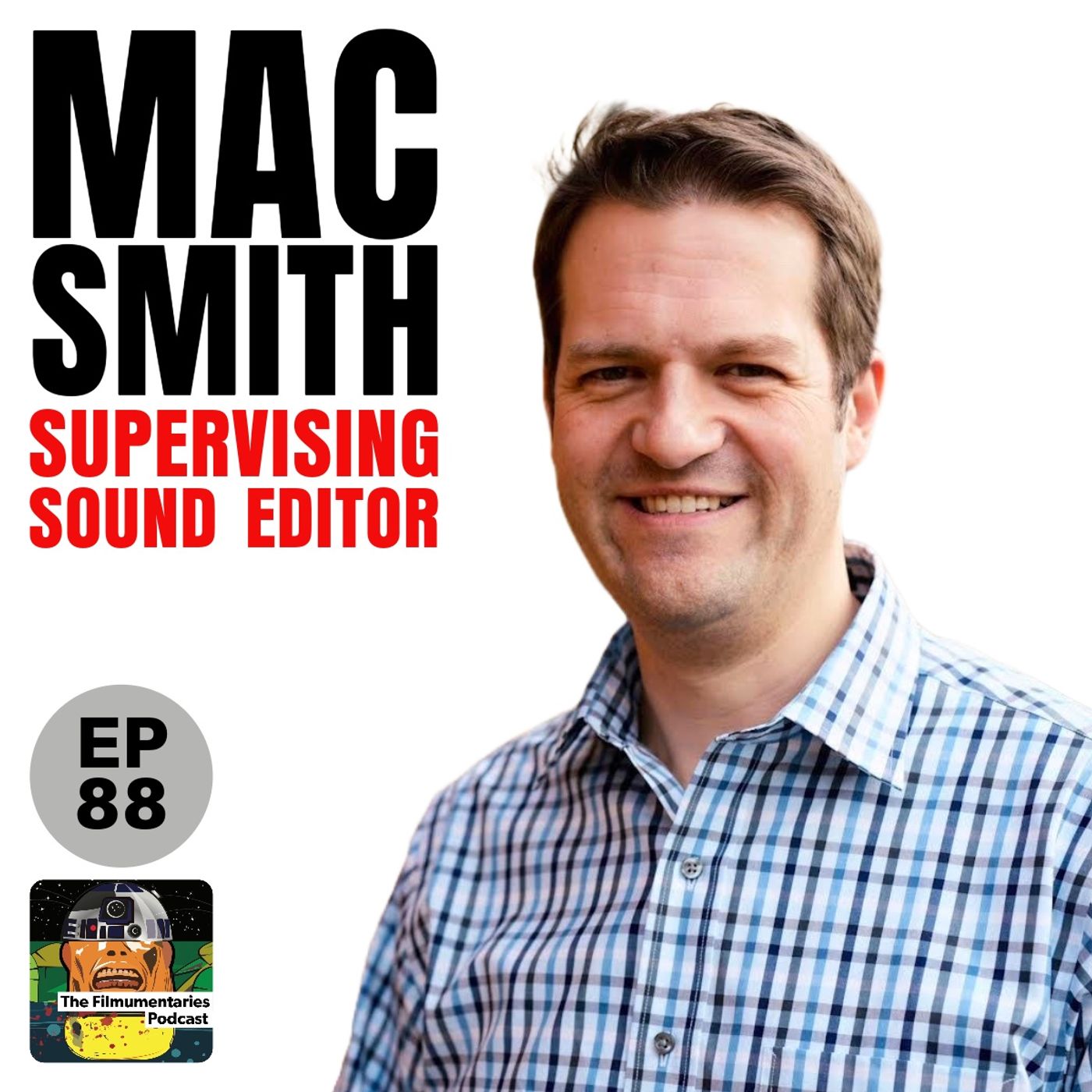
88 - Mac Smith - Supervising Sound Editor - Skywalker Sound
About this episode
Listen in for the full story.
Thanks to the folks at Skywalker Sound for helping set this up.
All the links!
This podcast is completely independent and made possible by listener support. If you’d like to help me keep making these episodes, you can join my Patreon community here: https://patreon.com/jamiebenning
Watch more on YouTube:
Check out the Filmumentaries YouTube channel for behind-the-scenes clips and extra content: https://youtube.com/filmumentaries
All my links
Transcript
Automatically generated, so expect the odd misheard name.
Welcome to episode eighty eight of the Film You Entries podcast. This is Jamie Benning talking to from my home here in London, England. If this is the first time you've listened to the podcast, the remit is all about preserving film history really, so you can treat this and the eighty seven episodes that came before it as an archive, a film history that can be used to listen to for your entertainment, for search material for your book or podcast or even essay. You have about an hour of film chat ahead of you and I hope you enjoy it. If you're a regular listener, Thanks as always for joining me and for your support, and thanks to the lovely people that already support the podcast by a Patreon that's patreon dot com forward slash Jamie Benning, I really do need your help to keep this podcast going and to make it financially viable.
I need at least another forty or so of you. So if you like my work and you buy me a pint or a coffee if we were to meet, then please consider supporting the podcast with just twelve dollars for a whole year of episodes. There are several tiers to choose from on Patreon with several perks, including videos and merchandise. You can find all the details as I said, at Patreon dot com, forward slash Jamie Benning. You can also support the podcast by buying some merchandise at Filmiamentary's dot creator, dash spring dot com.
I'll leave that in the show notes, and there you can buy t shirts, bag bottles, and even socks with the film thementary's logo on it. I'll leave the links for the Patreon and the shop in the show notes as I say. And if you can't support the podcast via either Patreon or on the store, please just share, like, subscribe, and leave a review of the podcast. This is a very small independent podcast. It's just me and my laptop, and I need all the help that I can get to spread the words, so thank you for your support.
You can follow me on Twitter or x at Jamie swb and on my profile there's a link tree to all my various sites, including my Vimeo channel, where you can find hours of video to watch for free on films like Star Wars, the Emposhtracks, Back Return the Jedi Jaws, Raisers of the Lost Arc, Back to the Future, and more. Okay, back to this episode number eighty eight. I spoke to Max Smith in June twenty twenty three about the path he took to his career as supervising sound editor and employee of Skywalker Sound via marching bands, a chance meeting with water merch, being propelled into the industry working for Robert Zemeckis, and so much more so. Thanks to the folks at Scarbalker Sound for helping set this up.
And here's my interview with supervising sound editor Mac Smith, and I'll be back at the end for a bit more jabbering on. So where did it all begin for you? Mac? With you a family that went to the cinema a lot, would your parents take you there? Absolutely?
I was going to the movies all the time from a very young age because I was the youngest child in our family with a sister's nine years older and a brother was thirteen years older. So I felt like I was their age all the time and sort of being whisked along to go see things with them. I think I'm a similar age that you are. I was three years old when the original Star Wars came out and grew up in Omaha, Nebraska, there's a story that my parents were in bed reading at nights and my brother, who would have been sixteen, came running home and came into the bedroom and said, oh, my gosh, there's this amazing movie and the good guy wore white and the black guy wore black and he was really bad, and like, you have to see this movie.
So I think they all went and saw it at some point without me, and then decided that they should take me as well. And being three, I don't have distinct memories of going to the theater. All I remember is then pointing at the black and white advertisement from the newspaper that they were going to take me to this movie. I don't know if it was my first film, no my parents, it probably wasn't. But shortly after that Star Wars really took over my life to large degree.
I just wanted to consume everything possible, So any you know, making of books or anything that I could get my hands on, I would just devour, and including the toys. My mom fueled my obsession with the toys, which I still have a lot of them to this day, with the original boxes. And yeah, it's just like I said, it kind of you know, ruled the direction of where I was headed, and I just wanted to be part of movies. I didn't know exactly what part of movies that I wanted to be involved with, but I just remember sort of like pointing at the screen and like I want to do that. Yeah.
I would pour over the books and you know how they made the special effects and the pictures of like how they were inspired by, you know, Ray Harry Housen or Errol Flynn movies or things like that, and I just wanted to learn as much as I could. I became a early subscriber to Bant the Tracks, which was the Star Wars fan club newsletter, and it's funny I didn't realize until a number of years ago that there was one issue of Bant the Tracks that actually came with a floppy record from Sprocket Systems that Ben Bert had put together. I think it was like sort of sound design suite that you know. It was one of those such a floppy piece of vinyl that you had to put pennies on either side of the spindle to keep it on the turntable or keep it down because it was so lightweight.
I think that's on YouTube somewhere it's very funny. So how did you then make the transition into the industry itself. Did you Were you able to seek out a college that would lead you in that direction. Well, I, you know, I was always interested in being involved with filmmaking, but I didn't quite know exactly how to get there. In high school, I did a few things.
They had a public access news program that you'd put on sort of a weekly show, just talking about what's happening at our school, and I got involved with with that class and we would sort of take turns being talent on camera, being behind the scenes, and I really liked directing that show. I felt like that was the place that made sense for me, so I kind of cut my teeth in that as long as as well as experimenting with video cameras at home and doing very rudimentary VHS to VHS editing, I landed a internship at the local ABC television station in the engineering department. I was not, you know, a super technical kid, but it was just sort of getting my foot in the door. So I learned about the different departments of a newscast, and watching that happen live was very interesting and enlightening, and seeing broadcasts that went well and some that went not so well.
Yeah, and a lot of the expletives behind the scenes that the audience at home didn't hear. And I got to run video sorry, run the studio cameras periodically here and there. They that'd sort of like a summer period where they would let the full time workers go off for a few weeks and so we would step in and cover their shifts. So that was interesting, but it also taught me that I did not want to work in live TV. I had that same feeling when I went to college and then I ended up in live TV.
But it is important, isn't it to do those things to kind of realize what you don't want to do, to point you in the direction of what you do want to do. Absolutely, And part of it was also seeing some people who had been there for a lot of years and were not very happy people, and so that that was sort of a telltale sign right there. I remember, I think it may have been when I was sixteen, sitting in the basement playing video games at home, probably Nintendo or something, and my mom dropped an application in my lap and I was like, what is this? And it was an application to USC summer production workshop in southern California, and I kind of looked at her and said, really, and like, if I got in, I could do this, and she said, yeah, fill it out.
So I filled out the application and sent it in and I found out that I got in. So the summer when I was seventeen, this would have been ninety one, my parents drove me from Omaha, Nebraska, which is right in the middle of the United States, to Los Angeles, passing through New Mexico, where my sister was living in Arizona, where my brother was living at the time, and they we got to Las Ana to USC and they got me all settled and then they hopped in a plane and went home. So they left me with the family car in Los Angeles for six weeks when I was seventeen, and it was just an amazing experience. It was kind of just a crash course in filmmaking, not actually using physical film but using SVHS format, and we had to shoot three short projects from you know, write them, cast them, shoot them, out of them, and present them.
And I just had a blast. I felt like it was exactly what I wanted to do, and at that point I had my sights set on USC to go to school, but I also talked to one of the professors there and really got his advice, and he was saying, you know, in order to become a good filmmaker, you need to go live life. You need to get out there and travel and have different experiences and have things to say. And of course, being seventeen, you're kind of like, huh, I just want just let me make movies. So I went home and continued school.
I did apply to USC, but I did not get in, unfortunately. But I decided to go to the University of Iowa, which is in Iowa City. It's almost exactly halfway between Omaha, where I grew up in Chicago, Illinois, right on Inner City eighty, about a three and a half hour drive either to Chicago or to Omaha. And I spent a number of years at Iowa. They had a not really a full fledged film school, but they had a communications department that had sort of an emphasis on film.
So I landed in Iowa. And the other part of my background, which I haven't talked about yet, was music. Music was a huge or my family. I actually come from a family of tuba players, believe it or not. My father played tuba in college and various other bands in Nebraska, and then my older brother and older sister both played tuba.
So when I was in about fourth or fifth grade, when in American schools it's sort of if you want to be in band, it's time to pick an instrument. My father said, you can pick any instrument you want, but we have three tubas in the basement, like hant hint and Yeah. I really wanted to be a drummer, but but I sort of listened to his wisdom and part of it was an instrument like drums or trumpet. There's a lot of competition, everybody's wanting to play that. Where every band is desperate for a tuba player, you're gonna have a lot more opportunities as a tuba player.
So I was in band through element school, junior high, high school, did marching band, jazz band, codser band, and then my parents were involved with the Omaha Symphony. My dad was on the board and they were also involved with this Omaha Press Club show, which was like grid Iron show that would happen once a year where they would play sort of parodies of famous tunes but all based on politics of the city and the state, and so I got sort of embroiled with musicians because we would have parties at the house and we had a baby grand piano and seeing people gather around the piano and sing songs and have great time. So I loved music. And not only did I play tuba, but I played bass guitar, and so I went off to college knowing that I wanted to do filmmaking, but I had this big musical background.
So I first thing I did when I landed in Iowa was I joined the marching band. And this is a big ten marching band. You know, it's two hundred and fifty to three hundred, you know, college kids, and it was an instant sort of club and group, and there were parties every night. We actually traveled to Newark, New Jersey to play in the Kickoff Classic in Giants Stadium before classes even started my freshman year. They were flying me across the country and so it was just like, wow, this is so much fun.
You know, I was not really a big sports fan, but but just to be on the field and the energy with with you know, the huge crowd, and that was fun. So I was all in in the marching band and one of my one of the guys in my section who I played susophone tuba. He uh. He was like, Hey, I work at the college radio station k r U. I you should come check it out.
And also not only was I a musician playing music, but I was also voracious as far as like just digesting music and just loved all kinds of different obscure things. And so suddenly here's this college radio station where there's you know, thousands of CDs, thousands of vinyl records, and I was just like, oh my gosh, yes, I want to be part of the radio station. He by buddy ended up taking over as as general manager and got me an overnight slot DJing I think at you know, three to six in the morning, which I was fine with, you know, at the age of you know, nineteen or twenty. Oh you can handle it then, yeah, exactly. And I get to play, you know, all my favorite things and learn about new music and write.
At sort of that moment, he my friend who was a manager, had some extra money in the in the fund for the radio station to spend on a very new, somewhat primitive but digital audio editing piece of software called Deck two. Which was kind of a precursor to pro tools, And so when I showed up, it was all analog, still with splicing quarter inch tape, and there were car machines. But suddenly there was this piece of software where you could record your voice into or digitize a piece of music, and you could chop it up and move it around and reverse it and add some very primitive effects. And my mind was just blown. I was like, oh my gosh, this is so cool.
So I kind of jumped in first to learn as much as I could about that software and just experimenting with it. There was a show happening at the radio station that a couple of older college students were doing. They called it advertorial infotainment, where they would they would sample all kinds of like slogans from advertisements and commercials, very short soundbites like you know, four second, five second, you know, maybe ten second, and they would one of them would would be DJing music underneath, mostly sort of ambient or instrumental music, and the other one would be firing off samples just on the on a Mac computer, just on the finder level, just like double clicking sound files, just sort of randomly.
But it would it would come up with this sort of experimental hodgepodge of you know. In some ways it was it was almost like performance are and I thought that was so cool, and so I wanted to do that stuff. So I started sampling things for movies and and and doing that kind of thing. Actually, you know, all of this stuff kind of got me a little sidetracked from my studies, and my grades were not great because I was spending so much time at the radio station. I actually the first class to sort of get into the the film part of the communications part of the school was an intro to media production where you had to do three different sections.
You had to do like a live TV like section, a field production section where you went out and shot something in the real world and put it together, and then the third was sound And we did the live TV went first, and it was it was old hat because I had done that at high school with both in school with a with a cable program, and then also at this TV station that the field shooting one. I got very ambitious and my buddy from Marching Band, who had a metal band, I said, let's shoot a music video. So I spent you know, probably a good two weeks just shooting them rehearsing in the basement of their house in concert at a club, and then like out at a like old broken down farmhouse, like straight out of an Alison Chains, you know type type music video, and then painstakingly on VHS tapes you know, or it may have been three quarter I can't remember, cut this thing together with their studio track like you know, rolling back and is the guitar really in sync in this moment and working overnight, and and sort of blew everybody away in the class with that video.
And then when it came time for the third section audio the TA who was teaching that class, it was all still analog audio. And by that time I was like sewed down the digital path that I was. I was like, oh, you know we could do this, you know project, I'll tell you what I'm going to do it digitally and then just recorded off onto the analog and turn it in that way. Well, I made a couple of mistakes. One was I didn't tell her I was doing that, and number two, I actually, when it was time to double off, had lost the piece of a quarter inch tape that she'd given us, So I borrowed one from the radio station, but it was a different brand, so it was a telltale sign when I turned it in that something was wrong, and she was furious, and I ended up getting a d in the audio portion of internal media production, which is pretty funny looking, but you know, quick thinking on your part to you know, think of the best and most sort of valuable way for you to do it at that point, I mean there, of course it is worth learning those disciplines that came before the digital age, absolutely surely what they're trying to teach you.
But you know, also I would have marked you up at least to a seed for for initiative, you know. Yeah, and you know, in hindsight, yeah, I was. I was a dumb kid, and I should have you know, followed the rules or at least I told her what I was doing. But then you know that I was, you know, just sort of continuing down that path college radio and doing all that stuff. And then I went one night to a friend's apartment and they had videotapes of the DCI Championships from nineteen ninety four.
And DCI is Drum Corps International, which is an umbrella organization for all of these like in essence Olympic level marching bands. Right, So if you think of like the NFL as the umbrella organization for all these football teams, DCI was sort of, you know, the head of this summer circuit of the best of the best players. And I had been a little frustrated with a college marching band that there were a lot of people who were in it just to party and not play well or march well. And I was like, oh, wow, this is an opportunity to like go all in. So I talked to a friend and decided that I had only one year of age l ability because the cutoff is at twenty one years old.
So I decided to audition for this group Adam Madison, Wisconsin called the Madison Scouts, which were an all male drum corps, and they just had like so much swagger and they played Latin jazz and it was just like it was so incredible, and I was like, you know, I'd be dumb to not go try to be in, to go for it and be in this group. And Madison was only about a three two or three hour drive from from Iowa and went up there and there were something like forty spots open. No sorry, Yeah, forty spots open, but there were eight hundred people trying out for those forty slots, and even though they were based in Madison, Wisconsin, there were kids from actually all over the world who were trying to be in this elite group.
So we had people fly in from England, from Japan, from the Netherlands to try to be in this group. And they were the best of the best. And these groups aren't affiliated with a university or a school at all, They're just totally independent. So I showed up. I had a prepared piece, and I was so nervous.
I was like practically shaking watching, you know, all the people go in and out, and somehow, like maybe about a minute before they called my name, just all the nerves went away, and I was like, what do I have to lose? You know that they could say no. So I went in there with a lot of confidence. I didn't play. I played fairly well, but they I think my confidence sort of unpressed them and they seem like I would fit in.
But unfortunately the next day I was I just missed the cutoff. They filled the tuba slots contra slots, and I was like the runner up. So I went home thinking that I wasn't going to March that summer, and two weeks later I got a call from from the executive director saying somebody had dropped out and if I wanted to join, I could, and so I jumped at the you know, I said absolutely, And that following summer was probably one of the hardest summers of my life because I was practicing nine hours a day in the extreme heat, sleeping on high school gym floors, traveling on charter buses overnight, and playing this eleven minute show on a football field where for the first time, it's you know, in college, it's like you're playing on the football field and most people are like, you're not paying attention.
They're like, you know, they're going off to the restroom, We're going to stand in the to go get a beer or whatever. But this was like suddenly there's a stadium full of people and they are like honed in on every move you're doing. And I was like, wow, like that it was just goosebomps here. It was incredible. So that kind of proved to me, like, you know, I was not the best, but I just worked hard and stayed in and hung in there, and it was an incredible summer.
It was one of the best things I ever did in my life. And that's got that's got to put you in a position where you know, you you happen to be so driven to do something like that and you're being drilled through. I mean, I have a nephew who's what is the eighteen now, and he did the marching band thing in high school and I know he was in Texas, you know, in forty five degree heat or like ninety hundred degree heat as you guys would have it. I couldn't believe what he was going through, and even that it was allowed to treat kids in that way. Yeah, he's come out the other side of this as a very disciplined, very driven kid who's you know, speaks Japanese.
Now, what's to travel the world? He opened your eyes and experience like that, I'm sure to what is what is possible? For you? Totally? It teaches you grit and and also you know, I've kind of been stupidly ambitious throughout a lot of my life.
You know, like, you know, what's what's I'll just go for it. You know, what's the worst that could happen? That's kind of it's got me a long ways. So I came back to school and I ended up being the music director at the radio station. And then at some point something sort of clicked in my head and said, like, wait a second, I'm doing this audio production that is is cool, but somebody has to be doing that for film.
There's got to be a connection. And so I just started kind of like poking around a little bit. And of course, I you know, I'd gone to see movies my entire life, you know, I was I was at the theater, you know, probably seven or eight times a month when I was a kid, right, and I knew movies like sounded cool and sounded incredible, But it didn't really sort of click that, oh yeah, somebody's got to be doing this and making all those choices and decisions. So I I ended up buying a bunch of audio equipments at home and just sort of banging on and trying to teach myself how to use it, you know, and it. And I was also sort of toying with the like, well do I want to do more music composition or audio?
And so I bought a couple of keyboards and I was experimenting with sequencers. I was not very good, but but I was just kind of like trying everything I could maybe even like I really got into these scratch DJs from the Bay Area that sort of made a big splash in the mid to late nineties. They just fascinated me with like, Wow, they have these vinyl records and they're they're essentially manipulating sound by hand. They're there, it's a it's almost like a musical instrument, but it's like almost they're almost unlimited choices because it depends what you have on the vinyl. So I experimented a bit with that.
Again, I was not great at it, but I was just trying to sort of like figure out as much as I could. And I bought an early pro Tools version of pro Tools, which was was not something that that your average person purchased back then, but I wanted. And it's funny that, like the first place, because at that point, Digit Design was the company that made pro Tools, it was before I have it became involved. They actually like you had to buy it from, you know, based on your region. So in my region of Iowa, I was supposed to buy it from a place in Chicago, and there was really only one big sort of music store and I called them up and said I wanted to buy pro Tools and they laughed at me, said you're yeah, yeah, right kid, and pretty much hucked up on me.
And I didn't even say, like do you you know would you be able to pay for it? So I ended up finding another place to buy it from and just you know, played with it an experimented as much as I could. I ended up going to New York City for like a week long sort of crash course and pro tools to learn that. But that I was like, you know, I want to do sound for film. Well what's the best way to do it?
And I just happened to a friend of a friend was going out to Bethlehem, Pennsylvania to shoot a short film and I just said like, hey, you know, I'd love to do the sound on your film. I know I've never done it before. It's kind of a big ask to say, hey, let me do the sound, even though I have no experience. She was kind enough to connect me with the directors, which were two sisters, and I talked to them on the phone a couple of times and they were very nice, but they were like, oh yeah, take the job. They called me up, I think about two weeks before the shoot and said, we actually need a boom operator.
We have a production sound mixer, but would you be willing to come out sort of be a sound consultant and and help, you know, as a boom opera. And I said, sure, why not. So flew out to New York with a you know, crew that I really didn't know, and and it was they shot this film and in their the house they grew up in Bethland, Pennsylvania, and I think it was maybe a four or five days shoot. The woman who was running the productions sound was very crabby and and did not not have a lot of patience for me because I didn't know what I was doing. You know.
She would yell and scream at me like, you know, you're old, the boot wrong, you know you're doing this? Do it like this? And baptism of fire, yeah, pretty much, and you know, and I was, you know, going with it. I was because I wanted to learn, But I think because she was so sort of harsh with me, I got a lot of sympathy from from the rest of the crew. So by the time it did all wrap up, they said, yes, you can do the post sound.
So I was that Linn's Wake the first film that I see on your IMDb. Yeah, yep, that's the first one. And then quite a leap from a short film with some friend of a friend to working for Robert Zemeckison on Castaway. And I'm sure that was there anything in between or is im the representation of that leap? There's it happened, there's a little bit.
So kind of what happened was sort of in the middle of Lynd's Wick, my fiance and I decided to make the move to northern California from Iowa. My parents met in San Francisco in the nineteen fifties and they always set their sights on wanting to retire back in northern California. So they had already moved to the Bay Area, and we had gone out to visit them a number of times, and I had spent a summer in Los Angeles, and I knew there were, you know, a lot of sound jobs in Los Angeles, but I was like, I know, skywas in northern California. My parents are already out there. Let's make that big move and see if we can make a work.
And I think we kind of give ourselves like a timetable of maybe two years. If I can't get my foot in the door and get some work in the two years, we'll move to Los Angeles. So that was July of ninety nine. We made the big trick, and I was so yeah. I was finishing up the sound on Lynd's wake at home.
But then I was so naive. I'm like, is it in the newspaper there, you know classified ads for like, hey, we need a sound editor. I had no idea. So I ended up just kind of calling various recording studios around the Bay Area to find out, you know, if there was any work for someone like me. I didn't get you know, a lot of people hanging up on me.
But but there were not a lot of opportunities until I came across a smaller studio in San Francisco called Outpost, and I got an internship there, and they were a facility that they're still there. Actually they did a little bit of everything. So yes, they did a little bit of independent film work, but they were doing recording for like Wells Fargo voice prompts. They were you know, just kind of you name it. They were kind of a we'll do help you with whatever kind of you know, smaller scale sound thing.
So it it was nice, you know, to get that opportunity. But I was also like at home, I felt like I had a good handle on pro tools, and they were not letting me touch pro tools there. They were definitely like keeping me back. They were like, you know, go coil some cables or set up these microphones or or whatever, which is fine, you know, it's it's you know, I did know a lot of experience, but I know I've kept being very ambitious, like trying to figure out what the next you know thing was. And it was obvious after a few months that they were not going to sort of give me those opportunities.
But I hung in there for a bit and by total accident, I came across an ad online this is you know, early two thousand that there's a sound design seminar featuring Walter Merch happening in Iowa City, where I had moved from nine months prior. Wow, And it was not only Walter Merch, but Randy Tom Dave Stone, who was a sound designer predator. There were a lot of heavy hitters, and it was they were sort of pitching the seminar as here are practitioners and then here's a group of people who were film scholars who study sound, and we're sort of putting the two groups together. And so I talked to my wife and I'm like her, she was my fiancee at the time, we were about to get married, and said, you know, yeah, we don't have a lot of money, but I think I should fly back for this, you know, stay on a sleep on a friend's couch.
And she agreed. So I flew back to where I'd spent the last number of years at school and and showed up for the seminar, and you know, opening piece of the of the seminar was Walter Merch, you know, dissecting Apocalypse. You know, it was just like wows, Yeah, it was incredible. Yeah. And then the next day is is Walter at the local sort of like cineplex just off campus, like at nine am, dissecting Touch of Evil and the work he had done that and playing playing not only the original cut, but then like coming back and forth, like let me play you the first ten minutes of the original cut, and let me play you the first ten minutes of the re cut that I did based on Wells memo and it was, you know, so fascinating.
Of course, like three hours in, we'd only gotten about thirty five minutes into the film before they kicked us out because they needed to open for real business. But I ended up like becoming sort of the de facto tour guide for this group because there were maybe only about thirty people that flew in from out of town for the seminar, so it was a pretty intimate seminar. But you know, it was time for lunch and they would all kind of look at each other, well, we don't know where to go, and I'd say, oh, let me take you this way. If we if we walk up this street and take a rite, there's there's a pretty good Italian restaurant and their's sessions such is really good. So people kind of like, you know, got to know me because I was the de facto tour guide there.
So by the time the seminar was kind of wrapping up, I knew both Walter and Randy were living and working in the Bay Area, and I said, hey, you know, I actually live in the Bay Area and I want to get into film sound. And they were both kind enough to give me their email addresses. So when I came back, I was still working as an Internet at Outposts, but I was emailing Randy and Walter, and I think Walter responded pretty quickly and said, you know, once you come down to the Zootrope facility just to sort of on the edge of North Beach in Chinatown in San Francisco, and come hang with me for a little bit while I'm working. Well, I didn't know that he was working on Apocalypse Now Reducts. So I come in and he walks me down to the basement studio where they recorded a lot of the original music for Apocalypse, and I'm sitting there, just the two of us, in the dark, while Walter is screening French Plantation dailies, and I'm just like blow bubber Lake, like is this even real?
Like somebody pinched me. He was very kind and very gracious. There wasn't really an opportunity to work with him, but I was very thankful to meet him and have that time. Raddy was a little harder to reach at that time because I think he was in the midst of finishing will Lies Beneath. But we played email tag and you know, I wasn't emailing him every day.
It was maybe every two weeks or so, and he finally said, you know, why don't you come out to the ranch and have lunch with me? And so I drove out to the ranch for the first time, and it was like, you know, oh my gosh, you know, this is surreal, my whole you know, childhood. You know, it's based on Star Wars, and now I'm driving onto the property that you know that George Lucas owns, and and yeah, again somebody pinched me and Raddy had his son, Austin there, who I think was probably maybe in his early to mid teens, and he met me out in the parking lot with Austin and we walked over to the to the fitness center where they serve lunch. And I think he did tell me later on another day that you know, he noticed how kind I was to his son and that sort of made an impact.
So he asked me before I departed that day, would you like to come out here two or three days a week in the afternoon to intern with me. I'm starting to work on a film called Castaway. Wow. And I was like, absolutely yes, I mean already I'm kind of almost mentally noting here. The things that have got you into this position, you know, one of them you just mentioned is being a good person, which is always great.
You want to work with good people, people that are kind and you know, good team players. You're also are very open to opportunity. By the sound of things, I think a lot of people let those things slide, you know, by it's that sliding doors thing, isn't it. You know, Oh, should I have done that? Should I better to regret, you know, doing something and it not working out than not doing it and totally and also just just kind of having that interest in something that leads you in those directions as well.
You know, something that you're kind of passionate about, something you have an interest in, even if you don't know specifically what that interest is, you know, even if it's a kind of broad interest, just feeling your way around that room, that wall, if you like, until you find that sweet spot and it sounds like I mean to land on as a Mechis film, you know, as an apprentice sound design. I mean, that's that's got to be up there for anybody trying to get into the industry. That's a that's a absolete absolutely and I and I do credit my parents for so much of my success because number one, they were very supportive with whatever I was interested in. They would say like, oh, you want to learn about that, Let's figure that out.
And that also just you know, having much older siblings and having my parents like to entertain a lot, so I was around adults a tremendous amount when I was a kid. So I learned to talk to people and learn how to how to sort of fit into a situation and how to sort of spark conversation. But yeah, Cassaway was was pretty crazy because suddenly I was coming to the ranch. I let out posts know that I was, I was leaving there. I think I spent another two weeks there to fill in, and that I became sort of focused on working at Skywalker and Randy me, you know, mostly sitting on the back couch kind of observing what he was doing.
But he also asked me to help him locate some things to record for the show. And this was a very unique kind of film, I'm sure as you know, because number one, he stranded on this island and they had already decided there's going to be no music during this whole sequence on the island, and Zamechas had set up very strict rules that he didn't want the sounds of insects or birds because he didn't want it to sound like a paradise. He wanted to sound very lonesome because he didn't want audience members to go like, oh, I wouldn't mind spending you know, being isolated on this island. So that really limited Randy's sort of palette to water and wind and you know the things that water and wind are interacting with and foley, and there's very little dialogue.
And he note he knew that he needed things like palm frons and different things to record various textures with. So I went to a nursery in San Francisco to get sort of their their clippings that they'd clipped off, like sort of these are the weaker fronds that we're just gonna dispose of. Of course, the first day they were like, oh, yeah, no problem, you could take those, And then the second time I showed up, they kind of looked at me like, now what is this for and started asking for a payment, which which was fair. But the other thing that he wanted me to go get were these young coconuts which if you're familiar with the movie, Tom Hanks's character finds these giant green coconuts and he's having a hard time getting into them.
And so Randy wanted to go find those coconuts that we could record around the ranch, you know, dropping and hitting and smashing. And I was like, sure, no problem. So I go off to the grocery store, you know, down in Santa Refel. Those coconuts are not in the produce aisle. So I came back empty handed, and somebody may have been Randy's assistant at the time, told the picture department that we were having trouble locating these, and I think the post supervisor called around and found an Asian store in Santa Refel and said, oh, they have them, go down there, and I said, okay, So I made the track down.
Well, I asked for the young coconuts and it was just the young coconut meat we just like saran wrapped. And so again I came back empty handed, and this person when they found out that I didn't get them, they were screaming. I mean, not somebody from Skywalker, it was somebody on the picture side. And I was like, no, no, they had them, but they were appropriate to record. I ended up going to the wholesale produce market in San Francisco at like five A and asked a bunch of people there and they're like, oh, no, no, we don't get those.
Typically they may come in once or twice a year. And so I told Randy, you know, I think it's a dead end, and he said, well, go to the store and buy some other things that you think would sound like that. So I ended up going to Whole Foods and buying different sized melons and hardshell coconuts and acorn squash and buttered out squash, and so we spent an afternoon recording and hitting and smashing these different things. A few weeks later, somebody was able to actually ship some from Hawaii, which we recorded. But Randy decided, and I think I have this story correct, that the acorn squash sounded more realistic than the real thing, which was a lesson for me right there that it's not necessarily the real thing that sounds the best.
Yeah, absolutely, yeah, Because I think people have an assumption with sound that it's either recorded on set or is the sound of that thing they're looking at in some shape or form. But as a sound designer, you have to you know, having spoken to several sound designers now, I'm sure you know I've taken this on board that you have to think very much outside the box sometimes as to what might be the appropriate sound for that, because if anybody, if anybody out there is listening who's tried to edit sound into one of their projects, you soon realize the true artistry is not at your fingertips when you begin, because it sounds so out of place, and it sounds so ridiculous and fake. There's an absolute art to it, and it sounds like by this time you're very much on the way to reaching that.
The other funny anecdote from Castaway is a lot of the production dialogue that was shot in Fiji was unusable because number one, there were lots of insects which Zobaca sidn't want, or the surf was too loud, or they actually lost I think they lost a maybe a sound package or maybe a camera in the surf at one point. So a lot of there's not a lot of dialogue on the island. But when they had Tom Hanks record his dialogue in an ad R studio, which is very dead and dry and of course, didn't sound like the island. We had some time and the supervising sound editor who was working with Randy, Dennis Leonard, he had an idea that let's go world eye Tom Hank's dialogue, which world dizing is a term that Walter Merch used on American graffiti where they would re record the sound of these songs in an environment, like in a back alley or something.
So what Dennis wanted to do was to back behind the tech building there's a little tiny canyon and he wanted to set up a big PA system and have Tom hanks adr record of him screaming for help, shoot out and sort of bounce around the canyon and re record it so it sounded like it was coming from that environment. Of Course, they discovered that the birds were too loud out there when they set it up, and Bob didn't want any birds. So they said, hey, Mac, come out back with your jeep and sit in your car near where we're recording, and we'll queue you. So we'll hit record, we'll que you, you lay on your horn and scare the birds for about ten seconds and we'll fire off Tom Ank's dialogue And so they queue me Bee beep, and then you hear ap somebody had eybody.
Okay, then they'd que me up and do it again. After about the fourth or fifth time, we hear tires squealing and it's ranch security fish tailing up the road because they think somebody is screaming for help back behind the tech building like they're injured. And uh so we we were told to, you know, cease then, and you know, you can't do these things without letting us know. And so it was. It was very funny story that Dennis loves to tell to the stare you.
You mentioned, of course that you you kind of grew up as a as a Star Wars fan, and I think was the first project you worked on involving Star Wars the Nights of the Old Republic game. I remember playing that game. I'm trying to remember what system I would have had it on, but I remember playing That was the second one, wasn't it. Yeah? Yeah, I believe so.
Yeah, So I just give you a little context of before I got into the video games. So I continued with Brandy on a couple more projects as his apprentice intern, and then he had ed up going off to England to work on Harry Potter and the Chamber of Secrets, which I was able to help him a little bit with prior to him leaving, but I was not in the budget or allowed to go to England unfortunately, and he was away for six months. So suddenly it was like my one opportunity at the ranch. The person I know who who has worked for me is gone. So suddenly I was, you know, not at the ranch, not doing much sound work, trying to sort of figure out how to maneuver, and ended up working on a couple of freebie and low budget projects and just was trying to meet more people.
And I ended up meeting this this guy, Nick Peck, who had been a sound designer at LucasArts that did a lot of the Star Wars lucasfilm video games, and he had been up at the Ranch working on a couple of projects, and he and I got along great, and he let me know that he was maneuvering to try to figure out how to start a video game sound division at Skywalker. He was not really happy with with how things were going at LucasArts for various reasons, and was trying to get this off the ground and took you know, took a lot of maneuvering, but he finally sort of made some headway to start this division, and I decided, like, you know, I really want to be a part of that. You know, I love video games, I love sound, I love Star Wars.
And he was gonna I knew that he was gonna have me come down to LucasArts to meet his boss and another sound designer down there, and I knew that they were going to ask me, like, what's your favorite video game? What what do you think sounds the best? I hadn't, I think, bought a video game console for probably at least five years, and I, you know, had been so focused on just trying to you know, get into sound for movies that I, you know, sort of abandoned my video game hobby. And so I decided, well, I should go rent an Xbox and and get some games and just do a crash course and Hollywood Video and Blockbuster. For years, had you could rent an Xbox or a PlayStation or whatever.
And sort of right at the time that I showed up to do that, that that policy had stopped. They no longer did that, and I was like, oh crap. So I went to Costco the discount warehouse place that we were remembers of, bought an Xbox brand new, and then went to the the rental store and readed like ten games and pretty much spent a week playing as much as I could, so in the interview I could sound educated about all the and I was right they they fired off all these questions to me. It was it was Nick, I can't remember his boss's name. And then David Collins was the was the third person there, who's a famous sound designer, voice actor, composer, does the soundtrack show.
Yeah, and he and I are really good friends now. So I did well at the interview. I got the gig, and I ended up returning the Xbox to Costco because I couldn't afford it at the time, and and started they they weren't quite ready for me to start working on the episode three video games, so I sort of just helped on a couple of those. Those other titles I wasn't on very long, one Nights of the Old Republic, and I can't remember the other title, Republic Commando I think was the other one that I did a little road to work on. But suddenly I was at the ranch with a much longer term gig.
So I was on the Episode three video game for I think almost nine months, and our first child had just been born, so you know, definitely desperate to start making some income. And then being at the ranch for that period of time, I really got to meet a lot more of the people and going to lunch and people recognizing my face and going, oh, yeah, this guy's you know, not too bad to hang out with. So that was like a really sort of critical time for me to get known around the ranch. Because all of the creative jobs at Skywarker Sound are project to projects. There's almost nobody here on the creative side that is, you know, sort of salary or guaranteed hours.
So because of that period of time working on those those games, I got my first assistant job on a feature, on a film feature, and that was huge. But working on Star Wars was a dream come true because it was like, this is incredible, and I was I was working on the cut scenes for the episode three game and there were a huge number of cinematics. It was something like seventy or eighty plus. At the very end, we found out that there was going to be something like fifteen minutes of live action content from the films that were going to be released in the game, and the game was coming out two weeks before the movie did, so this was sort of the incentive for people to buy the game was get a glimpse of the movie before it comes out in theaters.
So I actually had to get the gumption up to knock on Ben Birt's door to say like, Hey, I know you're still working on this movie, but I have these scenes. Do you have any sounds for us so we can put in the thing? And and I remember walking to his office for the first time and it was like a museum, just all this incredible stuff from his history. I remember sitting on the couch and turning behind me and there were the sheets for the Yub Nub Song or Return of the Jedi that he had he had written out sort of fanatically for the singers to sing. And I was just like, it was crazy again one of those moments where I had had to pinch myself.
Yeah, yeah, yeah, it was pretty crazy. I'm working within that kind of library of sounds there, particularly in the Star Wars Library of Sounds. You're kind of in a world that already exists, yet you've got a kind of build upon that. But then I noticed as well that you've worked on a lot of animation movies where really you're starting from scratch. Surely there's you know, there's no there's no on set sound.
Of course, do you find that discipline of having to start from from afresh, from a clean slate to be more rewarding than maybe using a sound library that already exists in a in a franchise. I mean, they're they're all challenging, like Star Wars. Yeah, there's such a high bar for those for what people are expecting with all those signature, iconic sounds that are truly incredible and people know instantly, So there's a lot of pressure on those projects to make it sound right. And then if you are building other things that it fits within that sonic universe. But yeah, like the working on a brand new piece of of say animation that has no existing universe, I mean that that can be daunting too, but it can also be very freeing that there there are as many rules.
I mean that one of the things of the animation that I think a lot of people don't realize is the people who've been working on it. I'd say, like the picture editors and animation have been living with it for years before we get we get it, and they've they've put a lot of tempt sound in the Avid or you know, Premiere or whatever they're working in, and so there's a lot of sometimes there's a lot of Stockholm syndrome with those sounds. I mean, we of course love getting all of their sounds because it's definitely like a clear direction of like what they want to hear and sort of shows the peaks and valleys and what are the important sounds. And there's sometimes where we're utilizing their sounds but then detailing things around them.
But there are a lot of times, like I said, that they've been living with them for so long, but by the time we've come up with our palette and our version that we're proud of, they're so focused on what they're used to hearing that they can't sort of separate themselves from these new ideas. Yeah. Yeah, especially if they've had a audience screening and there's a sound that generated a laugh, even if it was a terrible, low quality sound recorded in the nineteen fifties, they don't want you to replace it, even if we could put in something that's funnier. They're just so used to like no, you know, people laugh to that one. So we do our best to you know, accomodate in those situations.
And I'm sure as a sound designer that has been working for many years, you have a kind of a mental and a physical or digital library of sounds that you know instinctively whether they might work or not work on a film. But I'm sure there's a lot of experimentation in your job as well. How do you kind of ensure that you don't fall down, you know, the experimentation rabbit hole. I mean, of course you have a deadline, but you know, you also want to find something different and unique to give to this director. Yeah, it's it's challenging, I mean, and that's a lot of ways what we do is fresh because every project is different, every client is different, animation, live action, horror films versus you know, comedies versus whatever.
But I do find myself and I'm in the start of a project right now, wanting to spend it a lot of time experimenting. As Randy likes to say, you know, make don't be afraid of making mistakes, just try to make all the mistakes of the of the front of the project. It's very hard to sort of like figure out when to stop that, you know, creative experimentation and really sort of buckle down and and get the cutting done. Do you stop? Do you have a start point?
Sorry to interrupt, do you have a start point for that experimentation? Is it a matter of taking a sound that you already have and changing the speed or the pitch or something like that. Is that you kind of find your way through it? Yeah? Sometimes.
The one part project that is close to my heart is a horror film called Haunt, which is directed by Scott Beck and Brian Woods, who wrote A Quiet Place and they did the film sixty five. I loved working on that project and just the opportunity of like, what is this haunted house sound like? So on that project, for example, I started, we have a you know, a giant sound library that we have access to at our fingertips, but I took the sort of the pitch speed slider and I slid it down from one hundred percent to about eighteen percent, and I wanted to just poke around the library and started listening to sounds at extremely slow and low pitch playback, and it definitely inspired a ton of ideas, you know, even taking things like power tools that you have this sort of rhythmic thing and then you slow them way down and it's suddenly comes this eerie texture.
So it really depends on what the project is asking for you. We usually have meetings early on with the clients, you know, the picture director, maybe the producer to figure out, you know, what are the what are their wishes about the project and what what are to sort of get an idea of the tone and what they're after. And so largely that direction will will sort of point us to where to start. And something like Marvel. You know, it's if it's something brand new and fresh, we we can we can start fresh.
But we we also know the bar is set high and whatever we create might live on in multiple series or films later. So so keeping all that stuff in mind in the back of your head. But yeah, starting in a blank session is very daunting. It's like you know, a blank canvas or like you know, a blank piece of paper. It's like where where do you start?
And a lot of it is just like you got to throw a paint of some kind on there too, even if it's wrong. Just like throw it on there and start playing, because yeah, the more you play, the more it'll start telling you what it needs and what it doesn't need. And does that sometimes include you, you know, leaving the studio and going out into the field again and recording something. Absolutely, Yeah, one of those people that always has a microphone in the bag just in case I try to. I'm not always as good as I as I should be about that stuff, but I do have a small recorder that I take around periodically, and if I don't, sometimes I'll just use my phone to grab something.
Because the other thing I've I've found is, you know, going out recording new, fresh stuff is not just great to have something unique in your own but it's also now you have a concrete memory tied to that experience. And sometimes it's even something like, oh, I, you know, have this appointment to go record this big machine at a factory and you show up and the machine is is terrible. It's not at all what you're expecting. And as you're leaving, there's something around the corner that's malfunctioning or or dropping in a weird way on a piece of metal, and you go record that and that sticks in your head of like when you're sort of in the hot seat on the mixtage and somebody's like, oh, I want to sound like such and such.
You know, it's one thing to like, you know, type glass break in the library and suddenly twelve thousand glass breaks come up. But if I can go, oh my gosh, I remember that time I went to go record that car and there was this amazing glass break, I'm going to go hunt for that because I have that memory tied to it, and sometimes that ends up being so much more valuable. Yeah, I know the time you doing this, you're also trying to as a supervisor, I'm sure you're kind of looking at the overarching sonic identity of the movie as well. It's not just a matter of isolating these particular sounds and then later the team who're re recording and mixing it. You have to kind of think about the film's sonic identity throughout the project and make sure that you know it's telling the story absolutely.
And on some projects I find it's helpful to sort of make rules. Not that we have to completely stand by those rules, but it kind of like will set sort of a structure to start working in and then learning on when to break those rules. For one example, the film Nine Days that I worked on, which largely takes place in a in one location, this house that's in the middle of this desert that has this giant wall of TVs. I wanted to make the house sound kind of oppressive for the lead character because he had this baggage that was attached to him and made him the way he was, and the house was sort of almost like a physical representation of this character, and so having sort of this heaviness in the air was really helpful.
But that we also decided, like, let's when we mix it, let's only keep the sounds on the screen of the ambience and the characters, the folly and the talking, and really only sort of really open up the soundscape in very certain times, which which creates that sort of dynamic that it's like, oh, you know, suddenly something is different. Why is it different, Well, because something happened in the story that really changed. Also, having like all of those layers of sort of oppressive air and tone on the house then allowed us to really strip things down when there was a really intimate moment and able to sort of pull away Tho's layers without the audience really knowing, sort of like a you know, pulling a rabbit out of a hat, not seeing how we're doing it, but really you know, make finding a way to make the audience sort of lean in and be sucked into the story even more than they would.
You sort of earn those moments. Yeah, I understand, Yeah, yeah, how do you you know? Because we in movies, we tend to strive for, you know, complexity in all in all parts of filmmaking, whether it's visual effects or sound. How do you make sure that you're not overwhelming your audience sonically? Is there?
Do you do? You sometimes have to take a step backwards and say, look, we need to get rid of this, this, this, this and this and just sort of hone in on the core of what is needed. Absolutely, it is so easy to overcut you know sound, whether it's you know, for a certain event or you know, say it's a big space ship battle and wanting to really cut every explosion and every blast and every I I really sort of in those situations sort of try to channel my inner Gary Reitstrom. It was very good at at you only need to be hearing you know, a couple things at once. You know, where where is your eye going or where where do you want the idy go for the audience.
But oftentimes you have to cut a lot of those layers to then be able to know when to Okay, now I have all these things. Now let's figure out what's really important. And the hope is to make a lot of those decisions before it gets to the mixed stage. But inevitably a lot of those decisions do end up happening in the mix once the full score shows up and we add all these things for you know, this big supernatural event, but the scorer is in all those frequencies and so suddenly there's a sonic clash. You know, they're all those the sounds, the music, and the design are all taking up the same sonic real estate.
So really trying to step back and pull those layers out and deciding, oh, we need something completely different there, or maybe we can we've established this thing already, we can pull back here and the audience won't notice that it's gone, which is an amazing you know, wrights Room and you know a lot of the other veterans here at Cowarker are so good at that that trick of you know, sort of establish it and get out. But your your blame. Your brain plays tricks on you that you think you're still hearing it, but you're not. I interviewed Mark Mangini and Theo Green about Dune was it last year or the year before, and we were talking a little bit about how their work kind of dovetawels with the work of a composer in a film.
And another example of that recently was Daniel Pemberton's score on Into the Spider Verse. You kind of it's half music half sound design in a way. Do you find and that you're now interacting more with composers on projects or are they still to very separate worlds that just kind of dovet out towards the end when the mix happens. I would love to be collaborating with composers more. Unfortunately, it's it's just super tricky time wise.
You know, we all have our best intentions. There are some people that are able to, you know, sort of carve out that time and I envy them that they're able to have that sort of collaboration of the composer. Peter Albertson, who is a Danish sound designer, is very He tries to get involved as early as possible and loves having those conversations and sending things back and forth. Just unfortunately, on a lot of the projects that I work on, just the by the time we start and by the time the composers start, it's just a race to finish line. And also when the picture is changing so much throughout the process, you know, they're they're trying to balance you know, record the score as late as possible based on picture changes, and we're we're trying to race to the mix that hopefully we have an idea of what the music is doing based on demos that are coming to us from the picture department.
But yeah, I wish there was more collaboration. Same with VFX, Like when it wouldn't it be wonderful if if VFX and sound could have more collaboration. But just the way that schedules are designed, it's it's just not it's not easy at this point. But I but I hope and and wish that some point in the future, you know, we're we're able to make it sort of less assembly line and a little more sort of you know, getting getting involved early and really trying to collaborate and spa you know, have different department heads spawn ideas which influence other ones, because I think ultimately that's going to make for, you know, the better product. I wonder if that would be led by technology change in the way that stage craft has kind of brought the effects to the front end of a movie's production as well as the back end.
I wonder if there would be a leap in technology somewhere within the sound world that that might afford you that chance to to you know, set the intention and collaborate earlier on. I just think yeah, And I don't think it's necessarily a technology thing, because there there have been stories of like the the Russo Brothers having Alan Silvestri put together like a nine minute suite for Infinity War and Endgame that then they were able to sort of play on set for the actors or the camera folks. The story I heard was that, you know, Josh Brolin was wearing you know, the spandex with all the the ping pong balls on it. But he's supposed to be this, you know, sort of menacing character, but he didn't look very medicine in that outfit on set.
But once once they played the Fanos suite that Silvestry had had composed. They were like, oh, you know, influence the camera operator to drop low and you know, make him look you know, much more oppressive, and things like that. So I think there are are opportunities for for things, especially if if there's something sound wise that actors need to respond to, like something off screen, you know, screams or is you know, a dangerous sound. I think, you know, there is potential for having sound designers or or sound supervisors create you know, a preliminary version of those things and fire them off on set to get a natural reaction from the actors. One of the other questions I wanted to ask you about, and I'm not sure if it really comes under your remit as a supervising sound editor, but you know, it's a sound question.
There was a time in movie making where the mix was done, it left the hands of those artists and went to the distributor and it was theatrically shown and you know that was about it before home movies, right, and then home movies come along and you've got to start thinking about different mixes, you know, and then laser disc comes and DVD and Blu ray comes. For how much of the time you're working do you are you considering things like how is this going to play in Dolby atmos versus someone's iPad or iPhone. Is that something that you have to consider as you work through the project. Absolutely, and especially on projects that we know are going straight to streaming that are going to skip theatrical I've done three Marvel streaming shows and one Star Wars one.
We definitely have to sort of keep in mind that people are going to be listening to it and literally thousands different ways depending on the device and the room that they're in, and is it hooked up correctly or is it not? I mean, so we can't there's no way to really judge every single way that somebody's listening to it. But I do have a set of inexpensive speakers here in my sound design room, so when I am sound designing for those streaming shows, periodically I will pipe a piece of sound design through of those cheap speakers just to see is it reading, is it having sort of the same impact, And a lot of times the low end just completely goes away. So it really makes you challenges you to find other frequencies that will read and will work on those things.
And I've also learned that when we're when we're in the mix and we've sort of made our first pass in the mix, to try to listen to it through headphones, to pipe it through a flat screen TV that as tiny speakers, you know, maybe even play it through an iPhone just you know, and not watch the whole thing, but but kind of see how things are going in. And I'm also, you know, very aware of people complaining about losing dialogue in a lot of formats, and so that's always at the forefront of my mind, is like dialogue clarity. But it's it's a big challenge because there's so many factors unfortunately, and there are a lot of factors unfortunately before it gets to us, whether it's poor recording on set or on location, not always the fault of the production sound mixer.
Sometimes it's just the conditions that they're in. But a lot of it is there are fewer actors trained for the theater that don't project, that tend to really mumble and swallow, swallow their syllables. And if if that that's a losing battle right there. So if the is not you know, clear and projecting, you know, it's it's definitely an uphill battle. We can clean it up.
We can, we can push as far as you can, but after a while you start pushing and it just sounds completely unnatural, and if it takes you out of the story, then it's like what are we doing? So you have to really sort of balance all those judgments and see, you know what's going to be best. But it's there's also the syndrome of we're sitting in the mixed room with the clients and we've all heard the lines fifty sixty, seventy eighty times. We know what they're saying, so to really sort of like mentally sort of you know, try to clean your palette and go, you know, I want to listen to this objectively and try to not as like I know what they're saying. Can we truly understand the words and so but it's a challenge.
Yeah, yeah, talking of all to Merch, I remember he told me when I first met him, I configured his film bench for a cold mountain, and he told me that one of the reasons he stands up is that he likes to just be able to have that instant distance and sometimes he said, he would hit the space bar walk out of the room and walk back in to see if something was working, because he wanted to see it sort of instinctively and hear it instinctively, rather than you know, just be this person almost with their head buried in a viewfinder, you know, where you're just kind of experiencing it again and like you say, sixty seventy eighty times. I also I also interviewed a guy recently who's a special effects supervisor, Richard van den Berg, who worked on and Or.
Actually it's where I met him when I did that panel at Stars Celebration, and he said, jokingly, but I just want to set the record straight here. He said, Oh, sound guys hate us because of turbines, explosions, you know, wind machines, all sorts of things. What's your feeling on the special effects work? And sometimes the tracks that you get to work with that are recorded on set. It's funny because you know, they these things happen on sets which need to happen because they need to you know, visually have you know, see the wind blowing in their hair or something.
And we get these tracks back and you know, we we say, okay, we're going to do that in ADR and maybe we do do it in dr or maybe the director says, no, I like that performance. I want to keep that performance. I don't care if it's noisy. So the dialogue editors spend all this time trying to strip out and clean it as much as possible without losing the integrity of the actor's voice. And then on the sound effects side, which is the side that I work on, mostly we're trying to put that noise back in.
Which is funny. It just happened on a project that we wrapped last week where you know, they just we had an outdoor scene where there were birds and you know, basic outdoor ambience. But the dialogue mixer was like, can you do anything? And so I found, you know, a wind track with a sort of a distant creek that was kind of roaring, and it just had enough movement in it to make it sound natural to try to cover up when you heard the dialogue come on and had that little burst of noise. So yeah, we clean like crazy, and how do we add noise?
But we add the noise so then the re recording mixer has the ability to have those elements separate, so then they can they can add as much or take as you know, take it out if needed, So it's the dance. Yeah. As a last question, we've nearly been talking for an hour and a half here Mac, which has seemed very easy. As a last question, then if you work in visual effects, you know, I've spoken to people who say they want their work to kind of be invisible to a certain extent, you know, because it's there to serve the story. It's there too, not to distract you.
Obviously, sometimes it can distract you, and it's there for a reason in doing so. I don't know what the audible version of you know, invisible is, because we don't want to say inaudible, because we still want to hear it. But how do you kind of work with that balance of, you know, trying to make something that stands out and continues to excite people both in and out of the industry to think, oh, that's some great work that they've done their sound wise, but at the same time trying to make sure that it doesn't stand out. Yeah, it's very true, the exact same thing you said for VFFAX per sound. You know, if we if we kind of remain unnoticed, then we've done our job, which is which is frustrating at times, because you do want people to sort of take notice of your work.
But again, it's it's really about the story. You know, You're really trying to have them sucked into and immersed into that story and go on a journey. You know. The thing I like to tell people is audience members are very savvy when it comes to music. Like if music is trying to manipulate their emotions, if they hear the sad violins coming in, they're like, oh, okay, something sad's about to happen.
But we can do those same things with sound to manipulate and sort of pull on those you know, imaginary levers and some inside someone's mind to make them feel something. You know, you think of an outdoor suburban scene. If you put happy songbirds in, that's going to have one effect on the audience, Versus if you have no happy songbirds and you only have crows, it's something going to make people feel, oh, something's a little uneasy. But I'd say nine out of ten people aren't going to be like, oh the sound people put crows in here, We're something weird's gonna happen. You know, a lot of people, like as you said before, think that oh, it's when the camera flipped on, that's what they're hearing, which is largely not true.
We're you know, we're tough sing every piece of audio and making so many artistic choices from from moment to moment. And I like to tell filmmakers too, like, if you can craft your scene and and let you know, sound help support that scene and leave the music out and and get the audience to that natural emotion without music, but then have the music come in and respond and take that emotion to the next step, then that's really powerful because there is a tendency for especially and experienced filmmakers to want to have music wall to wall. But after a while, if you have music wall to wall, it's it's not effective anymore. It's not doing anything. Yeah, exactly.
So it's like finding those those breaks in those moments too, to let let the audience just or sort of live with those characters and live with that moment. And also, you know, having a moment for no dialogue and maybe maybe what is that character on the screen, what are they listening to or what are they hearing and filtering the reality through that person, which suddenly gives us so many opportunities to maybe put things, you know, a little caddy wampus or something you know it's a little a little off kilter, and and help help define the character by by what they're hearing. Well. I hope you enjoyed my chat with Mac there. Thanks Mac for giving your time to chat with me, and I hope we can meet up some time in the future.
Coming up on the podcast, I'm still hoping to speak with Gareth Edwards about his sci fi I picked the crew. Gareth has been doing the press tour at the moment and he's recently been quite on well following that, so I'm hoping we can get a date booked in the coming weeks. I also want to speak to the creator's production designer, James Klein. I'm hoping I can line that up soon as well. I've also got forthcoming episodes with Creature creator Tom Spener, author John Walsh, and Halloween's special episode coming up at the end of this month.
So in about a week's time in which I'm back at the British Film Institute talking to Doug Weir and his colleague Vic Pratt about Spooking You release, as well as an in depth chat about the amazing work they do there at the BFI. Please remember to check out the Patreon page. Please leave a review, Please remember to subscribe. Thanks for joining me and I hope you can do so again. For the next episode of the Film Yourmentors podcast,



Similar episodes across the network
Matched by shared keywords.
-
Primetime - Kulture Meltdown
1 shared keyword: robert
-
Justine Nelson - Unsung Cinema
1 shared keyword: band
-
Father Malone's Weekend Bonus - Send Help (2026)
1 shared keyword: castaway