
Season 1 · Episode 142
Ep 144 | Randy Thom — Oscar-Winning Director of Sound at Skywalker Sound
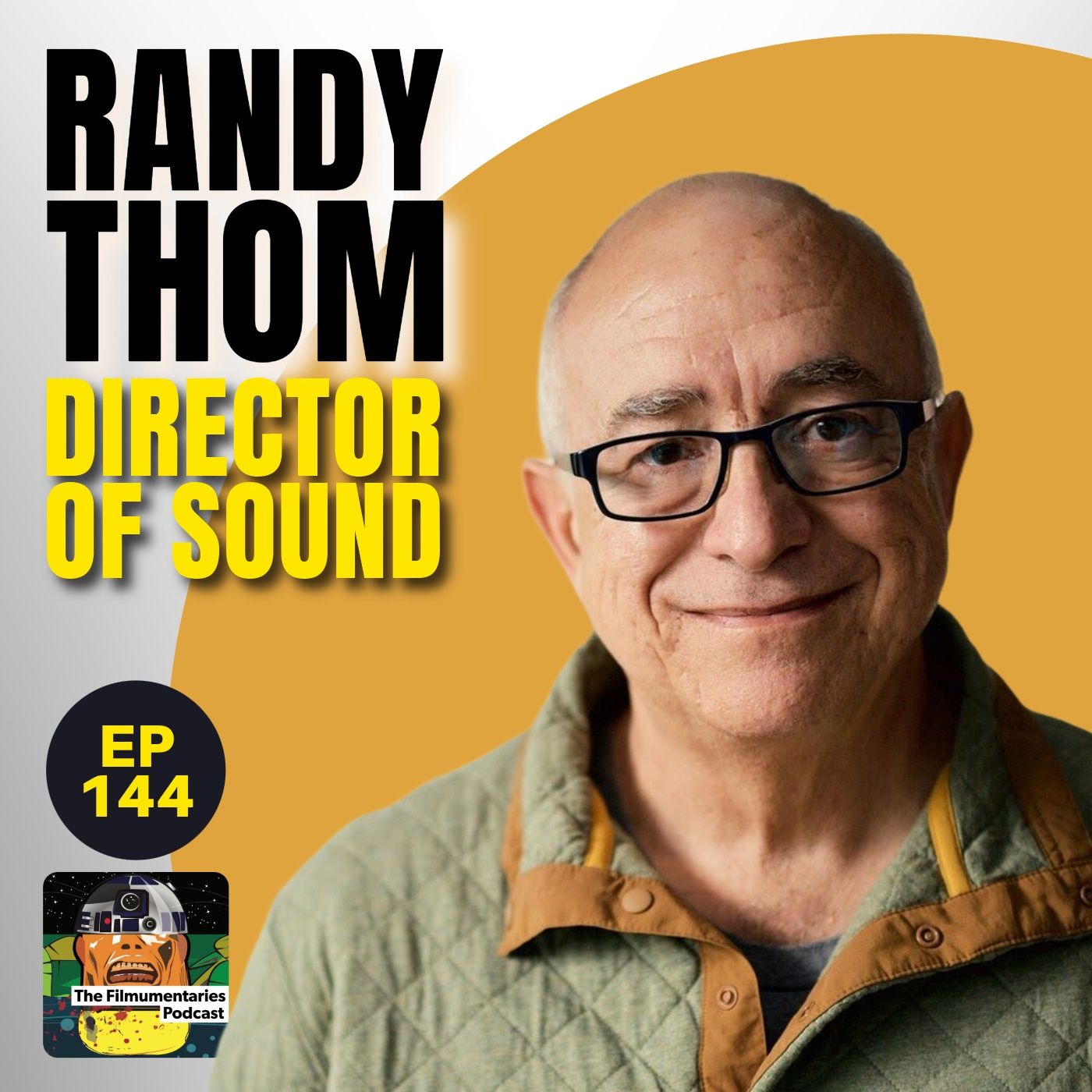
About this episode
- Growing up loving movies and discovering sound via college radio in Ohio
- Making a cold call to Walter Murch and landing a job on Apocalypse Now
- Early sound experiments at Skywalker Ranch
- Recording effects for The Empire Strikes Back and Raiders of the Lost Ark
- Collaborating with Robert Zemeckis and David Lynch
- Why sound should be involved in pre-production
- The evolution from analog to digital workflows
- The creative and economic impact of AI on film sound
- The philosophy behind “inventing” sonic space
- Winning an Oscar for The Right Stuff
- Winning a BAFTA for The Revenant
See below for all the links you might need!
This podcast is completely independent and made possible by listener support. If you’d like to help me keep making these episodes, you can join my Patreon community here: https://patreon.com/jamiebenning
Watch more on YouTube:
Check out the Filmumentaries YouTube channel for behind-the-scenes clips and extra content: https://youtube.com/filmumentaries
All my links
Transcript
Automatically generated, so expect the odd misheard name.
Weirding Way Media. Hello and welcome to episode one hundred and forty four of the Film we Mentor's podcast It's just Me Here. Jamie as always jabbing on about the artists behind the films we love and in the midst of all the noise and chaos that's going on in the world at the moment, here's a cart film focused distraction for the next hour or so. Today's guest is the legendary sound designer, re recording mixer, and director of sound at Skywalker Sound, Randy Tom. Randy's career stretches from the analog era of Nagra recorders right through to the digital revolution.
He began in radio, but making a cold call to Walter Merch found him working alongside his hero on Apocalypse Now, a film that would redefine what cinematic sound could be. From there, he went on to work on films like The Empire Strikes Back, Raiders of the Lost arc The Right Stuff, Forest Gump, The Revenant, and many many more, collaborating with directors including Robert Zemechis, David Lynch, and Francis Ford Coppola. Of course, so we talk about the moment A certain film pushed him into film sound working at Skywalker Runt in the early days, why sound should be involved in pre production that shift from analog to digital, the looming impact of AI, why authenticity can sometimes get in the way of storytelling, and what it actually feels like to win an Oscar and a Bafta.
As always, if you enjoy these conversations and want to support the podcast, you can do so at patreon dot com forward slash Jamie Benning, where you'll get a few extra bonuses depending on the tear that you choose. So here's my conversation with Randy tom, director of sound at Skywalker Sound, and I'll be back at the end for a bit more jabbering on. Randy, your path into sound wasn't necessarily a straight line. But were you always a movie fan growing up or did that fascination come from somewhere else entirely? I think I did always love movies.
I think maybe the first movie I remember going to was Bambi maybe, and I think that was the first movie I took my son too as well. And I remember going to the Alamo, you know, John Wayne's version of the Alamo, and you know, lots of other movies. As a youngster, and so yeah, I loved movies, though it never occurred to me until I was around twenty that I might get involved in sound as a career. And what was that moment at twenty then where you thought this could be for me? Well, I was.
I had dropped out of college, and I was roaming around the US, being a hippie basically, and found myself in Yellow Springs, Ohio, which is where Antioch College is, which in those days around nineteen seventy or so was maybe the most liberal college in the country and attracted students from all over the country into this southwest corner of Ohio. And I was just living there, curious to be there because of the culture. And I happened to see and I was, by the way, basically homeless. I was camping out and doing odd jobs and exchanging you know, being able to sleep on somebody's couch for washing their dishes and that sort of thing. And happen to see a notice on a bulletin board that said we're looking for volunteers for our radio station.
And I thought, well, that sounds interesting, And it turned out it was the college radio station. But you didn't need to be officially associated with the college to get involved. So I volunteered and they somehow let me in, and I fell in love with sound in a whole new way. And I was reasonably good at science in school, and so I understood pretty quickly how most of the equipment worked, and did some DJing and started doing little documentaries for National Public Radio and things like that, and some sound design, though we didn't call it sound design in those days, for radio plays that were being produced at the college. And so that's how I got into sound and worked in a couple of radio stations for several years.
Moved to the California to Berkeley and worked in the radio station their KPFA, which was the most liberal station there. The funny thing is, you know, when people hear my deep voice, they say, well, you know, of course you worked in radio. But the irony is that the kinds of radio stations where I worked, the last thing they wanted was somebody who sounded like they belonged on the radio. So actually my voice was more of a problem for me in those stations than it was an asset. So that brings us up to the mid seventies, and I decided it was time that I got a little more serious about earning a living, and because not much money to be made in public radio and especially in those kinds of stations.
And so I saw Star Wars, and I think seeing the first Star Wars film was the thing that pushed me over the edge and made me decide I needed to work in film sound somehow. So I started knocking on doors in northern California, where I lived, in the San Francisco Bay Area, where there was a small but significant film community. At that point I decided I did not want to move to Los Angeles, which is where most people, of course in the US go if they think they want to work in film. Wise move, as it turns out, yeah. Any aspect of film.
And for about a year, maybe a little over a year, I was very diligent at you know, trying to get jobs. Nothing was happening. And but somebody uh suggested that I contact Walter Merch because they had taken a class from him that he had a little seminar that he had taught at the San Francisco Art Institute. And so I called American Zootrope just a cold call and asked to speak to Walter Merch and by some miracle. Walter answered the phone and I said, you know, I'd been working in radio for several years now.
I've done quite a bit of music recording and doing sound creative sound work for radio plays and that sort of thing, and I'm really interested in working in movies. And so he invited me to come and meet with him. Amazing, and so I spent all day one day watching him remix the sound for the George lucasfilm American Graffiti into stereo. The original film had been released only in mono, and so they were going to do a stereo version. And coincidentally, Ben Burt was there also, because Walter had kind of handed over the George Lucas sound raids to Ben at that point, and a couple of other people who I would wind up working with later.
So it was quite a day in terms of meeting film sound heroes. Yeah, and at the end of the day, Walter asked me to write an essay about what I had seen and heard that day, and I thought, well, I guess this is how you get into the movie business. You've write an. Essay that's very Walter. Yeah, yeah, yeah, And by the way, he lost the essay and I don't have a copy of it, so I have no idea what I wrote, but he apparently liked what I wrote, and he invited me back for another interview where I was also interviewed by one of the other picture editors on Apocalypse, and Walter hired me to be one of his assistants on the film.
And so I spent the next year and a half or so working on Apocalypse Now, and that was my film school. Wow, you sort of lucked into with that determination of trying to get in and making that cold call. You lucked into future and current. I guess sound royalty there save Walter Ben and that film as well. Apocalypse Now.
I can't sort of help when I think about the film, I can't help but think about the soundscape. It's part of the film's DNA somehow, isn't it. Some films, you know, the sound kind of passes you by, but that you can't imagine that film without thinking of the soundscape, whether it's the you know, the ceiling fans and the helicopter sounds, or whether it's the music. What a project to be the first or well, yeah, the first few to work on. I mean, what do you think were the biggest lessons you learned during that film, because that was when the idea of multi track sound really took off, wasn't it.
Yeah, it was certainly one of those one of the first films, if not in the first film to have what we now think of as five point one sound. And it would be hard to come up with the number one lesson that I learned. I learned so many important lessons on that one. One of the most important one was that it taught me what I I guess. It taught me the questions that I needed to ask about what opens the door in a film to have really interesting sound.
And you know, the original John Millia script for the film was a much more kind of traditional, straightforward movie than the film Coppola wound up making. And but Coppola once he started revising the script after it was determined that he was going to direct it, because of the original idea was that George Lucas was going to direct Apocalyuts. Now as he began to work on it, as Francis began to work on it, he decided that it should be much more point of view than a traditional narrative. He really wanted to express the point of view of the American soldiers in Vietnam in general, and specifically of the central character, Captain Willard, the Martin Chene character. And so that decision to tell it via somebody's POV really is what swung the doors wide open for Walter to do all the amazing things that he did.
And so that's been the kind of soapbox that I've been on since that is trying to help myself understand better and help filmmakers understand better how to design their films in ways that open doors to sound really participate in. Yeah, And that early engagement of the sound apartment is something that seems to run as a thread through many of your talks I've seen in your essays and things. And I've spoken to a bunch of sound department people at Skywalk Sound and elsewhere, and all of them say. That the best projects they worked on all those projects. Where sound can have a two way street between sound and picture.
Sounds can inform visuals, visuals can inform sounds. Is that something that you urge directors to do to bring the sound apartment on early in projects? Yeah, Yeah, always, whenever it's possible. Yeah, there's really no reason why sound ideas shouldn't be fairly deeply considered and even experimented with in pre production, just like cinematography ideas and production design ideas are experimented with in pre production. Yeah, the temptation, the convention is always to wait until the end, after the film has been shot, to really begin to think seriously about sound.
But by then the ship has already sailed in terms of lots of decisions that could have been influenced by sound if somebody had thought to do that earlier on. Ben started collecting sounds and designing sounds for the original Star Wars film over a year before shooting began. Yeah, and that's one of the reasons that it was the success. It was, Yeah, and still always talked about so much today. It seems to be that you found yourself in a situation where sound was really having this turning point, where it's particularly in the Lucas and Spielberg kind of wheelhouse, you were able to and working with Zamechas as well.
I would imagine you were able to be on those shows very early. I mean, I think when I look back at your filmography that the mention of the empire strikes back and raising the Lost Arc You're working as a sound recordist, and that was some of the some of the very earliest sounds being made for those films, wasn't it that? Were you down there in the Marin County Hills blowing up things and recording guns and things like that. Yeah. Yeah, before any of the new buildings were built at Skywalker, Starting in I think nineteen seventy nine, Ben and I and Gary Summers and a couple of other people would go out to what is now Skywalker Ranch and you know, literally blow things up and record ricochets and yeah, all kinds of things that we're not allowed to do now of course.
Yeah. Yeah, and yeah, those those recordings are still being used today in films. Yeah, amazing. And did Randy Tom ever win a trophy at the Droid Olympics Water. No, I never did.
Yeah, I wish the Droid Olympics was still an ongoing thing. Yeah. I saw Walter earlier in the year at a funeral. Sadly, but we were talking about the Droid Olympics and he had that same sort of wish that it could still happen because it was such a sort of great way of bringing all of those collaborators together all those people in your field. But that's something that George really seems to have fostered, is that kind of collaborative nature, and that whole reason for moving everything up to northern California Creighton Skywalkeranch And you know, having been there myself, I'm aware of the beauty that's surrounding you.
You know, you could be in a room with. No natural light, but when you step outside, you've got the lake and the hills and the cows and the bees and everything else going on. What does that environment do for you, as somebody who's clearly very creative, what space is that? Does that enable you to have to then go back with fresh ideas? Maybe?
Yeah? Yeah, Some people who visit the rants say, how in the world you get any work done here? I'd be outside, you know, hiking on the trails all the time. But the odd thing is that, in a way, the reverse is true. Being in an environment that's as beautiful as that, I think actually encourages more work.
Funny enough, maybe it's because you don't have this general kind of feeling of alienation and you know, I, you know, I hate coming to this city every day and et cetera. Yeah, so those kinds of thoughts are just not in your mind, and somehow it allows me to concentrate more on what I'm doing. And I think everybody knows that it's always a good idea to work for a while, maybe as little as fifteen minutes, times thirty minutes, sometimes an hour, and then get up and walk around you know, the building that you're in or outside for a few minutes, and then come back. And it's not only good for you physically, but I think it gives your mind a kind of reset, so that very often I find that if I have some kind of creative block about something, if I just get away from it and go take a walk and have a conversation with somebody and then come back, very often I'll have some new insight that I wouldn't have had if I just sat there staring at the computer screen.
Yeah, there is something about that kind of isolationist approach where people think they have to lock every door and hunker down to get something achieved. But just being I could sense just walking around the ranch and the tech building that you know, despite this amazing work going on behind those closed doors, when you walk down the corridor, you would see people just chatting about the project they were working on and suddenly that there is something that's to do with sound as well. I think where you just verbalize something and there's this sort of feedback it goes back into your ear and sometimes you've solved the problem yourself just by having the fact that somebody's there listening to you.
You know. But do you find that collaborative nature really useful, like being able to just talk across different projects and having lunch in the same space and having those kind of community events and things. Yeah. Absolutely. One of the things that George wanted to do in starting the company up in Northern California was to make sure that it had as many similarities as possible to the best parts of film school.
Yeah, for his memories of film school at USC, which was all about collaboration and about sharing responsibilities, you know, one person being able to maybe do several kinds of jobs, not be pigeonholed into only being able to do one kind of job. And he thought that the you know, the traditions in the Los Angeles film community were counter to that. That was trying to restrict what people can do instead of open doors for different kinds of opportunities and learning about different crafts and that sort of thing. So, and when we were next door to Ilm before what was called Sprucket Systems in those days became Skywalker Sound and moved to the ranch, it was very common for us to wander over next door to il M to the model shop and ask stupid questions and they would do the same.
They would come over and chat with us and learn about sound. And you know, that's an amazing opportunity when you know visual artists and sound artists can interact that way. So that's always been the kind of work culture at Skywalker, very collaborative, not proprietary or secretive in the way things too often are in film soyal where people are afraid to give away their trade secrets because then other people might steal their clients from them. That kind of attitude really virtually doesn't exist at all at Skywalker. We very much believe in sharing what we know.
And you think that the rising tide will float all of the boats even higher. Yeah, that's a great that's a great way to look at it. And as your career trajectory continues, I mean, I've been involved with so many amazing directors, so many amazing films, and I, you know, I see that, like Walter, you're a technician, you're an artist, you're also a philosopher in many ways about your craft. And is there is there a director that you worked with where you felt a particular kinship or that you naturally aligned with, where it kind of not made your job easier necessarily, but you kind of had a shorthand with each other. Well, certainly zamecas I think I've done sixteen films with Bob's Americas, and he knows pretty much how I'm going to respond to the images that he generates, and so there's very much a kind of shorthand.
We don't always have to have long conversations about, you know, how things should sound, because I have a pretty good idea of what he's going to want. Occasionally I'm wrong, but then I just go back and redo it. Yeah, but there have been lots of directors that I felt kind of sonic kinship with, you know, David Lynch. David I only worked on one Lynch film, Wild at Heart, but when that was over, he asked me to move to Los Angeles to be his sound guy because he didn't want to have to come up to northern California. And it was a bit of a tough decision for me to make, because you know, who would who who would turn down an offer from David Lynch to be his in house sound person.
But I was already so well established at Skywalker and it's such an amazing place to work, and I get to work there with such a wide variety of directors that I had to tell David no, And I think David didn't like to be told no, So I never worked on another one of his films. What do you think it was that he saw in you that made him have that and made it have that kinship? Was it a particular kind of outlook on the approach to sound? Was it the because you know, as a as a director, of course, he's very visual, but he also doesn't really conform to the way other people do things. That's what made him David Lynch, did he see that in you?
Do you think as well? I guess yeah. We both certainly love to experiment, and he always was a big believer in improvising and you know, having a plan, but not being reluctant at all to deviate from the plan if something happened that seemed to offer new possibilities, and I think that's always been my attitude as well. And we both loved bass frequencies. I think that was something we had in common.
You know, Alan Split had done the sound for all of Lynch's films up to Wild at Heart. But Alan was such a kind of gentle soul, really a hippie, and the violence in David's films was a problem for it. And I think when you know, Blue Velvet was violent enough, but then when Wild at Heart came around and the first scene is somebody being beaten to death, I think that was just too much for Alan. So he told David that he just didn't think he could do it. And so that's how I got the opportunity because the picture editor on Wild at Heart, this guy named Dwayne Dunham, is somebody who I had known at Lucasfilm and so he suggested to David that he talked to me, and so that's how I got the job.
And in watching sort of Lynch's films after that offer, did you I mean, it must have been difficult not to imagine how that relationship might have been. But is there a particular sound designer or collaboration between an a sound department person and a director that you admire. Is there somebody particular that kind of stands out to you that was your north star or was that always within those four walls of the branch? Well, certainly Walter and the way that he worked with Francis. I think Walter and Ben were definitely the two biggest influences on me, and Allen as well.
I think I may be the only person who got to work closely with all three of those kind of sound film sound titans of the seventies Merchant Burden split all one syllable on a poetic on a mother poetic names, and so you know, something from all of them, including the ways that they worked with their directors, definitely rubbed off on me. That's sometimes mentors aren't necessarily people standing there and standing over you and guiding you. Are they They're people who you know, whose work you admire and who you want to kind of learn the lessons from and all those things. Would you say that Walter and Ben were those mentors for you. Mostly, then sure, yeah, absolutely.
Yeah, Yeah, it's important to have mentors. And then you reach a stage in your career of course, where suddenly you're the older guy and you've got these younger people coming along. Did you have. People that you mentored throughout your time at Skywalker. Oh yeah, there have been lots.
I wouldn't say that I had always been a good for a very good mentor, but I certainly have mentored a lot of people. There's a guid named Will Files who started as my intern who's now a kind of film sound big shot in Los Angeles. And Mac is another person. Yeah, I met him at the same time. I met Will Files actually in Iowa at a tribute to Walter, and they both told me that they were, you know, interested in maybe moving to California and doing film sounds.
So I said, well, you know, come to Skywalker and we'll have a talk, and I wound up hiring both of them. So yeah, they've been many, many people who I like to think I've had a good influence on. Yeah, I'm sure. I'm sure it's the case. Again, when I look through your filmography, Randy, there's so many amazing tiles, so many amazing films that you've worked on.
But you've worked in the industry over so many decades where technology has completely changed where how sound is approached and a film has completely changed as well. What do you think. I mean, obviously the technology is just at all ultimately and you have to move with the times. Was there a particular time that you've found challenging because of that technological change, Because at some point you kind of have to leave the old ways behind and adopt the new ways because that's what's expected for somewhere, like you know, Lucasfilm, you want to be at that cutting edge as well. Yeah, well, I got into the film business at the beginning of approximately the last decade of the analogue era, and so I was using nagras and moviolas and you know, thirty five millimeters sprocketed film, and it was definitely a challenge going to digital.
And there were a lot of people, a lot of film sound veterans who quit, who retired, who just couldn't wrap their heads around this brand new, very different technology. That's funny. I often remind some of the engineers who were around in those days who assured us that once everything is digital, there just won't be any technical problems anymore. How wrong they were. Yeah, yeah, So yeah, that was tough and we are about to go into a similarly era where AI is going to have more and more influence, and you know, there's no doubt that a lot of people are going to lose their jobs.
There will be it's inevitable that there will be fewer people working on film sound projects twenty years from now than there are now. We hope that there will be other kinds of jobs for them to do, but they won't be doing what they're doing now. So I'm somewhat grateful that I will probably be fully retired. You really have that. You really sat in the sweet spot there, Andy, haven't you, you know, going through that transition and yeah, yeah, it's amazing.
I just saw today, I think it was a video from Adobe in premiere. Now you can just open up a mono track into multiple stems of different like here's the background noise with a bell, here's the here's the dialogue, here's the music, and you can cancel this. I mean, it's incredible where it's going. It's all of those things that you know we used to see on things like CSI, you know, like Enhance or Blade Runner or something you know, visually, but now the tools are kind of getting to the point where they're kind of undermanaged, unimaginable because you can't understand the technology behind it. That's what's difficult for me, and I think, you know, even the creators of this stuff don't know exactly how it's working.
Yeah, we're all able to be Harry call now in the conversation. Yeah, take that mono recording of people talking with loud music in the background and wind it down, remove the music in a Yeah, it's amazing. Yeah, Walter, the visionary half. For visually driven directors then, because you know, direct the director's job is mostly regarded as a visual medium. Right.
Do you see that there's been a ce change in directors who've come up through film school as opposed to people in the seventies that maybe didn't go through the film school environment, where they are more keyed into to sound as you know, one of the many tools in their toolbox. Or do you think that sound is still regarded somewhat as a post production process. Yeah, it is still regarded as a post production process to a greater degree than it should be. There are more and more directors who are getting sound involved early, partly because I've written so many of these articles and opinion pieces about that. I more and more writer directors are getting in touch with me and asking if I can consult on scripts, which is a great thing that never happened, you know, fifteen or twenty years ago.
And now I get an inquiry like that, you know, every month or so, at least once a lenths, i'd say, And so that's pretty gratifying, and it makes me optimistic about the future. I'm not sure whether it's necessarily film schools that are introducing those ideas into directors' heads or if it's just sort of in the air. I'm sure it's at least partly the film schools that are doing a better job of saying, you know, sound shouldn't be thought of as the caboose on the train, and sound ideas can influence the way you shoot the film and should in many cases. But I'm glad the tide seems to be turning a bit. Again.
The Tempole movies that Skywalker sound are kind of associated with it. I can see you've worked on throughout the years. I mean that Skywalker becomes associated with just big movies. But if you look a little deeper, and I know that Skywalker trying to put it out there more at the moment that they're not just about those tempole movies, they're about documentaries and indie movies. How important do you think that is too the studio as a whole and to you personally, to have that sense of balance between those big movies and those those smaller projects.
Yeah, I wouldn't want to work on one big blockbuster movie after another. I think it's fantastic to go back and forth between different styles and different budgets. You know, I worked on cry Baby, this John Waters movie, which nobody would think of as a tent pole movie, and I've worked on lots of other films more or less like that, you know, Koyana Scatzi. In the very early days. The original plan was that there would be a kind of sound effects score along with the Philip Glass score, but we couldn't figure out how to integrate them.
And mister Glass won won the battle. And it certainly plays, you know, amazingly well done the way it was done, so I can't complain. But yeah, the Godfrey Reggio, the director, had this idea that there would be this kind of counterpoint mechanical, rhythmic, machine based score and certain sequences at least I thought worked really well, but in the end it was decided that it was better to just go with the musical score. So Yeah, I'm a big believer in working on a variety of projects, partly because very often I'll get an idea or I'll make a sound discovery when I'm working on one kind of film that may not even apply to that kind of film, and I can't find a way to put it in there. But when I go to another the next project, which is a very different kind of film, suddenly that idea is the perfect thing to work there.
So and it's just a good kind of creative mind reset. I think to work on all different kinds of movies instead of, you know, like one big action adventure film after another. And does working on a smaller project mean that you get to have, you know, a bigger range of roles rather than just being the re recording mixer or the sound designer on a big project. Does it on those smaller projects you sometimes get a chance to see it from its very inception all the way through to the final mix. Yeah.
Well, I've done that on big budget and low budget yeah projects, And that's always been my favorite way to work too, and that was Walter and Ben's original idea of the role of the sound designer. That term got perverted a little bit in the mainly in Los Angeles, where in the early days the supervising sound editors were afraid of sound designers because the fear was that they were going to, you know, walk in with their berets on and steal clients. And so the sound designer term got changed to me and just you know, the nerd who you hire to make the spaceship sounds, which was not at all Walter and Ben's notion in the beginning. It was that there should be somebody overseeing the sound creatively, beginning in pre production and going all the way through the final mix, all of the sound, you know, except for the music.
So yeah, that's always been my favorite way to work. But on some films I've just been a re recording mixer. I did have a short, very short career as a production mixer. Early in my career, I did the production sound for Never cry Wolf and Rumblefish and a couple of other films, but I quickly decided that was too much work and jumped back into post production. So yeah, yeah, I was just going to say about the sort of production sound.
Often, you know, it's the case that you're creating a soundscape with that kind of building block of what was recorded on set to a certain extent. But then, of course you worked on animation where there is no sound, you start completely from the ground up, I imagine as well. That's another discipline that is kind of tantalizing to you because it gets you know, you get to use a different part of your brain in a way. Yeah, and in animation it's almost necessary to begin working on the sound design early because the way that at least, you know, Western style animation is done, you know, anime is a little different, and the other traditions are different still, but the way animation is done mostly in the USA and Europe is that you basically start with a radio play with still images.
You know, you have storyboards, and very often there's not even a finished script for the film. There are just ideas about characters and scenes, and so the animators try to flesh those out and see if it turns into a full blown story. And so when those early assemblies of storyboards are being put together, the animation filmmakers really desperately need sound, both music and sound effects to sell these ideas and see if a sequence has any potential at all, and so on animation projects, we are very often doing pretty elaborate sound design jobs just to storyboards, you know, stick figures, which is sometimes really difficult because it's as much as we in sound complain about the dominance of the visual, we also lean on the visual a lot in terms of storytelling, and so it's in a way it's a luxury to have a more or less visual finished set of visual images, because that makes what you need to do with sound a little bit significantly more clear, whereas when you just have stick figures and storyboards, it's not always at all clear exactly what should be done with the sound or what the timing should be, and so you do a lot of guessing.
And so we do a lot of that kind of speculative sound design in animation and constantly sending things to the filmmakers and the animators, sounds for them to listen to, and then getting feedback from them you know this is great, this is really not so great because is too scary, this is not funny enough, you know, that sort of thing, And it becomes this iterative process where we send them things, They send us feed back, They send us new visual images that maybe clarify things that weren't quite clear before, and that all begins in you know, what might as well be pre production. Yeah. So do you have a sort of moment in time in a period of making a movie where the soundscape, at least the intention of the soundscape should become apparent, Like, do you get do you ever get past the threshold where you think we really should be in a better place right now?
I need to be nudged into those parameters by that feedback. Is there a particular moment in the project where you think we need to be there now? Well, it's of course different on every I'm sure project. Yeah, but yeah, there's usually at least there's a period of maybe a few weeks where that becomes apparent. Yeah, and I guess as well.
You've had experiences where you've gone down one path and you've got very close to completion and then suddenly something sparks and things have changed around for the better. Yeah, that definitely happens. You know, sometimes reshoots are done on a film, or a new footage shot that opens the door to sound that hadn't been there. Before, or a new assembly of the picture, a new cut of the picture will suggest things that maybe hadn't been suggested before. Yeah, yeah, yeah, And we spoke earlier about mentorship, and I noticed that I think I've followed you on Facebook for for some time now, and you have this this Patreon page now offering kind of behind the scenes access to your sound work and your philosophy, and subscription based, as Patreon is, I have Patreon for this this podcast.
Do you see that as a way of kind of well, as Yoda would say, passing on what you've learned. Yeah, and I still, you know, post tips and ideas on Facebook. Yeah, you know that are free for anybody to access. But I thought it might make sense to start a channel where I was somewhat restrictive in terms of, you know, the audience, and make a subscription based And it's certainly not a large channel at this point, but I'm very grateful to my loyal supporters who do subscribe to it. Yeah.
That's the thing, isn't it about Patron And I think we have similar ish numbers, But it's great to know you have got that kind of dedicated, committed group because I find as well that as I put things out there, the members are kind of influencing what I do as well. Have you found that as well, that. You get that feedback and it pays and it sort of plays into what you do day to day. Oh yeah, yeah. And it's one of the reasons that I've always loved having interns because they almost always ask really good questions that force you to rethink assumptions that you have been making for a while, and also being forced to explain something to someone who doesn't have as much experience as you do in a given area sort of teaches you something important about what it is that you're trying to explain because you're forced to break it down into logical, rollably easy to understand parcels.
Yeah, it reveals something, doesn't I do some training on an editing system. I work in television myself, and sometimes I'll get a student there's just firing questions at me, like thousands of questions, it feels like over three days, and it reveals something to me each time, something new each time, because, like you say, you're just you just have to kind of break it down and come to terms with why you've made these assumptions and maybe maybe they have a question that makes more sense than what you've been doing for twenty years. You know. It's sometimes they're able to leap frog those moments. Yeah, that sometimes happens.
You think, well, why have I been doing it that way? This halter. Yeah. One of the other things I was going to say for Skywalker Ranch is that you've got the full gamut of the sound process in that you know, you can be recording there, you can be doing foley, you can be doing mixing, rerecording, whatever you're doing. It can be done in those those kind of four walls if you like.
How important do you think that is for people that work in your department to be able to see that all the way through? And also you've got that amazing stag theater as well, which I was lucky enough to sit down in and be played this amazing demo reel, so you can see the final product right there as well. Do you think that's important to have all of those steps available for you and your colleagues. I think it is important to have a piece of every part of film sound, at least post production s there in that one facility. We also have a scoring stage where you can record a symphony orchestra, or we can record sound effects.
You know, we roll bowling balls across the big wooden floor. We destroyed a couple of cars in there just to record the sounds, record giant pieces of dry ice, et cetera. But yeah, to be able to do fully, to record a d R, to record sound effects, whether they're you know, in sync or wild, to be able to remix you know, a small film or or you know, mix any kind of film there in that one facility. Having all that together is a huge advantage. Yeah.
And when you sit down in that stag theater, are you a to be a member of the audience or in your first viewing are you is your analytical brain kind of fired up? And are you picking it apart from a sound perspective? Yeah, you mean when I'm seeing a film that didn't work. Yeah, when you when it's an Academy screening or something. Yeah, yeah, Yeah, it's it's a funny thing.
When it's when the film really gets me, gets to me and captures my imagination. It's almost impossible for me to think about the sound in the film. I sometimes have to go back and watch it again and make myself think about the sound because in that way, I'm just like, you know, a person on the street. It's it's a movie, and it's like it's a dream like experience, and you tend not to be analytical about it. And that's an important thing that we and sound I think forget too often, which is that people don't expect films to be you know, they don't expect a fiction film to be a documentary.
They don't expect everything about the soundtrack to be absolutely authentic and believable and a reflection of the real world. It's all about storytelling, it's not about trying to reproduce the real world. And so we always tip our hacks to authenticity. But I think it's always a mistake to be put in a straight jacket by authenticity. I sometimes complain about a mindset that goes along with, or is presumed by these new multi channel field recording setups, where, you know, isn't it amazing to be able to go to the Amazon and capture full, you know, surround sound, And it is amazing and it's great to listen to them, but it's often very difficult to actually integrate them into a film because let's say you were working on a film that takes place in the Amazon jungle, and so you go record, make all these wild recordings of that are in five point one, seven point one whatever in the field, and then when you try to integrate those with the visual images, what you will often find is that, you know, the great recording that you got of the parrot flying from the front left speaker to the right rear speaker isn't in sync with any bird in any of those shots.
And you what you wind up doing, inevitably is manipulating the the sonic sound field to make it work with what you're seeing. And so in some sense you might as well have just made a stereo or even mono recordings and then just tailored them to do what you need them to do. So I think multi channel field recording certainly has a place, but it's not at all a kind of, you know, panacea for doing multi channel sound for movies, you know, in Apocalypse Now. I think Apocalypse Now still has some of the best sonic environments of any film ever made, and an amazing number of those sounds were actually mono recordings that were just panned around the room and then of course mixed with other mono recordings and some stereo recordings, and so I'm always an advocate for inventing the sonic field rather than capturing the sonic field.
Yeah, the otherwise you're kind of hemming yourself in, aren't you. And I think as well, with audience expectations, there are certain tropes on there. There are certain sound effects that people just expect subconsciously. I think I saw a video as earlier today, I think November, talking about the sound of a silencer on a gun. You know, we're just used to that sound.
It's in hundreds of movies, and if you actually put in the real sound of a silencer, people would be saying, well, hang on a minute, and they'd be taken immediately out of it. So the work that you do has to be very careful and considered and subtle if you are going to deviate from those expectators. But I mean, I imagine that's something that is always a challenge, right that you've you've always got you've got these kind of railroads that you have to go along. But you are able to deviate slightly because otherwise you'd lose interest, I'm sure, as well as the audience. Yeah.
Yeah, A classic example is the delay between a flash of lightning and the thunder. It's the movie convention is to almost always have the thunder begin immediately for you when you see the flash of lightning, even though very often there's a quite a bit of a delay. And so if you're true to the laws of physics and allow for that delay, sometimes it will momentarily take people out of the movie because they'll think, well, I'm so used to hearing the thunder immediately that you know, is there a technical album I was there that even though they know you should know from your own human experience that that's the way it usually is. Somehow, the conventions that have been set up in movies over so many decades will rule the day.
Yeah, As a last question, Randy, because I could talk to you all day. Awards, You've you've won many awards over the years. You've had this amazing career over multiple decades. Are you able to kind of take a moment pause, look back and kind. Of appreciate.
What you've achieved over the years, or you somebody that's always kind of forging ahead to the next project. Well, some of both, I think yeah, And I don't think I've ever been as kind of obsessed with winning awards, as some of my peers have been, and I'm sure some are even less concerned about it than I am. But I certainly know people who just get depressed when they one of their projects doesn't get nominated or doesn't win an award, And I've never been that way. In some ways, I take awards seriously, you know, it is it's great to be nominated by your peers, but all award processes are flawed. You know, every year, I think there are certain film sound projects that should get nominated or win awards that don't, and always a few that do win the awards that I think shouldn't have.
And I think you just have to take all of that with a grain of salt and understand that that's the way life is, and everything isn't always fair. And if you're lucky enough to win an award or at least get nominated for an award once in a while, yeah, you should appreciate that, and and I do very much. Is there one in particular that was Was it the first one that really hit the hardest for you? When you want the first one an Academy award? Yeah, getting an Oscar for the right stuff.
That was an amazing experience because you know, oscars are such an iconic object in world culture, really yep, and so it was you know, like a like a dream. It was amazing. But I had always wanted to win a Bafta and so I'd say getting a getting the BAFTA Award for the Revenant was almost equivalent to getting my first Oscar because, for one thing, it's such a beautiful statue. And I think the BAFTA membership has a different set of criteria than the Oscar membership does, and so it was great to successfully climb that mountain at least once as well. Yeah, it feels in some ways like you know, I mean, it's the same for us here, I'm sure, and how we regard the Oscars because it can feel a bit insular in your own little bubble there, I guess wherever you are where they're in Hollywood or they're in the UK.
So it's nice to have that recognition from the outside. Were you in attendance for that? We did you come over for this? I was? I came over brilliant.
And I have to say I think the BAFTA experiences is superior to the to the Oscar experience in a variety of ways, and I had a wonderful time. That's good to hear. That's made me feel a little bit prouder for being British, which you know, we don't have a great chance to do in modern times quite often. So no, but Randy, I really appreciate your time today, and you know, from this side of the screen, thank you for your work and thank you, thank you. For everything you've done.
It's been a pleasure speaking with you. Thanks a lot. I hope you enjoyed my conversation with Randy tom there. I love to speak to people like Randy. Actually met Randy in person back in twenty twenty three when I visited Skarbalkok Runch.
Max Smith, who works there at Skywalker Sound, took me round to see Randy and we had a small chat because I did try and get him on the podcast back then, but for some reason we couldn't do it. I can't remember, but we did get around to it finally. He's another deep thinker about how films are structured, how point of view opens doors for sonic storytelling, and why we shouldn't put ourselves in a straight jacket of authenticity. I like that. I like that idea.
I particularly loved his idea about inventing the sonic field rather than just capturing it. That the idea that sound isn't just about reproducing reality, it's about well, of course, it's about serving the story. If you enjoy this episode, please consider leaving a rating or review, sharing it with someone who loves films, or supporting the show on Patreon. Thanks to all of you that supported the recent gofund me for the Joe Apps project, We've almost reached our target. I think we're at fifty five percent or so now.
So if you want to check out the show notes, if you want to contribute to that. Because it is an important story, it needs telling, and nobody else is going to pay for it, we need to pay for it as fans, so I'd appreciate if you could get on board with that as well. But as I said, the Patreon genuinely keeps this podcast going. Couldn't do it without that. Thanks for listening, and hope you can join me for the next episode of the Film Wementaries podcast.
Weird get Away Media



Similar episodes across the network
Matched by shared keywords.
-
Primetime - Kulture Meltdown
1 shared keyword: robert
-
Remington Steele: Making it Happen with Jerram Swartz
1 shared keyword: robert
-
Scarecrow and Mrs. King and Martha Smith
1 shared keyword: smith