
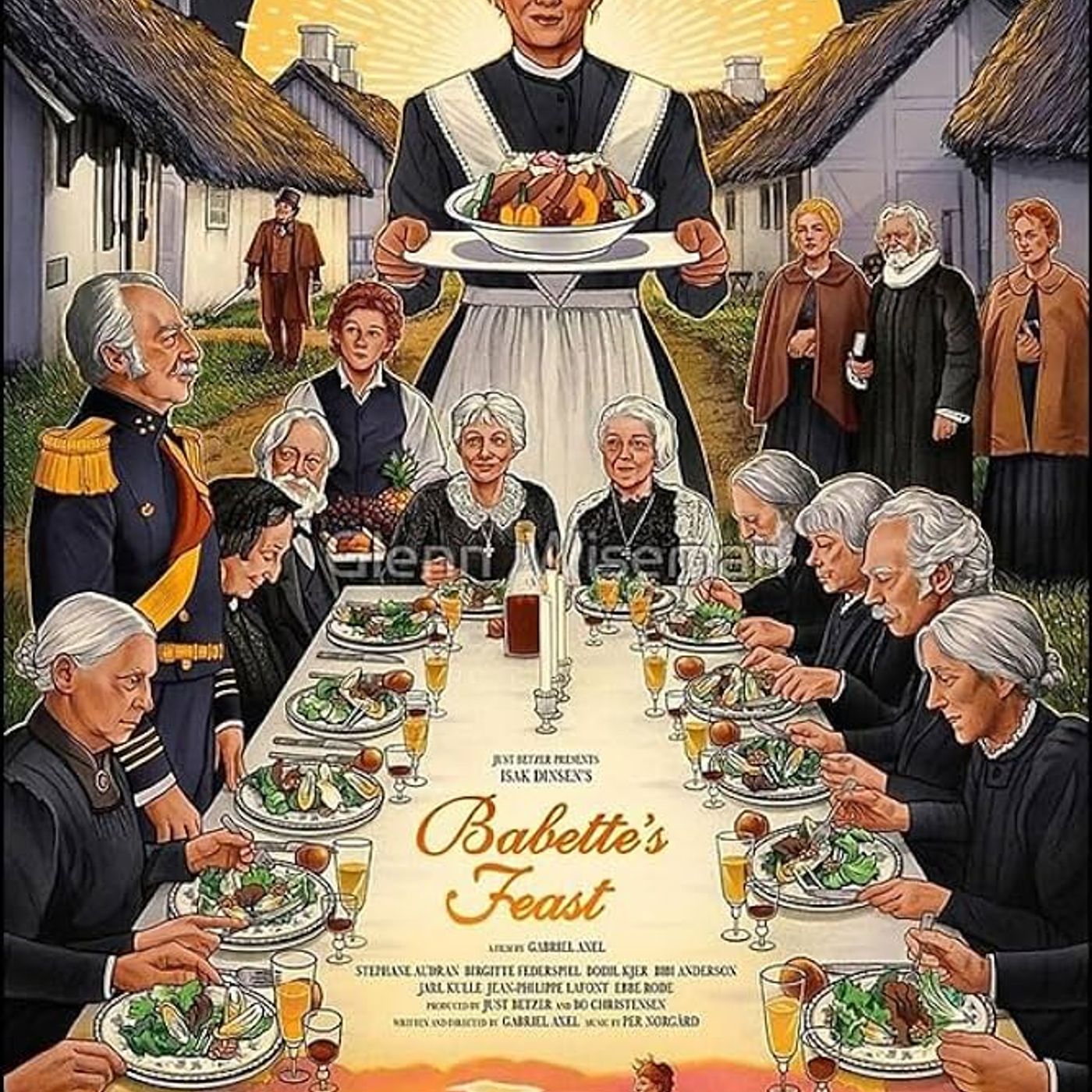

About this episode
Based on the short story by Karen Blixen, the film tells the story of two sisters, Martine and Filipa, who, after devoting their lives to their father, take in a French Revolution refugee who becomes their live-in chef. This chef becomes part of their lives and, after winning the state lottery, decides to pay it forward with the titular feast. Religion, food, and where the two meet; it's a truly mesmerizing film and a worthy adaptation of the classic story.
For more Kulturecast episodes and podcasts guaranteed to be your new favorite audio obsession, check out Weirding Way Media at weirdingwaymedia.com.
———
The Kulturecast is a film and culture podcast from Weirding Way Media, hosted by Chris Stachiw, the Doctor of Podcasting, alongside a rotating table of guest co-hosts. Each week digs into where film and culture meet — and how each one bends the other. Now home to sub-feeds including Required Viewing: A 360° Film Study with Dr. David D. Perlmutter.
New episodes weekly.
Subscribe on Apple Podcasts → https://podcasts.apple.com/us/podcast/the-kulturecast/id931361376
Spotify → https://open.spotify.com/show/5wjxip9XVYapYuY12yEaGY.
Back the show: https://www.patreon.com/cw/kulturecast
Transcript
Automatically generated, so expect the odd misheard name.
Weird, weird. So, Richard, it has been a minute since you've been on a culture cast. Did you realize that? No, because I feel like I've been talking to you so much. Well hold on, now, that is not what I said.
We talked regularly to the point of, like I mean, recently it's almost been weekly, but that's just been because of the things that we've been working on. But I don't think we have talked on a Culture cast together since August when we when we did a prayer for the Dying with Spencer, which went really well because then one right afterwards with Father Malone where we oh yeah, the oh yeah, So essentially, I mean that was like the same week. I'm pretty sure we recorded those. So it's been you know, two months since things have changed. Things have changed in the industry a little bit.
Because you were you were beating the drum pretty hard for the strike, and now the strike is over. Both strikes are both strikes strikes are over. So we're living in You can now go back to work if if somebody wants them well and if their movies are just gonna get shelved by Warner Brothers. Oh like, oh my god, aren't you glad you used to work for them, you know, aren't you glad you used to have a check signed by someone at Warner Brothers? Like at least they were paying you, to be fair.
I mean, look, I always got paid. They aired my stuff, you know, it didn't it didn't affect me directly, thank god. But but I can't even imagine what that would be. And they're doing it routinely. Yeah and girl, remember bad Girl.
Everybody and and everyone thought that that was going to be a singular moment, and now it has become like a I think this is it's third or fourth time now they've done it. So I gotta say it is shocking how poorly these people have managed not only their their responsibilities as owners of these companies or whatever role it is they play, the role they believe they play, because I think it's also a perception of what you're doing. They should be the stewards of these libraries, you fucking as souls, like if you're steward's of modern mythology in a lot of ways, like don't fuck this up, Like, don't fuck it up there they're piloting ships they don't understand. Look if twenty twenty three if there's a motto or a slogan, it's billionaires aren't your friends?
Semi got and they never have been dummy? Yeah, I mean, I mean, I don't think. I don't think the opinion, the general opinion of billionaires has ever been lower. I don't think anyone subscribes to the notion any longer that these people are our saviors or even give a shit about not only us or the world, but their own goddamn product. Yeah, and and unless you're trying to sell it to someone else after you buy it, right right, Elon Wright, Elon, But that's even I mean, the degree to which these guys have tanked their own public image.
It's like it's like every day they get on TV, take a hammer and start bashing themselves in the face. It's like, no one asked you to do this. I just I fucking love it. It's just could you be held in lower regard? Well, wait till tomorrow.
Let me call someone I do tomorrow. Yeah. Well, and you know, to transition this into something a little bit more fun and to kind of give the dear listener a reprieve from our depressing this, I would say that Elon Musk is perfectly suited for a project we're working on right now, which is ranking on bond because he may be a genuine bond villain in our in our in our ability to conceive and perceive reality. He's a bond villain. No, well, certainly in the degree he's universally hated by anyone with half a dick.
Oh half that is a new phrase. I am glad that I was here to hear it. Hey, you got half a dick? Or what? Right?
Well? I mean, you know, as as you know, as he is the patron saint of the dickless, as are they all? Uh? Who else would possibly get excited about Elon musk Mine? Oh God, what shape does your life and soul need to be in that you get excited about that?
It's shocking. I wonder the same thing. And Zuckerberg and Gates and every last one of them. They're not our friends, and they never pretended to be, but we always like we society for whatever reason, gave him a pass. I don't know, look the other way.
I don't know. When someone goes, you know, you could solve world hunger with X amount of money, and someone with that amount of money is able to see that message and goes h like, Okay, yeah, so I failed to see. I failed to see why this person is worth anything other than universal discussed. But you know it's not worth universal discuss Richard. What we're gonna be talking about on this episode of the Culture Cast, which is still hosted by me Christashi, much to the chagrin of many, I'm joined by my good friend.
He's now a podcaster and a screenwriter and a lot of things I don't know. He's one of my close friends, though I know that much your friend and mine. One of the hosts of Rankin on Bass and soon to be Ranking on Bond, Richard had him hello, sir ster, Hello hello. And on this episode of the Culture Cast, we're kicking off I guess Food Month. It's a little bit of a reprieve from horror movies because every October we always overdo it.
So I figured, let's take a moment to watch movies about food. And this is a movie that I had heard about since I was eighteen and hadn't watched it until I was now whatever age I am now thirty three. So yeah, on this episode of the Culture Cast, we're gonna be talking about nineteen eighty seven's Bebet's Feast. Babbett's Feast is the internationally acclaimed movie based on a short story by the author of Out of Africa. Vincent can Be of The New York Times says it is swift, clean, witty and elegant, a spectacular feast.
David Denby of New York Magazine calls it marvelous, a triumphant son burst of sensual and spiritual delight, a supreme banquet, harmonizing body and soul. David Anson of Newsweek calls it an irresistible mixture of dry wit and robust humanity. This bountiful movie, like the Feast itself, can turn your heart. Richard Schickel of Time Magazine says it is delicious, a meal and memory will forever a saver. That BET's Feast from Orion Classics.
Wow eighty seven. That makes this movie? What is this third? Like thirty five years ago? Ish thirty six?
Jesus Christ, Because I remember when this came out, this movie was a thing. So let me take you back to where this movie took you. Just go and folks, I love it. I love it. You're the only person I know who I would literally not only allowed to do this.
But I'm totally on board with you just doing it. If you grew up in Los Angeles in the eighties and in eighty seven, I was a year away from graduating college, there were there were a few theaters that you would go to to see these kinds of films. Okay, let's call it what it is. It is a foreign film of a certain type, right, like it really it really like you know, your your wife and I earlier this year talked about like water for Chocolate, this movie and that movie boom boom boom of a piece. Yeah, this movie just came out six years earlier than most of those kinds of international movies would come out, right, And I had a friend named Herb Patterson, and Herb would be the one dragging us to see The Draftsman's Contract and Fanny and Alexander and you know, I mean, just again, whatever foreign film or even those well, I don't even know if I say a merchant Ivory film, I don't even know what cultural cachet that even has anymore, if people understand what I'm talking about.
But that is the company. Those producers were the ones who made films based on Henry James novels, you know, or you know, a beautiful pastoral setting with British people in a large manner. And those were the merchant ivory films. Anyway, any movie that wasn't a you know, a major release, they'd be they play in these other theaters. The Beverly Center was one of the places that would show these movies and and it was it's a mall in West Hollywood.
It's the most depressing mall that's ever existed. And at the very top of it were these little theaters. They were like screening rooms. It was the strangest thing. And you would buy your tobolarone chocolate that was they were the only ones that had it.
How high class, right, make me off a piece of the tob larone rich, I'd like to eat some, well, very much, but it's I mean, that was the whole vibe of the place. And you'd go in and Sydney's theaters that were literally like maybe fifty seats yah and on a small screen watch a movie from Norway and and try to understand it and read the subtitles and anyway, this brought all of those memories back of watching form film, being in film school, and really, really, I'm meeting the filmmaker more than halfway. Like, it's not the kind of film where you sit back in your chair and go entertain me. These are the ones where you're like, Okay, this is gonna be a job of work, so forget being entertained. Just lean forward and try to take in whatever it is they're giving you, and maybe by the end there'll be a morsel in your mouth that you can digest as Oh, that's why it existed, and that's Babett's feast, and we're done.
I have nothing else to say. Good night. No, I'm joking. I mean, what's funny is the way that this show before we talk about the movie proper, since you've kind of brought up where and how you saw this, I think it's just as important for me because this movie for me, like I said, I literally was told about this movie fifteen years ago. I had a professor or a teacher I guess, given that it was high school, who would talk about this movie all the time.
And he would talk about how big of an impression this movie made on him and how important this movie was to understanding, in his opinion, European history in terms of the way that the church and the people interacted with each other. I would wow after seeing this. Was he European? Like, was he French? Or was he?
I don't, I don't remember what he was. He was a he was a short guy, really eccentric, and his name was not did not belie any sort of last name. Wasn't you know, like Wurstensten or something. I mean like, it wasn't like any of the last names of any of the people like Kyberg. It wasn't anything.
Imminently, I guess Northern European got it. That being said, he was my Advanced Placement European History teacher, so he was my AP. He was my AP European history teacher, so he knew he knew. And the only professors in high school that I ever really resonated with was my ap Us history or AP World history and AP European history, because those professors felt like they actually took the time to tell us why things happened, not how things happen. And if you've listened to this show at all, you know that the questions that I ask tend to be more about the whys of things, not the hows of things.
Because the whys tends to be more important and more entertaining than the how, at least for some of the things we talked, I would say a lot of them. You know, these movies were these weird you know, missives from another land. You didn't have a way to see stuff, so this was the only way. Like if a movie from anywhere Germany, France, Sweden was made and was being shown, this would be the only way you could see it. That obviously it was being shown on television.
You couldn't just dial it up on the internet. So you would go. And part of the experience of seeing a movie like this back then was was that you felt physically transported to a very different place. I mean everything about the feeling of this movie, this small village they live in, and the fog rolling in off the sea, and these spartan homes they live in. I mean you can and just just the way film felt then, where it was very grainy and yeah, and you really feel like the dirt on the walls and you're like wow, like I am, I'm physically cold, Yeah, watching the fog slip in through the window here of this uninsulated house.
I loved this movie. Can I say that I love this movie. I not only love it, I loved this movie, but I love the message of this movie, especially as someone who is not religious but considers themselves. I mean, I mean, religion is one thing, but spiritualism, I think, and being spiritual is very personal. I think religion is more of a shared experience.
Spiritualism is a personal experience. And we'll get into it. Yeah, but no, I enjoyed this movie immensely, obviously. I mean there's a lot to talk about that as very little to do with the movie itself and more of the themes, but just the movie itself, the things that you just mentioned, the way it's shot, where it's set, because the story is set somewhere different than the movie is set. The story is set in bar Biglag, and the movie is set in Jutland, which is more remote than the story.
I mean, the story shows that it's remote, but this feels more remote, even more remote, and even I mean again it plays into the theming of of what's going on, what we're talking about the two sisters and kind of their entire existence. It makes more sense that their environment reflects reflects their lives, their lives and their life experiences that they've they've essentially shared. But I enjoyed this movie immensely. What about you? I mean, you know, I enjoyed it.
I don't know. I try I would say enjoyed it immensely. Let's let's sort of bring the listeners in for a second. We're the movie is set in this very small village and uh is it Jutland And that's in Denmark. It's in Denmark, and it's it's near northern German as well.
Okay, okay, and it's in the eighteen seventies and in the decades previous. There are flashbacks. But but but basically, we're we're sort of in and among a very small group of people in this town, many of whom belong to a I wouldn't say a cult, but sort of a very strict religious order. That is, it's it's Lutheran, but it's there's a there's an asceticism about it there or a stowis It's like, we're we're here to praise God and not do a lot else. Pious Lutherans, super pious and like nice people like not like we don't see them.
Sometimes in movies, these people can be portrayed as you know, like scary or punitive or something, but they seem like very nice people. They're just it's like, we don't ask for anything. We just drink our broth and praise God. Okay, and that's it. And we I mean, living humbly before the Lord is everything for these people.
And in the first half of the movie we see a couple of ways in which this plays out, because we're focusing on these two young women who are the pastor's daughters. So anytime a suitor comes around, he kindly chases them off because he's an older man, and I think he sees them as in a way not only sort of his precious, you know, untouched jewels, but also, yeah, I need someone to take care of me in my old age. If you marry my daughter, he's gonna leave and I'm and then what will become of me? He calls them his left and right hands, is what he says. Yeah, those they are my left and right hands.
What would I do without my hands? Which is lifted directly from the source material, which I think is one of the one of the more striking lines because it again it just it reinforces the idea of the authoritarianism that's expected, and the authoritarianism that just exists. You know, they're my left and right hands, and that's what what do you want me to do? That's the extent, Like what would I do without them? And it's like, well, there, you could do plenty, But that's not the point.
But that's not the point because that's not the expectation. And he's not presented as a horrible guys. It's just that I would say he's presented. He's presented without airs almost entirely. I mean, he's just presented very matter of factly.
You don't get a sense of him. You get more of a sense of him the way he's remembered by other people than the way that he presents himself. But that's intentional, given his purpose in the story and his visibility within their community as a profit, a literal profit. Yeah, yeah, he is. He's a big deal among twelve people in this remote philam But I mean also towards the end of the story, we learn that the Queen herself reads his texts.
So I mean again, like I think the thing that's strange is we don't know his reach outside of this village. So the expectation is it's just these twelve brothers and sisters of Christ living together in the middle of nowhere. But I mean, we never get a sense of it. But I think also that adds to the theme of the movie and what the movie is talking about. So in the middle of this film, a couple of things happen.
Each of these sisters, in their own way, has a suitor who comes from outside the outside world. In one case, it's a young man moving his way up through the military, and he ends up spending a few months there falls in love with one of them. But because the mood not only of the landscape but of the sort of the religious mood of the the town, finds it so oppressive that he realizes, I this is This is tougher than I thought. I can't stay here. I'm in love with you, but this is impossible, and so I say goodbye and he leaves.
Which is interesting that that's is this at your interpretation? Well, according to the subtitles that I read, he kind of implied, whatever's going on here, I can't hack it. I'm not fitting in here. I think I gotta go, which is interesting because in the source material and my read of it was he finds what he finds there, it transforms him so much that like I mean, like he takes that with him and he makes that very clear, like the things that he's learned while he's there. I guess I didn't get the I don't know, Like the thing that I got the sense of was that he couldn't be there around her if he could not have her, right, And I guess I have to assume that that is not a possibility, Like on no level would he have ever been able to marry her, I guess, right, But that's the thing, Like I think she could have left with him.
I just I don't like I think the decision that she she makes that decision to not right. Well, it's funny because we don't, you know. Unfortunately, she doesn't have a big voice in this. He sort of says to her, I'm leaving and then he leaves and you'll never see me again, like literally yeah, And she doesn't say anything, and you get it. It's like, well, Okay, this is a young woman who's sort of grown up.
But when I say young woman, also, this is not a seventeen year old. This is more like a thirty year old at this point. I mean she's or deep into her twenties, right, but in the source material she's like she's like seventeen. Yeah, no, the thing I would not say, that's what I know. She's a little older in the movie, which I mean again, like I think that that helps reinforce.
Like, like you said, like she doesn't say a lot in that scene, but you get the suspicion and it's made very more or less clear by the movie that it's because of her father's influence. She doesn't say anything because she has not been able to say anything as much as another woman with more autonomy would have been able to, right, and unlike a more Victorian text that you don't get a sense of overwhelming grief and just this you know her shattered heart and you know her soul torn asunder because this man has left. You get the feeling that she's she's a little bit sad, but she's also like, well that's okay, I can just stay here and praise God and that's fine, right, It's not like me. Yeah, she doesn't.
She doesn't look at her father with hatred or anything. It's just like, well, okay, that happened. And then the other sister is it comes to the attention of an opera singer who uh, who is taking a vacation to be alone and goes to this remote spot and here's her singing in church and is like, oh my god, I've come to this small town that no one knows about, and I've discovered this woman who sings better than all the sopranos of Europe. And I'm going to work with her and I'm going to take her with me. And he's falling in love with her, and she is going to be a great diva of the opera state.
And she is an amazing singer. I mean, we learn at that point. We see extended scenes of the two of them singing together, and she's incredible. She absolutely could have that life. But I guess weeks and months go by, and pretty soon the dad is like, yeah, that's not going to happen.
So here, give this letter to opera boy and tell him she ain't going anywhere, and thanks a lot, no thanks, you can leave now, goodbye, And he does. He leaves. He's broken hearted, and the daughter seems fairly sanguine about the whole thing. Well, and her father's her father's retort to her, and God's paths runs across the rivers. I love that, like, I mean again, like it's that it's a justification, right, And there will be opportunities that you will pass over because that is not the past for you, right, I mean, you know God's path runs across the rivers.
I interpret that more as God's path runs across other paths. I interpret the phrasing of rivers as opportunities, you know, like another path of your life, and that's not the path God. I mean, you hear it all the time, now you hear you know that this is God's path. You know, when God one door closes, another opens, like, right, what is God's plan for you? Right?
And God's and God's plan theoretically, the way it's explained to her is you will follow this path that you're on, and it is, you know, the I guess willing willingly depriving yourself of worldly things in a lot of ways, worldly happiness. And that's again God's choice is to is God's path for you is not the path of worldly delights or beauty because again the thing the thing that is kind of not overlooked, but the thing that again the movie doesn't really because it's a literary thing matter and the source material they talk about how Pepin that the opera singer goes to that he goes to Jutland and he feels old and alone, but then he goes into that the chapel and he hears her singing, and it's like an epiphiatic moment for him where he sees an angel and it's like the you know, the air around her vibrates.
And in the source material they refer to them as angels, and they live in a yellow house and it's the only yellow house in town. And it's very interesting because again angels and religion obviously play a huge part in the in the story. And then at the end of the movie and at the end of the source material they say the you know, and you will entertain the angels in heaven and we'll get there when we get there to talk about that. But I think it's interesting that they don't put as much time into this idea of these women are also really transformative of the people that they're meeting. It's not just it's almost like they're not transforming the way they're transforming other people, that the place that they live and their belief system has this transformative nature on the people that they're meeting, but they themselves are so stuck, seemingly duck.
And again, as we continue through the narrative, like we see that they are not only literally physically stuck, but also emotionally stuck however you want to perceive it. I mean again, religion can sometimes not allow you to grow because the expectation is you will follow the ways of the text, which leave very little room for interpretation sometimes or modern interpretation or modern viewing it through a modern lens. I again, like the old the old ways and the new ways clash in this movie a lot because of the people coming into the town and interacting with the townspeople. Yeah, yeah, and and and you know, years go by, decades go by, and they continue with their life and a way it's always been the way it's always been in and it doesn't get any better, and it doesn't get any worse.
It just is what it is, and they seem happy enough. And during this time, a young woman Papan the opera singer. A few years later, and when when war comes to France, Civil War, a refugee is sent to the town, a young woman named Babette, and he basically says, would you please take this woman in and and give her a job, let her be your you know, your your maid servant and and help her out. And they're, you know, being good Lutheran Christians and and they're like, of course we will. They're like, well, we can't pay you though, and she's like, I don't need to be paid.
I just need somewhere to be where I'm not going to be killed. So if i'm safe here, I'll do whatever you need and we'll figure it out. And they're like, oh, well, of course, then we'll take you in. You know, we don't want you to be killed. So they take her in and they teach her how to speak Dutch, and they live with her and and and teach traic.
It appears that they teach her how to cook. That's what appears to be happening. Ale and ale and bread, soup dune. That look good, right, And she's sort of and it's funny because she's sort of taking it in and repeating it. But it's more for the language of it, I think, than the right, than the process and and and the outward visualization that these people are helping her.
I mean, again, this is right but but it's but they're actually helping each other. I mean that's I mean, right like that, you know, I mean, but it's but it is that kind of like okay, sure you know, well I'm not put the water in the beer. Okay, sure like ook it? Well, okay, sure like it's very she disarms them, obviously. Yeah, and then we don't we don't see a lot.
We we see her shopping, and we see her charming the grosser, and we see that she knows what she's doing. She knows when the bacon that she has been sold is rancid, she knows good ingredients, she knows how to bargain the fishermen down in price. And so we're enjoying this bit of worldliness that she she is bringing uh yeah to this world, a level of change to the town. We don't get a ton of it, but we get again in a movie where it is a fairly flat line, dramatically, even small spikes loom large. Right, So now we're like the town, We're like, oh, thank god, someone's here.
Okay, somebody knew. So we're paying attention to her. And then almost before we know what, fourteen years go by, and then she receives a letter and the letter says she's won the lottery. Oh I thought you froze there for a second. Shit, No, I ended my sentence abruptly for effect, because the movie does a pretty good job of the exact same thing.
It's one of the last things you expect from a movie like this where someone's like, hey, I just won the lottery. Well, if they mentioned it, they kind of mention it as like the singular thing that is her tie to her homeland, which is I have a friend who keeps re upping my entry I guess into the National Lottery, which is ten thousand francs. I mean, is that the top prize? That can't be the top prize? I mean what we end up finding out later in the movie is how much it would have cost to eaten at the at a nice deal cafe on Glaise in France is ten thousand francs anyway, So it's like, oh shit, like is that a lot?
Is that a little again? Like you said, I mean yeah, depending on the economy you're working in, that's either that's either you know, six months or a year of income, or it's one night for a big dinner party with you know six couples that you like, right exactly. So, so she wins the lottery and before she leaves it it looks like she's leaving. It looks like she's going back to France. Now like things have calmed down, she can go back.
But before she leaves, she says, can I cook you a French dinner? I just want to cook you a French dinner as a way of saying thank you. Right, he never says she's leaving. The assumption on the part of Martine and Philippa is she's going home, and we were going to throw a dinner for our father's one hundredth birthday. And this is Cohen coincides.
She never tells them she's leaving. It's there, but it's their assumption that they make and then they I think that also colors a little bit where they come into the dinner because there's a little bit of not passive aggressiveness, but they kind of begin to reject her and everything that they have so like lovingly embraced for so long and accepted and taken advantage of all this food that she's made for them. Because you see in scenes in this kind of in between she leaves to go have her nephew get all the ingredients from France that they're going to need, and the two sisters tend to the city again or that you know that the parishioners, and they're making them the awful food and the parishioners don't even want to eat it.
And you realize like that the small graces that Babet has, you know, created in these people's lives. And they're sitting in bed all day, but they look forward to the soup that she brings them, and it's like those little specials, right, even though it's really not. It's just those little moments of grace that she provides to these people that again are just stuck in their ways. Yeah, yeah, and and so and it is. And like I said, in a movie that is you know, a fairly flat landscape, any any fun becomes, you know, a real knee slapper, right.
But you know, she she arrives and her nephew arrives, and they're just a boat, literally a boatload of like wait, what is this, Like there's a giant it looks like a sea turtle. It is a sea turtle. This is a giant sea turtle. And it's a live and there's a big cage with all these quail, and it's and and and we and the sisters. I mean, that's kind of the fun part, is that we too are in the position of what's going on?
Now? Yeah, what is she gonna cook? Oh? My lord. Chapter seven of the short story is titled the Turtle and then again because but they make a big deal out of it, because it's seen less as a turtle, but more as like a stand in of like the Harbinger, like things from the outside, things we don't understand, and we want to just we look at it, and it seems scary, and we need to reject it entirely.
We can't, can't. If this gets into our community, it might pervert the whole system by by accident, because it seems so decadent, and so there's indulgent and and you know, it's like we're supposed to get by on a crust of bread and a glass of water, and now this is just it's just too much, and it feels sinful to indulge at this level. And in one of the weirdest sections of the movie, one of the sisters has a nightmare. It's my favorite part it's my favorite part. The nightmare about the turtle is is is a A is a great visual She's just there's like the flames of hell sort of coming up, you know, in this nightmare, all around images of the turtle and the quail and various other like paintings of I don't know what those paintings were supposed to make us feel, but basically it's just it's her subconscious nagging at her that somehow allowing this dinner was the wrong thing to do, especially on their father's one hundredth birthday.
Okay, there you go, right, I mean that's the other thing, right, Like those these two things again the theme of the movie, juxtaposing two things with one another. Now you have the dinner for the father and the dinner for the woman who has transformed the community just by happenstance. Like it's I like that those two things have to exist at the same time. Yeah, and it's a it's obviously it's a spiritual clash, it's a culinary clash. It's a cultural clash.
And oh yeah, they don't want to eat that French food. That's also they go French. Well well, okay, so so they get together and they decide, well, look, we said they could have this, you know, we said that bet could make this dinner. But the sisters are like, we now feel that maybe we made the wrong decision. We're bringing something evil and decadent into into our community.
So I think the only fair kind thing to do is to eat the meal. But don't comment on it. Don't say anything, don't talk about the food. Just we just eat it. It's just a meal.
It's not special, just a meal. Don't even enjoy it. Don't even enjoy it. Don't even outwardly show that you are enjoying any of it, no matter how good it is. Right, and yet, let's not forget the bottles of wine and bottles of champagne and liqueur that you know, the amontiado, and the turtle and the quails, and the wheels of cheese and just the blocks of ice that they're transporting in the middle of nowhere.
Mind you like it? Yeah, but the fun part is they're gonna get tipsy. I mean that the booze helps the dinner, for sure, right, social lubricant totally, so okay. So so now they're they're worried about this, But then then news arrives the general general and what's his name lower time, Yeah, but it's what's his first name, Lorenzo Lorenz Yes, so the young man, the young military man who was courting one of the sisters, and now it's thirty years ago, is has returned to once again visit. He is now extremely elderly aunt.
It was she was old at the beginning of the movie, right, she was ninety. Now she's like one hundred and twenty. Yeah, that was. That was the moment I was like, wait a second, she's still alive. Yeah, they could have they could have aged her down earlier to keep her at the right age later.
But anyway, but he's going to be in town, uh literally in their town, and would it be all right if he came to dinner? And she like, yeah, of course, sure whatever, and again if there's a ton of excitement in her heart about this. It's played very solidly, so so so bad. Bet is cooking and now the people show up and they go into this room and the table is just set with china and glassware and silverware and tablecloth. You have tablecloth, cloth, napkins.
I mean, it's just gorgeous. But now no, here here is where I'm trying to figure out. I think this is where the movie has earned its place in history. Oh because in history, you say, well, to the degree that it is still regarded as a special movie. Yeah, I think, which I think it is.
Yeah, I think, And it certainly was then. And I got to say that throughout much of this movie, though, I was sort of going there was a lot of me going okay, okay, like sort of waiting for the brilliance to hit. Okay, wait, wait, wait it is should have hit by now, it was. I was fairly You're still on the fence at this point, all right on the fence. But I'm just sort of like, well, okay, this is clearly a movie that is not you know again, it's not jumping up and down to get my attention.
But okay. But what's interesting about it is that we have been in this ascetic environment for so long now, and it feels like we've been there for a long time that when the food starts coming out and we see the food, I mean, this is the classic case of a movie that is showing food that is making you hungry. And that's kind of what the final half hour of the movie becomes is just course after course of these very exotic dishes, and each one of them the viewer, certainly this viewer is salivating and just saying, oh my god, I wish I was at that table. Now there's this weird frustration though, because the people who are enjoying the meal aren't enjoying the meal. I mean, they're eating it and they're smiling, but they're not talking about it.
They're not going, oh my god. The only one person is right, and he's not well he's not I mean, it's it's one of those things where he's not in on the joke. You know, he's not in on the gag. The gag is you know, we're gonna sit here and talk about the Father and oh, I remember when the father well you know, and it's like and he turns to one of the people, he's like, oh my god, this whine and the guy's like, I've heard it's going to snow tomorrow. It's like, but here's and this is the thing that you didn't it's you didn't mention it.
But again, the movie part of it is part of the thing that's going on into this final scene is all of the parishioners are seemingly one another's throats too. There's a lot of dissension within the ranks. There are people that are like, well, you cheated me, and you cheated I cheated you back, and you you know you you and I we were I was unfaithful to you at the beginning of our marriage, and that's ruined our entire marriage. And you know, there are women that are spiteful to one another for seemingly no reason and they've held onto it forever. And so there's also a lot of that going into it.
Like these people are at odds with one another, but they can all agree to hate this meal even though you know, if you sit them down in the same room, they don't like one another, but they can agree that they don't like this more than they don't like one another. I mean again, is this not just a fucking like musing on the religious world right now and the way that everything is playing out in the world, Like, let you know what, we might not agree how much we love God, but we agree that we hate the people that don't like God at all? Right, right, I mean again, it's again like that's that's where this stands. But yeah, the scene of all of these people just going, oh, yeah, what this meal is pretty uh well, that's not even acknowledge it as they're eating, you know, turtle soup and bleanies and then oh my god, the quails in the puff pastry.
My friend, I want that so bad in sar Kufug. I mean just I mean, you know that my teacher in high school described this movie and the meal, and he did it justice. But it's just it's one of those meals where, yeah, you wish you could be one of these people. You wish that you could watch this movie and be served that meal before or after or just have been I mean, you know, or have been in this room to experience this meal. Oh.
I guarantee there were people in the late eighties who had Babette's feast parties. Oh yeah, whereas oh, we are going to we are going to replicate that menu and serve it and we're going to eat it and see if we can do it. Yeah, and man, yeah, you know, And you know that was the thing I wanted to ask you as kind of as a as a momentary aside from the film. You know, obviously this movie is about food, and there's a lot of religious subtext and a lot of you know, personal faith and stuff that comes into it. But you a foodie, you a food guy.
I mean, you live in Los Angeles. I feel like if you weren't, I'd be really disappointed. I'm definitely, I mean, but all up and down the range. I mean, I'm I'm up for a taco stand. I'm up for a sure, you know, I hope.
So you're not that kind of foody the asshole. Food is what you're saying. No, And it doesn't have to be like, oh, there's this one special taco stand in Silver Lake that is the good or the food truck or whatever it's. It's I just like eating and I and I'm lucky in that I don't have any allergies. I don't have anything I don't like.
It's not I don't it's like, oh, I can't have dairy or you know, gluten or I and there isn't really isn't anything I don't like. The only food in the world that I tend to avoid would be like oysters or mussels, and only because I got sick early in my life a couple of times on those to the degree that I thought maybe I'm actually allergic Because I became. But I'm or maybe that's got a bad one, But I got sicker than I've ever been, to the point where it's like, I don't even take the chance any donate those clothes muscles, baby, don't. I mean I ad the new Board day and tells a story about eating a bad oyster, and he said he knew he was sick before the thing even got down his throat, and it's like, but dude, I mean I didn't eat shrimp for a fucking decade because of how sick I got from shrimp one time.
So I get it like shellfish and seafood. I mean, look, I don't eat a lot of meat anymore anyways, which as someone who came from Texas and loves making food and cooking barbecue as much as I do, I don't eat it very often. But the sickest I've ever gotten is from eating meat, not from eating vegetables. And the sickest I've ever gotten is from eating aquatic meat, shrimp specifically. I mean, it bucks you all big time, man.
Okay, So I'll tell you my biggest foodie experience from almost twenty five years ago. It was the one time I've been to Europe. I spent a week in London and a week in Paris. This was with my ex wife and it's when the kids were really small. Anyway, we ended up going.
And when we were in Paris, there were two or three nights of really really like top of the guide book, you know, here are the top five restaurants in Paris, and it was those sorts of restaurants. And the first one, you know, you walk in and it's just a jewel box. I mean, you feel like you should not even be there. And and you know, and we sat down and you know, it's not just like a nice la restaurant. This is like no, this isn't It's like you're eating in a museum or something.
And it's like, how to what am I supposed to do? But you know, you know me, yeah, and I'm like, you know what, it's a it's a restaurant. You know, it's food. What am I gonna do? So the guy, you know, the guy comes out, oh you're American, okay, and you know, well, you know we have menus and you know, if here you are and you know, if there's something you you know, cannot have or whatever, and and then you may order and I was the guy who suddenly had the inspiration to say, you know what, I don't speak French, I'm not going to understand what this is, and I don't I want to get the best stuff.
So oh god, no you didn't. Richer. I collected up all the menus, I handed them back and I said, bring us your best, just bring tell the chef to just create a meal for us whatever, five course, six course, whatever. Oh and the guy is just like, he's like, you know, loumire the candle. He's like, oh, beat my gust.
You know, he's so excited, and and he's like really, and I'm like, yeah, are you allergs? Get anything? No, I just can't have, you know, I said, I'm like, no oysters. And he's like, oh, don't worry. Okay, great, so and he overjoyed and he runs back and then he comes back and he's like okay, and we begin.
And that began six courses over the course of three and a half hours, with separate wine pairings with every course. The most fantastic meals of my life were those meals. And and you know, they're teeny tiny little bit of this and a bit of that, just enough to take three or four bites before your mouth becomes used to the flavor and stops noticing it. And that is what I want. I want to go back, I want more of that, and I haven't had that experience since anywhere.
Wow. Yeah, you know I thought about like, because I've been thinking like coming into this month. I was like, you know, I am. You know, I have some dietary issues now that I deal with, but they're not like allergies. It's just other stuff.
And so it's changed my kind of relationship with food in a weird way where I mean, I used to be pretty overweight. I used to eat a lot, and I don't eat as much as I used to, and I'm not as overweight as I used to be, but I still love food, just like yourself. I think more when I travel about the places I want to go and eat than the things I want to see, because for the most part, getting to travel just means getting to eat things you can't eat where you live, and where I live ain't the most fuck it exciting. It ain't La. I mean, I'm not saying there are bad restaurants here in Nebraska, it's just it's not La.
No shit. I remember in twenty nineteen, and you were I don't know if you remember this, but I was. I shared some of it with you, you know, through text message. I cooked a fifteen course meal at the end of the year in twenty nineteen. That's right.
Oh my god, that was so fun getting those pictures all night. I'm like, what's going on? Yeah, And so you know, my family, my dad's side of the family is Ukrainian, and so I cooked a fifteen course Ukrainian meal, which is traditional, and it was like a week and a half worth of prep. And I, you know, it's one of those things where I think back on it and like twenty nineteen, in December of twenty nineteen was like on the edge of a precipice that none of us knew about. It was like we were standing on the edge of a cliff and no one knew that there was a cliff.
And I think back to that, like that dinner and the people that were there, and like it was the it almost feels like the last time that that dinner could even happen, because it hasn't even really happened since in a way that like is even remotely the same, and it in a lot of ways, Like I don't know, like I understand the transformative nature of a meal because some of the most important experiences that I've had in my life and the moments that I think about were over a meal. And I know that that sounds hyperbolic and I sound like Anthony Bourdain and Andrew Zimmern and all their intros of their shows, but it's the truth. Like, you know, Mike White and I have only ever met one time, and it was over a meal in in Toronto, like together over Korean barbecue, to the point where that's like a thing that we share and it's a shared memory.
And like I hope to get to spend more time with Mike in person, but that is something that him and I think fondly back to. And you know, undoubtedly when I meet you in person for the first time, while it may be at your house, it like we will commiserate over a meal and that will be a shared experience that we will have forever. And that is something that again the take all the religiosity out of this meal, that is ultimately the transformative nature of a meal together because the religious trappings aside. The people go into this meal one way and walk out of it, genuinely transformed as people, and they are able to put aside their bullshit, even if it's just for the evening. They're able to put their bullshit aside and share a meal.
And you see that at the beginning where they're rejecting everything, but they're worn down by the grace that Babette is able to give them as a human being, like she I mean the self sacrificial nature of a meal, especially if you're not eating it. Because she just sits in the kitchen and drinks wine. She doesn't even she's not even able to eat the meal. It's such a self sacrificial thing. It's so interesting, and it was something I did not expect.
She does not interact with the diners at all. No, she's in the kitchen. Her young nephew is carrying out the plates of food and refilling the glasses of wine. She's in the kitchen with the with the little wagon driver who brought the general and his mother or his aunt, and he's sitting in there because they're the help, and they're enjoying the food, and he's really enjoying and she's tasting things, and the nephew gets to taste some things, and and it's it was pretty amazing. It's just the food just comes out.
Now. The general is the one guy and you you were, you made reference to it earlier. He's the one guy who's worldly enough and has been around enough to understand. And when that when that quail in puff pastry comes out, he's like, oh, He's like, I had this exact same dish at this at this amazing restaurant one other time. Yeah, one other time, and never I've never seen it.
And he tastes it and he's like, this is every bit as good, if not better. This is incredible, and and he's he's kind of pontificating about the food, and the other people are kind of smiling at him, but they're not joining in, but we're having the fun of him sort of like, wait, he's sipping the wine. I know the vintage. This is extraordinary. He drinks the champagne.
Wait a second, I know the year. I mean, he knows, he's really getting it. He's worrying getting it and really enjoying it. And thank god, because if no one at that table is enjoying this meal, it would be the most frustrating thing to watch, because what we want is to see these people just give over to a more physical side of their nature. And of course that's what that's one of the themes of this movie is that is the question, is denying yourself physically truly a way to praise God?
Right, the God who has giving you your physicality, who has placed you in a physical realm where where you can only continue to exist by indulging in sex and food. And that's it. I mean you have to you you know, without sex, we don't get more people. Without food, you die. So how can we praise beauty by rejecting it at the same time when God created that beauty?
Right again, Like I'm using their logic, not using my logic, using the logic that religion deny. Oh, it's like religion is like God creates things in his image and beauty is created in the image of God. Yet you reject beauty? Why you exactly with you withhold it from yourself because you believe that by doing it, like you said, you're closer to God. Right And and it's and it's very moving that this film does take place over a course of decades and we see these people, but especially these two women, age in a way where there's still I mean again, they're lovely and they are good people, but you can't help but question, and then overtly question at the end, especially when this old suitor comes back after decades, how have I spent my days?
And did I spend them the right way? And did he? And what are his feelings? And and you know, how do we reconcile the passage of time and and and and our choices? And and it's an occasion like this, this dinner that ultimately forces the more reflective of them to really come to terms with those things.
Well, and I really love the kind of speech that the General gives. You know, he kind of stands up with his glass and he's like, you know, there comes a time when your eyes are opened and we come to realize that mercy is infinite. We need only await it with confidence and receive it with gratitude. Mercy imposes no conditions. And lo, everything we have chosen has been granted to us, and everything we rejected has also been granted.
Yes, we even get back what we rejected. For mercy and truth are met together, and righteousness and bliss shall kiss one another. And I mean again, you hear it? Right there, this guy who rejected this choice, who rejected this place, these women who have rejected moving into the future, moving into a different life. But yet here they all are once again right.
And he says, he says, he when he takes his leave that evening, he says to this woman that he's like, I've been with you, or you have been with me every day, every meal. Yeah, maybe not physically, but spiritually, and you will be with me for every day for the rest of my life. And and he and again it's strange that he seems kind of okay with it, and she seems kind of okay with it. And he leaves, and she watches him go, and and again you're not left with that sort of you know, Heathcliff on the moors. No one's going to jump from the belfry because they're the love of their life has left.
They they have found some sort of grace and mercy in this, in this moment. And and the parishioners in the town they've had they've had a few glasses of wine, you know, and they've and they've had their you know, their meal, and they're definitely feeling the effects of it. And and they are able even to reapproach some of their grudges with each other and say, hey, you know what you you know, you cheated me years ago, but but I you know, I got back at you and ways you don't even know about. And I guess we're even and everyone seems kind of okay with it. Something about the meal unlocks a level of self reflection, self forgiveness and forgiveness of others that I do sort of feel will last.
I mean, these are very subtle effects. By the way. There there are no big scenes where where big plot points are resolved. There's just people going, all right, I know you and I have fought in the past, and maybe we don't like each other, but but we're good with each other. Well you you mentioned it as well.
You know, the idea of mercy, right like these people, you know, he says that, you know, we wait at the moment to be granted mercy and hope that we can do it with like confidence and gratitude and being being grateful for the opportunity to have that. And it's you know, these people are at one another's throats, but then they give each other that moment and it's and it's kind of beautiful. Frankly, like towards the end of the movie, you see these people just kind of it just drops away and they leave it in that room, and it's like, do they need to reacknowledge the fact that these things have happened? No, because I think at some point you're just given the opportunity to move past it. And so many people don't ever take that opportunity.
And again he mentions it. He says, you know, you're you can wait for it and in the and and and when it comes, it comes, and you need to be willing to accept it. There needs to be a willingness to accept these things that you can be given, given the opportunity to forgive someone, to give that mercy to someone, and so many people never get that opportunity. But these people get that opportunity and they give it to one another. And the General's able to give it to the woman that he, you know, courted so many years ago as well.
He looks at her and says, you know, even though I rejected this as much as she rejected it, I still had the opportunity to come back and tell you that I never forgot And it's not like I left and forgot you completely and I forgot what you in this town gave me. And that's again, it's such a transformative moment that I understand. This is Pope, for instance's favorite movie. Isn't that crazy? That's crazy?
And it's he mentions it too, Wow, isn't that crazy? Though? But like, if you think about it, like, is the discussion that this movie has not one that more people in the religious community should be having, Like to understand that, yes, to reject the forward momentum of time can be a thing that you're being asked to do in the church, But at the same time, to do that is to not be part of a bigger conversation in a lot of ways, because you see it with the General, like he goes on to say that, well, I've done all these things, and I've seen all these things in these other people just look at him aghast, and you wonder is it because they could never see themselves doing it, or because they realized that this guy who was in their town made the decision to leave and they could have made the same decision and never did, not just the sisters, but all these other people.
And he was in their town, which means they they were in the same space and could have left just like he did and chose not to. And you wonder, like, what are they what are they seeing in him in that moment that they're also seeing, you know, in themselves. I don't know that. Like, there's a lot going on at the end of this movie. You're completely right about the last half an hour of this movie, right, Oh?
And then I mean, and we haven't even reached the final scene, which is which is the most interesting. He says, what does the general say about fear? He says something about fear or I almost feel like he says something about decisions made of fear or you know, which sounds like he's ruminating on regret. There was something in my subtitles, and I sort of my attention was drawn away for a moment, and I'm not sure I got the full And we tremble before making our choice in life, and after having made it again, tremble in fear of having chosen wrong. But the moment comes when our eyes are opened and we see and realize that grace is infinite.
Grace, my friends, demands nothing from us but that we shall await it with confidence and acknowledge it in great attitude. Oh, yeah, there you go. Yeah. Yeah, so let's say, yeah, it's acknowledgement. Yeah, it's not a story of people living with regret.
It really isn't. No, they've made their choice. They've made their choice. So then our final scene comes and it's be bet and it appears now she isn't leaving right, and the sister's like, but wait a second, I mean what about you? And you're rich, You've got it, and she's like, no, I'm not.
Ultimately, what we learn is that she has spent the entire ten thousand francs on this meal, providing this meal, buying the wine, the champagne, the liquor, the terrapin, the beefhead, the quail, all this stuff has run her apparently ten thousand francs. And they're like, this is insane. How could you have done that? And this is when we get to where these stories always get to. And this is a truism that I cling to.
Any movie about a chef is a movie about the experience of being an artist. Sure through the lens of it's like, well, I can't I'm a movie director, I'm a writer, I'm an actor. I don't want to talk about that. So I'll talk about someone who cooks, and I will use that as my metaphor for creation and then consumption by an audience. And that's what she says.
She says, I'm not poor. Now, an artist is never poor. You do get the feeling. And then she reveals I was the head chef, a one that was the one that was spoken about so lovingly by the general, which also we kind of didn't mention it, but I think it would stand kind of a little inspection. What is the movie saying by having a communist revolutionary come and live in the household of two Lutherans, Because is that not the implication?
I mean, she's a revolutionary. You mentioned she's a refugee, but it's more or less hinted at, like you, she was on the wrong side of the conflict, which in that in the conflict we're talking about, that would make her one of several things, but a revolutionary who is on the wrong side of the revolution. But I think it stands more the idea of a of what does that mean for this character who is a strong woman, clearly of her own autonomy, taking a backseat of that autonomy to serve two other women of the Lord you know, right, And well, not only that, but also the impression that we get is that whatever this artistic impulse she has, it has not found expression in at least fourteen years, right, not in the way she would like for it.
Right. So if her thing, in other words, if she were a violin player, she has not picked up the violin in fourteen years because of circumstance. But now she's picking up that violin and she does her performance. And I don't know that there's any acknowledgement. I don't know that.
It's not like people are stopping by in the kitchen going, oh my god, be Bet, thank you so much, this was delicious. But do they have to what do you well, I mean that's the question, right, you know, But I mean just think about it. In terms of podcasting. I mean, we sit here and we talk post the episode on the internet. I assume people listen.
I know when I go and listen and look at the stats and the numbers, I know people are listening, but don't have the highest amount of audience engagement from the audience to me. So again it's that same question of like existing as an artist in spite of engagement. Directly, do you need it to continue? Is an artist? What makes an artist rich versus an artist poor?
Well, there are there are people who who are artists within themselves who even without exterior acknowledgment, like they would they would just be painting, you know, and those paintings just go up in the attic and then another canvas, and then another canvas and then another canvas. And they're not waiting for someone to either give them an award or pay them a lot of money for them to feel ah okay, now the trend. Transaction is complete. The transaction is complete once they've completed a work of art and it could go on the drawer, right that type. Yeah, and then and then you sort of, you know, fill out the rest of the spectrum where for other people, to some degree, you want a reaction obviously, and there's some forms.
If you're a stand up comedian, you you need the laughs. If you're not getting the laughs, you're not really a stand up comic. So what do you do? You know, Yeah, it's a again, like you know, I'm I It doesn't seem like to me the movie really wants to have that conversation. Obviously.
I think it kind of just brings it up at the end. I think it's interesting that doesn't the does the movie not more or less come down on or kind of it's weird that the way the movie ends doesn't necessarily paint our two sisters in a necessarily positive light, right, Like it doesn't. Right, they still they don't get it. They still don't get it by the end of the movie, right, they still don't get it. I'm glad that we're on the same page there because like it's what's he says to her at the end of the movie, like, oh, how you will enchant the angels in heaven?
Like did you not hear what she just said? Like she literally just said like none of that matters to her. Well, yeah, she's not her. There is something more earthy about Babat, right, And and it's like her reward will come or not in this realm? Right.
Well, and if you don't believe in heaven, what is the point of you'll entertain the gods in heaven with your with your abilities? It's like, what about the people that don't believe in that? Like, right, that's then there is no opportunity for that. And and but that's but you have two characters who are so resigned to their own fate that that the one sister, who say, who gives up the ability to sing Philippa, that is her only course of recourse now is you will enchant the angels in heaven. But yet again I will mention that the two sisters are mentioned as or compared to angels throughout the short story.
So did be that not enchant the angel theoretically anyways? By cooking that meal for them? I mean that's you know again again that's but that's my point of saying, like they don't get it because she did. She just did the she did the thing for you guys, just now, like right, well, but also, angels are not physical and are not human and cannot appreciate a good meal. In other words, angels are already in a rarefied spiritual realm that is gossamer and untouchable and demonstrably not of the flesh and blood and bad bed is of the flesh and blood.
And we see that flesh, and we see that blood. When she's making the meal. We don't see a lot of it. I mean, they don't push that as much as they could, but we're when that meal is served, Like I said, we feel the asceticism that we have been jumped into for the past hour and fifteen minutes, and now we are excited to return to our human senses and enjoy this meal vicariously. And again, thank God for the General.
He becomes our favorite character because he becomes our spokesman and are are representative because he's the one guy who really appreciates it. And toward the end of the meal, we see that one lady sort of sipping her water and then she's like, fuck that, and she grabs her wine glass and really really slurps out of it and licks her lips, and we're like, ah, here we go. Now we're getting a little bit of some of some flesh and blood on these old religious bones. Well. I also really like the way the movie, you know, speaking of contrasts and contrast the beginning and the end of the movie, just the way the characters are presented.
The sisters when they're younger are dressed in white and black, they're dressed in yellows, golds, and then the end of the movie it's all black and white. But one of the one of the few things that Babet never wears is black or white. She's more or less always wearing gray, which I find to be interesting, giving that the sisters only wear black and white more or less do the entire as in day proceedings of the movie. And so again, like, what is that saying about the area in which Babet exists is a gray area because she's trying to balance her existence against the existence of these people that are stuck, and she makes such small changes that make such big impacts on their lives. They don't really mention it in the movie, but in the short story they talk about how she takes over the cooking and the cleaning, and all of a sudden, it doesn't cost as much to make the food, and she's made it somehow cheaper, but the food better.
And it's that again, like, it's what is that commenting on in terms of religion? The stuckness of religion doesn't allow for any progress which could make their lives easier, which could make them thankful for this existence of this weird woman who's come to their town and is now making better soup for them and allowing other women to get things for cheaper from the fishmonger, Like it's those small changes. And again it's that juxtaposition of the old ways, being stuck and refusing to change even though benefits come out of it, positivity can come out of it. And again, to go back to the idea that this is the Pope's favorite movie, I think that's kind of progressive of someone who's Roman Catholic to watch this movie and go, so this is a movie about maybe not being stuck in our ways constantly and embracing a forward momentum.
Because sticking to God's word completely has not necessarily enriched the lives of these people completely in a lot of ways, It's caused them to be stuck. And being stuck is not a positive in a lot of ways. And I've never i mean, you know, personally, I've never understood that. Maybe I've understood, but I haven't liked the notion of rejecting the physical for only the spiritual, you know, not no singing, no dancing, no eating, no drinking obviously, not to access or to enjoyment. Yeah, exactly.
And it's it does seem sometimes counterintuitive to deny yourself the gifts of creation when they are gifts, and who are they gifts from if not from If you believe, then they must be from God, So right, Yeah, I enjoyed. I don't know. I enjoyed the questions that this movie asked a lot, but I also enjoyed the movie for what it For what it is, it is a visually rich movie that Yeah, the a man, the way it's shot is just there's a reason that this movie is so well regarded, not just as a movie, but the cinematography and just the visual richness of the movie cannot be overstated. Frankly, I don't know. There's something about a movie shot on film, right, like, especially a foreign film in this place, in this time.
And Yeah, do I think that this is a movie I should have watched fifteen years ago? Probably, But I don't think I would have appreciated it as much if I had watched it when I was eighteen. Like what is an eighteen year old going to get from this movie? Is my question? Yeah?
Am now? Well again like that? That ultimately is the question that this movie asks, is like, with the passage of time, what do we want for ourselves? And if we deny ourselves things in the hopes of future gains in another plane of existence, are we foregoing things that we miss now and the opportunities that we don't take you know, and this movie was produced by Benny Corson, which is why you're on this episode. Who's Benny Coorsen.
Benny Coorson produced a lot of Rankin on bass stuff, a lot of Rankin and bass stuff. So there you go, good, full circle, right, it's all It's like poetry arrives. So Richard final thoughts on Bebitt's Feast, Well, I would recommend it provisionally as long as modern viewers understand they're going to be seeing a movie from thirty six years ago that has paced beyond leisurely, that is in a foreign language, so you have to read subtitles, that concerns itself with a small religious sect that doesn't bend over backwards to entertain. But once you get into its rhythms, it does have its gifts, and I do I would say it's worth saying, yeah, same, I would. I would say that the questions the movie asks, I think are rather timely, especially in our divided, seemingly more and more divided times.
And you know, the idea of trying to find a way to coexist with people that feel one way and act one way, but know that another way is possible and might even be helpful. I don't know like it rings true in a way that I think more people that could and should see this movie should but won't because you know, that's just the way things are. Even though it is right now on HBO Max, you can check it out. If you've got HBO Max. You can watch it while watching in between episodes of Game of Thrones.
You could throw this on. I don't know if you would, but you could if you wanted to take a break from all the dragons and the sex to watch a movie about people eating on the high Islands of Dead Melk, and then when you're done, check out a couple episodes of Titans. Rig the shameless self promotion that Richard Adam does my friends, Hey we're not on strike anymore him for Titans. Please watch Titans and buy it on physical media too. Is it on physical man?
It is? It has received All four seasons are on DVD. Crazy. Yeah, that's fucking nuts. In twenty twenty three, Yeah, did I receive them for free?
I did not. Was I invited to do a commentary track? I was not. Wow, Well it is still Warner Brothers, So yeah, do you take the bad with the worst? I guess or the middle of the road with the worst.
And speaking of that, we'll take a break. We'll play a preview for the next episode of the Culture Cast. It's the controversial film Time Magazine calls excellent, exciting, extraordinary, diabolically funny Raves, Rolling Stone, The Cook, His Wife and Her Lover. That's right, The next episode of the Culture Casts are going to be watching another movie about food that happens to be yes, an international film, The Cook, The Thief, His Wife and her Lover. From what I've heard, a little bit more exciting than this movie.
I think there may be cannibalism in that film, and I've never seen it, but Father Malone is a huge fan. Oh wow, Okay, yeah, but yeah, it sounds good. All listening until then, Richard? Where Yeah? So now, I guess this is the first time you've been on the Culture Cast since all the wildness happened.
So where can people find you and the things that you work on? Both podcasts and not Well, you can find all my podcast work on weirding Way Media, along with my wife's podcast Eighties TV Ladies, and then you can you can watch my stuff on HBO Max watch Titans and uh and write a letter to David's aslav and tell him that you want that show to remain on the platform and not have it pulled off off so that he doesn't have to pay residuals. You mean, not go the way of Westworld. Yeah, and so many others. So yeah, but seriously, I'm mostly glad that the strikes are over so that people can consume entertainment without feeling this weird sort of inner conflict because I had so many people come up to me going, well, should I counsel all my cable and should I not go see Barbie?
And all the writers are like, no, enjoy the product. That's what we want. We want you to enjoy the product. We want there to be movies that make a billion dollars. We just want the people who made those movies, the actual artists involve, to share in those profits.
And now to a small degree, we'll share in a little bit more small infinitestinal infinteta infinitesimal. Richard, we both know that, right, they haven't gotten rid of us yet. They still can't make a movie without us. Half of a half of a half of a percent sound good to you, right when it's a raise? Yes, all right, Jesus Christ.
Yeah, no, I am. I'm glad that the strikes over as well, so that we can you can plug the things that you work on, not just the audio stuff exactly. Yeah. As for me, WEIRDINGWAYMDIA as well dot com as where you can find the things that I work on, both with Richard on rank and on bass, and various episodes of the Bollywood Cinema Club and then other things scary stories we tell rich Richard has been on as well. So yeah, Weirdingwaymedia dot com, culturecast dot com for this, Patreon dot com, slash Culturecast ten twenty fifty levels you can get in at to help the show financially, but like rate and review the show wherever you get it more than likely iTunes.
It helps us find our audience, helps our audience find us. Richard, thank you for joining me. This has been fun. It's been great man. Let me know, let's not wait two more months.
Well well, hey, when someone else program is one of those months and doesn't want you on there, I just kid it. He never said that, And you asked me about programming a month and I haven't sent you my titles yet, but I've got some time but you'll get them. Yeah, Richard's talking about twenty twenty four. Folks get excited for that. And we'll we'll talk all about that in a year, and we'll talk to you on the next episode.


