
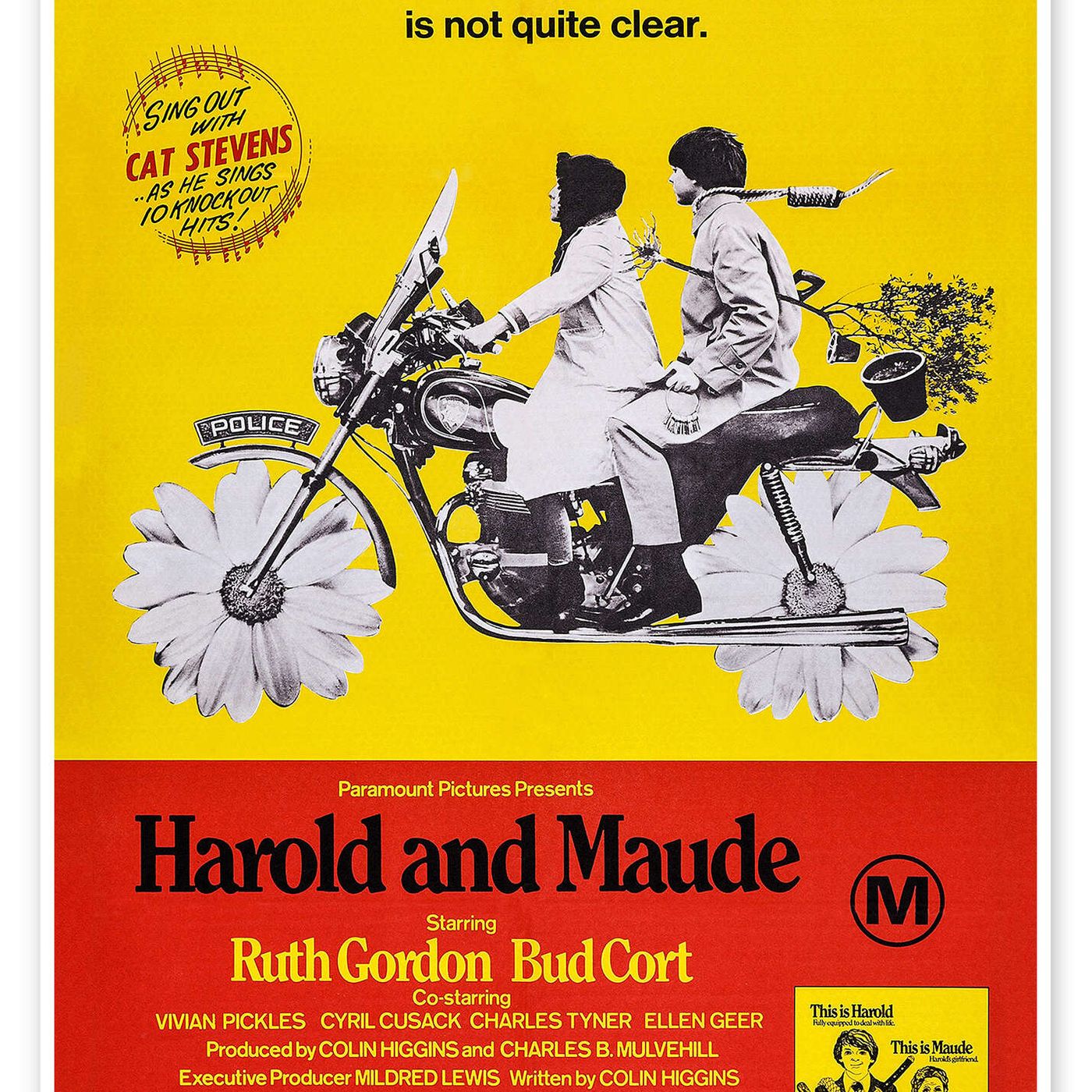
About this episode
Written by Colin Higgins as his senior film thesis, it follows the titular Harold and Maude, one obsessed with death, one obsessed with living life, as they fall in love. To say its an unconventional relationship may be to understate the genuine charm and magic of the film and its leads.
For more Kulturecast episodes and podcasts guaranteed to be your new favorite audio obsession, check out Weirding Way Media at weirdingwaymedia.com.
———
The Kulturecast is a film and culture podcast from Weirding Way Media, hosted by Chris Stachiw, the Doctor of Podcasting, alongside a rotating table of guest co-hosts. Each week digs into where film and culture meet — and how each one bends the other. Now home to sub-feeds including Required Viewing: A 360° Film Study with Dr. David D. Perlmutter.
New episodes weekly.
Subscribe on Apple Podcasts → https://podcasts.apple.com/us/podcast/the-kulturecast/id931361376
Spotify → https://open.spotify.com/show/5wjxip9XVYapYuY12yEaGY.
Back the show: https://www.patreon.com/cw/kulturecast
Transcript
Automatically generated, so expect the odd misheard name.
We were so Adam, I feel bad because I think the last time you and I talked was when we did the other But we we recorded the other episode in like March, and then I ran it in I think October for as a bonus for the Spooky Month, because it was it was such I mean, it made such an impression that I was like, I feel like this is the right time to share it and I might get lost in the shuffle otherwise, Uh, that is not the case. On this episode. You are here because you you wanted to talk about this with me. But this was something that I had programmed Harold in Maud, a movie that I had been putting off watching probably as long as I've been doing this, And this isn't something that I necessarily knew about before I started really getting into film with a capital I.
But Adam, it's been a long time since I had you on, is what I'm trying to say. And it feels like a shame. I know. We were we were on role there with the Peter Bogdanovitch films. We did Last Picture Show, we did What's Up the Doc, and we're going to do Paper Moon and somehow we got derailed.
So we never got down. All right, we need to read. Yeah, we still made to get back on that. I was enjoyed. I was enjoying that.
I actually we were talking before before we started recording about your show Adam's Corner, and you were talking about your top ten. I didn't ask you, but you were talking about your top ten movies the last year. I would say, if if in terms of like top ten movies, maybe not like a new movie, but a new watch for me, I would say, What's up Doc? Would actually be in the like top I would say two of them. I would say two of the movies that you brought to the show, yeah, I would say at least, yeah, two of them would be in my top ten, What's Up?
Doc? And the other like those were really fun and terrifying in the other one's case, but those would have made my list. And I complete credit to you because those were things that I was like, what do you want to talk about? And you were like these two movies which I had, one I had heard of, in the other I hadn't, And they would have made my top ten if I had one. But I'm not cool enough to do that.
I don't know if that's the case, I just I've now I don't know, like I've I feel like my top ten would be so bad because like, for the most part, I don't necessarily go and see new things. And the new things that I see, like they're good for the most part. But like the stuff that I'm excited about is the stuff that like I get to watch for the show and then I get to talk about it on the show. So like that's I don't know, Like new movies are fine, right, Like I like new movies, but I enjoy a lot of the older stuff a lot more because I don't know, it's just more interesting. Sometimes.
Well, yeah, something seems to have been lost even with filmmakers whose previous works I've enjoyed, even they seem to have lost a step. And it's a really weird time that we're in. New films are you know, coming coming around, and you know, and it's it's it's easier to see things than it ever was at any time, you know, with the streaming and all of that, and the and the theatrical window is shorter. But you know, the like Paul Thomas Anderson is a good example. You know, I love Paul Thomas Anderson and Boogie Knights and Magnolia.
Those are movies that really hit home for me. And yet his last film was I just didn't think it was good at all, Licorice Pizza. I was extremely disappointed with that. And so that's one example of you know, I a filmmaker who has let me down, and there's been more than one, trust me. But it's funny that you talk about my top ten films because my favorite film.
Uh And by the way, I'll say, it warms the cockles of my heart to hear that you enjoyed two of the films I recommended last year. So let me go ahead and get that out there. I don't remember what was what was the third one again? I mean the last picture show was the other one? Oh yeah, oh god, oh Jesus, no, that three?
Like then three? That's right? God, I mean that would that would probably be up there and like that would be like one, that might be two? Like that was I mean again, like that movie not only lived up to the expectations like I I mean, yeah, God, that's the thing I felt. God, it almost felt like that was twenty twenty two when we did that, Like I don't know, twenty twenty three was a very weird year.
It felt very before and after a certain point, and so like I've got the last Picture show. Okay, yeah, that was it did all those. Yeah, last year we did all three of those. It was we were on a roll there for a while and then we got sidetracked. But no, what I was gonna say was my favorite film last year was directed by Alexander Payne, and that was The Holdovers.
It was my favorite film. I really enjoyed it. I'm sure I'm going to be revisiting it probably every year at Christmas because it is a Christmas theme film and Alexander Payne's films have a certain kinship with the director that we're going to be talking about tonight. That's what I was gonna on this episode. There's a lot of similarities, and especially with The Holdovers, I felt a lot of Hal Ashby.
Not to spoil the you know, not to jump ahead here, but hal Ashby is the man responsible for the film we're going to be talking about, and I think Alexander Payne has a lot of in common with his sensibilities and I really felt it strongly on The Holdovers. It looks like it was shot in nineteen seventy one or two. It's just amazing. It even as the uh, the the the rated R certificate on a blue background. You remember how you used to see that.
You'll see some of those on old BHS tapes or whatever. It even has that. It's uh, it's just such a retro looking film that did such a great job. And of course Paul Giamotty is just great. Uh.
You know, nobody, nobody does curmudgeon like Paul Giamotty. And having a touch of curmudgeon myself, you know, certainly, I guess that's why I feel a kinship anytime I see Paul Giamotty in the film. So yeah, I always In fact, I have been told by quite a few of my close friends that Sideways, that he also collaborated with Alexander Payne on that They said, if you substitute wine for film, you're that guy, because oh my god, you're that picky, because you won't date a woman if she doesn't respond to certain movies, and you because he's you know, he's constantly saying she's if she she likes Burlow, that's it. I'm not you know, it's right, I'm kind of like that guy. So I said, well, guilty is charged, So uhh, I mean you know what again, Adam, You know what?
Like that is why I love you, because you are like you are you, and that is the most endearing thing about you, is like, but seriously like. And that's the thing that I love about getting to do this, is getting to meet people that are passionate about things. Because at a time and place long before now, we both existed when being passionate about things made you uncool and unexciting to people and UnHerd or whatever. And now and like, apathy was at an all time high. And I'm not saying you can't be apathetic now, but I think it is much more cool.
And I think we as society would agree that it's more cool to be passionate about stuff and to give a shit as opposed to not give a shit. I'm not saying again there are certain things to not give a shit about, but giving a shit about the things you love or doing good or something to that effect, like, I think, is a lot better than just not caring at all. So that's cool in my book. And you know what, uh I eat Sideways is a great movie, while Gi Your Body is great in that movie, and uh, I do like your transition because, like you mentioned on this episode of the Culture Cast, I am still your host, Christashire, and I'm joined by the host of Adam's Corner, a podcast that you can find on the internet, Adam Long.
Yes, yes, yes, and thank you for having me back again. I just h I do hate that there's been such a gap, but you know, life happens, and we wasn't intentional, but you know, I'm just glad to be back on as a guest. I always enjoy bantering it up with you, and we always the time just flies, and it really does when we do these shows. Yeah, I just blink and it seems like an hour or more has passed, so and and months I think close to six months since we last chatted, and it's like no time has passed it all every time we reconnect. So it's yeah, funny how that works.
And that's a sign of a good friend where you can just pick it up where you left off half a year ago and it's like no time has passed. So that's always you took the words right out of my mouth. And you know what's funny, Like in the last since list time we talked, you are, Like I mentioned again, not to bury the lead, but you are your own podcast host now, so you do your if you want to tell the audience a little bit about what your show is, if they were to go and listen to Adam's Corner, what they would be hearing. Well, you know, I used to be the home entertainment correspondent for Movie Geeks United, and I reported on physical media releases every month. I've been doing that since twenty fourteen, I guess, and Movie Geeks had been around since two thousand and seven, so I joined them when they were roughly about seven years old.
Jamie the creator Jamie Duval, the creator of the show, had asked me. I was a fan of the show and called in frequently, and he finally just said, you know, why don't you just come on and be a home entertainment correspondent? And so I did and really found it to be something that I enjoyed more than I thought I would. I write for a local publication. I'm in the Charlotte, North Carolina area.
It's actually a print publication, but it's also online focused newspaper, and I'm a member of the Southeastern Film Critics in North Carolina. Film critics, so I vote for those organizations when the awards come along. So I was already doing that when Jamie asked me to join the Movie Geeks team, and I did. And then Jamie decided this past summer of twenty twenty three that he just didn't want to do it anymore. The passion had left him, and he he said, you know, I've interviewed pretty much everybody that I wanted to.
I mean, on his show. He had had at different points, Francis Ford, Coppola, James Cameron, Brian de Palmer. The list of people that he's had on there is pretty amazing. It's staggering, and shit, yeah, yeah. Jamie was lucky in that his podcast was one of the first, and so he got in at the starting gate, and so podcasting was a new thing, and so a lot of these directors were curious, and so he had done For instance, he did a one week a series of live shows where they got as many of Brian to Palmer's collaborators as they could possibly get, and they covered a film each night, and they would have like Paul Hirsh editor or William Finley who's in Fantom of the Paradise and they Nancy Allen, who's in Dressed to Kill, and they had so many for an entire week they did that.
You find those shows online and apparently Brian de Palma was listening and it was, you know, podcasting in its infancy. And so when it came time for to Palma to uh promote his next film, well, he reached out to the movie eeks and so he came on and of course they were like, I'm gonna rouser as any one of us would be. Yeah, so it was pretty you know, so those are the kind of things. So Jamie had the fortuitous uh uh, you know, I guess Foresight is the board I'm looking for to start the podcast at a time when it was you know, it is a new thing. And so he'd kind of done everything he had wanted to do.
I think the only people that he didn't get to interview that he wanted to and tried multiple times was Al Pacino. We actually went to a screening together for City Hall where Al Pacino sat three rows in front of buts almost we were three rows from the stage, and we were he was within the distance where he could actually talk to mister Pacino, and we we didn't have any luck getting him on. That was the bad thing. But you know, he tried, and Oliver Stone was the other one. We've tried multiple times there.
Uh and that kind of amazed us because Oliver Stone has been on some questionable podcasts, shall we say that are of less caliber than Jamie's show. So but you know, he chooses to do what he wants to do. So anyway, Jamie said, you know, I think I've pretty much done it, you know, And I just kind of reached out there to the fans that I do have, and I said, you guys want me to start keep doing this. You want me to just hang it up and right off into the sunset. I can do that whatever you want.
Oh, they begged me not to not to stop doing what I was doing. So I just decided instead of making it just a movie show, that I would make it also about just basically obsessions of mine, you know, whether it's television shows I grew up with or pop music. I'm a big, huge I call myself a Billboard charter to Hollick because I have this weird ability to tell you exactly how high a song placed on the Billboard charts if it was popular between the fifties and the nineties. I kind of got out of that once we entered this this century, but for about forty years there, I'm pretty good about telling you if somebody was truly a one hit wonder or they weren't, and so those I'm as obsessive about that as I am about film.
So I figured it was a good place for me to, you know, interview people who were not just in film, but you know, pop music, or in the case of one of the people I interviewed as a guy who I'm very he got an online radio station called the Awfully Awesome Eighties. I'm a big fan of that. I reached out to him, I had him on. We talked about one hit wonders who really weren't one hit wonders. And so that's kind of some of the things that I'm doing.
In the latest show that I had posted was I did an interview with Christopher Norris, who was on the TV show Trapper John m d And she was also an Airport seventy five, which turns fifty this She's one of the few surviving cast members. So that's the kind of stuff I'm doing. I also had the creator of the Incredible Hulk television series. Mister Kenneth Johnson came on for the third episode and he shared some rare behind the scenes photographs that had never been seen from the set of The Hulk, which we did a video and I posted that as a bonus on a YouTube channel, so you know, So that's kind of what I'm doing now. And I still did the Blue ratios.
I do those once a month, and usually we'll reach out to somebody to come on and then banter it up with me somebody who's into physical media. My son has joined me twice because he's a physical media collector as well. And the shows with my son and I seem to be a favorite of people who listen, so there's that too. So that's kind of how it all happened. It's a long, shaggy dog story, and I apologize for the long winded this, but you know, I'm guilty of that more often than not.
I'm just sitting here listening. There's no long windedness as far as I'm concerned. So I will say, you know again, like like you mentioned, you know, doing a podcast and then especially what you're doing a weekly podcast is uh, it's nothing to sneeze at and it's it's it's impressive, And again I am impressed and again super excited to listen to your show. I have listened to some episodes, and I think, again, what you're doing is great, and giving giving yourself an opportunity to talk about the things you care about and sharing that with other people is cool. That's what I try to do.
I know, that's what so many of us try to do with the movie podcast side of things, or just you know, pop culture podcasts in general. Is you know, sharing Ultimately, it's about sharing or talking about or analyzing the stuff that makes us feel a certain way. I won't say love, because there are plenty of people that make content about stuff that I don't think they like at all. Yeah, which which is cool, like there's a there's a time and place for that. But I I don't think either one of us go into things that way, at least I don't try to.
I mean, you know, every now and then I'm becomes along that really grinds my gears, as it were, this is not one of them. Because on this episode of the Culture Cast, like Adam's kind of alluded to, we're gonna be covering the first film of February, which is a romantic comedy. But this is a drama that, like you mentioned, is a you know, Alexander Payne. Definitely, I mean yeah, yeah, well yeah, like yeah, yeah, exactly. We're gonna be talking about nineteen seventy one's hal Ashby directed Harold and maud Well.
If you want to seeing out, seeing out, and if you want to be free, be free, that he may bless and deliver all souls of the faithful departed. Bring him to the bliss of heaven and eternal peace. Oh Lord, grant him forgiveness for all his sins, the help of your grace, you who live and reign forever. And she took my car and Harold try something new each day. After all, we're given life to find it out.
It doesn't last forever. Oh, it's all right, It's again it Harold, mar did I tell you How'll be eighty on Saturday. This is definitely in new experience for me and must smell mm all around us, living things, what sense in borders and nations and patriotism above morality, take a chance, get heard even for play as well as you can. MM. I haven't lived, I've died.
I've died a few times. Oh, Harold, everyone has the right to make an ass out of themselves. Kind at the world judge you too much. Do you have any friends? Maybe one?
Would you care to talk about this friend? No? Com mingling with sagging breasts? Absolutely no? Now are you ready, Harold?
Should women run for president of the United States? I don't see why not? Absolutely as is it difficult for you to accept criticism? Oh no? Do you believe in capital punishment for murder?
Absolutely? Yes? War is not all black? Why hell? World War two gave us the ballpoint?
Then that's common knowledge. Who's where's my old lady? I'll be gone by midnight? Wow, Oh, it's all right, it's organic. So.
The film is directed by Hal Ashby, written by Colin Higgins, who I have seen a lot of his films recently, completely randomly, and it stars Ruth Gordon and Bud Court as the titular Harold and Maud, a young man and an older woman who find companionship in one another. And that is the man that is like the like the one sentence description of this movie. But there is so much more going on. I am I am super excited to talk about it with you, Adam, so I am going to kick it to you first. What is your relationship with Harold and Mott.
Well, my relationship with the film goes back about I guess about forty odd years. I guess I would say we first got cable in my house in August of nineteen eighty two. This was also the time when video stores were first popping up. Prior to this, the only way that you could see a film at home would be to either rented on sixteen millimeter film. That was generally there were catalogs you could read rent sixteen millimeter films and people could pitch in and you know, by could chip in and rent a film that they were expensive to rent.
You only got to keep them for about three days. But around the early eighties things were changing and you could go to the video store or and cable, and I think cable channels were doing package deals. They were buying a lot of these older films in package deals and they would show them over and over again. And Harold and Maud was one of those films. It was on Cinemax and that's where I first caught it.
I think on a Saturday morning. I think my father and I just happened to have the Cinemax on and there it was, and i'd heard the title. I was about guess, about twelve years old at the time, and I was just really kind of gobsmacked by the film, and especially the ending. I just wasn't really quite prepared for the ending. And I don't want to spoil it for anybody.
I know we're talking about a fifty three year old film at this point, but we sure are. Yeah, I would say the statute of limitations has long expired on this movie. But we will be talking spoilers. But I do think and I think you would agree, just to say broadly, you know again, and this is not something that I necessarily think matters in a lot of ways, but this is a movie I think you and I would broadly agree is worth checking out right. Oh absolutely, yeah, it's It was the second film for hal Ashby and I didn't get a cat and it was, but it was the first.
I don't think it was the first film of his i'd seen, I think before this, I had seen Bound for Glory, which is his biopic of Woody Guthrie. I'd seen that on CBS when it ran on the CBS I think Tuesday Night Movie or something. So I saw that in the late seventies and I being there, which was his film with Peter Sellars that was actually filmed about two hours from where I lived, over at Bilmore House, and so that's the galatial estate that doubles for Melvin Douglas's character in the film. That's where they filmed. I'd say probably the biggest part of the film was shot at Biltmore House, and that's a major attraction in North Carolina.
People go there at various times of the year to see it, especially in the fall and at Christmas. And so those are probably the first two halil Ashby films that I had seen. But I knew the name because I was in third grade, I think when Coming Home came out and I remember seeing his name in the ads. You know, I was a little too young to see that at the time. So I guess Harold and Maul was probably the third of his films that I had seen.
And I don't really think that I put the pieces together that the you know, his sensibilities until later on. But I knew that this was a different kind of film, that's for sure, because it was certainly the first time that I had ever encountered a couple, a romantic couple that was so such a large gap and age, and that these people were drawn together in such a way that that that I was not used to seeing in conventional uh you know, love stories of the time of the early eighties or late seventies that I'd been exposed to, and it was, it was, It was definitely like a breath of fresh air. I didn't get a lot of the nuances or the deeper meanings of the film until I was much older and h was you know, revisiting it on subsequent viewings brought new layers of meaning to me.
And then, well, I guess it was about twenty years ago I finally sought out the script and read it. And the script is just a terrific read by Colin Higgins. As you mentioned, it's I think it was his first screenplay. I believe it was his thesis. Yeah, that's correct, that's correct.
Is it go Wild? I mean, a hey, that's your thesis. Man. It's like Dark Star, Like, holy shit, I would love for that to have been my thesis. Like, yeah, some people, you just they just have talent right from the get go, and it's very evident.
And this was reading his script, and you know a lot of times you read a script and it's not really it's not a good read. You know, it's just a blueprint for the film. But you read the script for Harold and Maud and you're laughing out loud as you read it, and it reveals things that they're in the film, but I don't think they resonate as they didn't resonate as strongly to me until after I'd read the script and went back and rewatched the film, and I think it gave me an even deeper appreciation of the film. So if anybody out there lived has never read the screenplay, I would recommend getting that and because it is, it's a terrific read. It just really is, and you just see that this was a guy who really had talent, and that would be proven over and over again with his especially with his next film, Silver Streak, which I think has just about everything that you could possibly want a film.
There's romance, and there's a disaster movie type subplot at the end of the film. There's you know, there's there's a murder mystery. There's everything you want in Silver Streak and so this was not a one trick pony. He was. He was certainly a real talent who was unfortunately cut down way too short by AIDS in the uh An AIDS casualty in the late eighties.
And that's a shame because I would have loved to have seen what he would have gone on to do. And apparently he had a very good friendship with Dolly Parton. Of course they met on the set of nine to five, and then she specifically requested that he be in charge of writing and directing the Best Warhouse in Texas. So they were very very close from what I understand. So yeah, other people could obviously see his talent as well, but it's it's very much on display, even though this is a hal Ashby film, and hal Ashby has a certain sensibility too, and so I think it's a good meshing of the both of them.
It's really a perfect project for they just blend so well together with this film and the casting. Of course, Ruth Gordon. She won the Oscar for I believe Rosemary's Baby for Best Supporting Actress. I want to say she did, or she was at least nominated, I believe, So if she didn't Win. I can't remember right off the top of my head, but you know she had so this was kind of in the phase of her career revival.
And of course Bud Court coming off of mash was you know, this was like where of his early well and there was Brewster McLeod. So he'd done those Robert Altman films, but this was his one of his first non Altman projects. I guess she would say, and he just he's he just looks so so young in this film. He's just he just has such an innocence about him in the film. And and she a Maud played by Ruth Gordon, has such a world weary uh you know, look and uh there's a lot of stuff going on there that we do find out.
And it's I like how it's revealed that she was a Holocaust survivor that it's gradually revealed it's not. And you can maybe speak to that a little bit too. What your thoughts on how they choose to reveal that in the film, that she's seen a lot of dark stuff in her life but refuses to let that start to keep. She refuses to to not see the good in life, even though she's seen a lot of the worst in life, and so she has an indomitable spirit, as it were. And probably about forty one years ago since I first encountered this film, and it just grows and grows and grows.
And I recently saw it on the new pair amount Blu Ray that came out a couple of years ago. That has a splendid transfer and good good audio video transfer there. So I would recommend that. Unfortunately now four K just a Blu Ray, but maybe someday. I was actually talking with a friend of mine, Ryan Verel of disconnected if there was a four K of this, and he said no, because he has I believe he has.
He's a physical media guy like yourself, and I believe he has the same box set that this is. End right. It's a blue it's a Blu Ray set. Yeah, it has the Uh, it has the packaging where it has the reproduction of the poster as you open up the the case. It's just it's a single disc set, but it's it's really well done for the film.
It's a good presentation. Uh. There was an earlier Criterion release, but this one I think supersedes it in terms of the transfer for me. Anyway, on my equipment. So anyway, nice.
Yeah. So I for me, I had never seen this movie before, but it is a movie that I have heard about countless times. Close friend of the show, frequent guest co host, Father Malone was supposed to join us on this episode, and unfortunately he was unable to. And this is a movie that I know holds a very special place in his heart, and that was one of the reasons that I wanted to cover it this year, was to finally watch something that I know he cares a lot about. Now I know that this is a movie that obviously, I mean again, forty one years is a good span of time to have history with a movie like this, and I can see this being a movie that every time you revisit it at certain times in life, it may have a certain the meaning may feel different, or the what you take away from it may feel a little different.
It feels like that kind of movie in a way. And I think all good films that dabble in existentialism, I think a lot of them do have that sense of timelessness. And I think that there's a timelessness to this movie that I really appreciate. Itakes place in seventy one, but it could take place at any time, at any place in time, because again, like the story that they're telling about two people drawn together that again for all intents and purposes outwardly, you would not think because again one of them is seventy nine and the other one is Again they never say how old he is. He's probably one is late teens, early twenties, seventeen.
I would think, yeah, maybe right, But I mean the story is so the story is so timeless, and the two of them, Ruth Gordon and Budcourt are just amazing. I mean, the chemistry that they have together, it's just you know where the story is headed from the moment they meet, and it the inevitability of the film chugs along and you can feel it, and she and she alludes to it several times, you know, and again like alludes to it. But again, if you're if you're listening and you're really picking up what the movie is laying down, it will be where it is headed. And even though you know it go, it's going to go there, and there's an inevitability to it. The story is just so moving, and them together it just works, like I believe it, and I'm not saying, and I know you kind of mentioned this the idea of like it is an unconventional relationship, at least in terms of cinematic expectations, like and you know, not a lot of other movies have done this kind of relationship, this sincerely frankly, I mean again, like when you've got this movie, I don't know if you need to do another movie this sincere.
But again like sincere, but in a very honest way. And there's a difference because there's false sincerity and there's honest sincerity. And this movie is very honest, which I think is also something that could feel off putting for some. But I think the best movies really challenge you as a as a filmgoer to suspend your expectations for things and maybe meet the movie in the middle. And I think this movie kind of expects that from the audience, because again, I mean, if you go into this, say Ruth Gordon and Budcourt, there's no way and it's like no, I mean, the movie gets over that hill immediately, frankly, And like that's the thing.
It's like the movie doesn't and like the movie does such a good job of getting over that hill. So like effortlessly you believe it that, like, do you believe at the moment, Like there's no moment where you start believing it versus not like it's just it's it's obvious from the moment they meet and everything about them again is just so it feels so real, And yeah, I'm so glad I finally got to watch it. And there's a lot to parse through, there's a lot to break down, but I think the first direction to go is the idea of I mean again, cause you mentioned and this is something again that the movie does an interesting thing in that it talks about it does I mean, like the concentration camp stuff is there, but like it's it doesn't get in the way because it I mean there.
I would say, like it's to call this a Holocaust movie is kind of a weird thing, but in a way, like it's about the experiences of a Holocaust survivor sharing their life experiences, even if it's not directly what happened to them with someone who has never experienced life in a meaningful way and doesn't feel like they can either, that's the other thing. So yeah, I'm curious your thoughts on kind of the the the holocaust and concentration camp angle of the film, because again, like I'm not saying I'm surprised by it, It just it wasn't something I immediately jumped to when I when I watched the movie the first time, but when I when I went back and started doing research and reading, and like you mentioned, especially with the script, like there's some things in the script that make it a little bit more obvious what is kind of quote not quote going on, but again what the underlying kind of subtext of the movie is.
Yeah, I think you know. I like how it's gradually revealed, as I mentioned earlier, because then you slowly start to understand why she is embraces life because she has seen the fragility of life and how you're all hanging by a thread, whether we want to believe that or not. And it doesn't. All it takes is a split second of some horrific thing happening and it's all over. Uh, And she knows that, she knows, she's she's been there, she's seen that from the front lines, and you know, it gives you an appreciation of life that you can't have, that an average person couldn't have had they not experienced that, and I think that's why it's so important to things that she does later on in the film, especially towards the conclusion, because you know, she she knows that, you know, she's she's seen the best and the worst, I guess is what I'm trying to say in in Mankind and uh this and that is kind of solidified when you do see it's revealed by the numbers on her arm as as it were in the film, Uh, that that she was indeed a survivor.
So I think I think that's my feeling about it, is that uh, you know, it's just it's uh. And so with her having gone through that, then she becomes somewhat of a mentor in a way to do Harold as well, not just a romantic partner, but you know, also teaches him a little bit about life and uh you know, of course he's obsessed with death. Anyway, they meet at a at a funeral. Uh meet cute, Yeah, meet cute, right right. It's uh, it's it's wild that scene where they meet, Like it's I mean, it makes perfect sense with where the movie ultimately heads, but like that, you gotta you gotta applaud the movie for making a scene that has no right being as endearing as it is very endearing for the two characters in it, who are just there my hiring the funeral possession as it were.
Yeah, yeah, yeah, that's this is true. And then you find out that not only is she interested in uh well you know, and and her obsession maybe isn't quite as I don't know that she's obsessed but with death as much as Harold is. He's more obsessed, I think than she is. But she she as I said, she's just interested in life and the meaning of life. I think that's more about where it's coming from for her.
That's the way I always pick picked up on it. Whereas he he really is obsessed with death because he throughout the film he commits these fake suicides and some of them are pretty hilarious, uh and and like quite amusing, and I you know that's that was always that was one of the first things takeaways that I had with the film when I saw it the first time, where the fake suicides and and at the beginning of the film, it's done in such a way that you you know, you you're not sure what this is all about. It's oh, I just offed himself, and then you see that it's just an obsession that he has that and he's trying to one He's kind of in a game of one upsmanship, as it were. Does he keeps trying to top himself with the fake suicides?
Right? You think the last one was bad, just twaite? Do you see the next one? Oh, Harold? Right?
And that's the thing that I really I mean again, like it's really interesting and you know, with with where the movie goes, especially how the movie opens, like you mentioned with him committing suicide, and again like I think that obviously you know, in the day and age that we live in now, you know, you can get demonetized on YouTube for even saying the word. And obviously I mean again, like I understand why I don't necessarily agree with with it, but at the same time, like this movie uses it in a way that I have not seen a movie use it, which is, you know, you ask yourself, what is the purpose of what he's doing? And the purpose to what he's doing is again like I don't think he understands the concept of death even like remotely, I mean again, like what is he trying to do by killing himself constantly?
Is what is what I was trying to figure out while I was watching it, because again, like the scenes are played humorously, and then you know, he starts out kind of on his own doing it, and then he becomes kind of more over the top and kind of exhibitionary in what he's doing. I mean, one of the women that he his mom brings over to the house, he lights himself on fire seemingly in front of her, which again like self immolation, pretty gnarly, but like to what end is he doing that? And in some ways it's like to shock these people that his mom is bringing around, but also I think it's to show like he's obsessed with death, But I don't think he understands the concept of death like at all. Like I think that he's just he's obsessed with something and he's trying to understand it by engaging in it.
But because you can't really engage in it more than once, as it were, he's doing all of these fake suicides, and again, like you said, they kind of they start escalating. I mean, he hangs himself in the first one, and then by the end of it, he's got like a gun and he's shooting himself or he's in a pool, and it's like it's just he escalates to the point where they're becoming like hilariously theatrical, and he's involving other people by accident, and again it's like he's he's learning about death by engaging in death in a way that again like okay, like I don't know if there are actual people doing this for this purpose, but in the framing and context of the movie, it makes sense. Paired with the character of Maud, Yeah, yeah, yeah, that's that's a good take on it, good read.
And I think there's there's a certain rebelliousness to his character as well. I'm totally I've always kind of had that sort of thing going on too. Uh, just kind of you just want to sometimes you just want to get a rise out of people, and I've I've been guilty of that from time to time. I'm I try to be a nice guy, I try to be go along to get along, but every now and then I'll be in a situation where it's just everybody so seriou and I'm like, you know, I just I just I just want to get a rise out of these people. Aren't to do something ridiculous and just shake it up here, and so he's he's like that all the time.
I think, you know, and I think we all have those moments where we just we feel like we're just almost suffocating because everybody's just being so serious and and you just want to do something to break up the monotony of the situation. But he, like I said, this is not an occasional thing for Harold. He's he's like this all of the time, or basically from what I'm seeing. But yes, as you said, he doesn't really seem to It's kind of a death is kind of a joke, a ghastly joke to him, and he just laughs it off until he is faced with the actual death of somebody who is very important to him, which you can stop the show now if you don't want to hear how the film ends. But yeah, but I feel like it's obvious right from like where the movie, like where their relationship starts.
It's like, I feel like it's kind of faded, right. Yeah, that's true. But when when Maud you know, wants Maud decides to take her own life, and she keeps alluding to it throughout the film, uh, and then she finally gets to a point where she actually does it. You know, she feels like she's it's time to go, and she's she's made peace with that decision, and she's chosen to do it herself. And so he's so then his character grows because he's faced with an actual death as opposed to the theatrical kind.
And so that you know, exhibits uh, which is one of the things that make you know that we that we look for in a good film is growth of the character. And Harold grows because he's faced with a real death as opposed to a an orchestrated one. So I think that's that's the thing. But but along the way, there are a lot of amusing scenes that I certainly enjoy. I always enjoy the uh, the attempts to get him into the military, uh, with the uh, the recruiter with the who's missing an arm?
Yeah. Charles Charles Tyner as the as Harold's uncle UH for the scenes that he's in makes a mixed impact. He's a yes, I mean he's great. And then towards the end of the movie, where you you you see Harold and Maud kind of concoct a plan to keep Harold out of the military, which ends up resulting in him killing her quote unquote, uh, I love that scene, and I love that he's it's he's I mean again, like bud Court and Ruth Gerdin were so good together, but bud Court on his own, he's just he plays He plays such a I mean, like the moment you see him on screen when he's when kind of you kind of get what he's doing. He's everything about him is just so interesting and he's just portraying such a fully realized character.
And you know, I kind of alluded to having seen Colin Higgins's stuff a lot recently. I just recently, for the first time, watched foul Play, which I really enjoyed. Last year I saw Nine to five and The Best Little Horrorhouse in Texas, which are the other two movies that he directed ann wrote along with Vowel Play, And I mean, Best Little Horrhouse has its problems. I'm not sure that they're his fault necessarily. I think it's more just the narrative writ large, which he didn't come up with the original narrative.
I think that his movies are fantastic, and I uh, the ones that I've seen, and I agree with you it is a shame that he was taken so early, because you really wonder what he could have done with like just some of the actors in the nineties or the two thousands, or I mean again, any any actors, because again, he inspired so many people, you know, in a lot of ways, like Colin Higgins's stuff and Hal Ashby's stuff inspired you know, a Wes I mean someone I'm not a huge fan of, But Wes Anderson I think is kind of like the next logical progression in a certain direction of this kind of filmmaking. You mentioned Alexander Payne. I think he's the logical progression in a certain direction of this kind of filmmaking.
I think they both take their unique stabs at it. I think Wes Anderson comes at it a little bit more leaning into the quirk, and I think Alexander Payne leans more on like the naturalism of things and kind of just like real ish people having elevated ish interactions with each other. Like that's the thing, you know with Alexander Payne and Sideways, a movie that I adore, and I mean I love Thomas Hayden Church and Paul Giamadi in that movie. I mean they're they're they're a lot of fun, and I think that their pairing is is great. I mean, again, if you're into wine, you know, awesome.
But if you're into if like you mentioned at the at the beginning, like if you're a person who is passionate about things, it's also kind of a love letter to people who feel a certain way about certain things, and we'll see no other which is and which is which is great? Like again, like I think that that's an interesting subtext to Sideways. But I think that to come back to a movie like this, you can see a lot of those ideas of just like interesting characters interacting with each other interestingly, and like that. I don't know how else to put it, because like Alexander Payne for the most part, writes and directs his own stuff, and the characters that he creates are again in a lot of ways, things that are very unique to the kinds of movies that he makes, and I would say the same here, like all of Colin Higgins's stuff, for the most part, feels very similar the stuff that I've seen, and like, I appreciate it for that.
I appreciate that he seems very capable at making characters that feel real, even if the situations are a little kind of elevated in terms of realism. The characters feel really grounded and like real people like Harold and Maud for the most part, feel like real people. And that's why it's so easy to connect with them, because it feels like such a genuine relationship because they feel so genuine. Yeah, they sure do. M Yeah, it's and you've met people similar to them in life, probably and maybe maybe not as extreme as Harold with his face suicides.
But you know, I've known people who were in that wheelhouse, shall we say, And so yeah, they do seem and and that's all we're missing in a lot of films today is just characters that have a real depth to them and are relatable on a human level. You're just not you know, even in a lot of these the independently made films that are critics darlings these days, a lot of the times these characters seem aloof and just not you know, it's it's something that's missing. I mean, occasionally you'll get it, like with The Holdovers, as we mentioned, that is an example of a film that has fully fleshed out characters, but it's becoming rarer and rarer as it were, and that's a shame. But yeah, this but hal Ashby certainly paved the way for a lot of filmmakers making personal films.
Of course, he had a rough run of it in the eighties and his career really as the decade of the seventies made way for the eighties. He just really had a series of setbacks for various reasons with films that he released during the eighties. And of course he passed away before the decade was over. I think it was at the end of nineteen eighty eight. But he had multiple cancers.
I think lung cancer. I can't remember that, others too, I think, but yeah, so he died fairly young too. So he and Colin Higgins, both the architects of this film. They both passed away within I think a year of each other. So it's sad to think that they've been gone going on forty years now, close to it.
So yeah, it's something to really consider well. And also given the fact that the movie at the time was not a critical or commercial success, I mean, this is a movie, I mean, this is a movie that has really found a life in the subsequent years. I mean like subsequent as in like a decade later, and I mean plus, I mean, this is a movie that I think is immensely important. I mean the National Film Registry agrees as much. Uh, And I think that this is a very important movie for I mean again at least like having the conversation about life and death and what is what is the point of not caring about one and caring about the other vice versa, and how can you meet those in the middle.
And I think that this is an important movie again to in terms of about the subtext of the Holocaust, and you know, again like that it being kind of like amusing on that and using that as a justification and way of giving you the audience an idea of where this character has been and why this character is doing the things that they're doing and why they feel a certain way. Yeah, and it's it informs the decision that they're making. But this was not a movie that liket like that at the time. People were like National Film Registry, that was not a thing like this is in the subsequent years, and like that, you can tell by watching this movie that this movie at the time, it was not going to be a movie that people were going to be able to watch and be like, Okay, I get it, and that's crazy.
Like what. Like we've talked about the Academy Awards a little bit, it's shocking that this movie got nothing, Like I'm shocked that this movie was not, like that Ruth Gordon wasn't nominated for an Oscar because she's so good and Bud Court is so good too. But again, like, I just this movie. They didn't get it in seventy one, Like they really didn't get it, is what it feels like. And like sometimes movies do come out before their time, that is the thing, and this movie is genuinely one of them.
Well, yeah, I think there was a one two punch that actually kind of got this film back in the consciousness after its failure when it was released, as you mentioned, because it did it, it was issued, and then it just kind of died a quick death. And then the Westgate Theater in Minneapolis, which was a repertory theater, they started running it and it became such a runaway success that they ran it for two and a half years I believe it was, and so much so that the residents in the area started picketing the theater and requesting that they finally run something else so that because they'd run the film for so long. There's actually a podcast on that that I listened to. Can't think it was the movie.
They do a podcast, the independent streaming service movie m Ubi, they do a and they did a series on a repertory the revivals theaters that had led to rediscovery of films, and this was one of the episodes they did. It's a very fascinating story about how it was revived after it was originally considered dead. And then Danny Perry's Cult Movies, I think his series of Cult Movies books it was there's a chapter on it in there, and I think that actually also you know, got people talking about it again, So that was a one two punch I think then then, and then you had the added benefit, as we talked about, of cable, because it's part of the package deal that ran on pay cable in the early eighties. And so with all of that together, I think that's that's kind of how I got restarted.
And of course Ashby went on to the next year he did or two years later, rather he did the last detail Jack Nicholson, which was a success and then Shampoo, which was maybe even a bigger success. I'm not sure with War, although there's been rumors that Warren Batty co directed that film, as he was known to do, but nevertheless it's credited to how Ashby, so there is that. But yes, this was one of those films that just failed to, you know, register during its original release, and that does happen sometimes, and time is the ultimate judge on films. Just because something fails when it originally is released doesn't necessarily mean that it's not going to have some sort of a life, as has been proven many, many times by many other films.
So yeah, I'll h I don't know if you saw, but I'll read you Ebert's one and a half star review out of four. And so what we get, finally is a movie of attitudes. Harold Is Death Maud Life, and they managed to make the two seem so similar that Life's hardly worth the extra bother, the visual style makes everyone look fresh from the wax museum and all the movie lax is a lot of day old Gardenia's and Lily's and roses in the lobby, filling the place with a cloying sweet smell. Nothing more to report today, Harold doesn't even make Paul Bearer. Wow, Roger Ebert really enjoyed being an asshole, so I mean, I you know what, like he did, he enjoyed it sometimes like he reveled in being able to verbally dismantle a movie.
And he was entitled to his opinion. But I think mister Ebert was wrong on this one. But I understand. I understand this movie not resonating with you. Like that's the thing, like I almost I mean, you know, again, like I joke, you know, he liked being an asshole.
And again, like he's entitled to his opinion, but I'm not going to necessarily disagree because I think this movie oscillates so widely at times. But that's an intentional thing that I could see it rubbing someone the wrong way. Well, and to give Ebert some credit, there were films that he really didn't get when he saw them originally, and he would go back and revisit them, and then he would come back around and write an updated review and say, hey, you know, I kind of missed this when it came when it first was released, I didn't really get it, but you know now, I think it's one of the great films. There are several incidences where he finally came around to things, so he was you know, you know a lot of times you will see like Pauline Keal famously would see a film one time and her opinion was made up, and she's like, well, I don't need to re see it.
I don't need to see a film a second time. My opinion is my opinion. But Ebert was man enough to occasionally admit, hey, I was wrong, you know, I miss this, I miss that. So yeah, he could be a bit of a curmudgeon to use that word again occasionally, but he would, you know, admit when he was wrong and that he missed something. And so I always gave him credit for that.
And I'm not sure if he came around on Harold and Maul. That would be interested to know if he ever felt differently as time went on. But yeah, there were several films that he just didn't like. The original Night of the Living Dad, he was meentoriously, but then eventually came around. He came around and said, it's one of the great horror films.
I missed it, you know, And then I think the Devil's Ken Russell's the Devils. He didn't care for that either, but I think eventually he felt a little differently about that too. So you know, there were some sometimes when he just you know, hated something and then it's like, well, you know, And I do think that's where Pauline Kele could be wrong in not wanting to go back, and because you know, you sometimes miss things. There have been films that I totally you know, if i'd seen Vertigo when I was a teenager, and I really didn't get it, and it was mainly because I hadn't had profound loss in my life. And as I got older and offered some profound losses and went back and watched Vertigo, I saw what a masterpiece it was.
It's a film that you literally have to have lost in order to appreciate the film. And so that's one example of many that I could cite that. You know, if you're if you're a young whipper snapper, you're not gonna get the things out of that film that you will as a more seasoned human being, as it were. So so yeah, so that's that's interesting that he gave me one star and a half, though I find that very curious that I will go and I looked at review up, I'll be interested to read it. He never came back to it.
So not that I could find to answer your question. I never found. I never found Ebert changing his mind. It also shows up on several lists of like it. In lots of things that I found, people talk about Ebert being dismissive of the movie, but yet if you go and look on the website, it gives the film a thumbs up.
So I don't what the what the fuck? One and a half stars out of four and a thumbs up. I fail to see how that's possible. But maybe I'm just confused. Maybe it's, you know, trying to split the difference.
Wanted to half stars but thumbs up. Because we can acknowledge the fact that it's a culturally important movie, it might not just be for you. And that's the thing I mean again, like there are parts of this movie that I could one hundred percent see rubbing a contemporary audience the wrong way, like someone younger than me, not to be the wokester of the group. But again, with something like suicide being played for laughs, that is not a thing that is done in contemporary media. Like it's just not it's really just not And again I have no feeling on it either way.
I know people who have I know people who have attempted it. It does not trigger me. I mean again, it's a storytelling device that has been used wherever will continue to be used, and it is what it is in a lot of ways, frankly, like sometimes you just have to get this or do we have to revel in it? No? Do we have to make it something that people are enjoying doing or appreciative of.
No, But again, like it's something that can be treated with a level of seriousness. The subversiveness of this movie is the fact that it doesn't treat it that way. And I mean Colin Higgins again is a in a lot of ways, I feel like he is a subversive writer, uh, and he approaches that subversiveness head on. I mean, we have multiple suicide attempts in the movie, and they're all staged. I mean, they're all very theatrical, and they become more theatrical the longer the movie goes on.
And that's the thing that again I feel like would rankle some people in twenty twenty four, but at the same time, like it's the thing about the movie that I appreciate, and you've mentioned it. It's like the movie understands what it's doing. Regardless of the time and space that the movie exists in, the message remains the same, which is again, like, you cannot have a life worth living if you don't want to live your life at all. And if you don't live your life, you can't complain the day death comes in goat you because you didn't live for anything. And like that's an important message, Like, and that's something to definitely internalize.
And this in our ever changing and fast paced times, it's very easy to get caught in the same loop or the same pattern of doing things and you know, taking things and people and other stuff for granted, it can be done very easily. In this movie, I think, in a lot of ways, makes the case that we should be enjoying the life that we're given, regardless of how we choose to live it. But we are given one life and we should enjoy it because if we don't, we have nothing to complain about. You can't tell any what does Maud say? You have nothing to tell anybody at the bar?
That's rights? Yeah, that's true, and how true it is? Well, what do you think about the unproduced sequel and prequel. Oh my god, God, even then, huh. Even then someone was like, well, we've got this ip here, and it made a lot of no I I would uh, you know.
So you know at seventy eight, right, Higgins talked about doing a prequel in a sequel. I mean, the character of Harold. I think by the end of the film, I would like, I mean like, I don't know if I really want to see more of his story. But at the same time, I would think it would be interesting to see them more of the Harold story. And I think it would be interesting to see more of the Maud story.
But I don't think. I don't think it's necessary because I think this movie does a good enough job at giving you an idea of what those things are without beating you over the head with it or like just like exposition dumping in a scene. It does it in a way that is like nuanced. And I mean, if if Colin Higgins had written those movies, they probably would have been nuanced. But I mean, again, that's the only person I would want doing them, and he was the one who mentioned it, and they never happened.
But I would have I mean I would have watched him, I mean, and we would have talked about him. What about yourself. Well, yeah, the more interesting of the two is a Grover and Baud, which was the one that where there was the prequel you referred to a reference rather and supposedly it was going to get into how Maud learned to steal cars from Grover Muldoo, the character that was played by Richard Pryor in Silver Streak. So there was a crossover there and they and he actually wanted uh Ruth Gordon and Richard Pryor to reprise their respective roles. So the Higgins verse, h well, and that's and I saw that, which which made me want to watch Silver Streak.
Like again, like Silver Streak sounds interesting from from the way you've talked about it, and you know, again it came up in in research a couple of times because again that connection and then just again the Colin Higgins connection. But I mean, that sounds interesting because again there is this subplot of Maud stealing cars, and that's right. I don't I never asked the question of how did she learn how to do it? But that could be an interesting part of a prequel story. Because again, like that is kind of a random thing that this older woman just seems to be able to do, which is every time she shows up, she shows up in a different car because she's hot wiring cars because she doesn't have a car, doesn't have a license, doesn't believe in them, I guess, is what she says.
That's right, that's right. Yeah, well, I you know, you know, I I think that would would have been interesting. But yeah, I envy you that you haven't seen Silver Streak because I'm envious of people who who it's a first time watch for them, because it is such a a really well made film, even though it's directed by Arthur Hiller, who was kind of a director for hire. You know, he did, he did some good stuff, like The in Laws is one of his high spots that people talk about, but he but Silver Streak is is really like I said, it's got all the as I mentioned earlier, everything you want a film is there. There's disaster movie subplots and like I said, the the romance and the Hitchcock style mystery and uh, it's just got a little bit of everything and I totally and some comedy.
There's there's comedy there too. So there are all kinds of elements that that blend together very well. And I was it's funny. I was out in Los Angeles having dinner with my friend Ray Morton, who is a frequent guest, and he's written quite a few books about the making of books on several notable films, and so we were just strolling through Pasadena after we'd had dinner, and he said, well, right over there is where they filmed such and such scene from Silver Streak, and he just pointed it out as we watched, and I looked, and sure enough it was it's like all that Wow, you just never know. So yeah, but yes, I recently saw in Arthur Hiller film.
Actually, I watched the Americanization of Emily, which I really enjoyed. Yeah. Yeah, Yet, speaking of being a pacifist and anti war, I mean a different kind of anti war movie, but there's an anti war sentiment in and Harold and Maud. But yeah, I would be curious to watch more of hal Ashby's stuff because again, like I feel like I've seen the big things of Colin Higgins's catalog, with this being kind of like the last thing seemingly Again, I didn't do any of this intentionally, It just kind of happened that way. The only thing I haven't seen is Silver Streak and the Devil's Daughter, So I mean I would be I would be curious to watch at least Silver Streak.
I mean, you haven't mentioned the Devil's Daughter, so I mean I never saw the Devil's Nolter. Actually I'm aware of it, but that's one that that's a blind spot for me. So yeah, I must say it's a TV movie, that's all I know. But yeah, no, Foul plays great. I mean, I enjoy the characters that Colin Higgins is able to create, and I feel like if there had been a sequel or a prequel, I'm sure they would have been fantastic.
Like I'm sure they would have been worth watching, worth checking out, especially if he was the one doing the script, because he seemed to have a pretty good grasp on how to make interesting characters that are worth spending the entire movie with. And I mean a scene as simple as you know, Budcourd doing somersaults in the middle of a field and Ruth Gordon watching him is just so I mean again, it's so simple, but at the same time, like you get so much of the characters and their performances from just these little scenes together, and the entire movie in a lot of ways, is just these little moments strung together between them. And again, like, I'm not saying it shouldn't work, but Ruth Gordon's lust her life and like yearning to live is so infectious that she acts like, you know, a teenager and he acts like the old man.
But then once they meet one another in the middle, it's, you know, we haven't even talked about it. And again like I feel like it's something worth mentioning. But the Cat Stevens music, which which was originally supposed to be Elton John and then you know, Cat Stevens comes in and ends up doing the music. I mean, I would say that the music from this movie is rather well known. I feel like, I mean, if you've never seen this movie, there's a more than zero percent chance that you've heard the song I feel like from the movie.
If you want to sing out, say out, I feel like it's pretty well known. But the music in this movie I think is also perfect for what this movie is. YEP, totally agree. And it it's interesting that the complete soundtrack of the film was not issued until I think in the last ten years. It finally because there's been several issues of it, but they were missing key tracks from the film.
But there was finally a complete version of it that was released I think on Record Store Day several years back, so sometime in the last ten years, but two years ago, yeah too. Wow. Wow, took them a long time, but yeah, because you were talking twenty twenty two and the movie came out in nineteen seventy one. Yeah, it's a very long time, and it's it's It's worth it, though, because the soundtrack is that good. I mean it again, it's Cat Stevens.
It's Cat Stevens, and then it's also I mean again, it's also the characters in the movie singing Kat Stevens from time to time, which again, like is fantastic. I think. You know, Look, I'm not old enough to know any of the controversy surrounding Kat Stevens and Yusuf Islam, so I have no opinion on that. I know very little about it other than get the base amount of research to be done regarding things related tangentially to this movie. But I like his music for the most part, and I actually don't what's weird is like, if you were to step back into the alternate universe where this movie exists, but it's the music is Elton John, I don't it would.
I feel like, I don't know if Elton John has that same feel that folksy feel that Cat Stevens does that I feel whenever I listen to Cat Stevens for the most part, like it's just inherent to the music that Cat Stevens makes. I feel like, Yeah, Yeah, Elton John did a film score similar to this one for a film called Friends in nineteen seventy one, and that was also a paramount release too, I believe, So, yeah, he did do something similar to that around the same time, So that might have been why they were they had him in mind because he had previously done that. But I think he was more content on, you know, moving along with his solo career as opposed to being a film scorer as it were, as it were, so uh yeah, but yeah, I do have the soundtrack for Friends.
It's It's It's It's you know, it is what it is what it isn't, And it actually had a charting single. The song Friends got got into the thirties because I'm the chart of Halleck. As I said, I know all these chart positions. So what did I mean, did did if you want to sing out, sing out it charted right? No, it did not.
Wow, that's a shame. Not a charting single. It may have gotten into Hot one hundred, but it certainly didn't make the top forty. And that is that. And you know, you never can tell about these things.
It's it's funny, how but then again, it's not really a surprise when you think about it, because the film itself wasn't a success, so it's no surprise that the songs from the film wouldn't have been a success either, because it just all kind of like ayme and went so quickly and it took time to be old. But yeah, but it looks like we've got our work to do. It looks like we maybe can reconvene at a later date for Silver Streak or one of the hell Ashby. Yeah, that's what I was, That's what I was gonna say. Like, I mean, the way you've kind of talked about Silver Streak, I feel like, you know, like you mentioned, we had been kind of doing our own just kind of thing on the side because why not, And like, I think you're right, like it's it sounds like a fun time And like I mentioned, I mean Colin Higgins's work, at this point I am almost completely familiar with, like it is the real big last thing left, And not that I'm some sort of completionists, because I'm not, but at this point mine as well, and the way you're talking rather glowingly about it.
And plus it has Gene Wilder, who I haven't seen enough things. I mean again, I've seen what I would consider to be for people my age, the thing, you know, Charlie and the Chocolate Factory. I guess Willie walk in the Chocolate Factory. But for me, like I haven't seen Gen Wilder and enough stuff. So I'll also jump at the opportunity to see Gene Wilder and Richard Pryor in a movie together, which I know was like a big pairing at the time, and a pairing that would happen multiple times as it were.
So yeah, I would totally watch it. I would be game. I mean again, like I enjoyed this movie a lot like that that is the thing to bring this full circle, Like I this movie lived up to the expectations of the people that I have heard talk about it, and it lived up to the hype as it were. I mean again, I know that this is a movie that means a lot to a lot of people, and it's a movie that people have commiserated over, and you know, it's an important movie to certain people's relationships, and this is a movie that they bonded with their significant other, their partner over, And I mean again, you know, two against the world in a lot of ways, like you know, two weirdos taking on the world together, and like there is there is some of that in this movie.
I mean again, there are other movies like it, but for me, this movie, like I completely understand now why this movie is so important to so many people and why so many people feel so strongly about this movie the way that they do, because, like I mentioned, this is a movie that I will not only be sharing with my significant other, but it's also a movie that I will genuinely revisit every couple years because even watching it two times, I took away different things from it, and like I can only imagine as a older adult the things that I might take away from it. So I lived up to the expectations for me, which I'm not saying movies don't, but sometimes you watch movies like this from this time period, from like the sixties, from like broadly, I would say between the sixties and the eighties, there are a lot of important movies that come out, and sometimes I understand why they're important just by watching them, and sometimes you have to do a little bit more research to understand why they're so important.
And I watching this movie, I kind of understand it on the face of it. And I also, like we've mentioned, I understand why this movie took a little while to gain some heat, as it were, because seventy one is not necessarily a time to be forcing people to have an existential crisis. This is true. Yes, so yeah, Adam. Final thoughts on Harold and Matt.
I just think it's a beautiful film that gets better with each viewing. It's one of the you know, just is rewarding on so many levels and has rewarded me over the forty plus years that I've had a relationship with it, and I always look forward to revisiting it from time to time, never never tire of it, and it's a film that will I will continue to revisit as the years roll On. But my kids are very familiar with it. I showed it to them when they were very young. I think my son was eleven or old and my daughter wasn't much older than that when she saw it, so they're very familiar with it as well.
So it's a it's a family affair, as it were. Well, And I mean again, like this this is the movie that I can completely understand sharing with someone and then kind of charting the way you interact with it or the way that they interact with it, because again, like there's there is a lot going on, and it's a movie that I think speaks to a lot of people in a lot of different ways. But again, I mean living and living honestly, I think is an important thing that's hard, that's hard to come by in this day and age for a lot of people, and I understand, and you know, I love a good movie that is entertaining, that feels genuine, but also at the end of the day, has a message that I think I agree with and that resonates very strongly with me, which is, you know, life is tough, but sometimes life being tough makes the parts of life that aren't tough that much more worth living for and it makes those and it makes those moments in life that much more enjoyable because there has been trials and tribulations and things people have to live through through no creation of their own.
Because that's right, Maud, I mean, Maud didn't make the Holocaust happen anymore than any character in this movie did. But her ability to live and live, you know, live and laugh through the tears of the existence that that must have been to then go on to be this person who is so vivacious in life that she can turn around the life of someone else who is so unfamiliar directly with death but believes that they are and ends up walking away with a new appreciation for life is just I mean again, it's a message that I think is immensely important, especially in these trying times as it were, which I feel like I say all the time now. But yeah, I enjoyed this movie and I'm so glad we got to talk about it together.
This was a good one. It's a good way to start off the year. And again, in terms of romantic comedies, it's a little bit of a romantic comedy tragedy, but that's okay. Yeah, a little honesty a little realness never hurt anybody. You know.
I think I appreciate a movie that's honest more than a movie that coddles me as as a filmgoer, So I would tend to agree. Yeah, you're a little food for thought. Yeah yeah, so so yeah. On that note, let's take a break and we will play a preview and some ads for the next culture cast. Hi.
I'm Susan and I'm Sharon, and where are the hosts of Eighties tv Ladies? Check us out wherever you find your favorite podcasts, and please like and follow us on Facebook, Instagram, and Twitter. At Eighties tv Ladies you can find interviews and exclusive behind the scenes content on all of your favorite eighties TV ladies. Eighties tv Ladies is the place to go. Please join us right Hi, this is Age from Noise Junkies and this is follom Alone from Dark Destinations.
Please join us as we examine one of the greatest sitcoms in television history, Taxi on Night. Mister Walters at Taxi Podcast. Good night, mister Walters, Good evening, and welcome to Knight Gallery. Thank you, Rod, and I want to welcome everyone to Midnight Viewing, where once a month. We talk all about your follow up to The Twilight Zone, Rod Serling's Night Gallery.
They say it's Rod two Las Night Gallery, and it isn't really Rod to Las Night Gallery. It's somebody else's. Oh we know, we talk about it a lot. Your curators at midnight viewing are the projection Boots, Mike White. What can happen to human beings when trust is wiped out by suspicion and culture casts?
Chris Stashu small boy incased in the Crystal Ball and I'm father alone, the kind of thing that usually infest nightmares. Join us monthly at midnight viewing. The Night Gallery podcast at Weirdingwaymedia dot Com doesn't belonged to me. I have no proprietary interest in that at all. I'm in Lancaster.
Are you bailing out? Yes, Jude, I'm bailing out for the cat. I've got no parachute. What do you think the next world's like? I don't know, so I know anywhere.
I'm sorry. I'm not June by Heaven, isn't it. Peter couldn't have got away with it. He was due here half a now after me. There's been a mistake when the records don't balance.
All the alarm bells start ringing in the records office. Oh so there have been mistakes. We'll explain your grave error to Squadron leader Carter and ask him to follow you. Oh, Peter, it was a cruel joke. It was it was on me.
I've fallen in love because of your mistake. Well, if it's a respectable place, there must be a law of appeal, which has never been done. I call Squadron Leader Peter D. Carter exclaim you love, I do love. Would you die for him?
I would, but I'd rather live sor right. On the next Culture Cast, we are going to be talking about a matter of life and death from nineteen forty six with David niven I believe, which I am super excited to talk about because David Nivin's great. On that episode, I'm going to be joined by Mike White and someone's favorite productions professor Will Dodson. So until then, Adam, where can people find you and the things that you work on? Well, there's a if you want to read my weekly column column that's at focusnewspaper dot com.
It's published every Thursday in both print and online, where I do a roundup of physical media releases and recent theatrical and streaming releases. Well, you can find the things that I work on over at Weirdingwaymedia dot com, where I work on this show and so many other shows. But there are also plenty of other great shows on the network, including Cambridge and with Shan, Feminine Critique, adiestv Ladies, Twisted and Uncorked. Lots of great shows that are totally worth checking out, and you should Overtwirdingwaymedia dot com. As for this show, culturecast dot com Patreon dot com slash Culturecast is where you can go to support the show financially.
Every little bit helps and if you get in at the ten dollars level, you can listen to Ranking on Bond, a show that I do with the Projection booths Mike White and Ranking on Basses and DC Titans writer and executive producer Rich Adam, where we talk about James Bond movies once a month, and you can find all of that over at patreon dot com slash culture Cast. Again, big thanks as always to Adam for coming on the show and talking about Harold and Maud and we'll catch you on the next episode.


