
About this episode
Mike, joined by co-hosts Andras Jones and David Rodgers, unpacks how Arizona Dream bends tone and narrative into something closer to folklore than plot, balancing melancholy against absurdity. The conversation explores Kusturica’s outsider view of America, the film’s uneasy relationship with realism, and the way dreams—Inuit or otherwise—function as both refuge and trap. Mike also talks with screenwriter David Atkins about shaping the script, collaborating with Kusturica, and navigating a studio-era release that never quite knew what to do with a movie this strange.
Transcript
Automatically generated, so expect the odd misheard name.
The Projection Booth podcast is sponsored by Scarecrow Video. Try out Scarecrow's rent by mail service. Choose from over one hundred and fifty thousand films to get Blu rays, four k's and DVDs delivered directly to your door. Visit scarecrow dot com today. Oh g is folks, it's showtime.
People say good money to see this movie. When they go out to a theater. They want clothed, sodas, hot popcorn, and no monsters in the Projection Booth. Everyone pretend podcasting isn't boring. Don it off.
Listen you know what I mean. I just can't become a slave to my to my career, to my success. I have to say myself. You know I think, yes, yes, excellent Brasks, Grasks. Why must you try to screw every man that you see under thirty shot?
Immature? Right? You're old enough to be his. Mother, But I'm not, mister sweetie, I'm his lover. You know, if it hadn't been with you, he still be alive.
If you want these filthy, living bastards to live, he'll still leave my. Why I've been waiting for you to do I want to shoot? What do you want. I want you to go, I want you to close, I want you. To Wrongs don't make a right.
That's my. I know. I say, I'm not your fucking husband either. I me what is man? You work?
Your Welcome to the Projection booth. I'm your host. Mike White joined me once again as mister Andras Jones. There. Oh, I don't have a line for you, but three me dreamy Green.
And also back in the booth is mister David Rogers. And can't quite pull a quote from it either, but it feels like. Fishy, fishy, fishy. He feels appropriate. Well, I thought for sure one of you guys was gonna say, do you want to fuck my wife?
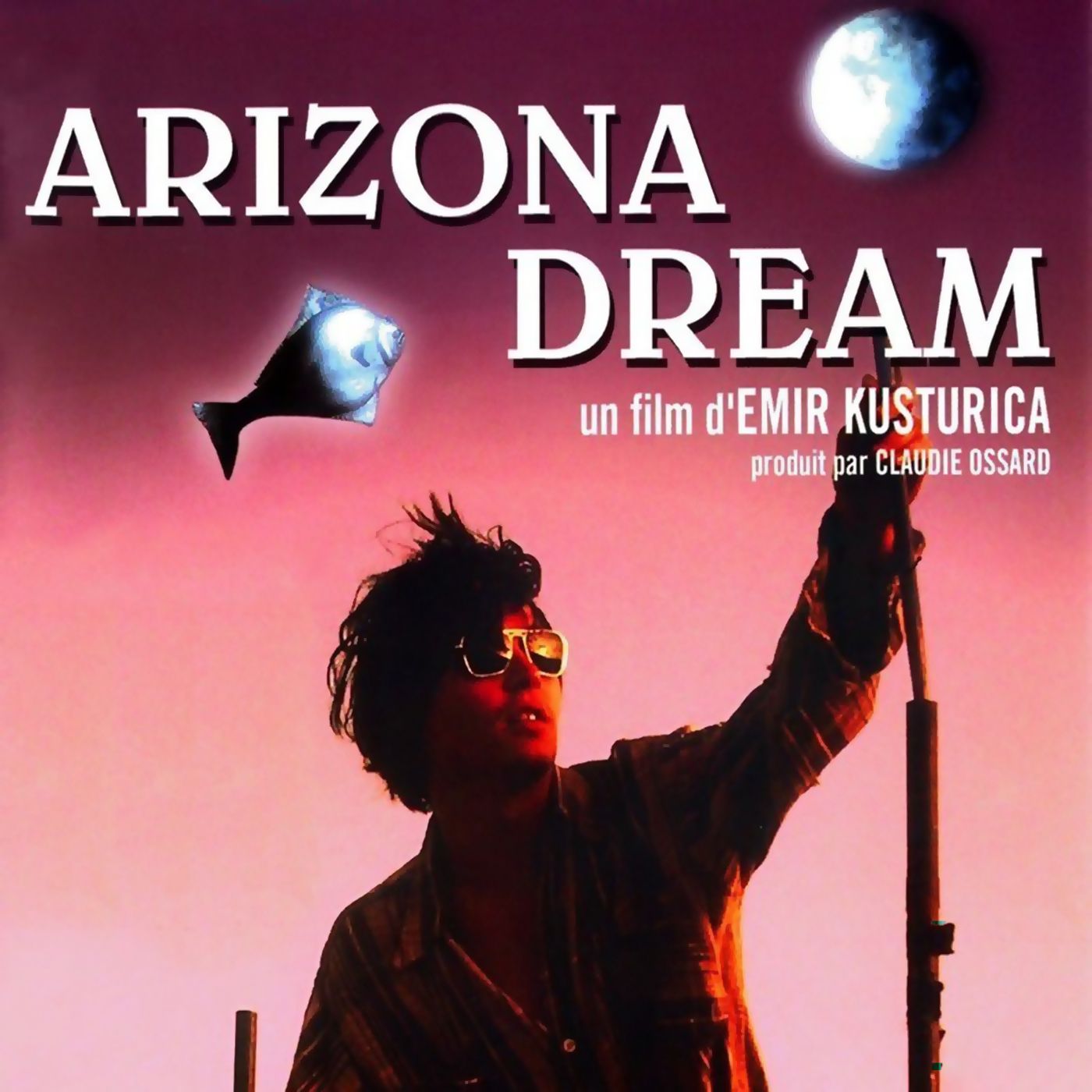
We are looking at another Patreon request, this one from mister Jones himself. Arizona Dream written by David Atkins, who you'll hear from later and directed by Emir Costa Rica Sure that works. Johnny Depp stars as Axel Blackmar who works for the Fish and Game Department in New York and dreams of Inuit people. He basically gets kidnapped to Arizona by his cousin Paul played by Vincent gallow So there he's reunited with his uncle Leo. Uncle Leo played by Jerry Lewis, and meets up with mother and daughter Stalker that's their surname, not their profession, played by Faye Dunaway and Lily Taylor.
I'm not going to talk too much more about the plot because there's not a whole lot more plot to go around. However, I will warn you that we will be spoiling this film as much as we can, So if you don't want anything ruined, turn off the podcast and come back after you've seen it. We will still be here. So andras you asked for this one. When was the first time you saw Arizona Dream?
And what did you think? It must have been on videotape? Been like nineteen ninety three, the year it came out on video and would have been a new film among my friends. I was an early appreciator of Johnny Depp. Even earlier.
I was like I was kind of competitive with him as a young actor because I used to we were similar heights and colorations, and so I had like a pre prejudice against him when he was on twenty one Jumps, But when he got into movies, I was I feel like I was early on board with him, and this was one of those films that I guess I love, pretentious, actors centered films that kind of go off the rails and sort of you feel like there's so much going on in it that you can't even take it into your eyeballs. And I think that's what this kind of this film is. And the reason I suggested it here was just I know how rigorous you are in your research, and this is a film that's always been kind of mysterious to me, so I was I'm just looking forward to learning more about this film that I sort of love and holding a very special place in my brain.
And where what you've been able to uncover with your detective work. Well, hopefully I don't disappoint and Dave, how about yourself? When did you first see this and what did you think? Well about three weeks ago to prepare for this podcast. But no, I mean, and even though that's the first time I watched it is something that's been on my radar.
It feels like a movie that's been kind of in the lore. I think I heard about this reading an article about lost long cuts, and there's like a mysterious four hour cut of this out there I even saw in one of the interviews you put in the Dropbox with Johnny Depp, where I guess he had it on VHS. I don't know if I would sit through four hours of this, but you know, maybe in pieces. I don't know. Impressions.
It is an interesting movie. I will say if you're looking for a plot, it's very hard to get into. I will say, on a second watch, it is very much like a hangout movie or just kind of let it wash over you if you're there for a plot that's kind of beside the point. So I saw this one also on VHS, and yeah, I must spend ninety three ninety four. This one was at the video store that I worked at.
I swear I just put it on during the day and had it running. I remember just being really taken with it. I especially remember this guy who looked a little bit like Quentin Tarantino, who is one of the main characters in this movie, and I just thought, like, this guy has a lot of talent. This is like, if Quentin Tarantino could act, this guy would be it. I think this guy is going to go someplace.
That was my first introduction to Vincent Gallo. I can't say that. I'm a huge Vincent Gallo appreciator. I mean I've tried my best to make it through Brown Bunny. Not a big fan of that.
Just kind of like, Okay, I understand you really like John Cassavetti's films, but you don't have to make one that's just a John Cassavetti's film. You can do something else. I mean, just John Cassavetti's with Falatio. I mean, that's the one thing that I think all of John Casavetti's films were missing, right, it was some Falletio. I really kind of fell in love with this, the whole idea of the dream logic.
I mean, the cast of this we should probably just say right up front. You know, I mentioned, I mentioned Dunaway, I mentioned Jerry Lewis. I mean, it's just like everybody in this movie is somebody, and it's just a super impressive cast. I imagine that this whole Fade Dunaway Johnny Depp thing. And I think again, going back to that interview that you just mentioned, is that the interview where the interviewer is French and he's just speaking English.
Yeah, I'm super impressed with that interview because he seems to understand everything that she's saying. Occasionally we'll respond back in French, but she understands him while he's speaking English. He understands her while she's speaking French. And there were moments where I was like, okay, I think he said that he and Faye Dunaway met on the set of the Tom Petty video Into the Great Wide Open, and I imagine that that was probably around the time that they shot this movie, because it sounds like it was on the shelf for a little while, a little time before it finally came out. Yeah, the four hour cut is that's an interesting idea.
I kind of vine with this movie. The more I watch it, the more I'm just like, oh, okay, We're getting some of these images coming back again and again, and some of these themes and just this whole idea of is Johnny Depp and Inuit in this or does he just dream of them? Are these this family that opens up the film, are they even real? Because it ties directly to his dream several times. And even there's a deleted scene that we'll talk about, even this whole thing of this balloon that the father gives to the child and he blows it up and it floats all the way from Alaska or Greenland or wherever these folks are, all the way down to New York and by it popping, that wakes Johnny Depp up, and that begins the story.
I really like the way that this movie flows. That's one of the things I love about this movie and also makes it difficult to discuss, is because like a dream, it kind of evaporates in your mouth when you're trying to explain it. But if you do just sort of surrender to the flow of it and don't get caught up trying to make sense of it, like is he is He? An escale? Like you?
You're everyone in the dream. But the dream logic of this film and the way that it also uses fit like I love the way it uses self referential cinema. That's also I think a particular cinematic kink of mind. When it works, it's great, and in this case, I think it works amazingly. Like the Vincent Gallows.
That's the thing that stuck with me is Vincent Gallo re enacting the north By Northwest scene on the stage the first time. I was watching it again just now, and there's something about it. I don't love embarrassing moments in film or TV, but I love when there's an embarrassing moment that the character that's happening to is so invested in it that they're not embarrassed, that they're appalled that anyone would think that they would be embarrassed. He jumped out of this film And yeah, as you're right, everyone else they also kind of live in this dream place. Like they're not just really great actors.
I mean, Lily Taylor and Johnny Depp are young enough to be still sort of they haven't established themselves, but everyone else, like well, Jerry Lewis, particularly Jerry, I guess Jerry Lewis and Faye Dunaway are such big archetypes and they get to do their thing so much anyway, I yeah, it's it is a crazy dream that like you could just focus on one little dream logic piece in it and be like that would be the coolest thing in somebody else's whole movie, And this movie is just packed with them. This might be pretentious to say, but it does feel like Lynch Light or Diet David Lynch. If you will happy Lynch, Happy Lynch, There you like. David Lynch but likes but more but not so Austere. I found interesting different things at point of you know, fish, there's a lot of dog imagery in this are not imagery but just dogs in general.
The first scene with the with the dogs in the ice kind of tore my heart out a little bit. I'm a dog, you know, I have dogs my own, so that kind of struck home. But it is something again after the second time watching it and just letting go of any idea of a plot per se. I mean, you could say, you know A to B two C for sure, but you just got to give yourself over to it and just kind of give in to it and it flew over you. I don't know, maybe we'll pick out some themes or ideas in this.
I'm still letting it sit with me a bit. Johnny Dupp, he gives us a voiceover. Does his voiceover last the entire film or is it just pretty much no? Okay, it just kind of introduces us. I think it might come in back at the end.
I didn't get that on my second watch day. I haven't quite got to the end. But yeah, it definitely starts with it, but then you're just in it. My life is not like that now. But in the nineties, around when this time this came out, my life was not totally unlike what I'm seeing in this film.
And I'm trying to figure out if that was my wee just like the messiness of our human interactions and being young and much more sexual, and engaging with different ages of different people, being a and have and like the crazy having a crazy dreamer artist friend who's doing, like with some sort of weird like performance arc that only you and a few other people get, and maybe they become Visit Gallo or maybe they become that guy that used to do that thing. I don't know, there's something about it. When I'm watching this film, I feel like I relate to it personally so much, But I don't know if that's a universal thing. Did do you guys have some of that? I don't know what you're I kind of get a sense of what your age is, might a little younger than me, but about the same age.
But when you watch this, does it seem like a foreign world and totally surreal or there's some core of realness at the center of it that you kind of relate to. For me, there's some relatability. I grew up in a small desert town, so that landscape certainly rings true to me. I wasn't lucky enough to get taken by somebody like Faye Dunaway. But no, I do find it a bit relatable.
A messier, like real world version of her perhaps. Perhaps, I mean, you know it's funny you say real world version is because watching this, I feel like her character was the cleaned up version of her character from Barfly. Like if they just got a couple things together and maybe didn't drink so much, they could have been this person. The other thing that struck me is in terms of relatability, is this is the one movie from the especially from this era, where I don't feel like Tixception, maybe like Edward Scissorhands, but I don't feel like they're into really pretty up Johnny Depp. I mean, he's already naturally pretty, but it just doesn't feel like they put a lot of effort into his look in this movie, because I don't know a lot of young men don't.
I was watching it thinking about Johnny Depp as a movie star and the way that he did seem to empower a lot of weird films the kind that I really like and this is one of them, or like dead Man like, he lent his early star power to some very odd, meditative or experimental pieces that seem to bring out the weirdness in his collaborators in a way that like say, I mean obviously, like someone like Tom Cruise doesn't, or like a different movie star the Keanu Reeves doesn't necessarily bring out that same intellectual weirdness that a movie star can empower by their choices. Did you like that moment when Vincent Gallows. Don't touch my face? Okay, no, no, come on, I'm not kidding. We can make love, but do not touch my face or my hair?
Are all actors like that? All the great actors? I like that. Do you think anybody touches Brando's face? He touched the Nero's face.
Think anybody touches Johnny Depp's face. No one's going to touch Paula's face. You think Johnny Depp lets you touch his face and they're like right there. I love that. That was like very that made it got the dream hooks even in more.
But I could imagine that totally not working and seeming like seeming very off putting, but for some reason it totally worked, and I feel like the film is full of those kind of things. I don't know if it's cohesive. I don't know if it's a good film cohesively. I just know that there are so many amazing moments that I just I'm justpoly sort of popping from lily Pad to lily Pad on and that's one of them. I mean, I've talked about this on the show before, how much I admired what Depp was doing in the nineties, especially that he's on this hit show.
He's on twenty one Jump Street. He's got legions of fans from that show. And I mean I was working at a movie theater in nineteen ninety when cry Baby came out, and all these teeny boppers would come in and I would say, you're not going to enjoy this film. This is a John Waters film, Like, you're not going to like this, and it was like we still kept selling tickets, but then we had a lot of refunds because young girls didn't get cry Baby, they didn't understand it. I really like the ones that did where they could actually connect with the film.
But to go from John Waters to a young Tim Burton to a mirror. I'm not going to try his last name again, to lots of Halstrom. You know, he's just like with all of these and like you mentioned dead Man, I mean, this is all within like five years. He's working with all of these directors who are very indie and just out there kind of stuff. I'm like, yeah, this is great.
The way that you were doing this. Things cooled off later with I mean Nick of Time was interesting. I actually like Nick of Time. That was pretty early. I loved it as a choice for him to do that sort of could do a Frankenheimer film.
I like assassination thrillers too. Something about that one just didn't connect with me. But I think the concept was better than the payoff. I guess because it was. Wasn't it one of those minute by minute movies or real time movies if I recall.
Yeah, I mean even before the nineties was out, he was working with Terry Gilliam, he was working with Roman Polanski. I mean, just very interesting choices, and then also directing himself in The Brave. And it's so interesting how the connections of like your dead Man and The Brave just seemed to come from this. I mean that we have Iggy Pop doing so many of the songs on the soundtrack. Obviously he was in cry Baby with Iggy Pop, so it's just like, well, this is really interesting.
I mean this film, we covered The Brave I think last year or the year before, and this film and The Brave really feel like they slept from the same cup. I mean, the whole idea of like using Marlon Brando in The Brave versus this one where you're using Jerry Lewis. So yeah, you have this kind of like legacy stars and stuff. You've got Iggy Pop on the soundtrack, You've got these very you know, contemplative main characters that Johnny Depp is really good at playing in this, Like he is very similar also in Gilbert Grape where it's just like, you know, he's kind of being affected by the world rather than affecting the world. He's kind of there as like a observer of things, and this one he has a little bit more I don't want to say to do, but he is a little bit more active, and you're talking about like is there stuff we can relate to?
I mean, this whole idea of like the fade Dunnawy character versus the Lily Taylor character, and just the way it almost feels like and I think one of the articles I dug up talked about this, it's like are they the same person? Like are they just like two aspects of the same person, because the way he kind of vacillates between the two, Like at first it seems like he's more into Lily Taylor, and then he kind of ends up going more fade doun away, and then he ends up going back to Lily Taylor and Lily Taylor like you're asking it to answer your question from you know, a few minutes ago, like do I relate to this Lily Taylor and her drama and her whole I'm going to commit suicide stuff? I've known people like that.
It gets real tired really quick to the point where you're just like, but almost all of those scenes end up being rather comedic until it actually happens. Like her trying to hang herself with a nyline that basically looks like a bungee cord was really fucking funny to me. That whole dinner scene. Woof, Yeah, that dinner scene is quite a. It's agreable short film on its own.
The Bear can learn a lesson like the like the Bear didn't take it that far in their dinner scenes. You know the TV show. They got credit for these amazing dark dinner scenes, but none of them have turtles or a bungee suicide in the middle of it. Or the propeller ceiling fan that looks like it would cut off your head if you just stood up. And then Vincent Gallo just you know, doing the cawardly lion from Lank or not Lanking a Wizard of Oz.
When I watched that the first time, it took me a moment and I'm like, I know that, where is that from? And finally kicks in. Yeah, his obsession with movies. You know, he's definitely well maybe not a precursor because Reservoir Dogs was out a year before this, but he's definitely one of the first of the generation of the movie the ad nausea move, quotas or how whatever you want to call it, spouting out that's all he can talk. This is what it feels like, is that's his one note is he knows movies.
He can quote it. He thinks he's a great actor. Well, he jumps on the stage to do raging Bull and interrupt the movie, and you're watching this and be like, well, first of all, they got Raging Bull, how did they thank you? That was the only piece of that town that was unrelatable. I was a little pissed.
I'm like, why couldn't I watch Raging Bull? But imagine if it finally came to your town and you're watching it for the first time and this guy gets up visit Galla, gets up and starts doing you fucked my wife Bett. It should be embarrassing, but when you watch it, you feel it feels to me triumphant, even when he's running away from and he's saying, this is my nightmare, which is I love that they actually bring back they reenact the north By Northwest at the end with Bay Dunaway. It did make me wonder because I picked up on a lot of reference, but it also made me wonder, are there references that I'm not picking up on. Towards the end, there's a shot where Vincent gallows on the porch and there's a fly on his face and he washes it away, and then he goes over and he's washing his head and the like under the spigot of the like the sort of old Western watering hole and he's wearing the black suit and I'm watching this and I'm like, is this a pecan?
Am I watching a peck and paw? Reference? That I don't get is that he's he doing a Warren Oates. I almost would like, wish I could get your guys's cheat sheet of what what you recognized, because I'm sure there were things that I didn't get, Like I wondered if there was like that thing when he does the spin to the spin around with Faye Dunaway telling her story, Like is that something from Fellini that I'm kind of It's in the back of my mind, but I'm not quite remembering. Yeah, I definitely caught the north By Northwest because I'm trying to think of all the movies he read, because he does that Godfather, Raging Bowl, Wizard of Those are the big ones.
Doesn't he say that he hates north By Northwest when they're talking about The Ideal Way to Die Real? He hates that movie? I know, because yeah, it's great, that's part of it, Like he takes no joy in it at all, but he defends it so furiously. It's a character I can relate to so much. I can say I caught any references, but I mean, I will say there are certain scenes that this gave me vibes of, specifically, like that guy at the car line doesn't this car doesn't have good vibes.
But Michael J. Pollard, Yeah, I don't know the whole thing, just the setting and of course the talent show or whatever you want to call that he kept calling in an audition, but I don't know for what it felt like a talent show, but something about that felt like true stories the David Byrne movie. Again, just the setting and it just felt like, you know, the celebration of happiness or whatever it was in that movie. And I can't imagine. I really don't think there was any connection to it.
But for some reason, that whole dinner scene just reminded me of nothing but trouble. I don't know why. It just felt as the just dank. I mean probably wasn't as dank as that, but I don't know. For some reasons, it gave me that feeling during that scene.
The unhinged feeling is it is it is. It's as similar, notch light, as much of a gross out, but it has that same a kind of chaos that is not actually that easy to create and mean without it, like I'm bursting into something that is not pleasurable to be in. But that with the Turtles, with everyone doing all of that stuff and then having that great thing to build to it does does you know? I think you said it stands that it's like a great little short film like it does. I think there's lots of pieces of this movie that sort of work that way.
Like the little nugget of what it is is kind of perfect. It definitely has the feeling of, you know, like a bunch of theater kids who had some film and a bunch of ideas and let's just throw it in there and see what sticks. Some movies can be made very well that way, you know. I know, Like again in one of the interviews, Johnny Depp was saying that, like, I want to say, the scene where him and Fadenaway are wrapped up in that piece, or maybe it was another one, but you know, he wanted to act like a rooster, a young rooster. Yeah.
So it just feels like, hey, let's try it. Oh yeah, And it feels like the director was very down for all of that and just like sure, you want to try something, let's try it. And I mean you'll hear in the interview later somebody like a Jerry lewis not necessarily that open to being directed or being told how to do things by anybody other than himself. So he was fairly difficult to work with. But I think he's just a really good He's almost like a little bit of an anchor to the movie.
And it's like, I don't know why Johnny Depp's character likes him so much. I mean, he murdered Depth's parents basically, so and then like still drives around in the car that he murdered Depth's parents in. I mean, there was an auto accident, accident question Mark. But it's like, yeah, all right, you still like this Uncle Leo so much, And he really starts to try to become like Uncle Leo, like getting the job at the car dealership and starts dressing differently and all these things, and then it feels like Faye dune Away and Lily Taylor start to take him away from that, like to the point where Uncle Leo comes back and he's just like, give me my nephew back. There's all of that talk of the man who wants to stack all the cars so high that they go to the moon, and then Jerry Lewis basically goes to the moon like when he dies.
He has this mysterious heart attack and dies and then next thing you know, they're talking about, yeah, he's probably on the moon now, and it's like, Okay. I like the role that Lewis is playing, and I liked these like mid nineties early nineties roles that he would play. Things like Funny Bones would come out two years after this, and I think that kind of going back to what I was talking about earlier about when I think this was shot, Like I said, the Tom Petty video was ninety one, it came out, But at the movie theater where they're showing and probably Raging Bull, they also are showing The Sheltering Sky, which came out ninety So I'm thinking that this was being shot in nineteen ninety, so it took three years.
One of the things that I like about Jerry Lewis in this because the character is an archetype. It was in the script whatever, and that's like that's sort of what you're talking about, like he can't he's the guy who killed Depp's father, and his parents and all that, but just once Jerry Lewis is in there, he's doing a lot more of the goofy Jerry Lewis c kind of stuff that I feel like he didn't do a lot of other people's things like the you know, like little things like that, or really leaning into a kind of comedy that I kind of miss that I really miss from Jerry Lewis. And I don't know if he did that. I know we didn't do it in the King of Comedy. I'm trying to remember if he does that in Funny Bones.
I mostly remember I liked his performance in that. I think it was more sedate. I don't think it was more of the Freud Lavin type of stuff. What I remember that movie mostly for is introducing me to Lee Evans, the British actor who I think is retired now, but he would show up in things like There's Something about Mary or The Fifth Element, and he does this comedy routine and I think it's Oliver Oliver Platt and Jerry Lewis watching this routine. I think Platt's like a talent agent, and Lee Evans gives one of the most crazy performances.
I just absolutely loved it, and that's the moment that just sticks in my brain from that movie. But yeah, I love those, like the home movies that they have inside. It's like, like you're saying, it's almost like a tribute to movies inside of this movie with this, you know, all the stuff that Gallo is doing. But as soon as Depth comes in and is like, oh hey, Uncle Leo, like let's hang out. Uncle Leo breaks out the movie projector and they just start watching family films together and you get the return of like the balloon in that, and you know, just all of these like other images that you're going to see through the rest of the movie just keep echoing in different ways.
And he's playing like he's playing with all these kids, and I feel like, Okay, well now I'm watching him kind of watching Jerry Lewis. We're watching it sitting on the couch watching a Jerry Lewis telethon with him like goofing around with all these kids. And I'm like, that's the dream logic of this. I think it encourages this is like, you know, I don't want to get to go down the huge rabbit hole, but I've done a lot of work with synchronicity with my show Radio eight, where we answer questions by picking songs at random and interpreting them like musical tarot cards. And when you do that kind of thing, you realize that the human mind does a lot.
If you set up the context to open up the part of your mind that makes connections, the human mind goes out of their way to do a lot of the heavy lifting for you. You don't actually have to have all that much connective tissue for us to start to connect these things. Once you start bringing in archetypes of north By Northwest and Raging Bull, and then playing fast and loose with referencing Johnny Depp Walli's in the thing, the dream logic of our mind then starts to be like, well, what's our associations? What are our associations that the filmmaker could never have intended? Like watching Johnny Depp in a crazy violent sexual relationship that goes so over the top now and I'm watching it, I'm like, well, they weren't thinking of Amber Heard when they made this movie, but I'm thinking of her when I'm watching this movie.
And That's another kind of connectivity that this a film like this kind of opens itself up to inspiring that kind of thinking, very personalizing the dreamlike nature of the film. Were you thinking about these people, because every one of them except Lily Taylor is a somewhat controversial person in this film, either before, during, or after. Did you feel like that lent something to the sort of crazy outlaw did dreaming nature of the film? That they are all kind of outlaws in their own weird ways. I mostly thought about Gallo and just how much I liked him in this movie and how little I've liked him and other things since then, and then of course his whole You know, I wish you'd get cancer to Roger Ebert.
I mean, that's probably one of the most notorious things that he ever did. Are you glad you wished cancer on him? Rogers is a nice. Guy, and what you gave him cancer, I mean, that's got to be a highlighted. I gave it to him, but I put him in remission.
I gave it nice of you, And in the end it was good for him because the scare is good. He's eating better, he's changed his whole life, he's exercised here. You did him a. Favor, But I didn't really think about the rest of them in that way. And I think at this point I had already seen Lily Taylor in Dogfight, which that movie tears the heart out of me, and also starring one of Depp's contemporaries who was just so freaking good with River Phoenix.
I mean those movies. What a one to two punch of her being in that and then. This, and that's the one that's been on my radar, so that might get me the push to watch it. But I mean, I will say, Lily Taylor watching this, this might be the first movie that actually found her very interesting or very attractive. I mean, she is an attractive woman, but she kind of feels like the Judy Greer of her generation.
She's always the sidekick. So it was kind of nice to see her a little flourish or break out a little bit and be allowed to be the object of attraction, if you will, because it feels like in other roles that isn't allowed, or at least from the ones I've seen or can recall along what you were saying andres, I mean, it is a movie like this can allow your mind to float and make connections. Vincent Gallo again, what a breakout role, and honestly, it makes me think of dreams that has absolutely nothing to do with the specific movie. But I'm watching it and then I'm thinking, like, oh, yeah, I remember I sat there and watched The Brown Bunny in a theater and then at a Q and A and he was there like five feet from me, so you know which, And then it makes me think of that weird scene in The Brown Bunny again, just pointing out that, yes, my mind can This movie allows your mind to kind of float in and out and can make connections that absolutely have nothing to do with the movie itself.
Specifically said it's come up twice. I have to say I am a I'm a defender of Brown Bunny. I think it gets a little bit overshadowed by that one scene, although I would if I needed to, I would defend the one scene. But my favorite scene in the movie is the scene with Cheryl Tigus at the rest stop, and it's actually it's different. It's a lot more sedate, but I think it has the same qualities that I love in this in Arizona Dream that there's so much good that isn't that's in it that's not in most films that I see that.
I just like the good in it, and is Brown Bunny the movie I do? I want to see a movie about a creepy motorcycle guy driving around the country. That's not the movie I'd make. But then I also wouldn't make most of the movies Scorsese makes and dig them as well. I had to say one other Have you guys, either of you seen Tetro, the Opola film with Vincent Gallo and Alden aarn Reich, because that you had just this and that and you could wiped our memories of everything else.
Vincent Gallo, that's a career just in itself as on film those to films. If you haven't seen Tetro yet, I really recommend it. No, I haven't seen it yet. I did see it, and I actually saw it in the theater. That is the era of Coppola that I'm just not a big fan.
I'm I'm in a weird camp where I think Copola kind of works best within genre versus free flowing. But that's just a personal opinion. I did not see Youth Without Youth, but I did see Tetro and the one right after that. Well, yes, I did see Megopolis, but there's that one with Val Kilmer, because it was actually shot in my counch. So it starts with the tea.
Yeah TwixT? Is it TwixT? Oh well, maybe I'm wrong. Maybe Tetro was recut as TwixT. That's what it is.
Different thing. Yeah, so yeah, so I don't think he recut Tetro. I think he recut TwixT. So yeah, so I apologize for that. So because I get the two movies mixed up because they both start with the t their later Coppola and I avoid it both like the Plague.
Tetro feels more like Rumblefish. It's it's it has, it has a similar like it's a black and white melodrama about brothers. I do like me some Rumblefish. I mean, I will say the fault of the movie is not with Gallo. I will I will say any any faults I have with it is not his.
But it is a gorgeous movie. I will say, having seen it on the big screen, it is gorgeous, and give it that. I'm also a big fan of Alden Aaronrick. I think he's one of them. I mean, for someone who's works and works and stars and films, I think he's one of the more underrated actors of his of his generation.
He's been in something like is he the one that played young Hans Elo? He played young on Solo in the much maligned Solo. He was in the Warren Batty Rules Don't Apply, the his Howard Hughes film. And he had that sort of standout role in the Coen Brothers Hail Caesar. Yes he did, Yes, Wood did it were?
Wood? Did it were? He was just in weapons, I believe. I think he was great in weapons. He's great and it was very good.
Yeah, anytime he shows up, it's going to be interesting. But back to this film, Sorry, I got us down the rabbit hole. Who was We've talked about Gallo, We've talked about Jerry Lewis, Johnny Depp, Lily Taylor, Faye Dunaway. Watching it now, it's very When I was young and I saw this, I was much more like Johnny Depp and like super horny for her. And now I watch it and it's not like I Now I have a distance from it, and I can see her character in a totally different way than I saw it when I was in my twenties and watching it, well, I.
See both her character, and I'm totally horny for her because she looks freaking amazing in this movie. I like her. She's, you know, kind of flighty and everything, but not She's not a dingbat, you know, She's more she knows what she wants and she wants to go for it. I mean, the stuff with the flying machine for me, kind of comes out of nowhere other than that propeller ceiling fan type of thing, and then it becomes that longer montage of them trying this, and I'm just like, Okay, this works for me. I mean, we have a fish that flies around, why not have Fay Dunaway fly around as well?
And that also ties into that whole thing of depth saying, you know, I wasn't falling in love. I was flying in love. And I'm just like, yeah, that's how you feel when you fall in love. Like falling in love, that's kind of a good metaphor, but flying in love, because you really do. When you meet the right person, you feel like gravity just doesn't even apply anymore.
And he's basically helping her make that situation. And I love this whole thing of like Lily Taylor constantly trying to undermine her and you know, damage the plane and she's just I mean really, that's why I kind of agree with the idea of them maybe being the same person. It almost feels like Lily Taylor is the is like that doubting, nagging feeling that is always there because she just harps on fade done away all the time. She's Faye Dunawing's Tyler Burton Lily Taylor kind of at least the first half of the movie, I just found her character obnoxious again, you know, like you were saying earlier, you could relate to characters like that, like, you know, just do it already again, her hanging with the nylons, bouncing up and down.
It was such a release to what felt like the whole tone of the thing is comedic, but with a few tweaks, I could have just gone very dark. I mean, the content is dark, but it has still remains a light tone. Again, going back to the dream logic of it, there's a piece of me that's like, that's her mother. Why isn't she jumping in to try to help her child? You know, does she not care?
But part of that is because Faye Dunaway's character seems to be kind of only involved with herself and her needs and wants. But that also might lead to the lend to the Tyler Dirden theory, if you will. I love when Lily Taylor is trying to hang herself and you cut back to them watching and Faye Dunaway, I think, has one of her eyes closed, like I can't believe what I'm seeing, I can only look at it with one eye, and that whole thing of Lily Taylor kind of going up and down on that bungee noose as it were. I like how that comes back later when they're at that party and she's in the chair, and the chair and the camera lift up and just kind of go up to the ceiling there's all the balloons, and then she comes back down, and I think she says that when she's at the top, she's like, now it's time.
So I was just like, Okay, is this signaling like now is when I'm actually going to commit suicide. I've been kind of messing around with this before, but now is the time that I'm actually going to do it. I've come to that real conclusion. It feels like Lily Taylor is a bit more adult, although she is a bit grating, but it feels like, again going back to what you were saying, Mike about you know, he's flying, he's in love, like that is the piece that he is falling in love with the youth of it, all the free flying. But it feels like that scene where him and Lily are sharing a cigarette just feels like, if we're going to get lean into that they're the two or one, I don't know, that just feels like a much more mature version like with whyse growing up.
Just it felt like that he needs to be with her a bit more. But again, if they're the same person, that makes sense that you know, she's just maturing, kind of coming down to earth if you will, because we never see well of course we see fadeen away in the air all the time or not all the time, but a couple seen. Yeah, she's definitely associated with air and with you know, with floating, and yeah, that totally makes sense. Yeah, that was another interesting party might have been that same article where they were comparing people to the elements, because the whole thing where Vincent Gallows talking about how he wants to die in the bathtub full of vodka and pull the TV and that's playing north by Northwest, so it's like, okay, well, if she's there, if faded away is air, he's more water.
And then I'm trying to remember, is it fire? There's the fire of the tree that explodes from the lightning when Lily Taylor. Yeah, Lily Dan she's smoking all the time, she's fiery. Even the way she plays the accordion has this fiery, fiery thing to it. And then I don't know how we tie earth back to Johnny Depp, but I'm trying to remember how he said he would like to die, because that's an That conversation seems to lend itself to a lot of ideas.
You want to be thrown thrown off a cliff. Okay, there you go, so crash into the ground. I guess the weird fantasy to want to be thrown off a cliff, but okay, it's not for me to choose. But yeah, and I'd like this whole idea of like the you know, you mentioned the turtles and the turtles on the table and how the turtles just are all over the place when it comes to that dinner scene, but then you keep seeing the turtles and then with Lily Taylor. She's just like, I want to be reincarnated as a turtle.
And interestingly enough, like Johnny Depp, like he's so associated with the halibut and this whole idea. I love the idea of like the real life fish and how it changes itself, how it's this flat fish and goes from having eyes on both sides of its head to having them migrate so it's on one side, so it just lays their flat. Because when the Inuit at the beginning bring up that halibut and they put it on the sled, at first, with the shape of it, I actually thought it was a turtle, and I was just like, well, this is weird. Is there a turtle in the you know, the cold climates. And so it took me a while to realize that that was the halibut.
And then we get that recurring image of the floating halibu just kind of swimming away, which I guess kind of talking more about Johnny Depp, I guess they actually make a reference to that in Rango. There's a floating fish toy that happens. Flash forward to Rango, one of my favorite Johnny Depp performances where he kind of mixes Hunter S. Thompson with you know, Sergio Leone? Do you know there's something about this?
I hope this connection will make sense. Have you seen the extended version of Heaven's Gate? Not yet. There are a couple of scenes that take place in this cabin where it's like John Hurt and Jeffrey Lewis and the young Mickey Rourke and who's the French actress who's in it. It's great French actress is a Bellu Pear and they're all in and Jeffrey Lewis is insane in these scenes.
I mean they're all crazy, but he's particularly nuts and it's just in a cabin and they're just bouncing off the walls. And when I watched that movie, when I watched the movie, I sort of think I wish I could see the whole movie of just these people in this cabin. And that feels like what Arizona Dream is. Just like these like and if you enjoy the craziness of four just like people individually, you could watch any of them. They're going to be the most interesting thing in any scene in any movie they're in with anyone else, but they're all together being just super interesting at each other and you just can't kind of get your brain goes into overload, and I feel like that's this movie has these just so many overload overload moments.
It's exhausting kind of I'm really curious to know what who are the creators you spoke with about it? I spoke with the screenwriter, Yeah, with David Atkins, so was unable to get with anybody else. I did try the director several times. He's more playing rock and role music rather than directing these days. And then I reached out also to Faye Dunaway's people, actually her son who answers her emails, and he's he said something very odd.
He was something like, we don't do that anymore. And I was like, we don't do that, we don't do interviews anymore. Just it's so strange, like we don't do that anymore. I was like, Okay, that's fine. And then, of course, you know, I've tried Taylor, tried Gallo, tried depth, but that's never going to happen.
You're saying that there's a way that this film feels like they just let the rains go, but there's also ways that it feels very thought out, like there is some structure, like there's not a plot structure, but there's an archetypal imagery kind of structure to it. That's interesting. And the other thing, it's interesting because we're talking about Johnny Depp, of all these young actors, he really was a music first guy who fell into two films, and it does seem like that might like he attracts the rock and roll type people around him, and then that probably spills out onto the set and so you have if you when iggy pop is involved, that gives this a film a different kind of feel, and finding out that their director is a rock and roll person that maybe that in a way, this does feel like the most of a depth, like a depth forward production, like already production, as opposed to when he's working with Frankenheimer or the co or like any of these great directors of Terry Gilliam or anyone else who's going to really come with their own thing, John Waters.
Whereas this is kind of unhinged depthness all over the place that allows Jerry Lewis and Fayton Way and all these other people to do their thing. They're crazy thing. Yeah, Well, I'm looking forward to the interview I'm excited to find out about this more about this film I love so much. Yeah, and the screenplay is very interesting because it's a quote unquote only one hundred and thirty six pages, So when they talk about a four hour cut of it, I'm just like, what does that mean? Then you know what is that?
And there's definitely there's a lot more Brando when it comes to the actual screenplay, and like they go to a bar, the bar that they go to where you see Johnny Depp's like friend like that, I think that's his biggest credit. As I'm Johnny Depp's friend. I'm trying to remember the actor who's on the phone and he's yelling in the phone talking about you went to Tibet, Like that whole thing that bar is called Blanches, So there's a Blanche Dubois thing going on. There's this whole thing about like Rod Steiger, Like what is it? I'm actually reading from the screenplay angrily.
Paul throws together two chairs and launches into the texicab scene from on the Waterfront. He plays both Brando and Steiger, bouncing from chair to chair. So this whole idea of the movie stuff has always been in there and just to see like, Okay, we're not going to have on the waterfront, but you know we'll have these other films as well, So it's like. Yeah, I think Raping Bull is less obvious. That's a better choice.
Was it? Were they both in there? Or I don't remember if Raging Bull was in there. I can take a flip through. Raging Bull is a way better choice, more modern, like less like that that bid in the car had been overdone, like done on Saturday Live, and all these people had done at his comedy so much good choice.
Yeah, and what else is that? What else did Coustua Costa Rica do? The only thing that I recognized and I actually tried watching it, and then the plex copy I had just the subtitles crapped out halfway through. But he had one called Time of the Gypsies, which I had heard about for years, and I actually tried watching him tend to give up. That's the only other big title I pulled or I could see.
I have a friend who's a filmmaker who is a huge fan of that film. I have, but I have not seen it. Yeah, that was the title I really knew by him. I haven't seen it yet. He also did one called Underground from ninety five that I remember getting some notice, as well as one called black Cat White Cat from ninety eight that got some notice as well.
But yeah, Time of the Gypsies I think put him on the map. But I think I had seen one he did in eighty five called When Father Was Away on Business. I think I watched that in an Eastern European film class, but I'm not sure because I don't remember that much about it unless there are is some like Elvis music in it, and if so, then I think I do remember. It Elvis Presley or Elvis Costella. Elvis Presley because it's kind of like a well, it's set during the whole idea of like the Tito and Stalin split, so I and like father was away on business, he might actually have gone to a gulag.
It's been a long time since I've seen it. Hey, we didn't. We haven't given a short trip to Pauline Aportskova. Well, I think there's definitely a lot more. Did you guys get a chance to see the extra scene that was on the Blu ray for this.
The YouTube like they have the extended ending but that we were talking about the alternate ending. What I saw and I don't know if I saw the alternate ending what I saw, and you tell me if this is that was Eventually it feels like a dream sequence, as does so much of this movie where Johnny Depp where Axel and Millie the Portskova character get married. Yes, okay, it really reminds me of like the end of Giant when James Dean is a drunken asshole. I can see that and like he's older, and Johnny Depp totally feels like it feels like that kind of scene, like he's drunk and and he hates his life, and like now he is he's become the car salesman that he hates. If that's what the extended version is.
I actually like it better that they go back to Alaska any fish together, which is stupid, but I it's way it's a way better ending for this dreamy movie. It fits so much better because it feels like his trajectory through this whole movie is to quote unquote get back there, even though he might not have ever been there. I want to go to there. I mean, it is kind of curious that this does feel like one of the definitely the lesser known of his movies during this run. I mean because almost everything I mean, even the quote unquote you know bombs at the time are well known now, I mean, like like Pray Baby, But this one seems to really really go under the radar.
Like I said, I've been aware of it, but clearly I don't hear this in any conversation of Johnny depp movies or his best roles or anything. You know. It also feels a little too much, even though the characters are much different. I mean, it was around that same era as Gilbert Grape, and he just looks very the characters look very similar, but it feels like pure unfiltered depth. For better or worse.
It seems a walk of fine line because Johnny Depp, go especially during that era, went far out of his way to downplay's image. He you know, he did Edward scissor Hands, you know, John Edward anything to put on prosthetics and be somebody else. So it feels like him just playing in every Man kind of goes under the radar. Well. And it's also not that easy of a film to get into, you know, like I think the three of us obviously we're familiar with like dream logic and dreamy images, but it's not everybody's cup of tea, you know, And I really appreciate what they're doing with this stuff, Like even simple scenes like when he's looking out the window and the whole airplane falls apart, and you know, that's one of the first moments where we see the fish kind of flying around.
The dog's barking maybe at the fish, I don't know. We're looking out that window as well, and it feels like the window and the camera kind of crane down together. It feels like we're going from the second floor down to the first floor via this window. And there's a great shot too, where you've got him Johnny Depp on a swing on a porch and it's the director is basically giving us like a split screen effect horizontally where it's like the bench kind of cuts the frame in two, where it's Depp in the foreground and then everybody else in the background. It's like a party scene almost in the background.
It's just like, these are really beautifully shot things, but unless you're into it, it's like, and I'm not trying to say like we're superior to other people, but it's just like, yeah, like this, it's no coincidence to me that like something like like Water for Chocolate comes out the year before, or it's like I'm primed and ready for magical realism and dream logic and these kind of things. It's not everybody's cup of tea. Like especially like I was talking about how the young girls were all crazy to go see Crybaby and we're horribly disappointed. I don't think a lot of young girls would have been like, yes, two tickets for Arizona Dream Plays. Although there's a lot of pretty depth going on in that.
He looks amazing. Maybe it did better on VHS. I don't know, kind of strange, like this must have been a big disappointment, was it. I believe it was Warner Brothers. I put it out at least here in America.
Just doesn't feel like a big studio movie at all. You know, you started off by talking about David Lynch, and I do feel like that it is a little bit of a golden window for Hollywood being open to some surrealistic ideas. It's I think particularly it's in the wake of Twin Peaks, because that's the real breakthrough through, like the other like Blue Velvet made a big deal for a small immune for a small thing. But when that kind of it doesn't need to make sense thing is on a major TV show and is on every magazine. It's just I think it just you have a little window of it opening up.
This film film feels so much more benefiting from that window of lyncheatness than anything iver to do with Tarantino, other than like some sort of stylistic connection between Gallo and Tarantino and the way they talk, because like even the self referential thing, it feels more of a it's more like the kind of stuff that Lynch is referencing classic film Giant Rub without a Cause, brand, Oh, Wizard of Oz. Yeah, Tarantino is way like if it was it was, if it was influenced by Tarantino, it would be all of this grindhouse see or even you know, or even just puffer like Clint Eastwood and you know, punchy kind of stuff. This is way more Douglas Sirk and pretty and melodrama and you know, sex, which is very much I feel like that's way more in the realm of Lynch, and it's it's I miss it, like I watching it now, that's I wish that there was.
I look forward to someday there being another kind of renaissance of surrealistic film thinking, because someone comes along with a really unique voice that makes that happen. It was good. It was a good time the mid nineties for weird shit well again. And it's also the indie boom. You know, this is fitting right into that, and people forget that the indie boom was not just you know, okay, yeah, here's Alison Ander Anders and Alexander Rockwell and Robert Rodriguez and these folks.
It's like, no, this is also a great time for former independent filmmakers, some studio filmmakers. I mean, this is also the era of like the player in Shortcuts and the return of Robert Altman, and it was that was such a vab deal Soderberg, you know, like him first coming out with all this, the Kohen Brothers them, but then yeah, like they are all scrappy indie filmmakers at this point, even the more established guys. It's kind of like, you know, back in the early seventies where it's like you could take you know, you got your Arthur Penn's, your Steven Spielberg's you know, all the of these young pups coming up, you know, Jaglums and all these, But then you also had a lot of classic filmmakers who were just like, oh cool, this is my first time where I'm able to be free and do some things that I wasn't able to do during the sixties, during the more studio system and all that kind of stuff, Whereas now I can do this, now I can be appreciated.
Again. Altman was right there with that stuff. And then you get into this era and you're just like, oh, yeah, Like, not only do we have these fresh young filmmakers, but somebody who's established in Yugoslavia and gets to come over to the United States and have his turn, Okay, great. I just feel a little bad for him. I know he ended up bouncing back, he landed on his feet, but it's just like, yeah, this was a disappointment, I think to a lot of people.
Yeah, So I have such appreciation for the filmmakers who make these great films that are disappointments to their studios. And I like him so much better than a hundred home alones. No offense to the home alone fans out there. That's great, but it's just like and I could pick I could pick any number of wonderful movies that fitnant could I could say for that, but like, there's nothing like this, And of course I'm like, it's such a great thing to make a movie that fails like this. What a gift to me?
And do you do like anyone who enjoys that weirdness and that messiness because it's because it's not really messy. It's messy in the frame and the frame is fucking pipe. I love it. It's controlled chaos. I mean, it's intended chaos, if you will.
Just to add on to the nineties, I mean that was just it felt like a second well, it was a second wave. I mean, as you mentioned the seventies, all all bets were off. It felt like, yeah, yeah, there's some fine cinema in the eighties, but you know, the masses were pretty watered down. But it just feels like the boom of the nineties they just tried so much odd shit, you know, to the bad. I mean, I don't know why this movie is coming to my mind, and it has nothing to tie into the themes of this, but just a wild movie like Freeway is one of my favorites, the Matthew Bright movie.
It just it just we just threw you know, and supported by you know, eld veteran Oliver Stone and just just weird shit. Let's just try anything, I mean, for better or worse. I mean, we wouldn't get a Tarantino if people didn't take chances or roddery as or Smith. Well Smith actually took a chance on himself, but then somebody took a chance on him. But yeah, it was just I just love that era of just let's try different shit.
The other thing I forgot that ties this to The Brave is that it's the same cinematographer and that cinematographer Vilco Felak. Also he did a few things before this, but yeah, he would really worked with the same director many times. So yeah, no wonder The Brave has such a good look. He also ended up being the DP on at least one of David Atkins' films, which was Novacaine. That was really what he became known for after this one.
That the not the one that just came out with Steve Martin Jack Quaid. Yes, yes, the Steve Martin one where he's the killer dentist, which is ironic since he was also almost a killer dentist in Little Shop Wors Little Chop of Worus. Yes, wow, well, I just love it this film exists then, Like the more it's just made by weirdos that you haven't heard of before. The more it just seems like what a pressures thing to somehow got through the system that gave them the millions of dollars it took to be able to hire those actors and make all those camera moves. Yeah, it's a gorgeous film.
I love the score for it as well. I think it really captures again that dreamy feel to things. And those iggy pop songs are wonderful and I think he wrote those with the composer of the score. And that constant bit long based on a moucho at the end. If you're going to have to hear a song over and over again, that's pretty good.
That's the other thing from that ending is more of the Mariachis. It feels like, and I forgot that the Mariachis are there almost at the very beginning when he comes to Arizona and there's the wedding party that's going on behind the scene of them like reuniting and Johnny Depp just stick in his middle finger right into Vincent Gallow's face and all these things, because at that point he's pissed off for being kidnapped and sorry, one small thing, but I was surprised at how quickly he's able to drive from New York to Arizona. Plays into the dream logic. But the other thing that got me was that in movie making terms, he's going the wrong way. Like, for me, if you were to go from New York to Arizona, you would be looking at the car going from screen right to screen left, and instead it's more like a three quarter going from the right from the left to the right, So it's like you're going the wrong way.
But apparently he's able to make it there overnight, which is another like it's one of our real initial like, oh, this movie is acting by its own accord. We are not going to follow the. Rules, wait by the same route as the balloon. The other thing that stuck out of my mind is something that feels unreal was that movie theater. Well it was so bright, like how are you?
Like? The thing is, how could you watch. This so bright? And the way that they just kind of flip and like the girls are suddenly sitting in these different positions and gallows finger banging. The one girl who's got the great lazy eye.
I'm just like, she looks amazing. I love this and yeah super bright. They let a dog just stand up on this on the stage in front of the screen, and I like how it almost feels like it's that same theater where the audition slash talent show takes place later on, probably is ah and that great the clockwork song that the one woman does. I love that she is awesome. This music box sequence is a reference to the same song and routine and Chitty Chitty Bang Bang.
This is the other connection that they came up when I was watching it is it feels kind of like it lives in between slacker and waking life. Like when you're talking about the lighting of the theater feels very slacker and the weirdos, but the logic of it feels very very waking life. Like this movie feels like it just it lives in the liminal space in between those two movies, Like that would be a nice triple feature. I don't know. They are definitely movies that you just kind of you have to let it wash over you versus trying to stick there watching a plot.
Like you said, this movie is a vibe and this could be easily a hangout movie. I really would have liked to have sat down with my friends at the time it just had this playing because it it just kind of takes you over and you just let it do its thing, because, yeah, if you try to impose something else on this movie, you're not about to do it. I mean the silly little things like after he has sex with Faye don Away, I guess it's so good that he's got three cigarettes all at the same time. I mean, any movie where you're just like, there's a flying halibit just kind of as this Skuy's spirit animal. Okay, Yeah, I'm here for it.
Yes, And the indigenous music pouncing away and the dramatic moments before we got jaded about that. Having lived through the nineties, I wonder if that gives me a particular kind of nostalgia for this that maybe someone who is born after the nineties watches it and just like, I really wonder what the film like this feels like to someone who doesn't isn't able to like have that connection to I don't know the feeling of those kind of places and those kind of people, like I really knew them. And yeah, I think I would be down to watch the four hour cut of this, Like you said, Dave, not all at one time. Probably break it up over a couple of nights, or at least do a gummy beforehand. Just put it on in the bar and go through the whole.
Shift like well, that wasn't too far from my experience the second time watching it. All Right, we're going to take a break and we'll be back with an interview with David Atkins, the writer of Arizona Dream, right after these brief messages. Look, if you're something superior to streaming, a place with more than five times the selection available and all the streaming services combined, check out Scarecrow Videos rent by mail service. It select from an unparalleled collection of over one hundred and fifty thousand films that get Blu rays, four k's and DVDs delivered directly to your door. Get in at it now at scarecrow dot com and rediscover the wonders of physical media.
Obviously, I want to talk to you about Arizona Dream, but I really want to know how you got involved with writing in the first place. I went to film school at Columbia University after doing a lot of film stuff as a kid, like a lot of people do Super eight and stuff like that. And I started at Columbia in eighty six and that's where I met A Mir And I was sort of on the outside. You know, there's an insider thing and an outsider thing at the film school. Friends and I were not the favored students by the faculty necessarily, although some of the writing profs liked me or maybe saw something there.
So I was there and that's how I met Amir. He was a prof He was a visiting professor for one semester I think, or maybe it might have been a full year. But he's spoke in such a different way that most people just didn't understand him. However, it wasn't that he had a strong accent necessarily. It was just that he was talking on a whole different level.
And once I tuned into that was I really was able to understand what he was saying. He was able to understand me, and we liked each other. Well, tell me, how did the project come about? Was that at the suggestion or something that you'd been working on. How did that idea even originate?
Well, I went to school to originally to be a director, but I knew the way to get in For me, I knew how to skill at writing, so I even as a little kid, I sort of knew it. I just wanted to stay away from it because I had this sense, even as a small child, that way lies madness. You know. I guess I had heard about all kinds of crazy writers and alcoholism and you know, f Scott Fitzgerald, I don't know what the hell. But I was great at it.
Had the writing thing, and I loved writing funny to make people laugh and take them by surprise in class, because it's a bit of a class clown thing when you are reading your stuff and all of a sudden you can zing them with something and they get them. And that was always very enjoyable to me. And Mirror got it. He understood my sense of humor which was a little bit out there, because he was out there. And I wrote and directed a short film that was kind of like a punk short film called It Came from Brooklyn and with these kind of punk characters, and that was the scene that I was hanging out and at that time, and in fact, Amr was a bass player and I'm a drummer, so I invited him to come play with us.
He was a little intimidated, I think about that, but he saw my movie and he came up to me after the screening and said, let's work together. So I was slightly aggressive in terms of like proactive in those days as he hustling, and I was gonna call him and say, hey, you're writing this movie Crime and Punishment, and you don't speak the language so well, but I do, and how about letting me write the script? But instead of so, as I was in my memory as I was reaching for the phone to call him and say that to him, the phone rang and it was a mirror, and he said, look, I'm doing this movie called Crime and Punishment and I don't speak the language so well, and you're really a good writer, and would you be interested in writing it?
And I was like, hey, that's a great I'd never thought what a great idea. No, I didn't, really, I wasn't like that. I was like, yeah, I'd love that. He said you've read it, of course, right, Crime and Punishment by Dostoevsky, and I was like, oh, yeah, yeah, yeah, absolutely, I mean, of course I have. And he said, great, let's talk Monday.
So I hung up, and I remember running to the bookstore. I ran to the bookstore and I got Crime and Punishment, and when, with much chagrin, I opened it. It was centered in seventy four pages, and I remember to this day how many the page count. But man, that is a great book, especially when you have to read it in one weekend. It was Friday on that day that I got it, and I met on Monday with him and we had a really great plan to do it, and so we started hanging out and talking about it and meeting different people and seeing his world.
He was something of a gypsy. I had previously gotten involved with another director named Peter Masterson, who was a professor at Columbia as well, and his daughter was Mary Stuart Masterson, who at the time was a pretty hot actress. This was going back some years. We were trying to make something the three of us, her dad and Stu and myself. Well we couldn't quite get that off the ground.
So then Emir and I started talking about Crime and Punishment and started working on that, but nothing happened, and time went by and I guess I got impatient. So I had just completed a script called Headlong. It was very hard noir esque or neo noir, and I sent that to him so that he would remember how good I was. I had just finished it and I felt good about the script. And he called me a week later from cann and said, Hey, I'm here with some pretty users and they love your script and they want to make it, and would you be interested in making your script first and then Crime and Punishment?
And I said hell yeah. And we were often running right there, and you're what still early twenties ish, no, I think it was about twenty seven, you know, And I was definitely goofing around in life. I was very serious about filmmaking, but meanwhile, I'm having a blast and you know, just doing I was living in New York City and in the late eighties and in early nineties, and so there was a lot of interesting things going on there at the time. Playing in a band and a whole running crowd of interesting people. It seemed really cool and a unique opportunity.
But at the same time it just seemed like the flow of life. Well, okay, we're making a movie. Let's go so what happens with that one? We started rewriting it headlong. We started rewriting it, and we started playing with it, and over the course of about a year, we'd meet in different cool places like Sarajevo many times, or Paris.
We would hang out and go to bars and drink and meet interesting people and discuss, hang hang and discuss, drive places, drove all around the different The Balkans basically did a lot of partying in Paris and it was so much fun, really, and slowly my hard noir film screenplay started expanding and becoming and having elements of magical realism and symbology. Things started taking on symbolic qualities of dogs and fish and playing with metaphor and allegory, and it really get very interesting in terms of narrative, playing with the narrative and adding layers. Yeah, layering. That was because I rewrote it for about a year a year and a half, and it felt like just adding layer upon layer on the script.
Per these discussions that weren't really script discussions. There were just life discussions, and things would stick in my head and then I'd go off and I'd write some more, and then I'd send some pages over to him and then he'd say, come on out, let's talk some more. So it was a hell of a lot of fun, a lot of traveling around, and I was also being exposed to the Roma culture. I met and hung with a lot of very interesting folks, some of whom were absolutely Roma travelers. You know.
I hung out with some of the people from Emyer's earlier movie which I loved, called Time the Gypsy. That's how I became aware of him in my world as somebody special. He showed me his rough cut because I got him and nobody else seemed to be getting him. You know, he didn't last long in an American film school. We had Scorsese there, and we had Brian de Palma and Milosh Foreman was there, although Milosh was much more like like a mirror, much more European, and that whole foreign film esthetic was my aesthetic.
And that was that's perhaps why we why he got me and I got him. We were definitely living like gypsies and hanging around with the Time of the Gypsy guys. And I think that sensibility or philosophy or that aspect definitely started working its way in to the story without me even really being aware of it. The characters of Axel Blackmarn, Paul Leger, they started off as me and my best friend, Paul Philopolis. They still stayed rooted in that because that helped me to write I understood those guys because it was me and my best friend.
But they took on more of more sort of magical realist aspects and gypsy elements, which have that magical realist aspect to it in a certain way. The early nineties were such a great time for independent filmmaking and just studios taking chances on things as well. Was this kind of fitting into that, slotting into that kind of independent film movement that was happening. At the same time that the independent film movement was happening, the European film phenomenon was still in bloom. If you wanted to impress a love interest of some kind, you would take them to a foreign film.
That was like a hip thing to do, and that had been going on since Bergmann, So since perhaps the late fifties, early sixties, sixties. It was a thing absolutely, and now it's the eighties, it's the early nineties, and it's the end. Really, As it turned out to be a foreign film to a certain extent. It continued on for another little while, but American independent cinema almost overtook it and took that audience. For a time, they were overlapping.
You would go to the independent American films, or you would go to a European film and see something great from Bertolucci or something or milosch Foreman. That was a good time. But we got involved with a French company. They had fairly deep pockets. They had just done Betty Blue, which was a hit on the circuit, and they were about to do Delicate Tssen, which was another hit on the circuit, and they were pretty cool.
They were very supportive of letting us run with nuttiness and crazy ideas. The first producers that came in were based out of Paris, Constellation, and then the company that came in behind it was UGC, you know, along with go mal in France at that times to be that those were the two biggies. So we had UGC sort of bankrolling us. After a while they came in, but first we developed the script through Constellation, and Constellation, while having a nice pedigree of films, had never made an American film. Amir had never made an American film.
I think they needed somebody, maybe an American person, to root an American film in America. It was a learning curve for me to understand. This was a European film shot in America about America. I fully embraced that aesthetic because it was my esthetic. But that company and Amir had never made a movie in America, nor did our keys, Vilko filac Our, our cinematographer, and Kreiga, who was our production designer, and everybody came in from that side, the European side.
So I was supposed to be the American tour guide. I'm not much of a tour guide for America other than the fact that I'm an American born and bred. I wasn't like somebody like John Millius, who was a jingoistic, patriotic American, you know, or something like that. That's not where I am coming from or was coming from at the time. On the American West is so different than when I'm sure you're probably used to.
You're talking about hanging out in Brooklyn rather than out in the Great Plains or the desert, the dust bowl. Well, I had gone to Colorado College, and I had spent a lot of time in the four Corner regions there in the Southwest. So I'm trying to remember why we originally set it in Arizona. It was originally set in western Pennsylvania, and it went back and forth, sort of a road movie aspect, which is maintained in the script, went back and forth between Boston and western Pennsylvania, and we moved it out because Arizona is more iconographic of an American spirit or something like that. And the idea of the last Cadillac dealership on the edge of the world had to do with Douglas Arizona, which literally is the edge of America.
It's right on the border of Arizona and Mexico, so that's where we shod. And so this idea of the car dealership, Cadillac dealership is loaded. Cadillac being a quint essentially American automobile defines a kind of an American ideal or esthetic in a way, and Arizona and a car dealership, the automobile is very American too. So that's that was the irony of this film, was that it was a European type film about America. Well, and also the addition of the Alaskan Frontier as well, which was a really nice way to have that kind of also desolate place, probably as desolate as parts of Arizona.
I've spent time in Alaska too, and I love it. I've had some near death experiences which there, which add to you're feeling about a place for me. Alaska's magic and that too is very That American spirit of the rough outdoorsman is there. I can do it all. You know, I'm a pioneer and I'm I'm in the wilderness, living in the There's an American aspect there.
And yet that was stolen, buy me directly from and nobody ever called me on it. I stole that from Jack London's to Build a Fire, that whole story, you know, of going out and falling through the ice and then you know you're frozen. And our main character a Dewey I think his name is is and that he builds a fire because he's frozen, and he finally warms up. But the fire builds and builds and builds, and unbeknownst to him, there's a fresh snowfall in the boughs of the of the tree which fall down on him from the heat of the fire. In the story and the Jack London story.
He contemplates cutting open his dog and putting his hands and feet in to save himself, but he can't bring himself to do it to his lead sled dog, and he just goes into this warm, lovely, nice sleep. And as a kid, that blew me away because I was spending a lot of time backpacking and in the outdoors and in winter camping, and so that was profound for me. In our version, the dog has taken on an allegorical and a sort of a metaphorical aspect. This symbol of angel, symbol of angel, and the dogs in that movie are angels, and the dog circles the man hypnotizes him and he falls back, and then the dog drags him back home and saves him that way. And then stolen from what I thought was Nanuk of the North, but I've subsequently gone looking for it, I can't find it.
But I thought I stole this from when I was like twelve in school and they showed us that movie was the man Dewey has brought home unconscious on his sled and the wife brings him back, rubs him and brings him back. They make love and or no, no, before they make love. The guy Dewey wakes up. He cuts open the fish and the fish head of a lot of symbolic meaning, cuts it open, pulls out the stomach, blows it up like a balloon, gives it to his son to go outside to amuse himself while he makes love to his wife. I thought I got that from Nanuk, and I wonder if any of your listeners if they know where I stole that from the Inuit hunter cutting open a FIDG and pulling out the stomach and blowing it up, inflating it and then giving it to his kid, who plays with it like a balloon.
I don't know that it is in Nanuka, the North. Do you know is it in Nanuk? It's been so long since I've seen Nanook. I mean it was probably nineteen eighty two, probably right around the time just before I saw Arizona Dream. Actually then I lifted from my favorite part didn't make the end of the movie.
I lifted big from Catcher in the Rye. I just took Holden Cawfield's voice that kind of he thinks everything is kind of phony. He's not buying any thing. He's very skeptical. I read that book, and then I wrote all the voiceovers, and they were I was trying to be sort of trippy with the voiceover, but more like thought provoking and provocative with these ideas, and it kind of a poetic obtuse way, not too on the nose, saying somewhat trying to be profound, but fake profound, dumb profound in a way, you know, like or faux Naith is what it is.
It was a faux a character, but with that Holden Coffield inflection, and that was great. At the end when I saw the movie, when all was said and done, after this whole journey, boy oh boy, was I deeply chagrined to hear what was on there. I thought for years Johnny Depp had just freestyled the voiceover because it was just so unlike what I had written. But it turned out that Amir had gotten another writer to rewrite my voiceover, which was really disappointing because that was kind of my favorite part. But that whole Alaskan part up front was supposed to was designed to be a kind of a microcosm of the story that was to come.
I know that you had made at least a short before this, but how was it having Jerry Lewis, Faye Dunaway, you know, young Vincent Gallo, Johnny Depp, all of these either about to be big stars or had already been big stars. To hear them saying your words and working with them in this movie. The answer is kind of like schizophrenic. On one hand, Oh my god, you know how awesome Jerry Lewis had been. I grew up with Jerry Lewis.
He was my hero Saturday afternoons at the movies, Jerry Lewis and Faye Dunaway. She was my, for lack of a better phrase, she was my childhood wet dream. Johnny when I met him, you know, the casting process was long and a lot of fun, but he was the very last guy we saw. We couldn't find a person. We were working with a lot of different actors before that, but Johnny, when we got him, he just seemed like me.
I don't know if he was doing that on purpose, but the first time we met pretty much at a place called Ben Franks up on I think on Sunset. We exchanged jackets, which is something they do and down by law. At the end, Tom Waits and John Lurry exchange Johnny and I did that because I liked his jacket and he liked mine. He just seemed like a guy that was just like me at that time. We had different trajectories subsequent to that, but Vince Gallach just seemed like a crazy nut to me who was funny and funny to a mirror, and we had a lot of fun with him.
But so on one hand, I was really I was extremely fulfilled. It was magical and everything that you would imagine to be with and hanging out with and just talking with and collaborating with all these people. On the other hand, when we sat down for the first table read, it was a nightmare because I'm in between, you know, Fay and Jerry, and I'm looking at Johnny and right across from me, and everybody's there, the whole company's there. Were about to start shooting, and it's maybe we're in a week of rehearsals or something like that, or and we're reading, we start reading and it dies. It's death.
Everybody sucked. No person worse than my hero Jerry Lewis, who was mangling stuff. But I have subsequently learned something, which is that at this table read, prior to I've seen this work differently, But for most of my table reads I've been involved in, people do not they purposefully with any making any any emotion and making any decisions at this time. In some cases, they really haven't read the script. I'm pretty sure Johnny hadn't fully read the entire thing.
I think he read his part. It was the first time people were hearing it all together, and nobody wanted to take any chances, make any commitments, and perhaps try too hard. So it was a nightmare and I thought, oh my god, we're doomed here. And this was not anything that came necessarily right away the flow. And Lily Taylor was there too, a lovely actress, a very strong actress.
She always pretty much was on the money. Yeah, even when she wasn't trying, she was strong. We had the wonderful and beautiful Portskova Paulina. On her first read, it didn't sound at all like what I was thinking. In fact, everything was coming with starting to sound and feel to be differently than it had been in my head.
And this was an aspect of filmmaking that I had to have a strong learning curve, as this being my first film. Just because you conceptualize the characters and the and created the dialogue and everything. Doesn't mean that when you bring it to the whole team of collaborators and actors and that it's going to come out at all like how you saw it. And yeah, that was weird. Even down to locations, it looked different than I had it in my head.
But so with regards to working with this cool cast, it was special. It was transformative for me. And yet because there was so much work to be done, that had been done and that was going to be done in the future, I had no time really to get two. I never got tongue tied or starstruck or anything. I just a period where I had to figure out who everybody was and how to most effectively deal with them.
How was the actual shoot itself. Really difficult, really contentious. The mistake started with a guy named Paul Gurion who was brought in to line produce. He was a nightmare and he was an arrogant guy. I don't know what happened to Paul, but he had made a couple of decent films.
Who produced a couple of decent films. I'm pretty sure he did. Peggy Sue got married the Copola film, which I loved. He came in and he started playing mind games right from day one and created a situation where was the producers versus the actors, writer and director. So we were all in one team and the production staff was on the other team.
And it was contentious and and in fact we shut down after day two. In the middle of day two, production shut down for two weeks and the completion bond company came in. It was all challenging for me because there was a lot of aspects that I didn't understand, some of which were coming from the Hollywood way of doing things, and things like ego and this US are them thing where you are vying for power and I don't know what ultimately that leads to, but it created. On the other hand, Emir had told me that he was secretly he had told me before we went into production that he was going to do something to shut down the production so he could buy more time. And sure enough, on day two he refused to come out of the trailer.
What had happened was the night before we were getting ready. It was Bill Coe, the cinematographer, the production designer, Amir the director, and myself were going over some last minute stuff and just hanging when the producers knock knock knock at our at the house and they come in and they tell us we need to cut fifteen pages out of the script by tomorrow's shoot. First shoot day, and the day before you start a movie, you're nervous. I know a mirror. Everybody felt kind of excited, but nervous.
You're like, you don't know what it is, but you know you're going to have to go fast and be organized and together and produce. Now, it's like where the rubber hits the road, and so there's that, and these guys showed up knock knock, knock. You have one hundred and thirty five pages, and we need to get this to one hundred and twenty before tomorrow. Well I had added fifteen pages. Unbeknownst to them.
We were one hundred fifty going into production the night before, and they wanted us to get it down to one hundred and twenty there before. We needed to cut thirty pages. And Amir did a thing where I'm not sure whether he was acting or not, but he sort of broke down, how am I supposed to do this? To the producers? Tell me where here's the script where am I supposed to cut the thirty pages?
I think most of it was an act on his part, and so there was a lot of manipulation going on and subtext, some of which I caught and some of which I didn't. You know, all I knew is that I was screwed because as the writer, I needed to cut out thirty pages in no amount of time. And I said, you know, it was an all nighter. We cut maybe fifty before the next morning, but they were still hounding us. And on the second day at lunch, a mirror refused to come out, citing nervous breakdown.
Who knows if he had a nervous breakdown or not. He wouldn't. I was like, bang, bang, bang, Hey, Mire, what the fuck, what's going on? You know, let me in. He wouldn't even answer the trailer for me.
And he had been partners for you know, a year and a half on it. I didn't know whether he was playing or not. But uh, that was the cause of the shutdown. How long did that go on for? I'm pretty sure two weeks that I might be conflating the time.
But at some point Paul Gurian, the so called producer, he was banned from the set for two weeks. I cut. The problem is I made a very rookie mistake, super rookie, and didn't back up my material. Printed out one hundred and fifty pages so that everybody in the production. I brought it to the copy machine, the printer at the production office and asked for a number of scripts so that we could rehearse and go over the script with the actors.
And of course the production team printed out extra copies and sent it all around to them, and when they saw that there were one hundred and fifty pages that we were starting from, they had a shit fit and everything started coming at me, the American in this European group, the only one on the sort of like production because the producer, Paul Gurion, had turned against us. So when you say how was the shooting? There was this almost every day, this kind of contentiousness. And when I get pushed, having come from Boston and New York and did the punk thing and everything, I had my hackles up a little bit. I was pretty making sure that nobody was going to roll over me.
And that wasn't a great position to be in, nor was it a particularly great posture to assume on my part now, as an older person, I would definitely be more trying to find a way to breach the gap or collaborate in a way that wouldn't be a zero sum game. So but we had adversity all the way through, and a significant part was that Amir had said something to me early on that without pain, you cannot create art. And boy, oh boy, he helped to because he wasn't completely innocent of everything himself. He was busy manipulating everybody, including me, to get in front of him, and so there was a lot of pain and from that Arizona was born. You know, how was Jerry Lewis to work with?
Well, he was as bad as as you've heard. He was truly nightmarish and he was playing games too. You know, I was the naithh. I thought I was a phone N eighth, but I really was naive. There's a garden in the script.
You'll see it. It's an important garden that he has maintains at the dealership at the end. The penultimate scene occurs around this guard and in the back of the dealership, and central to that garden is a suarrow cactus and some form of new sapling, and the suarrow cactus protects the sapling as the sapling grows, and ultimately the sapling will overtake the cactus, but right now the sapling is smaller, and so suarro cactus was a metaphor for Jerry and for Jerry's character, and the sapling was a metaphor for Johnny Depp's character, and that was their relationship, and that was one of the essential thematic ideas behind the movie that no matter what, no matter how hard you try to run away from it, you will invariably become your parent.
Like it or not, you will become your In this case, you will become your surrogate father instead of a father. Jerry Lewis's character is an uncle, Uncle Leo Sweety, and therefore by saying that is as much as you try to run away from it, you will become a cog in the wheel of society. That was always the idea behind the movie, that you're going to get sucked in and subsumed and become part of this American America in a way. And so we're filming early on with this garden and Jerry okay action and Jerry goes or I think he comes up to me. He says, how do you want to how do you want me?
How do I He's calling it a cigarro cactus. So we discussed it, and I say it's pronounced I'm pretty sure it's pronounced suarro. He goes, oh, okay, okay, And then action, Well, Axel, how do you think? What do you think of my cigarro cactus? And cut?
Jerry comes up to me and says, how is that? Was that good? And incidentally, nobody we didn't know any better. The writer in Hollywood does not speak to the actors. The director does, but not the writer.
I didn't know any better, Amir didn't. How do you want me to handle this? Amir? He goes, talk to him, tell him what you want, tell him how He very rarely got involved with the actors. He was certainly at first intimidated by the language issue.
So I was doing a lot of that, and so Jerry, okay, well let's try another. Jerry goes, okay, I got it, let's try another one to take two. Action, well, Axel, what do you think of my Cigarro cactus? Then okay, Jerry comes over, So you see where this story is going, over and over, take after take I'm being really cool. But by the you know, by take five six, I'm like, Jerry, I noticed that you accidentally said cigarro, and I'm quite sure that it is sorrow.
He's like, no. I asked my maid. She is Mexican, and she said it's cigarro. I said, okay, well do it however you want, but it is sorrow and it is you, so I figure you'd probably want to. And then he kept on doing it.
Finally he said, look. He put his face in my face, big fat finger with pinky ring and said, look, let's start this way. I've made fifty motion pictures. This is your first one. When the actor tells the writer the way it's gonna be, this is the way it's going to be, understand and I like said, well okay.
I backed off, but and I was stung. I was stung by that. And I can't remember whether he pronounced, oh, we cut the scene at the end. We cut that after all that, but ultimately he banned me from the set until I had to go back and apologize to him for what contradicting him or something like that on a mispronunciation. That's what working with Jerry Lewis was like.
And I imagine this is before Vincea Gello got that kind of bad boy reputation that he would eventually get. Yes, it was. He was a sweet, funny guy. He won us all over by telling us about the first and only time he had ever smoke pot. He had a bad trip.
He's like a quintessential New York Italian guy who grew up in like can't quite remembered, but it's where all the Christmas lights go up in New York and provincial section and if I remember correctly, and love Vincent, if you're listening to this, love you man. Been a while. What an interesting and funny guy became a weird trumper, but whatever. Vincent won us all over by telling us the story that he accidentally, on purpose tried pot and ended up having like a twelve hour bad trip, paranoia trip where he ended up hiding out underneath the car on the streets of New York City waiting for it to be over. But he was an interesting guy and had come from downtown, the downtown scene, and he was a real interesting and fun guy.
He was pissed off enough time has gone by and where the truth can't be revealed. He was so pissed off because Johnny Depp was clearly the center of the film and Vincent was the side character or the best friend, the sidekick. He was for funny, you know, comedic color, and he was very important, but Johnny is the heart and people treated them that way, and Vincent did not like that. He didn't understand why he wasn't being treated as equal as an equal to Johnny Depp, and he had resentment about it and sort of brooded a lot, did a lot of brooding, and decided to sally forth into the town of Douglas and get involved in somewhat nefarious activities which I won't go into, but Vincent, you know what I'm talking about.
I guess maybe in order to alleviate some these feelings that he was feeling. And yeah, and it sounds like the conflicts didn't really stop once the camera stopped rolling, because there were the different cuts of the film as well. What happened was once production was over, there was a period of editing in Paris. So now we're out in Paris a lot and goofing around in the same way we were goofing around before, like partying and driving around late at night and stuff. And then the movie, and then the movie is shown, it's a four hour cut.
It's a four hour cut because Emir came from a different tradition of filmmaking entirely the whole process typically they took months and months, and ours was I can't remember what our schedule was. It might have been no more than six the day's schedule, but with our shutdown, it lasted for six months anyhow somehow, and then comes the cutting, and then I saw then it was time to watch the four hour cut. Oh my god, it was beautiful. It was perfect. It was exactly the movie, and all the ideas were there that was in the script.
Typically you shoot a minute per page, so right, one hundred and ten page script was going to be one hundred and ten minutes, but our script probably was about one thirty. The whole time should have been just over two hours. Cut away the fat two hours. But what it really was, there was so much digression during production, so much improvisation and playing that it came out the correct one hundred and thirty hundred and forty page script or whatever I sent you, perhaps it's one hundred and fifty pages that ended up being a perfect four hours maybe just under four and we watched it and it was like the most fulfilling experience of my life. But Warner Brothers, who had come in as the American distributor, it was a negative pickup deal.
So we financed it through Constellation and UGC and Warners also was involved in negative pickup. Is I believe, if I remember correctly, is once they pay only once they get the negative. I think that's how that works. We'll have to double check that. So they may or may not have come in with their money yet, but they were the all important distributor and they would not release, obviously a four hour movie.
Nobody made four hour movies at that time, and really they still don't. You can't because obviously programming it into the theaters. They used to have a thing back in the old day it's called movie theaters where they would actually show these movies at the theater. So anyhow, you couldn't have a four hour movie and it had to be contractually a two hour movie, and that's what caused the different cuts, And unfortunately we had to cut the last fifteen minutes of the movie, which provided the whole cential ending. It was all a steady camp shot, a single steady camp shot fifteen minutes, had a special magazine built because in those at that time the biggest the largest magazine was twelve minutes of film, and we did it that last take about I think three to five times.
Well. That whole ending had to be removed and the dream sequence in the middle was put at the end as the ending. That Eskimo scene between Depp and Jerry Lewis when they're speaking in fake intuit. I think so the first time I saw in the theater at two hours, I couldn't understand really what the movie was about anymore. It finally, I think it came through, especially for European audiences because they really gutty.
But in America, Warners dumped it. I don't know exactly what happened, but they did not release the film, and a gentleman named el Kit Carson, I believe, and I could have this wrong, but I always was under the impression that he distributed it somehow. And so I went to a cast and crew screening and watched it in a two hour cut, and I was much chagrined because the four hour cut was perfect and the two hour cut seemed badly splash Dad hacked at really to me. Over the years now I've become used to all the way that it flows, and I would be surprised, and it's too bad. I believe Johnny Depp is the only guy, and who knows if he still has it, but he had a four hour cut that was the cut of this movie well.
And then Studio Canal released it as a little bit longer one hundred and forty two minutes DVD and then eventually Blu ray. So it's getting a little bit more respect but still not nearly as much as I think it deserves. It goes out there in the world and then it goes the way it goes. I was just in in Germany and Passau last year, and the next thing I know, it's a small town and they somehow found out that I was there, and then next thing you know, there was a screening of the film and a Q and A afterwards. It was pretty great to see it after quite a while and to see how it flows, and they were very appreciative.
Even still, it had a chance to reconnect and with the film that I hadn't seen. But you put it out there and it goes the way it's going to go and you and you keep on rolling yourself and it's like a child. You create it and then you put it in the world, and then then it has its own life. However, it's going to go with a. Troubled production quote unquote.
How did that affect you in your career? I mean, was it tough for you to make your next film or did you get to move kind of past that without too much fuss. I remember thinking at the time that if the Mountain doesn't come to Mohammed, Mohammed's going to go to the mountains. So I'd moved from at that time, I was living in Upstate New York. I moved out right when the movie didn't open here.
I went out to LA and they came a courting a little bit, so I got an agent and I moved out to LA and I became a Hollywood screenwriter for many years and took assignments and worked at all the studios, but nothing. And and they the people in the know, in the in the industry, they really liked the movie a lot. It was It was very I'm gratifying to walk into one office to pitch something and there is a giant Arizona Dream poster behind the main person there who I was pitching to, so that that was great, and they were very Hollywood was very welcoming as result of this European tinged art film that had an interesting cast and a lot of beautiful elements to it, and I got for a long time, I got the weirdos, the weird projects.
I worked with Luke Besson. I worked with Oliver Stone on a fairly spectacular project about Henry Ford and his son Edsel and Edsel's son Henry the Second. It was very Shakespearean story and an evil fixer named Harry Bennett, just a wonderful wild thing and was working at all the studios. But what I really always had wanted to do, of course, was direct, So that's when I wrote Novacaine, and when they wanted to buy it, I was like, no, I want to direct this. And then Steve Martin got a hold of it and said, come on, let's make that.
And that was beautiful experience working with those folks and Laura Dern and Helena Bonham Carter and Steve Kevin Bacon and stuff like that. And then I moved into working a little bit more in television, or trying to. It seemed like that's where the way that the industry was going. Things were starting to really get interesting there and move away. But it was hard making the transition a little bit from film to television.
And after a certain while I had a baby. I really wanted to be involved. With my family, and my dad wasn't well, and so we moved east from Hollywood and pretty much decided to stay outside of the world after that. For the most part, I got involved in. I was one of the writers on Hot Tub Time Machine.
There was about six writers there. I did not get the credit, nor did I deserve getting the credit, but I worked on that for some time and that was a lot of fun. Did quite a lot of script doctoring and ghosting. But right now it's a very different world in terms of the industry. And just came out yesterday, which would be September two, twenty twenty five.
They weren't happy with the summer box office, although when I looked at the graph, it was very close to last year. But you know, the industry is significantly shifted, that's for sure. I had the pleasure of seeing Novacaine in the theater. I was down in Baltimore for a film festival, and there was a special Sunday series that they would have at the Charles Theater, and I was there for a festival that was not related to the Charles Theater at all, but the festival organizer had a deal with them. So we would bring in all the out of town guests and some of the locals and we would all just go to this Sunday morning screening.
We call it film Church. So we got up early for film Church and all went in and got to see Novacaine and with a pretty older crowd, probably older than I am currently. So this was what twenty four years ago, I think Novacane came out. Yeah, but that was such a treat being able to see that and such a great film. And my god, Steve Martin, he just nails it every single time.
And I heard your interview with Terry Gross and you said that he would just watch the procedures once and just pick. It up because I had my dad and my two brothers in there, and he was very fastile in fact physically a great comedian, and as Jerry Lewis is, really I've been fortunate to be in the presence of a couple of comedy geniuses. I'd say go as far as to say Kevin Pacin was hilarious and almost stole the show in Novacane. But Steve had an interesting way of doing funny bits. I asked him how he wanted to get the funny in because this was a sort of a black comedy.
Novacane is a black comedy, but we didn't want comedic aspects. And so when it came time to do those, Steve, do you want me to write the gags you want to co write? I thought about that and I said, so, is that what you want me to do when it's time for something like that? And he said, yeah, yeah, let's try that. And so that became the button that I would press anytime I wanted something, and you'd see Steve, Hey, Steve, what's funny this part up here?
This beat right here, and you'd see him go okay, and then he'd like look at the location where he was about to make his presence felt and be it. He'd look at the frame, he'd look at the location, he'd kind of squint his eyes a little bit, and then you'd go, Okay, I think I got something, and I'd be like don't tell me, don't tell me, roll camera, you know, action, and Steve would come out and do his thing, and it was and he had a strong audience in me because I was trying my hardest not to laugh whenever he was trying to make me laugh. And he's a wonderfully funny guy, of course, playful as hell. Some people were put slightly confused by Steve because he's not always on like comedians are not, actors are not.
When he's in repose, he's just a regular guy. And people all expect huge things out of these people like Steve and movie actors and celebrities and stars, and they're just regular human beings for the most part, except a little bit extraordinary and in aspects just due to their either gift and or celebrity. But they're not quite like you and I. But people always twenty four to seven expected hilarity out of Steve, and it was hard. But when the cameras roll and it was time to go, Steve could bring it every single time.
What an't you up to? The things? Stays? I'm presently casting with my producing partner Bobby Bauer, were casting a film called Bell and the Cat, which is a comedic crime thriller, romantic kind of thing like Cannibal Express sort of. That was an example of something that we were looking at.
We're casting that nowadays to make a movie, films to get greenlit are cast contingent. Obviously, you need to have that. So it's somewhat challenging to get a cast before you get the dough to unless you're making a studio film this and independent. And then I have a new series, episodic one hour series about I decided to focus to take another look at that Ford material. And the key to the whole thing is this Tony Soprano esque fixer who was the most powerful underworld criminal figure in America in thirties forties and was in the basement of the Ford Service Department, ran the Ford basically the Ford Police, and had fingers in all the pies across the country in an amazing way old myriad of government officials and judges and really was able to And that's another sort of allegory for America in a way, and to a certain extent, for our political situation right now on a very subtextural level.
So that's an interesting thing. I'm just finished the script and now about to start showing it to people and seeing what they think. Being here in Detroit, I mean, Flord is held up in some areas and then completely put down in others. I mean to hear of some of the things that were going on, especially back in the thirties with the labor unions and some of the other more unpleasant things, especially leading up to World War Two, and how he was such a big fan of Hitler. It never ceases to amaze me what a figure Henry Forward is.
So I'm very excited for you to do that. And in looking at Detroit, most of the locations are still there, including this guy Harry Bennett's is like a castle with turrets and underground secret tunnels where he kept his lions and tigers who he would walk on a daily basis. And the turrets were definitely there, for you know, he was shot through his door and wounded in the in the knee, so he had armed guys all the time. It's like a and Ford himself epitomizing not only the richest man in America and probably in the world at the time, really epitomized and still does our country. And yet he was the only person in MINDKMF who was American, the only person who was named and praised, and he received the Iron Cross from Hitler himself during in the thirties, right before we jumped in to the war.
But on the other hand, Ford and Harry Bennett, this guy, they integrated their workforce and had African Americans. Harry Bennett's best friend was the black Man, and they had a huge black workforce at in Detroit at a time when this was simply not done in America, and that arguably was a turning point for the labor movement. And at the same time they fought like crazy against the labor movement and the unionists, and they had strike breakers and there were huge wars, including as the Battle of the Rouge, famous pictures, photographs taken, and that I definitely dramatize in my series as well. I think it would be a great It's if you know, my central guy is an anti heroes. He's an anti hero, so like Tony Soprano or dead Wood or let's see who else has a strong anti hero mad Men and the Brian Criston Breaking Bad.
I love shows like That's what I'm chasing after with this thing. Well, mister Eckens, thank you so much for your time, and this is great. Thank you, Mike. It's been a real pleasure to storytell and meet with you, and you you're a great interviewer and you ask great questions. Thank you so much for reaching out.
It's been a real pleasure. All Right, we are back and we are talking about Arizona Dream. And I'm so glad I haven't screwed up and called it Raising Arizona, because I will tell you my fingers type raising Arizona every single time I go to type Arizona Dream. I don't know what it is. And I love that.
You know, there's all that dream stuff in Raising Arizona as well. We mentioned the Coen Brothers in our first part of the discussion where they were up and coming at this time, and you have that whole thing of like high going. It was someplace distant. Maybe it was Utah, you know, the land of his stream. I mean, he kind of is dictating things through his dreams, and but this one it's very like Johnny Depp, are you making these things happen?
Because we get a flash of them him and Uncle Leo in Alaska or wherever, And I always say or wherever because I think they shot that stuff in Greenland. They have that in the middle of the film. And then I agree with you that having the dream having the actual Inuit stuff at the end ties that together from beginning to middle to end, and then also is a way nicer ending. And yeah, it's we've saved him from becoming a miserable old coot like Uncle Leo. I mean, Uncle Leo does seem nice despite his flaws like murdering his parents and all those things.
But otherwise, yeah, he seems like a pretty decent guy. And even though I love how he's got that double standard where he's marrying Paulinea Portskova, who is so much younger than him. And meanwhile he comes out to be like, hey, missus stalker. You see that sixty five coup Deville over there's sixty six, not sixty five. I beg your pardon.
It's a sixty five. And although it's a very nice car, it needs suspension work done in the front. Suspension is perfect, I just had a checked. All right, then it needs a new alignment. Did you come here to give me automotive advice?
Even though it's an older model, it still retains its poise and its style. Just imagine, if you will, missus, start a brand new Coupe Deville, fresh from the factory, sitting alongside of your sixty five. The beautiful lines of the older model lose their elegance, the body SAgs, the finish is dull. So you'll wash it, you'll wax. It's still lifeless.
And there isn't a thing you can do, mister Smiley. There isn't a thing you can do to make it new again. Those two automobiles do not belong together. Am I making myself clear? The only thing that's clear, mister Smiley, No, sweetie, mister Smiley, is that your feeble attempts to insult me with carr metaphors are incredibly immature.
Immature, right, you're old enough to be his. Mother, But I'm not, mister sweety. I'm his lover. You're doing the exact same thing, just different genders. You know what.
It's great though she destroys him in that scene from a purely just like watching two great actors. That might be one of my favorite scenes in the movie because they're both on ten and she just owns him, but it brings out his comedy, like the way he runs away that we get a really like a legally kind of darry Lewis runaway with her with the shotgun Heaven moment. I really feel for her, Like when Depp goes away for a while after Uncle Leo dies and it comes back, she's just pissed off, like what are you doing? Just abandoning me, like no calls, no nothing, and yeah, I'm like, yeah, I can completely feel for you. And I love those moments where I think they have a moment of dialogue together and they're being reflected in that really warped mirror, and it just feels like there's something over the lens more than anything, more than even watching a reflection.
It's just there are so many great moments throughout this entire film. I mean, it's basically a film made up of moments, and so many of them are directed so beautifully. I hope this doesn't come off like an insult, but I mean it, even even the discussion feels a little disjointed because there's no thorough line you can go with this with this movie. There's just I mean, again, you could be very A to B two C, but I mean that's that's kind of be on the point. But going back to the young bride Forget.
There's a there that moment where she and Johnny Depper talking and she's asking what his age is. I mean that scene goes from funny to tragic so fast, because I mean it is kind of funny. She just has that moment of realization of like, oh, we're pretty much the same age, and yet I'm marrying this old guy. You know, a moment of clarity after just having a bit of a giggle, of her realization that you know, this is going to be her life. There's something about the casting that like makes or ruins this movie depending upon like that.
You know the story about Brando in Streetcar Named Desire, the character Stanley Kwafsky as the monster, we're supposed to hate him when they can Brando in it, and he was cast because he was so charismatic. Like there's a thing that Kazan says about Tennessee Williams. Tennessee Williams are so attracted to Brando that he let Brando ruin his play. You know, I can't tell if it's ruining it or making it. It's like Uncle Leo's supposed to be gross, but we love him because he's Jerry Lewis.
Maybe the Johnny Depp characters could be a rootless creep, but he's Johnny Depp, so we love him. And Faye Dunaway could be pathetic, but she's Fay done Away, so we love her. You know, it's like ever the casting and that or Vincent Gallo could have been played by any comedian and it would have been funny instead of insanely brilliant. Right, And when you wrote it, I don't think you could have imagined like you probably wrote her as a little more pathetic, and Jerry Lewis is more of a skiz. And then somehow this movie became this movie about these very charismatic people who are discussing on the page or gross on the page, but in the film they're you know, they're movie stars.
They're all like all every one of them like what we want from a movie star, of just like I like them. I like being in the place where their hurdles are crawling on their spaghetti. I would think it was gross with anyone else here, but this is I want to be at that party so bad, And I like. That the movie recognizes how many tropes are in it, just especially with depth talking about the whole Chekhov's gun thing, where he's just like, oh, there was a gun, Something's going to happen, and they play Russian Roulette with it. He comes in with it and points it against Lily Taylor's head where after she has destroyed the airplane at one point, and it's just like all right, like we know this is going to go off at some point, and then it ends up being what cansos or suicide.
It's like all right, And she almost seems surprised that the gun goes off because that is at the moment when lightning strikes that tree, and it almost feels like she pulled the trigger from a fear response than a purposeful thing. Yeah, ambiguity all over this film. Positive ambiguity in the sense of, like it's not leaving stuff out because it's lazy. It is consciously wanting to keep us in a state of sort of disoriented confusion. I embrace this chaos, and I think the first time I watched it, it was a little hard to get through that dinner scene, just because it is so chaotic and gets so loud and so crazy.
Yeah, once Gallos starts doing the cowardly line thing, you're just like, Wow, this is really over the top and just like just insanity. But it plays into all of these other ideas through the rest of the film, and that's probably the loudest that it gets. And then the rest of it is little bits of bursts of loudness here and there, but for the most part it gets pretty contemplative. I'm not going to be able to not think about nothing but trouble. Now.
You've got nothing of a t now. Whenever I see that scene, I'm going to think about nothing but trouble. You you put that in there. Good. I'm glad to have corrupted you.
I like that movie way more than anybody should, and just a victim of watching it on HBO lots. On my podcast The World Is Wrong, we did an episode about nothing but Trouble and Brown Bunny and Tetro. Yeah, I really need to sit down and watch Tetra. I was doing a little bit of a dive into Coppola just because I've been obsessed with Megalopolis since I saw it, and we by the time this comes out, there will have been an episode about it out during that period, I was just like, Oh, I need to watch Tetro. I need to watch TwixT, but then I wasn't sure which one had been recut, and I'm like, I haven't seen the original, so I just kind of got scared off of both of those.
TwixT is the original cut, and then like twigs before are there it has some subtitle. Yeah, but TwixT the Between or something like. That, which I'm willing to give it a just the recut, just because. I will say, I've been a big fan of some of Coppola's recuts, you know, particularly Outsiders and Cotton Club. Just he can reform a good movie, an okay movie and make it a lot better.
Yeah, I'd like to check out both of those. It's been forever since I've seen Cotton Club. And I actually the only time I ever saw The Godfather three was at the theater, so that's been thirty five years. I think the. Recut of that is it's a huge improvement.
I mean, there you can't necessarily cut around the performance of Sophia. It tightens it up a lot better, and it flows a lot better, and it's much more tragic. But uh, yeah, and then Cotton Club, I will say, I can't recall if I actually have never seen the original cut, so I can't really compare it against the other, but there's a rendition of Stormy Weather in that movie that just is heartbreaking and just cuts you. So highly recommend for that at least. I feel like that one kind of is not this not as bad as Sophia Coppola, But Richard Gear.
Give me any of the actors from The Outsiders in that role, in that role, maybe a slightly older version of them. I feel like that's a that's a film where I wish there was someone else at the center of it. Then Richard Gear. I like Richard Gart a lot of stuff. I just don't think he's great in that.
It didn't bother me, but I'm with. You the Outsiders it was it was. I liked what he added and recontextualized with that. Yeah, it always felt like a movie missing something, and then that recut just added whatever it was for me. Well, hopefully one of these days we'll get a recut of this film and we'll get see that four hour version of it, because I mean, why not.
I know, I bought this on Blu Ray a few times, just trying to get all the extras. I think, as you guys probably saw, the French one was the one with the most extras. But unfortunately, when I rip stuff sometime I can't get the subtitles. So there was a gentleman I think he was Vietnamese who's talking about the movie. And he was talking about it for a long time, and I really would have liked to have understood what he was saying.
And thank goodness, to go back to that interview with the French woman. Thank goodness, step was not speaking fluent French. Otherwise I just would have turned it off. But to have him just half the conversation and half of it in English, I was like, thank you, this is really good to hear. And yeah, Johnny wants you to split up that VHS with the four hour cut on it.
All right, Well we're going to take another brief break and play you a preview for next week's show. Right after these brief messages, is completing. His destructive cycle. It many years ago, a time manment prior to the destructive process for ncing. We leave in this vehicle and come here in order to bring a message of food will and to pass on the pony.
The journeys of destruction still be changed. See should I don't know what you're talking about can. You repeat the information so far conveyed? No, Oh, surely you know they're here. We know they're here, but can you convince anyone else that they're here?
You scare the pants off us. You nearly kill me with that now and then you stop playing god? I mean, what do you want the government? Don't talk to me, fashett forgive our directness. It seems essential to alert as as possible.
You have people jumping off buildings if you go on this way. But you can't just wake them in the face with that lighting and hope it works the whole country. Just stop strike all over the world. Surely we are ailing. We do not comprehend the ways of this place.
Will you help us? Why should I tragedy? Wanna pick me? Won't even pick my kids? I haven't.
Time is not in a certain little but be like the whole of correct combinations is always possible. There is a direct benefit for you. Shall we can get and distress? Right? How a pure effolk?
Your thought terrific? Shure, we're talking about power. We can give you power for deal. Thank you? Can you take me back to the game that's not my fingers?
Wait? So you must not tell you Lage. Right. Ah, oh god, I'm I've had to find you like this for Sarah Sarah Cratures from out of Space. I'm made a deal.
And if I help them, they're gonna help me, and I'll do the same for you. We're all in it and they want us to be their mouth. Pacience, it's the gay. That's right. We'll be back next week when they look at Shirley Thompson Versus the Aliens, as we kick off a month of looking at Australian films.
Until then, I want to thank my co host David and Andras. So, David, what if you've been up to? This isn't be a really boring answer, but nothing. So absolutely, I have nothing to promote. I am not on any other shows right now.
So do you want people to follow you on letterbox or anything? You know? I do have a letterbox, but I don't even know if I have a special name. I just use it literally for tracking. So I mean, I guess if you can find me on laterbox, David Rogers, I have a Dan.
My last name R O D G E b RS. Like Paul Rodgers from Bad Company. Yes, exactly like Paul Rodgers from Bad Company. I've been making a lot of music. I've been putting out singles and videos with them.
You can find my stuff on Spotify under Andros Jones and all the other places where you can steal music, also on YouTube. My last single was a big dumb pickleball anthem called Dinky in the Face. Before that, I put out a track called I Saw Them Everywhere, which was lucky enough to have Pete Thomas of The Attractions on drums playing with me on that one. In January, I'm coming out with a cover of Lenny Bruce's who is a preposition Come as a verb, done in the style of the who Live at leads. So follow that stuff if you're into strangeness on the level of Arizona Dream and if you just want to hear me talk about movies.
Movie podcast, The World Is Wrong is out there and it's a very positive podcast where we celebrate films and film artists the world is wrong about like Brown Bunny. Thanks again, guys for being on the show. Thanks to everybody for listening. Do you want to support physical media and get great movies in the mail, head over to scarecrow dot com and try Scarecrow Video is incredible rent by mail service, the largest publicly accessible collection in the world. You'll find films there entirely unavailable elsewhere.
Get what you want, when you want it without the scrolling, and yes, they have both the American and eurocuts of Arizona Dream. If you want to hear more of me shooting off my mouth, check out some of the other shows that I work on. They are all available at Weirdingwaymedia dot com. Thanks especially to our Patreon community. If you want to join the community, visit patreon dot com slash Projection Booth.
Every donation we get helps the projection booth dig over the world. I don't always wait there for something, maybe the fly and the cheese. That's when I'm from play that's I do the same, but no menenough. To see Ada bive day. Yeah.
I always wait there for something, maybe flying on machine. That's when I found this. That's not of excerse. See f. He gone to see Ada by day.
Yeah,
More from The Projection Booth



Similar episodes across the network
Matched by shared keywords.
-
S6E4. Some people never go crazy: Barfly (1987)
1 shared keyword: faye dunaway