
About this episode
The conversation covers the film's three screenplay stages and two finished cuts, the studio-mandated voice-over that Proyas spent a decade trying to undo, and Roger Ebert's role as the mechanism of the film's survival. Mike and the Robs also place Dark City within the remarkable 1998–99 cluster of simulated-world films — The Truman Show, The Matrix, eXistenZ, The Thirteenth Floor — and examine what it means that Murdoch's triumphant ending leaves the city still a construct, still running on hidden machinery, with only the god changed.
Transcript
Automatically generated, so expect the odd misheard name.
Hey, this is Emily sowderback of Scarecrow Videos Viva Physical Media. All right, this is Matt Lynch, co host of Viva. The Projection Booth. Podcast is sponsored by Scarecrow. Try out Scarecrow Videos rant by mail service.
Choose from over one hundred and fifty five thousand films and get blue rays, four k's and DVDs all delivered directly to your door. Visit Scarecrow video dot org today. Oh ye is boot it show Die? People say good money to see this movie. When they go out to a theater.
They want cold sodas, hot popcorn, and no monsters in the projection booths. Everyone pretend podcasting isn't boring. Cut it off. First, there was darkness that came the strangers. They come when we sleep, seeking a cure for their.
Own mortality, to steal our thoughts, ourselves makes us different. From them, to shape own memories. We have much to. Do, to take away all that makes us human. It is time.
Worry, but one of us lose their secret. He brought them continue the exists, and one of us out of time. Stop gap as the boer stop that. Welcome to the Projection Booth. I'm your host.
Mike White Joiner once again, mister Rob Say Mary. The only thing that makes you a guest here pal is cash on the barrel head. Also joining us is mister Rob Spencer. If it's less confusing for the duration of this episode, you may refer to me as mister pod sci Fi. June continues What They Look At nineteen ninety seven's Dark City Well was finished in nineteen ninety seven, but didn't come out till nineteen ninety eight, Almost a victim of the Titanic, as we spoke about last week with The Postman.
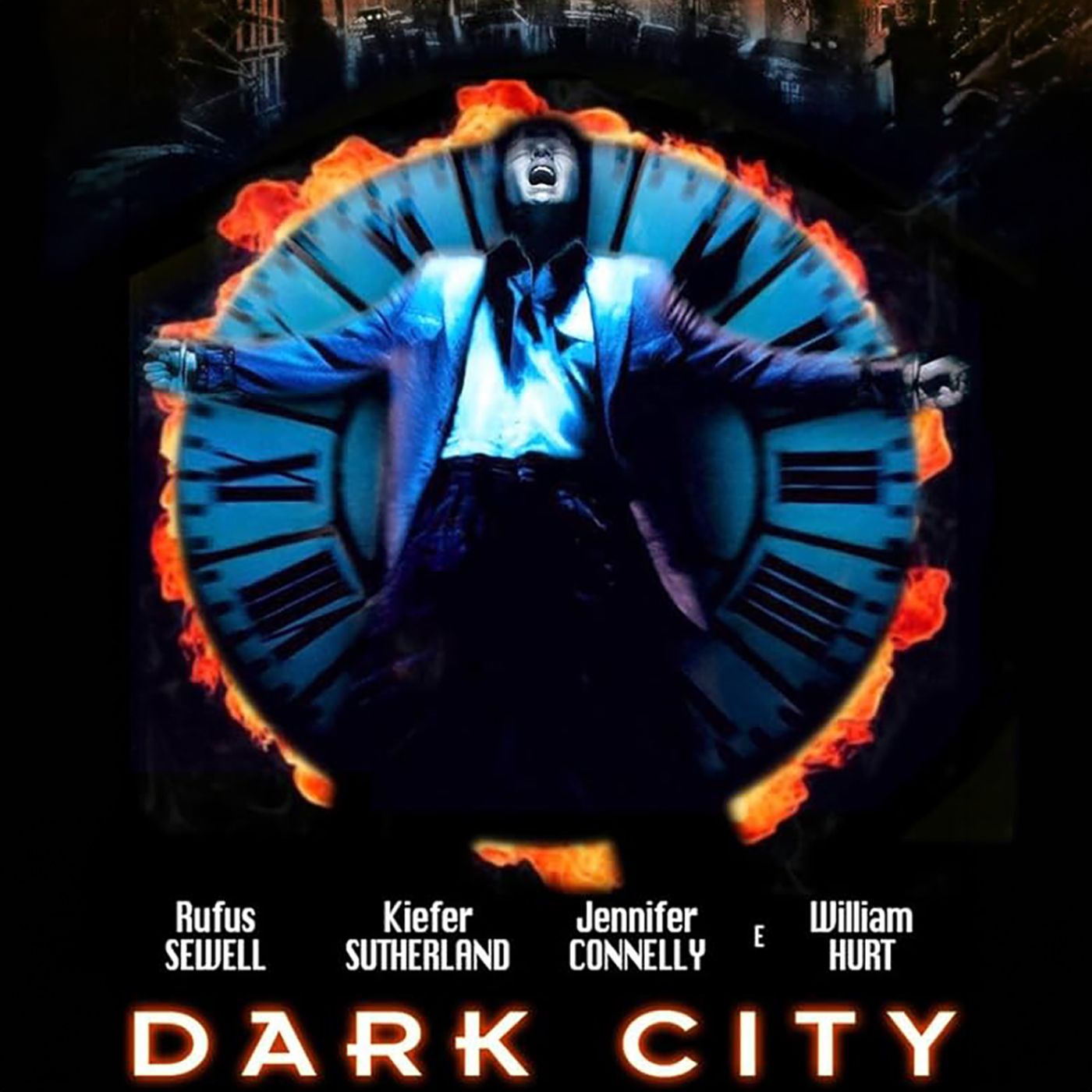
This is the second Alex Prays film that we've covered this year. This one stars rufus Sewell as John Murdoch, a man who wakes up in a cheap hotel room in a strange city with a dead prostitute in the next room. I mean, who hasn't right. This film stars William Hurt as Detective Frank Bumpstead, who's investigating the crime as he investigates Murdoch and Murdoch is investigating the unsettling goings on in Dark City, the titular dark city where daylight is just a memory and strange bald men seem to control the world. Again who hasn't been there, right.
We will be spoiling this film as we go along, So if you don't want anything ruined, please turn off the podcast, watch the film, Watch the director's version of the film. Like I said, if you don't want anything ruined, watch the director's version of this film, and then come back after you have. We will still be here, so Rob Saint Mary. But this is going to get confusing. Thank you, mister Pott.
I really appreciate you volunteering that. When was the first time you saw Dark City and what did you think? To begin? I think it's curious that strange bald men are controlling the universe because we have strange bald men controlling this show, or should I say a strange bald man, you sir. Very strange and very bald.
Yes, Dark City. I saw the theatrical version in the theater when it came out. I think I was one of about six people, which included Roger Ebert, who I know we'll be talking about later, who saw that version and thought, yeah, this is good, there's something going on here. I know for me at the. Time, I was twenty when he came out, so I was and you know, the huge intellect that I am today, as you know, but you know, being a Detroiter, I had an interest in what this director was going to do because the entryway for their American films was The Crow, which of course takes place in Detroit.
Wasn't shot in Detroit, but it obviously deals with Devil's Knight, which we're familiar with, especially you, Mike and I being of a certain age. Devil's Night isn't quite what it used to be back in the day, and thank god for that. But but when I saw Dark City, I was like, you know, I really liked it. Did there was something in there that I really liked? I know that I saw it once and then I don't think I saw it again until the director's cut was available, so I actually had to go back and rewatch the theatrical version and go I understand why this issue and the director's cut is not just an exercise and oh, some guy wants to add extra stuff in that he was too precious and want to cut.
This is you know, the difference between what a film should have been on its original release and trusting the audience to get it as opposed to what sadly New Line did with with the opening, which I feel completely spoils the rest of the film overall. Yeah, seeing it the first time, there was something there for me, and I've come back to it over the years, and it was one of those where I started to see for Suell Moore, I don't maybe he's on TV now, but I always because of this, really enjoyed him as an actor. And then of course Jennifer Connelly. I mean, I'm a big fan for stuff too, so so there's a lot going on here that I really enjoy and I'm glad to be here. And mister Pott about yourself.
Yeah, I also saw this at the theater when it came out, and I immediately went wild for I was a big sci fi geek. I suppose I still am not to think we grow up out of these things, but I don't think I have. And I went with a bunch of friends who are also sci fi geeks, and I was quite outraged that they walked out of the film going, eh, it was okay, it didn't we make much sense. Why was it all Why was it all surrounded in space? How could they breathe in space?
I'm like, no, it's a force field. Man, this is all thought through and it's interesting. I've seen it many, many times, and it's one of those fascinating examples of a film with real thematic depth. I mean, there are so many ways this could be read. But also it has a very literal sci fi narrative that actually works very very well, and even thinking through the logical ramifications of what's in the story can kind of blow your mind.
So yeah, I think it's a brilliant film. I did not see this in the theater, and when I saw it on probably DVD maybe VHS the first time, I was a little underwhelmed. And I have mister Ebert to blame for that, because he hyped this movie up so hard. It was like the second Coming of Christ and nothing was going to ever live up to what he was doing. Kind of like I still haven't seen Hoop Dreams, just out of spite, because there were two films that he would just get on the stage and bang that drum over and it was Dark City and Hoop Dreams, and I was so fucking tired of hearing this guy talk about those two movies.
So yeah, I saw Dark City and I was like, yeah, yeah, it was all right. It was Okay, this was okay. I definitely have. Grown to appreciate it a lot more over the years, especially on these more recent viewings. I'm like, okay, yeah, I can really see this now having seen more of Croyus's work, just having seen more films in general.
I mean, this movie came out what thirty years ago, well twenty eight years ago, and yeah, it just gets better and better, especially in this late nineties wave of science fiction where we were questioning reality a lot. I can see some people when they'd be like, well, this movie rips off the Matrix. Well, sorry, this movie came out well before the Matrix. There's elements of like the Thirteenth Floor, even some stuff with existends. I mean, just this kind of late nineties, we're kind of losing touch on reality.
Strange days, these types of movies. It feels very Philip K. Dick to me. I mean, just the guy waking up in the bathtub having this suitcase full of things. People probably shouldn't remember the movie Paycheck with Ben Affleck, but it's very similar to that with his whole like all of these little items that he has that might or may not play into what's going on, even getting the phone call from the key for Sutherland character very much reminds me of when Quaid gets the phone call from the guy outside in Total Recall.
So yeah, as a Philip K. Dick fan, I really like what's going on with this movie. And yeah, the look of it is so great. This is such a beautiful looking movie. A little rough sometimes with some of the special effects from late nineties, but I really forgive it a lot, and just the cinematography overall really captures that kind of blue green aesthetic.
You know, you saw movies like The Matrix that really had this kind of green tone to them. This one has that. It's almost like this neon almost fight club type of look to it. Again, just kind of like what was in the water in the late nineties. This one really just shows off so much of that aesthetic and does it in such.
A great way. I think that there's even earlier references in there too. I mean there's Metropolis in certain shots, the Blade Runner for me in certain ways, and of course all of film noir. I mean, this is living in that. And then I will even go so far as to say the Strangers design it's like the dudes from Hell.
There's a certain kind of hell Razor esque slash film noir long coats, you know, a faster look. It's got the horror imagery too, doesn't it. And I do wonder I know that didn't Alex Prous say that the Strangers were based on a dream he had, and they do conform a lot to that sleep paralysis physical figure that people talk about wearing the hat, which is where Wes Craven got the idea of Freddy Krueger from. We were talking about Rodney Asher the other day Mike on my podcast. He did a film called The Nightmare about that, and it's one of these weird, widely report globally reported phenomena of people having these sleep paralysis streams and seeing a.
Man in a hat. So it's it's kind of yeah, it's got all these pop cultural references, all these artistic references. You've even got elements of Hubism and surrealism in the way that the landscape literally moves. It's willfully artificial, looking almost too perfectly dystopian from a visual point of view, but that then suits the story as well. It's a thick soup of a lot of stuff going on in this film.
I think from a design Also I was thinking of like Frank Garry architecture, where the buildings look like they're kind of melting and falling into each other and they're distorted. Yeah, there's just so much great stuff in here, and maybe that's part of it. I mean, it's like, I feel that this movie has grown with me in terms of my appreciation because I can see those layers, because I understand the references. I understand where he's pulling these things in. As you get into it and you realize that the whole thing is a construct, it's absolutely interesting that the construct is that way, because to me it you know, someone could watch it and go, well, you know, it's not very original.
They're just borrowing from all these other places. And it's like, but that's the concept of the place, is that it borrows from all these places. And one of the things that I really like about it so is is this question of what identity is. And one of the things that I remember from a kid, you know, standpoint of going with my parents to the hardware store was the paint mixing. And I love the fact that he refers to that as paint mixing, and you see the kind of drops of things that come together to form this concept of what identity can be, which, again, like I said, Mike, I do think that that's a very Philip K.
Dick because that feels like total recall, where it's like, well, what kind of life do you want? Like we can make you a superhero, or we can do this, or we can do that. So there's a lot of this blending of concept in terms of identity and what identity means and all of that stuff, and we can get further into that time. There's an existential paranoia to the works of Philip K. Dick, which come right down to questioning if you are who you think you are or is someone has someone manipulated your life into thinking this?
And that's yeah, I think this exploration here the strangers remain a little bit of an enigma to us even after the reveal. We don't much know why they're in the particament that they are in, or why they are so fascinated to explore notions of the soul through memory. But it then traverses that exact same territory as Blade run Er, where it's like, Okay, if do memories make us who we are? Could they be fabricated in that case, and how much does that actually change or is there an underlying fabric of who we are that shines through no matter what happens to our memories, which is really quite fascinating. I think I love this whole call to Lang.
You know you mentioned Metrapolis and especially you've got that so much of this revolves around clockworks, right, I mean the whole thing of like a midnight everything stops and the strangers do their thing. They manipulate well, probably, it's an interesting thing. He's like, they don't manipulate time. I'm like, well they ca. Sorry.
You've had a lot of opinions on your commentary track, and a lot of them I actually disagree with, So that was one of them. Like, yeah, I feel like they do manipulate time, because otherwise, how all these people all sleep at the same time and the only people that are aware of what's going on are the people that happen to wake up at inopportune times or that haven't been spiked with their memories, like Kiefer Southern that was trying to do to rufus Sewell, this whole idea of the clock that controls everything. You think of that famous shot in Metropolis with the guy with the arms, you know, trying to move the clock around at what was at thirteen hours on the clock. Very nineteen eighty four, Very George Orwell, even though that was before Orwell was writing nineteen eighty four.
So have m with the way that the city feels so oppressive all the time. Also, I can really see Sutherland kind of doing a Peter Lorie impersonation through this, or influenced by I love when Sutherland would do real twitchy type of performances, Like a few years before this, he was in so unexpected for him to show up in Twin Peaks Firewalk with Me, and I thought he was wonderful in that world stuff, Like I mean his performance in Freeway was freaking amazing. Yeah, he can just do these great things. And then in the middle of that you have him as like the total dickhead marine guy from Few Good Men. You know, it's like he could do whatever he wanted during this time.
And then also the other thing that really reminded me of Lang was I just watched The Thousand Eyes of Doctor Mabuse, and then you've got Jennifer Connolly singing The Night has a Thousand Eyes, which always reminds me of that film title, So I don't think that that's a coincidence either, because everybody's watching everything, and you've got the strangers watching everybody, this whole thing being the experiment, this whole thing of having you know, these spirals all over the place and even into if you look at the microphone that Connolly is singing into, it's got this kind of spiral pattern to it. You look at the maze that Sutherland has this rat running through as a total spiral. Also going back to m all of the thing about the fingerprints, and that's one of my favorite images in m is when the detectives are trying to track down Peter Lorri and they've got that huge fingerprint printed up or projected over the guy's head.
And I just love how big fingerprints are in this I mean big as in holding your hand right at the camera and seeing that his fingerprints aren't loops, they are just circles going in on each other, which also reminds me a little bit of Alfred Jerry and Hataphysics and Uber Roy who has this huge spiral on his on his belly in that play. I think that all of this. Stuff is definitely for lack of a better term in place. The strangers also remind me of the Board in that they are collective, they're not individuals. Kind of a passed off reference.
It's a very small reference. Is that they're using the bodies of the dead. Very planned nine from outer space. That way through. There's kind of jellyfish thing when the one gets practed, their skull gets pracked open.
But I really have this idea of like insect collective or ants colony, things like that, that there is a kind of a central and then I think it's what is it. Mister Book is sort of the main guy who's kind of the leader of the orchestra, leader makes everything go, and they have a little bit of a The scene kind of reminds me of I think it's in some of the earlier soul films. Are definitely in the Brona remake of Frankenstein, where they have sort of that surgical theater where there's the guy who's down here and they're all in sort of this choir and they're looking down in and so there's that kind of design. The one thing that I really love and hear and I know Mike that that you're a fan and you might have more of a broader understanding of his acting career.
But fucking Richard O'Brien in here is fucking great. Like not knowing really who he was when I saw it when I was twenty, because I don't think i'd seen Rocky Horror at that point, but like him and here, I'm just like, why the fuck didn't someone put him in more movies. I'm just like, this guy should be in other places. He's so good. Bruce Spence and Here is making my heart flutter.
I always love seeing him show up and stuff. But yeah O'Brien, especially the way that the strangers end sentences, not with a question of yes at the end, it just this yes at the end. And I just love the way that he speaks and he carries such menace. It's great seeing Bruce Spence because it kind of whenever I say Bruce Spence, it just reminds me of mad Max Throy Morio, and I think there's some similar, sort of quite on the nose references going on that I think George Miller would be proud of. I think in the names I was thinking about the names of these guys, so mister book, he is like the brain of the operation.
And they take these kind of quotidian objects to name themselves after, but they all have symbolic meaning. I think it's you've got mister Book, who is the brain of the operation. You've got mister Hand who is he executes the will of the collective, so he's like the hand of the king almost from Game of Thrones. And then who also you got mister wall is a guard. The little kid is mister Sleep, and that kid seems to be some kind of assassin or something seems to do a lot of the killing.
So yeah, it's just really I love this sort of simple the way language can be used to get some of these archetypal concepts across what. I love all the puns, and I think they are almost all lem dabs, adding those in things like I'm just as in the dark as you are, things like that, you know for dark City. Just there are all these little things that pepper through this as well as as you know, Rob your opening was even quoting that that cash on the barrel head. These kind of nineteen forties, nineteen fifties pulp doir type of phrases that they have peppering out throughout this whole thing, and you know, you were talking about this whole world of anachronisms, like all of this stuff is, you know, all of these different eras, like the guy who talks to him about you know, oh, you got to take the Express train.
That guy's right out of the nineties. But then everybody else seems like they're in the forties, fifties, sixties, seventies, even it's all over the map, which I just love that it's this construct of this world that the strangers have put together and they just seem to have very loose ideas of how humans work and everything, and they're just trying to like figure us out. And that whole thing of the insects inside of them, I mean that was like the literal thing in the earlier drafts of this screenplay, where that they were insects inside of these brains and you know, they would come out and you could just squash. I mean, it's so Robert Heinlein's The Puppet Master, which I think Keifer Sutherland's dad had just been in a version of that and maybe six.
So it's like just all of these things feeding on each other again, Like I think there was the puppet Masters and Abel Ferara's version of the Body Snatchers were out right around this time. It's like kind of leading us into this new millennium. The idea of facades or shells, and that the shell becomes an important word. If you think about the strangers, they're almost kind of like hermit crabs. They're sort of taking the sort of cast off physical remains of some creature, and that's what they that's what they live in, and that's what they need to get around it.
If they're removed from that, they can't survive. And I think that then brings us onto this symbol, which I've been puzzling over a lot. Actually it's never been too obvious to me, but the spiral and what that all means is clearly very important. And the more I think about it, the more I'm thinking of ways that that can be interpreted either either as a symbol of a never ending something that's never ending, but actually also potentially as a symbol of the opposite, because if you think about it, a circle is never ending, and there is a lot of circular circularity to this story. You know, these cycles of change that they go through twelve o'clock every night, the same thing happens.
But a spiral is almost taking a circle internally. A spiral in a way is just not that different from a straight line. If you just curl it up, it's got to beginning and an end at least that we can see. So maybe suggesting that there is a way to untangle this, this puzzle. It's funny I think about Hi and all of the spirals, the Febinacci sequences that are mean character in Aeronofsky's Pie keeps talking about.
There's even a shot of William hurt when he wakes up and the cream in his coffee is going around in a spiral, and that's right out of Aeronofsky's Pie, which I think was what like the year before. So it's crazy how all of these things are like speaking to each other within just a brief few years of time. Yeah, there was a lot of these movies about is everything really okay? I mean, it's interesting to look back out from twenty twenty six and think, imagine a time when life seemed so fine that we had to dream up there must be something wrong. There must be something wrong somewhere.
We were right, there was, it was on the way. But yeah, very nineties thing I wonder if it's almost if it's one of those trends you could trace back to times of prosperities where you get a lot of dystopian cinema. Don't know, spirals. I believe in ancient symbolism and certain cultures had been related to chaos. So there's that aspect that I mean, the universe is a spiral.
We live in a spiral universe, so so you can use a lot of these kind of elements in that way as to why that keeps coming up. And like I said, from these questions of existentialism, I mean, there's a lot of it in here. Like I say, at the time, when I saw it the first time, I don't think I picked up on that. The thing I always used to talk about on writing on levels is that the thing that I always like is a is a property, an idea that does well that you could show it basically to anyone and they could enjoy it. So for example, like I always used to point to The Simpsons in the early years, where you could just watch the Simpsons and if you weren't like overly literate or into certain things, that was okay, Like you couldn't just enjoy it and it was good, enjoyable piece, and then there were these layers of you know things that they were bringing up, references, questions, whatever, And so I always the films or the books or whatever art that works best for me are those that work on these multiple layers.
And then when I go back later in life and I rewatched them, I find so much in it. And at the time, I think when I was twenty when I saw this, I wasn't sitting around doing a lot of you know, heavy thought on you know, existentialism or Cameu or you know, the absurd and things like that. But as I've gotten older, yes, like I've gotten into philosophy and all of that, and you can see a lot of that in here as well. The big question for me and my readings of Camu and existentialism is that, yes, you know, you can say, oh nihilists, right, you know, it means nothing. The universe means nothing, There is no plan.
But the question is is what do you do in that, Like, like, where do you find your value in the fact that there is no meanings? So that's what really life is about. It's about finding the value in something that is valued less, Like there's this paradox that you have to deal with, and I think that a lot of this in here. When you get into the deeper philosophical angles. That's what you'll find.
I think if if you've had enough philosophy reading, you can you can pull those and tease out those elements, and it's interesting in that way and. If you follow along that continuum. So that's one reading, but then some of the same questions that come up in that sort of philosophy are also the same questions that come up if you're thinking about areas like mental illness. And I feel like this is potentially an allegory for mental illness as well. I mean, this whole thing could just be the delusion of a paranoid schizophrenic or something like that.
And that's where the psychological horror of the film literally comes into it as well, is that he just does not know what is real and what isn't. It takes some of the tena's of existentialist philosophy and boils them down to a fundamental level of survival of how you even function as an organism within a society, which is something that is mirrored by the strangers, who are the strangers the strangers seem to be no one in a way, the fact that they're all gathering around conducting this massive experiment with which their survival supposedly depends and they cannot grasp what seems to us to be the so fundamentally simple that we don't even think about it, but for them is you've got to understand, and you just get the sense, well, they're never going to understand today, are so far off understanding in a way they don't really exist.
Which what is the ramifications of that? What if they don't actually exist? And that can be ready to the film as. Well, real quick about the spirals and everything. I'm wondering if that was also an influence on something like Westworld, the TV series, not the movie, with the whole thing of the Man in Black, the Ed Harris character in the way he keeps finding that spiral pattern and I think he even like walks a spiral in the end of the first season.
I never really made it past that. But that also brings into the whole question of what's it mean to be human? Who is human? Who isn't human? You know, are the humans safe when they come into this world that's populated with these automatons and just I mean the whole idea of what does it mean to be human again goes back to Philip Kate Dick so hard and yeah, the whole idea of the memories and you know, Rachel having the niece's memories.
One thing that I found interesting too talking about Madness is the one character who is truly truly mad, Violenski, who was the former detective or he got cast in that role. And for me, so much of this movie as a metaphor for acting and filmmaking, where you're constantly casting people in these different roles and they have to just adopt and adapt these new things that are being pumped into their heads, you know. And he's the one who sees the truth and cannot handle it, and he's the one who, you know, kind of goes off the deep end. He's got that. I'm surprised he doesn't have a conspiracy wall, but he's got a lot of you know, circles and spirals in his room and everything.
When they go in there. He makes up for it with a lot of chalk drawings on his ceiling. And absolutely very John Hurt and the crystal skull kind of thing. But The thing that he reminded me of too, was the original partner of or the original detective in Blade Runner who we see asking Leon about, you know, the tortoise. And there's that deleted scene where you see Decker going in and visiting that guy, and it's like that guy was the first detective, you know.
And it's like we keep getting these like little hints of the first detective. And we have Violensky, who I always want to call Lee Violensky after the character from The American Astronaut, but Volensky, who's just like I was the guy who you know, found this out. There have been many of us. It also reminds me a little bit of the failed Messiah character, like the the Quisas Haderak that wasn't you know, like the the Sting character or the Austin Butler characters, Like he almost was the Quizas Hadarak. He almost was the one, but then we have to wait for the one.
And basically rufus Sewell is the one. He's the one that will liberate us. And it's so fascinating that this was just right there, right before or the Matrix comes out, and I just feel like the Matrix, like solidified it just. A little bit harder. But like you even look at things like the movie begins in a hotel, it begins with a phone call, you know, have all of these things.
And I've heard people say, oh, yeah, they recycled sets from this for that because they were both shut in Sydney. But I'm not sure. You know, Heart of the City looks a little bit different than Hotel, But I also like that hotel is just generic, Like the strangers aren't going to name the hotel, They're just going to call it hotel. One of the interesting things about Rolenski is it's the flip sides of what I was talking about, this sort of search of reality or truth as some sort of survival need. The flip side of that, and the scary thought is, well, maybe finding out the truth is the worst possible thing that can happen to you, so it certainly doesn't do him any good.
He finds his own way out, which is not the way out that he was probably looking for. And I thought this was explored really well in the matrix to this same idea with the Joe Pantoliano character who wants to just go back to being oblivious to all this, and he's right, that's what I would want. I would like, I'll put me back in the put me back in the simulation that in reality. And let me eat steak and peace. There has been a couple of movies recently where there's been conspiracy theory characters who you think are crazy, but actually they know the truth.
And at the end it's like, see, you should listen to the conspiracy theory people. I know, I want you to talk. I know one of the ones you're talking about. It, and I don't want to say which one it is because I don't want to ruin it because that's the big ending. But the thing is is that Wallinski like knows this, like he knows that the truth, and then he kills himself, which to me, Camu's greatest piece is the Mythisisiphus, And the first line in the Mythisisiphus is the biggest moral question is suicide.
That basically, when you know that there's nothing, that everything doesn't make any sense, you should just off yourself, right, And he's like, no, that is the cheap way out. He goes, you know, you have to be like Sissifus, you have to go Yes, I know, I'm condemned. I know I have to roll this boulder, but I have to find my value. That is what I think rufus Seule's character does is that he could very well throw himself in front of the train, like wellinskin go oh, it doesn't make any you know, all of this is bullshit. It doesn't make any sense.
There's no fucking point. But no, he has to figure out how to survive it and in the end use the tools that he has to build the world that he wants. And that is the value of what the ending is is that it's up to him. It's up to us as individuals to figure out what reality means for us, what life means for us. I love that you're bringing that up, especially sisipists, because sorry to go back to Dick and do androids stream of Electric Sheep, but I mean mercerism, the religion that a lot of people, I don't know how to say, perform, but like it's almost like this virtual reality thing where you're watching this guy mercer pushing a boulder up of a fucking well.
I mean, it's totally sisiphas. So it's great that there's that connection. Because the roof of Saul character, he has to sort of get over this nightmare. I mean, how's this many mental illnesses manifest in the feeling that you're untethered and unable to maintain a stable sense of identity, Whereas John Murdock's nightmare is to be the only stable identity in a society of infinitely mutable ones, which I think is a nice little way to turn that in the head. It's his problem is sentienced.
His problem is self awareness that no one else has, which, when you think about it, is a scary thing. And again, I mean, I don't know if it's I don't know what it is about this storyline, but I feel like I keep imagining situations where you say, look, if this suddenly appeared tomorrow, or you're going to show it to someone who'd never heard of it and said this was made last year, what meaning they might read into it? I mean, if you did it a couple of years ago, they'd probably think it was some sort of anti VAXX type tirade, you know, the idea of like the shady government trying to inject you with shit in the middle of the night. It's not good for you, you know, And the one man sees the truth and takes horse pace instead.
Exactly, it is bizarre right wing conspiratorial fantasy because it operates on these levels of maybe because it dredges up all that it's not Freudian, but it feels like very subconscious. Yes, yeah, it's so young, it really is. And because it focuses on this idea of identity and memory and perception and perception being an unreliable thing, which is basically the definition of manness is when you cannot trust your own perceptions, and films which can explore that world are always like hugely effective. When it sort of dawns on you how little you could be tethered to the world if this is if you could not trust your senses. Well, speaking of tethering, I mean, the only thing that tethers or that gives any sort of a lafe line to the soul character is that postcard you welcome to Shell City.
For him, it's you know, he sees the billboard. Even when they break through the wall, they see what they think is the outside world, but again it's that billboard until they finally do see the outside world and see the see the fucking void. Man. It's it's very uh, Nietzsche in that as far as like looking into the abyss kind of thing, right, But this whole idea of him following this path and again he could be following the spiral, going in and in and in trying to find, you know, his childhood and find that beach again. One it reminds me a lot of Barton Fink and the whole idea of that picture on the wall and the way that he goes into the picture or lives that world at the end of Barton Fink.
It also reminds me a lot of Requiem for a Dream because how's that end with Jennifer Connolly, you know, on the Boardwalker and just this kind of beautiful scene as well, this kind of you know, life was beautiful once, but for me, it's it's verys and it's him kind of getting back to his childhood. I mean, I think Shell Beach is basically Luna Park, you know, And I wasn't familiar with Luna Park until we did that Australian Month a few months ago where we talked about Spirits of the Air, Gremlins of the clouds. We also talked about Shirley Thompson meets the Aliens, where that takes place in Luna Park and the whole idea of her meeting the aliens in Luna Park and it's like, okay, so it's like this decrepit kind of you know, play place type of thing, and you know it like the water and all that.
I mean, the one safe space for you if you don't like the strangers or if you're trying to get away from the strangers is water. Like that's the sanctuary for Kiefer Sutherland is in that big pool of water. When O'Brien is just walking around, he's just like, oh, you picked a very clever place, like we hate water. I'm like, okay, yeah, so of course you would want to go back to Luna Park. Yeah.
I clocked the Luna part reference straight away. I do like how in the Dark City because in Sydney, I haven't seen Luna Park for a long time. I went there as a kid. It was brilliant and then it kind of went into rack and ruin slightly, but it was always painted up in bright reds and yellows and it's a happy place. And I love in Dark City, it's this glowering dark thing with green eyes and purple light on it, and I think, yeah, that doesn't look quite so inviting.
But I'm not sure if it's deliberate either. But when he creates Shell Beach at the end, what he actually creates is a sort of a headland that comes up out of the water. It looks a lot like it's the same shape as the Wounded Peninsula that goes off into the Sydney Harbor, which has all Sydney's beautiful beaches on the seaward side of that. So yeah, I think there is quite a few references to his hometown there. And of course you want to get back to that, you know.
It's that whole danger of nostalgia, like I want to get back to that place at the end. You know, we've seen that so many times where a character is just kind of searching for their childhood and the sweet memories of childhood. Sutherland is creating those memories and he's smelling things and he just seems to have that like oh, yeah, this reminds me of this, or like oh, I haven't smelled this in a long time. He just seems so pleasured by having that. And that's that weird scene where all of the strangers are going through the belongings, like things that they seem to have taken from the people, which that of course I'm thinking like Nazi Germany and looking at like Sutherland as being like kind of a inspirator.
You know. However, that collaborator, Yeah, he's the one. You know, he's very Peter Lauri and the Lost One kind of thing. It's just like, oh yeah, yeah, what did you do during the war, Daddy, Well, I created the formula to inject into people's brains to give them new memories. I was the doctor Mengela on staff.
Because he is the collaborator, he can also be the guy who can crack the code. So that's what allows him to show Murdoch through the injection like this is where you need to go. Which a funny version of this, it must have been around the same time, is in Mister Show. There was a sketch in Mister Show where there's a trial and Bob Odenkerkson's proud came over exactly what the sketches and it's like and then there's the jury and it's like, well, could you tell us about this? And it's like, well, I could, but if you all just take the tablets that are in front of you.
You'll go there. Oh, that's kind of the same thing, you know, this kind of bizarro idea that you can just inject someone and they will have the exact same experience as you, or you can guide them in a very particular way. I love the way he uses smell likes. I'm sure that's is that like a Priestian reference, like connecting smell to memory. So of course says things that they're injecting people with must have certain smells.
They've done studies in that in terms of memory when it comes to smell, And I know for myself, like when I was a kid in my single digit year, is my friend my parents had friends from Korea, and I would go to their house and they'd make dinner and there's a very certain scent of the food. And I remember, like twenty twenty five years later, you know, because they're like long gone and i'd seen them in you know, since I was very young. I walked into this Korean restaurant and I smelled that same thing and I was just taken back to when I was like eight years old, you know. So so smell can have a very deep memory for us in ways. Good to call him the proofs, the medlines and all that and then just see like, oh, I'm taking back completely the danger of finding the truth, the danger of a Vilenski and just you know him and seeing the truth and driving him crazy.
I think that's what is really scaring Bumpstead, the William Hurt character, is that he starts to doodle the spirals, you know, and just starts to see maybe a little bit more because he This is such an interesting movie too, in so far as you know, has these trappings of film noir, which are primarily a lot of them are detective stories, and here we have actually two detectives. We've got Suwell doing his investigation and then we've got Bumstead doing his investigation. It kind of reminds me a little bit of like maybe The Big Sleep or The Multi Falcon, where it's like, yeah, you've got the Humphrey Bogart character who's outside the law and they constantly think like, well, did you kill your partner Spade, and it's like no, no, you know, like did you murder your wife here Murdoch, No, No, I did not murder, not murder my wife, murder these prostitutes.
No I didn't murder these prostitutes. Maybe I'm going to find out who did, or I just want to find out what the hell's going on. And then you've got Bumstead, the William Hurt character who's kind of investigating Murdoch, but at the same time he's also trying to figure out what is the way to the truth, and this whole idea of like when they finally come together at the end and the two detectives join forces, that's when shit can actually get done. There's an interesting idea to here, just in terms of the literal interpretation of the story, which is that all these people, we don't know what their starting point was. We know they were taken from Earth.
We don't know how long they've been out there. They could have been there potentially for generations. They could have been there for like a month, not probably a bit longer than that. It feels like it's been a bit longer than that, but we don't really know, and we don't know who they were. And there's this idea of does anything of who they were come in?
How much of who we are is learnt or experienced, and how much is innate to us? And you get a little clues, like the guy he works in the office building. He says no days off for good behavior, and when he sees him again and he's doing another job, he then uses that phrase again to sort of suggest, Okay, there's still the same person in there somewhere, even though you can change all the trappings about them. So someone like Bumstead, is he any good at being a detective? I mean, like he might have no aptitude for.
It could have been a butcher, it could have been a chartered accountant the day before. Now they would have implanted the education and experience of being one, so he will get that, which is a central which is sort of a twist at the end of this which is for John Murdoch, but still is the basic aptitude there for all these things. And you know, it's really interesting with Jennifer Connelly's character, who is a lot more she's quite passive in comparison to their characters. She's not really She becomes aware because John makes her aware that something is wrong, but she is consigned to not retaining her identity that we are introduced to that we know, she becomes someone else. But I think what I think the film does pull off is I think the intent is that we believe that she is, in many respects the same person.
We just buy that. What's funny you bring up the line that the one person uses multiple times even though he's repassed, and then you get the line again that Robbies at the beginning, the whole cash on the barrelhead thing, that line gets used by the white guy who's working behind the desk, and then used by the black guy who's behind the desk as well, and it's just like, okay, like we made sure that this character, this krusty hotel blurk guy, is going to use that same phrase. So it's so fascinating because yeah, I love this idea of are we our memories? Are we ourselves? You know?
What makes us? It's fascinating listening to the writer audio commentary for this because they were obviously not recorded in the same time. Maybe they were given the same set of questions to discuss, because they will both start to talk about things, and so you've got like lem Dobs and he's just like like, oh, yeah, well, you know, I really feel like we are you know, so much of us is born this way. Like if you're a killer, you're born a killer. If you're you know, a brilliant person.
You're going to be born a brilliant person. And then they go to David S. Goyer and he starts talking about things, and then he comes to his conclusion of well, I feel that it's much more you're born with these things. I'm just like, this is fascinating to hear how these guys kind of repeat each other. It's almost an interesting experiment in audio commentaries and just how these two writers kind of comment things from different ways, but they end up in the same place a lot.
It was also interesting to hear how many times Lem Dobs had to talk about being raised in England, because I think he said it about seven times within like a ten minute span. At one point I was just like, oh. My god, Lem, I got it. So I don't know if that was all because they were cut together from different places, but I was like, man, we get it. We get it that you're from England or you're born and raised in England or whatever.
So like, yeah, it was funny how they both come to things like Monty Python, they both came to things like Brazil. There was a real rejection from Dobbs of Kafka and Kofka esque because as i'm watching this, I'm just like, well, obviously Dobbs wrote Kafka for Soderberg, and this has such a Kofka feel to it, and I think at one point he does talk about the trial. I know Proeus talks about how the original ending of this was going to end with the trial. I'm glad they went away from that, but yeah, I definitely saw a lot of Kafka in this, and I kind of disagree with Dobbs as far as like not seeing that this whole idea of these and even though he brings up Brazil, which for me is very Kafka, asked this whole idea of these forces outside of yourselves that are manipulating yourself and manipulating you, and you have no idea who these people are, what they're doing, but you are basically just a cog and a wheel and being spun around by somebody else's power.
It was interesting that Preyus said, yeah, it's a bit like Kafka, but not as much as you might think. I think it's more like an episode of the Twilight Zone. Get where I get where he's coming from. I think there is a lot of Caffeca it. It as a hell of a lot of Cafgar in it, but I think where he's coming from is in this case, there is the appearance of that sort of It's not it's not technically surrealism, Kafgar is it, but it's it is like a surreal story.
So there is the appearance of that surreal surreality, but actually there is a very hard, cold, fully understandable reality that is explaining everything that we're seeing, whereas something like the trial whenever, we'll never understand what the fuck's going on in the trial. You know, we're in the same boat as k At the end of the day, it's just inexplicable, and the only thing we're probably left thinking is it's probably all just happening for no real reason. That's the complete randomness of the world. So it's definitely got a nod to a lot of this surrealist sort of art, but it has this reality to it external internal to the story, but external to the experience of what we go through, which is one of the which I think is actually what makes this such a narrative triumph, is that that twist when the when the rug is pulled from you, it's it's a bit hard for us to put our minds back into the late nineties when this was a new thing, because it's been done a lot.
And we saw it again the year after with the Matrix, and it blew every a much bigger audience's mind because they actually went and saw the matrix. But it was I remember seeing the matrix and thinking, hey, on, this is dark city. What happens. But it's such a cool twist. It is such a cool twist.
And he keeps doubling down all the time on all the the kind of scientific reality of what you're seeing. There is an explanation for everything here, which seems incredibly audacious because it's, like I said, it's a thick stew of weird stuff going on that feels very internal, feels very psychological, but actually it's all external. I was just thinking in terms of roles, and you know, Mike, you had talked about well, it kind of reminds me of you know, film or you know, like actors got to play different roles. I was just thinking of just roles in general, like all of us, you, me, everyone else, we all end up playing certain roles, like what does it mean to be son or father or employee or you know, all of these roles.
You know, we play a multitude of different roles every day. They're they're all variant of us, but they're tweaked very differently. So, for example, the way I'm talking with you on this show, I probably don't talk like this at work, you know, to my boss. So so's there's a different way in which we have to navigate the world and what do those roles mean and where they come from? And I think that that has also been one of the reads on the Matrix recently, and especially when people look at the Matrix now through the lens of obviously trans you know, creators, and they go, it's a trans story.
It's about roles. It's about, you know, having the scales fall from your eyes and then being given a gift to reimagine yourself. And I think in a lot of ways there is that in here as well, because I don't believe that the John Murdoch who's on the pier at the end with who used to be Emma and is now Anna, is the same John will be the same John Murdoch that we first met the bath, though that he understands now we understand. I think that he can make it what he wants to make it. And I don't mean in the way that the strangers can manipulate things and stuff like that.
I mean from the standpoint of I have to appear and live this. I have to figure out how to make this work, because this is what I have to work with. This is, you know, the cards I've been dealt, and so I think in a lot of ways, that's what it speaks to me on and it's terms of its value as a piece of art. The visual hook we get there is that it suddenly becomes a very sunny film at the end, without ever looking like realism. It's not real sun, but it's it looks like a simulated sum to us.
But in the story it's a blinding real sun. And I think one of the maybe a big point of difference I think between the narrative here and the narrative in the Matrix when you put all the when you put all the esthetic trappings to one side, is that the Matrix is very much a narrative about an entire population or culture of people being liberated from some sort of from a simulation and then being able to then take back their self determination, their autonomy, whereas this is not so much. In a way, all that's happening is that John is just going to perpetuate the delusion for everyone he but it the idea is at least you have hopefully a more benevolent dictator at this point than you did under the Strangers, which I think is an interesting difference.
Yeah, it's funny that Saul would go on to play I can't remember what role he was in and man in the High Power another Philip K. Dick thing. But that whole idea of set are in charge and doing this. And when you think too of the matrix as being the christ allegory, I mean John and Richard O'Brien, as he's getting the memories put into his head, they're both basically crucified in this big machine. So and that comes up even clearer in some of the production sketches where it just looks like such a crucifixion where the legs are more together than spread apart.
But yeah, I love, by the way, going back to Emma and Anna, these palindromic names that they have and just know, very smart, smart naming, very very smart film and very well written. And I like that you were saying the whole idea of the Yeah, it's Kafka, but it's really more Twilight sound. You know. I went back and I watched Where is Everybody This Morning? The I guess it's the pilot episode I never had seen, the one with Desi Arnez introduces things at the beginning, since it was all you know, their company that was putting us out to him and Lucille balls, but then having this intro with Serling where he's walking through like, gentlemen, I think you'll enjoy this show.
We are going into this and that and the other thing, and we have all of these stories. I'm just like it was the pitch for the people at the network. It was crazy, but it reminds me of that of course, whereas everybody, but it also really reminds me of one that we talked about just recently, which ironically two weeks in a row we have mentioned Theater Sturgeon. There's a Theater Sturgeon short story that led to an episode from eighty six called a Matter of Minutes, and we talked about that on the Leangaliers episode. Because the Langoliers are the ones that take care of destroying the world at the end of it, so it can be rebuilt the next day kind of thing.
This one a matter of minutes is Alan Arkin and his wife wake up early and they actually see the world being built, like you see Adolph Caesar as this supervisor, and they're building the world for them to kind of move into every single day, like at the night. At night they tear everything down and the next morning they build everything up. And this is how we go. And these guys basically are the strangers, you know, they they do the construction. Even though with this with and Again nineteen ninety seven, ninety eight, the cg a little rough compared to something like Inception.
But then I'm watching I'm just like, oh, Inception, all right, the whole idea of building the city and you know, the mirror usage. And all that. I'm like, okay, for sure, I have a feeling that. Well, it was probably in an anime that Nolan saw and liked and took that. He's very Aronofsky in that way.
But I was really feeling a lot of Inception when I was watching Dark City this last time. A little dash of Papricia, a little pitch of prois. Yes, a little bit of perfect Blue. I think that's the one that Aeronovsky always goes back to. Well, I was also thinking, and this one's a little further afield, because I think we think of it in terms of media, but also like the Truman.
Show, Oh very much, yeah, or Pleasantville that. There's one guy and like the whole world built around him in this and then he gets to the edge of the world, like there's a door, looks outside, you know, So there's that kind of aspect. Well, gosh, Rob, how many years ago did we do the thirteenth Floor where when you drive out of town, this whole thing of like how do I get to Shell City? And where's Avenue C? And yeah, when was the last time you saw the sun?
They try to drive out of town and they end up at the edge of the computer simulation. You see the ones and zeros basically you see the matrix you now being shown there. But yeah, it was reminding a lot of Truman Show. I was reminding a lot of Pleasantville. And again those are both nineteen ninety eight that those come out.
There's a great book came out that I read recently. It was called the I think it's called the Best movie Year Ever, and it's about I think ninety nine but but yeah, sort of that hussin there, you know, and like all this weird stuff and like how did this get made? Like how did they allow such things to happen? And so it really was a great era in that sort of late nineties. I'm not trying to sound like some old man, you know, nostalgia for the old days, but there was a lot of this kind of questioning of reality.
I think a lot of it had to do, to be honest with if you think back, because I think all three of us are old enough to remember when the Internet came in and there were all these like big promises of what like the Internet was going to do, and there still is to a certain extent. But I think we were just bathed in this, you know, sort of like there will be an alternate reality and you know, you'll live on the computer. Like that concept is so old, thirty plus years old, the metaverse, I mean, there was second light. I think that the Internet is also where we got the Mandela effect. And that's another thing where're just like questioning your memories all the time.
For me, that's always you know, talked about this in a previous episode, where it's just like how self centered are you that everything revolves around you and ingram memories and just because you don't remember something the same way somebody else does, that means that I don't know aliens or strangers or somebody came in and changed the fucking world just because I pronounced that Berenstein is that of Berenstein. Yeah, some of this Mendelar effect stuff is it's it's both hilarious and incredibly depressing. People going, I'm sure Portugal and Spain went on the same land masks ten years ago, but really, well, I think you're just wrong. But it's also just the malleability of memory. And this is one of the things that you know, people who study this stuff will tell you you're terrible eyewitnessed.
Eyewitness testimony is very unreliable. I think the other thing too, that I kept thinking about watching this film is all the simulation theory stuff, because I got I got really interested in that. I think it was a special feature on the disc release of What's the Fastpender film about the simulation. Oh World, Done a Wire? Yeah, which was the same source novel as The Thirteenth Floor.
Right, Okay, and is it? Nick Bostrom is the guy that was given a lot of money to sort of for these sort of simulation theory studies. I don't know how you study simulation theory. It's narrowly kind of unprovable order thought. But I've always found the logic of that it just doesn't work.
I just don't understand how it could ever be accepted. It just seems to ignore a very big question because there isn't the theory. If I've got this right, that in the future there will be immensely powerful well humans with immensely powerful technology. That's the first thing you've got to believe. We're there.
Okay, yeah, we're already there. They will have the ability to create simulations that are indetectable to anyone in the simulation. Again, it's another big leap for me. Now, if you believe those two things, then if they have any interest in how their ancestors lived, they will project simulations of the past. And if that happens, there is likely to be many, many of those.
And so there's only one actual past and many many simulations. So the logic goes, we must be in a simulation. It's in vanishingly small chance that we are not in a simulation, and it's like, yeah, there's a lot of ifs to get to that point. I think that okay, youbu. I mean, wasn't that after he had his revelation?
Wasn't that very what Dick was on about for the last few years of his life? Oh yeah, all the oh I can't remember what it's called, but all the sort of religious stuff. Yeah. Well, there's also going back to Rodney Asher that he made about the kid who thought that he was in a simulation because of the matrix and ended up killing as parents. I mean, this is nothing new.
I remember reading an account around the time of the is it the Great Fire of London sixteen sixty six? Everyone thought that was going to be the end of the world, the end of New Year's Eve sixteen sixty sixty, sixteen sixty seven. I think I think that was believed by many that that was going to be. The next day was Armageddon, and then you know, Paradise was going to come and all that kind of stuff, and a number of people, to show their devotion threw themselves from the top of churches or something at midnight. Does God need you to do that?
Really? We all know it was twenty twelve, twenty twelve it was end of the world. And then I think a lot of people pinpointed to twenty sixteen when Prince and David Bowie both passed and they're just like, yeah. That was it. That was the end of it.
Yeah, so there's the Christians that were wrong and the Aztecs were wrong. But I mean, well, Bowie dying, I mean, that's got to be compelling. Shook my foundations. I don't know about the pillows of the Earth. I just think about Bill Hicks, he said, you know, he was talking about you know, someone takes acid and then they think they can fly, and they don't jump out a window.
It's like, why not try and take off from the ground first, even if it is a simil you know, even if it is so, what your job still as a person here is to try and make it work for you, you know. I mean that's the way I look at it is. I don't get hung up on these questions, you know, So I'm just like, I just got to make it work. No but raw. But if you understand it's a simulation, you can do that limbo thing and then bullets will come past you really slow and you'll be invincible.
So that's why you've got to crack the code. Just start fighting guys with very slow hand movements and everything. Yeah. I mean even when you look at this whole thing, like where this is set, this floating city out in space, I mean it looks so similar to the whole Iroquois creation myth where the world is a flat disc on the back of a turtle floating around in space. I'm just like, Okay, yeah, Terry Pretschett was rot.
I mean, even when it comes to like the you know again, the spiral in William Hurts coffee cup, I'm just like, well, maybe that's because this thing has to spin, and it's that whole thing of like does the toilet flush backwards in Australia versus chicken? You know, you gotta be careful who shows movie to because it proves flatter theory son't. I mean, there is no horizon in this world, that's for sure. There's no son in this world either, which I just love that that becomes like the gata unlocking William hurt is, when was the last time you saw the sun? And the way that Sewell wakes up or wakes up quote unquote and his uncle Carl the benevolent Uncle Carl is.
Just like, oh yeah, you fell asleep during the day, son. You know. It's like, no, that becomes a thing. I mean, we I love that fill noir is. Some of them are perpetually dark.
There is no daylight in some of these noir films. But this one actually brings that, you know, to the fore and says, when was the last time you saw the sun? It's like, oh, yeah, no, I guess you're right. There's a great So there's another thing here about disconnection from the natural order. Now, you were mentioning about the time and whether or not time really stops.
Now, the really clever thing about this, I think, if you understand it correctly, is that the only way to really understand time is in relation to the natural world, and it's basically about how many times you go around the sun all yourth spins or whatever it is that is our frame of reference for time. I know time exists without that stuff. It exists everywhere. But that's how you know time is passing, essentially. And the really great thing, it's like a final little revelation at the end of the film, which no one ever talks about because it just seems poetic, but I think it's actually like a cool logical revelation is that the reason it's a dark city and it's night all the time is just because this bloody thing is tilted away from the sun.
That's all it is. So he's just got to tilted back around. So but what that does, as well as suiting the kind of vampiric existence of these strangers who don't like the light, it also it enables them to manipulate your mind and time. And it still starts even getting back to this sort of notion of body and body health and mental health and all that kind of stuff. How much light you need to see?
I don't even know if this is true, but you know, the conventional wisdom is always you've got higher suicide rates in countries that have really long dark winters, all that kind of thing. It's a very literal metaphor for just mass depression. It's a dystopia of the mind as much as anything ducks ity. You know, mister Hand reacts so adversely when the sunlight hits them in the face. I'm surprised he doesn't start burning from that.
But the idea too of running water, like not too many people think about that one when they talk about the vampire myth. But vampires hate running water, so that's a perfect place to hide out as they're in not Luna Park but Neptune Vellar or whatever they call it. Care well, also the darkness, like you were talking about Youngian idea of the integration of the shadow and the shadow self and all of that. So it's like I say, there's a lot of layers in here for me. That's why it's always It's always been one that I like to go back to and I like to share with people.
It's lucky to get to see it on the director's cut on big screen about it a year or so ago. I think it's always going to be one that I'm going to enjoy. Find more things. Matt from Viva again and Emily looking for something superior to streaming a place of more than ten times the selection available on literally all of the streaming services combined. Check out scacro Videos rent by mail service, select from an unparalleled collection of over one hundred and fifty five thousand films and get blue rays, four k's and DVDs delivered directly to your door.
Get in on it now at Scarecrow Video dot Com and rediscover the Wonders of physical Media. There's a couple of moments in the film that I noticed this time where some of the logic slightly falls apart, But I think there's a certain artistic flourish to it which I think makes it okay. So, for instance, when they finally get out to where shell Beach is supposed to be and they find this wall with this mural painted on the wall of Shell Beach, I really love that, even though it makes no literal sense. I mean, I don't know why they would paint that there if no one's ever supposed to ever get there, But it works for us as an audience. It is a postcard, that's all it is.
Basically, that's all you're seeing. But one of the funnier ones is where we have John go back to his uncle, his friendly uncle, who, by the way, is another one. It's another piece of evidence for the hypothesis that you are fundamentally someone. Is that when he becomes a new person, he's still really nice because he stands up to let Anna sit down on the bus or whatever. I love that.
But when he goes to his house and he finds an old scrapbook like a coloring in a sketchbook from when he was a kid. But when he opens it up, all the pages are completely blank. And then there's a scene not long after that where he's being interrogated by Bumstead. He has that book and he's and he throws at him and says, well, why have you got all these pictures? Then?
And it's just a moment for him for John to say, yeah, but there's nothing in it. But he opens it up and it's full of kids drawings, which is sort of a neat trick until you would think, why on earth was did Bumstead care about his kid's picture book that he found with Why would he take that to him and go, why have you got this kid's picture book? Would you just say? Because I drew it when I was a kid. What's the problem are you don't getting me about that?
But yeah, well it's like a bad prop. You know, It's like we did the set dressing, but we forgot to put the stuff in the prop. You know. You hear about the actors where they want to have everything in the drawers, you know, because they they are probably never going to open up those drawers for their desk or whatever. But they want to have the stuff in there so they feel like the world is more real and they.
Can do a bit of business too with whatever's there. Exactly exactly so they can, yeah, use the they can start twiddling with their pens, soling a cigarette, those kind of things. Yeah. I love the way that certain actors prepare where it's just like, no, no, I need all of these things before I can find my character. That just brings me back to your notion about this being some sort of allegory for the filmmaking process.
I do like what that then suggests about the mindset of the studios, those running the Hollywood movie making machine, which is for the nineties works because at the beginning of the nineties, they didn't know what they were doing, did they. They were sort of casting about trying to figure out what they were going to do. And then we got the indie boom, which kind of showed the way for a while, which is why we got that sort of slight golden era I think at the end of the nineties, because all the indie stuff was going on, it's a bit like New Hollywood. There was a bit of creativity allowed for the filmmakers and that kind of thing. But it's interesting in this film, which suffered some meddling by the studio bosses, and of course it's so reminiscent of something like Brazil and another filmmaker who just could not get along with his masters in the studios at all, in Terry Gilliam.
But this notion that missed a book, the brains of the operation does not does he know what he's doing? They're just doing the same thing over and over again. And what's that old adage about insanity being doing the same thing over and over again and expecting a different result. It's a little bit what the strangers are doing. That's one of the things that I also wanted to talk about Mike and rub is the difference between because we've talked about all of the thematics and design, but I never really talked about the difference between the theatrical and the director's cut so much.
And maybe we can get into a few points on that, because I think those are very telling in some of which that there's one that's kind of subtle that my girlfriend pointed out that I didn't obviously the opening voiceover, but the one that she pointed out was that in the theatrical version they had a professional singer dubbed Jennifer Connelly, but in the director's cut it is Jennifer Connelly singing, and she felt that Jennifer Connelly singing actually works better because it shows she's not a professional singer. It's in the role of the professional singer. And I'm like, ah, very nice, doubtle touch, she's not a singer. Yep. That voiceover is just so clunky, and I mean it's it's hyenus.
It's a hyenas crime. It's a terrible piece of vandalism on the film. Well, it just feels too like it's key for Sutherland, like the way that he walks towards the audience and everything. It's just like, Hi, I'm giver something line welcome, We've got a really special play for you. Is that he's doing the Rod Serling thing right now.
But yeah, it's like it's all of these like little differences so much but they all add up to be so different. And yeah, I totally forget about the Connolly thing. I felt kind of bad, like kind of going back to Connolly. I mean, Lem, I think it's Lem Dabbs. I'm not sure if it's Goy or Dabs, because after a while their voice is kind of if he wasn't talking about, you know, being raised in England.
I wasn't exactly sure who it was, but I think it's him that's bagging on Connelly pretty hard. He's just like, yeah, she's a great. Actress now, but I was like, whoa, hey, wow, all right, great, yeah, but yeah, she's not given hey lem he didn't really give her a whole lot to work with on this. You know, I always love to see her in a film. I think she's fine in the film.
It's not that much of a character. The character is slightly it's short changed, I will admit, But I'm not sure naturalistic acting was big on Broyce's priority list. I don't. I think for Sutherland is great in this. It's not a naturalistic performance.
It is very very arch it's it's it's very hammy. It's really hamming it up. He kind of draws attention to itself in a way which I think suits the film beautifully. Even though he is not He is the only character that you could not give that sort of excuse that yeah, but he's not really that now. He is he is who he is.
He's the only guy who is he knows what he's doing. But I think Rufa Saule is great. I think he's a really great actor. I mean you mentioned the man in the High Clast. I think he is terrific in that show.
That's what we have first really impressed me with Rufa Saule. But I think if this role had been given to someone like like someone the proy has worked with later, like say Nicholas Cage for instance, this film probably would have done a lot better. It probably affected its chances of being I think it just got disregarded partially because of that, which is a bit sad. Yeah, I really like Seuel. I've seen him show up in a lot of things.
I know that. I just was watching the honest trailer for a Nates tale. He's the bad guy in that. He was in a show I want to say it was like two thousand and six, two thousand and eight or something. It was called The Eleventh Hour, and it was one of these consulting detective, the beautiful female detective and they're working together.
I mean, we've seen that in so many times. And there was like a little period of time where it's almost like, oh, well, what's this detective's problem. Well, he's got I don't know, schizophrenia, or he can see into the future or whatever. It's like, you know, he was the molder to somebody else's Scully. But I remember really liking it, and now I'm like on a quest to go back and try to rewatch it, just because it was an unusual series, but it really left a good taste in my mouth.
Is there anything else in there? In the differences between the cuts, it really stands out because to me, I think the voiceover is really the most damaging piece I'm trying to think of, because it doesn't seem like it was recut and shifted around. It seems like it was narrowed a bit and then they just shove the voiceover on the f Yeah. I mean, the director's cut is something like ten or eleven minutes longer, isn't it? And I was when I really because I watched both in the lead up to this, But watching the director's cut, I couldn't really I couldn't really tell that many differences other than that opening piece with the with the voiceover.
It was subtle enough that I just didn't notice it. And it was odd because I in a way, that opening narration it does totally spoil it. It's just it's clearly a mistake. It's much better without it. But yet, I mean, I saw it at the cinema in the theatrical release.
It was cut that way. I didn't bad an eyelid at the time, and it all still worked for me. So I guess it doesn't ruin the film. But it's such a shame when you think, Yeah, that just should have been a that really should have been a revelation that should have been given away in the opening moments of the film, is that there's aliens involved, because that's basically what he says. There's a website called movie dash censorship dot com where it's a great site.
I don't know they still updated or not, but they will give pretty much beat by beat comparisons of things with screenshots, which is freaking fantastic. And so with that one, it's like, well, here's a little bit more dialogue. Here's an alternate shot of John walking into the automat, here's an alternate shot of Bumstead doing this. So they do a good job of doing that. Yeah, the impression I got from Proeus's voiceover commentary track, and I'm glad he didn't read this commentary track.
He did that for Spirits of the Air. This one felt much more natural hearing him talk. It just felt like he was extending bits here and there, which is nice. So it wasn't like, you know, oh, this whole scene was cut, but then he would add more to things or let things play out a little bit more so that we got a better feel for this world. Yeah, eleven minutes is a significant chunk, but it doesn't feel like it was all like, well, this scene, the scene, and this scene are the three things that make up the eleven minutes.
It was more like I had a little here, I add a little bit there. But it feels very, very carefully put together. And I want to say that he said that that really wasn't even the version that they showed to test audiences, that that was a slightly different version. And he's like, yeah, we'll never get that version back. But I could be wrong.
I could be making that up. It could be my bad memory or an implant to memory from mister hand. Your memories are not your in mock. I'm sorry, I'm Jita, Telly. I love by the way, that his name is mister Hand.
Because of course, I kept thinking of fast times at Richmond High. I kept waiting for rufus Sewell to order pizza. And you know, mister Spicoli, you're on dangerous ground here. You're causing a major disturbance on my time. I've been thinking about this, mister hann If I'm here and you're here, doesn't that make.
It our time. There's a lot of movies that I've seen theatrical cuts, even the first time ago, and it feels like a real's missing. Like like I remember when I saw the original X Men the Brain Singer one, and I'm like, god, I'm like, this feels like twenty minutes is missing. And years later, yep, sure enough. So so sometimes you can tell when you see it.
But I you know, as much as I would rather watch the director's cut than the theatrical, the theatrical doesn't feel outside of that voiceover. It doesn't feel horrible, you know what I mean. It don't feel like it's got big, glaring, fucking holes in it and shit's missing. No, it still works, but it does. I don't know if this is just because I know it's different, but it feels to me a bit choppier, like the editing is just a little more abrupt than it needs to be, which makes sense with what you're saying, mind, because that he just let those scenes breathe a little more in the director's cut, whereas clearly when when it was taken off him and they did this slight hatch job when they were trying to bring it in at a certain time as well, and you get a little bit of coherence in the story lost through that.
It's a real shame that the studio was just so intent on meddling, especially because from one understand Luckily you know, by the way, the Arrow disc of this is freaking fantastic. It has both versions of it, it's got extras, it's got audio commentary tracks. I think altogether. There's a guy that I work with sometimes and he collects audio commentaries. I want to say there were six for this, between the theatrical and like the old theatrical version and then the director's cut version.
I want to say, Ebert does two employestas two and then there's woman the writers, and I can't remember what the other one is. But this arrow disc is just jam packed with all this stuff and in the making of the movie supplemental material. I want to say they took this to three different studios. I know it was at Disney for a while. I want to say it was a Fox for a while, and then New Line was the one that finally released it, right, and then New Line messing with this was just such an odd thing for them to do, Like, this does not feel like you know the house that Freddie made.
You said there was two a bit audio common trees. He's one of them for Hoop Dreams there. Well, it's really weird. He starts talking about dark sitting and then he goes into this whole hoop dreams thing. Yeah, there's a great book on New Line.
I think I told you about that book on New Line. If you have an interest in New Line, definitely check out this book. I'm making sure to get a link to it. Trying to remember the name of it as. Off top Man.
But but this isn't this weird shoulder season for New Line. You have to remember, like you know, there was you know, in the early days, there was the Waters films, and then there was Freddy, and then it kind of lulled a bit, and then they got boosted by Lord of the Rings three years before, so this is right before Lord of the Rings and so this is before they go big and then busted and so, uh, it's a really it's a really interesting thing to consider because you know, Newline had such. They had such a weird thing. I mean, like in this period, what they were putting out a lot of like the Hood comedies, weren't they wasn't this like they were putting out you know, black comedy in this time. Maverick Movies is what it's called, Maverick Movies, Newline Cinema and the transformation of American film.
Yeah, so it's it's it's a great book came out basically about a year year and a half ago and really traces the history of the company. So if you have any interest in what they were up to, that's that's an excellent one to look into. So I guess that's only natural that this was on the docka to discuss because looking at some of the other films that this was compared to, and some of the ones that we've already mentioned, the only one that I haven't brought up yet was Existends, and that was also ninety nine. Also just deals so much with these layers of reality and it's just like again, you know, and I think we mentioned well, we mentioned Strange Days when we were talking about Storm, the Doug Trumbull movie, and this whole idea of recording memories and all that stuff and again transferring.
You know, you were able to see somebody else's memories through this device. I mean, it's very I'm sure that the key for Sutherland character would absolutely love to have had a device like that. And I also love that Keifer Sutherland's character in this is what Schreiber and named after a I want to say, was he a psychiatrist who had schizophrenia and he wrote an entire book about the experience of losing his mind. I was wondering if shriek because they pronounced it shreeba, and I kept thinking they were saying streeba, and I'm like, what is this some sort of like communion with Whitley Streemer talking about there's actually aliens around and no one's believing him in that kind I was wondering if it was a reference to that, but that might have been a stretch on mine.
I could kind of see that Streeper's films definitely, you know, kind of go there and play with the mental and everything. Yeah, with strange days. Is it the device they use called a squid which is basically what these things are sitting inside, these dead skulls, and these little squiddy things. Or the things that try to take out the Nemakanzer in the matrix, they call those squiddies as well. Oh yeah, of course, yeah, yeah, you get a lot of that sort of imagery.
It was Memories of My Mental Illness by Daniel Paul Shreeper, right, okay, yeah, so yeah, again, very very smart naming of this stuff. And I guess that originally the drafts of these scripts went Bumpstead character being more of our protagonists to the Murdoch character. So like that's I think having so much well one, it's William hurt and William Hurt is doing one hell of a job in this movie, and him and then having Sewel as this kind of secondary protagonists or primary protagonists. I love that you can kind of still feel those echoes, like we could have just turned this into the Bumstead movie, but having you know, him not knowing and investigating versus Murdoch not knowing other things and investigating him, knowing for sure or thinking for sure that he didn't murder these people.
And this whole idea of like waking up in the morning with the dead body and not knowing exactly what's going on. I guess another thing that just popped into my head was this whole idea of, you know, going back to Dick again. I just can't stop talking about Dick. Use that as a sound clip. The Adjustment Bureau.
I don't know if you guys remember that one. I want to say Matt Damon was in it, and it was basically, here are these people that like kind of tweak the world. So they're kind of again the strangers where it's like, okay, well we're going to adjust this over here and adjust that over there while people don't notice and create like the new experience for people. That's very like the more benign version of the But again, once you find out that the Adjustment Bureau exists, it's like, well, now I know how the world really works, and you're one of those people who yap. They're the enlightened ones, and they're the ones that know that, you know, if I get a vaccine for COVID, I'm going to get five G Can.
We talk about this? And like little vignettes I think within the film that are quite interesting. The one that I like is the couple, the very working class couples. This is one of the tuning episodes, and they're arguing. The guys come home from the night shift.
He's complaining about his work. They're living in sort of a squall, this squalid apartment, and at the end of the tuning period they've been transformed into this very very rich couple sitting across each other from a table that extends out and everything, and that I just love how that's like this little microcosm of you know, it's like the American dream just all sort of sped up for you, the idea that, yeah, this world, actually you can from be an overnight success, from rags to riches. I am oh us bothered a little bit by the actress's voice. You were talking about redubbing. It always feels like her voice was dubbed over to me for some reason.
But otherwise, yeah, I love that, and I kind of almost wish we had a little bit more of the look at this person's move and look at this person's move and instead, like you were talking about Uncle Carl, who's seen in a wheelchair in one part and then standing up for Connolly in another part. This whole idea of if you pay attention to this movie, really pay attention to it, you start to see that it is just a few people that we keep seeing time and again, just recasting these different roles. It's kind of like for me as a movie fan, and I'm sure for you guys as well, that whole game of character actors where you're just like, oh, there's this guy and he played the chef in this movie, and there's this lady over here and she was the crossing guard in this other film.
It's just always so nice when you see these familiar faces, and this whole movie becomes like a world of familiar faces. Actually, I mean for any Australians watching the film, a lot of these smaller roles are played by actors who spent most of their time in Australian TV, so you always know it's the same in the matrix. You always know when a film is Australia pretending to be America, because there's just all these little big parts of all these people from you know, neighbors and doome and away. And so that's what I said when we were talking about knowing the one with Nick Cage and just like seeing like Terry Calmieri show up and I was just like, oh, yeah he was in you know, speaking of another Australian director, as in Peter, Where's the Truman Show?
So it's like here he is in this one. And yeah, that for me was like the most Australian American movie I've ever seen in my life, just with all of those aussy character actors showing up. It's like when Ben Mendelssohn could actually use his own accent and it's it's funny here because suwell the way because I know he's British right, and the way he is suppressing his accent, he still reminded me of like, well, not nearly as bad as Ben adcumber Batch, but he reminded me a little of when you do that flat affect for an American accent. But again, I think he's. Great in this and he despite that awful hairdo that he's got, he really.
Makes this movie. Is that a perm? I don't know, it's like a weird like yeah, mullet perm kind of thing. But yeah, he's just one of those people with curly hair that has decided to grow a mullet, which I think is just doesn't work when. If you've learned one thing, never fight a man with a perm.
I didn't know what he's going to do for start. I once I was I was going over to a friend's place and we decided we're going to watch Blade Runner, and I was like, we're gonna watch Blade Runer, let's watch Total Recall as well. And then I popped a thing in his calendar called dick Fest and his wife saw it and was like, what is this? Just when my mate comes over and we hang it out, like literally hanging. Out Sturve spotted Dick.
So that just adds another layer. We haven't talked about Lenski that much, and I was just wondering, is this Yeah, it's this idea that yeah, I know we did talk about it, didn't we that if you find the truth that this somehow leads to your destruction or that you've you've got to get out. But I love that scene where where he does check out. It's this really beautiful little linking. Sometimes films have these scenes where you think this scene has moved the plot forward, given us a little twist created a kind of short, sharp shock of some kind.
That's exactly what this scene does where he meets him on a train. He's just realizing that he can't get to Shore Beach. On the train, We're getting this sort of beautiful new environment, which is another thing this film does well in terms of its art design, is give us quite a varied landscape of environments to look at for something that should, in theory be so restrictive. And just as just as we and John are figuring this bit out and why Wolenski is the way he is, he's like, you hear the train coming, so there's like a beautiful use of sound, and he's like, I've found a way out, and you're like, I know what he's going to do. And he throws himself under the train and it's just such a perfect little way to It's not exactly like a second act crisis to take you into the third act or something like that, but it just it's one of those mid act escalations which I just really liked.
I think I feel like this film's got a lot of that. It's just like a little bit like blocks being fitted together to create something that then is a very solid edifice. The more you pick away at it, the more you think about it afterwards, you think, yeah, no, there's probably yeah, I can think of a reason for that. I can think of a reason for that. It's it's very satisfying in that sense.
When the train comes along and there's that scene where trying to find the express train, I was so reminded of Jacob's Ladder, which kind of fits into this as well as far as the multiple layers of reality and and you know, the dream stuff that he has and seeing the kind of faceless people on the train at one point, and I think with that he wakes up on the train at some point and may even be pretty close to the beginning of the movie. It's been a minute since I've seen it. But it also of memory serves he's reading Camou in that point, so yeah, I can definitely see that. And then no coincidence, you know, I just mentioned Brainstorm Bruce Joel Rubin, and then you've got the Jacob's Ladder also, Bruce Joel Rubin.
I think him and his whole story, I'm not telling stories out of school here, his whole tale of overdosing on acid back in the seventies really, you know, kind of helped open those doors a perception for him and then never closed. So this whole idea of what is real what is not is definitely something that he played with, you know, throughout his entire career. The other little touch that I love, it's right at the beginning what was supposed to be I think in the original director's cut. This is one thing that he changed in the new director's cut, is that for some reason, I don't quite know why, he says on the audio commentary, I just liked it. He keeps that opening segment with Kief as Sutherland Inner just doesn't have the voiceover.
But when you think about it, the rest of the film is all tightly constrained to He says, it's totally constrained to John Murdock's perception. But that's not true because we've got the scenes in the bath house and so on with Shreba, so it is split anyway. But it's the scene that was originally the first scene, which is John asleep in the bath with the swinging lights. I love the call back to that at the end. It's so cool because a you realize why it's swinging because we've just seen Shreeber was disturbed.
He got up, backed out, bumped his head on the light fitting. So this is why this is how soon it is after that that he wakes up. But also it explains why Murdoch has had this fitful ability to tune. He's not fully on top of it. He doesn't really know how to do it, but he can do it a bit.
And it's because of that broken syringe thing on the floor. He only got a partial dose of the memories he needed to be able to become this master tuna. It's just a nice again, a little jigsaw piece falling into place. I think at the end. The one thing I don't think works as well as it probably could have, and I don't really even think that it matters, is when Proeus on the commentary is talking about this.
There's a scene when Bumstead is driving him and Murdoch and they've got Schreeber in the back seat and Shreeber and I love you know, we're talking about spirals, like when he uses his power, it usually comes out of his mouth and it is very spirally the way that these waves come across. He does that to Shreeber, and Shreeber reaches up and grabs onto his ears in immense pain. And I always thought that it was he, you know, is causing some sort of like sonic overla load or like high pitched noise or something that is really disturbing Shreeber that we don't hear, only to find out in the audio commentary he's making his glasses kind of spiral again. His glasses go around his ears and they like start it's like if you pull somebody's ears kind of thing like that doesn't really come through, and I'm glad that we don't get a close up of the glasses going around his ears.
But yeah, I was like, Oh, isn't. One hundred percent successful, But it doesn't really matter because I'm so in the vibe of this movie at that point. Yeah, I think he said he sort of just bailed out of doing it too, didn't he took some leaking shot out of that would have made that apparent. Instead, it just didn't matter. They just left it out.
Yeah, And it really just shows the control he has over his crack and it just kind of makes me sad that I enjoyed knowing. But like these first three films that he did with Spirits and then The Crow and then this one. It's like, oh wow, I can't wait to see what else this guy did, and he would go back and work with Suel again for that God to thank you. And I'm just like, I'm not a big fan of this one, So I guess I need to look at some of his other films. I haven't seen Garage Days still, and I always forget that that's in that mix too.
Yeah, I can't. I saw Garage Days when it came out. I think I saw it at the five minutes. It must have been at a cinema somewhere, and I just remember it was very it was very reminiscent of a time and place where I lived in a city Sydney at the time. Very different from his other films.
But I can't, for the life of me remember how good it is. I'd have to revisit that one. I know it's very It's a very sort of straightforward, real world sort of narrative for someone like Proyus, who is such a he really loves working in this area of sci fi and fantasy. I want to say I liked I Robot despite Will Smith. It's Innette.
It's a decent detective story. It just it looks very I don't know, Muddy, I guess just the world that he creates here looks very, very clean, and it's got the nice lights and the facts that he has, and when he will bounce back and forth in time, you can tell what's happening, and just it looks like a very clean film. The use of the I think more of the special effects just look very what they are like twenty ten special effects, where just everything looks kind of like you know, oh, I did you know one or too many renders on the computer and now it looks like garbage. The tuning of the city and the buildings growing and swirling up around. I feel like that's hold up really well.
The CGI effects of the aliens not so much, and he wisely avoids showing them too much. I think so. I think in You didn't look that great, but I think the city scape does that. I it just opens up possibilities. I mean, this city does remind me a lot of the city and the Crow.
I mean it could almost be one of the have been one of the cycles of tuning you had these kind of characters. Likewise, I was thinking it also reminds me of Tim Burton's and conceptions of Gotham City, this city, I mean Batman returns especially, I mean this that could have been, that could have happened on this in this simulation. Well there's a part where they're going through the city in a rowboat, and I was so reminded of City of Lost Children at that point. Oh yeah, yeah, which again, like I love the look of that, I love Ron Peerlman in that it just wasn't necessarily one hundred percent successful for me. I've only seen it the one time though, so maybe I need to go back and watch it.
And the one person I was surprised wasn't in this movie was the one of the main characters from City Is a City of Lost Children, Daniel emil Fork, who we talked about with the what was it the Shangadoor the Stranger, I can't remember that sky, but amazing bald actor with a beautiful face. After we are done talking here, I'm going to be talking about In the Name of the Rose or The Name of the Rose, the Sean Connery film, where you just have some of the most beautifully grotesque male actors ever in that movie. Just I think that the director actually said I want beautifully ugly people. I remember seeing the name of the Rose when I was a kid, and just like the visuals of that, it's just like, oh, this is a strange place.
These guys are all looked up, and all these bold guys killing each other. Bizarre. All right, guys, Well, let's go ahead and take a break and play your preview for next week's show. Right after these brief messages. A beautiful, innocent girl on her honeymoon, her passionate dreams of perfect romance turned into a living nightmare.
Or this sweetheart she married, the man she had loved, was merely the hollow shell for the invaders from out her space? Bill? Who would believe her? Who could help her through the flesh crawling terror of this unearthly marriage? When anyone she turned to put me one of them?
Could she touch the body of this masquerading alien who wanted to learn the secrets. Of human love? Your race has no women, it can't have children, It will die out eventually. We'll have children with him? What kind of children?
All kind? Was it true? Could space monsters mate with earth women? See the startling answer in the shacker of. Them all.
That's right, we will be back next week with a look at I Married a Monster from Outer Space. Keeping a classic here. Until then, I want to thank my co host Rob and Rob. So, Rob, what are you working on these days? As I always say, I'm enjoying my time here in the high Desert.
I have just been doing some writing, living the life, and you know, I'm going to be on I think maybe every month or a few more times this year, so hopefully that will continue until Mike decides he's had enough. But it's been fun. That's it. You're out of the band. Cash on the barrel head, Cash on the barrelhead, Son.
This day has been a long time coming. It's finally come. And Rob, how about yourself? Yeah, we've got the podcast Caliber nine from Out of Space is my podcast that I do with my co host Joe. Yeah, that's going well.
I think we've just posted up our episode on We did a double feature of Stage Coach from nineteen thirty nine and The Italian Connection from nineteen seventy two, the Fernando de Lao film, and this week the next one we've got coming up. We've got a couple of were wolf films we're doing. My mom's are Werewolf and I can't say. I've I've got to try to use an American accent to say that. Moment's impossible too.
And we've paired that up with howling to your sister's a were wolf, which should be fun. We've got a heather drain that's coming on that who is often of this parent? Yeah, your sister's aware. Yeah, that's what I think of. Wow.
Yeah, I was just looking at the schedule, Rob. It looks like you are on every single month. Maybe see for. November, but otherwise you are. Yeah, you're even on two in December, Sir So, Rob Saint Mary big presence here at the projection booth, going.
Forward Overnight Sensation fifteen years in the making. There you go, and you are both here again for sure in Valhalla our August celebration of Vel Kilmer, So Rob Spencer will be talking about Kill Me Again, and Rob Saint Mary will be talking about The Sultan Sea. Should have interviews with the directors of both of those films. No interviews for this one. Tried my best but was unable to get a hold of anybody, including Lem Dobs, who, from what I understand, was raised in England.
Well you know that much about him? What else do you think, Tony, I don't know. Jury's still out. I want some corroborating evidence. I wanted to talk about scones and teen crumpets and clotted cream.
He's got a picture book. He's got a little coloring inbook that he did when he was accuate in. England, My English Memories by Lemdobbs. If he does show up, he has to speak in the Cockney rhyming slang that he wrote for the Glamy. So there you go.
Well, thanks again Rob and Rob for being on the show, and thanks to everybody for listening. If you want to hear more of me shooting off my mouth, check out some of the other shows that I work on. They are all available at Waitingwaymedia dot com. Thanks especially to our Patreon community. If you want to join the community, visit patreon dot com slash Projection Booth.
Every donation we get help some Projection Booth take over the world. Lately that your runner, I love you say it is so. But if you put me down for another now, no believe me, now, no conn head above the night above, it can't help. But see. If you.
Aren'tr me. So remember when you tell those little I Lies after night has a thousand lies. You say that you're at home when you phone me, and how much you're really care. So you keep telling me that your lone me. I'll know if mom one is there.
The night for the problem lies a bob and I can't help, but see if you aren't me. So remember when. You tell those at WHI lies after night as a album. One of these stage, You're gonna be starvey because your game I'm gonna play and you find out with our release by each time that my case free cause a night of about the eye a thousand eyes will see me too, And matter what I do, I could. Never these guys on my little while life has a nice has a thousand I So remember when you tell those little while lies at the night has a thousand.
I want to support physical media and get great movies in the mail. Head over to Scarecrow Video dot Org and try Scarecrow Videos incredible rent by mail service, right. Matt, that's right, Emily the largest publicly accessible collection in the world. You'll find films that are entirely unavailable elsewhere. Get what you want when you want it directly to your door.
Again, visit Scarecrow video dot org now and watch us on Viva Physical Media every Sunday
More from The Projection Booth



Similar episodes across the network
Matched by shared keywords.
-
Reel Talk: Altered States
1 shared keyword: william hurt
-
Manborg
1 shared keyword: science fiction
-
KCxTPB: The Matrix Resurrections
1 shared keyword: the matrix