
About this episode
Jessica Shires, and Spencer Parsons join Mike to dig into this criminally underseen West German neo-western — its debt to Leone, its surreal humor, its nihilist gut-punch of an ending, and why it deserves to stand alongside the genre's best.
Transcript
Automatically generated, so expect the odd misheard name.
Hey, this is Emily sowderback of Scarecrow Videos Viva Physical Media. All right, this is Matt Lynch, co host of Viva. The Projection Booth. Podcast is sponsored by Scarecrow. Try out Scarecrow Videos rant by mail service.
Choose from over one hundred and fifty five thousand films and get Blu rays, four k's and DVDs all delivered directly to your door. Visit Scarecrow Video dot Org. Today Old ye is boot. It's showtime. People say good money to see this movie.
When they go out to a theater. They want cold sodas, hot popcorn, and no monsters in the projection booths. Everyone pretend podcasting isn't boring. Put it off, get it over with. No, no, no, you have to show me what a tough guy you are.
You're getting old. Where's the money? Without me, I'll never find it? Where's the money? Where is the boy?
Thank god you came. You gotta take me with you. Don't worry, I'll pay you. You saved my life. And where's the money.
Welcome to the Projection Booth. I'm your host, Mike White, Jimmy Once again is Miss Jessica Shires. Hello, Also back in the booth is mister Spencer Parsons. Hello. Our look at Western's continues with a Patreon request from our very own Jessica Shires.
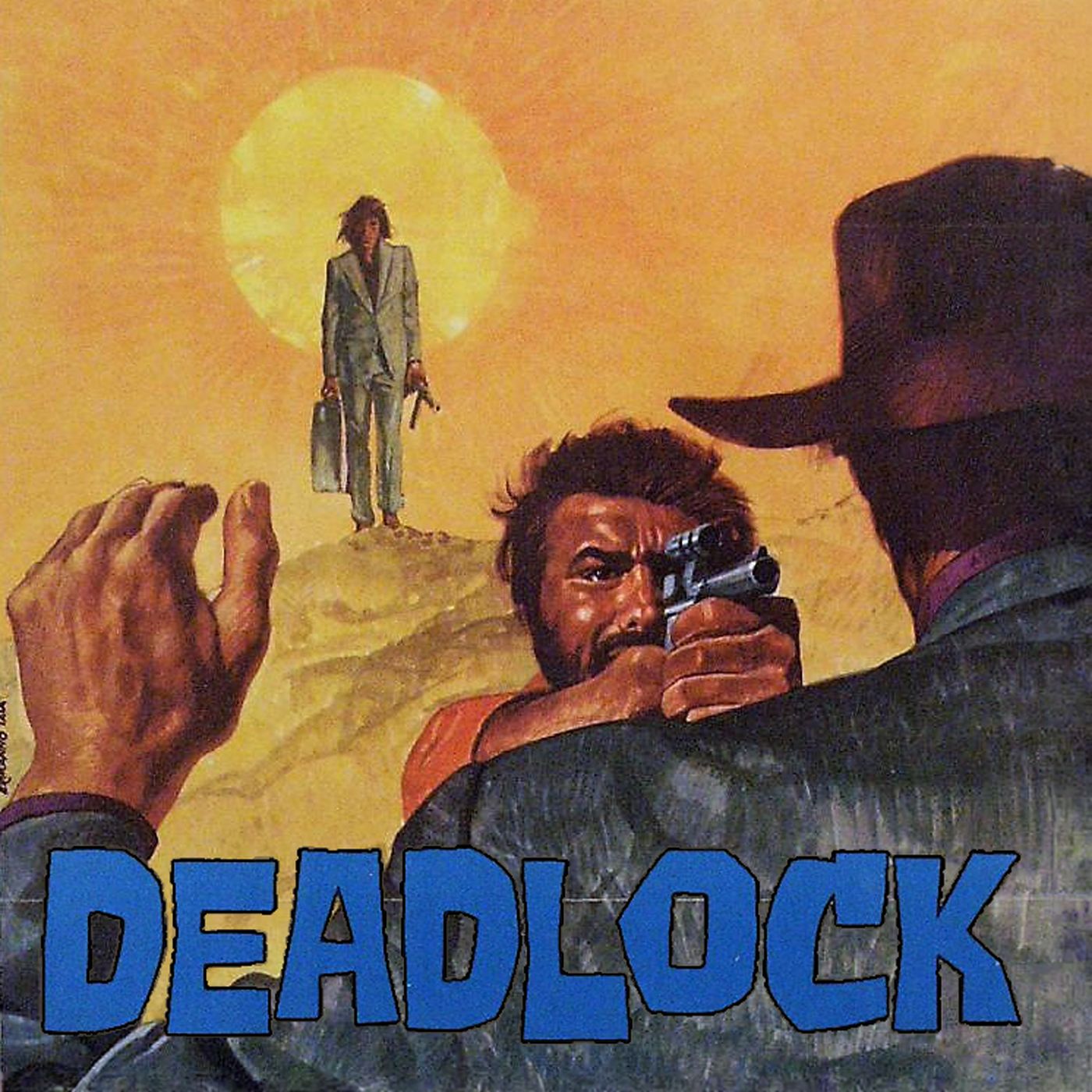
Deadlock released in nineteen seventy. The film was written and directed by Roland Click. It stars markwand Boehm as Kid, a mysterious figure who wanders out of the desert with a machine gun and a suitcase full of money and a forty five RPM record. He's found by the always wonderful Mario Adorff as Charles Dump, who takes the money and abandons the kid with some dire consequences. We will be spoiling this film as we discuss it, so if you don't want anything ruined, go track down the film and watch it.
We will still be here. So, Jessica, when was the first time you saw Deadlock? And what did you think? So? I first saw this one just a couple of years ago, actually, and I'm not sure what exactly about this may me go, oh yeah, I really want to see this other than the fact that it is a euro Western.
And what may surprise people who've heard me cover other things on the show before, is you know, you mostly do like sort of eurocult horror adjacent type of things. But I love westerns. I love euro westerns from the sixties and seventies particularly, so when I found out there was this West German, a lot of people referred to it in the genre of acid westerns, so I was kind of intrigued. So I checked it out. Just really liked it, loved the soundtrack obviously.
I really became intrigued by the director. Roland Click is a really interesting character and I'm really excited to talk about him and his career, and so, yeah, I sought out his other films after that, and yeah, I just think this movie is great fun And. Or was this the first time watched for you? Yeah, this is the first time watch for me. As I think I mentioned previously, I'm not big on western so one thing is this is an opportunity for me to step out of comfort zone a little bit, and that was part of why I wanted.
To check it out. I think it's a very interesting film. I really love the visual style of it. I mean, like that's what I'm going to go on and on about. And I love the soundtrack by Can, credited here as Duck Can the nine inch Nails.
In that one episode of. Twin Peaks The Return. All the music by Duck Can is great. I actually only wish there was more. I would love, you know, more soundtracking in this movie.
So I'm really really jazzed by the sights and sounds. I will say the plot and characters don't really grab me, and after a certain point, arguing about who's going to get killed over this money. Is just not my thing. But that said, this is I went to look up Click's other work because I was very intrigued by what he's up to visually. So thanks to you guys for inviting me onto this.
Because he's now a project, I've got to check out these other films. That I haven't seen before. I've been aware of Supermarket and wanted to see that for some time, so now that's high on the list because I think he's pretty amazing director. He's also quite the character as well. He's still alive.
He turns eighty seven years old next month. Most of his pices have he hasn't He actually hasn't. I'm sure we'll get into this slater and we'll talk more about his career, but he has not done that many feature films. He gets lumped in. I think with the new German cinema suspender.
Hebdog a lot of these people, young German directors who are working around the same time, but his work is a lot different for reasons that we'll get into at some point, but I will say he does the commentaries for all I think all of his films that are commercially available on home video, and he's an incredible rack huntur. It's amazing how much he remembers from these movies. This particularly his films from the early late sixties, early seventies. He's got great stories. He's a really fun interview.
You've seen the documentaries, two documentaries with him, great stuff. He's like incredible to listen to, and he's yeah, just got a million stories to tell. So I engaging with his work has been really fun. Yeah, this was the first time watched for me as well. I had this kind of on my radar for years and years, and I was just really glad, Jessica when you asked to cover this, because I was like, Okay, great, finally an excuse.
I've had supermarket deadlock. I can't remember if I have White Star on DVD, but it's yeah, just give me an excuse to finally sit down and watch these movies. So it's okay, thank you so much for providing that with me and I Yeah, I didn't listen to the commentary for this. I did watch Supermarket with the not the commentary on, but I had the subtitles for the commentary, so it was nice. I was just reading what he was saying while I was watching it and listening to the original audio.
It's wish they would do that for more commentaries, whether they were in English or not. Just give me the English subtitles of the commentary so I can just read along while I watch it. But yeah, it was a lot of fun, and I had a lot of fun with this movie. I agree with you, Spencer. There is a point in here where it gets a little long in the tooth.
This is a very sparse film. There's only a handful of people in here. While I was watching it, I was reminded of things like cul de Sac or even Spirits of the Air, Grimlins of the Clouds, where especially that one, because it's this nouveau western in Australia and there's this threat of there's the genman who shows up at the beginning. There's a brother and sister rather than being a whatever dump is to this woman and her daughter. And then there's the threat of other gunman coming to town, and you've got this whole thing of mister Sunshine coming to town.
Love these names, by the way, I love dump Kid mister Sunshine, But I have to say the mom. She's in her web three times, and I was really hoping she would be more of a presence, and instead she just like shows up here and there, and she's just wild. She looks like, I don't know Edith Massey of the Desert. Yeah, she's apparently a famous Israeli actress, and I'm sure we'll get to talking about later on about the location and things like that, but she was a local actress because it's film is shot in Israel, so she was just like like a well known actress that they probably just pulled in locally. The part, well, she has this really different energy that not only is evident however she shot, but she's also shot differently from from the other characters in the movie.
She gets these big, wide angle almost directly into camera, soops moving around with her and nobody else does, and it's a kind of It's interesting because she makes an impression anyway, But then it's pretty clear that something about the way that they were working together required this other way of shooting. And I kind of love that. We can describe this as a Western, but there were moments too where I was completely thinking of a noir. This feels like this could be something that Jim Thompson could have written, where you've got these bizarro characters who are under a lot of tension. I think, especially if we had learned more of Dump's backstory to find out why the hell he's here in this mining town and what the hell's going on with this former mind.
And I love when he has these moments where he's I have police authority because he's just such a The first time you see him, you get a beat on him so easily. First off, Mario Adoff has a fantastic face. I love the shape of his face. But then just to see that outfit in the big hole in his sweater, and that he is where multiple layers have closed. At one point later on in the film, he dresses up in a suit, and meanwhile, the kid is almost always in a suit, if not completely through the entire film.
This light blue, powder blue suit that just gets dirtier and dirtier as we go along, so I'm like, Okay, are they going to kind of switch places? And they don't, but yeah, it's just watching the outfits that these people are wearing. It's kind of telling its own story. Just to your point about we don't get any of Dump's backstory. I think Klick has spoken in interviews about the fact that he doesn't like to over explain, and part of his approach is that he and this is something that separates him from I think the fellow German New cinema directors, is that he has approaches to engage with the audience, so he doesn't like to over explain.
A lot of his endings for his films are incredibly ambiguous, this one included because he wants to have a dialogue with the audience and not just give them everything. So I think part of the reason he spoke about sort of the beginning of this film and how it's just slightly inexplicable, But I think at the same time also echoes a lot of the spaghetti westerns where someone walking through the desert, because we've got this unexplained person in a suit walking through the desert with a machine gun and a suitcase with the sun blazing down and he says nothing. You don't get dialogue. In this movie until at least quite a few minutes in and then so yes, he wants to create I think this air of for the audience to be asking themselves questions about what exactly is happening here rather than just giving you everything.
It's funny. It's a very different movie, but it reminded me of the opening of Paris, Texas with Harry Dean Stanton walking out of the desert. Obviously it's a common idea to the Western but the I canography here with the suit like Harry Dean Stanton with his red hat, that creates a similar kind of man from nowhere vibe that goes to very different places in these movies. What's that kind of incongruity too, the red hat on Harry Dean Stanton versus this guy who's carrying a machine gun and a suitcase full of cash. Yeah.
I just don't know guns that well. But the visual choice of this particular machine gun is great because it's very strange, cobble together looking a weapon. Yeah. Anthony Dawson's as well, is very It reminds me of the howitzer in The Great Silence, like the sort of weird gun that Silence has. It's just like sort of a hybrid of sorts.
It reminded me of the gun that Colonel Mortimer uses in for a few dollars More, where you kind of put the stock on it and use it almost like a rifle when he's doing those long shots at different things. As I was, the dead shot in there, luckily, not the grade of shots in here. There's a lot of times where people should be shot but they aren't. If you bring down Western to just one historical period, I don't think that that's. I don't think that that's quite on point.
And one thing you mentioned Jim Thompson. Thompson's novels often have but you know, like Savage Nights for instance, has a very you know, Western kind of flavor to it, and a number of noirs deal with rural noir gets overlaps a little bit into Western territory. But we have we really have the iconography and then extremely stripped down but a very typical kind of you know, Western setup of the lonely man walks into this place, interacts with three people who are there until a bad guy then also converges so that we can build up to a kind of final showdown. That's one of those kind of classic Western plots that then is just really reduced because we have like a Samuel Beckett style number of characters in this town, and I do think there's a beyond whatever budget issues there might be or anything else.
This is definitely being played as a hyper abstracted Western, and yeah, we get trucks in place of horses, for instance, but it really is about these people introduced into a landscape together and the violence that results from that, and the abstraction is really beautiful. For the way that the camera moves with people throughout the film, Nearly every shot is beautifully choreographed, and we get such an expressive range of relationships of the camera to these characters and to the landscape and some really beautiful tricks. When I see camera moves like this, there's a part of me as a filmmaker that starts in my mind diagramming what kind of track is it, where is it? Are they using a zoom lens in the move and everything?
And all those things are present, But there are a number of places in the movie whereas stripped down as everything is. I still I actually. Was wowed by going, Oh, I don't know how to diagram this. I'm not sure. The way that we're relating to the characters feel so bespoke and of its moment that it's not diagrammatic camera work.
And I really appreciate that about it. I think, as I said, Click is going to be a sort of project for me, because anybody that shoots this way, I feel pretty ride or die. I think he also works narratively in a similar way because we don't I mean, yes, we know from sort of objects in the film, we can guess that it's taking place sort of in and around nineteen seventy, you know, based on the jukebox and the kind of cars we see and the clothing. You do know what time it's said in roughly, but I mean, you really it's I think it's easy to forget and I personally, I think because it channels spaghetti westerns so well, I think you sort of are able to sort of lose yourself in the fact that this could be happening in the wild West.
And I think that's partially because it's so sort of you know, it is so desolate and isolated, and we have so many visual trademarks of spaghetti westerns in there as well, mingling with the sort of modern props that I think it's and I think I think this is why this film and some of clicks other works as well, because I think this is something that he works across his films, is that he he really does create like films in the zeitgeist at the time he's making them in so they always feel really fresh, like even now, because he's able to possibly sounds a little contrary, but because he's able to set them in this point of time, they somehow how he's able to make them still relevant decades later and feel interesting and fresh, whereas some films might feel dated.
That's interesting With last week the show, we covered Cemetery Without Crosses, and in that the first time you see the writer, director Robert Hossain in the film, he's living in a ghost town and he's this artifact man out of time. And I would say that Dump is very similar as far as the place that he lives at is so completely run down, and I think that the production design of this shack, for lack of a better term, the shack that he lives in is so completely run down. You just see the wear and tear of the boards and everything. Everything is a mess. Stuff is just piled on top of each other.
It is just absolute chaos. And he's just like, why is he even here? This is a former mind? Is he protecting the mind? Is that why he has quote unquote police authority?
But you've got like these big rooms. One of the first times that we see the Daughter character, she's in this blue painted room. The windows were all smashed and broken, and then you get like she's there by a piano and it's like, what the hell is this room? What did this used to be? Was this like some sort of gathering place where these offices for the people that ran the mind?
But just yeah, it is so empty. And then you get things like his friend Enzo coming through and that really beat the shit car that is completely covered in dust. I love when he's like spitting in his handkerchief and rubbing the window and everything and he's just got all that shit on his car, but especially all the crucifixes that are on the car. Okay, and that's where we really get this whole idea of the commerce stuff, because he is such a vulture when it comes to how much he's charging for things and just always trying to upsell. And he's got these dirty pictures that he's handing over to dump and just like, oh you like that?
Huh yeah, how about five bucks for that kind of stuff? Oh, I'll throw it in for free. It's just a real character. And I really just how because he's only what the sixth character in here, and that's it. I think we just get six people.
Yeah. I just love the big the huge bag of toilet paper that he hands over, this big plastic bag like eggs and like a huge plastic bag of the toilet paper. This is among Westerns that, whether intentionally or not, feel post apocalyptic, that it's so stripped down, it's so run down. We're down to three people. Were yeah, we're like arriving with toilet paper.
There's a post apocalyptic quality that then renders the money that's at the center of this so absurd What is money worth within the world as we're seeing it, What is it worth at all? Which I do think, as you know, an intentional absurdity here that they care so deeply about all this money, but within the available evidence of what this world is, how much is it worth anyway. It reminds me of some of our current billionaire class being concerned with what might happen in an apocalyptic event, and it's and the realization that, oh, their money isn't actually going to get them out of that. That even if the money allows them to survive, how long can that go on? Where is that going to go?
Who will work for them when money isn't worth anything and pay is not an option? These kinds of strange things. So it takes my mind to that place, and I find it interesting. One of the repeated images of the film is this cowboy on top of you know, the building, and it has this arm that's been kind of broken and is dangling, you know, in the wind. And we come back to that a number of times.
So that, Yeah, the kind of outrageous life level of desiccation to the world is something that I found absurd and fun. And one of the more compelling elements of the story. But you'll enjoy Supermarket when you get around to watching. I think he he does play around with societal issues, and I think money is definitely a theme that pops up in more than one of his films, because Supermarket is about also about giving too much away, is about money and commerce and economics and class. And I was watching a trailer earlier today and it was one of those moments of oh, supermarket.
Where have you been all my life? I definitely have to see that. That trailer completely sold me. I love the dump. He's given so many opportunities to murder the kid, and he wants to murder this kid, but he just can't do it.
He's given a chance with rock, he tries to with a wrench, then eventually takes the kid's gun and it's just got him to rights, but still can't do it. And then at the end it comes back to bite him in the ass when he's got the gun on mister Sunshine and he finally fucking pulls the trigger the only time he's able to pull the trigger, and the gun's empty. But it's this whole movie is him trying to work up the courage to shoot this gun. He talks so big, but he's never able to back it up with anything, even when it comes to him living with this mother and daughter, and you know, he's just pining for the starter the whole time. I don't know what kind of relationship he has with the mother, but there are I want to say that.
His Friendenzo the salesman, is like, did you get with the daughter yet? It's no, not yet. So I'm still pining for her, and I'm still she's still trapes it around in her little dress. And I love that she's absolutely mute, like one of these great spaghetti western type characters where she just never is going to open up her mouth and say anything. And I kept thinking that at the end she would say so thing, but no, we never get that.
Yeah, Maria Adolph really gives an amazing physical performance in this, and I think that's largely due to Click because I think this was something that was very important to him and his actors. So I think you see all of the times where he's powered in a corner, like shaking, wanting to be able to dispose of the kid, like to get rid of him, but he just can't do it, or when he's about to shoot Sunshine and just be's standing there, his hand is, he's got the gun pointing at him and he's shaking. He's just like he's fundamentally quite a weak character, and I think that's why eventually he's spoiler alert, he's the first to be dispatched, because he just doesn't have this sort of backbone that I think the Kid and Sunshine have to just be able to, you know, ruthlessly go after this money at all costs.
And he's such a welcome presence. He is one of these actors that I mostly associate with spaghetti western, so he's done a whole lot more. But it's funny because, again going back to last week's film, Robert Hossain worked with him quite a few times, including a Taste of Violence from I Think sixty one, where he is playing a Mexican character, as is every pretty much everybody in that movie. He has this kind of international quality to him where he can play different ethnicities, but he no matter what he's playing, he just always has this great presence to him. Like I said, that jaw is just it's a wonderful thing that he has.
I was curious, did you guys watch the English dub of this or the German dub dub of it? I watched the English, which was interesting, and then I realized, oh, maybe I should have watched the German because but then again, you know, when you're in the land of this is maybe not a spaghetti Western, but it's more like a Specsla Western or something when you're in that zone. I don't think it's necessarily in authoruthentic to watch the English dub because this is one of those things that's kind of, you know, part of the deal in producing them. It's an intention. But I rather liked the performances in the English dubbing.
I watched the Germans. I actually haven't watched the English, just didn't get around to it. All of this is recorded posts like his movies are all posts like many were, especially spaghetti Western. So yes, there they may have different qualities, but in essentially there is there is no version with the original sound. Even in German mockwart Bohm was dubbed by another actor.
Obviously, Anthony Dawson is going to be dubbed. I don't know if he did his original voice in the English dub. I'm suddenly curious about that. But and I don't know if Audorff did. I think he did.
It sounds like him, but yeah, yeah, it's because there is everything is and again, for this was something that Click like to do. Is he actually liked to put things together, the audio together and posts because he liked to create what it called like a music konkrete, the sound, the ambient sounds, and he often when he goes through the commentaries pointing out like, oh yeah, that truck sound is great. Oh I love the sound here that we did, or my sound guy did so rafting the sound and presumably that including the dialogue was part of his way he constructed the film. I also watched the English dub. I turned down the German for just a hot second, and for whatever reason, I was just like, yeah, this hasn't hit me as right as the English version.
So I'm there with you, Spencer. As far as when I'm watching a spaghetti western, if I'm watching something that wasn't recorded in an original language, yeah, just we know that so many of those were done completely MOS or just wild sound. Yeah, I'm absolutely fine watching an English dub. I'm not as snabbish as I am most of the time, which is saying something because I'm a pretty big snob. Just before I forget to mention, Mario rip he passed away I think just last.
Month at ninety five or ninety six, and oh what a loss. I just was going through his filmography and just he's in things like the Tin Drum and Lost Honor of Cotterina Bloom and every art House to Fernando de Leo's crime films and Giolli and just what a career. I love too. When I was talking about him being such a coward that he can't pull the trigger, he's such a coward that he's hoping that the kid's going to get an infection and die that way, like the slow, painful, awful way, because he's too much of a coward to basically put the kid out of his own misery. One the bullet stays in.
I can speak a little bit about again about Click and his approach to his actors and their performances, and again, this is something else that separated him from German new cinema direct is that Click really wanted his actors to bring something of themselves to the role, and he was part of the reason why he Cass Mariotto, or if it's part of the reason why he casts everyone across all of his films, is because of what they themselves, be it their personal gestures or just some like quality facial expression that they have, or in the case of something like Supermarket, the lead actor like similar background as the character in the film, So like he what was important to him is what his actors could bring of themselves to a role, rather than someone like like Fossbender, who really just went to like his sort of theater troop of people who were just he didn't necessarily know.
He was more wanted to have this sort of like have someone throw themselves into a role and like kind of their own persona to disappear behind it, whereas Click was just the opposite. He wanted some of people for what they themselves as an individual could bring to the role. What's funny that Adorf was in Lost on Our Ketterina Bloom because I don't associate him with German stuff as opposed to the kid who is just fear eats the soul. Kings of the Road is just like okay, yeah, definitely big in the German scene. And I had not realized that Adolphin he was also in the weak spot the Peter Fleischmann film.
That's my week spot is Peter Fleischmann. I love his stuff, and it's just okay. When am I going to finally talk about Dorothy's revenge on the show one of these days? I promise we will, But I really enjoy his stuff, and then I was I associate. Even though I know he was in what hundreds of movies, No, I guess about eighty eight movies he was in Anthony Dawson even though he wasn't in that many spaghetti westerns.
I still just one hundred percent associate him with spaghetti westerns. And my god, what a face that guy has. It's he's like the is he Scottish Sharre, English is like the He's like the Scottish John Keardy. He was got a. Share by birth.
Yeah, he's great and Death rides a horse. He's great in the Bond films as well. He's a Bond battie and he's in his dial in for murder. And he was working in Rome actually when this film was being cast. And I don't know what film, if they were in a film together, but he's recommended to Click by Mario Adar, who I guess knew him either from a film or from just being in the film scene at the time.
So that's how Dawson came to or to be cast as Sunshine. The costumes in this are. Quite simple, but I just think they're so well selected. I just I really love mister sunshines kind of he's wearing a raincoat as a duster, and he's got but other than under that, he's got the sort of modern like black shirt and pants. But yet somehow it's also it just completely works as a costume for a character in a spaghetti western.
So again, I think there's that parallel. Yeah, I just love it. I just think there's so many there's so many great details in general and Deadlock that just I think, just just make it for me personally. That hat, it's not a cowboy hat, but it's as close to a cowboy hat as we're going to get in this movie, and it just really works so well. I like the appearance of the kid in this movie because while he's like twenty nine at the time that they made it, so he's definitely young, but there's something not just weather beaten, but even as he kind of cleans up a little bit through the movie, there's something.
Seedy about him. He's the kid, but there's a strange well of experience of something of feeling a little bit beaten up by life even though he's still really young in the film that I appreciated about. It actually made it, you know. A very kind of true Western in that way the landscape beats you to hell. And one thing that I track in Westerns is how sunburned are people and when and there comes a point where Dump is extremely and alarmingly sunburned, you know, near the end, I'm hoping and praying that's makeup and not the real thing, because it looked extremely painful.
But yeah, there's this real sense with very well selected costumes, well selected actors, but then with the detail of feeling totally part of this extremely blasted, run down small I don't even know if town fits, but this like little, this little mining village that they're all running through. Basically, it was finding this location that was what made him decide to basically do the film. He had the embryo of the plot kicking around in his head, and he traveled around to a Maria and Tunisian and some you know, other spaghetti westerns were shot, and then someone recommended that he got to Israel and he you know, came across this point in the Negev Desert I think it was, and he just he basically just I think he camped out there for like a few days, was just.
Like this is it like this is where I need to do this. Film obviously, like in a very sort of inopportune time, because this movie was shot like right after the Six Days War between Israel and Jordan, I believe, so basically there was still all this sort of tension geographically and with between these two governments, and basically they're shooting and was still all kind of hot sort of war zone under the protection of the Israeli military. So yeah, so it was basically click tell these tells, these great stories about how sometimes they had to shut down all the lights because there was like enemy fire or there was a threat of enemy like, it's just it, and he clicks says that he thinks this this sort of heightens the sort of the tension and gives it this sort of highly charged atmosphere because all of this was going on and it was such a sort of hot spot.
Well, yeah, very hot spot. I love how the sun is used in this film, especially in the beginning when he's walking through the desert and you get those close ups or the shots of the sun and then what's obviously to me anyway like a white light was somebody like going across it with something. So it gives a Strobe effect and everything, and that our antagonist is called mister Sunshine. And I love in that early exchange between Dump and Sunshine when he Dump actually gets the upper hand on him and pulls the gun out of the truck and he's going to shoot Sunshine, and Sunshine is the one who's walking forward and Dump is moving backwards because again he's scared for his life. And I love how Anthony Dawson Antonio is his Italian name.
Well, yeah, he just this does this little wave with his hand. It just it freaks out Dump every single time that he does it. It's just such a little tease move that he's doing. It's so great. And I think those are exactly the kinds of things that click.
As I was saying before, the little it's like little gestures and like little things that like Dawson, he doesn't say so necessarily in the commentary, but I'm sure this is something that Dawson just came up with and click went great. Yeah, I love that. Just do something with your hands and just Dawson just improvise and it just what does it mean? Who the hell knows, But it works great, It looks, it just looks fantastic. Yeah, I think the sun just to go back to that as a theme.
It is just like the son obviously traditional symbol of warmth and life giving, and it's just such a brutal, like malicious force. In this film. Like starting from that very first scene, I just want to say, like I this opening credit sequence is really like one of my favorite because it's you've got that, You've got the walking through the desert inexplicably with in the suit with the suitcase and the and then also the can music is like building up with these drums and also and it's like the title comes with the glare of the. Sun and the title, the title across the screen. I just it's so great.
It's just like I remember watching it for the first time, just going, oh, yeah, I'm gonna like this. It really reminds me a lot of the Good the Man the Ugly in that whole sequence when they're going through the desert and Blondie and his this skin just looks so awful and his lips just are all cracked and everything. I just love how brutal that whole thing is, and just the way that Tuco's just teasing them with water and everything. It's so nice. Well, I think there are tons of parallels to that film in this.
Obviously you have this, I mean you could really, I mean it's not difficult to sort of map those characters onto the ones in Deadlock. I mean you really have, you know, like the Clint Eastwood character as the kid and you know, to go as god Or and Dawson as Lee van Cleef and they angelize and then you know, you get you know, you have that in mind, and then you get the scene where the three of them go to the cemetery looking for the grave with them and I'm just like this, you know, and I love that movie, and I you know, I love a good reference. So I mean, I just I thought that was I'm sure some people would argue like, oh, they ripped it off. I'm good done, Just like I just think it's a great homage.
It's really fun. Well also as homage, it's like doing with what you have, because that cemetery pops up and every time I see it, I'm thinking of the Good, the Bad, and the ugly, and it's a really interesting cemetery because obviously it's not enormous and mythic like in The Good, the Bad, and the ugly. It's little, but it's also loaded in relationship to like the number of people that we see on screen, because a lot more dead people than live people in this movie, you know, just on the basis of like all those crosses crowded into that tiny little space for the cemetery. So I think it's like, yeah, homage whatever, it becomes its own kind of iconography within this film to import that. And back to the Sun, oh man, this is just like the beauty of the editing of the Sun at the beginning, but then as a payoff at the end when mister Sunshine is going to finally murder the kid and spoiler he doesn't, but in the moment that he is, this montage of sun and eyes and gunfire and everything is just.
It's pretty great. Another great sort of Sun is one of my personal favorites, is when the kid is delirious, having this literal fever dreams, is suffering this gunshot wound, and he has this vision of Jesse, the young woman, standing on the roof with the sun just behind her, so she's just this sort of shadowy outline and I and just look, there's this great weird cam and I guess this is where the sort of acid western if he Will influences come in, because it's very psychedelic. It's very the. Camera's kind of wobbling in this weird way, and she's just standing there. It's just such a beautiful shot.
I really love it. Her introduction is also a psychedelic She's just leaning against the doorframe, but' very she's well lit from the front, but she's also so backlit by the sun that it creates this halo and it feels dreamy or like a hallucination. In that moment, the kid is not in great shape, but when he looks towards this door, there she is, is this kind of shimmering figure, and it makes me wonder is she real? Is she a memory? What are we gonna find out?
And of course she's real, but that's also is she a memory or is she a dream or whatever? Is part of the vibe here asking that question before confirming that somebody is part of the diegetic world of the movie. I'd like that there's an echo there too, when you see him later on and he's got the mirror and she's across the way and she's on the building and he's got the mirror and shining the light at her that way, and you get that nice echo too of dump counting to three and gets up to two before mister Sunshine takes the gun away from him. And then at the end when it's the big showdown between the kid and mister Sunshine, that there's also a count to three. But that's just a bizarro scene because I think he counts to two and then rather than killing the kid, he massacres the girl, and then he massacres the mother, and then he can't get his gun off on the kid.
The kid ends up taking the gun away and ends up killing mister Sunshine. But yeah, during that whole thing too, you've got yeah, like you said, the psychedelic the mouth open mister Sunshine and the camera's practically going inside of his mouth, and it's. Just less madness with the way he's shot in that scene, he's just like the one like the almost as if the sun is driving him crazy like that kind of feels something like that or inciting some kind of psychosis. There's a great shot in here too, where there's the bullet that was pulled out of the kid comes back a few times and he's like walking down the middle of the street when the ghost town basically and you've got mister Sunshine. I think they have yet to see each other again for the first time.
And Sunshine, though, like lifts up a window and is looking at the kid as he's walking, like this porthole kind of thing, and I'm just like, this so reminds me of Yo Jimbo or A Fist full of Dollars, where it's like the way that the Undertaker would always be looking at things and just observing stuff. I always enjoyed that about that film, or my other favorite moment of that film is like when Yo Jimbo is up on the high tower looking down at everybody and looking at the two gangs coming together. He's like sitting in that privileged position. There's no privilege for dump. He's just like he's so powerless.
Especially by the time you've got both the kid and Sunshine in there. He's just like on the outs completely. I think the only advantage he has is he knows where the money's at. And you're right about the way that the mother is shot, just that it's very different than everything else. It feels very handheld, and even though she's interacting with the other characters.
A lot of times it feels like she was just there on her own. I'm trying to think if we see a lot of two shots of her with anybody else, I think there's a little bit of a dance that she does with the kid, or she does that strange thing of whipping her breasts out and chasing him along, and he's just, oh, I want no part of this. I mentioned psychosis just a little bit earlier, but there's a like with the this is not a very feminist reflect his personal views, but it's not necessarily one that I think feminists will find a lot of value in, because yeah, so like I'm forgetting her name. Now, the older female character, the mother of the younger woman, you know, she's like half crazy. You know, she apparently used to run the town bordello, so that's like kind of a little bit of her backstory.
And you know, her daughter is presumably the offspring of some encounter she had, possibly with Dump, possibly with someone else. Dump I think, sort of disavows this and says like, oh, she's not mine or whatever, but I think there's some ambiguity there. And then you know, Jesse is. Just mute and seems to be being fed like psychotic drugs by or psychedelic drugs viral. You know, she like jump like pulls a bunch of pills out of her mouth off at one point.
You know, she never speaks obviously, she's just sort of clearly like not white all there. But yeah, so there's this kind of like sickness that runs through like at the very least the female characters in the movie, which is like an odd touch. I think her name is Karina. It's like everybody's got a little bit of a title. And I was trying to look this up yesterday and I never did figure it out.
It's like she and I don't speak Germans, so this is going to be horrible diclite shlacktel And I'm like, I have no idea what that is because everybody like Jesse the Girl and Soo something or other kid the Young Killers. But and then for Charles Dump it's the rat as if Dump is not enough, oh, it's the stripped box, is what it comes back as through translation. So yeah, Karina the stripped box. I don't like round of that. I'm going to stay away.
When you talked about the use of the trucks instead of horses, and yeah, definitely puts it in a very particular time using these trucks, even though they're all older and beat up. But I want to say, and please correct me if I'm wrong, just the whole idea of vehicles, like it feels like Click is very into vehicles. I think you definitely see that in Supermarket Sure, and oh in his first It's really interesting that you point that out, actually, because I'm like, oh, yeah, and he does this in his first film, aw which is called Bubchin, which in it it really means a little boy, but I think it gets translated to English as like little vampire or something like that. The movie has nothing to do with vampires.
But again, cars play a huge without giving too much away, cars play a really big Vehicles play a huge part in the story the storyline of that film as well. So that's very interesting because that is or I think about it, the more I see that as a sort of he does use vehicles a lot in his films for various purposes. Yeah, I just looked up Enzo's title from German to English is the Wretched Snoop. Very appropriate. This is fantastic.
I'm wondering where these descriptions come from. I compared the mother or what the snatched box. I can't remember. I compared her to Edith Massey before, but honestly, she looks like she would belong also in a Rodarowski film. This does bring to mind a couple times of El Topo for me, or even more The Holy Mountain.
I think she could be in The Holy Mountain. Yodorowski actually saw this movie at I don't know if you guys have heard this story about just a little bit of backstory, so this in nineteen seventy one. This movie was initially the West German selection for the can Film Festival and was going to compete and due to based on if you believe the way Click tells it, the powers that be in West Germany did not want this film to be the official selection for West Germany. They wanted something that was more traditionally in the German new cinema, so they kicked something else instead. I can't remember why I looked it up.
It's a movie I've never heard of. It clearly didn't have to stand the test of time from what I can tell, but Deadlock was shown out of competition elsewhere at the festival and Yodorowski attended a screening of the film and then spoke to him afterwards and said, like how much he liked Deadlocke and how great he thought it was. And I think they were basically probably made around the same time, So I don't think it would have been possible for Click to have seen al Topo until much later or sometime later. I don't know. He doesn't mention at what point he would if he has, but he basically said, oh, yeah, Yodorowski and I we just sat around eating from the cold buffet at the screening, and so yeah, apparently Yodorowski was a big fan.
Sounds like a lot of people enjoyed this movie. And I was reading on the Wikipedia. It was like he got tons of offers after this to make more spaghetti westerns. Yeah, and he turned them all down because he didn't want to repeat himself. He just said, I did that, this was my Western.
I want to do something else now. So again really kind of like working within you know, the likeeist of the time, like Okay, well I've done my Western, now I want to do something else that a few years later. I want to do something that's relevant to nineteen seventy three or whatever whenever he started to make his next film again and just to go back briefly to Click's approach to filmmaking, and he got accused a lot of and again this is why he was never really fully accepted by the new German cinemas, because there was always a kind of a commercial or what was perceived to be a commercial element to his films, and Deadlock made money. Not all of his films were commercial hits. But I think he was accused of because he had this approach of wanting to engage with the audience he wanted.
He said he wanted to make movies that were not in the ivy tower. He wanted to make movies that audiences would want to come and see and thereby engage with. So I think this was interpreted as an attempt to make commercial films. So I think he was accused of being a sort of a populist filmmaker. He just wanted to please audiences, whereas I don't think it was quite that simple.
Yeah, I'm surprised that this movie made a lot of money. It's just so peculiar for me. I mean, I enjoyed it. I think I really enjoyed it, and For me, one of the most fun scenes is the scene that kind of reminds me of a Western the most. It's this great little bit of business of the kid having a forty five in his suitcase, in his briefcase of money, and then you see the forty five being played, like there's the jukebox and you see the forty five.
There's just the one forty five in the entire jukebox, And I love when it's skipping this kind of like non diegetic diegetic music and the way that adoff just gives like a little nudge to the jukebox. But then there's the whole thing of them having a drink. I love when it takes the drink and puts it over his shoulder and they're going to come back with that the glocken spiel. You don't get a glockenspiel in movies very often, and if so, reminded me of like Bugs Bunny and You're Somebody Sam when he's got the piano wired up where if he plays the right note, it'll blow up in his face. No, that's not try it again, you're stobbit like that.
But instead he's just like trying to play the glockenspiel and Anthony ny Dawson keeps shooting out the last note of the music he's trying to play, and you get that great framing of his eyes through the glockenspiel of eyes. It's so good just to go back for a second to the skipping and the record. It reminds me of being in like a a luck groove and a record, and it kind of like kind of channels with the title of the film as well. It's just like a sort of an unending loop. Yeah.
When it came to the title of the movie, I was very curious what it was going to mean because for whatever reason, and I guess it was just the art on the DVD Slash Blu Ray that I have not that compelling. It's like the girl's face above and then there's a truck and maybe dump on the cover, and I'm just like, what the hell is this movie? You have no idea what this is. It's very unappealing, and so I was just like, deadlock, what is it is that? Like a do they have collars around their necks and if they run past a certain point their heads are gonna explode?
What does this mean? And then I was thinking of the Sarah Pereitsky Vier Worshowski book that Viera Worshowski's based on, and that's about a like the Sioux locks up here in Michigan. There's an explosion, so they have a dead lock, and I'm just like, what the hell? And then yeah, I made a joke about the Bruce Willis film. I can't tell you how many movies there are called deadlock, and I'm just like, all right, is it just Loggerheads were deadlocked?
And something I. Actually picture and again to go back to go the band and the Ugly it's just sort of there's like a sort of figurative interpretation of the scene in the cemetery where they're all kind of pointing guns at each other and there is that literal deadlock of they can't everyone's got a gunpoint at the other one. So where are you gonna their characters are deadlock from making it for their move what made me think of? Anyway, the alternate titles apparently that Click considered were Bloody Sunshine and Showdown. I think Deadlock sounds much cooler personally.
I think it's a great title. I'd like to talk about the soundtrack, just a little bit, because this is one of the things that is different for a Western, whether contemporary or not. We've got the. Forty five is in there, but also the non diegetic soundtrack music and what can contributed a really odd different kind of feeling. Just it's one of one of my favorite kinds of soundtracks where it feels at once really off topic and yet perfectly apt.
Something about the rhythms and the guitar feedback and whatnot that's going on in Western music was really fascinating to me. And it was interested to find out that that they participated in the sound design that in the editing process they were at they were looking at the movie, and they were also contributing bits of sound and musical things that didn't sound like music into the overall sound design for the movie. You know, that's the kind of way I would love to make a movie. And it never seems to work out. Their effect on this film, I think is really interesting.
And then the place that it has on you know, there what turned out to be kind of a big deal album for them soundtracks you know, and sort of in their early discography, you know, building up their reputation. This soundtrack is actually like really important to that. And the way that these songs play on the album, you know, because I was listening to the album mom, but you know before we got on here is really really interesting. And I'm just curious about some of your feelings about how this works as soundtrack music. I love it.
It's one of one of my favorite elements of the film. Just to shed a little bit of background. So Click himself as a musician, and I think he initially wanted to do the score for the film, but they decided, I guess in the editor in fact, when he was putting it together, basically said oh, you know, I think you need some different music. And you know, he recommended Can, who were not like well known at all at the time. They were just in your German band.
So like Click met with them and that's you know, they kind of came up with the it's in what sounds like a very collaborative process, came up with a score. I love the fact that the track that's heard on the jukebox is a tango. And apparently he had, you know, he told Can he said, you know, I want a tango, which is just again why in a Western Why? I don't know, but it's great and it works perfectly, and so like can listened to like forty or fifty different tangos, and that's how they came up with. A tango whiskey Man great, which is a great track.
Yeah, I know, I wish they were I wish they had done more music for this film. Like I wish it was like a like a you know, a full like score. But it's We've got these three tracks that are all wonderful, and it's just it just makes you want more. It reminds me a lot of the and I mean, I guess both in the fact that it's an acid Western and also that it has this kind of psychedelic rock soundtrack. Is Muttalo if you know that movie, just that combo.
I absolutely love it. I just think it for whatever reason, it works. I mean, I think part of the reason why it works is because when these films, some of these, especially some of the slightly later spaghetti westerns, we're kind of trying to channel youth movements, and the Kid is clearly representing a post hippie kind of youth movements, even bottom mine off kind. Of stuff that was going on. I think that was a way and then Muttalo as well in the cost even though it's a traditional spaghetti Western, they have this psychedelic element to their costumes and stuff.
Then by adding that layer of psychedelic rock on top, really drives home that sort of point in time that they are and just that kind of the just the whole psychedelic kind of elements and culture that we're going on at the time. I want to say that the scene that really inspired them for the Tengo Whiskey Man scene was where I want to say, it's the whiskey gets employed, but also the whole Oklahoma Kid Goodfellas scene with them shooting at at our's feet and him the way that he has to dance, and they're just like, yeah, he dance for us. And then he comes in and that's when they say, okay, yeah, we'll take a little bit out of the whiskey. I love how Dawson does that, like shakes a little bit out and then gives him the rest of the bottle and then eventually just pours it down his throat.
Though I have to say that the pouring of the whiskey down the throat very oral rape at first, just the way that the bottle is being placed and that it's being forced into ad Our's mouth. That was forgive me for being the guy who sees that violent. And yeah, Can, oh man, there's a great and I don't think they're doing it anymore, but they're And what sucks is that they had just started on a whole kroud rock series because they love to do series. There's a podcast called No Dogs in Space and they they're one of my favorite music podcasts, if not like the only music pop I guess I listened to Morris Is, but the it's such a great music podcast. They get so in depth and they did a whole series.
They didn't go past Can, but they did a whole series on Can. I think they did four or five episodes, and they dive deep, like they put me to shame with the way that they dive into stuff. And so to hear them talk all about the history of Can, I love the story of the lead singer and that he really wasn't that good at German or English and just would go with the flow. And just the way that all of that music came together such a great thing. And it feels, I mean, it felt I don't want to say feels, but it felt like there was a little bit of a cannaissance a few years ago when it was like I kept hearing Vitamin See in different movies between Inherent Vice and The Gentleman at It, and I was just like, oh, this is great.
But ye know, we've actually talked a little bit about them before on here because they did the soundtrack for Deep End, the Skolamowski film Mother Sky. Yeah, it's such a such a good track, wonderful, and that's another grand I'm so glad if you guys hadn't already covered that film, it would definitely have been one of my picks. I absolutely love Deep End. It's great, and yeah that the track is amazing, But. Yeah, I agree with you.
I wish there was more of their music here, But what we do have is Chef's Kiss. Yeah, so good. You would think that like in Italy, where a movie becomes popular and then a bunch of directors rush out to pump out a bunch more to capitalize on the success, you did not have that in Germany. This is a very much a standalone film and just to I can give it. And there's a little bit of history with Germany and Westerns because in the early sixties and mid sixties, there were these films in East Germany which were like adventure novels that were adapted into Western films.
I haven't seen them. I've seen just a few clips. They're like really cheesy, and they're like again, they're like Karl My who wrote these novels that that were then adapted by the DFA and were very popular, and then they petered out around sixty seven and sixty eight something like that. So then you didn't have anything in Germany that were there were a lot of co productions where in fact what just going back to the Gray Silence I think is possibly a German co production. I can't quite quite remember, but but there weren't any sort of German language German produced westerns until Deadlock came along, and so what didn't happen is a whole bunch more German western they didn't pick it up.
And again I think that's because there was so much focus on the sort of young intellectual group of film makers who were doing And again I'm not this is a no. I'm a huge Fosspender fan, so this is the no. I'm in no way denigrating directors like volkashlundor for Fossbender or Alexander Kluga. But they were very they're much more intellectual. Although I will say, and I don't know if you guys have seen this film Fosspender actually did.
It's not really a Western. It's more of a Southern Gothic movie. It's called Whitey. It was done the same year. It's a really interesting, kind of weird entry into his canon.
It is almost again, it's not really a Western, but you could view it in that lens because it's set in a similar it's set in a sort of Western like kind of period. So that's a that's an interesting one. I think that's maybe as far as I know, that's like the only one that came close to touching on what could be perceived as a West. I just remember, there is another character in this movie that you see for about thirty seconds, and that's the guy on the train that kicks and dump off of the train when he throws the bag of money onto the back of the train, or at least you think it's the bag of money, and I wish it was. That's great.
He's got that gigantic wrench, that wrench that he's hitting him with and then he basically gets the money. Right, No, he does it, but it's just like it is one of these weird moments of okay, what happened here? Where are we in the movie? Like total absurdity, And. They did that in one take because apparently they had because the budget was so low for this, not surprisingly, like basically they had this was just like just a train that was just like a freight train that they just they had to so they had to time it to make sure so he's running at just the right speed to miss it as it's moving, and just so it was like they just had to set everything up and like they had one chance to get it right, and it's just like that.
I think that is just so amazing to me, considering how complicated did it actually the set up actually seems that's a great one. Yeah. I kind of wish that the money had been on that train and that was just because that would have been one of those Jim Thompson endings where it's just like, Okay, nobody gets the money. Who gets the money? The conductor gets the money, Chris Borg nine from Emperor of the North Pole gets the money.
Yeah, yeah, yeah, well no, it's interesting. I guess this is something I should credit to the movie, just causing that lasting confusion for me, because in the moment, I was like, oh, wow, the money is just going to go away on the train, and then it turns out no, that it doesn't. But there's enough of a weird fake out of what exactly is happening, Who's got the money, who's going to get away with it at that point in the movie that that, Yeah, it remains, the feeling of it remains in my mind, you know, like it gets It reminded me a little bit of. That the guy on the train who sends him away. I don't know if you've seen The Emperor of the North, Ernest Borgnin character comes in and you know, dispatches hobos that are trying to hop the train with a hammer, and this giant wrench was like kind of a nice step up for keeping a guy from hopping the train.
But the bag stayed on. I don't know what's in the bag, but it took off with the train for good. Yeah, I think it just I just took it as like a sort of desperate attempt to get the hell out of there. Again. You mentioned absurdity and I think the absurdity of the one shot that it takes to destroy Enso's car because at one point after yeah, after the train goes by, Dump is like, Okay, I guess I'll go back, and then here comes Enzo coming.
Wouldn't you know that mister Sunshine's in the passenger seat. Sunshine gets out, Enzo rolls away and he's I shouldn't let that guy go, and it gives the gun to Dump is okay, and he shoots with one shot. The whole truck clows. Wow. I think that's the first and only time that Dump actually kills someone, right, So, yeah, it's just it's sort of his you know, friend of all people.
And maybe I'm just too big of a fan of black shampoo. Everybody can accuse me of that. But after Dump gets hit by the truck and he's dispatched by this truck, I was just like, when's he coming back? He's got to come back, right, He's going to show up at the end with an axe and take out somebody. Why is he not coming back?
But no, he never comes back. So it's just such a big bummer for me because it's Oh, Dump was kind of my favorite character. Yeah, I know it happens. It's towards the end of the film, but it's still like enough before the end of the film that it feels something about it feels a bit a little premature. But yeah, I could.
I think I could. I don't think it occurred to me that he would come back, but I think you could see a version of the story where he comes back, and I. Think it would actually just work perfectly. It would just it would fit. If he had crawled across the desert or whatever, just this long trip back because he had.
It's just amazing that it's like who's got the gun, Who's got the money, and just the way that they can take the guns away from each other so easily at times, and then yeah, they're just constantly like swapping the money. Who's got it now? And like I said, I thought I was right there with you, Spencer. I thought the money was on the train. And then you know it's going to come back in this other way, and then it's Sunshine leaves and finally is smart enough to open up the briefcase only to see sorry, old man.
I love that scene. It is so great and again just the old man. And this ties into something I mentioned earlier about the kid and being a representation of youth ulture. There's a kind of an interesting cross generational kind of dialogue battle that's happening, and especially it plays out a spot in the scene where Dump is about to get run over, and basically the kid is saying something to the effect of you're too old, you haven't got it anymore. You don't egging him on and just be you know, playing on his Sunshine's potential insecurity at being an old man and not being as able to pull things off that like the kid.
Because I think one thing maybe we didn't mention is that where the money comes from in the first place, which is apparently from a robbery that Sunshine and the kid pull off before the film starts. And the reason why the kid has a bullet in his arm is because we find out is because Dawson shot him and he says something like, you put this bullet in my arm. So basically there's again and so there's this element of like potentially characters who were once friends or partners at the very least, and this element of betrayal that like adds this extra layer of mistrust between the characters. And I can definitely see that as being a generational mistrust you mentioned, and I'm going to fuck up the name as a bitter Minehoff Bottom, mine haff Bottom mine Hoff and just yeah, these political movements that were going on at the time.
I totally thought, Okay, the kid wants us money to fund some sort of terrorist activity. I was just like this, Yeah, that I could easily have believed something like that was in mind at the time. I think that this whole. Idea of the younger generation and just the way that you know, by the end of this movie, it is so neialistic. Everybody's dead, right, it's just the other than the kid.
Every person that we've met in this entire film, other than the kid, and I guess the conductor now are just dead. And I don't even know if we get a shot of the money at the end. I think we just get a shot of the fake money in the briefcase, and so we. I think the money is still buried in the cemetery, perhaps. Yeah, under the grave of Ourton.
And so maybe that's where he's going. Yeah, I think Jesse's end and this is just so sad. She's just the sort of sweet, tender, innocent character basically all the way through, and then she has this love scene with the kid and clearly falls in love with him, and then you see her it's the only time she changes. Really. Two times that characters change clothes in this movie is when Dump puts on a suit to have this final showdown with his counterparts who are also wearing suits or suit like clothing not a sweater vest of the hole in it.
And Jesse, who is wearing this sort of blue flooral dress throughout most of the film, and then she changes and he's barefoot through most of it. And then you see her at the end with her suitcase and she's in this pink dress with shoes on, trotting out with her suitcase ready waiting to be taken away by the kid, and it's from the look of it, Sunshine as well, and they're just like, no, or are they Sunshine? I think I can't remember exactly. How it plays out, It's fun basically says no, she stays behind, and then he stays behind as well. That's when he says something like, why don't you just kill me now?
And he's he throws the gun out and yourself, yeah, yeah, yeah, I. Get exactly what the line is, like, why do you know I left? You might gun do it yourself? Such a such a gray line. So yeah, and then they just mow her down.
At the end. With a not a feminist film, I think it treats all of its characters fairly nihilistically, to be perfectly honest, So I don't think it's necessarily Click being one sided and in terms of how he has approached the gender of his characters. But it's grim all around. But it is particularly sad because she's the only, maybe the only redeemable character in the movie, and she's great Masha Robin, who did not appear in very many films, and like she basically Click tells the story that he met her when he was like playing music in a club in Munich, and they became friends, and then he didn't see her for a number of years. She was like very young at the time, and then thought of her again when he was casting for Deadlock.
And I think Mike evencluded this deep Dechance film, this documentary about the casting of Jesse, where this big casting call was put out and many women tried out for the role, and then in the end he didn't pick any of them. He picked Masha Robin. We just remembered and then went to visit, like tracked her down at her mother's house and said realized that she was the perfect choice for the character and cast her. I think she'd only been in maybe one other film around the same time, and she only appeared. She was in World on a Wire by Fossbender, she was in Wernersh Schrader's Salome, and maybe a handful of a couple of other things, and then she basically were In nineteen seventy five, she retired from films and never acted again.
I'm very curious. She had two credits on IMDb, which I'm curious if they are her or someone else with the same name. There's a two writing credits Children of the X Files and Gemini Counters. That's probably her, Yeah, because just because I do know and click explains this is she lives in Los Angeles now and she's a writer and translator, so that it probably is her. But she didn't.
She definitely didn't appear in any films after that. Because she's still around. I'm slightly disappointed that we don't get an interview out of her, because I would love to hear her side of what making this film was like, I don't know, maybe she just doesn't want to. I tried tracking her down so far nothing. So if the miracle happens before I put this episode out, i'll let you guys know.
But so far Crickets with a writer director you get one less interview and then also with two of or three of the stars being passed away. Yeah, and I don't know if the train conductor's still with us or not. You never know. I love how dire the end of this movie is that it just cuts to black with the can music playing. There's no credits, no end card, nothing, and the way that the kid is just kind of wandering back to this mining town ish type thing.
It's is he going to be the new dump? Is he just going to hang out here for the rest of his life? Or will he take the money and go do some terrorism? Like I was saying, it is a classic click ambivalent ending for sure. Yeah, Boomchen is great.
I actually just watched that one for the first time preparing for this because I really wanted to see it and like have some sort of background of clicks that's from nineteen sixty eight, his first feature. It's great. It is so dark. It's about all it just briefly, it's about like a and again this is click taking from things that were going on at the time. Is basically a little boy who possibly accidentally, possibly intentionally kills his little sister.
So just to give you an idea of like it's very sort of dark source material, and it came from Click reading about like children who kill, like around like there were some high profile news stories about like children who killers at the time, and that kind of inspired him to write this story. But that one is great. I've not seen White Star. From what I hear make a great double feature with Baxter, the Belgian film. Oh I don't know that one.
Oh that's a good one. You should definitely check that one. Okay, Well, yeah, a boy and his dog and the boy is he's pretty twisted, so yeah, I highly recommend it. Yeah. I haven't seen White Star either.
Yeah, it sounds like it was a complicated Just to give everyone listening a little bit of backstory, you know, it's stick got Dennis Hopper early eighties, so you know, he was doing a lot of coke at the time, and that made filming the film is basically like the dates are between eighty one and eighty three because I think his performance and his like Click was saying like he couldn't even act more than two hours without like having a meltdown, and you know, like just that was very hard to get the film completed. So I think it's basically like, you know, I would want to see it for myself to judge personally, but you know, it was kind of considered a failure. Also interesting to note is that Click was originally the first choice director for the movie Christiana f So he was involved in like the casting and and and again this is sort of something similar to what he did in Supermarket is he you know, he went around to like the what is it the bon hof Zo like you know, and like talk to like teenage junkies, and you know, like really wanted to like cast people who were part of this world and you know, give it this elements of realism.
And for whatever reason, he got into a bunch of disagreements with the producer was eventually kicked off the project. But it would have really been interesting to see what he would have done with that story. I think, so that was kind of sort of a missed opportunity for him. And then so he went on to make White Star, and then he made like one or two basically one or two more features that are like quite hard to track down, and then he just stopped making films altogether and just taught and did writing and stuff like that. So basically, like you know, he stopped making movies around like the end of the eighties.
So he doesn't have I mean, he does have some early films which I haven't seen. I'd also really like to see those. He considers this short film Ludwig that he made in nineteen sixty four. I believe he considers that his best film. It's like a black and white film about like a village idiot.
It's like two it's very minimal, just like few There's a trailer on Vimeo that. You can watch. But he considers that his best film out of everything he did. And like I said, he doesn't have like a huge filmography, but which is a shame because I think if he didn't, but because he had such a singular vision about what he wanted to do and how he wanted to do it, that he self financed a lot of things. So a lot of times he just had trouble coming up with money for to materialize projects or he just turned down things.
Apparently Steven Spielberg I think, wanted to work with him at some point after Deadlock, and he had opportunities to go to Hollywood, and he just said no, he just didn't want to do it. It was too He felt again that you could really use this as an argument against people who want to say that he was a commercial filmmaker and all he wanted to do is make money in popular movies. Is he had penty opportunity to make money hand over fists and make huge Hollywood movies, and he just said, I'm not. Going to do that. This is one of the things that's interesting about fiction narrative film as an art form, and it goes across different national cinemas.
Is that what makes somebody an outsider, as you were mentioning insider versus outsider. Someone can even be an insider, but if they have the wrong attitude, by which I mean the willingness to go make. Something that you're not as interested in, so that then you might have the chance of making something the one for them, one for me planned that a lot of people have when they're trying to make more personal kinds of projects. That's actually a kind of thing that can land you as an outsider, no matter how inside or how well you can command the mechanism. That's really interesting about him, I think and about it a number of filmmakers.
It's obviously it's extremely rare to end up in a kind of David Lynch sort of position of only making really personal kinds of projects, only making the things that you really want to after a certain point in your career, and having a mechanism around you. But even in that case, we know, sort of infamously from Post Inland Empire, David Lynch, you know, you had a number of projects, you know, and one infamously with Netflix with Styria that you know, just sort of fell apart. But you know, you have these very few examples of filmmakers who can really only work on the personal projects, and then others, you know, I think, like Click, the way that you're describing his career puts him as an outsider simply because he's approaching this a little bit more as an artist and as a personal filmmaker, and that no matter what national cinema you're working in, the mechanism is too big for a lot of people.
To do that love the fact that he worked with Hopper, and I would be very curious to see that because I know it's not necessarily his in the Wilderness period, which I would consider it to be a little bit more like mid seventies when Hopper's making things like crush Proof and the and I don't know the American Friend is mainstream, but mad Dog Morgan he was definitely off a rocker. It's just so interesting to track his career because man, oh man, just even right around the same time it was like Rumblefish, Austerman Weekend, Human Highway. It's like, these are just amazing and amazingly different films. And out of the blue as well. Oh yeah, after a White Star comes out, and I know, again the timeline is always weird with when you shot it versus when it comes out.
There's one called Inside Man where he's a submarine or something where it's like based on a real incident of a Russian submarine that was in Swedish waters. I'm just like, okay, sure, yeah, let me track that one down and try to see it. What a wild career. And yeah, I'm like you said, I'm very into seeing more of these click films. Yep.
I highly recommend. Yeah, this is a great beginning, and actually this conversation makes me want to rewatch Deadlock, because maybe it's one that requires some repeat viewings to at least get me to the place that I'm fully appreciating everything that's in it. Well, from your comments here, it doesn't sound like you didn't appreciate it at all. So no, I did, but I honestly got at a certain point. I'm just listening to you guys, because I had a.
Certain kind of experience where I guess I would say this is esthetically I was really into it, but it became a little empty for me at a certain point. And I think that's maybe more on me than it is on the film, because certainly by the end, I was like, I gotta see Supermarket, I gotta see other films by click. This is a really great director. I just don't know if I totally vibed with this one, But I don't know. Maybe my next viewing will be the one where I'd totally vibe.
All Right, We're going to take a break and play a preview for next week's show right after these brief messages. Matt from Viva again and Emily looking for something superior to streaming, a place with more than ten times the selection available on literally all of the streaming services combined. Check out scacroter Videos rent by mail service, select from an unparalleled collection of over one hundred and fifty five thousand films, and get blu rays, four k's and DVDs delivered directly to your door. Get in on it now at Scarecrowvideo dot org and rediscover the wonders of physical media. You're a machaelman, that's right.
Lead me your contact. It's a collector, a big deal. Put your hands flat on the table. You're finished, Mark, Then. I'm just gonna pay me money for my trouble.
I figure's two hundred and fifty thousand to make things right. Nothing but a goddamn hi skit go around sticking up banks. What kind of operation is that? Man like you and Eddie and the others can't let things be, You can't leave people alone. That is my brother.
I owe him something. You'll be shot down like he was like a dog in the gutter. Four when we started. I didn't give it down. I'm scared.
I'm gonna get my ass shut. Yeah, I want him to day. I see your operators by shit. Hobay, I'll be sitting here and you'll get killed and I don't even know. Say time you're ready, I'm ready.
That's right. We're taking a little break from Westerns and talking about the Outfit in a celebration of the new Blu ray release, which features a commentary track from Jedediah Ayers and myself until then and whyt' they my co host, Jessica and Spencer. So, Spencer, what's the latest with you? Sir? It's summer, so I'm finishing a movie.
That's as much as I'll say. And Jessica, what's new. In your world? Back in April, I was very excited to be invited to co introduce screening of the Image, which I previously did an episode of the production Booth for in New York at the Metrograph with Ashley West and Rob King, who wrote the book on Radley Mesco. Was really fun to meet them and get to talk about the film in.
Front of an audience. It was brief, but. And then later I guess if this is going to go live in July, I'll probably be the same month. But I was on Sam Deagan's Aerosplus Mass past to do an episode with her, and I'll i won't say what it was about. I'll leave that to be a surprise.
But it was a great time and I loved Obviously, Sam is wonderful and I it was a great time just getting to talk with her about one of our mutual favorite filmmakers. Thank you so much, folks for being on the show. Thanks to everybody for listening. If you want to hear more of me shooting off my mouth, check out some of the other shows that I work on. They are all available at Wadingwaymedia dot com.
Thanks especially to our Patreon community. If you want to join the community, visit patreon dot com. Slash projection Booth. Every donation we get help some projection booth take over the world. Web.
This no. About with you, Allo sid Chi with the smile of tender race just watches back down. You stop having the band and the smile of tender is just oh just snap stop stop. Okay, Well how about it you stop? Not long siutside.
Want to support physical media and get great movies in the mail, head over to Scarecrow Video dot org and try Scarecrow Videos incredible rent by mail service. Right Matt that's right. Emily the largest publicly accessible collection in the world. You'll find films that are entirely unavailable elsewhere. Get what you want when you want it directly to your door again.
Visit Scarecrow Video dot Org now and watch us on Viva Physical Media every Sunday.
More from The Projection Booth



Similar episodes across the network
Matched by shared keywords.
-
Rollercoaster (1977)
1 shared keyword: 1970s cinema