
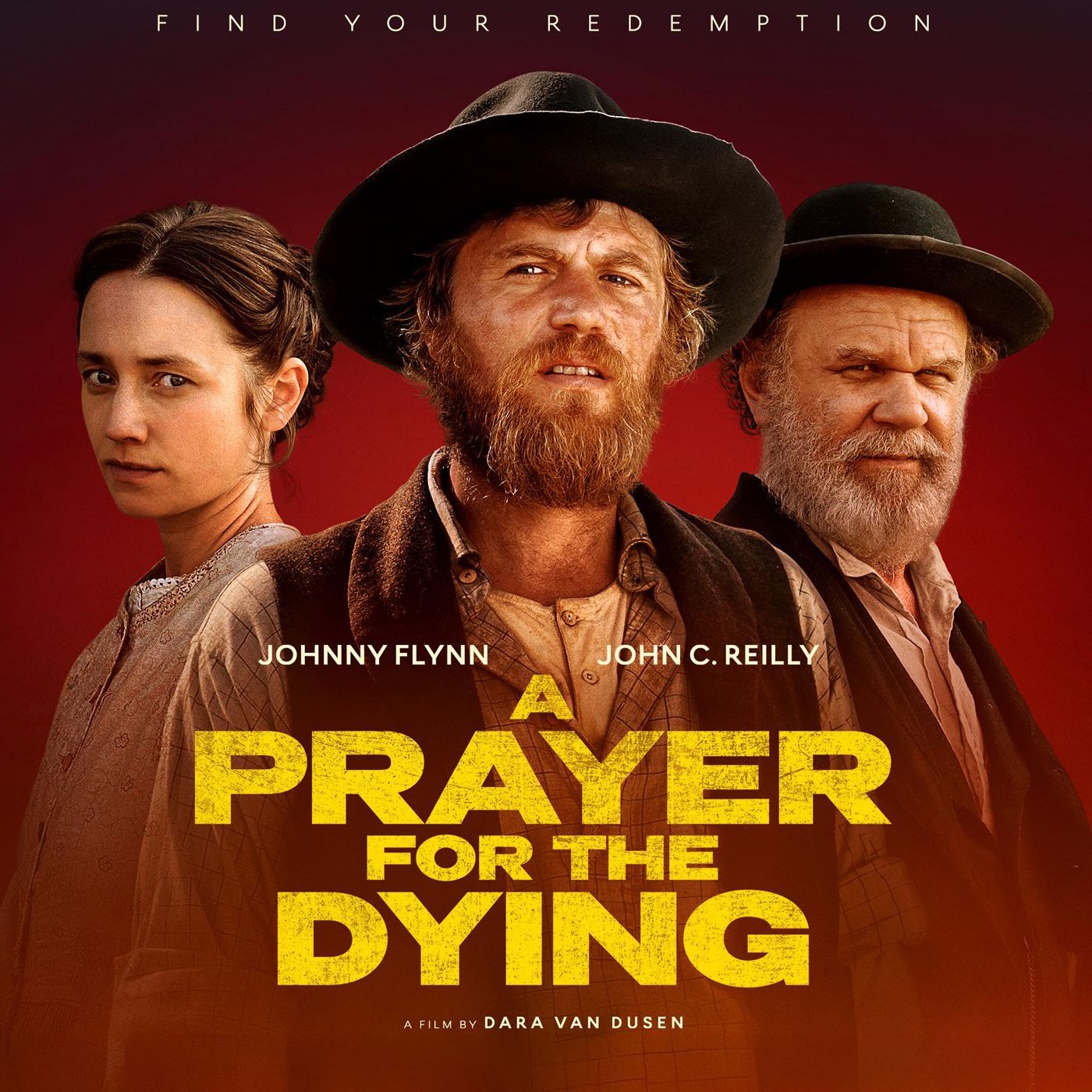
About this episode
Flynn also gets into what drew him to working with a first-time feature director, tracing it back to his experience on Michael Pearce's Beast and explaining why a director who's spent a decade fighting to get a passion project made brings an urgency he finds irresistible. He talks about Van Dusen's path through Poland's famed Łódź Film School (where she met cinematographer Kate McCullough), her decade-long effort to secure the rights to O'Nan's book, and the film's long road from its 2024 shoot to premiering at the Berlin Film Festival.
Transcript
Automatically generated, so expect the odd misheard name.
Hold your ears, folks. It's showtime. People pay good money to see this movie. When they go out to a theater, they want cold sodas, hot popcorn and no monsters in the projection booth. Everyone pretend podcasting isn't boring.
Turn it off. We all have a soul. Our souls might live forever. Because we know that death is certain. It comes to us all.
Sir Hansen! There's a dead body! Alright. All right, we'll get him on the ground. Don't dress him out.
Don't touch anything. And you wash up good after. He's a soldier. Jacob, I'm not asking. What is it?
Diphtheria. It's too contagious. What if you get it? How long? I cannot allow us to be so irresponsible.
We need to quarantine now. The whole town. No one in, no one out. Go back inside. Now!
We need to get people out. Do what's right, Deacon. You don't get to decide who lives and... Out! Get out!
You can't save everyone, Jacob. It has to be you. What must we do to be saved? Hey folks, welcome to The Projection Booth. I'm your host, Mike White.
On this episode, I am talking with Johnny Flynn about A Prayer for the Dying, directed by Dara Van Dusen. In her future debut, the film adapts Stuart O'Nan's novel of the same name, itself loosely inspired by the Book of Job. Flynn plays Jacob Hansen, a traumatized war veteran confronting an epidemic sweeping through a Scandinavian immigrant community in 1870s Wisconsin alongside John C. Reilly. The film premiered on February 13, 2026 at the Berlin International Film Festival, where it picked up a Best First Feature nomination, and Quiver Distribution has since picked it up for a North American release.
Had a great time talking with Johnny, and I hope you have a great time listening. Enjoy! I'm super excited to talk to you today about A Prayer for Dying. Can you tell me a little bit about how you got this role, how you came across this? This is a film that I am so proud to be part of, basically.
It's a time and a place in terms of films and storytelling that I'm so into. I don't know, I grew up on Lonesome Dove and stuff like that. huge fan of Westerns. I wasn't allowed to call it a Western while we were doing it. It's not a Western. It might be a Midwestern.
Basically, yeah, Dara Van Dusen sent me the script, who's the writer and director, adapted Stuart and Anne's brilliant novella. And it just had me from the first few pages, really. And then what really cemented it for me was reading the book that is based on the Stuart and Anne's book and it's written in such an eerie style. It's a kind of, I can't remember what it's the tense is it's first person future or something. It's all inside his head.
The Jacob who I play and I think I'd never been a part of something or on screen that is It needs to be so much from his perspective, which you realize is a warped perspective. He's what they call in literature an unreliable narrator, which I found so cool as a storytelling device. You suddenly start to see things from other people's perspective and you realize that what you've been seeing through his eyes is not necessarily the whole truth. And then you understand more and more about his past and his He's a Civil War veteran, and the war had finished a couple years before, and the guy who owns the shop is bringing the truth to his doorstep in terms of stuff he's been through, and you realize, oh gosh, this guy's got PTSD.
Anyway, I found it fascinating. It's a long time since I first spoke to Dario, because we shot it in 2024. Yeah, that's right. And it's just taken a while to... I think, such a bold and interesting film.
It took a while for it to find the right festival to open with. So we were at Berlin, which was perfect. It was a bold festival and the directors of the festival were really excited to have us and we had a great time there. And it's just really cool to see it finally making its way into the world. Had you played a cowboy before?
And I also have to ask, was that your real beard? It was my real beard. Dara's, in her mind, she didn't have me down as having a beard, and then I turned up with this big beard. It was my... I just...
I wanted it. John C. Reilly was developing his own beard, and I think she thought it would be, like I said, a beard fest. It just felt right. And also, it's...
I don't know if this is in any of the marketing, but the original book is loosely based on the book of Job. And I don't know, which I love. It's the strangest, darkest book in the Bible. And there's just no let up in that book. It's about, I'm sure you know it, but a man of God who's tested basically by having everything he knows and loves taken away from him. which is what happens in our film.
And it's somehow, yeah, the beard gave, gave me a sense of piety or something, a biblical piety that I wanted for him. And it was hot. It was hot in that beard. It was like wearing a rug on my face and 40 degree heat through a really hot summer. But yeah, I love the film so much and I love doing it with those amazing actors and, They built that whole town.
They built all those sets on a beautiful hill in Slovakia. And we had the best time, even though it was so dark. You've been around the block. You've acted for many years. Dara, from what I understand, is a first-time director.
I'm sure you've worked with other first-time directors. But how is that experience for you? For me, it's one of my favorite things in terms of working with a director, because somebody like Dara, even though it's her first time directing a feature, she's hugely experienced. I think she worked as a script supervisor for many years, and she went to this amazing film school, which I keep meeting or working with people who went to this place, and they're always my favorite kind of artists. But it's a film school in Poland called Łódź, I hope I'm saying that right.
But it's produced some really interesting filmmakers, and I just worked with another couple, a Polish director duo, Małgorzata Zimowska and Michel Englert, who also met at the same film school. And Dara met Kate, our DP, there. They had both made this pilgrimage to go to this school and had become very close friends. She... has been carrying this story for a really long time. She wrote to Stuart and Ann when she was like 19.
I think she was the youngest person at the school. So probably was finished at the school by the time she was 20 and has been trying to tell this story, which has gripped her for many years. And to his credit, he allowed her to have the rights and develop it, but it was like 10 years. And I guess as an actor who we don't have that experience of that depth of carrying a story for that long period, The more experienced I get, the more invitations I have to produce things and develop things, which I love. And it can be many years of helping support and read, you know, drafts of a script and give notes and all that.
I'm really into all of that. So when you work with a director that is a first time director, really, it's like they been carrying this story for 10, 15 years. And it's a privilege to work with somebody who is in that kind of moment of getting to, you know, work on their first film. There's no, certainly no kind of looking down in terms of experience because I don't have that experience that they have. of needing to tell that story. And so I just want to be a collaborator.
I want to be as useful to them and telling the story. And I had that experience with Michael Pierce on beast, which was like one of them, another one of my favorite films that I've been a part of and several other first time directors, but those are like the golden ones actually. And there's an excitement and a preciousness about it. You don't want to let them down with that first film. It's very, yeah, it's very, very precious.
And I also feel like supporting those people who've had to work so hard to get the funding for their first film, it's almost impossible to get an indie film made. So when I meet somebody who I love and find a great script, I'm like, I'll do anything to just help here. It has been such a pleasure talking with you. Congratulations on the film. It is wonderful.
Oh, thank you so much. Sorry if I chewed your ear off. No, no, it was great talking with you. You asked the right question. That's something I'm passionate about.
I would love to have another half hour with you, but we only have so much time. So thank you so much. I really appreciate this. Thanks, Mike. There are times when I've wondered And times when I've cried When my prayers, they were answered And times when I've lied But if you asked me a question Would I tell you the truth?
Now there's something to bet on You've got nothing to lose Yeah. When I sat by the window and gazed at the rain With. An ache in my heart but never feeling the pain If you would tell me just what my life means Walking a long road never reaching the end So so
More from The Projection Booth



Similar episodes across the network
Matched by shared keywords.
-
Hell or High Water (2016) — "150 years ago, all of this was my ancestors' land. Everything you could see."
1 shared keyword: western
-
The Life and Times of Judge Roy Bean (1972) — "The law is the handmaiden of justice."
1 shared keyword: western
-
Fusco Fest - Young Guns
1 shared keyword: western